




Abstract

Atrial fibrillation, the most common cardiac arrhythmia, affects approximately 1% to 2% of the overall population. Without preventive treatment, atrial fibrillation will recur in 90% of patients. Catheter ablation is superior to antiarrhythmic drugs in maintaining sinus rhythm and improving quality of life in patients in whom drugs have already failed.
Cryoablation for pulmonary vein isolation has become mainstay of managing patients with paroxysmal atrial fibrillation, considering shorter procedure time with success rates comparable to radiofrequency ablation.
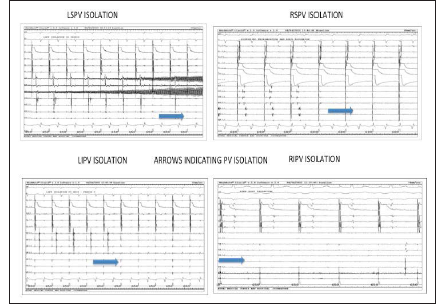
We report a case of paroxysmal atrial fibrillation in a 52-year-old hypertensive male, who had multiple clinical recurrences on flecanide. The patient had undergone successful pulmonary vein isolation with cryoablation (Figures 1 and 2).
Four panels showing electrogram recordings from four pulmonary veins by circular mapping catheter. At the start of cryoablation in all four panels, two potentials, one atrial signal, and second spiky potential recorded from pulmonary veins noted. As the arrow indicates, during cryoablation there is complete disappearance of second spiky sharp potential indicating successful isolation pulmonary veins.
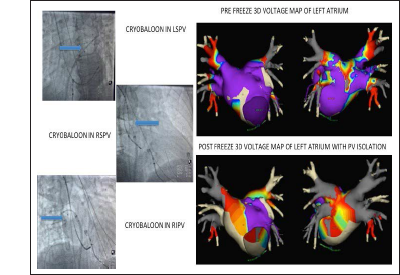
The left side of the picture shows fluoroscopic images depicting positioning of cryoballoon in the pulmonary veins and arrows indicating cryoballoon. The right side of the picture shows a 3D map of the left atrial voltage. The upper part of the image shows normal voltage (Purple color coded) in both left atrium and pulmonary veins. The lower part of the picture shows post cryoablation freeze, pulmonary vein, and antral areas showing successful isolation (gray color coded in a 3D map).
Footnotes
Declaration of Conflicting Interests
The author declared no potential conflicts of interest with respect to the research, authorship, and/or publication of this article.
Funding
The author received no financial support for the research, authorship, and/or publication of this article.
