




Abstract
Background:
Discussing death, particularly among future healthcare professionals, remains a challenge. The “Death Café” initiative offers a relaxed setting for such conversations, and this study investigates its educational potential for medical students.
Objectives:
To assess the effectiveness of “Death Café” as an educational tool for medical students in palliative care, and to understand students’ perceptions and reflections on death and end-of-life topics post-participation.
Design:
An exploratory qualitative design was employed, analyzing reflections submitted by medical students following voluntary participation in a Death Café session.
Methods:
Medical students from a course on palliative care participated in the “Death Café,” a structured yet informal discussion about death in a relaxed café setting. Subsequently, participants submitted written reflections on their experiences. These reflections were analyzed using a thematic analysis method, identifying emerging themes related to the students’ perceptions of death, the event, and its impact on their future medical practice.
Results:
Forty-two students attended the Death Café. Twenty-one reflections were collected from 29 medical students who participated. Most students found the “Death Café” environment conducive to open conversations about death. Key themes included recognizing the fragility of life, the role of medical professionals in end-of-life care, and the personal and professional growth derived from such reflections. The students also highlighted the transformative nature of the event, shifting from discussing death in general to pondering on their roles as future healthcare professionals. Positive feedback indicated the absence of negative comments about the activity, with suggestions provided for future iterations.
Conclusion:
The “Death Café” serves as an innovative pedagogical approach to medical education, particularly in palliative care teaching. It offers students a platform for sincere dialogue on death and reinforces the significance of integrating innovative methods in medical training. This initiative not only enriches personal understanding but also emphasizes the commitment to holistic patient care.
Plain language summary
Talking about death can be challenging, especially for students training to become healthcare professionals. The “Death Café” is a unique place where people can have relaxed conversations about death. This study explores if it can help medical students learn about end-of-life care. To do this, we asked medical students to participate in a “Death Café” event and share their thoughts afterward. We collected feedback from 29 students who attended. Most of them felt that the “Death Café” was a good place to discuss death. They talked about how fragile life is and the role of medical professionals in caring for people at the end-of-life. They also mentioned personal and professional growth from these conversations. The students appreciated the event’s transformational nature. They went from talking about death in general to thinking about their future roles as healthcare providers. We didn’t receive any negative feedback, but students gave suggestions for future “Death Café” events. In conclusion, the “Death Café” is an innovative way to teach medical students about end-of-life care. It encourages open conversations about death and shows the importance of creative teaching methods in medical education. This approach helps students not only understand the subject better but also emphasizes the need for holistic patient care.
Introduction
What do we know about Death Cafés?
A Death Café is a nonprofit platform for people to engage in open, respectful, and confidential discussions about death. Individuals from diverse backgrounds come together in an informal and relaxed setting to share tea, coffee, and snacks while exploring the profound topic of death and the dying process. Miles and Corr’s exposition of the subject in their work shows that these gatherings, essential to note, do not aim to influence participants’ conclusions, decisions, or actions. 1
The central premise underlying Death Cafés is to create a non-judgmental space for individuals to explore their thoughts and emotions regarding death. Often organized by people from civil society, these events aim to normalize discussions about death and reduce the stigma associated with it. Prominent figures like Bernard Crettaz, a Swiss sociologist, and Jon Underwood, a British advocate for open discussions on death, have played significant roles in promoting these gatherings. The official website emphasizes that Death Cafés do not function as grief therapy sessions but as platforms for meaningful and authentic dialogues about death in a casual and unstructured setting. 2
This local movement has evolved into a global phenomenon, gaining acceptance in various parts of the world, including Europe, North America, Australia, and Asia. Meetings occur in diverse settings, ranging from cafes and community spaces to private homes, reflecting their inclusive nature.
People are drawn to Death Cafés for various reasons. Some are motivated by personal experiences of loss, while others may have connections to death through their work in healthcare, especially in palliative care. Miles and Corr reflect on the opinions of attendees at these meetings and state that they respond to a need as people are eager to talk about death. 1 These meetings provide a friendly and relaxed atmosphere that facilitates conversations because of the environment and also because of the absence of a rigid script. Normalizing conversations about death is a vital step in ensuring that individuals facing terminal illnesses receive the necessary support and care to make their final stages of life comfortable and meaningful.
The intention behind organizing Death Cafés is to transform the perception of death from a dark and fearful subject into a natural and integral part of the human experience. This transformation has far-reaching impacts, not only for individuals but also for cultural and societal aspects, ultimately aiming to shift the perception of death from something morbid to a normal part of life.
The “death-positive” movement is an initiative striving to alter how society approaches and comprehends death, attempting to eliminate the taboo surrounding death and promote open conversations about this topic.2–5
Hohsvik et al. within their investigation interviewed 49 Death Café organizers across 34 countries. They reach a new interpretation of Death Cafés, not only as opportunities for death awareness but also as examples of what Zygmunt Bauman called “peg communities constructed to assuage the loneliness experienced by individuals in liquid modernity.” 3
In Nyatanga’s opinion death cafes can provide a unique and supportive environment for these conversations. 4 Paula Baldwin’s work, conducted through semi-structured interviews with 15 Death Café facilitators asserts that this initiative facilitates open discussions about death, dying, and end-of-life issues, aiming to promote a more accepting and informed approach to mortality. 5
In essence, the goal is to change how families and individuals face death and “empty the closet” of death and dying to facilitate open conversations. A writer of a non-specialized press summarizes some of the experiences reported by several death cafe organizers over different cities reporting that these gatherings are crucial due to their ability to address the taboo surrounding death and normalize discussions on this topic and even help to bat around philosophical thoughts such as what death is like. 6 In a society that often avoids talking about death, these gatherings provide a space for people to openly explore and discuss their thoughts and feelings about the reality of death, which is crucial, especially in the current context of the COVID-19 pandemic, as the health crisis has underscored the fragility of life.
Despite the growing popularity of Death Cafés, there is still a need for stronger empirical support to evaluate their impact and benefits. While it’s intriguing that these gatherings may promote a healthier relationship with death, it’s essential to substantiate this claim through comprehensive and detailed research. Qualitative studies delving into participants’ experiences and perceptions can shed light on how these events influence individuals’ approaches to death and grief. 7
Innovative methods in palliative care education
Medical education now emphasizes innovative approaches in palliative care training. 8 Students seek comprehensive learning beyond conventional theory, valuing practical experiences, and innovative methods that encourage active participation. This approach helps future doctors understand the importance of spiritual and compassionate care, going beyond scientific knowledge. 9 It prepares healthcare professionals to effectively address the complexities of end-of-life care and fosters empathy, compassion, and respect for patients facing terminal illnesses.
Students engage in real-life palliative care situations, interacting with patients and reflecting on their experiences. This reflection helps internalize medical values, creating well-rounded, and compassionate professionals. 7 Innovative palliative care education enriches the medical profession and ensures healthcare professionals can deliver compassionate, high-quality care.8–10
“Death Café” as an educational method in palliative care
Traditionally, discussing death in medical education has been avoided, limiting the preparation of future doctors for end-of-life care. 11 A novel approach is the “Death Café,” providing a safe space for students and healthcare professionals to openly explore topics related to death, loss, and disease. 11 Interviewed nursing students found the death café experience stimulating and helpful, aiding in addressing the sensitive aspects of death and encouraging self-scrutiny. 12
The significance of “Death Café” in palliative care education lies in its ability to confront the taboo around death in traditional medical teaching. It allows students to openly discuss death, preparing them for the complexities of end-of-life care. 11 This method goes beyond the practical aspects of medicine, emphasizing empathy, compassion, and respect for patients facing terminal illnesses. Participation in “Death Café” enables students to engage in meaningful situations involving death and reflect on their experiences. This process fosters a deeper understanding of the importance of humane care in medical practice and shapes their approach to future medical work. 11 “Death Café” is not merely about acquiring practical knowledge; it molds future doctors to be compassionate, empathetic, and attuned to the needs of terminally ill patients. In a society that often shies away from discussions about death, these sessions provide a vital space for future doctors to openly explore their thoughts and feelings about this topic. 11
In conclusion, “Death Café” is an innovative educational approach to palliative care that confronts the taboo of death in traditional medical education. It offers a platform for open discussions on death-related topics, aiding future doctors in handling the challenges of end-of-life care. 11 This method contributes to the development of well-rounded and empathetic medical professionals in an evolving healthcare landscape.
Objectives
The main objective is to explore the educational potential of incorporating a “Death Café”-style activity into medical student training in our environment. Additionally, there are secondary objectives, including identifying and describing the themes concerning death and the dying process mentioned in student reflections, evaluating the acceptance of this activity among participating medical students and examining students’ emotional experiences during the activity. These secondary goals will enhance the analysis of the effectiveness of this innovative approach in educating future medical professionals and its impact on their engagement with sensitive topics like death and dying.
Methodology
An exploratory qualitative study was designed. 13 Within the framework of the “Palliative Medicine” course at the Faculty of Medicine, University of Navarra, on the sunny afternoon of March 22, 2023, an optional activity was organized in the main cafeteria of the university campus, titled “El Faustino Death Café.” Invitations were extended to sixth-year medical students enrolled in the mentioned course, to students from the specialized nursing master’s program, as well as students from other departments, such as psychology and communication. It is worth noting that some of these students were enrolled in the interdisciplinary course “Care and Society,” which focused on palliative care.
The organization of the event followed the guidelines proposed in the manual available at https://deathcafe.com, 2 which outlines the process for conducting these gatherings. A promotional poster and a brochure were designed (Figure 1). During the event, coffee tables were set up for groups of five people, and each participant was offered a drink—coffee, tea, or a soft drink—accompanied by cake.
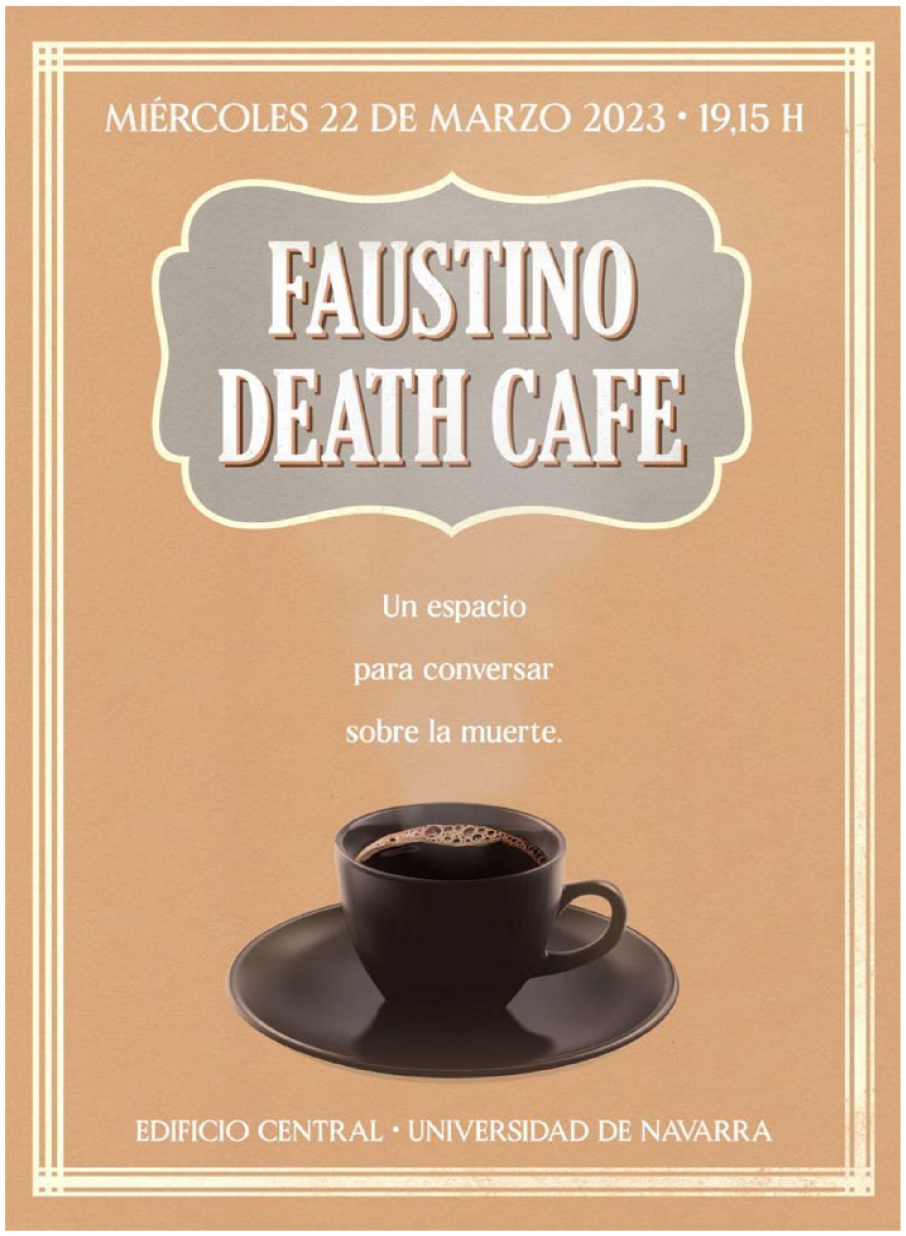
Promotional poster designed specifically for this event.
Participants were randomly seated at tables of 5–6 people; the facilitators asked them to sit preferably with people they did not know and from different academic backgrounds. When seated at the table, participants found a small piece of paper on the table that briefly explained what the activity consisted of and some questions that were intended to encourage conversation starters at tables where conversation did not initially arise naturally. The participants did not change groups during the activity, which lasted about 45 min. The facilitators were three people professionally involved in palliative care (one doctor and two researchers). Their mission was to explain briefly at the beginning of the event what the activity would consist of and to be attentive to the well-being of the participants throughout the event. The facilitators were clearly instructed not to participate in or interrupt the conversations that were freely taking place at each of the tables.
Subsequently, as it was a Faculty of Medicine activity, only medical students were encouraged to submit a brief written reflection (500–600 words) about their experiences in the activity in the week following the event. This introspective exercise was proposed based on its potential to deepen the understanding of the lived experience.14,15 Following an initial review of these reflections, motivation arose to analyze them more rigorously and systematically. Consequently, an exploratory qualitative study was carried out using thematic analysis. 16 There were no predefined categories. It was an inductive process conducted independently by two researchers. Each of them read each document and coded the text and then they met at intervals to compare and refine codes. Connections were made between the codes to identify categories and connections among categories were identified and derived into themes. All reflections were treated with confidentiality, being coded and anonymized. This manuscript adheres to the Equator network guideline SRQR (“Standards for reporting qualitative research”; Supplemental File 1). 17
Results
A total of 42 students attended the Death Café. Most of them were women between 21 and 27 years old. There were medical, nursing, psychology, and humanities students but we did not register the number of attendees from each faculty, except for medicine (n = 29). Twenty-one reflections were collected from 29 medical students who participated (a response rate of 91%). We identify these 21 reflections anonymously by naming them in order from E1 to E21.
The analysis of the reflections provided by the students revealed four main themes: the encounter (1), view of death from more personal and social perspectives (2), testimonies of personal losses (3), and reflections and internalization of their role as future healthcare professionals in end-of-life care (4).
The reflections had an average length of 550 words, ranging from 276 to 831, with a median of 570. It’s worth noting that five specific reflections did not follow the instructions of being a reflection of their experience, and they were essays on what is a death café or an evolution of the movement’s history so they were excluded from the analysis. They addressed related topics but from a perspective unrelated to the activity. Significantly, these were the shorter texts. The term “experience” is mentioned in most reflections, with an average of 2–3 times.
Table 1 presents the themes and categories within each theme and the frequency of each subcategory. Several subcategories emerged prominently. The subcategories “wide emotional richness experience,” “death seen related to personal beliefs around faith and spirituality,” “death is part of life but it’s a taboo,” and “behind the doctor’s gown” were the most highlighted, mentioned by at least 12 students each. This suggests that these themes resonated particularly with most participants.
Categories and subcategories cited by students.


Gray-shaded rows correspond to categories; Yellow-shaded cells: those subcategories cited by more than 12 students; orange-shaded cells: subcategories cited by nine students.
Other themes also had notable presence, mentioned by nine students: “death in society,” “shared experiences of loss are embraced and resonate in the group and promote personal reflection on the painful experiences that occur in life,” and reflections on the “meaning” of death. The depth of the reflections can be estimated by the high density of themes in each reflection. On average, each reflection addressed 7–8 subcategories.
It is essential to consider that, despite the utility of analyzing the frequency of these subcategories, direct quotes from students’ reflections can offer a richer and more contextualized perspective on their experiences and perceptions.
The encounter
Students have described in detail the nature and structure of the “Death Café” indicating that the format was an unexpected experience for some. One participant expressed their surprise by mentioning that, despite having some guiding questions, in the end, “we led the conversation. . . it has been an experience I didn’t expect at all” (E4). Another attendee, who had never participated in such a meeting, admitted their lack of knowledge about how the event would unfold: “. . .admitting that I had never been to a Death Café before and I didn’t know how the evening would go” (E16).
A constant theme in the reflections is the positive perception of the atmosphere during the event. Participants described it as welcoming and conducive to communication: “the atmosphere was very welcoming” (E2), “it provided a pleasant atmosphere for us to share experiences that, in other situations, might not be as easy to express” (E17), and it was noted how it provided “a space where we could talk about these issues without being censored” (E16).
Most students had a highly positive response to the activity, and many expressed gratitude to the organizers. The evaluations were unanimously affirmative: “I really enjoyed the experience, and I would like to do it again. I think it was a great idea on the part of the course organizers, and I encourage them to continue with the idea in the coming years” (E5). Another testimony emphasized the emotional richness of the experience, noting that the event “allowed us to share, reflect, and experience different emotions, from empathy to sadness or distress” (E13). Furthermore, gratitude toward the organizing team was palpable on numerous occasions, as evidenced by this comment: “I sincerely thank the Palliative Medicine team for creating these initiatives” (E20).
In summary, the experience of the “Death Café” seems to have been profoundly significant for the students. The activity not only provided a safe and welcoming space to discuss sensitive topics but was also appreciated and valued by those who participated.
View of death from more personal and social perspectives
The second thematic category, “View of death from more personal and social perspectives” highlights a series of reflections that turn around the perception of death in society, personal beliefs related to death, and the importance of addressing this topic collaboratively.
One of the most mentioned aspects by the students is the idea of death as a taboo subject. This perception is not only reflected in the participants’ reflections but also aligns with the literature consulted and the foundational reason behind the “Death Café” activity.4,12 Despite being a certainty in life, death is avoided in conversations and thoughts: “Death is a taboo, it happens; we know for sure it will. But no one wants to talk about it. It’s scary, frightening, and requires thinking. And sometimes, we don’t want to think. That’s what happens” (E14).
The relationship between death and personal beliefs also holds a prominent place in the reflections. Students addressed both religious faith and spirituality, both seen as sources of meaning and understanding regarding the topic of death. For example, one student pointed out the difference between believers and atheists, stating that: “For believers, death means the end of one stage and the beginning of a new one, and for atheists, it means the end of the endings” (E6). Another participant emphasized the importance of finding meaning in life and death, whether through religion, a way of life, or spirituality: “Giving meaning to life and death, whether through religion, a way of life, or spirituality, allows you to face it in a very different way from a person with a life devoid of meaning, and that’s something we should admire in our elders” (E9).
On the other hand, the fear associated with death is a constant theme in the reflections: “Fear is a constant when it comes to talking about death because of the close relationship they maintain” (E1). This fear seems to be linked to the negative perception that society has about death: “In society, death is associated with a negative idea, suffering, sadness, fear, helplessness because you can’t avoid the end-of-life. . . all of this generates rejection and avoidance in addressing this topic” (E15).
Finally, an interesting and motivating point is the relevance given to teamwork in addressing the topic of death. This idea emphasizes the need for a multidisciplinary approach, where different professionals can join efforts to provide the best possible support in the final moments of life: “I consider the function of the entire multidisciplinary team very important, especially in the final moments of life, to listen and accompany the patient” (E8).
In summary, this subcategory reflects a series of profound and varied thoughts about death, its perception in society, and how to address it comprehensively and sensitively.
Testimonies of personal losses
The third thematic category focuses on testimonies of lived experiences related to the death of loved ones. Throughout the students’ reflections, there is a tendency for them to feel more comfortable talking about the death of others than about what they imagine their own death will be like in the future. This observation is particularly highlighted in the testimony of a student who shared the deeply painful experience of her mother’s premature death, an experience that resonates in the reflections of several peers and sheds light on the influence that a shared experience can have in a group.
The premature death of a mother is one of the most challenging experiences one can face in life, and this is evident in one student’s reflection: “The death of a young mother is a profoundly painful and traumatic experience that reminds us of the fragility of life and the importance of appreciating every moment we spend with our loved ones” (E4). The emotional impact of this story is amplified when learning that several students at the same table echoed this experience in their reflections.
Interestingly, the student who shared this experience does not explicitly refer to it in her reflection. Instead, she indirectly mentions how she felt about sharing her story: “. . .I also don’t like to talk about my personal experience because I feel it may seem like I’m trying to elicit pity from the listener. However, this experience encouraged me to talk about the topic because the atmosphere was very welcoming, and we all shared opinions or experiences” (E2). This reflection is particularly revealing as it shows the internal struggle between sharing a painful personal experience and the possibility of being misunderstood.
In summary, this thematic category highlights the emotional complexity and vulnerability that surrounds experiences related to death. The ability to share these experiences in a safe and welcoming environment, such as the “Death Café,” underscores the importance of these spaces for addressing such sensitive and crucial topics in the training of future medical professionals.
Reflection and internalization of their role as future healthcare professionals in end-of-life care
In the fourth thematic category, it is noticeable that students provide deep and personal considerations about the process of death and dying. With their words, they demonstrate a surprising capacity for introspection and understanding on the subject, highlighting how they have internalized the role of future healthcare providers who will be responsible for accompanying patients in their final moments.
Through their reflections, students focus on a variety of subthemes, including legacy, the uncertainty surrounding death, the meaning of life, and suffering. However, what stands out is that many students position themselves “behind the white coat,” assuming a professional role. For example, E3 mentions the responsibility of healthcare professionals, saying: “Healthcare professionals are fortunate to accompany in this process, to prevent suffering, to try to improve the quality of life and relieve the symptoms they present, doing what is deemed appropriate and within our means.”
Overall, students’ responses suggest a positive experience with the “Death Café” since no negative comments about the activity were found. Some suggestions for future editions indicate a desire to further enhance the experience, such as the proposal by E17 to offer the activity to patients and their families in hospitals.
It is important to note that only two reflections focused on the sensitive and controversial topic of euthanasia. Death Café encounters sometimes generate conversations about social concerns related to death and new laws. Of these, E4’s reflection is particularly strong in tone and opinion. While it is essential to acknowledge and respect individual opinions, it is wise to address this comment with sensitivity, as it presents a rather radical perspective on the subject. E15, on the other hand, offers a more moderate perspective on the same issue.
In summary, the reflections in this category underscore the students’ ability to analyze and understand the process of death from a professional standpoint, emphasizing the importance of humanity, empathy, and support in this final journey. These reflections also highlight the valuable opportunity that the “Death Café” provided to open a dialogue on a topic often avoided but inherently human.
Discussion
Research on Death Cafés yields essential insights into their utility by highlighting how these spaces play a significant role in contemporary society. These gatherings foster open and candid conversations about topics related to death and the dying process, contributing to sensitizing students to the temporality of life. The results underscore the importance of providing a conducive environment for dialogue where participants can openly share their thoughts and experiences. Furthermore, the influence of Death Cafés on the perception and understanding of death by those who participate is emphasized, suggesting that these spaces can be valuable for personal reflection and attitude transformation toward death. 18
The activity organized by the Department of Palliative Medicine has been exceptionally well-received by students, as observed after analyzing their provided reflections. 14 While it is true that many expressed initial unfamiliarity with the type and conduct of the activity, none claimed to have found it uninteresting. There are no negative comments regarding the activity, its content, or its execution.
The implementation of this activity was a novelty within this university environment, open to the participation of students from other disciplines. However, this study focused on medical students taking the Palliative Medicine course in the sixth year of their program. We share a similar starting methodology with the work of Nelson et al., 11 organizing a Death Café in a student environment and collecting their opinions afterward (in their case, verbally). Like them, we observed that this type of forum provides a special opportunity to share opinions and experiences on end-of-life topics in a safe environment that allows them to express themselves comfortably and freely.
We also share some of the reflections from the work of Koksvik and Richards 3 on how crucial it is to bring strangers together around a table and the role of cafés as third places between the public and the private, also driving dialogue. This setting, removed from the classrooms, provides students with a different, albeit not entirely unrelated, academic atmosphere since the event is part of university activities. This symbiosis is positive for facilitating conversations and protecting the privacy of attendees.
The qualitative approach employed in this research is crucial due to its ability to explore the experiences, perceptions, and emotions of students regarding death and the dying process in depth. It allows for capturing nuances and understanding the motivations behind attitudes and behaviors. In this context, qualitative research reveals how participants positively valued Death Cafés and how these safe and collaborative spaces impacted their learning and openness to discussing sensitive topics. This qualitative methodology allows for a holistic and rich understanding that enriches research in medical education in palliative care.
Some methodological aspects of our study warrant a comment. Since the activity was optional, our sample may reflect the opinions of students particularly interested in the topic, and therefore, it is reasonable to suspect that the opinions offered do not represent a balanced account. We observe this potential bias in other studies. This is an initial exploratory study, and a comprehensive assessment of the impact of this activity on the student population requires a longer-term study, including complementary data collection methods such as focus groups or personal interviews, and a more extended evaluation of behavior and conduct after the activity’s conclusion, encompassing more than just immediate reactions.
Conclusion
The participation of medical students in the Death Café has proven to be a valuable educational tool in teaching palliative care. Through this study, we have identified that these gatherings provide a safe and conducive space for open dialogue about death, enabling students to reflect on life’s finiteness and the significance of their profession. The relaxed and informal atmosphere of the encounter enabled sincere and profound conversations, leading students to position themselves from the perspective of future physicians and recognize the importance of being adequately prepared to address end-of-life issues. In summary, the Death Café not only enriches personal understanding of death but also reinforces the educational commitment to medical training, emphasizing the need to incorporate innovative pedagogical methods in the education of future healthcare professionals.
Supplemental Material
sj-docx-1-pcr-10.1177_26323524241273490 – Supplemental material for Death Café conversations: evaluating the educational potential for university students in palliative care teaching
Supplemental material, sj-docx-1-pcr-10.1177_26323524241273490 for Death Café conversations: evaluating the educational potential for university students in palliative care teaching by Ignacio Borque, Elena Oliete, María Arantzamendi and Carlos Centeno in Palliative Care and Social Practice
Footnotes
Acknowledgements
To all the members of the Palliative Medicine Service at the Clínica Universidad de Navarra and the Atlantes Research Group for their invaluable support and contributions. To the Faculty of Medicine of the Universidad de Navarra, all its students, and faculty members.
Declarations

Supplemental material
Supplemental material for this article is available online.
References
Supplementary Material
Please find the following supplemental material available below.
For Open Access articles published under a Creative Commons License, all supplemental material carries the same license as the article it is associated with.
For non-Open Access articles published, all supplemental material carries a non-exclusive license, and permission requests for re-use of supplemental material or any part of supplemental material shall be sent directly to the copyright owner as specified in the copyright notice associated with the article.
