




Abstract
This article is devoted to the symptom of gendered trauma and its lasting psychological effect on Holly Gibney, the central female protagonist in the novella collection of Stephen King, If It Bleeds. With a trauma-based approach to a literary analysis combining gender studies and psychological interpretation, this question will take into consideration the long-term effects of gendered violence on Holly Gibney. The exhibition of violence does not simply cease at the physical but goes on to investigate psychological trauma, emotional vulnerability and embodied experience. This article talks about the ways in which the novella describes common post-traumatic stress disorder (PTSD) symptoms and other psychological reactions like anxiety and dissociation. The study brings out the processes involved in psychological resiliency, adaptive coping, and recovery by using the character of Holly, who is able to be strong despite hardship challenges. Overall, the research contributes to the current knowledge on gender violence and trauma in modern literature, especially in the horror sub-genre, where the inner world of psychological suffering and survival can be observed. Through an interdisciplinary approach to gender, trauma theory, and literary analysis, the article reveals the intricate nature of female subjectivity and psychological resilience in a world that is constructed by fear, violence, and unequal power relations.
Keywords
Introduction
Overview of Stephen King’s If It Bleeds
If It Bleeds is a novella series published by Stephen King in 2020. Of the four novellas, the narrative bearing the name of If It Bleeds foreshadows the character of Holly Gibney as the leading investigative hero whose presence becomes more prominent after her prior roles in the previous works of King. Holly is not just a typical detective fictional character, but a psychologically nuanced character, who is bargaining with outside and inner dangers. She is not only fighting monstrous forces but also emotional and psychological after-effects of gender experience and personal weakness. As Susan Bonsteel observes, King’s narratives often delve into the “psyche of his characters, laying bare the vulnerabilities and scars they carry.” 1 Holly is especially noteworthy in that aspect because her investigative process is both a process of trauma confrontation, agency reconstruction, and identity redefinition. Instead of making Holly a hero or villain archetype, King develops her as a trauma-aware subject whose investigative practice cannot come out of this state without being emotional survival and self-identification, embodied resilience. The horror narrative is therefore not just a genre of entertainment but a literary channel through which the psychological disturbance and gender fragility are narrated issue.
Relevance of Gendered Trauma in Modern Literature
Gendered trauma and its discussion in literature have become more and more discussed in contemporary academic discourse. Emma Dutro, in her article on trauma as testimony, presents the opinion that literature offers a valid channel through which the traumatic experience can be told and marginalized subjectivities expressed. 2 In this context, literary works can be viewed as spaces in which psychological pain, memory, and relations of power socialize. King continues this tradition in If It Bleeds by making the experiences of Holly Gibney subject to the vulnerability that is specific to gender and the constant possibility of misogynistic violence. This kind of representation makes the readers address the previously unnoticed mental cost of gendered violence and its long-term impacts on emotions. 3 Moreover, Michelle Balaev stresses that visualization of trauma in literature has to be interpreted through overlapping categories, that is, gender and social positioning, cultural context, etc. 4 Instead of displaying trauma as a single occurrence, the modern narrative of trauma addresses the effects of identity, embodiment, and social norms in determining psychological reaction and healing. The character of Holly that King depicts is thus consistent with the larger literary effort to explore the issue of trauma not as an end in itself but as a continuous bargaining between memory, endurance, and social restriction. Notably, gendered trauma in modern literature is becoming more and more interconnected with issues of embodiment, trust in relationships, control of emotions, and vulnerability in relationships between people. The portrayal of the character of Holly by King is a part of this larger literary trend because it prefigures the effects of psychological trauma on intimacy, self-concept, and the ability to socially connect, connecting horror fiction with the new trends in the medical humanities and psychosocial studies.
Research Objectives and Scope
This article aims to examine the gendered representation of trauma in If It Bleeds, with a specific focus on the psychological impact of the violence that Holly Gibney went through. The analysis examines the manifestation of trauma in terms of emotional regulation, anxiety, dissociation, and changing patterns of relational trust and puts Holly in the role of exploring gendered suffering and psychological durability. It is analyzed through the prism of a trauma-informed point of view that, as Shabnam Shahbaz points out, focuses on the ways that characters roll through the traumatic experience to become resilient rather than vulnerable. 5 The article, along with a close textual analysis, evaluates the relations between gendered violence, psychological response, and adaptive recovery by placing the character of Holly in broader contexts of trauma, identity formation, and power structures in society. Literature written during a crisis, as presented by Pellicer-Ortina and Ganteau, constitutes an important critical commentary upon the trans relationship between trauma and vulnerability and social relationships.3,5 In line with this, this article presents King in his horror narrative as a literary site where gendered trauma cannot be understood as clinical pathology but rather as narrative presentation. Psychological terms are thus used analytically and not diagnostically in that the study can define how fiction transforms emotional anguish into cultural significance, moral contemplation, and possibilities of resiliency and change.
Theoretical Framework
Trauma-informed Lens in Literary Studies
The theory of trauma-informed approach to the study of literature is one of the primary theoretical frameworks of this study, as it investigates the impact of the traumatic experience on individuals and groups by exploring the psychological, emotional, and behavioral results of the traumatic experience. Instead of addressing trauma as a narrative process, this framework examines how the identity, perception, and interpersonal relationships of traumatic memory are restructured in literary work. In this direction, narrative construction plays a very important role because literary texts disclose trauma not by the plot development alone, but also by the characterization, the narrative voice, and the emotional response. Trauma-sensitive reading allows researchers to recognize repeated patterns like fear, anxiety, dissociation, disrupted sense of self, and altered relationship involvement as intrinsic parts of character development. Agaibi and Wilson argue that “trauma often reshapes individual identity and interpersonal dynamics, making it essential for literary analysis to focus on these transformative aspects.” 6 Similarly, Bonanno highlights that “resilience and recovery from trauma are complex processes that literature can illuminate by depicting the varied ways characters navigate their experiences.” 7 Cless and Nelson Goff further stress the importance of examining “how traumatic experiences are represented in literature to better understand the emotional and psychological struggles faced by characters.” 8 In the current research, the application of the theory of trauma is as an interpretive approach but not as a diagnostic model in clinical terms. They are analyzed analytically using the psychological terms of post-traumatic stress disorder (PTSD), anxiety or dissociation to understand narrative representation, emotional symbolism and character development. Such a methodological explanation situates the analysis in the context of literature trauma studies and does not impose medicalized categorization of fictional characters. Combining these standpoints, the theory of trauma emerges as an interpretative lens that demonstrates the multifaceted negotiation between memory, suffering, embodiment, and recovery in the texts of literature to enable psychological growth in Holly Gibney to be viewed through the prism of standardized literary conventions.
Gender and Violence: Societal Power Dynamics
Gender violence in literature exists within other systems of social power in which structural inequalities define vulnerability and resistance. Literary expressions are often used to reveal the ways in which patriarchal conventions, cultural demands and institutional frameworks reproduce gendered patterns of violence and psychological marginalization. In these representations, fiction turns out to be a critical space in which the question of the social production of trauma is interrogated as opposed to being privatized. Balaev suggests that “literary representations of gendered violence often expose the systemic power imbalances that contribute to and sustain such violence.” 9 Similarly, Dutro notes that “literature provides a means to explore and critique the societal factors that exacerbate gendered trauma and shape characters’ responses to it.”2,9 Pellicer-Ortín and Ganteau further argue that “literary analysis of gendered violence uncovers the ways in which societal structures impact characters’ experiences and responses to trauma.” 3 In this theoretical sense, the experiences of Holly Gibney could be explained not only as individual pain but as forms of a greater socio-cultural power relationship defining female vulnerability in modern society.
Psychological Impact of Trauma: A Gendered Perspective
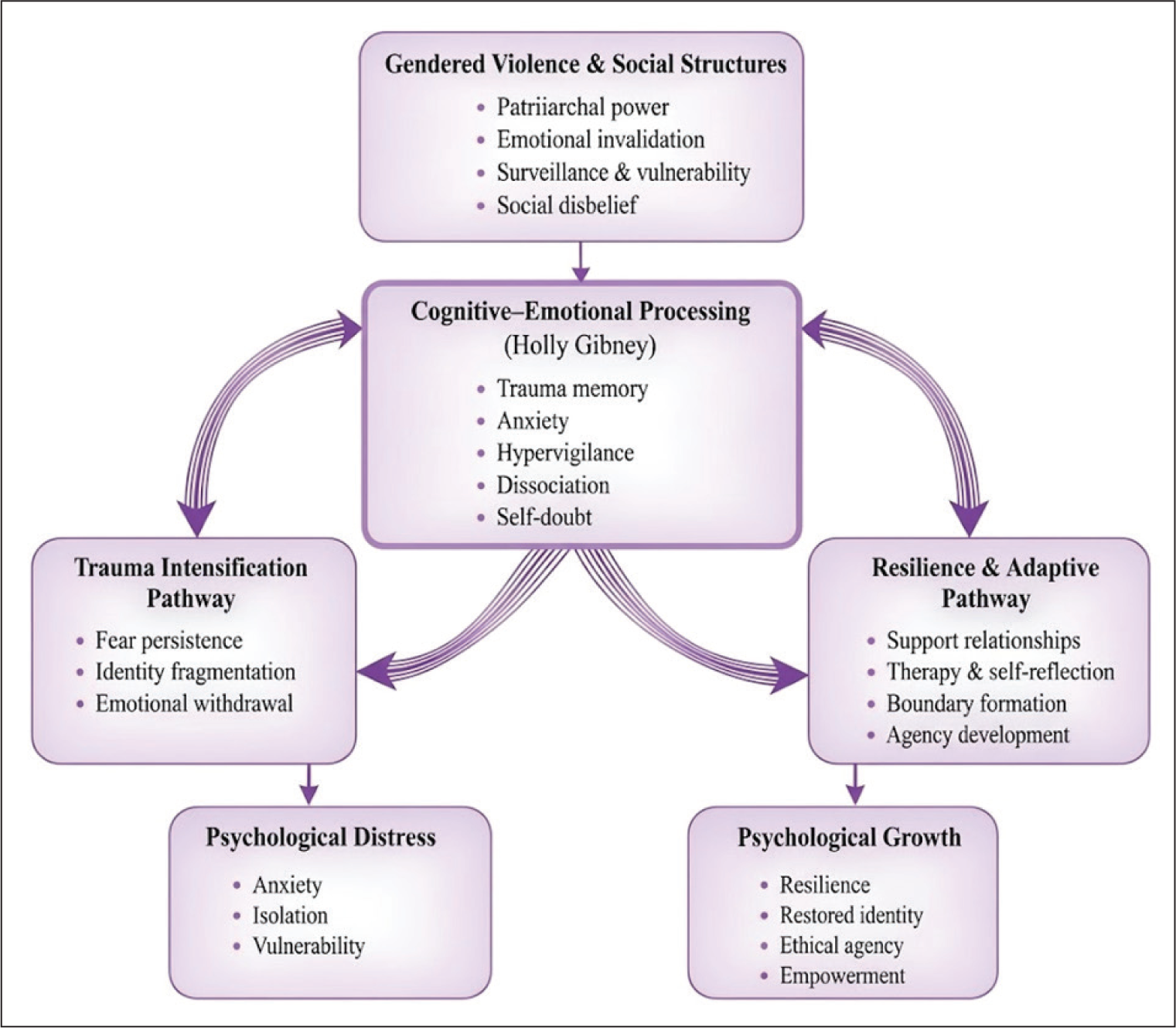
A gender-sensitive approach to trauma acknowledges that there is mediation between psychological reactions to violence by socially constructed gender roles and expectations. Even though the expression, interpretation, and recovery of trauma can be universal, cultural presumptions of femininity, emotional expression, and vulnerability can inevitably shape these processes. Literary texts can thus shed a lot of light in regard to how female characters bargain in a confining social realm in the face of trauma. Grossman et al. argue that “the psychological impact of trauma is deeply intertwined with societal views on gender, influencing how characters experience and respond to traumatic events.” 10 Heidarizadeh similarly emphasizes that “gendered expectations play an important role in influencing the psychological outcomes of female characters as victims of trauma, which in turn manifests in terms of symptoms and coping mechanisms.” 11 Jaber further observes that “the representation of female trauma in literature explains how the constraint of societal roles and gender expectations impacts characters’ psychological strengthening and susceptibility.” 12 Applied to If It Bleeds, the psychological issues in Holly Gibney, including anxiety, self-doubt, and emotional control, can be interpreted as not only the reaction to personal traumas but also to the process of gendered socialization. Figure 1 outlines the conceptual framework informing the current study by showing how gendered violence, psychological response, and resilience are analytical dimensions which are interrelated in this article as part of the trauma-informed literary reading.
Conceptual Model of Gendered Trauma and Psychological Adaptation in If It Bleeds.
Holly Gibney: A Character Study
Holly’s Backstory: Foundations of Trauma
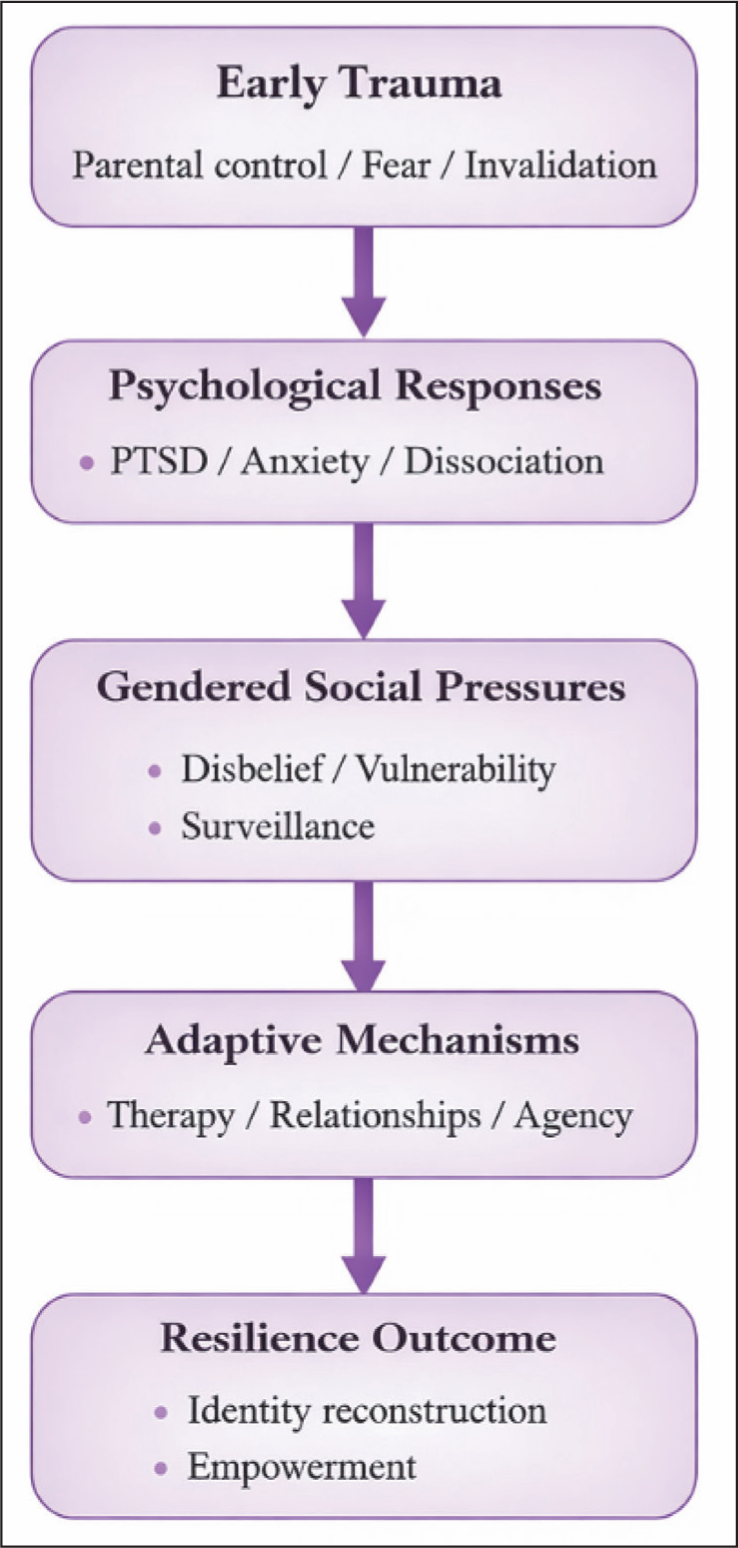
Detective Holly Gibney is severely affected by the traumatic personal experience that is still reflected in her mental character. Instead of serving as a detective in the horror narrative, Holly turns out to be a character whose investigative powers cannot be set aside against emotional vulnerability, anxiety, and long-term psychological conditioning. King builds Holly neither as an archetypal heroic character but as a trauma-shaped subject whose investigative powers grow together with physical vulnerability and introspection. Previous instances of the character in the Mr. Mercedes trilogy predetermine the formative psychological experiences that condition her behavioral patterns and self-perception. In contrast to the iconic heroic investigators, the personality of Holly is not based on a single disastrous incident but rather on the emotional composure, parental oppression, and lifelong self-doubt. The narrative recurrently goes back to the relationship between Holly and her mother, Charlotte Gibney, whose noncompliant reactions to the emotions of the first one led to the developing patterns of suppressing and feeling insecure. Holly remembers that the expression of distress was discouraged, and it indicates the internalization of early emotional invalidation and its continuation in adulthood.1,13 This relational aspect of trauma is also pivotal to the analysis of the formation of Holly as a psychological being, violence is not the only source of trauma but the process of emotional control that is being forced upon the growing personality. Instead of describing trauma as a singular event, King describes psychological suffering as accumulative and relational. Norbury argues that “Trauma experienced in early life becomes a lens through which the individual perceives and interacts with the world, often manifesting in long-term psychological challenges.” 14 In this light, the investigative vigilance, the hyper-vigilance to danger, and the self-doubt that Holly shows might be perceived as trauma-wise adaptive responses instead of weaknesses of character. The trauma of the past can be shown as persistent in time, as Holly experiences it repeatedly, in her current relationships and behavior. King portrays the concept of memory as an active and dynamic psychological space that defines perception and emotion. Holly, trying to balance love and hate toward her mother, shows that trauma is a continuous negotiation between attachment and resistance, which is the psychic imprint of the early relational turmoil. This portrayal is consistent with the concept of trauma theory, which states that memory is intrusive, recurrent, and relationally embedded. 15 The conceptualization of the developmental relationship between early trauma, psychological response and resilience in the character of Holly can be shown in diagrammatically illustrated Figure 2.
It Illustrates the Experience of Trauma.
Gendered Violence: Specific Incidents and Their Impact
The character development of Holly Gibney cannot be discussed out of the context of the gendered violence she faces. King frames the experiences of Holly as explicitly gendered encounters where vulnerability is a product of social construction by patriarchal power relations, and not individual incompetence. Violence in If It Bleeds functions not only based on physical intimidation but also on observation, intimidation, and the psychological control of female presence in both public and investigative fields. Her interactions with male villains continuously put her in a position of being dominated and watched. This moment demonstrates the manner in which violence functions as both a perception and objectification of the female body into a place of power exchange. Embodiment and vulnerability are predetermined in the scene, displaying the experience of gendered trauma as an observer, judged, and unsafe in the daily presence. Atiyat’s discussion of domestic violence supports this reading, arguing that “gendered violence in literary works often serves as a reflection of the broader societal patterns that perpetuate such abuse.” 15 After all, the life of Holly reflects structural imbalances within the social systems, and it is in the way that personal trauma is a mirror of social gendered reality. The narrative is thus no longer one of personal victimization but becomes one of social commentary and sets the experiences of Holly into broader structures of gendered power. The systemic aspect of the trauma on Holly is also revealed in scenes where her agency is challenged or reduced even more. Vickroy observes that “Trauma narratives in contemporary literature often reveal the ways in which gendered violence affects not just individual experiences but also societal structures.” 16 Similarly, the concept of crime trauma fiction introduced by Rodi-Risberg describes the way in which violence in crime fiction can be used to explore the larger psychological and social impacts. 17 In this respect, the suffering that Holly endures is subject to all three levels of personal, interpersonal, and institutional, relating individual victimization to institutional marginalization.
Societal Vulnerabilities: Holly as a Representation of Women’s Struggles
Holly Gibney ends up being a symbolic character who expresses modern fears of gender, trauma, and social weakness. King does not just present Holly as a person who survived but as a personification of women who explore the world that is organized by disbelief, dismissal, and patriarchal domination. Her character is such a place in the narrative that the individual psychological suffering of the person is brought against the background of the gendered experience. As Michelle Balaev argues, “Trauma in literature often mirrors the broader societal contexts in which it occurs, revealing systemic issues that contribute to individual suffering.” 9 The experiences that Holly goes through are hence mirror images of broader social realities, whereby the emotional reactions of women are often fronted as illegitimate. Her frustration becomes evident when she reflects: “People never take me seriously, always underestimating the depth of my fears and the validity of my concerns.”2,13 This quote indicates what can be termed as secondary victimization whereby social lack of faith exacerbates the primary trauma. Similarly, Holly recognizes how emotional resistance is socially misread: “Every time I fight back, every time I stand up, there’s a part of me that’s labeled “angry” or “hysterical” instead of “resilient” or “strong.”3,13 Here, King reveals how policing of emotional expression is gendered, with assertiveness on the part of women pathologized, and vulnerability expected on the other hand. The fact that the narratives of trauma disclose the overlap between the suffering of an individual and the oppression of the system further explains the evolution of Holly, as the observation of Vickroy confirms. 16 Her progressive psychological development in If It Bleeds shows that it is not the external pressure by society that leads to the development of resilience, but rather the process of negotiating with that. In this description, King reveals how social institutions, interpersonal relationships and cultural expectations contribute to the perpetuation of trauma and at the same time define the circumstances of resistance and recovery. Holly is thus not a victim, nor a villainous character, but a survivor whose mental strength speaks against mainstream stories of female vulnerability in horror fiction.
Psychological Effects of Gendered Trauma
PTSD in Holly Gibney
The psychological experiences of Holly Gibney in If It Bleeds can be examined using the concept of trauma-informed literary analysis, where the psychological language is used as an interpretive tool and not a diagnosis. Holly is not a medical object of the present study; rather, the notions related to post-traumatic stress serve in an analytical manner and describe how the narrative structure is the expression of memory, fear, and emotional vulnerability. Trauma, as depicted by King, is temporal in the sense that the past continues to interrupt the current thinking. The reflections of Holly indicate an unconscious memory and emotional radar sensitivity, which implicitly indicates that trauma is a narrative process of recurrence and not resolution. Instead of making trauma spectacle-based, King makes it internal and psychological. The investigative work of Holly triggers emotional memory over and over again, proving the theory of trauma, claiming that traumatized people experience the emotional memory not only as they remember it. Her alertness, indecisiveness and critical apprehension are thus adaptive survival mechanisms and not pathological symptoms. According to Sherin and Nemeroff, traumatic exposure can have long-term psychological effects characterized by elevated arousal and recollection. 18 King transfers these theoretical understandings into the literature, as a result of which readers can feel traumatized not in the name of clinical classification. The figure is a conceptual representation of the psychological growth of Holly Gibney in If It Bleeds, reflecting the transition between the experience of early trauma and gendered vulnerability to coping and resilience.
Anxiety and Dissociation: Manifestations in Holly’s Behavior
In addition to the repetitive traumatic memory, Holly also exhibits consistent anxiety that defines her daily relationships. Anxiety in If It Bleeds is not in the form of one-time panic, but a prolonged emotional condition that can affect perception, communication, and choice. The foregrounding of the characterization of King is the symptom of anxiety in the form of increased awareness of the senses, physiological stress, and reserved interaction with people. Emotional memory is inextricably linked to the body’s response, strengthening the relationship between psychological trauma and lived experience. Another adaptive mechanism that Holly uses to cope with the excessive emotional pressure is dissociation. At some point, there is psychological distancing that allows her to continue functioning at the time when everything is going on. Yilmazer notes that complex traumas tend to interfere with emotional regulation and cause psychological distancing experiences. 19 The dissociative reactions of Holly thus indicate both resilience and vulnerability and explain how survival mechanisms can both defend the person and alienate them.
Intersection of Gender and Psychological Responses
The psychological reactions in Holly Gibney cannot be fully explained without referring to the impact of gendered social norms. The experience of trauma is mediated in If It Bleeds not only by personal history but also by cultural norms on how women should experience and manifest suffering. King constantly depicts Holly in the negotiating tension between social expectations of composure and vulnerability. Her distress is often downplayed in human relations, and this is in line with the wider society that tends to downplay the psychological suffering of women. The inner monologue of Holly shows that she is frustrated at such a rejection, which illustrates the work of social disbelief that exacerbates the trauma instead of reducing it.4,13 Gender roles thus influence how Holly views herself and how other people react to her ordeal. Social recognition is inseparable from psychological recovery, and Holly has to avoid falling into the narratives about emotional expression as a form of weakness. Christiansen states that gender plays an important role in the experience and expression of psychological distress by victims of trauma, especially in the expectations of femininity that are socially controlled. 20 This negotiation between personal healing and cultural constraint is depicted in the gradual growth of Holly in the course of the novella.
Resilience and Adaptive Strategies
Holly’s Journey Toward Psychological Resilience
The metamorphosis of Holly Gibney in If It Bleeds does not constitute a quick recuperation of trauma, but a constant process of psychological building formed with the help of experience, memory, and the support of relationships. King introduces resilience as a slow recognition of self instead of forgetting pain. The foregrounding of healing by Holly as a vulnerability-agency negotiation puts resilience as a process of developing a narrative. King does not portray recovery as a heroic victory but focuses on the daily acts of survival. The increased faith in investigative decision-making and the act of communicating with people shows that Holly is going through a process of self-distrust to self-trust. King recursively invests strength in relationships. King recursively instils resilience in relationships. Holly communicates with Jerome Robinson and other friends in a way that indicates that healing is not done alone, but through the recognition of oneself, teamwork and emotional validation. Trauma, therefore, does not disappear but is absorbed into the new definition of identity. According to Gumb, stories about trauma tend to explain the healing process as identity rebuilding, in which individuals regain authority after the interruption. 21 Holly is no exception to this pattern of development because she is gradually redefining herself without the past tendencies of insecurity and emotional repression. Her strength is not evident in the fact that she has forgotten the trauma, but now she can learn to live with it in a more independent manner.
Adaptive Mechanisms: Coping with Gendered Trauma
King describes coping as a dynamic process that includes emotional management, boundary establishment, and restoration of relational trust. Holly constructs consciously those spaces where she feels safe and respected throughout the narrative. Her investigative prudence, planning and use of trusted associates serve as the means of protection that have been developed based on experience. These strategies are of particular importance within the gendered trauma narrative. The fact that Holly understands danger is not a sign of weakness, but social learning in an environment of social threat that is patriarchal. Her healing then consists in reasserting control over spaces and the relation and determination of choices that were once characterized by terror. Bell asserts that recovery of traumas has to be viewed through the cultural and relational framework and not as an individual psychology. 22 Clauss-Ehlers also stresses that the social support systems are significant as stabilizing forces in building resilience. 23 Phanichrat and Townshend also show that survivors with supportive relationships and self-care practices show better outcomes with respect to adaptation. 24 These principles are narratively demonstrated in the characterization of Holly by King, which is not explained in theory, but exercised in practice: the practice of resilience is maintained by community, affective consciousness, and conscious self-defense.
Persistent Fortitude: Holly’s Character Arc in the Context of Trauma
The character arc of Holly Gibney ends up being that of dogged determination as opposed to a total mental reconcilement. King does not want to offer trauma recovery as a conclusive solution. Rather, it is in the ability to build meaning with a simultaneous recognition of constant vulnerability that resilience is manifested. Holly has become more self-confident, professionally independent and emotionally stable by the end of If It Bleeds. Her readiness to face danger, make independent choices and believe in her own judgment is an indication of change based on self-acceptance and not emotional invulnerability.5,13 Southwick et al. describe resilience as the ability to bounce back after a disaster while letting misery create psychological development. 25 This interdisciplinary knowledge is reflected in the way Holly develops; trauma does not disappear in the identity of Holly but becomes a part of it. Gumb also observes that literary characters who incorporate traumatic experience into self-awareness tend to go through transformational development, 21 as Clauss-Ehlers makes it clear that resilience is progressive motion enhanced by wisdom but not a reversion to a previous state of normality. 23 King reconstructs horror as something other than an object of terror through the path of Holly. It turns into a place in which one can survive, feel morally about themselves, and experience some emotional revitalization. The strength of Holly is thus not to deny being traumatized but to express artistic endurance based on relational power and self-agency development.
Representation of Gender Violence in the Horror Genre
Horror as a Form of Discussing Gendered Trauma
Gendered trauma can be traced as an experience and a social category in horror fiction, which offers a unique narrative structure. Horror is an externalization of fear, vulnerability and physical danger, unlike the genres where violence is treated as a solitary action, which the genre is able to take internal emotional agony and give it a visible narrative. In this context, terror is not just entertainment, but a form of addressing cultural repressed fears of gender, power, and embodiment. Stephen King uses horror tropes in If It Bleeds to pre-empt the lived reality of vulnerability of women in their navigation of spaces organized around surveillance, mistrust, and possible violence. His experiences with danger are not often presented as a spectacle of supernatural nature; more likely, they demonstrate how fear can be created out of familiar social patterns. Horror can thus be regarded as a form of social commentary. The mood of discomfort of Holly’s movements, whether it is on the territory or inside the house, is an example of how trauma restructures perception and makes the previously harmless surroundings potentially dangerous. Fear is made concrete instead of being abstract, and it influences posture, attention, and emotion. Ballon and Leszcz propose that horror stories are both given a chance to face fear and also exhibit certain cultural processes of trauma interpretation and coping. 26 King enacts this dual role by putting horror both as an exposure to danger and as a narrative channel toward facing it. Instead of making Holly the victim only, the novella follows the slow shift of her agency. Horror, therefore, not only turns out to be a manifestation of gendered violence, but also a literary area where resistance and psychological survival might be brought forth.
King’s Narrative Techniques: Amplifying the Psychological Impact
King enhances the psychological aspect of gendered trauma by using narrative tools that make the reader close to the interiority of Holly’s mind. It is based on the focalized narration, sensory description, and fragmented memory to recreate the experience-based traits of trauma. Memory disrupts the current action, making the distinct time between the past and present experience blurred. By alternating exploration and examination, King builds the trauma as the ongoing mental state as opposed to the accomplished one. The moments of tension can often be created by minor sensual stimuli, a shift of environment and an encounter with unforeseen situations or a memory of previous danger, which arouses emotional memory once more.6,13 This type of structuring of narratives reflects the theory of trauma in the concept that recollection is involuntary and embodied. In this process, imagery is of great importance. King focuses on physical perception as heartbeat, or physical tension, as well as awareness of the space, thus, placing the trauma in the body itself. This consideration of embodiment broadens the debate on gendered violence beyond physical injury to emotional infraction, loss of control and impaired relational faith. Relationships between Holly and male characters are another way to show the relational quality of trauma. Power imbalance is expressed not only by visual violence but also by some nuances of intimidation, dismissal or threatened feeling. Such experiences show the psychological functioning of gendered trauma, which influences the perception of oneself and interaction with others. Rodi-Risberg points out that crime and trauma fiction often utilize psychological interiority to make the reader a part of the inner world of experience of the character. 17 The narrative approach of King is a perfect example of such an approach; he transforms horror into an ethical experience of vulnerability and survival.
Comparative Analysis with Other Works in the Genre
If It Bleeds is set against the context of the wider history of horror fiction, in that this literature recreates and renews the previous traditions of depicting the vulnerability of females. Classical Gothic works like The Haunting of Hill House by Shirley Jackson put women in areas that confine them in spaces that border on psychological instability and supernatural danger. The spatial and emotional entrapment experienced by Eleanor Vance is an echo of a long-standing association between femininity, fear and confinement in literature. 27 King carries on with this tradition, but transfers the horror of haunted architecture to modern social reality. Instead of showing terror as something supernatural, If It Bleeds shows danger as something to be found in the context of human relations, as well as in the context of systems of gendered power. This change is part of a significant development in contemporary horror. Where Gothic stories usually end with uncertainty or mental breakdown, King brings the prospect of healing without overlooking the continuation of trauma. The evolution of Holly reflects the rising trend of modern horror to focus on resistance, moral action, and psychological rebuilding. According to Vickroy, the new trauma narratives stop focusing on how people suffer but on how they can turn their pain into identity and power. 16 King shows that horror can both be a form of exposure to gendered violence and a place of healing, through Holly Gibney. Fear, embodiment, vulnerability, and resilience coexist in the genre, and horror fiction can contribute to the present-day dialogue about trauma and psychosocial health.
Conclusion
Literary representation of gendered trauma in If It Bleeds finds compelling articulation through the character of Holly Gibney, whose psychological journey foregrounds the capacity of contemporary horror to engage deeply with vulnerability, embodiment, relational trust, and resilience. Rather than treating trauma as an isolated rupture, Stephen King situates it as a lived, ongoing condition shaped by gendered violence, emotional memory, and entrenched socio-cultural power structures. In doing so, the narrative reorients horror away from the purely supernatural toward the unsettling realities of everyday interpersonal and institutional harm. Holly’s experience reveals trauma as a layered phenomenon operating across personal, relational, and cultural dimensions. Her struggles underscore how gender mediates not only the experience of suffering but also its recognition and validation, making it impossible to detach psychological response from its social context. Importantly, the text resists reductive portrayals of trauma as mere victimhood. Instead, it traces a nuanced process of adaptation, relational negotiation, and self-reconstruction. Adopting a trauma-informed literary approach, this study employs psychological frameworks as interpretive tools rather than diagnostic categories, allowing for a meaningful dialogue between literary analysis, trauma theory, and medical humanities. Within this framework, If It Bleeds demonstrates how narrative fiction can render embodied pain and emotional survival without collapsing into clinical reductionism. Holly’s characterization challenges the fatalism often associated with Gothic traditions, presenting resilience as an ongoing, incomplete process. Healing emerges not through erasure but through the integration of trauma into one’s evolving identity, enabling renewed agency and relational depth. In this sense, horror becomes a site not only of fear but of critical reflection and empowerment. This study contributes to interdisciplinary conversations on gender, trauma and narrative by highlighting literature’s capacity to illuminate the psychological consequences of violence while also imagining pathways toward resistance and recovery.
Footnotes
Declaration of Conflicting Interests
The authors declared no potential conflicts of interest with respect to the research, authorship, and/or publication of this article.
Ethical Approval
Not applicable.
Funding
The authors received no financial support for the research, authorship, and/or publication of this article.
Informed Consent
Not applicable.
Patient Consent
Not applicable.