



Abstract
Disability or the disabled ‘body’ is not just a concern of the medical domain; it can be linked to the question of identity or challenging the definition of physical identity. Culturally and politically, disability is a cornered or marginalised space against which the ‘able-body’ is represented. The objective of this article is to study the disability representation in incarceration through the screen text Orange Is the New Black, which enables the viewers to peep into the lives of the female prisoners of Litchfield Penitentiary. The much-acclaimed Netflix original series, Orange is the New Black, is adapted from Piper Kerman’s 2010 memoir Orange is the New Black: My Years in a Women’s Prison. In Litchfield Penitentiary, we can visualise many female prisoners who suffer from mental illness or mental disabilities, which leads them to commit crimes. From time immemorial, women have been presented as the ‘other/the mutilated men’; similarly, disability is also a deviation from ‘normalcy’. When disability and femininity intersect within the carceral site, the tale becomes more poignant. The female jailbirds are already segregated from society, but if they are suffering from some sort of disability traits, they are meant to be doubly outcasted victims in the enclosed space. This article attempts to focus on disabled characters like Suzanne, Norma, and Lolly and how they are treated by their fellow inmates and prison authorities. Their abled fellow inmates often call them by nicknames (Suzanne as Crazy Eyes, Norma as Mute), which define their disability. Lolly, the helpless paranoid schizophrenic inmate, fails to prove her innocence when she is put to psych in charge of murder. Another section of the prison is the old inmates, who are segregated from the other inmates and are not allowed to participate in the main discourse of the prison, even though they are allotted particular tables to sit in the cafeteria. So, ageing also becomes another form of disability. This article aims to portray the suffering of disabled female prisoners and the varied reactions of their fellow inmates and custodians towards them. For the theoretical framework, I will use theories related to disability studies; Michel Foucault’s notion of discipline and punishment and Hillary Neroni’s idea of biopolitics, where the body is considered as an archive of information which can be accessed through torturing the body.
Introduction
The disability study has acquired a new momentum in the field of social science and humanities. Disability roughly incorporates physical, mental, and cognitive incapacitation, which segregates a person from other social beings. This kind of disability may occur due to some illness or mishap, or may exist at birth. Literally, disability refers to an inability that hinders people from participating in social activities and makes them a minority class. Their inability alienates them from society and transforms them into the ‘Other’. If someone is detected as disabled, she or he is excluded from the so-called social circle of normalcy. Disabled persons are generally differentiated based on their physical deformity affecting their mental health by making them conscious of their disabilities. A disabled person is stigmatised because of his deformity, and his deformity manifests his difference from a normal man. The predominant notion of disability generates a comparison between the abled and also points out the relationship between disabled bodies and their environment. Michael James Hoiles Oliver, in his book The Politics of Disablement (1983), talks of the social model of disability. 1 He states that today’s consumer culture is not willing to approve of people who are physically and mentally impaired. Michael Oliver’s book suggests that disability is not an individual but a societal problem. He also notes that disability is not an inherent feature of a disabled person; it is the problem of society that fails to include the disabled into the circle of ‘normal’ community and understand their struggle, considering them as unfortunate. Therefore, the paradigm shifts from a medical problem to a social problem. Society will not be able to do justice to disabled people until it takes an inclusive attitude towards disabled bodies. This notion of social problem is vividly evident in the film Barfi, where the deaf and dumb protagonist Barfi is regarded as unsuitable by his lover’s mother for his disability. According to WHO, disability has three facets: deformity in a person’s body, limitation of activity and deformity leading to restraint in participation. 2 In Introduction to Disability Studies (1998), Simi Linton contends, ‘setting off disability studies as a socio-political-cultural examination of disability from the interventionist approaches that characterise the dominant traditions in the study of disability’. 3
Disability studies attempt to question the fabricated collective stories of disabled bodies and how cultural representation differentiates and stigmatises deformed beings. Portrayal of disability has become a key theme in literature and cinema. Disabled characters are often portrayed as evil, and deformed bodies are to be feared. These deformed bodies are marked out by their disability, and they are portrayed as negative forces scheming against the protagonists. Two great Indian epics, the Ramayana and the Mahabharata, present two disabled characters: Manthara, the hunch-backed maid servant of Kaikeyi and Shakuni, the cripple brother-in-law of Dhritarastra, who becomes instrumental in two great wars. Ancient classics and epics have portrayed disabled characters in such a way that they have become the embodiments of sinister forces like jealousy, revenge, conspiracy, and betrayal. The portrayal of disability in literature and cinema has evolved over time. Previously, the disabled bodies were connoted with evil, but now the stereotypes against the disability have been broken, and society has also been gradually changing its attitude towards the disabled people. Now, the term ‘especially-abled’ is associated with disabled people. Literature and cinema attempt to come into the forefront to talk about the lives of people with disabilities and how they cope with societal and political hierarchies. The present article aims to visualise how disability and femininity intersect in the carceral system and how disabled female prisoners cope with the prison environment and authority.
Research Methodology and Theoretical Framework
The methodology which I am pursuing for the sample analysis is a combination of narrative analysis and visual analysis. For narrative analysis, I am analysing the narrative of the film in detail in the context of female incarceration. Various units and modes of the narrative, and most importantly, the syntagms related to the punishment and suffering of female inmates, will be scrupulously analysed here. As visuals are of supreme importance in a film, visual analysis becomes requisite for film analysis. This visual analysis incorporates the mise-en-scene which dispenses the overall presentation of a production and the point of view of the film. In a film, a scene is made up of several shots, and several shots compose a film sequence; for this, I am analysing the film sequence with the help of Christian Metz’s notion of shots and sequence. Apart from this, I am also attempting to elaborate on the still images associated with female incarceration. For the theoretical framework, I have consulted Michel Foucault’s Discipline and Punish: The Birth of the Prison (1975). It studies the historical appearance of the prison in its modern form, starting with the disappearance of the public execution in favour of execution hidden behind bars. The imprisoned body is subject to power relations. The knowledge of the body creates a mastery over it. Power and knowledge are linked, and Foucault points out that ‘power produces knowledge … power and knowledge directly imply one another, there is no power relations without the corrective constitution of a field of knowledge, nor any knowledge that does not presuppose and constitute at the same time power relation’. 4 The body is a target of power; the docile body is subjected and transformed. The primary aim of disciplinary power is to train. Foucault also talks of Jeremy Bentham’s idea of the panopticon, a building with a tower at the centre from which it is possible to watch each cell. Panopticon induces a sense of permanent visibility that ensures the functioning of power. Next, I have applied the notion of biopolitics from Hillary Neroni’s The Subject of Torture: Psychoanalytic and Biopolitics in Television and Films, which investigates the efficiency of torture as a fact-finding procedure through the visual representation of it. 5 Biopolitics considers the body as an archive of information and considers the truth as a material object which can be accessed through torturing the body.
Plot Summary of Orange is the New Black and Female Carceral Subjugation
Netflix series Orange Is the New Black is an adaptation of Piper Kerman’s memoir Orange Is the New Black: My Years in a Women’s Prison (2010). This show received 13 Emmy nominations in 2014 and won the award for ‘Outstanding Casting for a Comedy Series’. The show got many accolades for its unique portrayal of racial segregation, transphobia, sexual diversity, prison conditions and many more. OITNB enables the viewers to peep into the lives of the female prisoners of Litchfield Penitentiary. 6 Litchfield functions as a microcosm of the PIC (prison industrial complex), and it highlights how women in prison experience the criminal justice system. Prison for most of us is unfamiliar, and anything we know is mostly through representations in various media. The hidden environment of prison is made visible to us mainly through prison narratives and prison visuals. So, the prison films and narratives contribute to shaping the audience’s attitude towards prison and prisoners. The present study attempts to delineate the disabled female jailbirds and their suffering and carceral subjugation in the OITNB.
The show begins with an utterance from the protagonist Piper Chapman ‘I am here because I am no different from anybody else I here. I made bad choices. I committed a crime and being in here is no one’s fault but my own’ (‘WAC Pac’ 00:6:16- 00:7:01). In her interview with NPR’s Fresh Air, Jenji Kohan concedes Piper as her ‘Trojan horse’, stating that
[Y]ou’re not going to go into a network and sell a show on reality fascinating tales of black women and Latino women and old women and criminals. But if you take this white girl, this sort of fish out of water, and you follow her in, you can then expand your world and tell all those other stories. But it’s hard sell to just go in and try to sell those stories initially’.
7
The white protagonist Piper is imprisoned for her past deed of drug smuggling, and again she ends up meeting her ex-girlfriend, Alex Vause. Though the season opens with Piper, it gradually shifts its focus towards other female inmates, and Piper’s story gradually becomes the secondary one. OITNB examines prison as a space of psychodrama. Incarcerated women are now shifted into a new microcosm, that is, prison, and they struggle their utmost to be accustomed to prison life, resulting in exploring and re-configuring themselves in many ways.
Litchfield Penitentiary classifies women as white, Black, Hispanic, Golden Girls, and others. Asians and Latinos are presented as poor, criminals trespassing on the USA. Racial segregation is evident from the very beginning of the show. When Piper enters the cell, she gets a toothbrush from Lorna and yogurt from prison cook Red, as Piper is from their own white race. In the visitation room, Piper’s mother also heals her daughter, saying, ‘Sweetheart, you’re nothing like any of these women.… Darling, you’re a debutante’. 8 In season four, Piper and some inmates form a group for the welfare of Litchfield Penitentiary, but the group later transforms into a white supremacist group concentrating on the ideology of ‘white lives matter’. Another instance of racial segregation becomes very much visible when a TV actress, Judy King, enters the prison, she gets special food, books, a separate room and a white inmate, Yoga Jones, is selected as her roommate. During a crossfire, the black girl, Poussey, is killed by a correctional officer, but her death goes unnoticed. So, Litchfield represents whiteness as a privileged status.
The show also voices for transgender movement through the character of Sophia Burset (played by trans activist Laverne Cox). Being a trans-black woman, Sophia encounters ill-treatment and marginalisation, and she is unjustly shifted to the isolation room. Laverne Cox praises this show for offering a platform for trans people to voice their experiences. The show visualises the lives of the female inmates and their suffering and oppression at the hands of the prison authority. The female prisoners’ experience in prison becomes evident in the statement of Tasha Jefferson
We are stuck in hell trying to survive. Years and years of abuse at the hands of guards and the prison system that looks the other way … I’m seeing that the real sad part is I’m not special. I’m one of millions of people just like me. Millions’.
9
Representation of Disability in Orange Is the New Black
Racial Segregation and Suzanne Warren as a Disabled Character
One of the most important issues to talk about in Orange Is the New Black is the portrayal of disability in the disciplinary system. One such character is the disabled black woman Suzanne Warren, nicknamed Crazy Eyes, clearly indicating her mental illness. She never identifies herself as lesbian, but her queerness becomes visible over time as she starts calling Piper her prison wife. The show offers heartrending spectacles of how a disabled woman struggles in prison and how it affects her relationship both with her prison mates and her familial bonds and thereby Suzanne becomes one of the most vulnerable disabled characters in the show. Most of the time, her disability becomes a source of laughter for the inmates, and their insensitive attitude generates a sense of pathos. The audience can encounter one such scene in the episode named ‘Thirsty Bird’ (Season 2), where, instead of allowing Suzanne to participate in the game, she is told to keep track of the time of the game as if it were also part of the game. Her fellow inmates consider her a crazy, stupid woman; therefore, she cannot join the circle of normal people. Her disability makes her different and segregated from others. Though she suffers from a mental disorder, she can comprehend other people’s ill-treatment towards her, and this aggravates her suffering, resulting in self-harm and calling herself stupid.
In season two, the show provides some glimpses of flashbacks depicting Suzanne’s childhood and past life. She is an adopted daughter of white parents, and when this couple is blessed with their biological white daughter, Grace, Suzanne’s racial difference becomes more visible at home and outside. Suzanne is intelligent, but she lacks social skills. Suzanne attends a birthday party for Grace’s friend Isla, where the girls tell a story, but Suzanne’s response to the story makes her a fool in the eyes of the other girls. Her imaginative and creative thinking is disapproved by the so-called normal people, as she has some disability; her thoughts are also considered foolish. Suzanne’s characteristic traits show some signs of autism; she is a grown-up adult but mentally immature. She cannot understand why people do not want to socialise with her. In season four, episode one (‘People Person’), we come to know about how Suzanne’s mental immaturity causes her incarceration. Lonely Suzanne asks Dylan to be her friend and to stay over for the weekend, but Dylan disagrees and gets afraid of her disabled behaviour. He calls the cops and tries to flee through the fire exit, but falls off the balcony and dies. In her attempt to find a friend, she becomes guilty of Dylan’s death. She has the mental capacity of a six-year-old child, but society fails to understand her vulnerability.
People with disabilities often become a burden for society and family, but the disabled person’s suffering becomes more poignant when she is in prison. Ableist violence against a disabled black woman becomes more evident during a prison riot when Suzanne’s inconsistent behaviour becomes a source of discomfort and irritation for riot makers. During a riot, Suzanne’s mental health deteriorates day by day, and her fellow inmates choose torture over care to silence her. Her condition becomes more pathetic when her cellmates join the riot, and she is left inside her cell tied to her bed. Sometimes, disabled persons become the source of laughter and discomfort for society; sometimes, they become the victims of able-bodied people’s scheming. The hardcore criminal Vee attacks prison cook Red but convinces Suzanne to believe that she has committed the crime. So, disability becomes the weakness of a disabled person and the abled attempt to take advantage of it.
Suzanne suffers from hallucinations, bipolar disorder, aggressive outbursts and difficulty in communication. She periodically visits psych and she is on medication to cure her schizophrenia. The show portrays Suzanne’s hallucination with comic effect, which invokes discrimination and stigma towards disabled people’s mental illness. lightens the gravity of Suzanne’s mental illness. Schizophrenic behaviour can be cured with proper medication and cure but in the case of Suzanne, Litchfield fails to provide her with proper medication due to a lack of funds. Her cellmates fail to realise her pain and keep their distance from her. Litchfield’s environment worsens Suzanne’s condition as her inmates often wistfully make her angry and use her for their gain. But Cindy, Poussey, and Taystee are a few inmates who are affected by Suzanne’s suffering and try their best to give Suzanne comfort and solace.
Disability Makes Norma Romano Silent
Another disabled inmate of Litchfield Penitentiary is Norma Romano, a white, partially mute woman who works in the prison kitchen with Red. She is known as ‘the quiet one that works in the kitchen’. She has a disability in speaking as she suffers from a severe stuttering problem. She is one of the kindest people in the prison, so her disability cannot define her fully. But it is also true that she is often addressed by her disability, as the inmates call her ‘the mute’. She tries to overcome her inability and communicate with other inmates by writing down words on a piece of paper. We hear her voice on some occasions, like singing for Christmas, comforting Soso after Poussey’s death and once to her husband. Through flashbacks, we become familiar with her life before imprisonment. She meets Guru Mack in a workshop and is influenced by his ideology. Later, Norma, along with other women, marries him and joins a polygamous cult. Years later, Norma finds Mack a false prophet who often mocks her shutter problem. Disappointed with her present condition, she pushes him off a cliff and calls him ‘son of a bitch’. Norma wants to speak, but her shuttering problem has made her a timid, helpless creature. But her disability cannot stop her from becoming a lovable being in prison. So, disability may restrict a person’s sphere, but cannot wholly determine her way of living.
Disability Inadvertently Makes Lolly a Victim
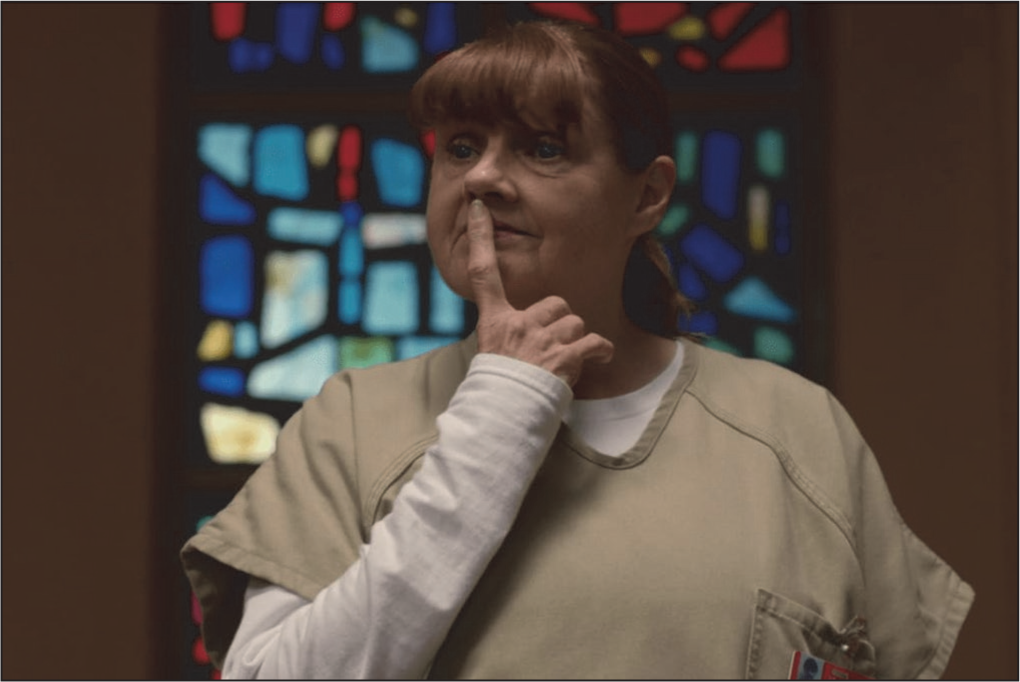
Before incarceration, Lolly served as a journalist in the Free Weekly newspaper. But she loses her job because of her excessive interest in finding out about government corruption and surveillance. After losing job, she starts selling cups of coffee in a shopping cart to earn her livelihood. Out of misunderstanding, one day she gets involved in an argument with police officers and she is arrested on a charge of police assault. She is shifted to Litchfield Penitentiary where she experiences hallucinations and paranoid delusions. She believes that government agencies are trying to kill her and attempts to convince other inmates of her conspiracy theory. Initially, Lolly is obsessed with Alex and keeps an eye on her as she thinks Alex is an NSA agent trying to kill her. Later her closeness with Alex makes her a murder suspect. In season four, episode ‘Work That Body For Me’, Alex murders a prison guard Aydin who tries to kill her and buries her body in the garden with the help of Lolly and Frieda. Lolly’s psychosis reemerges and she can see and hear things that are not there. So, her paranoia becomes a source of threat for the inmates involved in the murder. She starts digging up the ground to shift the dead body to a different place. Her mental illness gets worse day by day and prison correction officer Sam Healy arranges her counselling thinking that it is all her delusion. Later the dead body is discovered and Lolly is accused of that murder. After the discovery of the dead body, Lolly is considered a dangerous mad woman who needs to be isolated from other inmates; therefore, she is put in psych. A mentally unstable person is helpless when she is in normal society but she becomes more unprotected when she is in prison where there is no near and dear one to look after her. So, able-bodied people can scheme to frame a disabled person by taking advantage of her mental illness. Innocent Lolly becomes a victim of a crime which she has not committed. Lolly’s predicament speaks for all those who suffer from mental illness and become helpless victims of ill-treatment and prejudice.
Ageing Makes People Disabled
Old inmates of Litchfield are called ‘Golden Girls’. The old inmates are segregated from the other inmates of the prison. Nobody pays attention to the old convicts; they cannot participate in the mainstream affairs of the prison. They are not invited to the meeting or discussion on any issue. They have their own separate table in the cafeteria, and nobody wants to sit with them. Their age has made them disabled; they are like the yellow leaves about to fall from the trees. Some of them suffer from dementia. Frieda, Jimmy, Chang, Taslitz, and Irma belong to the group of Golden Girls. After a broil, Red’s friends leave her, and she is with the group of Golden Girls. After being dismissed from kitchen duty, Red involves her Golden Girls in restoring the greenhouse. They also help her to combat Vee. These old inmates are imprisoned in Litchfield for a long time, and later we see that some of the inmates are given compassionate release due to their decaying health. So, the show projects that disability is not only limited to deformity, mental illness, impairments, and delusions; ageing can also make someone a burden and unfit for our society.
Disability and Incarceration in Orange Is the New Black
Orange Is the New Black is set in Litchfield Penitentiary, which is composed of a minimum-security prison and a maximum-security prison. Initially, it is run by the Federal Department of Corrections; later, it is taken over by MCC, a private corporation. A minimum-security prison is for the inmates who have committed nonviolent crimes and for the elderly inmates who have already served a long period in a maximum-security prison. Minimum-security prison is also known as ‘camp’, which is dissolved after the riot in season five. Except for old and diseased inmates, all are assigned to paid labour. A maximum-security prison is for inmates with serious offences and is known as ‘Max’. The isolation ward and psych are situated here. Psych is for mentally unstable inmates. In season seven, Psych is closed and mentally unstable inmates are shifted to B block, which houses the old, the trans and the mentally unstable inmates.
Litchfield houses many female prisoners who committed both violent and nonviolent offences, along with disabled female prisoners. Prison is at work to discipline the prisoners. Here, the idea of detention and punishment from Michel Foucault’s Discipline and Punish can be used to analyse the incarceration and suffering of female prisoners. An offender is put to prison to correct him, to make him a disciplined subject. When she enters the prison, she is regarded as a body always under surveillance. Before putting a prisoner into a cell, detailed information about her physical appearance, name, address, and crime is recorded in official documents. A strip search and detailed inspection of her body are done by the prison guards. The registration process transforms the female inmates into mere names and are made into docile bodies to be disciplined. An inmate’s body is considered an archive of information which can be accessed through torturing the body. During their detention period, inmates are supposed to be corrected and disciplined.
The inmates are now separated from the outside world, and they try to socialise with other inmates with whom they have to make new bonds. Women are regarded as the ‘Other’ in respect of men, but when they are imprisoned, they are doubly marginalised. However, the predicament of disabled female prisoners becomes more vulnerable in prison. Most of the inmates are not interested in paying attention towards the disabled inmates. They often become objects of laughter and discomfort for the other inmates. The disabled section becomes the minority group in prison, and they are often put in the psych ward and isolation chamber to cure them. But this segregation makes them more unstable. So, when disability and femininity intermingle within the correctional system, the tale becomes more tragic and pathetic. The female jailbirds are already alienated from society, but if they possess some sort of disability traits, they are meant to be doubly outcast victims in the enclosed space.
Orange Is the New Black explores themes of disability, incarceration and female subjectivity through Foucault’s notions of power, discipline, and surveillance. The show shows Foucault’s concept of power as productive rather than repressive. The prison is not only a site of punishment, but it also constructs forms of subjectivity by disciplining the female inmates. Foucault’s concept of discipline highlights how the prison exercises its control over the inmates. The prison system employs various techniques of surveillance, panopticon, discipline and normalisation to regulate the behaviour of the inmates. While discussing the intersection of disability and imprisonment, Foucault’s concept of the construction of knowledge and truth becomes relevant. Disability invites marginalisation and exclusion for the prison inmates. These representations echo the reflections of reality, which are formed by existing power dynamics and hierarchies. The series deals with various themes, including female subjectivity, disability, and queerness within the context of incarceration. This intersection of female subjectivity and disability in the show becomes more poignant while dealing with characters like Suzanne Warren (Crazy Eyes), who suffers from mental illness, and Miss Rosa, who struggles with cancer. On the one hand, these characters are battling with prison life; on the other, they are coping with physical or mental health issues. Their stories show how the prison system fails to address the needs of the inmates with disabilities, making them more marginalised beings. This convergence of carceral female subjectivity and disability sheds light on the themes of power dynamics, vulnerability, agency, resistance, and cultural representation.
Conclusion
Disabled people are considered a minority group; they are segregated from mainstream society. Their rights, freedom, and opportunities are often violated because of the apathy of mainstream society. They are often treated as sub-humans, and in this regard, Alan Gartner comments that the treatment of disability is like racial segregation
Just as whites have imposed their images upon blacks, and men upon women, people without disabilities have imposed their images upon people who are disabled. These images have told us not only what is beautiful and right; they have also warned us that the image of disability is ugly and evil.
10
To secure the rights of disabled people, it is necessary to make people aware of what disability is, and there is a need to include disability studies in our curriculum. Literature and cinema can play a crucial role in providing people with a better understanding of disability and empathy for the disabled.
Footnotes
Declaration of Conflicting Interests
The authors declared no potential conflicts of interest with respect to the research, authorship and/or publication of this article.
Ethical Approval
This study did not involve human participants or experimental research. Therefore, ethical approval was not required.
Funding
The authors received no financial support for the research, authorship and/or publication of this article.
Informed Consent
Not applicable, as the study does not involve human subjects.