




Abstract
Transgender individuals experience notable disparities in life outcomes relative to cisgender individuals. These disparities have been linked to adverse childhood experiences, mental health, and discrimination. However, notable gaps exist in our understanding of the mechanisms linking early experiences and gender identity to later life outcomes. This study aimed to explore early experiences and gender identity to identify factors contributing to different life outcomes among the transgender community. Semi-structured qualitative interviews were conducted among 21 transgender individuals with a mean age of (20.94 ± 2.15). Five themes emerged relating to participant experiences: the impact of family dysfunction, body discomfort before and after transitioning, relatedness and belonging, the importance of social support, and community and healthcare dilemmas. These findings highlight the importance of support systems at the familial, community, and healthcare levels. Having a positive self-concept, supportive relationships, family acceptance, and access to care were critical in promoting resilience and long-term success among transgender individuals. Future research endeavors should examine the perspectives of family members, friends, school faculty and healthcare professionals to gain a more comprehensive understanding of factors contributing to social inequities within the transgender community.
Introduction
Transgender individuals experience significant disparities in life outcomes, including mental and physical health, employment, income, and education, as compared to cisgender individuals.1,2 These inequities have been linked to stigma, discrimination, and unstable family environments. 3 In recent decades, the number of individuals identifying as transgender and seeking care has notably increased. In the United States (U.S.), over 1.3 million adults (0.5%) and 300,000 youth ages 13–17 (1.4%) currently identify as transgender. 4 Given this prevalence, it is crucial to gain a deeper understanding of transgender individuals’ lived experiences and identify factors that promote positive life outcomes.
The family environment plays a critical role in a child’s development and can have long-lasting effects on an individual’s transition into adulthood.5,6 Transgender individuals frequently report experiencing unstable family environments, particularly during childhood and adolescence.5–7 In the United States, transgender individuals report significantly higher rates of both single and multiple ACEs compared to the cisgender population. 8 Family instability can disrupt a child’s development and ability to successfully transition into adulthood, contributing to poor outcomes such as behavioral problems and lower educational attainment.5,7 Consequently, transgender individuals are more likely to experience poorer mental health and socioeconomic outcomes. 6 However, protective factors such as family cohesion have been shown to buffer against negative outcomes, especially in mental health. 3
Data show transgender individuals encounter distinct challenges related to marginalization and victimization that affect various aspects of life, including healthcare, housing, employment, and education.9–11 Social inequities stemming from discrimination serve as major stressors, increasing the risk for mental health conditions such as anxiety and depression.1,12 Transgender individuals also face several barriers to accessing care and frequently encounter discrimination and mistreatment in clinical settings.13,14 Many general practitioners report limited knowledge of transgender-specific health needs and express difficulties in communicating health information. 15 These barriers have been shown to hinder the exchange of critical health information and increase the likelihood of avoiding future care, threatening the healthcare status of transgender individuals. Despite the effects of discrimination, research has identified the role of support groups in mitigating poor outcomes. 11 However, little is known about how these protective factors function and change over time as transgender individuals progress from childhood to adulthood. 16
Current Study
The purpose of this study is to qualitatively explore the lived experiences of transgender individuals through their perceptions of early experiences and their impact on later life outcomes. Semi-structured individual interviews were conducted with transgender adults to gain insight into their experiences relating to gender identity from childhood to adulthood and to inform approaches to provide more effective support for this population.
Methods
Study Design
This study involves a convenience sample of individuals who participated in qualitative interviews to explore factors promoting positive life outcomes and contemporary challenges within the community and healthcare system. Thematic analysis was employed to systematically identify and categorize recurring themes in participant responses. 17 This study was approved by the University of Michigan Institutional Review Board (IRB).
Participants and Procedures
A total of 21 transgender adults were recruited between October 2024 and December 2024 through flyers posted at the University of Michigan, Michigan Medicine clinics, and on social media platforms. Participants completed an electronic pre-screening survey to determine eligibility and were subsequently sent a consent form via email. Once participants provided their written consent, a 30-45-minute semi-structured interview was conducted using video conferencing software. Audio recordings were taken from each interview and transcribed verbatim for analysis.
Measurement
The interview protocol was created by a research team at the University of Michigan with experience in qualitative research. Interview questions were developed based on preliminary quantitative findings, and the interviewer periodically asked follow-up questions to clarify or expand upon participants’ responses.
The interview questions are listed below:
How would you describe your relationship with your family growing up? In relation to caretakers In relation to siblings In relation to other family members What was your experience when you first started exploring gender? What was it like to share your identity with people in your life? How does the support for your identity now compare to when you first came out? What aspects of support positively impact your life? What experiences (if any) negatively impact your life? What challenges (if any) have you faced with your identity? How has your gender identity impacted your life regarding employment and school? How would you describe your current health and overall well-being? What factors in your life improve or worsen your mental health in relation to your gender identity? What could the community or the health care system change to better support transgender individuals?
Data Analysis
The data was analyzed using NVivo 15.0 for thematic analysis. This method was used to identify, analyze, and interpret recurring patterns and themes among participants. The first author became familiar with the data by re-reading all interview transcripts, listening to the audio recordings, and taking preliminary notes. A second researcher coded 20% of the transcripts that were de-identified to add inter-rater reliability and mitigate researcher bias. The transcripts were systematically coded, and recurring themes were identified with the support of participants’ quotations. Information for each theme was summarized and included several quotations from the participants to highlight their experiences.
The first author contacted participants and provided them with the opportunity to review and verify the findings from the analysis, thereby increasing credibility and mitigating threats to validity. 18 Participants were given three weeks to complete this verification, and several confirmed the accuracy of the findings.
Results
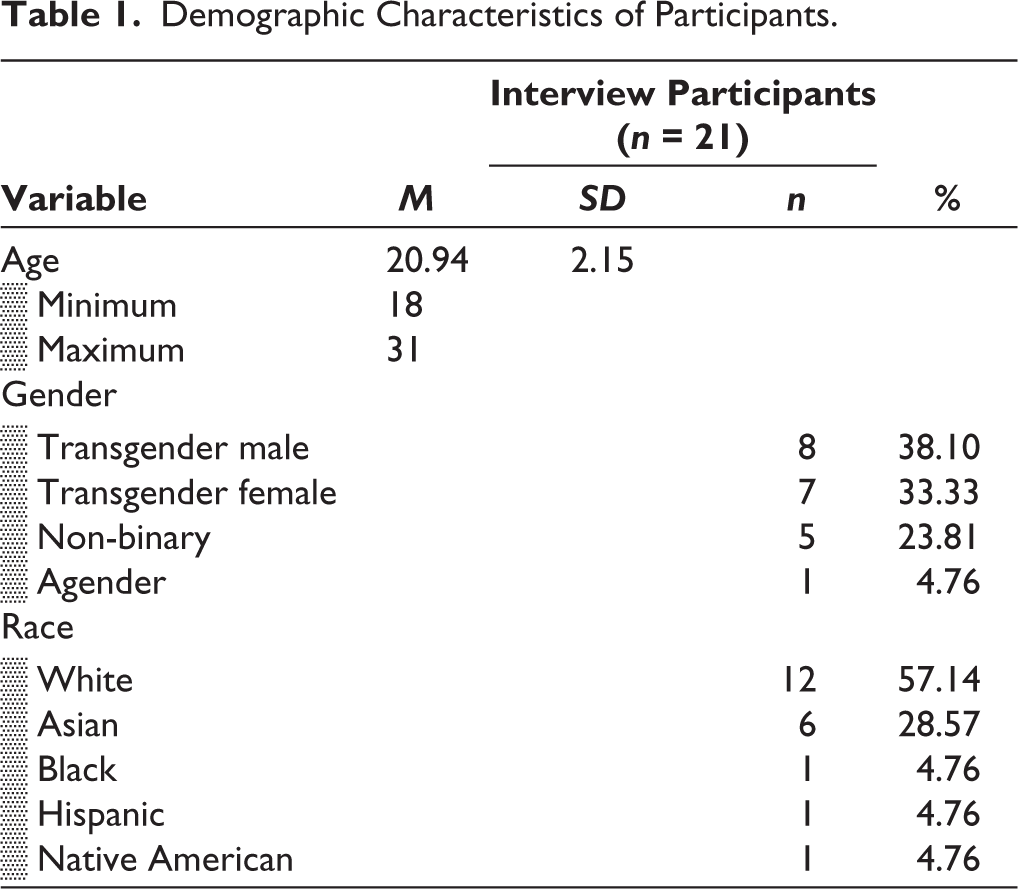
Table 1 presents characteristics of the sample, who had a mean age of 20.94 years (SD = 2.15). Eight participants identified as transgender male, seven identified as transgender female, five identified as non-binary, and one identified as agender.
Demographic Characteristics of Participants.
Qualitative Themes
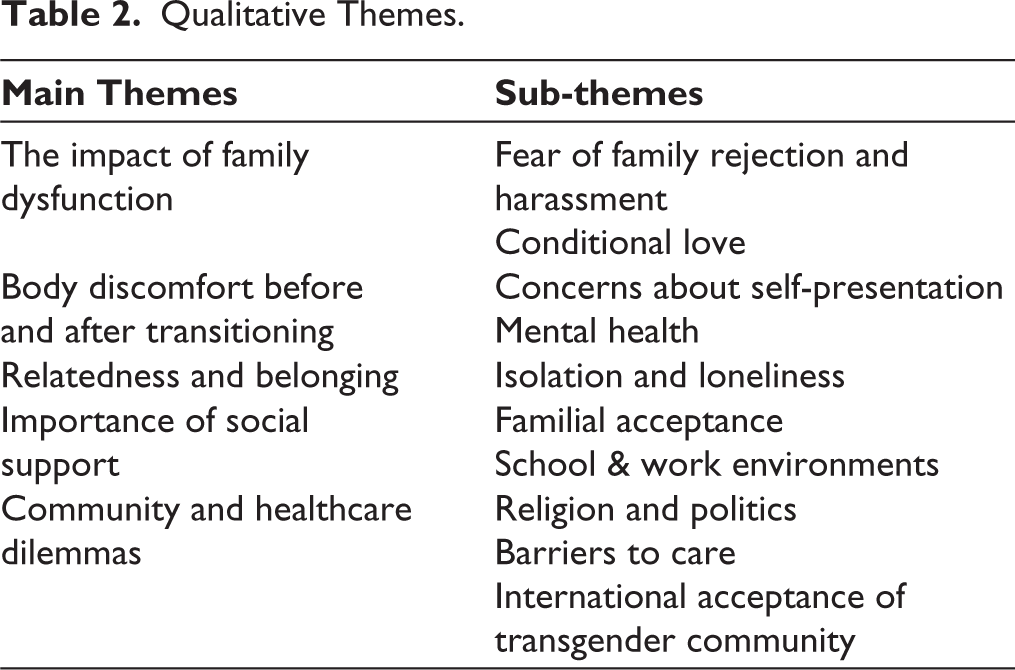
Analysis of data obtained based on the interviews yielded five themes that were common to the experiences of transgender individuals, shown in Table 2.
Qualitative Themes.
Theme 1: The Impact of Family Dysfunction
A total of 81% of participants described their childhood as dysfunctional by characterizing their caregivers as neglectful, unresponsive, combative, or abusive. One participant described their childhood experience, saying, “I know it was chaotic … I know it was traumatic … my dad was a drug addict … my mom … She’s verbally abusive.” Moreover, many participants reported not receiving adequate support and stability from their families during childhood and adolescence. Some participants became child caretakers for their younger siblings to account for their parents’ absence. The following quotes illustrate the participants’ family dynamics:
I had a pretty tumultuous childhood, on paper. Everything was pretty stable, but emotionally, I had a very volatile mother and a very absent father, and they were frequently fighting. Family functioning was very rough. It was lots of arguments, a lot of disagreements, a lot of yelling, a lot of just disorganization and distance, and tension … my mom … she was very absent … as I got closer to being a teenager, I took more of a parental role toward … my sister.
Several participants also described their parents as having mental health and substance use issues and being periodically incarcerated. One participant stated, “My parents are both drug users … my dad was kind of in and out of jail for rehab.” Instability at home limited participants’ gender expression and created additional mental health challenges for transgender individuals coping with these unstable environments.
Sub-theme: Fear of Family Rejection and Harassment
The majority of participants felt unsafe exploring or sharing their identities with their families for fear of pushback, harassment, and punishment. As a result, they experienced guilt, struggled to accept their identities, and tried to deny or hide them from family members, as captured in the following quotes:
The environment that I’m in, it’s not really safe for me to question it, so I just had to kind of deal with it … Oh, something’s not right here, but I don’t want to question it because it’s not safe for me to question it. My parents not feeling safe to talk about it around other people. Not feeling safe necessarily, even to have some of the friends that I do, because they are non-binary or gender nonconforming or trans, and not wanting to either be in trouble with my parents or get them in trouble with my parents. I could never tell them [parents] and I have always thought that maybe I should … try to man up more and camouflage my identity so that I can put up with society more, and face less bullying … I was not allowed to express it out loud.
Sub-theme: Conditional Love
A few participants discussed the idea of “conditional love,” where they believed their families would only continue to love them if they concealed their gender identity. One participant expressed this concern, saying, “I was worried … they would just decide that they were done with me, and there was that feeling … this acceptance is conditional as long as you’re one of the good ones.”
Sub-theme: Identity Pathologization
Moreover, many participants felt their families struggled to accept their identity: “My mom is very stuck in the view of who she wanted me to be when I was a baby.” This clash between the parents’ expectations and the child’s wants often created tension within families and limited participants’ gender expression. Individuals raised in conservative communities discussed their experiences with harassment and tension created by conservative family members. Several participants reported that family members pathologized their identity by labeling them as mentally ill. Others were told that their identity was a phase or that they were delusional and confused. These family reactions had a negative impact on participants’ mental health, as shown in the following quotes.
My mother was crying … you have killed my son! I am losing my son for you … She didn’t want to accept it in a way she thought, maybe if it’s a phase, it’ll go away, but she had seen me dressing up since I was one.
So family, like, I said, they’re not that supportive … part of my family, and including my dad are … kind of ignoring it … My oldest brother … has told me explicitly to my face before that, Oh, you have a disease … and you’re gonna change and get out of this.
My mom was saying you’re in a cult; you’re following a trend. You’re whatever, really like awful ignorant stuff, and she kept on saying that. She was horribly abusive to me that whole summer.
Theme 2: Body Discomfort Before and After Transitioning
Participants described discomfort with their bodies from a young age and reported feeling constrained by gender stereotypes, which limited their ability to explore different identities. Eighty-six percent of participants described intense negative feelings regarding their bodies and struggled to identify themselves when looking in the mirror, as one participant explained, “I experienced a lot of discomfort and a lot of self-hatred … it was really difficult to express myself in a way that felt comfortable.” Many individuals believed these feelings of incongruence were not normal and tried to suppress them, as illustrated by the following quote:
There’s a real ‘why does everything feel wrong’ like I don’t feel congruent with my environment, or how I look, or how I want to do things. And you’re like God, I don’t like this … my body is changing in a way that I don’t want to.
Sub-theme: Concerns on Self-presentation
Several participants expressed concerns about how others perceived them and whether they were “passing” as their gender. Many feared they would be “clocked” or recognized as transgender, which they believed could result in harassment. This concern exacerbated the participants’ anxiety, leading them to take additional precautions when navigating public spaces to ensure safety. One participant described this feeling in the following quote:
I had this fear of people clocking me so I was to like get up early in the morning and do every kind of makeup … so that … nobody can pick up on or put up a finger on me … whenever people would … clock me I would be very frustrated and have panic attacks and so I secluded myself.
Sub-theme: Mental Health
Despite discomfort with their bodies, many participants reported improvements in their mental health after transitioning socially and/or medically. Some expressed feeling alive and free after their transition. Moreover, many participants felt at ease and could exist without battling their outward appearance. These emotions are captured in the following quotes:
I do feel a bit more alive … I feel less dull … I’ve always hated my body, and I know that’s a harsh term, but it’s made me nauseous. … and medically transitioning … it just feels right. It feels like I’m supposed to be. I feel very relaxed and very calm and very at peace post-transition … It’s like my whole life was inside a pressure cooker. And so everything had to stay very, very tight and very controlled, and I had no space to breathe and no space to think or do anything. So post-transition, I’m just letting all the pressure out, and I can just exist in the world.
Sub-theme: Security & Recognition
Additionally, participants reported increased confidence, self-acceptance, and self-recognition after transitioning. Many felt more secure in their identity and expressed feelings of hope and optimism as their outward appearance better aligned with their internal sense of self. Participants described a newfound recognition when they viewed themselves in the mirror after hormone treatment, as captured in the following quotations:
I started taking my hormones … there was a delay in my mental health really going up at first … but more recently I feel a lot more comfortable in my body. I recognize myself more in the mirror still, not fully, but I look in the mirror, and I don’t see a stranger. There are things that I had to deal with every single day, and I would wake up, and I would have to fight with that, and I would be immediately reminded that my body does not work the way that it should and the amount of damage that did to like my self-confidence, and just how I felt interacting with the world and not having to deal with that has been such a tremendous weight off of my shoulders.
Theme 3: Relatedness and Belonging
Relatedness and belonging were especially important for improving participants’ mental health. As mentioned, several participants were restricted by their home environment, which hindered their ability to safely explore their gender identity. However, once they gained access to the internet or distanced themselves from their families, they reported greater freedom to explore and connect with other individuals who shared similar experiences. This theme was recognized by the participants, who stated the following:
I was in a lot of online queer communities … so I knew a lot of other trans people and they would talk amongst themselves about their experiences and I started realizing … that I related to a lot of what they were saying. I retreated into the online sphere and … it felt really nice to have people online that I could point to and be like, Oh, yes, you’re experiencing and feeling the same thing that I am and there’s a word for it and I’m not going crazy so it built that sense of community.
Forming connections with other transgender individuals helped alleviate feelings of loneliness and provided participants with a sense of belonging as they could relate to others’ experiences. Transgender individuals have distinctive experiences relating to their gender identity. Therefore, having others understand their perspective and feelings helped participants feel more comfortable and secure in their identity and with sharing their experiences, as illustrated in the quotes below:
A big part of my mental health being better is just having those spaces where I’m not made to feel like I don’t belong where I’m not … told to hate myself and to be someone else, and to put on this mask. My friends understand what I’m talking about, and it’s not something that I have to go in-depth and explain. Having that shared experience really changed things for me in terms of understanding my identity because it was like, Oh, I’m not alone in feeling this. I’m not alone in trying to figure it out and the ways to express it. When I was younger … I always thought I would be alone. I didn’t really think people were like me. I thought I was abnormal … messed up, or something. You know, growing up and understanding people like me exist, understanding people like me want to help me understand they’re there for me has been like an integral part of sticking with being trans.
Sub-theme: Isolation and Loneliness
Many participants recognized a difference between themselves and others from a young age and often reported feelings of isolation and loneliness. One participant said, “Growing up, I always knew I was different. I knew I was not like everybody else.” Moreover, they frequently felt disconnected from their peers in school who appeared less affected by the pubertal changes. This sub-theme is captured in the quotes below.
Puberty at that time … it was very isolating … seeing people who were cisgender kind of embracing that … and then kind of just being there like, I hate everything about this, and I don’t want any part of it, but there’s nothing I can really do to stop it.
There wasn’t really anyone at school that I could identify as … looking into your gender identity that I am. So it’s isolating there, but then it … alleviated that feeling online … just knowing that there are people out there.
Theme 4: Importance of Social Support
All participants identified social support as a key factor in improving their mental health. Support for their identity helped build their confidence and contributed to greater self-acceptance. Moreover, support enabled participants to be authentic, empowered them to express their identity, and facilitated gender self-advocacy. Participants primarily received support from their friends, with whom they felt more secure sharing their experiences, as one participant said, “My friends … It’s nice to know that they don’t think of me as some kind of person who’s sick essentially, and they’re respecting me.” One participant described the impact of their friends’ support in the following quote:
I think if I didn’t have them I would be in that fearful state forever … I have these times when I’m with the people who accepted me and I could feel normal. I could feel good. I could feel like a human and not constantly always be on edge.
Sub-theme: Familial Acceptance
Conversely, many participants reported having family members who were unsupportive and unaccepting of their gender, which negatively impacted their mental health. Many found it difficult and scary to share their identity and received negative reactions from family members. Although some participants had supportive caregivers, the majority faced conflict when sharing their identity. The following quotations illustrate the impact of familial support on their lives.
My family is really rough. They’re not that accepting which isn’t fun. So I’ve kind of just been hiding it from them a lot … I love my family so much … Thinking about my future is really scary because there’s a big possibility they won’t be in it.
My mother was really hurt initially, and I was hurt because they are my parents … I have my responsibilities to them but obviously I can’t also let myself suffer for that right. I have to live my life in that way … My mother’s reaction … She didn’t want to accept it.
Sub-theme: School & Work Environments
In terms of their experiences in school and work, most participants expressed support and acceptance for their identity, saying, “I think the school has provided a really good safe space for students like the spectrum center,” and “My work environment overall is very, very accepting.” It is important to note that many participants are enrolled in progressive institutions, which tend to be more accepting of the LGBTQ+ community. However, a few participants were concerned about concealing their identity at work, especially when working with children. The quote below illustrates this concern:
I’m teaching in a public school in Texas. My boss knows that I’m trans … but do I want, you know, this counselor to know? Do I want my student’s parents to know? That was probably the most fraught … people talk all the time about like, you know, trans educators, grooming kids, or trying to turn their kids.
Theme 5: Community and Healthcare Dilemmas
Several participants emphasized the importance of education and acceptance of transgender individuals within society and the healthcare arena. They believed that accurate information and education should be made accessible to transgender individuals seeking care and to society to reduce the spread of misinformation about the transgender community. Many participants raised concerns about the anti-trans movement and hatred toward the LGBTQ+ community, which they believed stemmed from misinformation and ignorance, as illustrated in the quotes below.
I’m trying to fight against the idea that trans people are dangerous … Because once you get rid of that fear, I think it’s a lot easier to talk about the facts, and how to help people. But I think fighting against the fear of and the hatred of trans people … would really help a lot of people.
I think … social movements paint trans people as evil, which I think is the biggest thing standing in the way of trans people being able to access medical treatment easily or be able to fit in socially easily … I think … it’s kind of an information issue.
It’s born out of a lack of understanding, but that doesn’t excuse or diminish the malice that is also present because of that lack of understanding, and I think that it’s being taught that people are different and should be made fun of.
Sub-theme: Religion and Politics
Several participants discussed conflicts with religion and how their religious ideas clashed with their gender identity, which led certain participants to distance themselves from their religion. One participant described, “I became a lot less religious and stopped having a lot of this fear around my religion.” Politics was another challenge for transgender individuals who expressed concern about the impact of future policies on treatment accessibility, as one participant noted, “I think that gender-affirming health care is in a very dangerous position right now, just because of the political climate.”
Sub-theme: Barriers to Care
Regarding the healthcare system, participants discussed challenges with treatment accessibility, affordability, and poor trans-medical education. Several transgender individuals experienced stress before doctor visits as they believed healthcare professionals lacked knowledge about transgender terminology, saying, “I do still just get really anxious about doctor visits … I’m pretty consistently misgendered or just having to deal with new information, kind of on top of that.”
Furthermore, there were differences in care accessibility and affordability among participants receiving treatment (i.e., therapy, hormones, and surgery), as some faced several barriers to care while others did not. Participants’ descriptions of poor trans-medical care and barriers to healthcare are captured below:
Having education classes about how to interact with pronouns other than he/him and she/her is really necessary … I think that that can be really othering, just knowing that your doctors have absolutely no contact with the non-binary or just gender diverse literacy. A lot of hospitals and local ones as well follow the WPATH standards and so, in order to get the care I need, I have to make pleas to licensed therapists or psychiatrists, to write me letters of support, to be able to then pursue the care I need … It gatekeeps a lot of really important care … in terms of access to hormones … some people are put on extremely long waitlists. I get this a lot from trans-fem women that I know who are like they were not explicit enough about fertility, preservation … It can sometimes be a little like Ew … I’m a part of an experiment.
Sub-theme: International Acceptance of Transgender Community
Participants who originated from different countries provided their perspectives on transgender ideology and healthcare within the United States and their country of origin, which included China, India, and Romania. Every participant believed that the United States was more accepting of transgender individuals and had more advanced transgender healthcare.
In India, most transgender people work in sex work or they beg on the trains, the commute, or the roads … denying your gender identity and treating you as your birth gender is something that is very rampant.
America cares more about … rights and respect and protection for transgenders … but in China, people really don’t care about transgenders, and most people would just believe that there are simply 2 genders
Discussion
The purpose of this study was to qualitatively explore early experiences and gender identity in relation to later life outcomes. Given the health and social disparities among transgender individuals, it is critical to research early experiences and gender identity to deepen society’s understanding of factors relating to positive life outcomes.
Transgender participants often described experiences of familial conflict, neglect, lack of support and security, and unresponsive caregiving. The family environment plays a critical role in child development by influencing one’s ability to form relationships and regulate emotions. 5 Participants in the study who felt unsupported by their caregivers often concealed their gender identities and self-isolated, which exacerbated their mental health struggles. Family support and acceptance are crucial for promoting well-being and fostering a stable sense of self. These factors provide a sense of belonging, security, and love that enables individuals to better cope with life challenges. 19 Given the prevalence of loneliness and mental health problems within the transgender community, it is important to highlight the role of social connections for minority groups.
From an early age, participants identified an incongruence between their physical appearance and internal sense of self, which many initially believed was abnormal and attempted to suppress. As a result, they developed strong negative feelings toward their body and felt distress during puberty. Body dissatisfaction has been linked to poor psychosocial functioning and impaired health-related domains, including work, school, social activities, and relationships. 20 Although transitioning brought both positive and negative emotions, participants generally reported increased confidence, self-recognition, acceptance, and improved mental health after transitioning. Stress post-transition was often externally driven, as participants were concerned about their outward presentation and potential victimization. Previous qualitative research supports this finding, which suggests that distress over appearance can be triggered by situational and gendered expectations. 21 Overall, body discomfort tends to decrease as transgender individuals’ physical appearance better aligns with their internal sense of self.
Several participants felt unsafe exploring their identity at home and turned to the internet and external social groups to learn more about gender. Online spaces provide opportunities to build connections, escape stigma and violence, boost confidence, and develop hope. 22 These alternative environments allow transgender youth to authenticate themselves, laying the foundation for appropriate self-exploration and developing relationships based on shared experiences. However, online spaces also present risks, such as exposure to misinformation, which can negatively affect psychological well-being. 23 These findings reflect the need for reliable, trustworthy online content that promotes social support and accurate information.
Most participants discussed the positive impact of support, especially from friends, on their mental health. Social support serves as a protective buffer against stress and discrimination, which reduces feelings of isolation and better equips transgender individuals to cope with challenges.22,23 Participants who lacked support from their families turned to peers who provided a sense of security and freedom to express themselves. Through these connections, participants felt accepted and comfortable in their identity, lending to a sense of normalcy.
Participants expressed the need for increased education and awareness for the transgender community to combat misinformation and reduce stigmatization. Education on transgender experiences and the harmful effects of transphobia can help reduce stigmatization and negative attitudes toward the transgender community. 24 Participants also voiced concerns regarding the impact of misinformation on future legislation, which may limit transgender rights. Understanding the lived experiences of transgender individuals is critical for informing policymakers of the potential legislative effects on the transgender community.
Barriers to care, such as accessibility, affordability, and negative encounters with healthcare professionals, discouraged participants from seeking care. Healthcare professionals who lack knowledge of transgender terminology and care may result in misgendering and perceived insensitivity to gender identities. 15 These experiences can diminish one’s willingness to receive care, raising concerns for health status among the transgender community. Medical school curricula would benefit by integrating holistic approaches that account for trans-specific needs to better equip doctors to provide high-quality care to transgender patients.13,14
Limitations
Convenience sampling used in this study may have increased the likelihood of selection bias. Participant recruitment was primarily done on the University of Michigan campus, which may have skewed the sample toward younger, college-educated participants. The majority of participants were White/Caucasian and college-educated, which may not reflect the experiences of transgender individuals from other ethnic and educational backgrounds. However, the sample consisted of working professionals and college students from different states and countries. Future research could include a more diverse sample to better understand the impact of these factors on transgender individuals’ experiences.
Summary
Exploring the lived experiences of transgender adults from childhood through adulthood is instrumental in gaining insight into the persistent social and health disparities within this population. Findings underscore the critical role of family cohesion, support networks, societal acceptance, and access to care in promoting positive life outcomes. Protective factors such as having a positive self-concept, supportive relationships, and family acceptance were critical in promoting resilience and long-term success for transgender individuals. Support and validation from family members, peers, schools, and workplaces were consistently linked to greater self-confidence, self-acceptance, and a stronger sense of belonging, which increased their willingness to achieve academic, personal, and professional goals. Moreover, experiences of minority stress, such as discrimination, harassment, and stigmatization, uniquely contributed to adverse outcomes in education, the workforce, healthcare, and overall well-being. Therefore, it is imperative that caregivers, educators, policymakers, healthcare professionals, and the broader public work toward a deeper understanding of transgender experiences to mitigate gender-based discrimination and reduce social inequities. Further research on this topic is warranted to examine the perspectives of family members, friends, school faculty, and healthcare professionals to gain a more holistic view of factors influencing transgender individuals’ experiences and life outcomes.
Authors’ Contribution
LB, NB, KJ, and BP participated in the study planning and revision of the article. All authors contributed to the article and approved the submitted version.
Data Availability Statement
The data that support the findings of this study are not publicly available due to participant confidentiality.
Footnotes
Declaration of Conflicting Interests
The authors declared no potential conflicts of interest with respect to the research, authorship, and/or publication of this article.
Ethical Approval
The studies involving human participants were reviewed and approved by the University of Michigan Health Sciences and Behavioral Sciences Institutional Review Board (IRB-HSBS). (HUM00000246).
Funding
The authors disclosed receipt of the following financial support for the research, authorship, and/or publication of this article: This research was funded through the Tanner Memorial Award and Senior Honors Research Funding Award by the Department of Psychology at the University of Michigan.
Informed Consent
The participants provided their written informed consent to participate in this study.