



Abstract
Background:
Premenstrual dysphoric disorder (PMDD) is a common yet underdiagnosed mental health problem among women of reproductive age group with a significant potential to perturb social, academic, occupational, and interpersonal milieu of suffering women. The aim of this study is to see the Prevalence of PMDD in Nursing Students.
Methods:
A cross-sectional questionnaire-based study was conducted among the nursing students of the Acharya Shri Chander College of Medical Sciences Nursing School, Jammu and they were screened for the presence of PMDD using the Premenstrual Symptoms Screening Tool.
Results:
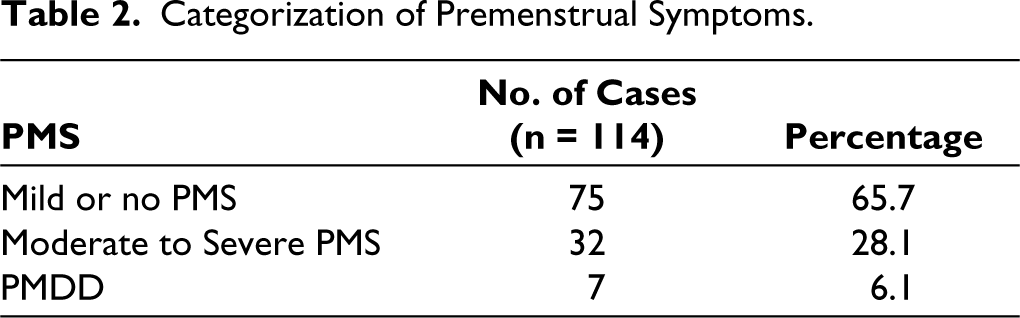
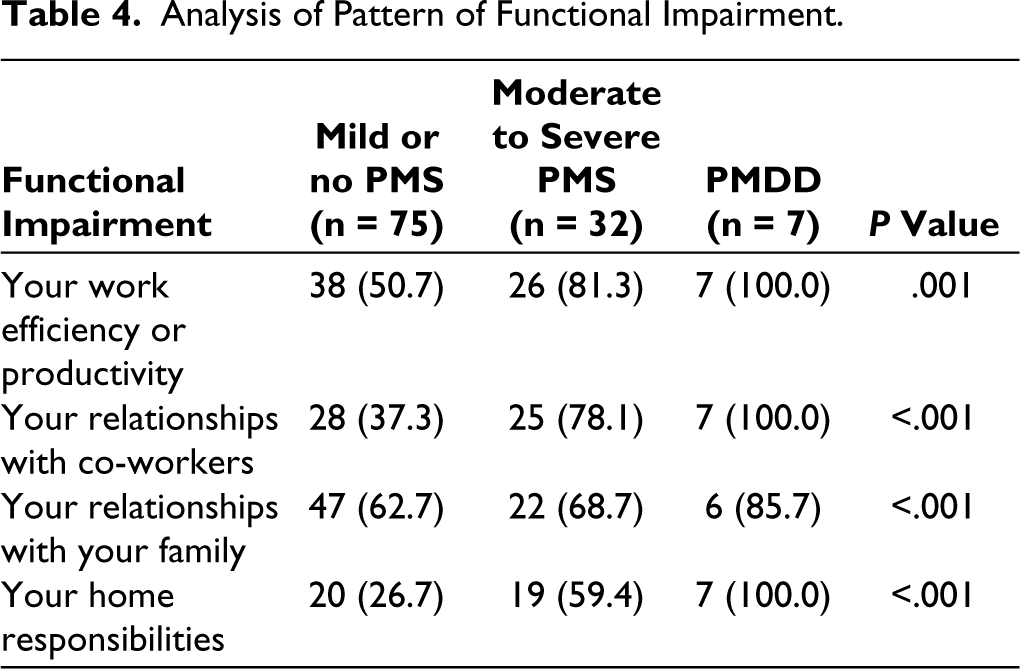
Prevalence of moderate to severe Premenstrual Syndrome (PMS) was 28.1% and PMDD was 6.1%. The commonest premenstrual symptom among the cases was fatigue or lack of energy. In the moderate to severe PMS category, it was anger, and in the PMDD category, it was anxiety. Impairment of college efficiency, or productivity was in 81.3% and 100.0% of students having moderate to severe PMS and PMDD, respectively.
Conclusion:
PMS and PMDD were prevalent among a substantial proportion of nursing students with significant negative influence on academic performance, emotional well-being and behavior. Strategies should be adopted in college health programs for the timely recognition and management of PMS and PMDD in nursing students.
Introduction
Premenstrual syndrome (PMS) is a common clinical condition affecting many women during reproductive years. According to estimates by epidemiological surveys, as many as 80.0% of women experience some vexing symptoms related to the premenstrual period. 1 The worldwide prevalence of premenstrual dysphoric disorder (PMDD) is estimated to be 3.0%–9.0%. 2 According to Western literature, there is an enormous amount of health care and economic burden associated with PMS and PMDD. In India, more than one-fourth (27.7%) of the female population falls in the 15-25-year age group. Worldwide literature shows that women are more likely to develop depression and anxiety disorders. 3
PMS is the name given to a collection of physical, cognitive, affective and behavioral symptoms that happen cyclically with each menstrual cycle. The physical symptoms which are more common and bothersome are breast tenderness, bloating, weight gain, headaches, fatigue, joint and muscle pains. Cognitive symptoms include difficulty in concentrating, feeling overwhelmed, or out of control. Affective symptoms are anger, irritability, anxiety, sad mood, hopelessness and decreased interest in regular activities. Behavioral symptoms of PMS are increased sensitivity to rejection, tearfulness, food cravings, insomnia and hypersomnia. These symptoms appear during the late luteal phase of each menstrual cycle (7-14 days prior to menstruation) and resolve quickly within a few days of onset of menstruation. 4
PMDD is considered the most severe form of PMS. Both conditions are associated with physical, emotional, and behavioral symptoms. There can also be anxiety, tension, sadness, feelings of being over-whelmed, or being out of control. The mood symptoms can be very debilitating and may lead to marked impairment in the occupational, social, and interpersonal domains of a woman’s life. Sleep disturbance, which can either be insomnia or hypersomnia, is among the commonly reported behavioral symptoms. 5
Even though PMDD has a high impact on academic performance, special attention is still not given to premenstrual-related problems. Female university students are highly vulnerable to stress, and impairments including occupational, social, or other important functioning areas, and this also disturbs their academic performance, particularly prior to their menstruation. These PMS-related issues can develop into PMDD, a severe form of PMS, and if left untreated, grow in number and severity.
The findings of this study will help to develop and implement suitable policies, strategic plans, and intervention programs to identify and treat such PMS-associated disorders early. Additionally, this helps to lessen or eliminate its detrimental impact on an individual’s academic attainment. 6
Material and Methods
The cross-sectional study was conducted on 114 students at ASCOMS Nursing School. A thorough history was taken from the nursing students and the students currently diagnosed with any other psychiatric illness and those fulfilling the ICD-10 criteria for any other psychiatric illness were not included in the study. Data was collected from the nursing students and they were screened for the presence of troubling symptoms using a screening tool for premenstrual symptoms.
There was no intrusive treatment done. Strict confidentiality was maintained.
Sample Size Calculation:

Z is the statistic corresponding to level of confidence,
P is expected prevalence
d is precision (corresponding to effect size).
Sample size calculation
Assumptions:
Precision = 5.0% (0.05)
Prevalence = 8.0% (0.08) 7
Population size = Infinite (0)
Z = 1.96
Estimated sample size:
n = 114
Inclusion Criteria
Female gender.
Symptoms only during the premenstrual period with marked relief at the onset of menses.
Age between 18 and 45 years.
Not Pregnant.
No hormonal contraception.
Regular menses for six previous cycles.
No previously diagnosed psychiatric disorder.
Providing informed consent.
Exclusion Criteria
The symptoms are present outside the premenstrual period.
Age below 18 years or above 45 years.
Pregnant or taking hormonal contraceptives.
Irregular menses.
Currently diagnosed with a psychiatric disorder.
Patients not giving informed consent.
Premenstrual Symptoms Screening Tool (PSST)
It is the screening tool developed by Steiner M et al. 8 This screening tool has two sections. The first section, which focuses on different premenstrual symptoms, consists of 14 items, with the severity of each item graded as not at all, mild, moderate, or severe. The second section, which measures the severity of disability in various domains like work efficiency, relationship with friends, family, and social life, as well as home responsibilities, uses the same severity grading as the first section. To make a diagnosis of PMS and PMDD, at least one of the 1 to 4 items, in addition to at least four of 1–14 items in the first section and at least one of the items in second section should be present in moderate severity and severe form, respectively.
Statistical Analysis
Microsoft Excel was used in creating the database, while data was analysed using Statistical Package for Social Sciences (SPSS) version 23 for Windows. Chi-square test was used for qualitative variables (premenstrual symptoms and analysis of pattern of functional impairment) to find the significance of difference between proportion of individuals experiencing the symptoms among respective groups: “no/mild PMS,” “moderate to severe PMS,” and “PMDD.” P Values less than .05 (P < .05) was considered statistically significant.
Rationale for Doing the Analysis for Different Groups
The rationale for doing the analysis for different groups, that is, no/mild PMS group, moderate-severe PMS group and the PMDD group is that the pattern and severity of premenstrual symptomatology are different between these groups, the symptoms commonly associated with PMDD causing the most functional impairment, thus highlighting the need for timely recognition and management of these symptoms of PMDD.
Results and Observations
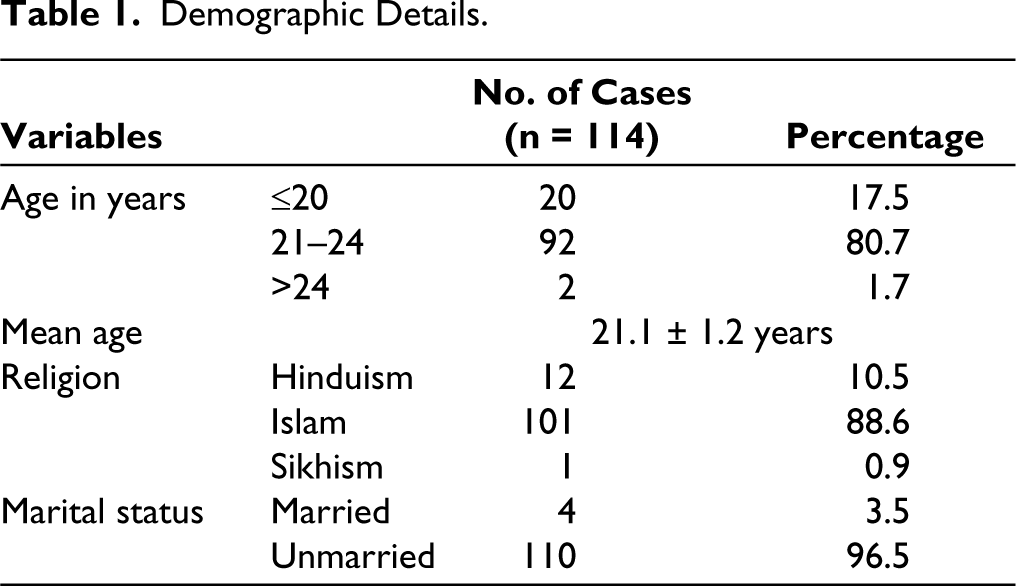
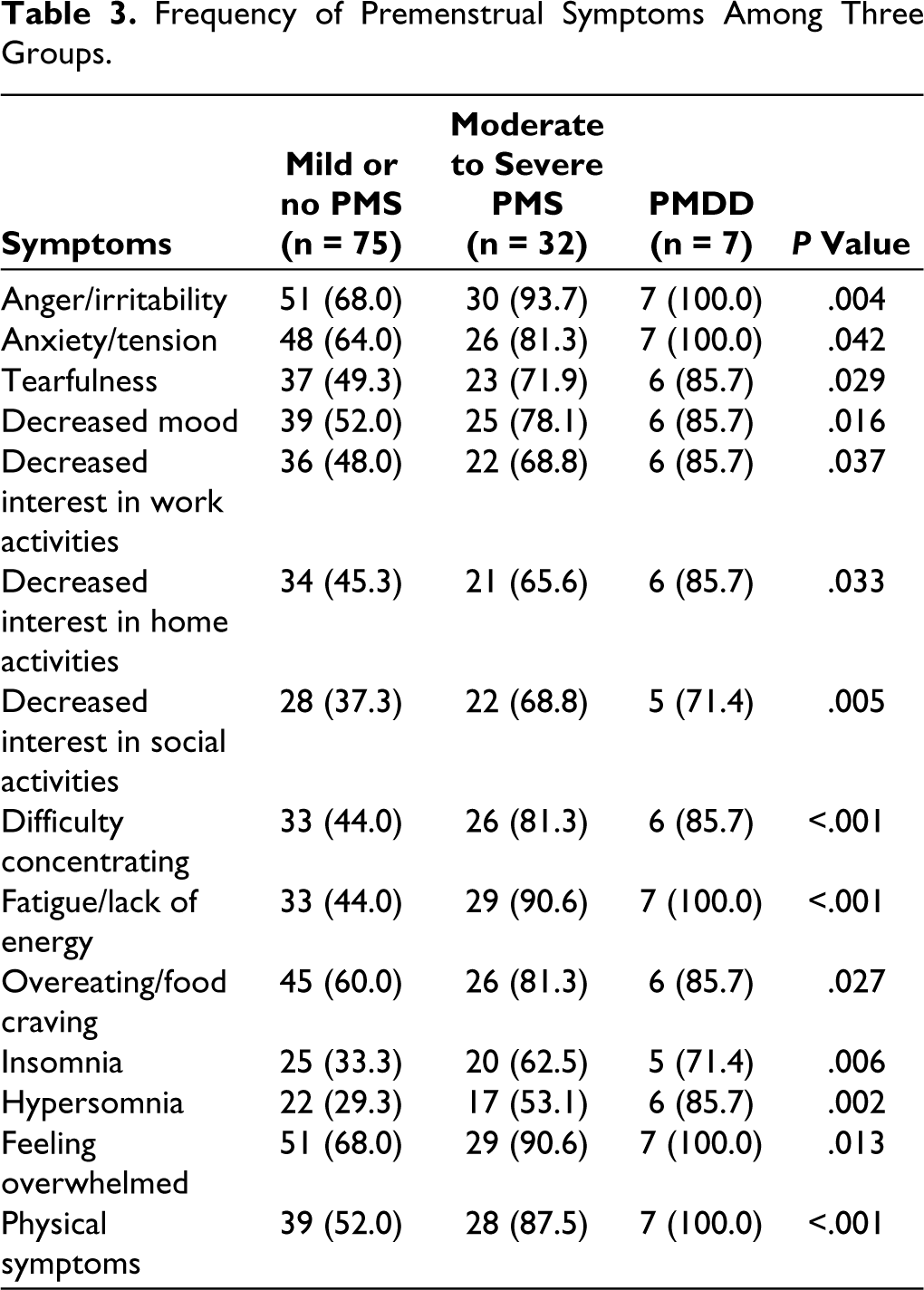
The mean age of studied cases was 21.1 ± 1.2 years where the majority of the cases were unmarried (95.5%) and were Muslim (88.6%). According to PSST scoring criteria, prevalence of moderate to severe PMS among nursing students was 28.1% and PMDD was 6.1%. In moderate to severe PMS, anger/irritability (93.7%) was the commonest symptom, followed by fatigue/lack of energy (90.6%) and physical symptoms (87.5%). In PMDD category, the commonest symptom was anger/Irritability, anxiety/tension, Fatigue/lack of energy and physical symptoms (100.0%). There was functional impairment among nursing students. College efficiency/productivity was identified as the most often reported functional impairment in the moderate to severe PMS and PMDD group, with 81.3% and 100% of students reporting it, respectively.
Demographic Details.
Categorization of Premenstrual Symptoms.
Frequency of Premenstrual Symptoms Among Three Groups.
Analysis of Pattern of Functional Impairment.
Discussion
Symptoms of PMDD have a negative impact on the academic performance of female students. 9 , 10 Therefore, it is important to establish the prevalence of PMDD and pinpoint the risk factors that contribute to it. Additionally, this would aid in the problem’s prevention and the planning of treatment strategies that enhance the academic success of female nursing students.
The present study sample was female nursing students whose mean age was 21.1 ± 1.2 years. This was similar to the ages in some other studies. The mean age in a study by Dorairaj A et al. 11 in year 2019 was 19.3 years. In a study conducted by Raval CM et al. 12 in year 2016, mean age was found to be 18.6 years and Pavitra R and Sireesha S reported mean age of 20.3 years.
In our study, according to PSST scoring criteria, prevalence of moderate to severe PMS among nursing students was 28.1% and that of PMDD was 6.1%. There is a wide variation in the incidence of PMS diagnosed with ACOG criteria as indicated by the studies done in medical colleges in Lebanon and Saudi Arabia, where prevalence of PMS was reported as 7.1% and 35.6%, respectively.13,14 Prevalence of PMS was 27.8% and PMDD was 13.8% in Budarapu S et al. 4 study, which was in line with Steiner M et al. 8 and other studies done in Asian countries which is also consistent with our study. The above prevalence rates are not in agreement with the study conducted by Raval CM et al., 12 in which prevalence of PMS was 14.70% and that of PMDD was 3.70%. Banerjee N et al. 15 reported prevalence of PMDD to be 6.4% similar to the present study. However, this study had a small sample size. Thakur P et al. 16 demonstrated that prevalence of PMDD screened by PSST was 5.04% and prevalence of PMDD was 4.43% by the daily record of the severity of problems form (DRSP). Currently, the prevalence of PMDD ranges from 3.0% to 9.0% in reproductive-age women. 17 In our study, rate of PMS was high in nursing students as they are of younger age group, in their late adolescence which is a vulnerable age. Takeda T et al. 18 reported in their study that PMS was common in teenagers than in adults.
In this study, among participants with moderate to severe PMS, anger/irritability (93.7%) was the commonest symptom, followed by fatigue/lack of energy (90.6%) and physical symptoms (87.5%). Among participants with PMDD, the commonest symptoms were anger/Irritability, anxiety/tension, Fatigue/lack of energy and physical symptoms (100.0%). All the symptoms increased significantly from mild or no symptoms category to PMS and PMDD (p < .05). Our findings were in accordance with the findings of Durairaj A et al. 11 who reported that 1084 (97.5%) of students reported at least one premenstrual symptom and the commonest symptom was fatigue or lack of energy (82.5%). In their study, in moderate to severe PMS, anger/irritability (96.0%) was commonest symptom, followed by fatigue/lack of energy (94.70%), and physical symptoms (92.0%), and in the PMDD category, the commonest symptom was anxiety/tension (100.0%), followed by fatigue/lack of energy (97.4%) and difficulty in concentration (94.9%). The commonest symptom in college girls without PMS and PMDD reported in the study and by Raval CM et al. 12 was fatigue/lack of energy, while it was sadness and abdominal bloating in the study by Mishra A et al. 19 and in the studies from Saudi Arabia and Turkey, respectively.14,20 According to Budarapu S et al., 4 in premenstrual symptoms group, commonest symptoms reported were anger/irritability—66.0%, fatigue/lack of energy—45.0% and difficulty concentrating—45.0%, and in the PMDD, 84.0% reported anger/irritability, 81.0% reported tearful/increased sensitivity, 75.0% reported anxiety/tension followed by the depressed mood in 73.0%. A study by Stout AL et al. 21 also reported “decreased energy” and “being irritable” as the commonest reported premenstrual symptoms in a community-based study. The study by Singh P et al. 22 confirms findings that commonest symptoms reported by the subjects without impairment was “irritability,” and in those where there was some impairment, the commonest symptoms were “tiredness, and lack of energy.” In a study by Jha RK and Jha M 23 the commonest symptoms reported were anger or irritability (100.0%) followed by depression, lack of concentration, feeling overwhelmed or out of control, all three reported by 90.0% of the participants.
In our study functional impairment was also noted among nursing students. The most frequent functional impairment in moderate to severe PMS and PMDD was noted in college efficiency/productivity, which was reported by 81.3% and 100.0% of students, respectively. Though there is difference in symptomatology pattern between various studies globally, the predominant functional impairment in both PMS and PMDD categories reported in our study and in several studies was interference in college efficiency.12,24 According to Budarapu S et al. 4 the most frequent functional impairment seen was in domains of school or work efficiency and productivity, and relationships with friends, classmates/co-workers. This study was in agreement with Steiner M et al. 8 who reported that three-quarters of PMDD, and almost half of severe PMS cases suffered interference with their relationships with classmates, friends, or co-workers, and school/work efficiency/productivity. Jha and Jha et al. 23 reported that impairment is present in all areas of functioning, most frequently in work efficiency or productivity (100.0%) followed by home responsibilities (90.0%).
In the current study, younger girls demonstrated limited awareness of premenstrual disorders, as most students with PMS and PMDD did not recognize their symptoms as abnormal. Health-seeking behavior among these students was poor, with only a small number of students with symptoms consulting physicians or receiving treatment. This lack of action is attributed not only to the student’s insufficient knowledge of PMS but also lack of awareness among parents and teachers, whom the students often approach first for help with these symptoms.25,26
Limitations of the study
The study sample represents only a selective group from a medical college, the nursing students. Therefore, results cannot be generalized.
Although PSST is simple and brief, its retrospective nature adds recall bias.
Conclusion
A significant number of college girls experience PMS and PMDD, which severely affect their behavior, emotional well-being, and academic performance. Patterns of premenstrual symptoms vary between PMS, PMDD, and the general college student population. Our research found that the prevalence of PMS was particularly high among nursing students, who reported some level of impairment in their daily activities. We recommended lifestyle changes to alleviate PMS symptoms and enhance overall quality of life. Students have been educated on recognizing symptoms early to prevent progression to PMDD. Additionally, awareness programs should be established to inform students, parents, and teachers about PMS and PMDD. Sensitizing young medical students about this topic will help them cope with this disorder in a more effective way and enable them to disseminate this knowledge to the broader public, indirectly benefiting many women in the community.
Footnotes
Declaration of Conflicting Interests
The authors declared no potential conflicts of interest with respect to the research, authorship and/or publication of this article.
Ethical Approval
To conduct this study, clearance from the Institutional Ethics Committee of Acharya Shri Chander College of Medical Sciences was acquired, with the reference number ASCOMS/IEC/2023/Meeting-I/24, dated 18-03-2023.
Funding
The authors received no financial support for the research, authorship and/or publication of this article.
Informed Consent
Participants in this study were fully informed about the objectives, procedures, and potential risks involved. Participation was entirely voluntary, and written informed consent was obtained from all participants prior to their inclusion in the study. They were assured that their data would remain confidential and used solely for research purposes. No identifying information was collected, and participants were free to withdraw at any point without any penalty or consequences.