




Abstract
Background:
The development of SexTech (Sexuality + Technology) has profoundly altered the way relationships are experienced, and an accessible example of that, which has millions of users, is the dating apps (Tinder, Grindr, and Bumble), which can locate partners with common interests nearby.
Aim:
To determine whether the use of dating apps is associated with higher levels of stress, anxiety, or depression and to assess the main motivations for using dating apps in young people.
Methods:
An online questionnaire addressed to university students was designed with an initial part aimed at collecting the sociodemographic data of the sample, a second part to address motivations for the use of dating applications, and a third part designed to evaluate the anxiety and depression scores of the participants.
Outcomes:
This study had two main outcomes: anxiety and depression scores measured using the Depression, Anxiety, and Stress Scale (DASS-21).
Results:
Four hundred and ninety-seven people participated in the study, with an average age of 21.8 years. Seventy percent were female. Thirty-four percent of the students use or have used these applications. Recent users showed a statistically significantly higher depression score than non-users. However, the ones who ever used dating apps did not report significantly higher scores than non-users. Homosexual participants have a statistically significantly higher anxiety and depression score than heterosexual. The most stated reason for using apps was “meeting new people,” followed by “entertainment” and “curiosity.”
Clinical Implications:
To promote mental health and sex education, have more tools to respond to topics related to sexuality and technology.
Strengths and Limitations:
The DASS-21 questionnaire is an adequate tool for screening for anxiety and depression disorders. However, other methods should be added to establish a formal diagnosis. The methodology applied in this research allowed us to establish an association between variables but not causality. In any case, we argue that our results shed light on the impact that the much-used dating apps have on mental health and the main reasons for their use.
Conclusion:
Being a user of dating apps does not seem to impact mental health; however, recent use and belonging to a minority constitute predictors of more anxiety and depression symptoms.
Introduction
The advance of technology has profoundly affected the way people meet and develop interpersonal relationships. Geosocial Networking Apps, most commonly known as dating apps, are software for mobile devices that, through GPS location, allow users to get to know each other based on photos and common interests. They are thus designed to enhance social, romantic, and sexual contact between strangers in the same geographical area. These applications have a relevant impact even at the demographic level, having been estimated that one-third of marriages between 2005 and 2012 in the United States resulted from encounters through these online platforms. 1 Studies in different geographical and cultural contexts have shown that 40% of single adults are looking for a partner online 2 and that 25% of new couples meet this way. 3 A study with a large sample from Sweden showed that 35% of men and 40% of women, aged 18–65, have met a sexual partner online. 4 The Statista Market Forecast portal estimated that by the end of 2019, dating apps had more than 200 million users worldwide.
Tinder is one of the most popular and studied apps. Established in 2012, it has about 75 million active users worldwide, with 60% between the ages of 18 and 34, and has contributed to 27% of marriages. 5 This app allows users to view numerous profile pictures within their geographical area and to “like” the other users by swiping right or to “pass” by swiping left. There is a “match” when the interest is mutual, and from there, a chat opens where they can chat and set up a date. It is difficult to determine the prevalence of Tinder use, as results vary depending on the context of the studies and the samples evaluated. Globally, an estimated 52% of young adults between 18 and 24 years old use this app. 5 There are an estimated 22% of users among Belgian college students, 6 15.8% of prior users among Spanish college students, and 12.7% who have used the apps in the past 3 years. 7 The popularity of this dating modality is based on some advantages compared to offline dating – it requires less effort and time, partners can be preselected based on a set of preferences, the threat of rejection is lower, and it allows for extending the social network more efficiently.8, 9
However, some risks have been associated with the use of apps, namely regarding mental health (problematic use) and relational health (infidelity, risky behaviors, and sexual violence).10, 11 In a study that included 437 Australian participants, higher depression, anxiety, and stress scores were found among users of Swipe-Based apps compared to participants who did not use them. 12 Another study, with 3074 participants, added that social anxiety symptoms were shown to be positively related to the use of these platforms, with these symptoms predicting a lower likelihood of initiating contact with a “match” in male but not female users. 13 It has been described that Tinder is positively related to reporting more sexual partners and non-consensual sexual intercourse, the last being more prevalent among women and sexual minorities. 14 In a study on problematic use of Tinder, 47% revealed a low score and 27% an intermediate score, thus showing that the app is not associated with problematic use. 15 It can even be beneficial for many, helping to initiate casual relationships or engagements, promoting self-validation, and encouraging socialization. 15
Having more knowledge about the usage trends of these apps can be useful for developing and implementing mental and sexual health programs, as they are widely consumed by adolescents and young adults. Sexual minorities are a group where this is particularly relevant, as they are frequent and more vulnerable users. 16 Therefore, the aim of this study is to study whether the use of dating apps is associated with poorer mental health globally and in subgroups such as sexual minorities.
Methods
This study includes a quantitative and a qualitative evaluation. Data was collected using a questionnaire informed by previous studies 17 (see appendice and Table 3). It was designed using the online tool Google Forms, comprising an initial part aimed at the sociodemographic characterization of the sample, a second part with questions addressed to the access motivations of the users of dating apps, and a final part where the Depression Anxiety and Stress Scale – DASS-21 (Lovibond and Lovibond, 1995) was added (see appendices) to evaluate the depression and anxiety scores of participants.
The inclusion criteria were attending higher education at a Portuguese institution in the current year, 2023. We excluded those who were less than 18 years old and had incomplete questionnaires.
All participants gave their informed consent, and the study protocol was approved by the Ethics Committee of the Lisbon Academic Medicine Centre.
It was disseminated with the help of student associations, social networks, online student groups, and, in person, at some faculties in the Lisbon area. It was available from January 28, 2023, to April 22, of the same year.
Data Treatment
Statistical analysis was performed using SPSS version 29 and STATA version 14.2. A descriptive analysis of the data from the t-test–Student’s test was performed initially. Then two multivariate linear models were built considering the anxiety and depression subscales of the DASS-21 scale, respectively, as the outcome and the following predictor variables: sex attributed at birth, age, being an app user, recent users (logged on last week), and sexual orientation (homosexual, heterosexual, bisexual, pansexual, demisexual, and asexual). We followed a stepwise backward selection to determine the final multivariate model. A p-value <.05 was considered statistically significant; it was used as a criterion to include variables in the model, and 95% confidence intervals were used.
Results
Quantitative Analysis
A total of 514 answers were obtained, of which 497 were considered valid. Of these, 53.7% were studying at the University of Lisbon, and most (44.5%) were attending health courses (Medicine, Dentistry, Nursing, and Physiotherapy). Their mean age was 21.8 years, with the lowest being 18 years and the highest being 41 years. The sample data are shown in Table 1.
Characterization of the Sample.
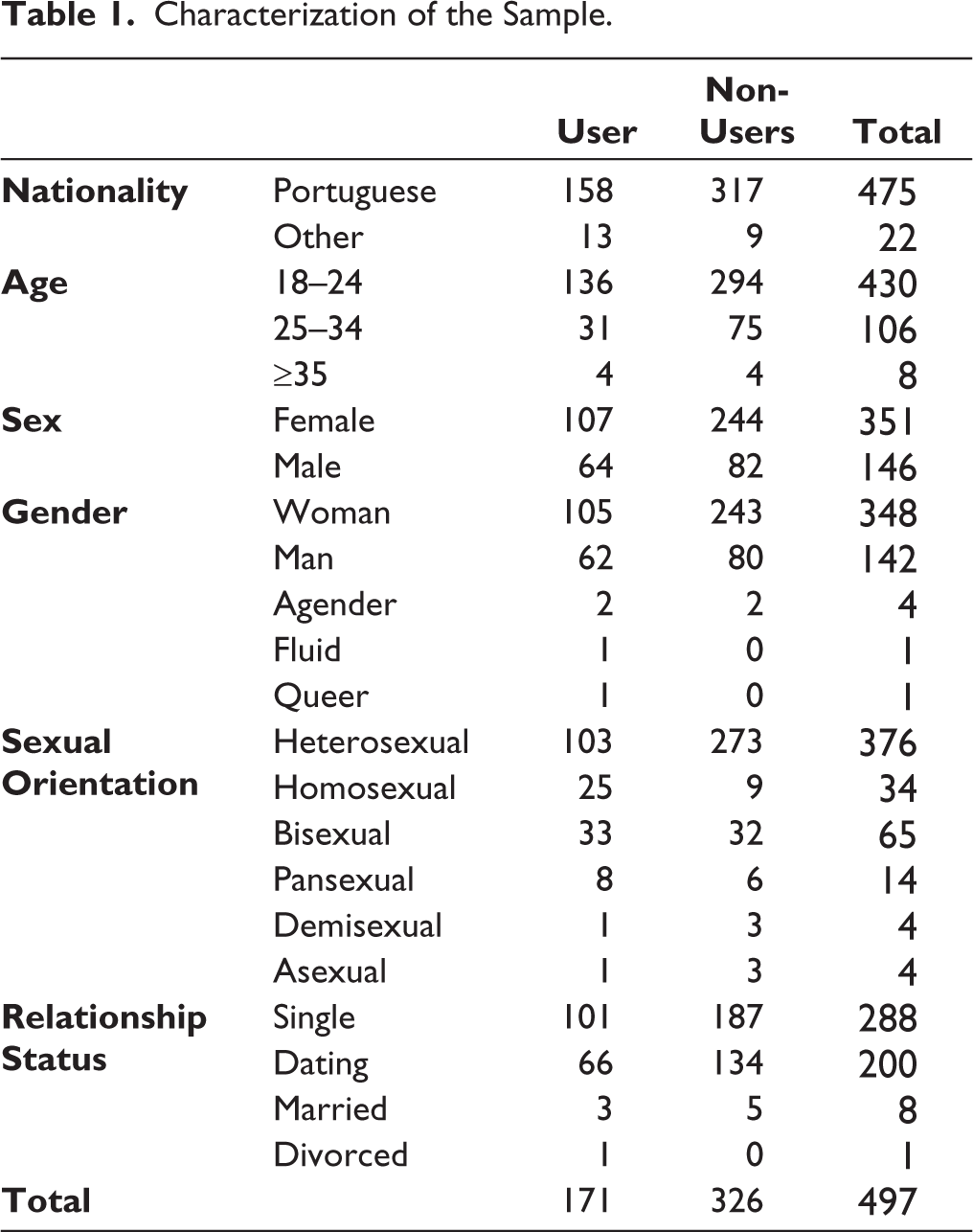
Thirty-four percent of the sample use or have used dating apps. About 27% of heterosexual respondents use the applications, while 73%, 50%, and 57% of homosexual, bisexual, and pansexual respondents, respectively, are users.
The most widely used was Tinder, followed by Bumble and Badoo. Most (26.3%) started using them when they were 18 years old. More than half of the sample accesses these a few times a week, and, on average, users spend 30 min on each access. Recent users who accessed at most 1 week ago represent 27% of the participants.
Logistic Models
Depression
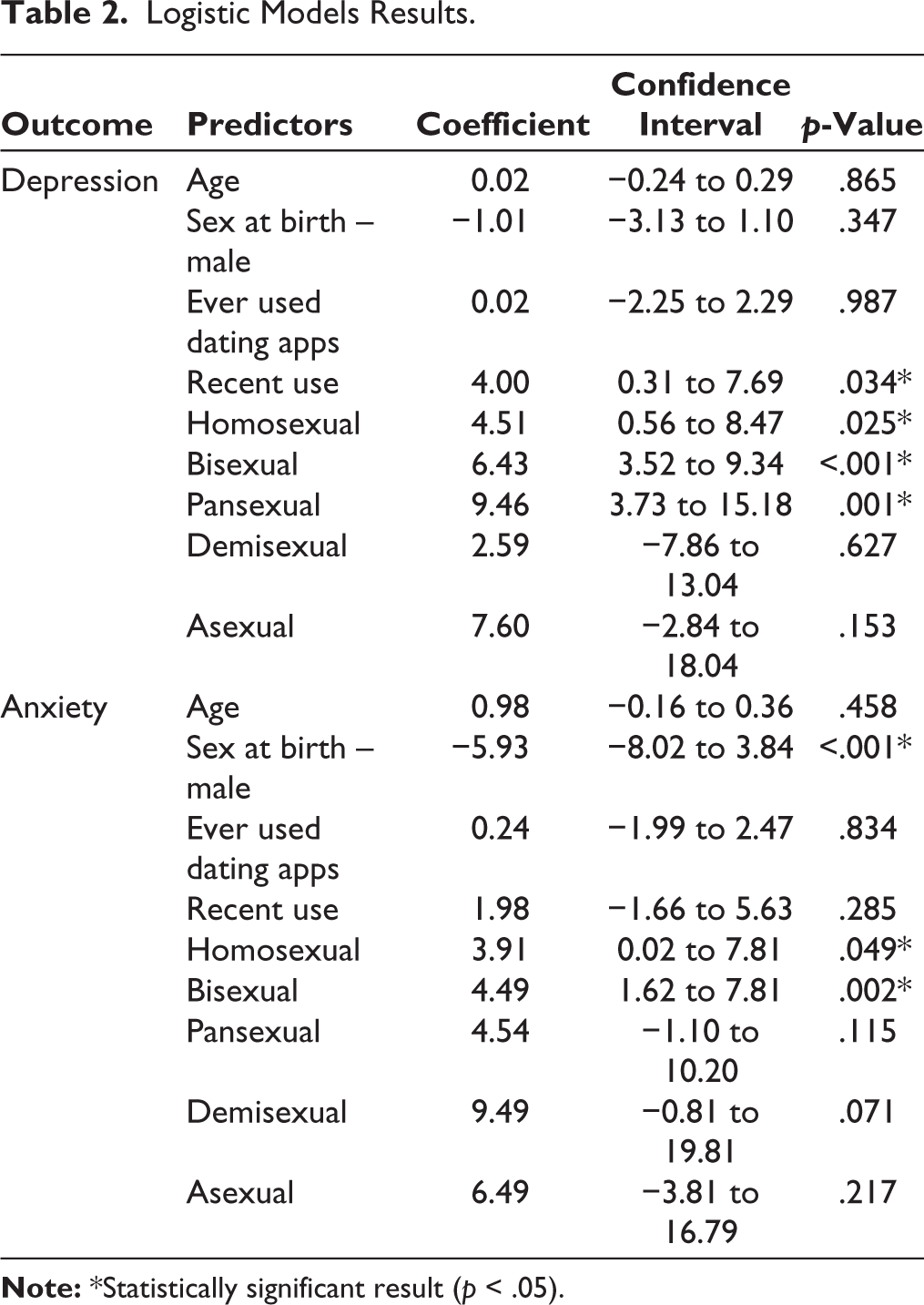
Regarding the model built for the prediction of depression, being homosexual (Coef. 4.52; p = .025), bisexual (Coef. 6.42; p < .001), pansexual (Coef. 9.46; p = .001), or recently using dating apps (Coef. 4.00; p = .001) significantly predicted higher depression scores at the DASS-21 scale. Therefore, these variables were kept in the final model of depression.
Anxiety
For the prediction of anxiety, being male (Coef. −5.93; p < .001) predicted lower anxiety, while being homosexual (Coef. 3.91; p = .049) or bisexual (Coef. 4.49; p = .002) significantly predicted higher anxiety scores at the DASS-21 scale. Therefore, these variables were kept in the final model of anxiety.
The results from the logistic models are represented in Table 2.
Logistic Models Results.
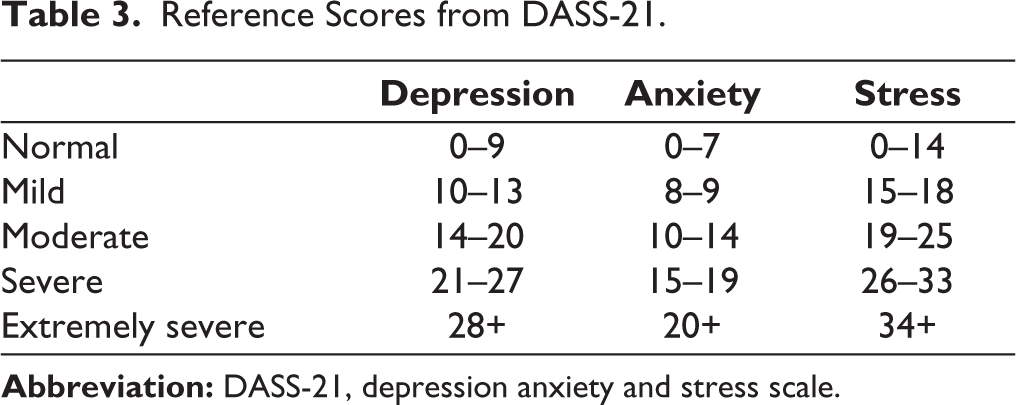
Reference Scores from DASS-21.
Qualitative Analysis
Motivation for Use
Regarding motivations for use, 58.5% stated that they were looking for opposite-sex partners, 19.9% said same-sex, and 21.6% said both sexes. The overwhelming majority (76.6%) were looking for peers of the same age group, and what captivates most users is the appearance in the photos (78.9%), followed by the interests described (69.6%), originality (55.6%), and finally the academic or professional background (21.6%).
Fifty-five percent of the users have been on dates set up through the apps, and half of them usually talk for a few days before the first date. The majority (48%) have never been sexually involved with other users they met through the apps. Of those who have, they usually get involved on the first date.
Another relevant piece of data is the fact that 31.6% of users have already developed a romantic relationship with a partner they met through the apps. Regarding the motivations for using the applications, the respondents rated from 0 to 5 the motivations listed: meeting new people (3,8), entertainment (3,4), curiosity (3,2), seeking a romantic relationship (2,7), making friends (2,6), increasing self-esteem (2,6), casual dates (1,7), and monetary gratification (0,2). Between male users, interest in a casual date is the second most pointed motivation (3,0) and between homosexual users, seeking a relationship (3,2) and making new friends (3,2) are the principal motivations after meeting new people (4,0).
Additionally, 15.8% stated that their motivations differ according to the application they use (in the case of those who use more than one). As for their satisfaction, from 0 to 5, an average of 2.9 was obtained.
Discussion
Our study showed that 34.4% of the participants surveyed use or have used dating apps, with a significant preference for Tinder. This value is below the 52% of young adults aged between 18 and 24 years who use Tinder globally, 5 but above studies done in Europe with 22% of users among Belgian university students. 6
Comparing from the perspective of sexual orientation, we can see greater discrepancies.
While 27% of heterosexual respondents are users, 73%, 50%, and 57% of homosexual, bisexual, and pansexual respondents, respectively, use dating apps. These data confirm other studies, which show that sexual minorities are frequent users, 16 reaffirming that dating apps are a way to overcome the low partner availability, social isolation, and discrimination that often afflict this population. 18 Another data that goes along with this is the fact that 58.5% of respondents seek partners of the opposite sex, 19.9% of the same sex, and 21.6% of both sexes.
Dating apps lead not only to casual encounters but also to long-lasting relationships; in fact, 31.6% of the users surveyed have already established at least one romantic relationship with a partner through this method. Previous literature suggests that for heterosexuals, the Internet has become the third most likely way of meeting a partner, following closely behind meeting through friends (28%) or at a bar/restaurant (23%). 19
Regarding depression scores, in the total sample, they were slightly higher than those found in a previous study among Spanish students using the same scale, reported as 9.7 and 10.88, respectively. 20 Those surveyed who have ever used dating apps did not show higher scores than non-users. However, recent users significantly predicted higher depression scores on the DASS-21 scale. This differs from a previous study that linked app use to increased levels of depressive symptomatology, anxiety, and stress. 12 In this study, current users were considered the ones who logged in within the last 6 months, and non-users were the ones who have never used or have not used a dating app in the last 6 months. A multivariate logistic regression was also applied, and after adjusting for age, gender, and sexual orientation, user status was significantly associated with distress and depression. Besides, individuals who used dating apps daily and those who had used them for more than a year were both found to have statistically significantly higher rates of psychological distress and depression, suggesting that the impact of dating apps use on users’ mental health and well-being may be dose- dependent. Although we did not verify this in our study, recent use was linked to higher depression scores.
Also, being homosexual or bisexual predicted higher depression and anxiety scores. It is, therefore, data that confirms previous studies indicating that the homosexual population has a higher prevalence of depressive and anxious mental symptoms/disorders. 21 In fact, data illustrate overwhelming evidence that LGB persons are at greater risk for poor mental health across developmental stages. Studies using adult samples indicate elevated rates of depression and mood disorders,22, 23 anxiety disorders, 24 and alcohol use and abuse. 25 In a meta- analysis, Marshal et al. 26 reported that sexual minority youth were almost three times as likely to report suicidal ideation; these investigators also noted a statistically moderate difference in depressive symptoms compared to heterosexual youth. Some of the risk factors for this group are family conflict, stigma, and discrimination. 27 As protective factors, studies of LGBT youth have consistently shown that parental and peer support are related to positive mental health, self-acceptance, and well-being.28, 29 Baams and colleagues 30 found that the presence of a romantic partner buffered the effects of minority stress on the psychological well-being of same-sex-attracted youth. LGB youth who reported having sexual minority friends experienced less depression over time, and the presence of LGB friends attenuated the effects of victimization. 31 This is where dating apps play an important role because they are a way of connecting people with the same characteristics.
As for the motivations for use, we established eight main ones, in order of relevance according to this study: meeting new people, entertainment, curiosity, seeking a love relationship, increasing self-esteem, making friends, casual dates, and monetary gratification. As in previous studies, we found that one of the main motivations is thrill-seeking, with seeking a love relationship outweighing the interest in a casual date. 32 However, among female users, the second least reported reason is casual dating, while among male users, this is the second most reported motivation. This again confirms previous studies, which report that the search for casual sexual partners is more frequent among male users, while women are more likely to use dating apps to find a romantic partner and to increase self-esteem. 17 From the sexual orientation point of view, homosexual users prefer to use apps to establish romantic relationships and make friends. This result confirms what was described above, in that this population may see dating apps as an alternative to society’s heteronormativity 18 and as a way to seek those protective factors described above.
This study has some limitations that must be acknowledged. First, the DASS-21 questionnaire is an adequate tool for screening for anxious, depressive, and stress disorders, being useful to identify individuals with increased risk for these disorders. However, other methods should be added to establish a formal diagnosis. Second, the methodology applied in this research allows us to establish associations between variables but not causality.
Future research, in this area, may be useful to overcome these limitations. In any case, we argue that our results shed light on the relationship that the much-used dating apps have with students’ mental health and what the main reasons are for their use.
Conclusion
With this study, we concluded that there is no link between the use of dating apps and a higher prevalence of depressive and anxiety symptoms. Recent use may be associated with even higher risk. Homosexuals and bisexuals have a higher risk of suffering from these pathologies.
Users use the apps mainly to meet new people, for entertainment and out of curiosity. Female users prefer to use the apps to establish romantic relationships, while male users give preference to casual encounters.
The results of the present study may have implications at several levels. In a first instance, to doctors and health professionals, in promoting mental health and sex education, having more tools to respond to topics related to sexuality and technology.
Second, to the users and potential users, by increasing knowledge about their use.
Footnotes
Acknowledgements
I would like to express my sincere gratitude to my advisors, Professor Filipa Novais and Doctor João Paulo Rema, for their valuable guidance and support throughout the investigation process.
I also want to thank my colleagues at University of Lisbon for their helpful feedback and support. In particular, I would like to thank Elena Dragu for her invaluable contributions to our data analysis.
This research did not receive any specific grant from funding agencies in the public, commercial, or not-for-profit sectors.
Declaration of Conflicting Interests
The authors declared no potential conflicts of interest with respect to the research, authorship, and/or publication of this article.
Ethical Approval
The study protocol was approved by the Ethics Committee of the Lisbon Academic Medicine Centre.
Funding
The authors received no financial support for the research, authorship and/or publication of this article.
Informed Consent
The participant has consented to the submission of the article to the journal.