




Abstract
Background:
A society’s perception of rape is largely determined by Rape Myth, an important psychological construct, whose endorsement promotes rape supportive attitudes among people. Again, the extent of people perceiving the various forms of sexual interactions are also largely affected by different personality dispositions.
Aim:
The present study attempts to assess the impacts of the big five factors of personality (often termed as the OCEAN factors) on people’s acceptance of rape myths.
Method and Materials:
A total 608 young adults (370 males and 238 females), who are the students of colleges and universities in Tripura, India participated in this study and were administered with the updated Illinois Rape Myth Acceptance (RMA) Scale and the Ten-Item Personality Inventory in order to measure the aforesaid study variables.
Statistical Analyses:
Product moment correlation and Structural Equation Modeling (SEM) were conducted to fulfil the objectives of the study.
Results and Conclusion:
Results in the Structural Equation Modeling model revealed that RMA is significantly correlated to and predicted by the neuroticism, extraversion, openness to experience, and agreeableness factors of personality. However, RMA and the conscientiousness factor were not found to be significantly related. While neuroticism was positively correlated to RMA, a negative correlation was found between the RMA and the other four factors of personality. The findings add concrete knowledge to what was known about rape-supportive attitudes till date. The study shall serve as crucial literature to future works on rape and rape myths.
Introduction
In the words of Burt, 1 rape myths are the “prejudicial, stereotyped, or false beliefs about rape, rape victims, and rapists.” Again, Scully and Marolla 2 clearly stated that rape myth predicts rape, itself. After committing rape, men begin to adhere to attitudes favorable to rape and it is also found that they try to rationalize their actions. When rape supportive attitudes were reversed, it was found to be effective in lowering the perpetration of forced sex. 3 Different factors may be linked with rape myth acceptance (RMA) such as loneliness, 4 rejection sensitivity, 5 sexual desires, 6 pornography consumption, 7 and history of past victimization. 8 Further, the gender differences in attitude towards rape have been determined in prior studies. 9 In recent years, several cases of sexual misconduct and violence against women have come to light, many of which are a part of the #MeToo movement that came to light through the abuse of different powerful men on women around the world. 10 The rape myths that people hold, deny the extent of sexual assault, place enormous strain on survivors and contribute to post-rape trauma. A juxtaposition of rape myths is the acceptance of sexism, racism, homophobia, antiquity, classism, and religious intolerance. 11
The different manifestations of aggression such as rape or being ignorant to the crime of rape has its root in the person’s values, beliefs, and predispositions or can be better explained by people’s personalities. The big five factors are linked to a wide range of behaviors and attitudes. 12 The five major trait dimensions in personality are: neuroticism (relating to emotional stability), extraversion (nature of interpersonal interactions), openness (seeking out new and exciting experiences), agreeableness (nature of cooperation and social harmony), and conscientiousness (organization- and goal-directed behavior). They are also regarded as the OCEAN factors of personality. 13 Given the stability and pervasiveness of these personality factors, they may be important determinants of perceived sexual offence. For instance, Forbes and Adam-Curtis 14 emphasized on the extraversion trait in sexual aggression and coercion. Rape and other sexual offenses are often attributed to the personality pattern. Many such perpetrators have been found to possess traits similar to antisocial personality disorder. Erickson, et al. 15 attempted to profile the personality patterns of sex offenders. The profiles have been found to be remarkably similar to murderers and property offenders. Rapists have been found to possess an ambivalent personality style. 16
Hypotheses
H1: There exists significant correlation between RMA and the big five personality factors.
H2: There exists significant impact of the big five factors on RMA.
Methods
Participants
A total of 608 young adults comprising of both males (N = 370) and females (N = 238) residing in the state of Tripura, India were selected and retained to participate in this study. People who were willing for voluntary participation were selected. They belonged to the age group of 18–35 years (M = 24.16, SD = 3.65) and were mostly students by occupation; however, some were pursuing part-time jobs as well. The inclusion criteria included good working knowledge of the English language.
Materials
The updated Illinois Rape Myth Acceptance Scale (IRMAS) 17 was administered to assess the RMA. There are 22 items spread across four subscales. The IRMAS utilizes a 5-point Likert-type scale, where the scores range from 1 (strongly agree) to 5 (strongly disagree). Higher scores in the test indicate greater rejection of rape myths. The test and its subscales were found to possess satisfactory reliability (Cronbach’s α between 0.62 and 0.8), validity, and other psychometric properties when administered to the present sample hailing from Tripura, India. 18
To assess the big five factors of personality, the Ten-Item Personality Inventory (TIPI) 19 was used. The responses are made on a 7-point scale, where the responses vary from 1 (disagree strongly) to 7 (agree strongly). It is a 10-item scale assessing the big five factors, which again composed of five subscales of the inventory. The subscales are emotional stability (neuroticism), extraversion, openness to experience, agreeableness, and conscientiousness. The reliability, validity, and other psychometric properties were determined and found to be satisfactory (Cronbach’s α between 0.21 and 0.85).
Procedure
The data was collected from participants who gave their full consent. A proper rapport was established with each one of them, following which the questionnaire was administered and the instructions were clearly elucidated. All the ethical standards of participant-based research were strictly adhered. After the data was collected, the scorings and tabulations were done. This was followed by statistical analyses, where the data was firstly cleaned for outliers and other unwanted features, thus retaining a total of 608 best suiting participants. Firstly, the product moment correlation was run in IBM SPSS v25 to test the first hypothesis. Then, for the second hypothesis, the structural equation modeling was conducted using IBM SPSS AMOS v22. The required visualizations were drawn and the results were carefully interpreted.
Results
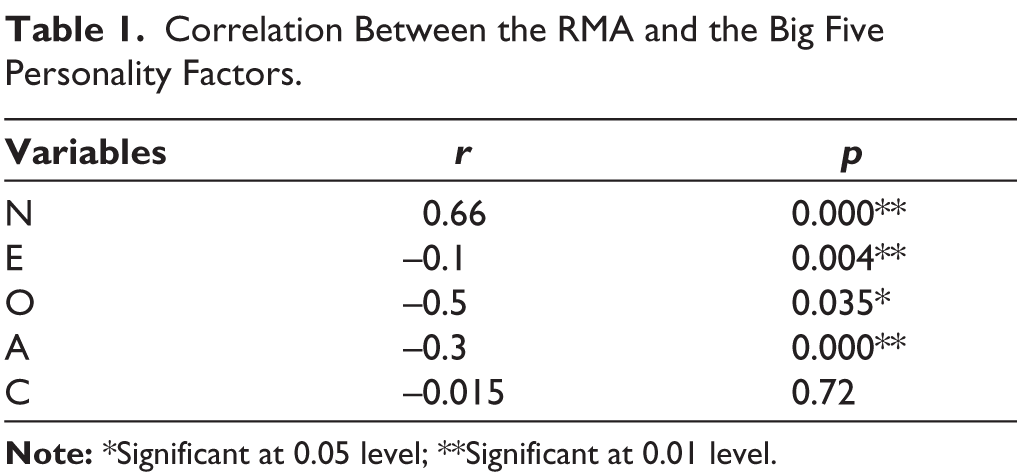
Table 1 reveals that RMA is significantly correlated to each of the N, E, O, and A factors of personality. A highly significant correlation is noted between RMA and each of N, E, and A (p < 0.01). The O factor is correlated to RMA at 95% confidence level. However, the C factor of personality does not significantly correlate to RMA (p > 0.05). Positive correlation is noted for the N factor only; however, the other four factors correlate negatively to RMA. Hence, the first hypothesis is partially accepted.
Correlation Between the RMA and the Big Five Personality Factors.
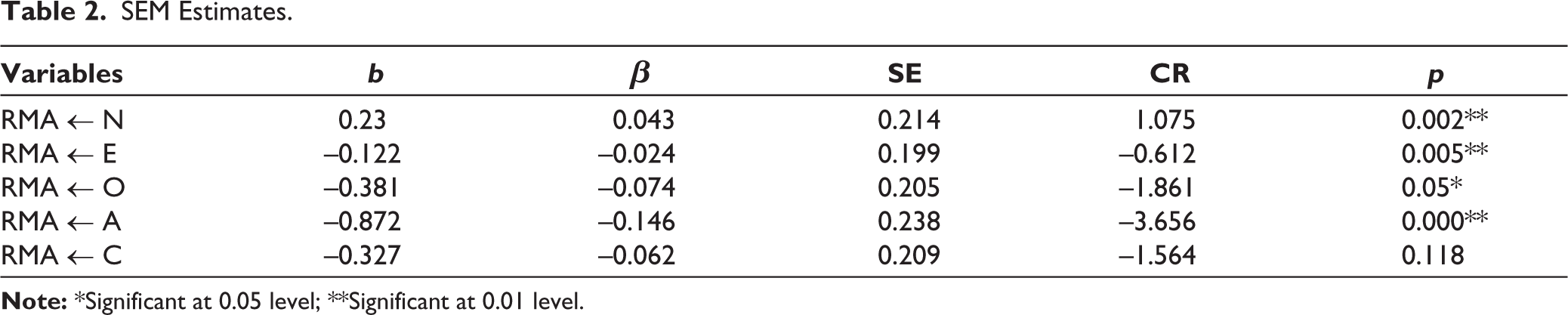
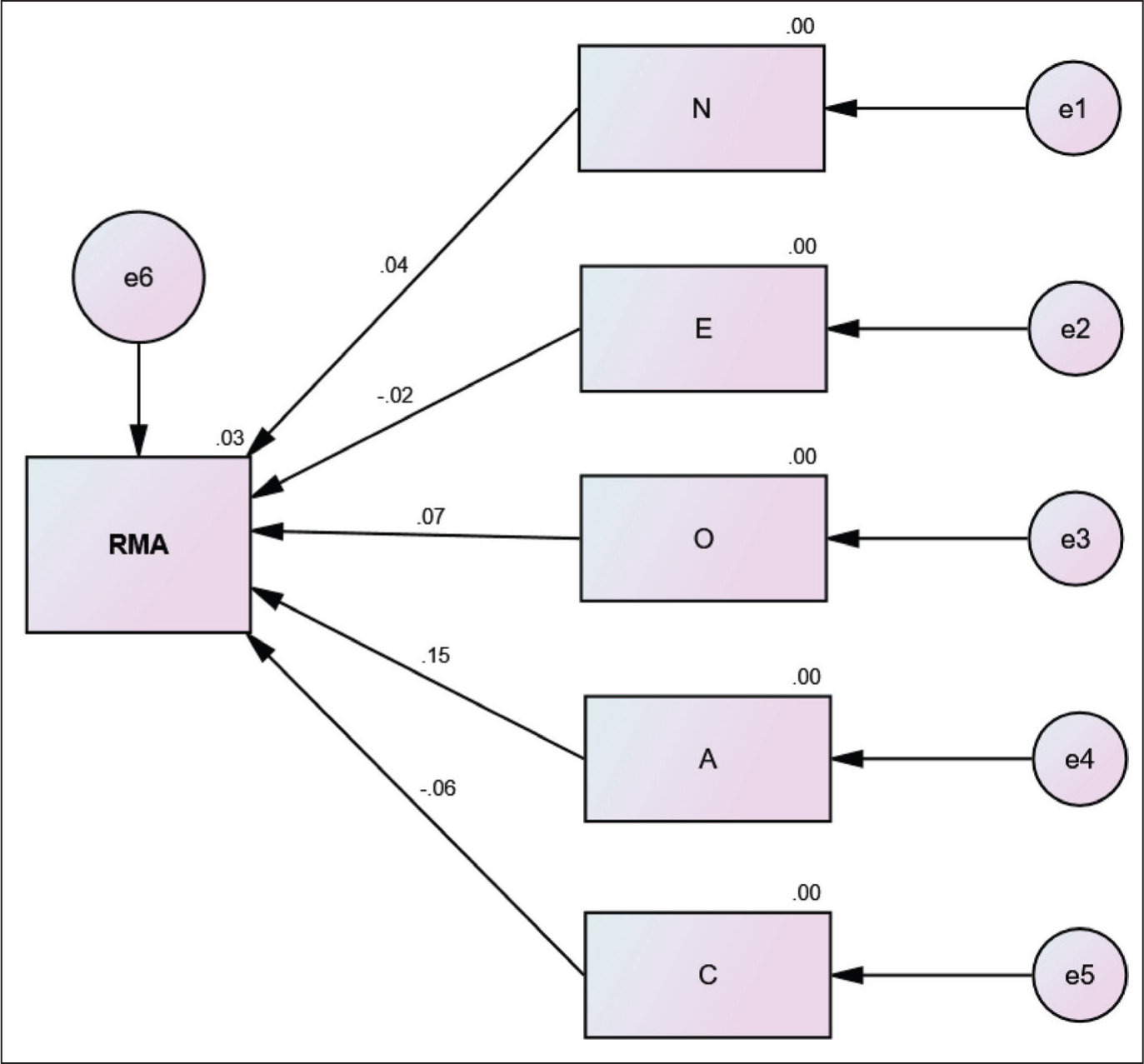
Utilizing the Structural Equation Modeling, a predictive model is formed and analyzed where RMA is being predicted by the big five personality factors. Table 2 reveals that N, E, O, and A significantly predicts RMA. No significant prediction of RMA is found by the C factor (β = –0.06; p > 0.05). The other estimates have been provided in the table. The path analysis is illustrated in Figure 1.
SEM Estimates.
Path Diagram Illustrating the Prism Effect.
Hence, the second hypothesis is partially accepted.
Discussions
The results of this study reveal that RMA is significantly correlated to N, E, O, and A factors of the big five personality traits. The path analysis shows significant prediction of RMA by these four variables. Several studies have been found to concur to the present findings. A positive correlation is noted between RMA and N. High trait anger and trait anxiety among people high on neurotic trait were found to be linked with RMA. 20 Emotional disturbance, which is one of the core features of neuroticism, is prevalent among the people who are rape perpetrators. 21 The other domains of neurotic trait were also found to be linked to RMA, that is, impulsivity, 22 deviant temperament, 23 and lack of sensitivity. 24
Other than N, the rest of the factors correlate negatively to RMA. Concurring to the present finding, Landole 24 noted that extraversion was one of the negatively correlated constructs associated with RMA. This means that the more a person endorses the rape myth, the less socially open he/she is. The person will be reserved, quiet, and passive.25,26 However, Voller and Long 27 were of the view that extraversion and RMA can be directly related because the E factor seemingly adds the element of dominance in rape myth endorsement. Also, people higher on rape myth endorsement shall be less open to experiences (O factor) in life, as it is found in this study. Hockett et al. 28 ruled that people with high sexual prejudice tend to be dogmatic and they also believe in social categorization. They are also found to be of closed-minded nature 29 and possess a conservative mindset, 30 which is also an important feature of people who are low on the O factor. The next factor A is also negatively related to RMA. Further, lesser agreeableness is linked to higher RMA, which can be seen by their ruthless, 31 less trusting, 32 and antagonistic 33 nature. Long 25 found that agreeableness is a less prevalent quality among sexual assault perpetrators. This is especially true because people who blame the victims more than the rapists are generally not the most kind hearted, softhearted, and trustworthy person. They will, in turn, be more skeptical about the intentions of the victims.
Finally, the C factor is found to be negatively related to RMA; however, there is no significant correlation or prediction noted. Opposing the current finding, studies have focused on the significant effect of conscientiousness on RMA. 34 In another study, high values of RMA was found to be significantly associated with lower conscientiousness scores. 25 One explanation for the disassociation between the C factor and the RMA is that this dimension deals with individual’s discipline, order, and control. 35 Also, the C factor is a variable, which is often used in organizational/workplace research. 36 The features of rape supportive attitudes are not very well explained by the C factor, which stands for hard work, ambition, and perseverance.
Conclusion
The relationship and the impact of the big five personality factors on RMA has been determined. The Structural Equation Modeling shows that neuroticism, extraversion, openness to experience, and agreeableness significantly correlate and predict RMA. The conscientiousness factor does not significantly predict RMA. A positive correlation with RMA is noted only for neuroticism and for the other factors, negative correlation was found.
Footnotes
Declaration of conflicting interests
The authors declared no potential conflicts of interest with respect to the research, authorship, and/or publication of this article.
Ethical Approval
The ethical approval was not required to be obtained from the local Ethics Committee or Institutional Review Board since this study follows mere questionnaire survey and not any field or laboratory experimental design. The adult participants were briefed about the study objectives and the nature of items contained in the questionnaire; further, on their full consent to participate, their data was collected by strictly adhering to the ethical standards of empirical research. Moreover, most institutes do not deem it necessary to furnish ethical approval reports for mere non-experimental, questionnaire-based research designs. The personal consent of the adult participants are deemed sufficient in that case.
Funding
The authors received no financial support for the research, authorship, and/or publication of this article.
Informed Consent
All the participants were briefed about the objective of the research and their roles in it. The participants were convinced as gave their full consent to be a part of this research.