




Abstract
Central neuroendocrine system regulated by hypothalamus, controls most of the body homeostasis involving processes, like metabolism, reproduction, stress responsiveness, growth, and energy balance mainly through hormonal signals. Plasticizers and pesticides interact as endocrine disruptors with endocrine hormones causing adverse effects which tend to destroy the body homeostasis. Exposures to these compounds during critical developmental stages such as puberty and pregnancy (prenatal or perinatal) influence neurodevelopment, social behavior of the growing fetus and causes sexual dimorphism. Plasticizers and pesticides systemize its effects on adulthood either by mimicking, antagonizing, or having an impact on steroidal activity also along with hormonal disruptions. The aim of this review is to address some of the effects of plasticizers and pesticides exposure on female behavior. In this review, we are discussing the remedial nutritional choice to control the plasticizers and pesticides mediated endocrine disruption.
Introduction
The hypothalamus is the link between the central nervous system and the body through its control of the neuroendocrine system. The neuroendocrine system is responsible for the body’s homeostasis, specifically metabolism, reproduction, stress responsiveness, growth, and energy balance. The hypothalamic neural cells that regulate the anterior pituitary gland are thyrotropin-releasing hormone, corticotrophin-releasing hormone, growth hormone releasing hormone, gonadotropin-releasing hormone, somatostatin, and dopamine. These neurotransmitters are synthesized by hypothalamic neurons packed into secretory vesicles and released directly into the portal capillary system that vascularizes the anterior pituitary gland. The pituitary in turn releases its corresponding hormones, which are then sent to peripheral endocrine organs that release hormones. All of this ultimately works for regulating body’s homeostasis. 1 The hypothalamic neurons are very sensitive for steroids and glucocorticoids and have specialized neurons in arcuate nucleus and ventromedial hypothalamus which are sensitive for glucose and have an important role in appetite.
Plasticizers
The neuroendocrine system responds to the external stimuli; they are recently found to be the targets of endocrine disruptors. Most of the plasticizers are endocrine disrupting chemicals (EDCs). EDCs can be industrial compounds (plastics and plasticizers), agrichemicals (fungicide, pesticides, herbicides), personal care products, household chemicals or contamination of food chain, phytoestrogens, and many others.
Endocrine disruptors, sometimes also referred to as hormonally active agents, EDC, or endocrine disrupting compounds are chemicals that can interfere with endocrine (or hormonal) systems. 2 The mechanism of action of EDCs is complex but since most of them are lipophilic, they can cross through cell membrane and can either bind to stimulate\antagonize the nuclear receptors or interference with enzyme involved in biosynthesis of steroid or hormone elimination/degradation. 1 EDCs ultimately lead to altered endocrine phenotype. The EDCs’ effects are adverse when exposed in crucial developmental period of life like puberty, intrauterine, or times when organisms are more sensitive to hormonal disruption. 3
Plasticizers exposure has been associated with many adverse effects in females including reproductive health, high miscarriage rates, reduced fertility, or longer time to conception. Certain studies in developed countries have shown that menstrual period age is prolonged in girls and is attributed due to the exposure of plasticizers. 3 The aim of this review is to address some of the effects of exposure of plasticizers on female behavior. Second, the dietary supplements that we consume may counteract on these plasticizers which we regularly and rarely consume.
Different Classes of Plasticizers and Its Effects on Female Behavior
Plasticizers Present in Dietary Supplements and Other Products
Food and environmental contaminants may modify child growth bidirectionally, either leading to retardation or undesirably rapid height gain related to increased energy efficiency. Endocrine disruptors are also associated with increased fasting insulin, increased BMI, and reduced cognitive and neurodevelopment. Mycotoxins have been strongly linked to stunting and immune function impairment.
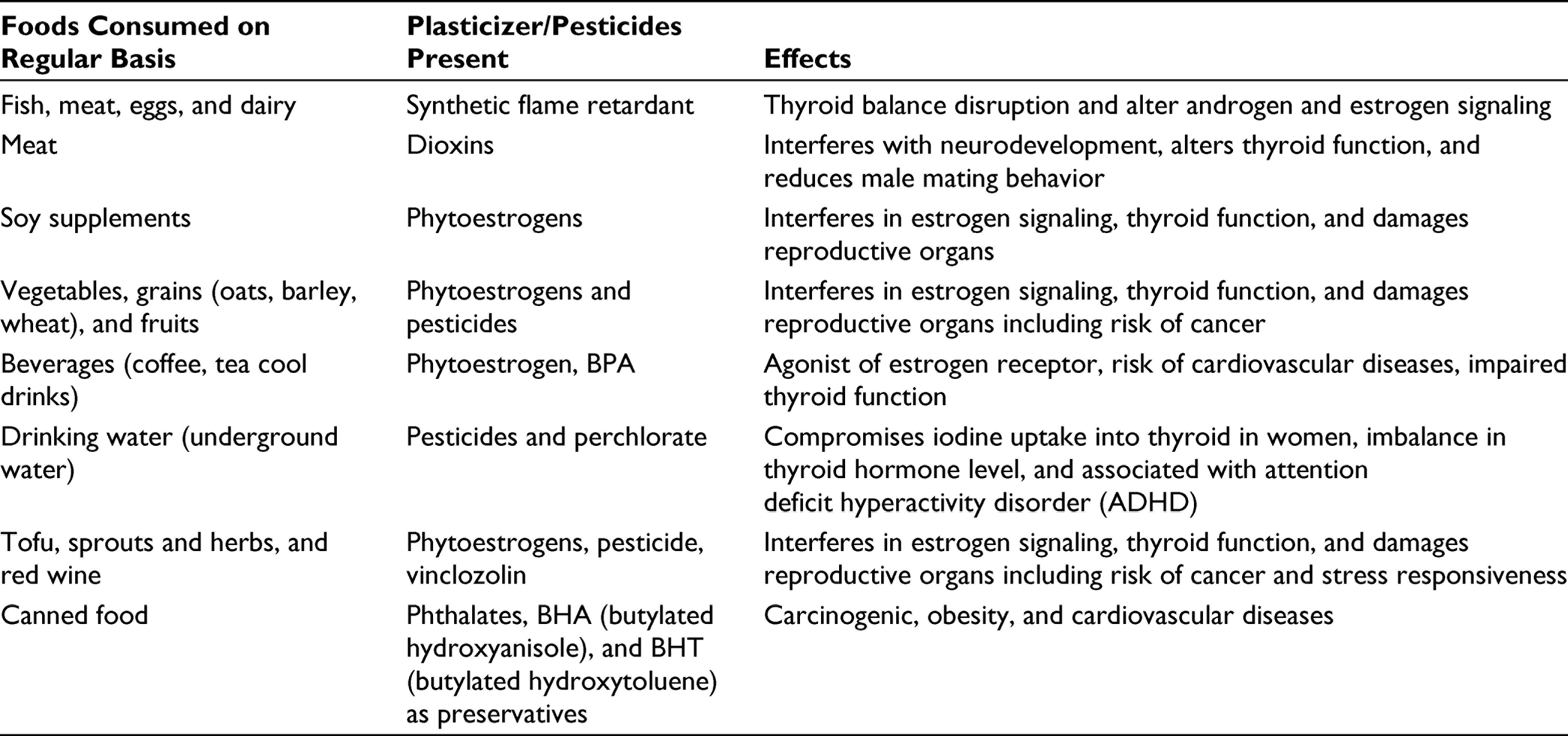
Humans are exposed to plasticizers through the environment, with food being the most common source of exposure. Humans are exposed to a variety of plasticizers, including:
Some of the Foods that Are Consumed on a Regular Basis
Other Products Where Plasticizers Are Prominent Present
Personal care products and antimicrobial products contain triclosan which is linked to development of asthma, allergies, central nervous system problems, and low levels of thyroid hormone.
Sunscreen and cosmetics have ultraviolet filters which interfere with thyroid activity.
Polyester fabric and deodorants contain paraben which mimics estrogen activity.
Plastic container, beverage cans and food packaging, nonstick coating of cookware contain BPA, and perfluorinated chemicals that cause diabetes, sperm anomalies, reproductive organ dysfunction, and altered immunity.
Byproducts of combustion include PCBs and dioxins.
Cleaning agent and perfumes contain phthalates.
Relevant Scientific Evidences on EDCs
Diethyl stilbestrol (DES) increases circulating levels of sex hormone binding globulin while decreasing circulating levels of LH, TSH, FSH, DHEA, testosterone, and estrogen in humans. 11
In utero exposure of DES correlates with a shift in women estrogen metabolism with a relative decrease in 2-hydroxylation. 12
Developmental exposure to DES increases proliferation in the developing female rat reproductive tract and abnormal mammary gland morphology; DES induces keratinization of the vaginal epithelium of mice. 13
Vulnerability
The outcomes of exposure to certain environmental pollutants may only be evident years or decades later. Another difficulty, when assessing the consequences of EDCs on human health, is that humans are exposed to many chemicals; each has specific modes of action, while interactions between them may lead to different results than with the individual compounds. The phrase “the dose makes the poison” is a traditional toxicological assumption first proposed by Paracelsus, where larger doses have a greater impact than lower ones. 14 However, with plasticizers, the dose no longer makes the poison, and understanding their toxicity is not a trivial process. Very low doses of some chemicals can have a greater impact on health than much higher ones. At low doses, they can bind to the receptors and induce a biological response. In contrast, higher doses can saturate the same receptors and inhibit the correspondent pathways. Long-term exposure of some chemicals at extremely low doses can have adverse health effects. The timing of exposure can also be a crucial factor. The toxicity of plasticizers is a time-dependent process, and exposure to them during critical stages of development can have dramatic effects later in life.
Counteracting Against Plasticizers
The above information provides that plasticizers are everywhere in nature; when this is the condition, there is a necessity to find a solution to this situation since it is not only the human suffering from plasticizers but also the wildlife which we humans are responsible. Below are some ways to counteract plasticizers.
Washing hands with filtering tap water and without fragrance soap is the basic first step to prevent any kind of threat situation.
To reduce the use of chemicals and source it as far as possible from the household.
Less use of fossil fuels.
Use glass, steels, ceramic, and aluminum containers more.
Ask the manufacturers what chemicals they are using and about its safety of consumption and find alternative eco-friendly products as much as possible.
To get rid of toxins from our body, it is healthier to choose organic foods over processed or canned foods and eat more of fibers than junk foods. Importantly, cooking food properly is necessary as half-cooked foods can also cause a threat. Avoid using a microwave for heating purposes.
Conclusion
Individuals are exposed to plasticizers and pesticides on a regular basis from varied sources including foods, herbicides, and pesticides. Exposure of these plasticizers can have immense effect on the neuroendocrine system, especially in females as most of them mimic estrogens influencing the reproductive or nonreproductive, sexually dimorphic behaviors during critical development periods. Furthermore, plasticizers act in a dose-dependent manner where even the lowest dose can have harmful effects in vertebrates. Hence, as said prevention is better than cure, we should try to avoid plasticizers as much as possible by keeping the environment clean, avoid usage of plastic and plasticizers, turn more toward organic and fresh cooked foods, also to create awareness among the people around us to get a better result.
Footnotes
Declaration of Conflicting Interests
The authors declared no potential conflicts of interest with respect to the research, authorship, and/or publication of this article.
Funding
The authors received no financial support for the research, authorship, and/or publication of this article.