




Abstract
Introduction:
Novel coronavirus (COVID-19) pandemic is the worst health emergency the world has seen in the last 100 years. It has adversely affected human life both directly and indirectly. The pandemic has led various countries to opt for lockdown to control the outbreak. India had also enforced lockdown in the country from 25 March 2020 in various phases. Lay reports have been speculative about the effects of this lockdown on the sexual practices of people.
Method:
The current study was a cross-sectional, online study performed to evaluate change in sexual behavior during the period of lockdown using a structured pro forma that studied the sociodemographic parameters, Arizona sexual experience scale, and sexual behavior of respondents before and during the lockdown.
Result:
Overall, 290 respondents were analyzed. Our research showed that there has been a decrease in the practice of vaginal sex during the lockdown but, the practice of anal sex increased among respondents who preferred it. Sexual experiences were better in respondents who were females, married, and working in essential services.
Conclusion:
The effect of lockdown on sexual behavior has been extensive, with couples adopting newer activities in their repertoire. The lockdown has also affected sexual behavior by its indirect effect on family life like increased time spent together within the boundaries of walls, direct or indirect financial loss, and lack of recreational options. There is a considerable amount of heterogeneity in the studies in this field and more studies are warranted.
Introduction
Severe acute respiratory syndrome coronavirus 2 (SARS-CoV-2 or COVID-19) pandemic is the worst health emergency the world has seen in the last 100 years. It has adversely affected the human life both directly and indirectly. The pandemic has led to various countries opting for lockdown to control the outbreak. India had also enforced lockdown in the country from 25 March 2020 in various phases. The period of lockdown entailed a number of restrictions, the most significant of which was a complete ban from stepping out of home and increased adoption of e-services for working and learning from home. The lockdown also affected family life by loss of household help, increased time spent together within the boundaries of walls, direct or indirect financial loss and lack of recreational options. Since 1 June 2020, the phase of unlocking began when significant relaxations were given.
Lay reports have been speculative about the effects of this lockdown on the sexual practices of people. The effects of the inescapable proximity have been deemed to be both beneficial and deleterious on couples. 1 For couples living a fast tracked life because of their occupational obligations or other reasons, the enforced slowdown could have acted like a boon. But, for others, this lockdown could also have been a time to explore new sexual fantasies. In some cases, this could also potentially open a path of sexual exploitation. In such a background, the current study was planned to understand the change in sexual behavior during the period of lockdown.
Methodology
The current study was conducted using a cross-sectional design through Google Form on respondents from India. The respondents were recruited using a snow-ball technique after requests to respond to the study were sent either by personalized communication via email, online messaging platform, or by group posts in social media. The study obtained clearance from the Institutional Review Board. Because the survey was anonymous, the confidentiality of the subjects were preserved at all points. Participation in this study was voluntary and participants had the option to withdraw consent at any point of time till the final submission. The study was completed between March 23, 2020, and June 30, 2020. The reporting of this study according to the checklist for reporting results of Internet e-surveys (CHERRIES) 2 can be found in supplementary Table 1.
The subjects were included in the study if they fulfilled all of the following criteria: (a) All subjects provided informed written consent for the study, (b) all respondents were staying with their partners during the lockdown, (c) all respondents must be staying in India, and (d) all subjects were comfortable in reading and responding to the questionnaires in English. The subjects were excluded if there was history of any severe mental illness in the respondents or their partners. The inclusion and exclusion criteria were validated on the basis of a series of leading questions (yes/no) at the onset of the online form. If the response to any of the questions did not fulfill the desired criteria the further form was not displayed. The study questionnaire included a structured pro forma that studied the sociodemographic parameters, Arizona sexual experience scale (ASEX), and sexual behavior of respondents before and during the lockdown. The definitions of essential services were in accordance to the criteria defined by the Government of India. 3 Financial loss was ascertained by a single-item subjective question to the respondent.
Results
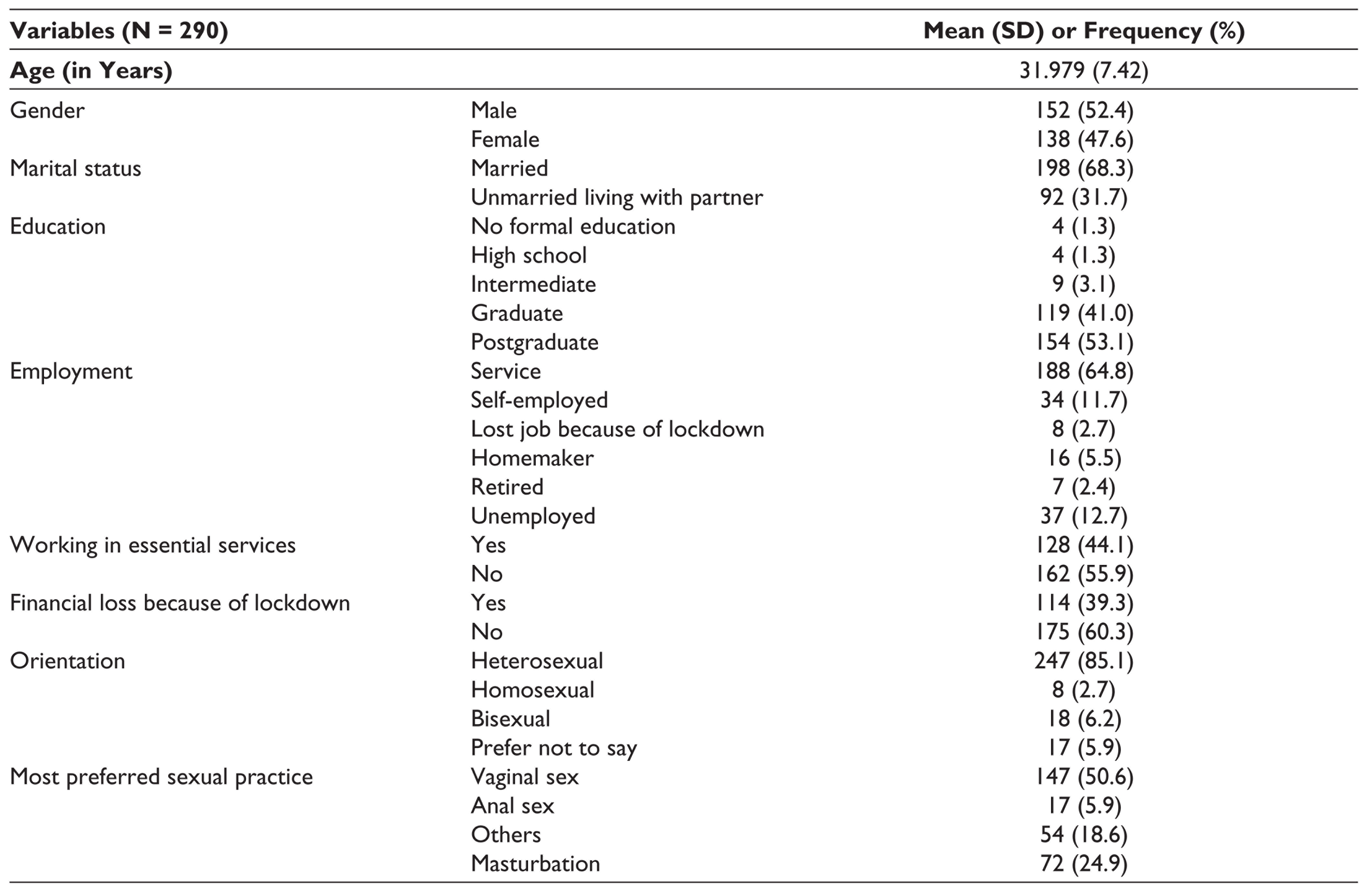
Overall, we received 471 responses. 181 responses were rejected because of various reasons (eg, non-Indian responses, incomplete or self-contradictory responses, etc.). A total of 290 respondents were analyzed, of which 152 (52.4%) were males and 128 (44.13 %) were involved in essential services (hence, not completely locked down). The details of other sociodemographic parameters have been shown in Table 1. Our sample consisted of 247 (85.1%) people who identified themselves as heterosexual, 8 (2.7%) as homosexual, 18 (6.2%) as bisexual, and 17 (5.9%) declined to reveal their orientation. 147 (50.6%) reported of vaginal sex as the most preferred sexual practice, whereas anal sex was preferred by 17 (5.9%); masturbation (self or partnered) was preferred by 72 (24.9%), and other practices (like body-rubbing and dry-humping) were preferred by 54 (18.6%) (see Figure 1).
Table Depicting the Sociodemographic Profile of the Respondents
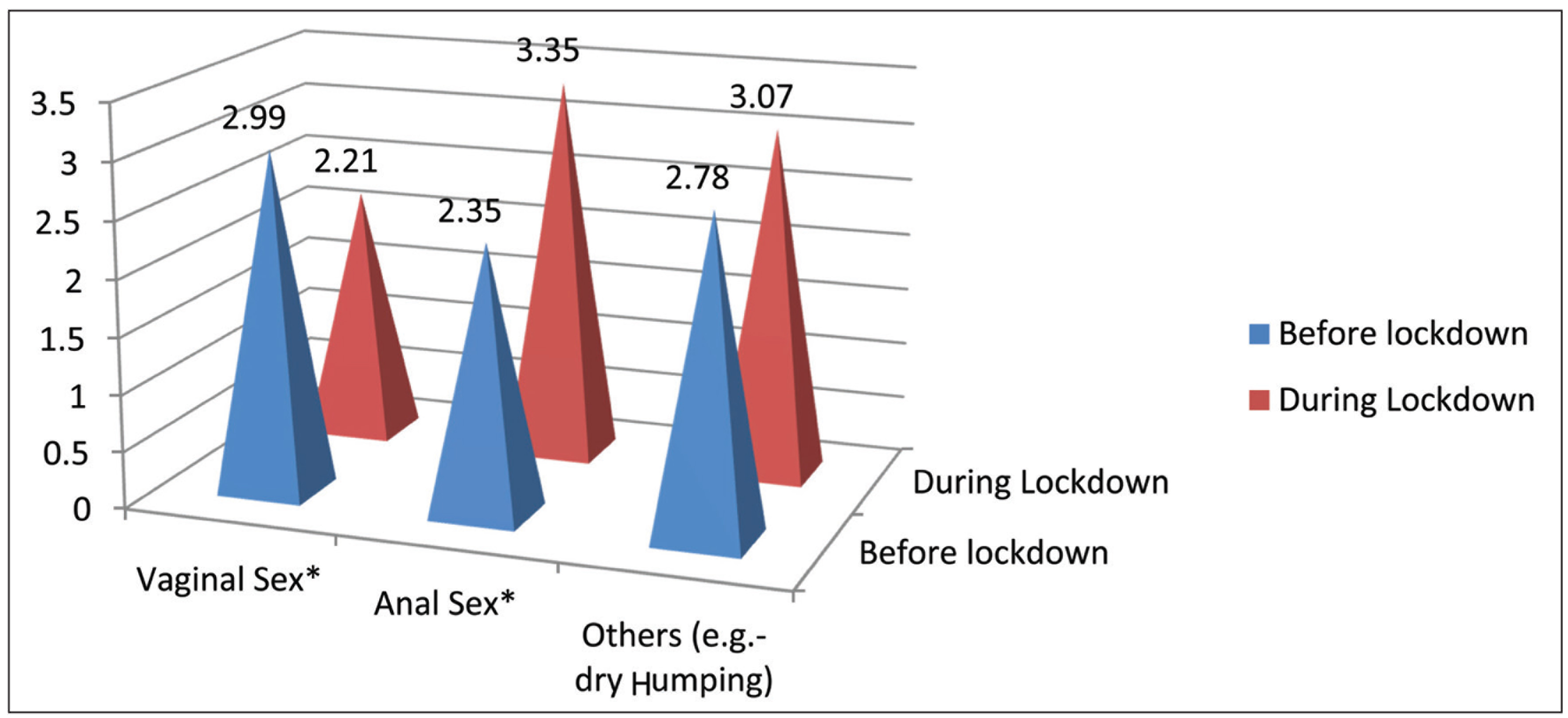
We compared the mean of weekly frequencies of sexual practices over 2 timeframes: 12 months before lockdown and during lockdown. Using paired sample t-test it was found that the mean weekly frequency of vaginal sex significantly decreased during lockdown (mean before lockdown, –2.99; mean during lockdown, –2.21; T = 4.572; P value, –.000). The mean weekly frequency of anal sex significantly increased during lockdown (mean before lockdown, –2.35; mean during lockdown, –3.35; T = –2.915; P value, –.010). However, there was no significant differences in the subjects preferring other practices (mean before lockdown, –2.78; mean during lockdown, –3.077; T = –1.678; P value, –.099).
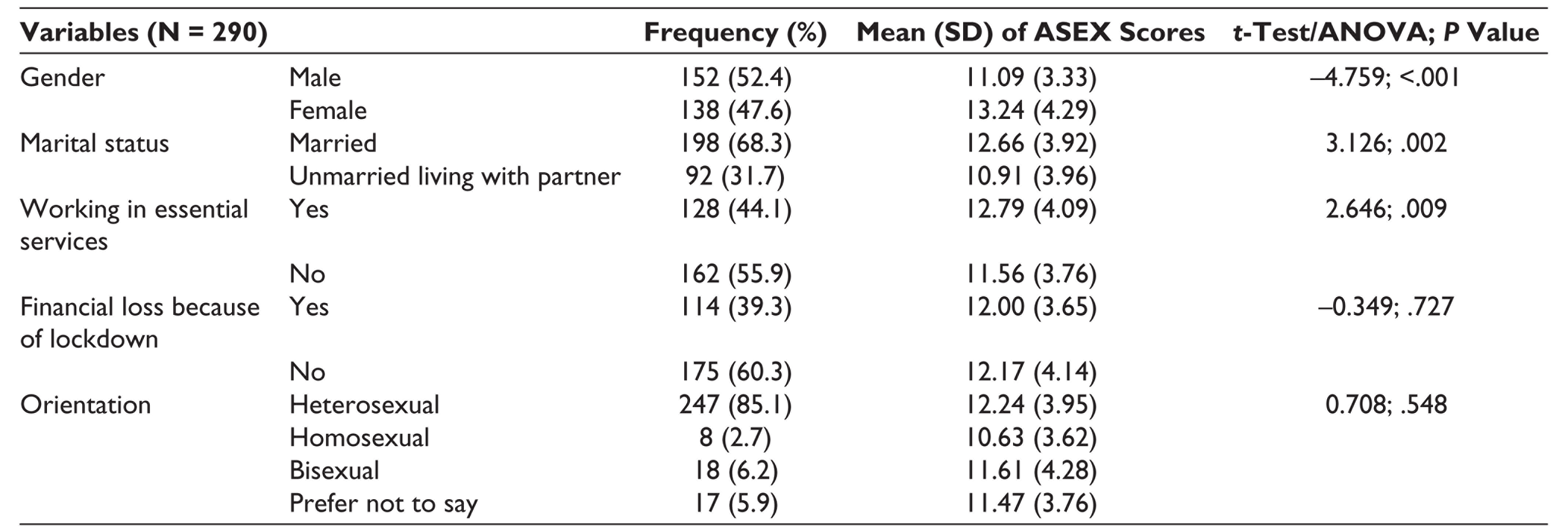
We also compared the scores of ASEX across various important sociodemographic variables in Table 2. We found that scores of ASEX were higher in respondents who were females, married, and working in essential services. Interestingly, we found that the scores of ASEX did not vary across orientation and amongst respondents who had suffered financial loss during the lockdown.
Table Depicting the Comparison of Scores on Arizona Sexual Experience Scale Across Select Sociodemographic Variables
Discussion
The research on the sexual behavior during the times of COVID-19 has picked up in the recent months. But there is a fair amount of heterogeneity in the trends of the results, which makes our study even more relevant. Overall, our research showed that there has been a decrease in practice of vaginal sex during the lockdown. Our study contradicted another study 4 conducted in 3 Southeast Asian countries including India using online survey, which showed that there has been no change in the frequency in the sexual behavior, though 45% of respondents reported that lockdown was affecting their sexual life. This could be because of the reason that our study had a larger sample size. But, interestingly, another study conducted exclusively on females 5 reported that the COVID-19 related lockdown led to increased sexual desire and increased frequency of partnered sexual activities.
We could observe an interesting trend of the frequency of anal sex going up in respondents preferring it. This could be because of the reason of couples having more time to explore newer ways of sexual fulfillment. 6 Another factor that could have played a role is more time spent watching pornography during lockdown. 7 But, data-driven research in this field has been relatively less, more so in cases of nonvaginal sexual practices. Our findings can be considered to be in sync with another report from 1559 respondents of an online survey that reported increase in a variety of sexual practices and incorporated newer activities. 8 There has been evidence that shows that during the course of this lockdown couples have reported lesser preference for pregnancy and contraception. 5 Adoption of anal sex could be a result of such preferences.
Our study showed that the sexual experience as assessed on ASEX was higher amongst females and married population. This is supported by the evidence of females reporting higher sexual desire in the lockdown, as reported on an online survey. 5 Very interestingly, the respondents who were involved in essential services reported higher scores on ASEX. Although we do not have any representative data to compare this finding, we can presume that this could be because of respondents appreciating sexual intimacy as a mode of relaxation and bonding in stressful times.
There was no significant difference in the ASEX scores across the sexual orientation of the respondents. This means respondents who preferred same-sex encounters (homosexual and bisexual) did not differ from the heterosexual respondents. This finding is out of keeping with the evidence from a study from the USA, 9 where male respondents who prefer same-sex encounters reported significant hindrances in their sexual practices owing to the COVID-19 situation.
We believe that this lockdown provided us with a unique opportunity to study the nuances of human sexuality. Since the outbreak of COVID-19 pandemic, throughout the world people had to make various changes in their lifestyle. For that matter, people have also started to adjust to the ‘new normal’ in their sexual life. The fear of infection because of kissing and physical touching has led to various couples being wary of partnered sexual activities. 10 On the contrary, people are also starting to adopt various virtual methods for sexual gratification (video-chats, remote-controlled sex toys, etc.). 11 Lockdown changed various factors that can affect sexual behavior, such as increase time available to partners, lack of privacy because of higher number of inmates at home, and stress arising out of economic shutdown and sudden change in interpersonal dynamics. 12 The major limitations of our study were the use of a convenient sampling, use of English media, using a cross-sectional design, and loss of sizable data because of incomplete responses (which could be because of sensitive nature of questions). Also, our study focused on the sexual behavior. The emotional aspect of sexuality has not been studied in this endeavor. However, in spite of that we believe this study was able to generate a hypothesis which can be a foundation of more rigorous research. The future studies in this field should be conducting longitudinal studies to look for long-lasting effect of the lockdown in the sexual behavior. We should also try to incorporate the important findings of the current studies in the practices of psychosexual medicine in the future.
Conclusion
Our study which was conducted during the lockdown enforced because of the outbreak of COVID-19 pandemic studied the sexual behavior of couples during the lockdown. It showed that there has been a decrease in practice of vaginal sex during the lockdown but, the practice of anal sex increased among respondents who preferred it. Sexual experiences were better in respondents who were females, married, and working in essential services. The lockdown has also affected sexual behavior by its indirect effect on family life such as increased time spent together within the boundaries of walls, direct or indirect financial loss, and lack of recreational options. There is a considerable amount of heterogeneity in the studies in this field and more studies are warranted.
Footnotes
Declaration of Conflicting Interests
The authors declared no potential conflicts of interest with respect to the research, authorship, and/or publication of this article.
Funding
The authors received no financial support for the research, authorship, and/or publication of this article.