




Abstract
Abstract
Introduction
Pornography, perhaps the most accessible forbidden material, has been with us from historical time. Over the time, only the medium of pornography has been changed from sculptures, photograph, books, magazine, and video tapes to today’s e-book, digital images, and videos. 1 Internet is an ocean of potentially rewarding explicit content, and it has now become easily accessible and affordable even in developing countries. With ever-increasing demand from the users, pornography has become a stable multibillion-dollar industry.2, 3
Smartphones give the user a private space and anonymity. Hence, a combination of smartphone and the internet is the most preferred way of pornography acquisition nowadays.4, 5 The internet search trend reflects the information-seeking behavior of the internet users. 6 For a sensitive issue like pornography, online anonymized data collection is a better choice than self-report information-seeking behavior. A face-to-face interview or questionnaire-based study may have several bias.7, 8 “Google trends” provides trends of internet search volume in terms of “relative search volume (RSV)” over the time and according to different geographical locations on their website (https://trends.google.com/trends).
It has been found that higher educational attainment is positively associated with higher usage of pornography in Dutch adolescents. 9 Luder et al also found similar picture in Swiss adolescents. 10 Study by Lim showed that higher educated young Australians use pornography at a higher rate. 11 In contrast, Peter et al reported no relationship of education and pornography use in Dutch adolescents. 12 Study by Yang found that people with lower social status, lower income, and higher working hours has lesser opportunity for sexual intercourse and thus uses pornography at higher rate in the USA. 13
Literature about pornography-seeking behavior and its association with education and income has not been explored in India. With this background, our research question was if there is any correlation of online pornography-seeking behavior with the literacy rate and the net state domestic product (NSDP) in Indian states.
Methods
Ethics
This study does not involve any human research participants. The data used for analysis were obtained from a public domain which does not restrict a user to analyze their data for any research purpose. Hence, formal ethical clearance was not obtained from the institute for this study.
Settings
Data relating to the internet search trend were collected from the website
Process of Data Collection
Pornography-related keywords (viz., porn, XXX, Xvideos, and sex) were selected after reviewing the article by Markey et al. 7 These keywords were searched on the Google trends website first individually, then in combination for last 5-year period in India. State-wise RSV data were downloaded from the website for further analysis.
Educational level and per capita NSDP according to different Indian states were collected from a public domain managed by the Government of India.14, 15
Data Handling and Statistical Analysis
Collected data were compiled into the spreadsheet software, Microsoft Excel 2010 (Microsoft, USA). The state-wise data were arranged alphabetically to get data of a single state across a row. During this stage, Google trends data of “Lakshadweep” was found to be missing. Hence it was removed from the list. For matching the state-wise RSV of pornography-related keywords, the literacy rate and NSDP of Lakshadweep were removed. Furthermore, the NSDP of Dadra and Nagar Haveli, and Daman and Diu were not obtainable. Hence, during analysis of NSDP and RSV, those 2 states were removed from the RSV list.
For finding the overall pornography-seeking behavior, a mean of RSV of 4 keywords were used.
Pearson correlation coefficient was used to find a correlation of RSV with the literacy rate (percentage) and log-NSDP in GraphPad Prism 6.01 (GraphPad Software, Inc., California, USA). Statistical analysis was presented with correlation coefficient (r), 95% confidence interval, and P value. A P value < .05 was considered statistically significant.
Results
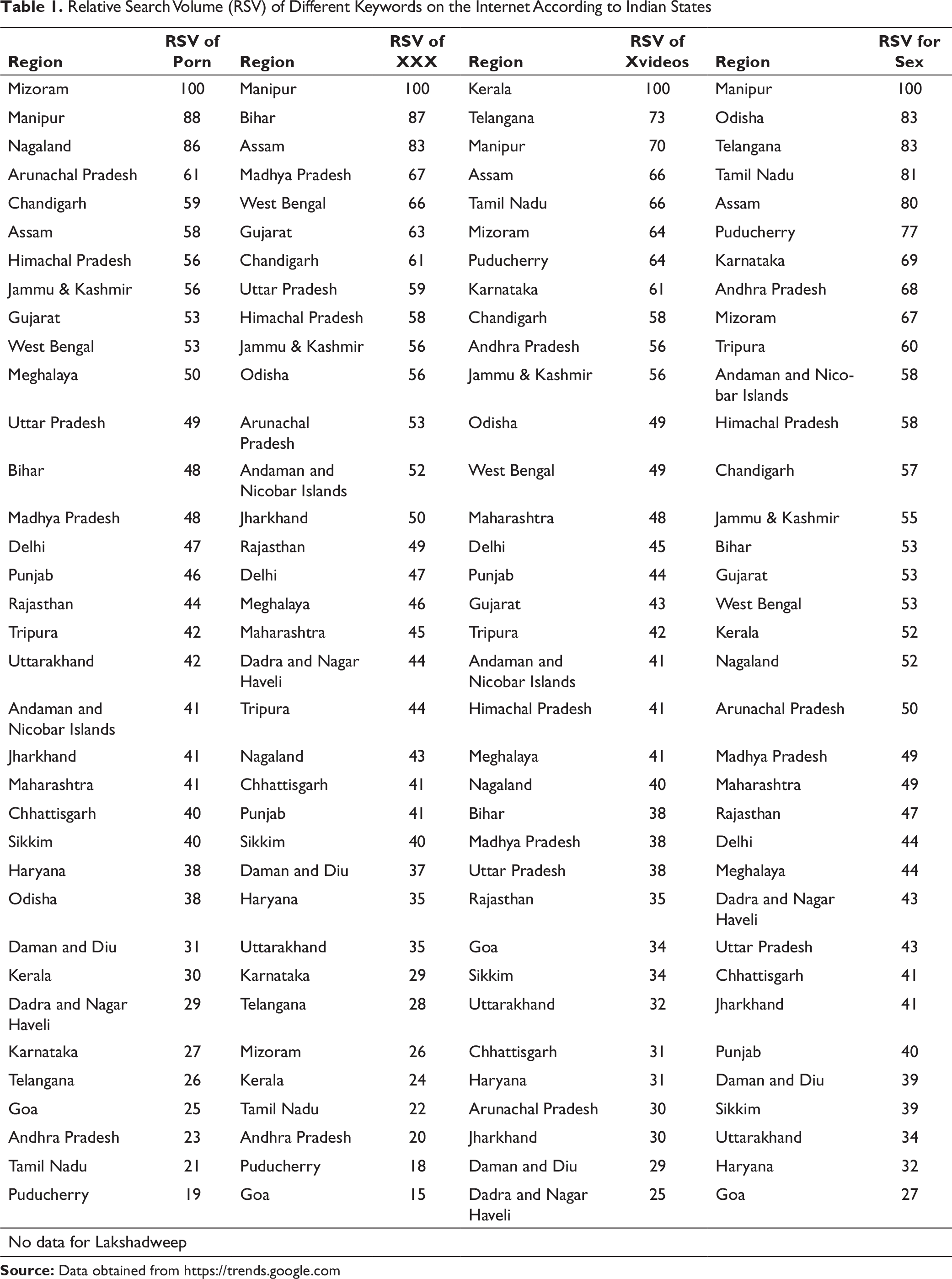
State-wise RSV of the keywords are presented in Table 1. The top 5 states searching the word “porn” were Mizoram, Manipur, Nagaland, Arunachal Pradesh, and Chandigarh. The top 5 states searching the word “XXX” were Manipur, Bihar, Assam, Madhya Pradesh, and West Bengal. The top 5 states searching the word “Xvideos” were Kerala, Telangana, Manipur, Assam, and Tamil Nadu. The top 5 states searching the word “Sex” were Manipur, Odisha, Telangana, Tamil Nadu, and Assam.
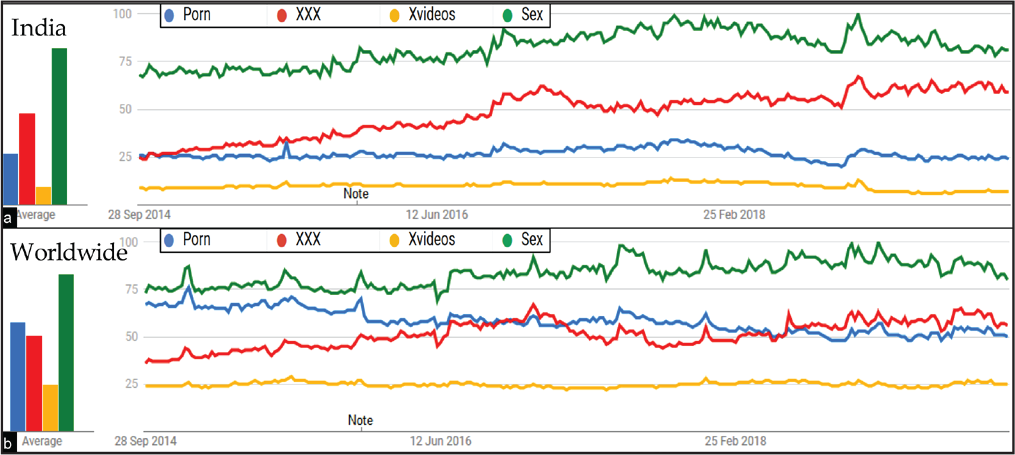
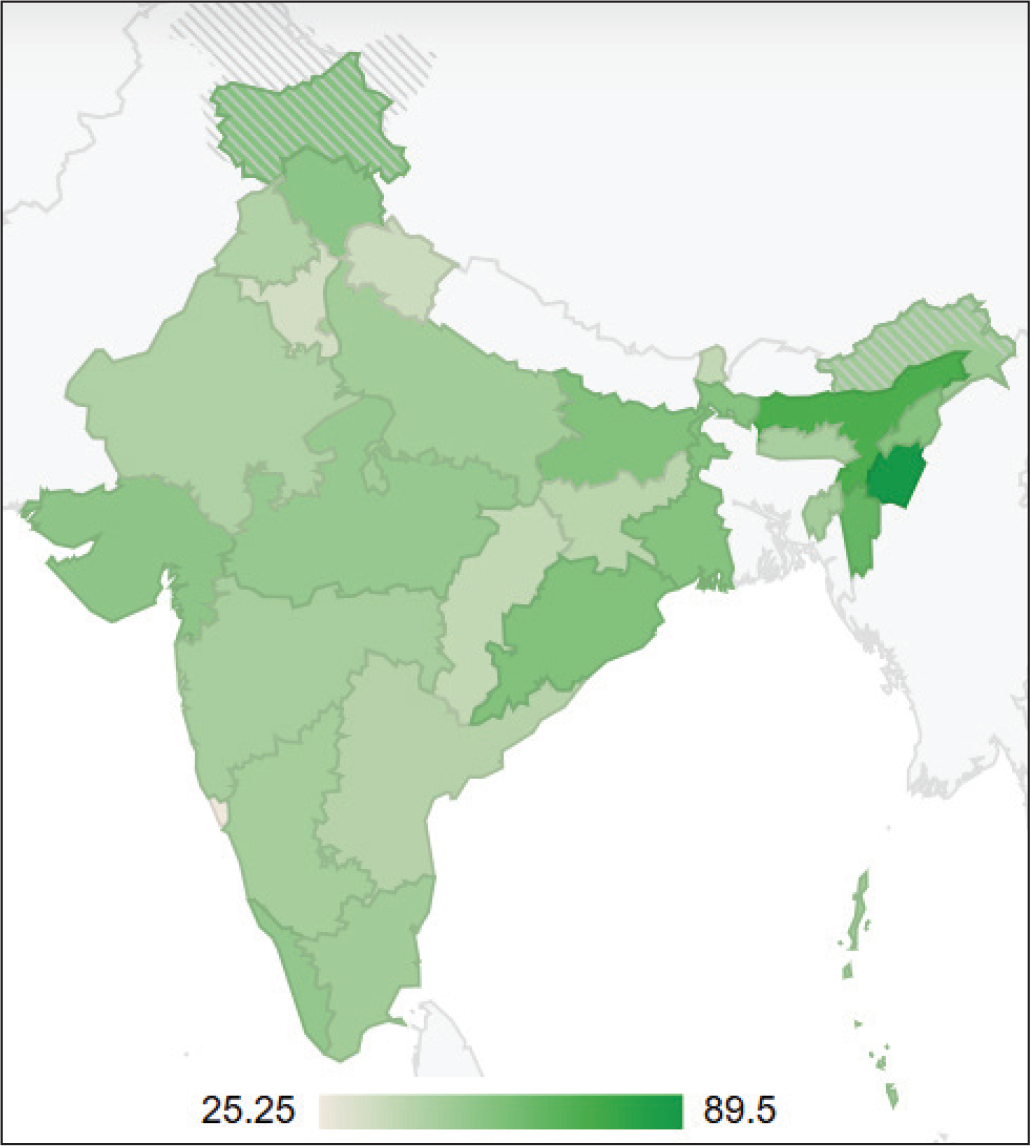
5-year relative trend for the keywords is presented in Figure 1a. The trend for the same set of the keywords worldwide is presented in Figure 1b. Indian online users search the word “sex” at a higher rate followed by “XXX”, “porn”, and “Xvideos”. Similarly, worldwide search for “sex” was higher than the other keywords. However, “porn” is more searched than “XXX” worldwide. The word “Xvideos” remain the least choice worldwide like in India. The RSV of “sex” and “XXX” were increased over time with a dip at the end of 2018. The trend for other 2 words remains invariably stable over the time. Overall state-wise pornography-related search volume is shown in a heat map in Figure 2.
Relative Search Volume (RSV) of Different Keywords on the Internet According to Indian States
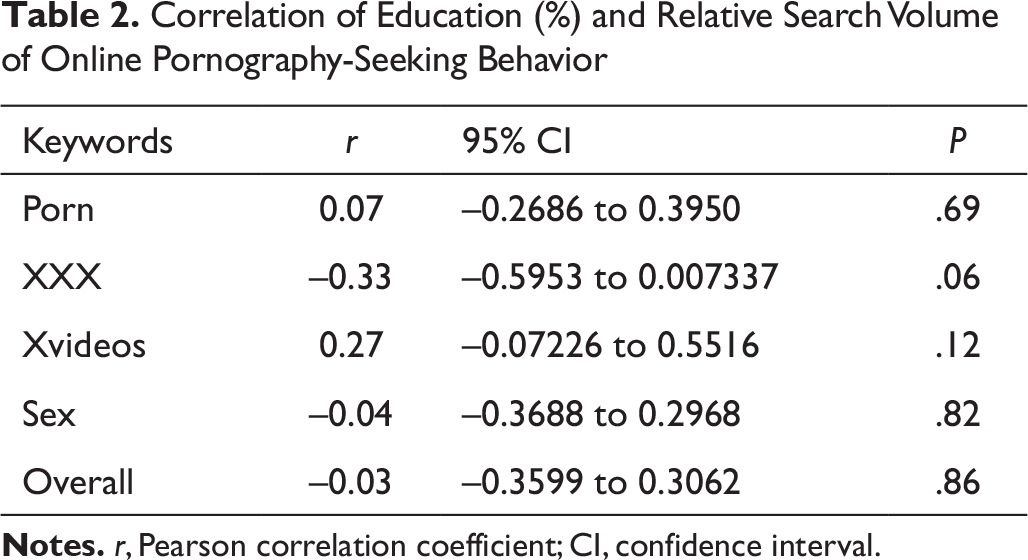
Correlation of Education (%) and Relative Search Volume of Online Pornography-Seeking Behavior
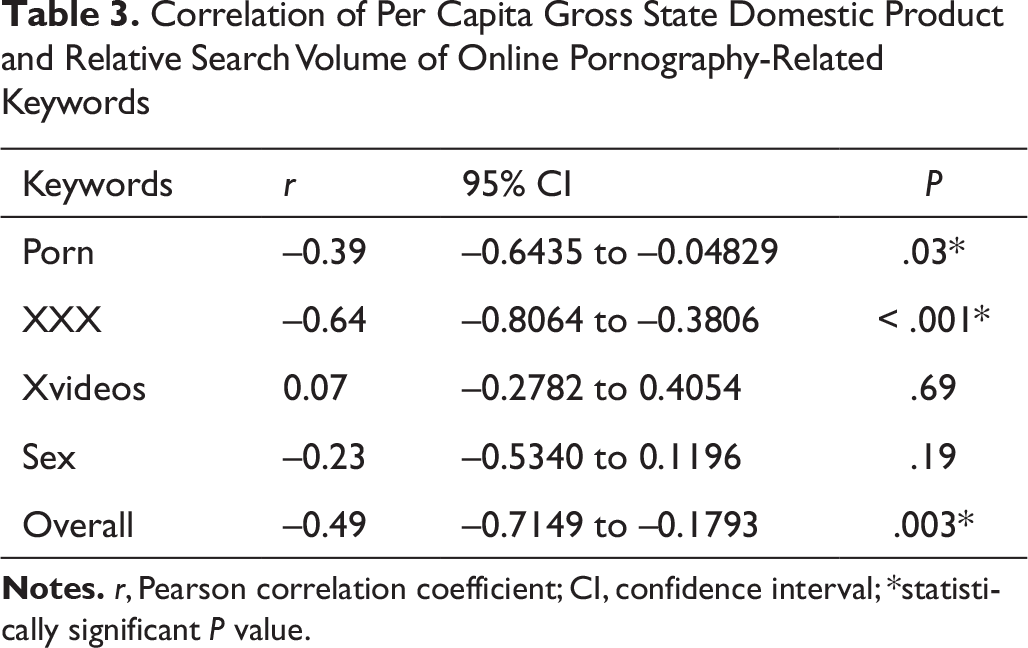
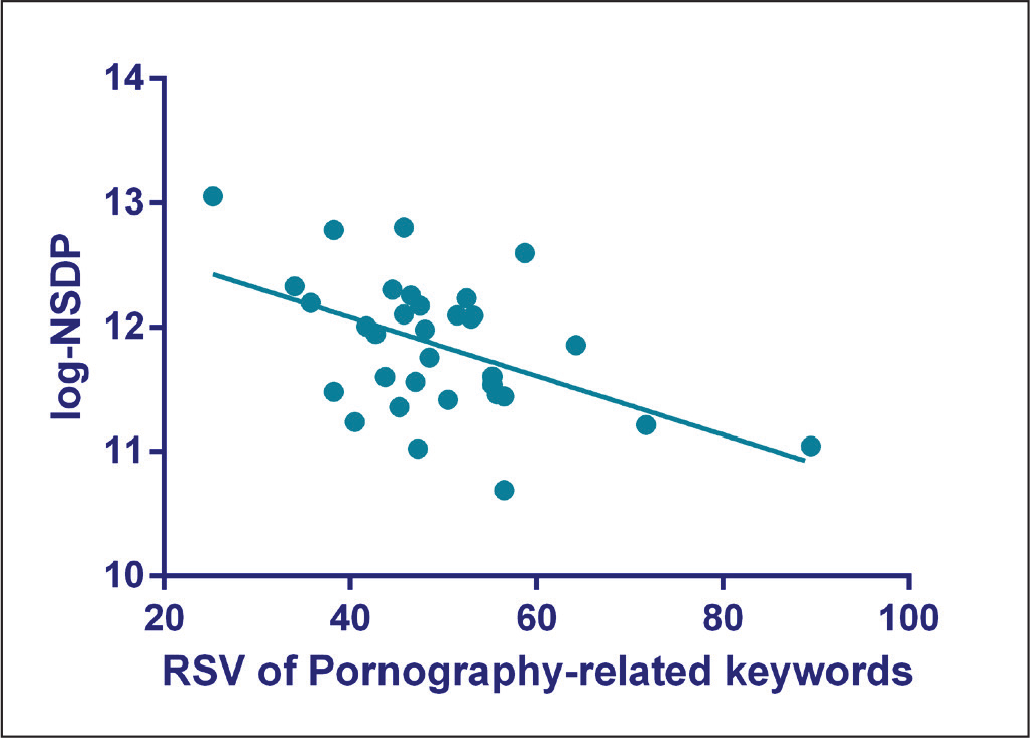
Correlation of Per Capita Gross State Domestic Product and Relative Search Volume of Online Pornography-Related Keywords
Discussions
Region-Wise Pornography-Seeking Behavior
In this study, we report Indian state-wise data on pornography-seeking behavior on the internet. It is found that overall pornography-related keywords are searched at the highest volume from the northeastern states. This information-seeking behavior may be due to lesser sex education in the region. Hence, governmental and nongovernmental organizations may think about strengthening formal sex education in the northeastern region of the country. Another reason is lower socioeconomic status of the states. However, if we take individual keywords, there are other states which top on the list of top-five states searching for the keywords (Table 1). Hence, the underlying factors except the socioeconomic status should be further explored.
Pornography-Seeking Behavior and Literacy
The relationship of the pornography-seeking behavior with literacy rate was neither quantitatively nor statistically significant (Table 2). This finding does not support the previous study conducted on adolescent and youth in the Netherland, Switzerland, and Australia. Majority of the previous study found a positive relation between these 2 variables.9-11 There may be various reasons behind this noncorroborative finding. The finding of the previous study was based on survey on the population level. In the current study, we used online user data which is a part of population having access to the internet. Further, there may actually be a difference between the pornography usage and the pornography-seeking behavior. Simply, a pornography user may not seek information from the internet. On the other hand, an information seeker may not use pornography. In addition, we used the data as the literacy rate, not the level of literacy. Whether a graduate seeks more or less pornography than a high school pass out is a topic of future research in India.
Pornography-Seeking Behavior and Economy
The online pornography-seeking behavior was found to be negatively correlated with NSDP. This finding suggests that an increase in NSDP decreases the pornography-seeking behavior or vice-versa. This finding is corroborative with study by Yang from the USA. A higher socioeconomic status enables people to have access of various entertainment opportunities and sexual exposures. 13 This may be the reason for less pornography-seeking behavior in states with higher NSDP. However, socioeconomic status at the individual level and its relation with pornography-seeking behavior remain a topic of future research.
Effect of Pornography Usage
Many teenagers and young adults use pornography as a resource for sex education, while others use it for sexual arousal.16, 17 Exposure to pornography increases the frequency of sexual encounters. 18 In addition, excessive watching of pornographic content may influence the sexual life or even increases chances of relationship breakdown.19, 20 There is also reduction of grey matter volume with high exposure to pornographic content. 21 In contrast, at the social level, a higher usage of pornography is associated with a reduced rate of rape. 22 This statement may seem to be an oversimplification of the data of pornography usage and the rate of rape. Kutchinsky showed that pornography usage does not increase the rate of rape. 23 In support of the finding, Math et al from India found that pornography has no association with the rate of rape. 24 India has a strict law to prevent production, storage, and usage of the child pornography (ie, explicit content showing children). 25 However, adult pornography is not banned, but not even legalized. 26 Indian telecom operators have banned many pornography websites which may be the cause of a dip in the trend data near the end of 2018 (Figure 1a). 27 This also proves that a huge number of internet searches are for pornography. Despite the ban, the search volume does not show any decline. Hence, in India, pornography remains the accessible forbidden matter with unproven advantage or disadvantage.
Novelty of This Study
This study reports anonymized online pornography-seeking data at the national level and reports correlation data on the pornography-seeking behavior with state-level literacy and NSDP. There is no previous study on this topic from India. The data may be considered devoid of any bias from the level of data collector to the respondents which otherwise may present in survey-based data. However, the literacy and NSDP data itself may have some minor error as it actually comes from field-level survey.
Limitation of the Study
Only Google provides the search trends; hence, we could not analyze data from other websites (eg, Yahoo, Bing). However, Google search shares 92.96% on all platform and 95.86% of mobile global searches. 28 Only search result in English was considered. Though there are diverse languages in India, English is the popular search language and it is the major language (54.6%) on the internet and Hindi search comprised of only 0.1%. 29 There are some missing data relating to a few states at the level of Google trends website and governmental websites. Hence, those states were excluded from the analysis.
Conclusion
Overall, northeastern states of India showed higher volume of internet search for pornography. The literacy rate of states does not have any relation with online pornography-seeking behavior. States with lower NSDP search pornography at a higher rate than the states with higher NSDP. Exploration of the underlying reason of this finding should be a future research topic.
Footnotes
Declaration of Conflicting Interests
The authors declared no potential conflicts of interest with respect to the research, authorship, and/or publication of this article.
Funding
The authors received no financial support for the research, authorship, and/or publication of this article.
