




Abstract
Abstract
Introduction: The volcanic eruption of the #MeToo movement shows that the problem was there for long and was simmering on. The movement was initiated with the aim of knowing the magnitude of the problem and has now spread worldwide. The cases of the Me Too sexual wave are recent and have not yet attracted much scientific attention, though literature on sexual harassment is widely available and the psychological mechanisms implicated in this movement can be understood and examined through it.
Objectives: This article aims to attract attention of the medical fraternity to update themselves of this issue which is essential for better understanding of the movement which has potentially good, bad, and ugly undercurrents. We will call attention to these aspects perusing the literature both at national and international levels. This would also be subjected to an analysis of the established concepts and principles of human psychology and behavior.
Conclusion: It is amply clear that the time for sweeping things under the carpet is over and the catharsis that flooded the social media, print media, and TV just show how important it is to make the future workplace fair to both genders.
Introduction
Me Too and Men Too movements are the phenomena which gained its early foothold on the internet chat-boards to support sexual harassment victims. Generally, victims are supposed and encouraged to have a formalized complaint process, perhaps even by a prescribed format. But, social media, a new way to communicate, exposed the otherwise hidden problem via a movement called Me Too via attaching the hash tag #MeToo to the shared posts.
The reaction to this movement depends upon whether one is a perpetrator/enabler or a sufferer or a mere bystander and varies from total denial to sharp satire or outrage.
#MeToo, re-popularized by actress Alyssa Milano, demonstrated the widespread prevalence of this problem. 1 The incredible momentum that it has gained, combined with men getting more involved through campaigns like #MenToo, indicates that it could be a tipping point for making significant and never lasting changes in the area of sexual assault and violence. Indeed, contemporary social narratives, including the notion that “real men” can protect themselves, 2 pose obstacles for males coping with victimization. 3 First and foremost, we hope that each and every survivor sharing their story feels valued and believed, and those who had not or could not share their tragic story also feel supported. Furthermore, we also hope that men will start to understand that they have the solution.
Origin and Purpose of #MeToo
Social media gave the power to express the topics which were earlier considered very difficult to articulate. Sexual harassment and abuse (SHA) is a challenging topic for individuals to talk about, irrespective of whether the environment is an online or offline setting.4, 5 Potential perpetrators vary from close contacts such as spouse, parents, or other family members to colleagues and men in powerful positions.
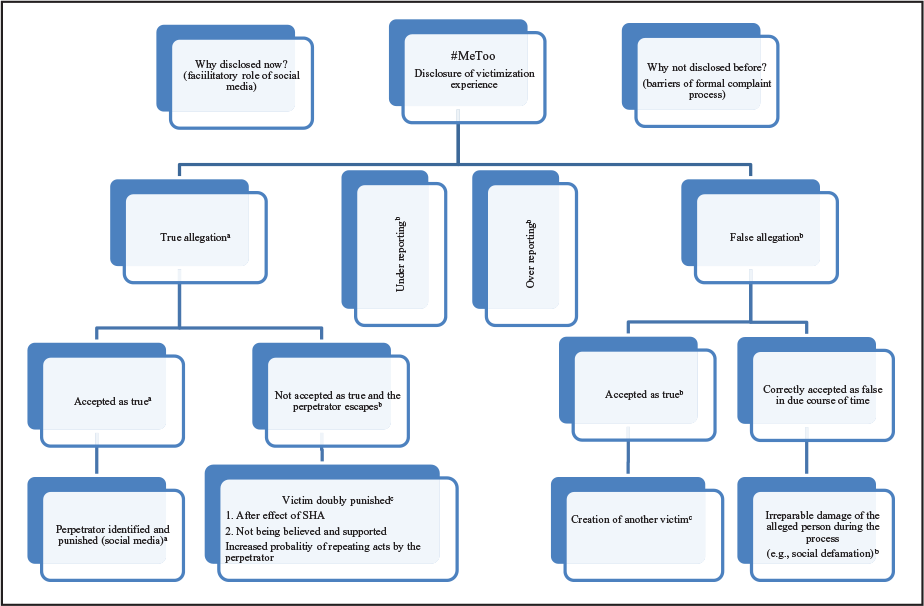
Society can respond in many ways. Movies, television specials, talk shows, books, and social media have brought the problem out into the open. SHA complaints vary from informal remarks to formal written complaints. Generally, victims are supposed and encouraged to follow a formalized complaint process, perhaps even in a prescribed format. Recently, social media, a new way to communicate, expose the magnitude of this severe problem via a movement called Me Too by attaching the hashtag #MeToo to the shared posts (Figure 1).
The purpose is twofold—assessing the magnitude of the problem and to see whether it is gender-specific.
Assessing the Magnitude
World Health Organization 6 reported that an alarming percentage of women worldwide, 70%, had suffered from some form of violence in their lifetime. Childhood sexual victimization was reported by 20% of women and 10% of men. 7 Another study revealed that 70% of the adolescents were abused by someone known.8 In a telephonic survey in Australia, prevalence of unwanted non-penetrative experiences (34%) and penetrative experiences (12%) before the age 16 were reported by females which was in sharp contrast to males where these rates were half (16% for non-penetrative and 5% for penetrative experiences). 9 Shockingly, the abuser does not consider any relationship boundaries and can vary from parents, step parents to caretakers or complete strangers.10, 11
#MeToo is Not Gender-Specific
Facebook and Instagram started hashtag movements and all the social media platforms were flooded with stories of experiences of personal pain and anguish over sexual assault. 12 Men were villainized as perpetrates and women as helpless victims. 13 However, in a review, 20% of adolescent girls and about 45% of college women self-reported that they perpetrated some form of sexual violence. 14 Interestingly, data regarding female sexual perpetrators is lacking, 15 mainly because men may under report as such incidents may be perceived as an insult to their masculine identity. 16 Among women, lesbians reportedly experienced more female perpetrated sexual violence than heterosexual women. 17
Good, Bad, and Ugly Aspects of the Movement
Many high profile cases of sexual harassment, coercion, and assault were reported from around the world, including India. However, there are good, bad, and ugly aspects of these movements (Figure 1).
Good
The #MeToo phenomenon has come with many benefits as it is entirely plausible that due to fear of formal or informal retaliation, some victims feel it difficult in filing a complaint and instead of filing a complaint they might quit. The #MeToo movement has encouraged many women to come forward. In short, it can be said that these means provide the victims with a platform to express, to get social support, and ventilate their feelings.
Many personal stories of anger and guilt, buried under years of silence, emerged out to public media because of these recent campaigns. Many victims have come forward by the means of these movements who might not have felt empowered and have not spoken out and now started speaking out using social media to share their tragic stories, support and stand with one another, and expose their alleged offenders.
It provides heightened awareness and promotes a quasi-legal framework around social and workplace harassment. It also allows a more level playing field where women can focus on the job rather than the clothes they wear. It would provide a safer and more sanitized work environment.
Bad
The movement led to “trial by media” with alleged persons publically “blamed and shamed” before getting a chance to defend themselves and having an opportunity of a fair trial.
Some individuals may have the desire to keep distance from females. 56 The Bloomberg’s article “Wall Street rule for the #MeToo era: avoid women at all costs” summarized some of the fears people have of wrong accusations, gender segregation, and adverse impact on women’s careers. Moreover, it would kill all spontaneity and natural behavior and create fear, paranoia, and avoidance. These intense reactions might be based on the facts that these individuals do not fully understand what actions are inappropriate or wrong, and it is more worrying that those responses seem to have reactive aggression behind them. 18 In short, it can be said that unethical use of these platforms can lead to broken faith in the relationship. Moreover, sometimes, offenders can try to threaten the victim that may have bad impact on the victim, as instead of getting help and support they are pushed back, demoralizing them and shattering their confidence.
Ugly
Some incidences of false allegations and wrongful convictions arguably indicate that the pendulum has swung too far: such allegations generally have a snowball effect and may lead to severe damaging consequences on the reputation and careers of the falsely alleged perpetrators even if they were ultimately proved innocent.19, 20 Different studies have reported that false rape allegations and charges were frequently made by persons with different motives. 21 Due to prejudice against victims, many professionals consider that nearly 50% of claims were false.22, 23 From the sports arena, several stakeholders believe that the young people lie and make false allegations of sexual abuse but there is hardly any support from literature for this.24, 25, 26 Similar myths like females lying about rape and children lying about incest lack evidence.27, 28 In short, over reporting and false allegations are the ugly faces of these movements.
It is believed that popularity plays a central role in social network sites; individuals wants to be perceived as popular at any cost. 29 Kanin 30 discusses three main motives for filing false allegations, namely alibi, revenge, and attention/sympathy-seeking. Another motive proposed for false allegation is gain which may be material or emotional. Another study proposes eight different categories of motivation for filing false allegations: material gain, alibi, revenge, sympathy, attention, a disturbed mental state, relabeling, or regret. 31 Saunders 32 noted that it might be difficult at times to identify an actual motivation behind a false allegation, as combination of contextual and personal factors operate to create such motivations.
#MeToo: Psychological Consequences of SHA
SHA is a serious crime that violates the liberty, dignity, and physical and psychological integrity of the human being. In a study, 50% of rape victims lost their jobs or were forced to quit their jobs within a year following the incident of rape. 33 Other significant consequences reported following SHA include weight loss/gain, 34 bed wetting, 35 increase in fatigue/decreased energy, and acting out behaviors causing physical harm.36, 37 Apart from these symptoms, problems with interpersonal relationships including ambivalence toward family members and fear of men 38 were observed. In addition, significant persons have fear of re-victimization. 39
Why few stepped up and few did not. #MeToo is a hard time for many people—for many who carried hurt within for years and for those who were engulfed in denial or pain for those men who did not know what they did was all that wrong. It is a saga of bravery, belief, truth anger, pain, litigation, and so on (Figure 1).
The reasons for not reporting or under reporting sexual abuse experiences are as follows:
Fear of not being believed;40,41 Fear of social rejection;42 Feeling of shame, guilt, or fear with overriding wish to protect their perpetrators, with whom they had ongoing relationships43]; Reluctance to discuss unpleasant memories44]; Negative perception by professionals such as police persons
45
and health care or community providers
46
; Abuse by a family member (father, sibling or other relative), a family friend, or a person responsible for a child’s supervision or care. Disbelief and denial are typical responses since, otherwise, familial boundaries and beliefs favoring the sanctity of the family and relationship are challenged
47
; Experience of stigma, betrayal, self-accusation, helplessness during the process of disclosure of the abuse, but in subsequent effects too
4
; Many victims feel guilt, shame, and feel that they are somewhat at fault or let whatever happened, happen. This results in delayed and hesitant disclosures if disclosure occurs at all; Feeling of being re-victimized while reporting sexual assault and going through the legal process.
Unfortunately, many sexual assaults are never reported to the police. 48 The psychological trauma often leads to inconsistent information as victims have difficulty in remembering the precise details of the assault, due to the neurobiological effects of trauma.49
What Next: Moving Forward
To remain silent on this issue would be more harmful for society. 50 Mental health professionals work with a marginalized and vulnerable population which is under-represented and under-resourced, often experience levels of oppression or invisibility, and are at higher risk for victimization. For example, people subjected to physical and sexual violence are more vulnerable to develop mental health problems. 51 In addition, sexual offenders are also more likely to suffer more mental illnesses. 52 Moreover, people with mental health problems are at a higher risk of victimization as compared to general population. 53 These facts indicate the need for psychiatric evaluation and intervention in these groups. Mental health professional may come across both “false positives” (false conclusions confirming sexual abuse) and “false negatives” (false conclusions rejecting sexual abuse) while taking the history. 54 Over-diagnosing sexual abuse (false positives) is considered to be a more pressing concern than failing to identify true victims (false negatives). 55 Therefore, the professionals involved in assessing SHA, said to have been sexually abused, must understand what is known about false allegations. Though Me Too victims can express what they honestly think and feel, yet their inner need to be believed and the need for encouragement and support are apparent. We suggest that being mental health professionals and as a responsible member of society, we need to listen and take them seriously by understanding their points of view and, if needed, disagreeing with them respectfully if needed.
Mental health professionals can help men who keep distance from women due to fear of false allegations, helping them to move beyond their unnecessary fear and creating an environment that supports trust and well-being for every sex. Workshops and awareness program against sexual harassment must be conducted. We are in agreement with Bun-Hee Lee
18
when he says,
This recent transformation is not limited to sexual harassment and assault, but it should be expanded as follows: Discrimination or harassment based on color, religion, race, national origin, gender, gender orientation, gender identity, age, or disability will not be tolerated in anyone. We all have to act and participate in achieving the shift and change.
Going forward we need a safer more sanitized work environment for the future generation. It came as a Tsunami and has ebbed. It appeared devastating painful and catastrophic, but hopefully, it will leave a clear ground to rebuild a stronger and safer relationship between the two sexes evolving a pleasant workforce that respects boundaries.
Three Main Things Need to Be Done
Reexamining the workplace. Take it as an opportunity to set things right.
Understanding and examining what makes the environment pressured and toxic to women or even men.
Creating and spelling the policy at the workplace with three essential ingredients—establish clear boundaries, no exceptions, towards zero tolerance.
Conclusion
#MeToo and social media provided a perfect medium breaking the barriers and igniting cultural reckoning that prompted increased self-reflection, conversation, and changed perceptions of sexism, sexual harassment, and sexual assault. Victims live in a dilemma when victims’ allegations of abuse are considered as false, and they are not abused only by the abuser but by the so-called modern society that neither believed nor protected them. In this Scenario, the mental conundrum of many underprivileged survivors can be understood who might not feel empowered to break their silence. It seems entirely plausible in the vulnerable groups like survivors who work in low-wage positions, persons with mental illness, or children.
Conversely, when allegations that have no basis are believed, innocent adults can have devastating experiences with shame and ostracism. Every divulgence of sexual abuse must be taken seriously and investigated in detail. There must also be an equal punishment to someone who makes false charges. Both victims and offenders have been found to have a higher risk of having or developing mental illness. We recommend mental health support to both the victim and offender to prevent further damage. These movements have definitely made a strong push for initiating actions to create safer work environment for future generations.
Declaration of Conflicting Interests
The authors declared no potential conflicts of interest with respect to the research, authorship, and/or publication of this article.
Funding
The authors received no financial support for the research, authorship, and/or publication of this article.