




Abstract
Abstract
Objective: The purpose of this study was to explore the pattern of suicide and extent of depression among female commercial sex workers (CSWs).
Methodology: 200 female CSWs classified as beginners and established depending on the number of years of sex work were referred to Victoria Hospital in Bengaluru, India, by an NGO called Swathi Mane which works for the betterment of these women.
Results: The pattern of suicide and the number of attempts among both the groups were different indicating that the number of years of sex work played a major role among these women in deciding the number of attempts and pattern of suicide. The reasons for attempting suicide also are interesting to the fact that the women who are new to this profession suffer from depression and guilt and attempt suicide, while women who are into this profession for quite some time now are accustomed to this trade and have lesser or no suicide attempts. The depression scores among these two groups were also higher as per Hamilton Rating Scale for Depression scores.
Introduction
Commercial sex work is the business or practice of engaging in sexual relations especially in a promiscuous way, in exchange for payment in money or other things of value. The legal status of sex work varies from country to country, from being permissible but unregulated to an enforced or unenforced crime or to a regulated profession.
Prostitution is sometimes referred to as “the world’s oldest profession.” Commercial sex work is so widespread in India that there are 6 million female sex workers in India, with 35.47% of them entering the trade before the age of 18 years. There is increasing evidence that the extent of depression is relevant for mode of suicide in this population and that sexually abused women who reported experiences of forced sex were at significantly greater risk of depression and suicide than sexually non-abused women.
Design
This longitudinal study was conducted at the outpatient Department of Psychiatry, Bangalore Medical College and Research Institute, Bengaluru, India. A total of 200 female commercial sex workers (CSWs) who were divided into two groups as beginners and established CSWs based on the number of years of commercial sex work were chosen for this study. Written consent was taken from all the subjects. Women above the age of 18 years up to 50 years engaged in commercial sex activity and attempted suicide were considered while those having any other physical co-morbidities, human immunodeficiency virus (HIV) and sexually transmitted diseases (STDs) were ruled out.
Methodology
Women in sex trade since 1 year or less (minimum 6 months) were termed as “beginner” CSWs and those who were into this trade for more than 1 year up to 10 years were termed “established” CSWs.
The women belonging to both the groups belonged to low to middle socio-economic status (Kuppuswamy’s classification) and majority of them, that is, 89% of these women belonged to Hindu religion, 8% of them were Muslims, and 3% of them followed Christianity.
To ascertain the number of suicide attempts, mode of suicide details were taken on a pro forma (Appendix I) and severity of depression was assessed using Hamilton Rating Scale for Depression (HAM-D).
Results
A total of 100 CSWs were identified in the beginners group to ascertain the pattern of suicide attempts. Two groups emerged in this category.
Age group was 18 to 28 years.
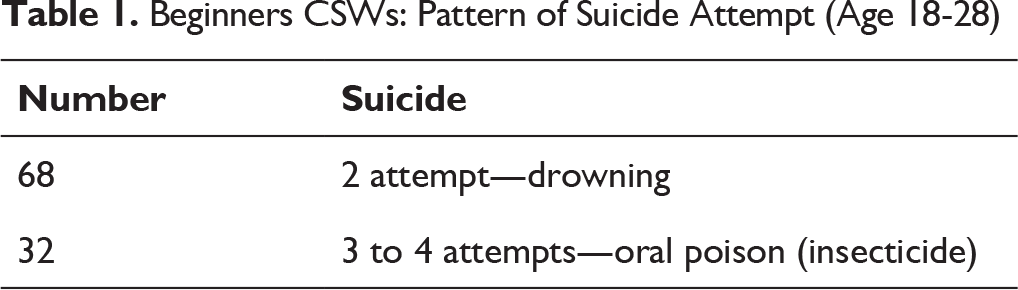
This group had 68 women who had attempted “suicide at least once” in the past 1 year and the mode was drowning as per Columbian Suicide History form (CSHF).
While, the remaining 32 CSWs had attempted “suicide 2 times” in the past 1 year through the use of poison and insecticides as per (Table 1).
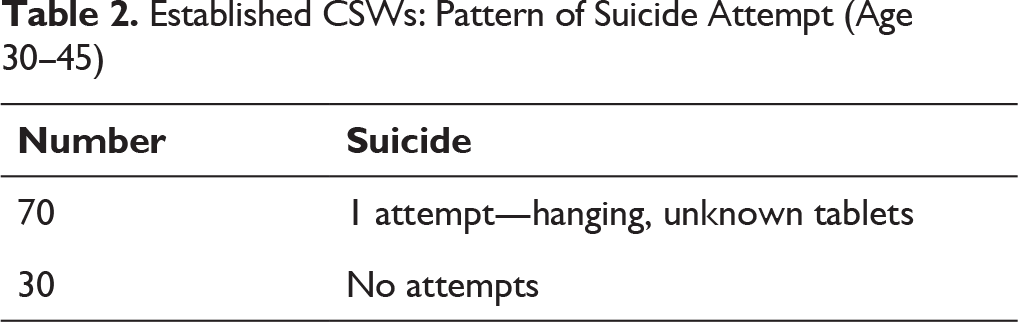
The 100 established CSWs ranged between the age of 30 and 45 years. There had been “3 to 4 attempts” in the past 2 years and the mode was hanging and unknown tablets as per CSHF (Table 2).
Assessment for severity of depression was done using HAMD. The scores for both beginners and established groups was 16 indicating it was significantly higher.
Discussion
Beginners CSWs: Pattern of Suicide Attempt (Age 18-28)
Established CSWs: Pattern of Suicide Attempt (Age 30–45)
Suicide Attempt
A total of 68 beginners had 2 attempts and their pattern was drowning and 32 of them attempted suicide 3 to 4 times using oral poisoning. Of these, 73 women in the beginners group reported sexual coercion, forced sex, involuntary prostitution, and they were victims of immoral trafficking.
A total of 70 in the established CSWs group had 1 attempt by hanging or unknown tablet consumption, while 30 women did not have any attempts. These women were into this profession since 10 years. They had adapted themselves to this profession and reported that they had attempted suicide because of domestic violence, adjustment disorder, work place violence, etc. and sex work was not the main cause for them to attempt suicide.
Both the groups were cautious not to use burns as a mode of attempt which was a significant finding in our study.
During interview, they expressed this concern that if they fail to complete suicide due to burns, then their life is scarred permanently as they would not be able to carry out their commercial sex activity, which was their primary concern.
Major Findings
The beginners CSWs group had 2 to 4 suicide attempts, while established CSWs group had 1 suicide attempt which was different from the beginners group, and the number of years of commercial sex work played a pivotal role.
Future Implications
Study to be taken for this group of women to lower the depression by using cognitive behavioral therapy.
Any family history which is associated with sex work among these women can be explored.
Conclusion
This study enhanced the hypothesis that there is a strong relationship between number of years of sex work and the number and pattern of suicide attempts among female CSWs.
Limitations
The sample was mainly from the urban areas and those who visited the outpatient unit of the psychiatry department. Information revealed during the interview was taken on face value; there was no other method of cross-verification.
Declaration of Conflicting Interests
The authors declared no potential conflicts of interest with respect to the research, authorship, and/or publication of this article.
Funding
The authors received no financial support for the research, authorship, and/or publication of this article.
Appendix I
Data Key Sheet
Socio-demographic Profile
Name (........................) Age: (.................) Sex: (0-Female) Education (0-SSLC, 1-PUC, 2-Degree) Religion (0-H 1-M 2-C 3-others) Marital status (0-Unmarried 1-Married 2-Separated 3-Divorced 4-Widow) Income/month (0-3,000-4,900 1-5,000-6,900 2-7, 000-9, 900) Presently living with (0-with family 1-Swathi Mane 2-alone) No. of children (0-no children, 1-1 2-2 3-3 4-4) Sex of the children (0-male 1-female) No. of years into CSW activity (0-6 months 1-1 year 2-1 to 5 years 3-5 to 10 years 4-10 years and more) Present psychiatric history (suicide): (0-absent 1-1 attempt 2-2 attempts 3-3 attempts) Mode of suicide attempt (0-nil 1-poison 2-hanging 3-burns 4-cutting 5-other modes insecticide/pesticide/unknown tablets) Do you consent to participate in this study: (0-yes 1-no)