




Abstract
Research on organisational storytelling has shed light on different types of narratives. A specific story type, organisational myths, has caught the interest of some scholars in the field, but has not been theorised in any great detail. While it is rarely disputed that organisational members can and do develop emotional connections to myths and mythical stories in their social context, how and why these myths, or ‘sacred stories’, emerge in organisational settings has remained mostly unaddressed. Therefore, drawing upon a Jungian psychosocial approach, we propose a process model for the emergence of mythologised stories in organisations by situating members’ psychological dynamics within the social context in which they emerge. We propose that a conscious understanding of the conditions that lead to the emergence of mythologised stories in organisations can help clarify and deepen the relationship between different types of stories to support and sustain organisational change and development. The paper contributes to the existing literature on organisational storytelling and myths within organisational studies.
Introduction
Scholars in organisational studies were originally sceptical about studying storytelling because it diverged from positivist assumptions in knowledge construction. However, the profound richness it adds to the field has become widely recognised, marking organisational storytelling as a firmly established domain of study (Beigi et al., 2019) to the point of asserting that organisations cannot function without stories (Mitroff & Kilmann, 1975). Narratives, fables, archetypal tales and legends now find their place in organisation studies to help explore, examine, analyse and manage, among others, organisational change (Boje, 1991), organisational identities (Brown, 2006), control (Wilkins, 1983), organisational politics (Feldman, 1990), organisational communication (Brummans et al., 2020) and broader unconscious dynamics within organisations (Gabriel, 2000; Rhodes & Brown, 2005). Regardless of their purposive intents, scholars seem to agree that stories are primarily used to make sense of organisational experiences (Weick, 1995); they are considered tools for a ‘never-ending construction of meaning in organizations’ (Czarniawska-Joerges, 1998, p. 15) through which life in organisations is made meaningful (Stokoe & Edwards, 2006).
Traditional storytelling studies used to focus on the dominant stories told by those in powerful roles, notably the top management, which are sometimes referred to as master-narratives (Frandsen et al., 2017), authoritative texts (Kuhn, 2008), managerial monologues (Rhodes & Brown, 2005) or grand stories (Aaltio-Marjosola, 1994). A more recent approach, referred to as ‘critical organizational storytelling’ (Beigi et al., 2019, p. 447), instead focuses on listening to the stories of those who are not at the top; that is, the stories of employees or marginalised voices, to help us see the organisations through their eyes and gain access to their feelings and views of organisations (Boudens, 2005), which might not be always similar to the master-narratives (Frandsen et al., 2017). Listening to different accounts and gathering different stories from organisational members in this way provides a deeper and multi-layered insight into the functioning of the organisation (Kostera, 2012) that arguably would not be possible through the use of other approaches (Boudens, 2005).
Even though organisational storytelling is now an established field of study, scholars do not seem to have reached a consensus on the basic elements of storytelling, starting with the definition of what a story is (Beigi et al., 2019). Two dominant approaches to stories come from two prominent scholars in the field. The first seminal approach originated with Boje (1991, 1995) who argues that everything can be interpreted as a story in organisations, including factual or descriptive accounts of events about an organisation. From this standpoint, even a few words about an organisation can be understood as a story; they can be fragmented, unfinalised, non-linear, incoherent, presenting a certain view about the organisation, be constructed by any stakeholder without necessarily having a central plot, or being about certain characters having a particular importance (Boje, 2008). They can be about the past, present or future of the organisation. They can be contradictory, conflictual, or ambiguous. The same story might mean something for one member and hold an alternative meaning for another.
The second, equally well-known, approach to what constitutes a story comes from Gabriel (2000) who describes stories more canonically as narratives with linear plots, characters and an emotional aspect. Defining his approach as ‘the most conservative’ (Gabriel, 2008, p. 283), he asserts that narratives that do not include any emotional component should not be considered stories. From this perspective, organisational members communicate their feelings, values and experiences through stories which make their inner worlds accessible to the listeners of their stories (Alvesson & Kärreman, 2000). For Gabriel (2000, p. 135), stories do not need to always provide factual information about the accounts of organisational events because ‘[t]he truth of a story lies not in its accuracy but in its meaning – and paradoxically the inaccuracy, the distortion, or even the lie in a story can offer a path towards the deeper truth it contains, at an individual or collective level’. What is important is not whether a story is true or not, but how it is used as a tool to communicate experience and the underlying emotions to the listener of the story.
Gabriel (2000) further argues that, among all the stories that hold an emotional component, organisational myths demonstrate a depth and complexity rarely achieved by other organisational stories. Gabriel (2008, p. 191) defines such mythologised organisational stories as stories that ‘carry powerful symbolism, are capable of generating strong emotions, and have a profound effect on our thoughts and actions’ in organisational settings. The common assumption behind the mythologised story of an organisation is that by cultivating a strong emotional connection between people and the organisation, it provides collective meaning and a joint purpose for organisational members, thus becoming vital in shaping an organisation’s core organising processes (Bowles, 1989; Gabriel, 2016) as well as members’ experience of organisational life (Fotaki et al., 2020).
The experiences, emotions and meanings that myths provide, which belong to ‘the sphere of the sacred’ (Kostera, 2012, p. 21), make them distinct from the other shared stories within organisations. They are known as bearing ‘epic’, ‘sacred’, ‘mythical’ qualities, expressed as ‘larger than life’ stories, so that, when such stories are pervasive, organisations ‘become mythologised when they acquire meaning beyond the mundane and even beyond the profane’ (Kostera, 2008, p. 10).
However, among the limited studies on organisational myths (compared to other types of storytelling) the sacred sphere is rarely theorised or explained. Even though some studies (e.g. Gabriel, 2004; Kostera, 2012; Neville & Dalmau, 2010) have explored the functions and subject matter of myths in organisations, questions regarding their origin and the motivations or conditions behind their emergence, as well as questions on how and why certain stories gain sacred qualities while others do not, are still not sufficiently answered in the existing literature. For instance, Kostera (2008) talks about certain organisational stories being mythologised, and also talks about parts of myths dying in organisations, yet she fails to provide an account of the processes that lead to some phenomena being mythologised or de-mythologised.
Therefore, alongside the increasing interest in studying myths within organisations, it becomes essential to better understand and appreciate the psychodynamic and sacred dimensions that make myths so distinct. We believe that gaining insights into the processes that give rise to myths and mythologies generates fresh opportunities to address some of the challenges still faced in organisations; for instance, in terms of understanding why successfully crafted stories designed to create change may fail to do so.
The organisational mythology literature usually situates the sacred in the collective unconscious of humanity, out of which everything is born, a theoretical assumption first introduced by Carl Gustav Jung (1954). This perspective, and the one that we equally adopt here, views mythological stories as manifestations of largely unconscious dynamics in the human psyche (Gabriel, 2000). In an academic field which has long been reluctant to accept storytelling as a legitimate research approach, acknowledging the idea of an unconscious layer shaping decision-making and behaviour – in other words, daring ‘to give voice to the unconscious’ (Petriglieri & Petriglieri, 2022, p. 1444) – is an important step forward, yet not without its challenges. Furthermore, convincing researchers in the field of organisational storytelling to accept the concept of a collective unconscious containing universal archetypal elements would be doubly challenging and might be one of the reasons why to date the research in this sub-field has remained somewhat underdeveloped (Gabriel, 2018).
In this paper, we aim to offer two main contributions to the field of organisational storytelling. First, we develop a process model to show how and why stories become mythologised in organisations through the psychosocial processes and organisational conditions that lead to the emergence of mythological stories in organisations. Second, by introducing the Jungian concepts of numinosity and synchronicity, we contribute to the understanding of the sacred dimensions behind organisational mythologies.
In the following sections, we first review the organisational mythology literature. This is followed by the introduction of the core elements and processes of our process model proposed for the emergence of mythologies in organisations. In the subsequent section, we discuss the insights provided by the process model to expand our understanding of organisations and the implications for future research on organisation studies.
Situating Myths in Organisations
Myths trace back to early civilisations (Palaeolithic era starting around 20,000 BC), although the more well-known versions of mythologised stories that have informed modern European society – such as the Oedipus myth, Hero’s myth and Zeus myth – have their source in Greco-Roman times (see Graves, 2005 for a list of world mythologies). Mythologies can be understood as the containers of the collective identity of a social group as well as the structure that situates the role of each group member within the collective story, especially in the context of life’s finitude and the human desire to transcend one’s mortality (Campbell, 1988). As Armstrong (2005, p. 6) notes, myths provide necessary answers to questions about where we came from, where we are going, and what is the meaning of ‘those sublime moments’ in which we experience something beyond self. The significance of these questions for individuals and communities is universal and essential for social functioning, which explains why the structure and motifs of myths share many similarities across different cultures, different languages and different symbolic imaginations.
As an arguably necessary function of human psychology, all societies create and live by mythologised stories that give them a sense of purpose and sacred meaning specific to their society, stories that are then transmitted across generations (Armstrong, 2005; Gabriel, 2008). Societies translate traditional myths into their own languages based on their context to maintain the myths’ vital qualities and their ability to act as a bridge to the unconscious, the original matrix of human consciousness (Jung, 1955). In the contemporary world, the mythologising process has been used in newly created stories that still fulfil the functions of traditional myths, for example, in films like Star Wars, The Matrix, books like The Lord of the Rings, the Harry Potter series, Dune or TV series such as Game of Thrones (Kostera, 2012).
Traditional myths have also infused work organisations where people look for meaning and purpose in their lives (Bowles, 1997). Organisational myths are stories about various aspects of organisations, derived from the mythological images that have an emotional dimension, to which members assign meanings. Scholars studying organisational mythologies mostly study them through their manifested contents – socially and culturally constructed – available in an organisational setting. For instance, Meyer and Rowan (1977) argue that certain formal structures of organisations which might not necessarily provide efficiency and control gain legitimacy and hence are embraced by the organisational members because they have become myths merely by way of the social context of organisations giving them legitimacy. Functions like sales, production, advertising and accounting turn into ‘taken-for-granted means’ giving organisations ‘appropriate, rational, and modern’ status (Meyer & Rowan, 1977, p. 344); they are culturally ‘prefabricated formulae’ available for any organisation, one that can be viewed as ‘mythical’ in the common sense of the term.
Given that such manifested elements have similarities with mythological figures (e.g. heroes) or themes (e.g. birth, death, creation), myths can be studied as a framework to inform change and development that can be instrumentally crafted in the present context (e.g. Allen, 2002; Boje et al., 1982; Ganzin et al., 2014; Grant, 2005; Neville & Dalmau, 2010), or at least they can help us with understanding different organisational phenomena (e.g. Höpfl, 2004, for the theme of consumption through the Demeter myth; Moxnes, 1999, for the study of mythological familial roles in organisations; Sievers, 1994, for the mythological themes of life and death and how they affect organisational processes).
We argue that while the above-mentioned approaches to mythologised stories in organisations provide insights and contribute to our understanding of organisations, in most cases, prior studies have been mostly interested in the so-called already manifested, socially shaped structural elements of mythological stories. However, how and why such images manifest as mythological stories with sacred qualities within organisational contexts remains largely unexplored. Because they emerge from the collective unconscious, it is not possible to know what is going to emerge from the unconscious, and it is important to remember that such myths may be ‘spontaneous productions of the psyche’ (Campbell, 1988, p. 4). For that reason, it seems harder to argue that stories can be instrumentally mythologised in organisations (Gabriel, 2008). Conscious myth-making in organisations would mean losing the connections between the inner and outer worlds: the genuine sacred quality of the mythological story would then be lost. In other words, if that sacred sphere is not understood as such, all the conscious efforts to bring about change, solve problems and transform organisations might remain stunted. Segal (2004) states that a way to grasp this (but not in a definitive sense) is for disciplines studying myths to try to find suggestive answers to these three questions: their origin (why and how they arise), their functions (why and how they persist) and their subject matter (what they contain). As discussed above, organisational studies research has primarily examined myths from the standpoint of the latter two questions. In this paper, we aim to explore the first.
According to Neumann (1954), the individual psyche is the source of all cultural phenomena, so that if we are to study where sacredness comes from, we have to understand the psychological processes that lead to the emergence of myths in individuals and in organisations. Furthermore, one of the primary functions of myths is to foster development (Segal, 2004) both for the individuals and the collective communities in which they emerge. Development in this sense is understood as constructed not only rationally, consciously or socially, but also through a nuanced understanding of symbolic cues that the psyche offers through the language and imagery of the myths. In this sense, underlying psychological processes behind myths as well as outlining the impact of the social context in the shaping of myths are viewed as complementary and irreducible, whereby ‘each is merely the environment and the precondition for the other’ (Mitroff, 1983, p. 395). Therefore, organisational myths are psychosocial in nature, emerging from the psychological dynamics of their members, but also shaped by the organisation’s unique social context.
Fotaki et al. (2020) recognise the increasing complexities of organisations in current times, and advocate the need to go beyond our well-known organising paradigms and deploy new, psycho-analytic ways of theorising organisations. Petriglieri (2020) similarly suggests using a psychodynamic lens, studying organisations through understanding the reciprocal relationship between systems and the psychological dynamics of their members, including their unconscious dynamics (e.g. Petriglieri & Petriglieri, 2022). Aiming to fulfil this need, and by drawing upon the Jungian understanding of mythological stories (Jung, 1954), we propose in the text that follows a process model to understand the emergence of mythologies in organisations as manifestations of collectively unconscious psychosocial dynamic processes that are archetypally informed, as well as shaped, by the social context. Based on this model, we argue that providing that the archetypes are consciously understood, the stories they form bear potential insights to better make sense of complex organisational life in a dynamic and non-dichotomous way.
Aspects of the Process Model of Organisational Mythologies
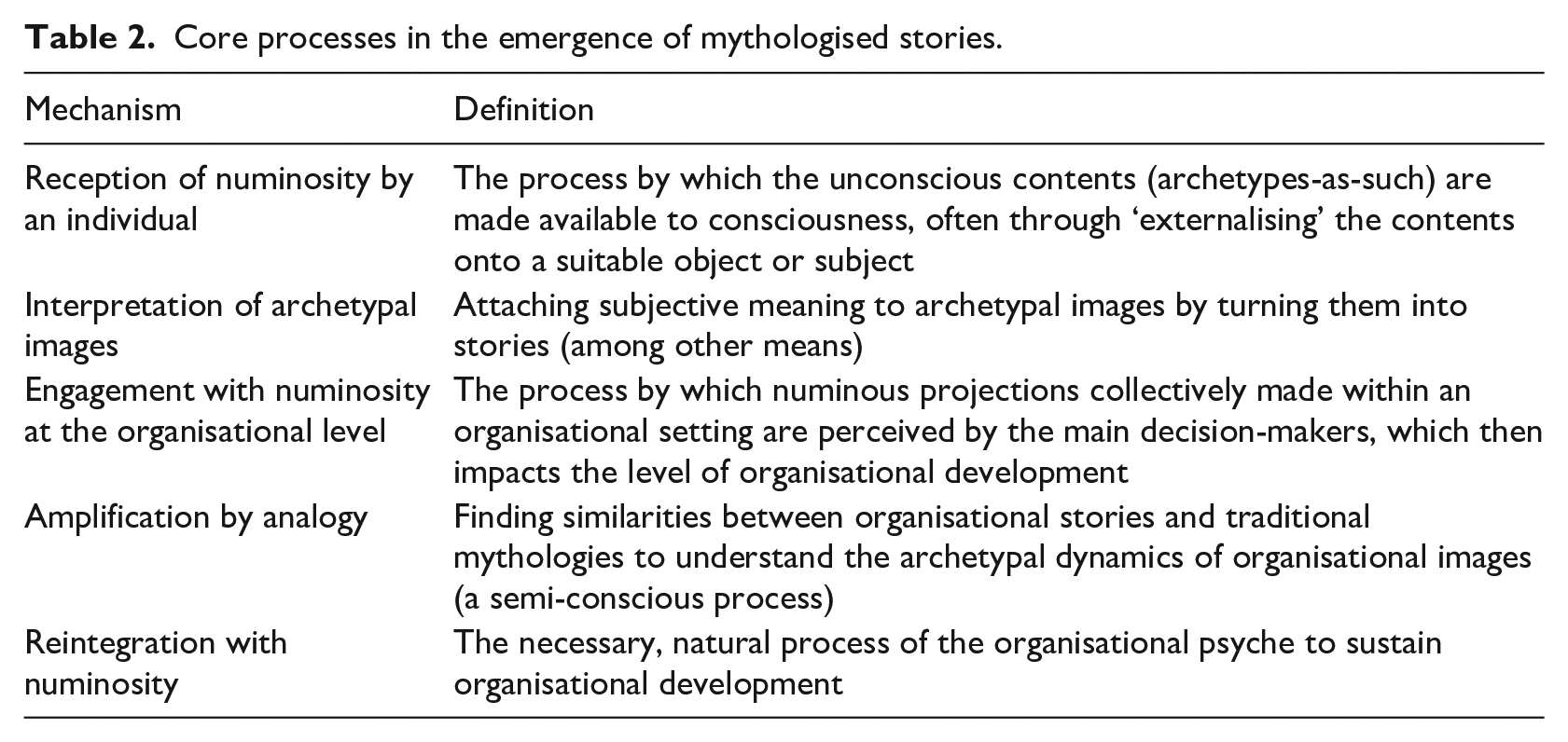
In this section, we develop a process model to show how mythological stories likely emerge in organisations. We present our model in the form of a recursive process model, depicted in Figure 1. To make the model easier to understand, we summarise definitions of key concepts and processes in Tables 1 and 2. Our primary objective here is to explain (1) the processes leading to the emergence of mythological stories in organisations and (2) the kinds of organisational conditions that shape initial myth-making processes.
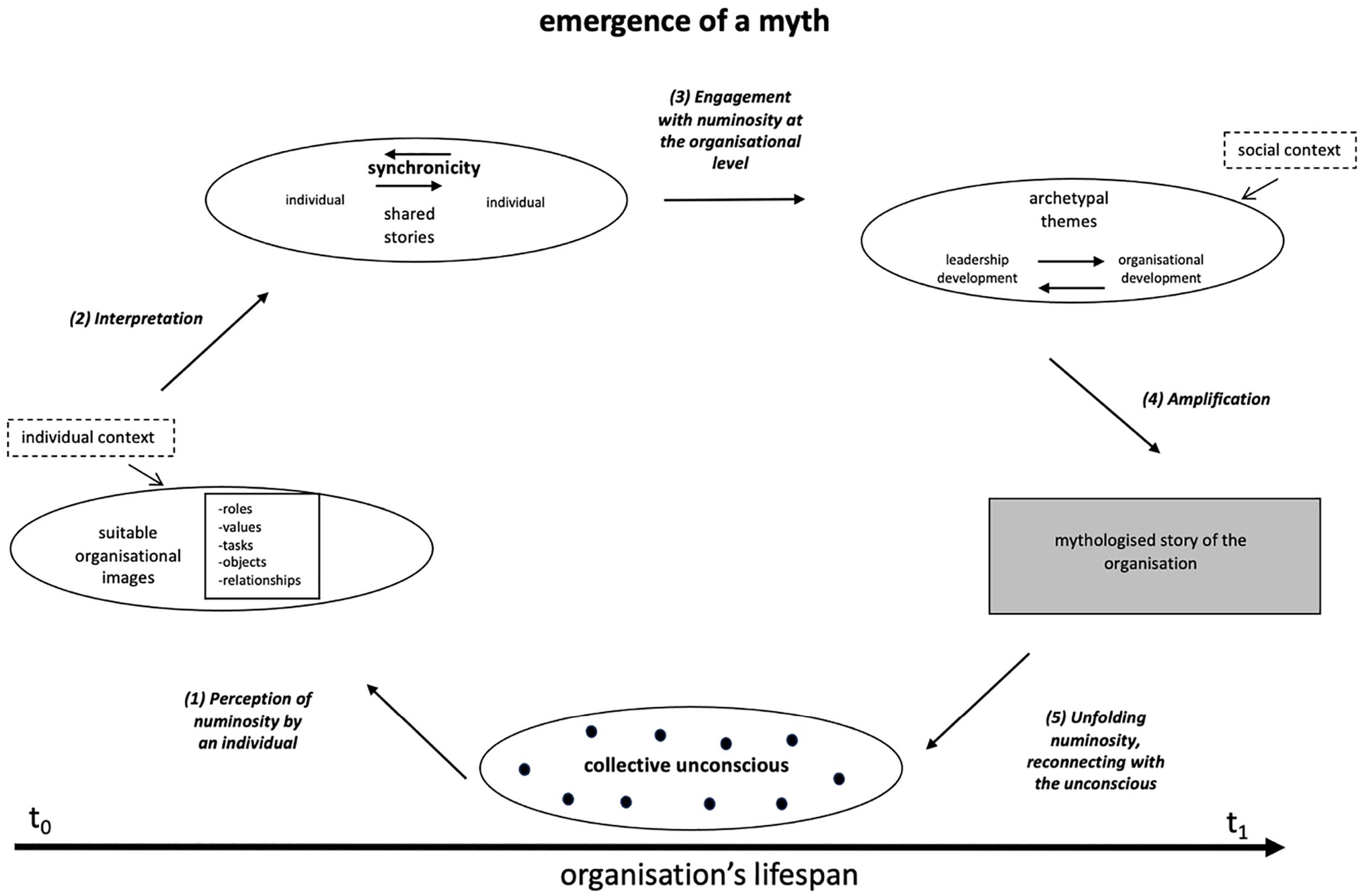
Emergence of mythologised stories in organisations.
Core elements in the emergence of mythologised stories.

Core processes in the emergence of mythologised stories.
Identifying the processes of mythologising in organisations is dynamic and iterative. It is almost never a linear process but requires revisiting the processes as the story emerges and unfolds within a particular organisation. For that reason, while we are aware that developing any model carries the risk of oversimplifying the complexity and dynamism of its object of study, we believe that the recursive relationships that we suggest provide a useful schematic to outline the dynamic and complex processes of mythologising in organisations within empirical studies.
Concretely, we develop a psychosocial model where individuals are assumed to be psychosocial beings, meaning that their experiences are shaped by their individual psychodynamics, but they make sense of these experiences in relationship with their external social environment (Hollway & Jefferson, 2013). From such a perspective, the organisation is assumed to be constructed psychosocially as well and its different aspects can be studied as a collective unit through the individual experiences of its members – including their own mythologised stories.
Emergence of Myth
The universal need arising from the collective unconscious
We assume, following Jung (1954), that everything that is developed in consciousness, including the mythologised stories of organisations, arises from a universal need to achieve a greater consciousness, or self-awareness, for oneself. Whether it is about individual or collective development, fulfilling this teleological orientation requires differentiating the psychic contents existing in the concept of the collective unconscious (Jung, 1921) from the conscious level (see Figure 1). This natural process of individuation, that is, becoming a consciously differentiated individual being, forms the animating force behind the emergence of mythologised stories in organisations. Depending on how the collective unconscious is perceived and ‘accessed’ by individuals or collectives, the process might lead to transformation at the conscious level, or not. This nurturing of a conscious connection with the collective unconscious – bridging between the two – is a fundamental psychological and spiritual need both for individuals and communities (Jung, 1958a), yet this aspect is often disregarded in organisation studies compared to more obvious needs (e.g. the need for safety, belonging, and financial growth) (Hart & Brady, 2005).
Furthermore, the psychic contents that exist in the collective unconscious layer are defined as archetypes-as-such (Jung, 1954). Because their manifestations at the subsequent conscious level display qualities that are more or less consistent everywhere and can potentially exist within all individuals, they are postulated to be ‘universal’ (Jung, 1954, para. 4), corresponding, as mentioned, to the universal need to become differentiated at the level consciousness – a sort of psychological instinct specific to the human species.
Bowles (1990, p. 406) states in this respect that ‘all human experience is potentially archetypal’; however, some archetypes-as-such usually appear in consciousness more visibly than others. Jung himself described and wrote more extensively about manifestations of these core archetypes-as-such including the mother (Jung, 1952b), the father (Jung, 1949), the divine child (Jung, 1940a), the hero (Jung, 1952a), the Self (Jung, 1951a), the anima (the feminine aspect of the individual psyche; Jung, 1951b), the animus (the masculine aspect of the individual psyche; Jung, 1951b), as well as the motif of death and birth (Jung, 1952b).
The existence of these archetypes-as-such can best be grasped when considering the mentioned teleological disposition of the individual and of the collective psyche. At the individual level, healthy psychological development depends on primary needs being recognised and satisfied in a suitable way; e.g. the need to be nurtured by an archetypal mother figure, or the need to be protected by an archetypal father (Jung, 1949). Similarly, the process of psychological growth towards maturity is described and expressed as a heroic journey, accomplished through heroic qualities valued universally in mythologies all around the world, starting with leaving the parental home to forge one’s own identity and place in the world and learning through trials and meaningful encounters (Campbell, 1988). The feminine (anima) and masculine (animus) archetypes-as-such are also universally recognised as evoking the duality and complementarity of perceptions and experiences, which individuals need to learn to balance internally, if not externally, to achieve higher levels of consciousness (e.g. Neumann, 1963).
We argue that the same teleological disposition, or striving, applies to the development of consciousness in communities and societies, which are highly influenced by their historical and cultural contexts. For instance, the Self, the central archetype-as-such representing the totality of an individual psyche (Jung, 1961) is represented through a God-image in religious societies, a collectively acknowledged symbol with distinct meaning. The Self-image appears in mythological stories at the heart of major religions, including the figures of Mohammed in Islam, Christ in Christianity, or Buddha in Buddhism, whereby the people collectively project onto these figures superordinate heroic qualities, and their actions are interpreted as archetypal, divine and sacred.
It is important to recognise that the manifestations of such archetypal images from the unconscious are not always mutually exclusive, meaning that they do not belong to one single archetype-as-such. Archetypes-as-such are always multifaceted, so that they can manifest in similar, overlapping ways at times, and in seemingly contradictory ways at other times. The heroic journey is at the same time the journey of a child undergoing their psychological development (Jung, 1928), so childlike qualities can be seen in both an archetypal hero and a child image (e.g. Perseus depicted both as a hero and as a child); or protecting and nurturing qualities can be seen in both an archetypal mother and an archetypal father image depending on the contexts in which they manifest (e.g. Osiris as a nurturing father archetypal image, Demeter as a protective mother archetypal image). Archetypes-as-such invite us to think not in strictly linear ways, but instead to focus on, and play with, possibilities of meaning and associated potentialities of growth.
In our proposed model, we envision that at certain times in the lifespan of an organisation, likely critical times of development (such as birth, emergence, transformation, crisis, external chaos), the archetypes-as-such will manifest more loudly, making it harder for organisational members to ignore the need for something ‘more than’ what is consciously present to help navigate that critical time – albeit without yet an understanding of what that ‘more than’ might entail. This experience and the subsequent response is encapsulated by the notion of projected numinosity, to which we turn next.
Reception of numinosity from the collective unconscious
The contents of the collective unconscious can be represented at the conscious level through an already-mentioned process of individuation and projection. In this process, an external image at the conscious level can, once produced, activate the contents of the collective unconscious and typically in the form of symbols holding some of the archetypal qualities. When there are suitable images in an environment, and when the environment itself enters a phase of development, we argue that, analogous to a magnet-like force, these images attract and corral the archetypes-as-such, and they become in turn imbued with so-called numinous qualities (see Figure 1) – and usually without people’s conscious understanding of that projection. Numinosity is a term coined by Jung (1940b, para. 6) to describe ‘a quality belonging to a visible object or the influence of an invisible presence that causes a peculiar alteration of consciousness’ in that ‘it seizes and controls the human subject’ without their ‘arbitrary act of will’. Numinosity gives archetypes-as-such a ‘certain autonomy and specific energy. . .[enabling] them to attract, out of the conscious mind, those [images] which are best suited to themselves’ (Jung, 1952b, para. 344). Their numinous qualities provide these images with a clear potential where, through the organisational members’ conscious interaction with these symbolic images, they may foster further psychological development and strivings for meaning.
Readiness of the images
We furthermore argue that the enabling role of numinosity in the mythologising of stories depends on a further set of interrelated conditions: the psychological ‘capacity’ of the people receiving and perceiving the projection, the suitability and quality of the organisational images onto which projections are made, and the broader organisation and external environments that create a receptive environment for these images, or not.
First of all, to receive and understand the numinosity as an encounter with the sacred demands a degree of conscious maturity at the individual level, as a numinous presence is, once faced, awe-inspiring and often overwhelming. While this argument is usually based on and unique to the individual needs and psychological development of each person (Jung, 1931), we argue that it similarly applies to organisations where the majority of individuals forming an organisation would share similar levels of conscious maturity.
Furthermore, not every object (or possibly subject) in an environment onto which an archetypal projection is made can hold the same amount of numinosity. Readiness in this regard refers to the affordances and/or characteristics of the object/subject or material; the extent to which it is deemed sufficiently similar to the built-in structure of the archetype-as-such, as well as the capacity of individuals to perceive, consciously differentiate and become informed by the resulting numinous image after the projection (Stevens, 2001). As such, depending on the conscious capacity of individuals and the perceived suitability of the image, the degree of numinosity can be high or low. The stronger the numinous experience, the more archetypal the image becomes; that is, it becomes imbued with richly complex archetypal qualities (Stein, 2006).
Finally, the images onto which numinous qualities are projected are determined by the broader socio-cultural context – that is, the various organisational and other social environments around individuals that influences the manifestation of the archetypes-as-such. These various socio-cultural contexts shape the objects, and for that reason the qualities of the objects onto which numinosity is projected might differ (see Figure 1). For instance, the father archetype-as-such can be experienced and manifested as the godfather, a caring father, an authoritarian father, a loving father, or sometimes as an absent father, depending on the object/subject to which it is related and its context. All these manifestations are different representations of the father archetype-as-such, whose multifaceted qualities are constellated in different ways. Hence, archetypes combine the universal with the individual, and the general with the unique in that they are common to all humankind, yet they manifest themselves in each setting in a particular way (Stevens, 2001). The existence of archetypal dynamics in any setting, individual or collective, is certain, but how and what forms archetypal contents will manifest in (their numinosity) is not always obvious.
Furthermore, an archetypal image receiving numinous qualities possesses them as long as it relates to the needs and the lived experiences of individuals and communities, and the readiness of the environment – which sustains its mythical qualities. Equally, when the archetypal image no longer demonstrates numinous qualities, nor therefore taps into the inner needs of individuals and organisations for conscious purpose and meaning (that is, the image loses its suitability for the projection), then the projection gradually and slowly withdraws. Having said that, when an archetypal image has displaced a numinous power over people for a long(er) period of time, its initial presence and power may continue to affect people even after the projection ends (Von Franz, 1980). This effect explains as well why the impact and aura of a particularly powerful (e.g. creative, or authoritarian, or paternalistic) leader can leave an enduring mark on the organisation long after their departure, whereby the numinosity of the image they were ‘cast’ as lingers outside of the object/subject itself. Only when the lived reality begins, as the salient socio-cultural environment, starts to challenge the hold of the numinous projection over organisational members will the projection withdraw.
At the same time, the numinous quality of the archetypal images might also gradually increase for different reasons. The socio-cultural context might make it suitable for certain archetypal images to be manifested more strongly than others. For instance, in patriarchal societies where the father figures are usually authoritarian in ways accepted by the culture, it would not be surprising to see more authoritarian fathers than caring fathers manifested and consciously recognised in broader society, both within family structures and also across organisational and institutional structures. Similarly, in Western societies where rationality is embraced as an important quality, we might expect to see rational imagery being imprinted into the structure of an organisation, even though sometimes these images might not always be fully realised or lived up to in the organisation’s decisions and practices (Meyer & Rowan, 1977).
In organisations, the simplest example of an archetypal image that has become manifest is the experience of heroic leaders. By unconsciously, but often inevitably, projecting heroic qualities onto their leaders, employees may portray them as superhuman figures – effectively, as archetypal images – with no flaws, whose power is perceived as absolute (De Board, 2014; Kets de Vries, 1979) and whom they would follow unquestioningly. In return, such a projection might distort the perception of those leaders, who might identify with the numinous projections they receive and try to use that power, with at times dangerous consequences. Such a numinous attraction ‘lures men [sic] to extremes, so that a modest truth is regarded as the truth and a minor mistake is equated with fatal error. . .’ (Jung, 1961, p. 154).
Interpretation by stories
The subsequent communication of the numinous experience is usually done in the form of stories through a process of narrative interpretation (see Figure 1). By interpreting the images through crafting narratives and stories, people make sense of, give meaning to, and emotionally connect with their numinous experiences within an organisation. In an organisational setting, these interpreted numinous experiences can in turn evolve into a mythological figure and story of an organisation, but only if these experiences are collectively recognised and members of the organisation share the same meanings.
Indeed, the background, roles and levels of authority of individuals across organisations might variably affect these interpretations. Furthermore, while the interpretation of archetypal images through stories is seemingly individual and unique to each person, it also entails a collective, archetypal root which, we argue, emerges from the collective unconscious. These stories with numinous qualities elicit in their (re)tellers and listeners intense positive or negative emotions, affecting the way in which they may in turn become shared: excitement, admiration, fascination, attraction, or fear, inferiority, urgency, or a daunting feeling (Otto, 1958). While it is difficult to put into words what a numinous experience feels like, listening to the tone of voices, the excitement, and the scope of positive and negative emotional expressions when such mythical stories are being told and retold within organisations allows one to spot the presence of numinosity in someone’s narrative. In this respect, what is important is once again not whether a story is true or not, but what it at a deeper level means for the members collectively (Gabriel, 2000). The stories that arise in organisations from individuals’ personal experiences of organisations become organisational stories when they are shared by many members, and, as mentioned, such stories may hold the kernel of myth-making when they become numinous and reflect a shared striving and purpose, as mentioned earlier.
Construction of organisational stories through synchronicity
As mentioned, individual stories might become stories that are broadly shared within organisations, having more or less similar meaning for many organisational members rather than just a few. A key process that fosters this development and that we wish to highlight here as part of our process model is synchronicity. Organisational stories become synchronised when more than one person projects the contents of their inner world (archetypes-as-such) onto the same or a similar objects/subjects, as images, and these projected images in turn evoke more or less a similar meaning within the same organisational context (see Figure 1). Synchronicity is explained as ‘an acausal. . .connecting principle’ that connects the inner world of archetypes-as-such with the external world of archetypal images (Jung, 1952c, para. 866). Synchronicity implies that this process of shared stories occurs outside of conscious control or rational intent. In other words, one cannot intentionally or strategically turn organisational images into archetypal images with a numinous quality; what makes an organisational image become archetypal is the relative and continuing ‘hunger’ for numinosity of the organisational members at that point in time – something which they will not be conscious of themselves – as well as the readiness of the image itself to hold such an intense projection – to effectively become a symbol of the sacred in ways that resonate with many, and which may be particularly profound when the organisational context itself is subject to significant change.
For instance, when an organisational member interprets the picture of the founder of the organisation hanging on the wall of the board of directors’ office as representing the grandiosity, prestige or lineage loyalty of the company (projection of a numinous quality), and then talks about it over a tea break with another person (sharing their interpretation), and when that person has a similar interpretation of the same picture, and another employee overhearing the conversation joins in with a similar interpretation, then we can talk about the experience becoming collectively synchronised with individual stories turning into collective ones. Hence, insofar as there is a conjunction of meaningful coincidences (in this example, spontaneous sharing of a similar experience) that enables a kind of rapprochement, that is, a tying together of individual stories around a common archetypal theme evoking a similar emotional intensity (thereby holding enough numinosity), then those stories become organisational stories, shared stories of significant mythical meaning for the organisational community. Examples of such shared patterns in an organisation can be found by examining the symbols to which members collectively attach meaning, such as patterns of values, relationships, roles, or other social significant objects/subjects (Bowles, 1990). Those who study organisations through such a Jungian lens (e.g. Aurelio, 1995; Bowles, 1989, 1990; Moxnes & Moxnes, 2016) recognise these symbols as archetypal images representing the archetypal mythical qualities of an organisation.
As previously mentioned, numinosity can be projected onto either visible or invisible objects/subjects in an organisation – i.e. an artefact, a practice or ritual, an organisational role, or a person enacting a role. This is not a negative or abnormal phenomenon though: as explained before, it merely demonstrates that the possibility to connect with the collective unconscious exists in organisations. This is an important point to note because connection with the unconscious is, as we have argued, a fundamental need in the context of healthy psychological development (Jung, 1958a). Just as the body needs food, our minds need some degree of numinosity in every aspect of our lives, including in our organisational lives. That said, our capacity to consciously satisfy this natural ‘hunger’ for the sacred depends on how we acknowledge, relate to and respond to the numinous experiences we encounter within organisations. If the members of an organisation are consciously ‘mature’ enough and the images are suitable to receive the requisite numinosity from the collective unconscious, then engagement with these images and the stories they carry leads to the potential for conscious organisational development. If, on the other hand, the conscious capacity to recognise the numinosity of projected images is somewhat lacking – for example, because the organisational context is too chaotic to sustain the emerging story, or the shared hunger for the sacred is not strong enough to sustain interest in the emerging story – then the opportunity for conscious development subsides, and the possibilities held by the archetype-as-such return into the unconscious. What remains may be a ‘business-as-usual’ approach, with members of an organisation being bereft of the deep meaning that a shared consciousness around common myths would provide.
Engagement with numinosity at the organisational level
The way in which members of an organisation collectively engage with numinosity shapes, as mentioned, whether shared stories turn into mythological motifs or not (see Figure 1). While we have argued in the previous stages that perception of numinosity requires the psychological attentiveness and maturity in enough individuals in organisations, shared organisational stories also need a fertile soil – one where organisational members are open to, or are in need of, a deeper meaning from sources they cannot necessarily or rationally explain – in order to become mythologised. In other words, for mythical stories to be sustained they need supportive organisational contexts that have capacity to honour the potential for the sacred, and reflecting their own psychological level of development. Furthermore, an organisation’s level of development in this sense depends not only on the individuals, but also on the social context in which the organisation operates (see Figure 1). Within the organisation, there has to be a certain willingness among its members to suspend the mundane and accept the unknown, the greater-than, the odd, the mystery – that is, to fully engage with numinosity at a conscious level – so that organisational stories gain such mythical qualities and do not remain ‘mere stories’. Similarly, this willingness within an organisation may not simply exist, but might have to be sheltered and protected from demands and pressures from its external environment – which might potentially curtail this support for psychological development (Laloux, 2014).
From the teleological stance that we mentioned, organisations are born, grow and mature across various stages of development, just as individuals do (Laloux, 2014). Correspondingly, as individuals mature and grow in consciousness, so do collectives and organisations, given that organisations are largely expressions of the level of their members’ stages of development (Laloux, 2014). By studying an organisation’s structures, practices and processes, we can gain some idea of its level of development, and relatedly of the organisational members’ own level of conscious development.
Laloux (2014) discusses different stages of psycho-spiritual development that characterise contemporary organisations, each stage evoking a different set of core beliefs, needs and expectations, and therefore emphasising different (archetypal) images. For example, organisations focused solidly on short-term performance and efficiency (Bowles, 1990; Laloux, 2014; Zanetti, 2002) operate from the assumption that everyone in the organisation shares the same objective – the economic success of the organisation – and that pursuing this goal requires control and command, embracing the archetypical myth and symbol of the organisation as a machine. Petriglieri (2020) goes one step further and argues that while this pursuit turned organisations into machines – dehumanised workplaces – such organisations, in return, have predictably turned us into machines.
However, organisations are not just machines but are also communities (Petriglieri & Petriglieri, 2022). This argument brings into the discussion a new organisational model, which focuses on the evolutionary purpose of organising instead of self-defined goals. In contrast to the ‘machine’ view of organisations, some organisations perceive themselves as living organisms striving for a psychological kind of wholeness rather than pursuing self-defined goals (Laloux, 2014) – wholeness in terms of relationships with their communities and stakeholders, and in terms of their overall aspirations and purpose, all the while acknowledging the need to adopt different qualities in the process of their development. As Petriglieri (2020) similarly argues, such a view ‘humanises’ organisations as compared to the dehumanising ‘machine’ model. In these terms, it can be expected that engagement with numinosity will look different in a ‘machine’ organisation than in a ‘living organism’ organisation. In the former, numinosity would need to be controlled and used instrumentally for it to have any chance of taking root, while in the latter, numinous images can be acknowledged as emerging manifestations of fresh possibilities and in a largely organic manner – possibilities that may or may not elicit subsequent organisational development.
What is of note here is not that one organisational model, or mythology for that matter, is always better than the other, for a lot depends upon the psychosocial reality of the organisational context and its environment at large. Rather, we wish to highlight here that the capacity to recognise and engage with numinosity in a way congruent with the (often unconscious, always compensatory) needs of the organisation is a crucial aspect of organisational development. Focusing on efficiency and rationality has not been the issue, but an exclusive focus on rational efficiency represents a one-sidedness which proves problematic and creates dysfunctional results (Bowles, 1990, 1993a, 1993b; Denhardt, 1981; Rozuel, 2019). Our modern worlds are going through a spiritual emergency (Collins, 2008), more visible than it has ever been, and there is no shortage of studies illustrating how a one-sided emphasis towards materialistic gains in organisations leads to disruption and destruction, such as the North Sea oil installations affected by the Piper Alpha platform disaster (Collinson, 1999), or the Enron scandal (Cohan, 2002; Stein, 2007) or the Volkswagen scandal (Rhodes, 2016), just to name a few. The current climate crisis, repeated projections of our inability to reach sustainable development goals (SDGs), and increasing numbers of reported employee burnouts (International Labour Organization [ILO], 2016) are all signs of an urgency to change the psychological make-up of our organisations. Similar to our argument here, Petriglieri (2020) suggests that turning to the study of unconscious dynamics in times of crises might be the way forward. In our view, and as captured by our process model, a key objective here is to understand how individuals and collectives strive for meaning, how they may come to share a deeply profound, mythical experience within organisations, and how in turn this fosters their psychological development and that of the organisation as a whole.
Leadership development
Organisational development usually reflects the attitudes (and the individual developmental level) of their decision-makers (Blanco-Garcia, 2020; Hambrick, 2007; Laloux, 2014). Hence, the leadership of an organisation generally sets the tone for the stage of an organisation’s development (see Figure 1). Most likely, an organisation cannot evolve in its mythologising processes beyond the stage of development of its actual leadership. Depending on their own level of conscious development, and their capacity to understand the numinous experiences they encounter, leaders can build relationships with the numinous images in their organisational settings, and eventually allow the stories to grow into mythologies simply by recognising the need for the sacred at that moment in the organisational lifespan. When leadership listens to numinous messages, cultivates an openness to the spiritual sacred level, ‘the life that wants to be lived through’ them (Laloux, 2014, p. 184), they also cultivate the possibility of taking different actions, including actions of a mythical – beyond self – quality if organisational development so requires. As Campbell (2011, p. 21) puts it, ‘awe is what moves us forward’, including arguably within our organisations. However, leadership development studies have usually focused on understanding the skills leaders have or should have to influence others, rather than on understanding the important psychological dynamics behind their behaviours (Petriglieri & Petriglieri, 2015).
A common example of an archetypal image is that of the heroic organisational leader (Bowles, 1989). While some leaders clearly become the subject of numinous projections that cast their actions and experiences as a literal heroic journey akin to those in traditional mythologies (e.g. Ganzin et al., 2014 for an exploration of Steve Jobs’ life story through the hero myth), not all of them are apt to hold on to the heroic numinosity and connect to the sacred realm. If the leader is mature enough and able enough to withstand and work with such heroic numinosity, they indeed become part of the myth, allowing something greater-than-self to guide organisational development, albeit with some challenges along the way. If, on the other hand, the leader fails to withstand the projected numinosity for lack of psychological readiness or conscious capacity, they risk becoming inflated, consumed by believing that they are the source of the myth, the originator of the numinosity, and in ways that will come to serve the needs of their delusion over the needs of the organisation as a whole.
More often than not, in line with their historical context, leaders become representations of their era of organisations (Blanco-Garcia, 2020). On this point, Bromley and Meyer (2021) argue that the global neoliberal cultural context gave rise to a new leadership discourse which they call hyper-management. Hyper-managers are expected to recognise the multiplicity of the goals between individuals and organisations and aim to unite them together; at the cost of recognising the significance and value of local and national contexts. That, effectively, is the demand put upon contemporary organisations and their leaders; that they have to have the right level of ‘maturity, the psychological capacity to handle more uncertainty, more turmoil, and most of all, more dissonance within and between people’ (Petriglieri & Petriglieri, 2022, p. 1441). In common mythological storylines, when the hero meets a dragon, they must decide whether to kill it or to tame it. In other words, the hero’s journey is full of responsibilities and risks. To achieve something, the hero needs to understand that they have to give something else up. In this canonical sense, it is only through a conscious understanding of the choices made that the hero can proceed with their journey (Stein, 1998), that is, they can live through their mythology. Otherwise, the stories remain simply that; stories about heroic leaders (e.g. Blanco-Garcia, 2020; Ganzin, et al., 2014; Hatch et al., 2005) but without acquiring the mythological dimension that would make room for the sacred, that is, for the possibility of more holistic, unusual experiences and for the kinds of organisational development that may in turn follow.
Amplification by analogy or symbolic amplification
For an organisational story to be understood as a mythologised story, it furthermore has to evoke and display mythological dimensions through resonance and analogy to traditional myths, a process known as amplification (see Figure 1). When similarities in behaviours, patterns, roles and values between organisational stories and traditional mythologies are found, those analogies can be used to consciously interpret the archetypal images emerging from the collective unconscious (Jung, 1945). In other words, the archetypal image that emerges within the context of the organisation is compared with the archetypal images found in traditional mythological stories. For example, Zeus is a good illustration of a strong father archetypal figure in Greek mythology, and this is, as an image, frequently found in organisational settings (Bolen, 1989). Building upon these various symbolic parallels between the organisational stories and traditional mythologies both ‘widens and enriches the initial symbol’ (Jung, 1916, para. 493). It means that the archetypal image is not reduced to a fixed quality, constrained by the actual socio-economic reality of the organisation; instead, it encompasses the multifaceted nature of the archetype-as-such, unrestricted by the known or the logical realm. For instance, when the manager of an organisation evokes aspects of a father figure and this father figure is amplified by using the father figures of traditional mythologies, a greater variety of possible expressions of the father archetype become possible. This process of amplification with an analogy, however, is almost never a linear process but requires multiple revisits of the matching and sense-making steps as the story unfolds further, and the archetypal images are accordingly analysed in a richer, more contextualised manner. It is also possible that, at any given time, amplification does not lead to such extended sense-making, at which point the process stalls (see Figure 1) or might encourage a novel trajectory around new synchronicities. The myth that had emerged may then once again return into the unconscious, to maybe re-emerge anew in the future as the organisation enters a new stage of development.
Mythologised story of an organisation
The previous recursive stages of the model explain how stories in organisations turn into mythological stories (see Figure 1). They are the stories that organisational members collectively feel, live and experience, that have a numinous and emotional impact, and a symbolic power, or hold, over them. As Jung (1958b, p. 371) suggested, a mythologised story is always ‘the product of an unconscious process in a particular social group, at a particular time, at a particular place’. The group dynamics can only truly be understood when listening to the shared stories of members about their particular workplace.
There are, as we have already mentioned, different types of myths found in organisations: heroic journeys, family myths, creation myths, to name a few. For example, family roles (mother, father, children, and so on) can frequently be found in family businesses (Tognazzo & Neubaum, 2020). The story of how the founder of an organisation establishes his business usually resembles creation myths and hero myths (Neville & Dalmau, 2010). Mythological stories found in organisations are not necessarily independent of one another either, but more often than not are intertwined and revisited.
Reconnection with the collective unconscious
The process of being consciously connected with the collective unconscious and building a bridge between the archetypes-as-such and the archetypal images repeatedly, recursively and not necessarily in a linear way continues as the mythological story unfolds. Telling and retelling mythologised stories ‘causes [unconscious] processes to come alive again and be recollected, thereby re-establishing the connection between conscious and unconscious’ (Jung, 1951c, para. 280). Because from a Jungian perspective the need to be connected with the collective unconscious is the necessary natural process of our collective psychology, it is an ongoing flow that never stops (see Figure 1). Greater consciousness is achieved only if more unconscious contents are allowed to be expressed at the level of our consciousness; if not, it is likely that the conscious development has been hindered. Because of the frequent psychological ‘immaturity’ of organisational members (that might block such development), be they leaders or employees, or the also frequent unreadiness of the social context, some archetypal qualities, figures or stories might not acquire enough numinosity to become mythologies. However, once the above-mentioned processes of mythologising are applied to organisational stories, and a story is found to have gained some mythological qualities, we can begin to better understand which archetypal qualities appear to manifest themselves in the organisation at a given point in time by studying these stories systematically.
Discussion
In this paper, we have proposed a process model for understanding the emergence of mythologised stories in organisations through a Jungian lens. Mythologised stories in organisations help us understand the complexities of the psychological experience of organisations and how this in turn may impact organisational development. In this section, we will elaborate upon the insights that the proposed process model provides to extend our understanding of organisations and organisational analysis.
First of all, when organisational stories – which inform key organisational decision-making – are overwhelmingly dominated by a certain worldview, for example a focus on economic success and efficiency of the organisation, they leave little room for consideration of the psychic needs of other organisational members or stakeholders which may relate to other archetypal qualities present in the collective unconscious. However, there might be other stories in organisations that are created and shared by groups that challenge the dominant narratives, called counter-narratives (Frandsen et al., 2017). In that case, processes or principles that may conflict with such objectives are usually undervalued and disregarded (Zanetti, 2002).
The qualities deemed to be conflictual with the ones emphasised in the collective stories that members of an organisation usually share create the organisation’s shadow (Bowles, 1991). Instead of appreciating the emergence of hitherto unknown qualities from the collective unconscious, organisations tend to embrace the qualities that they see as more aligned with their named objectives. While they push unwanted qualities into the shadow, they, in fact, unconsciously, disconnect themselves from a lively relationship with the collective unconscious and archetypal numinous qualities. This paper argued that such a disconnection comes at the cost of more creative possibilities to be, to grow and to develop, especially when, as now, organisations face a significant call for change.
Some scholars (Bowles, 1990, 1993a, 1993b; Höpfl, 2002; Zanetti, 2002) argue that this dissociated point of view is what makes today’s organisations strive for improvement. The feeling of being ‘never good enough’ or ‘never successful enough’ can be interpreted as the striving for ‘constant growth’, which is present in many work organisations’ purviews (Laloux, 2014). Baring and Cashford (1991, p. 665) call any social system focused mainly on certain archetypal qualities like those listed above and undervaluing the others ‘an excessively dissociated point of view’: the system is effectively dissociated from its original root in the collective unconscious, which arguably limits the scope of archetypal experiences that organisations can relate to and tap into to foster their own state of consciousness.
For organisational development, the limiting aspect of such one-sidedness must be recognised, such that by being attentive to the unconscious, organisations learn to be more dynamic, observant of changing contexts and ready to make room for alternatives. Organisational development in this sense would include the cultivation of differences in and between individuals and relationships (Petriglieri & Petriglieri, 2022). Such an approach, we have argued, can only happen by being consciously aware of the unconscious contents affecting organisational life. To do so implies that the organisation’s shadow, usually expressed through counter-narratives, should be acknowledged as reflecting tentative needs left unaddressed by the dominant archetypal qualities sustained by the master-narratives. A prime example of such alternative needs includes social needs (e.g. the need for belonging) or room for psychological development, as well as, on a more unconscious yet critical level, the need to connect with numinosity, sacredness and the collective unconscious, or as Petriglieri (2020, p. 9) puts it, having organisations uphold ‘an equal regard for instrumental and humanistic aims’.
The process of challenging the dominant stories to make room for alternative counter-narratives is, in itself, an effortful and individual accomplishment. Indeed, in line with the process model that we developed, an organisation’s development continues as long as it sustains its connection with the collective unconscious. Organisations should take steps to mature enough so as to be better able to consciously understand the many possibilities of organisational development at a given time: to follow known ways of thinking or to adopt new ways of organising. For this, the readiness of people, leaders and the overall environment in supporting such development is, as we have argued, critical.
That said, processes in an organisation are affected by deeper unconscious dynamics as well, so that any conscious change in those processes will also demand a deeper unconscious pattern of change (Petriglieri, 2020). This is how the mythological dimension of an organisational story can, once surfaced, help illuminate the way forward: an understanding of the mythologised story allows members to self-reflexively grasp the representations of the dominant archetypal qualities in the existing organisation, and to identify in a dynamic compensatory manner what could be needed to bring balance to the organisation. In comparison, when this is not done, such unrecognised qualities risk accumulating in the shadow and remaining unconscious – but not insignificant. The shadow will in time tend to disrupt the organisation in unexpected ways (e.g. a lack of morale, employees feeling depleted), and any subsequent resistance to this inconvenient disruption would then only lead to a state of growing dissociation.
Hence, in line with the model that we have conceptualised, the next ‘stage of growth’ for contemporary organisations seems to entail paying more conscious attention to some of the often-disregarded qualities within their societal contexts so that they can both develop and enrich their stories, as well as support a sense of conscious balance within the organisation (Petriglieri, 2020). As Laloux (2014) convincingly argues, we need new organisational models which will probably lead to new social systems (Baring & Cashford, 1991), which in turn will help address the spiritual emergency our societies are going through.
Although pursuing efficiency and growth has contributed to the economic and social development of many communities across the world, it is time for us to reshape our view of organisations (Fotaki et al., 2020). Jung (1940b) describes the imbalance caused by the emphasis on certain archetypal qualities and the undervaluation of others as essentially a moral catastrophe. Bowles (1990), Tarnas (2006) and Zweig and Abrams (1991) contend that this deficit makes it a pathological problem for societies and organisations alike. Indeed, as Rozuel (2016) outlines, the valuation and undervaluation of certain archetypal qualities that exist in the human psyche in organisations becomes a determining factor for what societies value, both socially and morally.
In changing contexts, one cannot recreate the past in the present. Mythological stories are told in a particular culture, at a particular moment in history. Accordingly, the mythological stories of organisations and our economic systems at present need to be reinterpreted in line with the changes in global contexts that give rise to manifestations of different archetypal images at the level of our collective consciousness. It seems time to move forward with the next stage of our collective mythologised story. By understanding the importance of unconscious archetypal contents in organisational life, it is possible to imagine a balanced and integrated organisation, maybe not solely focusing on providing growth in economic terms, but also sustaining growth in terms of enrichment and development of the welfare of society at large, while also honouring the need to nurture our connection to something numinous emerging from the collective unconscious.
The process model that we have conceptualised provides a basis for future research to apply this model to different organisational settings. First and foremost, for an in-depth understanding of the complex, processual and contextual nature of organisational storytelling, empirical research can explore mythological stories and archetypal images in organisations in different social contexts. Second, this model can be used to deepen our understanding of different archetypal qualities that are usually present in the master-narratives emphasised in organisations. Finally, further research could assess the value of this model as a guiding tool for organisational change and development, especially when adapted to understand how emergent stories unfold through changes in contexts. Applied studies on organisational mythologising could inform our understanding of what actions are necessary to consciously understand processual and contextual myth-making, especially in understanding the psychic and layered needs of organisational members. Such work can contribute significantly to the organisational change literature and provide insights on how, in cases where deeper processes of meaning making are involved (such as around identity or purpose change), we may turn failing change attempts into relatively more successful ones – at least from the perspective of the employees and their psychosocial needs and development.
Conclusion
With this paper we contribute to the organisational storytelling and mythology literature by exploring and contextualising organisational mythologised stories, highlighting the complex, processual and contextual nature of life in organisations. Grounding our approach in a Jungian psychodynamic perspective, we have proposed a process model to understand and possibly guide the study of emergent processes of mythologising, and to appreciate the power of the numinosity of mythological stories and archetypal images that inform organisational life in unexpected, unconscious ways.
One of the main challenges of psychodynamic approaches to organisations is that they seek to apply to groups and organisations concepts that originated in the study of individuals (Stein, 2011). Yet, the inherently dynamic relationship between the social layer and the psychological layer of the human experience calls for process models such as the one provided that can bridge the intrapersonal with the interpersonal so as to enable an in-depth understanding of an organisation’s complex dynamics. We have argued that the Jungian psychosocial lens offers the possibility to study collective processes in and of organisations in their complexity and to contextualise the mythical stories that such processes may produce (Singer, 2013). The Jungian lens accepts that part of organisational reality is essentially mysterious and cannot be made sense of purely scientifically; rather, it involves an immersive engagement in a territory not-directly-known, but rather uncovered and comprehended indirectly in and through appreciative inquiries within organisations (Roesler, 2012). We hope that with our process model we provide a basis for such future inquiries.
Footnotes
Declaration of conflicting interests
The author(s) declared no potential conflicts of interest with respect to the research, authorship, and/or publication of this article.
Funding
The author(s) received no financial support for the research, authorship, and/or publication of this article.
Author biographies
 ).
).