



Abstract
This manuscript theorises the use of heroism in marketing by analysing selected representations of the army hero in contemporary advertising. Adopting the discourse-mythological approach to analyse Jungian archetypes, we focus on three US advertising campaigns that depict the army hero. Our analysis reveals that representations of the army hero combine traits, symbols, and images of the Magician, Warrior and King archetypes. ‘Archetypal blending’ is theorised in order to understand the mythological complexities of modern heroism, which expands the individually centred Hero’s Journey through references to a collective journey and collective responsibility. This study advances theoretical insights into how advertising blends narratives of heroism and other mythical archetypes to remain meaningful to multiple audiences - balancing the reproduction of conventional views of military heroism with representations that reflect changing societal values.
Introduction
All stories are built using archetypes: the character roles which recur in myths and stories. However, it is stories of heroes in particular that have held a central place in human societies since before the rise of written history (Kinsella, Ritchie and Igou, 2015b). In marketing, the use of the hero archetype arguably portrays the highest symbolic level a brand can be elevated to (Hollenbeck and Patrick, 2016). Brands understandably want to be associated with heroes and their moral crusades and missions, such as saving humanity or improving the world. The hero archetype is a powerful tool in exchanging meaning through combining storytelling and branding (Sciarrino and Roberts, 2018). Stories of military heroism in particular are prolific, with a long and rich history in popular culture, with marketing playing an important role in both their contemporary and historical social construction.
The hero archetype reflects the values and characteristics most admired in a given society. It therefore carries a plethora of fantasies that could be used to stimulate consumers’ desires in pursuit of their ‘idealised selves’ (Markus and Nurius, 1986). As a result, many brands use the ‘army hero’ in their marketing communications, but in increasingly more diverse representations. For example, the Hero Salutes (MotoCorp, 2016) and A Hero’s Welcome (Budweiser, 2014) campaigns both reproduce the long-standing tradition of celebrating military heroes. In contrast, in Behind Every Hero is a Hero ad campaign (First Command Channel, 2021), we are shown the spouse’s viewpoint. Similarly, in the U.S. army GoArmy campaign (GoArmy, 2022), a cross generational approach is chosen. In the For Everyone (Coca-Cola, 2020) campaign, army heroes are saluted along with other military servicemen, health workers, teachers, cashiers and various other ordinary people. This recent diversity of representations (Frisk, 2019) calls for a closer investigation into multiple meanings of the army hero in marketing narratives.
In this paper, we theorise how the army hero is depicted in three illustrative examples from contemporary advertising using discourse-mythological analysis (Kelsey, 2017, 2018, 2020). All three adverts are from the United States. Two of the adverts were produced by the U.S. Army for recruitment purposes and one was produced by Gillette in partnership with the veteran charity, Operation Homefront. The three adverts provide examples of how the army hero is currently being depicted in advertising in one national context.
We expand Joseph Campbell’s (1949) theory of the Hero’s Journey (the so-called ‘monomyth’) that manifests itself in different ‘faces’ – that is, in distinct ways in different cultures at different historical periods in ways that reflect their distinct value-systems, but that nonetheless serve as a common narrative structure for hero stories. We propose that the three adverts not only adapt the way the hero’s story is told but also, more fundamentally, evolve the hero archetype itself through the creative ‘blending’ of other archetypes. We propose that these ‘blended’ archetypes reproduce, challenge or transform traditional notions of the hero. Two challenges and transformations are identified. First, the army hero is no longer exclusively depicted as a masculine character and the understanding of masculinity itself is also transformed in two – but crucially not all – of the adverts. Second, the hero is not only depicted as a special and highly prized individual with unique qualities, but also as embedded in the collective story of the family, the nation and the world.
In so doing, we develop a theoretical lens that shows why a simplistic application of the traditional monomyth to these advertisements, which searches for the figure of the archetypal hero, would produce an incomplete understanding of the texts. Rather, by problematizing conventional uses of heroism as intertwined with other mythical archetypes, we advance theoretical insights into how the advertising industry blends narratives to both preserve conventions and adjust to social change.
The paper is structured as follows. First, we discuss the diverse ways in which heroism is conceptualised within historical and contemporary discourses and how these discourses are put to ideological use to defend a certain view of the military and (re)produce traditional notions of masculinity. The paper then discusses archetype theory through discussion of Carl Jung’s concept of the collective unconscious, Jung’s influence on Joseph Campbell and the significance of the monomyth of the Hero’s Journey, before introducing discourse-mythological approach (DMA). After a brief overview of the data and methods, the paper presents a DMA analysis of the three selected adverts, followed by a discussion and conclusion.
Heroes of past and present
The propensity to commemorate and worship heroes has been described as ‘a universal feature of human culture’ (Becker and Eagly, 2004: 163) and a social practice upon which the fabric of society itself rests (Carlyle, 1840/2013). The symbolism of heroes preserves collective values, provides role models for emulation and guides collective action (Klapp, 1954). These shared responses to the idealism of the hero figure have facilitated comradeship and cohesion within large groups since early stages of civilisation (Cooley, 1902). As such, stories of heroism are held to promote moral elevation and pro-social behaviour, whilst also fulfilling important cognitive and emotional needs (Allison and Goethals, 2016). Stories of heroism are used on an individual level as moral guides (Kinsella et al., 2015a) and sources of meaning (Kinsella et al., 2019) used by politicians, educators and cultural-industry professionals to instil societal values through the construction of ‘national heroes’ (Danilova and Kolpinskaya, 2019).
In antiquity, despite the many diverse conceptions of the virtues befitting a hero, the concept of courage was central. Considering the period from Homer until Plato, Schmidt (1985) identified five different conceptions of courage: individual excellence as a warrior (Achilles), steadfast endurance (Odysseus), the professional competence of a military man, able to control fear due to superior knowledge of what is truly dangerous (Pericles), the wisdom and fortitude to sacrifice oneself for the right cause (Socrates) and audaciously remaking the world as one wishes it (Callicles). These conceptions are still common in present-day discussions of heroism, especially if ‘military professionalism’ is extended to be ‘professional competence in a field deemed heroic’, such as nursing or firefighting. However, the demands of particular periods and societies still shaped conceptions of heroism, with the Bronze Age warriors of the Iliad giving way to the citizen-soldiers of the Classical era (Schmidt, 1985).
The eight properties commonly identified with heroism identified by Allison and Goethals (2011) – smart, strong, charismatic, resilient, inspiring, caring, selfless and reliable – also demonstrates the diversity of conceptions of heroism. For instance, Carlyle’s (1840/2013) ‘Great Man’ characters are rarely caring, selfless, while an assertion that nurses are ‘everyday heroes’ is primarily associated with assumptions about their caring and selfless nature. Indeed, we have seen a shift in modern societies away from hero-worship of Great Men towards a concept of heroism available to anyone, including by women (Frisk, 2019), as we will discuss next.
Heroism and masculinity
Heroism has been historically associated predominantly with men (Allison et al., 2017; Goodman et al., 2002). Supposedly ‘male’ characteristics, such as ‘competitiveness, power of will and risk-taking’, together with traits such as ‘physical strength’, have typically been associated with heroes (Frisk, 2019: 97). Male figures have also historically occupied social roles that require actions entailing risk to life (Becker and Eagly, 2004), including warriors, who rank amongst the first ‘hero’ figures (Featherstone, 1992).
Women’s roles were historically more hidden, usually restricted to within the home, leaving few traces in cultural myths and history books. The few women that were celebrated in early writing include female saints in various religions (Sharma, 2000) female ‘national heroes’ such as Florence Nightingale (Jones, 2007), in tales which celebrated traditionally ‘feminine’ virtues. In the rare cases that women were celebrated for their military achievements, such as Boudicca, Jeanne D’Arc or Elizabeth I, they were often viewed as mythic and superhuman creatures to avoid damaging the norm of the masculine warrior (Lawson, 2013). In the age of mass printed literature in the eighteenth century, more women began to appear as the heroines of stories. Notably, stories of the heroic adventures of women who disguised themselves as men to fight in the army were initially popular with British readers, until they became seen as socially unacceptable in the Victorian era (Wheelwright, 1987), showing how different societies construct their ideas of heroism in distinct ways (Frisk, 2019).
Thinkers of this era asserted not only that heroism was rightly reserved for men (Carlyle, 1840/2013), but that women’s liberation from domestic activities could cause social disarray (Cooley, 1902: 433). Underlying the ‘masculine character of heroism’ (Frisk, 2019: 96) lay patriarchal social structures that enabled men to ‘stand out’ in stories of heroism framed and recounted in men’s terms (Allison et al., 2017). However, from around the 1950s, representations of heroism became more inclusive, embracing ‘relatively mundane figures as celebrities, foot soldiers, mountain rescuers, Righteous Gentiles and sportspersons’ (Frisk, 2019: 90). This ‘democratic turn’ (Frisk, 2019: 93) also enabled associations of heroism with masculinity to be problematized. Becker and Eagly (2004), for example, found that women were no less motivated towards heroic behaviour and risk taking on behalf of a common good than men. Importantly for our purposes here, other more recent analyses of archetypal heroism in societal storytelling (e.g. Bassil-Morozow, 2018, 2021; Carriger, 2020) have also shown diversification beyond the traditional, masculine imagery.
Military heroism
Heroes provide inspiration, attract esteem and are awarded respect, making them a key part of ‘a system of social control’ (Goode, 1978: vii in Frisk, 2019). Although ‘great men’ identified as heroes are usually individuals, heroism can also be assigned to particular occupations or institutions, especially where the public recognition of the heroic status is tied to incumbency of particular social roles and power structures (Frisk, 2019). Military heroism is singled out as a sub-type of heroism identified by Franco et al. (2011) that is associated with accepting physical danger beyond that required by duty. Importantly, stories of heroism in military contexts are known to be appropriated to legitimise military action and procure popular support from the public (Frisk, 2019; Kelly, 2013).
In recent years, the appropriation of the hero figure for legitimation purposes became more acute as the military campaigns of Western nations shifted from a national defence frame towards a frame of ‘rooting out evil’ across the globe, such as in discourses of the ‘war on terror’ and the ‘axis of evil’. For example, in relation to the armed forces in the UK, Kelly (2013: 724) highlights the juxtaposition of the ‘virtuous and heroic British soldier’ (‘our boys’) with the ‘extremist’ or ‘evil insurgents’ (‘the Other’). Here, a universal ‘heroification’ of the whole armed forces was used to stifle criticism. According to Kelly (2013), this heroification is enforced by frequent, highly visible ceremonies in which military personnel and the families of those killed in conflict adopt appropriately dutiful demeanours. When the public and the media join the ceremonial show of deference, they reinforce the notion that citizens should be glorifying the ‘heroes’ doing the ‘good work’ (Kelly, 2013: 735). Heroic themes are also widespread in military-related charities, such as ‘Help for Heroes’, 1 ‘Building Heroes’ 2 and ‘Hire a Hero’, 3 and other public events paying homage to ‘fallen heroes’ (Danilova and Kolpinskaya, 2019). This collective sentiment stands in contrast to the idea that heroism is marked by exceptional, supererogatory acts by individuals (Heyd, 1982).
Archetypes, narratives and heroes in advertising
Advertising often draws on mythological archetypes for the purposes of promoting particular products, services or ideas (Caldwell and Henry, 2010). According to Mark and Pearson (2001: 7) ‘advertising has always used archetypal imagery to market products’. More specifically, it is narratives, where a collection of archetypal characters progress through a series of events to reach a resolution or conclusion, that provide the central means through which marketing practices communicate meaning (Woodside et al., 2008).
As a type of narrative, myths draw on culturally established ideas of how the world works and reinforce ideas about what behaviours and characteristics society should value or admonish. It is precisely because people find narratives filled with archetypes like ‘heroes and villains’ (Monbiot, 2018: 4) replete with both resonance and interest that they are powerful tools of persuasion. As Thompson (2004: 162) notes, ‘[m]ythologies permeate consumer culture’ for precisely this reason.
However, representations of heroism also evolve over time in accordance to the societal values that advertisers seek to reflect or shape. As societal values embrace diversity and inclusivity, for example, so does advertising (McDonald, Laverie and Manis, 2020), helping us to understand why the hero archetype is not historically or culturally invariant (Franco et al., 2011). For example, Sciarrino and Roberts (2018) found evidence that brand hero archetypes incorporating human flaws resonated more with consumers than idealised brands since authenticity is an important motivation for Millennials. In military advertising contexts in particular, Bailey (2007) noted that the US Army’s 2003 advertising campaign following the American invasion of Iraq shifted from the patriotic ‘call of duty’ narrative to emphasise what the Army could provide for recruits. British and Swedish military recruitment has similarly begun to focus on personal growth and fulfilment, such as in the British Army’s long-running slogan ‘Be The Best’ (Strand and Berndtsson, 2015). Such discourses forge a more progressive positioning of the army as an institution, one that is arguably less aggressive and more inclusive (Jester, 2019).
Heroes are powerful archetypes precisely because they reinforce society’s understanding of what should be celebrated, admired and revered. Heroes can play different roles in consumer adverts: endorsing products, embodying brand personality or simply lending easily recognisable meanings to marketing claims. When the potential hero in the audience is awakened, the audience can also feel inspired to take risks, take a stand and make a contribution to society (Mark and Pearson, 2001). Marketing communications build on this phenomenon, thriving on stories carefully woven around themes of fantasy and heroism (Heath and Heath, 2016). Likewise, consumers have been found to build on heroic stories from mass culture to construct and negotiate their own identities, for instance, as ‘man-of-action heroes’ (Holt and Thompson, 2004).
Following the content priming perspective (e.g. Janiszewski and Wyer, 2014), the incorporation of heroes in advertising can trigger the recollection of existing concepts of heroes, making the heroes’ schema integrated in individuals’ perceptions and behaviour. With a continuous exposure to heroes through communications, characteristics associated with heroes can thereby be represented as brand associations in memory (Keller, 1993). Consumers can also find psychological reassurance or protection in portrayed heroes because they elicit hope, provide guidance and serve as a buffer against perceived threats (Kinsella et al., 2015b), such as mortality threats (Ulqinaku et al., 2020). Hero representations have been shown to = affect individuals’ social behaviours, self-concepts, emotional and cognitive functioning (e.g. Allison and Goethals, 2016; Sullivan and Venter, 2005). Hero images have even been shown to make unhealthy products appear less associated with ‘vice’ and more associated with ‘virtue’ (Masters and Mishra, 2019). According to Goodman et al. (2002: 377), ‘archetypes are particularly important to advertising messages because they are readily accessible and understandable and are able to communicate meaning deeply and quickly’. Consumers are prone to instinctively identify with archetypal representations because they form the fundamental ‘building blocks’ of narrative (see Kelsey, 2022). Our approach to archetypes in this paper draws specifically on Jung’s (1959) theory of the collective unconscious, which we will explain next.
Archetypal theory: Carl Jung and the collective unconscious
Jung (1959) proposed the concept of a collective unconscious, understood as a set of shared psychic structures within all human minds that are fundamental to human psychological development. Jung (1959) did not overlook the significance of culture and personal experience in the development of individual psychology,, but he did propose that deep beneath each person’s unconscious mind lies a shared psychic structure (the so-called ‘collective unconscious’) that is universal.
Jung conceived archetypes to be ‘innate neuropsychic centres processing the capacity to initiate, control and mediate the common behavioural characteristics and typical experiences of all human beings’ (Stevens, 1994: 49). Through a modern synthesis (Kelsey, 2022), our adoption of Jungian archetypal theory recognises that archetypes are both neurological and evolutionary characteristics that are also shaped by their cultural and historical contexts. As such, archetypes are evolutionary products of both biology and culture, understood as complementary and mutually influential phenomena. However, explaining why archetypes exist or providing new theories on human consciousness are outside the scope of this paper. Rather, we are concerned with identifying which archetypes are used in contemporary advertising, what purpose these archetypes serve and why they warrant critical attention as a marketing practice.
Archetypes appear through recurring behavioural patterns that feature both in our personalities – some being more prominent in certain character types – and also in the character roles of the stories we tell. There are many archetypes: the villain, the great mother/father, the god and the devil, the wise old man/woman, the trickster and of course the hero. A common archetypal form associated with heroism is Joseph Campbell’s ‘monomyth’ – the term he gave to the common template for hero stories involving the ‘Hero’s Journey’, to which we will turn next.
The Hero’s journey
Through the influence of Jung, Campbell’s (1949) book The Hero with a Thousand Faces (1949) examined the historical and cultural traits of hero figures from ancient mythology to contemporary society. Campbell identified a cyclical narrative pattern in the journeys they pursued that formed their characters – which he called the monomyth: ‘A hero ventures forth from the world of common day into a region of supernatural wonder: fabulous forces are there encountered and a decisive victory is won: the hero comes back from this mysterious adventure with the power to bestow boons on his fellow man’ (Campbell, 1949: 23).
In other words, hero narratives typically progress from a call to adventure, to struggles of self-discovery, to a triumphant homecoming with something to give back to the community. Whilst heroes appear in many different forms across history and across cultures (the ‘thousand faces’), Campbell argues that the monomythical narrative conventions of the story have remained.
Like Jung, it was this recurring narrative pattern of the Hero’s Journey that interested Campbell, making fictional and non-fictional hero stories so familiar and recognisable from around the world. However, Campbell (1949) also showed that heroes are constructed to reflect the distinct values and ideals of the societies from which they emerge, meaning the hero characters could be ‘warriors or pacifists, leaders or rebels, saints or sinners, rocket scientists, rock musicians, or sports stars’ (Lule, 2001: p.83).
More recently, scholars have urged us to rethink the narrative role of archetypes. Campbell’s monomyth, for example, has been challenged to expand it beyond traditional representations of the heroic masculine (Bassil-Morozow, 2021; Carriger, 2020; Murdock, 1990). Further still, Zuckerman (2016) extends the Hero’s Journey beyond the heroic individual to ‘Collective Journey’ stories that reflect communal calls to adventure, with diverse characteristics represented by different social groups. The complexities of contemporary heroism stories in their symbolic, moral and gendered forms are what we seek to understand in this paper using the discourse-mythological approach (DMA) as an analytical framework, which we will explain next.
Analytical framework: The discourse-mythological approach
DMA is a framework that was initially designed to analyse discursive constructions of mythologies and how they function ideologically (Kelsey, 2015). More recently, DMA has been expanded to consider the psycho-discursive role of archetypes in mythological storytelling (Kelsey, 2017, 2022). This approach distinguishes discourse, mythology and ideology as separate (albeit overlapping) terms. Discourse accounts for representational, semiotic and linguistic practices of communication and meaning-making. Myths are the stories people tell to express the ideals and values of the societies we live in. Ideology involves the systems of ideas, political agendas and power relations that operate through society and serve to legitimise unequal social structures.
As Kelsey (2015, 2017, 2022) has shown in previous studies, DMA can be applied in quantitative and qualitative research. However, it has mainly been applied to small-scale qualitative samples consisting of manually selected texts in specific contexts. DMA seeks to understand the what and how of storytelling. Rather than making generalisable claims across large data samples, DMA typically seeks to understand the textual and psychological aspects of communication appearing in multimodal forms. Importantly, DMA employs the tools of Critical Discourse Analysis (CDA) to understand the textual features of stories, the discursive practices involved constructing and consuming stories and the social practices that account for the cultural and ideological contexts of the story (Fairclough, 1995).
Myth theory (e.g. Lule, 2001) and semiotic approaches to myth (Barthes, 1993) enhanced DMA’s ability to show how mythologies serve moral and political purposes in society. As Bell (2003, p.75) states, ‘Myth serves to flatten the complexity, the nuance, the performative contradictions of human history; it presents instead a simplistic and often uni-vocal story’. Myths can bind together groups and societies who collectively believe in the moral values that they convey, such as with the myth of the ‘Blitz spirit’ reproduced in British media discourse (Kelsey, 2015). DMA was selected for the study because it enables us to understand the mythology of modern hero stories in military advertising.
Kelsey (2017) proposed that our understanding of meaning-making should not be limited to the textual elements of semiosis; it should also pay attention to those archetypal qualities of the collective psyche (Jung, 1959). Hence, the analytical scope of DMA was expanded to understand the deeper psychological and affective dynamics of our personal and societal stories. Together, the foundations of DMA and Jung’s theory of the collective unconscious enables us to appreciate the trilogy of representation, psychology and ideology.
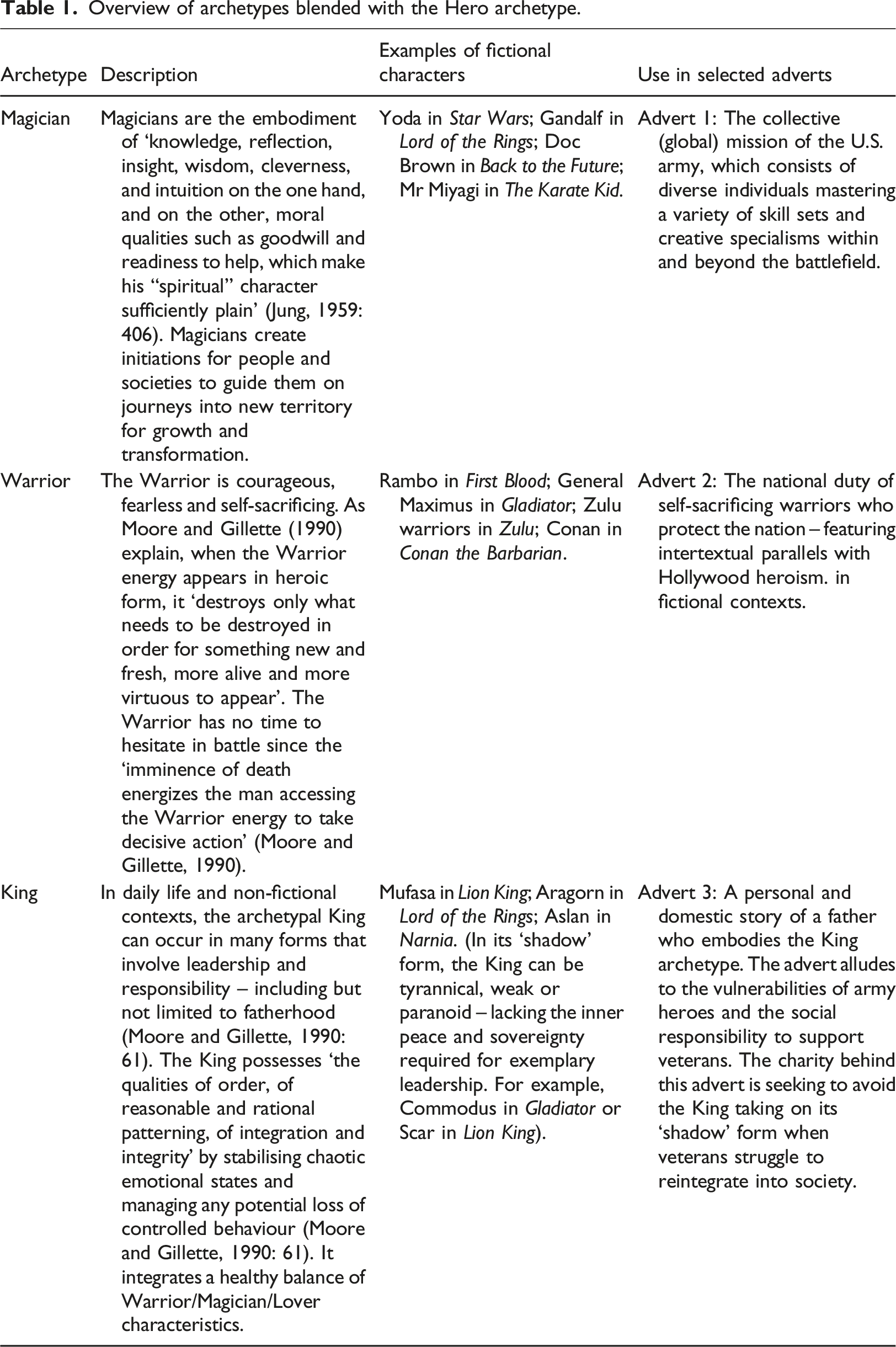
Overview of archetypes blended with the Hero archetype.
Illustrative examples
The advertisements that we selected for analysis were chosen based on the following criteria. Firstly, they had to portray the hero in an army context. Secondly, the term ‘hero’ had to be explicitly related to the advertising campaign, either through the use of the term within the adverts or explicitly stated by its creator(s). Thirdly, the adverts had to be aired (through traditional media or social media) within the last five years, to capture contemporary manifestations of the army hero archetype. Finally, the advertisements were all from the same cultural context, the U.S., to enable us to make common contextual observations. Our initial Google search produced eleven advertising campaigns that were then narrowed down to three that satisfied the above mentioned criteria, detailed in Table 1. Advert 1 targets viewers between 17 and 24 years old, the so-called Generation Z (Rempfer, 2019). Advert 2 uses footage from the movie Independence Day: Resurgence and was co-launched at the same time. Adverts 1 and 2 are produced for the U.S. military for recruitment purposes. Advert 3 is a Gillette Deodorant advert made in partnership with Operation Homefront – a charity organisation that supports military families.
We began our analysis by using DMA to identify the hero archetype in the advertising messages through its various multimodal forms. During our examination, we further recognised the presence of additional archetypes in each advert. We then analysed these archetypal combinations to show how they operated to try to achieve different viewer effects. The three case studies are illustrative examples that show how these archetypal combinations operate ‘synergistically’ in specific adverts, being combined to serve distinct purposes in relation to their social context, purpose and target audience.
An overview of this analytical process is provided in Table 1. In this table, we also provide some fictional examples of characters that embody these archetypal traits to help familiarise readers. After identifying these distinct archetypal traits in each advert, we conducted our multimodal analysis, which is presented next.
Advert 1: The ‘global’ hero-magician
‘What’s your warrior’? (USA, 2019 by DDB New York) 4
According to the advert’s commissioners, the advert was designed to mimic the genre of the fictional ‘superhero’ team, such as those depicted in Marvel movies, who join forces and combine their distinct ‘powers’ to defeat the enemy and conquer evil. Brigadier General Alex Fink, the US Army’s chief of enterprise marketing, explained: ‘The idea is, if you think about a Marvel-type series, and it was how these characters, heroes, came together and it wasn’t any individual that defeated evil. It was the power of the team that defeated evil’ (Keller, 2019).
Despite this, and despite the advert title (‘What’s your warrior’?), we will show that it is in fact the Magician archetype that underlies the characters it portrays: ‘All knowledge that takes special training to acquire is the province of the Magician energy… You are undergoing an ordeal testing your capacities to become a master of this power’ (Moore and Gillette, 1990:98). While the magician was originally categorised as a variant of the ‘old wise man’ archetype (Jung, 1959), Mark and Pearson (2001) have since identified it as a separate archetype in its own right used in marketing to create characters that use ‘magical lore’ (p. 140) to offer secrets to the pursuit of ideals such as healing, longevity or prosperity. This represents a distinct set of abilities and values to that of the warrior and requiring the two characters to work together (as in the military roles portrayed here) is a common feature of stories. Furthermore, Kelsey (2022: 21) explains how magicians and wise old men in popular storytelling often reflect characteristics of the warrior archetype through fictional examples such as Gandalf in Lord of the Rings, Doc Brown in Back to the Future and Mr Miyagi in the Karate Kid.
The first half of advert 1 illustrates a diverse range of skill sets and specialisms that individuals could contribute or develop through their career in the army: technological, scientific, linguistic and physical skill sets – all of which are typically associated with the archetypal magician (Kelsey, 2022; Jung, 1959; Mark and Pearson, 2001). The annotations displayed throughout the opening images state: ‘Cover mountain ranges. Split cells. Master the elements. Speak new languages. Command the tools of tomorrow’. The text is accompanied by images of army personnel in various roles: a helicopter flying through mountains; a cell splitting followed by a scientist in a laboratory with a pipette; a soldier poised with a rifle in a windy field with lightning behind him; a pair of hands hovering over a town with its fingers tapping on the rooftops; a woman’s face covered with computer graphics and linguistic texts; and three soldiers operating a mobile satellite dish. The advert is shot with a ‘video-game feel’ to the action scenes (something noted also by those commenting on the video) and is accompanied by instrumental music with a heavy bass beat of the type often used in action sequences in movies.
The Magician is both the initiator of these specialist skill sets, and the initiator for others (Kelsey, 2022). Firstly, the army as an institution, and its current personnel, is the ‘initiate’ of the Magician’s knowledge – the mentor who will guide recruits and provide them with the knowledge and skills required to pursue their mission. Secondly, it is the Magician energy within each individual that the advert seeks to resonate with: those who want to invest the time and energy to undertake the ‘ordeals’ and ‘tests’ to ‘master’ the magical powers (Moore and Gillette, 1990: 98). Regardless of whether they are the shamans, witch doctors or wizards of ancient civilisations or the modern scientists, doctors or lawyers of modern time, they all reference the same (typically masculine) ‘energy pattern’ of the Magician (ibid: 98).
Crucially, though, the ‘powers’ of those individuals who feature in the advert do not allude to individual acts of heroism. This constitutes a key break from the Hero’s Journey, which concerns itself with the journey of the exceptional individual whose courage, bravery, perseverance and sacrifice stands out above all others. Rather, army recruits are presented as individual initiations of power and knowledge that contribute to a collective challenge. There is a collective ‘call to adventure’ that is common in hero mythology, but rather than a story of individual heroism, this is about the eclectic characteristics of army personnel who contribute a variety of creative and transformative skills through the energy of the magician archetype.
Traditional masculine notions of the ‘gung-ho’ army hero are not only less prevalent, they are also challenged. The faces visible in the advert feature both men and women. There are more recognisably male than female faces, but not overwhelmingly so. Moreover, the roles they perform involve technical specialisms (e.g. depictions of computing and laboratory science technicians), not only the physical strength and courage associated with the activities of front-line soldiers. The closing message of the advert states: “Turn a global challenge into your daily mission. We are a team of a million unique and powerful individuals. Join forces with us and take on anything. What’s your warrior?”
The closing shot of the advert pans out to show a single (male) soldier surrounded by a variety of soldiers in different roles and outfits standing together as one team in a large army base. Notably, the soldier at the centre of the image, depicting the central protagonist of the story, is a man dressed in combat wear. There is, however, a call to adventure here aimed at all role incumbents – a familiar, monomythical narrative through which the individual will discover their ‘inner Warrior’ but only as part of a collective seeking to achieve a collective mission. The ‘collective’ here is not the nation-state or tribe, as is typical of Hero’s Journey stories. It refers to a mission to improve the plight of the entire planet: a distinct contrast to the nationalist role of the army represented in Advert 2. The nature of the ‘global challenge’ itself remains ambiguous. Importantly, though, the individual cannot take on this ‘global challenge’ alone. It calls for the individual to discover their specialism as part of a collective journey.
The transformational energies of the Magician archetype reflect a crucial archetypal complexity for modern times: an oscillation between the individual and the collective (Kelsey, 2022). This oscillation is a distinct, albeit under-recognised, trait of hero mythology. The Hero’s Journey is not innately individualistic: the hero’s self-discovery and homecoming would typically see them return with something for the benefit of the community. The coda, or moral of the story, would typically be cast as fulfilling a greater, common good that protects or benefits the community rather than benefits the individual. The Magician serves by ‘channelling power’ for the greater good (Gillette and Moore, 1990: 99; Kelsey, 2022).
Advert 2: The ‘national’ hero-warrior
‘Independence Day: Resurgence: A Source of Inspiration’ (USA, 2016 by McCann Erickson) 5
Whilst Advert 1 was about the global presence of the army, Advert 2 tells a story about the national, patriotic and defensive role that the army has played both historically and in modern warfare. Here, we see an example of the hero as a Warrior archetype in its more familiar form. The advert is unashamedly ‘gung-ho’ and parallels the work of the military with a Hollywood blockbuster movie. It shows a combination of clips from Independence Day: Resurgence – in which the earth is invaded by aliens and America leads the fight to save humanity – and real-world footage of American soldiers and military vehicles on the battlefield.
The U.S. Army joined forces with 20th Century Fox to design the advert for an Army recruitment marketing campaign timed alongside the release of the film Independence Day: Resurgence in 2016. According to the Director of the Army Marketing and Research Group, the advertisement is ‘highlighting the real-life heroes fictional characters are based on: U.S. Army Soldiers’ (Sheftick, 2016).
The narration of the advert states: “When the soldiers in the movie rise up… when they adapt to a new threat facing the world, and they find a way to win no matter what, remember where Hollywood gets that from. The U.S. army has been defending American independence for more than 241 years. Go to goarmy.com/independence to learn how you can join their ranks. Independence Day: Resurgence in theatres June 24th.”
The audience is reminded that the ‘fiction’ of Hollywood gained its inspiration from the ‘real-life’ stories of army life. The army career is depicted as packed with the kind of action and drama one would expect from a movie. The soundtrack comprises instrumental music which speeds up in tempo and is layered with the sounds of aircraft flying and shots being fired.
Independence Day operates as more than a commercial feature here. It is a metaphorical trope that signifies the ‘outside other’ – an alien force that poses a threat to the nation. The trope enables the advert to allude to any outside force or enemy that has posed, or could pose, a threat to the nation-state. The theme of invasion is important here because it signifies the necessity to protect domestic interests and U.S. independence.
This coda – the moral of the story involving the veneration of the kinds of brave, patriotic and selfless individuals who are willing to risk their lives to defend America against the threat of invasion – provides the narrative conventions that are necessary for the archetypal Warrior to play out (Moore and Gillette, 1990). The alien threat denoted in Independence Day resonates with the theme of human pettiness being set aside for the sake of a greater good – the nation-state, independence and American values and ideals. Since the alien invasion is a threat to the whole planet, the mission to protect American independence is also presented as a struggle to protect humanity. The values of America are, by implication, the values of the world.
The Warrior archetype is, of course, not exclusive to American society or Western society more generally, but this is the particular context of this advert. The Warrior in this sense is less about individual identity, specialism or knowledge and more about the monolithic duty to serve the nation-state – putting the self to one side in aid of a greater good. Unlike Advert 1, which is about unique and diverse individuals developing various specialisms, this story is less about individual specialisation and more about the monolithic, regimented actions of battlefield Warriors. Their shared duty to fight on the front line and defend the nation is the one, shared factor that collectively defines them.
The association with Independence Day functions to metaphorically pitch the U.S. army against a superior enemy that is technologically more advanced than any human army. From our cultural familiarity with this archetype, we know that the advert suggests (albeit implicitly) that sacrificial heroism is a genuine possibility when the Warrior commits to this cause. Our anticipation of ‘martyrdom’ associated with the Warrior’s sacrificial commitment to a greater cause enhances the moral resonance of this archetype. As Moore and Gillette (1990: 82) point out, the ‘Warrior traditions all affirm that, in addition to training, what enables a Warrior to reach clarity of thought is living with the awareness of his own imminent death’. The Warrior archetype, in its traditional masculine form, is reinforced by this advert, which does not show any faces or voices of those soldiers on the battlefield: ‘He says little, moves with the physical control of a predator, attacks only the enemy, and has absolute mastery over the technology of his trade’ (Moore and Gillette, 1990: 83).
The sense of urgency and immediacy of an advert that opens with a shot of an alien ship invading earth followed by a series of battle scenes (and finishing in less than 30 seconds) provides a narrative pace that operates sufficiently for a Warrior story (Moore and Gillette, 1990: 82). This is a simple story about Warriors who fight, risking their lives for the protection of their society and its values.
Advert 3. The ‘domestic’ hero-king
‘Every Hero Sweats, Some Never Show It’ (2019, Gillette Deodorant, in partnership with Operation Homefront) 6
Advert 3 is not made by the U.S. army. This is a Gillette Deodorant advert that is made in partnership with Operation Homefront – a charity organisation that supports military families. The charity’s website defines its mission as follows: ‘Build strong, stable, and secure military families so they can thrive in the communities that they’ve worked so hard to protect’. This mission statement makes the connection between the Warrior’s commitment and sacrifices made in Advert 2 with the moral responsibility of the community to support those who have risked their lives for a greater cause beyond themselves. Sara Saunders, Associate Brand Director, P&G Personal Care, described the message behind the advert: ‘The campaign shows the duality that many service members experience—balancing commitments between work and family. It also shows the struggle many face when they have to re-enter civilian life and find a job’. The Gillette website states: ‘Gillette wants to celebrate the everyday heroes who persevere through that transition [between the military and civilian life] all while balancing the everyday demands of their job, family life, and any number of additional challenges they face’.
The advert tells the story of a (male) soldier with a young family who is struggling with the process of leaving the army and re-entering civilian life. The advert begins with the soldier waking up in the morning and applying Gillette deodorant – one clip shows him in his barracks and the other one in his bathroom at home. The series of clips that follow continue to alternate between the soldier away on duty and the same man as a father at home with his wife and children. The activities that he pursues at work are paralleled with his role as a husband and father at home – suggesting his job as a soldier provides him with ‘life skills’ that are transferable beyond the army.
The viewer is shown clips of the soldier missing his children whilst he is away, pacing up and down in his barracks in apparent anxiety or distress and having difficult conversations with his wife at home, ostensibly around civilian job opportunities. We then see him embracing his wife in a gesture of providing or seeking reassurance or comfort. Finally, we see him dressed in a suit and waiting outside an office for an interview. After the interview, he returns home to his family where he tells his wife and children that he got the job. The family embraces and smiles. An annotation then appears across the screen, stating: ‘Every hero sweats. Some never show it’. The advert finishes with a shot of the Gillette deodorant and the brand tagline: ‘The best a man can get’, followed by the statement ‘Gillette deodorant proudly supports servicemen, veterans & their families’ (emphasis in original) and finally information about the Operation Homefront charity and link to www.gillette.com/militarydonation.
The archetypal King – or what Mark and Pearson (2001: 244) refer to as the ‘Ruler’ – commonly appears through various social, personal and professional leadership positions and responsibilities (Moore and Gillette, 1990: 61). In this advert, the King archetype resonates through the soldier’s role as a father seeking to provide for his family after leaving the army. Reflecting common characteristics of the archetypal King, he battles to maintain his strength and composure and maintain his integrity as the father figure, provider to his family and role model to his children. In its fullness the King possesses ‘the qualities of order, of reasonable and rational patterning, of integration and integrity’ by stabilising chaotic emotional states and managing any potential loss of controlled behaviour (ibid: 61).
The King typically incorporates multiple archetypal qualities that enable him to lead his kingdom (in this case, his family and inner sovereignty) and display different characteristics according to the responsibilities that arise (Moore and Gillette, 1990). The Warrior in him can exert aggressiveness when necessary to maintain order and enforce order against the threat of chaos: as a father and soldier he can protect his family and country, respectively. But the Magician’s energy also provides him with a deep wisdom to make necessary judgements and create new possibilities (in his army and civilian life). The archetypal Lover (ibid: 119–141) delights in the qualities of others (his wife and children, who he displays affection for throughout the advert), which is crucial to his decision making through which he also relies on his family’s support. The King beholds a healthy balance of these archetypal qualities – in this case through fatherhood, and his flexibility enables him to adapt in awkward circumstances in order to serve his kingdom (family).
The latter is also important to the gendered dynamic of the advert. On the one hand, the man of the house is first and foremost the provider and, as such, fulfils a traditional masculine role. At the same time, this is not a simple Hero-Warrior story, with a male protagonist who shows no emotion and never flinches under pressure. We are encouraged to empathise with a man who is feeling the pressure, but managing his emotions to maintain his calm and integrity for the sake of his career and family. But crucially, he does not do this alone – hence the requirement for Operation Homefront. He needs both his family and the support of the wider community. Whilst Gillette deodorant provides a metaphorical symbol of protection that ‘hides’ the hero’s sweat, its commercial partnership with Operation Homefront provides a more serious message that is both moral and archetypal in its conventions.
The advert alludes to the fact that society has not always taken proper care of veterans in the past. The traditional discourse of masculinity expects the soldier to be ‘tough’ and emotionless. Instead, here we are shown that heroes need their family, they need their community, they need charity, and they require empathy when they leave the military and begin new lives and careers. Heroes can also show signs of stress or distress, reflecting shifts in societal discourses of masculinity that challenge the ‘tough guy’ imagery and encourage men to recognise and talk about their mental health. We note, though, that in establishing this less restrictive image of masculinity, some deliberate choices were made regarding whom to exclude. Gillette supports ‘servicemen, veterans & their families’ (italics our own) without a similar linking of their products marketed to women with supporting servicewomen, nor any suggestion that men may need support as family members of servicewomen.
The deodorant ‘masking’ the hero’s sweat serves as a metaphor for the hero ‘masking’ his inner emotional turmoil from others. The background music, a slowed down version of ‘Three Little Birds’ with lyrics ‘Don’t worry, about a thing, 'cause every little thing, gonna be alright’ reinforces the emphasis on inner turmoil and emotion. Unlike Adverts 1 and 2, with their fast tempo instrumental music accompanying action-packed imagery, the slow-paced melody and the lyrics take centre-stage, with no voice-over or character voices heard.
As an advert developed in partnership with the charity Operation Homefront, the advert alludes to the commonly known scenario of the veteran who is ‘damaged’ by their army experiences and returns home to descend into a spiral of degeneration and destruction (drugs, violence, mental illness, etc.) often depicted in Hollywood movies and media stories. The advert serves as a kind of ‘warning tale’ for society: if you fail to do your part and care for the returning soldier, the hero can become the anti-hero. Without this quid pro quo, we risk the ‘shadow’ elements of the archetype unleashing chaos and destruction, if the ‘damage’ of combat is not repaired. In mythological terms, the King can become the ‘shadow King’, who is a tyrant in the family home, his Warrior energy is not channelled or disciplined, and his Magician energy becomes deceptive and dishonest (Moore and Gillette, 1990: 63). The message in this advert suggests that the qualities of Hero-Warriors, Hero-Magicians and Hero-Kings are only harnessed appropriately when they leave the army if they are able to access the support that any enlightened King requires for their kingdom (inner and outer) to prosper.
The three adverts we have analysed show how these archetypal blends enable modern hero stories to adapt and reform according to the societal and audience values they attempt to resonate with. Of course, in all three cases, critical readers of different ‘interpretive communities’ (Kelsey, 2017) might suspect that shadow forms of Magicians, Warriors and Kings operate beyond the text; engaging in military or social practices that they deem to be ideologically exploitative, misleading, destructive or morally questionable, despite the representations of military advertising.
Discussion and conclusion
This study theorises the use of heroism in marketing by analysing selective representations of the army hero in contemporary advertising. We have used the Discourse-Mythological Analysis approach as a novel theoretical lens for the study of advertising. Through a DMA analysis of three adverts featuring army heroes, we explicate how military advertising involves the ‘blending’ of multiple archetypal forms. Our analysis indicates that the army hero is not a homogenous archetype; rather, military heroism is heterogeneous and is a product of different archetypal combinations used in advertising. This study cannot capture every archetypal blend that has been used to depict the army hero in all cultural contexts, nor can it lay claim to have found the ‘dominant’ archetype used in contemporary advertising. Rather, we have shown that, even within a small sample from one cultural context, representations of military heroism blend archetypes because they serve multiple social and institutional purposes, appeal to the interests of different interpretive communities, and operate in multifaceted cultural contexts.
Following the principle that hero figures take on different forms according to the values and ideals of their culture, we illustrate how the Hero archetype combines with other archetypes – namely, Magician, Warrior, King – in order to convey distinct meanings of heroism in current times. Advert 1 demonstrates the role of the Magician archetype in the collective global mission of the U.S. army, which consists of diverse individuals mastering a variety of skill sets within and beyond the battlefield. Advert 2 shows how the Warrior archetype functions through the duty of army heroes to protect the nation-state – featuring intertextual links with Hollywood heroism in fictional contexts. Advert 3 shows how the King archetype functions in a domestic story that alludes to the vulnerabilities of army heroes and the collective social responsibility to support veterans. Together, our analysis shows how advertising can either reproduce or revise the moral and gendered roles of the traditional hero according to the global, national and domestic messages conveyed in the adverts.
Masculinity is still central to heroism in all three adverts, but some contemporary modifications are observed. Advert 2 reproduces the classic conceptions of traditionally masculine characteristics and virtues: replete with images of risk-taking, physical strength and bravery (Becker and Eagly, 2004; Featherstone, 1992; Frisk, 2019). However, Adverts 1 and 3 adapt this classic conception. Advert 1 rejects the classic conception of the hero as a male ‘lone wolf’ who – thanks to their exceptional levels of bravery, risk-taking and self-sacrifice – can be singled out and accorded the exclusive status of ‘hero’. Advert 2, inspired by Hollywood, emphasises the power of the team rather than the power of the individual and represents both men and women working together to tackle their shared ‘global mission’. Advert 3 places the focus on the individual army hero but also adapts the classic conception by explicitly rejecting the macho ‘tough guy’ image of the masculine hero. The audience is invited to see the sweat – serving as a metaphor for mental anguish – lying behind surface appearances of the ‘tough’ army hero. Here, a soldier can experience doubt, stress or anxiety and still be a hero, but one that requires support from the family and community in the ‘quid pro quo’ for their patriotic duty and sacrifice.
While heroism remains relevant for marketing and advertising in commercial and non-commercial contexts (Hollenbeck and Patrick, 2016; Sciarrino and Roberts, 2018), the concept is not immutable. We have contributed to theorising the ever-changing representation of heroism by identifying the phenomenon we have called ‘archetypal blending’. In order to resonate with audiences across multiple social contexts, archetypal blending enables adverts to serve multifaceted purposes. Archetypal blending enables hero narratives to remain meaningful to diverse audiences who may simultaneously expect familiar and conventional representations and might also demand transformations that reflect emerging cultural values. This expands monomythical conventions of heroism to facilitate understanding of how and why archetypes are combined.
In the military context, archetypal blending allows the army to be presented in a way that appeals to a wide range of the public who identify with traditional images of the army hero and those who favour a progressive or inclusive outlook, but who could be alienated by a complete rejection of either of these. Parallels can be drawn with the British Army’s 2019 recruitment campaign, which combined a pastiche of the classic ‘Lord Kitchener wants you’ poster of 1914 with appeals to the ‘compassion’ of ‘snowflakes’, the ‘drive’ of ‘binge gamers’ and other qualities associated with contemporary youth. Importantly, though, this campaign was widely mocked for appealing to characteristics unworthy of being valorised. It was also dismissed by progressives as a shallow whitewashing of militarism. Notwithstanding, the army reported a marked increase in applications, suggesting that such ‘blended’ archetypes can function as an effective marketing tool by enabling the young target audience to intertextually connect their values and identities to established cultural images of patriotism (Hirschman, 2000).
While this study did not literally find a ‘thousand faces’ (Campbell, 1949), we did find three distinct faces of the army hero in contemporary U.S. advertising by (and about) the military. Figure 1 depicts these three ‘faces’ across the three adverts according to their archetypal blends and associated meanings. The archetypal blending of the Hero archetype in army advertising.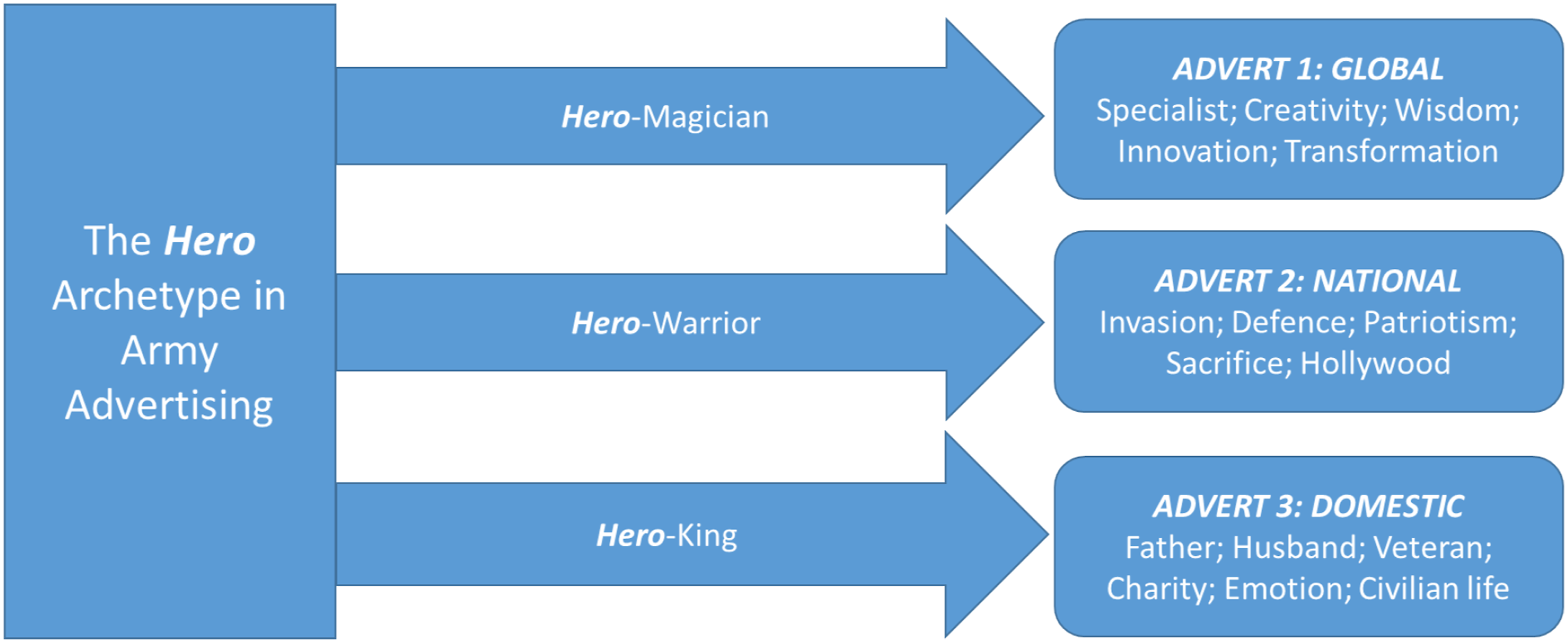
While archetypal stories clearly can and do evolve, they do not fundamentally change per se. Rather, they are repurposed and ‘shapeshift’ into new combinations of pre-existing archetypal forms in response to the needs of particular cultures and societal institutions. Military recruitment adverts do not necessarily reflect what Zuckerman (2016) envisaged in her call for stories of the Collective Journey to revolutionise our formulation of monomythical storytelling. However, they do show how the institution of the army has sought to adopt a less reductive focus on the individual in hero stories. When we consider the intertextual and archetypal complexities of these adverts, what we see is an oscillation between the individual and the collective where each has a responsibility to the other.
These findings are also relevant to our understanding of heroism in society beyond the context of army advertising. While Campbell rightly argued that the hero archetype has continually evolved throughout history, our findings show how it simultaneously adapts and transforms in those parallel contexts of the same culture and historical period. Through archetypal blending, the hero archetype can serve multiple ideological purposes at any given time – without a dramatic shift in historical, cultural or geographical context. It is through the blending practices we have analysed that the hero archetype can adapt to the ideological requirements of any specific context.
Our findings are to be understood within the limitations of our chosen methodological approach, where we seek authenticity of meanings rather than generalisability. Future research could extend our investigation to advertising campaigns that portray the army hero in other time periods and other cultural contexts. Understanding archetypal blending using DMA to study other consumption-related contexts would also build on our work here. Importantly, audience studies would be needed to see how the blended hero archetype is interpreted by audiences and how it influences consumption. The role of strategic polysemy, where the multiple meanings and associations of signs are purposively exploited, could also assist future investigations in understanding how heroic signs and symbols used for marketing purposes. Finally, given the recent references to archetype blending by practitioners working on branding (e.g. Dowd, 2021), future research could usefully unpack the practices through which marketing professionals make judgements about what archetypes to blend and how they should be blended to maximise their potential as a marketing ‘tool’.
Footnotes
Author Contributions
This manuscript theorises on the use of heroism in marketing by analysing selective representations of the army hero in contemporary advertising. It introduces the discourse-mythological approach as a novel theoretical lens for the study of advertising. It advances theoretical insights into how the advertising discourses can blend narratives of heroism and other mythical archetypes to remain meaningful to audiences who may simultaneously require conventional views of the military and demand transformations favoured by emerging cultural values. This expands monomythical conventions of heroism, while proposing ‘archetypal blending’ as a concept to facilitate understanding of how and why archetypes are combined.
Declaration of Conflicting Interests
The author(s) declared no potential conflicts of interest with respect to the research, authorship, and/or publication of this article.
Funding
The author(s) received no financial support for the research, authorship, and/or publication of this article.
