




Abstract
Our title harks back to Frederick W. Taylor’s influential book. But our identification of the principles of algorithmic management is certainly not advocacy. Our task in this essay is to develop a theory of algorithmic management in relation to fundamental changes in the shape and structure of organization in the 21st century that are reconfiguring boundaries, roles, and relations among managers, workers, engineers, professionals, consumers, and other user categories. In particular, such a theory must be attentive to transformations in the topology of organization. Today, many of the most valuable actors, assets, and activities are not located within the firm but involve a complex entanglement of information flows, practices, and users. This topology gives rise to a distinctive challenge: how to manage when the most valuable assets and activities are not in the firm. Whereas actors in hierarchies command, in markets they contract, and in networks collaborate, on platforms they are co-opted. The co-optation of actors, assets, and activities is undertaken by algorithmic management. To grasp the distinctive principles of algorithmic management, we compare and contrast the features of its ideology and practices with those of scientific management and the more recent collaborative management. Algorithmic management, we argue, operates within a different organizational form, articulates a different ideology, and addresses different managerial problems with different governance principles along different lines of accountability.
Keywords
Introduction
The opening decades of the 20th century marked a period of heightened conflict in which capital and labor were locked in struggle over the conditions and control of industrialized work. But alongside (or in between) that dichotomy was an emerging new class spearheaded by mechanical engineers championing the social movement known as scientific management. Pioneered by Frederick Winslow Taylor, scientific management made claims to legitimate the professional managers’ share of the social surplus, not because it owned or because it labored but because it knew better. Advancing these knowledge claims, the mechanical engineers around Taylor were the vanguard of a new knowledge class (Stark, 1980).
The opening decades of the 21st century now mark another period in which a new set of actors are making new knowledge claims. At the forefront, again, we find engineers. But these are software engineers, and the movement they are championing is known as algorithmic management (Birnbaum & Somers, 2023; Kellogg et al., 2020; Stark & Pais, 2020). As with the analysis of scientific management, algorithmic management can be examined through the lens of heightened conflict between capital and labor. But just as it would be inadequate to analyze scientific management along dichotomous class lines, such dichotomies will leave important structures and processes unexamined when studying algorithmic management.
Our opening premise, therefore, departs from the widespread view that algorithmic management is an amplification of scientific management. Characterizing algorithmic management as bureaucratic, rule-based, and preoccupied with efficiency, analysts use terms like “digital Taylorism” (Günsel & Yamen, 2020; see also Brown & Lauder, 2012), “the new scientific management” (Birnbaum & Somers, 2023), “scientific management 2.0” (Schildt, 2017), and “Taylorism on steroids” (Noponen et al., 2023; see also O’ Connor, 2016) to highlight the unbroken continuity across the centuries.
Despite some similarities, 1 algorithmic management should not be understood as a simple extension of scientific management, we argue, because it operates within a different worldview: whereas scientific management saw humans as programmable machines, algorithmic management sees machines as capable of learning.
Our title harks back, of course, to Taylor’s influential book (Taylor, 1914). But our identification of the principles of algorithmic management is certainly not advocacy.
Instead, our task in this essay is to develop a theory of algorithmic management in terms of broader changes in the shape and structure of organization in the 21st century. Much more than a new moment in the relationship between capital and labor, algorithmic management should be theorized in relation to fundamental changes in organization—including their boundaries (or the lack thereof) not only in production or distribution but across many domains of activity—that are reconfiguring roles and relations among various users such as managers, engineers, professionals, and consumers, as well as workers, suppliers, and other producers.
As we elaborate in more detail below, we give special attention to the erosion of the boundaries of organization. Algorithmic management, we argue, responds, and further contributes, to a process in which many of the most valuable actors, assets, and activities are not located within the firm but involve a complex entanglement of information flows, practices, and users. Misunderstood as merely the supervision of labor, algorithmic management is an attempt at co-optation of these heterogeneous actors, assets, and activities wherever they might be in organizational space.
Our project is less restricted than a new theory of the firm, but also more bounded than a new theory of society. Instead of offering a theory of the “algorithmic society,” we operate at the organizational level. Our relatively bounded project is to theorize a style of management organized around algorithmic practices that emerges together with relatively boundless organization.
In the pages that follow, we briefly diagnose three limitations of the now dominant perspectives on algorithmic management. We then indicate a starting point for an alternative conception situating algorithmic management in relation to fundamental transformations in organization. That conception is more fully elaborated in the subsequent major section of the paper. Our analytic method offers a set of dimensions along which we recognize and present the principles of algorithmic management in relation to other styles of management in prior forms of organization.
The study of algorithmic management will be distorted if compared only to scientific management—for it also resonates with aspects of post-bureaucratic forms that have appeared during the past fifty years alongside fascinations with autonomy, flexibility, empowerment, and self-management (Boltanski & Chiapello, 2005; Heckscher & Adler, 2006; M. Y. Lee & Edmondson, 2017; Turner, 2010). To identify and analyze the distinctive principles of algorithmic management, we therefore systematically compare and contrast the stylistic features of its ideology and practices with those of scientific management and those of the more recent collaborative management.
As we shall see, algorithmic management operates within a different organizational form, articulates a different ideology, and addresses different managerial problems with different governance principles along different lines of accountability.
New Problems and New Answers for a New Era
Current approaches
Within just a few years, the study of algorithmic management has burgeoned. We see three limitations in the current perspectives. The major limitation of a first, now common, approach is that it confines algorithmic management to the workplace. That view focuses on algorithmic management as a new way to manage labor, whether in the gig economy or the more traditional workplace (Baiocco et al., 2022). A prevalent theme is that algorithmic management results in increased exploitation (Moore & Woodcock, 2021) requiring “human labor in forms that are highly fragmented, decomposed, and controlled” (Altenried, 2022, p. 7; see also Birnbaum & Somers, 2023; M. K. Lee et al., 2015). Importantly, even when algorithmic management takes place “outside the traditional factory. . . onto streets or into private homes,” these sites are characterized as workplaces, “digital factories” that “take on the disciplinary functions of the traditional factory” (Altenried, 2022, p. 7).
Kellogg et al. (2020) go beyond this singular emphasis on discipline to depict the algorithmically organized workplace as a site of “contested terrain” (see also Schüßler et al., 2021) in which workers can resist (Cameron & Rahman, 2021; Graham, 2020), ignore, or merely pay lip service to the production technologies charged to control them. But, staying within the parameters of the prevailing view, they too restrict algorithmic management to a method for supervising labor in the workplace. 2
To be clear: bringing labor process theory into the analysis of algorithmic management can bring historical depth to the study of the latter (Vallas & Schor, 2020; Vertesi et al., 2020). Conversely, making algorithmic management an object of study for labor process theory is revitalizing debates about that theory (Kellogg et al., 2020; Shestakofsky, 2017). But the analysis of the structures and processes of algorithmic management must, we contend, not be a sub-field of labor studies.
For reasons we elaborate in greater detail in the subsequent section, taking the workplace as the exemplary setting for algorithmic management suffers from a serious limitation because it unnecessarily restricts the applicability of the concept. Moreover, taking the supervision of labor as its exemplary function suffers from a serious limitation because it obscures how, the more its scope extends beyond the workplace, the more its task cannot be reduced to surveillance.
A second strand of thinking defines algorithmic management as automating managerial decision-making. Birnbaum and Somers (2023), for example, write that algorithmic management “involves the use of algorithms to perform functions that were previously done by humans. Most applications involve decision-making so that algorithms are used to make decisions that were previously made by managers” (p. 3, emphasis added). A related strand, slightly more expansive but nonetheless still reductive, defines algorithmic management as the “delegation of managerial functions to algorithms” (Jarrahi et al., 2021, p. 1; see also M. Y. Lee & Edmondson, 2017; M. K. Lee et al., 2015).
Our major problem with this perspective is the assumption that algorithmic management can best be understood by starting with what managers do: managers make decisions and perform functions; that is now what algorithms do. We disagree, first, because in place of a dichotomy, either human or machine, we see action as distributed across humans and non-humans. “Management” should not be equated with those persons who are managers. Neither is it now the province of anthropomorphized machines. For us, algorithmic management refers to algorithmic practices—not algorithms alone but configurations of humans and machines (Barley, 1990; Callon & Latour, 1981; Knorr-Cetina, 1997; Stark, 2022). 3 We also differ with this view because, as we shall see, many of the functions performed by algorithmic management were not previously managerial; in fact, some may not have been previously performed at all. Algorithmic management is therefore not simply a new way of performing already existing managerial tasks. For example, more than offering a different way of managing the activity of professionals, algorithmic practices can intervene to directly carry out tasks previously performed by professionals. 4 In the process, alongside modifying the managerial functions, it also re-configures the contours and character of the professional functions themselves (for examples from accounting, see Power, 2022).
A third limitation of existing research is that it frequently characterizes algorithmic management as bureaucratic. This view is so prevalent that it affects researchers who have moved out of the workplace and are focusing on activities that were not conventionally managerial. Curchod et al. (2020), for example, find “bureaucracy” even when their pathbreaking ethnographic study of online retail trade discovers new forms of “power asymmetries” in triangular relations among platform operators, producers, and end users that dramatically depart from bureaucratic practice—as if asymmetry is necessarily bureaucratic.
But not all research is captive to this limitation. In a rich ethnographic study of a technology company, Valentine and Hinds (2021) boldly state their observation that “the decision structuring of algorithms is fundamentally different from that of bureaucratic systems.” We agree. The power relations of algorithmic systems of ratings and rankings (of and by providers and users, for example) can be imbalanced, but they are not a supervisory hierarchy (Stark & Pais, 2020).
Bureaucracy is hierarchical—in its conceptual as well as its organizational structure. With a supervisory hierarchy in which subordinates are supervised by those who are themselves being supervised, the organizational structure of bureaucracy is hierarchical. Hierarchical as well are the conceptual structures and categorization systems of bureaucracy (for example, a hierarchy of increasing generality, knowledge, and scope of vision as one advances up the organizational chart). 5 Algorithmic categorizations, by contrast, need not be hierarchical. Although algorithmic orderings can, and frequently do, reinforce bias, algorithmic orderings can depart from bureaucratic orderings (Alaimo & Kallinikos, 2021, p. 1389), yielding new forms of visibility and new opportunities for insights, as Flyverbom (2022) and Valentine and Hinds (2021) show. 6
Organizing beyond boundaries
The limitations of the dominant perspectives can be expressed succinctly: either, they posit a new way to solve old problems (algorithms as the means to control labor, for example, or to reverse the growing ranks of middle management), or they pose a new problem (how to manage heterogeneous producers and users on online platforms) but can only imagine the answer within the forms and formulas of an old solution (the bureaucratic). Our view is different: we need to understand how, in our era, managing takes new emergent forms in response to new problems and, in the process, makes new problems.
In analyzing the basic organizing principles of algorithmic management, we therefore put our attention to the new challenges that it encounters in the changing organizational environment and to the new organizational problems it creates. Our assessment is that algorithmic management emerges in a moment characterized by fundamental changes in the very nature of organization. In particular, we link algorithmic management to transformations in the topology of organization. Not respecting the organizational boundaries of the firm (or the non-profit, or the government agency, or the school, church, or political party), algorithmic practices address the management challenges of this transformation even while creating new problems.
Organization theory is familiar with the idea that organization should not be confined to the boundaries of the firm (Ashkenas, 1995; Hirschhorn & Gilmore, 1992). But its insights, innovative for the problems then encountered, are insufficient in this new moment. In the network theory of organization (as perhaps the best example of this style of thinking), organizational boundaries were depicted as becoming more and more porous and coordination across them more and more important, leading some to argue that, as the real unit of action, not the firm but the network of firms should be the proper unit of analysis in economic sociology (Powell, 1990; Stark, 2001; see also DiMaggio 2001a, 2001b). But whatever their claims about units of action and units of analysis, it remained the case in the network theory of organization that the units with the ever-more porous boundaries were, after all, firms; and to coordinate activities across these boundaries trust and reciprocity were operating in place of markets or hierarchies. 7 The changes in topology we have in mind are yet more radical and the means of coordination more novel.
Take a basic operation: an online purchase by an end user on a social media platform with a shopping option. In this non-hypothetical operation, a single click by the user simultaneously buys a product; directly triggers a purchase order for a component for a production process several links upstream in the supply chain; registers the user’s stylistic preferences, credit card information, and current location; transmits that information to advertisers; signals the purchase to other consumers in the user’s social media network; and, all the while, the user is not an employee of any of the platforms or firms in which these chains of actions, information, data, and products are taking place.
Whereas in the past, organization was generally understood as strongly bounded, with relatively clear distinctions between what was inside and what outside, today it is more and more difficult to demarcate important assets, actors, and activities as inside or outside the organization (Birch & Muniesa, 2020). That is, in platform organization (the organizational form most typical for algorithmic management) rather than focus on boundaries and their degree of porosity, analysis would be better placed to consider organization as tendentially unbounded—like the form of the Möbius strip, topologically without inside or outside (Watkins & Stark, 2018).
This Möbius topology and its corresponding basic operation can be expressed in contrast to the three forms of coordination (hierarchies, markets, and networks) familiar to economic sociologists: whereas actors in hierarchies command, in markets they contract, and in networks collaborate, on platforms they are co-opted (Stark & Pais, 2020). This topology gives rise to the distinctive challenge of the platform as an organizational form (Kornberger et al., 2017; Stark & Pais, 2020; Vallas & Schor, 2020): how to manage when the most valuable assets and activities are on the platform but not in the firm.
Our diagnosis is that this challenge cannot be addressed by any or all of the familiar triplets: they will not be managed by supervisory ordering within the firm; cannot be negotiated by contracts across firms; and are of a scale, scope, and type too complex and vastly too large to be amenable to relations of trust and practices of reciprocity. Entirely different, the co-optation of actors, assets, and activities is undertaken by algorithmic management.
The Principles of Algorithmic Management
To identify and analyze the distinctive principles of algorithmic management we compare and contrast it to scientific management and to the more recent collaborative management along the following five dimensions: organizational form, the object of management, ideology, modality, and accountability.
Organizational form
Although some scientific managers addressed the office (Leffingwell, 1917), the school (Bobbitt, 1912), the household (Wilson, 1929), or even the kitchen (Gilbreth, 1930), the organizational form typical of scientific management was the factory. By contrast, the emblematic form of the post-bureaucratic style was the project (Grabher, 2004; Sydow et al., 2004; Vanden Broeck, 2020), whether the stand-alone startup or the agile research unit with its own distinct temporality within a larger organization. Collaboratively managed projects could and can coexist even inside otherwise fully bureaucratic structures such as automobile producers, defense contractors, and the National Aeronautics and Space Administration (Vertesi, 2020).
The organizational form most corresponding to algorithmic management is not the factory or the project but the platform. Unlike projects that can stand outside or stand within the hierarchically organized firm, platforms activate resources and personnel for which unambiguous terms like inside or outside do not capture their status. Everyday language for talking about the platform reflects this curious topology: the activity of social life takes place on the platform.
Identifying the platform as the organizational form most characteristic of algorithmic management does not mean, of course, that the platform is its exclusive locus. For example, AI-assisted decision-making (sometimes known as augmented decision-making) need not take place on a separate, public-facing platform but can occur within the day-to-day operations of the firm. Yet, in many cases, such AI technology is located on a local, private “platform.” To access algorithmic recommendations the manager, professional, or technician must go “on the platform.” In such cases, actual practice and the lexicon about it make reference to the platform as the model organizational form corresponding to algorithmic management.
Moreover, as our reference to algorithmic-assisted decision-making indicates, we should not assume that the platforms on which algorithmic management is practiced are only social media or streaming platforms. Some platforms are far afield from Facebook, TikTok, Spotify, or others that first come to mind. Perhaps the best example might be MyJohnDeere, the cyber-agricultural platform of the giant agricultural equipment manufacturer. Using on-board computers with GPS and GIS on precision-equipped tractors and combines, programs like Autosteer will plant or harvest a field with little guidance by the farmer. Sensing systems and software programs that are part of the proprietary management platform meanwhile can gather data on soil conditions and crop yields on a meter-by-meter basis, as well as moisture content, starch, protein, and other traits. This information can be fed back to the system to make automated adjustments, on a sub-field basis, to the spacing and depth of seeds and the levels of fertilizers come the next planting. That is, while farmers plant seeds and harvest corn, John Deere harvests data. Just as algorithmic management figures in precision medicine and precision education, so too it operates in precision agriculture (Miles, 2019; Schrijver et al., 2016; see also Grabher, 2020; Stark & Pais, 2020, p. 48; and, for accounts and photographs from the field, Stark & Warner, 2013, pp. 90, 94–95, 108).
Thus, when we write about the platform as algorithmic management’s characteristic organizational form, we have in mind more than the continued growth of streaming, social media, and e-commerce platforms. That is, we think about an ongoing and intensifying “platformization” (Frenken & Fuenfschilling, 2020; Plantin et al., 2018; Power, 2022) in which more and more economic, political, and social activities will be algorithmically managed on some kind of platform model.
Although scientific, collaborative, and algorithmic management emerged in different historical epochs, none of the three styles of management is confined to its initial period. In fact, because our concept of organizational form is not co-terminous with that of a company, a given business entity operating today could be analyzed as exhibiting all three management styles, each corresponding to its constituent organizational forms. At Amazon, for example, we can find scientific management in the operation of its distribution centers, collaborative management in the projects of its research units, and algorithmic management on its platforms (on Meta/Facebook, see Christin et al., 2023).
Object of management
As the previous section suggests, the three management styles differ in the type of management problem to which they are addressed. Developed in the factories of industrial production at the turn of the last century, the typical object of scientific management was the supervision of labor. By contrast, post-bureaucratic management was the product of post-industrialism. Nurtured in the start-up cultures of high-tech and new media in California’s Silicon Valley and New York’s Silicon Alley (Neff, 2015) as well as in the R&D units of established corporations in fields such as pharmaceuticals and engineering (Kunda, 1992), its objective was the coordination of specialists.
The notion of post-industrialism as a new stage of development in which theoretical knowledge becomes a productive force (Bell, 1973) only partially captures the setting in which collaborative management emerged. The challenge that it addressed was recombinant innovation, a new form in which innovation was not just applying theoretical knowledge but combining knowledge from different fields and disciplines. Thus, in the new post-bureaucratic teams, coordination often involved heterogeneous specializations: interactive designers, software programmers, and merchandising specialists, for example, or biologists, business strategists, engineers, and information architects. With a high premium on rapid innovation, operations in such teams shifted from sequential engineering to simultaneous engineering (Dorf & Sabel, 1998; Piore & Sabel, 1984) in which the parameters of project sub-components (or even of the overall project) are not planned and fixed in advance. This magnified the importance of communication within and across specializations without recourse to managerial levels formally above them. The result was not simply to flatten hierarchies. Coordination of specialists would be collaboration among the specialists themselves. Not directed from above, coordination would be self-directed (Levine & Prietula, 2014). Many teams had “project managers,” of course. So, strictly speaking, such collaborative management was not management without managers. But supervising the work of the diverse specialists would be seen as interfering. Instead, their task was to prepare and manage the background conditions supporting the coordination that was ongoing among the non-managerial specialists themselves (Barker, 1993; Kunda, 1992; Manz & Sims, 1987; Stark, 2009).
Certainly never explicitly voiced as workers’ self-management, collaborative management was, nonetheless, a curious kind of self-management. First, in the sense that the team was a unit managing itself (M. Y. Lee & Edmondson, 2017). And second, that the individual specialist in the team was doing considerable management of the self (Kunda, 1992; Stark, 2009, ch. 3). Like hacker culture, which is one of its tributaries, into collaborative management would flow various cultural influences such as New Age self-reliance (Turner, 2010), notions of “participation” as remnants of the New Left, and an emphasis on autonomy whether from libertarian or counter-cultural sources (Boltanski & Chiapello, 2005).
If scientific management is about managing the relationship between capital and labor, and collaborative management is about managing relations among specialists, to what relation is algorithmic management directed?
Algorithmic management is frequently about managing labor; and it can also be about coordinating specialists. But algorithmic management can also be directed to managing relations to actors outside the boundaries of the organization—consumers, for example, or providers, or suppliers (on consumers, see Airoldi & Rokka, 2022; on providers, Cutolo & Kenney, 2021; on supply chain management, Spiegel et al., 2012).
It is characteristic of algorithmic management that—whether as labor (whether as gig workers or regular employees), or as specialists (including professionals), or as other parties including customers, citizens, or even suppliers and providers—the actors involved are typically configured as users.
The language of “the user” is so familiar and taken for granted in our everyday lives that it seems a provocation to suggest that it could be an analytic category. The real provocation, however, is out there in the social world where the same term is being used in reference to so many different types of relations in so many diverse settings. What does this mean? How could it become so taken-for-granted? And how does that familiarity indicate some fundamental similarities across dissimilar contexts while masking other important differences?
Consider, for example, an ordinary consumer on a simple streaming platform. As some analysts of such platforms have observed, “Users are not employees nor are they simply customers” (Alaimo & Kallinikos, 2021, p. 1402). Others note that those who post messages and create various content on social media are not just consumers but are also contributors, i.e., quasi-producers (Ritzer, 2018). While we agree with the “neither employee nor simply consumer” position, we think there is something interesting going on even beyond the case of the “prosumer” for whom technology is a means of expression and/or for social networking. Such a prosumer is, of course, a user. What we want to stress is that the experience of everyday actors on even the simplest streaming platforms is one of using the platform and its algorithms. They are users, and not just in the rhetorical way deployed in the terminology of the “terms and conditions.”
If I buy a ticket to a concert, I might use the ticket to get into the concert, but I would never think that the concert hall is a tool that I use to experience music. I might be a movie or concert-goer but I am never a movie-house or concert user. You would never ask me “Do you use the Metropolitan Opera?” But you could definitely ask, “Do you use Spotify?”
“The user” is, doubtless, socially constructed (see Akrich, 1992, 1995; Grint & Woolgar 1997, esp. ch. 3; Latour, 1992; Woolgar, 1990). But we should not lose sight of the fact that algorithmic technology affords such construction. Even in the seemingly passive roles that do not involve some overt, deliberate creativity, users of streaming platforms do more than listen to music or watch videos. They rely on its algorithms for recommendations. They make playlists. They search for, evaluate, store, and share cultural products. They also misuse controls, scramble settings, meander and get lost on the platform, sometimes in unpredictable ways. And the differences in the kinds of tastes, how they use such functionalities, and the various combinations of these go well beyond the formal differences of levels of subscribers (simple, premium, professional), resulting in a vast multitude of different types of user.
These heterogeneous users are managed algorithmically. Algorithms co-opt and organize users. First, by categorizing them. But such classifications need not conform to the categories of lay or expert communities (Alaimo & Kallinikos, 2021)—and not only because the number of different dimensions and levels of granularity of such classifications are incomprehensible. The point is that the operations for managing the users are done algorithmically. Categorizing users, here by this principle, there by another; interacting with the user and facilitating her interactions with other users; guiding, nudging, limiting, or expanding possibilities; all these and more are managed algorithmically.
Moreover, the user—as nothing more than an ensemble of data points—has no personhood from the algorithm’s perspective. Indeed, to the extent that a user is being constructed, rather than thinking about managing the user we should conceptualize the important managerial challenge as one of algorithmically managing the multiplicity of profiles represented even on a single platform and in the case of a distinct individual. The algorithmically constructed user is, thus, no longer the “inscribed” or “built-in” user typically described in science and technology studies (Akrich, 1992, 1995; Araujo de Aguiar et al., 2022; Grint & Woolgar, 1997; Latour, 1992; Woolgar, 1990). Instead, it is one for whom updates, adjustments, modifications, re-classifications, and de-classifications are ongoing, perhaps different tomorrow morning from what they were this afternoon (Prey, 2018).
Stated simply, our argument here is that algorithmic practices co-opt and organize the agents who use algorithms. Such circularity is a non-trivial recursivity: it is in using the algorithm that one is folded into algorithmic management.
Specialists are also those for whom platform software and interfaces are framed as tools for users (Kelkar, 2018; Valentine & Hinds, 2021). Specialists have long used communication technologies for coordination in multi-disciplinary projects. Think of email, instant messaging, Zoom, Slack, and other team communication platforms. A line is crossed, however, when technologies are no longer merely the means of communication among parties but themselves become communication partners (Esposito, 2022)—especially pronounced when the summaries, scheduling, and agendas of meetings are determined by algorithms using generative AI.
Algorithmic management also shapes and is shaped by changing roles and orderings in the relations between professionals and organizations. Many professionals encounter algorithmic management as users in fields as diverse as accounting, (Power, 2022), journalism (Christin, 2020), medicine (Pullen-Blasnik et al., 2024; Rabeharisoa & Bourret, 2009), education (Selwyn et al., 2022), law (Girard-Chanudet, 2023), libraries and museums (Kallinikos et al., 2013), policing (Brayne, 2017), psychotherapy (Brunn et al., 2020), and the military (Suchman, 2020, 2023).
The study of the dynamics of the relations between professional expertise and algorithmic practices is in its infancy. Under what conditions can we expect resistance by professionals to incursions by algorithmic practices? When are compromises likely? Examined within a single field one might think that the problem is one of competition over professional jurisdiction (Abbott, 1988)—whether the individual field studied is medicine, or education, or law, or psychotherapy, or art appraisal, or librarianship. If it were any one field, the problematic of professional jurisdiction might be appropriate. Yet professional expertise is confronting algorithmic knowledge claims in each of these and many other fields, as our partial list indicates, and so the problem cannot be captured as dispute over professional jurisdiction. Moreover, algorithmic knowledge is not professional knowledge, as we elaborate further at the end of the subsequent section.
If in its infancy, the study of algorithmic management and professionalism takes its starting point from Christin’s pioneering comparative research (Brayne & Christin, 2021; Christin, 2017, 2018, 2020). What we can say on that basis is that the effects of algorithmic management on professional expertise cannot be assumed in advance but depend on national, institutional, and organizational structures as well as cultural and interpretive practices. Many more comparative studies will be needed to formulate a comprehensive theory of the dynamics of professional expertise and algorithmic management.
Ideology
For Frederick Winslow Taylor and his followers, scientific management was practiced in the service of efficiency. In this ideology, efficiency was both a means and a goal. Whether with the stopwatch or with time and motion studies, the mechanical engineer would conduct careful observations to be analyzed, classified, and centralized in the planning or laying out department of the firm. The resulting formulas and protocols formed the basis for instructing the workmen with the “one best,” i.e., most efficient, way to perform his or her functions within the division of labor.
By contrast, not efficiency but flexibility was the watchword of the post- (or should we say anti-) bureaucratic movement (Piore & Sabel, 1984). Viewed in terms of allocative efficiency, there might, indeed, be a most efficient means for doing things. Viewed, however, in dynamic, adaptive terms, locking all of the firm’s resources into this “one best way” would be wasteful when the environment of the firm changed dramatically and the firm lacked the requisite diversity of organizational DNA with which to successfully adapt (Brown, 2001; Stark, 2009, chapter 5; on “productive friction” see especially Hagel & Brown, 2005).
The chorus of flexibility was sung in many voices: the free-market version as flexibility in laying off workers as well as the coordinated-market version of the flexible re-training of a unionized workforce (Piore, 1986). The critique of bureaucracy was painted in many colors: from the “just in time” Toyotist critique of Fordism to the flattened hierarchies where there’s a foosball table in the workroom, beer in the fridge, and everyone can email the CEO on a first name basis. Common to all was the theme of empowerment. For some it was to be freed by the market from the tyranny of bureaucratic rules, for others it was to be freed from the structures and categories of hierarchies by collaborative practices through which everyone could be empowered to realize their full potential.
The ideology of algorithmic management plays with and against this melody of empowerment. With its notions of ceaseless updating, it does celebrate a kind of flexibility because it is explicitly opposed to unwieldy bureaucratic rules. Partially rooted in hacker culture, the algorithmic style has a vibe of “anything goes,” but empowerment is not a term we would identify as one of its watchwords. Platforms are extraordinarily powerful and, perhaps for this very reason, power, even empowerment, is not a key topic for discussion. If power were in the rallying cry, instead of “power to the people!” it would be “power to the apps!” Algorithmic practices are compatible with markets, but algorithmic ideology is not explicitly and inextricably bound to markets. The markets in which the major platforms operate are notoriously monopolistic (Peck & Phillips, 2020) and, in Peter Thiel’s belief system, “competition is for losers.”
To the extent that it has an emancipatory or libertarian streak, the ideology of algorithmic management is a “technologically induced emancipatory narrative” (Vesa & Tienari, 2022, p. 1141) offering liberation from rules and from choices. This statement will sound strange to those who think in binary terms along the lines: algorithms are just a new form of bureaucratic rules; no, algorithms boil down to markets; better yet, algorithms are a new combination of bureaucracy and the market (Farrell & Fourcade, 2023). By contrast, as we elaborate in more detail below, algorithmic ideology claims to free you—you, the manager as well as you, the producer and the user—both from the burden of the rules of bureaucratized supervision and from the burden of too many choices.
The recommender system—paradigmatic in online cultural forms but not limited to the playlist—is a pervasive example of this algorithmic logic: we have done the work of selecting from a universe of possibilities too vast for you to comprehend. No need for deliberation or real decision, just click.
Instead of efficiency or flexibility, we characterize the ideology of algorithmic management as organized around immediacy—for us, a term with a double valence. We think of immediacy, first, in the sense of immediately. Whereas the Toyotist supply chains were “just in time,” the ideology of algorithmic management is “already, in no time at all.” In algorithmic management, time and its rhythms are counted not in years, months, weeks, or days but in fractions of a second, as we are reminded with every Google search. 8 Algorithmic logic operates in a world of urgency. It is as if, common across many different domains, the inscribed user is an impatient user. 9 With scientific management, Taylor promised that greater efficiency would increase the pie to be shared with labor; and in the post-bureaucratic world, drums beat flexibly to one’s own rhythms. But in the ideology of algorithmic management, gratification is instantaneous. As with information, so also opportunity and experience are available immediately.
Similarly, algorithmic logic is one of ceaseless ubiquity, all the time, everywhere—because in principle, one can always be on the platform, from anywhere. Not content with being efficient, algorithmic practices strive to be convenient. For all users, of any type, whether senior or lower-level managers, professionals, specialists, or end users, the tools of algorithmic management are immediately available and easy to use. 10 Alongside convenience, and greatly surpassing flexibility, the algorithmic promises abundance. If there was a rallying call and response for algorithmic management, it might go: “What do we want? More of everything! When do we want it? Now!”
Second, immediacy is unmediated. In the ideology of algorithmic management, for the leadership team of the platform, as well as for the regular user, access is direct and unmediated. To senior management, for example, it promises unmediated access to every aspect of platform operations. The notion that senior management could have an unmediated relationship to every aspect of platform operations is, of course, an ideological fantasy (Vesa & Tienari, 2022). Similarly, the idea that algorithmic agents solve the principal–agent problem because software programs only do what they are programmed to do is at odds with the practices of unsupervised machine learning in which AI agents are not programmed but trained. The more that AI agents are autonomous, adaptive, and social (Alonso, 2014), the less it is the case that they do what they are told to do.
Meanwhile, to the regular user algorithmic management promises unmediated immediacy to services in fields such as education and mental health. This prospect is especially relevant for the relationship between end users and professionals because algorithmic management does (and will increasingly) offer services unmediated by professionals. The notion that the end user will receive professional-level care through algorithmically guided instruction or mental health coaching is also an ideology. Regardless of how proficient or beneficent, services not provided by a professional are, by definition, unprofessional. About screen culture in the mental health field, Sherry Turkle notes that human empathy gives way to (programmable) expressions of compassion; online connections take over the role of intimate conversation in each other’s physical presence. Instead of a therapeutic relationship, the exchange between patient and screen is reduced to the conveyance of information (Turkle et al., 2017). Yet the promise of unmediated immediacy remains (cf. Zeavin, 2021).
If immediacy characterizes the ideology of algorithmic management in relation to various types of user, another dimension of its ideology rests on its distinctive knowledge claims. We characterize these claims as increasingly totalizing, starting from its relationship to managers, then to professionals, and then up from the organizational to the societal level.
More than a century ago, the scientific managers were actually not managers; they were engineers. Within decades, professional managers emerged as a separate social category, leading to a pact between engineers and managers along the following lines: “You, the managers, get the humans; we, the engineers, get the machines. You make the decisions; we make the devices.” Today, that pact is unraveling as we can now hear from the engineers: “Our devices make the decisions.”
More broadly, the ideology and practices of algorithmic knowledge are challenging the knowledge claims of professional expertise. Those knowledge claims do have some similarities. Most importantly, both professional expertise and algorithmic management are forms of specialized knowledge. Yet that similarity masks a fundamental difference. The professional expert claims to know better—about a specific field. Professional expertise is knowledge framed as highly contextual. Because of this, the expert does not simply apply formulas and follow routines but exercises judgment.
The knowledge of algorithmic management is also a specialized knowledge—software engineering (data science more broadly). But this is a specific kind of specific knowledge: 11 algorithmic management makes claims to be applicable in almost any field (Amoore et al., 2024)—software code is software code in whatever field for which it is being written. Its great advantage, so its advocates trumpet, is precisely that it need not be troubled by the vagaries of contextually localized judgment. On this basis, it challenges professional expertise.
The ideology of the new class projects in the opening decades of the 20th century rested on knowledge claims that were grand, even grandiose. In historical terms, those of the opening decades of the 21st century are by comparison so totalizing as to seem almost boundless. As part of a fascination with time and motion in the fields of art, science, and film, 12 Taylorism claimed knowledge of the laws of industrial motion. In the same historical moment, Leninism was an even more expansive new class project. Combining Taylorism with Marxism, it claimed knowledge of the laws of motion of history. A century later, the new knowledge claims are yet more expansive, combining machine learning with enormous databases to yield an emerging ideology that claims knowledge of how to productively access the totality of human knowledge.
Modality
As a third dimension along which we outline the distinctive features of algorithmic management, we consider its modus operandi, for our purposes here labeled as its modality. We have in mind a basic operation or mode (perhaps call it method) that is consistent across a range of activities and levels. In very general terms, modality is similar to what Norbert Elias (1978) termed “figuration”: a characteristic mode of linking elements to the whole, individuals to society, identities to relationships, and so on.
Considered in these terms, the modality of scientific management was standardization. Through analysis and classification, Taylorism sought to standardize the motions of the laborer, a mode consistent with the broader aims of mechanical engineers to set international standards (see Yates & Murphy, 2019) in an era not only of mass production, but also mass consumption, mass communication, and mass movements. Concerning the relationship of the individual to society, Taylor stated bluntly at a special Congressional hearing in 1912: “In the past, man has been first; in the future the system must be first” (Taylor, 1947, p. 7).
Opposed to standardization, the modus operandi of collaborative management involves diversification. It celebrates the uniqueness of the individual and the diversity of evaluative principles in the era of flexible specialization (Piore & Sabel, 1984) featuring the customization of consumer products and the rise of identity politics.
In much of the scholarly literature, algorithmic management either (1) amplifies the celebration of individuality with its programs of personalization, (2) marks a scorching reprise of standardization reminiscent of Taylorism, or (3) seems to do the former while actually pursuing the latter (Farrell & Fourcade, 2023). As you will now expect, we disagree. For us, the modus operandi of algorithmic management is not standardized or diversified but synthetic. Emphatically not as a synthesis or combination of the prior two modes, the algorithmic operates through a basic synthesizing mode whether in its output, its processes, its systems of classification, or its very notion of identity.
Take first, for example, recent developments in generative AI. Consistent with the term artificial intelligence, its output is synthetic. Programs such as ChatGPT, Stable Diffusion, or Audiocraft produce original texts, images, or music by making synthetic composites from swatches taken from enormous data probes (Manovich, 2020). Similarly, for all their talk about personalization, recommender systems are not configured around the user as an individual person, but neither are they standardized. Instead, like the classificatory logic of algorithmic systems more generally, they work by constructing synthetic clusters of similarity and difference along the vectors of hundreds if not thousands or even hundred thousands of variables.
The resulting classifications in the algorithmic mode are not “categories” in the sense of human cognition or those of community- or expert-based categorizations (Alaimo & Kallinikos, 2021; Danks, 2014; John-Mathews & Cardon, 2022). Advanced recommender systems sometimes disregard standard demographic variables, drawing instead on behavioral and contextual data, for example, haptic data from your mobile phone indicating you were recently in the gym plus locational data indicating you just got out of your car and are entering your home. From this perspective, writes Robert Prey (2018), “a music listener who is about to go for an early morning jog has more in common with another jogger than the person they were 30 minutes earlier, when they were just waking up.” In such models, individuals are seen as multiplicities, endlessly “subdividable” in Deleuzian terms (Deleuze, 1992; see also Lury & Day, 2019), leading Prey (2018) to argue that, about such recommender systems, there is “nothing personal.”
That algorithmic classifications can depart from conventional categorizations offers opportunities for professionals and other specialists to gain cognitive distance from routine typifications. In their study of a retail technology company, Valentine and Hinds (2021) show that algorithmic classifications, neither completely foreign nor eerily familiar, departed enough from bureaucratic orderings to prompt new ways of structuring product lines. Algorithmic models can, of course, be trained to do pattern recognition; but unsupervised models can be an association engine, breaking from established categories to produce a kind of re-cognition (Stark, 2009, pp. 184–187) or, in the words of architect Kyle Steinfeld (2021, p. 9): “A catalyst that propels creative action.”
Accountability
In the frame of scientific management, accountability is hierarchical. Together with authority, it operates vertically. In opposition to personal authority based on the ownership of capital, Taylorism offers an alternative principle legitimating its authority—the principle of scientific management. As Bendix (1974) shows, Taylor’s animus was against personalized authority, represented by the owner (the patron, the boss) at the level of the firm and by the gang foreman at the level of the shopfloor (p. 278; see also Stark, 1980 for further details). With the goal of replacing this arbitrary personal authority with professional managers, scientific management was in the service of bureaucratized supervision. Within this logic, authority and accountability are unflinchingly vertical.
By contrast, in the post-bureaucratic, collaborative frame, accountability operates laterally. As an interactive graphic designer in a Silicon Alley new media startup told Stark (2009), “I’m accountable to everyone who counts on me.” Yet collaborative management is not simply non-hierarchical. Because it tolerates and even fosters multiple principles of legitimation, accountability is heterarchical. Not locking in to one principle, productive tensions among these coexisting “forms of worth” (Boltanski & Thévenot, 2006) contribute to innovation (Christin et al., 2023; de Vaan et al., 2015).
Neither vertical nor horizontal, accountability in algorithmic management is twisted. As Stark and Pais (2020) argue, the power relations of algorithmic management in the platform economy should not be represented as a hierarchy of supervision. Instead of a bureaucratic structure in which those who supervise are also supervised up a chain of command, they observe a triangular structure (Vallas & Schor, 2020) with the platform operator at the apex and producers and users at the other corners. Instead of exercising bureaucratic control (Kornberger et al., 2017), platform operators enroll users and providers in a system of ratings that often circulate in feedback loops as rankings. When a user rates a provider on eBay, for example, she is not acting as a subordinate to whom eBay has delegated authority. The platform benefits from her agency without her acting as its agent (Stark & Pais, 2020; and see Curchod et al., 2020, for an analysis of power asymmetries on eBay). The platform operator leverages rather than delegates.
If the cybernetic feedback loops of algorithmic management are not the vertical ordering of a bureaucratic hierarchy, neither are they the horizontal lines of mutual accountability of collaborative management. The ratings and rankings by users (e.g., clients on Talkspace) and by providers (e.g., sellers on eBay) circulate among them and the platform operator in peculiarly shaped feedback loops. Their twisted character makes it possible for the platform operator to deflect accountability (Beckers & Teubner, 2021; Cameron & Rahman, 2021; Rahman, 2021; Stark & Pais, 2020).
Heterarchical forms already provided opportunities for deflection: one who is accountable to many, in many different registers, can be one who is accountable to none (Stark, 2009, p. 202). And forms of organization in which the network is the unit of economic action raised issues for legal theory bound to the conception that the unit of accountability was the legal person, whether individual, LLC, or corporation (Buxbaum, 1993; Teubner, 1991). But who or what is accountable when an algorithm exercises decisions that occur faster and with a vastly larger number of inputs than a human can physiologically comprehend and react to (Vesa & Tienari, 2022, p. 1137)? Some scholars suggest that the answer is to develop a legal theory of accountability distributed across persons and algorithms (Beckers & Teubner, 2021). In algorithmic management cybernetic accountability is neither hierarchical nor heterarchical. It is distributed, deflected, and denied.
Table 1 presents a summary view of algorithmic management as seen in comparison and contrast to scientific management and collaborative management. In representing the results of our analysis in tabular form, we necessarily simplify—no less than the numbers in the rows and columns presenting the results of a logistic regression express findings in simplified form. But we trust that our readers do not equate simplified with simplistic. The one- or two- word phrases in the cells of our table are signposts that can guide the reader in a journey back through our argument. An appropriate map would show many possible routes connecting the elements.
Algorithmic Management in Historical Perspective.
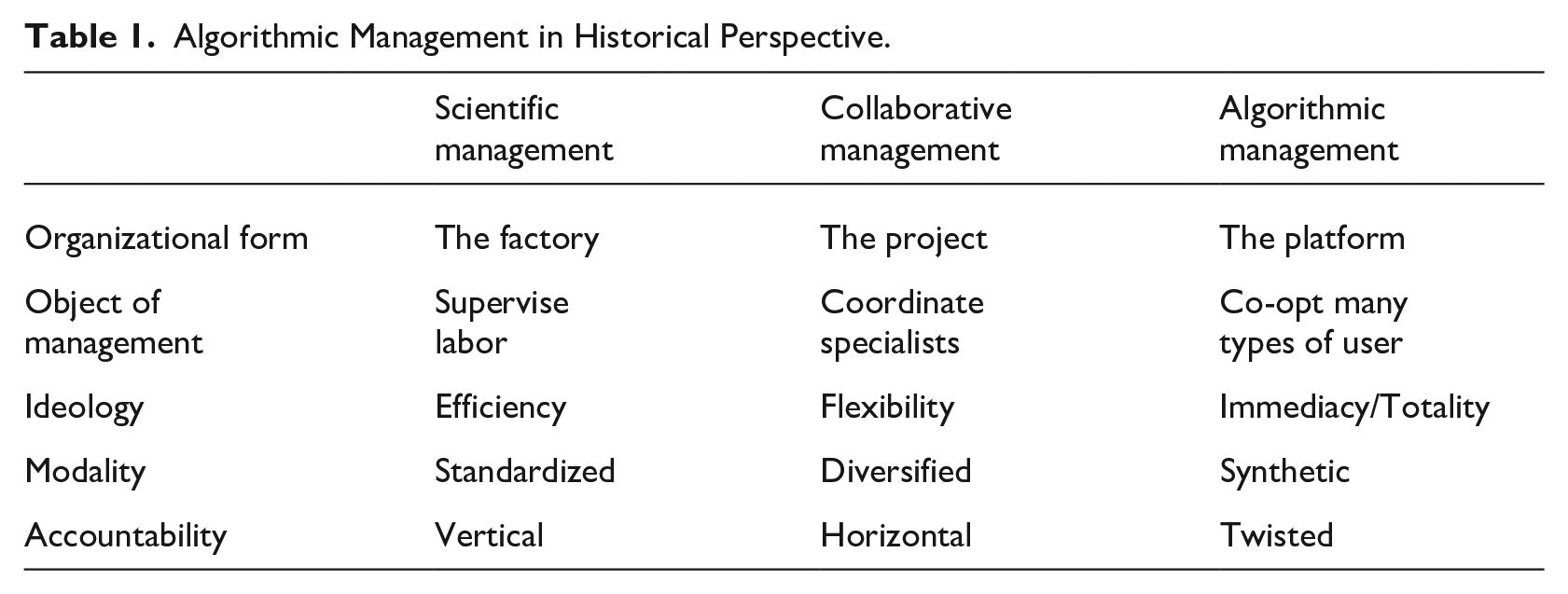
Whichever route taken in making those connections, we expect that the reader will grasp that algorithmic management is more pervasive and all-consuming than can be seen in the singular elements. The novelty and reach of algorithmic practices take the managerial credo in the malleability of organization to unprecedented heights. Rather than an exercise seeking to coordinate oppositions within the conventional organizational unit—between labor and capital, for example, or between various departments, levels, or teams, and so on—algorithmic management turns to and envelops the broader world. The latter is no longer presented as an environment to which the organization is expected to adapt, but as an addressee that can be co-opted and mobilized.
Scientific management displaced the personal authority of the owner/boss with impersonal formulas and procedures; but its scope was largely confined to the factory. By celebrating work as self-expression and dissolving the distinction between work and play, evaluation criteria in collaborative management moved beyond performance measures to include the performance of personality. As a new form of management that leads to the platformization of large parts of the economy and society, in which almost any activity, however mundane or personal, can potentially be coopted and ever more parts of our lifeworld are subjected to such organization, algorithmic management configures us all as users in ways more divergent and encompassing than in earlier models of efficiency and flexibility. What contradictions are arising in, and with what dynamics for the evolution of, such a system?
Out of Bounds
During the middle of the 20th century, Robert Merton and Paul Lazarsfeld embarked on an ambitious research agenda. As one arm of this venture, Merton set out to understand the structures and processes of bureaucratic organization. To do so, he and his PhD students deployed a range of research methods: ethnography (Alvin Gouldner), survey research (James Coleman), and small group analysis (Peter Blau). As the other arm, Lazarsfeld studied the counterpart of bureaucratic mass production: mass communication. Here, too, the methods were pioneering, the focus group being one such example (Lezaun, 2007) and the Lazarsfeld Stanton Program Analyzer, capturing users’ moment-to-moment “likes” and “dislikes,” being another (see Fiske & Lazarsfeld, 1945; Lazarsfeld & Merton, 1943). Each of the components of the research agenda was theoretically rich and methodologically innovative. But the twinned studies—analyzing mass communication in the era of mass production—took place on decidedly parallel tracks.
Like our Columbia predecessors, the research agenda that we are advocating examines the domain of organization. But whereas Merton and Lazarsfeld studied bureaucratic organization, we turn our attention to a new mode of management in an emerging organizational form: algorithmic management on the digital platform. Also like them, further research should study the corresponding field of communication. But whereas Merton and Lazarsfeld analyzed mass communication as the related, yet separate, field corresponding to bureaucratic organization, in our case, organizational form and communication field are conjoined. In our era, organizational design is inseparable from design of the digital interface (Davis, 2009; Stark, 2009, p. xvii).
Our research agenda is also shaped by and departs from the work of JoAnne Yates (1989) on the technology of bureaucratic organizations. In contrast to Merton and Lazarsfeld who separated the study of organization from that of communication, Yates studies bureaucratic organization as communication. Her analysis of “systematic management” (her term for the broader movement of which scientific management was a leading part) focuses on the importance of written communications in the emerging bureaucratic organizations. Yates’ book Control through Communication is, in part, a study of genre forms—the report, for example. But its major insights shine light on technology—the telephone, for example, or even more importantly, the technologies of inscription, copying, and retrieval such as the typewriter and the vertical file.
Like Yates, we study how organization and communication are intertwined. Like her, our agenda considers genre forms, for example, the genre forms of ratings and rankings. Moreover, like Yates, we must be attentive to technologies—the screen and the smartphone, for example, or even more importantly, the technologies of artificial intelligence such as machine learning. But whereas Yates was rightfully preoccupied with the role of technology as a medium for communicating orders from top to bottom or for reports issued by subordinates to superiors, we are interested, instead, in algorithmic practices in which the technologies are themselves our communication partners (Esposito, 2022). This new sociality—when the partner with which we are communicating is an algorithm—will be a critical component of further research on algorithmic management.
The notion of technology as a communication partner precedes the emergence of ChatGPT, dating back at least as far as the copy machines famously studied by ethnographer Lucy Suchman at Xerox PARC in the 1980s (see Suchman, 1987). Novel at the time, now, with the development of generative AI, the idea of communicating not by means of technology but with technology becomes so obvious today that we take it for granted, whether learning a language on Duolingo, managing stress on Happify, or “chatting with Jesus Christ” on textwith.me. But even when the machine is not the personified personal assistant, we communicate with technology when engaging in such mundane activities as making purchases or booking travel arrangements, and such communication is likely to increase as more and more of our daily activities are algorithmically managed.
Yates’ work offers a further jumping off point: departing from her focus on technologies of communication in organizations, our analysis of algorithmic management suggests that attention shift to the technologies of organization themselves. That is, in our era, we should begin considering technology as organization. As a first, but very inadequate approximation of this idea, one might think about the socio-technologies of algorithmic management as a kind of organizational infrastructure. But the thought exercise we have in mind is something yet more radical. What if, instead of thinking about technology as organizational infrastructure, we considered technology as synonymous with organizational structure? 13
As we have argued in this paper, algorithmic management is a product of and a stimulus for changes in the very nature of organization. Among the changes we have highlighted, we close with one of the most important: the changing topology of organization. Unlike organizations with clear boundaries demarcating who and what are inside or outside, the organizational forms most characteristic of algorithmic management adopt structures and practices yielding a Möbius-like topology with no inside or outside (Stark & Pais, 2020; Watkins & Stark, 2018). In the associative character of algorithmic logic, folding together entities that once seemed distant, dissimilar, and unrelated (Lee et al., 2019), organizational architecture does not begin by building boundaries and end by providing passageways across them. The action happening in this new world is not making boundaries impermeable or porous, but operating without them.
To close, we turn to the field of religion, a social setting seemingly as distant from the workplace as it is from online shopping. Not long ago, one of us spoke with a senior minister at Victory Church, one of the largest megachurches in Oklahoma City. Its slogan, in bold lettering on the enormous sign in the parking lot of the former shopping mall that the megachurch has now greatly expanded, reads “Belong Before you Believe.” If Victory Church was a business, Pastor Dale (as he is known) would be its chief operating officer. I asked him about what belonging means in the megachurch context. Aren’t churches different from commercial organizations, I wondered. One belongs as a member, right? 14 “We don’t have a membership list,” Pastor Dale responded, “we have a database.”
Footnotes
Acknowledgements
For their comments, criticisms, and suggestions on earlier drafts of this paper, we are grateful to Chris Anderson, Jonathan Bach, Pablo Boczkowski, Angèle Christin, Joep Cornelissen, Elena Esposito, Gil Eyal, Gernot Grabher, Byungkyu Lee, Lina Moe, Pedro Monteiro, Jose Ossandon, Ivana Pais, Hatim Rahman, and Steven Vallas. Our special thanks to James McNally for assistance at every stage of research and writing. We also benefited from insights and feedback by friends and colleagues where we presented this work: the CODES Seminar at Columbia University; the Center for Work, Technology, and Organizations at Stanford University; the Department of Organization at the Copenhagen Business School; the Center for the Sociology of Organizations at SciencesPo Paris; and the Centro de Estudios Públicos in Santiago, Chile.
Declaration of conflicting interests
The author(s) declared no potential conflicts of interest with respect to the research, authorship, and/or publication of this article.
Funding
The author(s) disclosed receipt of the following financial support for the research, authorship, and/or publication of this article: This work was supported by the European Commission under the Marie Skłodowska-Curie Action Program (Grant ID101032759).
Notes
Author biographies
 .
.