



Abstract
Artificial intelligence (AI), and the use of Generative AI (GenAI) to increase productivity and replace workers has garnered much attention. However, prior to GenAI, the use of algorithms to automate the management of workers, reduce labour costs and increase productivity, was already occurring first in the gig economy and, more recently, in standard employer–employee work arrangements. Through interviews with HR managers, technology vendors and union representatives, this paper explores the use of app-based and AI-driven platforms to automate HR practices in standard work arrangements. More than AI, this paper illustrates the platformisation of work in Australia and the critical new challenges it poses for labour relations.
Introduction
Artificial intelligence (AI) is transforming contemporary work and employment practices, reshaping how work is distributed and conducted and how workers are managed (Malik et al., 2023; Vrontis et al., 2022). Debates about the impact of AI on work have been prolific both in academia and in media, particularly since the launch of the Generative AI (GenAI) ChatGPT version 3.5 in November 2022. The debates juxtapose the managerial benefits of productivity, efficiency gains and reduced labour costs (Ardichvili et al., 2024; Cappelli and Rogovsky, 2023) against the potential negative impacts on workers, including work intensification, skill degradation and substantial predictions of job losses (Guliyev, 2023; Lane et al., 2023; Lazaroiu and Rogalska, 2023). Indeed, recent media reports have attributed job losses at Canva, Atlassian and other organisations to the transformative impacts of AI (Chalmers, 2025; Kruger, 2025; McGuire, 2025). However, prior to the open availability of GenAI tools, organisations were already introducing AI-enabled technologies and using algorithms to reduce labour costs and increase productivity in roles that were not previously subjected to automation (Acemoglu and Johnson, 2022).
Algorithmic management (AM) is a system of control where software algorithms ‘assume managerial functions’ (Lee et al., 2015: 1603) and supervisory practices are enacted with limited human involvement (Baiocco et al., 2022; Jarrahi et al., 2023). AM can augment or assist managerial decision-making by providing detailed insights on work activities, or because of advances in AI, can be used to fully automate managerial control (Adams-Prassl, 2022; Wood, 2021). A prolific practice in the gig economy where digital platforms use algorithms to automate, optimise and manage worker activities (Jarrahi et al., 2020; Veen et al., 2020; Williams et al., 2021), AM has expanded into standard work arrangements 1 , contributing to what has been termed the ‘platformisation of work’. That is, the growing use of digital platforms in a wide range of organisational settings to enact AM practices that coordinate labour for capital gain (Baiocco et al., 2022; Fernandez-Macias et al., 2023; Poell et al., 2019).
This paper explores the platformisation of work in Australia. The paper argues that while AI (including GenAI) is accelerating these changes, technologies that enable AM have already been eroding conditions of work, worker rights and labour relations with limited regulatory or policy intervention. First discussing the emergence of platformisation in the gig economy, then, through data drawn from interviews with HR managers, technology vendors and union representatives in Australia, this paper uncovers the use of App-based and AI-driven technologies (platforms) to automate HR practices in standard employer–employee work arrangements where a formal contract of employment exists (standard work). The systems of managerial control that are embedded within the algorithms that drive them and the implications for labour relations are discussed.
The platformisation of work and AM
Taking a cross-disciplinary perspective, Poell et al. (2019: 5–6) define platformisation as ‘the penetration of the infrastructures, economic processes, and governmental frameworks of platforms in different economic sectors and spheres of life’. The concept of platformisation extends beyond digital labour platforms, to consider how a wide range of platforms, including Apps, websites, social media, e-commerce and communication technologies algorithmically, arrange, facilitate, manage and even monetise our social and economic interactions (Poell et al., 2022; Stark and Vanden Broeck, 2024). In a work context, the European Union positions platformisation as the ‘increasing use of digital platforms for coordinating work processes in all kinds of economic organisations’ (Fernandez-Macias et al., 2023). This is done via portable technologies that digitally track and monitor activity, collect real-time data, algorithmically allocate work and enforce time-based targets to control the pace of work (Moore and Joyce, 2020). Epitomised by digital labour platforms in the gig economy, conventional organisations are also turning to platform-based technologies that algorithmically coordinate the labour process (Fernandez-Macias et al., 2023; Gandini et al., 2025; Moore and Joyce, 2020).
Platformisation has many benefits for organisations. Firstly, digital platforms provide an efficient (and low-cost) method for facilitating interactions in a workplace, particularly when both workers and customers may be dispersed. Platforms provide ‘spaces of coordination’ (Richardson, 2021) that are not bound by physical location, making platformisation particularly appealing during the COVID-19 pandemic (Adascalitei et al., 2022; Baldwin and Dingel, 2023). Secondly, platforms facilitate datafication. That is, the tasks or processes that constitute work along with the behaviour of workers themselves, can be monitored, measured and turned into data to quantify the granularity of worker activity and inform managerial decision-making (Duggan et al., 2020; Giermindl et al., 2022; Möhlmann and Zalmanson, 2017; Poell et al., 2022). Additionally, platforms can direct worker activity. Through automated reports, pop-up nudges and notifications, digital distribution of tasks, and by necessitating interaction with the system in order to complete their work, new platform-based HR technologies shape worker behaviour, and mediate workplace interactions with little, if any, human supervision (Gandini et al., 2025; Kellogg et al., 2020; Poell et al., 2022). In platforms used to coordinate labour, these features have been widely characterised as AM.
AM is when work ‘is assigned, optimised and evaluated through algorithms’ (Lee et al., 2015: 1603), reducing or removing ‘human involvement and oversight of the labour process’ (Duggan et al., 2020: 119). Advances in AI mean that through new platform-based HR systems, vast amounts of data can be automatically collected and analysed and algorithms can ‘restrict and recommend’ work, ‘record and rate’ worker performance, and in some cases automatically ‘replace and reward’ workers (Kellogg et al., 2020: 368). Acknowledging a long history of using technology to automate and reorganise production, monitor workers and enact greater levels of managerial control, Brown (2024: 480) suggests that digital platforms can be viewed as an evolution of the mechanical platforms of Fordist mass production. Jobs are broken into discrete, codified and measurable tasks, enabling the automation of managerial oversight (Brown, 2024; Moore and Robinson, 2016; Tyson and Zysman, 2022). Many argue that the constant, real-time, quantification of labour enabled by platforms contributes to increased precarity, de-skilling, wage reductions and work intensification (Acemoglu and Johnson, 2022; Cappelli and Rogovsky, 2023; Moore and Robinson, 2016).
AM in the gig economy
Much has been written about AM in the gig economy, where it is central to digital platform operations. Through a website or app, digital labour platforms connect people who require services, such as rideshare, food delivery or home maintenance with workers who are willing to provide their labour (Healy and Pekarek, 2025; Williams et al., 2021). Work is typically characterised by short-term, one-off tasks or ‘gigs’ and workers are usually independent contractors and not employees of the platform. Digital platforms use algorithms to mobilise and manage this independent, distributed workforce. Extensive research has demonstrated how platforms apply AM to assign tasks, monitor completion times and worker locations, regulate the quality of service through customer ratings and reviews, automate systems of payment and reward, and take disciplinary action such as restricting access or terminating workers from the platform (Baiocco et al., 2022; Veen et al., 2020; Williams et al., 2021). AM enables platforms to streamline service delivery and reduce labour overheads by avoiding traditional modes of employment altogether.
For workers, the impacts of AM have been substantial. Tight deadlines coupled with the fear of restricted access to future work opportunities have been found to lead to work intensification and risk taking (Bajwa et al., 2018; Kadolkar et al., 2024). Delivery workers, for example, may take risks on the road including speeding, and ignoring road signs to improve delivery times (Christie and Ward, 2019). Workers may be penalised for slow responses to the algorithm or for non-acceptance of gigs (Eurofund, 2018; Reid-Musson et al., 2020). The algorithmic practice of surge pricing in rideshare can encourage longer work hours to maximise driver income (Berger et al., 2019; Rosenblat and Stark, 2016). Creative workers on platforms have also reported doing hours of extra unpaid work to achieve higher client ratings and raise their algorithmically-determined visibility on the platform (Nemkova et al., 2019; Schörpf et al., 2017). These examples show how AM practices can drive worker behaviour in ways that negatively impact well-being (Duggan et al., 2020), with implications for worker voice, resistance and labour relations (Aloisi and De Stefano, 2024; Keegan and Meijerink, 2025).
The expansion of AM to standard workplaces
Despite the potential negative impacts on workers, through automating many HR processes, the practice of AM is increasingly being adopted by conventional firms seeking to enhance operational efficiency and workforce oversight. Historically the HR function has been criticized for being inefficient and administratively focussed (Dundon and Rafferty, 2018; Marchington, 2015). Using algorithms to automate workflows, HR can now use Apps and other technology platforms to streamline many cumbersome operational HR activities such as time and attendance and payroll management, workforce reporting and resume screening in recruitment. AI has further extended the capabilities of these technologies beyond automating HR processes to automating the decisions made throughout the process. In doing so, new platform-based technologies are able to extract additional effort from labour without additional human supervision, making AM ‘a key part of AI-driven digital transformation in companies’ (Jarrahi et al., 2023: 1).
An array of AI/algorithmically-enabled platforms are being used in standard workplaces to monitor and measure the work activities of employees by automatically taking screenshots from employees’ computers, logging keystrokes, analysing email content, audio, tone of voice or facial expressions, tracking when they start and finish work, where they are located in the workplace, and how long they take to complete a task (Baiocco et al., 2022; Cappelli and Rogovsky, 2023). This data is used to automatically roster employee shifts, allocate discrete tasks to employees throughout the day, prompt them to take breaks or to work faster, and report on their productivity relative to other workers, often through a leaderboard or ranking system (Aloisi and De Stefano, 2024; Williams and Khan, 2025). As in the gig economy, some systems also integrate customer survey results to provide a summary of worker performance (Moore and Joyce, 2020).
Platformisation is occurring in a range of industries, including retail and hospitality, transport and logistics, and domestic and hotel cleaning services, where Apps and other devices that facilitate AM are used to monitor, measure and rank worker performance and automatically renew or cancel worker contracts (Wiggin, 2025; Wood, 2021). Increases in hybrid working have fuelled the rise in platformisation as employers seek to more closely scrutinise remote worker productivity (Aloisi and De Stefano, 2024; Meijerink et al., 2021). This is particularly the case in white-collar industries such as insurance, banking, and finance where algorithms determine task allocations, time-limits for task completion, and measure worker performance against algorithmically-determined key performance indicators (Perez et al., 2022; Saner, 2018; Sharples, 2023; Tan, 2023).
Platformisation in standard employment
In the 2022–2023 Business Characteristics Survey, 11.3% of Australian businesses reported introducing new ‘methods of organising work responsibility, decision making or human resource management’ in the prior two years (ABS, 2022-23). Supporting the view that increased monitoring has risen alongside remote working, and in practices similar to the management-by-App typical in the gig economy, more than half (56.9%) of respondents in a recent survey of HR professionals in Australia (n = 236) said they used laptops, tablets, smartphones or other mobile devices which include monitoring or tracking software (Williams et al., 2024: 37). While limited by a small sample, the Australian data is consistent with patterns of platformisation reported by a recent survey of workers in Germany and Spain (Fernandez-Macias et al., 2023). Like Germany and Spain, in Australia, the most common reasons for doing so were to improve efficiency and track productivity of employees, usually by tracking working time and activities. Enabling ‘work from home’ or ‘managing remote workers’ were also cited reasons. In Europe, platformisation was also found to be stronger for workers who worked from home, a vehicle or a place that was not their employer's premises (Fernandez-Macias et al., 2023: 37).
Constant monitoring and collection of data on worker location and activity is a central feature of AM. Australian organisations were also using GPS or other location tracking of employees (28.7%), or biometric devices such as fingerprint and eye scanning (23.0%) (Williams et al., 2024: 37). Chatbots were a growing feature with 28.2% of HR survey respondents using them, with a further 24.3% saying they intended to implement them in the future (Williams et al., 2024: 37). Using AI chatbots to answer employee questions or Apps to distribute, receive or change rosters are common examples of the mediating role of platforms at work. Workers are forced to interact with the platform rather than, or before, a human supervisor (Möhlmann and Zalmanson, 2017).
Data collection
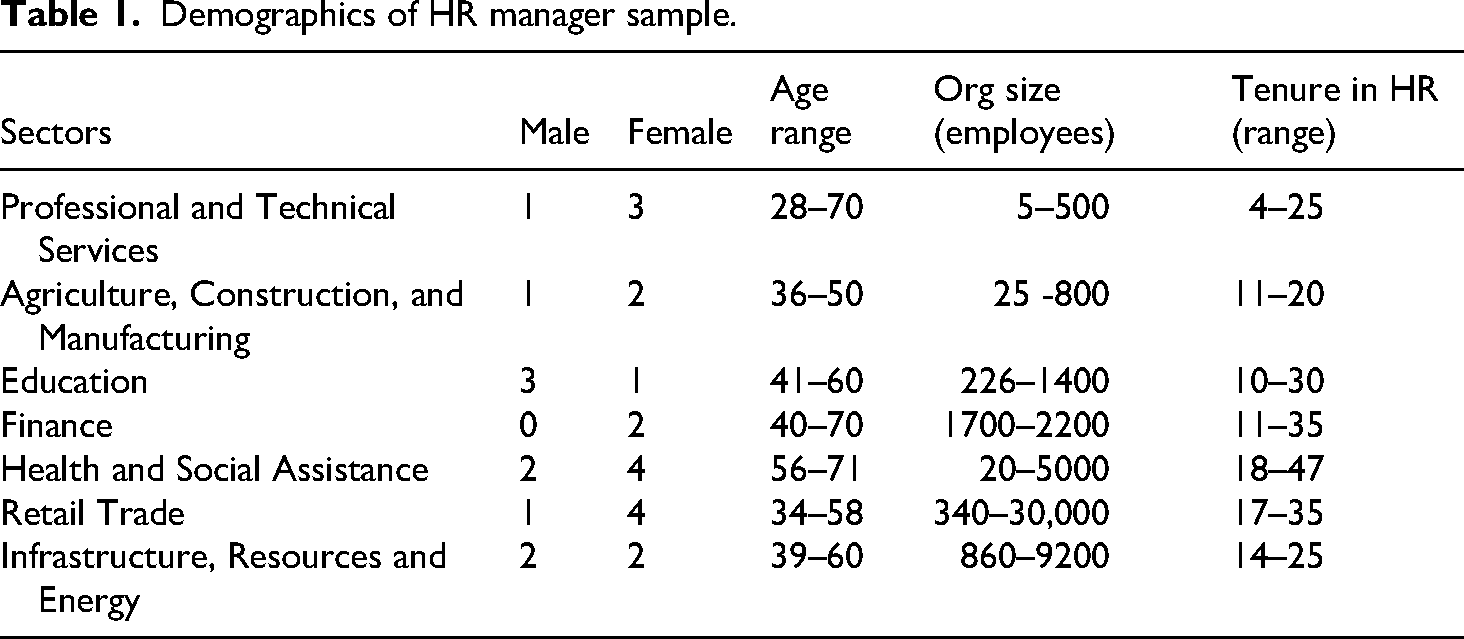
To further understand the extent to which Apps and other platform-based technologies that facilitate AM are being adopted in Australian workplaces, and the reasons for doing so, exploratory interviews with 28 Senior HR managers responsible for overseeing HR systems, 9 vendors of HR technologies, and 4 union representatives were undertaken between May 2024 and April 2025. Senior HR managers 2 representing diverse sectors (Table 1) were asked about the technologies they use to manage work or workers, benefits and risks, and employee reactions. Vendors who sell HR technologies were interviewed about the services they provide, the motivation of clients adopting their technologies, and benefits and risks. Representatives from four unions 3 provided their perspectives on the benefits and risks that arise for workers. A thematic analysis (Braun and Clarke, 2019) within and between each participant group identified common reasons for investing in new HR technologies, and also uncovered patterns that show platformisation in standard employment relationships, with greater scrutiny and control over worker time and activity, and the potential for rising tensions in labour relations.
Demographics of HR manager sample.
The characteristics of platformisation in Australia
In addition to illustrating the emergence of App-based platforms to manage employees, three themes emerged from the interviews. The first illustrates how platforms are being used to obtain perceived efficiency benefits, the second explains how platforms change the form and nature of managing labour relying on quantification and optimisation, and the third foreshadows an AI worker, placing technology vendors as HR change agents and new actors in the labour process.
Platforms for efficiency
Indicating the expansion of platforms into standard workplaces, interviews with HR managers and union representatives described the rising use of Apps and mobile technologies to manage employees. Often loaded onto an employees’ personal mobile phone, apps frequently included GPS to track employee locations and automate previously manual time and attendance processes. This was particularly the case when employees worked across multiple locations but also applied to employees who were based solely in one location. The following quotes illustrate how these platforms worked, and the benefits of them for organisations: They do have a check in, check out on their phone when they login and logoff. It will capture their location if they haven’t turned it off but that's not so much for security and safety. That's in case the fraud squad come knocking. We want to make sure that our staff are protected from any claim that they’re illegally claiming anything. (HR Manager 1, not-for-profit) It's on the app and they have the geolocation functionality active, so you’ve got to be within a certain distance of the site for it to recognise that you are actually at work. … Some sites actually have facial recognition where you’ve got to have the camera on, it recognises you, the geolocation you’re at site; therefore, you can sign on, but if it's not you and you’re not at location, it won't permit a sign-on. (HR Manager 9, private sector) We had probably, you know, 10% of the workforce that were serial offenders when it came to not clocking in and out regularly. I think some of that was to do, you know, potentially with them trying to inflate their hours. (HR Manager 12, private sector) Our […] systems will know exactly what keystrokes we’re putting in, what sites we’re going to, what we’re viewing or utilising. (HR Manager 3, public sector) Keyboard tracking has been in the sector for at least the last decade, if not longer…We had a slew of people [working from home] who were raising concerns and were being asked to answer for inactivity at various parts throughout the course of their day because of the monitoring that was happening on their laptops. (Union representative 1) They [workers] believe that it's almost, in some cases, they feel that it's tracking them…Some of our members have said, look, I’ve gotten this message that says, what are you doing? When the poor [travelling employee] is simply called into a shopping centre to find a toilet, that sort of thing. … what it does is to put people under terrible time pressures, … everything they do is within this sort of rapid, one job to the next job to the next job. (Union representative 2) Another thing that is coming up is toxic productivity. If when you are reporting on your time, every second of every day, it feels like you have somebody hovering over you all of the time, watching. Then how do you do those things, like take a 15-minute break to clear your head space. If you are somebody who suffers from a non-physical disability and you can't concentrate for periods of time, or you can't concentrate in meetings, that becomes an issue. (HR Manager 4, private sector)
Platforms for optimisation
Platforms were used to improve the efficiency of HR processes (such as rostering and payroll), and to increase employee productivity, sometimes referred to as ‘optimising the workforce’. This involved setting targets or ranking employees. From my understanding of the systems, they are workforce optimisation systems, so they are typically based on the highest performing, that's where you’ve got to – to be optimised, you’ve got to be at that top level. (Union representative 3) One of the things we could do with it was, uh, we were able to, I guess, optimise the work of our workforce in terms of the amount of time and shifts we could offer them. So there was a shift bidding function and a target, within time target. So if we had a vacant shift, we could send a notification out to our [employees] who were working casually or part-time, and we could offer the shift out to them and they could accept that shift, and that could be set geographically, to a certain area, a certain range. (HR Manager 2, private sector) We’ve never used any tracking how much you’ve used your keyboard or how long you’re logged in for or anything like that. That's not to say we don’t have the ability to, because we do, but we’ve never had a reason to do it. We’re trying to build and maintain trust with our employees, and we treat them like adults…so to say all that and then start tracking…it's kind of contrary. (HR Manager 5, private sector)
The AI worker
The integration of AI had already occurred in many systems mentioned in interviews, and the use of GenAI to further automate work, including managerial advice or oversight, was discussed as an inevitability. I think there's an element of where it's going to become unavoidable. A lot of vendors are choosing to build AI into their product, therefore you end up with that AI as the result, unless your IT team finds a way to disable it or opt out of it. Companies may try to avoid it and be against the use of AI but it's going to get to a point where it's going to be virtually impossible to do so. Also sadly, whether or not your product contains AI will become a competitive edge. (HR Tech Vendor 1) With so many products and so many things, we see help centres becoming automated, becoming chat bots. (HR Tech Vendor 1) We do aspire to get to a point where much of the mundane work that takes a lot of time with professional people can be done by AI and delegated to AI. (HR Tech Vendor 2)
Discussion
AI's transformative impact on the future of work has garnered much attention in both media and scholarly literature where debates have focussed largely on GenAI, juxtaposing the benefits of improved productivity and individual and collective efficiency gains against worsening job quality, lower wages and the likelihood of job losses, especially in previously in demand white collar knowledge work (Acemoglu and Johnson, 2022; Adams-Prassl, 2022; Lane et al., 2023). Notwithstanding these possibilities, this paper extends the debate beyond GenAI to consider how AM embedded in platform business models has been fuelling the emphasis on productivity over secure and decent employment for some time. Decades of gradual advancements in technology have enabled more sophisticated tracking of worker activity and performance (Acemoglu and Johnson, 2022). Technology has also transformed social interactions, changing patterns of consumerism and communication through social media and Apps built into our mobile devices (Poell et al., 2019, 2022). Together these advances underpin the gig economy where a new business model emerged that relied on algorithms embedded in digital platforms to organise, manage and control labour for profit.
This paper demonstrates how practices similar to those adopted by digital labour platforms in the gig economy are occurring in standard Australian work arrangements. Platforms such as websites and Apps are being used to distribute rosters or tasks with GPS to track the location of employees. Worker activity is constantly measured through various practices including keystroke tracking, and leaderboard or ‘stack’ ranking. Automatic notifications distribute new tasks or remind employees when they have been taking too long, are doing something unauthorised. These AM features are embedded in a wide range of new AI-enabled HR technologies, designed and implemented to increase employee productivity, and functioning as a mechanism for extending managerial control over the labour process. Many are multifunctional platforms that automate supervisory tasks while detecting non-performance or fraudulent activity, collecting and aggregating data to inform management decisions but leading to new concerns over worker privacy, data security and uneven impacts (Aloisi and De Stefano, 2024; De Stefano, 2020; Williams and Khan, 2025).
AI is furthering the technological capabilities and practice of AM, resulting in less and less direct human supervision over the labour process, and embedding platforms into everyday working lives. This is because AI is able to capture, process, act on and learn from volumes of data at a level and speed that exceeds human capability (Tyson and Zysman, 2022). Without having a human supervisor present, managers can know the minutiae of employee activity, regardless of an employee's location (Moore and Joyce, 2020). As described by interviewees, GenAI further advances AM functions using, for example, chatbots or avatars in the place of supervisors as the first point of contact for an employee (Cuesta-Valiño et al., 2024; Krishnasamy and Lee, 2024). However, as is the case in the gig economy, employee productivity is measured primarily through the AI-enabled micro-management, collection and measurement of time – time at work; time taken to do a task; time spent on the keyboard, or travelling, or time at a specific location. Described as the quantification of labour (Moore and Robinson, 2016), other measures such as complexity, quality and service delivery become distal. Viewed from this more holistic lens, the industrial and employment relations implications of AI extend beyond direct job losses to more subtle and nuanced consequences for worker autonomy, voice and working conditions. This paper argues that the platformisation of work, facilitated by AI (and originally by more simple algorithms), is progressively transforming the labour process. In standard employment arrangements, platformisation has the potential to facilitate the gradual erosion of employment security and established rights and conditions giving employers the means to ‘deploy’ rather than ‘employ’ labour (Brown, 2024: 482).
Digital labour platforms in the gig economy disrupted many industries and circumvented existing labour relations frameworks, managing and profiting from, but not employing, labour (McDonald et al., 2021). In this business model, AM is central to capital-labour relations. The documented effects of AM on digital platform workers (Franke and Pulignano, 2023; Veen et al., 2020; Williams et al., 2022) are likely to also be experienced by employees when work in standard organisations is platformised. The associated constant monitoring and measurement devalues both task autonomy and the intellectual and human contribution employees bring to their work, reducing creativity, innovation and problem-solving in the workplace (Giermindl et al., 2022; Moore and Robinson, 2016).
Platforms act as an intermediary between capital and labour, restricting the opportunity for worker voice, moderating social exchange and exacerbating power asymmetries (Galière, 2020; Kellogg et al., 2020; Williams and Khan, 2025). The integration of sophisticated AI chatbots into platforms to supervise employees or respond to their questions only serves to further distance organisational decision-makers from the daily experiences of workers. The increasing reliance on supervision by AI (or algorithms) may also complicate processes of policy-setting, negotiation and conflict resolution in the workplace if workers have fewer avenues to individualise or modify work arrangements or to contest decisions, and if performance metrics and work-related policies are developed solely through AI-generated data or the developers who build the technology. With increasing reliance on externally-designed technologies and AI-generated advice and decisions, platformisation may serve to diffuse responsibility when worker rights are violated (Adams-Prassl, 2022; Giermindl et al., 2022).
Conclusion
The automation of tasks and even whole jobs is nothing new. For decades technology has been used to achieve greater levels of productivity from workers using various management systems to quantify and extract value from labour (Acemoglu and Johnson, 2022; Moore and Robinson, 2016; Tyson and Zysman, 2022). However, much of the function of management itself is now automated. As this paper shows, by algorithmically managing and automating the allocation, distribution and monitoring of work, digital platforms diminish the need for human managers, yet extend and intensify managerial control, intermediate capital-labour relations and position the technology vendor as a critical change agent in the future of work. Rapid advancements in AI are broadening the platformisation of work into all kinds of organisational settings, and in ways that warrant significantly more attention. Future research on how GenAI is amplifying platformisation and how it varies between different industrial contexts is required. Research that uncovers the direct impact on employees is needed, including when and how employees resist these new forms of control and the privacy and data security implications. Finally, as AI regulation gains a global focus, more attention on the intersections between proposed regulation and existing workplace protections is warranted.
Footnotes

Ethical considerations
This study received ethical approval from the Queensland University of Technology Ethics (approval #7199) on 05 June 2023.
Consent to participate
All participants provided written informed consent prior to participating.
Consent for publication
Prior to participating, written informed consent was obtained from participants for anonymised information to be published.
Funding
The author disclosed receipt of the following financial support for the research, authorship, and/or publication of this article: This work was supported by the Australian Research Council [grant number DE230100950].
Declaration of conflicting interests
The author declared no potential conflicts of interest with respect to the research, authorship, and/or publication of this article.
Data availability
The datasets generated during and analysed during the current study are not publicly available due to the need to protect participant confidentiality and anonymity but are available from the corresponding author on reasonable request.