




Abstract
Prior research on social movements and markets has thus far paid only scant attention to movement goals. In the few instances that goals are considered, the focus is on how goals provide a shared purpose to movement participants, and not on their substantive nature or ‘content’. In contrast, our review of the movements and markets literature suggests that the substantive nature of movement goals is critical because it provides a more comprehensive understanding of different market-based movements and their interactions with market actors – ultimately impacting the consequences for movements and their targets. We develop a social movement typology using a goals-based perspective to distinguish between three types of movement: alteration movements, whose goal is to alter or change the practices of markets or their actors; creation movements whose goal is to create new market categories as a means of addressing their grievances; and elimination movements whose goal is to eradicate or remove products, industries, or markets altogether. We propose that the relationship between these types of movement and market actors goes through a four-stage life cycle – emergence, action, interaction and settlement – and that initial variation in movement goals shapes differences in the movement–market relationship at each stage of this life cycle.
Keywords
Introduction
Over the past two decades, there has been a proliferation of research at the intersection of social movements and markets (for reviews, see Briscoe & Gupta, 2016; King & Pearce, 2010; Soule, 2012). From the development of new industries and market categories to changes in firm practices (Lounsbury et al., 2003; Sine & Lee, 2009; Zietsma & Lawrence, 2010), this research has illuminated the important ways in which movements shape – and are shaped by – markets and the actors within them (Schiller-Merkens & Balsiger, 2019). On the market side of the relationship, prior work has highlighted how and why firms become activist targets, the ways that firms respond to being targeted, and the consequent implications for firm performance (e.g. King, 2008; Soule et al., 2014; Weber et al., 2009). Other work has given more consideration to the social movements operating in market spaces, offering insights into their ideological and functional differences (e.g. Den Hond & De Bakker, 2007; Wang et al., 2021; Yaziji & Doh, 2013; DeCelles et al., 2020), as well as their internal dynamics and evolution over time (Buchter, 2021; Kim & Schifeling, 2022; Massa & O’Mahony, 2021; Reinecke & Ansari, 2021). While this work has given us detailed accounts of the interactions between movements and their market targets, it has largely left the antecedents of social movement influence in market contexts understudied (Leitzinger et al., 2018).
In order to develop more nuanced and comprehensive theories of social movement impact in market arenas, we argue that it is necessary to consider the earliest stages of social movement emergence – an area of research that has largely been the domain of scholars studying movements in the public sphere. Social movements form in response to shared grievances and coalesce around mutual goals, which form the basis for initial mobilization (Klandermans, 2004). Goals are fundamental to most organizing efforts, including those related to social movement activity (Snow et al., 2004). For example, goals help to coordinate action (Barnard, 1938), shape patterns of attention (Cyert & March, 1963) and collective meaning (Weick, 1995), and influence crucial facets of social action, such as the level of risk-taking (March & Shapira, 1987) or conflict (Pache & Santos, 2010). Yet, despite the importance of goals for guiding social movement action, prior research on movements and markets has paid relatively scant attention to them. The few studies that do consider movement goals generally take them as a given, and focus on them only insofar as they provide movement members with a shared purpose (e.g. Massa, 2017), while disregarding the substantive nature or ‘content’ of these goals. However, because goals condition subsequent movement action (Cross & Snow, 2012; Van Wijk et al., 2013), analysing differences in the substance of movement goals is critical for shedding new light on the antecedents and forms of social movement influence in markets.
To assess the impact that goals have on the relationship between social movements and their market targets, we develop a typology that distinguishes between three types of movement goals – alteration, creation and elimination. We define alteration movements as aiming to alter or change predominant industry practices, such as in tourism (Van Wijk et al., 2013) or hospitals (Kellogg, 2011). Creation movements strive to create new market categories, like beef from grass-fed cows (Weber et al., 2008), organic produce (B. H. Lee et al., 2017), or regionally grown and cultivated food (Boghossian & David, 2021; Massa et al., 2017). And elimination movements seek to eradicate specific industries or products, such as single-use plastics (Barberá-Tomás et al., 2019), wild fur (Boghossian & Marques, 2019), or pesticides (Maguire & Hardy, 2009). We further propose that the relationship between these types of movement and market actors goes through a four-stage life cycle – emergence, action, interaction and settlement – and that initial variation in movement goals shapes differences in the movement–market relationship in each stage of this life cycle.
Our goals-based approach to studying social movements in market arenas makes several contributions to the literature in this space. First, we reconceptualize the role of social movement goals by centring their content and substance as a key driver of social movement action in market arenas. While current research focuses mainly on what happens in the later stages of the movement–market life cycle, our understanding of these stages remains incomplete if we do not account for how they tie back to the goals that social movements pursue. In doing so, we make the case for management and organizational scholars to give greater attention to the earliest stages of social movement organizing. Second, our goals-based typology adds nuance to existing movement typologies, contextualizing their relationships to each other and situating them within a broader constellation of movement types. For example, the well-known distinction between radical and reformist activist groups (Den Hond & De Bakker, 2007) is analytically more useful for alteration movements than for elimination movements because elimination movements are skewed towards radical activists whereas alteration movements are more likely to include both radical and reformative factions. Finally, our goals-based typology offers opportunities for further theoretical development in the study of social movements and markets. By segmenting social movements into these three theoretical categories, we generate opportunities to examine their relationships to each other within and across issue fields.
In what follows, we first develop our social movement typology using a goals-based perspective. Next, we describe the life cycle of the relationship between movement and market actors, which forms the organizational structure of the paper. Afterwards, drawing from a review of prior research, we theorize the key differences between movement types across each stage of the life cycle. Finally, we conclude the paper with a discussion of the implications of our typology and how a focus on goals as a driver of movement choices illuminates new directions for future research.
Social Movement Goals
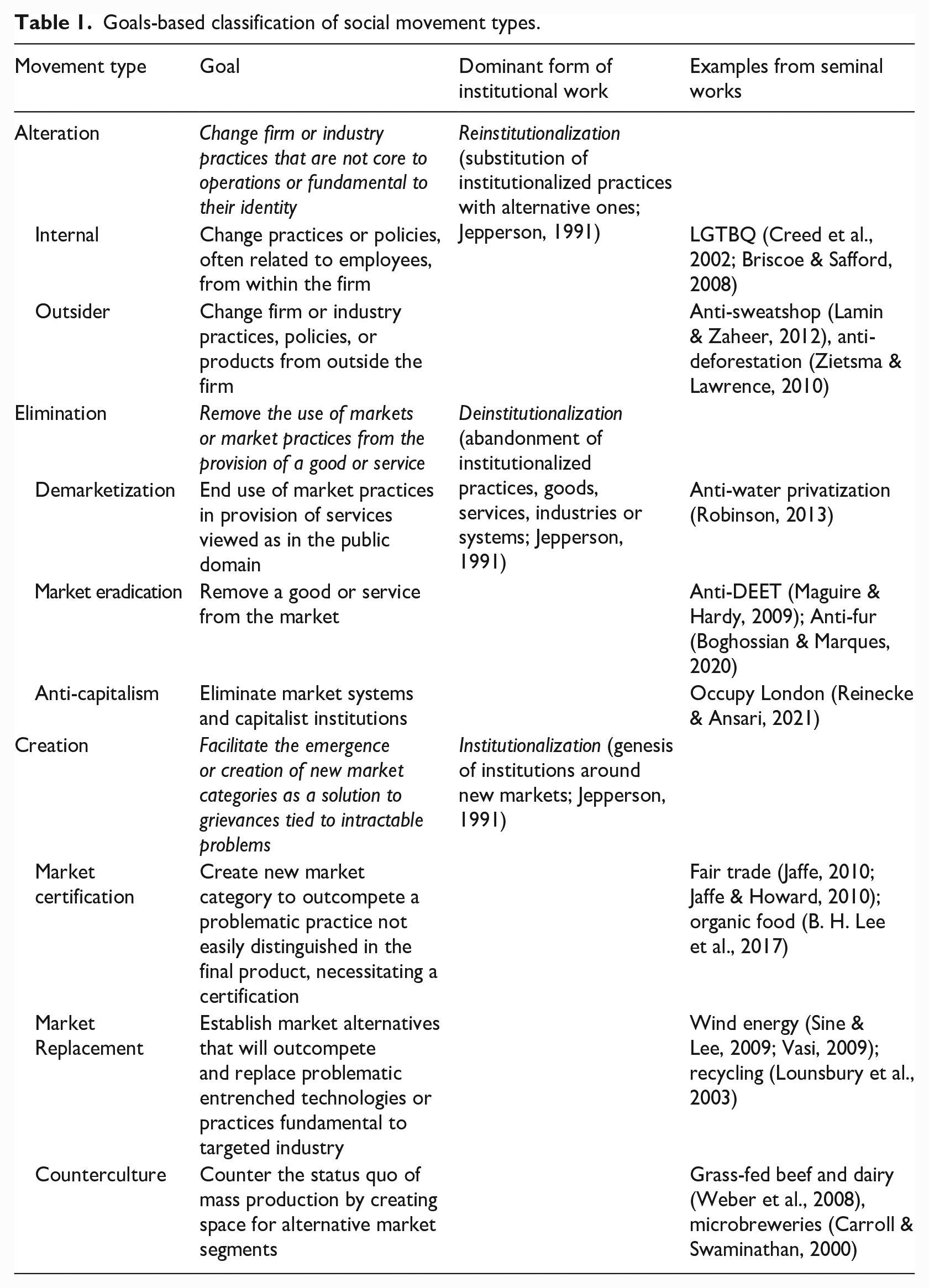
A key function of social movements is identifying prevailing practices, ideas, or outcomes within a given social order as problematic and engaging with these issues with an intent to alleviate them (McAdam et al, 2001; Weber et al., 2008). The shared grievances at the core of these issues serve as the catalyst for collective action and – combined with mutual goals – form the basis for initial mobilization efforts (Klandermans, 2004). Goals are the aspired changes that the movement seeks and, while they can be influenced or constrained by the broader field in which the movement is situated, they are largely internally determined (Cross & Snow, 2012). Social movement goals form the central point around which movement organizing takes place. As Cross and Snow (2012) note, ‘goals are framed by strategies and then executed by the tactics used to enact those strategies’ (p. 534). Yet, despite the importance of goals in directing movement action, most research on movements in market settings has focused on latter developed elements, such as movement discourse (e.g. Maguire & Hardy, 2009) and framing (Nyberg et al., 2020; Werner & Cornelissen, 2014) or specific movement tactics, like protest (Aranda & Simons, 2018; Gupta & Briscoe, 2019; Negro & Olzak, 2019) and boycotts (McDonnell & Cobb, 2020). Given the importance of goals in determining movement strategy and tactics, as well as the nature of their interactions with market actors, we examined the literature on social movements in markets with an eye towards the types of goal they pursue. In doing so, we identified three broad categories of goal types which we noticed describe different types of market-based movements: alteration, creation and elimination (see Table 1 for a summary), which we elaborate below.
Goals-based classification of social movement types.
Alteration movements
The first type of social movement is those with the primary goal of altering the practices of markets or their actors, which we refer to as alteration movements. These movements consist of groups of people and organizations united in their efforts to address what they perceive as being problematic or unjust outcomes stemming from firm activity in a market. Their objective is to change firm, industry, or market practices in such a way that it alleviates their grievances. These efforts may focus on any facet of a firm’s or industry’s operations, including its practices, products, prices, personnel, partnerships and promotions. When such efforts arise within firms, internal movements generally manifest themselves as mobilization efforts intended to alter practices directly impacting employees. This can be seen in the movement for domestic partnership benefits for example (Briscoe & Safford, 2008) or activism on the scutwork performed by interns in hospitals (Kellogg, 2011). Other prior work on social movement-led practice change concentrates on the mobilization of actors external to the firm or industry, known as outsider movements. For instance, Zietsma and Lawrence (2010) explored environmentalists’ efforts to alter lumber harvesting practices in the forestry industry in Canada, and Luo et al. (2016) investigated the ability of internet activists to pressure firms to change their corporate donation practices in China.
A core assumption of alteration movements is that the targeted firm can change – that the products, processes, or services in question can be modified without affecting the firm’s continued ability to operate. For example, workforce diversity is generally not core to a firm’s operations and could therefore ostensibly be altered, whereas calling for a coal mining company to stop extracting coal is effectively asking the firm to cease to exist. Some common types of alteration movements are labour and consumer movements, as well as many offshoots of the environmental movement.
Creation movements
The second type of social movement that we distinguish focuses on creating new market categories as a means of addressing their grievances. These creation movements have identified problems within current markets which they perceive as being systemic and intractable in some form. There are three main subtypes commonly found among creation movements. The first occurs when the source of the movement’s grievances is an entrenched, market-wide practice in which changes would not be easily distinguishable by stakeholders. For example, the practice of clear-cutting was a deep-rooted forestry industry practice and the products it created were visually identical to forestry products made with sustainably harvested trees. In such cases, creation movements aim to out-compete firms using the problematized practices by developing an alternative market category. Because of the inability of stakeholders, especially customers, to identify differences in the products that use such problematic practices versus those that do not, differentiating signals and visual cues are needed. In developing the new, competing market category, creation movements will often form certification systems – either privately (e.g. Forest Stewardship Council certification) or through the state (e.g. USDA National Organic Program). These market certification movements are evident in research on the fair trade movement (Jaffee, 2010; Jaffee & Howard, 2010) and the organic food movement (B. H. Lee et al., 2017).
The second subtype of creation movement occurs when the targeted practice is fundamental to the existence of the market and a simple reform is not feasible. In these cases, the movement champions an alternative system – often a technological innovation – that it feels offers a more just substitute to the market’s status quo. For example, the burning of fossil fuels such as coal or natural gas to generate electricity encompasses a system of technologies and practices that cannot easily be altered to alleviate the grievances of environmentalists. For these market replacement movements, the path to addressing injustice is through the development of a competing market category. Continuing with our example, renewable energy technologies like wind or solar energy offer an alternative method of producing electricity without the environmental harms caused by incumbent technologies. As a means of alleviating their identified injustices, creation movements champion these new technologies and production methods with the aim of out-competing targeted incumbents. This goal can be seen in some environmental movements’ efforts to institutionalize wind energy as an alternative to fossil fuel-based electricity production (Sine & Lee, 2009) and recycling as a replacement for other solid waste removal methods (Lounsbury et al., 2003).
The final type of creation movement that we identified is countercultural in nature, aiming to create new market spaces that stand in opposition to dominant production and consumption methods. Early work in this space depicted such efforts as ‘social movement-like’ in nature (Carroll & Swaminathan, 2000, p. 731), but more recent studies describe these cases as ‘identity movements’ (Rao et al., 2003; Sikavica & Pozner, 2013). These counterculture creation movements oppose the status quo of mass production and engage in cultural and symbolic work aimed at creating space for alternative forms of production. This is evident in studies of the emergence of grass-fed beef and dairy as a substitute for factory farmed animal products (Weber et al., 2008); the rise of microbreweries as an alternative to large-scale beer brewers (Carroll & Swaminathan, 2000); and the development of low-power FM radio as an answer to the dominance of corporate chain radio stations (Greve et al., 2006). In all three subtypes of creation movement, the development of new cultural institutions is critical for the success of their efforts.
Elimination movements
The third and final type of movement in our typology has the overall aim of eliminating markets altogether. These elimination movements generally oppose capitalism and the market economy in some form – either for a specific market category (e.g. the anti-fur movement), for goods or services perceived as a human right that should not be subject to market forces (e.g., the single-payer healthcare movement in the United States), or capitalism itself (e.g. Occupy Wall Street). In the first subtype, a market category’s goods or services are perceived as problematic and the movement seeks to eradicate the market without providing an alternative. Examples of these market eradication movements include the movement to end the use of the pesticide DDT (Maguire & Hardy, 2009) and the anti-fur movement (Boghossian & Marques, 2019). In the second subtype, the elimination movement’s focus is on demarketization, with the movement’s grievance stemming from the use of market practices to provide a good or service that movement members believe should be fully within the public domain. We see these demarketization movements in efforts to end the use of market practices in such areas as healthcare, pharmaceuticals, energy, housing and education. Finally, the third subtype encompasses anti-capitalism movements that more broadly attribute their grievances to the general use of market systems. The Occupy Wall Street movement and movements opposing the World Bank and International Monetary Fund are examples of movements that have targeted capitalist institutions as a means of addressing identified injustices. In all three subtypes, the deinstitutionalization of market systems is a core aspect of their work.
For the purposes of this review, we treat the three general types of social movement as discrete categories in order to identify and compare their defining features and, subsequently, how they shape movement and market interactions and outcomes. As such, the cases we discuss symbolize idealized representatives of each movement type. In practice, we expect these categories to be much more permeable, as social movement goals may evolve over time in response to movement successes and failures or as a result of interactions with targets and other stakeholders (Zald & Ash, 1966). In the discussion section, we further address the implications of goal evolution and how movements may strategically alter their objectives in their pursuit of grievance alleviation.
Social Movements and Markets
Taking a goals orientation in our review of the movements and markets literature naturally leads to examining this prior work from the perspective of the social movement. Adopting such a perspective requires that we include the early stages of movements’ emergence in our review – and not only the more visible stages around actions, interactions and outcomes that typically attract more attention from scholars and the public (Briscoe & Gupta, 2016; Cross & Snow, 2012). Because movement goals are fundamental to strategy development, which in turn drives movement action, examining the emergence and early stages of social movement organizing is imperative for cultivating a deeper understanding of the life cycle of social movement and market interactions.
With this in mind, we identified the key inflection points in the relationship between activists, market actors and their stakeholders – from the emergence of the social movement to the final outcome of the movement’s efforts. These turning points represent the potential for significant shifts in the strategizing, mobilization and tactics of movements as their efforts evolve. From these transitions, we propose a four-stage model encompassing the full life cycle of social movement and market interactions. These phases capture the formation of the social movement (phase 1); the social movement’s first actions (phase 2); the interactions between the social movement, its target(s) in the market, and their stakeholders (phase 3); and the possible settlement of the process – depending on the outcomes achieved (phase 4). While our first two phases coincide with classic works on social movement phases (e.g. social fermentation and popular excitement, Blumer, 1957); our second two phases diverge and extend this line of thinking due to our focus on the relationship between movements and market actors and related outcomes.
In the four sections that follow, we use this model as an organizing guide to explore the movements and markets life cycle. Within each section, we begin with a brief overview of the phase’s defining characteristics. We pay particular attention to the facets of each phase where we expect to find differences – meaning that we spend less time on movement dynamics that are important across multiple phases or that may be similar for all movement types, such as the mobilization of movement constituents. This review is followed by an examination of what prior research tells us about the three movement types within each phase. As our purpose is to explore how segmenting movements by their goals informs our understanding of movement and market relationships, we focus our review and synthesis on the points of divergence between alteration, creation and elimination movements (see Table 2 for a summary of our key findings). For each movement type, we then also identify where opportunities lie for furthering research in this space.
Social movement and market interaction life cycle by movement type.

Phase 1: Emergence
The first phase of our model captures the formation of social movements around newly identified shared grievances, as well as the renewed mobilization of established social movements in response to emergent issues of interest. The majority of research on social movement and market interactions has focused on the outcomes associated with activism, which has generally left the antecedents of social movement influence understudied (Briscoe & Safford, 2018). Key questions remain as to how social movements that target markets and their actors form or, if already established, become mobilized to address new issues. While there is an abundance of research on the emergence and development of social movements that target the state, a number of studies suggest that there are important differences between government organizations and firms (see for example, Ingram et al., 2010) that may prevent findings about the one setting from being generalizable to the other (DeCelles et al., 2020).
Below, we briefly review prior research that explicitly studies the emergence of mobilization in markets. Because an emergent movement’s grievances and the initial actions of individual activists occur in this first phase, we posit that it is at this stage of social ferment (Blumer, 1957) that we can examine how a movement’s goals develop. As such, our review is organized around the three types of movement we previously defined (alteration, creation and elimination). Within each of these movement types, we first synthesize our current understanding of their emergence based on research that studies market-oriented movements. As this work is quite limited, in this phase we focus more on what is known and theorize less on how the movement types differ – instead giving greater consideration to opportunities for future research.
Alteration movements
While most of the research on movements and markets examines alteration movements, few studies focus on their early development. Most research in this space either does not discuss the movement’s origins (Eesley & Lenox, 2006) or does so only in a cursory manner (e.g. Zietsma & Lawrence, 2010). One critical factor, however, that frequently appears to facilitate the emergence of alteration movements is the manifestation of tensions, contradictions and oddities in the established market order (Gehman et al., 2013; Seo & Creed, 2002; Steele, 2021). For instance, the widespread use of exploitative labour practices in the supply chains of Western multinationals laid bare the contradiction between human rights principles espoused by citizens in wealthy Western countries and the economic benefits they derived from the violation of these very same principles abroad. This tension constituted the basis for the emergence of alteration movements that pressured firms to adopt responsible sourcing practices (Bartley, 2018). While such structural market inconsistencies are often critical for alteration movements to emerge, it is generally also the case that the experience of specific events that leave a profound impression can provide the immediate impetus for the formation of alteration movements. Examples include disasters, such as the collapse of the Rana Plaza building in Bangladesh in 2013 (Linstead et al., 2014), or the discovery of specific forms of corporate misconduct (Roulet & Pichler, 2020).
In recent years, researchers have additionally become increasingly interested in studying activism within firms in the form of employees engaging in movement-related activities (for a review, see Briscoe & Gupta, 2016). As organizational members, employees typically form alteration movements, rather than elimination or creation movements, and mobilize with the goal of bringing about change in their employer’s policies and practices. Like the emergence of external alteration movements, tensions, contradictions and inconsistencies are also often at the origin of insider alteration movements. For example, when a firm’s publicly stated values do not match its activities (Gehman et al., 2013) or when universal principles are only narrowly applied within the firm (Buchter, 2020), it can create a dissonance that spurs employee activism.
Yet, despite these similarities, there are also important differences between alteration movements that emerge externally versus those that form inside firms. For instance, although emotions play an important role in the emergence of alteration movements both inside and outside of firms, their impact appears to vary between the two settings. While negative emotions, such as anger, have a mobilizing effect on alteration movements formed external to the firm, they might stymie mobilization efforts within firms (DeCelles et al., 2021). On the other hand, positive emotions, and especially positive emotions towards one’s own employer, appear to enhance insiders’ participation in alteration movements (Wang et al., 2021). These incipient findings are intriguing and should incite more research on the circumstances under which the impact of emotions on mobilization patterns varies between insider and outsider alteration movements.
Interestingly, research investigating outsider and insider movements also shows that there is often a temporal ordering where alteration movements first appear on the outside and then gain allies inside firms (e.g. Wang et al., 2021). Here, insider activists are often depicted as agents that bring about change by collaborating with others outside firms (Schifeling & Soderstrom, 2022), emerging only once outsider activists have managed to pressure firms into accepting that such collaborations with the alteration movement are warranted (see the dynamics elaborated in phase 3). An open question that future research might address in this respect is whether these dynamics always unfold in this way or whether there are circumstances under which the process is reversed, with an alteration movement first emerging within a firm and only then spilling over into society at large.
Creation movements
Like alteration and elimination movements, few studies theorize or empirically examine the initial emergence of creation movements – although many narratively depict their history (e.g. Greve et al., 2006; Sine & Lee, 2009). But, by examining the event histories of previously studied creation movements, we can identify some trends which warrant further examination. Creation movements often emerge after exogenous factors have changed the political, social, or market environment in ways that provide opportunities to develop and promote alternative technologies as a basis for production and consumption. For example, the energy crisis of the 1970s offered an opportunity for environmental groups to advocate for renewable energy technologies as an alternative to fossil-fuel based ones (Sine & Lee, 2009). Similarly, the first Earth Day in 1970 was a motivating factor for the nearly 3,000 non-profit recycling centres that were established in the following six months, marking the emergence of the recycling movement (Lounsbury et al., 2003). Such exogenous events offer a direct lead into exploring more generally when and why creation movements form in markets. Future research is however needed to better understand which types of event spur movement emergence, what additional environmental characteristics facilitate movement emergence around key events, and how these precipitating events shape the developmental evolution of these movements and the markets they champion.
Other research on creation movements suggests that discontent or even conflict within an established social movement can be a key source of creation movement emergence (Rao et al., 2003; Weber et al., 2008). As discussed later in phase 3, creation movements are particularly susceptible to cooptation by both new entrants and by movement members attempting to scale the new ‘moral’ markets they support. This can lead movement members who hold purist views to create spinoff movements. Furthermore, these spinoffs may be designed to address the areas of conflict that drove them away from their source movements. This was evident in the emergence of the grass-fed beef and dairy movement that was started by entrepreneurs who had left the organic food movement after its cooptation by large corporations (Weber et al., 2008). The entrance of large agrifood businesses led to the shedding of many elements of the organic food movement that pertained to the scale and speed of production, resulting in a much narrower definition of organic and one that became inclusive of commercial farming operations. While there is anecdotal evidence of new movements emerging from conflict within a source movement, further research is needed to fully understand the process by which internal conflict leads to creation movement emergence. For example, it is not clear when and why movement members who leave their original movements start new movements – as opposed to joining other established ones – or simply demobilize and abandon activist work altogether. Furthermore, we have little theorizing or research on how these movements relate to or interact with their source movements or the implications that the mentioned dynamics have for the long-term development of their respective championed markets.
Elimination movements
Elimination movements tend to emerge when large groups in society start questioning the benefits of existing or planned products and services or when their harmful effects become increasingly apparent. The anti-smoking movement, for instance, emerged in the middle of the 20th century as an increasing number of experts started to suspect that smoking causes respiratory diseases such as lung cancer (Gardner & Brandt, 2006). Similarly, elimination movements targeting plastic (Barberá-Tomás et al., 2019), fur (Boghossian & Marques, 2019) and big-box stores (Ingram et al., 2010) first saw the light of day when evidence of their harmful effects on animals, the natural environment and local communities started to accumulate – thereby sparking debates over whether the benefits of these products outweighed their societal and environmental costs.
Beyond these general considerations, researchers recognize that they are poorly equipped to make specific predictions about the circumstances under which elimination movements emerge (Ingram et al., 2010). Perhaps the most compelling evidence on the antecedents of elimination movement mobilization comes from research that has examined community movements aiming to abolish new industrial projects. For example, Wright and Boudet (2012) examined communities with controversial proposals for large energy infrastructure projects, finding that motivation and measures of capability best explained whether community members mobilized in opposition. Similarly, Dokshin (2016) concluded that both the size and nature of the debates surrounding the industry of interest and community members’ perceptions of the risks and rewards of the project contributed to whether mobilization against the project occurred.
The fact that most of these community-level elimination movements have been studied in mainstream middle-class contexts in the US and Western Europe suggests a clear research opportunity to investigate whether similar factors drive the emergence of elimination movements in other national and socio-economic contexts. For example, as firms have continued to expand their extraction of natural resources in the 21st century, their efforts have increasingly put them at odds with marginalized communities – especially indigenous and native peoples around the world. And yet, the emergence of elimination movements in marginalized communities is typically not studied in research on social movements and markets, leaving several potential opportunities to extend research in this space (for an exception, see Kraemer et al., 2013). For instance, because of their historical ties to the land and waters which they protect, as well as their collectively shared heritage and strong cultural unity, indigenous movements offer organizational scholars a unique opportunity to study the role that culture plays in the emergence of elimination movements. Studying the conflicts between marginalized communities and extractive industries also has humanitarian implications, as numerous activist leaders and other movement members have lost their lives fighting for their causes. Because of the violent turn that these conflicts often take, research in this context also provides an opportunity to examine the use of force by market actors – physical and otherwise – which is rarely considered in organizational research.
Phase 2: Action
Our second phase captures the coalescence of the social movement and the commencement of collective action – and for more organized movements, the development of a central strategy. In this section, we review the selection of targets, the identification of appropriate arenas of action and the development of tactical repertoires by alteration, creation and elimination movements. We pay particular attention to points where the movements diverge as a means of illuminating how goals shape the overarching strategy and tactical direction of the three movement types – thus highlighting potential areas for future research. Broadly speaking, we find key differences between the three movement types: alteration movements engage primarily in reinstitutionalization, taking action to substitute institutionalized practices with alternative ones; creation movements choose arenas and actions appropriate for establishing and institutionalizing novel markets; and elimination movements focus their actions on ways of deinstitutionalizing existing products, industries, or systems.
In this phase, prior research often examines activist and firm interactions by focusing on specific social movement organizations (SMOs) within the broader social movement, as opposed to studying the movement as a whole. As such, our review switches between organizational and movement levels of analysis where necessary.
Alteration movements
Alteration movements endeavour to change current firm and industry practices and policies, taking action in market arenas as a means of bringing about such changes (Baron, 2001; Odziemkowska, 2022; Soule, 2012). Which concrete target an alteration movement and its main social movement organizations (SMOs) focuses on is influenced by the overall orientation of the movement (Soule & King, 2008). For instance, generalist environmental SMOs like Greenpeace or the Sierra Club set broad goals regarding environmental protection and are thus freer in their choice of how to achieve these goals, including which companies to target. By contrast, specialist environmental SMOs, such as greenbelt protection groups to prevent urban sprawl, have narrower goals and often a more local scope, and their choice of targets is thus more focused and constrained as well. This difference in overall orientation also impacts SMOs’ strategic posture. Their ability to pick and choose targets allows generalist SMOs to elaborate proactive strategies and to set up campaigns where they expect the biggest impact. Alternatively, specialist SMOs are by definition more subject to what is happening in their narrower issue domain, and they might therefore find themselves having to be more reactive to the immediate developments around them.
As important as the question against whom movements take action is what form the social movement action takes. Most alteration movements are split into radical and reformative wings (Den Hond & De Bakker, 2007; Mena & Waeger, 2014; Yaziji & Doh, 2013), with radicals preferring more contentious forms of action that typically take place in the public eye – such as boycotts, protests, naming-and-shaming, strikes, or shareholder proposals (Benton, 2017; Bertels et al., 2014; Godart et al., 2023; Gupta & Briscoe, 2019; Luo et al., 2016). In contrast, reformative factions favour more moderate tactics that are often less public – such as educational trainings, consultations, collaborations, or private forms of shareholder engagement (Briscoe et al., 2015; Ferraro & Beunza, 2018; Odziemkowska, 2022; Schifeling & Soderstrom, 2022). Alteration movements often start off with little power or prestige and therefore may suffer from a lack of access to decision makers in firms. As a result, they must attract attention from firms, and they typically do so by relying on symbolic forms of action that generate negative publicity, thereby threatening a firm’s reputation (King, 2008). This might explain the skew towards more radical tactics of many alteration movements when they start out, whereas they can switch to moderate tactics once target companies feel compelled to take remedial action, as detailed below in phase 3.
While we know that alteration movements increasingly use online outlets to generate such publicity and to engage in activism (Dorobantu et al., 2017; Luo et al., 2016; Massa & O’Mahony, 2021), there is also evidence that traditional news media continue to play an important gatekeeper role for movements and that movements continue to engage in offline forms of activism, such as physical protests (Gupta & Briscoe, 2019). Yet we still do not know much about how these different means and forms of activism fare when compared against each other. More research is needed to understand when it is most expedient for alteration movements to post on social media, when they will be particularly effective by generating attention in traditional news outlets, and when a combination of both might be most advisable. Similarly, under what conditions is it more productive to engage in physical protests in the streets versus online versions of such protests and vice versa (Davis et al., 2022)?
Creation movements
In contrast to the substitution work of alteration movements, much of the action that creation movements engage in is a form of institutional work. Market formation often requires specific and sequential instances of collective action (B. H. Lee, Struben, & Bingham, 2018). Research has shown that creation movements engage in these types of collective action that shape and reshape institutions in ways that facilitate market emergence. For example, creation movements can push for more favourable regulatory environments (Schneiberg & Bartley, 2001); provide mobilizing structures (Weber et al., 2008); develop, disperse and transform cultural frames which serve to mobilize constituents and educate key stakeholders (M. Lee, Ramus, & Vaccaro, 2018); train communities on new practices (Lounsbury et al., 2003); and seek overall legitimacy for the emergent market (Pacheco et al., 2014).
Some creation movement members go beyond merely supporting market emergence at the institutional level and take part in market activities themselves. This is especially evident in counterculture creation movements where members are often small-scale producers, such as in the craft beer (Carroll & Swaminathan, 2000) and nouvelle cuisine movements (Rao et al., 2003). But counterculture movements are not the only form of creation movement where members more directly take part in market activities. For example, M. Lee, Ramus and Vaccaro (2018), in their study of anti-corruption movements in Italy, documented the existence of commercial SMOs, which directly take part in selling products or services (p. 2133). While it is clear that some movement types view market entry as key to furthering their goals, additional research is needed to understand when and why some creation movements choose to join markets instead of simply facilitating their emergence and institutionalization.
Much of creation movements’ efforts lie in the institutional work needed to provide resources to fledgling markets, but for some types of creation movement, engaging in contentious action aimed at incumbent industries is also critical for their success. For market replacement movements pushing for the establishment of alternative technologies, the effective framing and stigmatization of entrenched technologies is essential for creating incentives for new technology adoption among incumbent firms (Vasi & King, 2019). Efforts to stigmatize incumbent technologies – and by extension, the firms that use them – may coincide with the use of more contentious tactics aimed at disrupting operations, garnering media attention and swaying public opinion. For example, environmental activists seeking to replace coal burning technologies with renewable energy alternatives often engage in protests, sit-ins, rallies and other forms of contentious action aimed at stigmatizing incumbent electricity generators (Leitzinger, 2014). Such disruptive acts are essential for problematizing incumbent technologies and calling into question the status quo, potentially opening the door to the legitimization of less environmentally detrimental technologies and the development of related markets.
In contrast to market replacement movements, countercultural movements make use of such contentious tactics much less frequently, instead engaging in moderate, professionalized forms of activism. We see this in the microradio movement’s use of petitions to the Federal Communications Commission (FCC) in their attempts to create space for microradio stations to exist and their participation in FCC hearings (Greve et al., 2006). While research suggests that most creation movements engage in some degree of problematization of incumbent markets, less is known about the strategic tactical choices made across creation movements. Given the distinctions that we have made, future research may further elaborate theory around how and why creation movements engage with the incumbent firms they aim to, if not replace, at least unseat.
Elimination movements
Most of the action of elimination movements is focused on deinstitutionalization work (Maguire & Hardy, 2009). To carry out this deinstitutionalization work, elimination movements are – in contrast to alteration movements – unlikely to successfully make direct demands of targeted firms as the change they seek is typically the abolition of the target or its products. This often results in an increased focus of elimination movements on targeting stakeholders instead, such as the general public, the media, consumers and the state.
Despite this focus on their targets’ stakeholders, elimination movements often still engage in contentious tactics at the targeted firm’s facilities. For instance, the Occupy Wall Street movement frequently employed contentious tactics on the grounds of financial industry firms (e.g. Reinecke & Ansari, 2021). Although many of these contentious tactics resemble the tactics employed by the radical factions of alteration movements – revolving around protests, boycotts, blockades, etc. – the two movements do not necessarily employ them in the same way. For alteration movements, as mentioned, the goal is to put their target’s reputation on the line, thereby hoping to capture the attention of the decision makers in the firms with the aim of pressuring them to take remedial action. Once such remedial action is under way, alteration movements might decide to let companies off the hook (Den Hond & De Bakker, 2007; Odziemkowska, 2022; Swartz, 2010). Alteration movements thus often give their targets an off-ramp to repair their damaged reputations.
By contrast, elimination movements use such tactics with the goal of imposing core stigma on targeted companies. Stigma describes a ‘perception that an organization possesses a fundamental, deep-seated flaw that deindividuates and discredits the organization’ (Devers et al., 2009, p. 157), which the movement tries to link to a company’s ‘core’ (as opposed to peripheral) practices, products, or services (Helms et al., 2019). A company suffering from such core stigma may never really be able to shed the taint of that stigma (Hudson, 2008). If elimination movements are able to impose such core stigma on targeted companies, it thus helps them to compel key stakeholders, such as elected officials (Maguire & Hardy, 2009), customers (Godart et al., 2023) or investors (Maina et al., 2020), to disassociate themselves from these companies and to ‘actively impose harmful social and economic sanctions on them’ (Devers et al., 2009, p. 157).
Stigmatization efforts typically rely on the use of evocative negative – and often moralizing – labels, such as ‘greed’ (Helms et al., 2019), ‘wretchedness’ (Lander et al., 2022), or ‘murder’ (Augustine & Piazza, 2022). Such negative moral rhetoric is effective at generating indignation and moral outrage (Barberá-Tomás et al., 2019), which in turn has been shown to motivate pro-social action (Hafenbrädl & Waeger, 2017). Negative moral rhetoric, providing it resonates and sticks, can thereby push company stakeholders to take measures aligned with a movement’s pro-social goals. However, the same kind of rhetoric can also have undesired side effects in that it might convey a sense of hopelessness and despair, which can result in a passive stance from targeted stakeholders, rather than motivating them to take action (O’Neill & Nicholson-Cole, 2009). Consequently, the ability to transform moral outrage and negative emotions into concrete action is likely a key challenge for many elimination movements in this phase. While we know that concrete encouragement from an elimination movement’s leadership can help overcome such inertia (Barberá-Tomás et al., 2019), many questions in this area remain unanswered. For instance, is it feasible for elimination movements to balance negative and positive language to avoid passivity among adherents or does this negate the movement’s stigmatization efforts? If feasible in principle, which types of negative and positive framing are particularly suitable to strike such a balance? And are there certain types of negative emotions that, when elicited, are particularly likely to stymie further mobilization? Or conversely, are there other types that are suitable to compel movement adherents to act?
Phase 3: Interaction
Movements enter the interaction phase once their targets issue some form of response. It is in this phase that new dynamics emerge as movements and their targets interact and maneuvre for dominance, which may result in strategic changes being made to a movement’s action repertoire. Iterative interactions between movements and their targets can lead to unexpected shifts of the movement’s own goals and its relationship to its target. Based on prior research, we observe that alteration and creation movements often face pressure to lessen their demands or weaken their values – both by allies and opponents. In contrast, elimination movements are generally challenged to maintain mobilization in the face of stiff and uncompromising resistance. In this section, we explore how target responses differentially impact each movement type and how the movement–target relationship evolves as a result.
Alteration movements
When targeted by alteration movements, firms’ immediate concerns generally revolve around salvaging their reputations. Thus, they typically focus on ways of getting rid of the negative publicity that has come from social movement action, rather than on directly addressing the underlying issue that the movement has raised. Firms’ initial responses are therefore typically defensive and symbolic (Benton, 2017; Guérard et al., 2013; McDonnell & King, 2013). Yet, such responses frequently do not succeed in silencing activism from alteration movements and, as such, often do not constitute a durable solution to firms’ reputational problems (Zadek, 2004). At least some firms are likely to respond by engaging more substantively with the issues raised by alteration movements. This may be especially true in comparison with elimination movements, as alteration movements do not fundamentally question the right of the targeted firm to exist. But substantively responding to movement issues poses another challenge. Firms that pursue financial performance as their main objective (Kim & Schifeling, 2022) suffer from an acute credibility problem when they attempt to engage on the social or environmental issues that alteration movements raise (Odziemkowska, 2022). The dissonance between these firms’ profit orientation and their forays into corporate sustainability or responsibility can expose them to accusations of hypocrisy and greenwashing (Carlos & Lewis, 2018; Hafenbrädl & Waeger, 2021). To inject credibility into their responses, firms frequently try to set themselves up as engaging in collaborative endeavours (such as with roundtables or accords) with members of the alteration movement that targeted them (Swartz, 2010; Zadek, 2004). For such collaborations to occur, the reformative faction of the alteration movement needs to be willing to cooperate with firms (Den Hond & De Bakker, 2007), which it will only do if the radical faction will not denounce it for engaging with market actors (Odziemkowska, 2022).
When collaborations do happen, however, they constitute an important shift in an alteration movement’s overall emphasis from generating attention to a problem towards crafting and implementing solutions (Van Wijk et al., 2013). Although reformative activists typically only collaborate with companies when they discern a willingness for substantive change (Mena & Waeger, 2014; Odziemkowska, 2022), such collaborations nevertheless often result in at least partial cooptation of the movement, where activists dial back their initial goals to generate buy-in from firms (Davis et al., 2008). For instance, when the Dutch sustainable tourism movement started collaborating with the local tourism industry, they abandoned their original demand of a ‘quota on the number of flight vacations allowed per person [. . .] in favor of simply informing consumers about carbon offsetting’ (Van Wijk et al., 2013) – a less stringent ask. Yet, collaborations between firms and alteration movements are also credited with generating real and progressive – though typically limited and localized – solutions to issues ranging from deforestation (Zietsma & Lawrence, 2010) to labour protection (Donaghey & Reinecke, 2018) to carbon emissions (Schifeling & Soderstrom, 2022). In these collaborations, movements shift from the role of external critic, to that of implementer and expert, using their specialized, on-the-ground knowledge to successfully plan and execute joint projects (Austin & Seitanidi, 2012).
Increasingly, movement activists also play the role of collaborator from inside their firm targets. For instance, the Environmental Defense Fund (EDF) has set up the Climate Corps program, which sends a graduate student fellow to work on energy projects within participating firms. Via these ‘embedded activists’, the EDF provides ‘extensive support, including technical guidance, tactical insights, and motivation’ to firms’ organizational change efforts (Schifeling & Soderstrom, 2022: pp. 5–6). Having dedicated internal groups to change firms from within can be crucial in determining an alteration movement’s success, not only because internal groups typically have better access to decision makers (Briscoe & Gupta, 2016), but also because they have insights into navigating the internal political environment, which can be critical for successful change efforts (Alt & Craig, 2016; Buchter, 2021; Kellogg, 2011; Skoglund & Böhm, 2020; Weber & Waeger, 2017). While existing research has mainly depicted internal activists as being part of the moderate faction of alteration movements, questions remain as to if, when and how employees implement radical forms of activism. Although it is likely that employees fear reprisals from their employers when criticizing them too openly (DeCelles et al., 2020), there is anecdotal evidence of more radical forms of internal activism. Be it employee walkouts in protest of their companies’ strategies or professional athletes refusing to stand during the playing of the national anthem (Rheinhardt et al., 2023), more research is needed to understand under what circumstances these and other radical forms of internal activism emerge.
Creation movements
Creation movements may also be subject to the threat of cooptation, although it takes a form that is different from that of many alteration movements. Whereas in alteration movements, cooptation typically results from the pressure of firms targeted by the movement, in creation movements it often occurs from within as new entrants join the movement and the emerging market over time. That is, early movement members are generally driven by values and the ideology of their cause, whereas later entrants are often more attracted to the perceived economic viability of the market. This can lead to a shift within the movement and its market as values-based logics become less influential and economic logics emerge instead as the dominant guiding force. Such examples can be seen in studies on organic food (B. H. Lee et al., 2017), wind energy (Carlos et al., 2018) and recycling (Lounsbury et al., 2003). While this process may differ slightly between the three subtypes of creation movement (market certification, market replacement and counterculture creation movements), cooptation most frequently occurs when new entrants join the market. For example, the process of creation movement cooptation is especially clear in Lawrence and Mudge’s (2019) paper on the bitcoin movement – a market replacement movement – and the entrance of Silicon Valley venture capitalists. As one investor in their study noted, ‘[M]y interest in the Bitcoin ecosystem is not ideological but mercenary’ (Liew, 2013 as cited in Lawrence & Mudge, 2019, p. 126).
Market certification movements similarly face significant threats from cooptation when large corporations adopt their standards and begin exerting influence over certifying bodies. This process can result in dilution of the standards promoted by these movements and can weaken the related certifications. For example, large corporations that have adopted fair trade practices and sell certified products, such as Starbucks (Jaffee, 2010), have clashed with the earliest members of the fair trade movement over the stringency of standards and governance mechanisms (Jaffee, 2014). Likewise, the entrance of major agrifood corporations into the fair trade market has resulted in a loss of the original movement’s more transformative goals, the partial regulatory capture of fair trade certifying bodies, and ultimately the weakening of fair trade standards (Jaffee, 2010, p. 268). Similarly, cooptation processes have been found in counterculture movements when the market segments they create gain the attention – and eventual entrance – of large corporations. In McInerny’s (2014) study of the ‘Circuit Rider’ movement, the emergent market segment providing information technology services to social justice-oriented civil society organizations attracted the entrance of major technology firms. The entry of established market actors led to the displacement of many Circuit Rider initiatives with a more market-oriented social movement organization that had corporate support.
While there are several studies that explicitly explore the cooptation of creation movements (Kim & Schifeling, 2022; B. H. Lee et al., 2017), a more systematic examination of these processes is very much needed. Prior work suggests there is an inherent tension between movement efforts aimed at seeking legitimacy and maintaining the original values underlying the moral markets they facilitate (B. H. Lee et al., 2017). In some cases, it is the activists themselves who may strategically suppress movement values while engaging in the institutional work necessary for market expansion (Hedberg & Lounsbury, 2021). This observation raises questions as to the inevitability of cooptation in creation movement-led markets, which stages of market development are most vulnerable to cooptation, and the ways in which cooptation influences the market’s and the movement’s subsequent evolution. Furthermore, future research is necessary to determine whether cooptation occurs similarly across all movement subtypes, or whether additional differences will emerge when this phenomenon is examined in more detail. Finally, this line of research has implications for the members of creation movements, raising questions as to when and why activists abandon movements that have been coopted and the actions they take upon leaving – such as starting new spinoff movements (e.g. Weber et al., 2008).
Elimination movements
Interaction between elimination movements, companies and stakeholders takes place both in publicly visible arenas as well as behind closed doors. Members of elimination movements lobby regulators and legislators in private to ban certain industries or products. At the same time, both the movement and the targeted companies and industries engage in a public contest which impacts how effectively the two sides can make their case with authorities and other relevant stakeholders, such as investors or consumers. It might therefore not be surprising that some of the most stigmatized companies are also the ones that are particularly vocal about their pro-social credentials. For instance, tobacco companies were among the first to publish CSR -reports and have won several awards for the quality of this reporting (Palazzo & Richter, 2005).
Some elimination movements have been very successful in pressuring states to ban widely used products or industry practices (Maguire & Hardy, 2009) to the point where governments at times become allies to the movement and pressure other governments to follow suit (Boghossian & Marques, 2019). At the same time, getting public authorities to act is typically an arduous, lengthy and highly uncertain process (Soule & King, 2006), especially when movements make such consequential demands as the banning of a product or a service. And many companies and industries threatened by elimination movements have learned that not reacting to their actions at all prevents elimination movements from developing a platform and is therefore often effective at stymying their efforts (Reinecke & Ansari, 2021). Elimination movements, perhaps more than alteration and creation movements, can therefore face the prospect of prolonged periods during which their actions yield little or no tangible results. This can undermine a movement’s sense of efficacy – the sentiment that change can be achieved – which itself is linked to decreased movement action and might thus impair the viability of the movement over time (Fantasia & Hirsch, 1995; Kellogg, 2009). A related danger can come in the form of mission drift, where elimination movements engage in action that fulfils movement members’ needs for experiencing that sense of efficacy, but that effectively does not further the goals for which the movement has originally mobilized. Elimination movements pursuing higher levels of societal change that are unlikely to yield short-term results (e.g. anti-capitalism movements) may be particularly susceptible to such drift. For instance, Occupy Wall Street quickly became fragmented as many of its chapters shifted their focus to more specific challenges (e.g. Occupy Madison became an organization fighting for shelter for the unhoused). While there may have been strategic intent in these direction changes for some Occupy chapters, others experienced unintended drift through reframing processes and the identification of new targets – as was the case with Occupy London’s redirection away from focusing on the financial institutions in the City of London towards targeting the Church of England (Reinecke & Ansari, 2021).
More than addressing the vexed cooptation problems that alteration movements and creation movements experience, it appears that the central challenge for elimination movements in this interaction phase thus consists of maintaining movement members’ continued engagement while avoiding mission drift. Organization theory suggests that mission drift is most likely to occur in decentralized structures (Waeger & Weber, 2019). Accordingly, one way for elimination movements to avoid mission drift might be to organize around a central coordination function that keeps members motivated and aligned with their original goals (Barberá-Tomás et al., 2019). Yet, it might not be feasible for every movement to rely on a centralized movement function (Massa & O’Mahony, 2021) and an open question for future research thus revolves around what other instruments can allow elimination movements to maintain member engagement while avoiding mission drift. Similarly, although drift is mostly negatively connoted, future research could explore whether there are productive forms of that phenomenon and under what circumstances productive and non-productive forms of drift are more likely to emerge.
Phase 4: Settlement
The interaction phase ends and the settlement phase begins once some form of outcome is achieved. While this can be the concession of targets towards certain behaviours and the achievement of movement goals, it can just as easily be due to the demobilization of the movement when goals are out of reach – either because of unrealistic expectations or the refusal of targets to concede. We find that even after concessions, the relationship between firm targets and alteration movements may endure. Similarly, the relationship of a creation movement with its championed market may continue to evolve, whereas elimination movements may need to identify alternative targets and pursue smaller, connected goals before achieving larger successes. In this section, we review outcomes for key actors impacted by movement and market interactions – considering both intended and unintended consequences, as well as potential secondary effects.
Alteration movements
The impact of an alteration movement depends both on whether the change prompted by the movement is broadly considered to be meaningful (versus superficial) and if it has become widely recognized in the organizational field that was targeted. Regarding the former, the extent of cooptation and compromise during the interaction phase is often critical to how meaningful the change is in the end. Regarding the latter, the spread of new practices in an organizational field happens because later adopters imitate earlier adopters of these practices. We know that such imitation accelerates when firms that were formerly known for resisting the alteration movement switch their stance and adopt the promoted practice (Briscoe & Safford, 2008; Waeger & Mena, 2019) or when firms have made changes on the basis of accumulating evidence, rather than confrontational interactions with movements (Briscoe et al., 2015). There are also less voluntary forms of spread, for instance when these new practices become part of supply chain governance at lead firms (Levy, 2008) or when trade associations (Van Wijk et al., 2013) and private regulatory initiatives (Bartley, 2018; Haack & Rasche, 2021) require member firms to adopt them.
In the absence of meaningful firm changes, contention between alteration movements and their targets may continue, especially when evidence emerges that firms’ measures are ineffective and insufficient (e.g. Zadek, 2004). It is interesting to note that one outcome from insufficient change is that it might lead firms to become more receptive to movement demands further down the road. For instance, McDonnell et al. (2015) found that firms initially react to movement pressure not so much by fulfilling movement demands, but by establishing ‘defensive devices’, such as internal committees, to manage that pressure. Yet, once established, these committees can become boundary-spanning units that translate external movement demands into internally acceptable measures and, over time, increase firms’ receptivity to calls for change (Weber & Waeger, 2017).
While outcomes at the level of the firm and the organizational field are frequently studied, more research is needed on what the relevant outcomes for alteration movements themselves are. It is clear that alteration movements often do not fully attain their original goals and that cooptation is a frequent problem. What does this mean for alteration movements? Generally speaking, we know that social movements may split (Van Wijk et al., 2013), change targets (Mena & Waeger, 2014; Reinecke & Ansari, 2021; Soule, 2012), go dormant (V. Taylor, 1989), or even demobilize (Piazza & Perretti, 2020), but it is unclear under what circumstances we can expect these outcomes for alteration movements. Conversely, alteration movements may continue to mobilize even after attaining success. For instance, the movement that mobilized in the 1970s to change Nestlé’s baby formula marketing practices continues to take action against Nestlé, even though the company has substantially altered how it markets this product. When can we expect alteration movements to continue mobilization efforts even after attaining success? Is it the result of the type of interactions that movements and firms establish during the interaction phase (e.g. friendly versus hostile)? Does it have to do with a movement organization’s tendency to self-perpetuate even when their goals have been achieved (Zald & Ash, 1966), or are there other reasons?
Creation movements
Most of the prior work on creation movement outcomes focuses on how movements facilitate the creation of new market categories. Some of this work examines the effect of creation movements on firms within the markets they champion at different points in their emergence and evolution. These studies largely find that intent to enter a market category (e.g. Sine & Lee, 2009), opportunity recognition and market entrance (Hiatt & Carlos, 2019), and expansion of firm operations within a market category (Durand & Georgallis, 2018) are all positively associated with the social movement’s presence and activity. Most of this work has focused on the earlier stages of market emergence and evolution, such as the prior institution-building work on applications to enter heavily regulated markets like low power FM radio (Greve et al., 2006) and wind energy (Sine & Lee, 2009). While the literature has started moving its focus further down the market life cycle timeline (Durand & Georgallis, 2018), there is still little known about the impacts of creation movements on the latter stages of market category evolution.
Recently, however, scholars have ‘flipped the arrow’ on the social movements and markets relationship, investigating how creation movements are impacted by the markets they support. As movement-backed markets grow and evolve, the diversity of social movement organizations supporting them increases (Pacheco et al., 2014) even as the importance of the movement for entrepreneurial entry may decrease (Carlos et al, 2018). For example, in their study of the wind energy industry in Colorado, Pacheco et al. (2014) found that market growth coincided with the emergence of technology-focused SMOs that specifically took part in developing and promoting the adoption of wind energy technologies. In contrast, Carlos et al. (2018) found that the impact of the environmental movement on wind farm founding rates diminished as the market developed. Taking a goals-based approach to studying social movements and market emergence can help connect these disparate findings. When we use goals as a basis for categorizing social movements, we find that new markets benefiting from social movement action may have more than one movement supporting the market emergence process. The first movement type, exemplified by studies using Sierra Club membership as a proxy for social movement activity in support of wind energy (e.g. Carlos et al., 2018; Vasi, 2009), are alteration or elimination movements that do the work of deinstitutionalizing and stigmatizing incumbent practices or products (see also Schneiberg, 2013). From here, a second movement may develop – or even work in tandem or collaboratively with the first – that engages much more specifically with the championed alternative market. These creation movements perform institutional work aimed at legitimating the market, such as pushing for supportive regulations and developing market infrastructure (see phase 2).
Returning to studies on social movements and wind energy, it is feasible that research examining the role of environmental activists captures a different type of movement at an earlier stage of market emergence than studies that investigate more market-specific SMOs. While there is evidence that different types of SMO play a role in market emergence over time (Pacheco et al., 2014), as well as across geographies (Leitzinger, 2014), and that their importance depends on the market’s level of development (e.g. Carlos et al., 2018), how these SMOs interact with each other and the differing roles they play in supporting emergent markets needs further elaboration. Separating these findings by movement type raises, we suggest, interesting questions about the role and importance of social movements as markets mature. For instance, do all social movements diminish in importance to the markets they facilitate over time, or does the type of social movement change in line with our typology as the market evolves? Furthermore, what is the relationship between the actors in an initial, issue-based movement and a more market-specific creation movement later on; is this relationship sequential, concurrent, collaborative; or does the latter evolve from the former? Additionally, how do these processes and relationships differ across types of creation movement? For example, is the work of elimination movements more essential for the later efforts of market replacement creation movements than it is for counterculture creation movements that are more producer-led? Taking the goals-based approach to studying social movements that we have proposed and using more fine-grained methods to capture types of movement activity over time can help in answering these questions and further develop theory at the intersection of social movements and markets.
Elimination movements
Elimination movements strive for certain products and services currently provided by markets to be either phased out or to be provided as public services. To be fully successful, elimination movements almost always need support from governmental bodies – such as in the form of legislators passing new laws that ban certain products (Maguire & Hardy, 2009). While this provides, in theory, for a straightforward role for governments in the world of elimination movements, the reality on the ground is more complex. For one, the wheels of government turn slowly (Soule & King, 2006). In addition, the role of governments can be ambiguous or outright hostile towards the goals of the movement. For instance, when the European Union considered a ban on trapped fur imports, the Canadian government took action that ‘not only averted a ban, but effectively shut down international debate over restrictions concerning the sale of products using trapped fur’ (Boghossian & Marques, 2019, p. 1241).
But even when governments side with the elimination movement, it is not always clear whether such a ban effectively addresses the issue that the elimination movement has campaigned for. For instance, many political issues are blocked at the federal level in the United States. Consequently, elimination movements are increasingly forced to shift their activities to the state, county, or even municipal levels (Soule, 2012). While these lower levels of government may decide to implement bans, such changes are eminently porous if there is not a substantial number of local governments making the same decision. Without widespread government adoption, local successes by elimination movements may not lead to the eradication of the product or service in any systemic or meaningful way but may instead lead to companies shifting their production and services to places where such bans do not exist (Surroca et al., 2013).
Geographic boundaries affect outcomes less when elimination movements focus their campaigns on pressuring the intermediaries of their firm or industry targets. For instance, the fossil fuel divestment movement pressures investors everywhere to divest from fossil fuel industries (Maina et al., 2020). And the anti-fur movement has not only lobbied governments, but also companies further down the value chain, such as high-end fashion companies, to stop using fur in their products (Godart et al., 2023). But even in instances where elimination movements target intermediaries, a patchwork of movement successes and failures is a likely outcome, resulting in decreased use and popularity of the targeted products or services, rather than outright elimination. For instance, while getting high-end fashion companies to stop using fur constitutes a success for the anti-fur movement, it is also clear that this is only one of many industries using fur.
Some elimination movements focus on preventing the launch of new products, as opposed to eliminating long-established ones – an area that is understudied. For example, Weber et al. (2009) found that the anti-biotechnology movement in Germany prevented the domestic commercialization of biotechnology among pharmaceutical firms during the 1980s. And Google employees were successful in pressuring their company to abandon secret plans to launch a search engine in the Chinese market that would have abided by the Communist party’s censorship rules. We do not know much about how such ‘prevention-focused’ elimination movements fare compared to elimination movements that mobilize for the eradication of already existing products. Could it be that prevention-based approaches are more promising than the post-hoc path that elimination movements are typically on – because a product that is still under development is less entrenched and has fewer defenders than a longstanding and well-established product?
Discussion and Conclusion
In this paper, we used a goals-based approach to review and synthesize the literature at the intersection of social movements and markets, considering the diverse types of goal social movements adopt. We developed a typology that distinguishes between three types of social movement based on their goals: alteration, creation and elimination. Furthermore, we developed a four-phase model of social movement and market interactions that captures the full activism life cycle – allowing us to comprehensively trace the impact of movement goals from emergence to action, through interaction, and finally to settlement.
Our typological approach adds much-needed conceptual depth to the study of goals in social movement research. In much of the existing literature, there is little regard to the actual content of social movements goals. Instead, the presence of goals is treated as sufficient regardless of their substance. For instance, movement goals are treated as relevant insofar as they imbue a movement with a ‘shared purpose’ that helps to overcome coordination and collective action problems (Massa, 2017) – thereby serving the same function as ‘common identity’ (King et al., 2011; Rowley & Moldoveanu, 2003; Wry et al., 2011), ‘collective action frames’” (Snow et al., 1986) or ‘cultural cohesion’ (Gusfield, 1962) in other parts of the social movement literature. In contrast, we use our typology to emphasize that the very content of social movement goals is critical and to illustrate that there are important differences in how movements with different goals act and interact with market actors.
Our review advances research on social movements and markets by highlighting the long-term impacts of movement goals on social movements and their targets throughout the entire life cycle of their relationship – ultimately influencing how markets evolve. We theorize, as illustrated in Table 2, that the influence of movement goals plays a critical role in shaping the institutional work that movements engage in, the nature of the relationship between movements and their targets, and the array of feasible outcomes for both movements and market actors. As such, we propose that organizational and management scholars studying social movement influence should give greater attention to the early stages of movement emergence in market settings. Doing so can facilitate more nuanced theorizing as to how social movements influence firms and their stakeholders, making stronger connections to the subsequent consequences – both intended and otherwise – of social movement action.
Our review also complements existing movement typologies, such as the categorization into radical and reformative activist groups (Den Hond & De Bakker, 2007) or into outsider and insider activists (Briscoe & Gupta, 2016). For instance, elimination movements are typically composed of radical activist groups that operate from outside of the firms whose products or services they intend to eliminate (Barberá-Tomás et al., 2019; Boghossian & Marques, 2019; Maguire & Hardy, 2009), whereas alteration movements can encompass a wider range of activist groups. Consequently, the distinction between radical and reformist activist groups or between insider and outsider activists is analytically more useful for alteration movements than for elimination movements. Our goals-based approach thus helps with contextualizing existing movement categorizations and situating them within a broader, overarching typology.
Finally, developing a broad, inclusive typology of social movements creates opportunities for further theoretical development. While we have created strict delineations between our three movement types for the purposes of examining their differences, the boundaries between alteration, creation and elimination movements are more fluid in practice. This permeability stems from several factors, some strategic on the part of the movement and others emerging from the characteristics and constraints of activism in a market setting. In the previous sections, we focused on what we can learn theoretically from stringently categorizing movements by their overarching goals, highlighting opportunities for future research within each movement type and across each phase. But there is also much to be gleaned from examining the interstitial and overlapping spaces between movement types. In what follows, we consider how these overlapping spaces can inform three specific areas of future research: goal emergence, goal selection and social movement interactions.
Goal emergence
For many groups of activists, the process by which a main movement goal emerges is heavily constrained by the grievances and set of problems faced. For example, pursuing a goal of practice change as an alteration movement is a natural choice for workers harmed by substandard workplace safety practices, as market creation or elimination goals would be unlikely to alleviate their grievances. But for other movements, the development of an overarching goal can be a complicated and ongoing process. For example, multiple groups of activists may construct and pursue solutions to their shared grievances – resulting in a period of competition between activists over the nascent movement’s direction. This was evident in the sustainable tourism movement’s attempts to shape the Dutch outbound tour operations field (Van Wijk et al., 2013). The authors found that a variety of initial activists pursued different visions for how sustainable tourism could be embedded in the market – some through the establishment of new organizational forms that offer alternatives to incumbent firms and others by acting as change agents pressuring entrenched firms to adopt more sustainable practices. In the early stages of an emergent issue space, the resources necessary for success can be sparse – leaving activists jockeying for access to resource providers (Van Wijk et. al, 2013). How such intra-movement competitions play out can have important implications for the movement, its agreed-upon goals and the sets of market actors they in turn target. In the case of tourism in the Netherlands, the sustainable tourism movement settled on alteration as a goal, resulting in the eventual dual cooptation of both the targeted industry and the movement itself. Better understanding the earliest stages of movement emergence can further develop our theories of how markets come to be shaped by activism.
Goal selection
Some movements may also strategically straddle between goal types based on the opportunity structures of firms (King, 2008) or industry targets (Schurman, 2004) and in anticipation of key stakeholders. If the relevant opportunity structures are closed to a movement, it can result in a search for alternative audiences and points of access for creating pressure on their targets. As a result, a movement’s overarching goal may initially necessitate the pursuit of alternative subgoals that offer more paths to success. For example, Leitzinger et al. (2016) found that a campaign to alter lumber harvesting practices in old growth forests aimed directly at forestry companies was ineffective due to targets that had limited stakeholders and were unwilling to change operational practices core to their business models. As a result, activists first targeted firms at the other end of the lumber products value chain, seeking to eliminate the market for old growth forest products as a means of pressuring the forestry industry to change its practices. When movements capitalize on the power relations and economic dependency among the actors in a targeted industry’s value chain (Schurman, 2004, p. 249), they may in fact be strategically positioning themselves between or across movement types to leverage a greater number of stakeholder groups, thus increasing their likelihood of success (Swartz, 2010). While this is an established analogous practice in some corporate campaigns (Manheim, 2000), it remains unclear as to which types of movement use this strategy and the degree to which these shifts are pre-planned versus strategic maneuvres made in response to the actions of firm targets. Future research is needed to tease out the processes and mechanisms that drive movement shifts between goal types and how these changes impact both movement and market outcomes.
Social movement interactions
Finally, in any issue field, multiple types of movement may be present – acting either sequentially, simultaneously, or in partnership – further blurring the lines between the movement types that we distinguished. For instance, as previously discussed, the deinstitutionalization work of elimination movements may be critical for the efforts of creation movements championing alternatives to the offerings of targeted incumbents. Alternatively, one type of movement may serve as the radical flank of another movement type – either strategically or due to varying value sets and goals. For example, the movement to eliminate the use of animals in research may coincide with the movement to change research and testing practices to be more humane towards animal subjects. The way the two interact may shape whether they are viewed as radical and reformative arms of the same movement, or separate movements with oppositional goals. Further investigation is needed to better understand how movements within an issue space interact with each other and how these relationships impact both movements and market outcomes.
The state of social movements and markets research
We conducted this review during a time of great upheaval, in the midst of a global pandemic, through the resurgence of the Black Lives Matter movement and a world-wide racial reckoning, over the course of numerous environmental disasters, and during vast political uncertainty – and even violence – in numerous parts of the world. Reviewing the literature on social movements and markets at a time when social movement activism was salient in our everyday lives certainly shaped our assessment of the state of the literature and opportunities for future theorizing. Our theoretical conclusion from synthesizing prior work in this space highlights the importance of considering the actions of movements from the perspective of the goals they pursue. But the environment in which we conducted our review led us to an additional conclusion: our theorizing as a field is strongly shaped by our selection of data.
The majority of research on social movements and markets considers activism situated in western democracies and, as such, it largely examines social movements comprised of activists and social movement organizations with relatively significant resources and power (e.g. Greenpeace, WWF, Sierra Club). In fact, much of the prior research investigates populations that do not have intersectional identities (e.g. race, gender, class) linked to broader structures of inequality (Terriquez, 2015). For example, previous work has examined environmental social movement organizations (e.g. Lounsbury et al., 2003; Maguire & Hardy, 2009; Pacheco et al., 2014), which have been found to lack minority representation (except in environmental justice groups, see D. E. Taylor, 2015); movements internal to firms where the employees work at prestigious Fortune 500 corporations (Briscoe & Safford, 2008; Chuang et al., 2011) that often lack diversity; or the mobilization of people with specialized careers that require education and training that is inaccessible without significant resources, such as doctors (e.g. Kellogg, 2011). Furthermore, even movements that advocate for issues impacting marginalized populations, such as income inequality (Reinecke & Ansari, 2021; Vasi & Suh, 2016), tend to lack representation of vulnerable communities and are sometimes complicit in silencing them (Khan et al., 2007). For example, two thirds of Occupy Wall Street protesters held professional jobs, 80 percent were college educated, and more than two thirds identified as white, non-Hispanic (Milkman et al., 2013).
Given the rapid changes in the world and the state of social movement organizing over the past five years, it is unclear how well our current theories fully explain the numerous other types of activism directed at markets, occurring in contexts with less resources and enacted by people with limited privilege. For example, movements of marginalized peoples leading demarketization efforts to secure basic human rights – such as water, housing and healthcare – have increasingly gained prominence around the world. And the rise of authoritarian regimes on multiple continents and the consequent reduction in freedom of expression has increased pressure on multinational corporations to alter their practices while at the same time decreasing social movements’ ability to hold them accountable. Even within western democracies, the activities of social movements have taken fundamentally new forms. For instance, activists inside firms are increasingly organizing on social, environmental and ethical issues that do not have direct ties to firm operations or employee outcomes. This was prominently witnessed in Colin Kapernick’s protest of police brutality towards Black people during the playing of the national anthem at NFL football games. We contend that broadening our research contexts to include movements representing a greater variety of geographic locations, socio-economic backgrounds, racial and ethnic identities, and types of grievances is not only critical for developing more expansive yet inclusive theory but is also necessary for fully incorporating the role of goals in social movements and markets research.
Conclusion
Scholars studying the relationship between social movements and markets have a unique opportunity to conduct impactful research with the potential to address many of the so-called ‘grand challenges’ currently facing humanity. In this paper, we have made the case for considering the types of goal that movements pursue to further our understanding of how their actions unfold and how they ultimately impact market arenas. Our review demonstrates the importance of more deeply studying the social movement side of the movements and markets equation – by taking movement goals into account and by considering cases from a broader variety of contexts. This vantage point, we believe and hope, will open new opportunities for research grounded in the most pressing problems of today.
Footnotes
Acknowledgements
We are indebted to Organization Theory Editor in Chief Joep Cornelissen for his exceptional feedback and guidance throughout the review process. His patience and support were invaluable to the development of our paper and we are very grateful. We would also like to thank Juliane Reinecke for her thoughtful comments and suggestions that allowed us to substantially improve the paper.
Declaration of Conflicting Interests
The author(s) declared no potential conflicts of interest with respect to the research, authorship, and/or publication of this article.
Funding
The author(s) disclosed receipt of the following financial support for the research, authorship, and/or publication of this article: Daniel Waeger acknowledges support from SSHRC Insight Grant #210437 and from Canada Research Chair Grant #216005 for this publication.