




Abstract
The notion that communication is constitutive of organization has been developed in interesting ways, especially by the ventriloqual perspective and its observation that organizations are made present when human and non-human figures speak on their behalf. So far, this perspective has mainly been used as an analytical approach to study conversations. However, understood as a specific type of show or performance act, the ventriloquism metaphor has further potential to elucidate how organizations are constituted in communication. Ventriloqual shows are often meticulously prepared and rehearsed, especially when intended to be performed in front of an outside audience. In this conceptual paper, we extend research on organizational ventriloquism by discussing how such preparations influence organizations. To that purpose, we draw on the notion of autocommunication understood as communication through which collectives are animated by their own constructs. Specifically, we focus on those backstage settings where official presentations of organizations are contemplated and planned. In such settings, organizational ventriloquists engage in careful deliberations over the appropriateness of specific figures and discussions about how organizational presentations might be perceived by critical stakeholders. Conceptualizing such preparation as autocommunicative ventriloquism, we discuss how figures invoked in such settings can influence organizations and shape their future practices.
The ventriloquist’s talking to oneself is played out in more than one voice with the dummy functioning as a license of propriety, making talking to oneself or rather talking with oneself, okay, buttressed of course by the institution of show business. (Goldblatt., 2006, p. 40)
Introduction
Although organizations are often regarded as communicators, they have no voice of their own (Taylor & Cooren, 1997). Whenever organizations are seen to communicate, they always and inevitably do so through something else, for example through CEOs, receptionists, products, buildings, documents, norms, visions, or published value statements. Research focused on how organizations materialize as communicators through such other ‘beings’ has become known as the ventriloqual perspective on communication (e.g., Cooren, 2010). Understood as the practice of speaking through a ‘puppet’ or a ‘figure’, ventriloquism has proved useful as an analytical approach to study how organizations and other social realities emerge in text and conversation (e.g., Cooren, 2012; Cooren, Matte, Benoit-Barné, & Brummnas, 2013).
The full potential of the ventriloqual metaphor, however, remains to be realized. While ventriloquism involves the technique or art of ‘throwing’ the voice to create the impression that the sound is coming from elsewhere, such skill is often performed in front of an audience (Goldblatt, 2006). Understood as a show or performance act, ventriloquism is likely to involve careful preparations, including attention to the setting in which the act is going to be executed. This, we argue, is particularly relevant when applying ventriloquism to organizations. While organizational ventriloquism may be used to analyse all kinds of situations where organizations are talked about or otherwise invoked, the setting or context in which ventriloquism takes place is likely to influence how the organization is invoked, including which figures are mobilized on its behalf, how serious the mobilization is considered to be by those involved, including specific stakeholder audiences, and how the invocation influences other organizational practices. In this paper, we approach ventriloquism as a specific performance act or show in which the figures invoked can have significant downstream consequences for the organization in terms of how it is seen by its stakeholders and how it commits itself to act in the future. Specifically, we focus on contexts where members prepare official presentations of the organization. In such contexts of preparation, ventriloquism involves careful deliberations about how to craft organizational presentations for the potentially critical consumption of third parties.
This particular context is relevant and theoretically generative, especially because it foregrounds the issue of how the ventriloquist is affected when invoking the organization. As Goldblatt (2006) points out, ventriloquism is not a one-way street of influence through which a puppet or figure is controlled and made to speak, but a practice with the potential to animate the ventriloquist itself. While such potential is recognized in extant research (e.g. Cooren, 2010; Nathues, van Vuuren, & Cooren, 2021), there is little attention in the literature to the setting in which such reversed animation takes place or to its consequences beyond the ventriloqual moment. Furthermore, while any invocation, regardless of context, can influence its ventriloquists, such potential is more salient when ventriloquism takes place in contexts of preparing an official ‘show’ that might be critically evaluated by others.
Conceptualizing ventriloquism as a ‘show’ extends the aptness and heuristic value of the metaphor in the context of organizations (see further Cornelissen, 2004). Approached as a ‘show’ in which an audience is actually present or otherwise envisaged, the metaphor of ventriloquism allows us to distinguish between frontstage where the ‘act’ is being performed and backstage where it is carefully prepared and evaluated, alone or in the company of peers (see Goffman, 1959). While Goffman suggested that backstage is a context where participants can relax and drop their fronts and perhaps even contradict frontstage behaviour, he acknowledged that backstage simultaneously is an arena where frontstage performance is carefully planned and rehearsed. This latter observation is particularly relevant for organizations, we argue, when considering how to present themselves vis-a-vis outside audiences. Granting voice to figures that are meant to officially present an organization can influence the organization behind the ‘scene’, so to speak, leading to careful considerations about how the figures will be received by outside audiences and which expectations they might engender. The specific context of preparing for a ‘show’, in other words, adds a reflexive dimension to ventriloquism. The overall aim of this conceptual paper is to elucidate how organizations are constituted when members prepare the ‘show’. Conceptualizing such preparation as a particular type of ventriloquism, we discuss how the figures invoked in such settings influence organizations and shape their future practices.
To develop our theorizing, we draw on the theory of autocommunication, originally developed in semiotics and cultural studies (Lotman, 1977, 1990) and later applied to the fields of management, marketing and organization (e.g. Broms & Gahmberg, 1983; Christensen, 1997; Morsing, 2006). The theory describes why and how individuals, groups, cultures and other social formations are preoccupied with their own communication and how such preoccupation can affect the involved parties. In the organizational context, the notion of autocommunication has been used primarily to explain how existing identities and practices are sustained when recognized and celebrated by organizational members. Autocommunication, however, has potential to also elucidate how organizations can be stimulated and inspired to initiate new practices when experiencing their own talk. Extending this perspective, we argue that contemporary organizations are animated to see themselves in a different light, especially when planning to communicate in contexts of critical and sometimes hostile stakeholders. Imagining that their communication, for instance, might provoke heated reactions, and subversive readings from such audiences can turn communicators into precautious ventriloquists, carefully engaging with organizational self-descriptions and seeking to anticipate and bypass potential critiques. Such attempts, we argue, have constitutive potential for an organization.
By examining this potential, we contribute to organization theory in two ways. First and foremost, we extend research on organizational ventriloquism by zooming in on ventriloqual practices in contexts where official presentations of organizations are contemplated and planned. Conceptualizing ventriloquism as a ‘show’ that involves careful preparation, we explain how ventriloquism becomes autocommunicative, especially when the ‘show’ is produced for an absent third party. Second, and relatedly, by framing ventriloquism as autocommunication, we explain its potential to stimulate new organizational practices. Foregrounding this potential, we simultaneously extend the significance of autocommunication for organizational studies.
The remainder of the paper is organized as follows: we first review the literature on organizational ventriloquism, focusing on the possibility that invoked figures might influence their ventriloquists. Acknowledging that communicators can be animated by their own communication, we present the theory of autocommunication, synthesizing central insights from extant research and discussing hitherto ignored dimensions of organizational autocommunication. In particular, we highlight the inventive and self-disciplinary potential of such practice in contexts where communication is likely to be contested. We then investigate the inventive potential of organizational ventriloquism, focusing on contexts where official organizational communication is prepared. Labelling such ventriloquism as ‘preparatory talk’, we discuss the conditions under which such talk can inspire new practices. We conclude the paper with a discussion of the implications of our arguments.
The Ventriloqual Perspective on Organizational Communication
It is well established in organization studies that communication has ‘organizing properties’ (Cooren, 1999) that significantly influence and shape how organizations are constituted (e.g. Ashcraft, Kuhn, & Cooren, 2009; Cooren, Kuhn, Cornelissen, & Clark, 2011; Schoeneborn, Kuhn, & Kärreman, 2019). Organizations, in this view, do not exist outside or in advance of communication, but are ‘precarious accomplishments’ (Cooren et al., 2011, p. 1150) realized and changed in conversational and textual practices (Ford & Ford, 1995; Taylor & van Every, 2000). Moreover, since organizations do not have their own voice (as a single human being would), they only express themselves through the voices of others (Taylor & Cooren, 1997). During the last decade, especially, this perspective has been further elaborated with the metaphor of ventriloquism, understood as the art or practice of speaking through something else (a ‘dummy’, a ‘puppet’ or a ‘figure’). According to the ventriloqual perspective, organizations are made present or otherwise animated whenever figures are mobilized to speak on their behalf (Cooren, 2016; Cooren et al., 2013; Cooren & Sandler, 2014; Nathues et al., 2021). Below, we take a closer look at the central dimensions of this perspective, focusing on dimensions relevant to our discussion of ventriloquism as a ‘show’.
Organizations communicate through a wealth of human and non-human figures, including spokespersons, employees, products, documents, values, principles, experiences, arguments, emotions, dispositions, texts, statuses, rules, stated traditions, and so on (e.g. Cooren, 2010, 2020; Nathues et al., 2021). When such figures are invoked, deliberately or not, they ‘presentify’ the organization (Cooren, Brummans, & Charrieras, 2008) and partake in its communicative constitution: . . .any organization is always communicated into being through what or who make it present to someone or something else [. . .] everything or everyone can potentially become a channel, medium, or conduit for something or someone else. (Cooren, 2020, p. 182; italics in original)
From this perspective, even absent, missing, or imaginary beings, including future generations, can make an organization present by being invoked in a particular situation. Recognizing that many different figures with variable ontologies can presentify organizations and make them speak, illuminates the dispersed nature of organizational agency and the essential multivocality of organizational communication (Cooren, 2020; see also Cooren, 2018; Cooren & Sandler, 2014).
The fact that figures can attain agency and even come to dominate communicative interactions furthermore illustrates the reciprocal relationship between the ventriloquist and the puppet. Whereas the ventriloquist is usually regarded as the active part who controls the situation and makes the puppet speak, the situation is sometimes reversed. Cooren (2010, p. 86) draws on Goldblatt’s (2006) discussion of how the puppet talks back to the ventriloquist to suggest that ‘anything we are producing can, to some extent, retroactively affect us’. Organizations can equally be influenced by the human and non-human figures through which they speak. Thus, for example, while members sometimes act as the organization’s puppets who reiterate its interests, expectations and concerns, at other times they animate the organization to say and do certain things (e.g. Cooren, 2020; Cooren et al., 2013). Organizations, in other words, are ‘acted upon as much as they act’ (Cooren, 2010, p. 22; see also Caronia & Cooren, 2014; Cooren, 2016).
Figures vary however in their capacity to influence organizations, depending on how the situation is construed by the participants involved. The ability to invoke the organization through figures considered relevant by others is an important source of authority (Benoit-Barné & Cooren, 2009; Bourgoin, Bencherki, & Faraj, 2020; Brummans, Hwang, & Cheong, 2013). Referring, for example, to founding fathers (Latour, 2013) or recognized facts, policies or stakeholders can enhance a communicator’s influence in the situation and demonstrate that he or she is ‘not the only one saying something’ (Caronia & Cooren, 2014, p. 47). Mobilizing such figures convincingly in interactions can furthermore explain and justify opinions and practices and thereby make the organization’s behaviour accountable and intelligible to others (Bourgoin et al., 2020; Caronia & Cooren, 2014; Cooren, 2010; Cooren & Bencherki, 2010). Thus, while many figures may be invoked to describe a situation, some are likely to be considered more pertinent than others by reflecting what matters to participants and what the situation seems to dictate or require (Cooren, 2020).
What matters to participants, however, may ultimately not be enough to retroactively influence the organization beyond the moment in which the matters are voiced. Vásquez, Bencherki, Cooren and Sergi (2018) address this issue by discussing and illustrating how matters of concern become matters of authority; in other words, how some figures gain enough authority to legitimize and prescribe specific courses of action. While the voicing and legitimization of concerns are necessary to turn these concerns into collective matters, textualization contributes to their materialization: ‘In order to make a difference beyond the situation of their invocation, matters of concern need to be provided with endurance, either through human memory or by their inscription in documents and other artefacts or bodies’ (Vásquez, et al., 2018, p. 425). Extending this line of thinking, Bencherki et al. (2021) discuss how communication practices materialize an organization’s strategy. Specifically, they argue that matters of concern become strategic through processes of presentifying, substantiating, attributing and crystallizing. As concerns are expressed, negotiated and confronted through talk, they attain what Bencherki et al. call a ‘relative autonomy’ (p. 612) that can, once they have attained such a status, retroactively affect their ventriloquists.
Together, these dimensions of organizational ventriloquism are highly significant in our efforts to understand how organizations can be affected by their own communicative practices. The observation that figures may attain a life of their own that transcends what their ventriloquists had intended (Cooren et al., 2013, p. 264) is particularly important in the context of this paper. To date, however, only some dimensions of this possibility have been addressed in the literature. While the ventriloqual perspective explains how some figures become authoritative and why ‘particular realities ‘‘take root’’, ‘‘grow’’, ‘‘survive’’, or ‘‘regress’’ and ‘‘perish’’ through specific ways of interacting’ (Cooren et al., 2013, p. 274), its focus on the practical performance of authority seems to suggest that authority is absent until specific figures are invoked. As such, it tends to ignore that some situations are pregnant with authority in ways that a priori elevate the significance of some concerns over others. Research on ‘chains of agency’ is partly acknowledging this possibility by discussing how some actions travel through space and time (e.g. Castor & Cooren, 2006; Vásquez & Cooren, 2013) and thereby come to matter in other interactions. Yet, such a general observation needs to be unpacked to fully recognize how some contexts have potential to pre-determine the concerns of ventriloquists and the authorities of the figures they invoke.
By approaching organizational ventriloquism as a ‘show’ that involves careful preparations, including cautious deliberations about how to present the organization to third parties, we take a first step in that direction. Drawing on the notion of autocommunication, we unfold the possibility that organizations, when engaging with their own communication, are disciplined by taken-for-granted figures that come to matter beyond the situation in which they are invoked.
Organizational Ventriloquism as Autocommunication
Generally, when ventriloquists are animated by their own figures or puppets, they are reacting to constructs (words, mimics, moods, and so on) that are created or mobilized by themselves (Goldblatt, 2006). In such situations, ventriloquists are essentially engaging in autocommunication. Understood as communication with oneself, autocommunication is a rather common phenomenon often depicted in popular and learned thought (e.g. Athens, 1994; Bakhtin, 1986; Cooley, 1902/1983; Hermans & Gieser, 2012; Mead, 1934; Vygotsky, 1934/1986). Below, we shall argue that organizations autocommunicate too.
The propensity to communicate with oneself has been theorized most explicitly in the writings of Yuri Lotman (1977, 1990), a literary scholar, historian and semiotician, who was interested in understanding what communication does to the communicator. Engagement with their own communication allows communicators to reinforce or change self-perceptions and practices; rehearse, or simulate ideas and activities; and thereby learn who they ‘are’ and what they are not. Autocommunication, according to Lotman (1990), is not restricted to individuals, but is a common practice also in groups and cultures that maintain themselves by regularly revisiting and celebrating defining symbols, values and practices (see also Garsten & Nyqvist, 2013; Geertz, 1973). By foregrounding the dynamics and potential outcomes of autocommunication for individuals and collectives, Lotman’s theory has proved highly relevant to research on management and organization, especially in the areas of identity and corporate communication.
Broms and Gahmberg (1983; see also 1982, 1988) introduced the notion of autocommunication to management studies, suggesting that strategic planning documents and annual reports often serve autocommunicational purposes for managers or corporate boards of directors who use such documents to present themselves as heroes and boost their sense of team spirit as a group. Broms and Gahmberg, thus, essentially described how ventriloquism in an organizational context may serve to reinforce ideas about a collectivity and its place in the world. Along the same lines, it has been suggested that promotional texts (Alacovska, 2015; Cheney, 1999), CSR programmes (Morsing, 2006) and presentation videos (Uldam & Askanius, 2013) can foster member identification with an organization; in other words, serve similar autocommunicative purposes for organizational ventriloquists (cf. Elsbach & Glynn, 1996).
The notion of organizational autocommunication has been applied most extensively in the writings of Christensen and his associates. Christensen’s early works (1995, 1997) used autocommunication to argue that organizations often are absorbed by their own commercial messages in ways that prevent them from engaging in real dialogues with external audiences. In this work, the organizational ventriloquist is depicted as a narcissist seduced by its own images (see also Cheney & Christensen, 2001; Christensen & Cheney, 2000; cf. Gilly & Wolfinbarger, 1998). In his later writings on CSR and aspirational talk, Christensen and his associates (Christensen, Morsing, & Thyssen, 2013, 2021) adopted a more performative perspective on autocommunication, arguing that corporate CSR aspirations have the potential to inspire and drive organizations towards more responsible practices (see also Christensen, 2016, 2018).
Despite differences in emphasis, extant writings on organizational autocommunication have generally illustrated that organizations use their own communication as a looking glass in which they recognize or assess themselves. To expand this understanding and demonstrate its relevance to organizational ventriloquism, however, we first need to address a few important premises of autocommunication as a theoretical perspective. Reproducing Lotman’s vocabulary, extant writings on organizational autocommunication have focused on how distinct organizational senders consume their own external messages. This understanding and the implied transmission view on communication may seem to contradict the basic premise of ventriloquism and its implied constitutive view. Yet, as Cooren (2020) makes clear, the constitutive perspective does not rule out transmission altogether. Whenever something communicates, he points out, ‘it is always through an intermediary, medium, conduit, or channel that materializes it’ (p. 181) and makes it present to us (see also Peters, 1999, 2015). What the ventriloqual perspective emphasizes, however, is the fact that such media can be all sorts of figures – human or non-human – through which the organization is made present. Accordingly, the notion of a unitary organizational ‘self’ that communicates with ‘itself’ through well-defined and clearly demarcated messages is problematic. In the ventriloqual perspective, the organization that autocommunicates is fragmented and its boundaries unclear. Moreover, the messages through which it communicates with itself are not distinct and clear-cut entities, but dynamic sites where multiple figures can be mobilized to support or challenge specific understandings of an organizational ‘we’ (see also Taylor & van Every, 2000). Following these insights, we redefine organizational autocommunication as those instances where members are collectively animated – sometimes only temporarily – by the figures mobilized to presentify their organization; a premise that is compatible with the ventriloqual perspective. Since many figures, as we have seen, can be used for that purpose, autocommunication is plurivocal and, as such, a contested terrain where different perceptions of the organization compete.
On this basis, the significance of autocommunication for our understanding of organizations – and organizational ventriloquism in particular – extends beyond past work in two important respects. First, autocommunication’s potential impact on the organization is more dynamic and wide-ranging than acknowledged in extant research. Second, while autocommunication is usually described as being disconnected from the surrounding world, it is not equivalent to soliloquy, but a social practice with self-disciplinary implications. These important modifications and extensions of autocommunication as a theoretical perspective will be unfolded below.
A communication practice with different outcomes
In his original work, Lotman (1977, 1990) distinguished between two types of autocommunication: mnemonic and inventive. This distinction has not been recognized in extant literature on organizational autocommunication. Mnemonic autocommunication focuses on memorizing, retaining and confirming existing (self)-perceptions, ideals and practices. The rally cries of troops and sports teams or the recitation of mantras or business slogans by organizational members are examples of this type of autocommunication (e.g. Brummans, Hwang, & Cheong, 2020). Mnemonic autocommunication has a ritualistic quality and tends to preserve the communicator ‘as is’. Applied to ventriloquism, mnemonic autocommunication occurs whenever ventriloquists use their own invocations as a ‘mirror’ to recall, recognize, or sustain existing assumptions, values and opinions. With a few exceptions (e.g. Christensen et al., 2013), extant works have mainly focused on autocommunication’s mnemonic dimension. Such focus has proved helpful in illuminating the ways organizations, deliberately or inadvertently, enhance entrenched understandings of themselves as collectives with a coherent identity and a consistent set of practices.
Lotman (1977) associated the inventive type of autocommunication with ‘discovery’ or ‘inspiration’. Inventive autocommunication, according to Lotman, is stimulated by a contextual displacement. When ideas, opinions and impressions, for example, are rearticulated, revisited or envisioned in a new setting – involving, for example, a different audience, another time, or an altered format – they are often experienced in novel ways. Contextual shifts – even if only imagined – have potential to transform communicators and reshape what they took for granted. Giving the example of a poet who reads her own work in print, Lotman (1990, p. 21) writes: ‘. . .being translated into a new system of graphic signs which have another degree of authority in the given culture it [the work] acquires supplementary value’. A public medium, for example, has potential to enhance the significance of the communicative situation by lending it status and authority (Christensen, 2016). Yet, even mundane contextual shifts such as reading one’s own notes from a previous meeting (Vásquez et al., 2018) or presenting one’s work on Twitter (Sergi & Bonneau, 2016) can enable the communicator to discover new dimensions of the practices described. Inventive autocommunication, in other words, holds potential to inspire and transform the communicator (cf. Oguibenine, 1979).
In practice, it might be difficult to maintain a clear distinction between the two types. While reiteration of well-known material can help a communicator recall and hold on to a preferred perception of specific events, ideas, or thoughts, it simultaneously has potential to ‘elucidate’ the communicator to itself (Lotman, 1990, p. 21) thereby enabling discovery, inspiration and eventually change. A similar experience is possible for organizational members who recite a collective mantra (Brummans et al., 2020). A classic study that illustrates both the mnemonic and inventive potential of organizational autocommunication is Sutton and Louis’s (1987) investigation of recruiting and socializing newcomers. Emphasizing that significant time and effort are invested in preparing such practices, Sutton and Louis described how attempts to inform and socialize outsiders significantly influenced the recruiters themselves. In the process of explaining organizational qualities and ideals to job candidates or describing the ropes to newcomers, some recruiters behaved primarily as puppets who reproduced and confirmed official understandings of the organization. Others ventriloquized the organization in their own words, became aware of discrepancies between ideals and practices and reconsidered their understanding of what the organization ‘is’. Through their representative practices, thus, members do not simply reiterate existing understandings, but potentially breathe new life into the organization. In this capacity, they get access to the organization in a different format that facilitates inspiration and allows for new types of insight. Accordingly, it makes more sense to treat the mnemonic and the inventive types of autocommunication as co-existing tendencies of any communicative practice – tendencies that might unfold or not, depending on the situation.
With its particular focus on how organizations are invoked in specific situations, extant research on ventriloquism tends to reproduce autocommunication’s mnemonic dimension. Although Cooren’s (2020) discussion of surprise and undecidability in CSR practices implies that an organization’s mobilization of stakeholder ‘voices’ can lead to new insights, such potential is not explicitly addressed in the existing literature. In the remainder of the paper, we unfold this potential by framing organizational ventriloquism as collective autocommunication, emphasizing the conditions under which members are retroactively animated by the figures they mobilize to presentify their organization. Specifically, we argue that presentifying an organization in a potentially hostile communication environment adds a self-disciplining dimension to organizational ventriloquism.
A self-disciplinary social practice
In principle, autocommunication does not require other participants than the communicator itself. This is true for ventriloquism as well (Goldblatt, 2006). Yet, while it may take place in isolation, for example when speeches or shows are developed and rehearsed, it does always involve a notion of an audience (Athens, 1994; see also Weaver & Ness, 1957). In fact, even when talking to themselves, communicators have a strong tendency to mimic conversations with such audiences (Goffman, 1978). As social psychologists have made clear, the behaviours of social actors are inevitably shaped by notions of an ‘other’, a person (or group) with a strong influence on the communicator’s self-concept and behaviours (Bakhtin, 1986; Mead, 1934). Importantly, the ‘other’ is not necessarily concrete or real but may simply be an image conjured up in the mind of the communicator (Athens, 1994; Ybema et al., 2009). Social actors, such as organizations, are dependent on communication with such ‘others’ to validate their existence and behaviours (Cooley, 1902/1983; Mead, 1934). Moreover, the desire for recognition implies that communicators are strongly inclined to express themselves ‘in ways approved by others’ and feel liable for the expectations engendered by their use of particular words and formulations (Shotter, 1994, p. 141).
Similar principles apply to organizational ventriloquism. Imagining what absent others might think of the organization, organizational ventriloquists are inclined to attribute a particular importance to the figures they mobilize on its behalf (cf. Christensen, 2016). This is likely to be the case especially when the communicative context has a purpose beyond the trivialities of mundane interactions; for example, when it involves articulating a vision or a strategy, or giving an official account of something. Under such circumstances, ventriloquism is ‘saturated with otherness’ (Jabri, 2004, p. 5677). While the propensity to evaluate one’s own communication as others might see it is fundamental to any social identity (Cooley, 1902/1983), the ‘other’ is mobilized especially when there is a risk of being observed and critically appraised (Junge, 2006; see also Bakhtin, 1986; Oguibenine, 1979). Such perceived risk, we argue, has self-disciplinary implications. Even when the ‘other’ is not present, does not listen carefully, or is not in a position to communicate back, the awareness that critical reactions might occur is likely to influence how organizations are invoked by organizational ventriloquists and how such invocations retroactively affect the ventriloquists themselves (cf. Bakhtin, 1986).
Autocommunicative precaution and self-discipline is arguably more salient in a hypermediatized environment in which increased visibility submits organizations to potential critique and disruptions of many sorts (e.g. Thompson, 2018), including mockery (e.g. Cooren, 2020; Guadagno, Rempala, Murphy, & Okdie, 2013) and online firestorms (Pfeffer, Zorbach, & Carley, 2014; Rost, Stahel, & Frey, 2016). Although social media attention and flare-ups are often transitory and mostly focused on large iconic corporations, they contribute to a sense of uncertainty and instability in today’s communication environment. The consultancy industry explicitly contributes to this instability by urging organizations to assume a constant crisis mode to anticipate and preempt incipient problems (e.g. Coombs, 2015; Coombs & Holladay, 2012). These developments constitute a significant contextual displacement for contemporary organizations, a displacement likely to influence how current ventriloquists consider what the ‘show’ might be when contemplating and preparing official organizational presentations. As we shall argue in the following, increased precaution and attentiveness to how such presentations might be perceived by third parties have inventive potential.
The Inventive Potential of Organizational Ventriloquism
When organizational members prepare official presentations of their organization in today’s communication environment, the figures they mobilize can have significant consequences for the organization. Ventriloquism in such situations is therefore likely to involve careful deliberations over its appropriateness and effects among third parties. In the following, we discuss how such ventriloquism, characterized by precautionary autocommunication, affects the ventriloquists and their organizations.
Although this question remains to be empirically studied in more detail, some basic insights can already be derived from the literature on aspirational talk. Originally formulated in the context of CSR, the notion of aspirational talk refers to official organizational self-descriptions to which current practices cannot yet live up (Christensen et al., 2013; see also Christensen et al., 2021). Aspirational talk, in other words, denotes the ventriloqual practice – often associated with leaders and managers – of invoking ideals and intentions in ways that ignore or repudiate actual behaviuors (Christensen, Kärreman, & Rasche, 2019). As such, its significance for organizations extends beyond the CSR arena to strategizing more generally (Thayer, 1988; see also Shotter, 1993). While aspirational talk may involve pretense and manipulation (Winkler, Etter, & Castelló, 2020), it can trigger organizational improvements when performed under specific circumstances. Christensen and colleagues (2013) thus argue that public announcements of bold ideals and projects are likely to prompt organizations to imagine critical stakeholders demanding better practices (see also Bromley & Powell, 2012; Lunheim, 2005). This assumption has been confirmed in several empirical studies (e.g. Haack, Schoeneborn, & Wickert, 2012; Koep, 2017; Livesey & Graham, 2007). While none of these studies focus, as this paper does, on the preparation of official communication, they empirically confirm the theoretical tenets of retroactive and inventive autocommunication.
Livesey and Graham’s (2007) analysis of the Royal Dutch/Shell Group offers an interesting example of aspirational ventriloquism and its organizational implications. Shocked by numerous confrontations with NGOs in the 1990s, the company embarked on ambitious ‘eco talk’, anxious to transform its identity in a more sustainable direction. Examining texts by Shell and its stakeholders, the authors demonstrate how such talk, and the invocation of potential stakeholder reactions, became a driving force in reshaping the company’s understanding of itself and the sustainability issue at the time. Far from suggesting that Shell suddenly became an environmentally responsible company or that its transformations in that direction were accomplished simply by communicating differently, Livesey and Graham argue that Shell’s use of ‘outsider perspectives to interpret itself to itself’ (p. 342) disciplined the company to see its practices in a different light. Once it was published, Shell’s eco talk, in other words, became a powerful figure that retroactively disciplined the organizational ventriloquists to consider its behavioral implications for the organization.
Similar processes are illustrated in Haack and colleagues’ (2012) study of financial institutions and their adaptation of the ‘Equator Principles’, an ethical standard in the industry of international project finance. While conformance to the standard in many of the studied organizations was ceremonial at the outset, the novel ways of claiming responsibility became a central figure that animated and empowered employees to expect and demand better practices from their workplace. The fact that employees actively reinvoked the figure of responsibility against management – an outcome described by Haack and colleagues as a ‘Trojan horse’ effect – illustrates how organizations can be inspired and disciplined by their own communication. At the same time, it underscores the observation that organizational ventriloquism is a dynamic and contested practice where multiple figures can be mobilized to challenge existing understandings and practices.
Koep’s (2017) study of the Irish food industry likewise illustrates how organizations are animated by the figures they invoke themselves. Specifically, her study shows how publicly articulated CSR aspirations from the industry caused uneasiness and a fear of failing among the involved corporations. Such feelings, Koep argue, have constitutive potential, even in the absence of concrete stakeholder reactions or pressures, because they can motivate players in the industry to work harder to achieve their CSR aspirations. While the constitutive effects may unfold too slowly to satisfy stakeholder expectations (e.g. Ansari, Gray, & Wijen, 2011), Koep’s study along with the studies of Livesey and Graham (2007) and Haack and colleagues (2012) illustrate that organizations can be driven by their own ventriloqual practices, especially when they give rise to precautionary autocommunication.
Such retroactive animation is likely to become explicit and a matter of collective concern especially when organizations invoke salient social values and ambitions that ‘stick’ with others, such as responsibility and sustainability. At the same time, however, while notions of responsibility and sustainability seem to impose themselves on contemporary organizations in ways that come to ‘inhabit, drive or even haunt interactions’ (Cooren et al., 2013, p. 264), these figures are not clearly demarcated arenas, but expanding domains of values and expectations that can be invoked and mobilized against organizations, even when talking about other matters (Christensen et al., 2013; Matten & Moon, 2020; Sahlin-Andersson, 2006; Scherer & Palazzo, 2011). The precautionary invocation of critical voices is therefore not confined to cases, like the ones described above, where organizations explicitly engage in CSR-related communication. Rather, it describes more generally a heightened sensitivity to what might happen when organizations are ventriloquized in certain ways.
Getting ready for the ‘show’: Ventriloquism as preparatory talk
Research on aspirational talk illustrates how organizations imagine expectations and demands of outside audiences once their aspirations are publicized. The autocommunicative focus of this research, in other words, is on what happens after the ‘show’. Such focus might leave the impression that organizational ventriloquists are animated by their own figures only when they are invoked publicly and come to be contested by critical audiences (e.g. Winkler et al., 2020). In the current communication environment, however, communicators are likely to be animated by their own figures also when preparing the ‘show’; in other words, before they go public. In the following, we shall refer to such ‘backstage’ communication as preparatory talk.
In his famous treatise The Presentation of Self in Everyday Life, Goffman (1959) distinguished between frontstage and backstage; that is, regions where a show or performance is given and regions where it is prepared. In each region, he argued, certain behavioral standards are taken for granted. When backstage, performers can drop their fronts and relax. Yet, it is also backstage that performances are ‘painstakingly fabricated’ (Goffman, 1959, p. 114) and checked for inappropriate or other unwanted dimensions. Acknowledging that the distinction between the two regions may sometimes be blurred, Goffman gave examples of how a backstage style can be invoked, deliberately or not, when appearing frontstage. The opposite possibility, that is, situations where a frontstage style is invoked backstage, was not given much attention by Goffman, except to acknowledge that some performers may have difficulties relaxing their frontstage manners when backstage with their peers. Yet, when a performance involves considerable risk, which is the case for many organizations today, for example when publicizing their aspirations, it is quite likely that the seriousness of the situation is transferred backstage to influence preparations there.
Preparatory talk involves what Winograd and Flores (1986) call ‘conversations for possibilities’ (p. 151), including careful considerations about what is possible and desirable for the organization to state about itself. Whereas such conversations may often be a prerogative of management, as Winograd and Flores indicate, they take place whenever members are engaged in formulating official documents. Seeking to establish suitable organizational self-descriptions while trying to predict stakeholder reactions and crisis potential, preparatory talk is at play most prominently in the development of organizational strategies and vision statements (e.g. Nathues et al., 2021). Yet, such talk is found also in brainstorms or in all types of deliberations about how to describe the organization officially (Christensen et al., 2021). The relevance of this type of talk for our discussion of ventriloquism as a ‘show’ is threefold; First, its potential implications for the organization extend beyond the ‘show’ into an unknown future. Consequently, it is likely to be taken very seriously by the involved members. Second, it involves vigilant attention to how specific figures might be received by stakeholders. Thus, even when it takes place in settings shielded from outside scrutiny, preparatory talk presumably involves the invocation of the ‘other’. Third, by anticipating stakeholder reactions, it has potential to influence and animate the ventriloquists even prior to its publication. These characteristics add to and extend understandings of organizational ventriloquism, including how it comes to shape organizations over time. A few empirical studies can help us flesh out these conditions (e.g. Girschik, 2020; Penttilä, 2020). While these studies were done for different purposes, they illustrate the basic dynamics of the preparatory aspects of organizational ventriloquism
Penttilä’s (2020) longitudinal study of CSR aspirations in corporate strategy texts provides compelling insight into the constitutive nature of such preparations. Studying cycles of revisiting and fine-tuning CSR aspirations in formal strategy settings, Penttilä illustrates how these settings constituted significant contextual shifts that influenced how the involved managers ventriloquized the organization. Specifically, the study shows how managers, when discussing appropriate formulations of the organization’s CSR aspirations, invoked the voices of critical audiences and the potential consequences of articulating aspirations in specific ways. Of particular relevance to our focus on how invoked figures might animate their ventriloquists beyond the ‘show’, Penttilä illustrates how the recurrent engagement with the strategy texts provided authority and perpetuation to the organization’s CSR involvement even without concrete stakeholder pressure (cf. Vásquez et al., 2018). While the periodic processing of the strategy documents was justified by a concern for external stakeholders and the expectations that might arise outside the organization, the considerations and discipline involved in adjusting the aspirations were driven by managers themselves while imagining outsider reactions to their own formulations. Penttilä’s study, in other words, illustrates the autocommunicative dimension of organizational ventriloquism, including its potential to stimulate changes without direct demands from the surrounding world. Although Penttilä emphasizes that explicit pressures from outside audiences are likely to expedite an organization’s CSR involvement, actual reactions or ‘reality tests’ (Ashforth & Mael, 1996) are not necessary when the risk of attracting negative attention is perceived to be high. Under such circumstances, organizations will be inclined to mobilize figures that reinforce the assumption that the aspirations are already being scrutinized and questioned.
While Penttilä’s study focuses on a narrow group of managers and board members, the specific type of ventriloquism associated with preparatory talk may also be performed by members at lower ranks. Girschik’s (2020) study of a pharmaceutical company, for example, describes how ordinary members emerged as ‘protagonists of corporate responsibility’ (p. 2) in processes of developing a series of blueprints for change. Preoccupied with the assumed interests and concerns of external stakeholders when reframing the company’s responsibility approach, these members became internal activists carefully engaged with the organization’s own formulations, trying to evaluate them as others might do. By invoking the voices of critical and powerful ‘others’, this precautionary autocommunication influenced not only how the organization was described in official documents, but also how its members came to understand the implications of its official responsibility-related communication.
Together these studies illustrate the autocommunicative dimensions of ventriloquism in contexts where official organizational documents are prepared and possible formulations are explored and considered. While research on aspirational talk implies that such talk will manifest its inventive potential especially when the organization is being observed by outside publics and challenged by critical stakeholders, these studies suggest that the mere risk of being challenged and of being held to one’s words has constitutive potential that stretches beyond the ‘show’; that is, beyond the moment in which the words are publicized. Figure 1 summarizes our line of argumentation, defines key terms and highlights the difference between aspirational talk and preparatory talk and their inventive potential.
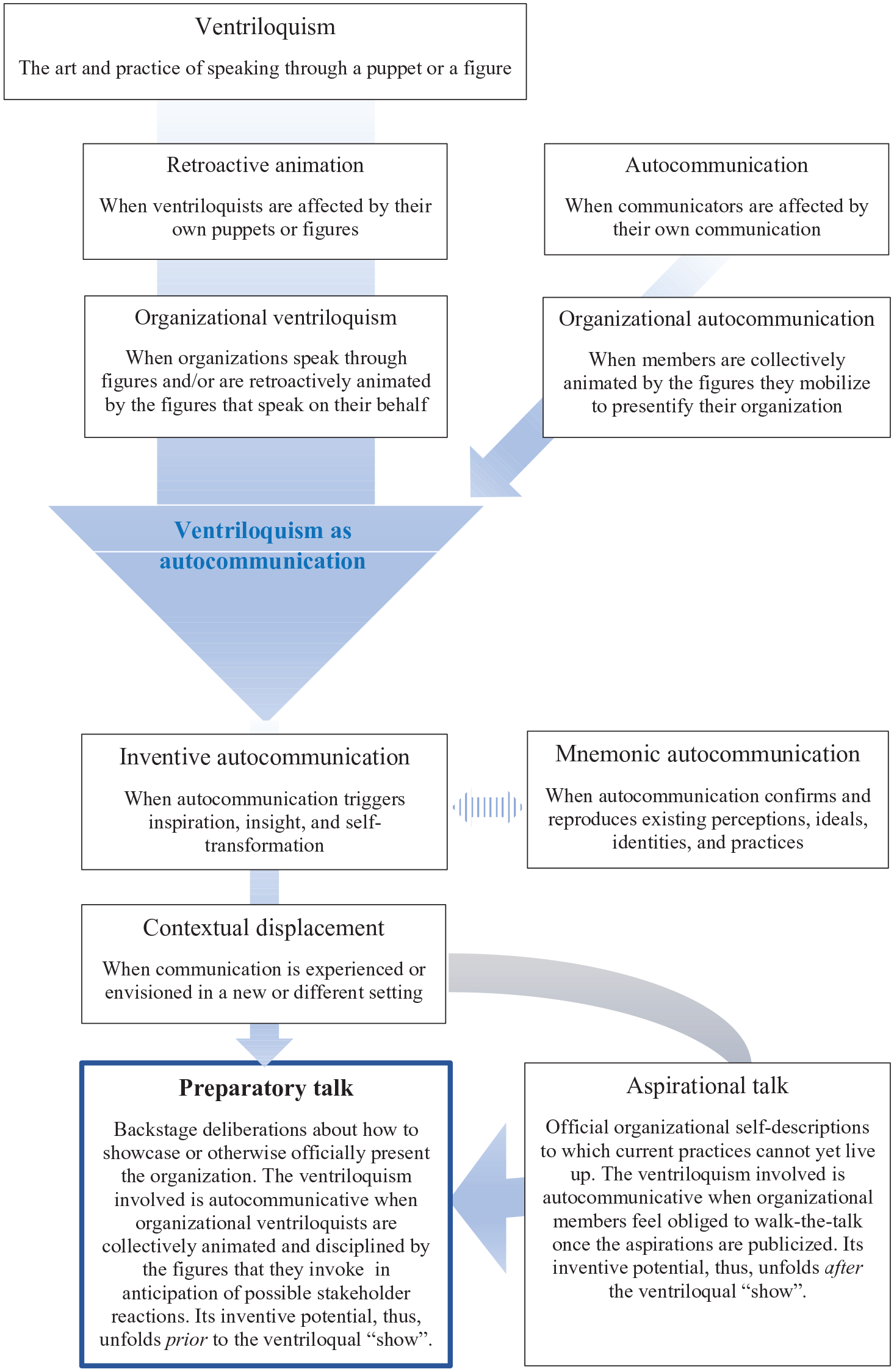
Organizational ventriloquism as autocommunication.
Organizational ventriloquism is, as we have argued, autocommunicative when ventriloquists are collectively animated by the figures they mobilize when talking about or otherwise presentifying their organization. Such communication has several possible outcomes. It can lead to a mnemonic reference to and celebration of existing practices or, alternatively, to an inventive discovery of new possibilities. Presentifying an organization through ambitious figures is by itself likely to mobilize autocommunication’s inventive potential because it allows members to experience the organization in a different light, something that can stimulate a reassessment of existing practices and attempts to reduce gaps between talk and action. So far, however, research on aspirational talk has addressed such potential after the ‘show’, that is, after aspirational self-descriptions are publicized. Our discussion of preparatory talk draws attention to inventive dynamics before the ‘show’.
Given its focus on anticipating and bypassing problems and crises, the setting of preparatory talk is likely to be experienced as a significant contextual displacement by the members involved, who will be inclined to mobilize the critical gaze of the other, both when listening to their own proposals and to the proposals of their peers. While the talk in such backstage settings may be casual, experimental and even playful (e.g. Goffman, 1959), its focus on developing inspiring descriptions of the organization that can withstand critical scrutiny by stakeholders adds gravity and precaution to the practice of presentifying the organization through particular figures. The current emphasis on responsibility and sustainability across organizations might suggest that these figures will continue to dominate preparatory talk, especially because they can be mobilized against organizations even when they ostensibly talk about other matters. Future empirical research, however, should focus more broadly on how perceived risk will shape preparatory talk and stimulate self-disciplining practices across organizations and settings.
Discussion and Conclusion
Research on organizational ventriloquism has recognized that ventriloquists can be animated by their own figures or puppets (e.g. Cooren et al., 2013; Cooren & Sandler, 2014; Nathues et al., 2021). We take a closer look at this phenomenon, focusing on how organizational ventriloquists – in this case, those charged with officially presenting the organization – are affected when deliberating how to describe the organization to potential external audiences. To this end, we draw on Lotman’s theory of autocommunication and his observation that autocommunication has both self-affirming and self-developing potential. Foregrounding the latter, we discuss the possibility that organizational ventriloquists are animated to see their organization in a different light when involved in preparing the ‘show’, that is, official organizational presentations. Such preparatory talk, as we call it, is likely to be shaped by current notions of turbulent environments and expectant or critical stakeholders. Specifically, we argue that increased precaution and alertness to potential stakeholder criticism can influence how preparatory talk unfolds in backstage settings and how such talk retroactively constitutes the organization.
In the discussion section below, we consolidate our core concepts and arguments, and elaborate on their implications for future studies of organizational ventriloquism. Specifically, we offer a general theoretical formulation of how contextual shifts and the nature of specific settings can influence how organizations are invoked, constituted and changed.
The ventriloqual context and matters of authority
A central tenet in our argumentation is that the setting or context matters. It shapes how ventriloquism unfolds, in our case how the organization is invoked, including which figures are mobilized on its behalf and how they autocommunicatively affect other organizational practices. Following Lotman’s (1977) discussion of autocommunication, we have argued that contextual shifts enable ventriloquists to discover new dimensions of their organization (cf. Brannen, 2004; Czarniawska & Sevón, 2005). In this paper, we have foregrounded a specific contextual shift that takes place when members become engaged in preparing a performance act or a show on behalf of their organizations, for example in the shape of formal documents or other types of official presentations. This particular focus, however, may leave the impression that contextual shifts are necessarily dramatic and that the members involved in such preparations step out of their normal work life and suddenly become serious about how they depict their organization. Yet, many types of mundane organizational work involve backstage preparations for frontstage consumption. Such work includes, for example, everyday strategizing, updating of social media content, responding to customer complaints, and other recurrent and partly routinized practices. Even if these practices call on involved members to put on a cloak of seriousness, they are not necessarily significantly different from regular work.
What is interesting for further development of the ventriloqual perspective is the capability of members to spontaneously make these contextual shifts themselves, for example by mobilizing behaviours and concerns that are taken for granted in the specific situation (Christensen & Christensen, 2022). Extant works seem to overlook the fact that many situations are pregnant with meaning in ways that a priori grant authority to some concerns over others. When preparing for the show, as discussed in this paper, certain matters of concern – for example, corporate responsibility or sustainability – are at the outset already considered legitimate and highly relevant. Whereas Vásquez and colleagues (2018) convincingly illustrate how matters of concern can become matters of authority through recurrent references to such concerns over time, they do not explain the opposite process, that is, how matters of authority can shape and perhaps even determine matters of concern (see also Bencherki et al., 2021). If certain situations in advance authorize specific figures and concerns, as we have argued in this paper, there is a need to develop our knowledge of the ventriloqual context. Vásquez and colleagues’ discussion of ‘privileged sites’ holds potential to expand our understanding of what is taken for granted in settings ‘where different matters of concerns are voiced and others made silent’ (p. 429). Yet, more work needs to be done to fully recognize what drives the silencing as well as the voicing, which in many instances may be seen as a ‘given’ to ventriloquists. Preparatory contexts, as we have seen, are already loaded with anticipation. This may, for example, allow members to apply pressure on their organization to reconsider and challenge existing messages and practices (e.g. Girschik, 2020; Haack et al., 2012). Research on ventriloquism, accordingly, needs to acknowledge that certain matters have a presumed authority before they are explicitly invoked as collective concerns in specific settings. The predominantly micro-level perspective of this research, in other words, would benefit significantly from increased attention to social constructions that are experienced as real constraints across settings and related to as ‘coercive facticity’ (Berger, 1967, p. 11). The sense of increased risk associated with official organizational communication in today’s world is but one example of such experienced constraints. More generally, this observation calls for a deeper understanding of the recursive dynamics between micro and macro processes of communicative constitution.
Organizational change and its sources
Although this is not a paper on organizational change per se, it has indirectly addressed the topic by approaching organizational ventriloquism as autocommunication and foregrounding its inventive or self-developing potential. Organizations will probably not change dramatically by interacting meticulously with their own figures. The discoveries and inspirations that can emerge in processes of autocommunicative ventriloquism are likely to be slow and incremental. Such adjustments may therefore come across as less significant than changes instigated and driven by external pressures or large-scale managerial initiatives. Moreover, since such adjustments unfold organically on a day-to-day basis – for instance, when communicators contemplate alternative vocabularies and illustrations for social media content, consider measures to counter, preempt, or circumvent criticism or prepare themselves for new types of demands from stakeholders – they may not be immediately noticeable. Yet, in today’s globalized and digitized communication environment, where organizational communication can be questioned and challenged from multiple sites, incremental transformations are likely to be a typical change pattern. Future research on organizational ventriloquism, accordingly, may usefully study those ‘backstage’ settings where the formulation, negotiation and polishing of official communication unfolds, where potential stakeholder reactions are invoked and discussed and where questions about appropriate presentations and follow-up activities are aired and negotiated.
While sources of organizational adjustments and change are many, we have in this paper focused on how specific contexts can stimulate a reflexive type of ventriloquism conducive to new ideas and new practices. Our reasoning implies that vigilance toward the ‘other’ when engaging in preparatory talk can result, paradoxically, in increased organizational introspection. In this way we challenge research that depicts environmental hypersensitivity and organizational self-absorption as contrasting and mutually exclusive tendencies. Hatch and Schultz (2002), for example, describe both propensities as dysfunctions. In their conception, too much attention and responsivity to outside opinions prevents an organization from sustaining a distinct identity, whereas too little keeps the organization from learning and changing. In contrast, we argue that increased sensitivity to external expectations and demands might coexist with – and might even intensify – an organization’s preoccupation with its own communication. Thus, while self-absorption may sometimes be an impediment to change (see also Christensen & Cheney, 2000), we argue that organizational adjustments and changes can result from autocommunicative ventriloquism if such inward-looking practices are driven by a concern for the ‘other’. This is likely to be the case when organizational ventriloquists engage in preparatory talk. Such talk not only shapes what the ventriloquists end up saying about their organization but may, as a specific context pregnant with authority, also shape the talk itself.
From this perspective, we also challenge Winkler and colleagues’ (2020) distinction between vicious and virtuous circles of aspirational talk. While this distinction is potentially interesting for discussions of communicative constitution, their line of reasoning suggests that aspirational talk is either ‘self-persuasive’, and ignorant of tensions and dissent, or oriented towards critical audiences. As such, it tends to disregard what the studies cited in this paper illustrate: that aspirational self-persuasion works especially if aspirations are communicated in contexts characterized by contestation (e.g. Girschik, 2020; Haack et al., 2012; Penttilä, 2020). Conversely, potential contestation is more likely to bring about better practices if sensitivity to such contestation shapes the aspirations and manages to discipline processes of organizational self-persuasion. The potential of aspirational talk to retroactively animate its ventriloquists, in other words, is closely related to its contestability (see also Christensen et al., 2021). The pertinence of this observation is evident especially in situations where organizational ventriloquists, out of fear of attracting negative attention to their organization, respond proactively to potential or imagined critique (see for example Girschik, 2020; Penttilä, 2020). Put differently, preparatory talk’s autocommunicative and self-disciplinary character is relevant in all contexts where organizations invoke notions of ‘what might happen’ if they do or say this or that.
The practical and ethical challenge for organizational ventriloquists interested in stimulating better practices is to cultivate and sustain a collective sense of urgency, including a strong conviction that the figures they invoke matter to stakeholders and are likely to produce heightened awareness, growing expectations and, perhaps, critique and dissent. Without sustained sensitivity to such reactions, organizational ventriloquists may not take their own figures seriously or be able to affect others in the organization. When that is the case, their involvement in their own communication is likely to be self-celebratory and mnemonic rather than inventive. To increase our understanding of organizational ventriloquism and its change potential, future studies should unpack the interplay between outward-looking and inward-looking sensitivity; focusing for example on whether the figures invoked are used to modify or stabilize existing perceptions and practices in the organization.
In sum, if we are interested in understanding the communicative constitution of organization beyond a momentary invocation of particular figures, we need to study more closely how organizational ventriloquists are affected or animated by the figures invoked in various situations and contexts and across time. Such a focus, we have argued, essentially implies approaching organizational ventriloquism as a form of collective autocommunication. Regardless of whether it mobilizes its inventive potential or not, autocommunication is an important social practice that significantly influences how organizations are maintained and developed. The understanding of autocommunication that we have advanced in this paper corresponds with work on the communicative constitution of organizations (e.g. Ashcraft et al., 2009; Cooren et al., 2011; Putnam & Nicotera, 2009). Yet, it might be more accurate, following our theorizing, to speak of an autocommunicative constitution of organizations. By applying the notion of autocommunication to the context of ventriloquism it becomes obvious that organizations emerge and evolve when they engage with their own communication, all the while imagining others who are relevant to their presence and existence.
Footnotes
Acknowledgements
We are grateful for the constructive and insightful feedback that we received from OT Editor Joep Cornelissen and the two anonymous reviewers. In addition, we thank Professor Dennis Schoeneborn for very helpful feedback on earlier versions of the article.
Declaration of Conflicting Interests
The author(s) declared no potential conflicts of interest with respect to the research, authorship, and/or publication of this article.
Funding
The author(s) received no financial support for the research, authorship, and/or publication of this article.
Author biographies
Lars Thøger Christensen (Ph.D.), is Professor of Communication and Organization at the Copen-hagen Business School (Denmark). In addition to ventriloquism and autocommunication, his research focuses on talk-action dynamics, voicing, hypocrisy, transparency and organizational identity. In addition to six books and contributions to many edited volumes, his research appears in Organization Studies, Journal of Business Research, Human Relations, Organization, Management Communication Quarterly, and elsewhere.
Emma Christensen (Ph.D.), is postdoctoral researcher at Roskilde University (Denmark). Christensen’s overall research interests are communicative constitution, performativity, discipline, and expectations. From communicative and sociological perspectives she currently studies the materialization and impact of ideas, visions, and norms in practices of artificial intelligence, strategizing, and member voicing. Her latest work, The Interpellated Voice: The social discipline of member communication appears in Management Communication Quarterly.