




Abstract
This paper examines how organizational members concretely appropriate equity, diversity and inclusion initiatives. This article results from a case study within a large Canadian organization, a study that was designed to explain the appropriation or disappropriation of discursive elements inherent to the implementation phase of new equity, diversity and inclusion (EDI) initiatives. Using interview data, I explain how these elements contribute to the ways in which organizational members adapt and respond to these new organizational initiatives and practices. This research proposes to mobilize a Communicative Constitution of Organization (CCO) perspective that can aid in understanding how individual appropriation/disappropriation of diversity discourse could have implication for the emergence and sustainability of EDI initiatives. The paper identifies various forms of appropriation (compliant/unconditional, fully aligned, equivocal/conditional and disappropriation) performed by organizational members. Moreover, the findings introduce a gradient approach to appropriation, revealing how the process can evolve over time.
Introduction
Over the past few years, in Canada, there has been renewed interest in implementing diversity, equity, and inclusion (DEI) initiatives within organizations. Despite current growing backlash, organizations continue to develop and implement new DEI practices to address issues such as discrimination and harassment. In the Canadian context, the acronym EDI is preferred to describe contemporary diversity practices within organizations, including “diversity intelligence” (Hugues, 2023, p. 8), that is, the ability to recognize and appreciate diversity. These initiatives can help mitigate societal biases tied to social identity and address issues, such as unfair treatment in the workplace. In the organizational context, diversity refers to how social identities such as gender, ethnicity, disability, and age—and their intersections—intertwine with contemporary organizational practices (Zanoni & Calas, 2014), including hiring, promotion, and other key processes. The organizational perspective emphasizes how these identities shape individual experiences and influence broader organizational processes. Moreover, with countries across the globe seeing a surge in migration—for instance, Canada is preparing to welcome approximately 380,000 new immigrants annually 1 —there is a pressing need to implement practices that promote ethnocultural diversity in the workplace. These demographic shifts highlight the critical importance of fostering inclusive environments that effectively integrate and support a diverse workforce.
Organizational members’ responses to new diversity practices have been examined primarily in two research streams: organizational psychology (Harrison et al., 2006; Herrera et al., 2011; Story et al., 2024; Weeks et al., 2024) and social psychology (Batson et al., 2002; Konrad & Hartmann, 2001). Psychology-based literature highlights a spectrum of reactions to EDI initiatives, ranging from overt hostility to inaction or superficial compliance (Iyer, 2022). Although attitudinal approaches to EDI initiatives provide valuable insights into the personal attitudes of organizational members, they fail to capture the broader organizational dynamics involved in deploying EDI initiatives. Focusing solely on individual responses may overlook how organizational EDI initiatives are shaped, contested, or reinforced and how local actions contribute to building collective efforts.
Understanding these broader dynamics is crucial for obtaining a comprehensive understanding of the implementation and evolution of EDI practices. Critical communication and diversity scholars have significantly expanded diversity research by focusing on language and diversity discourse and showing how organizational members’ reactions to EDI initiatives are performed. Indeed, EDI practices are frequently contested and reappropriated by minority employees to resist dominant diversity narratives, while other groups leverage them to exercise power (Janssens & Zanoni, 2021). From a communicative perspective, (dis)appropriation of diversity discourse could be considered a process of adapting, where we make our own the discourses, texts, and responses, thereby appropriating human (e.g., other people’s voices) and other-than-human (e.g., ideas, values, rules, policies) contributions related to EDI initiatives because they reflect our attachment to specific intended outcomes.
We propose mobilizing the Communicative Constitution of Organization (CCO) perspective (Taylor & Van Every, 2000, 2011) to illuminate the possible implications of individual appropriation/disappropriation of diversity discourse for the emergence and sustainability of EDI initiatives. Instead of viewing communication merely as a tool for information dissemination, the CCO perspective considers it integral to the organization’s constitution and emerging initiatives. Focusing on language and micro-discourses provides researchers with an innovative perspective on how diverse practices are shaped through communication. This case study examines an ethnocultural diversity mentorship program aimed at integrating newcomers within a large Canadian organization. The study offers valuable insights into how members continuously (dis)appropriate EDI initiatives and the implications for collective action. Based on interview data that capture organizational members’ micro-discourses before and after the implementation of an EDI initiative, this research highlights how local discourses are constructed and unfolded throughout the EDI process.
This study makes several important contributions to the field. First, it enhances our understanding of appropriation by adopting a communicative perspective and uncovering communication dynamics that transcend the simplistic categorizations of responses to EDI initiatives. The findings introduce a gradient approach to appropriation, revealing how the process evolves nonlinearly over time and is often characterized by iterative shifts and reversals. The study also contributes to our understanding of the composition of diversity initiatives by articulating what counts for organizational members in this context, thereby influencing broader organizational diversity initiatives. Finally, this study provides practical implications and valuable insights into organization-level EDI communication strategies.
In the following sections, I present a comprehensive literature review of diversity research that focuses on EDI initiatives, outline the theoretical framework introducing the CCO approach, and detail the methodology, including a case study. I then discuss the findings, followed by the discussion and conclusion.
Literature Review
This section examines diversity research on EDI initiatives, explores how organizational members view these initiatives, and discusses their implications for communication and diversity research.
Diversity Research and EDI Initiatives
Recent diversity research on EDI initiatives has explored their effectiveness and identified the approaches that may influence their successful long-term implementation. For instance, Kalev et al. (2006) systematically analyzed the effectiveness of diversity programs, drawing on federal data from 708 private sector establishments in the United States from 1971 to 2002. They assessed the impact of seven common diversity initiatives—affirmative action plans, diversity committees and taskforces, diversity managers, diversity training, diversity evaluations for managers, networking programs, and mentoring programs—on the representation of White men, White women, Black women, and Black men in management positions. They found that structures that embed accountability, authority, and expertise—such as diversity committees—are the most effective way to enhance the representation of minority groups. However, even the most successful programs had only modest effects, particularly for Black Americans, who remained underrepresented in management roles.
Although such programs are important, their effectiveness remains controversial. Moreover, diversity management scholars have highlighted the critical need to address the implementation gap (Riccò & Guerci, 2014) inherent in most diversity initiatives. This gap highlights the challenges organizations encounter when translating the concept of diversity management into practice. In this context, diversity management is viewed as a process of change, with diversity managed across multiple levels (strategic, tactical, and operational). The need for everyone’s engagement within the organization adds complexity, complicating the task and amplifying the gap between strategy and operation. Recent debates on diversity management highlight the complexity of implementing such initiatives, which are frequently driven by conflicting approaches, assumptions, and ideas.
These discussions include consideration of the “woke” 2 and “anti-woke” EDI approaches. Some authors associate the “woke” approach to diversity policies and practices with “leftist movements and ideologies” (Waldman & Sparr, 2023, p. 152), rendering them irrelevant in addressing organizational needs. Others emphasize that “woke” in an EDI context originally connoted being awake and informed and, thus, should not carry negative associations (Thomason et al., 2023). Other approaches, such as the business case, focus on incorporating diverse stakeholders to reshape business systems, drive innovation, enhance corporate social responsibility, and maximize profit (Buzzanell, 2020). By contrast, the social justice perspective emphasizes ethical responsibility, empathy, and resource redistribution to support under resourced communities. These approaches can conflict when organizations or their members prioritize one over the other. Furthermore, critically-oriented scholars (Janssens & Zanoni, 2021, p. 6) argue that moving beyond the “instrumental appropriation” of socio-demographic differences is essential, as diversity programs that focus solely on enhancing organizational performance can be limiting. For instance, Irawan et al. (2024) drew on critical race theory (CRT) to examine the power, privilege, and intersectionality of identities. CRT helps reveal how EDI-related issues, such as racism, operate as both individual and structural problems, highlighting the limitations of diversity initiatives that often fail to address deeper systemic inequalities. Critical diversity studies frequently question whether diversity programs and initiatives truly advance social justice (Ahmed, 2012; Janssens & Zanoni, 2021; Tyler, 2019), as “the language of diversity” can sometimes reproduce inequalities and reinforce an “us versus them” power dynamic. Unveiling how organizational members translate these assumptions into discourse and appropriate them remains a challenge. The appropriateness of these diverse approaches remains underexplored but generates a wide range of responses to EDI initiatives, as outlined below.
Appropriation and Organizational Responses to EDI Initiatives
In the organizational context, adaptation to new diversity initiatives (e.g., mentorship programs, training, and employee resource groups) depends primarily on employees’ reactions to diversity practices. According to Nishii et al. (2018), diversity practices send signals to employees about what is important and valued by organizations. Two common reactions to EDI initiatives are attitudinal reactions—namely, attitudes about the self, organization, or career—and cognitive reactions that represent a change in knowledge or skills related to EDI (Nishii et al., 2018). Research on mentoring EDI initiatives (Ragins et al., 2000; Young & Perrewé, 2000) finds that when employees are satisfied with their mentors, job satisfaction and organizational self-esteem increase.
Additionally, Plaut et al. (2020) highlight that diversity initiatives have evolved from emphasizing the experiences and representation of non-dominant groups to adopting broader, less-defined objectives that are less explicitly tied to moral considerations. In this sense, EDI initiatives can trigger varied anti-diversity responses from both dominant and non-dominant groups, posing obstacles to EDI efforts. To further explore the various types of responses to EDI initiatives, diversity scholars have focused on how organizations adapt to diversity discourse (Mease, 2016) and how reactions to EDI initiatives are socially constructed through language and communication (Janssens & Zanoni, 2021). Furthermore, the processes of adapting, interpreting, and internalizing discourse align with how some scholars have begun mobilizing the notion of appropriation to gain deeper insights into individual responses that inform larger organizational processes.
Ahmed’s (2012) research on EDI initiatives in universities illustrates how individuals designated as “champions of diversity” responsible for EDI initiatives are perceived as a means for the institution to appear committed to diversity. The university may appropriate the personal discourse on commitment articulated by these champions, presenting it as their own (p. 135). This form of appropriation reflects a subtle shift in which the university co-opts an individual’s engagement values, thereby becoming an institution’s commitment value. Thus, appropriation reveals the transition from individual to organizational values. Another notable development in the organizational diversity literature is the investigation of appropriation; for example, Lerma et al. (2020) outline the cycle of racialized labor appropriation. This cycle starts with individuals of color who address racial dynamics within organizations. In the second phase, the leaders respond obstructively. The third phase emphasizes the interaction between internal and external pressures, and the fourth illustrates how appropriation in leadership incorporates local racial equity efforts.
Although not explicitly addressed in this study, we envision that equity discourses may be integrated into diluted diversity initiatives. This spectrum often transforms the original intent because of negotiations between the initial objective and prevailing norms. However, the reception of such initiatives is not uniformly positive (Lerma et al., 2020) as they might serve to maintain the status quo through diversion. Exploring these dynamics in diversity research could provide a deeper understanding of the process and its impact on both individuals and organizations. In this context, diversity research could benefit from contemporary organizational and communication theories, offering a more dynamic and performative appropriation perspective.
Of note, Abdallah (2007) investigated a strategic plan’s appropriation, offering a typology based on her research on an art organization’s action plan. Although her longitudinal study is not directly tied to diversity initiatives, it highlights how strategic plan discourses can undergo diverse appropriations over time and offers a process view of appropriation as well as a performative one. From the interviews, Abdallah identified four key types of appropriation performed by organizational members: The first type is “common appropriation,” whereby employees adopt the plan’s rhetoric without deep integration. The second is “differentiated appropriation,” whereby initial enthusiasm gives way to employee tension owing to formal protocols, precipitating dissent. The third type is “instrumental appropriation” by managers, involving the use of a plan to justify strategic decisions, particularly during resource constraints. The fourth type, “symbolic appropriation,” pertains to employees who see the plan as a symbolic document reflecting values rather than a decision-making tool.
Chreim (2006) offers a process view of appropriation, outlining three appropriation stages in a management-proposed change program: early, equivocal, and later appropriation stages, which involve shifting from initial skepticism to the adoption of the managerial frame, revising the initial managerial frame, and transitioning employees from resistance to acceptance. These two typologies offered by Abdallah (2007) and Chreim (2006) highlight the performative and processual dimensions of appropriation and illustrate how appropriation unfolds over time.
The diversity literature predominantly focuses on attitudinal and cognitive responses to EDI initiatives, with less emphasis on how these responses are shaped by appropriation processes at both the individual and organizational levels. As a result, there is a critical gap: while existing studies explore appropriation in relation to the transition from individual to organizational values, maintenance of the status quo, and the performative nature of appropriation, there is a limited understanding of how organizational members communicatively (dis)appropriate these initiatives through discourse. This gap obscures the ways in which local adaptations, resistance, and reinterpretation influence and often destabilize EDI practices. Thus, a communicative perspective is crucial to uncover how EDI initiatives are sustained, altered, or undermined in organizational discourse. Given the increasing difficulty organizations face in sustaining EDI initiatives, understanding the communicative (dis)appropriation of these initiatives is critical for advancing conceptual insights and practical strategies that can foster equitable organizational practices. Furthermore, integrating insights from local reactions with research focused on organizational structures and processes remains challenging. Explanations of how these reactions shape organizational EDI outcomes are lacking. From a communicative standpoint, (dis)appropriation can be understood as the process of adaptation through the (dis)association of principles, approaches, and ideas related to EDI initiatives. Accordingly, this study was guided by the following research question: How do organizational members communicatively (dis)appropriate EDI initiatives over time? To address this question, the next section considers contemporary organizational approaches, particularly the ventriloquial CCO approach.
Theoretical Framework: The Ventriloquial-CCO Approach
In their effort to bridge communication and diversity research, Trittin-Ulbrich and Villesèche (2022) highlight the importance of focusing on communication processes, as communication regarding “human diversity significantly shapes organizations” (p. 3). This is particularly relevant when examining EDI initiatives that are critically shaped by communication and diversity discourses. They further argue that diversity research encompasses both individual-level diversity within organizations and broader organizational strategies for managing diversity. However, the boundary between these subfields is fluid. Further research is required to better understand how individual-level diversity is connected with larger organizational strategies. This article is grounded in the perspective that communication, especially in its ventriloquial dimensions, is constitutive of organizations (Boivin et al., 2017; Cooren et al., 2015; Nathues et al., 2021). Additionally, Janssens and Zanoni (2021), have noted that “diversity research has taken the firm for granted, producing knowledge of diversity within its ideational boundaries” (p. 2). Bridging communication and diversity research frameworks could foster the production of new knowledge, offering fresh perspectives on how to conceptualize organizations. Since the 1980s, communication scholars have argued for moving away from the organization’s metaphor as a container for communication processes, emphasizing the concept of “organizing,” where organizations are communicatively constituted (Cooren et al., 2015; Putnam & Nicotera, 2009). Ashcraft and Allen (2003) stress that gender and race are key aspects of diversity that impact how “organizing” is ordered. For example, race and cultural background significantly contribute to power dynamics, influencing perceptions of competence and interactions among organizational members.
Rooted in the Montréal School CCO framework, ventriloquial analysis presents communication as a relational process that accounts for how both human and other-than-human agents can make a difference in a given situation. It provides a viable framework for studying how various figures (e.g., persons, ideas, values, and artifacts) participate in the appropriation processes of EDI initiatives. The concept of ventriloquism also allows us to shift the focus of our analyses to focus on the “beings we create in contexts of interaction” (Cooren et al., 2013, p. 48), as this enables us, in practice, to make visible or analytically unfold what is more implicit and remains unsaid. This perspective provides a valuable lens for examining how agency is distributed among various human and other-than-human figures. Agency—the capacity to act or make a difference in a given context (Ahearn, 2001)—is not limited to human actors but extends to the other-than-human elements that animate them.
Thus, the ventriloquial approach enables a nuanced understanding of how various agents contribute to shaping organizational outcomes and interactions. Specific figures can animate individuals, prompting them to act and guide their behavior. These figures express various forms of attachment (Gomart & Hennion, 1999; Hennion, 2007) that can precisely explain why an individual may (re)appropriate or disappropriate an initiative. These figures may also hold authority (Wright et al., 2023) because they are often the driving forces behind specific actions within the course of events.
The theory also provides valuable insight into the (dis)appropriation of EDI initiatives by examining the communication process involving two vantage points: (a) how both macro- and micro-discourses contribute to transforming social structures such as EDI initiatives and (b) unpacking the implicit values and ideas underlying discourses and initiatives, particularly those to which members appear to be attached during the implementation phase of EDI initiatives.
This approach can be used to examine how various levels of (dis)appropriation can be expressed through different types of ventriloquation. Bencherki and Cooren (2011) conceptualize appropriation as the mechanism by which individual and collective actions converge. The responses we voice and discourses we produce are frequently perceived as our own, concealing intentional associations and dissociations. Diversity initiatives can be considered constrained or enabled by distinct figures to which members express various forms of attachment or detachment that drive them to (dis)appropriate an initiative introduced as a diversity program.
Method
This research is based on a qualitative case study approach, which provides a rich account of a new diversity program and offers insights into how employees and managers experience it.
Description of the Case and Organizational Site
This case study was conducted within a large organization operating in the Canadian energy sector and involved extensive data collection from corporate documents, meetings, and interviews. Additionally, examining the literature helped us understand how diversity research has been conducted (Stanley et al., 2019; Thomas, 2018). Case studies are particularly effective for identifying patterns in employee responses to employer-initiated diversity programs. Employing a case study, the qualitative approach involves one case (single case study) or a small number of cases (comparative case study) within a real-life context (Dul & Hak, 2012, p. 4). A case study allowed me to identify patterns and observe changes in the appropriation processes over time. For example, it revealed shifts from appropriation to disappropriation and thereafter to the reappropriation of EDI initiatives.
For approximately one year, the team with which I was associated assumed the role of an academic researcher within the organization. This organization employs more than 22,000 employees across various professional fields. Our study focused on a professional mentorship program designed for new immigrants with engineering backgrounds but limited work experience in Canada. We selected this organization because, at the time of data collection, it implemented an EDI mentoring program for immigrant workers with less than five years of experience in Canada. The organization selected an initiative that appeared particularly complex owing to the involvement of multiple stakeholders. The individuals hired through this program represented a form of ethnocultural diversity that the organization aimed to value.
The program primarily aimed to help its members recognize and value ethnocultural diversity, departing from a color-blind perspective in which differences are ignored to ensure equal treatment. This initiative aimed to help immigrant workers adapt to both the workplace and host countries. The project spanned from April 2017 to December 2018 and involved regular visits to the organization, office presence, and participation in mentoring-related work meetings. Here, the research focused on interviews with participants rather than recorded meetings, which has been the focus of other publications emanating from this project.
Data Collection
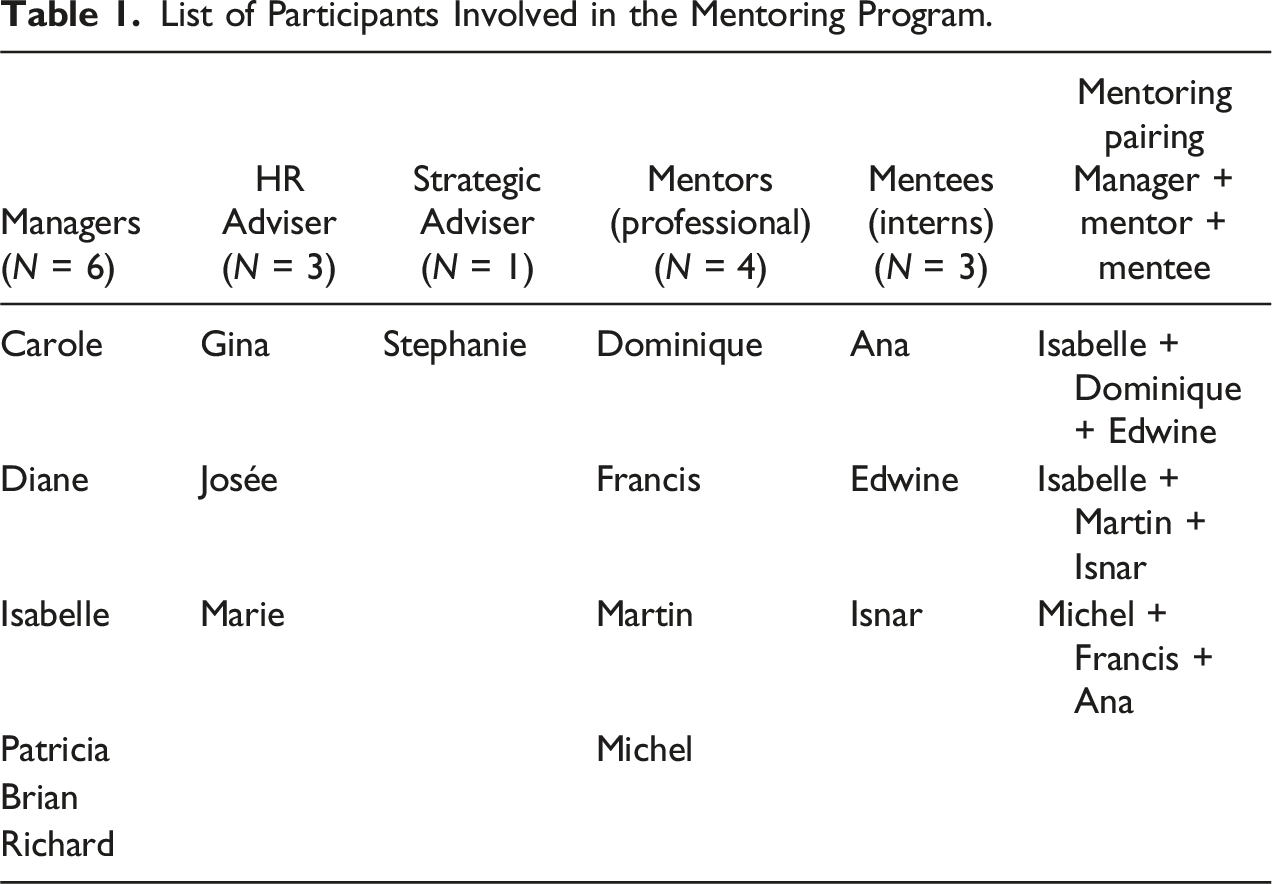
List of Participants Involved in the Mentoring Program.
Demographic Information.
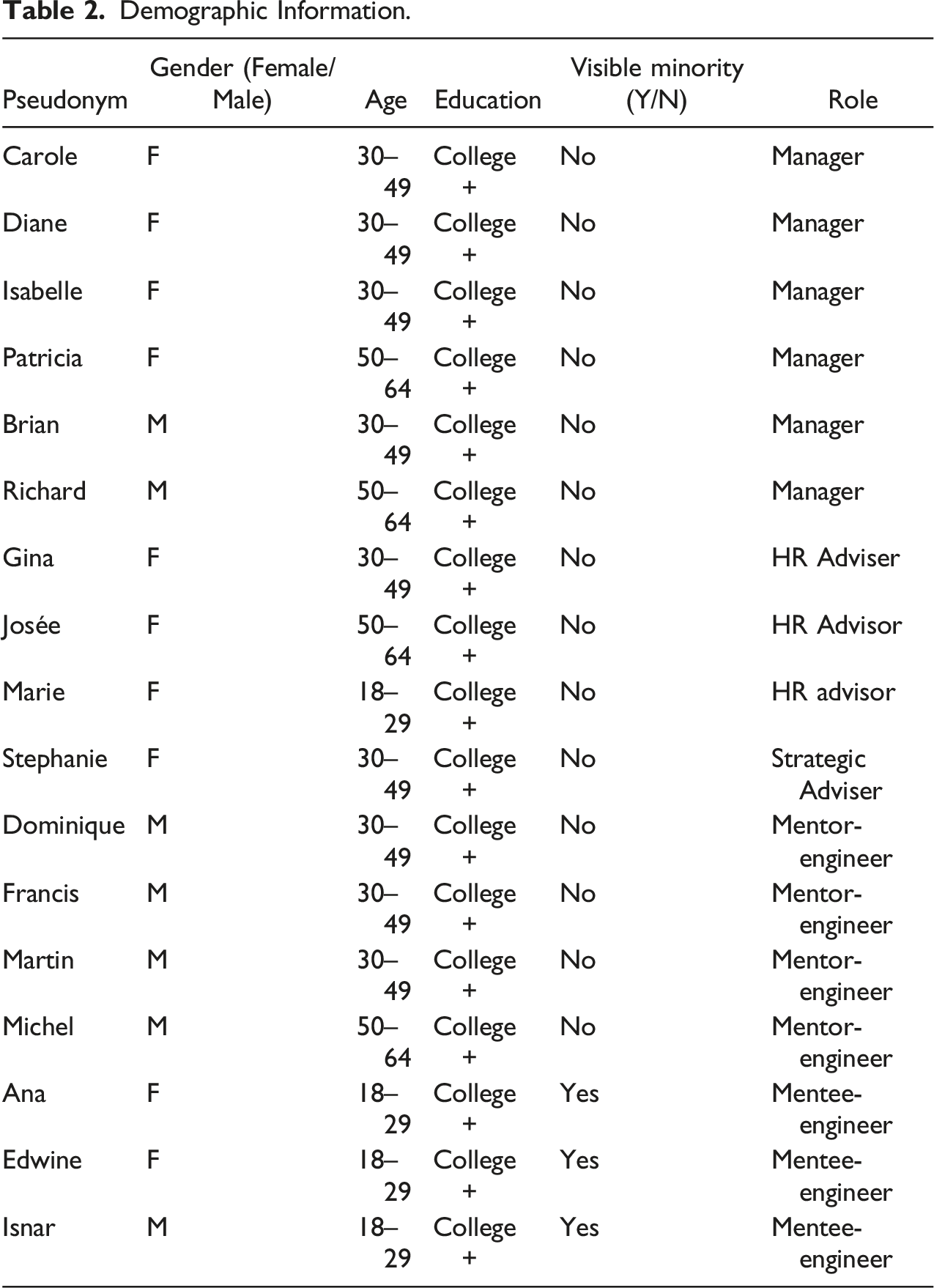
These interviews, conducted in French and lasting approximately 45 minutes, were recorded and stored in NVivo software. We conducted 24 formal (recorded and planned) and ten informal (unrecorded and spontaneous) interviews.
The first phase comprised 14 formal interviews conducted from October 30–December 17, 2017. These interviews were conducted shortly after the mentees arrived at the organization. The second phase comprised ten formal interviews conducted from April 10–July 5, 2018. The interviews were conducted with essentially the same program participants selected in Phase 1. Some employees were unavailable for Phase 2. Interviews were held with the mentees shortly before their departure, strategically capturing their discourse as the pilot phase approached its conclusion. The remaining participants were interviewed shortly after the mentees had departed. An interview guide was created for each phase to structure the interviews into specific themes.
Data Analysis
This study used a ventriloquial analysis (Nathues et al., 2021) to identify the key figures significant to the participants. Expanding upon the framework established by Nathues et al. (2021), the analysis was guided by a set of probing questions aimed at facilitating a deeper understanding of the data: (1) In the name of whom/what were the participants speaking in their interviews? (2) What figure(s) can be recognized based on what a person is saying? (3) What motives influence their expressions? (4) What potential ventriloquial effects emerge when distinct figures shape an individual’s alignment with the program?
This approach helped unveil explicit ideas and the implicit beliefs and elements that constituted the micro-discourse unfolded in each interview. This type of analysis differs from other inductive approaches, such as thematic analysis, as it focuses on ventriloquial effects and their performative dimensions. This approach involved observing how appropriation manifests by identifying the figures that facilitate or complicate the appropriation process. As discussed in the theoretical framework, appropriation is being increasingly understood as a communicative accomplishment. From a CCO perspective, organizational attributes such as technologies, spaces, and initiatives become organizational only as members enact and reinterpret them through communication. For instance, Wilhoit Larson (2020) demonstrated how workers integrate the features of external spaces (such as homes or coffee shops) into organizational life through communicative framing. Futhermore, Barrett and Stephens (2016) and Wilhoit Larson (2020) characterize appropriation as occurring along a continuum, highlighting how it can vary to some degree. Understanding these variations helps explain how organizational attributes are appropriated by members or attributed to the organization. Building on these insights, this study adapted Nathues et al.’s (2021) ventriloquial analysis framework to a new type of data—individual interview responses, rather than focus group interactions—to examine the appropriation of EDI initiatives. This adaptation deepens the application of ventriloquism analysis, allowing for a more nuanced understanding of the degrees of appropriation and the figures that animate them. It moves beyond treating appropriation as a binary outcome (adopted or rejected), and instead captures it as a dynamic, communicative process that unfolds along a continuum. By tracing how figures are mobilized with varying intensities, affirmed, contested, or transformed through discourse, the framework reveals subtle variations in how organizational initiatives such as EDI are enacted, negotiated, and integrated into practice. In this context, this perspective allows a better understanding of how participants in an interaction (considered ventriloquists) mobilize the entities (or puppets/figures to continue with this metaphor) that they speak and act, thereby positioning themselves in relation to EDI initiatives. Two data-analysis sessions were conducted with other laboratory researchers to ensure the quality and validity of the analysis. The researchers reviewed the verbatim data and shared their interpretations of figures related to the appropriation process. This collaborative process helped validate the findings and comprehensively understand the data.
Findings
Various Forms of Appropriation and Potential Resistance.
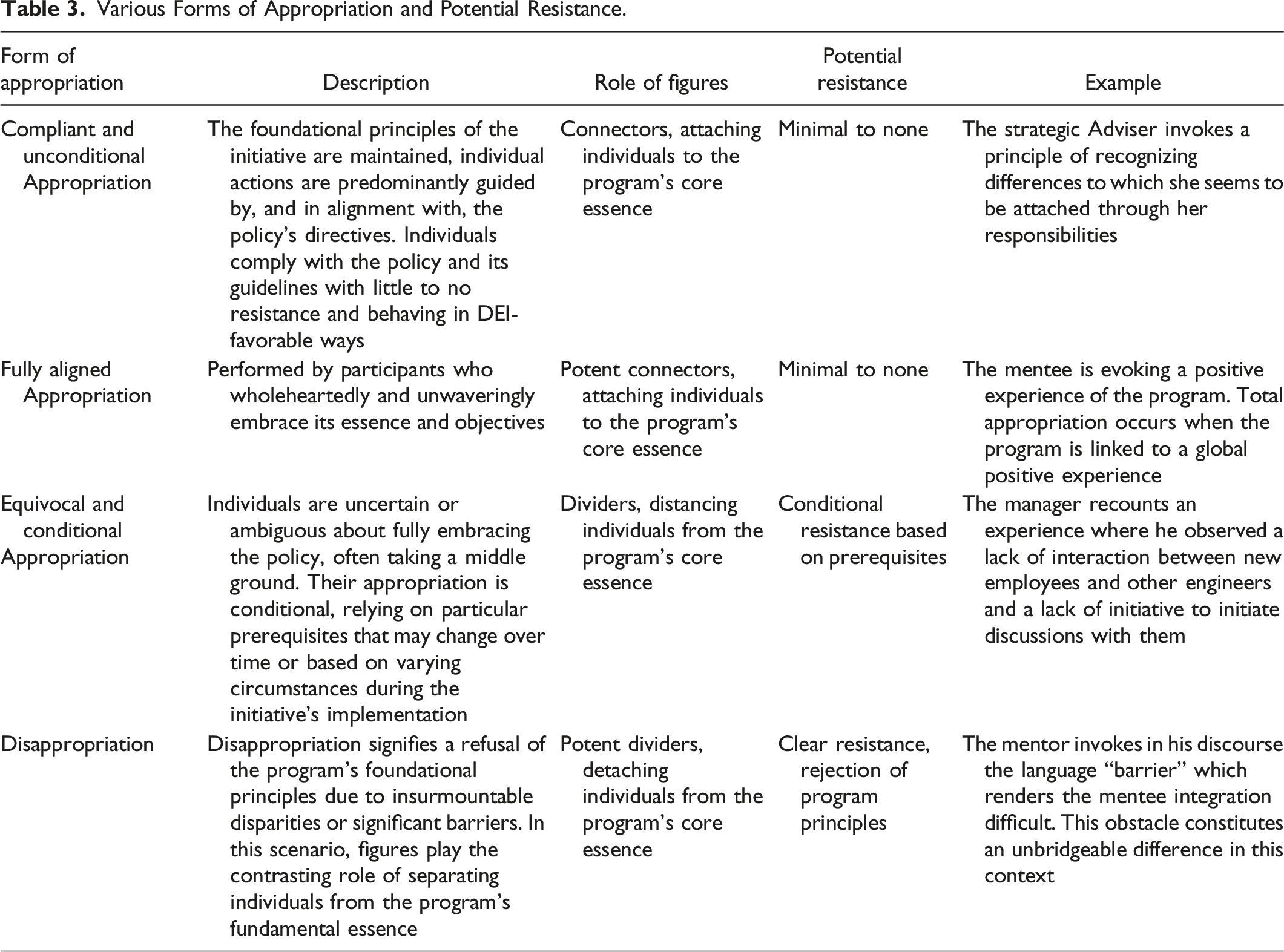
The analyzed excerpts deal with the integration and onboarding process of employees (mentees) who are welcomed by the organization for an internship. As illustrated in the following extracts, integration seemed to be highly important for the program’s success. These excerpts are presented because they serve as prototypes or exemplary illustrations of the identified gradient of appropriation. They demonstrate how organizational members appropriate the program in various ways, showing how they are animated by specific figures guiding their actions in each phase of the program’s implementation. These examples illustrate the varying levels of the gradient approach and offer a comprehensive overview of the appropriation process. In the first two excerpts, the figures act as facilitators of the ventriloquial effects that empower the participants and grant them agency. In contrast, the other two excerpts show the figures functioning as dividers, creating barriers in the process, and limiting the participants’ ability to act in alignment with the program.
These analyses help explore four types of appropriation: unconditional/compliant, fully aligned, equivocal/conditional, and a form of disappropriation vis-à-vis the diversity program.
Compliant/Unconditional Appropriation–Strategic Advisor’s Account
Strategic advisor Josée played an important role in the program. She was also the project manager and ensured that communication regarding the program’s objectives was unambiguous. In this interview excerpt, she explained some of the difficulties encountered while trying to communicate a general understanding of the program. She also expresses what could be identified as a compliant/unconditional appropriation of the program, which appears normal and expected given her responsibility. When asked how people generally understood the program, Josée said: Yes, what was most difficult to understand is now on top of my list for the next program cohort. It’s to distinguish the role of a mentor from a team leader who welcomes a new employee or an intern, who is responsible for communicating the culture of the company and all that, but who is also responsible for supervising different tasks for this new employee. This responsibility differs from that of a mentor or manager who welcomes an employee participating in this program. The main difference is in monitoring cultural and professional integration; this is major, and the focus should be there. But the message did not get through, even if the training sessions were dedicated to that.
This excerpt sheds light on how Josée implicitly invokes the importance of acknowledging cultural and professional differences, a key principle that she highlighted and ventriloquized in her response during the initial phase of the program’s implementation. Within this context, this figure—the principle itself—is implicitly presented as the object of a strong attachment (as she points out, “what was most difficult to understand is now on top of my list for the next program cohort” and “this is major, and the focus should be there”). This attachment is notable given her role as the person responsible for overseeing the diversity program. Her deep attachment to this principle also appears to express her unconditional appropriation of the program, as the latter should be animated by this principle. Furthermore, she readily complies with the “authority” of both the principle and the program, highlighting the agency of non-human agents that prompt her to act within this context. This becomes evident as she implicitly positions herself as adapting to the program’s requirements without imposing any preconditions. The principle that recognizes cultural and professional differences seems to matter most to her, even to the detriment of business principles. She is animated by these principles and makes them and the program her own. The figures help align Josée with the program by shaping her capacity to act on its behalf.
In this context, she emphasizes the distinction between welcoming trainees and welcoming mentees. She highlights that welcoming mentees requires mentors to adapt to the integration process. She argues that, in the context of diversity and inclusion, failing to acknowledge this difference poses a significant obstacle, and participants may not have fully comprehended its significance. For example, she explicitly mentions that the program must be aligned with the objectives of “cultural and professional integration,” which, according to her, does not seem to have been fully understood by the mentors and managers participating in the program. In ventriloquial terms, the program’s objectives can be seen as additional figures that may distort specific individuals from active involvement with the program and hinder their engagement with the initiative. According to her, there can only be unconditional/compliant appropriation when the program is truly understood—that is, grasped in its entirety—which, according to her, does not seem to have occurred during the implementation of this initiative.
Overall, Josée speaking on behalf of the principle to which she appeared to adhere strongly, namely, the importance of acknowledging cultural and professional differences is evident. Her strong attachment to this principle reflects her attachment to the diversity program, given that this principle constitutes one of its main elements, carrying specific “authority” within this context. Further, the strength of this attachment is sufficient to induce negotiations with existing organizational practices.
Fully Aligned Appropriation–Mentee’s Account
The interviews also provided insights into how the mentees experienced the final phases of the mentoring program. For example, in the following excerpt taken from an interview with mentee Edwine, who was paired with mentor Dominique (Table 1), Edwine experienced the program positively. Overall, it went very well; I learned a lot. As I say, it was a completely new field for me [. . .] Now I’m proud of myself because I was finally given projects that I’ve been doing on my own since the end of the year and that I’m trying to finalize before leaving. The thing that stood out or touched me the most, actually, is that I have my mentor who applied for a senior-level position, so Dominique [my mentor] left [the engineering team for another position]. And he told me clearly, “Listen to me; I give you carte blanche.” That [statement] made a big impression on me. I had done one or two fieldwork projects, and now he’s giving me about thirty fieldwork projects. He said, “Manage yourself the way you want; if you ever get stuck, come and see me.” That really touched me, the confidence he gave me.
As evident in her response to the first question, Edwine appears to express her appropriation of the program to the extent that no event would have tainted her experience. In her account, the figure of “experience,” which she implicitly ventriloquizes, presents itself as having gone extremely well and as an occasion where she was able to learn a lot. This figure connects her to the program and anchors her to the framework. In this way, Edwine’s appropriation becomes evident in her expression that her experience as a mentee harmonizes seamlessly with the program’s objectives.
This alignment was reinforced by the implicit evocation of her personal growth, suggesting that her participation had expanded her skills and knowledge. To support this favorable assessment, Edwine highlights her previous lack of experience in the field, which she contrasts with the fact that she was “finally given projects that [she has] been doing on [her] own.” This juxtaposition indirectly conveys the idea of her increased autonomy, indicating that she gained greater independence through the program. This contrast underscores the elevated appropriation level. Her enthusiastic alignment with the program became evident as it empowered her in terms of both learning and autonomy.
When asked what stood out in her experience as a mentee, she promptly evoked her mentor because of the responsibility that he increasingly placed on her during her mandate. In this case, she ventriloquizes him as she makes him implicitly express that he has great confidence in her by granting her “carte blanche” on a new project, reinforcing the level of autonomy attributed to her. The development of a strong relationship between mentors and mentees was a key outcome of the EDI program, fostering a sense of competency and increased confidence. This relationship not only supported professional growth but also reinforced the program’s role in creating an inclusive and empowering environment. Through her response, the mentor is depicted as someone who sees her as competent, in other words, a colleague he can count on even if he is unavailable to supervise her formally (“Manage yourself the way you want; if you ever get stuck, come and see me”). Edwine described the program as having not only given her agency but also the initiative to lead new projects so that she became autonomous. Thus, the program animated her, in this case, not with its own objective as was for Josée, but by giving her “carte blanche” to act as she chooses.
This interview was conducted at the end of the program when the mentee was about to leave the company, and this “sign of confidence” is presented here by Edwine as the element that matters the most to her. Therefore, she was highly attached to it, revealing that she appropriated the program because of this positive experience. Overall, it becomes evident that Edwine articulates her thoughts in alignment with a prominent figure and her positive experiences to which she has a strong affinity. Thus, all the figures evoked a positive experience, with the mentor and his confidence serving as crucial “potent connectors,” firmly attaching Edwine to the program’s essence. The following extracts show how a form of equivocal appropriation can be revealed through managers’ accounts.
Equivocal/Conditional Appropriation - Managerial Accounts
As indicated in Table 1, Isabelle was the manager responsible for supervising mentor Martin and his mentee Isnar. One of her responsibilities was to meet mentors and mentees regularly to oversee diversity initiatives. In the extract below, she shares her thoughts on the program and the integration of Edwine, a mentee. When asked if there were any changes following the implementation of the program, Isabelle said: No, Edwine [the mentee] made a good point. I think that she has less difficulty integrating. I think she comes from Africa, and she lived in France, she studied in France. She worked in France. So, she is used to changing, to moving, and has seen other cultures. She hasn’t always been in her country, and then all of a sudden was parachuted in here. That’s what she told me the other day; maybe that’s why she finds it easier to integrate.
When asked whether it was easy for the team to integrate these new employees, Isabelle stated It’s a little more difficult to evaluate, I would say. I even questioned myself because they do what they must do: at their desk. I see Isnar [mentee] exchanging with Martin, his mentor. Edwine was at her desk, but when I went to see her, she was with Dominique [her mentor]. The duo works very well. I saw Isnar [the other mentee] working with another engineer. But on his own initiative, or even on Edwine’s own initiative, I don’t see them asking questions. I haven’t seen them much doing that. Then this is what I want to watch more closely. Sometimes, it’s normal for everyone, and you sometimes get embarrassed. I will try to provoke or ask Dominique [a mentor]and Martin [another mentor] to help them [the mentees] talk and exchange technical questions, etc.
This interview occurred during the mid-phase, and doubt seems to persist regarding Isabelle, as she questions whether Edwine’s ease of integration was real. In this excerpt, she recounted her experience, describing the lack of interaction between the mentees and other engineers and what she presents as a lack of initiative to engage in discussions with the latter. In ventriloquial terms, Isabelle makes this experience speak for itself as an implicit confirmation of specific doubts about Edwine’s integration level. The experience she presents appears to distance her from the program. Isabelle’s discourse on the theme of integration shows a significant condition that she highlights as essential to the program’s success: taking initiative. One might assume that behaving like an engineer implies allowing oneself to initiate discussions, an authority that one can grant only if they feel confident and on a relatively equal footing with their peers.
For Isabelle, freely discussing the technical problems they encountered appeared to be a characteristic of engineers. However, Isnar and Edwine did not yet seem to have acquired this “trait.” Thus, Isabelle’s appropriation of the diversity program appears to require the imposition of conditions that were not initially included in this initiative. Therefore, there is a specific distortion in the initial aims of the program, which do not include the requirements for its success. For her, the program’s success depended on the fact that she had the impression that the mentees’ integration was taking place without obstacles. She appeared attached to this idea of integration, which she referred to in her response: Thus, this is a form of equivocal/conditional appropriation, as Isabelle’s appropriation depends on the success of the integration process, which also depends, on the mentees’ confidence level in the team. In addition to the conditions set by this manager, the program is equivocally appropriate as she avoids taking a clear stance or providing a definite answer regarding her commitment to the program. She appeared to have concerns regarding the integration process.
Overall, Isabelle’s alignment with the program appears diminished due to her connection with the figure of “integration” and how this figure animated her. Her attachment to this figure thus expresses her equivocal appropriation of the program, thereby impeding its swift implementation. Isabelle appears to be animated by the figure that plays the role of “divider,” as it distances Isabelle from the program’s essence by disengaging her from its principles. This equivocal appropriation might negatively impact the emergence of new diversity practices within the organization, hindering their development. The next section shows that mentors can also experience a form of program disappropriation that diverges from the equivocal/conditional appropriation described in this study.
Disappropriation–Mentors’ Accounts
This excerpt comes from our first interview with mentor Francis who was paired with mentee Ana. Francis shares his experiences with Ana toward the end of the program. When asked how the integration of the sponsored student into the team went, Francis reported: “The language barrier did not help. It also said that written and verbal communication was more difficult.” When asked how the communication within the team went, Francis stated, “It just meant repeating the same thing several times, or interpreting e-mails [. . .]. Yes, and it doesn’t help her integrate into the work team because of the barrier.” Finally, when asked if he had seen any form of resistance to the program, he said: Not at all. The only thing is really the language barrier; it’s really just that. In the end, if the barrier hadn’t been there, the progress would have been faster, and we would have been able to reach the goal we had set and keep her.
As illustrated in this excerpt, Francis addresses the challenges he faces while communicating with Ana, labeling it as a “barrier” impeding her integration and providing multiple examples to highlight the difficulties faced by his mentee. From a ventriloquial perspective, barrier invocation reveals that this obstacle represents an insurmountable divide between the mentee and the team he supervises. This language barrier hindered him from accomplishing the program’s objectives. This barrier is presented as the factor preventing Francis from assimilating his mentee as a colleague, similar to others. (Ultimately, if this barrier had not existed, progress would likely have been swifter). Consequently, this is a form of disappropriation in the program, as it becomes apparent that they could not offer Ana long-term employment because of her insufficient progress in French. This barrier matters to Francis as it prevents him from functioning as a good employee endowed with the capacity to communicate fluently.
Overall, Francis’ alignment with the program is weakened by his association with the figure of the “language barrier,” to which he expresses a strong attachment. This attachment leads to his disappropriation of the program, obstructing its smooth implementation. This figure plays the role of a “potent divider” by detaching Francis from the diversity initiative, which does not appear to be successful. This disappropriation has a detrimental impact on the emergence of new diversity practices within the organization, posing obstacles to their advancement.
Discussion
The present study was driven by the question, How do organizational members communicatively (dis)appropriate EDI initiatives over time? This study provides valuable insights into how various forms of appropriation manifest during the implementation of EDI initiatives. The interview transcripts revealed varying degrees of appropriation in the participants’ micro-discourses: compliant or unconditional, fully aligned, equivocal/conditional appropriation, and a form of disappropriation. A form of unconditional/compliant appropriation appears to express itself when the strategic advisor insists on the importance of understanding the program’s fundamental principles, which she places at the center of her strategic planning for the next cohort. She does not try to change the initiative itself but wants the program to be fully appropriated by the participants without any additional conditions. Although fully aligned appropriation suggests a high level of commitment and involvement, unconditional appropriation represents an even more profound and unwavering dedication that persists under various conditions and challenges. Similarly, a fully aligned appropriation is made visible when a mentee evokes a highly positive experience with a mentor who feels valued and trusted. By contrast, equivocal or conditional appropriation depends on the specific conditions highlighted by the interviewee. Thus, these conditions function as figures that matter to the person. If these conditions are not met, the program risks depreciation. Thus, appropriation appears conditional and equivocal because it can precipitate a distortion of program goals, ideas, or values, leading to the program deviating from its intended form. Moreover, a form of disappropriation becomes evident when Francis exhibits strong attachment to factors such as language fluency, which, in ventriloquial terms, are significant. These external considerations, although unrelated to the program’s primary objectives, cast a shadow over its fundamental principles, particularly regarding the promotion of diversity.
Appropriation and Organization EDI-Related Outcomes
Building on Bencherki and Cooren’s (2011) emphasis on appropriation as a vital link between individual actions and collective organizational efforts, our analysis contributes to communication and diversity research. The study demonstrates that the micro-discourse around diversity initiatives, expressed by employees and managers, influences broader organizational initiatives and plays a critical role in shaping organizational responses to EDI initiatives. Aligned with existing theories on organizational communication (Ashcraft & Allen, 2003), this study demonstrates how organizations are shaped by specific forms of diversity, namely ethnocultural diversity, through a mentorship program. This program enables organizations to assess whether particular forms of diversity embodied by individuals should be included or excluded from the organization after the program is concluded.
The study also demonstrates that when individuals are animated by specific values and ideas, these beliefs actively shape and guide an organization’s EDI-related outcomes. These underlying principles influence decisions, actions, and interactions, are ultimately affecting an organization’s ability to foster an inclusive and equitable environment. Furthermore, the actions of an organizational member can be appropriated by the organization when they act in the name of a program. When members appropriate EDI initiatives, it implies that the program now has people who act and speak in its name, knowing that this appropriation can alter and transform its initial purpose. This view acknowledges the interplay between human agency and other forms of agency within an organization’s culture, norms, and practices.
Gradient Approach to Appropriation in Diversity-Related Contexts
The second contribution of this study is demonstrating how a gradient approach to appropriation in diversity-related contexts both highlights common reactions to EDI initiatives (Nishii et al., 2018) and reveals how these reactions can generate ventriloquial effects, prompting actions at various stages of program implementation. These effects manifest as concrete actions that appear to fulfill the EDI program’s objectives but may do so in ways that either reinforce or resist the program’s true intent. This dynamic can help illustrate the discursive process by which individuals align with, and sometimes distance themselves from, organizational initiatives. Trittin-Ulbrich and Villesèche (2022) argue that diversity research addresses both individual-level diversity within organizations and broader organizational strategies for managing it. While individual-level diversity is often promoted and valued within EDI initiatives, mentees from minority groups may face increased scrutiny and feel pressured to conform to organizational integration standards.
The ventriloquial process reveals who holds the power to impose certain conditions; mentees often lack the power to engage with the program conditionally, as their acceptance within the organization may depend on their full adherence. The gradient approach illuminates these power dynamics, showing how individuals may not feel free to embrace a program fully or conditionally from the outset. However, the gradient approach does not highlight other power dynamics in which specific individuals may feel pressured to unquestioningly appropriate the program, driven by the fear of losing their privileged position. Furthermore, the appropriation process is nonlinear, varies in degree, and can shift back and forth. For instance, mentees may initially partially enjoy the experience but appreciate it even more as they gain autonomy. In summary, this analysis highlights how the ventriloquial-CCO framework provides a theoretical tool for understanding how organizational members actively appropriate both human contributions, such as other people’s voices and concerns, as well as other-than-human contributions, such as ideas and beliefs related to EDI initiatives.
The CCO Perspective and EDI Discourses
Finally, this study contributes to the CCO literature by reconceptualizing the link between communication and organization in EDI contexts. The organization is not assumed (Janssens & Zanoni, 2021) and views communication as not merely a tool but also a catalyst for fostering collective initiatives and shaping the organization’s perspective on EDI initiatives. Furthermore, this study enhances our understanding of how diversity discourse is utilized within organizations (Romani et al., 2019). This study revealed that EDI discourses not only privilege management but also empower non-management individuals to influence EDI perspectives within the organization. This analysis underscores the agency of organizational members by examining their priorities, affiliations, and decisions to engage in or distance themselves from the initiative.
The analysis reveals how organizational members invoke and convoke specific figures that influence and motivate their actions in particular ways. Additionally, this research provides deeper insights into the implementation gap highlighted in the diversity management literature (Riccò & Guerci, 2014). By focusing on what constitutes micro-level discourse, we can identify potential barriers to the implementation of new diversity practices. How organizational members appropriate the elements they select can inform implementers of how these initiatives can be reconfigured to accommodate certain discourse-derived elements that indicate the sources of attachment/detachment.
In organizational diversity literature, appropriation dynamics are becoming increasingly important for diversity initiatives, as highlighted by Lerma et al. (2020). Aligned with the CCO perspective, the process of appropriation and disappropriation can sometimes result in reconfiguring the initial intent and scope of these initiatives. Equivocal or conditional appropriation makes program implementation challenging. For example, the appropriateness of a program appears to depend on the successful integration of mentees. As noted above, some distortions in the program’s intent did not initially include this condition to attest to its success. Although this condition may exist implicitly, it was not imposed initially. One of the programs’ fundamental goals and conditions for success is to embrace a new perspective on diversity and inclusion. This perspective allows the organization to value and promote differences and avoid discourses that reinforce a colorblind perspective. Setting new conditions for success fails to support the program’s primary goal.
Equivocal appropriation and disappropriation can be discerned as nuanced manifestations of resistance toward the program, as they signal a lack of wholehearted alignment with the program’s foundational principles. This phenomenon gains additional depth when considering potential issues in the integration of new employees, their interactions with fellow team members, and the feedback they encounter. This subtle resistance could strategically uphold the existing status quo concerning EDI initiatives, resonating with Lerma et al.’s (2020) observation. By contrast, unconditional/fully aligned appropriation corresponds to participants (mentees, strategic advisors) who fully embrace the program because they demonstrate a form of attachment to the principles or values (e.g., differences or trust) that they evoke or invoke in their interviews, which correspond to the program’s own values. This is determined by whether the program’s founding principles are respected and its experience is positive.
This study advances the CCO approach (Boivin et al., 2017; Cooren et al., 2015; Nathues et al., 2021) by demonstrating how a ventriloquial perspective—identifying who or what influences organizational actions—reveals the constitutive role of key figures such as ideas and principles in shaping both the EDI program and, consequently, the organization itself. Ventriloquists, mentors, and mentees within the EDI program play a pivotal role in shaping the collective understanding of EDI approaches and ideas, directly influencing how the program is enacted. For instance, speaking or acting in the name of the principle of acknowledging cultural and professional differences implies a specific interpretation of EDI, guiding how individuals advocate it and conferring authority to their actions. This study also contributes to the CCO concept of ventriloquial authority (Wright et al., 2023) by illustrating how actors discern explicit and implicit elements of a situation that shape organizational processes and ventriloquial attachment elements that individuals deeply value. Furthermore, the study highlights how key aspects of diversity, particularly ethnocultural background, significantly influence the structuring of “organizing” (Ashcraft & Allen, 2003) through decisions related to organizational integration, the definition of competency, and the broader aims of an EDI program designed to facilitate the integration of recent immigrants.
Practical Implications
A gradient approach to EDI initiatives can offer several practical implications for organizations, particularly in addressing varying degrees of engagement, resistance, and appropriation of diversity initiatives. First, the gradient approach can help organizations develop a more flexible approach to EDI by considering various degrees of appropriation at different stages of the program. Some EDI programs may have only modest effects (Kalev et al., 2006). Recognizing that certain forms of appropriation may not align with program objectives, organizations can proactively address these tendencies to ensure that EDI efforts are aligned more effectively with broader organizational goals. However, EDI initiatives can also be contested and reappropriated by minority employees to resist dominant diversity narratives (Janssens & Zanoni, 2021) that could be perceived as superficial or as mechanisms for exercising power and controlling minority voices.
With insights into how employees from marginalized groups feel pressured to conform, organizations can develop specific mentorship and support programs to empower these individuals, allowing them to integrate on their own terms. The gradient approach acknowledges that engagement in EDI initiatives is dynamic and can vary over time. Organizations can monitor engagement levels and adjust strategies as necessary, thereby reinforcing their commitment to an inclusive and evolving approach to diversity.
Second, people who champion diversity programs often realize that they are navigating their initiatives against the current (Ahmed, 2012). However, they must understand that these opposing currents are made up of what animates the employees and managers they are trying to enroll, that is, what these individuals are attached to. A ventriloquial approach to such initiatives invites diversity champions to identify these sources of attachment, because these figures hold authority over the course of an action and may lead employees and managers to resist such programs. Once these sources are identified, two solutions are possible: the person responsible for the diversity program can ask these employees and managers to temporarily release their attachment or let go of what matters to them. For instance, of Josée, who was responsible for the EDI program, aimed to help people adopt a new perspective on welcoming recent immigrants. While organizational members may not see the need for a mentoring program that values differences in welcoming them, they sometimes feel that they can rely on existing practices such as those used in graduate student programs. However, the program’s primary goal is to encourage members to recognize and appreciate ethnocultural diversity, moving away from a color-blind approach that ignores differences in favor of equal treatment. Although this alternative may be challenging, it shows interlocutors that they must allow them to participate in the program should they feel that it forces them to give up what they professionally cherish the most. This suspension of attachment might provide mentees with sufficient time to prove themselves, or at least create conditions where they feel that their supervisors and colleagues would offer them a minimal chance to succeed.
Finally, the other option, which is not incompatible with the first, is finding ways to convince managers and employees that their sources of attachment are not necessarily incompatible with the diversity that the program endeavors to promote. In other words, champions of this type of initiative must demonstrate that interlocutors who promote diversity do not force them to forego professional attachment. However, they need the minimal value of this new figure (of diversity) that the program is attempting to promote. Although inviting people to value something they initially did not value is not easy, a ventriloquial approach shows that without this minimal attachment, the appropriation of a diversity program may not be sustainable Figure 1. Gradient approach on appropriation/disappropriation of diversity initiatives.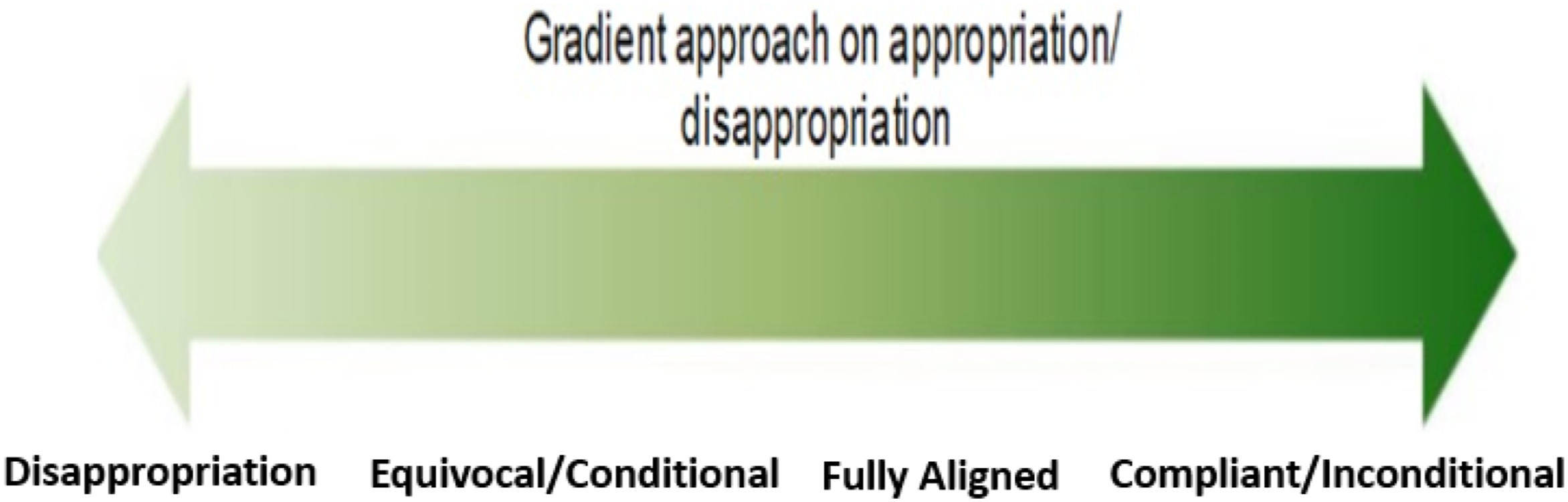
Conclusion
This study contributes to the diversity literature by embarking on a comprehensive exploration of the diverse forms of appropriation that manifest in the discourses of both employees and managers. It lays the foundation for a fundamental understanding of the complex dynamics of organizational appropriation. Additionally, this study introduces a gradient approach that illuminates the connection between individual actions and the broader organizational context, yielding nuanced insights into the pivotal role of figures as intermediaries. By focusing on the key roles of specific figures, we provide insights and deepen our understanding of the mechanisms underlying individual engagement in diversity programs.
The ventriloquial approach to communication provides a fresh perspective on the appropriation process, unveiling facts, principles, values, and ideas that facilitate or hinder appropriation. This nuanced perspective enhances our understanding of the performative dynamics underlying the acceptance or resistance of diversity initiatives in organizational contexts.
The limitations of this study provide avenues for future research. The absence of a macro-discourse in the analysis limits our ability to fully explore the broader ideologies, structures, and power dynamics that influence EDI initiatives. By focusing on a micro-level examination of interview data, the findings offer a localized perspective that may not fully capture larger social, political, and institutional forces. Thus, while this study provides a deeper understanding of the socio-material realities and figures that shape EDI practices, the lack of engagement with macro-discourses means that the findings may not fully account for the broader systemic factors that influence which EDI approaches are prioritized and why.
This study examined the dynamics of diversity initiatives within the Canadian energy sector; however, the scope of diversity examined is limited. The unexplored dimension of employee migration potentially intersects with the cultural diversity under investigation, significantly influencing the dynamics and outcomes of organizational change initiatives. This study focused mainly on employees’ and managers’ accounts in the context of interviews, and several organizational actors were also part of the diversity program. Future research should focus on other actors’ participation in local discourse on diversity and change and how resistance occurs when employee discourse interacts with an organization’s official discourse.
Footnotes
Acknowledgments
I would like to express my sincere gratitude to François Cooren, Kristie McAllum, Stéphanie Fox, Geneviève Boivin, Maria Cherba, and Mirjam Gollmitzer for their valuable feedback on an earlier version of this paper. Their insightful comments and suggestions significantly enhanced the quality and clarity of the study. I am deeply appreciative of their time, expertise, and dedication to advancing the field of organizational studies. I also thank Editage ( ) for their assistance with English language editing.
Declaration of conflicting interests
The author(s) declared no potential conflicts of interest with respect to the research, authorship, and/or publication of this article.
Funding
The author(s) disclosed receipt of the following financial support for the research, authorship and/or publication of this article: This research project was supported by a grant from the Fonds de recherche du Québec.