




Abstract
Much of the literature on multistakeholder partnerships that addresses grand challenges has extolled the virtues of such partnerships as a means of reducing uncertainty, acquiring resources, and solving local and global wicked problems. These virtues include opening up “access and agendas to wider participation” (Gray, 1989, p. 120), coordinating across jurisdictional boundaries, mobilizing diverse and heterogeneous actors, and generating novel solutions to address these complex problems. Yet partnerships are not panaceas, and the reasons they fall short of their stated aspirations remain underexplored. We argue that attention to the political landscape, and particularly who has power and who does not, can account for the shortfalls of many partnerships. Theory and practice can improve by considering power dynamics in the institutional field that shapes the context in which partnerships unfold and influences the problems partnerships are designed to affect. We consider four field conditions that differ with respect to the degree of power and alignment of goals among actors in the field. We discuss four trajectories of change originating from each of these field conditions that describe shifts in field-level power or alignment of goals: collaboration, contention, consciousness raising, and compliance. We explore the dynamics associated with each trajectory to show how fields may shift toward or away from conditions conducive to building and sustaining collaborative partnerships around grand challenges.
Keywords
The complex social and environmental problems often referred to as grand challenges (Ferraro, Etzion, & Gehman, 2015; George, Howard-Grenville, Joshi, & Tihanyi, 2016) are too multifaceted and complex for a single individual or organization to address. Tackling them often requires multistakeholder partnerships (MSPs) because no single domain of actors (such as business or government) has the capacity to solve them alone (Gray, 1989). Because the actors implicated in grand challenges are situated within and across institutional fields and span jurisdictional boundaries (Trist, 1983), MSPs and related forms of collaborative governance have the potential to institute field-level changes that can begin to resolve these complex problems (de Bakker, Rasche & Ponte, 2019; Ferraro et al., 2015; Gray & Purdy, 2018; Rasche, 2010; Vurro & Dacin, 2014).
Attempts by MSPs to collaborate are prompted by the opacity (Dorado, 2005) and complexity (Greenwood, Raynard, Kodeih, Micelotta, & Lounsbury, 2011) of fields, as well as by the interdependent, intractable, and often untraceable nature of the problems themselves (Rittel & Webber, 1973; Termeer, Dewulf, Breeman & Stiller, 2015). Collaborative initiatives allow a pooling of expertise and resources that is typically needed to ameliorate grand challenges (Gray & Purdy, 2018), as they can mobilize diverse actors and generate novel solutions to address these complex problems (Ferraro et al., 2015). Much of the literature on collaboration around grand challenges has focused on its value in reducing uncertainty, acquiring resources, and solving problems 1 as well as opening up “access and agendas to wider participation” (Gray, 1989, p. 120) and providing collective benefits for different “parties who. . .can constructively explore their differences and search for solutions that go beyond their own limited vision of what is possible” (Gray, 1989, p. 5). However, despite the well-meaning intentions of organizers and partners, collaborative partnerships often devolve into contentious negotiations (Bryan, 2004; den Hond & de Bakker, 2007; King & Pearce, 2010; Tilly, 2008) and frequently fall short in addressing the problems they seek to ameliorate (MSI Integrity, 2020). In line with calls to address power more explicitly in the context of multistakeholder initiatives (de Bakker et al., 2019) we propose that a deeper examination of field-level dynamics using the lens of power will yield greater understanding of why partnerships too often fall short of their intended goals, or even exacerbate the problem they are meant to address. In this paper, we discuss how power asymmetries within a field play a central role in shaping the processes, outcomes, and impacts of collaborative partnerships, and we outline four trajectories of field-level change that can impact partnership success or failure.
As Hardy and Phillips (1998, p. 222) note, studies of collaboration often fail to address what is “going on beneath the surface.” A common assumption is that stakeholders collaborate voluntarily, share common goals, and have equal power even when their goals, values, and beliefs conflict (Gray & Wondolleck, 2013; Waddock, 1989). However, for some actors with a stake in a grand challenge, participation may be restricted or even nonexistent (Gray & Hay, 1986) resulting in partnerships that only benefit some stakeholders while excluding or disadvantaging others (Alamgir & Banerjee, 2019; Gray & Purdy, 2018; Riisgaard, Lund-Thomsen, & Coe, 2020; Shouten, Leroy, & Glasbergen, 2012; Wijaya, Glasbergen, Leroy, & Darmastuti, 2018). In such situations, the intent of partnership organizers may be to protect or promote organizational interests of the powerful, to co-opt weaker players, or to prevent opponents from gaining power and reconfiguring the field to their advantage (e.g., Banerjee, 2008; Bloomfield, 2012; Chowdhury, 2017; Hardy & Phillips, 1998; Hazen, 1994; Nicholls & Huybrechts, 2016; Warren, Rose, & Bergunder, 1974). In these cases, partnerships may enable powerful organizations to reinforce their privileged positions and maintain the status quo so that “those who collaborate are coopted; those who do not are excluded” (Hardy & Phillips, 1998, p. 2018). Empirical research on partnerships often overlooks whether they are impeded by asymmetric power within the field or whether the field-level conditions that underlie grand challenges (and perhaps perpetuate them) change as a result of the partnership. Often only the “outputs” of actors’ efforts are considered in assessing the success of partnerships, leaving the longer-term outcomes and impacts they generate unexplored (Kolk, Van Dolen, & Vock, 2010), particularly with respect to shifts in power. Many MSPs fail to have lasting long-term impacts on the challenges they strove to address (MSI Integrity, 2020). These failures arise because MSPs often exert little influence on the institutional field that constitutes the problem domain (Trist, 1983) and do little to change the power asymmetries within the field.
Power relations “construct and shape the institutions and norms that regulate social life” (Castells, 2016, p. 1). Yet despite a growing body of scholarship examining power relations in fields (Besharov & Smith, 2014; Gray, Purdy, & Ansari, 2015; Lawrence & Buchanan, 2017; Levy, Brown, & de Jong, 2010; Munir, 2015, 2019), considerations of how power shapes partnership dynamics and outcomes are largely limited to cognitive, affective, or practice-level explanations for partnership effectiveness, barring a few exceptions (e.g., Gray & Purdy, 2018; Arenas, Albareda, & Goodman, 2020). The literature on grand challenges similarly pays limited attention to power relations, often stressing the complexity and entanglements of wicked problems (Rittel & Webber, 1973) while neglecting to consider how entrenched systemic power may prevent effective problem diagnosis and resolution efforts (but see Creed, Hudson, Okhuysen, & Smith-Crowe, 2020; Frey-Heger, Gatzweiler, & Hinings, 2021 for exceptions). Examining power dynamics is important because institutional processes are always embedded in power relations that promote certain actors’ interests and perspectives while neglecting or excluding others (Fairclough, 1992; Meyer & Höllerer, 2010; Munir, 2015). Further, power or its absence influences the mechanisms available to partners for initiating, challenging, and/or enforcing institutional change within a field (Gray et al., 2015).
We adopt Castells’ (2016) definition of power as “the relational capacity that enables certain social actors to asymmetrically influence the decisions of other actors in ways that favor the empowered actors’ will, interests, and values” (p. 2). Importantly, we argue that the exercise of power and its different faces “such as manipulation (e.g., shaping anticipated results) or domination (e.g., manufacturing consent)” is undertheorized in explaining partnership dynamics within the field of a grand challenge (de Bakker et al., 2019, p. 360). Accounts tend to be limited to competing frames, logics, goals, or values, or to future uncertainties but neglect which actors can engage in the subjectification and domination of others (Fleming & Spicer, 2014). This exercise of power can affect who participates in partnership processes, which rule systems govern partnership dynamics (Fairclough, 1992), who bears the added costs of governance agreements (Shouten et al., 2012; Wijaya et al., 2018), how implementation unfolds (Gray & Purdy, 2018; Whiteman & Cooper, 2016), and, ultimately, whether and how the partnership contributes to redistributing or perpetuating power relations within a field.
Stakeholders with little power may not collaborate voluntarily and may be pressured into agreements they do not want (Alamgir & Banerjee, 2019; Gray & Purdy, 2018). In multistakeholder discussions, the emphasis on impartial reasoning and “hard” facts and figures may prevent the marginalized from having voice, particularly in contexts marked by extreme social inequalities (Fraser, 2009; Gibson, 2012) as their arguments may be denounced as irrational or emotional, and thus devalued (Mair & Seelos, 2021; Reinecke & Ansari, 2015). Weaker stakeholders may end up acceding to demands to which they would not otherwise agree (Chowdhury. 2017; Shouten et al., 2012). Because actors are “imbricated in power relations” associated with the prevailing discourse (Hardy, 2011, p. 86), neglecting power may lead to celebratory accounts of “successful” institutional change arising from multistakeholder partnerships even when the status quo with respect to power does not shift and no lasting impact is recognized. While an MSP solution is ethically complex and its fairness is always moot (Bauman, 1993; Reinecke & Ansari, 2015), if weaker parties are not included or are pressured into agreeing to a solution, then it cannot be celebrated as a success, and the root causes of the problem the partnership had sought to remedy may remain unaddressed.
Our paper develops as follows. First, we briefly review the literature on the nature of grand challenges and arguments that tout MSPs as fruitful solutions to wicked problems. Next, we critique these arguments for often neglecting to consider how power differences may contribute to and exacerbate wickedness. We then identify and explicate the dynamics through which power differences among stakeholders prevent partnerships from exercising their full transformative potential in fields, resulting in sub-optimal outcomes and impacts over time. We do this by proposing four trajectories of field-level change that reflect potential pathways of interaction among partners in MSPs. Finally, we explain how and why these trajectories influence collaboration because of power alignments among partners. Two of the trajectories reflect field-level changes where power differences are minimal, while the other two trajectories reflect field-level changes where power differences are substantial. These latter two trajectories reveal steps that low-power stakeholders need to take before they can effectively influence more powerful stakeholders in a partnership, and they yield outcomes that create positive impact.
Collaborative Partnerships for Grand Challenges
Grand challenges are “formulations of global problems that can be plausibly addressed through coordinated and collaborative effort” (George et al., 2016, p. 1880). Many grand challenges have been identified as “wicked” because they are complex, transcend jurisdictional boundaries, entail nonlinear dynamics, and are marked by radical uncertainty (Ferraro et al., 2015; Rittel & Webber, 1973; Roberts, 2000; Termeer et al., 2015). Wicked problems are “ill-defined, ambiguous, and contested, and feature multilayered interdependencies and complex social dynamics” (Termeer et al., 2015, p. 680). They are the result of hyper-turbulent (McCann & Selsky, 2012) environments, in which the adaptive capacity of individual organizations has been overwhelmed, and they are often mired in complex networks of intractability that prevent easy resolution (Selsky, Wilkinson, & Mangalagiu, 2014). Consequently, crafting solutions to wicked problems and the grand challenges they pose requires the concerted actions of many interdependent players working collaboratively over considerable time (Bryson, Crosby, & Stone, 2015; Ferraro et al., 2015; Gray & Purdy, 2018; Reinecke & Ansari, 2016; Trist, 1983).
Proposals for how to solve wicked problems call for iterative representations of problems and solutions (Rittel & Webber, 1973), but neglect to address the power dynamics that shape how problems and their solutions are defined and developed by stakeholders. This is particularly troubling because solutions to grand challenges typically involve “changes in individual and societal behaviors” and “changes to how actions are organized and implemented” (George et al., 2016, p. 1881; Mair & Seelos, 2021) that are likely to challenge the status quo of relationships and influence among actors in a field. Similarly, scholars have approached grand challenges with pragmatism, encouraging “a set of collaborative processes that result in experimental and participatory responses” (Grimes & Vogus, 2021, p. 2) to the wickedness of these problems. Ferraro and his colleagues (2015, p. 373) identity three critical dimensions for such processes: (1) “participatory architecture”—a structural dimension for bringing heterogeneous stakeholders together and enabling them to interact; (2) “multivocal inscriptions”—an interpretive dimension involving discursive and material activities that sustain different interpretations and promote coordination without requiring explicit consensus; and (3) “distributed experimentation”—a practice dimension of iterative action and ongoing evolutionary learning that generates small wins, sustains engagement, and builds capacity for subsequent problem solving. Curiously, however, this framework does not acknowledge the power asymmetries among heterogeneous actors that may influence each of these dimensions. As several scholars have noted, organization theorists tend to discount or ignore “the hegemonic operation of ‘power’ as a relevant explanatory variable in many social and organizational contexts and see it as a possession employed episodically by social actors to attain their goals” (Munir, 2019, pp. 1-2) despite its indelible structurational effects on organizing (Fleming & Spicer, 2014).
While we have referenced Castells’ relational definition of power above, we acknowledge that power relations may be so deeply institutionalized that power becomes systemic or invisible (Clegg, 1989), that is, embedded into social structures in such a way that it becomes enduring and taken for granted. As Kenny, Taylor, Onyx, and Mayo (2015, p. 453) note, little attention has been paid to invisible forms of marginalization from “insidious form(s) of power.” In their evaluation of the concept of power, Fleming and Spicer (2014) draw on the work of Bachrach and Baratz (1970), Lukes (1974), and Foucault (1977) to describe four faces of power: coercion, manipulation, domination, and subjectification. The first two faces of power—coercion and manipulation—are more overt and can be seen as episodic because they rely upon identifiable acts that shape the behavior of others. Domination and subjectification are largely invisible and can be considered systemic because they mobilize institutional, ideological, and discursive resources to influence behavior. Distinctions between hegemonic (systemic) and episodic power have been clearly drawn by organization theorists (Lawrence & Buchanan, 2017; Lukes, 1974), but discussions of systemic inequality within organizations and among organizations within fields and society have received considerably less attention (for exceptions see Amis, Munir, Lawrence, Hirsch, & McGahan, 2018; Dacin, Munir, & Tracey, 2010, Gray & Kish-Gephart, 2013; Khan, Munir, & Willmott, 2007; Munir, 2015; Schildt, Mantere, & Cornelissen, 2020). Yet partnerships, particularly transnational ones, are embedded in milieus fraught with systemic inequities.
The impact of these inequities on partnerships is now coming more clearly into focus. Researchers have pointed out how differences in power influence the frames and logics through which stakeholders understand the issues the partnership purports to address (Brummans et al., 2008; Gray et al., 2015; Lewicki, Gray, & Elliott, 2003; Nicholls & Huybrechts, 2016), and shape stakeholders’ beliefs about whether they can enact their desired futures through partnership participation. For example, in an attempted collaboration to address the adverse effects of a hazardous spill from Peru’s Yanococha Mine, many indigenous groups boycotted the collaboration believing that the mine owners, which had considerable power, would not participate in the collaboration in good faith (Gray & Purdy, 2018). Although other stakeholders did participate in deliberations (known as the Mesa di Diálogo y Consensao) with the mine owners, after four and half years Yanococha Mine had committed little to the community’s clean-up and water monitoring efforts. The conveners of the Mesa concluded that “The Mesa was hampered by an absence of strong Mesa leadership and clear commitment from Yanococha to fully support Mesa processes” (Building Consensus Monograph 3, 2007, p. 40). The predictions of the indigenous people’s group had been correct: the mine owners had participated in the Mesa process in name only. They had effectively demonstrated that those partners with greater power can use it to design the partnership, shape the rules of the game (Fairclough, 1992), coopt less powerful partners (Selznick, 1949), and imbed control over the discursive practices employed (Hardy, 2011) to sustain their own advantage.
Researchers have also begun to examine the underlying dynamics of such failures and shed light on the real outcomes and impacts (as opposed to outputs) of MSPs (Arenas et al., 2020; Gray & Purdy, 2018; Lozano & Arenas, 2011; MSI Integrity, 2020). For example, in partnerships designed to make growing commodities (such as cotton, cocoa, and coffee) more sustainable by establishing certification standards, smallholder farmers bear a disproportionate share of the costs, and this either dissuades them from participating at all or further impoverishes them (Riisgaard, Lund-Thomsen, & Coe, 2017; Wijaya et al., 2018) by offering them a price lower than their pre-partnership one. For example, in their study of a partnership described as a “milestone in the development of Fairtrade Standards” (Fairtrade International, 2008), Reinecke and Ansari (2015) document how a “successful” collaboration ended up leaving the marginalized actors worse off. After protracted multistakeholder deliberations that continued for almost three years, Fairtrade International, the organization behind the Fairtrade label, announced the Fairtrade Minimum Price for rooibos tea from South Africa. However, despite the organization’s pledge to set fair prices, this price appeared to disadvantage smallholder farmers with higher costs of production relative to large-scale plantations. For instance, the debate about whether small farmers deserved preferential access to Fairtrade markets was couched in technical terms over rooibos’s classification as a tea or a herb rather than addressed as an ethical question about apartheid legacies that continued to disadvantage black farmers. Thus, participatory multistakeholder deliberation resulted in a minimum price below the cost of production of the smallholder farmers for whom Fairtrade had initially been founded. While Fairtrade-certified rooibos was celebrated as a role model for black community empowerment in post-apartheid South Africa that would enable farmers to penetrate Northern markets and achieve prices for rooibos that were well above conventional market prices, many of the poorest farmers have been left worse off.
Similarly, a recent report provides a scathing assessment of the failure of human rights MSPs for similar reasons (MSI Integrity, 2020). According to the report, multistakeholder initiatives entrench corporate power by failing to include rights holders and preventing civil society from acting as an agent of change. They further lack grievance mechanisms that give a voice to marginalized actors and place even higher burdens on (marginalized) Global South actors than (corporate) Global North actors, which undermines partnerships’ ability to address the root causes of human rights abuse, leading to little evidence of real long-term impact. The report concluded that multistakeholder partnerships have not fundamentally restrained corporate power nor addressed the power imbalances that drive abuse and impede meaningful change. The examples above reveal multiple indicators of significant power disparities that impede MSPs from collaborating effectively. In the Mesa case described above, critical stakeholders (indigenous people) were absent from deliberations, a powerful stakeholder (the mine) was not required to comply with the agreement reached, and the systemic power differences inherent in the context restricted both the participation of low-power stakeholders and their ability to express grievances, thereby reinforcing the initial inequalities despite the semblance of collaboration (Gray & Purdy, 2018). In both the Fairtrade and human rights MSP studies, low-power stakeholders in those partnerships were marginalized and ironically bore even greater costs as a result of the agreements that were reached. From the preceding examples, we conclude that when collaboration is attempted as a strategy to address wicked problems, the results must be evaluated not only in terms of whether new logics and practices are adopted, but also whether beneficial and enduring impacts have been created for both high-power and low-power stakeholders.
Failing to account for power differences when planning and analysing MSPs may leave lower power partners conceding to demands to which they would not otherwise agree (Chowdhury, 2017; Shouten et al., 2012). Neglecting power will yield incomplete or inaccurate accounts of how multistakeholder collaboration can actually happen, and inappropriately celebratory accounts of a collaboration’s success. In the next section we examine trajectories of institutional change that may be necessary in fields before effective impacts of partnerships can be realized.
Trajectories for Shifting Power in Fields
Gray and Purdy (2018) provide a model of four types of field in which multistakeholder partnerships may emerge. The fields are positioned on a 2 × 2 matrix. The horizontal axis maps the extent of the power differences within the field. The vertical axis reflects the degree of goal alignment among field members (see Figure 1). When an MSP is formed in a field, its members will reflect variation on these two dimensions of power and goals alignment. In the two quadrants on the left in Figure 1, power differences among partners are substantial, as in the Mesa case and commodity certification MSPs above. In volatile fields, partners’ purposes for a partnership are not aligned and conflict over goals is likely, whereas in quiescent fields, partners’ goals are aligned, but only because low-power partners’ voices are subjugated so they are not aware of their marginalization or are unable to express their dissent (Freire, 1970). In fields where power differences are minimal as depicted on the right of Figure 1, the field may be fragmented if participants have divergent goals, or uncontested when partners’ desired goals are aligned.
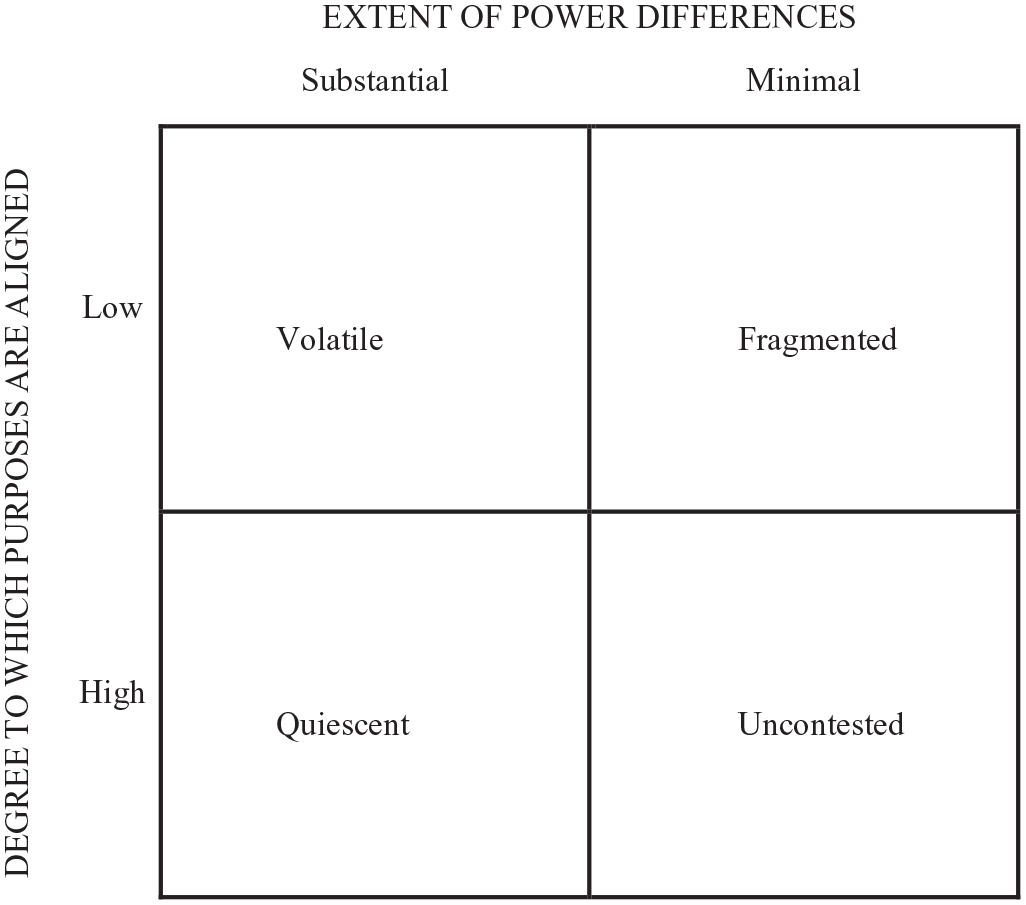
Field Configurations (Gray & Purdy, 2018).
Drawing from this model, we identify four change trajectories (see Figure 2) that reflect shifts in power or goals and therefore shape the context of the field in which partnerships emerge, unfold, and influence the problems they are designed to affect. Two of the trajectories, collaboration and consciousness-raising, result in field-level changes where power differences remain or become minimized, while the other two trajectories, contention and compliance, reflect field-level changes where power differences become or remain substantial. We begin by discussing the trajectories that result in low power disparities: collaboration and contention.

Trajectories of Institutional Field Change.
Collaboration
The trajectory of collaboration depicts the field-level dynamics that are most conducive to MSPs, namely, when stakeholders with relatively similar levels of power begin to identify shared goals for the field. As this occurs, the field may shift from the fragmented quadrant to the uncontested quadrant. When fields are fragmented, they experience extreme turbulence, i.e., “where events, demands, and support interact and change in highly variable, inconsistent, unexpected or unpredictable ways” (Ansell & Trondal, 2017, p. 1). Collaboration has been suggested as a mechanism of institutionalization in fragmented contexts (Gray, 1989; O’Mahoney & Bechky, 2008) if there are underlying interdependencies among the partners that generate turbulence (Trist, 1983). Actors in fragmented fields typically have little formal interaction and presumably no shared system of signification or common purpose that links them to each other, but each has sufficient power relative to others to question or block the actions of others and create conflict within the field. Of significance here is that the lack of power disparity in the field creates a fertile environment for progress on grand challenges via partnerships.
Collaborative partnering involves searching for a common purpose among field members who are competing over the appropriate logics, directions, and/or actions for governing the field. Over time, actors may gradually, serendipitously, or through mediated proceedings come to recognize their interdependence and realize that they share a common fate (or plight), leading them to embark on a collaborative partnership. A case in point is illustrated by contentious deliberations among loggers and environmentalists in Queensland, Australia, over desired levels of timber harvests that almost ended in stalemate until it became clear that shifting demand for softwood (rather than old-growth wood) would allow each group to satisfy their future goals (Brown, 2002). Using a variety of techniques (e.g., interest-based negotiating, visioning, mediation), collaborating can serve as a “mechanism by which a negotiated order emerges among a set of stakeholders” (Gray, 1989, p. 228) if they can successfully reach agreement on a way forward. Such agreements can generate proto-institutions (Lawrence, Hardy, & Phillips, 2002) and typically will generate a new set of shared norms and practices for governing the field and regulating partners’ actions (Gray, 1989; Phillips, Lawrence & Hardy, 2000).
The collaborative trajectory is evident in numerous other environmental conflicts in which businesses, environmental NGOs, and other stakeholders found common ground through negotiations (Bryan & Wondolleck, 2003; Gray & Wondolleck, 2013; Livesey, 1999; Zietsma & Lawrence, 2010). Collaborative negotiations have also generated field-level agreements in other fields as diverse as education (Gray, 1995; Lawson, 2004), conflict minerals (Reinecke & Ansari, 2016), mortgage lending (Gray, 1989), healthcare (Lu, Michaud, Gakidou, Khabn, & Murray, 2006) and dam relicensing (Gray & Purdy, 2018). In transitioning from fragmented fields to uncontested ones, institutional entrepreneurs (Battilana & Dorado, 2010; Maguire, Hardy, & Lawrence, 2004) are often engaged in deliberate efforts to convene field members (Carlson, 1999; Dorado, 2005; Gray, 1989) for collaborative partnerships, and mediation techniques are frequently employed to facilitate the discovery of shared purposes (Gray & Purdy, 2018).
On a transnational level, numerous collaborative forums have been created to establish standards for introducing sustainable commodity chains in the fields associated with forest products, soy, palm oil, cotton, fishing, and others (Visseren-Hamakers & Glasbergen, 2007; Shouten et al., 2012; Riisgaard et al., 2020). These partnerships were created with the intention of democratizing environmental governance, although, as we noted earlier, to varying degrees. If new settlements are reached that are deemed legitimate (Green, 2004; Suddaby & Greenwood, 2005), collaborative partnerships can transform fragmented fields to uncontested fields where purposes are widely aligned and power differences among partners remain minimal. Thus, relatively balanced power is an initial condition in the collaboration trajectory that supports the discovery of shared interests. Balanced power is also an outcome (or sustained condition) of this trajectory because collaboration leads to an uncontested problem domain where multilateral action may ameliorate the causes of grand challenges.
Contention
In the trajectory of contention, fields shift from volatile (with a high degree of power asymmetry among stakeholders of a problem) to fragmented (with reduced power differences) while shared purposes remain elusive. Volatile fields are often characterized by histories of conflict in the absence of a common field-level purpose. However, power differences are not immutable, and radical change in fields is possible (Greenwood & Hinings, 1996; Seo & Creed, 2002) if low-power stakeholders can mobilize collective action to engage in power-building tactics to challenge elites. A strategy of contention (McAdam, Tarrow, & Tilly, 2001) enables suppressed resentments within a field to emerge and precipitate change (Brown, 1980; Seo & Creed, 2002) if low-power partners can garner sufficient power through contention to challenge elites. This trajectory is often seen when protest groups gain agenda-setting power and force elites into partnership negotiations.
By mobilizing these resentments and using various other mechanisms, activist movements can often humble their adversaries depending on their own capabilities, access to networks, and resources (Briscoe & Safford, 2018). For example, external activists may exert coercive pressure on corporate elites through protests, negative public relations campaigns, public shaming or inciting boycotts to challenge the legitimacy or license to operate of corporate actors (Akemu, Whiteman, & Kennedy, 2016; Bosso, 1995; Davis, McAdam, Scott, & Zald, 2005; King & Pearce, 2010). In doing so, they take advantage of the cultural and structural vulnerabilities of these organizations and their leaders (Briscoe, Chin, & Hambrick, 2014; King, 2008). “Since the modus operandi of many social movement organizations is to campaign until reasonable change in fields has been made” (Zietsma, Groenewegen, Logue, & Hinings, 2017, p. 401), these organizations can disrupt fields in which powerful parties had operated with impunity. Social movements can also operate in the political sphere to push for greater voice for underrepresented groups. For example, Maguire and his colleagues (2004) reported how AIDS activists gained ground in advancing their agenda in the public sphere and thereby garnered influence and agenda-setting power for their cause. Whether it takes on corporate or governmental hegemonic power, social movement organizing challenges the systemic power structure of a field (Benford & Snow, 2000; Davis et al., 2005; Van Dyke, Soule, & Taylor, 2004; Van Wijk, Stam, Elfring, Zietsma, & den Hond, 2013). However, since strategies of contention will attempt to overturn existing power relations (Hardy & Phillips, 1998), they may generate explosive conflict (Chua, 2006) “because this pathway threatens existing structures of signification, legitimation and domination that serve elite interests to preserve the status quo” (Gray & Purdy, 2018, p. 194).
Movements can also mobilize broader resources (such as the media) to change public opinion about extant rules and practices (Schneiberg & Soule, 2005) and about the powerholders themselves to provoke change in the prevailing rules and regulations governing the field (Bartley, 2007). For example, in the lead up to the Canadian Boreal Forest Agreement (CBFA), 2 two activist NGOs (Greenpeace and Forest Ethics) initiated aggressive “do not buy” campaigns against Kimberly Clark and Victoria’s Secret. These firms were explicitly targeted because they used Canadian boreal old-growth forest products to produce paper products and advertisements respectively (Riddell, 2014). Similarly, NGOs employed consumer boycotts to pressure companies to rethink their timber procurement policies to increase the demand for sustainable timber—which eventually led to the formation of the Forest Stewardship Council (FSC) (Pattberg, 2006).
Activists may emerge within organizations as when employees initiate internal campaigns to expose and change exploitive practices (Briscoe & Gupta, 2016). So-called “insider activists” can pull some levers for change that outsiders cannot, and vice versa (Briscoe & Gupta, 2016). Insider and outsider activists can thus work in tandem by employing different tactics (McDonnell, King, & Soule, 2015) and cooperative strategies (Van Huistee & Glasbergen, 2010) to capitalize on the benefits afforded by each other’s position. Spillover effects can also result when other firms are influenced by tactics employed against targeted firms (Briscoe & Gupta, 2016). Activists may also use educational strategies that frame injustices to low-power groups to mobilize them to pressure state or corporate actors for change (Benford & Snow, 2000) or create “free spaces” in which activists can safely meet elites outside the public eye to negotiate their demands for change (Kellogg, 2009; Rao & Dutta, 2012).
All these tactics are designed to disrupt the domination structure of a field and reshape the institutional relationships within it (McCarthy & Zald, 1977; Schneiberg & Lounsbury, 2008). Contention enables less-powerful actors to disturb the entrenched stranglehold the powerful have within the field. As social movements engage in contention, they build discursive legitimacy (Hardy & Phillips, 1998) both for the issue and for themselves as legitimate actors within the field (Gray, 1989), opening the door to future partnerships. By building discursive legitimacy, social movement leaders may be able to “compensate for a lack of traditional power sources” and exert sufficient influence to modify the dominant institutional frames of the field (Hardy & Phillips, 1998, p. 182). As Castells (2016, p. 14) notes, “collective action from social movements. . .aims to introduce new instructions and new codes” into a field. Interestingly, in a study of contention over child marriage in Indonesia, women protestors had to secretly organize to challenge the government because their protests would be delegitimized if the gender of the protestors was known (Klaus & Tracey, 2020). A successful contention strategy can move a field from a volatile to a fragmented configuration by reshaping not only the issues under consideration in the field but also the field’s underlying structure of domination.
We next turn to the two trajectories that either preserve power differences or result in greater power asymmetry in a field, consciousness-raising and compliance, and discuss the consequences of these field dynamics for MSPs.
Consciousness raising
Shifting a field from the quiescent to the volatile quadrant is perhaps the most difficult of the four transitions to achieve, and it may seem counterintuitive to setting the stage for effective collaboration. However, as we have noted above, excluding low-power stakeholders from engagement with grand challenges can yield poor solutions that are unjust and saddle these stakeholders with the disproportionate share of the costs of executing the agreements reached. Low-power actors remain in quiescent fields because more dominant actors control their subjectivities (Foucault, 1988) to the extent that they cannot “see or imagine” any alternatives to their current circumstances, which leads them to view them “as natural and unchangeable” (Lukes, 1974, p. 24).
Douglas and Wildavsky (1982) described this position as laboring under a fatalist worldview. Such oppressive regimes have attracted attention from management scholars who study extreme contexts such as the holocaust (Martí & Fernandez, 2013) and the extortion scheme known as the pizzo imposed by the Italian mafia on merchants in Sicily (Vaccaro & Palazzo, 2015). In the former case, holocaust survivors resorted to forms of institutional work referred to as resistance to cope with the hopelessness of their oppression. In the latter case, the silence against the mafia could only be broken by organizing a secret campaign to mobilize support and solidarity among those who were willing to speak out and resist the pizzo. In effect, the organizers created safe havens where dissent could be incubated in secret (Rao & Dutta, 2012). Grounding the resistance in strong moral values about dignity and a positive sense of self was also crucial to the success of the anti-mafia resistance efforts (Vaccaro & Palazzo, 2015).
Lukes (2005, p. 24) characterizes the sense of fatalism described above as the “most supreme and insidious exercise of power” because it prevents people from having grievances by shaping their perceptions, cognitions, and preferences in such a way that they unquestioningly accept their role in the existing order of things. These interpretations result from coercive and especially discursive actions (Schildt et al., 2020) by the systemic power holders to subjugate others and retain power. In the context of the Indian caste system, the Dalit likely believe it is their karma to suffer this fate because “such an interpretation appears to justify the apparent injustice of life and puts the blame on the shoulders of the suffering individual rather than on the structure of the social system and its imbalances” (Kuppuswamy, 1972, p. 25).
Overcoming the misconception of fatalism requires what Paulo Freire (1970) referred to as conscientizaçāo” or “conscienticization,” a process he used with peasants in Brazil to raise their consciousness about their own powerlessness and marginalization. We adopt the term consciousness raising here. Consciousness raising is a signification process through which oppressed peoples come to recognize their oppression and begin to reconstrue their own identities. A Bangladesh peasant who went through this transformation described how the Bangladeshi NGO Nijera Kori (NK) enabled this transition for him and his community members: If we are to talk about the main strength of NK, I would say that in the past, we the poor did not realize many things. . .We thought that we would have to pass our days doing the same things that our forefathers did, that those with assets would stay rich and those without would stay poor. Through NK we came to know that we are not born poor, that the government holds wealth on behalf of the people, that our fundamental rights as citizens of Bangladesh are written into the constitution. Before when I needed help, I went to the mattabar [village elite]. Now I go to my organization. (Kabeer & Haq Kabir, 2009, pp. 49–50)
The consciousness raising trajectory is a challenging shift because “oppressed members of a field need to overcome the culture of silence” (Gray & Purdy, 2018, p. 192) and to develop self-awareness about how the existing social conditions fail to address their needs and interests (Seo & Creed, 2002). Consciousness raising may not change the power dynamics of the field, but it enables low-power actors in a field to overcome the subjectivities others have imposed on them (Foucault, 1972, 1982) and reconstruct their sense of self. In so doing, they also withdraw their compliance with the goals espoused by the powerful with which they were previously complicit and embrace previously unarticulated identities and, in so doing, reframe their relationship to other actors, and move the field from quiescent to volatile.
An example of how conscious raising can occur in quiescent fields is through the creation of free spaces. In her analysis of the construction of queer cabarets, Gouweloos (2021) explains how free spaces are used to develop collective consciousness among marginalized groups. In this case, two-spirit and LGBTQ+ persons sought to construct intersectional free spaces where they could freely and safely express their identity without recrimination. These spaces, referred to as “queer cabarets,” enable the development of collectiveness among marginalized groups through the process of consciousness raising (Evans & Boyte, 1986, p. 17). To achieve safety for two-spirit and LGBTQ+ persons, queer cabarets need to meet several criteria, as accessibility signals inclusivity: (1) they need to be accessible; (2) accessibility must include wheelchair accessed restrooms; and (3) they need to offer priority seating for those with disabilities. Intersectional free spaces that meet these criteria afford participants autonomy and create opportunities to reimagine a world without oppression, offering marginalized people what Polletta (1999, p. 11) refers to as prefigurative value so that they can enjoy other modes of operating and relating not normally available to them (see also Reinecke, 2018). Similarly, Hein and Ansari (2022) note how both formal and informal “safe spaces” allowed disabled workers in a sheltered workshop to share positive experiences of inclusion with other like-minded individuals. While these benevolently marginalized workers had followed a paternalistic identity prescribed by workshop staff, participation in these workshops allowed them to develop confidence in reconstructing their identities to achieve self-determination.
Within our framework, free or safe spaces are devices that enable marginalized people in a quiescent field to explore their individual and collective identity and subjugated status with similar others with whom they feel safe and to critique and analyse the power dynamics they experience. Such spaces allow the unsettling of hegemonic power (Gouweloos, 2021, p. 240) and the development of collective identity that can facilitate group members to mobilize and to sustain social movement membership (Terriquez, 2014). In other words, the field can shift from a quiescent one to a volatile one if marginalized actors in a field choose to mobilize around their new recognition of their marginalization.
The experience of the CONAIE (Confederation of Indigenous Nationalities of Ecuador) in the 1980s illustrates the importance of consciousness raising as a step toward partnerships that have impact on grand challenges. For the CONAIE, this meant challenging “the historical image of Indians as a submissive, backward, and anachronistic group” (Yashar, 1998, p. 23). Along with the demand to recognize their collective indigenous rights as citizens, CONAIE championed “territorial autonomy, respect for customary law, new forms of political representation, and bicultural education” (Yashar, 1998, p. 23). In effect, CONAIE discursively contested the very meaning of citizenship in Ecuador. Armed with their newly constructed identity, in 1990 CONAIE engaged in contention by assembling indigenous groups from across the country to stage a protest for agrarian land reform in the middle of the Pan American Highway, effectively blocking transport of goods through the country for several days. Because of this leverage, as well as intercession by the Catholic Church, the group was able to gain access to high-level government negotiations that focused on their demands (Jameson, 2008). CONAIE’s experience illustrates the extensive effort low-power groups may need to make to gain power and change the domination structure within the field. Their protests blocking the Pan American Highway enabled them not only to mobilize as a social movement and mount an effective protest but to gain access to collaborative negotiations with the country’s most powerful actors—negotiations that led to further power-balancing within the field by restoring control over their lands to them. Through CONAIE’s efforts, indigenous peoples in Ecuador now have an ongoing, established voice in Ecuador’s political process.
Efforts at consciousness raising involve a fundamental signification process (Giddens, 1984) in which oppressed people come to understand their oppression in a new way—not governed by a fatalistic attitude—but instead as something they can resist and over which they can exert leverage. It involves a fundamental reframing that supports exploration and assertion of identity, leading these actors to challenge existing norms and advance their own interests instead. Consciousness raising can prompt a field to shift from quiescent to volatile.
Compliance
The final trajectory describes a field in which domination by one or more actors is increasing, yielding greater power disparities among actors. Moving from uncontested to quiescent fields requires compliance (Hardy & Phillips, 1998; Raaijmakers, Vermeulen, Meeus, & Zietsema, 2015) in which rules and practices serve one group while others capitulate “with the actions they think their more powerful counterparts wish to see” (Hardy & Phillips, 1998, pp. 227–228). While this supports alignment over field purposes, it magnifies power differences among actors in the uncontested field by creating a culture of silence and suppressed self-image among some others within the field (Freire, 1970). The culture of silence prevents dominated individuals from critically responding to the culture institutionalized by the more powerful (Freire, 1970). Partnerships to tackle grand challenges may give rise to these field changes if actors of relatively equal power acquiesce to agreements that ultimately prove to favor others and undermine their status.
Stakeholders who are less favored by field norms may become socialized into a compliant role in deference to the signification structures imposed by the more favored actors in the field. According to Gaventa (1982), they may even become accepting of their oppression, concluding that the extant power distribution is acceptable or at least inevitable. Presumably, this occurred over 150 years ago when the system of pizzo was introduced by the mafia in Sicily (Vaccaro & Palazzo, 2015), and coercive violence encouraged widespread acceptance of the practice, which eventually became taken for granted. Thus, compliance can institutionalize voicelessness and ultimately lead to quiescence in the field. Emphasizing the power of discourse, Castells (2016) notes, Only by obtaining the acquiescence or, at least, the resignation of the subjected subjects, can institutions last. Power over minds is more important than power over bodies. Power over minds, moreover, should not be understood as a pure manipulation mechanism, but as the ability of certain discourses to be internalized and accepted by individuals in an effective communication process between senders and receivers of discourses. (p. 9)
Thus, the trajectory of compliance maintains the status quo in the field regarding shared goals but erodes the capacity of a partnership to effect change by diminishing the power of some partners while potentially creating a false sense of unity and progress.
Other trajectories
While it is possible to imagine other trajectories of movement between quadrants in Gray and Purdy’s (2018) model, the trajectories described here are those that are aligned with theoretical and empirical research around MSPs, representing observed pathways of field change. Some trajectories are unlikely to yield progress on grand challenges, such as the one that moves directly from a volatile to an uncontested field, as Bartley (2003) documented in his study of standard-setting partnerships related to workers’ rights abuses such as the Rana Plaza Agreement in Bangladesh. Although many of these attempts at partnerships created standards (e.g., Rasche, 2010), arguably most failed to shift the field’s power structure and to sustain lasting change in the field (Bloomfield, 2012). Specifically, the negotiated standards and accords failed to alter the conditions of garment workers in the plants despite country-level labor campaigns to organize these workers along with simultaneous global solidarity movements in support of workers’ rights (Alamgir & Banerjee, 2019; Donaghey & Reinecke, 2018; Reinecke & Donaghey, 2015). Instead, some have argued that the conditions for workers remained unchanged because the multistakeholder partnership provided “legitimacy to multinational corporations and their global brands” but failed to address “the structural problems arising from exploitative pricing and procurement practices” that resulted in deplorable working conditions for the factory workers (Alamgir & Banerjee, 2019, p. 272). According to Chowdhury (2017), this occurred because of complicity between Western MNCs and the Bangladesh elite NGOs that were designated to distribute compensation funds to injured workers. If this critical reading is correct, the apparent trajectory from a volatile to an uncontested field may simply have remained a volatile field in which the garment workers’ low-power status was reinforced. In contrast to the CONAIE example, it’s not clear that the workers themselves engaged in the degree of contestation needed to unseat the systemic power at work in this field.
In this analysis we have identified four trajectories of field transformation by which MSPs can generate field-level change. Two of the pathways, consciousness raising and collaboration, occur when actors focus on examining the taken-for-granted meanings and norms in a field and utilize partnerships as a forum for expressing their distinct visions for the field. For these trajectories to yield change at the field level, actors must embrace their identities and unarticulated goals and gain acknowledgment of them within the field (in the case of consciousness raising), or they must generate shared goals that become accepted in a fragmented field (in the case of the collaboration trajectory). These pathways emphasize meaning-making activities in which actors must articulate and amplify frames across the field through legitimation and signification (Gray et al., 2015). The other two trajectories, contention and compliance, emphasize the dynamics of power. Our analysis shows that actors with access to resources can influence the power dependencies within a field and shift power through mobilization processes. That is, to create a favorable context for collaboration, fields must be moved from the left to the right side of Figure 1 where power differences are low. To effect change, low-power stakeholders need to mobilize others and use social movement strategies to gain a seat at the negotiating table. However, before they can engage in contention to express their interests, stakeholders need to identify and embrace their right to express these interests which may have been subjugated by more powerful players (whether or not these interests are aligned with other parties). Depending on the power holders’ assessments of the power of contenders and the reputational damage they are incurring from protests or boycotts, powerful actors may elect to act unilaterally to preserve their systemic power or may (often in response to pressure from low-power groups and because their reputations are at stake) work to level the playing field to support broader participation in governance decisions for the field.
Discussion
Our theorizing generates several contributions to organizational theory. First, we suggest that conceptualizations of grand challenges have often neglected to consider how power differences exacerbate other dimensions of complexity and “wickedness” that impede impactful change within fields. Power disparities may be a root cause of many grand challenges (including poverty, hunger, environmental degradation, and so on). Neglecting power and focusing on outputs instead of lasting impact has led to prematurely celebratory accounts of multistakeholder partnerships that create superficial change but sustain the existing inequities among the stakeholders. By theorizing the role of power, we contribute to the still relatively few studies (e.g., Hehenberger, Mair, & Metz, 2019; Levy, Reinecke, & Manning, 2016; Nicholls & Huybrechts, 2016) that theorize how power shapes MSPs and affects their efficacy in precipitating field-level change. Even though coercive power was a key mechanism in early theorizing about change within institutional fields (DiMaggio & Powell, 1991; Dobbin & Dowd, 2000), more recent work has tended to focus only on the normative and mimetic mechanisms rather than on coercive ones to induce change within fields (Überbacher & Scherer, 2020). And in the context of multistakeholder initiatives, power has been addressed only implicitly with very few discussions of the different faces of power such as shaping anticipated results or manufacturing consent (de Bakker et al., 2019).
By explaining the role of power in MSPs for addressing grand challenges, we develop new insights into accounts of whether, how, and when such partnerships can impactfully change fields. What is seen as “successful” change in many accounts may mask the preservation of the status quo which enables extant unequal power relations to remain intact (Gray & Kish-Gephart, 2013; Munir, 2019). Indeed, many changes within fields occur without shifts in power relationships because “actors empowered by existing institutions use their advantages to elaborate institutions in ways that preserve their power and preclude alternatives” (Schneiberg & Lounsbury, 2008, p. 651). In particular, we argue that while a shift in meanings and logics can constitute field-level change, such change may not be accompanied by a power shift, or if such a power shift does occur, it is likely only among elites. The preservation of power relations or even reconfiguration of power among elites may not lead to the type of change that is necessary to address grand challenges and may even exacerbate them (Frey-Heger et al., 2021). To generate proportionate benefits, collaboration may need to shift the power dynamics of the field itself through consciousness raising, power building, and mobilization tactics which powerful actors are likely to oppose.
A second contribution of our work is to explain how power differences may impede or disrupt effective collaboration in partnerships. Specifically, we propose four indicators that show power dynamics are impeding collaboration: (1) the views of critical stakeholders are excluded from deliberations; (2) powerful stakeholders are exempted from participation and compliance with agreements reached; (3) the discursive practices that govern collaborative deliberations inherently restrict the participation of low-power stakeholders and thereby serve to perpetuate or reinforce the initial inequalities; and (4) low-power stakeholders disproportionately bear the costs of implementing whatever agreements are reached during deliberations. Attending to these power differences can reveal why many MSPs for addressing grand challenges end up creating only superficial rather than substantive change in a field.
While power is not an entity in a universal or transcendental sense, there can be enormous and enduring differentials in the capacity of some people to make others do things (Dennis & Martin, 2005). The power differentials among stakeholders in MSPs are the outcomes of discursive practices over time that legitimate some actions over others. Thus, it would be important to examine how these practices produce, perpetuate or change patterns of decisive advantages and disadvantages for the different stakeholders involved in partnerships. Our third contribution is to offer four field trajectories of partners’ interactions in a field that may or may not produce impactful collaboration. We show how the underlying power dynamics in three of these field trajectories are unlikely to produce impactful collaboration for addressing grand challenges. Each trajectory identifies movement between different “states” of institutional fields; in succession (e.g., from consciousness raising, to contention to collaboration) they comprise a pathway that identifies steps leading to more effective partnerships. It is important to note that we do not view “states” of institutional fields as stable entities that can somehow be disengaged from the ongoing flux of social interactions characterizing these trajectories. The field is an ongoing accomplishment continually structured by the consequential power relations that are enacted and sustained in social interactions (Gray et al., 2015).
Achieving effective partnerships involves some degree of power-sharing (at least discursively) as well as alignment of partners regarding the purposes of the partnership. However, to get to this point, large power differences need to be dealt with before actors can begin to collaborate effectively. In fields where systemic practices sustain and reinforce power differences (Mair & Seelos, 2021), changes in institutional dynamics must precede or emerge from partnerships if they are to yield meaningful and sustainable impacts on grand challenges. Where power differences undermine actors with low power to partner effectively, empowerment strategies are needed (Allen, 1998) before truly collaborative partnering can occur. Empowerment may mean facilitating consciousness raising and identity building among potential partners in quiescent fields or mobilizing protest strategies among low-power stakeholders in volatile fields or devising other strategies for increasing the voices of underrepresented groups in partnership deliberations. These strategies include unionization, moral engagement, leveraging social media, or finding more powerful allies to represent and champion their views. For example, in the case of revising United States laws around hydroelectric dams, half of the days of discussion were designated to prioritize the voices of indigenous Native American tribes to avoid dominance by resource-rich industry and NGO participants. This design supported greater understanding of tribal interests and led to changes in how the US government interacted with tribal nations around hydroelectric dam projects (Gray & Purdy, 2018).
Our analysis of power and partnerships prompts a host of additional questions for scholars interested in partnerships, fields, and power. First, a set of questions exists around how to manage power imbalances because they are a foundational barrier to progress on grand challenges. For many MSPs, and particularly those working on sustainability issues, advancing the wellbeing of all partners (or, at least not making anyone worse off than they started) is an essential criterion for their success (Gray & Dewulf, 2021). Solutions that impose new or excessive burdens on low-power parties are unlikely to yield long-term progress on grand challenges because they render these problems more likely to reemerge in the future. This definition of successful collaboration challenges partnerships to search for solutions in which “all boats rise on a rising tide,” which may lead to field-level changes in power relations. Let us be clear that this does not mean the fields where systemic power has been entrenched for decades will simply become more pliable and egalitarian overnight. Instead, it raises questions about the dynamics of managing power in MSPs. Should those who are convening and organizing partnerships engage in empowerment work with low-power groups as a necessary prerequisite to partnership formation? Or should they invite advocates for low-power stakeholders who could represent their interests more forcefully in partnership negotiations? In the Mesa case, for example, should the conveners have worked harder to involve indigenous people’s groups who eventually withdrew from participation, or should the Peruvian Ministry of Environment or the Catholic Church have intervened to balance power at the negotiating table? Or should less powerful partners simply rely on more contentious social movement tactics (Tilly, 2008) to try to level the playing field instead of partnering from a lower position? Indeed, contentious tactics may be needed to put pressure on powerful actors into accommodating changes in the status quo before attempting partnerships for engagement and collaboration.
Second, exploration is needed of how the power differentials among parties affect the “modes of actorhood”—“the essential features that constitute actors” (Hwang & Colyvas, 2020, p. 570)—in partnerships to address grand challenges. MSPs to address grand challenges constitute a fertile context for advancing research on institutional entrepreneuring—the processes whereby actors are created and equipped for institutional action to ameliorate grand challenges (Gehman, Sharma, & Beveridge, 2021). Infusing the notion of institutional entrepreneuring with power differentials may shed new light on how different modes of actorhood affect institutional arrangements such as partnerships for addressing grand challenges.
A third set of questions concerns the role that researchers might (and sometimes do) play in the empowerment and convening activities of MSPs. We wonder whether these are appropriate roles for organizational scholars and whether those who perform these tasks possess substantive influence or process expertise (or both) before presuming to step into a convening or mediating role. From a professional standpoint, mediators who work in multiparty arenas are expected to have at least thirty hours of basic mediation training and often take additional multiparty training as well. Mediators are also bound by rules of confidentiality which, if they intend to subsequently write about the partnership dynamics, would require being granted permission to break confidentiality from all parties involved. Perhaps most importantly, in light of the power considerations we have raised here, what is the potential for well-intended but naive academics to competently understand and address the power dynamics of the field in which the partnership is embedded? Partners’ perceptions of conveners and mediators with respect to their skills, neutrality, and trustworthiness in handling sensitive issues such as those mentioned here can facilitate or impede partnership success (Gray & Purdy, 2014; Gray & Wondolleck, 2013).
Finally, on a theoretical level, our paper raises intriguing and knotty questions about whether other trajectories are possible, as well as how much and what kind of field change MSPs can induce. As of this moment, there may be as many, if not more, stories about partnerships that have failed to generate substantive and long-lasting impacts on fields as there are success stories (MSP Integrity, 2020). In addition, since investigating and measuring impacts takes time, researchers often settle for more readily observable and measurable outputs and outcomes that render the challenge as manageable (Kolk, 2014). They also tend to concentrate on outcomes privileging the interests of the partners rather than on those that benefit the overall field. Finding MSPs to study just before or as they form is also difficult. Consequently, a combination of ethnographic and retrospective historical and archival analyses with action research may offer a promising methodological approach for understanding the antecedents to partnership formation and observing the emergence of systemic power in a field in real time (Hehenberger et al., 2019) that fundamentally affect the evolution of these partnerships. Going beyond the reporting of MSP outcomes, and determining and tracking impact indicators over time, is likely to generate the most promising evidence for evaluating field-level change.
Society continues to face a plethora of grand challenges formed from intractable social and environmental problems, ranging from inequality to climate change, where collaboration is perhaps the only way forward. Attending to the dynamics of power in fields in which MSPs are attempted is a promising pathway to achieve more sustainable and just resolutions.
Footnotes
Declaration of Conflicting Interests
The author(s) declared no potential conflicts of interest with respect to the research, authorship, and/or publication of this article.
Funding
The author(s) received no financial support for the research, authorship, and/or publication of this article.
