




Abstract
Research on organizational resilience has grown significantly over the past three decades – but it has done so in an increasingly disorganized fashion. In this article, we present an integrative review of the organizational resilience literature. We synthesize existing research to provide a compelling and generative conceptual foundation for future work in this scholarly area. Our review shows that current research tends to treat organizational resilience as a relatively homogeneous concept. We present an alternative formulation that conceives of organizational resilience as a heterogeneous phenomenon with three main forms – functional resilience, operational resilience and strategic resilience – each with distinctive foundations, dynamics and outcomes. Based on this conceptualization, we develop a cyclical model of organizational resilience that incorporates its heterogeneity and thus allows for more nuanced and precise applications to a variety of contexts and forms of adversity.
Keywords
Introduction
Natural disasters, financial crises, cyberattacks and epidemics are inevitable and potentially devastating occurrences for organizations. Such adversity undermines the ability of organizations to operate efficiently, impairs their structures and performance, and even threatens their survival (Gittell, Cameron, Lim, & Rivas, 2006; Meyer, 1982; Sutcliffe & Vogus, 2003). Greater complexity and interconnectedness of organizations have made adversity more frequent, intense, diverse and potentially fateful (Boin, 2009; Eshghi & Larson, 2008). Although adversity may be a ubiquitous facet of contemporary organizational life, the ability of organizations to respond effectively to adversity varies significantly: some organizations falter or fail in the face of adversity, whereas others successfully anticipate, respond, and even thrive in response.
The concept of organizational resilience describes the differential ability of organizations to anticipate, respond to, recover from and learn from adversity (Linnenluecke, 2017; Sutcliffe & Vogus, 2003). Organizational resilience is a matter of degree, such that more resilient organizations anticipate adversity earlier and more fully, respond more quickly and comprehensively, recover more fully, and learn more deeply from the experience (Meyer, 1982; Sutcliffe & Vogus, 2003; van der Vegt, Essens, Wahlström, & George, 2015).
A distinctive feature of research on organizational resilience is its distribution across a wide range of management disciplines including human resource management (Akkermans, Brenninkmeijer, Schaufeli, & Blonk, 2015; Kossek & Perrigino, 2016), strategy (Gao, Zuzul, Jones, & Khanna, 2017), leadership (Gilbert, Eyring, & Foster, 2012), and entrepreneurship (Dewald & Bowen, 2010; Hayward, Forster, Sarasvathy, & Fredrickson, 2010). The study of resilience is also spread across an array of topical research streams, including high reliability organizations (Bigley & Roberts, 2001; Weick, Sutcliffe, & Obstfeld, 1999; Wildavsky, 2017), organizational learning (Dahlin, Chuang, & Roulet, 2018; Sutcliffe & Vogus, 2003; Virany, Tushman, & Romanelli, 1992), and crisis management (Williams, Gruber, Sutcliffe, Shepherd, & Zhao, 2017).
Although this diversity of interest in organizational resilience signals its widespread importance, it has also led to a fragmentation of observations and insights regarding what leads to organizational resilience, how it manifests in the face of adversity, and the consequences for organizations of different degrees of resilience. Research on organizational resilience in the context of entrepreneurship, for instance, may overlook insights derived from the study of crisis management or high reliability organizations. More generally, it seems that the study of organizational resilience relies on a hub-and-spoke model of research in which each stream draws on a central, relatively homogeneous conceptualization of organizational resilience, but with little integration across the streams that could lead to a more fundamental reconsideration of the core concept. Williams and colleagues’ (2017) integration of crisis management research with the study of organizational resilience illustrates the potential value of bringing disparate streams together and considering the conceptual implications of doing so.
In this paper, we review research on organizational resilience to develop a more compelling and generative conceptual foundation for future work in this area. 1 Our review starts from the premise that the concept of organizational resilience is rooted in long-standing scholarly discussions of resilience across a range of social phenomena, including individuals, communities, ecologies and industries. Although the concept of organizational resilience emerges in part from these conversations, it represents a distinct phenomenon with characteristics grounded in the distinctiveness of organizations as social objects (Lawrence & Phillips, 2019). Organizational resilience is, for instance, neither an aggregate of individual resilience nor a subset of field or industry resilience. Thus, our aim is to conceptualize organizational resilience in a way that draws on its roots in disciplines that attend to a variety of social objects, and deepen the distinctiveness of the concept by integrating and synthesizing organizational and management research that has specifically explored the resilience of organizations.
Exploring organizational resilience through a systematic review of management research provides the basis for three main contributions. First, we reconceptualize organizational resilience in a way that systematically incorporates its heterogeneity of forms. Our review suggests that research on organizational resilience reveals significant heterogeneity in the forms of adversity organizations face, the impacts of that adversity, and the ways in which organizations respond (Kahn et al., 2018). Despite that heterogeneity, however, the concept of organizational resilience has tended to be treated as a homogeneous, general purpose construct. To overcome this limitation, we propose three distinct forms of organizational resilience – functional, operational, strategic – that are grounded in existing research, but have to date been overlooked as separate and distinct forms.
Our second contribution is the identification of specific foundations, dynamics and outcomes for each of the three forms of organizational resilience. Research on organizational resilience has tended to emphasize context-specific findings in this regard, leading to a gap between fine-grained research findings and generic claims about the general purpose concept of organizational resilience. Our conceptualization of organizational resilience offers a generative alternative based on a more complex understanding of the core concept. As such, it provides a basis for integrating context-specific findings into more general, abstract relationships: the three forms of organizational resilience we identify allow us to collect, organize and synthesize research findings in a way that cuts across specific research contexts, disciplines and topics.
Our third main contribution involves a better understanding of the relationships among the foundations, dynamics and outcomes of organizational resilience. The lack of a clear nomological net, resulting from the disparate studies of organizational resilience, has made it difficult to develop strong theoretical positions regarding the relationships between different foundations of organizational resilience, different ways in which it is enacted, and different outcomes, as well as the relationships that cut across these elements (Hillmann, 2020).
We present our review of organizational resilience in three main parts. First, we explore the concept of organizational resilience, including its relationships to other conceptions of resilience, and its emergence as a concept in its own right over the past 40 years. Second, we review research specifically on organizational resilience. From this review, we identify three forms of organizational resilience, all of which are anchored in the distinctive features of organizations as objects of analysis, and each of which is associated with distinctive foundations, dynamics and outcomes. Third, we explore the relationships between different forms of resilience, and their corresponding foundations, dynamics and outcomes. We conclude the paper by discussing the practical and theoretical implications of this review for future research on organizational resilience.
The Concept of Organizational Resilience
In this section, we examine the concept of organizational resilience. We begin by exploring the intellectual roots of the idea in research on individual resilience and ecological resilience. We then review existing conceptualizations of organizational resilience in management and organizational research. Finally, we develop a definition of organizational resilience, which will guide our review.
The intellectual roots of resilience research
Research on individual resilience
A core source of insight for organizational resilience research has been the extensive stream of work on individual resilience that emerged in the 1960s and early 1970s (Murphy & Moriarty, 1976). Research on schizophrenics opened up the possibility that features of a person’s life history might make them more resilient, even in the face of what had been conceptualized as an organic psychological disorder (Luthar, Cicchetti, & Becker, 2000). Following on from this work, research examining children living in challenging circumstances, including the children of schizophrenic mothers (Garmezy & Streitman, 1974) found that many such children thrived despite the risks they faced (Luthar et al., 2000). Despite growing up in the context of deprivation and trauma, many children seemed to develop in healthy, positive ways (Masten, Best, & Garmezy, 1990).
As this stream of work evolved, it entrenched ‘faith in the potential resilience of human cognitive growth’ (Kagan, 1976, p. 186). It led to a questioning of the ‘“recorder” theory of development, which assumes that from the first day of life every salient experience is recorded somewhere in the brain and is never erased’ (Kagan, 1976, p. 192). In contrast to this view, emerging research on individual resilience showed that individuals retain ‘an enormous capacity for change and, therefore, for resilience in the growth of psychological competencies’ (Kagan, 1976, p. 195). Indeed, a central finding in this long stream of research has been the ‘ordinariness’ of individual resilience, even in the face of significant adversity (Masten, 2001, p. 227). As Masten (2001, p. 234) argues, ‘[r]esilience appears to be a common phenomenon arising from ordinary human adaptive processes’, which is threatened primarily by ‘development[s] . . . that jeopardize the systems underlying these adaptive processes’.
For organizational scholars, an important turn in the study of resilience was the extension of resilience as an individual-level concept to consideration of resilience as a potential property of families (Patterson, 2002). Resilience in relation to a family describes its ability, having undergone some shock, to restore the balance between demands and capabilities, either within the family (among members) or between the family and its community (Patterson, 2002). Research in this tradition shows that key to family resilience are the relational dynamics within the family, including the degree to which a family provides a receptive context for the expression of pain (Focht-Birkerts & Beardslee, 2000), as well as cohesiveness and flexibility in family relationships (Patterson, 2002).
Looking across the early research on individual resilience, we see a set of important foundations for research on organizational resilience. First among these is the basic observation that individuals differ in their ability to withstand and recover from adverse conditions, and that this ability is rooted in ordinary adaptive processes. Individual resilience is thus threatened by disruptions to the early development of these adaptive processes. The concept of family resilience extended research at the individual level and showed the important effect of relational dynamics on a social unit’s ability to withstand adversity.
Ecological resilience
The concept of ecological resilience emerged in the 1970s to describe the ability of ecological systems to adapt to change (Holling, 1973, 2001). In a foundational paper, Holling (1973) explored resilience of ecological systems in relation to the interactions of predators and prey, and its capacity to persist in face of change. An important distinction made by Holling (1973, p. 1) is between stability, which describes the ‘nonvariable performance’ of ‘systems that perform tasks under a narrow range of predictable conditions’, and resilience, which describes the persistence of a ‘system profoundly affected by changes external to it, and continually confronted by the unexpected’. The distinction between stability and resilience is important both for how we understand the relationship between systems and their environments, and what it means to cope with environmental changes. Whereas stability describes the ability of a system to return to a previous equilibrium state, resilience describes a broader ability to persist – to avoid extinction (Holling, 1973; Westman, 1978).
It is important to note that the stability and resilience of systems are loosely coupled, at best, and can even be in tension with each other. This tension is clarified when one considers the approaches to managing system resources that can flow from stability or resilience as aims. Whereas achieving stability ‘emphasizes the equilibrium, the maintenance of a predictable world’, achieving resilience ‘would emphasize the need to keep options open, the need to view events in a regional rather than a local context, and the need to emphasize heterogeneity’ (Holling, 1973, p. 21). This difference is tied to the idea that the kinds of environmental changes relevant to discussions of resilience are ‘not continuous and gradual’, but ‘episodic’ with the ‘slow accumulation of natural capital . . . punctuated by sudden releases and reorganization of that capital’. Consequently, attempts to engineer stability in ecological systems, such as ‘fixed rules for achieving constant yields’ are likely to ‘lead to systems that gradually lose resilience and suddenly break down in the face of disturbances that previously could be absorbed’ (Holling, 1973, p. 21). The concept of ecological resilience thus depends on an assumption of the existence of multiple stable states to which a system might move depending on the perturbations it confronts.
While the ecological conception of resilience is associated with natural systems, the evolution of the concept has moved toward integrating the natural and social realms. This first involved exploring the relationship between the resilience of social systems and the natural systems on which they might depend or which they might be embedded. Adger (2000, p. 347), for instance, explicitly connects social and ecological resilience, defining social resilience as ‘the ability of groups or communities to cope with external stresses and disturbances as a result of social, political and environmental change’. Adger (2000) argues that the resilience of social systems depends on the natural ecologies on which they rely on for resources. What moderates this dependency, argues Adger (2000, p. 352), is the degree to which economic activities are specialized, which carries with it ‘negative consequences in terms of risk for individuals within communities and for communities themselves’. These findings are echoed in recent research on the significance of robust action in addressing grand challenges: robust action represents ‘actions that keep future lines of action’ (Padgett & Powell, 2012, p. 24), which in the context of grand challenges work to ‘mobilize heterogeneous actors and generate novel solutions’ (Ferraro, Etzion, & Gehman, 2015, p. 365). Because grand challenges carry with them deep uncertainty, robust action provides the kind of flexibility required to achieve a resilient response.
Early management research on organizational resilience
In management and organizational research, the study of organizational resilience is grounded in two landmark papers published in the early 1980s. Both papers examine how organizations respond to environmental threats but come to divergent conclusions.
Staw, Sandelands and Dutton (1981) argued that individuals, groups and organizations respond to environmental threats in two main ways that together lead to deleterious results. First, threats may result in a restriction of cognitive information processing, such as the narrowing of attention or simplification of information. Second, threats, especially in organizations, may lead to a shift of power and control to higher levels of hierarchy. Together, these two dynamics combine such that threats to individuals, groups and organizations can lead to responses that ‘become less varied or flexible’ – a dynamic they refer to as ‘threat-rigidity’ (Staw et al., 1981, p. 502).
Staw and colleagues (1981) argued that such ‘threat-rigidity’ may be maladaptive under some threat situations. In particular, they argue that in unknown situations involving radical environmental change, rigidity may be deleterious: ‘maladaptive cycles are predicted to follow from threats which encompass major environmental changes since prior, well-learned responses are inappropriate under new conditions’ (Staw et al., 1981, p. 503). In such conditions, responses to threats are often grossly inappropriate because they tend to rely on well-learned routines and dominant information. In contrast, rigid responses may be beneficial when threats involve only minor changes in the environment, because such rigid responses may have worked for similar previous minor changes in the environment.
The second key paper in the early management writing on resilience is Meyer’s (1982) examination of adaptation by hospitals to a doctors’ strike. In this study, Meyer found that a significant, unexpected jolt can lead to positive adaptations and outcomes. In this case, the strike caused severe declines in hospital admissions, occupancy levels and cash flows, disrupting the hospitals’ ability to operate, but a key finding was the heterogeneity of the hospitals’ responses and their effectiveness. Meyer (1982) found that this heterogeneity was explained by antecedent strategies, structures, ideologies and slack resources. Meyer’s empirical findings contrast with the arguments of Staw and colleagues (1981) in their emphasis on the potential creativity and effectiveness of organizational responses to unexpected and dramatic adversity.
Although the study of resilience was largely dormant in management research between the publication of these two papers and the late 1990s (see Linnenluecke, 2017), the dot-com bubble re-ignited interest in the topic. From this point on, the literature developed in earnest (see Figure 1), attending to a rich variety of contexts, kinds of adversity and organizational responses. Today, the concept of organizational resilience is used across a variety of contexts, research settings, and academic disciplines.

Number of Selected Publications for Review.
Defining organizational resilience
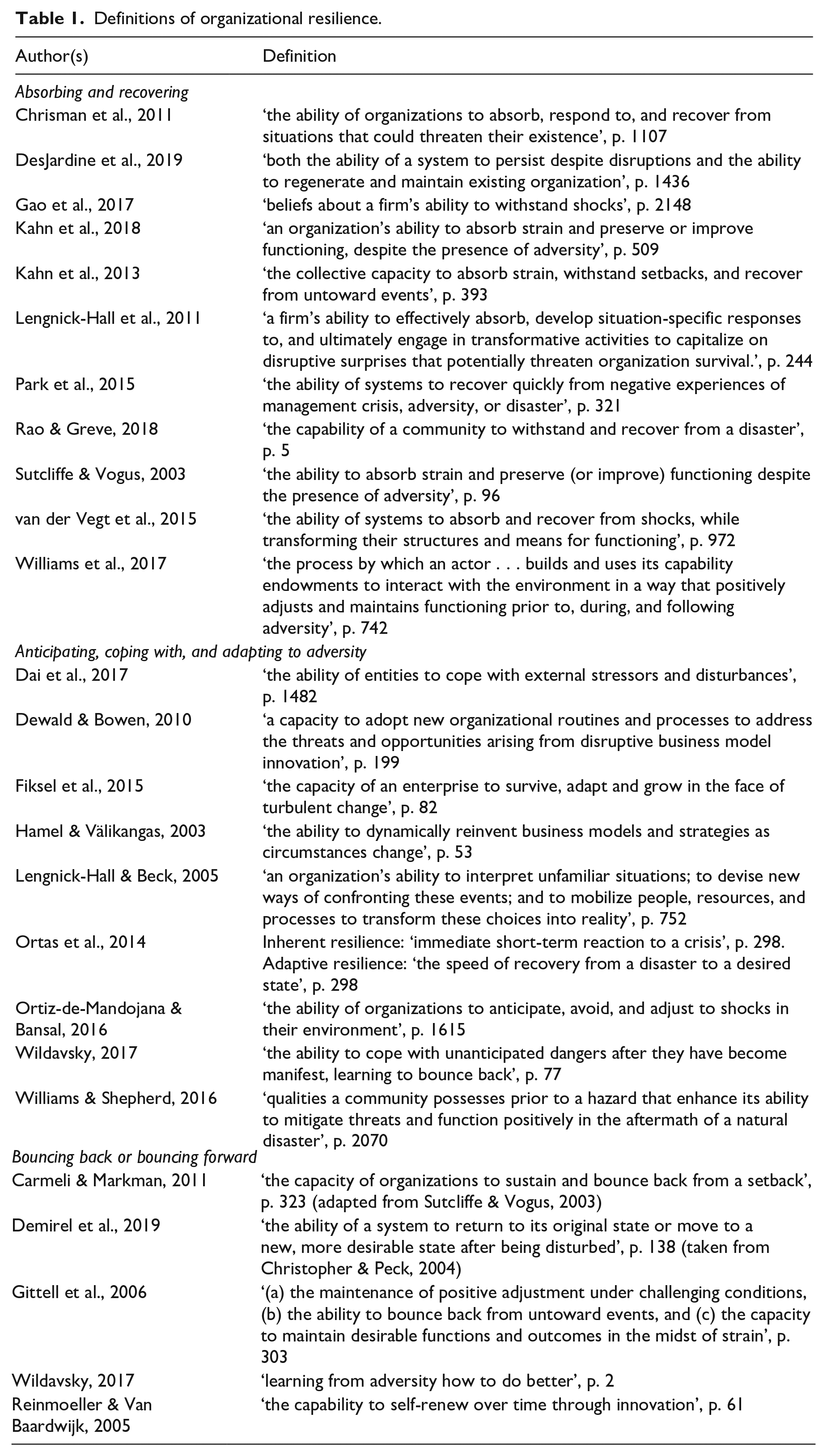
Prior research has defined, conceptualized and operationalized organizational resilience in a variety of ways (see Table 1 for a summary of definitions, organized by broad themes). In analysing existing definitions, we found three main approaches: ‘absorbing and recovering’, ‘anticipating, coping with, and adapting to adversity’ and ‘bouncing back and bouncing forward’. Absorbing shocks while maintaining functioning describes the ability of organizations to continue to function while absorbing shocks, but without claiming a return to a previous state or a change to a future state. Coping with adversity emphasizes adaptive activities and processes. Bouncing back describes the ability of organizations to return to a previous state after experiencing adversity. Bouncing forward describes the ability of organizations to learn from adversity – moving beyond previous states and emerging strengthened from the experience.
Definitions of organizational resilience.
A working definition of organizational resilience
Drawing on the definitions reviewed above, we define organizational resilience as the ability of an organization to anticipate, respond to, recover from, and learn from adversity. Our review of the foundational studies of organizational resilience in management and organizational research, as well as the research on individual and ecological resilience lead us to extend this basic definition in three main ways.
First, organizational resilience and adversity are intertwined phenomena. Organizational resilience is a property of organizations – an ability – but is only meaningful in the presence of adversity: an organization that has never encountered adversity cannot be understood as being resilient (Darkow, 2019). Resilience does not equate, however, to indestructability: more resilient organizations are better able to weather more severe instances of adversity, but all organizations, no matter how resilient, can perform poorly or fail under certain circumstances. We thus infer the resilience of an organization by virtue of its performance under adversity. This is consistent with research on individual resilience, which holds that ‘individuals are not considered resilient if there has never been a significant threat to their development’ (Masten, 2001, p. 228). Moreover, a specific form of adversity may have significantly different impacts on different organizations: it may threaten the survival of one organization, pose a moderate risk to another, and present a unique opportunity for another organization. For example, the global Covid-19 pandemic is a threat to international air travel, but less so less for domestic airlines. For other organizations such as Zoom that have replaced business travel with online meetings, the pandemic posed a unique opportunity.
Second, our definition of organizational resilience includes the ability of organizations to anticipate and learn from adversity, as well as respond to it. We include the anticipation of adversity (Linnenluecke, Griffiths, & Winn, 2012; Wildavsky, 2017; Woods, 2011) because the more accurately an organization anticipates adversity, the better it can prepare and consequently respond (Koronis & Ponis, 2018; Linnenluecke et al., 2012; Tasic, Amir, Tan, & Khader, 2019). We include learning because evidence suggests that many organizations do not simply ‘bounce back’ to a previous state, but emerge stronger from experience with adversity – ‘bouncing forward’ (Manyena, O’Brian, O’Keefe, & Rose, 2011, p. 45; Ruiz-Martin, Lopez-Paredes, & Wainer, 2018, p. 16). Thus, resilient organizations may transform – achieving a new state that is more resilient than the previous one (Clément & Rivera, 2017; Kantur & Iseri-Say, 2012; Tasic et al., 2019).
Third, organizational resilience is distinct from other types of resilience, such as individual resilience (Masten, 2001; Youssef & Luthans, 2007), ecological resilience (Folke, 2006; Holling, 1973; Walker, Holling, Carpenter, & Kinzig, 2004), institutional resilience (Barin Cruz, Aguilar Delgado, Leca, & Gond, 2016; Yılmaz Börekçi, Rofcanin, Heras, & Berber, 2018), urban resilience (Meerow, Newell, & Stults, 2016; Oliva & Lazzeretti, 2017), and cyber resilience (Hepfer & Powell, 2020). An important finding common across studies of resilience has been the specificity of its dynamics in relation to the category of social actor or system of which it is a property. Thus, our definition and review are focused on the resilience of organizations, rather than other collective actors or social systems, as we believe its foundations, dynamics, and outcomes are likely to be distinctive.
Three Forms of Organizational Resilience
In this section, we build on the definition of organizational resilience we have articulated above to develop a more complex conceptualization rooted in a formal review of the management and organizational research on organizational resilience. Our aim in conducting this review was to overcome both the fragmentation of the literature on organizational resilience and the over-simplification of the concept. The chosen approach was, therefore, to treat the existing literature as data that we would systematically review in a manner consistent with the development of an empirically grounded conceptualization, with our ‘stopping rule’ based on theoretical saturation rather than attempting a comprehensive collection of the existing literature. 2
The key insight that emerged from our review is that organizational resilience is a heterogeneous concept comprising three distinct forms: functional resilience, operational resilience and strategic resilience. For each form of resilience, we develop a conceptual definition, describe the main focus of the literature that examines it, and identify its key foundations, dynamics, and outcomes (Table 2).
Three Forms of Organizational Resilience.

Functional resilience
The first form of organizational resilience we identified is ‘functional resilience’, which describes the ability of a specific organizational function or system to respond positively to adversity. The concept of functional resilience rests on the idea that some forms of adversity are experienced by an organizational function or system in a way that is significantly independent of other organizational functions or systems (Kahn et al., 2018; Sheffi & Rice Jr, 2005). Functional resilience is elicited by adversity that interferes with a distinct organizational function, thus affecting a single unit nested within an organization.
If we take, for instance, a hospital emergency room, we can imagine it experiencing an unexpected wave of overcrowding due to a breakout of illness or a major accident, and needing to adapt to that condition, perhaps focusing on the most critically ill patients; in such a case, other functions of the hospital (e.g. radiology, inpatient floors) could remain largely unaffected and unaware of the situation (Kahn et al., 2018). The independence of the strain on the organizational function and the response of that function is what defines this form of resilience as functional.
The main focus of the literature on functional resilience has been on how single functions in organizations anticipate and respond to disruptions that only affect that specific function. Consequently, research on functional resilience is context-specific to organizational functions and examines idiosyncratic disruptions specifically relevant to that function, such as material flow disruptions in an organization’s supply chain (Saghafian & Van Oyen, 2016). Although there have been theoretical papers that explore functional resilience in relation to continuous sources of strain (Kahn et al., 2018), empirical research on functional resilience has focused relatively narrowly on discrete disruptions to supply chains (e.g. Ambulkar, Blackhurst, & Grawe, 2015; Chopra & Sodhi, 2014; Jüttner & Maklan, 2011; Kamalahmadi & Parast, 2016; Rice & Caniato, 2003) and information systems (Butler & Gray, 2006; Riolli & Savicki, 2003; Temizkan, Park, & Saydam, 2017; Wareham, Fox, & Giner, 2014).
Foundations of functional resilience
Research on functional resilience suggests that a key foundation is members’ functional knowledge, which is specific to functions nested inside organizations. Functional knowledge includes an understanding of function-specific vulnerabilities and risks (Fiksel, Polyviou, Croxton, & Pettit, 2015). This could include, for example, the understanding of employees in a supply chain function of events and factors that could disrupt the flow of goods and services (Ambulkar et al., 2015). Functional knowledge also includes the ‘collective capability to discern discriminatory detail about emerging issues and to act swiftly in response to these details’ (Sutcliffe & Vogus, 2016, p. 56). Deep functional knowledge on the part of organizational members may allow situated individual and collective mindfulness, as illustrated in Butler and Gray’s (2006) study of reliability and resilience in an information technology function. The roots of functional knowledge are often in prior experience with disruptions; such experience fosters tacit and explicit knowledge, which prepares the organizational function for future, similar disruptive events (Ambulkar et al., 2015). Bode, Wagner, Petersen and Ellram (2011), for example, found that experience with supply chain disruptions led to better calibrated responses to and decreased impacts of disruptions.
A second important foundation of functional resilience suggested in the literature is the design and infrastructure of the organizational function. Functional resilience may be rooted in the flexibility of a function’s structural design or a decentralized architecture (Chopra & Sodhi, 2014; Kim, Chen, & Linderman, 2015). Temizkan and colleagues (2017), for instance, showed the effect of a computer network structure on the resilience of the network when falling victim to a computer virus propagation. Design and infrastructure of functions are social, as well as material, properties. Kahn and colleagues have demonstrated the profound effects of informal and formal relationships among organizational members on the resilience of an organizational function, though their impacts on the ability of members to coordinate activities, share knowledge, and accomplish tasks under strain (Kahn, Barton, & Fellows, 2013; Kahn et al., 2018).
Dynamics of functional resilience
A second important theme in research describing each form of resilience was attention to the dynamics of resilience – the mechanisms through which the foundations of resilience are used to respond to adversity. Writing on functional resilience highlights two key dynamics.
The first dynamic is flexibility in responding in the wake of adversity (Christopher & Holweg, 2011; Jüttner & Maklan, 2011; Sheffi & Rice Jr, 2005). Research on functional resilience has demonstrated the importance of organizational members’ ability to quickly and flexibly restructure and deploy resources when facing a disruption in their organizational function (Ambulkar et al., 2015). In the face of supply chain disruptions, for example, research highlights the significance of supply chain managers quickly restructuring internal and external supply networks to facilitate functional continuity (Zhao, Zuo, & Blackhurst, 2019).
A second dynamic associated with functional resilience involves efficient execution of routines at the individual and organizational levels. Butler and Gray (2006), for example, show that information system resilience can be enhanced by the enactment of pre-planned routines that reduce errors, variation and waste in the context of unexpected disruptions. The authors note, however, that the routine must match and be appropriate for the crisis situation.
Outcomes of functional resilience
The final main theme highlighted in the resilience research is that each form of resilience – functional, operational, and strategic – is associated with specific outcomes tied to the kinds of triggering adversity. Research on functional resilience examines the consequences of adversity for specific organizational functions or systems, and is mainly concerned with efficiency-related outcomes. The main focus of research in this stream is on cost efficiency (Ambulkar et al., 2015; Chopra & Sodhi, 2014; Jüttner & Maklan, 2011; Melnyk, Davis, Spekman, & Sandor, 2010), reliability and stability (Butler & Gray, 2006; Christopher & Holweg, 2011; Demirel, MacCarthy, Ritterskamp, Champneys, & Gross, 2019), and recovery time (Kim et al., 2015; Sheffi & Rice Jr, 2005). In a study of supply chain resilience, for example, Saghafian and Van Oyen (2016) investigate the optimal design of backup solutions for the supply chain and conceptualize the benefit of functional resilience in terms of avoiding the costs of backorders.
Illustrative example
A study that illustrates the foundations, dynamics, and outcomes of functional resilience is Ambulkar and colleagues’ (2015) examination of supply chain resilience. In a survey of approximately 200 supply chain professionals, Ambulkar et al. (2015) document the potential for functional resilience in the face of disruptive events, including machine breakdowns, late shipments of inbound materials, and outbound logistics failures. Foundations of functional resilience highlighted by Ambulkar et al. (2015) include the cognitive orientation of organizational members towards supply chain disruptions, with an awareness of pending disruptions and learning from prior disruptions being the most important. Foundations highlighted in the article also include firms’ risk management infrastructures that can contain a department to manage supply chain risks/disruptions, the existence of information systems to manage supply chain risks/disruptions, and the use of key performance indicators and metrics to monitor the supply chain risk management/disruption management process. (Ambulkar et al., 2015, p. 113)
When supply chains are hit by adverse events, these foundations are translated into functional resilience by supply chain professionals in the organization who adapt by reconfiguring, realigning and reorganizing their resources in response to the disruption. With respect to the outcomes of functional resilience, Ambulkar et al. (2015) show that through the combination of these foundations and dynamics, responses to supply chain disruption can lead to greater operational efficiency, lower procurement costs and increased delivery reliability.
Operational resilience
The second form of organizational resilience that we identified in the literature is ‘operational resilience’, which describes the ability of an organization to respond positively to adversity that affects the organization as a whole, potentially threatening its ability to continue operating. If we take our hypothetical hospital, for example, operational resilience would describe its ability to respond positively to adversity that threatened its ability as a whole to operate; such adversity might be rooted in a doctors’ strike (Meyer, 1982) or a heavy snowstorm (Park, Sharman, & Rao, 2015), either of which could paralyse multiple organizational functions, and thus the hospital’s overall day-to-day operations.
Research has explored operational resilience in relation to a wide range of sources of adversity. One important stream of research on operational resilience has examined organizations that face endogenous forms of adversity that could threaten their operational ability (Perrow, 2011; Weick & Roberts, 1993). This focus has been particularly associated with the study of high-reliability organizations that have a never-ending need for operational resilience, such as nuclear power plants, chemical process plants and railroad operations, for which operational failures could have disastrous impacts on stakeholders, the economy and society (Carroll, 1998; Roth, Multer, & Raslear, 2006). Research on operational resilience has also examined exogenous episodes of adversity that threaten organizational operations, including natural disasters (Dutta, 2017; Huang, Kerstein, & Wang, 2018), terrorism (Branzei & Abdelnour, 2010; Coutu, 2002), and economic recessions (Davidsson & Gordon, 2016; DesJardine, Bansal, & Yang, 2019).
Research on operational resilience has also investigated forms of adversity that are initially associated with functional resilience but evolve into threats to the operational ability of the organization as a whole. In Rerup’s (2009, p. 884) study of a quality management crisis in a leading diabetes care company, for instance, a department manager recounted, ‘we realized very quickly that our quality problems were not confined to this department [of insulin filling], or to manufacturing for that matter. It was the entire firm’.
Foundations of operational resilience
Research on operational resilience suggests it is grounded in a set of distinctive foundations. We identified two overarching themes in research on operational resilience: operational attention and organizational resources.
One key foundation of operational resilience that research has highlighted is operational attentiveness, which involves a set of shared perceptions among members across an organization (Park et al., 2015; Sutcliffe & Vogus, 2003) that sensitize the organization to cues that signal potential threats to operations. These could include early signs of difficulties exposed in external audits (Rerup, 2009) or internal problems in quality performance (Su, Linderman, Schroeder, & Van De Ven, 2014). Key to this foundation is its collective and cross-functional nature: for operational attentiveness to underpin operational resilience, it needs to link actors across the organization in ways that expose environmental perturbations and activate organization-level routines and responses (Sutcliffe & Vogus, 2016; Teo, Lee, & Lim, 2017; Vogus & Sutcliffe, 2012). The ability of operational attentiveness to trigger action is key (Sheffi, 2015): organizational members need to recognize individually and collectively potential threats as such (Bullough, Renko, & Myatt, 2014; Davidsson & Gordon, 2016). In Weick’s (1993) classic study of smokejumpers, for instance, he found that the crew did not recognize the potential danger of the wildfire they were fighting, pausing to eat supper before taking action. Research on operational resilience has highlighted the roots of operational attentiveness in cross-functional shared situational awareness that runs across the entire organization, which is especially prominent in high-reliability organizations (Roth et al., 2006).
Research also points to the significance of certain organizational resources as foundations for operational resilience. Two important such resources are financial slack (Huang et al., 2018; Meyer, 1982; Williams et al., 2017), and organizational structure (Andersson, Cäker, Tengblad, & Wickelgren, 2019; van der Vegt et al., 2015). This research has also highlighted a range of intangible resources that underpin responses to adversity that threatens the ability of organizations to operate. These include prior work experience (Roth et al., 2006; Whiteman & Cooper, 2011; Williams et al., 2017), employee diversity (DesJardine et al., 2019; Dutta, 2017) and social resources (Adler & Kwon, 2002). Social resources, such as relationships, have received significant attention, with studies examining the role of both intraorganizational relationships (Olekalns, Caza, & Vogus, 2020; Weick, 1993; Williams et al., 2017; Williams & Shepherd, 2018) and interorganizational relationships (DesJardine et al., 2019; Dutta, 2017; Williams & Shepherd, 2016). In a study of a shooting at a business school, for example, Powley (2009) showed that the foundations of the school’s operational resilience all depended on personal relationships, which increase social capital within the business school.
Dynamics of operational resilience
Writing on operational resilience suggests that its foundations are employed through a set of specific dynamics, a key one being operational interpretation: this idea refers to organizational members collectively shaping the meaning of disruptive events or situations (Christianson, Farkas, Sutcliffe, & Weick, 2009; Weick & Roberts, 1993). Operational interpretation includes a diagnostic component, in which organizational actors collaborate to form a shared evaluation of the situation. It also includes a projective component, in which members collectively imagine possible future sources of disruption and possible responses.
A second important dynamic through which operational interpretation is achieved is the activation of relationships and networks in the face of serious disruption (DesJardine et al., 2019; Kahn et al., 2013; Olekalns et al., 2020). In Powley’s (2009) study, for instance, the shooting at a business school shattered normal organizational practices: the organization’s response was rooted in members’ social capital, but operational resilience depended on organizational members feeling empathy for one another, engaging with each other in new and different ways, and connecting with people outside their usual relationships.
The second set of dynamics highlighted by operational resilience research involves innovation and coordination in response to adversity. Operational resilience challenges the efficacy of overlearned routines (Branzei & Abdelnour, 2010; Dutta, 2017; Staw et al., 1981; Weick, 1993) because adversity is often far from previous experiences, and thus requires innovative, creative responses (Williams & Shepherd, 2016). Innovative responses, however, also depend on effective organizational coordination and communication (Chewning, Lai, & Doerfel, 2013; Kahn et al., 2013; Ridley, 2011; Roth et al., 2006; Teo et al., 2017; Weick, 1993). These dynamics are important because organization-wide innovation depends on the ability of multiple organizational functions to work together effectively.
Outcomes of operational resilience
The key outcomes highlighted by research on operational resilience are connected to the organization as a whole. Although outcomes differ depending on the type of adversity and organization, research on operational resilience has tended to emphasize short- and medium-term organizational performance as the key outcome (Branzei & Abdelnour, 2010; Richtnér & Löfsten, 2014). This has primarily been examined in terms of financial performance, measured, for instance, in terms of return on assets, cash flows and sales growth (Huang et al., 2018). A second significant outcome pointed to in this literature has been organizational learning (Carroll, 1998; Meyer, 1982; Sitkin, 1992; Weick & Roberts, 1993); these studies have shown how operational resilience may lead to significant changes in organizational behaviour, such that adversity leads organizations to bounce forward rather than back to their original states.
Illustrative example
An influential study of operational resilience is Meyer’s (1982) comparative study of 19 hospitals facing a physicians’ strike. Despite the strike affecting all studied hospitals similarly – dramatically disrupting day-to-day operations of the whole organization – the hospitals differed significantly in terms of how they anticipated the strike and adapted to it. Meyer examined three highly resilient hospitals for an in-depth analysis, and identified four key foundations of operational resilience: hospitals’ strategies (i.e. breadth, volatility and organizational surveillance of enacted market niches); structures (i.e. task allocations among subunits and mechanisms invoked to control and coordinate work); ideologies (i.e. shared beliefs that bind values to actions); and slack resources (i.e. financial reserves, human resources, technology, control systems).
Although all three hospitals went into the strike with an alignment of strategies, structures, ideologies and resources, the ensuing dynamics played out differently across them. A key dynamic that varied among the hospitals were differences in diagnostic interpretations of the strike among hospital employees: conversations among employees showed how they imagined different scenarios when anticipating a potential strike as well as different possible adaptations. Operational resilience ultimately came from a configuration of antecedent foundations and responding dynamics, leading to differences in adjusting (or failing to adjust) staffing levels and reallocating (or not) budgets, people and attention. Meyer’s study thus demonstrated the significant impact of differential operational resilience on organizational outcomes, conceptualized in terms of occupancies, staffing levels, cash flows and revenues.
Strategic resilience
The third form of organizational resilience we identified describes an organization’s ability to anticipate and respond to threats to its strategy, and especially its long-term goals; we thus refer to this form as ‘strategic resilience’. Organizational strategy describes ‘the long-term goals and objectives of an enterprise, and the adoption of courses of action and the allocation of resources necessary for carrying out these goals’ (Chandler, 1962, p. 13). In the context of for-profit organizations, strategic resilience may be in relation to a firm’s competitive advantage (Teece, 2010) – the elements of which can be undermined by unexpected sources of strategic adversity (Charitou & Markides, 2003). For non-profit organizations, strategic resilience is also important as it describes the ability of these organizations to respond positively to threats that might directly affect the viability of their long-term objectives.
If we return once more to our hypothetical hospital, we might imagine it facing unexpected strategic threats through technological developments in telemedicine, such as video consultations and remote surgery, that could disrupt the hospital’s competitive position relative to new entrants and substitute providers that can rely on these new technologies rather than operate full-service medical facilities. Strategic resilience in this case would involve the hospital’s ability to respond these threats to its strategy (Gittell, 2008), perhaps by pivoting away from in-patient treatment of serious illnesses or by adapting that strategy in ways that allow it to continue to compete.
Research examining strategic resilience has tended to focus on threats to firms’ long-term goals and thus their survival. Such threats stem from discrete events such as the 9/11 terror attack and its impact on the airline industry (Gittell et al., 2006), as well as evolving sources of adversity, such as the threat to Kodak from the transformation of photography from analogue to digital technologies (Dewald & Bowen, 2010). As with functional and operational resilience, the need for strategic resilience is not tied directly to the source of adversity, but from the relationship between the adversity and the organization: whereas a source of adversity might threaten one organization in operational terms, the same source of adversity might pose a strategic threat to another organization. The 9/11 terror attacks, for example, significantly threatened the operational ability of firms occupying the World Trade Center, such as Morgan Stanley (Coutu, 2002); in contrast, they posed a strategic threat to the business model of airlines, due to plummeting customer demand (Gittell et al., 2006).
Research on strategic resilience has examined a wide range of organizations, including banks responding to the 2008 financial crisis (Buyl, Boone, & Wade, 2019; Carvalho & Areal, 2016) and real-estate brokers coping with the rise of discount brokers (Dewald & Bowen, 2010). It has also explored the responses of online discussion communities to members abandoning their platforms (Butler, Bateman, Gray, & Diamant, 2014), family firms addressing intergenerational conflict over leadership succession (Chrisman, Chua, & Steier, 2011; Kachaner, Stalk, & Bloch, 2012) and multi-national enterprises adapting to the break out of war (Dai, Eden, & Beamish, 2017). Perhaps most imaginative is a study of the long-term strategic resilience of the Roman Empire (Carmeli & Markman, 2011).
Foundations of strategic resilience
Studies of the foundations of strategic resilience have emphasized senior leaders’ cognitive abilities, including strategic awareness and decision-making (Buyl et al., 2019; Dewald & Bowen, 2010; Gao et al., 2017; Hamel & Välikangas, 2003; Välikangas & Romme, 2013). The strategic awareness of senior leaders revolves around their perceptions of threats to and opportunities for their organization’s strategy and business model (Dewald & Bowen, 2010), as well as their attitude towards strategic risk (Buyl et al., 2019; Dai et al., 2017; Kachaner et al., 2012). In a study of strategic resilience of banks responding to the 2008 financial crisis, for example, Buyl and colleagues (2019) find that CEO narcissism and risk-taking negatively affected the strategic resilience of banks in times of crisis.
Somewhat surprisingly, the literature on strategic resilience has tended to pay little attention to organizational endowments – this despite the traditional emphasis in strategic management research on the critical role of resources for organizational performance (Powell, Lovallo, & Fox, 2011). Resources that research on strategic resilience has highlighted include organizations’ governance structures and processes, which might allow an organization under strategic threat to respond effectively over a prolonged period of time (Buyl et al., 2019, p. 20; Carmeli & Markman, 2011). Also highlighted as a resource that can contribute to an organization’s strategic resilience is an organization’s business model (Gilbert et al., 2012; Gittell et al., 2006; Ramdani, Binsaif, Boukrami, & Guermat, 2020), which can contribute to strategic resilience by providing strategic flexibility in meeting the changing needs of customers and restructuring relationships to suppliers and other stakeholder.
Dynamics of strategic resilience
Writing on strategic resilience suggests that it is enacted through specific dynamics that involve the interpretation of adversity by top management and strategic adaptation. A long-standing observation in research on strategic resilience has been the importance of how top leadership teams categorize issues as strategic threats or opportunities (Dewald & Bowen, 2010; Dutton & Jackson, 1987). These kinds of interpretive process are important because they shape organizational responses to adversity, and particularly strategic decision-making leading to the commitment of organizational effort and resources. Dewald and Bowen’s (2010) study of real estate brokers facing disruptive business model innovation shows how cognitive framing and risk experience shapes brokers’ perceptions of opportunities and threats, which in turn leads to their either resisting or adopting disruptive innovations. Top management interpretation processes are fundamental to the decision-making that leads to or away from strategic resilience (Pal, Torstensson, & Mattila, 2014; Sosna, Trevinyo-Rodríguez, & Velamuri, 2010).
A second key dynamic through which strategic resilience is achieved involves strategic adaptations that leverage the organization’s resources to respond creatively to potentially existential adversity. Research examining strategic resilience shows that resources are important as foundations, but resilience depends on how senior leaders allocate, deploy and employ those resources in ways that that reshape organizational strategies (Williams et al., 2017). Research has shown the importance of making resources available to explore strategy adaptations to fit with the competitive environment, innovating with respect to the firm’s core business, and creating and implementing new business models (Dewald & Bowen, 2010; Gittell et al., 2006; Hamel & Välikangas, 2003).
Outcomes of strategic resilience
With respect to outcomes, the literature on strategic resilience has focused primarily on the long-term performance of organizations, including organizational survival, longevity and economic performance measured in terms of profitability and market value (Buyl et al., 2019; Carvalho & Areal, 2016; Gittell et al., 2006). The emphasis on these outcomes suggests an understanding of strategic resilience as increasing the ability of organizations to prosper economically in the face of threats to strategies and business models. In contrast, poor economic performance is interpreted as an indication of organizations failing to recognize strategic threats or adequately shift resources in ways that allow them to adapt and respond. An important theme in this literature highlights the distinctive strategic resilience of family firms, which seems to stem from their attention to long-term goals and threats, in contrast to the short-term financial focus associated with publicly traded firms (Chrisman et al., 2011; Kachaner et al., 2012). Overall, writing on strategic resilience suggests that the most strategically resilient organizations are able to adapt in the face of threats to their strategy or long-term goals, emerging strengthened from the experience.
Illustrative example
The foundations, dynamics and outcomes associated with strategic resilience are illustrated by Gittell and colleagues’ (2006) study of airlines responding to the strategic threat associated with the dramatic downturn in air travel following the 9/11 terrorist attacks. The key foundations to strategic resilience identified in the study were financial reserves and positive relationships at work between managers and employees of the organization. A lack of financial reserves led airlines to lay off personnel, which damaged the relationships between managers and employees by destroying shared values, trust and loyalty, and consequently led to lower levels of cooperation. Through their negative impact on relationships, layoffs also negatively affected financial performance: layoffs undermined the airlines’ business models that depended on the efficiency and productivity of airline employees. In contrast, those airlines with sufficient financial resources tended to retain their employees, which strengthened employee relationships, and in turn reinforced the viability of those airlines’ business models. Thus, the combination of strong financial and social resources allowed some airlines to avoid the dynamics that led to reduced stock prices and greater likelihood of organizational mortality (Gittell et al., 2006).
Summary
Our review suggests that organizational resilience is a heterogeneous concept comprising three forms: functional, operational and strategic resilience. Each form describes the ability of an organization to respond positively to a specific kind of adversity, and is associated with distinct foundations, dynamics and outcomes (see Table 3).
Foundations, Dynamics, and Outcomes of Organizational Resilience.

Discussion
Our aim in this paper has been to provide a theoretical foundation for research on organizational resilience by reconciling the heterogeneous contexts within which organizational resilience has been studied with its relatively homogeneous conceptualization. In response, we reviewed the literature on organizational resilience and found it can be divided into three streams, each of which attends to a different form of organizational resilience: functional, operational and strategic.
Thus far, we have explored systematic differences between the three forms of organizational resilience: for each, we developed a conceptual definition, described the primary focus of the literature that examines it, and identified its main foundations, dynamics and outcomes. In this section, we develop a cyclical model of organizational resilience that comprises a set of nested, recursive processes that link the foundations, dynamics and outcomes of organizational resilience. We then examine the relationship between the three forms of resilience, focusing on scaling effects and their interdependencies.
Organizational resilience as a cycle of application, transformation and learning
Our review of research on organizational resilience suggests a nested, recursive model that connects the foundations, dynamics and outcomes of organizational resilience through processes of application, transformation and learning (see Figure 2). Our conceptualization of these processes builds on and extends previous conceptualizations of organizational resilience in terms of absorbing and withstanding, adapting and transforming.
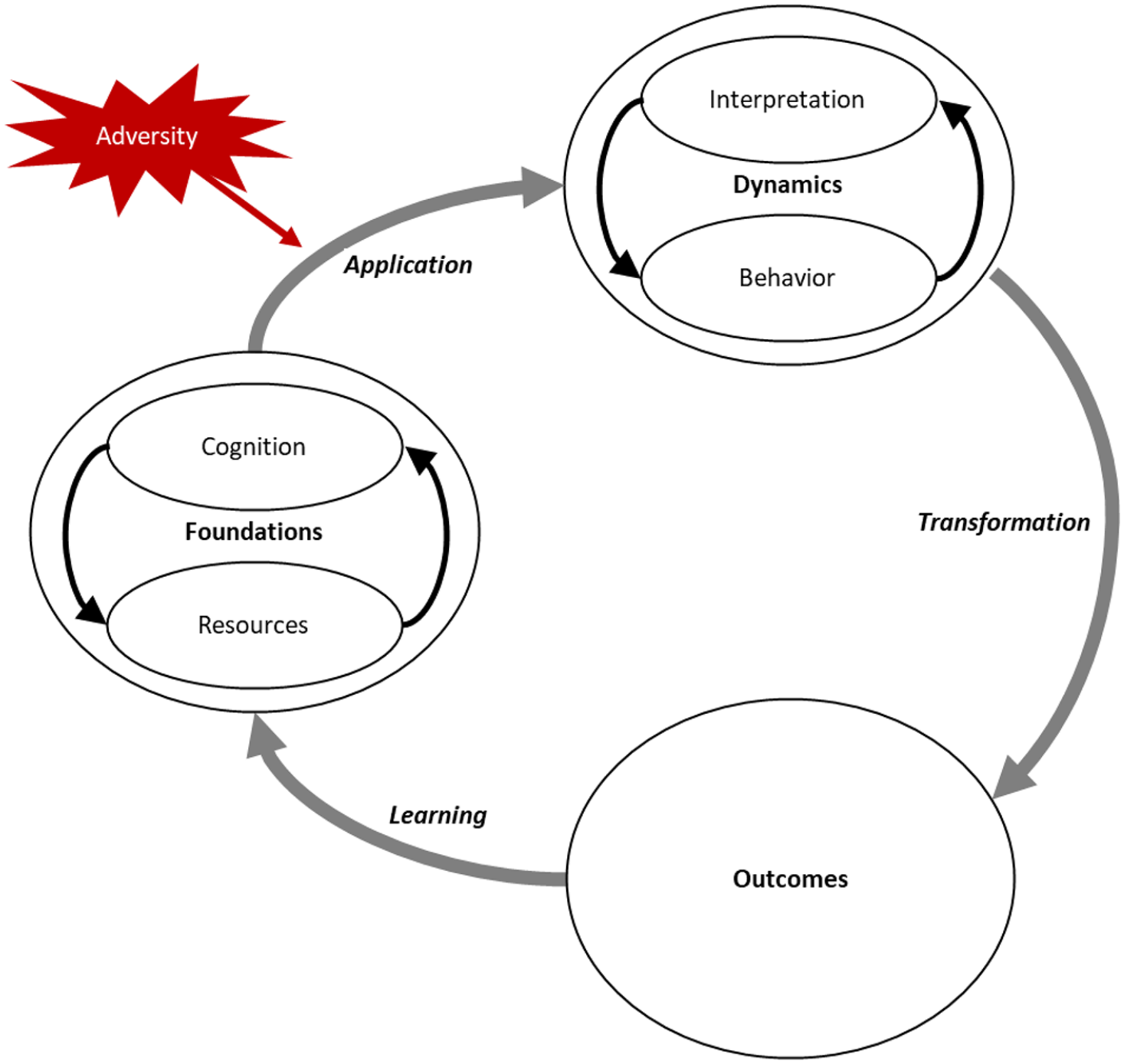
A Cyclical Model of Organizational Resilience.
The recursive foundations of organizational resilience
Looking across the foundations of functional, operational and strategic resilience, we can make two key observations: that the foundations of organizational resilience are built on cognitions and resources; and that these foundations exist in a mutually supportive, recursive relationship. Our review suggests that managerial cognition significantly affects whether and how organizations establish resources that can form the foundation for greater organizational resilience. In particular, existing research suggests that managers’ cognitive orientations to adversity lead them to make decisions about resource accumulation, allocation, development and deployment before adversity strikes (Ambulkar et al., 2015; Butler & Gray, 2006). These cognitive orientations depend significantly on experience: managers are more likely to anticipate possibilities that are familiar to them from prior experience (Carroll, 1998; Christianson et al., 2009; Levitt & March, 1988). In contrast, the possibility of unfamiliar adversity is likely to receive less cognitive attention, and consequently less effort toward accumulating and organizing resources in preparation. This suggests that more resilient organizations – functionally, operationally and strategically – are those in which managers’ cognitions align with more significant potential sources of adversity, and envision a future that leads them to make decisions to secure and allocate resources appropriately (Gioia, Corley, & Fabbri, 2002).
The research we reviewed also suggests the inverse relationship – that organizational resources shape managerial cognitions as foundations for organizational resilience (Carroll, 1998; Dai et al., 2017). Gittell and colleagues (2006), for example, show how financial reserves can shape senior leaders’ cognitions in ways that facilitate more conscious choices about responses to threats. Similarly, Rerup (2009) finds that managers who recognize that they have adequate resources in place to deal with specific kinds of adversity can shift their focus and attention to other issues. Resources, therefore, shape managers’ cognitions, perceptions and knowledge (Wildavsky, 2017).
Our identification of the recursive relationship between cognition and resources is significant for research on organizational resilience because it highlights the relationship between managerial cognition and resources as foundations of resilience. Such a relationship extends previous writing in organization theory and strategic management. The impact of managerial cognition on the development of organizational resources is well established in the context of seizing opportunities (Gavetti, 2012; Shepherd, Mcmullen, & Ocasio, 2017). Examining this dynamic in the context of resilience is less well understood but important, because the cognitive processes associated with recognizing opportunities in the environment (Thomas, Clark, & Gioia, 1993) are likely to be distinct from the mechanisms that underpin organizational resilience because of loss-aversion effects (Kahneman, Knetsch, & Thaler, 1991). A similar gap exists in our understanding of how resources shape management cognition in the face of adversity. The attention-based view of the firm has connected the cognitions of senior managers to the resources they have at hand (Ocasio, 1997, 2011; Ocasio, Laamanen, & Vaara, 2018), but we still need to understand how this relationship plays out in organizations facing adversity.
Overall, a recursive relationship between cognition and resources suggests a ‘strengths-based’ approach to establishing foundations for resilience. Organizations can start building the foundations of resilience from whatever cognitive processes or material resources are best developed in the organization – using them as ‘seeds’ to grow more robust foundations. If cognition and resources mutually shape and reinforce each other, then the key is to find a place to start and then reinforce, grow, and elaborate those potential foundations.
The recursive dynamics of organizational resilience
Our review suggests a second recursive relationship: across functional, operational and strategic resilience, organizational members respond through sets of interpretive and behavioural dynamics that operate in a recursive relationship. Our conceptualization of this recursive relationships builds on research on strategic issue interpretation (Gioia & Thomas, 1996; Thomas et al., 1993), sensemaking (Maitlis & Christianson, 2014; Weick, 1988) and collective mindfulness (Vogus & Sutcliffe, 2012). This work shows how interpretive processes guide action by motivating and shaping legitimate, appropriate responses to adversity (Christianson et al., 2009; Gioia & Thomas, 1996). In turn, behavioural dynamics shape interpretive processes in organizations (Maitlis, Vogus, & Lawrence, 2013; Weick, Sutcliffe, & Obstfeld, 2005) by enacting environments that lead to further collective and individual sensemaking (Maitlis & Christianson, 2014; Weick, 1988). We thus argue that adversity triggers interpretive dynamics that provide the foundation for behavioural responses, which in turn stimulate and shape further interpretive processes.
The relationship we suggest between interpretive and behavioural dynamics is significant for research on organizational resilience because it highlights the need to attend not only to the cognitive and discursive repertoires that shape interpretive dynamics, and the routines that underpin behavioural dynamics, but also to the connective tissue in organizations that binds them together. Understanding the responses of organizations to functional, operational, or strategic adversity depends on finding research methods that can surface these dynamics and their interplay. This is likely to be difficult when research is done from a distance, either socially or temporally; research that can capture these dynamics and their interactions is thus more likely to involve ethnographic or other methods that allow insight into the perceptions, actions, and interactions of organizational members as they experience adversity. The relationship between interpretive and behavioural dynamics also suggests the importance of a longitudinal view of organizational resilience, as the interpretive and behavioural dynamics through which organizations respond to adversity are likely to transform each other when that adversity remains for extended periods. From a practical perspective, the significance of these recursive dynamics points to the importance of developing linkages between interpretive processes, such as environmental scanning and operational evaluation, and behavioural dynamics that may be rooted in day-to-day routines.
Finally, our cyclical model of organizational resilience suggests that the positive outcomes of organizational resilience depend on both its foundations and its dynamics. Thus, any substitution effect between foundations and dynamics is likely to be limited. A useful approach to examining substitutability effects is through the logic of necessity and sufficiency, as prior research has done in the context of routines (Pentland, Feldman, Becker, & Liu, 2012), social capital (Dale & Newman, 2010) and competitive advantage (Powell, 2001). Literature on organizational resilience suggests that adequate foundations represent a necessary but insufficient condition for (functional, operational and strategic) resilience; similarly, adequate dynamics represent a necessary but insufficient condition for resilience (e.g. Gittell et al., 2006; Meyer, 1982; Powley, 2009; Weick, 1993). Rather, organizational resilience demands a configuration of mutually reinforcing cognitions, resources, interpretations and behaviours. The limited substitutability of foundations and dynamics is important because it suggests that reductionistic efforts to understand, predict, or lay the foundation for resilience by examining only one of these attributes is insufficient.
The relationships between functional, operational, and strategic resilience
Our review of organizational resilience literature raises important questions about the relationships between the three forms – questions that are important for at least two reasons. First, the relationships between the forms address the issue of scaling, which has been a long-standing question in the study of resilience (Linnenluecke, 2017; Ruiz-Martin et al., 2018; Sutcliffe & Vogus, 2003): whether and how one type of resilience might ‘add up’ to another type. Second, exploring the relationships of the forms addresses the broader question of how and to what degree the forms of resilience are interdependent.
Scaling in organizational resilience
Research on resilience has traditionally explored scaling in terms of levels of analysis – whether there are scaling effects among individual, group and organizational resilience, such that resilient individuals create resilient groups, and resilient groups create resilient organizations (Adobor, 2019; Lengnick-Hall, Beck, & Lengnick-Hall, 2011; Ma, Xiao, & Yin, 2018; Sutcliffe & Vogus, 2003; Tasic et al., 2019). Our review of the literature on organizational resilience, however, suggests that conceptualizing resilience in terms of levels of analysis – although seemingly useful for analytical purposes – may be problematic and perhaps even dysfunctional. From the perspective we develop, organizational resilience is neither an aggregate of individual resilience nor a component of field resilience.
While we agree with prior research that individuals are critically important to functional, operational and strategic resilience and, consequently, for the overall resilience of an organization, we believe the role of individual resilience (that is, people bouncing back after experiencing their own individual hardships) may be less important for organizational resilience than has been implied in much of the writing on organizational resilience (Bhamra, Samir, & Burnard, 2011; Linnenluecke, 2017; Ruiz-Martin et al., 2018; Williams et al., 2017). It is not that the qualities and abilities of individuals are unimportant to organizational resilience, but rather that there seem to be a host of organizational (and individual) qualities, aside from individual resilience, that contribute to organizational resilience, including systems, processes, structures, strategies, coordination, values, ideologies, skills, or cognitions.
Our review suggests that the three forms of organizational resilience we have identified are unlikely to be associated with scaling effects because each seems to be associated with distinctive foundations and dynamics. Thus, it is entirely plausible that an organization might possess a high degree of one form of resilience (e.g. functional resilience), but a low degree of another form (e.g. strategic resilience): for instance, an organization with a highly resilient supply chain might not have a resilient business model, nor might it be resilient in the face of adversity that threatens the organization as a whole. We thus argue that the most resilient organizations possess high degrees of all three forms of resilience, whereas the least resilient organizations possess low degrees of all three forms of resilience. Our model shifts attention away from apparent scaling effects across levels of analysis in organizational resilience to a set of more complex interdependencies among forms of resilience.
Interdependencies among functional, operational and strategic forms of resilience
If there are not scaling effects between the different forms of organizational resilience, the question remains as to whether they are in any way interdependent. Our review suggests that the interdependence of the forms of resilience may stem from the ways in which the kinds of adversity may shift in terms of their effects. Whereas we argued that the foundations and dynamics associated with different forms of resilience suggest a lack of scaling, this may not be the case for adversity. We have argued that the type of adversity determines which form of resilience is elicited: a supplier failure, for example, is likely to elicit functional resilience in relation to an organization’s supply chain function. Mounting functional adversity may, however, lead to responses that depend on other forms of organizational resilience: whereas adversity may arise in relation to specific organizational functions and thus demand functional resilience, cascading adversity that begins by affecting a single function may come to require operational or strategic resilience. This suggests an important interdependence among the forms of organizational resilience: a failure in terms of functional resilience may trigger the need for operational or strategic resilience. More generally, we suggest that failure in terms of one form of organizational resilience may reshape the type of adversity faced by an organization thus shifting the adaptive responses required (Rerup, 2009).
Conclusion
Our conceptualization of organizational resilience as comprising three distinctive forms points to areas of future research and provides guidance for managers aiming to strengthen the resilience of their organizations.
For future research, our conceptualization of organizational resilience can provide a foundation for empirical research that is more sensitive to the varieties of adversity that organizations face, the heterogeneous impacts of that adversity, and the range of ways in which organizations might respond. Although the study of organizational resilience has flourished over the past two decades, we believe that research in this domain has suffered from an overly general conception of resilience that has not been attuned to the distinctiveness of different contexts and situations. Our hope is that this review will allow scholars to articulate more nuanced research questions, narrow the focus of their empirical research, and develop more precise analytical strategies.
A second implication of our review for future research concerns the fungibility of organizational resilience. Empirical research to date has tended to explore individual disruptive events on organizations; an important question that remains is whether organizational resilience developed in relation to one type of adversity will lead to greater resilience in relation to other types of adversity. Would, for instance, an organization that has experienced a cyberattack and developed new capabilities in response to that threat become more resilient in relation to a global pandemic? An exciting direction for future research could involve longitudinal case studies of specific organizations that have been subject to multiple, severe sources of adversity.
A core practical implication of our review concerns the focus of organizational members when working to strengthen their organization’s resilience. Our conceptualization of organizational resilience suggests that such efforts need to target specific forms of resilience rather than aiming to foster a generic resilience. Research across the streams of literature we reviewed point to distinctive foundations that underpin functional, operational and strategic organizational resilience, as well as distinctive dynamics that need to be enacted. Thus, an important starting point is to establish whether the source of adversity threatens the functional, operational or strategic wellbeing of the organization.
In closing, this paper was motivated by a lack of integration across a fragmented and disjointed literature on organizational resilience, which has resulted in significant conceptual ambiguity. In exploring the fragmented literature on organizational resilience, we encountered a more deeply rooted conceptual problem: the unhelpful pairing of heterogeneous contexts in which organizational resilience has been studied with a relatively homogeneous conceptualization on which these studies depend. This mismatch has, we suggest, led to findings and insights that remain idiosyncratically tied to specific contexts, without systematically addressing the significant heterogeneity of the forms of adversity faced by organizations, the variety of impacts felt by organizations, and the varied ways that organizations respond and adapt. In response, we argue that organizational resilience is usefully understood as a heterogeneous construct, manifesting in three forms: functional resilience, operational resilience and strategic resilience. Those three forms, each with distinct foundations, dynamics and outcomes, recognize the heterogeneity of organizational adaptations to adversity and its impacts. We hope this paper can mark a new phase of research on organizational resilience that recognizes the significance of the concept while integrating its heterogeneity.
Supplemental Material
sj-docx-1-ott-10.1177_26317877221074701 – Supplemental material for The Heterogeneity of Organizational Resilience: Exploring functional, operational and strategic resilience
Supplemental material, sj-docx-1-ott-10.1177_26317877221074701 for The Heterogeneity of Organizational Resilience: Exploring functional, operational and strategic resilience by Manuel Hepfer and Thomas B. Lawrence in Organization Theory
Footnotes
Acknowledgements
We would like to thank Alan D. Meyer, Tim Vogus, and Joel Gehman for their immensely helpful comments, and Markus Hoellerer for his wise guidance and patience as our editor.
Declaration of Conflicting Interests
The author(s) declared no potential conflicts of interest with respect to the research, authorship, and/or publication of this article.
Funding
The author(s) received no financial support for the research, authorship, and/or publication of this article.
Supplemental material
Supplemental material for this article is available online.
Notes
Author biographies
References
Supplementary Material
Please find the following supplemental material available below.
For Open Access articles published under a Creative Commons License, all supplemental material carries the same license as the article it is associated with.
For non-Open Access articles published, all supplemental material carries a non-exclusive license, and permission requests for re-use of supplemental material or any part of supplemental material shall be sent directly to the copyright owner as specified in the copyright notice associated with the article.
