



Abstract
Causal ambiguity relates to ambiguity as to how organizational actions and results, inputs and outcomes, or competencies and advantage are linked. Causal ambiguity is important because of its organizational performance implications. Over the last 25 years, research has analyzed the concept from various theoretical angles. As a result, the literature is fragmented and presents different, and sometimes contradictory, views on the concept. In this article, we systematically review the literature on causal ambiguity and develop a framework incorporating the types, antecedents, and consequences of causal ambiguity for both organizational performance and organizational learning. We disentangle the arrays of conceptualizations and operationalizations present in the literature, and we isolate distinct streams in causal ambiguity research. One stream of research concentrates on causal ambiguity as an interfirm barrier to imitation, a second relates to causal ambiguity as an intrafirm barrier to factor mobility, and a third focuses on causal ambiguity as a potential trigger for intrafirm learning. Our review also helps to consolidate research on the substitution dilemma, the causal ambiguity paradox, and the challenge of learning under causal ambiguity. Finally, we develop a coherent set of implications for management practice, and we provide an agenda for further research.
Keywords
Causal ambiguity refers to ambiguity perceived by organizational decision makers as to how organizational actions and results, inputs and outcomes, or competencies and advantage are linked (King, 2007; Lippman & Rumelt, 1982; Powell, Lovallo, & Caringal, 2006). The importance of causal ambiguity in understanding firm performance and competitive advantage is widely recognized among management scholars, inspiring works that approach the concept from a variety of theoretical angles. Following Lippman and Rumelt’s (1982) original conceptualization of causal ambiguity as an isolating mechanism, early contributions mainly analyzed the concept from a resource-based perspective (Barney, 1991; Dierickx & Cool, 1989). Given its major impact on factor mobility, the concept of causal ambiguity has also been studied in terms of knowledge and technology transfer (Lin, 2003; Simonin, 1999) and routine replication (Friesl & Larty, 2013; Winter & Szulanski, 2001). In recent times, scholars have increasingly investigated organizational learning under causal ambiguity (Ambrosini & Bowman, 2005; Cording, Christmann, & King, 2008), drawing on conceptual foundations such as behavioral theory (e.g., Zollo, 2009) or institutional theory (e.g., J. Miller, 2012).
Extant studies of causal ambiguity offer various important insights into the phenomenon. The various theoretical lenses on causal ambiguity found in the current literature, however, present different, and sometimes contradictory, views on central questions such as where causal ambiguity originates from, how decision makers cope with it, and how it affects firm performance. This diversity has also led to a plethora of conceptualizations and measures in empirical research, further complicating a clear understanding of the phenomenon.
Various conceptualizations of causal ambiguity reveal distinct types, with some scholars emphasizing resource characteristics as potential triggers of ambiguity and others focusing on a perceived linkage between inputs and outcomes (e.g., Ambrosini & Bowman, 2010; King & Zeithaml, 2001). Research also differs as to whether perceptions of ambiguity relate to relationships between causes and effects within a focal firm or external to it (González-Álvarez & Nieto-Antolin, 2005; King, 2007; McIver & Lengnick-Hall, 2018). The absence of systematic insights as to how various types of causal ambiguity act in practice inhibits a full realization of the explanatory value of the concept.
There are also mixed arguments and findings about how causal ambiguity influences organizational performance. Some studies emphasize the potential performance-enhancing effects of causal ambiguity as a barrier to imitation (e.g., McEvily & Chakravarthy, 2002; Reed & DeFillippi, 1990). Others focus on its performance-detrimental effects as an incentive for competence substitution (e.g., McEvily, Das, & McCabe, 2000), as a barrier to factor mobility (e.g., Szulanski, 1996), or as a mechanism reducing the effectiveness of organizational learning (e.g., Mulotte, Dussauge, & Mitchell, 2013). These seemingly contradictory performance implications also lead to various challenges for decision makers in dealing with causal ambiguity.
Given this array of perspectives and challenges, we believe that a review of the field can help to not only inform ongoing discussions and advance our understanding of how causal ambiguity affects organizations but also lay the ground for future research. To do so, we have systematically analyzed a range of conceptual and empirical studies of causal ambiguity with the aim to improve our understanding of the phenomenon.
Our review contributes to the management literature in several ways. First, it reveals how extant studies differ in their underlying assumptions regarding the nature of causal ambiguity. Drawing on a systematic differentiation of distinct types of causal ambiguity, we discuss the operationalization of the concept found in current literature, identifying studies measuring objective data as proxies for causal ambiguity, perceptions of input characteristics, and perceptions of causal linkages. Second, on the basis of the analysis and synthesis of the literature, we develop an organizing framework that systematizes extant research. This framework helps us better appreciate the antecedents, consequences, and moderators of causal ambiguity. It integrates three major research streams, namely, the role of causal ambiguity (1) as an interfirm barrier to imitation, (2) as an intrafirm barrier to factor mobility, and (3) as a trigger for intrafirm learning. We also consolidate research on the substitution dilemma, the causal ambiguity paradox, and the challenge of learning under causal ambiguity, having identified these as the challenges embedded in or across these research streams. Third, beyond documenting the theoretical and empirical insights, our review reflects the unique benefit of synthesizing the managerial implications proposed by the prior literature and raising further managerial implications. Finally, by bringing together diverse, differing, and converging research streams, our framework provides a basis for discussing the gaps in theoretical and empirical knowledge.
Method
As we aimed to “map and to assess the existing intellectual territory” of a given body of research (Tranfield, Denyer, & Smart, 2003: 208), we conducted a systematic literature review (Denyer, Tranfield, & van Aken, 2008; Webster & Watson, 2002), following the approach proposed by Denyer and Neely (2004). They argued such a review requires a clear aim, preplanned methods, explicit and reproducible criteria for searching and selecting articles, and an impartial and comprehensible presentation of the findings.
To identify core papers relating to the concept of causal ambiguity, we conducted a systematic search for articles in the Business Source Premier (EBSCO) as well as in the Web of Science (Thompson Reuters). We searched for papers published between 1982 and 2017. The publication of Lippman and Rumelt’s (1982) seminal article on causal ambiguity as a driver of uncertain imitability provided the starting point for the review. We initially searched for scholarly articles that contained the terms causal ambiguity or causally ambiguous in the title, abstract, or topic/keywords. To ensure coverage of all contributions drawing on the phenomenon, we also searched for papers connecting “ambiguity” to “resource*,” “knowledge,” “capabilit*,” “competenc*,” “performance,” or “advantage.” We then studied abstracts to confirm their relevance for our study and dismissed papers with little or no link to causal ambiguity. We also undertook forward and backward searches, identifying papers citing key articles or identifying papers cited in key articles, respectively, to ensure all important contributions to the topic were covered (Webster & Watson, 2002: xvi). Aiming to develop a broad data set and avoid an exclusive focus on certain top journals, we included papers from all journals present in at least three rankings listed in the Harzing Journal Quality List. This procedure resulted in a final database of 73 papers. From these 73 papers, 32 were identified as conceptual and 41 as empirical. The 41 empirical articles were sourced from 30 journals. This demonstrates the breadth of the research interest in causal ambiguity. With 7 occurrences, Strategic Management Journal was the most strongly represented journal in our sample of empirical papers, followed by Organization Science with 5.
To synthesize the findings, we opted for a narrative approach (see Baumeister & Leary, 1997). It is particularly suited for advancing theoretical models, for providing different perspectives on controversial issues, and for presenting novel views on emerging issues in a field. Contrary to meta-analyses, narrative reviews “can accommodate differences between the questions, research designs and the contexts of each of the individual studies” and “enable the wholeness or integrity of the studies to be maintained, thus preserving the idiosyncratic nature of individual studies” (Denyer & Tranfield, 2006: 221). Both features are particularly valuable in our context because of the heterogeneity of conceptual backgrounds involved in the studies of our database. We started the review by inductively analyzing the papers concerning the research question. Our focus especially emphasized how the authors conceptualized causal ambiguity and measured its antecedents and performance consequences. The subsequent detailed reading of the papers facilitated the identification of the underlying assumptions and core themes in causal ambiguity research.
What Is Causal Ambiguity? Historical Development, Basic Assumptions, and Operationalization
According to the Merriam-Webster online dictionary, ambiguity (from the Latin “ambo,” meaning “both,” and “agere,” meaning “to drive”) denotes something “that can be understood in two or more possible ways.” Hence, something that is ambiguous does not have a single clear meaning. 1 The term causal ambiguity refers to ambiguity between causes (e.g., input variables such as resources or actions) and effects (e.g., outcome variables such as performance or advantage).
Lippman and Rumelt (1982) developed the concept to explain how firms might generate rents under perfect competition. Under such conditions, uncertain imitability acts as an isolating mechanism that facilitates firm heterogeneity. In particular, Lippman and Rumelt argue that “if the original uncertainty stems from a basic ambiguity concerning the nature of the causal connections between actions and results, the factors responsible for performance differentials will resist precise identification” (418). Without precise identification, “the uncertainty attaching to entry and imitative attempts persists, and complete homogeneity is unattainable” (Lippman & Rumelt, 1982: 418). Scholars later adopted the concept to support the resource-based view’s (RbV’s) basic claims (Barney, 1986, 1991; Dierickx & Cool, 1989; Peteraf, 1993; Reed & DeFillippi, 1990; Rumelt, 1984; Wright, Dunford, & Snell, 2001). As research on causal ambiguity progressed, scholars started to provide more differentiated perspectives on the concept’s performance consequences and investigated its ambivalent role in creating competitive advantage (Coff, 1997, 1999; King & Zeithaml, 2001; Lado, Boyd, Wright, & Kroll, 2006; McEvily et al., 2000). As a consequence, diverse views on the nature of causal ambiguity have emerged. Those views, however, partly rest on different assumptions underlying the origin of causal ambiguity as well as its distribution across and within firms.
Types of Causal Ambiguity: Conceptualization and Measurement
The origins of causal ambiguity are subject to differing perspectives in the literature. Synthesizing the literature shows that the characteristics of inputs and the properties of input-outcome relationships can potentially lead to perceptions of causal ambiguity. Input characteristics refer to particular properties of organizational resources such as tacitness, complexity, and specificity (McEvily & Chakravarthy, 2002; Reed & DeFillippi, 1990). Because organizational knowledge plays a pivotal role as an input variable, scholars also refer to ambiguity caused by such input characteristics as knowledge ambiguity (e.g., Ciabuschi & Martín, 2011; Law, 2014; Simonin, 1999; van Wijk, Jansen, & Lyles, 2008). The properties of input-outcome relationships, such as the temporal or spatial distance between deploying a resource and achieving the outcome of resource deployment (King, 2007) or feedback delays (Joseph & Gaba, 2015), can also lead to perceptions of ambiguity. They obscure cause-effect linkages and lead to a lack of clarity in interpreting organizational outcomes.
The extant empirical research has largely focused on these antecedents of causal ambiguity (with most focusing on input characteristics) or on managerial perceptions of causal ambiguity (see Figure 1). Drawing on the differences in conceptualizing causal ambiguity in empirical studies, King and Zeithaml (2001) introduced the notions of linkage ambiguity and characteristic ambiguity. Linkage ambiguity is anchored in individual perception and refers to “ambiguity among decision makers about the link between competency and competitive advantage” (King & Zeithaml, 2001: 77). Characteristic ambiguity, in contrast, is “ambiguity inherent to the resource itself” (King & Zeithaml, 2001: 77). Linkage and characteristic ambiguity are related, as characteristic ambiguity is an important antecedent of linkage ambiguity (King & Zeithaml, 2001; Simonin, 1999).
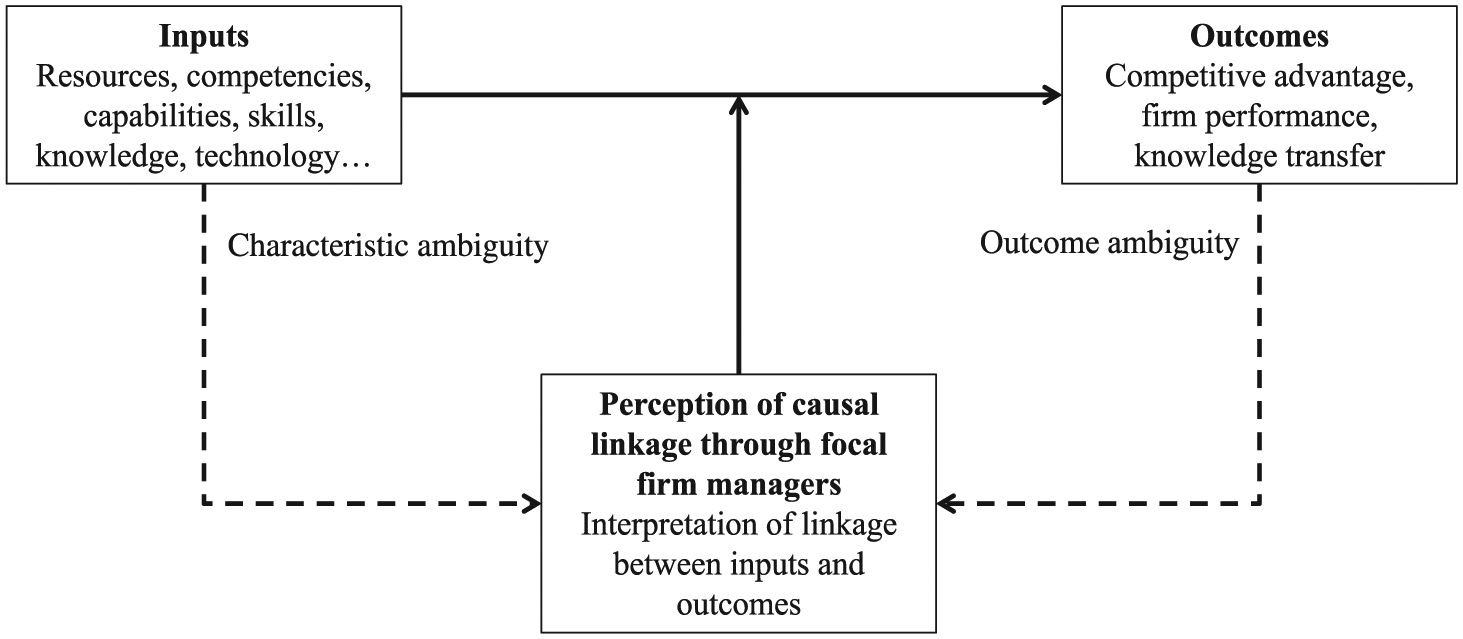
Origins of Causal Ambiguity
Although there is broad consensus that causal ambiguity ultimately resides in managerial perception (King, 2007; Powell et al., 2006), different empirical approaches to operationalize and measure the construct have emerged over recent decades. Analyzing how the studies in our article data set operationalized causal ambiguity reveals the existence of three different approaches.
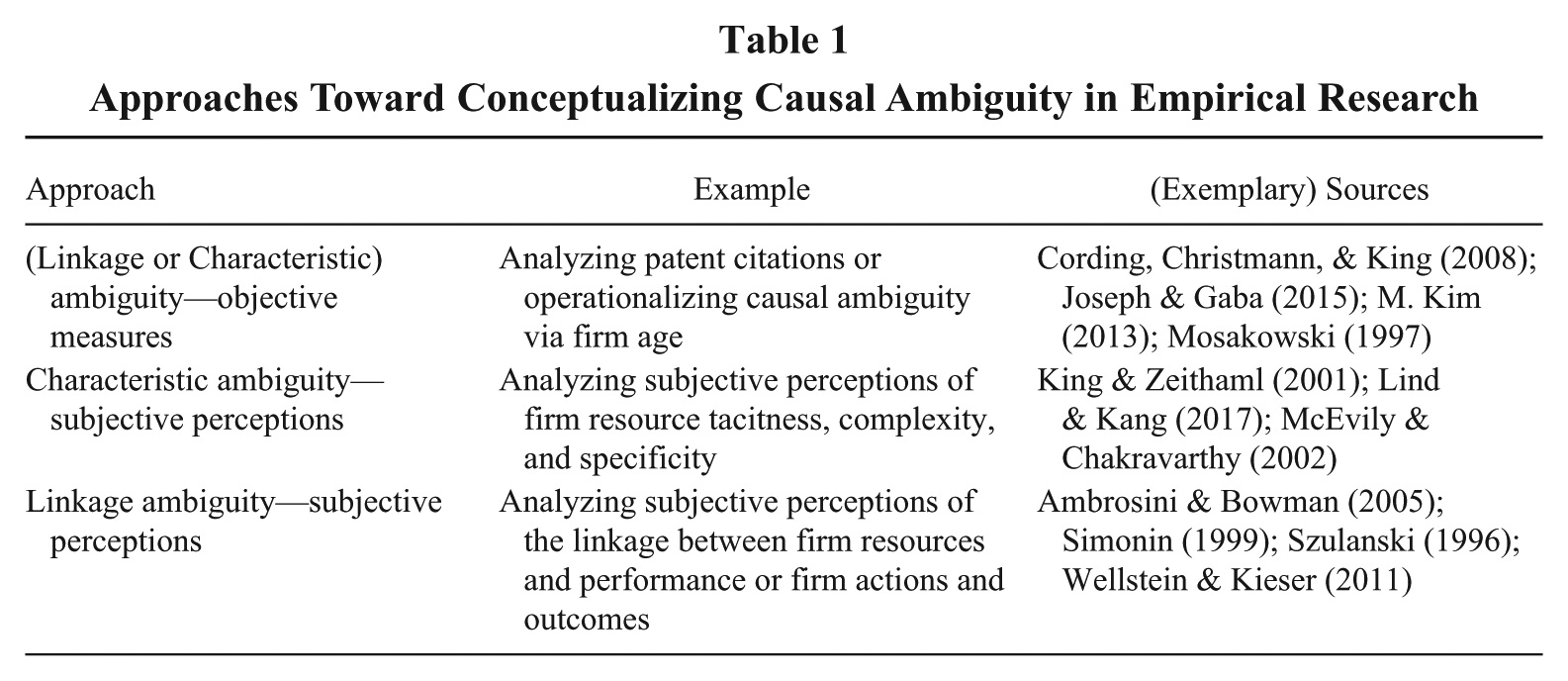
First, some studies draw on objective measures for studying (linkage or characteristic) ambiguity. These studies focus on measuring proxies, such as patent citations (the underlying assumption being that self-citation of a new patent serves as a proxy for tacitness) or firm age (the underlying assumption being that causal ambiguity diminishes with firm age), subsequently connecting the proxies to causal ambiguity (e.g., Beleska-Spasova & Glaister, 2013; Cording et al., 2008; M. Kim, 2013; Mosakowski, 1997).
Second, a further stream of studies focuses on characteristic ambiguity that is subjectively perceived. This research draws on respondents’ answers to questions of how they perceive resource characteristics that could be sources of ambiguity. The items used for this purpose are many and draw on various input-based antecedents of causal ambiguity, such as tacitness, complexity, and specificity. They include questions about the extent to which a competitor could acquire the same competence by analyzing trade or other publicly available publications (tacitness), about the extent to which several organizational elements interact in producing an effect (complexity), or about the extent to which the same competence can be applied in different settings (specificity; e.g., King & Zeithaml, 2001; Lind & Kang, 2017; McEvily & Chakravarthy, 2002).
Third, some studies investigate causal ambiguity in the sense of linkage ambiguity that is subjectively perceived. Most of the studies following this approach also integrate some items of characteristic ambiguity, complicating the differentiation of ambiguity types. Quantitative studies in this vein (e.g., Hansen, McDonald, & Mitchell 2013; Lawson & Potter, 2012; Sheng, Chang, Teo, & Lin, 2013) frequently draw on the measures developed by Simonin (1999) or Szulanski (1996). These seminal studies include questions regarding the extent to which cause-effect relationships are clear or the extent to which the inputs necessary to produce certain outcomes are known. A few qualitative studies conceptualize ambiguity as linkage ambiguity grounded in managerial perception (e.g., Ambrosini & Bowman, 2005; Laursen & Andersen, 2016). These studies analyze interview data or use causal mapping to investigate how managers make sense of cause-effect relationships.
The various operationalizations reflect different empirical approaches to capturing the phenomenon. Studies drawing on data relating to input characteristics measure ambiguity as something that is inherent to firm resources. These studies capture the potential of (objectively measured or subjectively perceived) input characteristics to lead to perceptions of ambiguity. Studies drawing on subjective perceptions of linkage ambiguity analyze how decision makers cognitively connect organizational inputs and outcomes. Table 1 provides a brief overview of the extant operationalizations and the measures used in empirical research. Supplementary Table 1 in the online supplemental material provides further details.
Approaches Toward Conceptualizing Causal Ambiguity in Empirical Research
Distribution of Causal Ambiguity: Symmetry Versus Asymmetry Across and Within Firms
King (2007) observed that extant studies build on different assumptions as to whether the perception of causal ambiguity is distributed equally among decision makers across firms. In his seminal work laying out the foundations of the RbV, Barney (1991) made a case for conceptualizing causal ambiguity as a symmetrical phenomenon across firms. Drawing upon Lippman and Rumelt’s (1982) original conceptualization, Barney argued that causal ambiguity could be a source of competitive advantage only if neither the managers of the firm that possesses those causally ambiguous resources nor the managers of the firms who try to imitate those resources understood the linkage between the resources employed and the resultant competitive advantage. Otherwise, any information that constitutes such an advantage would quickly be diffused through all competitors, for example, by hiring those managers from competitors.
Several studies depart from the assumption of industry-wide symmetrical causal ambiguity across firms. Instead, they build on the assumption that the degree of causal ambiguity perceived by insiders and those external to a firm can differ (e.g., Beleska-Spasova & Glaister, 2013; M. Kim, 2013; King & Zeithaml, 2001). This difference is what scholars also refer to when differentiating between intra- and interfirm causal ambiguity (King, 2007; Potter & Lawson, 2013) or manager and competitor causal ambiguity (González-Álvarez & Muñoz-Doyague, 2006; González-Álvarez & Nieto-Antolin, 2005). This research assumes that superior insights into inherently ambiguous resources are the major reasons for these differences. Figure 2 illustrates the difference between intrafirm (or manager) and interfirm (or competitor) causal ambiguity, which lies in whether ambiguity is perceived by decision makers located within the focal firm or external to it.
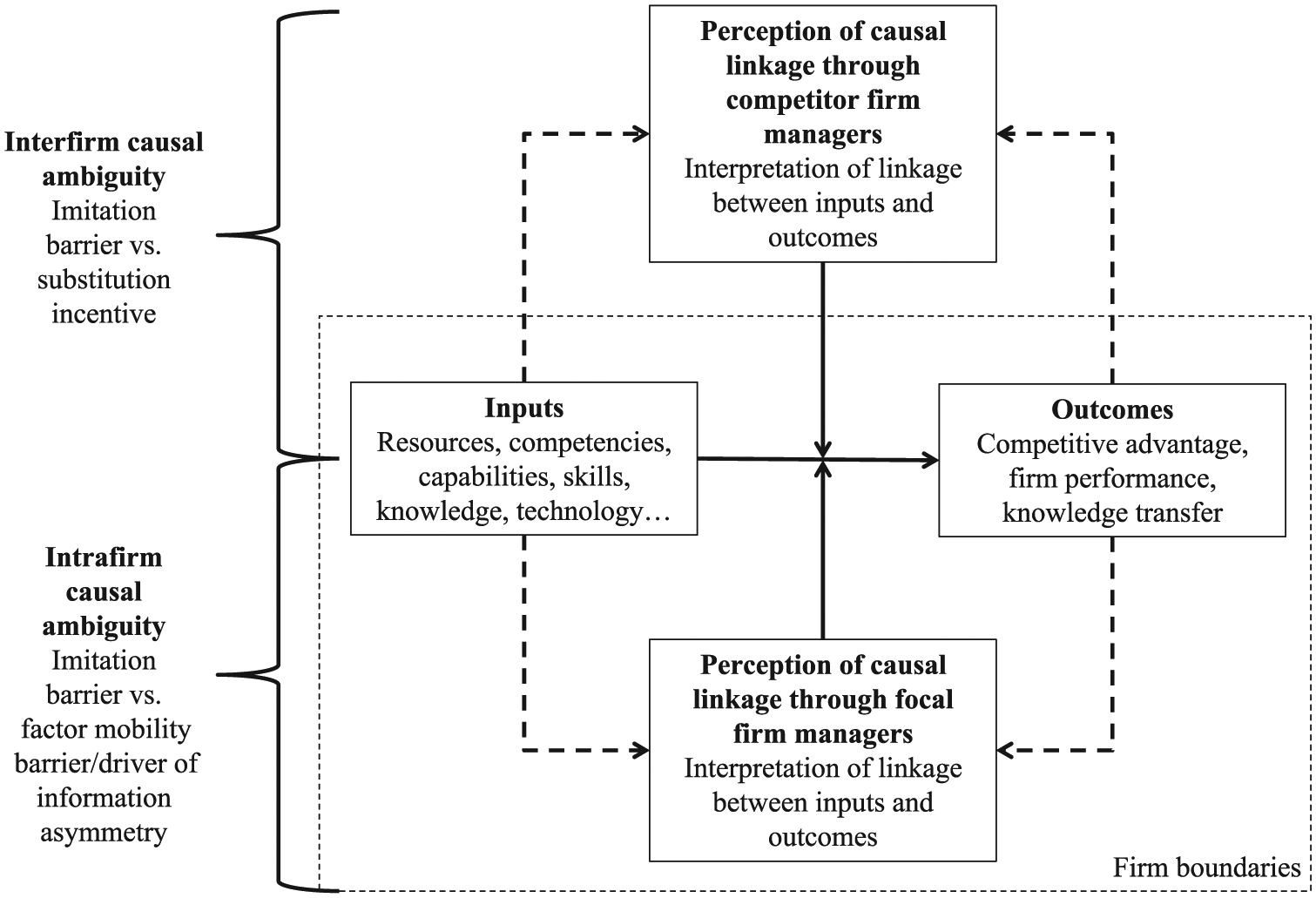
Interfirm Versus Intrafirm Causal Ambiguity
In addition to different assumptions regarding (a)symmetry of causal ambiguity across organizations, scholars discuss the implications of how perceptions of causal ambiguity are distributed within firms (Coff, 1999; Mosakowski, 1997). Mosakowski (1997) elaborated on that topic, differentiating between conditions of shared causal ambiguity (all decision makers do not possess the complete picture of causal relationships), the absence of causal ambiguity (all decision makers do possess the complete picture of causal relationships), and asymmetric causal ambiguity (some decision makers possess a more complete picture than others). Previous research on asymmetric causal ambiguity within firms has particularly focused on problems associated with the moral hazard that results from the superiority of insights into causal connections between organizational inputs and outcomes possessed by some organizational actors. For example, Coff and colleagues (Blyler & Coff, 2003; Coff, 1997, 1999; Coff & Kryscynski, 2011) have elaborated on stakeholder bargaining problems. These result from the differences in perceptions of causal ambiguity by stakeholders. They argue that because some actors have more information than others (their bargaining partners) about how the firm works, and how they contribute to organizational success or failure, the advantaged actors face reduced levels of causal ambiguity and may appropriate rents that are generated from their information advantage.
An Organizing Framework Mapping Causal Ambiguity Research Streams
The review of the conceptual foundations of causal ambiguity and approaches toward its operationalization has highlighted the equivocality of the concept. In what follows, we synthesize the literature further and present an overview of empirical findings related to the consequences of causal ambiguity. Our integrative framework highlights the various foci of the dominant research streams and the remaining challenges that pertain to each stream (see Figure 3). To develop our framework, and suggestions for advancing research, we analyzed extant conceptual models (e.g., King, 2007; Powell et al., 2006) and drew on the established procedure of analyzing antecedents, moderators, and consequences of a particular phenomenon (Short, 2009).
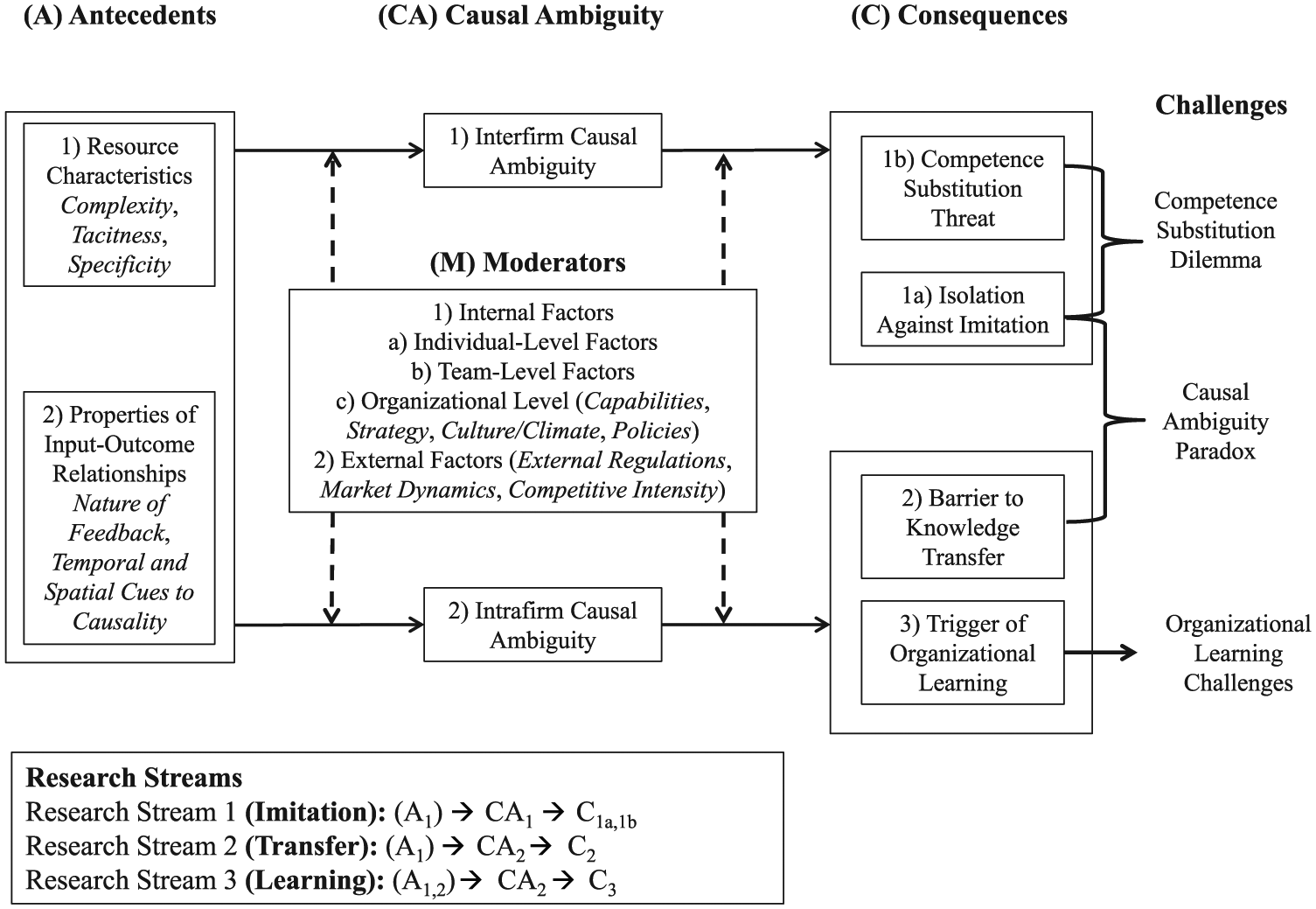
A Framework of Causal Ambiguity Research
Stream 1: Interfirm Causal Ambiguity as a Barrier to Imitation
With the emergence of the RbV as one of the dominant paradigms in strategic management, scholars have largely adopted Lippman and Rumelt’s (1982) conception of causal ambiguity to explain the sustainability of resource-based advantage. Here, causal ambiguity is identified as an important isolating mechanism (Rumelt, 1984), a barrier to imitation (Barney, 1991; Dierickx & Cool, 1989), and an ex post limit to competition (Peteraf, 1993), enabling firms to sustain rents from superior resource possession and deployment. Because causal ambiguity often suggests that something works, but not exactly why (Kaul, 2013; Mathews, 2003), competitors are thwarted in imitating those resource combinations that lead to success (for a review of research on imitation, see Ordanini, Rubera, & DeFillippi, 2008). As a consequence, Reed and DeFillippi suggest that deliberate investments in “competencies that can be simultaneous sources of advantage and ambiguity” (1990: 91) can improve the competitive position of firms. Inspired by seminal works underlining the crucial role of causal ambiguity for shielding resources against imitation, studies based on the RbV mainly stress how causal ambiguity leads to positive effects for achieving and sustaining competitive advantage (e.g., Harrison, Bosse, & Philipps, 2010; Lei, Hitt, & Bettis, 1996).
Empirical evidence
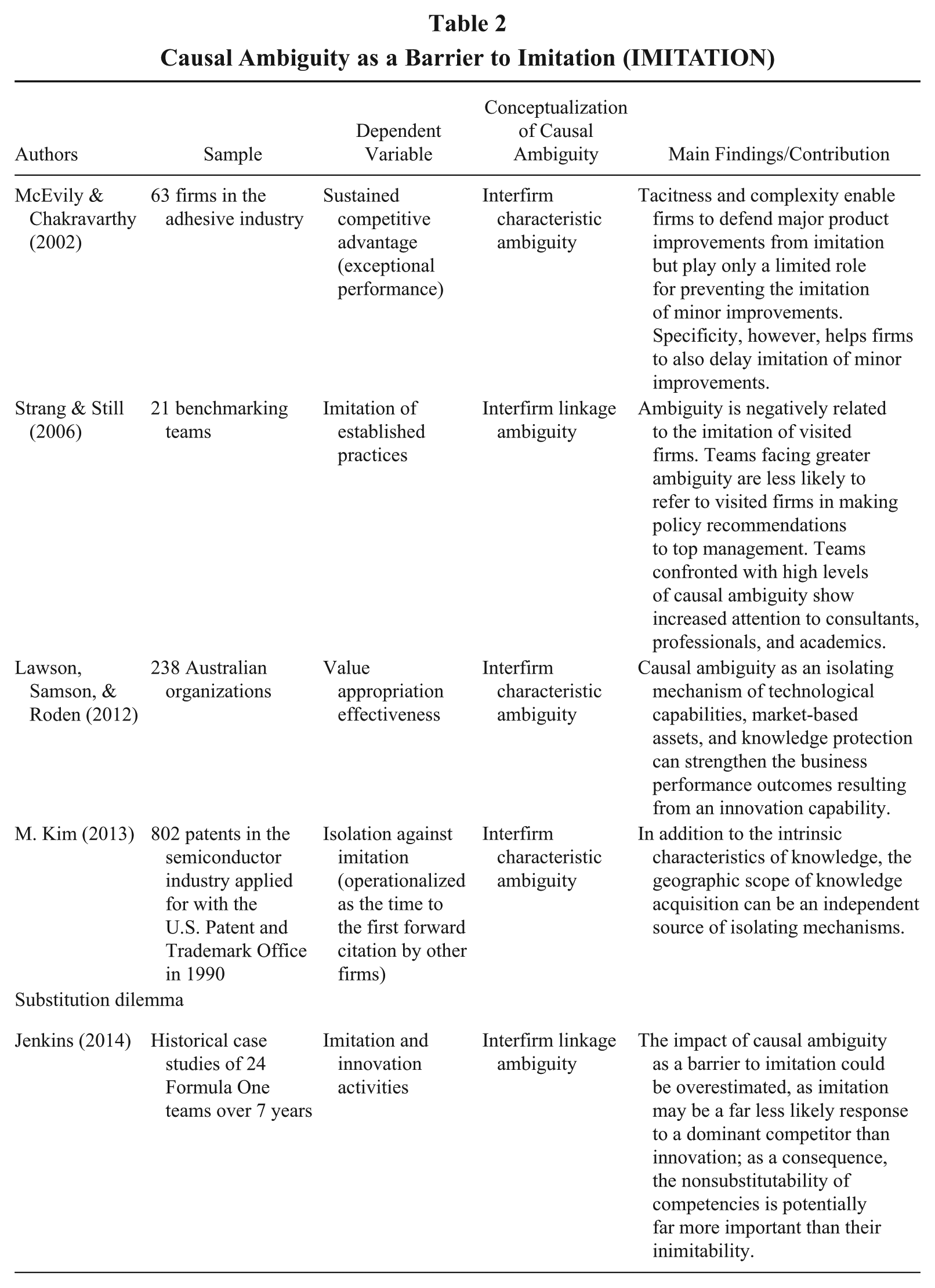
There is empirical support for the claim that causal ambiguity reduces the threat of imitation and enhances firm performance. Drawing on conceptual insights put forward by Reed and DeFillippi (1990), empirical research especially focused on tacitness, complexity, and specificity of firm competencies as factors that prevent imitation and prolong exceptional performance (Lawson, Samson, & Roden, 2012; McEvily & Chakravarthy, 2002). However, these factors vary in their impact. In their study of 63 firms in the adhesive industry, McEvily and Chakravarthy (2002) show that tacitness and complexity enable firms to defend major product improvements from imitation but play only a limited role in preventing the imitation of minor improvements. Specificity also helped firms to delay the imitation of minor improvements. In an international context, M. Kim (2013) further substantiated the finding that resource characteristics lead to causal ambiguity. His findings also show that the embeddedness of knowledge in the networks of a country leads to information asymmetry between firm “insiders” and “outsiders” and complements tacitness, complexity, and specificity as a knowledge-based antecedent of causal ambiguity.
Leveraging empirical insights also allows us to better understand how causal ambiguity operates as an isolating mechanism. For instance, Strang and Still (2006) examined the connection between causal ambiguity and imitation from the perspective of 21 benchmarking teams. Their study indicates that benchmarking teams, confronted with high levels of ambiguity, reduce their imitation efforts and shift attention toward consultants, professionals, and academics. Finally, on the basis of a quantitative analysis of 238 Australian organizations, and subsequent case studies of 6 of these firms, Lawson et al. (2012) show that causal ambiguity complements asset-stock effects and property-right regimes as an effective isolating mechanism that helps to increase competitiveness. Their case study evidence also connects to the extant body of research on causal ambiguity in the RbV tradition by suggesting that managers especially attribute superior firm performance to causally ambiguous knowledge characteristics such as tacitness and complexity.
Key insights of the imitation stream
Given the general acceptance of the RbV argument that causal ambiguity deters imitation and secures competitive advantage, there are comparatively few studies testing this proposition. Extant research in this vein, however, mainly supports RbV tenets. In particular, findings show that various input characteristics (tacitness, complexity, specificity), as well as knowledge embeddedness, lead to interfirm causal ambiguity and that interfirm causal ambiguity, in turn, prevents imitation.
The ensuing challenge: The substitution dilemma
While causal ambiguity plays an important role as a barrier to competence imitation by competitors, such inability to imitate might increase competitors’ investments in innovation for achieving competence substitution. Hence, the tension between causal ambiguity’s performance-enhancing effects as an imitation barrier and its potential performance-reducing effects as a trigger of competence substitution leads to the substitution dilemma. In a seminal article on the phenomenon, McEvily et al. (2000) argue that communicating core elements of their business models and credibly persuading potential competitors that alternative business models cannot lead to similar success could help firms to delay substitution. Ryall (2009) also points out that interfirm causal ambiguity might lead competitors to invest in competence substitution, providing a skeptical view of its role in sustaining performance differentials. In his formal analysis of the concept, he indicates that causal ambiguity may serve as a necessary condition for creating a competitive advantage but not as a sufficient condition for sustaining it. This argument was further substantiated by Jenkins (2014) empirical study on Formula 1 racing teams, connecting ambiguity to competence substitution. He demonstrates that the RbV’s focus on imitability might be misplaced, as—under conditions of high causal ambiguity—innovation seemed to be a more likely response by competitors than imitation.
Table 2 summarizes the studies core to this stream.
Causal Ambiguity as a Barrier to Imitation (IMITATION)
Stream 2: Intrafirm Causal Ambiguity as a Barrier to Factor Mobility
The knowledge-based view (KbV) emerged as an important approach that shares most of the RbV’s basic assumptions. The KbV focuses on knowledge as the most important organizational resource and as a foundation of competitive advantage (Grant, 1996; Spender, 1996). Along with the focus on knowledge came increasing interest in the dynamics of leveraging knowledge through intra- and interorganizational knowledge transfer (Argote & Ingram, 2000; van Wijk et al., 2008) as well as knowledge sharing in networks (Foss, Husted, & Michailova, 2010; Kogut & Zander, 1992; Priestley & Samaddar, 2007). One major dividing line between the RbV and the KbV concerns causal ambiguity’s role for firm performance. While it is seen as beneficial from the classic RbV, the proponents of the KbV argue that it reduces the chances of successful knowledge transfer endeavors (Fang, Yang, & Hsu, 2013; Law, 2014), thus restricting a firm’s ability to enhance firm performance through leveraging knowledge.
Empirical evidence
Empirical studies underline the critical role of causal ambiguity for knowledge transfer. Studies in this stream analyze direct and moderating effects of causal ambiguity during the transfer of practices, knowledge, and technology in intra- and interorganizational settings. Studies investigating the direct impact of causal ambiguity on knowledge transfer indicate a negative relationship between both. In a seminal work on barriers to factor mobility, Szulanski (1996) demonstrates that causal ambiguity increases knowledge stickiness, preventing best practice transfer within firms. This conclusion is further substantiated by Wellstein and Kieser (2011), who analyzed best practice transfer within the management consultancy context. Findings on technology transfer in manufacturing firms complement our understanding by indicating that causal ambiguity complicates not only the transfer of technology but also its subsequent application (Lin, 2003).
Several studies further extend our understanding of the negative impact of causal ambiguity on interorganizational knowledge transfer. These studies find that tacitness and complexity, as well as cultural and organizational distance (between knowledge sender and knowledge receiver), lead to ambiguity in strategic alliances (Simonin, 1999). They also show that protectiveness increases ambiguity, which complicates knowledge transfer in new product development (NPD) collaborations (Lawson & Potter, 2012). In addition, a study within the context of corporate acquisitions shows that causal ambiguity of the acquirer’s knowledge complicates knowledge transfer from the acquirer to the target and that causal ambiguity of the target’s knowledge is associated negatively with knowledge transfer from the target to the acquirer (Junni & Sarala, 2012).
Research into the role of causal ambiguity in knowledge transfer settings has also investigated the moderating effects of causal ambiguity in such contexts. In a seminal study addressing the moderating effects of causal ambiguity, Szulanski, Cappetta, and Jensen (2004) demonstrate that causal ambiguity moderates the relationship between the perception of a source’s trustworthiness and the level of accuracy of template reproduction. 2 Their findings indicate that under conditions of high causal ambiguity, perceived trustworthiness may become counterproductive because it leads to a lack of attention and accuracy in knowledge transfer, ultimately hampering a firm’s ability to leverage knowledge. Further findings in that vein show that high levels of causal ambiguity weaken the positive effect of an acquisition target’s attractiveness with regard to knowledge transfer (Junni & Sarala, 2012) and that under such high levels of causal ambiguity, tacit knowledge exchange should be given high priority during the initiation phase of the knowledge transfer (Szulanski, Ringov, & Jensen, 2016).
Research has focused not only on causal ambiguity as a moderating factor but also on the factors that moderate the effect of causal ambiguity on knowledge transfer performance. Drawing on data from 186 dyadic knowledge transfer projects in 25 multinational corporations, Lind and Kang (2017) demonstrate that causal ambiguity is negatively related to knowledge transfer efficiency and effectiveness and that monitoring and involvement by headquarters has a negative impact on transfer efficiency in situations of high causal ambiguity. Scholars also provide insights by examining what reduces the negative impact of causal ambiguity. The key findings are that a strong relationship between the sender and receiver of knowledge in transfer settings reduces the negative impact of causal ambiguity on knowledge transfer performance (Ditillo, 2012; Lee, Chang, Liu, & Yang, 2007) and that information and communication technology competencies also mitigate such negative effects (Sheng et al., 2013). These findings are in line with insights from Simonin’s (1999) seminal study that demonstrates that a firm’s learning capacity, operationalized as investments in information sharing during the transfer, reduced the negative effects of causal ambiguity.
Key insights of the factor mobility stream
In contrast to studies focusing on causal ambiguity as an isolating mechanism, studies in this research stream analyze the effects of causal ambiguity in contexts where knowledge transfer is desired. Findings consistently show that causal ambiguity has a negative effect on knowledge transfer and underline the importance of input characteristics, especially tacitness, and characteristics of the knowledge transfer context as antecedents of causal ambiguity. They also highlight the detrimental effects of linkage ambiguity for knowledge transfer. Some studies, however, also emphasize factors that may contribute to reducing the negative effect of causal ambiguity, such as social relationships of competencies that facilitate learning.
The ensuing challenge: The causal ambiguity paradox
While many studies based on the RbV portray the benefits of creating causal ambiguity, works anchored in other research streams have emphasized the detrimental performance effects of causal ambiguity. This paradoxical role, concurrently influencing the ease of intrafirm knowledge transfer and interfirm imitation, was already highlighted by Lippman and Rumelt, who argue that “ambiguity as to what factors are responsible for superior (or inferior) performance acts as a powerful block on both imitation and factor mobility” (1982: 420). Because of this dual role, Lado et al. refer to the concept as “a mixed blessing for RBV scholarship” (2006: 121).
Studies analyzing the causal ambiguity paradox have essentially adopted one of two approaches. One approach draws on the assumption that different types of causal ambiguity (characteristic and linkage ambiguity), having different origins and performance implications, coexist within firms. The underlying assumption here is that characteristic ambiguity has strong effects preventing imitation, while linkage ambiguity has strong effects impeding factor mobility. Resolving the paradox involves measuring and comparing the performance consequences of both types. Another approach distinguishes the intrafirm and interfirm performance implications of causal ambiguity. Intrafirm causal ambiguity is ambiguity perceived by managers and generally assumed to have negative performance effects because it restricts factor mobility. Interfirm causal ambiguity is ambiguity perceived by rivals and generally assumed to have positive performance implications because it restricts imitation. The net performance effects of causal ambiguity are then determined by measuring the performance differentials of intrafirm and interfirm causal ambiguity.
Empirical findings investigating the performance effects of different types of intrafirm causal ambiguity indicate that linkage ambiguity and characteristic ambiguity have opposing effects on firm performance. King and Zeithaml (2001) were the first to empirically approach the causal ambiguity paradox by distinguishing types of causal ambiguity by their origin. Their study provides evidence that linkage ambiguity among top and middle managers is negatively associated with firm performance. High levels of characteristic ambiguity, however, are positively linked with firm performance. Beleska-Spasova and Glaister (2013) confirmed King and Zeithaml’s findings.
Studies focusing on the net performance effects of intrafirm and interfirm causal ambiguity generally support the idea that the negative performance effects of intrafirm ambiguity are stronger than the positive performance effects of interfirm ambiguity (González-Álvarez & Muñoz-Doyague, 2006; González-Álvarez & Nieto-Antolin, 2005; Hansen et al., 2013). Research in this vein also elaborates factors that influence this effect. A study investigating the causal ambiguity paradox by analyzing data from Spanish manufacturing firms indicates that the use of high involvement human resource (HR) practices reduces the negative effects of intrafirm causal ambiguity (González-Álvarez & Muñoz-Doyague, 2006). Drawing on data from manufacturing firms in the United Kingdom, Hansen et al. (2013) corroborate the insight that the negative effects of intrafirm causal ambiguity outweigh the positive effects of interfirm causal ambiguity. Interestingly, their findings also indicate that the relationship between interfirm causal ambiguity and competitiveness diminishes when industry competitive intensity is lower, suggesting that environmental dynamics are an important moderator of the causal ambiguity–performance link. A further moderator proposed in the literature is long-term relationships with stakeholders. A study by Potter and Lawson (2013) shows such relationships reduce the level of causal ambiguity experienced within NPD teams. With regard to performance outcomes, the authors find that although causal ambiguity acts as a significant barrier to project performance, it has no significant effect on the time taken for competitors to imitate a new product.
Table 3 summarizes the studies core to this stream.
Causal Ambiguity as Barrier to (Factor) Mobility/Knowledge Transfer (MOBILITY)
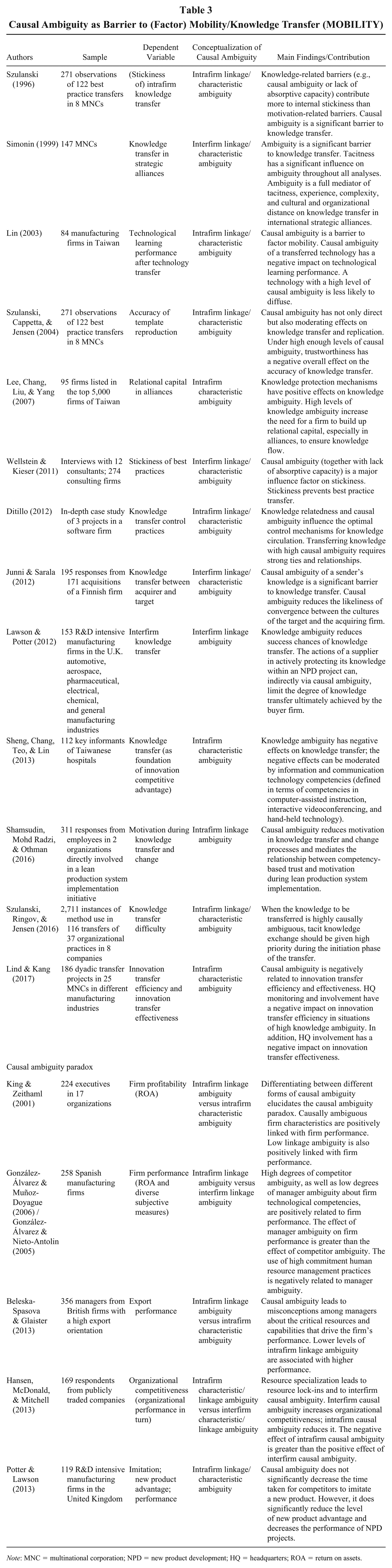
Note: MNC = multinational corporation; NPD = new product development; HQ = headquarters; ROA = return on assets.
Stream 3: Intrafirm Causal Ambiguity as a Trigger of Organizational Learning
We identified organizational learning as a third stream in causal ambiguity research. Although studies in this stream acknowledge its role as a barrier to learning, they emphasize especially the ability of individuals to manage causal ambiguity through taking actions to stimulate organizational learning. Approaches focusing on managerial reactions to perceptions of causal ambiguity hence assume that organizational decision makers “know what they do not know” and react accordingly in a—bounded, but still—rational manner by proactively engaging in actions aimed at reducing ambiguity. Zollo and Winter (2002), for example, propose that experience accumulation, knowledge articulation, and knowledge codification serve as learning mechanisms that enable firms to systematically enhance their understanding of the causal linkages between the actions they take and the performance outcomes obtained.
Elaborating what firms could do to enhance their causal understanding of action-outcome relationships, Warren (2005) argues that using time charts could facilitate a causal tracking of resource stocks and flows over time and therefore help overcome ambiguity by establishing logical chains of causality. The idea of tracking is also implicit in Ambrosini and Bowman (2010), who analyzed the consequences for competitive advantage and rent appropriation that stem from different combinations of linkage and characteristic ambiguity, advocating active management of causal ambiguity. They argue that resources are likely to become sources of sustained competitive advantage whenever there are high levels of both linkage and characteristic ambiguity. Other works particularly emphasize learning in the sense of causal ambiguity reduction as a core element of managing mergers and acquisitions (M&A). Such works conceptually substantiate the argument that causal ambiguity impedes the generation of synergies during M&A (Fiorentino & Garzella, 2015) and that causal ambiguity reduction is one of the core tasks during M&A that helps to increase the effectiveness of postmerger integration (Lakshman, 2011).
Empirical evidence
Extant studies especially analyze how decision makers can overcome ambiguity to improve their causal maps and understanding. In her seminal work, Mosakowski (1997) shows that decision makers’ interpretations of outcomes that are produced by their actions lead them to modify causal maps in “baby steps,” which facilitates improved understanding of their competitive environment, incrementally. Her study indicates that decision makers can reduce ambiguity through experimentation.
Subsequent studies have further deepened our understanding as to how the facilitation of learning enables firms to overcome causal ambiguity and stimulate innovation. Empirical evidence stresses the positive implications of adopting strategic planning tools such as the balanced score card for reducing causal ambiguity (González, Calderón, & González, 2012) and highlights the contribution of causal mapping for developing greater strategic clarity (Ambrosini & Bowman, 2005, 2008). Moreover, Brun and Sætre (2008) and Brun, Sætre, and Gjelsvik (2008, 2009) explored causal ambiguity in NPD projects. Their findings indicate that through applying a hypothetical-deductive method, which builds on continuously testing and revising those hypotheses that are embedded in interpretations, ambiguity can be reduced. The importance of trying to reduce causal ambiguity is substantiated by two studies: Laursen and Andersen (2016) and Lakshman, Kumra, and Adhikari (2017). The former shows that high levels of causal ambiguity in the early phases of NPD processes lead to a lack of role clarity among the parties involved in the processes, impeding the mobilization of resources and stimulating behaviors aimed at role clarification in buyer-supplier relationships. The latter indicates that the relationship of proactive market orientation and innovation capability was stronger for firms displaying lower levels of causal ambiguity than higher, which also highlights the importance of learning for decreasing intrafirm causal ambiguity.
Research linking causal ambiguity to organizational learning has especially investigated learning in the context of acquisitions, alliances, and market entry, as those are processes that usually involve substantial levels of causal ambiguity. Studies with this focus also examine how to diminish its negative impact. Two studies explicitly focus on the role of learning in causally ambiguous M&A contexts. Cording et al. (2008) suggest that defining intermediate goals serves as a means to support strategic learning. They also explain that breaking down the complex causal chain between integration decisions and acquisition performance into more manageable segments reduces causal ambiguity and enhances acquisition performance. Castellaneta and Conti (2017) argue that acquisition experience stimulates learning to select acquisition targets rather than learning to restructure because the acquisition stage is less causally ambiguous than the restructuring phase and hence allows for learning. A study within the context of strategic alliances indicates that the use of long- and short-term assignments, awareness visits, and workshops are organizational processes that can help to overcome causal ambiguity (Inkpen, 2008). Finally, Kaufmann and Roesch (2012) identify high levels of causal ambiguity as a factor that lowered motivation of decision makers in Chinese emerging market firms following a low-cost strategy to invest in marketing capabilities. Their findings, however, also show that the presence of experienced managers weakens this constraining effect.
Key insights of the organizational learning stream
This stream focuses less on resource characteristics as antecedents of causal ambiguity than the previous two streams and concentrates on perceptions of causal linkages and their implications for firm performance instead. The majority of the findings indicate that because managers experience the negative performance implications of intrafirm causal ambiguity, the perception of causal ambiguity leads to an increase in learning efforts. Studies in this stream of research also place a greater emphasis on how actors actually deal with causal ambiguity and tend to discuss potential solutions for overcoming causal ambiguity. Despite being critical for understanding how to manage causal ambiguity, studies analyzing how perceptions of causality develop over time are still rare.
The ensuing challenge: Organizational learning under ambiguity
While causal ambiguity seems to generally stimulate learning efforts, it can also potentially impede the learning effectiveness of organizations, especially if decision makers attribute outcomes to organizational actions despite there being little or no causal linkage between them. The consequence is superstitious learning. It “occurs when the subjective experience of learning is compelling, but the connections between actions and outcomes are misspecified” (Levitt & March, 1988: 325), and it leads to detrimental performance effects.
Empirical studies investigating superstitious learning are often rooted in behavioral theory. By examining the detrimental performance effects of premature generalization and overconfidence, these studies elucidate the process of superstitious learning (e.g., Heimeriks, 2010; J. Y. Kim, Kim, & Miner, 2007; D. Miller, Droge, & Vickery, 1997; Pozner, Stimmler, & Hirsch, 2010; Schwab, 2007). They contribute to our understanding of how misspecifications of causality and dysfunctional learning effects are connected. Zollo (2009), for example, investigated superstitious learning in rare strategic events by analyzing survey data of acquisitions in the U.S. commercial banking sector. Zollo’s analysis shows that outcome ambiguity enhances the risk of superstitious learning, though “deliberate learning investments and experience heterogeneity tend to counteract the negative consequences of experience accumulation on the likelihood of superstitious learning to occur” (897). In their study in the global aircraft industry, Mulotte et al. (2013) also elaborate on the negative effects of overconfidence on learning in causally ambiguous settings. They examined how preentry licensing affects subsequent independent operation performance. The findings of Mulotte et al. show that firms that gather experience and prove successful during prelicensing stages tend to become overconfident, which later “leads them to apply lessons they believe they have learned and to take inappropriate actions that can damage future success” (360).
While the works of Zollo (2009) and Mulotte et al. (2013) particularly focused on overconfidence as a trigger of superstitious learning, current studies of causal ambiguity’s negative impact on learning effectiveness have improved our understanding of the phenomenon by elaborating further triggers of superstitious learning. For instance, Ghosh, Martin, Pennings, and Wezel (2014) argue that causal ambiguity hampers learning effectiveness because it leads to inappropriate generalizations and negative experience transfer. Their findings, in line with Zollo’s arguments, indicate that firms can mitigate this risk by increasing managerial attention on learning and focusing search behavior. In addition, research emphasizes the role of oversimplification and the ensuing development of inaccurate rules of thumb as a trigger of superstitious learning (Brauer, Mammen, & Luger, 2017). Finally, J. Miller (2012) provides a study connecting mimicking behavior and superstitious learning. He combines theoretical assumptions from behavioral and institutional theory and investigates whether mimicking behavior increases or reduces firm mortality. His findings indicate that mimetic isomorphism in an emerging industry reduces survival chances when there is high causal ambiguity, as it stimulates superstitious learning, which in turn leads to failure.
Table 4 summarizes the studies core to this stream.
Causal Ambiguity as a Trigger of Learning (LEARNING)
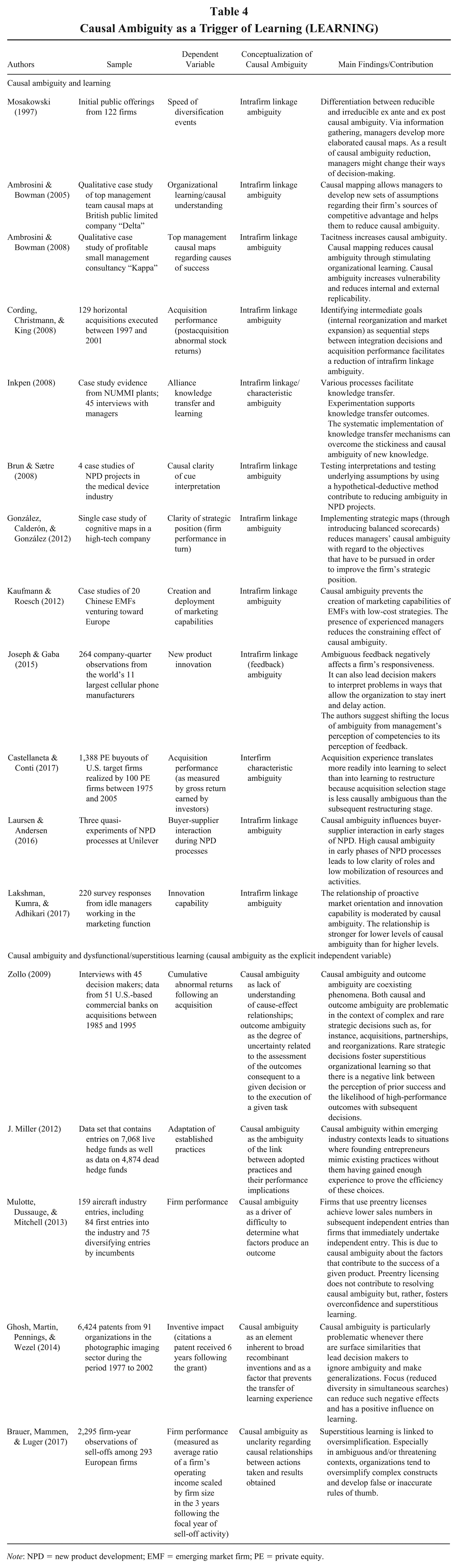
Note: NPD = new product development; EMF = emerging market firm; PE = private equity.
Practical Implications
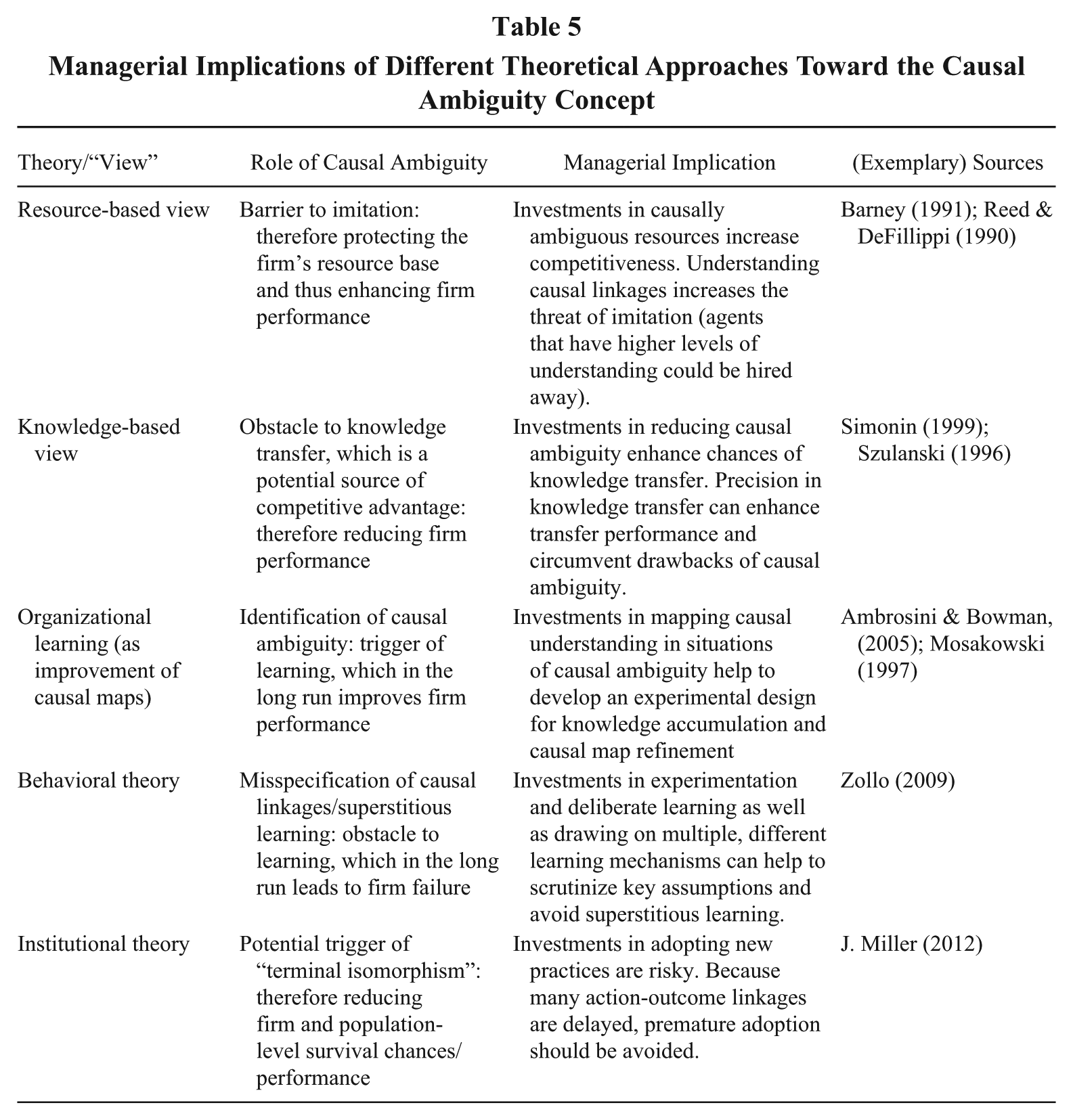
Synthesizing causal ambiguity research shows that the concept has attracted (and still attracts) research from various theoretical perspectives, reflecting general trends in management research. Extant research has also developed some practical and prescriptive implications. While they are limited, we reviewed them (see Table 5), and in what follows we outline the variety of theoretical views on the concept regarding the practical implications for dealing with causal ambiguity.
Managerial Implications of Different Theoretical Approaches Toward the Causal Ambiguity Concept
An Overview of Suggestions From the Literature
Research grounded in the RbV regards causal ambiguity as a mechanism that supports rent appropriation (Lawson et al., 2012) and stresses the importance for firms of investing in resources that are a source of causal ambiguity (Reed & DeFillippi, 1990). Research on knowledge transfer and routine replication (Szulanski, 1996) highlights the downsides of investing in resources that lead to causal ambiguity. The implications for managers dealing with causal ambiguity in such settings include close monitoring of knowledge transfer processes (Szulanski et al., 2004; Wellstein & Kieser, 2011) and the development of competencies that weaken the impact of causal ambiguity on knowledge transfer (Sheng et al., 2013; Simonin, 1999). Studies analyzing the net performance effects of causal ambiguity as an interfirm imitation barrier, and as an intrafirm factor mobility barrier, emphasize that firms should take actions to decrease linkage ambiguity while simultaneously increasing characteristic ambiguity (Beleska-Spasova & Glaister, 2013; King & Zeithaml, 2001).
Research connecting causal ambiguity to organizational learning either focuses on how causal ambiguity triggers learning and how decision makers cope with ambiguity or elaborates the negative effects that causal ambiguity can have on learning effectiveness. The first stream underlines the importance of perceptions of causal ambiguity as a starting point for organizational learning. On the basis of their perception, decision makers can, and should, take actions to become better informed and, thus, reduce ambiguity, for example, through trial and error experimentation (Mosakowski, 1997), hypothesis testing (Brun & Sætre, 2008, 2009), modularization (Cording et al., 2008), causal mapping (Ambrosini & Bowman, 2005), or utilizing strategic tools (González et al., 2012).
The second stream focuses on superstitious learning that results from decision makers’ misspecifications of causal linkages (Levitt & March, 1988). While most research on superstitious learning is rooted in behavioral theory investigating how prior decisions lead to overconfidence that results in misspecification of causal links (e.g., Mulotte et al., 2013; Zollo, 2009), some works are rooted in institutional theory investigating the performance consequences of “blind” mimetic isomorphism (J. Miller, 2012). To reduce the risk of superstitious learning, managers should deliberately counteract overconfidence through systematically reflecting on their decisions (e.g., through counterfactual thinking, the initiation of reflection circles, or collaboration with consultants or boards) and through investing in mechanisms that enable them to experiment and learn.
Further Practical Implications
Despite 35 years of research on causal ambiguity, as we can see above, research is only beginning to capture the exploratory power of the construct and what it means for practice. This is, however, important, as managers and employees need to unlock their organization’s entire potential to develop or maintain their advantage. One possible recommendation is that while causal ambiguity is a mixed blessing, managers and employees have to become comfortable in such an environment and learn to accept that causal ambiguity is part of organizational reality. By doing so, they might be less frustrated in their mentoring or control efforts and be more cognizant of the limitations of their agency. Moreover, furthering some of the practical implications regarding whether managers should attempt to intervene and reduce causal ambiguity, beyond giving managers the ability to understand their source of advantage better and to nurture it, one other practical reason for doing so would be succession planning. Arguably, it would be easier to take charge of a company if there is low causal ambiguity. In the same vein, if managers recognize that causal ambiguity is present in organizations and their understanding is incomplete, they may, in turn, realize that management consultants’ prescriptions may have limited value. If it is problematic for managers to fully understand their advantage, it is probable that prescriptions provided by external agents may not be fully appropriate or beneficial.
Integration and Avenues for Further Research
By mapping and assessing the intellectual territory of causal ambiguity research, this review also facilitates the identification of avenues for further research. Opportunities to deepen our understanding of causal ambiguity include further investigations of antecedents, moderators, and consequences. 3 In the following, we consider each in turn (see Figure 3 for further elucidation of the antecedent, moderator, and consequence abbreviations given), ending each subsection with a set of questions that have the potential to improve our understanding of causal ambiguity. These questions are not meant to be exhaustive but to illustrate further possible research directions.
Antecedents
In our review, we identified various antecedents of causal ambiguity. We believe that analyzing how these antecedents interact, examining which are the strongest triggers of causal ambiguity, and investigating how they relate to superstitious learning are important avenues for further research.
Input characteristics (A1)
Inspired by seminal conceptual work provided by Reed and DeFillippi (1990), previous research on antecedents has especially examined the effects of tacitness, complexity, and specificity and mainly confirmed their strong impact on causal ambiguity (e.g., M. Kim, 2013; King & Zeithaml, 2001; McEvily & Chakravarthy, 2002). Understanding how such resource characteristics influence perceptions of causal ambiguity is important for deriving implications regarding the management of the firm’s resource and capability base. Further research could help to develop a more nuanced view of this relationship:
What is the optimal level of tacitness, complexity, and specificity that helps to maintain interfirm causal ambiguity while keeping intrafirm causal ambiguity manageable?
Are perceptions of causal ambiguity more strongly associated with ambiguity stemming from one resource or a set of resources? Is this different for interfirm or intrafirm causal ambiguity?
How do the types of resources and the ease of transferability matter? Which resources matter the most? Does it make a difference whether perceptions of causal ambiguity stem from tangible resources such as technology versus intangible resources such as organizational culture or (dynamic) capabilities?
Properties of input-outcome relationships (A2)
We know from previous research that spatial and temporal distance between deploying a resource and obtaining the outcomes of resource deployment affect the occurrence of causal ambiguity (M. Kim, 2013; King, 2007). However, despite the importance of spatial and temporal distance for understanding causal ambiguity, research of these antecedents is scarce. We believe that the dominant focus on the more easily measurable resource characteristics as antecedents of causal ambiguity has contributed to this neglect. More explicitly taking into account linkage characteristics of input-outcome relationships would imply shifting attention from separate resources and their characteristics to the relationships between actions (i.e., resource deployment) and outcomes. Paying closer attention to particular feedback properties, such as consistency or delay (Joseph & Gaba, 2015; Luoma, Ruutu, King, & Tikkanen, 2017; Rahmandad, Repenning, & Sterman, 2009), that may influence perceptions of ambiguity, could help to better understand the antecedents of causal ambiguity:
Which effects do spatial and temporal distance have on interfirm and intrafirm causal ambiguity?
(How) Does spatial and temporal distance influence learning effectiveness in response to perceptions of causal ambiguity?
How do codification and modularization affect the influence of spatial and temporal distance on causal ambiguity?
Moderators
Our analysis differentiates between firm internal and external factors that influence how causal ambiguity is perceived and how it affects firm performance. We identify internal factors on the individual, team, and organizational levels. External influence factors comprise features of the firm’s environment.
Internal individual-level factors (M1a)
Given that causal ambiguity is generally framed as a cognitive construct that exists only in managerial perception (King, 2007; Powell et al., 2006), the lack of studies analyzing how decision-maker characteristics influence the perception of causal ambiguity is surprising. This is especially so against the backdrop of the broad variety of research focusing on the effects of managerial characteristics and cognitions (Eggers & Kaplan, 2013; Hambrick, 2007; Narayanan, Zane, & Kemmerer, 2011) and works that call for further research on behavioral strategy (Powell, Lovallo, & Fox, 2011). Investigating in depth how managerial characteristics and cognition are connected to perceptions of causal ambiguity could help to better understand how linkage ambiguity emerges and develops and how and why perceptions of causal ambiguity differ between decision makers in the same firm as well as across firms. Similarly, causal ambiguity research has typically focused on top and middle managers, whereas there is a need to also improve our understanding of its effects on other layers of the organization:
How does personality, or individual characteristics such as narcissism and hubris, influence the perception of causal ambiguity? How does motivation affect perceptions of causal ambiguity and actions to deal with it?
How can concepts such as dynamic managerial capabilities (Helfat & Martin, 2015) and managerial cognitive capabilities (Hodgkinson & Healey, 2011) help to better understand causal ambiguity? What role does managerial human capital play in the perception of causal ambiguity? Do education and training reduce the influence of causal ambiguity? How do social capital and the network position of actors influence causal ambiguity?
What role do heuristics or simple rules play in the perception of causal ambiguity? Under what conditions can they help to reduce perceptions of causal ambiguity, and when do they increase the risk of engaging in superstitious learning?
Internal team-level factors (M1b)
We encourage researchers to engage in examinations of causal ambiguity in management teams and workgroups. Previous research has often taken measures of the perceptions of causal ambiguity by one decision maker as a proxy for causal ambiguity within firms. Prior works that have focused on the effects of asymmetric intrafirm causal ambiguity (Mosakowski, 1997) have particularly focused on problems of moral hazard in bargaining situations (Coff, 1999). We believe that analyzing the factors that influence different perceptions of causal ambiguity and reactions to it at an interpersonal level could enhance our knowledge about how organizations deal with causal ambiguity:
How do characteristics of management teams influence causal ambiguity?
Does diversity lead to an increase or decrease of causal ambiguity?
Do teams in well-performing organizations perceive a lower level of causal ambiguity than teams in poorly performing organizations?
Internal organizational-level factors (M1c)
Research indicates that organizational capabilities, firm strategies, cultural characteristics, or policies influence the level of causal ambiguity. For instance, a firm’s learning capacity (Simonin, 1999) and information and communication technology competencies (Sheng et al., 2013) have been identified as factors that reduce potential negative effects of causal ambiguity in knowledge transfer settings. How firm competencies exert such influence is an important topic for further research. There are also only limited insights available as to how causal ambiguity is connected to firm strategy. Extant research indicates that firm strategies influence the resources available for firms and imply whether firms perceive causal ambiguity as a barrier to invest or as a trigger for learning (e.g., Kaufmann & Roesch, 2012). Further research could help to deliver more in-depth insights into this relationship. Policies that increase protectiveness (such as restrictions in dealing with knowledge; Simonin, 1999) or commitment (such as implementing high-involvement work systems; González-Álvarez & Muñoz-Doyague, 2006) can also influence the level of causal ambiguity perceived. More research could help to substantiate moderating effects on the antecedent–causal ambiguity and on the causal ambiguity–performance relationship. In addition, we believe that investigating how particular characteristics of organizational culture or formal regulations are connected to causal ambiguity represents a further research avenue:
What types of (dynamic) capabilities help firms to decrease interfirm or intrafirm causal ambiguity?
How are a firm’s strategies related to perceptions of and reactions to intrafirm and interfirm causal ambiguity?
How do HR systems (e.g., high-involvement or high-performance work systems) interrelate with causal ambiguity? What HR policies and practices have the greatest impact on causal ambiguity? Do terms of corporate governance influence causal ambiguity, that is, do managers who have to report externally about their organizations perceive less ambiguity than those who do not?
How do the characteristics of organizational culture or climate influence causal ambiguity or superstitious learning? How is psychological safety related to causal ambiguity?
External factors (M2)
Environmental characteristics could also play an important role as moderators of the relationship between causal ambiguity and performance but are still underresearched. As a consequence, how exactly they influence the relationship between causal ambiguity and performance remains unclear. Gottschalg and Zollo (2007), for example, make a conceptual point to argue that the effect of causal ambiguity as a barrier to imitation might be stronger in static environments than in dynamic environments because the need to adapt causally ambiguous resource configurations is lower under such conditions. Hansen et al. (2013) empirically show that strong relationships between interfirm causal ambiguity and organizational competitiveness diminish when industry competitive intensity becomes lower. More research into the role of environmental dynamics could help to understand better how the conditions under which firms compete influence the link between causal ambiguity and firm performance:
How are market dynamics and competitive intensity related to the linkage between intrafirm causal ambiguity and performance? How do they influence attempts of competence substitution or imitation?
How are external regulations or changes in external regulations connected to causal ambiguity?
How do market dynamics and competitive industry influence whether decision makers deal with causal ambiguity or engage in superstitious learning?
Consequences
Prior works on the consequences of causal ambiguity have particularly focused on performance effects. More research on the development of causal ambiguity could help to derive further implications for its management.
Managing interfirm causal ambiguity (C1a, C1b)
Although early works on causal ambiguity widely confirmed the positive performance effects of interfirm causal ambiguity, recent studies tend to deemphasize its positive effects on delaying imitation and primarily focus on its negative performance implications (e.g., Potter & Lawson, 2013). Nevertheless, managing causal ambiguity remains a critical issue for organizational decision makers. Future research could empirically analyze how managing causal ambiguity can serve as an imitation barrier while avoiding competence substitution. Further related issues remain about how the conditions under which firms compete or the types of resources that produce causal ambiguity affect the imitation-substitution balance. Examining the impact of functional equivalents to interfirm causal ambiguity, such as keeping trade secrets (McIver & Lengnick-Hall, 2008), could also help to comprehend better the implications of managing imitation barriers across firm boundaries for competitive advantage:
How do the types of resources that are causally ambiguous affect whether competitors invest in imitation versus substitution efforts?
To what extent do levels of causal ambiguity affect the ease of replication without imitation (Rivkin, 2001)? What is the sweet spot of causal ambiguity where imitation is delayed without substitution?
How can keeping trade secrets help firms to maintain interfirm causal ambiguity (while simultaneously decreasing intrafirm causal ambiguity)?
Managing intrafirm causal ambiguity (C2, C3)
Future research on managing intrafirm causal ambiguity could especially investigate how causal ambiguity develops and affects organizational learning. While perceptions of causal ambiguity generally appear to trigger learning efforts, some studies imply that the perceptions could also demotivate decision makers (Kaufmann & Roesch, 2012; Shamsudin, Mohd Radzi, & Othman, 2016). Analyzing what leads to increasing or decreasing learning efforts when facing causal ambiguity can enhance our understanding of the phenomenon. As little is known about how perceptions of causal ambiguity develop over time, new insights could be generated by broadening the range of conceptual lenses through which the phenomenon is analyzed, as well as increasing the variety of methodological approaches toward the phenomenon. The majority of investigations of causal ambiguity apply quantitative research methods from a competence-based perspective. Findings from qualitative studies or ethnographies building on observation data could enhance our understanding of how causal ambiguity unfolds and how decision makers cope with it. Specifically developing more granular views on causal ambiguity and its management over time could help to better understand decision processes under intrafirm and interfirm causal ambiguity. Doing so would imply drawing on contextualist approaches such as practice theory (Feldman & Orlikowski, 2011) or the sensemaking perspective (Maitlis & Christianson, 2014):
How does causal ambiguity affect managerial decision processes? Which influence has causal ambiguity on power relationships, (micro)political behavior, and the choice of social influence tactics?
How do decision makers’ interpretive schemata develop under conditions of causal ambiguity? How is the degree of mindfulness in performing organizational routines and scripts related to causal ambiguity?
In addition to exploring processual views on learning, we believe that investigating the role of artifacts, tools, and techniques for reducing causal ambiguity represents a promising further field of research. Scholars could also investigate how current trends, such as big-data processing, affect causal ambiguity:
Which artifacts, tools, and techniques are particularly suited for managing causal ambiguity?
How do techniques such as causal mapping (Laukkanen, 1994, 1998) or counterfactual history (Durand & Vaara, 2009) help to reconcile causal ambiguity?
How do big-data and digital technologies deal with causal ambiguity? Do they reduce it and decrease the role of causal ambiguity as an isolating mechanism?
Conclusion
Our review presents a systematic synthesis of the conceptualizations of causal ambiguity and provides an overview of how the construct is operationalized in empirical research. Through uniquely analyzing extant research, our study contributes to the literature in various ways. We develop an integrative framework that highlights the antecedents, consequences, and moderators of causal ambiguity. Our analysis shows the existence of three research streams focusing on different implications of causal ambiguity. We find that while early research of causal ambiguity has particularly investigated the concept’s effects on firm performance, more recent works elaborated how organizational learning can help to reduce causal ambiguity. Addressing the challenges related to the identified research streams also enabled us to illuminate the mixed argument about how causal ambiguity affects performance and to cover research that investigates the consequences of misperceptions of causality leading to superstitious learning. Moreover, we have consolidated our knowledge regarding the managerial implications of how to deal with causal ambiguity in practice and developed a future research agenda related to causal ambiguity. The avenues for further research of causal ambiguity not only include increased attention to antecedents and moderators but also indicate the value of approaching the phenomenon with a variety of methods for developing a more nuanced picture of how causal ambiguity develops over time.
Our comprehensive research synthesis allows us to make sense of this scattered field and clarify our understanding of causal ambiguity. We believe it provides a renewed starting point for further investigations of managerial (mis)perceptions of causality between firm inputs and outcomes and stimulates further research to fill some of the gaps that remain on the causal ambiguity research map.
Supplemental Material
CA-Review-JOM-Supplementary_Table_1-final – Supplemental material for Issues and Trends in Causal Ambiguity Research: A Review and Assessment
Supplemental material, CA-Review-JOM-Supplementary_Table_1-final for Issues and Trends in Causal Ambiguity Research: A Review and Assessment by Stefan Konlechner and Véronique Ambrosini in Journal of Management
Footnotes
Acknowledgements
The authors wish to thank Associate Editor Taco Reus for his invaluable input and support as well as the two anonymous reviewers for the insightful developmental feedback they gave throughout the review process. The authors would also like to thank Johanna Gruenauer, Wolfgang H. Güttel, Joern Hoppmann, Karin Link, Barbara Müller, Sylvia Schweiger, and Anja Tuschke for helpful comments on earlier drafts of this article.
Supplemental material for this article is available with the manuscript on the JOM website.
Notes
References
Supplementary Material
Please find the following supplemental material available below.
For Open Access articles published under a Creative Commons License, all supplemental material carries the same license as the article it is associated with.
For non-Open Access articles published, all supplemental material carries a non-exclusive license, and permission requests for re-use of supplemental material or any part of supplemental material shall be sent directly to the copyright owner as specified in the copyright notice associated with the article.
