




Abstract
Organization theory faces challenges on all sides, yet it is uniquely suited to help understand and guide our current economic transition. In order to make good on this promise, however, organization theory needs to adopt a rigorously comparative approach and to jettison “America first.” Those who organize firms require ingredients that often include capital, labor, supplies, and a rule-bound market for selling. These ingredients in turn bear the imprint of national economies and the institutions that govern and support them. We argue that innovations in information and communication technologies (ICTs) combine with national institutions to guide what firms will look like by shaping what ingredients are available; ultimately, ICTs can fundamentally reorganize institutions such as capital and labor markets. We illustrate this argument with a comparison of how the ridehailing industry (such as Uber and Lyft in the United States) is organized in the US, Sweden, Germany, India, Indonesia, China, and Nigeria. The same basic innovation—a platform that allows riders and drivers to match via smartphone—produces substantially different organizational forms depending on domestic institutions. Moreover, in the US “Uberization” is challenging fundamental aspects of labor markets and the employment relation in industries well beyond ridehailing. The “varieties of Uberization” across national contexts exemplify the kinds of phenomena that organization theorists should be examining right now, if we aim to inform a more humane future.
Keywords
Introduction
Strident voices have claimed that organization theory, and perhaps even organizations themselves, are in decline (Davis, 2016a, 2016b; Dunbar & Starbuck, 2006; Miller, Greenwood, & Prakash, 2009). Others have argued that the “theory” in organization theory is surprisingly inert, given all the changes in the world outside of academia (Polzer, Gulati, Khurana, & Tushman, 2009; Puranam, Alexy, & Reitzig, 2014; Walsh, Meyer, & Schoonhoven, 2006). Yet launching a new journal is a bold statement of optimism. We use this opportunity to argue for an organization theory that takes cross-national differences as fundamental to understanding organizations and organizing and seeks to make sense of how large-scale changes in technology—in particular, the pervasive spread of disruptive information and communication technologies (ICTs) such as the smartphone over the past generation—shape organizations in divergent ways around the world. The kinds of organizing arising right now demand new theory to help guide policy and practice.
This article begins with an observation: some of the most basic features of business corporations vary drastically around the world. Take size. The biggest corporation in Denmark has more employees than the biggest corporations in China and India. How is that possible? America’s biggest firms are mostly retailers. In Germany, they are mostly manufacturers. In India, IT services. In Brazil and Nigeria, banks. Why? On the face of it, any theory of organizations needs to have a robust account of such cross-national differences. Yet these concerns seem notably lacking from organization theory as a field, with a few exceptions (e.g., Aguilera & Jackson, 2003; Djelic, 1998). Theories rooted in the peculiar American experience, published in American journals, continue to exert excess influence (Hamann et al., 2020).
A good place to start an inquiry into cross-national differences is to examine the institutional domains that shape the raw materials available to those 1 who organize firms. The most salient institutional domains are the organization of capital markets, labor markets, product markets, education systems, and the social safety net. The configuration of these dimensions creates the conditions of possibility for firms and helps explain why some kinds of firms thrive in some places and not in others (Amable, 2003).
Conceiving of the context for firms in terms of nationally-specific institutional configurations suggests a way to understand how disruptive technological change shapes organizing around the world. How firms can access capital, labor, and product markets are all changing due to market- and organization-disrupting technologies. Financialization (the increasing reliance on markets for capital) allowed firms to recruit capital via global markets rather than through domestic banks or private sources, as stock markets spread to dozens of new countries during the 1980s and 1990s. Yet this happened in very different ways around the world. In some countries, the introduction of financial markets transformed the domestic economy; in others, their impact was muted. Similarly, the increasing reliance on digital communication technologies for recruiting labor, which we call Uberization, is allowing firms to recruit labor at a large scale in new ways. But as we show here, how this plays out varies drastically by country, with different effects on organization structure. We argue that financialization and Uberization are, in effect, analogous processes for the capital and labor markets on which organizations draw, and thus in a very direct sense shape the forms that organizations take.
Accessing capital or labor markets is inherently dependent on communication. Firms must communicate explicit financial information to recruit capital from disaggregated investors in stock markets. Similarly, they must communicate discrete task descriptions and incentives to recruit labor from disaggregated suppliers in digital markets. Domestic institutions (e.g., capital market structure, education systems) and ICTs (e.g., spreadsheets, smartphones) determine the conditions under which such communication occurs. More specifically, they determine whether and how: (1) pertinent exchange agents are identified (e.g., who makes the spreadsheet and who uses it?), (2) acceptable exchange conditions are constituted (e.g., is labor recruited by profession, by job, or by task?), and (3) expected exchange behaviors are enacted (e.g., what does it mean to ply riders or provide investment advice?). Consequently, to the extent that they affect how firms access capital, labor or product markets, domestic institutions and ICTs are mutually constitutive. And therefore, they co-constitutively fashion the structural, interactive, and contextual aspects of communication, fundamentally shaping what organizations look like. It follows that changes in national contexts and ICTs are reflected in changes in organizing.
Here we deliberately take a macro lens to the role of communication in organizing, exploring the conditions that variedly allow and deter the disembedded, extractive, and performative aspects of new organizational forms (Zuboff, 2014, 2019). The resulting argument is summarized in a rudimentary framework for a comparative organization theory. The framework is illustrated through a comparison of how the ridehailing industry is emerging in divergent ways around the world. While Uber itself seems like an unstoppable invasive species in some countries, such as the US, in other countries the ridehailing industry looks very different (e.g., Thelen, 2018, compares Uber’s diverse regulatory experiences across the United States, Germany, and Sweden). This comparison illustrates how national institutional differences shape the implementation of similar technologies in different ways—even for foundational technologies, such as those used to recruit capital or labor.
Organization theory is uniquely placed among the social sciences to explain the ongoing reorganization of commerce around the world. It draws on diverse disciplines and diverse methods, and addresses some of the central phenomena of our time. There has never been a more fruitful time for new theory about organizing than right now. But if we hope to have a positive influence on how this all turns out, our theory needs to be comparative and highly attuned to technology and communication. This article aims to start the conversation.
Variations in Organizing Around the World
Organizations and organizing vary drastically around the world. A clear symptom of such variation is size, which may be the single most fundamental attribute of an organization. By this point in its development as a field, organization theory should have a detailed and well-documented explanation for organizational size and how it varies. Yet explanations remain in short supply.
Table 1 lists the five biggest employers in each of eight countries. Several things stand out. First, the size of the biggest firms varies only obliquely with the size of the country’s population. The biggest firm in Denmark (population 5.8 million) is about the size of the biggest firm in China (population 1.4 billion). Brazil and Nigeria have vast populations but host few firms bigger than 100,000. Is size driven by industry? Evidently not. The biggest firm in the US is a retailer. In Germany, it is a manufacturer. In Nigeria, a cement maker. In China, an oil company. In India, an IT firm. In Denmark, a contract services firm. The question of where a firm is located is itself ambiguous. ISS is headquartered in Denmark, but the large majority of its employees reside elsewhere. Yum China Holdings, with 450,000 employees working in KFC, Taco Bell, and Pizza Hut outlets in China, was part of US-based Yum Brands until 2016, when it was spun off into a free-standing company. It is headquartered in Shanghai but incorporated in the US and listed on the New York Stock Exchange, leaving its nationality ambiguous.
Five biggest employers in eight economies, 2019.

Sources: D&B Hoovers, Forbes, Orbis, Statista, company annual reports.
Emps = number of employees.
Denotes a publicly listed company where the local and/or national government owns and controls more than 50% but less than 100% of the outstanding shares.
#The largest business employer in China, China National Petroleum Corporation, is a combination of state-owned and exchange-listed companies, including PetroChina.
Here is another contrast: General Motors, Toyota, and Volkswagen each produced 10 million cars in 2015, yet their employment sizes varied substantially. GM (based in the US) had 215,000 employees in 2015; Toyota (Japan) employed 344,000; VW (Germany) had 593,000 workers. Even among firms making the same products, in the same numbers, with similar technology, at the same time, there is wild variation across countries in how big firms are. What can we make of this?
Basic aspects of corporations, such as their size and fundamental purpose, vary markedly across national contexts, and they do not stop changing (Djelic, 2002). In 1986 GM had nearly 900,000 employees and vast operations in finance, consulting, and IT in addition to making cars; VW had just 282,000. We cannot expect a single global account to make sense of all this variation: it would be like asking for a single “theory of sport” to explain horse racing, hockey, the decathlon, and ice dancing. If organization theory is to have a future as a discipline, it needs to have a good way to think about how the national contexts that shape organizations themselves change over time. Fundamentally, this requires an account of communication in markets—of how technology and institutions shape market processes and in turn the form that organizations take—that has thus far been absent.
This article provides some suggestions about how organization theorists should think about technology and how it affects organizing. In particular, we distinguish ICTs from other technologies that are more directly tied to specific firms, industries or uses. ICTs determine how economic actors communicate, which is both critical to organizing and inherently rooted in national contexts. Consequently, we argue that ICTs interact with national contexts to shape crucial dimensions of organizing—variedly shaping and in turn being shaped by the salient elements of institutional configurations—to produce variations in fundamental attributes of organizations, such as size. To illustrate this argument, we first simplify institutional configurations and distinguish our notion of ICTs. We then develop a framework for organizing by examining the divergent spread of smartphone-enabled ridehailing as an example of technological change and its divergent implications across national boundaries.
Simplifying Institutional Configurations
What is “breakfast”? In Sweden, it might be smoked fish and dark bread. In South Korea, soup and rice. In France, espresso and a croissant with jam. In Canada, flapjacks with maple syrup. In Scotland, sausage, eggs, and sheep lungs stuffed with oats. Is it appropriate to have liquor at breakfast? In Denmark it is traditional to have a shot of Gammel Dansk at breakfast. In the US, drinking alcohol at breakfast is considered a cry for help. We use the word breakfast to refer to all these different morning meals, but they have very little in common beyond being the first meal of the day. They typically reflect domestic cultures and draw on indigenous ingredients. It would seem strange to propose a “breakfast science,” and stranger still if American breakfast cereal came to be seen as the standard form of breakfast within that science. Yet that is what organization theorists have done, as theories rooted in the American experience, published in American journals, came to be hegemonic. This is especially egregious in the case of agency theory, developed in the 1970s to explain how corporations with dispersed stock ownership were nonetheless guided toward shareholder value, at a time when most countries in the world did not even have a stock market (Jensen & Meckling, 1976). But it is broadly true for other approaches to organizations rooted in the post-War American experience. Around the world, when we talk about the corporation, we may not be talking about the same thing, even as we insist on using terms like “agency costs” or “coercive isomorphism.”
Why are organizations so varied around the world? The “varieties of capitalism” approach in political science provides an institutional account for corporate variation (Aguilera & Jackson, 2003; Hall & Soskice, 2001). It starts from the observation that corporations are vehicles created to produce goods or services in a particular context. The people who design them need ingredients that often include capital, labor, and a rule-bound market for selling. Those ingredients in turn bear the imprint of national economies and the institutions that govern and support them.
According to one empirically-based typology (Amable, 2003), which we adopt in this article, there are five central dimensions to a nation’s economic system most relevant for thinking about corporate structures.
-
-
-
-
-
Countries differ systematically in how they organize each of these dimensions. (Djelic, 2002, adds the dimension of management models and work systems.) The US relies heavily on financial markets to fund firms, and ownership is often dispersed; German firms depend more on bank loans and private ownership; China has large numbers of state-owned enterprises, including its largest banks.
Amable (2003) finds that these five dimensions tend to cluster into “specific architectures of complementary institutions” that are more or less shared across similar countries. Within the OECD countries he examined, Amable identified the Anglo-American, Mediterranean, Western European, Scandinavian, and East Asian systems, but conceptually there are likely to be many different configurations (e.g., in Latin America, Africa, South Asia, Central Europe). Within each configuration, certain kinds of firms and industries are more likely to arise, while others are not. Germany’s institutions (family ownership, vocational training, strong labor representation, robust social safety net) favor high-end manufacturing such as autos and machine tools. America’s institutions (vast and liquid capital markets, well-funded research universities, atomized labor markets, a large domestic consumer market) favor software, biotech, retail, and culture industries.
This helps explain why different countries may host concentrations of firms from particular industries and may even become global champions in those industries. In a sense, the institutional soil and weather lends itself to some kinds of “crops” and not others. Countries also differ in their cultural understandings of the purpose and social obligations of the corporation (Djelic, 1998). That is perhaps why the world’s largest auto manufacturers are configured so differently. To over-simplify drastically, GM exists to create shareholder value, and currently has 173,000 employees around the world. Toyota exists to ennoble Japan on the global stage and has 371,000 employees. Volkswagen exists to create good jobs for (German) workers and has 664,000 employees. Thus, the “make-or-buy” question that animates transaction cost economics (which relied heavily on the history of GM for its stylized facts; see Williamson, 1985) depends crucially on national context. GM is far more likely to outsource and downsize than VW because the American institutional context valorizes shareholder value, while the German context values stable skilled employment.
ICTs and the Disaggregation of Capital and Labor
Although “technology” broadly plays an important role in early theories about organizations (e.g., Lawrence & Lorsch, 1967; Thompson, 1967), information and communication technologies play a particularly crucial role in shaping the possibilities for corporations. By some accounts (e.g., March & Simon, 1958), organizations themselves can be thought of as an information and communication technology, enabling boundedly rational and cognitively constrained individuals to collaborate to achieve great things. Inevitably, if organizations exist to process information and make decisions, then advances in ICTs will reshape organizations (cf. Zuboff, 1988).
At an institutional level, advances in ICTs change the possibilities for recruiting capital and labor and delivering products and services. Firms look different today than they did a generation ago because how they are funded, and how they employ labor, have been reshaped by ICTs. And because these technologies inherently shape and transform how economic actors communicate, how they are implemented varies across national contexts.
ICTs have been perhaps the central enabling factor in financialization, the pervasive expansion of financial markets and the displacement of non-market forms of financing (Davis & Kim, 2015). Finance is a form of information technology. Processing loan applications, valuing capital assets, creating securities from pools of business loans, trading shares in far-flung corporations—all depend fundamentally on information technology. Without the humble electronic spreadsheet and the means to share it with potential buyers, it is hard to imagine that there could be a market for claims on a securitized bundle of subprime mortgages, each made to different borrowers with different household incomes and different patterns of repayment. The possibilities allowed by securitization (turning loans into bonds) in turn change the kinds of loans that banks and others might make, or even whether banks are needed at all. Relationship-based financing is displaced by lower-cost market-based financing. The neighborhood savings-and-loan is obsolete in the face of mortgage-backed securities funded by global investors—as long as the terms of the loan can be conveyed in a way that is understandable via spreadsheet.
But financialization did not happen in the same way in every country. Consider the spread of financial markets around the world beginning in the late 1980s. Whereas only about a quarter of countries had a local stock market in 1980, most had one by 2000 (Weber, Davis, & Lounsbury, 2009). These newly-christened “emerging markets” allowed local companies to be funded by global investors. Where firms previously had to rely on local banks or private investors to fund their operations, now they could attract foreign investors to buy their shares over the internet. In the neoliberal dream, this meant that economic development could at last be franchised. Open a local stock market and domestic entrepreneurs would come out of the woodwork to create a thriving economy, funded by investors around the world who would benefit from the greater growth opportunities available in developing economies (Davis, 2010). Things did not quite work out as planned. Some markets were raging successes, and others were dismal failures, depending on local circumstances. Financial markets turned out not to be a generic technology: whether and how they worked depended on the national context (Weber et al., 2009). Chocolate is delicious, but cacao trees won’t thrive in every soil and climate.
What ICTs did for financial markets in the 1980s and 1990s, they are now doing for labor markets via “Uberization.” Uberization is the creation of spot labor markets enabled by smartphones in which buyers and sellers can connect for the performance of specific tasks. The most visible version of Uberization is the ridehailing industry, where riders and drivers are connected via a smartphone app. But the idea is more generic: as the cliche goes, there is an Uber for everything now, from food delivery and Ikea furniture assembly to virtual physician house calls. The significance of Uberization is not just that it is cheaper to find a ride to the airport these days. It is that Uberization represents a very different means of recruiting and paying labor that is almost certain to undermine core aspects of the traditional employment relation—at least in some places (e.g., Cornelissen & Cholakova, 2019).
Our claim here is that Uberization is for labor markets what financialization was for capital markets. ICT-enabled financialization strengthened the wedge between ownership and control by expanding the possibilities for how firms were financed. Now, ICT-enabled Uberization may precipitate the separation of control and operation by changing how firms are staffed. (We note in passing that Alibaba and Amazon are creating the analogous change in product markets.) As with financialization, how this process unfolds will look different around the world. There is, however, an urgency to Uberization that seems entirely novel. In less than a decade, disaggregated labor controlled-by-the-app has spread to regions where financialization still struggles, rapidly adapting to diverse businesses (e.g., restaurants, retailers, software). It is precisely this pervasiveness, something that happened much more gradually with financialization, that, we believe, gives impetus to a necessarily comparative and macro-phenomenological take.
In the next section we develop a framework that binds ICTs and national institutional dimensions in a co-constitutive relationship influencing the fundamental possibilities for Uberized organizing. We then illustrate this influence by briefly surveying the divergent experiences different countries have had with the ridehailing industry, as the vanguard of Uberization and potential ICT-enabled spot markets for labor.
A Framework for Uberized Organizing Based on Technology and Institutions
The ICTs that underpin digital interfaces such as smartphones and webpages significantly alter how market exchange is coordinated and controlled. These underlying technologies specify a digitized trinity of critical components that effectively model the structural, interactive and contextual aspects of exchange-specific analog communication:
1. Roles or identifiable agent categories comprised of exchange-appropriate attributes. Arrays of linkage and recognition technologies allow ecommerce and ridehailing firms to identify and delineate customers and suppliers. For instance, linkage technologies like databases connect agents’ self-reported information to unique firm-specific identities (usernames and passwords), instantly classifying sellers and buyers, drivers and riders. Then, recognition technologies like global positioning chips embedded in smartphones report exchange-appropriate attributes such as precise location.
2. Rules or sets of digitally acceptable conditions comprised of exchange-appropriate rights and duties. Progressively standardized digital interfaces allow firms to determine the provisions of exchange and establish relevant contracts. For instance, customers and suppliers use their fingers or mouse-pointers to interact with an app or a webpage in familiar ways, clicking and sliding to agree to terms specific to their roles in each transaction.
3. Scripts or expected behaviors comprised of exchange-appropriate sequences of actions. Algorithms allow firms to prescribe the performance of transactions and monitor and enforce rules. For instance, algorithmic sequences govern the actions corresponding to enlisting, delivering services, accessing deliverables and incentives, providing feedback, and a host of other functions relevant to the smartphone- or webpage-enabled exchange.
Adopting disruptive ICTs to reduce the costs of using markets (Coase, 1937) will naturally lead to different roles, rules and scripts, and consequently, to different organizational forms. We add, however, that resulting forms do not just show up from nowhere. Whether it is how firms access finance or recruit labor, any change to how economic agents communicate must land on top of what is already there and must be applied in contexts that already exist (Stinchcombe, 1965). That is, whether ICTs sufficiently digitize roles, rules, and scripts to allow disaggregated coordination and control of business operations depends on nationally-specific institutional configurations. It is the critical dimensions of a nation’s economic system that determine which roles are delineated, what rules are constituted and enforced, and how actors behave within the boundaries of an economic exchange. These, in turn, determine the nature and extent of operations of Uberized businesses and the properties of pertinent business ecosystems.
National contexts and Uberized ridehailing
Capital markets influence how firms fund their operations and the organization of ownership. For ridehailing companies, the “organization” itself typically consists of administering and marketing the platform that connects customers and drivers (the direct labor). Ridehailing firms have typically been funded through venture capital financing; with financiers such as SoftBank and Rocket Internet providing the cash used to attract partners, lubricate regulatory machinery, and offer massive discounts. Unlike with traditional firms, however, most operations of smartphone-enabled ridehailing firms are indirect. Their success therefore relies on the vibrancy of national capital markets which determines whether third-party contractors and drivers can fund vehicles, regular maintenance, and auto insurance.
Labor markets influence how jobs and employment relations are organized. Direct operations of ridehailing companies are often conducted from small offices around the world. Employment and outsourcing relations pertinent to directly-controlled activities are governed in ways similar to traditional firms. A majority of ridehailing companies’ labor requirements, however, must be fulfilled outside traditional employment relations. Their survival therefore crucially depends on whether national labor market regulations allow sufficient leeway in identifying and engaging third-party contractors and drivers without entering traditional employment relations.
Product markets influence how the competition and collaboration among firms is organized. Ridehailing companies across the world must utilize common smartphone platforms, primarily those offered by Apple (iOS) and Google (Android). Consequently, all firms offer smartphone applications that have similar sets of human–smartphone interaction schemes, utilizing typing along with a fixed repertoire of tactile gestures such as one-finger clicks (links) and slides (buttons) and two-finger pinches (to control maps). Interaction schemas limited by the number of platforms allow third-party contractors and drivers to easily switch between multiple ridehailing apps. At the same time, the practice of identifying local suppliers as independent contractors prevents ridehailing companies from blocking such switching. Besides global product market limitations, national regulations variedly identify anticompetitive practices solely in terms of customer harm or in terms of both customer and supplier harm. In case of the latter conception, ridehailing firms become more severely limited in their ability to bypass traditional taxi operators. Moreover, national product market regulations may favor existing transportation infrastructure and provide significant protections and allowances to services that constitute such infrastructure.
Education systems influence how workers are prepared for jobs. Traditional taxi drivers must be effectively prepared to get a driver’s license, drive a car, understand and follow local laws, interact with riders, and give and receive payments. Customers using traditional taxi services need only be able to access and utilize such services and pay for them. Ridehailing customers and drivers, in addition to these respective abilities, must also be able to create an email address, operate a smartphone, efficiently utilize interactive smartphone apps and online maps, and send and receive payments digitally. Whether ridehailing firms are able to offer services and find ready markets for them depends on whether national education systems adequately prepare drivers and customers to engage in customary smartphone-enabled economic exchanges.
Social safety nets influence how health care, income security, and retirement funding are provided. Nations have traditionally structured social safety nets around various factors—employment relations; taxes on individuals and corporations; legal mandates on or incentives for individuals, groups and corporations; mixed public and private offerings; or combinations of the above. Variations in national social safety nets can emphasize different roles—employee, contractor, citizen, taxpayer, individual, firm, small or large firm, etc. Each schema may require ridehailing firms to alter how they identify third-party contractors and drivers and whether they offer social safety coverages. Further, schemas that emphasize collective roles (e.g., citizen, taxpayer) may require ridehailing firms to undertake additional actions (such as identifying taxpayer ID or deducting taxes) before, during, and after a smartphone-enabled exchange.
Figure 1 summarizes the organizing framework discussed above. Specifically, it shows how ICTs and domestic institutions shape the structural, interactive, and contextual aspects of communication, thereby specifying crucial elements of ICT-enabled economic exchange. Further, it provides the key units of analysis—roles, rules, and scripts—through which this mutually-constitutive framework can be studied.

A framework for comparative organizing, combining technology and institutions.
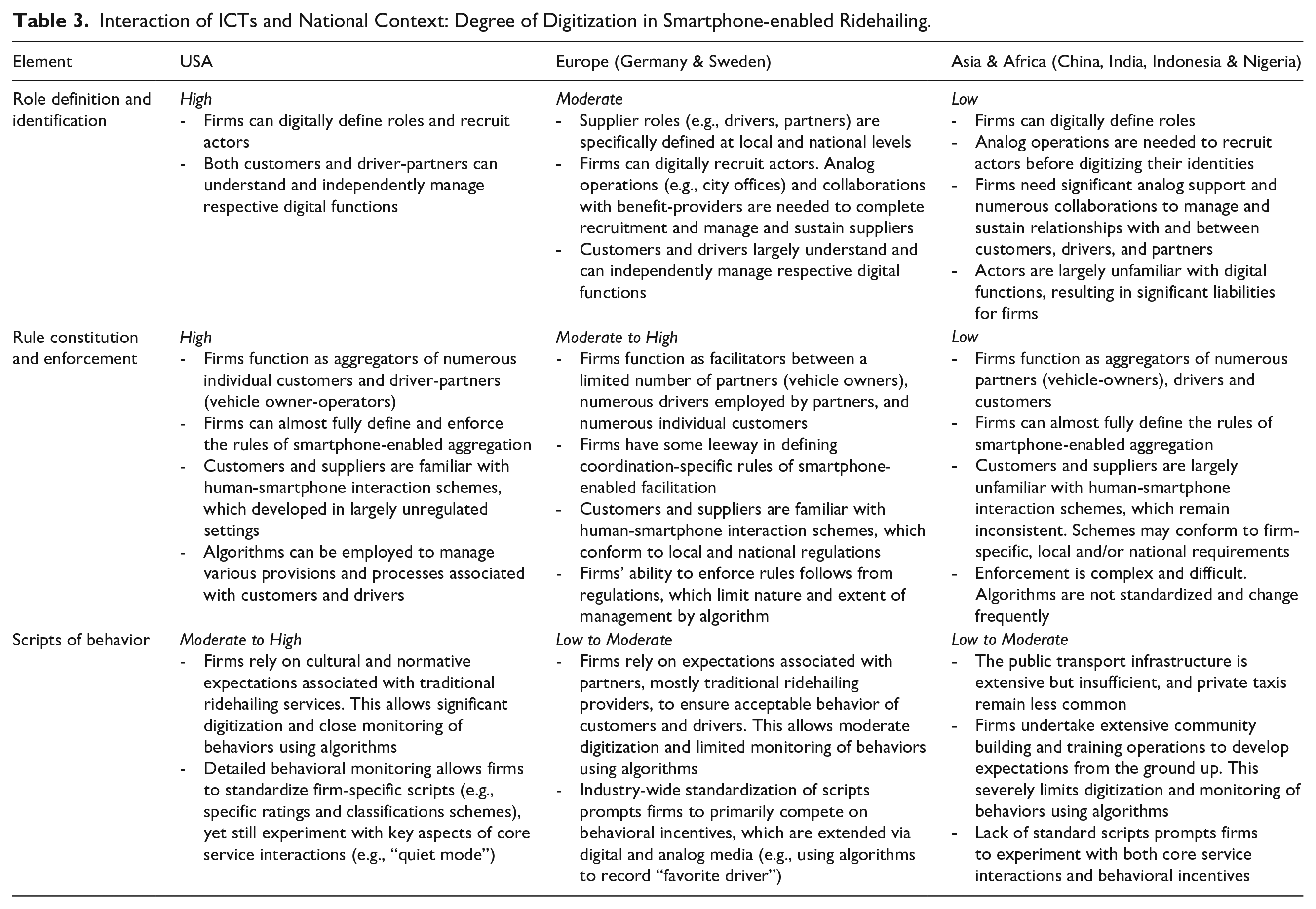
Table 2a and 2b list the differences in national contexts and the size of ridehailing operations (both direct and indirect), respectively, across the three comparative contexts discussed below. Our three categories are for analytic convenience and are not intended to imply that we see European countries, or Asian and African countries, as sharing fundamental similarities. Within each country, ridehailing is organized in diverse ways, and there is even more diversity cross-nationally (as our own argument would imply). We clustered countries based broadly on the nature of economic communication and the roles, rules, and scripts that must be specified for ICT-enabled economic exchange. Accordingly, Table 3 summarizes the degree of digitization of roles, rules, and scripts in each of the three, somewhat stylized, contexts.
National Context.

Size of Operations of Ridehailing Firms.

Interaction of ICTs and National Context: Degree of Digitization in Smartphone-enabled Ridehailing.
Case study 1: Ridehailing in the United States 2
Ridehailing roles, rules, and scripts in the United States are significantly digitized, as traditional taxi services have largely given way to ridehailing firms. A ridehailing driver is responsible for getting their own car and insurance, and is typically referred to as a driver-partner. Vibrant capital markets allow most individuals to access financing. While firms initially offered financing services (e.g., Uber Xchange) in an effort to attract drivers, such options have either disappeared altogether or continue in significantly altered forms (e.g., Lyft facilitates flexible car rentals linked to specific number of transactions). More generally, ridehailing firms do not have to worry about whether a driver owns, finances or leases the car, or what type of car she uses, as long as it complies with locally administered laws for which the driver is liable. Additionally, when some cities imposed additional labor identification requirements (e.g., background checks) on ridehailing firms, deficient public transportation infrastructures and consumer organization made public officials side with the firms (Thelen, 2018).
Labor regulations do not support organization of independent contractors. Nor are local and national labor organizations empowered to intervene on behalf of such workers. Education systems providing sufficient exposure to digital technologies over several years have ensured that a majority of drivers and customers are prepared to transact through smartphone-enabled exchanges with minimal training. Social safety nets structured around employment and individual roles leave “self-employed” drivers outside their purview. Consequently, algorithms manage the primary provisions for drivers, including informing them about peak earning hours, providing weekly bonuses, and administering rewards (e.g., greater flexibility in choosing rides) and loyalty programs for both customers and drivers. Further, algorithmic scripts governing transactions mimic local service expectations, so that riders can use the app to add gratuity and compliment drivers (e.g., for an engaging conversation or a neat car), and both drivers and riders can rate each other. However, firms continue to experiment with digitizing aspects of this interaction (e.g., Uber allows customers choosing their premium services to opt for a “quiet mode”). Firms’ direct driver retention efforts include automatic enrollment in insurance coverage and sponsored online driver communities. However, the insurance is only active for the duration that a driver is active on the app and the online communities are rarely able to influence company-wide policy.
Case study 2: Ridehailing in Europe (Germany and Sweden)
Ridehailing roles, rules, and scripts in Germany and Sweden are moderately digitized, as traditional taxi services and ride-sharing firms coexist and cooperate with each other. Vibrant capital markets ensure that drivers have access to ample financing options. However, because employment relations are closely regulated, drivers are more likely to be employed by an authorized taxi company that partners with a ridehailing firm. Ridehailing companies here function as facilitators, identifying and connecting drivers with a limited number of large taxi companies, usually called partners, and providing finance options via collaborations (e.g., LeasePlan offers favorable leases to drivers in several countries across the EU). Easier identification of partners allows ridehailing companies to place more stringent requirements on vehicles (e.g., all electric, all vans), though digitally recruiting drivers is not as simple.
In Germany, strong product market regulations focusing on both customer and supplier harm, aided by powerful local and national labor organizations, ensured that ridehailing firms’ efforts to fully digitize roles and rules were seen as anticompetitive and damaging to the economy (Thelen, 2018). In Sweden, social safety nets structured around taxes and taxpayers, aided by effective local labor organizations, ensured that ridehailing firms were forced to collaborate with tax authorities, to mandate additional training and to sufficiently change their rules of exchange. Consequently, ridehailing operations in these countries continue to include significant analog steps. For instance, Swedish drivers must get a taxi driver’s license, which typically takes two months. Similarly, German partners must get trade licenses, commercial registrations and also register for local value added tax or VAT. Some ridehailing firms further differentiate themselves by expanding direct operations. For instance, FreeNow (earlier called MyTaxi) established numerous local offices which provide email and telephone support for partners.
Attracting drivers under extensive social safety regimes with largely efficient public transport infrastructures requires ridehailing firms to offer significant benefits. For instance, ridehailing companies regularly collaborate with fuel, credit, insurance, accounting, and vehicle maintenance firms. Further, ridehailing firms such as Uber offer third-party insurance protection for drivers not employed under partners. Unlike similar provisions in the United States, such insurance covers off-trip personal medical needs such as sickness, injury, maternity, paternity, and jury duty, and is available across 20 EU countries to drivers who have completed a relatively small number of trips. Other benefits for drivers include the ability to be paid in cash or via firm-specific cards that do not charge payment processing fees (e.g., mytaxiPay). Far from standardized scripts, firms differentiate based on tweaks to their algorithms such as introducing tipping, allowing customers to book trips several days in advance or store “favorite drivers” for repeat trips.
Case study 3: Ridehailing in Asia and Africa (China, India, Indonesia, and Nigeria)
Ridehailing roles, rules, and scripts in China, India, Indonesia, and Nigeria are minimally digitized, as ridehailing services are required to undertake extensive operating responsibilities. Less-developed capital markets in some countries impose heavier role delineation requirements on ridehailing companies. Companies must identify, connect, and manage several roles. This typically includes identifying and marketing to numerous partners (car owners), who may own no more than a single car. Firms must also recruit and screen drivers, typically migrants in large metropolitan markets, and connect them to partners. While some local solutions have emerged to solve the recruiting portion of the problem (e.g., DriversNG in Nigeria), the migrant status of most drivers complicates existing financing and licensing problems. Drivers in China must present a hukou, a residency permit that controls where an individual can legally work, to get a ridehailing driver’s permit (Liao, 2019). Similarly, drivers in India must show difficult-to-obtain proofs of current and permanent residence to secure any financing. Ridehailing companies, including Didi Chuxing in China, Grab in Indonesia, Ola Cabs in India, and Uber in Nigeria, have countered these conditions by expanding their operations to directly offer loans, leases, maintenance expenses, and even some forms of insurance.
Despite having extensive direct operations, where ridehailing companies still remain distinct from traditional firms is their insistence on utilizing only disaggregated labor. While these countries have relatively strong labor rights, representative local and national organizations remain weak. This leads to numerous locally-organized union-like bodies that claim jurisdiction over taxi service norms and even geographic zones within cities. For instance, Uber, Grab, and Go-Jek drivers in Bali, Indonesia remain wary of local cooperatives who forcefully resist ridehailing drivers plying riders in their zones (Jacobs, 2018). The cooperatives on their part blame migrants for taking away jobs from local communities and ridehailing companies for unfair business practices. In India, the organizing remains more fluid, with frequent strikes by both traditional taxi drivers protesting ridehailing firms and ridehailing drivers protesting poor pay and benefits (Shah, 2018). Consequently, ridehailing companies have opened numerous local offices to address grievances and developed relationships with influential local leaders. Citing broad but insufficient public transport infrastructure, firms have further emphasized their role in these economies, lobbying state and national governments for regulatory support.
Education systems in these countries remain unevenly developed, often involving few digital technologies. This necessitates extensive training operations to educate partners, drivers, and customers. Companies also sponsor online and offline driver communities that focus on creating norms for good service and highlight key incentives. Social safety nets structured around mixed public and private offerings allow ridehailing firms to selectively partner with benefit providers such as healthcare and insurance companies (e.g., Uber Nigeria offers personal injury protection to drivers). Additionally, the lack of digital training and social safety requirements allows ridehailing firms to use a variety of scripts that both borrow from local off-line exchange behaviors and attempt to redefine them. This often becomes a source of differentiation between firms. For instance, ridehailing firms in India may offer daily payments and bonuses, while those in China may offer printed invoices.
Conclusion
Our brief tour of the ridehailing industry in seven countries demonstrates that a seemingly basic concept—the use of GPS-enabled smartphones to match drivers and riders—can be implemented in wildly diverse ways depending on the context of national institutions. How big is the firm? Are drivers employees? Who owns the cars? How is the enterprise funded? How do competitors respond? How actively does the government regulate this new market?
Almost 40 years have passed since DiMaggio and Powell (1983) told us that organizations were coming to look more alike over time. Since that point, organizations have become radically more diverse around the world, and new forms arise by the hour. ICTs are invading every aspect of economic and social life. By expanding the ways that firms can recruit the labor, funds, and supplies they need to operate, the channels by which their outputs can be sold, and the means by which participants can collaborate, the technologies behind our current transition are underwriting a Cambrian explosion of organizational diversity. To push the metaphor further, this diversity varies by continent and ecosystem, in ways that are largely unexplained, but not inexplicable. Our discussion of Uberization across seven different economies over the past few years provides an example of how our framework can be applied to current organizational phenomena.
If we hope to understand contemporary and future changes in organizing, we need to unpack the communication technologies that link organizational components together. And the way to unpack communication technologies is to place them in specific institutional configurations that force them to adapt differently, as with ridehailing. ICT innovations are not going to stop, and thus new kinds of organizing will be a continuous feature of our lives going forward. If we hope to provide scholarly insights into this welter of social change, we need to focus on how information technology and nationally-specific institutions combine to shape the kinds of firms and organizing we get.
We believe that this approach can throw more light on both classic and new questions in organizational studies, including the following:
- Questions concerning the comparative difference between the fundamental attributes of organizations such as size. It is surprising how little we know about how the basic facts about organizations vary around the world. Our framework suggests a set of core dimensions that can guide investigations into these features. In line with our framework, it is foundational for any future theorizing about organizations to have robust cross-national data on core aspects of organizations.
- Questions concerning the causes of inequality, examining, for example, how institutions allow ICTs to determine market participation and organization size. The incursion of markets into more domains of life can be a strong force for creating more inequality, and this is particularly true when it comes to labor markets. Uberization is allowing organizations to replace fixed wage contracts with “dynamic pricing” for labor. In the US, regulations about minimum wage apply to employees but not however to contractors, thus providing a mechanism for firms to evade wage regulation. Uber-like apps could both lower the lowest wage possible but also enable surge pricing for hard-to-staff tasks and times. In the American context, where citizens rely on employers for basic social services for health care, this technology seems certain to increase income precarity and inequality. But this is also certain to vary by country, as ambient national institutions shape whether this evasion of regulations is possible, and if so, with what effect.
- Questions around organizational responsibility and accountability, which may start by unraveling the varied controls embedded within ICTs (e.g., through algorithm audits). The algorithms that underlie applications such as ride-matching are not themselves neutral, as they develop within contexts that impart their own potential biases. And these technologies that enable new kinds of firms also enable new kinds of social movement activism towards reform and new forms of government control. A highly fruitful domain of future research is on the ICT-enabled activism that is shaping the construction of new markets to channel capital, labor, and supplies.
In conclusion, any hope for reining in the new kinds of organizations being created requires a better collective understanding of how they work. We believe that focusing on how technology shapes the different markets on which firms draw will provide citizens and governments with a strong basis for public policy attuned to local conditions. In this respect, we believe that society benefits from a vibrant community of organizational scholars who provide insights into the dynamics of contemporary organizing. If we hope to provide guidance for a more humane future, then organizational scholars need to be comparative, institutional, and attuned to new technologies.
Footnotes
Acknowledgements
We are grateful to Joep Cornelissen for his wise and patient guidance that helped this paper evolve to a readable argument.
Declaration of Conflicting Interests
The author(s) declared no potential conflicts of interest with respect to the research, authorship, and/or publication of this article.
Funding
The author(s) received no financial support for the research, authorship, and/or publication of this article.