



Abstract
Comparative political economy (CPE) scholarship has drawn various insights from organization theory throughout its existence. Organization theory has made more progress than CPE to explicate the organizational processes behind institutional change. In this paper, we draw on theory of partial organization to describe, interpret, and explain change in the coordination of one Coordinated Market Economy: Finland. We show that Finnish corporatism has become gradually re-organized during the last three decades. We argue that the structural and membership dynamics of partial organization explain some key patterns as well as the shape and timing of institutional change in the face of a changing constellation of economic interests. We argue that theory of partial organization complements the interest-based and institutional explanations of change in economic coordination.
Keywords
Introduction
Comparative political economy (CPE) scholarship has drawn various insights from organization theory throughout its existence (see Morgan and Kristensen, 2014). Especially the comparative institutionalism scholarship has regularly exchanged ideas with organization theory, and the two fields continue to provide contributions to each other (see Hotho and Saka-Helmhout, 2017). The comparative institutionalism scholarship has contributed to organization theory by exploring the societal differences in modes of organizing and their consequences; systematizing the relationship between societal institutions, economic organization, and their consequences; and discovering the implications of differences in societal institutions for multinational enterprises. In turn, organization theory has made significantly more progress than comparative institutionalism in enhancing understanding on how organizational innovations are enabled by societal, field, and organizational conditions in combination; explicating the organizational processes, such as institutional work, and characteristics such as an organization’s position or identity in the realization of institutional change; and addressing some of the social dynamics of capitalist systems, including insights into the ways in which firms bend public institutions in their favor and how firms organize their interests to influence policy making (Ibid.)
In this paper, we draw insights from organization theory to complement comparative institutionalist scholarship on economic coordination in Coordinated Market Economies (CMEs). We draw on theory of partial organization (see Ahrne and Brunsson, 2005, 2008, 2011) to describe, interpret, and explain change in economic coordination. We focus on the corporatist aspects of economic coordination, by which we refer to the institutional and organizational structures and practices, inclusive of both labor market policy and public policy arenas, in and through which organized capital and labor coordinate economic activity. We limit our analysis to the inclusion and participation of organized capital and labor (and not other interest groups) in public policymaking.
Our more specific focus is on the organizational forms and drivers of change in one CME: Finland. Nordic corporatism has changed significantly during the last three decades or so. The bargaining regime, wage policy-setting, and focus of organization have gradually shifted from the central level to either the local or sectoral/industry levels, while the peak-level negotiations have taken a new role as coordinator and/or regulator of decentralized bargaining (Andersen et al., 2015). These changes have been represented as a slow “erosion” of corporatist institutions (Bergholm and Bieler, 2013). Finland has appeared as an outlier in the Nordic trajectory. While there have been similar shifts in the contents of Finnish wage policy to other Nordic countries (Dølvik and Marginson, 2018), the institutions of Finnish corporatism have not followed the Nordic change pattern (Kaitila et al., 2022). Finland retained central bargaining much longer than other Nordic countries and has joined the Nordic trajectory only very recently. Finnish corporatism has also rapidly become more competitive and potentially less consensus-driven than in other Nordic countries (Lainà and Sippola, 2023).
In this paper, we argue that Finnish corporatism has been gradually re-organized during the last three decades and that this re-organization in part explains the deviant pattern and timing of change. We focus on the changing corporatist organizations and the changing partial organization of corporatist exchange. The former domain includes the local and industry-level trade union organizations and business associations, and the multi-industry, sectoral and peak-level meta-organizations (i.e., organizations whose members are organizations). The latter domain includes the organizational control of bipartite exchange between labor market organizations, tripartite exchange between labor market organizations and state actors, and inclusion of labor market organizations in public policy preparation. Our analysis draws on secondary research but is complemented with primary materials.
The case study shows that institutions of economic coordination may be dependent on specific partial organizational forms and structures, dynamics of partial organization have an impact on economic coordination capacity, and the impact of interests on institutions of economic coordination is moderated by organizational factors. Hence, comparative political economy scholarship ought to pay more attention to organizational dynamics to explain change in economic coordination and the effects of partial organization to economic coordination capacity. Even though we primarily gather insights from organization theory to offer new contributions to CPE, we also identify some contributions that our analysis provides for the study of partial organization in the discussion section.
Corporatism and partial organization
Corporatism may be seen as a variety of capitalism in which specific structural prerequisites such as unionization, centralization, and strong states combined with organized bargaining and concertation produce certain economic outputs. This understanding of corporatism, often referred to as “peak corporatism” (Vesa et al., 2018) or “social corporatism” (Blyth, 2003), is central to CPE scholarship. It attributes corporatist institutions and negotiated economic coordination to the CMEs of Northern Europe (Hall and Soskice, 2001). The concept of corporatism is also used in comparative research on political institutions to denote a variety of democracy in which economic interest groups are integrated in the preparation and implementation of public policies (Christiansen et al., 2010). This conception of corporatism is often referred to as “routine corporatism” (Vesa et al., 2018).
Both conceptions of corporatism are important for understanding the logics of economic coordination in the Nordic countries. The coordination of Nordic economies has relied extensively on tripartite and bipartite negotiation (Arter, 2006) as well as broad participation of organized capital and labor in public policy preparation and implementation (Christiansen et al., 2010). The two types of corporatism often intertwine and are sometimes hard to differentiate conceptually in the Nordics. Unless otherwise stated, we use the term “corporatism” as inclusive of both types in what follows.
Comparative political economy scholars have sporadically utilized organization theory to interpret and explain change in corporatism. The comparative industrial relations (IR) scholarship from the 1970s to the 1990s utilized organization theory most systematically (Morgan and Kristensen, 2014). Most of the later IR scholarship has focused on individual organizations or professions, while research on “peak” corporatism has typically drawn on institutional rather than organization theory (e.g., Ackers and Wilkinson, 2008; Kaufman, 2004). One possible reason for the lack of attention on the organizational aspects of corporatism above the individual organization level is the so-called disorganization thesis that was popular in the 1980s and 1990s. The thesis suggests that the rise of neoliberal policy regimes and the related changes in capitalist societies undermine the structural basis of corporatism and, hence, preconditions for maintaining corporatist forms of organization (Traxler, 2004).
A more recent example on the utilization of organization theory in CPE scholarship is the research on knowledge regimes. Campbell and Pedersen (2014) have utilized field theory to study organizations that generate data, research, policy recommendations, and ideas for policymaking. The corporatist countries are observed to have organized knowledge production in forms that involve extensive representation of organized capital and labor, but which are constantly changing due to the negotiated nature of each policymaking process.
Comparative political economy scholars have identified specific organizations as key drivers of change. Structural power brought by the organization of capital and labor, or business associations and trade unions, respectively, is considered a key determinant of change in CPE scholarship (e.g., Fairfield, 2015; Paster, 2015). In contrast, CPE scholars have paid little attention to the impacts of specific organizational forms and dynamics to institutional change (Hotho and Saka-Helmhout, 2017). These issues have been discussed extensively in organization theory. Organization studies have during the last decade or so started to pay increasing attention to the forms and dynamics of various organizations that are key to corporatist political economies. In this paper, we draw on one strand of such scholarship to address the organizational aspects of and determinants of change in corporatism: partial organization.
Scholars of partial organization focus on the organizational structures and dynamics outside the domain of formal, complete organizations (Ahrne and Brunsson, 2011). Formal organizations are distinct from other social arrangements that guide, regulate, and give shape to social activity, such as networks, institutions, movements, or group interactions in that they are purposeful and decided orders. Organization is complete when all the following structural elements formally exist: membership, hierarchy, rules, monitoring, and sanctions. When only some of these elements exist, organization is structurally partial.
We draw on two strands of scholarship on partial organization in our argument. First strand is focused on the structural dynamics of partial organization. The key idea here is that the structures of social arrangements with emergent and decided elements influence the relations and experiences of participants and stakeholders. Especially the making of an order more or less completely organized (i.e., inclusive of more or fewer structural elements of formal organization) is likely to have a major impact on the participant relations and perceptions of the order (Laamanen et al., 2020). Moreover, adding, for example, membership and hierarchy makes an order more visible and autonomous and may thus render it subject to more criticism and demands from outsiders (Ahrne and Brunsson, 2011).
Scholarship on partial organization has shed light on the structural dynamics of various orders that are relevant to economic coordination, including union organization (Bengtsson, 2021), multi-organizational negotiations (Nygård and Holmen, 2020), and even labor markets (Ahrne et al., 2015). However, the partial organization of corporatist exchange has thus far escaped research attention.
The second strand focuses on the membership dynamics of partial organization. The key idea underlying this scholarship is that who the members of a social order are will have impact on the nature and development of the order. This strand has focused primarily on meta-organizations, that is, organizations whose members are organizations (Berkowitz and Bor, 2022). Meta-organizations differ from organizations (i.e., organizations whose members are individuals) in various ways because of their members. Meta-organizations depend on their members in a different way, as members of a meta-organization can typically compete with the meta-organization by themselves (Ahrne and Brunsson, 2008; Berkowitz and Bor, 2018). This dependency means that the relationship dynamics between members and meta-organizations differ from those between individual members and organizations.
To be more precise, previous research has discussed five dynamics of meta-organization (Berkowitz and Bor, 2018; see also Berkowitz and Dumez, 2016). (1) Meta-organizations are easy to set up and maintain. They can function even without owning resources or having their own personnel, and a small number of members are enough to set up and sustain a meta-organization. (2) Meta-organizations have a low turnover of members. The low turnover can result in membership divergences. Member organizations may change over time and their priorities evolve, but all member organizations may not necessarily move in similar directions. Finding a common ground and deciding on the collective purpose or goals of the meta-organization can therefore become more difficult over time and lead to inertia. (3) The growth of meta-organizations can also be stimulated when members do not exist. Meta-organizations can create or support the creation of their own members. (4) Meta-organizations persist over the long term, even if their direct objective has vanished and they become “dormant.” (5) Multiple meta-organizations can emerge on the same topic and coexist. Meta-organizations may have different boundaries (e.g., infra-sectoral, sectoral, and cross-sectoral) and classes of members. Meta-meta-organizations, that is, organizations with meta-organizations as their members, may be established. One organization may cumulate membership to various meta-organizations. Membership overlap creates links between such meta-organizations. The mutual relations between meta-organizations may become more cooperative or more competitive because of these overlaps.
Scholarship on meta-organization has shed light on the meta-organizational forms and activities of business associations and trade unions of different levels (Berkowitz and Dumez, 2016; Garaudel, 2020). However, the interrelations of meta-organizations and the institutions of economic coordination, and the impacts of membership dynamics to corporatism, have thus far escaped research attention.
Toward the case study
To shed light on the partial organization of corporatism and the impacts of structural and membership dynamics of partial organization to economic coordination, we address the case study of Finnish corporatism from the beginning of 1990s to the early 2020s.
Regular trilateral political exchange between the state and organized labor and capital institutionalized corporatism in Finland in the post-war decades (Kiander et al., 2011). A key institution was the tripartite incomes policy agreements that sought to secure economic and political stability in the country. The incomes policy agreements gradually came to involve a wide variety of policies besides wage policy measures, and they were used later to promote a variety of agendas from social wage considerations and national competitiveness to neoliberal market reforms (Wuokko, 2021). The tripartite exchange also gave birth to the key institutions of the Finnish welfare state, including the mandatory earnings-related pensions, unemployment insurance, and educational institutions such as vocational training and apprenticeships. The continuous exchange in the governance and development of organizations related to these institutions, such as pension insurance companies and unemployment funds, is characteristic to Finnish “routine” corporatism. The interest groups of business and labor are also widely represented and enjoy a somewhat privileged status in public policy preparation and implementation (Vesa et al., 2018). Tripartite and bipartite knowledge production has been another typical characteristic of Finnish corporatism. For example, knowledge production for wage policy has been discussed in tripartite representative bodies and pension policy in bipartite expert groups (Sorsa et al., 2021).
Labor market peak organizations are the characteristic actors of Finnish corporatism. The current peak business association for large companies, the Confederation of Finnish Employers (Elinkeinoelämän keskusliitto, EK), a meta-meta-organization founded in 2004, represented in the beginning of 2024 in total 19 member associations that have over 15 000 company members. The peak association for small- and medium-size companies is called Yrittäjät (literally “the entrepreneurs”) with over 115 000 business members. The current peak organizations for public sector employers are the Local Government and County Employers (KT), the Office for the Government as Employer (VTML), and the Office for the Church as Employer (Kirkon työmarkkinalaitos). There are currently in total about 80 trade union organizations with individual members in Finland. The peak trade union meta-organizations are the Central Organization of Finnish Trade Unions (SAK), representing blue-collar trade unions, the Finnish Confederation of Professionals (STTK), representing unions of professional occupations and officials, and the Confederation of Unions for Professional and Managerial Staff in Finland (Akava), representing the white-collar trade unions.
Finland represents a deviant case study of corporatism in the Nordic context in the 30-year period studied. Some have interpreted the changes of this period to represent “slow erosion” of corporatist institutions (Bergholm and Bieler, 2013), while others have seen the changes toward the end of the period as a “sweeping reconfiguration” of industrial relations (Müller et al., 2018; see also Koskinen Sandberg et al., 2022). These interpretations mainly draw on comparisons with other Nordic countries. The “slow erosion” interpretation suggests that structural political-economic factors have resulted in a relatively slow erosion process: Finland has retained higher degrees of business association and union membership and has less transnationalized firms relative to other Nordic countries. The “sweeping reconfiguration” interpretation highlights that Finland has maintained central bargaining much longer than other Nordic countries and sees its recent abandonment as an abrupt paradigm shift. The rapid increase of competition and conflict in corporatist exchange have also been seen as abrupt changes that have made Finland increasingly deviant from the Nordic trajectory (Lainà and Sippola, 2023).
We argue that these narratives fail to capture the incremental and gradual change in the organization of Finnish corporatism over this period. In our case study, we look more closely at key changes in corporatist (meta-)organizations and the partial organization of corporatist exchange through secondary research. We re-interpret previous studies published in various fields of research to discuss the motivations, processes, and outcomes of organizational changes in Finnish corporatism. We complement previous research with some primary materials. We conducted four semi-structured interviews (three in mid-to-late 2017 and one in early 2019) on the leadership of the Finnish Forest Industries Federation (FFIF) to explore FFIF’s motivations to resign from EK in 2016. We also use interview materials to address the experiences of the earnings-related pension reform negotiated in 2014–15. We conducted five semi-structured interviews of the negotiating parties and knowledge producers in the summer of 2015. In addition to these, we use publicly available materials (newspaper reporting and public statements by member organizations) to shed further light on the withdrawal of EK’s mandate to engage in central bargaining and the peak-level merger projects.
The changing corporatist (meta-)organization
Successful and failed mergers of Finnish labor market organizations in 1993–2018.
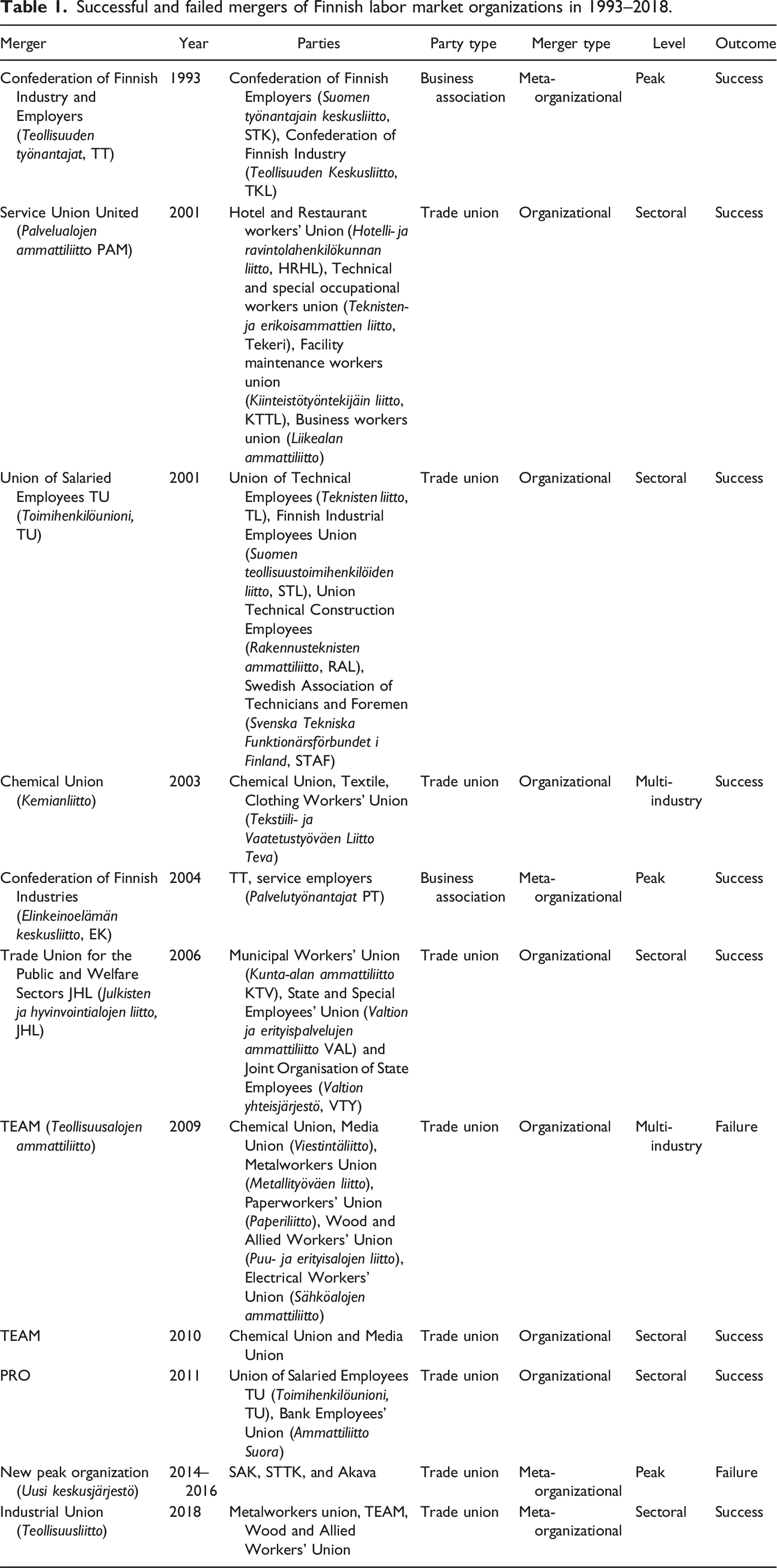
Mergers and centralization
Meta-organizations are often established to establish a negotiated environment for members (Berkowitz and Bor, 2018) and meta-meta-organizations to shape the field of meta-organizations (Ahrne and Brunsson, 2008). The first corporatist organization established in our case study period was the industrial business confederation (TT) in 1993. TT was born out of a merger between two meta-meta-organizations: the labor market peak organization STK and the industrialist advocacy organization TKL. The merger took place in the context of a major economic recession, an ongoing policy shift toward an export-led growth model, and preparations for Finland’s EU membership (Bergholm, 2011). Industrial employer opinions were somewhat divided on issues of currency devaluation and bargaining system overhaul, as some saw old procedures as appropriate crisis management tools while others highlighted more systemic issues. However, as all the issues were discussed in tandem by the government, industrial business associations, too, needed an arena where field-level stances on policy advocacy and bargaining issues could be formed in tandem.
In 2004, TT merged into the service sector employers’ peak association PT to form the Confederation of Finnish Employers (EK). In part, this merger continued along the lines of the TT merger. As one of our interviewees put it, the expectation was to provide one phone number that the Finnish Prime Minister could call to find out what large companies want. However, EK was established also to respond to a special motivation: the aspiration to form joint stances outside the public eye. Some business associations had had reservations concerning the merger of political advocacy with bargaining already when TT was established, for that it would give peak union organizations a justification to take part in public policymaking, especially industrial policy (Mansner, 2007). As unions had become more widely involved in public policymaking, the business associations of most sectors held that negative public perceptions and public fighting within the employer camp might weaken the employers’ status in tripartite exchange and central and sectoral bargaining (Bergholm, 2011). In this respect, EK was also established to improve the institutional status of its members. Other motivations existed but played a small role in the mergers. For example, organizational efficiency was publicly voiced as one motivation behind the EK merger (Mansner, 2007).
Meta-organizations usually rely on consensual decision-making and voluntary adherence, as members often have effective alternatives and are more prone to use the exit option than in organizations (Berkowitz and Dumez, 2016). Consensus rule is especially characteristic of meta-meta-organizations (Ahrne and Brunsson, 2008). However, in our case, these meta-meta-organizations were based on majority rule and binding rules, which were justified by the perceived need to form common stances in public policy and negotiate on behalf of all members. Thanks to the relatively aligned interests of the export industries of the time, a large majority bloc was easy to find in TT in the 1990s (Wuokko et al., 2020). When the service employers agreed to merge with TT to form EK in 2004, the governance model adopted in EK largely followed that of TT. Thanks to the rise of the ICT cluster built around Nokia, the export industries gained a hegemonic status in public policymaking and more generally in Finnish society from the mid-1990s onward. Thanks to this hegemonic status, export industries could relatively easily form a majority in EK as well (Pietiäinen, 2009).
The Finnish political economy had evolved into a bi-polarized interest configuration where the interests of the internationally and domestically oriented businesses became difficult to reconcile without negotiation. In Finland, the polarization resulted both from the growing importance of the domestic service sector to GDP growth and the rapid and successful internationalization of the export pole of the economy fueled by the global success of Nokia (Skurnik, 2005). The interests of the two poles were markedly different in public policy and wage regulation. For example, domestically oriented employers appraised centralized wage bargaining to maintain purchase power stability throughout the 1990s and 2000s, whereas export employers advocated reforms toward sectoral and local bargaining to flexibly meet the demands of rapidly changing industry fortunes (e.g., Pietiäinen, 2009; Wuokko et al., 2020). While such divergence of interests had led to increasing sectoral competition and decreasing peak-level engagement in many other economies in the 1990s (see Coen, 2009), the exceptional ability to exert majority rule and make binding decisions in EK allowed the industry bloc to dominate the peak-level Finland.
The meta-organizational structures also allowed the dominant export industry bloc to actively reshape the activities of the peak organization. The bloc broadened the scope of activities and gradually turned the peak organizations into less employer organizations and more advocacy organizations. The general importance of labor market policy decreased and those of EU regulation, trade, industrial, and economic policy advocacy increased from the 1990s onward (Wuokko et al., 2020). These priorities dominated EK’s public communications throughout the 2010s. Only a small fraction of public communications concerned labor market issues; for example, the relative frequency of topics such as social policy and entrepreneurship were much higher than labor market issues (Lainá and Sippola, 2023).
On the trade union side, centralization occurred not at the peak level but on the sectoral level. The established “three-legged” structure of the Finnish trade union peak organizations had institutionalized by the beginning of our case study period. The structure reflects an elastic division to blue-collar (SAK), professional (STTK), and white-collar (Akava) unions. The last major change to peak-level organizations occurred when the fourth peak organization, the Confederation of Salaried Employees (TVK), went bankrupt in the early 1990s. Most of its unions joined STTK. In the 1990s, some talks were held to merge STTK and Akava to make them a stronger party in exchange with SAK and employers. STTK was the more proactive party in this process, but the talks did not gain enough support within Akava to turn into a serious initiative (e.g., Åberg, 2021). The relations between peak organizations have been mostly competitive ever since (Levä, 2021).
Several mergers of multi-industry organizations occurred in Finnish trade unions in the 2000s (see Table 1 above). Mergers took place in both the industrial and the service sector, including both private and public sector unions (Laukkanen, 2008). The largest mergers were the establishment of PAM, which today represents around 200 000 members working in the private services sector, in 2000, and JHL, which represents around 165 000 employees in public and private services sectors, in 2006. The key industrial trade unions, including Finnish Metal Workers’ Union and TEAM, established the Industrial Union in 2018. It is a meta-organization for local unions that currently have over 200 000 individual members.
Meta-organizations are typically established for cooperative purposes while members continue to compete over the purposes and agendas of the meta-organization (Azzam and Berkowitz, 2018). The competitive aspects of meta-organization were central behind these mergers. The mergers were first and foremost motivated by the aspiration to improve status within peak organizations. For example, it was argued that the Industrial Union merger had to be completed to advocate industry workers’ interest within SAK, because public sector unions and private service sector unions had strengthened their status (Koivuranta and Koivisto, 2016). However, some unions also sought to improve their status directly in sectoral bargaining. The unions with declining membership bases were especially vocal in advocating for the establishment of sectoral meta-organizations to enhance their position in the bargaining rounds of 2007–2011 (ibid.).
As scholars of partial organization have observed, competition over agendas within meta-organizations may lead to competition between meta-organization on potential members (Azzam and Berkowitz, 2018). The increasing competition within peak organizations indeed translated into competition between the peak organizations on members in our case study. For example, several trade unions have shifted their membership from STTK to Akava and vice versa (Åberg, 2021).
The perceptions of a strengthening and more unified employer camp led to the revival of peak trade union merger talks in the 2010s. In 2014–16, talks to merge the three peak trade union organizations were initiated by several trade unions The publicly stated motivation for the talks was the need to strengthen the relative negotiation position toward the EK and the need to be more proactive in policy advocacy (Heinikoski, 2016). Research on meta-organization has shown that established meta-organizational identities are likely to create strong boundaries in a field (see Laviolette et al., 2022). Such boundaries between the trade union peak organizations became highly visible in these merger talks.
Akava, which opted out of the talks early in the process, has been skeptical toward the merger of peak organizations due to perceived differences in organizational identities and cultures, wage policy interests, and several policy stances (see Levä, 2021). It has stressed that the interests of the highly educated, experts and superiors necessitate their own peak organization (Pellinen, 2020). The rising membership numbers of Akava also contrast the declining numbers of SAK and STTK, which Akava has interpreted to signal higher degrees of legitimacy (Bergholm and Sippola, 2022). The talks continued on a possible merger between the SAK and STTK. While the process was widely believed to succeed, the merger talks came to nothing in 2016. A key factor behind the failure was the obstacles related to political identity, especially the association with party politics and the different stances and styles in public policymaking (Heinikoski, 2016).
Conflict and containment
Research on meta-organizations has shown that the interests of members of meta-organizations may change, and it may become more difficult to form common stances over time (Berkowitz and Bor, 2018). This dynamic had important consequences in our case study. A major shift in economic interests occurred in Finland from late 2000s to mid-2010s. The global decline of Nokia, the subsequent re-organization of the ICT cluster, and the changing fortunes of the paper industries reduced the importance of industry exports as drivers of the Finnish economy. At the same time, an enormous growth occurred in service exports, including numerous success stories in the gaming industry and B2B services (e.g., Tamminen and Nilsson Hakkala, 2017). The industrial exporters’ interests such as supply chain stability and transportation differed substantially from factors that contributed to the success of the growing creative industries and business services, such as education policy, skill formation, and social investment. In short, business interests tri-polarized in Finland in early 2010s (Sorsa, 2020).
The divergence of sectoral interests had not been highly visible in the late 2000s thanks to a temporary shift to sectoral bargaining. In the 2000s, the dominant bloc of employers within EK sought to devolve wage determination from central to lower levels (Bergholm and Bieler, 2013). Only sectoral bargaining was arranged in 2007–11. However, the sectoral bargaining rounds of these years had featured upward wage competition, which became costly for many sectors. Many companies saw these costs as an impediment to international competitiveness and unjustifiable in the conditions of economic decline since the global financial crisis of 2008–09. Moreover, due to the new conditions of the common currency and narrowing down of economic policy instruments due to Eurozone membership, and the perceived public expenditure rises brought by an aging population, the government would have few means to compensate for the increased costs. As a result, many sectoral business associations voiced calls for increased wage moderation and stricter coordination (see Jonker-Hoffrén, 2019).
The majority of EK members decided to re-engage with central bargaining. Finland returned to peak-level central bargaining in the 2010s with three social pacts in 2011–16 to fight the economic downturn. However, formulating common stances proved difficult in these pacts. As one of our interviewees noted, the members of EK became increasingly active in lobbying their stances within EK. Many of the business associations, such as The Finnish Forest Industries Federation (FFIF), that had been on the winning majority during the 2000s suddenly found themselves among the losing minority within EK. In contrast, the merged sectoral trade unions were able to influence the stances of their peak organizations, which resulted in a further divergence of negotiation objectives and positions.
Major conflicts within and between the capital and labor camps emerged in the key tripartite economic policy exchange of the decade: the Competitiveness Pact (hence: CoPa). The decline of the ICT sector had weakened the competitiveness of Finnish companies, while the stagnation of economic demand amidst the Euro Crisis had worsened economic prospects in early 2010s. In 2015, the newly elected center-right government called labor market organizations to negotiate upon forming a social pact to meet three central objectives: to enhance the international competitiveness of Finnish work and business, boost economic growth, and create new jobs. The conflict-ridden process involved various rounds of negotiation, including various departures from and returns to the process. (Kaitila et al., 2022.)
Research on meta-organizations has shown that diverse membership not only reduces the possibility to form common stances among members but also makes it more difficult for members to decide upon the mandate of a meta-organization (Ahrne and Sörbom, 2020). The negative experiences of the conflict-ridden CoPa process led to these difficulties in the employer camp. The members of EK decided on a rule change to limit EK’s mandate so that it could not serve as a contractual party in collective agreements in the future (see Kaitila et al., 2022). Peak-level central bargaining was thus disabled and the scope of corporatist exchange narrowed down to sectoral and industry levels through a change in one meta-organizational mandate.
Previous research has also shown that members of a meta-organization often join it and retain membership thanks to its monopoly status (Ahrne et al., 2016). When such status changes, members may perceive the meta-organization differently and reconsider membership. Important departures from EK occurred in the aftermaths of EK’s rule change. The FFIF resigned from EK in 2016 and the Employers’ Federation of Road Transport in 2017 (Luukka, 2017). Our interviews suggest that the FFIF had perceived the interests of EK’s members as divergent since its establishment, but the CoPa process suggested that the interests are also largely opposite and fundamentally irreconcilable. Without a monopoly status, membership made little sense for the FFIF.
Members of meta-organization often have alternatives to membership (Berkowitz and Bor, 2018). Alternatives played an important part in the FFIF’s decision to leave EK. One interviewee argued that other industry-level associations had given up much of their advocacy work and bargaining capacity due to EK membership—but not the FFIF. Our interviewees argued that independent action was considered more effective thanks to the extensive networks among policymakers and the new advocacy services tailored for FFIF by the Finnish Chambers of Commerce. The departure from EK also started the FFIF’s transformation from an employer organization into an advocacy organization. The FFIF decided to quit sectoral agreements in 2020, and its members no longer count as organized employers (Lainá and Sippola, 2023).
The changing partial organization of corporatist exchange
Next, our attention turns from corporatist (meta-)organizations to the organization of their exchange. The Finnish tripartite and bipartite exchange until the 1990s can be characterized as an emergent and negotiated order. The members and objectives of each exchange as well as the preparation process varied depending on the issues at hand and agreement between the interested parties. Longer-term broad policy measures (i.e., policies ranging over one government term) were prepared by ad hoc parliamentary committees in which labor market organizations of different levels usually had their own representatives. Committee members were typically public officials, researchers, and representatives from labor market organizations and other non-governmental organizations; however, labor market organizations were highly influential in shaping the agendas, goals, and even the outcomes of committee work (Rainio-Niemi, 2010).
Shorter-term broad public policy measures typically took the form of negotiated tripartite pacts, which coupled wage policy measures with several other policies and regulations. Wage policy pacts were negotiated by the peak-level organizations. The preparation of tripartite and bipartite pacts was based on negotiated knowledge production with representatives from all parties (Sorsa et al., 2021). Labor market organizations have had a privileged informal position in the preparation of public policy reforms that involve matters of work time, social security, and pensions. Policies in such sectors were prepared by expert actors of that special field and enacted through mandated bipartite agreements (e.g., Johanson and Sorsa, 2010).
From the 1990s to 2010s, these negotiated orders became morphed into more formally controlled, monitored, and sanctioned ones. Two temporally overlapping but separate transformations occurred. First, the gradual shift toward increasing organizational control of policy preparation. This shift involves two elements, namely, the introduction of new organizational controls over preparation and the dissolving of arenas of negotiated preparation. Second, the expansion of organizational controls over tripartite exchange.
Re-organization of public policy preparation
The first major transformation starts from the deinstitutionalization of ad hoc parliamentary committees. Committees accommodated a wide range of stakeholders whose members and working procedures were negotiated and continuously renegotiated in the process. The committee system was criticized for inefficiency from the 1980s onward, and the system was officially disbanded in 2002. The parliamentary committee system was replaced by a ministry-led system with two alternatives: government-nominated committees and multi-stakeholder working groups. Government-nominated committees were usually set for envisioning broader or longer-term strategic policy changes, often following the government program. Multi-stakeholder working groups are used for the preparation of laws and policies that reach beyond the boundaries of individual ministries. This reform allowed ministries to control policy preparation through mandates that defined the members, rules, and monitoring procedures for the process (Holli and Turkka, 2021).
Scholarship on partial organization has shown that more formal organization may be pursued to increase efficiency and efficacy even when these goals might be better achieved with less formal organization (den Hond et al., 2019). In our case, the government set strict mandates including the objectives and members for preparation committees and working groups. As a reaction to ostensibly unfavorable mandates, corporatist organizations adopted more antagonistic ways to advocate their interests within these groups. For example, the SATA committee of 2007–09 was mandated to improve basic social security. Insider observer accounts suggest that trade unions demanded the coupling of all improvements in basic social security with improvements in earnings-related benefits from the beginning, which in effect paralyzed the committee work (Hiilamo, 2012).
Scholars of partial organization have shown that setting the rules for open negotiation arenas may lead to lack of trust, protective stances, and zero-sum game bargaining strategies (Nygård and Holmen, 2020). Hence, the adoption of increasingly antagonistic stances in public policy preparation is not surprising. However, the response to these difficulties has not been the deorganization of negotiations or exclusion of antagonistic actors from negotiations. Instead, the government has started to change the role of corporatist organizations in preparation groups. For example, the Finnish government established a new committee to reform social security in 2020. Labor market organizations were not anymore included as negotiating members of the committee (which, apart from the chairpersons, consisted solely of political party representatives) but only as non-negotiating standing advisors. In this sense, corporatist actors are still represented in policy preparation, but in a role from which they cannot engage in negotiated coordination.
Typical to Finnish corporatism has been the flexible and pragmatic boundaries between different arenas—agendas may be taken up in whatever arena happens to be active. Central bargaining in particular enabled several public policy issues to be bundled together, which allowed the Finnish corporatist organizations to see tripartite exchange as an infinite activity. Previous research suggests that agendas often shift from one negotiation arena to another if the arena has better capacities to facilitate exchange (van Popering-Verkerk et al., 2022). However, alternative arenas must exist for such shifts to take place. In the case of public policy preparation, such arenas have been largely disbanded after CoPa. This has made corporatist actors increasingly reliant on ad hoc preparation organized increasingly formally by the government.
Most importantly, the multi-stakeholder Cost and Income Developments Commission (Tukuseto), whose work was facilitated by the Ministry of Finance, was the main knowledge producer for wage policy and tripartite in 1972–2020. Tukuseto consisted of representatives of key state institutions (Bank of Finland, Ministry of Finance) and labor market organizations. Its main purpose was to compile more-or-less consensual views on the trajectory of the economy (e.g., growth and employment, macroeconomic outlook, income developments, prices and purchasing power, and competitiveness) and its implications to wage bargaining. The outlooks did not contain direct policy recommendations but consensually established a context against which the feasibility and compatibility of wage claims could be assessed. Tukuseto was formally discontinued in 2020 after EK decided to withdraw from it in the aftermath of its rule change (Lainá and Sippola, 2023).
The re-organization of tripartite exchange
The second major transformation concerns the shift toward increasingly complete formal organization of tripartite exchange. The first instance of increasing partial organizational control of tripartite exchange in the 2010s was seen in the pension reform negotiated in 2014–15 (see Sorsa and van der Zwan, 2022). The government had witnessed the outcomes of tripartite exchange in the beginning of the decade. While the pacts had maintained modest wage growth and improved Finnish competitiveness, they had also become burdensome for public finances. In the pension reform, the government imposed a rule to the negotiations that the suggested measures must reduce the fiscal sustainability gap. Moreover, it gave the Ministry of Finance a monitoring role for the negotiation process as the authority responsible for calculating the impacts of reform proposals to fiscal sustainability. It also set sanctions for the process: if the negotiators failed to meet the objectives, the government would introduce a package of austerity measures and possibly take the pension system under increased political control. The corporatist organizations became divided on the matter, and for the first time ever, one peak organization did not sign the final agreement.
The introduction of rules to emergent orders has been observed to motivate resistance toward the decided order and often lead to the stalling of decision-making (Laamanen et al., 2020). This dynamic became evident in the CoPa process. The government tasked the peak organizations in 2015 to engineer an agreement that ought to meet the government’s unit labor cost (ULC) reduction targets. The government used positive as well as negative sanctions: success was to be met with fiscal rewards and failure with additional net expenditure cuts (Kaitila, 2019). Yet, the CoPa negotiations were conflict-ridden and stalled in a very early stage. The government threatened to introduce stricter sanctions if no agreement was reached. These sanctions marked a departure from earlier norms, as the government intervened directly into the “shop floor” level of bipartite exchange. The government eventually jettisoned the measures in the concluding negotiations and used more common fiscal rewards and sanctions to persuade individual union and employer organizations to sign the pact (Kaitila et al., 2022).
After CoPa, Finnish corporatist exchange has taken steps toward an organized one-issue-at-a-time exchange (see Lainá and Sippola, 2023). Recent governments have tasked the social partners to negotiate over relatively narrow and individual issues. Increasingly aggressive negotiation stances and the regular use of exit options have weakened the capacity to produce policy outputs. The increasing competition between sectoral concerns has made coordination more difficult. Unilateral exits from the remaining working groups that are perceived not to directly advance the interests of organized capital or labor have also become common (e.g., EK abandoned a working group surveying the openness of wage information in 2020).
Conclusions and discussion
Our analysis shows how Finnish corporatism has been gradually re-organized during the last three decades. Scholarship on partial organization in general and meta-organizations and structural dynamics of partial organization in particular provide conceptual tools for making sense of these changes as well as theoretical tools for explaining their consequences.
Theories of partial organization help to explain both why Finnish business associations established an exceptionally broad meta-meta-organization as their peak organization and why trade unions retained three different peak organizations. The peak business organizations were established to produce a negotiated environment for organized capital in conditions of a changing policy landscape that coupled together public policy issues and bargaining reforms and to improve the institutional status of employers by taking negotiations away from the public. The peak trade union organizations, in contrast, remained separate due to established identities and the related need to differentiate. Instead, multi-industry organizations and sectoral meta-organizations were established to improve the ability to compete over the goals and activities of their peak organizations.
The form of these meta-organizations and the organization of tripartite exchange also explain both why Finland retained central bargaining longer than other Nordic countries and why it was given up so fast. As scholarship on meta-organizations shows, member turnover in meta-organizations is usually low and finding common stances often becomes more difficult over time as the interests of members change. But thanks to the majority rule of EK, central bargaining was possible as long as a clear majority was formed within EK. The economic interests of Finnish business associations diversified at the time when central bargaining was on hold. Once central bargaining returned to the table, the difficulties to find common stances became visible. Thanks to the increasingly influential sectoral unions, the trade union peak organizations adopted more competitive stances, while the government sought to reintroduce tripartite exchange in a more organized form to avoid certain outcomes. As anticipated by scholarship on partial organization, this led to the adoption of more antagonistic stances. The negative experiences of the exchange led to the containment of the peak business association mandate, which contained the scope of peak-level exchange significantly, and ultimately dismantled the monopoly status of peak organizations.
All in all, our case study offers three lessons on the role of partial organization in economic coordination for CPE scholars. First, institutions of economic coordination may be dependent on specific organizational forms and structures. In our case study, corporatist exchange has been sustained by majority-ruled (meta-)meta-organizations that engage in multiples arenas of emergent and negotiated corporatist exchange. Second, organizational dynamics have an impact on economic coordination capacity. Our case study shows that the increasingly formally organized economic coordination has reduced the willingness of parties to commit to negotiations, while the containment of meta-organizational mandates has decreased the ability of parties to negotiate. Third, the impact of interests on institutions of economic coordination is moderated by organizational factors. In our case study, the specific types of peak meta-organizations were formed to articulate interests in a particular coordination arena, while gradual change in interests had a major impact on how corporatist actors perceived and mandated their peak organizations.
Theory of partial organization may also offer some insights for the current development trajectory of economic coordination in Finland. Finnish corporatism has rapidly lost its capacity to build consensus, which has taken it to a somewhat different trajectory from other Nordic countries. We argue that this is due to the loss of organizational capabilities and permanent arenas for negotiated preparation and exchange: corporatist exchange has become too adhocratic and complete in organizational form and the mandates of corporatist actors too constrained in scope to enabled negotiated economic coordination. Previous research shows that if governance actors are unable to take positions and make creative compromises in a governance arena, they are unlikely to retain commitment to the arena (Sorsa and van der Zwan, 2022). Commitment to tripartite exchange has arguably decreased. For example, one typical characteristic of Finnish corporatism has been tripartite social pacts to introduce ambitious measures to tackle crises. None were prepared to tackle the economic impacts of COVID-19 pandemic, even though the economic decline caused was at the time estimated to be as steep as that caused by the global financial crisis of 2008–09. The only significant tripartite exchange concerned the use of accumulated buffers to temporarily lower employers’ pension contribution rates.
The new right-wing coalition government that took office in Finland in 2023 has introduced various measures to decentralize wage bargaining, curtail political action organized by unions, and weaken social benefits. Numerous strikes were organized in early 2024. The unions and opposition politicians have criticized the government for the failure to negotiate with corporatist actors and called for broader and more open tripartite negotiations to tackle urgent problems. The government response has been to insist that corporatist actors will be included in policy preparation and will have a chance to provide a meaningful input to negotiated reforms. Our analysis offers little prospects for either line of action to succeed. While formally organized sporadic policy preparation is unlikely to enable genuine negotiation, even the most open peak-level negotiations are equally unlikely to produce broad consensus in the increasingly competitive and contained field of Finnish corporatism.
Our case study also opens some avenues for the development of meta-organizational theory. Recent debates within organization studies have criticized the tendency to decontextualize organizational analysis from the wider political economy (e.g., Jackson et al., 2019). Meanwhile, Berkowitz and Bor (2018) have called for increasing research attention on the coopetitive dimensions of meta-organizations. The case of EK offers several insights on the coopetitive dynamics in a contextualized manner. Competing business interest groups decided to establish EK to consolidate power. The consolidation also justified majority rule that allowed EK to act effectively and efficiently. While the combined monopoly position in the field and majority rule made EK highly valuable for its members, over time these features also marked its demise. Ultimately, EK started to offer less value for its members when interests within the dominant majority diverged and common stances became more difficult to find over time. The attempts to manage divergent interests led to the containment of EK’s mandate and departure of key industries from EK, which has further undermined the value it can create. The clear periodization and the existence of reinforcing features make EK an interesting case for the theorization of coopetitive dynamics in meta-organization.
Footnotes
Author's Note
Antti Alaja is now affiliated with The Finnish Centre for New Economic Analysis (UTAK), Finland.
Declaration of conflicting interests
The author(s) declared no potential conflicts of interest with respect to the research, authorship, and/or publication of this article.
Funding
The author(s) disclosed receipt of the following financial support for the research, authorship, and/or publication of this article: This work was supported by the Emil Aaltosen Säätiö.
