




Abstract
Fully explaining organizational phenomena requires exploring not only “how” a phenomenon works – i.e., the details of its internal structure and mechanisms – but also “why” the phenomenon is present in the first place – i.e., explaining its origins and the ultimate reasons for its existence. The latter is particularly important for central questions in organizational research such as the nature of organizations, the evolution of organizational culture, or the origin of organizational capabilities. In this article, we propose that cultural evolution theory (CET) can be usefully applied to organizational scholarship to pursue such “origin” questions. CET has adapted ideas and methods from evolutionary biology to successfully explain the evolution of culture in human societies, exploring the origins of various social phenomena such as religion, technological progress, large-scale cooperation, and cross-cultural psychological variation. We elaborate how CET can be also applied to understand the evolution and origin of important organizational phenomena. We discuss how CET provides ultimate explanations using micro-evolutionary formal models and deploying macro-evolutionary tools for empirical analysis. We provide a detailed application of these ideas to explain the origin of productive organizations (e.g., firms, partnerships, guilds). We also propose several avenues for future research; in particular, we explore how CET can serve as an overarching theoretical framework that helps integrate the myriad of theories that explain how organizations operate and evolve.
Keywords
Introduction
To explain important phenomena, the organization and management field have focused most of its effort on explaining the details of “how” a phenomenon works, which is a combination of several elements, such as: detailing the different components and subcomponents that are involved (e.g., antecedents, behavioral and psychological assumptions, outcomes of interest, environmental conditions, organizational context, etc.); clear description and/or measurement of these components; detailing the “cogs and wheels” that regulate and control the phenomenon by specifying clear causal or influence relations between components; and the boundary conditions specifying where the overall explanation works. Overall, these components combine to generate mechanistic, “middle-range” explanations of phenomena (Hedström & Swedberg, 1998; Hedström & Ylikoski, 2010), which has increasingly become the predominant mode of explanation in the social sciences and in our field (Hedström & Ylikoski, 2010; Miller & Tsang, 2011; Pajunen, 2008).
However, unpacking “how” a phenomenon works might not necessarily fully explain the phenomenon. In particular, detailed answers regarding “how it works” might prove insufficient to understand “why we observe it”; that is, to answer “why” the phenomenon arose in the first place. In other words, understanding the “cogs and wheels” of the phenomenon does not necessarily explain its origin. In the jargon of evolutionary disciplines, the “how-it-works” account amounts to “proximate explanations” and the “why it arises” to “ultimate explanations” (Mayr, 1961; Bateson & Laland, 2013). 1 We propose that most research in organization and management focus on proximate explanations of phenomena, without necessarily addressing ultimate questions.
Consider some central phenomena in our field. Plenty of research has unpacked how capabilities, routines and managerial practices work, for example by measuring them using large-scale surveys (Bloom & Van Reenen, 2007), unpacking how they are assembled from lower level elements (Grant, 1996; Salvato, 2009), whether and how they can be replicated (Rivkin, 2000; Winter & Szulanski, 2001), how they interact with social relationships (Gibbons & Henderson, 2013; Loch, Sengupta, & Ahmad, 2013) and cognition (Cohen & Bacdayan, 1994; Eggers & Kaplan, 2013) and how they impact outcomes, among others. However, while previous scholars have focused on history, experience, and path dependence as the origins of capabilities and routines (e.g., Helfat, 2000; Winter, 2012), this perspective has limitations, such as the problem of infinite regress in which the starting point to the explanation can be pushed back arbitrarily (Hallberg & Felin, 2020). A lack of a focus on ultimate explanation also plagues research on organizational culture and the nature of firms. On the former, the literature has produced many attempts to measure it; to describe how it works; to lay out its constitutive elements such as beliefs, norms and frames; to assess whether and how it influences performance; among other efforts (see Chatman & O’Reilly, 2016 and Giorgi, Lockwood, & Glynn, 2015 for reviews). However, accounts of the origins of organizational culture, other than a reference to the contingent history of a group and its founders (Schein, 2010), have not been produced. On the latter, the nature of firms, a large literature has conceptualized firms as arising from the purposive, rational attempts of entrepreneurs and managers to avoid transaction costs of different kinds (see Lafontaine & Slade, 2007 for a review); however, this functional explanation (Elster, 1983) – explaining the adoption of X by the benefits of X – becomes implausible when one acknowledges the massive transactional complexity involved in setting up a firm, one that would boggle any attempt at rational calculation or planning. Therefore, the governance devices of hierarchy (Williamson, 1985), property rights (Hart & Moore, 1990), and job design (Holmstrom & Milgrom, 1994) advanced by this literature serve as proximate explanation of specific transactions and not necessarily as an explanation of firms’ origin.
This lack of focus on ultimate explanations is connected to a second issue in our field, that of theoretical disintegration (Chen & Hitt, 2021; Cronin, Stouten, & van Knippenberg, 2021; Davis, 2015; Durand, Grant, & Madsen, 2017; Hambrick, 2007b; Watts, 2017). The focus on proximate, mechanistic, and middle-range theories, and the increased sophistication and precision with which the field is performing them, has produced great advances in our knowledge. However, there is a trade-off. The multiplication of precise but partial explanations without a common, integrative framework entails important risks; explanations may excessively proliferate if no criteria bound and restrict them; explanations may be inconsistent or even contradictory between them; connections between multiple explanations of a complex phenomenon go underdeveloped; disciplinary and methodological silos are created, and are often at odds with each other; and ad hoc, unconstrained “just-so” theorizing about empirical regularities may grow. In short, knowledge specialization might produce knowledge fragmentation. Our field, being an applied one in nature, draws significantly from several basic disciplines (Agarwal & Hoetker, 2007), and thus, it seems particularly at risk of these problems (Davis, 2015). If the centrifugal forces of theoretical disintegration and knowledge fragmentation are not opposed by some type of “centralizing force”, the aggregate outcome might be less than ideal (Chen & Hitt, 2021; Cronin et al, 2021; Davis, 2015; Ostrom, 2009). As Elinor Ostrom warns: “Without a common framework to organize findings, isolated knowledge does not cumulate” (Ostrom, 2009, p. 419).
In this article, we propose that cultural evolution theory (CET) (Boyd & Richerson, 1985, 2005; Cavalli-Sforza & Feldman, 1981; Henrich, 2016; Laland, 2017) might be one such framework and can contribute to address these issues in our field. Developed in the intersection between evolutionary biology and anthropology, CET has generated over the last four decades many insights about the origins, uniqueness, and success of the human species. This theory is increasingly informing the social sciences about the origin and evolution of many important phenomena across disciplines. For example, in psychology, it explains the origin of cross-cultural psychological variation (Henrich, 2020; Henrich & Muthukrishna, 2021); in religion studies, it explains why we have religious beliefs (Norenzayan & Shariff, 2008; Norenzayan et al., 2016; Wilson, 2010); in behavioral economics, it explains why we have prosocial preferences (Henrich, 2004; Henrich et al., 2001); and in history, it has started to explain why major historical transitions occurred (Henrich 2020; Mokyr, 2016; Nunn, 2020a; Turchin, 2018). We propose that by deploying its explanatory framework and methods, CET can similarly help study questions about the evolutionary origins of organizational phenomena; that is, “why” it is that we observe what we observe, both today and in our past. At the same time, by providing ultimate explanations of phenomena within a common theoretical framework, CET can help to integrate and bring coherence to the many (proximate) theories that have proliferated in our field.
To show how this is possible, we take several steps in this article. First, after this introduction, we provide a summary of CET which allows us to establish connections between CET and organization scholarship and to compare CET to two prominent evolutionary approaches in our field: evolutionary economics and population ecology. Then, in the third section, we explain the distinction between proximate and ultimate explanations, we provide examples from biology and the social sciences at large, and we discuss how these two types of explanation need to be consistent with one another. In this section we also: (i) explain why the social sciences, and organization and management by extension, tend to lack (or assume away) ultimate explanations; (ii) drill down into how CET generates ultimate explanations, by introducing the methods of micro-evolution (analysis of evolutionary dynamics within a single population using formal models) and macro-evolution (documenting ancestry and lineage by performing empirical analysis across populations); and (iii) explain in detail an example from our own research which exemplifies how CET can be applied to study the origins of (pre-modern) firm-like organizations such as guilds and partnerships (Brahm & Poblete, 2021a). Finally, in the last section of the paper, we explore how CET can serve as a general explanatory framework for many of the proximate explanations and theories we have in our field. We describe some important steps that are required to deliver this promise and we provide initial sketches of ultimate explanations for important organizational phenomena such as corporate social responsibility, capabilities and organizational culture.
What is Cultural Evolution Theory and how does it relate to organization and management scholarship?
CET was developed in the fields of evolutionary anthropology (Boyd & Richerson, 1985, 2005) and evolutionary biology (Cavalli-Sforza & Feldman, 1981; Laland, 2017) by adapting the ideas and mathematical toolkit used to study biological evolution in order to understand the evolution of culture. Culture is defined as “information capable of affecting individuals’ behavior that they acquire from other members of their species by teaching, imitation, and other forms of social transmission.” (Boyd & Richerson, 2005, p. 7). Information in this context includes notions such as beliefs, preferences, values, skills, knowledge, ideas, attitudes, and other socially transmittable “traits”. This information is usually in the form of mental states, but can also be embodied or stored in shared notions of norms, myths, stories, routines, technologies and in physical media, such as artefacts, blueprints, texts, etc. This is admittedly a broad definition of culture, in line with anthropology where culture encompasses many aspects of a society, from artefacts (e.g., pottery) to rituals (e.g., religion) to norms (e.g., kinship structures) to technologies (e.g., irrigation systems). A “cultural trait” in turn denotes “specific element(s) of the cultural repertoire of an individual” (Boyd & Richerson, 1985, p. 33), where “cultural repertoire” captures all the information that a particular individual “inherits” from others. Cultural traits can be held at the individual or group level. CET seamlessly integrates these two levels by allowing group traits to emerge from the interaction of individuals, and, at the same time, allowing group-level traits to affect an individual’s behavior. This broad view of culture in CET differs from narrower conceptions in our field, for example culture as the collection of norms and values in a group (see Cameron & Quinn, 2011; Chatman & O’Reilly, 2016; Denison & Mishra, 1995); in contrast, it is less distant to accounts such as Smircich (1983) and Schein (2010), in which organizational culture is described as the “essence” of the organization, capturing a big part of what comprises it (e.g., artifacts, norms, values, beliefs).
CET posits that cultural traits are subject to the forces of transmission (or inheritance), selection, and variation. As a direct consequence of these forces, the frequency of these traits in the population changes over time; in short, a population’s culture evolves (see Mesoudi, 2011 and 2017 for good reviews). In cultural evolution, these forces differ, however, fundamentally from biological evolution. The transmission of cultural traits happens through social learning among individuals. Social learning captures the notion of teaching, imitation, mentoring, and other means of social transmission. Social learning can also occur asynchronously via non-colocated and non-simultaneous transmission means such as text and recorded audio and video. Different to genetic evolution, transmission in CET: (i) can be not only vertical (parent to child) but also horizontal (peer to peer) or oblique (non-kin vertical transmission); (ii) does not require a “gene-like” unit, such as a gene or a meme; (iii) can be partial, copying only part of a cultural trait, or blended, combining two traits; (iv) can be one-to-one (between individuals) or one-to-many (from individuals to a group). Organizational scholarships already display many central ideas and concepts that parallel this notion of social learning, such as the diffusion of knowledge and practices (Naumovska, Gaba, & Greve. 2021; Singh, 2005), organizational learning (Argote & Miron-Spektor, 2011), and mimetic isomorphism (DiMaggio & Powell, 1983).
Selection is mostly driven by the way in which social learning operates. 2 Different biases in social learning will favor the transmission of different traits and over time alter their frequency in the population. A large proportion of research in CET is devoted to understanding the consequences that different biases in social learning (also referred to as “strategies”) generate at the population level (Boyd & Richerson 1995; Hoppitt & Laland, 2013; Rendell et al., 2011). There are content biases, meaning that some traits are inherently easier to transmit (e.g., gossip), and context biases, meaning that something in the circumstances of an individual or group guides learning. In the latter instance, two important sub-classes are frequency-dependent biases (e.g., copy the majority or “conformist bias”) and model-dependent biases (e.g., copy the successful, “payoff bias”, or copy the prestigious, “prestige bias”). Again, research in organizational scholarship has touched on such processes already; consider, for example, that conformism is a central idea in organizations (Asch, 1951) and that CEOs’ disproportionate influence on firm culture (Hambrick, 2007a), as well as the effect of founders’ imprinting (Marquis & Tilcsik, 2013), relates to one-to-many transmission and model-dependent biases.
Variation, includes, on the one hand, random mutations, which occur when the transmission of cultural traits is not of high fidelity (leading to alterations in traits), and on the other hand, purposeful manipulation of cultural traits, such as recombination (e.g., combining the best components of two tools), guided variation (i.e., purposively improving the trait during transmission), and individual learning (i.e., agents eschews inherited traits and instead spend time and effort innovating via trial and error or based on their own reasoning). As above, central concepts in organizational scholarship parallel CET. For example, the ideas of breakthrough versus incremental innovation (Henderson & Clark, 1990; Schilling & Shankar, 2019) are similar to the variation forces of individual learning and guided variation, respectively; or the innovation and diffusion curves of products and technologies described by the industry or product life cycles (Gort & Klepper, 1982; Klepper, 1996) and the diffusion of innovations (Rogers, 1995) literatures parallels the diffusion curves of cultural traits that arise in CET (Mesoudi, 2011).
On the whole, there are two central insights produced by CET. The first is the idea that social learning drives the accumulation of culture. Humans have a unique capacity for social learning; that is, to learn from one another via imitation, copying, and teaching (Boyd & Richerson, 2005; Laland, 2017). Two classic studies comparing children and non-human primates conclude that high fidelity copying and cooperative teaching are the key distinction of human cognition, much more so than the idea of a mind geared for general causal understanding of the world or gifted with specialized, problem-solving cognitive modules (Dean, Kendal, Schapiro, Thierry, & Laland, 2012; Herrmann, Call, Hernández-Lloreda, Hare, & Tomasello, 2007). This result has been called the “cultural intelligence hypothesis”: we are smart because we download accumulated cultural insights from our forbears via social learning, not because we are instinctively or naturally gifted. How does social learning generate cumulative culture? Given processes of conformist and payoff-biased social learning, whereby essentially individuals copy preferentially the majority and the more successful, useful cultural traits will diffuse within a population. This means that over time innovations in cultural traits will build on top of inherited ones, creating a process of cultural accumulation. This process is at the heart of the adaptive capacity of the human species, explaining why we spread across all types of terrestrial habitats (Boyd, 2018; Mathew & Perreault, 2015). The speed of change of cultural traits has been estimated to be (at least) 50 times faster than the speed of change of genes (Perreault, 2012); culture dwarfs genes in adaptation capacity. Extensive empirical evidence for the cumulative nature of culture comes from the evolution of artefacts and technologies, traced by archaeologists, anthropologists and technology scholars (Boyd, Richerson, & Henrich, 2013; Rogers, 1995).
The ideas of cultural intelligence and cumulative culture resonates with organizational and management scholarship. They direct attention to organizations being adaptive by accumulating culture over time; that is, organizations slowly develop a set of norms, knowledge, skills, practices, beliefs, rituals, etc. that have worked successfully in the past to meet their challenges and attain their goals. This claim is extraordinarily close to Schein’s (2010) work on organizational culture, in which organizational culture is conceptualized as the “evolving adaptation of a group”, that is, those learned solutions to the problems of internal integration and external adaptation. Also, it parallels with institutional theory, particularly its “old” version (Selznick, 1996) which “traces the emergence of distinctive forms, processes, strategies, outlooks, and competences as they emerge from patterns of organizational interaction and adaptation. Such patterns must be understood as responses to both internal and external environments” (Selnick, 1996, p. 271).
Notwithstanding, while cultural evolution tends to accumulate adaptive traits, it also possible that traits that are neutral or detrimental for an individual’s or group’s performance are selected (Boyd & Richerson, 2005). The same forces that produce cultural adaptations can produce, under certain circumstances, dysfunctional traits that persist (Boyd & Richerson, 2005). Again, parallels exist with our field. In modern organizations, Vermeulen (2012, 2018) provides several accounts of maladaptive traits (e.g., large-sized newspaper organizations) and explains them using a theory that is highly consistent with CET. More generally, institutional theory, particularly in its “new” strand (DiMaggio & Powell, 1983; Selznick, 1996) has a “neutrality flavour”: the set of beliefs, norms, practices, etc. that get institutionalized over time in an organization need not be functional or “sought for efficiency reasons”; instead they are a product of processes unrelated to a bare sense of efficiency such as mimetic isomorphism and legitimacy.
A second central insight produced by CET is cultural group selection (CGS). A well-recorded fact in the anthropological and historical record is that groups – clans, tribes, ethnicities, cities, kingdoms, countries, nations, empires – differ in their culture, even if they share a similar ecology or are neighbors. In contrast to genetic evolution, where little migration dissolves genetic differences among groups – and thus makes genetic group selection less likely – stable cultural heterogeneity can occur according to CET, and this creates a powerful evolutionary force: groups with advantageous traits outcompete others and thus those traits diffuse (Bell, Richerson, & McElreath, 2009; Henrich, 2016; Richerson et al., 2016; Turchin, 2016; Turchin, Currie, Turner, & Gavrilets, 2013; Wilson & Sober, 1994). For example, groups can outcompete each other via migration to better-off groups, direct war or conflict, imitation of better-off groups, and through an overall higher reproduction capacity. Group heterogeneity emerges from several micro-level processes and mechanisms (see Richerson et al., 2016 and Boyd & Richerson, 2005 for details), such as: (i) one-to-many transmission and prestige bias in social learning transform idiosyncratic founder and leader characteristics into group differences; (ii) errors in cultural transmission or historical happenstance lead to drift in cultural traits between groups; and (iii) symbolical markers of groups (e.g., dress, dialect, manners) arise endogenously under general assumptions about social learning. In maintaining these group differences, salient mechanisms are: (i) the fact that a conformist bias in social learning drives migrants to adopt local traits, limiting the homogenizing effect of migration; (ii) punishment – a well-documented trait across societies and ethnicities – can stabilize any norm within groups; (iii) complementarities among traits within groups render piecemeal changes difficult. A key feature of CGS is that it can drive the evolution of traits that are detrimental to the individual but beneficial for the group, such as cooperation and altruism (Henrich, 2004; Richerson et al., 2016; Sober & Wilson, 1999). 3 Evidence consistent with CGS is extensively provided in Richerson et al. (2016). 4
CGS is also consistent with many important findings and ideas in organizations. Consider three points of connection. First, CGS proposes stable heterogeneity between groups. Our field has shown that firms display extensive and persistent within-industry heterogeneity in their cultures (Hannan, 2005; Schein, 2010), which is reflected in extensive and persistent productivity differentials (Gibbons & Henderson, 2013; Syverson, 2011). In agreement with CGS, Jacobides and Winter (2012) view such differences as natural: “the popularity of the notion that heterogeneity is a puzzle is itself a puzzle” (p. 1367). Second, CGS proposes that within-group cooperation results from inter-group competition. Consistent with this idea, Francois, Fujiwara, and Van Ypersele (2018) show that, across a number of tests, firms subject to more competition display higher within-firm prosociality. This insight resonates with the view, common in our field, that firms, in addition to transaction cost economizing concerns (Williamson, 1985), are importantly defined by cooperation, identity, and purpose (Gartenberg & Zenger, 2021; Kogut & Zander, 1996). Third, the forces that generate and limit group heterogeneity in CGS have a clear correlate in our field. Path dependence and trait interactions in rugged landscapes are important sources of stable heterogeneity (Levinthal, 1997; Rivkin, 2000) and map well onto the notions of drift and complementarities within CGS. The ideas of isomorphic processes (DiMaggio & Powell, 1983) and inertia (Hannan & Freeman, 1977) also map well, respectively, to the CGS forces of “migration and imitation” between groups on the one hand (which wipes out heterogeneity), and “stability and conformism” on the other (which maintains heterogeneity).
CET and organization studies
In the previous section, we have already started to connect the basic building blocks and ideas of CET, with ideas, theories, phenomena that are central to organizational and management scholarship. Of course, these connections are selective and partial; nonetheless, they are also intuitive, cover a lot of ground, and are suggestive that a systematic and deeper relation might be present.
We believe that such a deeper connection can be made. Basically, CET is a theory that provides a general process through which social reality – knowledge, technology, products, beliefs, institutions, etc. – is produced, analogous to biological evolution being the general process that generates biological diversity. As such, one could conjecture that any theory that unpacks a specific social phenomenon is bound to be related to CET. We speculate that this relation has two aspects, which we label “type of explanation” and “correspondence”. As indicated in the introduction, when explaining a social phenomenon, CET provides a different, but complementary, type of explanation to the current canon. CET provides an “ultimate” explanation, in which a fundamental explanation about the origins of a phenomenon is provided; in contrast, theories in organization studies usually unpack the details of the phenomenon, describe it, show how it works, and unpack its components and mechanisms (i.e., a “proximate” explanation). We fully detail these two types of explanation in the next section.
Regarding the relation of “correspondence”, the idea is that CET provides a structure or a framework in reference to which the myriad of proximate theories in organization and management studies can be located. We suggest that any proximate theory can in principle be related to an element of CET, that is, to processes of variation, selection, transmission, social learning, CGS, and cumulative culture. We already drew some connections above, “matching” ideas, concepts, and theories of management and organization with parts of CET. This notion of “correspondence” – plus the capacity to provide ultimate explanations – is the basis for proposing CET as an integrative framework for our field, and even for the social sciences at large. This suggestion is reminiscent of the integrative impact that the theory of biological evolution had on the myriad of biological disciplines around the middle of the 20th century, which were until then disconnected and rivalrous (Mayr & Provine, 1998). We return to these ideas in the sections below.
Comparison with evolutionary economics and population ecology
In this subsection we make a brief comparison between CET and two prominent evolutionary perspectives utilized in organizations’ scholarship: population ecology (PE) (Hannan, 2005; Hannan & Freeman, 1977, 1989) and evolutionary economics (EE) (Nelson, Dosi, Helfat, & Winter, 2018; Nelson & Winter, 1982, 2002; Winter, 2017). 5
The main convergence between these theories is that EE and PE are essentially cultural group selection (CGS) theories; and thus, these two theories are, from our perspective, encompassed by CET as cases of CGS. The caveat is that unlike CGS, EE and PE do not fully unpack or explain where the heterogeneity between groups comes from; instead they simply assume such differences. EE assumes that a firm carries exogenously produced routines and capabilities. Similarly, PE assumes that firms are “born differently” and stay different due to founder imprinting and strong inertia. This heterogeneity-by-assumption allows EE and PE to focus on external selection, but at the cost of not modeling the dynamics and interactions among individuals and how these generate stable heterogeneity between groups over time.
The caveat of the previous paragraph highlights a crucial difference between CET and EE and PE: CET is truly a multi-level theory where evolution occurs both at the individual and group levels. We believe the multilevel nature of CET is a strength, as it models, unlike EE and PE, the micro-foundations of group phenomena at the individual level. Moreover, in CET the group-level phenomena also influence the micro-level foundations. This multi-level property of CET cuts through, and in a way renders irrelevant, the debate about levels of explanation in the social sciences, which in our field has been instantiated as the “micro-foundations” debate (Felin, Foss, & Ployhart, 2015). Boyd and Richerson (1985) indicate: Some schools of thought hold that . . . large-scale social patterns are the aggregate result of individual behaviour . . . other schools seek explanations of large-scale social patterns in terms of causal social processes acting on the scale of whole societies. In our models the two levels are reciprocally linked; large scale processes affect small-scale phenomena, and vice versa. (Boyd & Richerson, 1985, p. 23)
A second important difference is epistemological. In essence, EE and PE involve a more piecemeal borrowing of evolutionary ideas, whereas CET is actually more categorical or constitutive in its appropriation of evolutionary ideas. EE and PE may be classified as making use of heuristic analogies, selectively blending ideas from evolution with economic and sociological ideas (and very much still work with “as if” conjectures) (Ketokivi, Mantere, & Cornelissen, 2017). In contrast, a CET approach to organization projects an entire model and vocabulary to make sense of organizations, one that is built from “first principles” up.
Another important difference between these theories is that CET is capable of (or has more interest in) providing a rationale for the origins of traits, for explaining where traits come from (particularly vis-a-vis EE, as PE has provided explanations for the origins of variety in organizational forms). The reason is that CET is an evolutionary theory that has within it a general causal theory that explains why a cultural trait can be adaptive: either it improves survival (and thus one can invoke the process of natural selection, as is done in biology), or the trait improves the process of cultural accumulation by improving social learning or CGS. Just like biology has a theory of function for biological traits (“a trait is useful for survival or reproduction”), CET has a “theory of function” and thus the researcher simply needs to show that a trait improves either survival or the accumulation of culture to explain the origin of a trait (cf. Elster, 1983). 6
Types of Explanation
There are, generally speaking, two generic modes of explanation of phenomena: ultimate and proximate explanations. CET trades largely in offering ultimate explanations, using two methodological approaches, micro-evolution and macro-evolution. To explain these concepts, in this section we draw heavily from ideas developed in evolutionary biology (Mayr, 1961; Tinbergen, 1963), as applied and discussed in the context of CET (Bateson & Laland, 2013; Laland, Sterelny, Odling-Smee, Hoppitt, & Ulleer, 2011; Mesoudi, 2011, 2017; Muthukrishna & Henrich, 2019).
Ultimate and proximate explanation
Proximate explanation is about offering an account of the immediate and direct sources that are seemingly causing a particular phenomenon, trait or behavior to be realized, and it is concerned mostly with understanding how a particular trait works, what are the specific mechanisms regulating it, and how it grows and develops within an organism, individual, or group. Ultimate explanation is focused on deciphering the process that caused the phenomenon, trait or behavior to exist in the first place, and as such, it is concerned with “why questions”, unpacking the origin and function of a trait and its history, and in biology, its phylogeny (Laland et al., 2011; Mayr, 1961). Consider for example the trait of birdsong (Bateson & Laland, 2013), proximate explanations explain the physiological details of birdsong, their vocal apparatus, the environmental/situational triggers (e.g., time of the day), the neural circuitry involved, how it develops over the lifetime of a bird, hormones involved, etc. In contrast, ultimate explanation explores the evolutionary function of birdsong for reproduction and survival – in this case, similar to the peacock’s tail, birdsong is mostly male and is used to signal quality to attract mates – as well as exploring its phylogeny across bird species.
In biology, these two modes of explanation are necessary and complementary to fully explain a particular trait. There is division of labor, with evolutionary biologists, geneticists, and palaeontologists concerned (mostly) with forming ultimate explanations; and physiologists, ecologists, ethologists, biochemists, molecular biologists, anatomists, pharmacologists, developmental biologists, and others concerned (mostly) with proximate explanation.
Ultimate explanation encompasses and interacts with proximate mechanisms. Continuing with the birdsong example, if a change in ecological conditions favors male polygyny in birds (male birds having more than one female mate), then testosterone levels would be affected. This would predict a change in birdsong as testosterone has been shown to regulate the motivation to sing. In short, ultimate and proximate mechanisms are connected. This connection between these two explanatory levels is important for the capacity of evolution to be an effective overarching framework in biology, and not merely a metaphorical “as-if” story. We come back to this below in our example and in the further research section.
In Table 1 we display a summary of the ideas presented so far, and the example we discuss in the remainder of this article.
Summary of types of explanations and example.
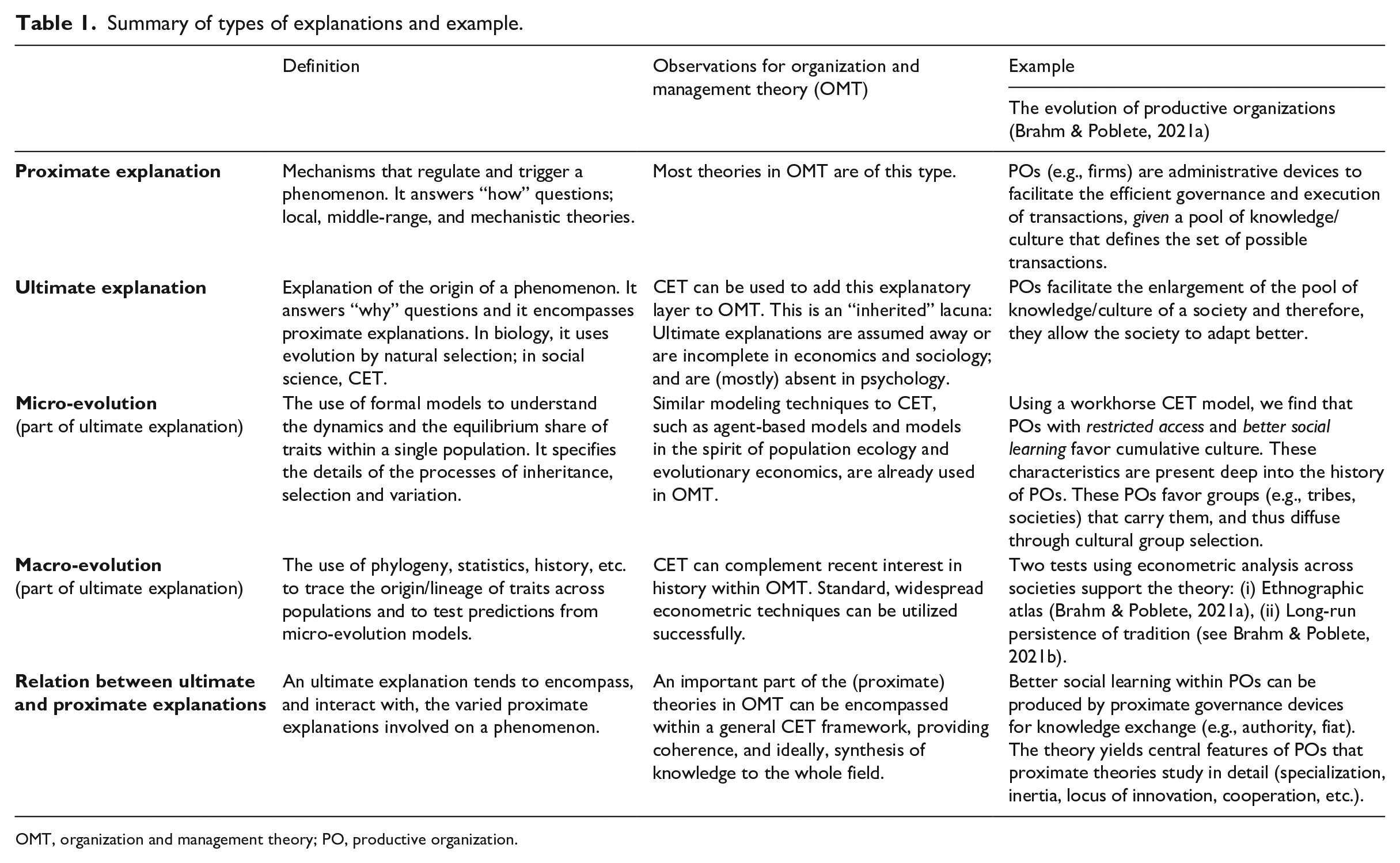
OMT, organization and management theory; PO, productive organization.
Proximate and ultimate explanations in organizations and management theory
We argue that the predominant mode of explanation in organization and management scholarship is in the form of proximate explanations. The field studies the details of how organizations operate; how people are selected, trained, monitored and rewarded; how workers come together and interact in teams or larger groups; how formal and informal structures operate and interact; how culture influences behavior; how to organize the different parts of the firm (production, logistics, finance, etc.); how decision-making occurs; how innovation can be fostered within organizations; and a long list of other topics where attention is devoted to the detail of how things occur.
Our field has mostly inherited this orientation from the basic disciplines it draws upon. First, across many social sciences, a mechanistic, “middle-range” explanation of phenomena has come to be the dominant approach (Hedström & Swedberg, 1998; Hedström & Ylikoski, 2010). With this approach, a clear phenomenon or empirical regularity is chosen and then unpacked to show how it “works” and to decipher what are the detailed mechanisms at play. Of course, this tends to direct researchers’ attention towards proximate explanations at the outset, away from thinking about ultimate explanation; for example, in sociology, the effort to build “grand theories” gave way to the “middle-range” approach. Second, the basic social sciences have some fundamental problems when engaging with ultimate forms of explanation. Drawing from Elster (1983), we consider each discipline in turn. In economics, ultimate explanation is replaced by a functional explanation, meaning that rational agents purposively adopt a trait due to its expected benefits. Why a trait exists is simply assumed to be a matter of the rationality of agents, eschewing the need for historical or evolutionary explanations (which, not unexpectedly, are mostly absent from mainstream economics). Thus, an ultimate form of explanation – in the sense of involving evolution and history – is simply not required. Such a functional explanation may be fine when the conditions of rational choice theory are fulfilled such as in auctions or thick and information-dense markets. But in many cases, such as when complexity is pervasive (e.g., coordination among a large number of interacting and heterogeneous agents) or when there is fundamental Knightian uncertainty, then economics engages in a “just-so”, incomplete functional explanation (Elster, 1983). In these cases, given the limits to calculation and foresight, agents might very well follow custom, heuristics, or other socially learned behavior. As a consequence, explaining the origin of a trait requires more than rationality. The situation is similar in sociology, which as a discipline tends to engage in forming incomplete functional explanations to explain origins. This discipline frequently assumes that macro traits, such as collective identity, culture, or institutions, benefit the group, organization, or society – whichever is the relevant higher level of analysis – and that this benefit in turn explains their existence. However, without carefully specifying how benefits affect and sustain the presence of traits (and not solely the opposite pathway from trait to benefis), functional explanations are incomplete (Elster, 1983). Finally, psychology and the behavioral sciences display the problem highlighted by Muthukrishna and Henrich (2019): a focus on empirical data and techniques (particularly now after the replication crisis) is masking a lack of ultimate explanations, whose absence threw proximate theorizing into disarray for decades, with pervasive ad hoc, largely unconstrained and undisciplined forms of theorizing.
Given this state of affairs in the disciplines that nourish the organizations and management field, and that native theories rely primarily on notions of bounded rationality (e.g., Cyert & March, 1963; March & Simon, 1958; Puranam, 2018), one can confidently say that there is room in our field for addressing “why” or “origin” questions in our field. The stake of not tackling these questions is that, while harmless to a great chunk of organizational research (just like a molecular biologist might not worry too much about evolution), it carries the risk that local theories of proximate explanation are weak, ad hoc, tend to proliferate, and/or display strong inconsistencies between them (Muthukrishna & Henrich, 2019). Some authors suggest this is indeed the state of affairs in the organization and management field (Davis, 2015; Durand et al., 2017; Hambrick, 2007b; Watts, 2017).
Example: Ultimate explanation of productive organizations
Organizations devoted to the production of goods and services that sustain a population have been prevalent in our history; think of modern firms, renaissance partnerships, medieval guilds, Roman workshops, Indian, or guild-like organizations in the early Neolithic period.
Current “theories of the firm” from economics, the go-to explanation for these “productive organizations” are effectively proximate explanations, not ultimate. In economics, firms (and “productive organizations”) are explained because managers or founders purposively select them in order to improve the efficiency of transactions (Coase, 1937; Hart & Moore, 1990; Holmstrom & Milgrom, 1994; Williamson, 1985). However, the assumption of rationality that sustains this purposive adoption frequently does not hold (Alvarez, Afuah, & Gibson, 2018; Maskin & Tirole, 1999). This rationality assumption requires the entrepreneur to consider, when setting up a firm de novo, two problems. First, she needs to think about all the transactions required in setting up a firm. In particular, she needs to think about (i) the make-or-buy choices of each transaction, (ii) the contractual details of each transaction, whether it has been internalized (e.g., delegation vs centralization) or outsourced (e.g., fixed price vs cost plus contract), and (iii) how all these boundary and contractual choices interact. The second problem is that she needs to coordinate with a large number of third parties in order to establish the characteristics that will regulate the claims and liabilities of the contractual vehicle she is setting up; for example, establishing limited liability requires buy-in and coordination with many third parties. We believe that solving these two problems is an extremely tall order for any entrepreneur: the first is an extremely complex multidimensional problem, and the second entails exceedingly difficult large-scale coordination. We suggest, instead, that when entrepreneurs address these two problems: (a) they copy the customary boundary and contractual choices for governing the set of transactions, and (b) they choose among the set of default organizational vehicles that a society carries at the moment, which varies across time and geography (e.g., modern LLC/partnership/corporation, medieval guild, Indian shreni, neolithic sodalities, Roman societas) (Hansmann, Kraakman, & Squire, 2006). While it is true that for specific transactions rationality could hold (and thus the economic theory can be highly informative as a proximate explanation), when thinking about the whole set of transactions and the organizational vehicle, entrepreneurs are well advised to follow custom. Historical evidence supports this view (Guinnane et al, 2007; Hansmann et al, 2006; Lamoreaux, 1998). 7 To summarize, setting up the entire contractual structure for a firm is a complex, highly uncertain problem, with limited space for rationality as the main explanatory thrust. 8 Therefore, economic theories of the firm are not ultimate explanations; instead, when attempting to explain “origins”, they are incomplete functional explanations (Elster, 1983).
By using a CET model, in Brahm and Poblete (2021a) we show that the ultimate explanation of modern firms, medieval guilds, Indian shreni, and other productive organizations across history is that they facilitated the enlargement of the pool of knowledge and culture of a society and thus, they allowed the society to adapt better and thrive. This contrasts with the economic theory of the firm which hardly considers how the adoption of firm governance impacts the accumulation of knowledge and culture (Williamson, 1999). 9
The problem of the expansion of knowledge and culture is equivalent to the well-known and central problem in the social sciences of how to motivate innovation when it can be copied. CET has its own evolutionary version of this problem, whose solutions are central to the CET edifice (Boyd & Richerson, 2005). This problem is known as the Rogers paradox (Rogers, 1988): while social learning generates a cultural tradition in a population, it can come at the cost of hampering innovation and thus, impeding the capacity of society to accumulate knowledge, adapt and thrive. This is paradoxical, as we know from simple introspection and observation that culture has been adaptive and useful to our species. Social learning hampers innovation because an agent that simply copies others can obtain adaptive knowledge from innovators without bearing the higher cost that innovation entails (experimentation, failure, etc.). Therefore, social learners would be favored by evolution and expand in their number, and, correspondingly, the share of innovators would shrink. This paradox has been shown to be robust to different assumptions (Boyd & Richerson, 1995). Given that solving this paradox is crucial for CET to be a plausible theory, it has generated an important research stream (Boyd et al., 2013).
In Brahm and Poblete (2021a) we show that for a range of models and assumptions, if one introduces organizations that are exclusive – entry is restricted (i.e., there is a boundary) – and that are better at social learning – it is more efficient or cheaper when done among members of the organization –, then the population can escape the Rogers paradox. In simple terms, in the face of a changing environment, organizations of said characteristics increase the adaptability of the population. This delivers an adaptation-based theory of organizations: they evolved because they enhanced our species’ capacity to expand its culture, and therefore to adapt better.
We show in the paper (Brahm & Poblete, 2021a) that these two characteristics of organizations are prevalent in our past, lending historical plausibility to our overall explanation. For example, the shreni in India in 500 BC – which produced most of the goods and services in that society – were a guild-like organization based on apprenticeship (i.e., low social learning costs) and where “the admission of a new member was put to a vote of the Shreni assembly” (i.e., restricted access) (Khanna, 2005).
The model also delivers a set of additional insights, all consistent with known aspects of productive organizations (see Brahm & Poblete, 2021a for details):
(i) organizations over time specialize in distinct technologies;
(ii) tradition, not innovation, is dominant inside organizations and thus organizations display inertia;
(iii) incremental innovation can dramatically boost the benefit that organizations bring to society;
(iv) if one assumes that organizations also have an individual learning advantage, the usual life cycle of firms emerges in the model; that is, when small the organization is fully innovative, only to become more traditional as it grows and becomes large;
(v) similar to guilds and partnerships, plausible assumptions – members maximize average rather than marginal fitness – produce a size of organization that would tend to be smaller than the size that generates maximum welfare to society; and
(vi) cooperation is central towards producing the organization’s social learning advantage, and thus, it is central to their very nature.
Notice that all of these insights correspond to deeply researched phenomena in organizations, and that scholars have already generated detailed, middle-range and proximate theories for all of these characteristics. This supports the notion that ultimate explanation encompasses proximate theories, and it is the latter that then “dives deeper” into the particularities and specificities of a phenomenon.
For example, the proximate theories from economics focus on administrative devices such as authority (Williamson, 1985), job design (Holmstrom & Milgrom, 1994), and residual control rights (Hart & Moore, 1990), as means to reduce frictions and increase efficiency in transactions. These proximate mechanisms are encompassed by our theory (just as a plausible ultimate explanation would do): the social learning advantage of organizations may come from any of these administrative devices. Knowledge and information transmitted via social learning is subject to hazards, and these devices can be invoked to support the assumption of cheaper social learning.
Micro-evolution and macro-evolution
Following biological evolution, CET unpacks ultimate explanations using two methodological approaches (Mesoudi, 2011); micro-evolution, which analyses short- to medium-term changes within a single population, and macro-evolution, which analyses long-term changes by comparing many populations. 10
Micro-evolution studies how the cultural traits evolve within a population of agents. It uses formal models to specify the details of cultural selection, transmission, and variation. This approach frequently uses the formalism of evolutionary game theory or agent-based modeling where the payoffs of different traits are specified, and replication dynamics are assumed – that is, in every period a small proportion of agents adopts the trait with higher payoff. These models are used to study whether traits can invade a population, under which circumstances they do so, and the properties of the evolutionary equilibrium, such as the long-run percentage of different traits in the population (McElreath & Boyd, 2007). These models are well suited to study what happens within a single population, exploring the (usually complex) dynamics of how traits evolve. This allows for uncovering why things turn out to be one way or the other, something which is hard to perform without micro-evolutionary models.
An example of micro-evolution relevant to organizations is firm-wide cooperation; that is, workers’ willingness to bear a cost to help colleagues or the firm as a whole. Cooperation displays a positive relationship with performance (Grennan, 2019; Podsakoff, Whiting, Podsakoff, & Blume, 2009). However, given its social dilemma nature – and the accompanying free-riding temptation – research has shown that it is hard to sustain cooperation when groups grow larger (Holmstrom, 1982; Olson, 1965). Therefore, explaining the origin of cooperation, namely, which forces drive its evolution and under which circumstances it can be stabilized, is a question of primary importance. Several scholars in CET, and the evolutionary sciences more broadly, have developed formal micro-evolutionary models to study how cooperation might evolve within a population (Boyd & Richerson, 2005; Henrich, 2004; Nowak, 2006). Important ideas such as kin selection, direct and indirect reciprocity, altruistic punishment, network selection, and group selection have emerged from this body of work. These ideas illuminate why humans (and other organisms) may have evolved innate prosocial psychology (an ultimate explanation) which then are used as an input for (proximate) explanations of individual behavior in an organizational context (e.g., Cropanzano & Mitchell, 2005; Grant, 2014; Lindenberg & Foss, 2011; Podsakoff et al, 2009). Also, if no innate prosocial psychology is assumed and instead behavior is assumed to be ruled by norms or heuristics (e.g., Di Stefano, King, & Verona, 2015), these ideas also can explain why prosocial norms or heuristics can arise in specific organizations in the first place (e.g., Francois et al., 2018). Further, even if self-interest is assumed, these ideas can also show how the conditions surrounding the interactions in an organization can produce self-interested choices that also benefit others or the organization as a whole (e.g., Dal Bó & Frechette, 2018; Rand & Nowak, 2013).
Macro-evolution studies the distribution and change in cultural traits across different populations, such as tribes, ethnic groups, nations, states or countries (Gray & Watts, 2017; Mesoudi, 2011, 2017; Turchin, 2018). The primary goal is to reconstruct the history and ancestry of cultural traits. For this, it is common to use phylogenetic tools adapted from genetics to study the history of the evolution of cultural traits. Some examples are the reconstruction of the history of languages (Pagel, Atkinson, & Meade, 2007) or European folktales (Da Silva & Tehrani, 2016). An additional goal of macro-evolutionary approaches is to test functional hypotheses – “trait X is adaptive for groups under the circumstances Y”. The development of these hypotheses is usually guided by micro-evolutionary models, as micro-evolutionary processes are necessarily underlying and generating the observed macro consequences across populations. Phylogenetic techniques allow for testing these functional hypotheses, though regular econometric or history-oriented techniques are also appropriate (e.g., Enke, 2019; Turchin, 2018). Experimental methods can also be used; this involves having different groups evolving in the lab subject to varying conditions. For example, the prediction that large and more interconnected populations favor cultural accumulation has been put to the test by Derex, Beguin, Godelle, and Raymond (2013) by using different groups in a lab setting that are asked to evolve a technology under different population structures.
While micro-evolution emphasizes formal modeling and macro-evolution emphasizes statistical analysis of archival data and experiments, CET is eclectic in terms of methods, valuing the deployment of a variety of tools to inform a particular question or problem. For example, formal theory and statistical analysis is frequently complemented by a deep understanding of the phenomenon from case-based or ethnographic work.
Example continued: Micro- and macro-evolution of productive organizations
Above, we introduced the setup and the main insights obtained from the micro-evolutionary model of Brahm and Poblete (2021a). Here we provide a further explanation of: (i) how is it that introducing organizations avoids the Rogers paradox and (ii) the role of CGS in our theory. On the former, without organizations, if social learners enters the population, they do very well: they can learn cheaply from plenty of highly adapted individual learners. Therefore, social learners would slowly expand their frequency in a population until their payoff, in expectation, is equal to that of individual learners. This expansion generates a negative externality: each additional social learner displaces an individual learner, making the rest of social learners worse off (and diluting any advantage that they might have had in small numbers). When organizations with restricted access are introduced, this negative externality is halted, and thus the benefits of cheaper social learning are not diluted away. This provides a new solution to the paradox that relies solely on social learning improvements (so far solutions relied on social learning improving individual learning; Boyd et al., 2013).
Regarding CGS, in our extensions of the baseline model (Brahm & Poblete, 2021a) we find that CGS is able to produce the advantage of lower social learning in organizations. Group competition drives cooperation which in turn improves social learning (exchanging knowledge and information is tricky as they are a public good). Therefore, we endogenize the social learning advantage of organizations and we connect with a long-held but scarcely modeled view in management that firms are essentially about cooperation and common purpose (Gartenberg & Zenger, 2021; Kogut & Zander, 1996). Further extensions to the model also showed that CGS is crucial to boost the spread of organizations within and between societies.
Regarding macro-evolution, in Brahm and Poblete (2021a), we provide empirical evidence using the historical record. We tested the predictions of the model, including its comparative statistics (e.g., organizations are less adaptive when uncertainty is large), using data from the ethnographic atlas (Murdock, 1967) and the standard cross-cultural sample (Murdock & White, 1969). We measure the presence of technologies in pre-modern societies (e.g., weaving, metal working, pottery) and whether they were executed throughout the society (i.e., no organization) or mainly by a small group of people which, according to the ethnographic evidence, were exclusive and favored social learning (i.e., the technology is produced using an organization). Using several measures of population and cultural complexity as our dependent variable, we find consistent evidence for the main propositions and comparative statics of our model. The results are robust to alternative explanations and endogeneity corrections.
Recently, we have performed a complementary empirical test that provides additional macro-evolutionary support for the theory (Brahm & Poblete, 2021b). Our model predicts that organizations are fundamentally characterized by a higher frequency of social learning; therefore, ancient societies that had more organizations would have displayed more tradition in the past which, if persistent throughout history (Nunn, 2020b), would be traceable today. Specifically, the prediction is that the reliance on tradition displayed today by the descendants of societies where organizations were prevalent in the past would be higher. We test this prediction using the data and method of Giuliano and Nunn (2021). Across several tests – using individual- and country-level data from the World Values Survey, immigrants coming into the US, and individuals from contemporaneous indigenous populations in the United States and Canada – we find supportive evidence for our prediction.
Directions for Further Research
In this section, we propose ideas for future research using a cultural evolutionary approach. We group the ideas in two categories: at the level of epistemology and at the level of organizational phenomena. In the first category we discuss how CET can inform two important epistemological debates in our field, namely the micro-foundations debate and the concerns around theoretical (dis)integration. The second area of our discussion is about showing how CET can be applied to generate ultimate explanations for other important organizational phenomena, such as the origins of capabilities or the foundations of CSR.
Epistemology
CET as cutting through the debate on micro-foundations
While the debate on micro-foundations launched by Felin and Foss (2005) has been influential, progress towards its resolution is not evident. CET has potential to resolve this ongoing debate it seamlessly accommodates both levels, micro and macro, within a single framework. McElreath and Henrich (2007) indicate: Are people products of their societies or are societies products of people? The answer must be “both,” but theory in the social sciences has tended to take one side or the other. In cultural evolution models, this classic conflict between explanations at the level of society (think Durkheimian social facts) and explanations at the level of individuals (think microeconomics) simply disappears. Population models allow explanation and real causation at both levels (and more than two levels) to exist seamlessly and meaningfully in one theory. We do not have to choose between atomistic and group-level explanations. Instead, one can build models about how individuals can create population-level effects which then change individuals in powerful ways. (p. 574)
The Coleman bathtub model is central to micro-foundations (see Felin et al., 2015, p. 591). CET parsimoniously encompasses the causal mechanisms embedded in this model. First, macro-level phenomena (or “social facts”) affects individual-level behavior. Consider the phenomenon of cooperation (for micro-evolution models of this sort, see Nowak, 2006), and assume that most individuals in a population are conditional co-operators, that is, they cooperate only if a certain threshold in the population does so (which they can more or less observe). For these individuals, the level of cooperation at the population level, a “social fact”, affects their choice whether to cooperate or not. Second, macro-phenomena emerge from individual behavior. Continuing with the example, cooperation at the population level – the social fact to be explained – is, in this case, simply the aggregation of individual-level cooperative behavior. These two levels in cooperation – “macro” population aggregates and “micro” individual choices – are entangled, as they mutually affect each over time, cooperation levels evolving as a result. Similar examples can be easily constructed for other frequency-dependent traits (e.g., technology adoption).
Contrary to the Coleman model, CET suggests conditions that might make causation between “social facts” a sensible explanation, in the sense that lower-level details can be safely omitted without much of a loss. As discussed above, a combination of general processes – social norm enforcement, prestige-biased social learning, conformism, etc. – can generate stable group heterogeneity in traits that are consequential for group performance (Boyd & Richerson, 2005). Therefore, the statement “group trait X causes group outcome Y” might safely avoid explaining in detail where heterogeneity in X across groups comes from (an explanation of how X affects Y is, nonetheless, still necessary). An example from our field is the argument that suggests that stable but heterogeneous levels of cooperation between firms – which can be assumed as “primitive” and not fully explained – is crucial for explaining their persistent profitability differences across firms (Gibbons & Henderson, 2013). (Of course, details of exactly how and why cooperation varies between groups can also be explored and this would be valuable; we are simply indicating that, for some purposes, bracketing the lower level is sensible and meaningful in the CET framework.)
(Dis)Integration of theories: CET can serve as an overarching theoretical framework
CET is a general framework, whose forces of selection, variation, and transmission can generate ultimate explanations for a broad range of phenomena, at different levels of aggregation. Local, proximate theories in our field relate to CET in two ways. First, they can unpack, describe, and unveil the “how” of a phenomenon whose ultimate explanation is then provided by CET. For example, social identity theory unpacks how identity works in organizations while CET can explain why organizations are around in the first place (Brahm & Poblete, 2021a). Attention to the connection between proximate and ultimate explanations is important here. In our example, identity helps in generating the social learning advantage of organizations, crucial to their evolution. Second, some theories in our field drill down and develop in greater contextual and phenomenological detail a particular force or mechanism that receives a coarse treatment as a building block in CET (in order to produce broadly applicable evolutionary explanations). For example, the diffusion of practices literature (Naumovska et al., 2021) unpacks how it is that social learning works in an organizational context.
Through these two channels, CET has the potential to facilitate the integration of many theories and concepts that are utilized in organizational scholarship. The idea is not to replace, modify or colonize current theories with CET; instead, the idea is to place “underneath” existing areas of research a new explanatory “layer”. CET can create a coherent edifice for proximate theories, which otherwise tend to hang disconnected from one another, and frequently in incoherent and odd ways (Davis, 2015). Prima facie evidence that CET can accomplish this role lies in: (i) the fact that, as we showed in the second section of the paper, many important phenomena and (proximate) theories in organization and management scholarship can be located in relation to, the different parts of the explanatory framework of CET; and (ii) Brahm and Poblete (2021a) provides an example, a “proof of concept”, that a solid ultimate explanation, one that is cogent and connects well with extant proximate theories, is in fact possible in organization theory.
This “integrative” role for CET has been highlighted by several authors for the social sciences as a whole (Aldrich & Ruef, 2006; Brewer et al., 2017; Buyalskaya, Gallo, & Camerer, 2021; Gintis, 2014; Mesoudi, 2011; Muthukrishna & Henrich, 2019; Wilson, Hayes, Biglan, & Embry 2014). Inspiration is frequently drawn from biology, where such an integrative process occurred in the early to mid-20th century during the period that is often described as the “modern evolutionary synthesis”. This process married classical Darwinian evolution with Mendelian genetics (previously at odds with each other) and firmly placed evolution as the origin of all biological diversity and as the overarching framework that united the myriad of until-then rivalrous biological disciplines (Mayr & Provine, 1998).
To explore the promise of CET as an integrative theoretical framework, the following two efforts seem indispensable. First, it would be necessary to systematically catalogue and specify the connections between parts of the CET framework and local theories deployed in organizational scholarship. This entails refining and expanding the exercise done in the second section of the paper. Such a step is reminiscent of the “grand theory” efforts executed decades ago in sociology (Mills, 1959); using CET as a guide, we believe that this effort might be more fruitful now. Second, as a field, organizational scholars could develop ultimate explanations formore phenomena that are central for organizational scholarship. Below, we provide ideas on how this could be done for the nature and traits of modern firms, the origin of corporate social responsibility, the origin of capabilities, and the foundations of organizational culture. The example on the nature of productive organizations that we laid out above can also serve as a template on how to conduct this exercise.
To illustrate how CET underlies different “local” theories, consider how it has been recently informing the field of psychology. In that field, CET has been proposed as a general theoretical framework to guide research (Muthukrishna & Henrich, 2019). The replication crisis in this field (Open science collaboration, 2015), often blamed as the result of poor statistical practices, might in fact be a consequence of a problem in theory (Muthukrishna & Henrich, 2019). Theory in psychology is partial, sometimes contradictory, ad hoc, commonly generated from intuition, and informal. This impedes the accumulation of findings, forcing the field to move forward by slowly sifting through a large body of (now questioned) experimental findings. The guiding hand of an overarching theoretical framework is missing, in motivating and constraining questions, in interpreting results, in applying consistency across branches within psychology (and in relation to other social sciences), or in verifying the logic of claims. Addressing these issues, CET has started to provide an overarching theory by proposing that human psychology is not “universal”; instead, it varies across cultures and this variation is rooted in history and in the cultural evolutionary processes that lead to heterogeneity across societies (Muthukrishna, Henrich, & Slingerland, 2021). Consistently, psychological research from the perspective of CET has convincingly shown that it is misguided to claim universal psychological insights drawing almost exclusively from individuals in western-educated-individualistic-rich-democratic (WEIRD) countries (Henrich, 2020; Henrich, Heine, & Norenzayan, 2010) (notice that Henrich et al., 2010, is one of the most cited and influential papers in the behavioral sciences in the last decade). Furthermore, this emergent body of work has provided precise ultimate theories to explain this variation across the globe. For example, it has uncovered the importance of the tightness of kinship relations (Enke, 2019) and the role of the Catholic Church in dismantling tight kinship structures in the West during the Middle Ages, which led to the distinct psychological traits of people in the West (Henrich, 2020; Schulz, Bahrami-Rad, Beauchamp, & Henrich, 2019).
Finally, we would like to note that we are not claiming that CET is the only theoretical framework that can allow for theoretical integration and knowledge synthesis. See Gintis (2014) and Miller and Page (2009) for complementary frameworks.
Organizational phenomena
In this subsection, we focus on four important, well-studied phenomena and suggest that there is mileage in studying these phenomena from the perspective of developing ultimate explanations using CET. The logic here is similar to the example we developed above: there are abundant proximate explanations in each of the four phenomena but a lack of progress on their origins. A CET approach makes use of this rich understanding on “how” these phenomena work, and adds a consistent, well-developed ultimate “layer”. We chose these four phenomena, as opposed to others, as we felt that we have developed more concrete ideas on these areas. There are many other phenomena that could be addressed using CET; here is a partial list: “industry evolution” as the outcome of social learning processes; “diffusion of practices” as an instance of social learning; the CGS origin of specific “institutions”, “norms”, or “beliefs”; “breakthrough versus incremental innovation” as rooted in CET learning types; the advent of “ecosystems” as the product of CGS; “founder imprinting” as rooted in prestige-biased social learning (i.e., the tendency to copy the prestigious); “organizational change” can be framed and guided by CET insights; the CGS origins of “accounting” (accounting boosts the speed of CGS, and thus it gets selected); and the stylized facts around “start-up growth”, “scaling-up” and the “nature of firm growth” (think “Gazelles”) can be understood using CGS theory.
Origins of modern organizations (and its traits)
The theory proposed in Brahm and Poblete (2021a) is well suited for examining traits that diffuse at the individual level and it explains the evolution of organizations geared to those traits such as guilds, partnerships, and the like. However, there are also traits that arise from the combination of specialized knowledge lodged in different individuals. These “complex group-level traits” – think of complex technologies, production processes or administrative structures – diffuse and evolve via cultural group selection (CGS) (instead of individual-level processes) and are mostly produced nowadays in “modern” organizations such as corporations and limited liability companies (LLCs). We know that the more complex these traits are, it becomes increasingly difficult for other groups, and often even unfeasible, to successfully copy them (Rivkin, 2000). Therefore, CGS cannot operate via traditional imitative diffusion between groups; instead it needs to operate exclusively via better groups growing and replacing or absorbing others. Herein lies a crucial puzzle; while the production and economy-wide diffusion of these group traits are at the heart of the neck-breaking, exponential, and ever-more-complex cultural accumulation in the past 150 years, estimates of group selection in traditional pre-modern groups (tribes, guilds, workshops, partnerships) indicates that this force is far too weak to explain this pace of development, even when allowing for some intergroup copying (Boyd & Richerson, 2005). Put simply, CGS applied to pre-modern groups does not explain the fast pace of modern technological development.
We argue that meta-selective pressures might have been at play on the characteristics of the groups themselves, favoring those that increase the speed of CGS. This meta-selective pressure can occur when CGS operates at two levels, or more (i.e., companies compete within regions, regions compete within countries, countries compete within continents). We believe that here lies the evolutionary origin of the modern firm from a CET perspective: the central characteristics of modern corporations and LLCs – asset shielding, free-access incorporation, limited liability – dramatically increased the speed and strength of CGS and therefore the creation and diffusion of complex group traits in societies. The basic idea is as follows: the production of complex group-level traits requires cooperation among specialized individuals. Modern corporations and LLCs greatly facilitate this cooperation to take place (as compared to previous organizational vehicles such as the partnership) as the cost and risks of forming and terminating firms are reduced dramatically. In turn, this leads to great increases in the strength of variation processes – the scope of search and recombination increases as failure is much cheaper – and selection processes – corporations and LLCs tend to perform better and those that don’t tend to be terminated quicker as it is less costly to do so – which produces a boost on the speed of CGS. To make progress in this idea, the crucial challenge for researchers is modeling complex group traits as arising from cooperation between specialized individuals and embedding these into a CGS model (for some initial ideas, see Smaldino, 2014; Derex, Perrault, & Boyd, 2018; Buskell, Enquist, & Jansson, 2019; and Rivkin, 2000).
Evidence consistent with our view is provided by Dari-Mattiacci, Gelderblom, Jonker, and Perotti (2017) and Hansmann and colleagues (2006). Our view contrasts with the historical view in economics in which limited liability – owners not responsible for the debt of the firm – has been given a primary role in explaining modern corporations by their role in facilitating the financing of complex, large-scale projects. Recent studies show that this role is not central and historically accurate, and that other characteristics such as incorporation and asset shielding are more important as they more strongly confer to the corporation and the LLC their independent and autonomous existence, becoming effectively detached from their owners (Dari-Mattiacci et al., 2017; Hansmann et al, 2006; Lamoreaux, 1998). This independent existence is crucial for CGS to take off.
The evolution of other firm traits can also be studied using the same logic (i.e., how adding a trait to firms may have improved the capacity of our societies to accumulate culture via CGS). For example, double entry accounting (Sangster, 2016) and generally accepted profit measures (Toms, 2010) can be thought of as ways to speed up CGS. Regarding hierarchy – the fact that there is a “boss”, or an entity (e.g., a committee), which has authority over organizational members – some ideas have already been developed in this direction: hierarchy has been proposed to facilitate the evolution of complexity in physical, biological, and human systems (Simon, 1962) and hierarchy-like structures in populations have been identified as “strong amplifiers” of selection, i.e., a population structure that increases the probability that a beneficial mutant will fully invade a population (Tkadlec, Pavlogiannis, Chatterjee, & Nowak, 2021).
Foundations of corporate social responsibility (CSR)
The last two decades have witnessed a rise in CSR investments by firms. Several explanations of CSR have been put forward (Garriga & Melé, 2004). We classify them in two broad groups: (i) agency problems between shareholders and managers; (ii) a general, social-dilemma framework of the internalization of externalities via collective action (Dorobantu, Kaul, & Zelner, 2017), via measurement of externalities leading to well-defined rights (Barby et al., 2021; Magill, Quinzii, & Rochet, 2015), or via willingness to pay by employees (Burbano, 2016), customers (Kaul & Luo, 2018) or shareholders (Morgan & Tumlinson, 2019). The first explanation views CSR as a “mistake”, while the latter views it as “adaptive” (when the internalization of externalities is achieved). Perhaps pushed by the large number of studies documenting the positive average impact of CSR on firm performance (e.g., Eccles, Ioannou, & Serafeim, 2014; Flammer, 2015a), the popular notion of “doing well by doing good” is increasingly being hailed as a dictum, and as the reason behind why firms purposively choose to pursue CSR. If that is the case, ultimate explanations would not be required, as adoption by purposive/rational managers pursuing benefits is sufficient as an explanation. Yet, our experience is that when expert scholars are pushed, they do indicate that (i) there are genuine trade-offs between pursuing CSR and firm profits, backpedaling on a blanket “doing well by doing good” mantra, and (ii) many firms choose CSR simply by imitating the “herd”. Thus, if benefits are not clear or universal, and imitation plays an important role, more elaborate ultimate explanations are called for. Simply pointing at the “average positive benefits” by CSR experts (e.g., Eccles et al., 2014) does not suffice, as this amounts to an incomplete functional explanation if “herding”, not rational adoption, is in place (Elster, 1983).
Within CET, cultural group selection (CGS) and multilevel selection may be well poised to offer such deeper explanations. CGS is highly consistent with the general framework of social dilemmas and the internalization-of-externalities (Dorobantu et al., 2017; Magill et al., 2015). What CGS brings to the mix is a mechanism for the long-run selection of collective action: when competition is strong between groups, those groups that manage to act well collectively (either voluntarily or by seeking governmental regulation) will bear an advantage and thus CSR will be selected and will diffuse. This mechanism can operate in the context of firms as groups or in the context of whole regions or ecosystems in a setup of geographical competition (e.g., competition between clusters such as wine-making areas around the globe). The evidence linking market competition with firm-level CSR investment (Fernández-Kranz & Santaló, 2010; Flammer, 2015b) and the documented dominant impact of country-level institutions – vis-a-vis other usual drivers (Liang & Renneboog, 2017; Ioannou & Serafeim, 2012) – is consistent with the logic of CGS as an equilibrium selection mechanism. CET has already led to the development of CGS analytical frameworks specific to sustainability which could equally be usefully applied to firms (Waring et al., 2015; Waring, Goff, & Smaldino, 2017).
Origins of capabilities (and management practices and routines)
Routines, management practices and capabilities are central topics in our field. Regarding proximate explanation, current scholarship has described how they work, for example, by measuring them using large-scale survey data and then relating them to outcomes (Bloom & Van Reenen, 2007); by analysing how lower-levels routines and practices build up and combine to generate firm-level capabilities (Grant, 1996; Salvato, 2009); by detailing how firms can replicate routines successfully (Winter & Szulanski, 2001); by showing how practices are difficult to imitate when complex (Rivkin, 2000); by describing how capabilities get triggered and interact with managerial cognition (Eggers & Kaplan, 2013); by studying their interaction with relationships and social preferences (Gibbons & Henderson, 2013; Loch et al., 2013); by describing their lifecycle within firms (Helfat & Peteraf, 2003); by studying how and when they may erode (Rahmandad & Repenning, 2016); or by studying how individuals create and store routines between them (Cohen & Bacdayan, 1994). Much of this work can be described as efforts at “decomposing” capabilities; unpacking its elements and antecedents, how these elements work together, and how they impact outcomes; all within the context of single firms and mostly independent of time. An “assembly” metaphor is apt here (Hallberg & Felin, 2020) (“reverse engineering” seems also applicable).
Regarding ultimate explanations, some work in economics is looking at the origins of management practices, for example, in the external environment of firms – labor law, competition, human capital, presence of “star” MNEs (Bloom et al., 2019); in training or transference programs (Bloom, Mahajan, & McKenzie, 2020; Giorcelli, 2019); or in a dynamic stock of slow-moving, intangible organizational capital that is highly dependent on CEO input (Dessein & Prat, 2019). The predominant view in management sees the origins of capabilities as “buried” in the history of organizations (Helfat, 2000; Winter, 2012), evolving from past experience, shocks, and path dependence. However, we fear these antecedents – environment, transfer, dynamic intangible capital, history, shocks, path-dependency – are labels for our ignorance; they explain by saying, essentially, that a capability in “t” has its ancestry in a capability in “t-x”, either outside or inside the organization. In scholarly terms, there is an “infinite regress” problem (Hallberg & Felin, 2020). We believe that our increasing understanding around time-independent assembly (a proximate account) requires fresh thinking about time, dynamics and evolution.
We propose that CET can help make progress here in two ways. First, using a micro-evolutionary approach, CET can model regularities in how a group develops and forms its capabilities over time. Several regularities have been uncovered in extant research regarding the development and assembly of capabilities (Felin, Foss, Heimeriks, & Madsen, 2012; Helfat, 2000; Helfat & Peteraf, 2003), and these could serve as the basic inputs of a micro-evolutionary model. This approach: (i) is consistent with Winter’s (2012) suggestion that the origins of capabilities are buried in the history of a group, (ii) provides a “real” stopping point to the “infinite regress” problem discussed by Hallberg and Felin (2020) because it grounds the effort in tight and realistic CET modeling (i.e., CET has “pre-defined” primitives which provide the stopping rule); and (iii) if the right dimensions are modeled, it can connect well with the detailed proximate explanations that have described how capabilities are grown and developed within a firm (Hallberg & Felin, 2020; Helfat & Peteraf, 2003). The second way to make progress is to embed such a micro-evolutionary understanding of the evolution of capabilities within a single firm in a larger framework of cultural group selection (CGS) between different firms, including entrants. Capabilities not only evolve within a single organization, but also at the population level. These two levels are necessary in order to fully understand the origins of different capabilities. Consider, for example, that for certain capabilities, perhaps those that are easier to codify and replicate, CGS may be more important than within-group micro-evolutionary processes; or that the CGS process may interact with, constrain or guide the micro-evolutionary process within groups. We believe this two-pronged approach to understand the evolution of capabilities is tightly connected to the ideas on the evolution of modern firms detailed above. After all, capabilities are a complex group-level traits “carried” by firms.
Foundations of organizational culture
Organizational culture is a central phenomenon in organization theory. Extant research provides thick and varied descriptions about the inner workings of culture by proposing and measuring key dimensions of culture (e.g., strength, cooperation, innovation, attention to detail, control orientation, ethics and integrity, etc.) (Cameron & Quinn, 2011; Chatman & O’Reilly, 2016; Denison & Mishra, 1995; Gelfand et al., 2011; Groysberg, Lee, Price, & Cheng, 2018); by formally modeling the role of concepts and categories within culture (Hannan et al., 2019); by highlighting the cognitive underpinnings of culture (DiMaggio, 1997; Hannan et al., 2019; Gibbons, Licalzi, & Warglien, 2021); and by correlating aspects of culture to performance (e.g., Sørensen, 2002). These efforts share a focus on understanding the proximate explanation of organizational culture, that is, “how organizational culture works” (despite having different epistemological and ontological approaches to culture; see Giorgi et al., 2015). However, extant research does not provide a formal account of the origins of culture and how it evolves over time within groups. To this point, Chatman and O’Reilly (2016) argued in their review of the field that “rather than simply looking for antecedents and consequents of culture, we need to explore the underlying mechanisms of action and explicate how culture is formed and transmitted” (p. 16; emphasis added).
In a working paper (Brahm & Poblete, 2021c) we use CET to formally model the evolution of culture within an organization or a group. The account of culture that emerges from our modeling is fundamentally one of adaptation to the environment via a process of learning. Culture is the evolved way in which a firm deals with the fundamental challenge of adapting to the environment and dealing with its changes. We show in our modeling that this adaptation is performed by using several cultural levers – beliefs, knowledge, norms, and behavior – all of which capture the richness and variety of extant culture research in a parsimonious way (see Chatman & O’Reilly, 2016, and Giorgi et al., 2015, for reviews of the literature). Our model then lays out exactly how these elements interact as part of an evolutionary process in order to generate different types of organizational cultures – it provides a mathematically precise evolutionary story of origins – and thus, goes beyond the extant view on the origins as culture simply located in the organization’s history (Schein, 2010). Further, the model can easily reproduce, by altering its parameters, the popular and empirically validated typologies proposed by Cameron and Quinn, 2011), Denison and Mishra (1995), and Groysberg and colleagues (2018) explaining where distinct culture archetypes come from. This provides prima facie empirical evidence in favor of our theory.
Concluding Remarks
Our arguments are essentially two. First, ideas, concepts, and theories in our field can be placed in relation to the CET theoretical edifice. We argue that, by slowly placing these in relation to one another under the CET framework, a much-needed theoretical integration would be served. The second argument, which was more substantively developed in this article, is that CET can provide an ultimate explanation for phenomena in our field. CET can explain “why” a particular phenomenon arose and spread in the first place (in contrast to proximate explanations which unveil “how” a phenomenon works). We exemplified this with the evolution of firms (Brahm & Poblete, 2021a) and provided initial ideas for developing ultimate explanation for other important organizational phenomena such as CSR, organizational culture, and capabilities.
If these two arguments are clear by now, we have done our job properly. We invite scholars interested in these ideas to pursue this fascinating agenda moving forward.
Footnotes
Declaration of Conflicting Interests
The author(s) declared no potential conflicts of interest with respect to the research, authorship, and/or publication of this article.
Funding
The author(s) received no financial support for the research, authorship, and/or publication of this article.
