




Abstract
This paper considers the way organizations respond to failure by actively repositioning the failed outcome as success. When an organization fails to meet planned goals, they do not necessarily learn from the experience, automatically terminate the plan, or persist with the failing course of action. Instead, another response is to shift original aspirations by recasting what was achieved, acting as if the ensuing failure is positive, despite indicators suggesting otherwise. As a mode of organizational interpretation, this repositioning reformats the criteria for what is success in order to move forward, enabling organizations to continue failed outcomes and their tasks that are well past their use-by date. After detailing this adjustment, we model an active-acceptance protocol on failure, discussing whether organizational effectiveness is predictable from how firms respond to failure in this way. The paper fills a gap in dialogue specific to failing by opening an alternative path to understand how organizations frame failure differently.
A longstanding and fundamental question in organizational research is: why and how do organizations fail? Defined as an organization’s inability to attain expected goals, which include thresholds, aspirations, or desired results, there is a history of theorizing failure, and the specific ways that organizations seek to avoid (Baum & Oliver, 1991), to manage (Rice et al., 2009), or to learn from failing (Birkinshaw & Haas, 2016; Edmondson, 2011). Connecting to a firm’s performance outcomes, these approaches predict that when organizations encounter failure, they try to rule out the actions or behaviours that may have caused the failure, and conversely, when organizations succeed, they cultivate and persist with current actions (March & Simon, 1958; Maslach, 2016). With this convention, failure is framed as part of an assessment; a potential opportunity, tool and learning experience. Usually, accounts such as these focus on the innovating process or background to contextualize the virtues of failure. This paper presents an alternative path to this orthodoxy by modelling the way organizations reposition failure as ‘success’ despite indicators suggesting otherwise.
Conventional research on failure typically has focused on finding possible end-state solutions to the problem of failing (Schwarz, Bouckenooghe, & Vakola, 2021) by identifying internal (e.g. role of top management; Khelil, 2016) and external (e.g. crisis, pressure; Heracleous & Werres, 2016) triggers of failure. Because of this emphasis on solution, underperforming but surviving firms that may destroy more resources than they create either have been persistently excluded from research (DeTienne, Shepherd, & De Castro, 2008), or incorporated into alternative outcomes (De Keyser, Guiette, & Vandenbempt, 2021). This protocol has created an ongoing tension in failure research – that to achieve success normally means minimizing failure in some way (e.g. Williams, Gruber, Sutcliffe, Shepherd, & Zhao, 2017), and especially on how we can learn to improve from failure (e.g. Bennett & Snyder, 2017). It has also seen attention on categorizing experiences as either successes or failures and then assessing failure from this viewpoint (e.g. Gong, Zhang, & Xia, 2019). It thus provides an incomplete understanding of the nuanced nature that characterizes alternatives to the unfolding of failure. This default position overlooks firms that may actively accept failure, representing a gap in failure literature.
In response, in this paper we adopt a more inclusive and comprehensive view of how organizations experience failure. With a starting point that failure occurred, our primary intent is to consider how repositioning failure unfolds in organizations. Repositioning relates to resetting a position (i.e. synthesizing different positions; Böhm, 2006) which entails normalizing failure. It refers to the end point of this adjustment; the accommodation of failure as success in order to move forward. Advancing this narrative, we consider organizational failure through project-related failure, which represents a common occurrence in organizational failure, where failing takes many forms, is repeatedly experienced in organizations, and ranges from small technical errors and mistakes to large-scale breakdown (see Habersang, Küberling-Jost, Reihlen, & Seckler, 2019). By project we mean the planned implementation of an initiative, venture, process, change. Project failure refers to ‘the termination of an initiative . . . that has fallen short of its goals’ (Shepherd, Patzelt, & Wolfe, 2011, p. 1229), which encompasses small failure in operationally defined goals (i.e. one project and in one organization). Typically, project failure leads to the termination of a project, with the realization of missed goals and milestones. Modelling failure assuming the cessation of a project enables us to narrow a focus specifically on failing, rather than the noise that tends to accompany multiple performance measures (e.g. Greve & Gaba, 2020).
The add-on value in exploring how repositioning of failure unfolds relates to context. Unlike a more conventional focus on how organizations move away from adversity, learn from failure, or sequence failure to achieve desirable outcomes (see Dahlin, Chuang, & Roulet, 2018; Habersang et al., 2019), we offer an alternative by explaining how an organization interprets project failure (Daft & Weick, 1984). This interpretation highlights an organization as an open system that processes information from its environments, in order to base further action. In this way, our principal focus concentrates on how an organization may detect failure while it occurs, and as a way of translating and developing shared understanding among individual members (Weick & Roberts, 1993).
This approach contrasts with other studies on organizational failure which regularly position the adoption or rejection of failure as a type of assimilation and learning adaptation to the experience. With this latter outlook, failure is reconciled because ‘success always starts with failure’ (Harford, 2011). This perspective implies that success – defined in terms of goal (Shenhar, Dvir, Levy, & Maltz, 2001), efficiency (Maltz, Shenhar, & Reilly, 2003), or measured performance (Spitzer, 2007) outcomes – is achieved by first experiencing some form of failure. Yet few studies have resolved this ambiguity between and within failure and success as they occur together. As Rerup (2006) highlights on the ambiguity of organizational outcomes, adopting a success first-failure dichotomy is convenient but also a somewhat misleading representation of reality. After all, as Bennett and Snyder (2017) empirically illustrate for organizational performance, learning from and converting failure to success is often the exception rather than the rule. For example, Denrell (2003) shows that failure contributes to a variety of false beliefs and assumptions about organizational effectiveness, and that a focus on high performing firms may generate misleading results about failure given that success often indicates luck rather than ability. In this context, we recognize Cyert and March’s (1963) note that failure (via poor performance) often arises because organizations may attend to narrow and specific goals, limiting an ability to access the full set of available alternative choices.
Acknowledging this unresolved tension, this paper proposes a more nuanced perspective in reconceptualizing the mutual inclusiveness between failure and success. By modelling a dialectical adjustment that diverges from conventional dialogue on failing – work on learning from failure, learned helplessness, and escalation of commitment literature – its focus is to understand better how an organization may respond to failure by repositioning the failed outcome as success. With this approach, we propose that failure entails an active adjustment repositioning of failure to vary in terms of possible dual positive and negative consequences. In this way, recognizing that failure and success are mutually inclusive, we model how an organization can continue a clearly failed project outside of conventional lenses taken on failure.
In what follows, we first define and identify the core characteristics of repositioning organizational failure. Next, we introduce and elaborate on the four phases underlying this dialectical adjustment (i.e. awareness, engagement, acceptance and accommodation), prompting discussion of how persistent failure becomes reoriented. The paper concludes by elaborating on the usefulness of this dialogue, noting that while scholars have identified many types of reactions to failure, our understanding of the functional nature of failure and how to embrace it is far more limited.
Framing Organizational Failure Responses
A nominal or substantive delineation of failure
Although there are multiple explanations of the term ‘organizational failure’ and what it means for an organization to fail, most present failure in terms of some measure of performance – of not meeting expected or planned goals. Such accounts frame organizational failure as either nominal or substantive (following Ackroyd, 2007). This classification distinguishes organizations that fail to meet some nominal (or imposed) goal – the application of clear, measurable performance criteria or planned outcome. It relies on an admission of the failure. For instance, with clear outcome measures a company can be identified as failing if it is not profitable, or a school if it does not educate students to a required level, even if they still survive and continue trading or educating (supporting Barnett, 1997). Organizations can also experience failure substantively which delineates an emphatic or extensive termination of an initiative or the status quo, characteristic of exogenous and self-evident failure. Such failure is visible and unmistakable, such as failed hospital systems and patient handover leading to death (e.g. Hewett, Watson, Gallois, Ward, & Leggett, 2009), complex accidents leading to disaster (e.g. Perrow, 1984), or strategic misalignments leading to bankruptcy (e.g. Sheppard, 1994). For both, a deviation from expected or desired goals and outcomes results in failure. Given its pervasiveness, we focus on nominal failure.
Using our previously stated definition emphasizing project failure, and in keeping with the behavioral theory of the firm’s use of aspirational levels that represent measurable outcomes (Cyert & March, 1963; Tyler & Caner, 2016), we reposition failure by focusing on an organization’s inability to attain anticipated project goals, thresholds, or desired results that fall below a critical threshold. Our interest is the confirmed failure (rather than impressions of the outcome; cf. Levinthal & Rerup, 2020). With its outcomes focused consideration, project failure in organizations represents a valid exploration of nominal failure. As a common occurrence in organizations across different environments, project failure usually refers to the end point of a project that has fallen short of its original goals primarily because of a failure to perform against particular criteria.
The study of continuous nominal failure by means of project failure offers a realistic, localized account of failure. It recognizes that organizations engage in projects with the explicit aim of achieving and sustaining specific outcomes through project goals, and that organizational members have clear guideposts for each project (Kuratko, Ireland, Covin, & Hornsby, 2005). Furthermore, keeping in mind that decisions are often guided by an aspiration on expected goals (Greve, 2013), our emphasis on project failure connects well with the broader notion of aspirations inherent to behavioral theory of the firm (Cyert & March, 1963). With this stance, our interest is how the experience of nominal failure – non-fulfilment of an aspired, planned outcome – gives meaning to and grounds for repositioning failure. Specifically, knowledge on similar failures is evaluated against the project failure informing the organization’s ongoing response. The visibility of the event, its recency and routines, and its scope will determine the experience of failure. In this way, and given its aspirational connection, we assert that nominal failure can also shape or inform substantive organizational failure outcomes. For instance, organizations can reposition intended but unsuccessful project goals as satisfactory that then lead to long-term detrimental outcomes for the organization (illustrated in Gong et al., 2019).
In light of these delineation variations, and complementing Joseph and Gaba’s (2015) recognition that performance feedback can be open to multiple interpretations, we introduce the repositioning of failure as an active acceptance response. Our starting point is recognition of (‘actual’) failure rather than an assessment of failure based on feedback and saliency effects.
Active acceptance: An alternative response to failure
Previously, the differentiation between nominal and substantive arguments presented in failure theory (Mellahi & Wilkinson, 2004; Schwarz et al., 2021) has relayed a conventional retrospective account of failure – that firms react to failure and adjust accordingly. By contrast, repositioning organizational failure intersects established perspectives by focusing primarily on how organizations model a response to failure, not just as a means of risk minimization (see Deichmann & van den Ende, 2014; McKinley, Latham, & Braun, 2014). Recognizing that failure can have simultaneous negative consequences and positive outcomes (Mellahi & Wilkinson, 2004), we argue that failure offers a continuum of nuanced, different responses. Adopting this continuum uses Cyert and March’s (1963) recognition that organizations often seek to meet aspiration levels on a broad range of goals in order to avoid conflict or political struggles between constituents. It also acknowledges that people act on the subjective meanings they give to their environment (Kim, 2021). In doing so, it acknowledges that reacting to failure can be framed differently dependent on different responses, exemplified in Figure 1.

Framing Responses to Failure.
Viewing failure as an interpretive response presents four framing possibilities. Based in Goffman’s (1974) theorizing on social evaluation and differentiation, these choices help us to package and direct information, but also act as a tool to give shape to reaction and/or evaluation (Giorgi & Weber, 2015). Following Tversky and Kahneman (1985), framing possibilities establish that failure response is a judgement influenced by preferences among options (see also Cornelissen & Werner, 2014). Such framing allows failure responses to be grouped based on (1) the lens taken on failure, and (2) the intensity of response (to failing). Viewing failure in a conventional light as a deviation from desired results, organizations may judge the act of failing as an outcome to be avoided or minimized (i.e. an avoidance lens) (Baumard & Starbuck, 2005). Alternatively, framed as a natural byproduct of an outcome, an organization may respond to failure by affirming it and its placement (i.e. an acceptance lens) (Martin & Marsh, 2003), even after environmental changes make success possible (Martinko & Gardner, 1982).
Different firm-level responses to failure also vary in their level of intensity. An active response adopts an embrace stance – a ‘failing forward’ outlook (Maxwell, 2007) – being receptive to failure and its creative possibilities, and pushing forward with incorporating its opportunities. With a passive response, organizations acknowledge failure but make minimal effort to react directly to it, or to necessarily change their actions and move away from the status quo. The passive focus is on mitigating the threat associated with failing and maintain commitments, rather than systematically focusing on or adapting to the failure and its parts. This difference in intensity may apply to both reactions that entail avoidance and acceptance of failure. In the former, adopting a mainstream avoidance lens, failure is assessed as an outcome to eschew, minimize, or possibly reject, while in the latter, with an acceptance lens, it is something that is recognized, and possibly embraced.
Combined, these framing possibilities unfold as separate responses that are well detailed in organizational failure literature (see Habersang et al., 2019; Kücher & Feldbauer-Durstmüller, 2019; Mellahi & Wilkinson, 2010): an active-avoidance response (e.g. learning from mistakes; Nonaka & Takeuchi, 1995), a passive-avoidance response (e.g. escalation of commitment; Staw, 1976), or a passive-acceptance response (e.g. learned helplessness; Martinko & Gardner, 1982). These responses typically juxtapose failure with success; that failure acts as a reference point to the end-point outcome. The fourth possibility, the ‘active-acceptance’ response to failure, is under-explored because few studies have resolved the many tensions between nominal failure and success as they occur together.
The active-acceptance response explains failure as a dialectical adjustment – a synthesis between opposing or contradicting views that come together or develop dynamically (Hargrave & Van de Ven, 2017). Instead of considering failure as a part of a natural sequence or evolution in dealing with missed goals, it depicts a repositioning through this adjustment. As part of this broader meaning-making, to ‘have failed’ to meet planned goals is reconstructed as a reasonable outcome. As Ariely (2008) shows empirically, this response is viable because facts that challenge an assumption are reconciled or balanced with an emphasis on the positive. While recognizing self-enhancement perspectives that consider the way individuals make choices to protect image or avoid blame (e.g. Audia & Brion, 2007), active acceptance is not focused on the self or on the way this motivation influences how people individually process and evaluate failure. Nor is the focus on adopting failure through comparison with others, and therefore leading to holding incorrect or inaccurate views (on the failure). Rather, active acceptance focuses on the outcome itself – or at least, its dialectical repositioning. Thus, active acceptance represents how an organization (through its members) comes together in not only embracing failure but building shared acceptance of it. The active-acceptance frame aligns with our earlier account of the notion of aspirations anchored within behavioral theory of the firm (Cyert & March, 1963). The firm’s failure to reach its goals mobilizes an active response to reset aspired outcomes (Posen, Keil, Kim, & Meissner, 2018). Such an adjustment serves to ‘affirm’ the dynamic tension between the contradictory elements of planned and actual goal outcomes, as a form of satisficing. This dialectical adjustment based on goal contradiction is made possible by three core mechanisms: (1) functional coping; (2) selective suppression; and (3) stasis state.
Functional coping
How organizational members perceive and associate the failure gives capacity to cope with and disconnect from failing, allowing them to proactively focus on the possibilities that arise from it (see Dahlin et al., 2018; Shepherd, Patzelt, & Berry, 2019). By depicting failure as a problem-solving response, functional coping provides an ability to deal with failure. Following Folkman and Moskowitz’s (2000) positive coping stance, a positive reappraisal is possible at the organizational level, enabling a lens on organizational failure as giving coverage to losses, or moving on to the next challenge. This coping response is functional insofar as organizations recognize that the failure is a reality, but also attempt to deal with the situation through its reinterpretation. Organizational members also do so by emphasizing its value rather than attributing blame or minimizing the problem, a response confirmed by Vaughan (1996) on NASA. Such reappraisal is less about addressing obstacles highlighted by the failure than it is about reinterpreting failure to enable a positive assessment.
Selective suppression
Selectively suppressing information that might deflect attention from original goals and commitments contributes to repositioning the failed outcome and makes failure more acceptable. Following Fang, Kim and Milliken. (2014), this suppression occurs when organizational members prefer to or choose not to report what they know about aspiration levels in order to distort information about performance. Such suppression is a way of taking advantage of or showcasing an unfavourable or objectionable situation, which allows a repositioning of goals and outcomes (e.g. Trivers, 2011). It relies on embellishing or underplaying results (in order to classify it as acceptable), enabling the tendency to portray poor outcomes in a positive light. By selectively focusing on the good that comes out of failure, this response primes the failed outcome as normal and acceptable.
Stasis state
Active acceptance of failure involves a form of stasis – a state of balance in dealing with the failure situation. As a form of resiliency, it incorporates Vogus and Sutcliffe’s (2007) notion that resilience in the face of disruptions such as threats, crisis, jolts, or change allows the maintenance of a positive adjustment. In contrast to views of failure as loss, this state enables a convergence of both positive and negative outcomes associated with the failure, such as Saltman (2014) showing how, despite its difficulty and resourcing cost, eliminating waiting times for elective hospital procedures led to optimal performance outcomes. Stasis assumes that organizations seek to achieve synergy between its parts and in seeking out predictability (see Mathews, White, & Long, 1999). In an open system, optimal performance is achieved when a period of stasis is reached, a condition that is accomplished when opposing forces compete for resources. An important assumption in this condition is that growth typically promotes success and stagnation leads to decline. Yet as resilient forces, success and failure are also able to counter-balance each other, promoting a dialectic state of affairs as they compete, maintaining the possibility of a status quo and producing stasis (Myeong-Gu & Creed, 2002).
Repositioning Failure (As Success)
Having delineated the active-acceptance protocol on failure, we model how this repositioning of failure unfolds as it occurs (see Figure 2). The dialectical adjustment to organizational failure involves a conscious, modulated and ongoing repositioning that leads to normalizing failure as a success despite original goal aspirations. For instance, in March 2011 after a 9.0 magnitude earthquake struck off the northeastern coast of Japan, damage from the tsunami that followed created one of the world’s most serious nuclear disasters at the Fukushima Daiichi nuclear power station. As Blandford and Sagan’s (2016) nuclear security account of the event highlights, although shocking, the outcome followed the operator’s progressive repositioning of project goals. The power station’s operator had synthesized multiple project failures and adjusted to negative assessments of operations in the years leading up to the accident. In this way, organizational members acknowledged safety failures as they occurred but adjusted to them, such as publicly explaining away known lapses in plant improvements and safety risks. Obviously, nuclear security is always taken seriously, and although public accounts of the event focused on the reactor’s design and its seawall protection, closer attention to its lead-up illustrates how failure was repositioned. Specifically, this reframing took the shape of officials modifying their views on the experience of previous systems failures (supporting Perrow, 1984), and on this contradiction then permitting risky construction, discouraging realistic emergency exercises, and continuously revising the level of acceptable radiological exposure dosages. The power station’s known lapses leading up to the tsunami were given positive meaning by those managing the plant as they reset minimum safety standards and lowered acceptable risk levels to meet government plant goals (see Kushida, 2015). While surprising to the broader community after the fact, this episode illustrates how repositioning failure unfolds as a dialectical adjustment to failure tensions.
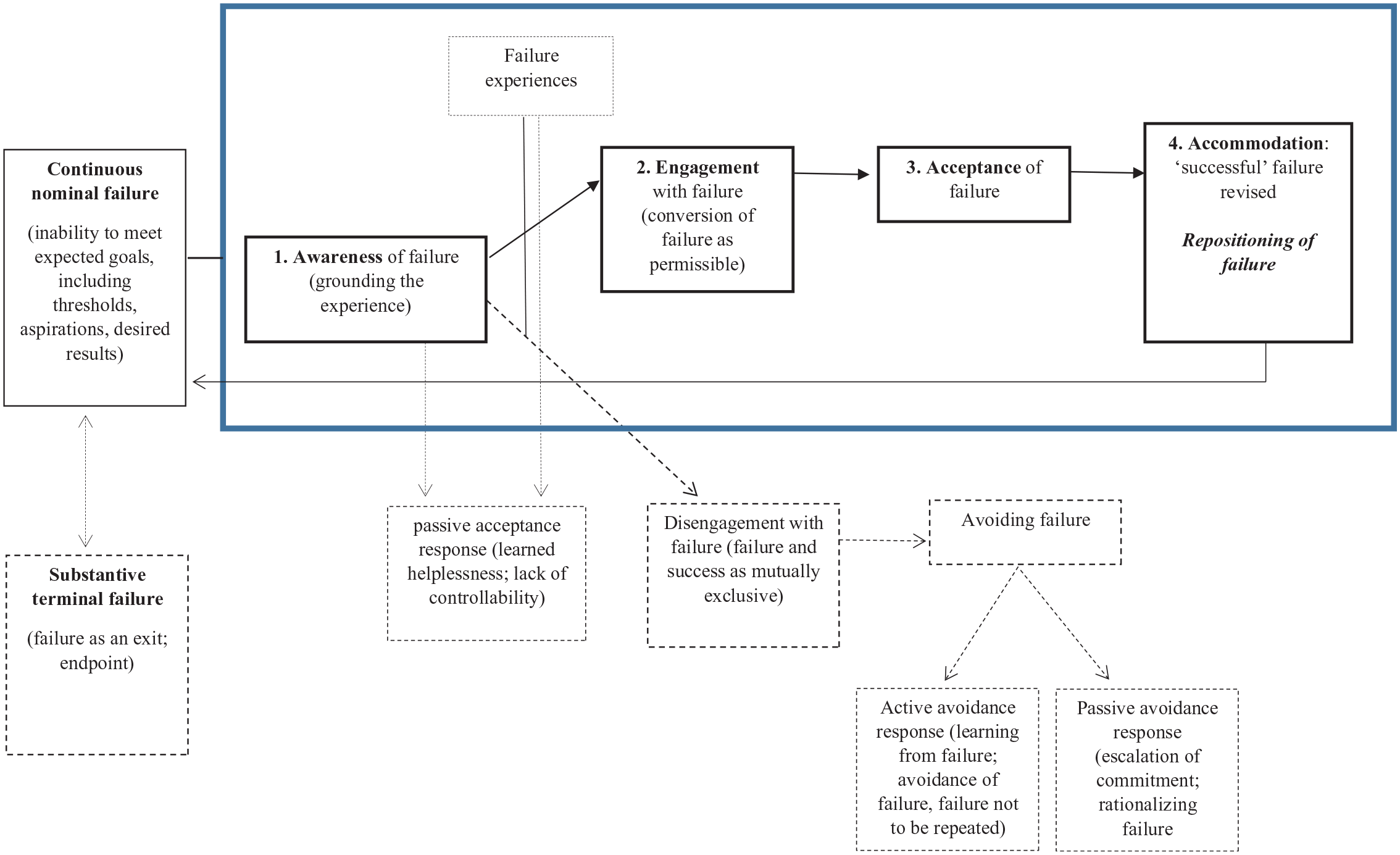
Repositioning Failure Through an Active-Acceptance Response.
Attempting to attain a goal and not quite doing so results in a graduated shifting response, with a focus on what has been achieved to allow for its continuation (e.g. project parts to continue). The key to this repositioning is that it relies on individuals translating events and developing a shared understanding among members. In this way, reaching convergence among organizational members gives meaning to the events leading to failure, which allows its acceptance despite what that represents for the firm (after Daft & Weick, 1984). The adjustment underlying this repositioning consists of four mutually reinforcing phases: (1) an awareness of failure; (2) an engagement with failure; (3) an acceptance of failure; and finally, (4) the accommodation of failure (as success), illustrated in Figure 2.
Phase 1: Awareness of failure
Knowing that failure has occurred is the first and pivotal step in repositioning through active acceptance. This initial interpretive phase incorporates two of the mechanisms highlighted earlier as core to active acceptance (i.e. functional coping, suppressing knowledge), giving failure a problem-specific boundary, coloured or influenced by previous failures. As Folkman and Lazarus (1980) illustrate, having a problem to focus on serves to give an experience shape and something that can be measured or assessed. More specifically, Denrell (2003) points out the value in being mindful of failure as it occurs, rather than focusing retrospectively on performance gains and success. Awareness links identifying the organization’s original goals to aspirations not reached. This affirmation gives failure a definite form, and allows organizations to generate an alternative social construction of it as a problem to solve or in need of a strategy to manage. In this context, and unlike responses to failure motivated by the need to correct a decision or to learn from the outcome (e.g. Brockner, 1992), awareness refers to the simple premise of knowledge that failure has occurred; the capacity to identify and report failing. In this way, awareness of failure differs from a behavioral approach to failure (Posen et al., 2018) in that it acts as a context setter to ground the failure experience.
Awareness implies being mindful of and drawing inferences from the experience in order to act on it, exemplified in the way that Fukushima power station members initiated active-acceptance by acknowledging safety failures. Invoking Gong et al. (2019) on the role of how members label failure, being aware suggests that organizations (through their members) are actively looking for and seeking out information relevant to goals achieved. This search effect enables a capability for organizational members to draw conclusions from their observations, and a willingness to recognize or discount non-relevant information in the context of what is occurring (Kokar & Endsley, 2012). It recognizes that, typically, failure experiences contain more information than successful experiences and are therefore more visible or able to trigger a response. In this sense, as a static state of knowledge, awareness gives a boundary to the failure encountered, becoming a function of how organizations may interpret the experience, and the strength of that experience. After all, organizations typically search for local knowledge that is familiar or closely related to an experience, giving it a boundary. In this way, the experience of failure acts as form of brokerage, occupying a bridging position between the awareness of failure and its engagement – where brokerage refers to the social influence that can lead to different views on failure (Halevy, Halali, & Zlatev, 2019). Awareness acts as an interaction connecting to and then influencing the likelihood of this frame being adopted (i.e. of an active-acceptance response). The effect of the group-based, normative experience of failing is an important boundary condition that influences high and low levels of awareness and reaction to failure.
We propose that level of awareness of failure acts as an expectation setting anchor, serving as a starting point for adjustment to a positive evaluation of the failed outcome. Being mindful of failure gives rise to differences in awareness. Specifically, a high awareness represents a frank, comprehensive and unqualified representation of the experience. It is key to transition to a proactive engagement with failure (seeing a ‘glass half full’ rather than half empty, i.e. phase 2) because it demands that the problem be appraised. With this recognition, the organization is able to present failure in problem-management terms, focused on minimizing and managing its effects. By adopting this condition, organizations recognize the problems associated with failing, giving attention to known risks of the failure, and incorporating its cues, giving it a less threatening tenor. With this belief, organizations with high awareness are more likely to recognize failure, hold a favourable response toward failure, or be more willing to embrace the project outcome. Repositioning failure acknowledges this dialectic and suggests that, as its starting point, organizations need to evaluate failure as ‘less negative’ – a feature that distinguishes this active-acceptance response from the others detailed earlier (Figure 1).
Differences in awareness of failure are due to the way that organizational members vary in how they assess difficult or challenging situations. The variation observed in awareness levels is often a function of history of other failure, and particularly the strength of that experience. As work on an attention-based view on failure reflects (e.g. Shepherd, McMullen, & Ocasio, 2017), the ability of individuals to allocate attention to failure – to focus on and detect failure – can determine the emergence of and level of awareness (also Joseph & Wilson, 2018). The effect of active, personal and direct experiences influences the level of awareness and reaction to failure. For this reason, organizations do not approach failure anew, but rather bring to bear a set of reactions. This variability enables different awareness options, as well as varying degrees of engagement with failure. With this boundary, organizational members who have a strong prior failure experience (and even differences in big or small failures; Gong et al., 2019) are more likely to have higher failure awareness than those with less failure experience.
To summarize, awareness grounds an active-acceptance response because it contextualizes failure to the organization’s recognition and appraisal of the experience. Organizations have the ability to assert something in order to gain some other goal, but only, if they are aware of that goal (Turri, 2011). This basic appraisal allows for a reasonable belief in the failed outcome without necessarily defending it. In this context, awareness is the foundation phase for repositioning failure as success.
Phase 2: Engagement with failure
The next phase in the repositioning is converting awareness into an engagement with failure; linking awareness to the beginnings of a positive reconstruction of failure. Because failure often is an uncomfortable and unwelcome outcome for an organization, this advocacy is key to enabling an alternative reading of failure. Engagement refers to the state of increasing effort to deal with or cultivate meaningful connection to the failure (Kahn, 1990). Like Ashforth and Anand (2003) on how certain practices become normalized as mutually reinforced practice, failure becomes viewed as a permissible outcome. It represents a protective response to the pressures associated with failing, in an attempt to provide a positive account of the failure. Whereas awareness emphasizes the presence of failure, engagement is a form of advocacy – the presentation of failure as a reasonable, competent possibility. It enables the appraisal of the failure as instrumental to the organization, and as a mechanism for thriving (despite failing); a belief in its value for improvement. For instance, at Fukushima, members adjusted to and synthesized ongoing project failures, adjusting negative assessments of the power plant’s safety and operations in the years leading up to the failure event. Rooted in the functional coping and stasis mechanisms core to active acceptance, such engagement helps us understand the importance of the potential attributed to or associated with failure. Unlike avoidance-based frames (e.g. Martin & Marsh, 2003; Sitkin, 1992), in the engagement phase of active acceptance, the focus is less on mitigating risks and the need to resolve threats and challenges associated with failure, and more on how the failure outcome is progressively converted into a legitimate option that creates a sense of momentum and meaning.
Engagement entails a number of actions aimed at establishing this connection to failure. These actions incorporate: (1) justifying the situation (‘As an organization we can learn to live with it’), (2) suppressing other possible options (‘This outcome goal is important’), (3) seeking support (‘Other stakeholders have similar views and interests’) and (4) not doing anything about missed original goals (‘Why change things; it works’). Such appraisal offers a means to envisage and adopt alternative outcome milestones, thereby generating positive meaning to failed goals or bolstering the status quo. Responding to failure in this way gives a conditional meaning to the outcome, perceiving failure as an active choice. That is, actively portraying the good in adverse circumstances, enabling the conversion of possible deep-seated or long-held unease with failing. Those organizations that are able to advocate for failure this way appraise the experience as beneficial, and approach subsequent, related failures with an increased sense of this mastery.
This positive adjustment to clear failure represents the organization’s fortitude to embrace the situation – the ability to absorb missed goals and recover from it regardless. It is this conditioned view that is essential to the end point (phase 4) of recasting failure because it indicates that, through such engagement, repositioning failure can take hold despite all indicators suggesting otherwise. As a dialect, it enables the existence of contradictory perspectives on failing (Hargrave & Van de Ven, 2017), allowing conflicting tensions to exist on the failure experienced. The willingness to evaluate failure in this way constrains an ability to see the contradiction of this response with the organization and its members willing to advocate for the outcome because it promotes selective parts of the original goal. At its core, it is not about ignoring or denigrating information, or suggesting limitations on initial aspirations, but about re-interpreting the perceived opportunities from the failure by viewing failure and success as mutually inclusive.
The relationship between failure awareness and engaging failure is related to how organizations interpret and then evaluate the failure as a credible, prospective outcome. That is, failure is accorded a positive meaning because it is viewed as a possible enabler or means of betterment. Given that it is an intentional assessment, this association enables both a practical (i.e. problem-solving) and an unrealistic (i.e. hopeful) appraisal of failure for the organization. Generally, organizations tend to engage a behaviour when they evaluate it positively, when they believe it or hold positive attitude towards it. It is at this stage of repositioning failure that organization members may reflect and act on variants of the question: ‘Is this failure good for the project?’ While an oversimplification, this advocacy reiterates the importance of a positive response to failure being a function of an awareness of failure. Following Baumeister (1982), organizations that defend the belief that failure will lead to mostly positive outcomes tend to hold a favourable attitude towards the outcome, and will couch the failure in such success-oriented terms. Consequently, an engagement with failure has a powerful impact on the ability to recast failure.
The engagement with failure response is bounded by the belief that the failure outcome is less of a deterioration than it is a possibility. The focus is on the benefits or positives associated with the failure, and a willingness to justify a sidelining of original goals. The level of engagement, therefore, is a function of how failure is evaluated in this way. For instance, explaining why soldiers at war make the decision to surrender, Grauer (2012) argues that soldiers tend to focus on the pursuit of favourable outcomes. Before surrendering, combatants evaluate the likelihood of surviving captivity based on other reports of prisoner treatment. That is, they use these ‘good’ signals to confirm the outcome (i.e. safety in war). As such, engagement is a protective response that modifies, ameliorates and alters the capacity to defend failure as reasonable outcome.
Phase 3: Acceptance of failure
As the third phase of repositioning failure, accepting failure rationalizes how an organization (through its members) shifts engagement to a functional or energizing possibility. As a synergy reaction, it represents the coordination of distinct failure elements and mutual approaches – a means to an end. It is at this stage that the ability to redefine the failure and present it as an opportunity is sanctioned and normalized. Acceptance is defined as an agreement with, consent in, or willingness to tolerate an idea or an explanation, that is, engaging a failure outcome as valid or suitable regardless of its known goal limitations. As such, its placement differs from other assessments of failure which typically present this welcoming reaction as one of the initial, essential steps in how organizations experience project failure (e.g. Bledow, Carette, Kühnel, & Bister, 2017). Rather, having an awareness of failure and a positive engagement, this phase incorporates a revised goal failure as a legitimate option for the organization, integrating Ashforth, Kreiner, Clark and Fugate’s (2007) recognition of how individuals rationalize and reframe actions and ideologies by refocusing action on the positive; the acceptance of this rationalization (which in turn strengthens engagement). With this grounding, organizational members synthesize meanings associated with a failure and its positive associations. This coming together highlights the essence of active acceptance – that failure and success are mutually inclusive.
Whereas engagement establishes a positive aspect on failing, as a judgement on the outcome, accepting converts these tensions to overlook the reality of failed goals. This judgement enables organizations to continue failing projects because they are explicitly supported or embraced by those experiencing it. This incorporation confirms the dialectical adjustment of repositioning failure – that when something is believed to be true, then there is also a stronger belief in arguments that support it, regardless of whether it is correct (Jones, 2002). Such tension enables new sets of arrangements and practices to form (see Hargrave & Van de Ven, 2017). With this reasoning, and far from being intentional deceit, a willingness to believe in failure or in the benefits of failure enables the ability to then act to constrain that belief (‘not really failure’), permitting organizational members to represent poor project outcomes as being of value (Bayne & Pacherie, 2005).
The degree to which different organizational members accept failing is determined by three moderators. First, the extent to which the failure outcome is distinct or different from other similar outcomes (after Ford, 1985). Organizational members positively engage and accept failure when they view the failure as distinct enough to represent a ‘victory’ rather than the norm (and therefore ‘another’ failure). Second, the perceived ability to control the situation or its causes, and the belief that the situation is manageable (after Taylor, 1983). If the failure is viewed as controllable, the problem is offset rather than abandoned. Organizational members then view the situation as acceptable, and therefore able to be incorporated. Third, the level of confidence in the choices that generate failure impacts on the interpretation of success and failure. High confidence is a source of certainty, promoting a positive sense of the outcome. Such confidence generates a belief in the value of sustained effort or problem solving, regardless of the failure.
Representing failure as a legitimate outcome in this way relies heavily on the functional coping and selectively suppressed knowledge mechanisms that underlie active accommodation because it cultivates selective information processing regarding this outcome and its parts. For instance, at the Senate hearing on the failure of NASA’s Apollo 13 mission to the moon, acceptance of failure was a central feature of how the incident was viewed and its details used to legitimize NASA’s funding and the value of the agency. What should have been a good story about space flight and a lunar landing turned into failure, with the landing aborted after an oxygen tank exploded two days into the flight, forcing the craft to limp back to Earth. The revised project goal for Apollo 13 logically became one of survival. As Kauffman (2001) observes, NASA viewed the event as ‘a successful failure’, focusing on its control of external communication about the failed expedition epitomized by the citation medal awarded to Apollo 13 astronauts which portrayed the event as ‘a triumph of the human spirit – of those special qualities of man himself we rely on when machines fail. . .’ (in Nixon, 1975). This acceptance was visible in how, once acknowledged, the failure was presented continuously in terms of the success of the mission’s accident recovery programme and its add-on value for NASA competencies – a direct outcome of the project’s failure (and paradoxically, also serving as the basis of normalization that would lead to other, significant NASA failures later; Vaughan, 2006).
Using this explanation, the programme director characterized success as this measurable outcome, because ‘the remaining systems performed in an outstanding manner in meeting the unusual demands placed upon them. At the same time, the flight and ground crews demonstrated exceptional competence in meeting a set of unusual circumstances’ (Hearing before the Committee on Aeronautical and Space Sciences, US Senate, April 24, 1970). One of the astronauts, James Lovell (1970), explained that while some would view the flight as a failure, he considered it ‘a triumph of teamwork, initiative, and ingenuity’ (p. 24). With this acceptance, failure and success were mutually adjusted and redefined – the revised goal being that Apollo 13 flew around the moon. While NASA could portray its project failures as part of innovation and learning outcomes, the relationship between public opinion and its connection to ongoing funding (Gustetic, Crusan, Rader, & Ortega, 2015) suggest this placement of nominal failure as acceptable. Realigning project outcomes for Apollo 13, the failed objective became less relevant against the background of first getting crew members back to Earth and then explaining how crew members survived, and retold in the context of ongoing Apollo missions.
While challenging norms on failing, a focus on accomplishments realized is logical given our earlier delineation of nominal failure as offering both positive and negative outcomes. Adding to this outlook, acceptance represents the adjustment to an alternative, new definition of goals. Thus, when confronted with failure, those responsible for project goal commitments may emphasize its positive features, either through choice or through assignment. The acceptance of failure in this way enables the view of those limited goals met as viable. While organizations exposed to failure may not agree with it or want it, by accepting failure they are able to reposition it as a legitimate response.
Phase 4: Accommodation of failure (as success)
The last phase in active-acceptance repositioning is the accommodation of failure, representing its portrayal as a success, despite indicators suggesting otherwise. As a form of goal realignment, this adjustment enables organizations to continue failed tasks that are well past their use-by date and supports its members’ choice to modulate their responses accordingly. It represents the active promotion of the failed outcome as a valid result, reinforcing each of the preceding three phases.
Accommodation characterizes the tangible coming together of the three mechanisms highlighted earlier as core to active acceptance – acting as a form of functional coping in enabling failure to be viewed this way, suppressing knowledge that might deflect attention from the original goal outcomes, and allowing a presentation of failure as a form of resiliency to the situation. Hence, it offers a constructive adjustment to the failed project as goals and standards are realigned to promote what are normalized as its successes. Also, accommodation embeds Ashforth and Anand’s (2003) recognition of the role of compromise inherent in normalizing actions in organizations. Having socialized active-acceptance values and outlook, accommodation becomes a form of failure co-optation in revising goals to rationalize actual fail as success.
The accommodation of failure is dependent on one of five conditions. First, by adopting an overconfident or optimistic outlook, organizations assume that they are less likely to have a negative experience (e.g. Helweg-Larsen & Shepperd, 2001). Second, by emphasizing and promoting achievements, the failure outcome is continuously associated positively (e.g. Covington, 2000). Third, by minimizing conflict on or reducing disagreement about the failure the outcome is given high relevance (e.g. Wiegand & Geller, 2004). Fourth, in paying attention to selective project goals that are achieved, the value of the solution is over-emphasized (e.g. Kim, 2021). Finally, in overvaluing failure, organizations recognize and explain this outcome as a reasoned choice (e.g. Ariely, 2008). Consequently, and despite tangible evidence, failure is accommodated to create a ‘successful failure’ disposition, representing an affirmative of the failure to achieve aspiration levels. With this response, the organization (via its members) portrays this same positive adjustment sentiment that Jordan and Audia (2012) explain as a subjective enhancement choice. That is, selecting favourable evaluations of goals met to enhance the perception of a positive outcome – of selectively focusing on the good (i.e. the reposition).
Accommodation represents the reasoning used to reformat the criteria for what is ‘success’, enabling organizations to continue failed project outcomes and superseded tasks. When organizational members approach planned goals from the viewpoint of trying to achieve a desired action, they naturally envisage success (Bagozzi & Warshaw, 1990). Accordingly, the failure to reach aspired goals can be confronting as it epitomizes a potentially poor outcome for the firm and its members, especially when read in the context of the typical framing of failure in negative terms. Accommodation offers an alternative view by legitimizing the conversion of failure acceptance, characterized by a willingness to believe that to fail is less of a deterioration than it is an opportunity. Rather than reset goals and outcomes after recognizing failure so that the gap between desired performance and actual performance is minimized (e.g. Greve, 2003), or instead of recognizing a performance gap and working around it (e.g. Staw, 1976), accommodation results in a synthesis of the positive outcomes of failure outcomes as they occur.
An example of accommodation is evident in Boeing’s supersonic transport (SST) plane project. In 1963, President Kennedy committed the US to the development of a commercially viable supersonic jet. The efforts of European countries to manufacture their own fleets of supersonic airliners provided momentum for an American effort. The project was a response to the imminent development by others of similar supersonic jets led by a European push to develop the Concorde, alongside the strategic weapons race with the Soviet Union, with several supporters using the SST to promote US manufacturing. Despite its promise, the SST gradually failed, facing several project failures relative to problems with its technical requirements and design, environmental concerns on sonic boom, ozone depletion and engine noise, and its fading economic viability (Primack & Hippel, 1972). Yet despite the failure, the promotion of the limited successes of the new jet was accommodated by the industry and its supporters and used to justify those goals met in the development process. For instance, repositioning SST failure as success, Pan Am used the failed project to recast its commercial development goals, using the failure to build its strategy of promoting new wide-bodied jets. With this accommodation, ‘successful’ failure was incorporated in industry performance. The SST project was actively accommodated by detailing the commercial benefits of far less sophisticated jet developments, and then portrayed as the basis for successful future ventures.
In summary, accommodation of failure recognizes that an organization intrinsically strives to hold mild and benignly positive interpretations of their performance, and for their future. Through accommodation, they maintain choices and strategies that preserve positive interpretations and minimize negative associations. In effect, an organization imposes order and sense on a failure outcome. Whatever change has occurred is salvaged and used to reposition failure differently, as it occurs. This embedded temporal aspect is an important add-on of our modelling given the tendency for retrospective and sensemaking accounts on failure.
Discussion
The paper fills an important gap in conventional dialogue on organizational failure. Although there is a long history of theorizing failure and there is a keen curiosity in both nominal and substantive failure, organizations remain uneasy about becoming failing entities. After all, organizational literature observes a paradoxical and ongoing tension between success and failure inherent in organizational systems (Smith & Lewis, 2011). As Greve and Gaba (2020) highlight, this view is built on the assumption that organizations tend to believe in the need to reduce outcomes to a dichotomy of either success or failure. Specifically, it is assumed that achieving outcomes comes through high level performance, where performance is measured in relation to reaching goals (or an assessment of those goals). By contrast, in this paper we introduce a categorization of the way organizations can respond to failure differently by repositioning the failure as success. With active acceptance, we propose that failure entails a dialectical adjustment that repositions failure to vary in terms of possible dual positive and negative outcomes. By introducing this dual adjustment and elaborating on its different phases, we add to possible failure responses by opening new paths for development (and adding to work on failure ambiguity, via Levinthal and Rerup, 2020) in how organizations frame failure that may differ from what is actually occurring.
Repositioning opens a new path for understanding how organizations respond to failure as it occurs. Despite recognizing its possible long-term benefits, few institutions publicly admit to promoting programmes or encouraging projects that don’t work (Cannon & Edmondson, 2005), and assume the placement of failure as part of a broader change strategy (Schwarz et al., 2021). Further, the challenge in terminating failed projects is often underplayed in favour of managing its successes. Our repositioning of failure as an adjustment provides an alternative reading of these responses, thereby adding to established theorizing on organizational failure (and on the social construction of failing; March, 1994). In doing so, our framing presents three specific contributions on organization failure – we model how failure is an adjustment process as failure occurs by synthesizing dual positive and negative consequences; our model explains the reorientation of organizational failure as a success, adding to mainstream perspectives on failure; and we progress theorizing on the emergent character of organizational failure – on the question of what ‘to fail’ means.
Instead of continuing to debate failure and the ways it is minimized, persisted with, or learned from, an active-acceptance framing expands discussion of how failure becomes normalized. Clearly, while repositioning failure is not the only path through which organizations cope with failure, it is an important condition for the different possible framing responses, and specifically, how organizations actively engage with failing as it occurs. This alternative approach recognizes that the nuances of how organizational-level failures are reframed is still under-developed in organization research, especially given the tendency to focus on retrospective accounts of their failure. In this paper, however, and as the basis of further empirical research, acknowledging that just as organizations have multidimensional goals, we argue that organizations do not always respond to failure in known, expected ways. This organizational-level stance extends behavioral accounts of how organizations use feedback to respond to failure in rationalizing how organizations recast failure.
Repositioning organizational failure as a framing response
In keeping with our acknowledgement that reacting to failure can be framed differently (Figure 1), it is helpful to understand how active acceptance fits into a broader nomological network of known framing responses towards failure. Repositioning challenges researchers to take a more varied position in hypothesizing about how organizations respond to the challenges of failure. It complements Joseph and Gaba’s (2015) recognition that performance feedback can be open to multiple interpretations. This framing is especially useful when recognizing that organizational failure is typically viewed in negative or neutral outcome terms (i.e. an avoidance lens, Figure 1), or defined in terms of comparative parameters (e.g. creation vs. death; success vs. failure). Although an important experience, and even with noted benefits (Birkinshaw & Haas, 2016; Sitkin, 1992), failing is habitually viewed as a poor initial outcome, whether it is through learning from failure or by cutting the losses that accompanied the failure. So, despite progress in the way it is presented, organizational researchers have made limited inroads in understanding its nuances, and especially a comparison of framing responses (cf. Dahlin et al., 2018; Dess & Robinson, 1984).
It is important to acknowledge that repositioning failure is founded in previous research on organizational-level decline and failure, recognizing the significant work done since Whetten’s (1980) essay urging researchers to study the subject. This organization level of analysis is relevant given research on behavioral, dispositional, situational and self-enhancement themes on evaluating performance (e.g. Audia & Brion, 2007; Greve, 1998; Sitkin et al., 2011) which we do not address in this paper. In particular, it incorporates research establishing that organizational responses to failure can encompass an ability to change and innovate just as much as they facilitate or promote avoidance and risk avoidance (Deichmann & van den Ende, 2014; McKinley et al., 2014). Such research acknowledges the upside of failure in a variety of ways, such as a means of error management (van Dyck, Frese, Baer, & Sonnentag, 2005) and the value of routines (Feldman & Pentland, 2003). Together, these perspectives establish that it is not remarkable to study failure as a juxtaposition with success.
Yet differing from the model presented in this paper, these views are built on the pragmatic reasoning that failure is (or should be) followed up by success or revised actions. Further, previous failure research often relies on a simple presumption that the characteristic of failure that matters is its robustness – acting as a reference point to judge the outcome (e.g. Maslach, 2016), or that failure is probabilistic and therefore causal regardless of outcome (e.g. Cyert & March, 1963), and that failure motivates because it is built around performance feedback (e.g. Greve & Seidel, 2015). Our argument recognizes these conventions but suggests that failure is not always a terminal point to build forward-looking strategy and options, helping us establish that there are other possible positive interpretations of failure as it occurs.
Repositioning failure and learning from failure
Repositioning organizational failure and learning from failure (active avoidance) overlap in that they both entail high-level intensity responses and as such contextualize the relevance of failure. For example, Nonaka and Takeuchi (1995) illustrate that awareness of mistakes and recognition of systematic small failures is an essential prerequisite for learning from failure, stimulating the sort of experimentation that is fundamental for sound policy development and management (supported by Cannon & Edmondson, 2001; Mueller & Shepherd, 2016). Despite this overlap, however, as an active-avoidance response, learning is actionable knowledge created specifically from the backward-looking experience of failing. Without this loss – and a retrospective sensemaking account of it – organizations and their members are unlikely to improve or drive change, given the assumption that organizations learn more from failure than successes. With this perspective, failure is bounded by lessons learned.
A crucial difference with our repositioning perspective and its active-acceptance basis is that while learning relies on the mutual exclusiveness of success and failure (e.g. Bledow et al., 2017), repositioning involves an ongoing, dialectical adjustment characterized by the conflicting forces of success and failure culminating into a synthesis that liberates rather than constrains action. With this difference, failure and success are mutually inclusive. Learning from failure presents failure as an end point in order to restart or motivate future behaviour – a reaction response to the failed outcome. It assumes that if failure and success coexist, they do so poorly since the former must first be terminated to create or maintain successes. By contrast, repositioning adjusts success and failure and offers a coping strategy to engage failure as it occurs, anchored to how failure is represented.
Repositioning failure and escalation of commitment to failure
The passive-avoidance response to failure, exemplified by escalation of commitment, explains how failing is progressively rationalized (as a failed course of action). It describes a tendency to persist with an ineffective course of action when it is unlikely that the situation can be reversed (Staw, 1976). Explanations of escalation relate to immediate involvement and responsibility for the decision, sunk costs and proximity to project completion. These reactions include a desire to affirm choices (e.g. self-justification; Brockner, 1992), to avert loss (Kahneman & Tversky, 1979), to substitute goals (Humphrey, Moon, Conlon, & Hofmann, 2004), and as a form of self-enhancement (Audia, Bryon, & Greve, 2015) with each suggesting that organizations and their members do not like to admit that their past decisions were wrong. Interpretation creates the experience. With this response, organizations do not wilfully accept failure but tend to avoid it or minimize its outcomes in the hope of reaching goals. In this way, escalation responses are an attempt at compensation instigated by an aversion for loss. Hence, failure is anchored as a poor or less than optimal outcome that must be avoided. Its focus is on a clear pathway of persisting with failure or withdrawing from the previously chosen course of action based on assessment of the probability of attaining goals, or given an unwillingness to admit the escalation (Schwarz, Wong, & Kwong, 2014). The pathway to failing is in commitment and ongoing justification of resource allocation.
By contrast, repositioning rests explicitly on awareness and engagement with failure – a recognition of the failure – creating a willingness to recast the failure to recast missed goals as a viable outcome. By taking an active-acceptance frame, not only is failing clearly acknowledged as part of the accommodation experience, but this repositioning enables the dialectical adjustment lacking in escalation. Repositioning proposes that success and failure mutually overlap (based on accommodation). Although the mechanisms at play are similar (i.e. negative associations with failure), the manifestation of failure is different. In escalation to commitment responses, organizations persist with a failing course of action in the hope of attaining original goals, even when they receive negative feedback about having missed these goals, leading to making choices to continue despite this failure. Whereas with repositioning organizational failure, missed original goals are acknowledged, but through the process of adjustment these same goals are reframed. In this way, while focusing on information related to goal expectation and values, the repositioning orientation is a more deliberate and active engagement with accepted failure.
Repositioning failure and learned helplessness
As a response to failure, learned helplessness (passive acceptance) occurs when organizational members perceive that a given outcome is independent of their actions (Martinko & Gardner, 1982). Facing this lack of control over the failure outcome, organizations accommodate failure and devise strategies to abandon any action at avoiding future failure. Typically, learned helplessness following failure results in basic protective reactions such as becoming even more passive in the face of associated challenges (Seligman, 1972). The experience of previous failure leads to a lack of control over future similar events. This process creates an expectation of further uncontrollability of related events, resulting in withdrawal, alienation and increased passivity towards the failure outcome, even if it retains an opportunity to cope with the failure (Zimmerman, 1990). Ultimately, as expectations and aspirations fall in line with an uncontrollable reality, helplessness becomes an equilibrium point, enabling organizational indifference towards failure – which allows it to adapt to the outcome. With this passive acceptance, reappraising failure involves both recognition of failure, and then a realization that no action will reduce its severity. This inability to control the outcome is the antithesis of the repositioning failure process. While sharing the same acceptance lens on failure, the adjustment of repositioning diverges from this response by presenting failure as part of a solution, recasting failure positively and as a newly favoured end-state. For learned helplessness, and given the centrality of the past, failure is considered in the context of a problem or adversity, and therefore is dealt with by passively withdrawing from it. By contrast, repositioning presents failure as part of an ongoing, functional process that is incorporated through its recasting, based on the reinterpretation of the end state.
Directions for future research
Complementing the body of work on organizational failure, a repositioning narrative offers an alternative response to a well-documented phenomenon – a willingness to believe in the value of an outcome because it confirms the importance of that goal. As we present it, when faced with failure, an organization can reformat the criteria for success and act as if the outcome is positive. This approach explains how organizations can continue with failed projects. Whereas there is plenty of theorizing at the behavioral or cognitive level explaining the possibilities for how and why performance goals are revised or redefined (Bouckenooghe, Schwarz, & Minbashian, 2015; Sitkin, See, Miller, Lawless, & Carton, 2011), the response proposed here presents an interpretive, adaptive one built around re-appropriating failure. If failure enables stasis as a positive outcome, then restating its effect is not so much a weakness as it is a reasonable outcome.
Key to this contribution and its transferability is that the repositioning response emerges from ordinary factors that manifest in nontraditional ways. There are already a large variety of studies on organizational failure, and there have been many important contributions made to our understanding of it (see Heine & Rindfleisch, 2013). Most present disparate perspectives on the topic, however, focusing on its antecedents, consequences and struggles of lessons learned. After failing, the view is that organizations will not only engage in a search to understand what happened, but they will look for information to alter their operations based on the assumption that failure reveals that existing ways of operating are no longer sufficient or appropriate. Instead, repositioning offers a coping strategy to engage failure as it occurs, anchored to how failure is assessed. Based on an assumption that failure is an ongoing process, this approach arises from a willingness to believe that missed goals or poor outcomes are less of a deterioration than they are opportunities. The paper fills a gap in conventional dialogue on failure by opening new paths for understanding how organizations frame failure differently. A primary implication of repositioning, therefore, is that it prompts discussion of what exactly ‘to fail’ means for an organization dealing with failure (where failure is the organization’s inability to attain expected goals, as we define it earlier).
This outlook incorporates a response to Denrell (2003) that organizational research tends to under-sample failure by paying too much attention to attending to success or strategies for performance. The perspective underscores that a basic problem in theorizing failure in organizations is the continual focus on viewing failure and success as mutually exclusive. Theorizing failure in this way offers many benefits because it is often easier to identify why a failure has occurred, and its follow-up resolution, than it is to explain success. Yet despite acknowledging its presence, to fail is seldom publicly celebrated, and rarely promoted even while the benefits of failure are tacitly acknowledged. As theory develops and increases our understanding about the place of failure, researchers have focused on reflecting on the experience of failing in this context, often focused on performance problems from attending to narrow and specific goals. We have become proficient at theorizing failure retrospectively, which makes it easier to detail responses to failure (e.g. Caldwell & O’Reilly, 1982) and its justifications (e.g. Taylor, 1983). Such typical delineations of failure, however, are limited by this narrow perspective on its meaning. Developing an alternative response through repositioning attempts to get past this constraint by adjusting how we view success and failure as mutually inclusive, enabling possible dual positive and negative consequences.
Noting our use of awareness on how knowledge forms in the process underlying repositioning – that the strength of asserting something that is known to be incorrect or unreasonable can establish that belief, despite it being false (Turri, 2011) – the active-acceptance response asserts failure to be a positive act. In this way, the dialectical adjustment in repositioning redresses the view on failure as an offset to success – the emphasis of and dominant view on failure as a difficult outcome (e.g. poor performance, lack of change, learning from mistakes). Repositioning offers a way forward in theorizing failure by prompting a different lens to understand the positive state and classification of failing, recognizing that there is a lot of discrepancy in organizational performance and what it entails.
Still, it bears asking (and then empirically exploring), how is it possible that an organization embraces a repositioning of organizational failure? For instance, there may be inherent organizational traps in consistently adopting this approach, such as the cultivation of unethical or illegal business practices that could result in eventual failure. Instead, repositioning offers a subtle, altered way of reinterpreting failure. It shows that by reconstructing what failure is, organizations can view it not so much as a failure than as an appropriate representation of what the outcome should have been. Clearly, there is a need for more research into this phenomenon, testing what is its tipping point and trajectory (into substantive failure), and what potential risks it holds. Questions to explore with this reasoning include why organizational members act against failure situations, how different external conditions such as downturn macroeconomic cycles impact repositioning organizational failure, whether having multiple planned goals matters, and how repositioning failure is attributed to different reasoning as firms age or grow. Future research could also examine leadership effects connected to the aspirations inherent to behavioral theory of the firm (Cyert & March, 1963) and the adoption of new frames. For instance, exploring how much influence individuals have on the response adopted, such as if an executive pushes the organization to adopt one response at the beginning of a project failure, but gradually shifts to a new response as the project evolves.
The paper also provides an alternative challenge to future research to move beyond popular learning and behavioral studies focused on failure. The dialectical adjustment proposed through repositioning involves a pragmatic action because organizations use it to recover from failure and to mitigate the stigma usually associated with failing. As we show through different ways of framing responses to failure, it is not a new experience that organizations convince themselves about a situation so that they recast original goals or choices. Yet the model re-applies this reaction to explain how organizations are proactive in accepting actual failure. The active-accommodation lens focuses attention on the generative processes associated with failure, rather than on the phenomenon. In this context, it may be worth exploring further if there are organizational differences in dealing with failure (such as size or personnel) that characterize the repositioning of failure, whether different project teams in the same organization can adopt different failure responses, and if active accommodation of nominal failure in multiple projects eventually leads to substantive failure.
Finally, the repositioning thesis suggests that recasting failure may be a reasonable and viable action because it is a coherent solution rather than a cost or mistake. This alternative position offers a new means to study failure. Far from assuming that the basic trajectory of an organization’s growth ensures that all transformations are time-dependent processes of progression postulated as a definite sequence of phases, as a dialectical adjustment, the active-acceptance response challenges conventional representation of organizational failure and its management. Rather than presenting failure as a passive state that is neutralized or becomes a sensemaking device, this interpretation could be confronting to organizational researchers because it is so different from the competitive view of organization and performance efficiency. Further, part of the barrier to studying continuous, nominal failure is that it is difficult to track such occurrences, and even more difficult to engage organizations willing to admit failing projects. In future studies, researchers might want to consider the problem-solving possibilities and upside of failing.
Footnotes
Declaration of Conflicting Interests
The author(s) declared no potential conflicts of interest with respect to the research, authorship, and/or publication of this article.
Funding
The author(s) received no financial support for the research, authorship, and/or publication of this article.
