




Abstract
Interorganizational ecosystems require governance arrangements that can align diverse and often competing organizations around a shared value proposition. Although blockchain, as a form of digital governance, promises to facilitate large-scale collaboration by codifying and enforcing rules, decentralizing control, and ensuring verifiable data exchange, many blockchain-based interorganizational ecosystems nevertheless fail. Leveraging 155 interviews and detailed internal records from a large technology provider covering 81 interorganizational blockchain projects across 25 industries, supplemented by archival evidence on the trajectories of 196 projects and 70 podcast interviews, we develop a grounded theory explaining how governance misalignments trigger collaboration breakdowns. Specifically, we identify three underlying governance tradeoffs that expose tensions between blockchain’s network-centric rules and actor-centric needs: consistency versus flexibility in coordination, system reliance versus actor reliance in trust and control, and ecosystem utility versus member utility in incentives. These tradeoffs are amplified or attenuated by corresponding boundary conditions related to scale and cohesion (for coordination), co-opetition (for trust and control), and value logics (for incentives). Our study advances governance theory by explaining how blockchain interacts with traditional governance, shapes critical tradeoffs, and influences ecosystem success and failure. We also offer
Keywords
Introduction
The governance of interorganizational ecosystems is especially challenging because large-scale collaboration typically entails complex interdependencies among many independent organizations (Jacobides, Cennamo, & Gawer, 2018; Ranganathan, Chen, & Ghosh, 2025). Governance in such settings can benefit from digital mechanisms that leverage algorithmic protocols and shared technical infrastructures to strengthen coordination, trust, control, and incentives (Hanisch, Goldsby, Fabian, & Oehmichen, 2023). Blockchain serves as a prominent example because it enables parties to codify and enforce rules, decentralize control, and facilitate verifiable data exchange across organizational boundaries (Wang, Lumineau, & Schilke, 2022). These properties have motivated a diverse set of interorganizational initiatives, including goods tracking in multilayered supply chains, cross-organizational data sharing in logistics, and financial settlements in banking (Goldsby & Hanisch, 2022; Lacity, 2018). For example, blockchain projects such as B3i in insurance, TradeLens in global shipping, Food Trust in grocery retail, and we.trade in trade finance sought to tackle ecosystem-wide data sharing, transparency, and settlement problems that traditional governance mechanisms struggled to handle at scale. Despite addressing widely recognized problems, many of these initiatives nevertheless stalled or shut down (Zhan, Yeung, Tan, Xiong, Xing, & Ye, 2025), fueling disillusionment and criticism of the technology.
In addition to the practical challenges, the question of how blockchain affects the design and effectiveness of governance in interorganizational ecosystems remains conceptually elusive. Part of this problem stems from the broader difficulty of theorizing the blockchain phenomenon (Lumineau, Kong, & Dries, 2025). Existing work often applies bilateral exchange theories such as transaction cost economics (e.g., Halaburda, Levina, Semi, & Min, 2024; Roeck, Sternberg, & Hofmann, 2020), although such lenses understate the multilateral nature of ecosystem interactions where governance complexity grows exponentially with each additional participant (Gong, Shenkar, Luo, & Nyaw, 2007). Other studies examine individual-level exchanges in blockchain-based networks (e.g., Gregory, Beck, Henfridsson, & Yaraghi, 2025; Hsieh & Vergne, 2023), which do not adequately capture the complexities of organizations operating under regulation, competition, and strategic interdependence. Ecosystem research provides a better foundation for addressing multilateral governance challenges (Adner, 2017; Wareham, Fox, & Cano Giner, 2014), but it has not systematically incorporated digital governance mechanisms such as blockchain. Advancing theory, therefore, requires a sharper understanding of blockchain as a digital governance mechanism in interorganizational ecosystems and its implications for effective collaboration.
To deepen theoretical and phenomenological understanding, we conduct an embedded single-case study of 81 interorganizational blockchain projects across 25 industries, drawing on 155 interviews with ecosystem stakeholders and detailed internal records from a major technology provider. We complement this core dataset with archival analyses of online records from 196 blockchain projects and 70 podcast interviews. Based on these materials, we develop a grounded theory of interorganizational ecosystem governance in which blockchain functions as a form of digital governance. Our empirical analyses show that blockchain engenders a fundamental tension between network-centric governance, enabled by codified rules and transparency, and actor-centric governance, focused on organizational discretion and adaptability. This tension manifests in three governance tradeoffs: consistency versus flexibility in coordination, system versus actor reliance in trust and control, and ecosystem versus member utility in incentives. Each tradeoff is influenced by a boundary condition: scale versus cohesion affects coordination, competition versus cooperation shapes trust and control, and value creation versus value-capture logics impact incentives. These interacting conditions explain why some interorganizational ecosystems achieve alignment and succeed, while others experience misalignment and fail.
Our study contributes to the literature by theorizing when digital governance mechanisms such as blockchain can benefit interorganizational ecosystems. We extend prior work on blockchain by moving beyond a transactional lens (e.g., Lumineau, Wang, & Schilke, 2021; Roeck et al., 2020) and individual-level interactions (e.g., Gregory et al., 2025; Hsieh & Vergne, 2023) to examine its role in structuring ecosystem-level collaboration (Hakanen, Eloranta, Shaw, & Töytäri, 2025; Schmeiss, Hoelzle, & Tech, 2019). Our findings show that while blockchain can complement and extend traditional governance, it also introduces distinct vulnerabilities—such as transparency exploitation and data hold-up risks—because its network-centric rules often clash with organization-specific needs. By identifying specific governance tradeoffs and boundary conditions that either amplify or ease these tensions, we further demonstrate why the pursuit of an “efficient” governance design in these interorganizational ecosystems (Provan & Kenis, 2007; Schmidt & Foss, 2025) is inherently fraught. We synthesize these insights into a conceptual framework and testable propositions, offering a clearer explanation for the recurrent failure of blockchain-based interorganizational ecosystems despite compelling value propositions and advanced technical architectures. Based on our findings, we distill recommendations to help managers navigate governance tradeoffs when building interorganizational ecosystems.
Interorganizational Ecosystem Governance and Blockchain
Interorganizational ecosystems require governance arrangements that can orchestrate networks of independent yet interdependent organizations whose joint success depends on the alignment of their autonomous activities to materialize a focal value proposition (Adner, 2017; Thomas & Ritala, 2022). Prior research shows that governing such ecosystems is challenging because they involve large numbers of stakeholders with only partially aligned and often competing interests (Huber, Kude, & Dibbern, 2017; Shipilov & Gawer, 2020). Scholars highlight several recurring governance problems. A first is the group participation problem, which concerns determining which actors should take part in transactions and how to coordinate their involvement over time (Davis, 2016). A second is scalability, since as the number of actors increases linearly, the possible connections and interactions grow exponentially, making contracting, monitoring, and trust-building increasingly costly (Gong et al., 2007; Provan, Fish, & Sydow, 2007). A third relates to incentive asymmetries, because while some members bear the costs of contributing data or resources, others may free ride or capture disproportionate benefits (Wareham et al., 2014). Under these conditions, traditional governance mechanisms such as administrative hierarchies, bilateral contracts, and relational trust can become inefficient and costly, which often pushes collaboration toward more informal and less structured arrangements (Dagnino, Levanti, & Mocciaro Li Destri, 2016).
Digital governance, and blockchain in particular, has been advanced as a technological response to these ecosystem governance challenges, offering new ways of scaling coordination, trust, control, and incentives across many organizations (Jovanovic, Kostić, Sebastian, & Sedej, 2022; Schmeiss et al., 2019; Sørensen, Viguerie, Giraldo-Mora, & Ahmed, 2025). By recording transactions on a distributed ledger validated through cryptographic consensus, blockchain allows members to coordinate without a central orchestrator (Kostić & Sedej, 2022; Wang et al., 2022). This design directly addresses the scalability problem: algorithmic rules and automated validation substitute for extensive contracting and monitoring, enabling ecosystems to grow without proportional increases in governance costs (Huber et al., 2017; Murray, Kuban, Josefy, & Anderson, 2021). In addition, blockchain’s tamper-evident records and verifiable provenance can mitigate the trust deficit among competitors or unfamiliar partners, offering a shared “single source of truth” (Gregory et al., 2025; Lumineau, Schilke, & Wang, 2023). Finally, blockchain reduces incentive asymmetries by making contributions and benefits transparent to all members—and tokenization further helps make incentives tangible through quantifiable and tradable rewards (Cong & He, 2019; Sørensen et al., 2025)—limiting free-riding and reinforcing collective participation (Crosby, Pattanayak, Verma, & Kalyanaraman, 2016). These theoretical promises have encouraged firms to adopt blockchain to address issues of data fragmentation and process inefficiencies across sectors (Goldsby & Hanisch, 2022; Hacker, Miscione, Felder, & Schwabe, 2023).
Despite blockchain’s potential for governing interorganizational ecosystems, research has mainly focused on permissionless (or public) blockchain networks such as cryptocurrencies (e.g., Biais, Capponi, Cong, Gaur, & Giesecke, 2023; Cennamo, Marchesi, & Meyer, 2020) and DAOs (e.g., Hsieh & Vergne, 2023; Zhao, Ai, Lai, Luo, & Benitez, 2022). In contrast, interorganizational ecosystems typically rely on permissioned blockchains (Iyengar, Saleh, Sethuraman, & Wang, 2023). Unlike permissionless systems, where anyone can join and validate transactions, permissioned blockchains restrict participation to approved members and establish tailored governance rules (Beck, Müller-Bloch, & King, 2018; Treiblmaier, Rejeb, van Hoek, & Lacity, 2021). This design provides greater privacy, compliance, and access controls, which are essential in industries where sensitive data, regulatory obligations, or competitive dynamics prevent public access (Barbosa, 2023). For example, IBM’s Food Trust in agri-food, Vinturas in automotive logistics, and PharmaLedger in healthcare all rely on permissioned infrastructures (e.g., Hyperledger Fabric) to balance data sharing with confidentiality. In finance, projects such as JPM Coin or the European Blockchain Services Infrastructure (EBSI) have similarly opted for permissioned blockchains to align with regulatory scrutiny. Here, blockchain applications focus on creating secure, scalable infrastructures for data sharing among established organizations, especially when no single entity can or should control the data (Lacity, 2018).
Although research on blockchain in interorganizational ecosystems remains nascent, a growing body of literature highlights both its potential and limitations as a governance mechanism. Scholars argue that blockchains represent a novel governance mechanism distinct from contracts and relational norms, enabling decentralized consensus and automated enforcement (Lumineau et al., 2021). However, permissioned blockchains also raise unique governance issues. Decision problems around membership, data management, ownership disputes, and transaction reversals complicate implementation, requiring explicit design choices beyond algorithmic enforcement (Ziolkowski, Miscione, & Schwabe, 2020). Empirical studies confirm that blockchain systems are not self-sufficient governance solutions but must be complemented with off-chain structures that manage coordination, control, and persistent trust issues (Goldsby & Hanisch, 2022; Naef, Wagner, & Saur, 2024). More broadly, blockchain’s transparency and decentralized structure can foster trust and coordination (Hakanen et al., 2025), but they also heighten risks of information exploitation and hinder hierarchical control. Consequently, scholarly debate is shifting from governance by blockchains to the governance of blockchains—that is, the strategic and organizational design choices shaping their effectiveness in ecosystems.
A particular concern is the high failure rates of blockchain-based interorganizational ecosystems, which raises the question of whether, and under what conditions, such initiatives can succeed. Recent case studies illustrate how governance misalignments often prove fatal. Hanisch, Goldsby, Fortin, and Rogerson (2025), for example, identify a critical centralization–decentralization paradox driven by interrelated governance contradictions in ownership, trust, and growth, which trigger destabilizing oscillations between centralized and decentralized governance modes. Zhan et al. (2025) similarly find that successful initiatives tend to be guided by powerful founders who exercise stronger direction, while failing projects struggle with diffuse authority and imitation of existing blockchain applications rather than ecosystem-oriented design. These insights underscore that blockchain’s digital governance capabilities alone are not enough to ensure success. Beyond these case-based accounts, however, there remains a lack of systematic and comprehensive understanding of how blockchain reshapes interorganizational ecosystem governance and the conditions under which it can succeed.
Methods
Research Setting
We selected IBM as our empirical setting because it offers an unusually rich environment for examining governance mechanisms, including digital ones, in interorganizational ecosystems. IBM has been a central actor in permissioned blockchain since 2015 and has deployed blockchain solutions across industries such as supply chain, trade finance, insurance, and healthcare. This breadth provided access to technically and organizationally independent projects, allowing systematic comparison of governance approaches under diverse ecosystem conditions. IBM’s longstanding role in shaping Hyperledger Fabric, a modular permissioned blockchain architecture widely used in enterprise settings, further enabled us to study how governance is encoded into digital infrastructures. In addition, IBM frequently collaborated with partners through consortia, joint ventures, and cross-industry alliances, which created varied governance arrangements for coordinating large groups of firms. Many practitioners involved in these projects had participated in multiple initiatives, which allowed them to offer comparative reflections on how governance decisions differed across ecosystems. IBM’s position at the intersection of technology development, infrastructure provision, and multisided collaboration thus provided a uniquely comprehensive vantage point from which to examine governance mechanisms in interorganizational ecosystems, including but not limited to their digital instantiations and associated consequences.
Research Design and Data Collection
We leveraged an embedded single-case study design to gain an in-depth understanding of the focal phenomenon (Yin, 2014), expose its underlying mechanisms, and uncover the relevant relationships (Bansal, Smith, & Vaara, 2018; Gephart, 2004). Our primary source comprised key informants from blockchain projects at IBM with deep insights into day-to-day blockchain implementations. Informant access was facilitated by the authors’ affiliation with the company, which enabled us to contact individuals directly through internal communication channels. To identify relevant blockchain projects and informants for this study, we employed a snowball sampling method (Noy, 2008), which was particularly effective given IBM’s organizational scale and the absence of a centralized overview of its blockchain projects. This approach allowed us to systematically uncover projects and key stakeholders across different regions and business units. The process started in July 2019 with a meeting with IBM’s global blockchain leadership team, where we identified eight blockchain projects and obtained contact details for their respective teams. Interviews with these teams led to referrals to other employees involved in blockchain projects across IBM, with the final interviews concluded in August 2025.
We conducted 121 interviews with project managers, business consultants, and systems architects involved in 81 blockchain projects, which serve as the unit of analysis (for an overview of all projects, see Table A1 in the Online Appendix). Interviewees were distributed across seven IBM divisions and 25 industries. For 49 projects, we interviewed more than one colleague to incorporate multiple perspectives, and for eight projects, we held a group interview. Group interviews were chosen when project members held highly specialized and complementary roles, for instance, when technical architects and business consultants worked in parallel streams. 1 These settings enabled joint reflection and produced richer accounts, especially in large projects with independent subteams. We conducted one-on-one interviews when a representative had broad knowledge of multiple workstreams or covered several roles (e.g., project manager and systems architect), when scheduling conflicts made group sessions impossible, or when language barriers would have disadvantaged an interviewee. For the 17 single-informant projects, we relied on additional archival sources and, where available, podcast interviews with stakeholders from these projects (see Table A3, Online Appendix). Furthermore, 26 informants contributed to multiple projects, enabling valuable cross-project comparisons, and four senior systems architects were re-interviewed to elaborate on complex technical questions. To ensure factual accuracy and minimize bias, we cross-validated insights across interviews and supplemented them with IBM’s internal archival data and external sources, such as press releases. Any inconsistencies were resolved through follow-up discussions on Slack, IBM’s corporate messaging platform.
To balance our IBM informants and explicitly challenge their perspectives, we strategically selected 34 external informants who could provide counterfactual evidence, including competing technology providers, regulators, hesitant firms, and organizations that had abandoned projects, alongside consortium partners and other ecosystem stakeholders. We further incorporated 70 publicly available interviews, podcasts, and webinars on IBM projects and blockchain governance (see Table A3, Online Appendix), plus specialized sources such as Ledger Insights, public announcements, internal records, and client discussions. These deliberately chosen informants and materials offered critical external perspectives that directly probed IBM accounts, enabling robust triangulation. For instance, Ledger Insights’ TradeLens coverage (2022) not only documented its discontinuation but also featured competing networks such as GSBN and rival commentary from Hapag-Lloyd and ONE, revealing tensions IBM informants downplayed. Such evidence proved particularly valuable for substantiating emergent and potentially contested concepts such as “cooperative intent” and “competitive intent,” drawing on both diverse participant accounts and archival data. Additional validation procedures appear in Table A2 in the Online Appendix.
Data Analysis
To systematically explore interorganizational ecosystem governance involving blockchain, we adopted the “Gioia method” to inductively derive theoretical insights (Gehman, Glaser, Eisenhardt, Gioia, Langley, & Corley, 2018; Gioia & Chittipeddi, 1991). This approach emphasizes translating and abstracting actors’ perspectives within a social system into broader, generalizable, and theoretically informed themes and constructs. It typically builds on interview data from key informants, which are systematically analyzed and aggregated to develop a data structure from which a grounded theory is derived and around which a narrative is generated (Strauss & Corbin, 1994). In our case, we also incorporated rich archival data to substantiate and contextualize the analysis. To ensure rigor, multiple coders independently coded overlapping subsets of the data and compared results, refining the coding scheme through iterative discussion until high intercoder agreement was reached. Some instances required extensive discussion, such as the role of trust: While blockchain is designed to create trust, its technical complexity often breeds mistrust or leaves trust voids, which led to diverging perspectives on how to address this complexity in the analysis. To mediate such differences, we sought external viewpoints through discussions with colleagues from both practice and academia, which helped anchor our coding in broader perspectives.
We analyzed the verbatim transcripts, notes, and archival data following the steps proposed by Gioia, Corley, and Hamilton (2013), using NVivo to organize and label the data and tabular overviews to track key quotes. Importantly, NVivo served as an organizational aid rather than an algorithmic coding tool. Our analytic strategy combined inductive and deductive reasoning (Gioia et al., 2022). We began inductively with informants’ accounts, iteratively grouping related quotes into first-order codes. To ensure that all first-order codes remained “skin close” to informants’ language (Gioia et al., 2013), we provide representative quotes and short in-vivo labels in Table 1, which demonstrate the direct grounding of first-order concepts in participants’ own terms. We integrated data from interviews and archival materials by giving primacy to direct informant accounts while using archival sources to corroborate, challenge, or extend those insights. A particular focus of our analysis was on understanding how actors conceptualize governance and their experiences in engaging with blockchain technology.
Concepts, Themes, Dimensions, and Quotations
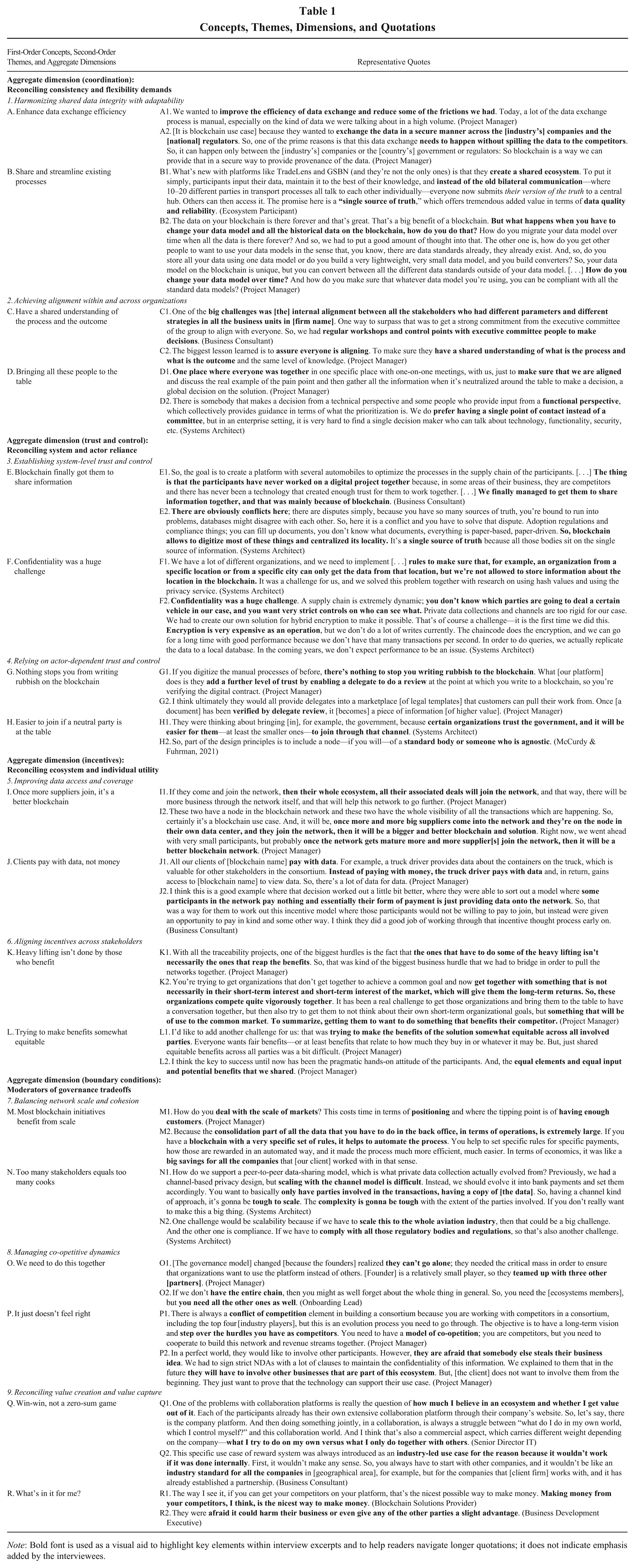
Note: Bold font is used as a visual aid to highlight key elements within interview excerpts and to help readers navigate longer quotations; it does not indicate emphasis added by the interviewees.
Some concepts emerged as important contextual factors; for example, most of IBM’s projects involved competing firms, which heightened governance concerns. We included these considerations as critical boundary conditions for our theorizing, contextualizing our main governance narrative (see our section called “Contextualization of Interorganizational Ecosystem Governance”). We also distinguished which governance choices were highly project-specific and, therefore, bore little value for theoretical generalization. For instance, one interviewee shared an unusual case in which the client firm “did not intend to become a founder of the network and, instead, decided to become a service provider to allow startups to build their own networks.” We opted not to include this evidence in our analysis, as this quote had few parallels with the other insights we derived. We continued data collection until reaching theoretical saturation, namely when additional interviews did not yield substantially new concepts or relationships (Saunders et al., 2018; van Rijnsoever, 2017).
To derive the researcher-centric second-order themes, we matched our emerging themes against existing governance constructs such as coordination, trust, control, and incentives (e.g., Chen, Richter, & Patel, 2021; Gulati & Singh, 1998; Poppo & Zenger, 2002), which helped connect, refine, and extend theoretical categories (Gioia et al., 2022). Circling back and forth between our data and the deductively derived theoretical constructs was crucial in determining any ideas that conform to or challenge extant knowledge. We grouped the first-order concepts in various ways to unravel their linkages and similarities (Grodal, Anteby, & Holm, 2021). This step helped us identify the second-order themes embedded in the data. For instance, before settling on the second-order theme “2. Achieving alignment within and across organizations,” we considered alternative groupings of codes and concepts, such as “assigning administrative and transactional authority.” We discussed these alternatives within the coauthor team and consulted with colleagues to ensure that our categories were consistent and theoretically informative, and whenever possible, supported by internal and external archival data. Finally, the second-order concepts were further distilled into larger aggregated dimensions, which, in our case, captured the broader governance tradeoffs. This threefold approach laid the foundation for the data structure described later and enabled a rigorous development of grounded theory, tracing our progression from raw data to core concepts and themes.
Analysis and Findings
Stylized Example and Descriptive Analysis of Public Blockchain Announcements
We begin our analysis with a stylized case study of TradeLens drawing on anonymous and public interview quotes to illustrate both the promises and limits of blockchain in ecosystem governance. Launched in 2018 by Maersk and IBM, the platform aimed to digitize and streamline global shipping logistics through blockchain-based tracking of documents and containers (Jensen, Hedman, & Henningsson, 2019). The core challenge was stark: A single container’s journey could involve “as many as 30 different organizations” and “at fewest 100 different people.” Further, the exchange relied on insecure EDI communication protocols from the 1970s, supplemented by “emails, phone calls, WhatsApp, or more realistically a lot of paper [and] faxing” (Wilson & Ruiz, 2019). Such fragmentation caused costly delays; shipments sometimes took “34 days to get from the farm to the retailers, including 10 days waiting for documents,” or sat idle for “14 days before the product was released because a document got lost on the desk” (Anand & Scott, 2018). Within a few years, TradeLens had enrolled more than 300 organizations, from customs authorities to port operators, but Maersk’s competitors remained wary (Ledger Insights, 2022). A key stumbling block was its ownership structure: many feared that a platform founded by the world’s largest carrier would never truly be neutral. As one participant explained, “Maersk and IBM [. . .] made the same mistake as all the others who tried to own it and dominate. ‘This is OURS [. . .] we should have all the say. And you just pay us to use it.’” Rival carriers hesitated: “If I would have started a platform like this, I wouldn’t have connected Maersk line as a founder [. . .] nobody would give a competitor all his data.” This resistance undercut the fundamental logic that “blockchain is a community effort [where] you need the whole ecosystem on board.”
Equally problematic were incentives and product design. TradeLens offered visibility and traceability, but many customers found the pricing unrealistic: “They are charging 10 [US] dollars per container, which in this freight rate environment is not realistic [. . .] it’s not what the market wanted.” Others argued the platform overlooked urgent needs such as disruption management: “Customers don’t really want a visibility product per se. What they really want is a product to deal with disruption.” The platform also suffered from a flawed go-to-market strategy: “They didn’t put much effort into how this gets marketed or sold. Uptake is growing—but it’s totally underwhelming.” With limited adoption, data quality lagged, creating a vicious cycle of resistance. Terminals saw “no economic benefit from their data sharing,” while shippers questioned why they should provide data without equivalent returns: “Why should I provide my data if I don’t get similar compensation?” Ultimately, TradeLens failed not because the blockchain backbone was inadequate, but because its governance model could not align control, trust, and incentives across a fragmented and highly competitive ecosystem.
The problems of TradeLens are not an isolated phenomenon. To put this case into perspective and understand the prevalence of such failures, we collected data on publicly announced blockchain projects, drawing from press releases by technology providers (e.g., IBM), specialized media outlets (e.g., Ledger Insights), and official project websites. We screened 196 projects across industries, including transportation (e.g., GSBN), healthcare (e.g., PharmaLedger), and agriculture (e.g., GrainChain). Notably, this sample skews toward larger, more successful initiatives, as many projects—especially those abandoned after pilot stages—were never disclosed. For instance, IBM engaged in over 500 blockchain projects, but only a fraction were publicly announced. As illustrated in Figure 1, a bar chart tracking project announcements from 2012–2025 and subsequent terminations, new launches peaked in 2018 before sharply declining, while failures—indicated by red bars—rose over time. This trend, also present in IBM’s internal records, reflects growing frustration among managers struggling to govern large-scale ecosystems with competing stakeholders, leading many initiatives to falter.
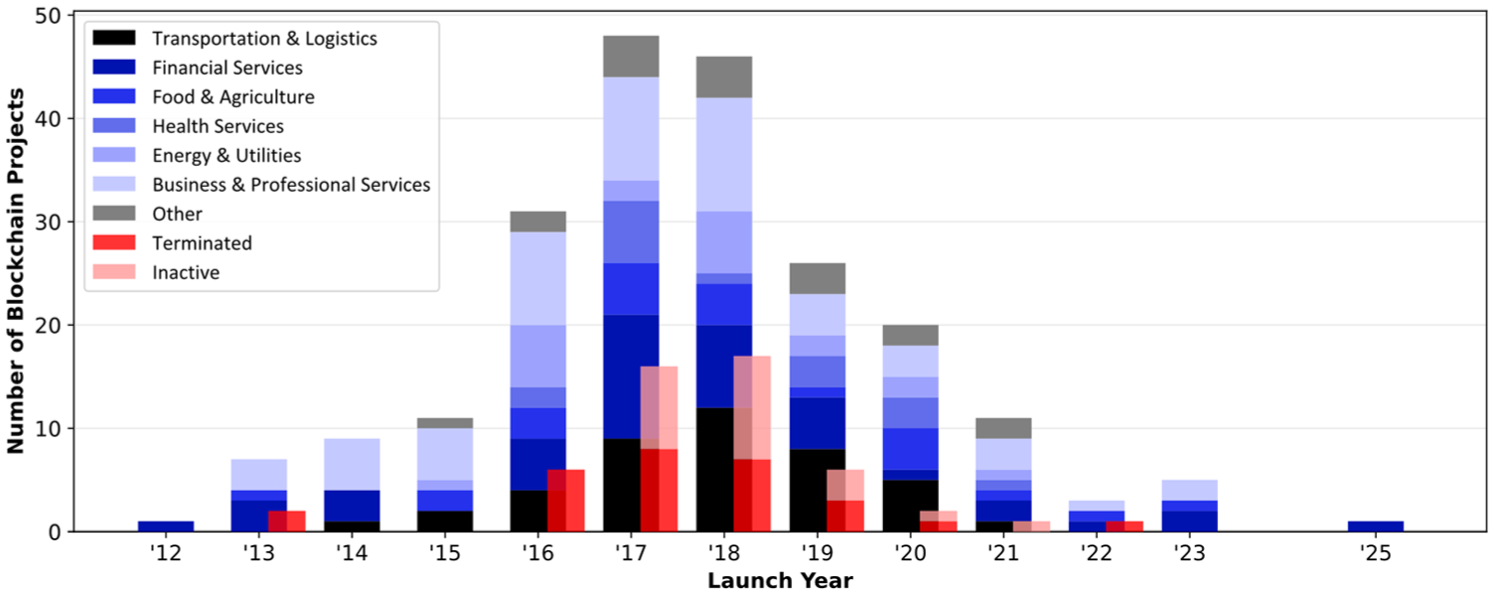
Launch and Termination of Publicly Announced Interorganizational Blockchain Projects
Comparative Qualitative Analysis
Data structure
We now introduce our inductive theoretical framework, which systematizes how blockchain, in interaction with traditional governance instruments, reconfigures interorganizational ecosystem governance and its effectiveness. We first elaborate on the overall data structure that resulted from our data coding, as illustrated in Figure 2. We then provide a more detailed explanation of our aggregate themes and dimensions. The left-most boxes in Figure 2 contain empirically grounded first-order concepts, derived directly from informants’ statements and quotations grouped along the three governance dimensions: coordination, trust and control, and incentives. In the middle, researcher-induced second-order themes reflect our theoretically motivated effort to understand the interplay between blockchain-based and traditional governance mechanisms. Finally, the right-most boxes present third-order aggregate dimensions, which capture the broader governance tradeoffs that underpin the first-order concepts and second-order themes. Supporting Figure 2, Table 1 offers representative quotes that underpin the development of all first-order concepts and the resulting themes and dimensions. For ease of reference, we provide the numbers in level-2 headings when referring to second-order themes and capital letters at the beginning of the level-3 subheadings to refer to the first-order concepts in line with Figure 2. In the following subsections, we embed these themes and dimensions into an overarching narrative that supports our theory development.
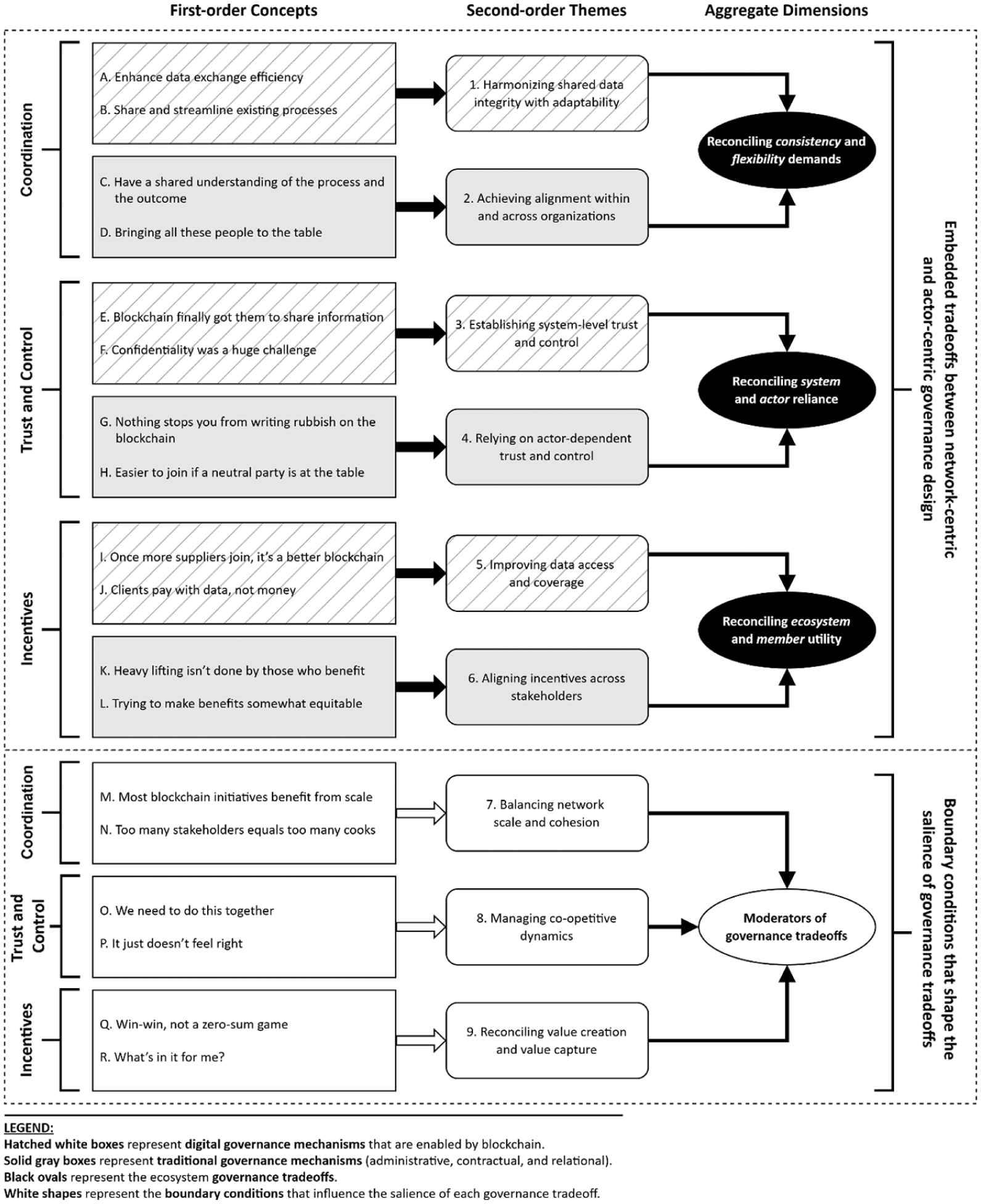
Data Structure
Blockchain-based governance
The relevance of blockchain in interorganizational ecosystems arises because they involve “distinct parties that belong to different organizations that do not necessarily trust each other” (Business Consultant). A typical requirement is to “elevate trust and transparency as well as asset provenance and tracking while maintaining data ownership of the different parties and limiting visibility of data, and that pretty much checks every checkbox as a blockchain use case” (Project Manager). However, blockchain is not a panacea for successful collaboration. As another project manager cautioned, “A good use case doesn’t necessarily mean a successful blockchain network because there are a lot of additional factors that go beyond what we would think of as a good blockchain use case.” In particular, many “underestimate the importance of governance in these particular networks” (Day, 2020) when trying to align the interests of diverse stakeholders with often conflicting objectives. Another project manager highlighted a crucial lesson learned over many projects as follows:
Blockchain is all about getting into an agreement with different partners, in terms of the business standpoint. It’s not about technology—although in many ways when you’re talking about traceability in terms of the data that you’re managing and so on—but it’s all about getting into an agreement, having the power of influencing and that power of establishing governance in the different projects.
This highlights that the success of blockchain-based interorganizational ecosystems “isn’t necessarily a technology problem” but rather “a people problem” (Webber, 2020a) that depends on achieving stakeholder consensus and establishing effective governance frameworks. In fact, our interviewees consistently emphasized that governance, “in terms of putting together that rulebook,” is one of the most quintessential aspects to achieve cooperation amid competing interests. This insight is also echoed in IBM’s (public) acknowledgement that the hardest part of building blockchain networks is not configuring the technology; it is designing the rules of the road for how ecosystem partners will work together to achieve their goals. In one word, the hardest part is network governance. (Sirus, 2020)
Hence, our subsequent narrative reflects this overarching leitmotif to disentangle the interplay between emerging digital solutions—in this case, blockchain technology—and traditional governance mechanisms. For a clearer differentiation of the salient governance mechanisms and to guide our analysis, we leverage the governance categories defined in the literature—specifically, coordination, trust and control, and incentives (e.g., Hanisch et al., 2023). Using these categories allows us to explore and contrast the governance mechanisms on a deeper level. We group trust and control because our interviews often interwove them in their explanations. Despite this theory-informed basis, the associated first-order concepts were inductively derived from our interview quotes, as shown in Table 1.
Blockchain-Enabled Coordination: 1. Harmonizing Shared Data Integrity with Adaptability
In general, coordination mechanisms help individuals and groups divide and allocate tasks while managing the interdependencies between them (Okhuysen & Bechky, 2009). In interorganizational ecosystems, however, coordination is particularly complex because loosely coupled organizations interact without an overarching administrative authority that provides unity of command or clear escalation paths for disputes (Hanisch, Reuer, Haeussler, & Devarakonda, 2024; Jones, Hesterly, & Borgatti, 1997). Instead, ecosystem participants must establish dedicated coordination channels to align members, allocate responsibilities, and prioritize actions across organizational boundaries. Our interviews emphasized that blockchain can support coordination at the transactional level by codifying rules, standardizing exchanges, and reducing ambiguity in day-to-day operations. However, these mechanisms have limits when it comes to higher-level alignment. Administrative interfaces thus remain essential to complement blockchain-based coordination, especially for managing exceptions, resolving disputes, and facilitating joint decision-making. In this sense, blockchain addresses low-level operational interdependencies, while administrative coordination enables strategic and relational alignment across diverse organizations. To illustrate these dynamics, we begin with an introductory vignette that highlights coordination challenges in practice. We then analyze blockchain-enabled coordination mechanisms before turning to traditional governance approaches that fill gaps where blockchain proves insufficient.
To illustrate typical coordination challenges, we examine B3i (Blockchain Insurance Industry Initiative), a consortium of insurers and reinsurers formally launched in late 2016 by five founding members and expanded to 15 by early 2017. Initially, the group aimed to “see some potential, let’s see if we can learn, let’s go build something to help us learn a bit” (Crow, 2018). After piloting a prototype in 2017 to support reinsurance agreements in cases of severe and unusually large financial losses from major events (e.g., natural disasters), the initiative incorporated as B3i Services AG in 2018 to operate as a “proper business” with a “for-profit mindset” and more execution-focused decision-making (Crow, 2018; Marke, 2018). The cooperative-competitor setup quickly revealed structural coordination difficulties. With “15 people around a table trying to make decisions,” discussions dragged on, delaying progress (Crow, 2018). While the ethos of being “by the market, for the market” fostered inclusiveness, it clashed with the agility needed for development (Elliott, 2019).
Aligning members’ interests proved difficult as participants joined for varied reasons such as curiosity, efficiency, or reputation, which complicated agreement. Coordination challenges extended ecosystem-wide since brokers, who were critical to insurance value chains, were initially excluded from decisions. As one participant noted, “that round table just happened to be insurers and reinsurers, and we didn’t have the brokers” (Elliott, 2019). Leadership later admitted this exclusion “created a false impression [. . .] of disintermediation” that fostered mistrust and slowed adoption (Crow, 2018). Industry-wide efforts to establish shared standards and integrate blockchain into legacy systems required coordinating dozens of firms and regulators, often overshadowing technical development. Even B3i’s 2018 platform shift from Hyperledger Fabric to R3 Corda, which was framed as a “business decision,” actually reflected conflicting member demands for privacy, scalability, and data access rather than purely technical considerations. Ultimately, B3i could not resolve these coordination problems, and its inability to align stakeholders, secure adoption, and maintain confidence led to its insolvency in 2022 (Sheehan, 2022; Sunset, 2025).
A. Enhance data exchange efficiency
Blockchain technology facilitates interorganizational data exchange by automating verification and access control, reducing inefficiencies in traditional processes while creating “the underlying language that allows us to standardize the data and communicate not only with other companies but [also] within our own framework” (Civitillo, 2023). As one project manager explained, the main motivation for adoption is to “enhance data exchange efficiency [. . .] particularly in high-volume scenarios.” A key benefit is that blockchain “actually addresses the key concerns that different parties have, and it takes care of integration,” offering a shared infrastructure that aligns processes across firms. In particular, firms are becoming aware that “data is becoming more and more valuable,” making them “less and less enthusiastic to give away their data to this central intermediary” as is typical in traditional platforms. Instead, a decentralized blockchain adds a digital “top layer” to “facilitate data sharing for a win-win situation for all the parties involved and willing to share their data.” This shared layer can also “record the actions or the transactions that are happening between parties,” providing reliable auditability and reducing time spent “rationalizing claims.” Nonetheless, participants voiced strategic concerns about exit, asking, “What if I want to leave the consortium but I can’t read my data? [. . .] I’m basically stuck with a data format that I then have to pay someone to convert.” Thus, while blockchain enhances coordination across organizations through better data integration, these benefits often require firms to cede some degree of autonomy to collectively governed networks.
B. Share and streamline existing processes
Building interorganizational ecosystems requires overcoming substantial coordination hurdles, particularly when firms must integrate heterogeneous systems and align workflows. One project manager noted that “the biggest challenge was everything [about] integration: integration into legacy systems, [. . .] even from a permissioning perspective, getting access to the banks, and cloud support.” Blockchain supports such integration because it provides a shared foundational layer that connects participants’ systems and establishes “immutable cross-references among databases,” turning the shared “technical standard” into a practical “embodiment of governance.” It creates a “single source of truth” that gives participants “full transparency of the data” while allowing them to “keep control over who can see what’s in the network.” Its sequential “append-only” structure provides the digital backbone needed to “share and streamline existing processes.” As another project manager illustrated,
this network allows us to capture the whole process: authentication, necessary approvals that were in place, checks that were done, invoices, and subsequent payments associated with the contract. All these are actually captured on the blockchain, so it is a very good and fast way to address the requirements from an audit perspective as well.
Coordination benefits also extend to document flows. In the case of Insurwave, a pilot for marine blockchain insurance, electronic bills of lading recorded on the ledger ensured “no fraud, no lost documents” and maintained the “authenticity of the transaction,” while workflows that once involved “very very manual” steps with spreadsheets could be automated (Henneberg & Blattner-Hoyle, 2018). Several participants emphasized that blockchain helps reduce the “volume and the time to pay claims,” improves dispute resolution because “everyone agrees that the data is the data,” and saves “up to one working day from a person” through instant customs clearance notifications, as a sportswear manufacturer noted about TradeLens.
Although blockchain can lower coordination costs, it also introduces new ones. These arise because coordination gains depend on collective arrangements in which organizations must “coordinate all the changes.” Blockchain removes the central “system administrator who’s got god powers,” so “literally everything has to be a collective collaborative effort.” As a result, “you really see this growing up of consortia along with blockchain business networks.” The coordinative burden becomes especially visible during system evolution, since “every upgrade, every bug fix, every policy tweak” requires broad agreement, and “if our different copies stop agreeing with each other, the whole thing just stops working” (Cox, 2019). This collaborative overhead is “the price of having distributed ledgers” (Cox, 2019), creating an almost paradoxical situation in which blockchain can reduce and increase coordination costs at the same time. Thus, while blockchain can integrate and streamline processes across firms, these benefits come with substantial new coordination demands.
Traditional Coordination: 2. Achieving Alignment Within and Across Organizations
C. Have a shared understanding of the process and the outcome
Aligning processes across diverse organizations presents a critical obstacle in interorganizational ecosystems. As one project manager recalled, the “biggest challenge is how to get 15 or 20 large organizations basically moving forward on the same project schedule and timeline.” This difficulty is compounded by the need to “rethink the overall process within the concept of a network of participants, where the rules need to be shared across a large number of parties,” as a consultant explained. Many organizations exhibit “resilience against change,” particularly when it involves “revisiting legacy systems, legacy teams, legacy processes,” making process alignment even more complex. A business consultant noted that while blockchain was suitable for certain areas, it often required changes to “processes that were already effective,” sometimes demanding that participants “need to change the way of doing business” to fit the new ecosystem reality. To address these challenges, administrative interfaces such as steering committees and structured workshops can bridge diverging objectives and establish a “shared vision” for ecosystem participants. As one business consultant described:
I think the most important lesson for us was how we were able to handle the changes. So, we had to have a good baseline, and we created that good baseline by not just having a design thinking session but going deeper than that. We created a process map that was very complex. That actually captured what the system had to do, and based on that, we could validate what work was involved and how much effort it would be.
Another project manager emphasized the need to “streamline [the] existing processes” within organizations to ensure compatibility with other participants. By leveraging blockchain’s digital coordination mechanisms alongside these supplementary channels, ecosystems can ease interorganizational coordination while maintaining alignment on both process and outcome.
D. Bringing all these people to the table
A recurring coordination dilemma in interorganizational ecosystems is how to reconcile the need for broad participation with the pressure to make timely decisions. As one interviewee explained, blockchain initiatives aim to “connect the whole entire end-to-end ecosystem,” so that participants can “plug into a common platform” and act on “more timely” and “more consistent information” in the interest of “the entire supply chain.” This ambition reflects the value of “allowing us to have the conversations we never had before, [. . .] bringing all these people to the table; before, we never had an opportunity to bring competition to the same table.” At the same time, involving diverse organizations introduces friction, since “the more complex these networks are, the harder it is to align goals so that everybody is working toward the same thing.” As one participant put it, “The real hard problem with blockchain is how do I create a consortium?” To cope, some ecosystems concentrated authority to accelerate decisions: “It is important to have one product owner—and not more than one—because when you’re working in an agile fashion, you need to make decisions fast.” Others anchored early development with a dominant player, arguing that “we could either take years and try to work out some really complex consortium model, or we could jump into the deep end with the largest player in the industry.” These approaches carried risks because “blockchain is a team sport,” and legitimacy depended on broader involvement. To balance efficiency and inclusiveness, some ecosystems split decision rights across working groups, forming “subcommittees [. . .] for the technical stream, the business and operations stream, and the legal stream.” These practices demonstrate that efforts to create an integrated ecosystem can lead to tensions between collective alignment and decision-making speed.
Synthesis of coordination: reconciling consistency and flexibility demands
Blockchain promises to reduce coordination costs by eliminating the need for any single party to “own the central database, set the standard, and maintain the integration,” which is often “a very hard problem to maintain.” For this benefit to materialize, “the first step is standardization [. . .] if you can’t get to the first step, [. . .] you’re going to struggle with doing the following steps and open up and scale and network” (Day, 2020). However, blockchain’s capacity for technical standardization and integration does not replace the strategic decision-making and adaptation processes that ecosystems demand. Because blockchain integrates with the “core of the company” by connecting to key operating processes, a CEO emphasized that it “really is a strategic decision whether to go for it or not.” This necessitates clarity on governance: “Who makes the decisions, and what decisions can [participants] make alone [. . .], and what decisions do they need to get our approval for?” Since markets and technologies evolve rapidly, governance systems require adaptive mechanisms—after all, as Webber (2020b) notes, “your governance documents are going to be living, breathing entities.” Blockchain by itself cannot account for these realities, as the Libra case showed, where “a bad case of Silicon Valley hubris—the belief that elegant code can simply wish away centuries of financial regulation” proved fatal (Catalini, 2025). Thus, while blockchain can facilitate technical coordination, failing to balance its consistency with flexibility risks creating governance misalignments that undermine collaboration among diverse organizations.
Blockchain-Enabled Trust and Control: 3. Establishing System-Level Trust and Control
Next to coordination, trust and control are two foundational governance mechanisms in interorganizational ecosystems. Trust reflects the belief that a party will act in ways that are mutually beneficial, while control denotes the capacity to influence or direct others’ actions (Das & Teng, 1998). Both have traditionally been considered as interrelated and dynamically evolving in interorganizational relationships (Vedel & Geraldi, 2023). The advent of blockchain technology has introduced new trust and control mechanisms, including “system-level trust” and consensus-based control algorithms aimed at verifying data integrity and consistency (Lumineau et al., 2023). For instance, Renault’s XCEED is a blockchain-based compliance certification platform that verifies the integrity of vehicle component data in real time, ensuring controlled access and resolving trust issues such as unauthorized changes and opaque verification (IBM, 2021; Le-Boucher, 2021). Despite these advantages, our interviews revealed that blockchain mechanisms also create governance voids, which require traditional governance based on contracts (e.g., non-disclosure agreements) and relational norms (e.g., trust through prior collaboration).
To illustrate how governance in interorganizational ecosystems hinges on balancing different forms of trust and control, we begin with an anecdotal deep dive into the IBM Food Trust Network. The origins of Food Trust lie in a series of food safety crises that “really shook consumer confidence,” exposing how fragmented data flows left firms unable to trace contamination sources without costly mass recalls (Civitillo, 2023). Susanne Livingston, former director of Food Trust, noted that “blockchain creates the trust needed for [suppliers] to be willing to share that information” (Livingston, 2020). The governance model centered on what IBM terms a “founder-led network,” in which the large retailer Walmart “basically came onto Food Trust, and then requires all their suppliers to do it.” Walmart’s market power meant that it could “force them to do it” and “do a lot of innovative things” by telling suppliers, “You have to adopt this if you want to do business with us.” While this coercive control accelerated adoption, it also generated “some contention” among suppliers forced to adapt “whole new sets of systems, and principles, and procedures.” Unsurprisingly, this “brute force” approach “didn’t go over too well” among suppliers, who had to invest in expensive RFID technology to track items (Ferris, 2020). Moreover, the system focused strategically on tracing products after they entered the supply chain, thereby “neglecting the growers to some extent” despite their being “super important” for food security.
Despite such pushbacks, Food Trust expanded beyond Walmart to other industries and commodities. In the coffee industry, the Farmer Connect initiative was built on the same IBM blockchain backbone, with the goal of “humanizing consumption through technology” and giving farmers a “digital identity and credentials.” As its founder, Michael Chrisment, further explained, “Farmer Connect has been in partnership with IBM since the very beginning,” leveraging the same infrastructure as Food Trust but with its own “governance structure” tailored to smallholder-focused needs (Chrisment, 2021). Similarly, in seafood, IBM partnered with Raw Seafoods to trace scallops, where previously “tracing the origin of wild-caught scallops could take days.” With blockchain, the process takes seconds, directly addressing “three of the core consumer concerns: safety, sustainability, and authenticity” (Wood, 2019). Yet technology alone was insufficient: “In these networks and ecosystems, 25%, maybe 30% is technology, 70% is organizational trust. Should I trust you? Or, is it somebody they have done business with for a very long time?” Food Trust sought to resolve this tension by ensuring that “every company owns their data and controls the privacy and how they want to share it.” Smart contracts reinforced this confidence by “enforcing an agreement of how data is handled once it’s on the platform,” backed by the guarantee that “IBM can’t change those rules—[. . .] they are encoded on the ledger” (Civitillo, 2023). Through the coupling of technology-induced and relational trust mechanisms, Food Trust and its spin-offs aimed to convince diverse stakeholders to join a shared infrastructure for supply chain traceability.
E. Blockchain finally got them to share information
We commence by examining blockchain-induced trust and control mechanisms, followed by a discussion of traditional mechanisms. Blockchain technology comprises distinctive features that digitally enhance trust and control, even when network participants do not directly engage with one another. In fact, in many scenarios, “parties need to work together and need to share information,” but there is no “trusted third party” or “companies don’t really trust a single entity to hold all the data for the entire industry.” Blockchain addresses this problem by offering “a super elegant approach to this [data sharing] process across the members of the ecosystem in such a way that no one person is in charge of the data and that all the members can have a say in how that data is governed” (Martin, 2019). Thus, when the collaborating parties display a “lack of trust in the data” managed by a central entity, blockchain can provide the necessary “digital trust in the data being shared among participants” through its decentralized, append-only architecture and data traceability capabilities. In other words, blockchain effectively minimizes data discrepancies and prevents potential data tampering when these data are hosted by a single entity. Furthermore, as a systems architect emphasized, blockchain-enabled immutability (i.e., “we can’t change anything after it’s been written to the blockchain”; [Fritz & Cuomo, 2021]) and transparency are key in building trust:
The transparency provided by blockchain was critical. Alternatively, it could have been a centralized platform, in which case the information could have been shared. But the transparency and trust—because of immutability—would not have been present.
In contrast to classic notions of trust, which center on trust in specific (organizational) actors, “blockchain establishes trust in the network,” as observed by another systems architect. This paradigm shifts attention from individual actors to the network as a whole. This form of trust, as reported by respondents, stems from blockchain’s unique features: immutability, transparency, and decentralization. Immutability guarantees that transactions once executed cannot be reversed, thereby reducing interpretive leeway and the risk of manipulation. Transparency enhances trust by ensuring that all participants have “access to the same validated data,” mitigating information asymmetries while decentralization ensures that “no single actor dominates the network.” These elements are pivotal factors in trust building at the ecosystem level and often serve as a primary motivation for adopting blockchain technology.
F. Confidentiality was a huge challenge
While blockchain-induced transparency can be greatly beneficial for trust building, it also creates a new set of concerns that may hinder collaboration. As a project manager stressed, the following paradox results from the adoption of blockchain:
I think that a lot of the clients who were participants are really interested in blockchain in order to gain trust and transparency, but they didn’t necessarily fully think through what that meant for themselves and [for] sharing data. So, I think that even though the network intent was all about, “Let’s be transparent; let’s share data,” that kind of thing—when push comes to shove, it is really difficult to get these clients to agree to share their data in any supply chain.
While a certain level of inherent transparency accompanies the implementation of blockchain, in particular cases, “you want very strict controls on who can see what.” Or, as Richard Brown, chief technology officer at R3, the builders of Corda, put it more vividly: “Blockchain is a nudist colony [. . .] people are going to see your private parts” (Brown, 2019). A particular danger stems from “reverse-engineering the data shared on the blockchain” based on meta-information accessible to all network participants. For example, “In delivering that sustainability data, I’m indirectly also revealing my cost structure” to competitors. Therefore, implementing clear access controls becomes a strategic imperative in networks where transparency is undesirable for competitive, privacy, or even legal reasons. In a typical interorganizational blockchain project, “some are partners or competitors, and some are not; so, you need to have a platform to share data via access control.” Such trust-control tensions arising from blockchain implementation have marked many projects. For example, a systems architect complained about how he and his team were forced to constantly fulfill
these contradictory requirements: You want the payments to be decentralized, but you want them to be safe. You want the payments to be private as well. When doing a transaction, not all parties should know all the details of that transaction, but they still have to validate the transactions.
To address these seemingly incompatible demands, the project teams had to develop creative solutions that satisfy both transparency and privacy requirements. A project manager relayed a specific example and the solution that the team had implemented as follows:
You have different members involved in this value chain, and very IP-relevant data are transferred between these different companies. What we are trying to do with this solution is to connect these different ecosystem members and ensure that only those who should have access have access to the content and that they only do what they are supposed to do with the information. [. . .] So, we have a provenance machine and a policy enforcement mechanism to make sure that documents can only be printed three times when they’re supposed to be printed only three times.
The previous quotes highlight that blockchain is not a simple trust engine. Instead, its transparency features, which provide system-level trust, must be balanced with control mechanisms that provide necessary data protection, ensuring that participants are willing to share their data in the first place.
Traditional Trust and Control: 4. Relying on Actor-Dependent Trust and Control
G. Nothing stops you from writing rubbish on the blockchain
Our interviewees consistently highlighted several governance limitations of blockchain that required complementary traditional trust and control mechanisms. A systems architect, for instance, described how, in a government project, even the immutable nature of blockchain had to be circumvented to meet the regulatory requirements:
The third challenge was the complicated process and the GDPR [General Data Protection Regulation] requirements. It was not allowed for us to store any information about the persons; we had to implement a solution to delete data. Of course, it’s not possible in blockchain—we know it. So, for that reason, we used a privacy service to hold the mapping and delete the mapping.
More regularly, projects implement checkpoints before data is injected into the blockchain because, without “IoT [Internet of Things], we’re relying on people to enter information, and they can be entering wrong information without being malicious” (Leveille, 2020). Since human input is the “most vulnerable part of a system” (Frankson, 2021), it becomes essential to establish a “mechanism to verify data before it is committed to a blockchain ledger,” as emphasized by a business consultant. “Of course, we do random checks; you cannot rely 100% on data of course,” as one compliance manager admitted. In any case, this verification process relies on “reputation-rated subject matter experts,” which undermines the fundamental idea that a blockchain is a fully decentralized “trustless” system. Similarly, while smart contracts enable dispute resolution and transaction transparency, they also require “trust in the credentials,” which, again, requires some form of external verification or reputation mechanism at the ecosystem level.
H. Easier to join if a neutral party is at the table
Another significant barrier in this context concerns cultivating trust among executives, particularly when it involves sharing data with competitors. As one interviewee pointed out, the formation of a supervisory body was discussed as a potential solution in a banking project, although this directly conflicted with the directors’ desires to retain sole ownership and control over their ideas. On the path toward an agreement, these banks engaged in prolonged discussions about business rules and requirements but were unable to reach a consensus. However, the involvement of an external entity, which “stepped up and made the decisions by trying to accommodate everyone’s needs,” notably contributed to breaking this impasse. Another solution used in a project was for IBM to “actually be the network administrator; that we will be the trusted authority that owns all of the nodes,” which was acceptable to most of the industry players because IBM was not perceived as a competitor. Given that blockchain projects are sometimes implemented in heavily regulated markets, particular applications also require a regulator to approve steps within this process, as a project manager illustrated:
These are heavily regulated markets that we are in. Every change in the bank’s infrastructure needs to be approved by the regulator. And even with other use cases we’ve tried—with assetizing or tokenizing certain assets—this is where a lot of the bank’s legal department is involved to comply with regulations, speak to the regulator. I would say there were delays. You always needed the regulator to confirm. They weren’t available 24/7. Then you had to go back to the drawing board, circle back. So, it definitely took time.
In addition to meeting legal requirements, the involvement of public entities could be beneficial for another reason. Some firms would rather “trust the government” than another company. For example, a commercial manager made the experience that “when the government announced that they will be joining [project name], that created a lot of stir, obviously, and we got a lot of traction within the private sector” because it gave credibility and legitimacy to the initiative. Thus, involving public actors could make it easier for others to join their network, thereby coupling the trustless nature of blockchain and the need for trusted entities. As these examples demonstrate, overcoming the trust and control issues at various levels when connecting to and interacting with the blockchain is essential for organizational participation.
Synthesis of trust and control: reconciling system and actor reliance
The previous findings on trust and control provide the basis for the aggregate dimension of reconciling system and actor reliance. This dimension captures the fundamental tradeoff between blockchain’s system-level trust and control and the need for complementary actor-centric mechanisms, a tension that can trigger persistent misalignment tendencies. On the one hand, blockchain offers “trust and transparency” by providing a “decentralized and digitized distributed ledger that records transactions between multiple parties in a very secure way.” Its “immutable recording of transactions” (Fritz & Cuomo, 2019) allows firms to “transact business in untrusted networks” (Bedell & Derebail, 2018), thereby reducing reliance on intermediaries and shifting the focus from actors to the system. On the other hand, blockchain’s transparency and decentralization raise new trust and control concerns. “Blockchain technology is basically a completely open technology, and that, of course, does not work in our context where, for business reasons, we do not want everyone to be able to see everything” (Henneberg & Blattner-Hoyle, 2018). Thus, finding “that sweet spot of having enough decentralization but not too much decentralization” (Martin, 2019) requires negotiation, safeguards, and actor-dependent checks that address blockchain-inherent governance voids.
Blockchain-Enabled Incentives: 5. Improving Data Access and Coverage
Incentives have long been recognized as a critical governance mechanism, shaping how benefits and costs are distributed among participants in an ecosystem (Kretschmer, Leiponen, Schilling, & Vasudeva, 2022; Wareham et al., 2014). In blockchain-based interorganizational ecosystems, these incentives acquire a new dimension through automation, which enables agreements to be executed transparently without reliance on intermediaries (Murray et al., 2021). Smart contracts translate incentive designs directly into code, which reduces the friction typically associated with cross-organizational enforcement. For example, Home Depot uses smart contracts to impose automatic penalties for supplier delays: “If their lawnmowers are delivered a week late, they pay 99% of that contract” (Adkins, 2023). Plastic Bank likewise employs tokenization to motivate plastic collection in vulnerable communities, turning contributions into a digital asset that provides “a starting point to a better life” for some of the world’s poorest individuals (Frankson, 2021). These cases show how blockchain’s programmable features can streamline incentive management and alter enforcement dynamics across interorganizational settings.
While blockchain can partially automate incentive management, its usefulness depends critically on the underlying data access and coverage that the network can provide. This construct encompasses two key dimensions: the depth of information shared by individual organizations (data access) and the breadth of participation across the network (data coverage), which determine the overall network value (cf. Fassnacht, Leimstoll, Benz, Heinz, & Satzger, 2024). Unlike classic network effects that rely on exogenous and uniformly accruing externalities (Katz & Shapiro, 1985), data access and coverage emphasize the endogenous role of governance design in shaping what data become available, how they connect, and which actors benefit from them. Research shows that firms may hesitate to share data due to two-sided risks, including fears of information poaching or manipulation (Bossler, Buchwald, & Spohrer, 2025). These concerns create a “chicken-and-egg” problem in early network stages: firms refrain from contributing data without immediate returns, while the network cannot produce those returns without their contributions. Addressing these issues requires mechanisms that incentivize data contributions, such as pecuniary and informational reward systems.
The case of we.trade illustrates how issues around data access and coverage interact with broader problems of incentive alignment in early-stage blockchain ecosystems. Founded in 2017 by IBM and 15 European banks to streamline trade finance for small and medium-sized enterprises (SMEs) (Trade Finance Global, 2019), the platform struggled to generate sufficient participation because value creation required extensive cross-organizational data contributions that did not materialize. As co-founder Roberto Mancone acknowledged, “We are building solutions that are perceived as valuable by the providers of the solutions, not the users” (PYMNTS, 2019). SME adoption remained hesitant, and even when one firm onboarded, its partners often did not, prompting criticism that “we.trade didn’t really change anything in the flow; they just blockchained it.” Banks also deprioritized the initiative once they realized that “SMEs don’t make them much money” (Morton, 2022). Misaligned incentives among banks compounded these issues, as Santander’s Fernando Lardies noted: “It’s hard enough with one bank. If you have a number of institutions, it’s even harder” (Ledger Insights, 2019). Although we.trade shut down in 2022 due to funding shortfalls (Ledger Insights, 2020), its collaborative groundwork supported the launch of a euro stablecoin initiative in 2025 (Sims, Wilkes, & Za, 2025).
I. Once more suppliers join, it’s a better blockchain
For blockchain networks to provide tangible utility to their users, data coverage is essential. For instance, data gaps in a supply chain significantly reduce the value that blockchain records provide because their data can only be traced up to these gaps. Part of bridging such gaps entails “educating participants about the blockchain’s role and its benefits in a business context” and the value they can derive from contributing to the establishment of or participating in such an ecosystem. Here, one of the most contentious issues is that firms “want to get as much information as possible from their partners, but their partners don’t want to share their data.” However, achieving “scale, volume, and market penetration” is critical for successful blockchain projects. A broader market coverage, as noted by a project manager, “will have a certain market network effect,” whereby collective participation is anticipated to attract more entities and garner associated business transactions. As another project manager pointed out, it is not just individual organizations but “their whole ecosystem, all their associated deals will join the network,” catalyzing further network growth. Consequently, once the initial resistance to joining a network is overcome, its network effects can become self-reinforcing incentive mechanisms.
J. Clients pay with data, not money
Overcoming early-stage incentive problems in blockchain networks often requires creative business models in which participants contribute data rather than direct monetary payments. This strategy not only enables inclusivity but also addresses the issue of “participants [who are] unwilling to pay to join.” As one business consultant highlighted, this approach “effectively lets participants provide data as their form of payment,” rendering them integral to the network. In the same vein, one project manager noted the prevalence of “data-for-data” arrangements, where firms exchange access to their own data for participation in a shared data pool. In this manner, “customers would also contribute something valuable to the network, not just be pulling services from it,” as another project manager explained. This model also challenges conventional expectations about value appropriation. One ecosystem participant captured this tension succinctly:
In most situations, investors building this kind of foundational platform expect to make a very large return, as it is hoped that the value of all data in an industry will accrue to the platform. I believe this is quite a naïve point of view in this situation [. . .] Why would anyone contribute data if they don’t receive any economic benefit from it?
Many participants failed to recognize that isolated data often has little standalone value. Instead, value emerges at the network level, where “every incremental carrier and every incremental player that we bring onto this network actually has not linear but exponential value that they can contribute” (Wilson & Ruiz, 2019). This dynamic makes it exceedingly difficult to assess the true worth of individual contributions and to distribute benefits in a way that participants perceive as fair.
Traditional Incentives: 6. Aligning Incentives Across Stakeholders
K. Heavy lifting isn’t done by those who benefit
Large-scale blockchain projects come with significant costs, raising the persistent dilemma of how to distribute them fairly among ecosystem participants. As one manager admitted, the founders ultimately bore a disproportionate burden: the initiative “cost them an awful lot more than they ever got out of it.” The project never came “anywhere near the business plan” and remained “a loss-making effort all the way from the beginning.” The core difficulty is that while allowing participants to “pay with data” can lower entry barriers and stimulate participation, such contributions rarely compensate for the substantial financial investments required to build, operate, and govern the ecosystem (del Castillo, 2021). Many new entrants therefore resist additional financial commitments, particularly once they feel they have already contributed their data “for free.” Consequently, ecosystem founders often fail to achieve their anticipated return on investment and must bear the cost burden of “common goods.” This predicament has given rise to a prevalent “free-riding” issue, particularly in ecosystems involving diverse actors with varying interests:
We ran into just a cost issue where the [client firm] didn’t feel that they would be able to fund the project exclusively on their own. So, not only was it difficult to get the [industry firms] to participate in the first phase, but they were also going to ask them to pay into the network—which was a nonstarter. (Project Manager)
The incentive problem arises when a firm “provides useful data to the network but actually doesn’t get a great benefit from the network. So, if you don’t build an incentive for them, then those guys are not going to pay, and your network just isn’t going to work” (Martin, 2019). As another stakeholder added,
The problem is that there is a value exchange mismatch, and some of the things which would be useful for the market to have an adoption generally—which provided great value for the wider market—weren’t necessarily the things that were gonna benefit the organizations who are gonna pay. That was a real challenge to say: they pay for something in the short term, which is a provision to benefit others in the markets, but the long-term benefits will be realized for the organizations that are going to back it.
L. Trying to make benefits somewhat equitable
Addressing common-good problems and the equitable distribution of blockchain project costs requires that benefits be accessible to and fairly shared across ecosystem participants, rather than disproportionately favoring founders. In the end, “there has to be something in it for everyone [. . .] everyone has to understand that I’m going to get something out of this ecosystem, right?” (McCurdy & Fuhrman, 2021). But
sometimes, a challenge can be that at the beginning, everyone thinks that they’re willing to make the same investment and get the same piece of the pie, but as the network takes shape, they understand more of what that means; priorities may shift. (Governance Lead)
In practice, incentives hinge on convincing participants that value creation will be matched by fair value distribution. As one interviewee noted, when “the work which you’re doing is driving a great saving for somebody else, it’s up to the governing entity to say ‘well, hang on here; we need to find a mechanism to make those benefits fair’” (Martin, 2019). Absent such mechanisms, participants may perceive “not enough in it for them,” ultimately putting their continued participation in the ecosystem at risk.
Making incentives quantifiable is another critical element of incentive design. As one practitioner stated, “the goal was to have something tangible—again to go out into the market, to investors, to convince them that this was worth investing [in].” This required a “careful consideration of how incentives would be perceived across potential players,” as noted by another stakeholder. Inadequate preparation in this regard could result in hurdles to attracting key industry players. A manager observed, “We got quite far along before we realized that the participation of [industry players] was going to be a big hurdle for us to get over. And we hadn’t really adequately prepared for that earlier on.” A project manager reiterated the centrality of such incentive designs:
The most important challenge—that’s true for all blockchain networks—is to really figure out the business model and the stakeholder mapping in the network before you focus on anything technical.
Synthesis of incentives: reconciling ecosystem and member utility
Interorganizational blockchain projects grapple with a fundamental tension between network-wide value creation and member-specific value capture—a source of destabilizing governance misalignment. As one respondent put it, the core challenge is guaranteeing “mutual benefit for every party to the platform.” This requires a careful “balancing act to make sure that everybody wins,” so that no member feels like “the turkey who is being slaughtered for Christmas.” For adoption to succeed, the incentive design must ensure that “every single participant, whether joining early on or at a later stage,” sees a “positive ROI” (Leuthardt, 2019), meaning “that bank 31 has to have the same imperative to join as bank number one” (Martin, 2019). This involves tailoring “value propositions for each of the ecosystem participants” and defining a “minimum viable product for each of the ecosystem participants.” If “early initiators have too strong [a] take on [. . .] the future evolution of the network,” potential joiners may be deterred. Effective incentive design must therefore “find a fair fix” (Leuthardt, 2019) so that “everybody has a fair—not necessarily equal, but a fair—incentive to want to play.” This avoids dominant actors who “act more like Zeus” and can lead to “a lot of trouble getting other players to join your network” (Martin, 2019). Together, these findings echo our aggregate conceptual dimension of reconciling ecosystem and member utility.
Contextualization of Interorganizational Ecosystem Governance
Extending our analysis, we examine boundary conditions that shape when and how governance tradeoffs become salient in interorganizational ecosystems. Our findings suggest that the intensity of these tradeoffs depends on three aspects. First, the coordination tradeoff hinges on the structural scope of the ecosystem, which, as it expands, increases the number of interdependencies that must be aligned and strains mechanisms balancing consistency with flexibility. Second, the tradeoff related to trust and control is shaped by the relational orientation among participating organizations, as collaborative versus adversarial postures influence whether participants feel comfortable relying on shared system-level rules or specific actors within the ecosystem. Third, the economic logic underpinning participation influences whether governance arrangements support collective value creation or devolve into distributive conflict, sharpening the incentive tradeoff between ecosystem-level benefits and member-level appropriation. In short, the degree to which the overarching tension between network-centric and actor-centric governance designs becomes acute depends on how the ecosystem is constituted.
Boundary Conditions Related to Coordination: 7. Balancing Network Scale and Cohesion
M. Most blockchain initiatives benefit from scale
The coordination tradeoff between consistency and flexibility intensifies as interorganizational ecosystems scale. Interviewees repeatedly noted that “most blockchain initiatives benefit from scale, volume, and market penetration,” but cautioned that growth compounds coordination burdens. As one senior executive put it, “The bigger challenge is scaling it [. . .] from the first, let’s say, handful of customers,” because “the real project really works when you get that mass scale.” Scaling, therefore, requires more than onboarding large players; it requires designing for smaller, less capable actors, too. A governance lead highlighted the dual need for scaling both participation and data: “Getting participants upfront might help to set up the project for success,” yet “without the network, without the data on the platform [. . .] it’s just a hollow piece of software.” An executive from an IBM competitor explained that their team lowered participation barriers by introducing “a very simplified API [. . .] with low mandatory requirements and with growing requirements at scale,” recognizing that “for mid-sized to smaller enterprises [. . .] you have to deliver so much insight that you wouldn’t have the capability of providing. Imagine you’re a small manufacturer—you don’t have a sustainability specialist, and even collecting basic data is a challenge.”
N. Too many stakeholders equals too many cooks
The very expansion that makes an ecosystem attractive also introduces significant coordination costs to achieve cohesion. There is a fundamental tension where “you don’t want the network to grow out of control,” but you still need sufficient input to get the design requirements right—where “two [founders] is bad, three is okay, and four is worse.” Practically, one consultant warned that onboarding multiple firms quickly escalates complexity: “If one said ‘Privacy! I would like this and this,’ then the other three would be, ‘Oh, that’s a good idea, we want that also.’ So, the list got bigger and bigger.” Others echoed this concern: “Too many stakeholders equals too many cooks, too many ideas, too many visions; but then we’re limited, and you run out of scope of doing things.” A project manager highlighted the same tension: “With nine founders, [it] just takes so long to do anything [. . .] every time you add another founder, things become exponentially harder.” To the extent that a team involved “more banks and maybe a few of the actual customers [. . .] more and more design requirements would come up,” which, while accommodating individual needs, made coherence harder to maintain. These experiences underscore a common predicament: “Each organization would attempt at various stages to try and enforce some individual requirements that weren’t necessarily reflected or endorsed by the other parties.” To avoid these complications, several managers stressed starting small: “Start with a small area parameter [. . .] with a few people, so it was really good for not having too much complexity,” while emphasizing inclusive design: “It’s interesting to have small players from the beginning [. . .] to make sure that [the network] is not designed only for the large ones.” Others mitigated these scaling issues through deliberate cohesion-building measures:
We have some different activities and exercises that we do with our clients to bring them together and to write the network intent together, to draft it together. And it’s really important that you have all of the founding members together when you’re doing this to create buy-in and everyone has the feeling they’re collaborating and partnering together, and they own this as one group. (Business Consultant)
In conclusion, while scale exacerbates the tension between consistency and flexibility in coordination, cohesion-building efforts can help align the requirements of diverse stakeholders.
Boundary Conditions Related to Trust and Control: 8. Managing Co-opetitive Dynamics
O. We need to do this together
A second boundary condition centers on how cooperative intent can ease trust and control concerns in interorganizational ecosystems. Although many industries face systemic problems that “no company is big enough to do [. . .] on their own” (Ballinger, 2020), participants often enter collaborations with deep-seated skepticism. Blockchain projects repeatedly showed that cooperation becomes viable only when actors adopt what one informant described as a “we need to do this together” mindset. Interviewees emphasized that when partners are “non-competing companies [. . .] that actually strengthen each other’s proposition,” collaboration proceeds with “natural cohesion.” Cooperation also advances when actors focus on shared problem-solving rather than firm-level defensiveness. Collaborative work sessions helped participants “see the problems that the other side is facing” and understand how both could “benefit equally and mutually,” which increased willingness to rely on system-level rules. Implementing governance structures such as advisory boards, which give all parties a voice, can lead participants to perceive solutions as being “for the whole of them instead of self-serving the owners.” This cooperative orientation makes it easier to reconcile trust and control needs by building shared interests in ecosystem-level outcomes.
P. It just doesn’t feel right
In contrast, the idea of collaborating with rivals often caused deep discomfort, articulated as “it just doesn’t feel right” when sensitive data or system control was at stake. Several interviewees stressed that “competing companies have a problem with trusting each other” and that participants were “not comfortable sharing more granular data,” fearing that competitors would “scrape my data and pretty soon you’ll be competing with me in all the places where I’m making money” (Ballinger, 2020). For example, in the music industry a studio would not want its “competitors to know what I’m taking in royalty” (Brown & Wolpert, 2019), and many firms in our study refused to join systems perceived as dominated by rivals: “We don’t want to be part of the network that you’re controlling” and “I’m not sure if all the carriers really trust them with the data.” In response to these trust and control issues, one senior strategist explained that they “didn’t want to hitch our wagon to only one horse,” which prompted a deliberate multiplatform strategy to avoid dependence on any single rival-controlled solution. Similar reservations surfaced in debates over governance roles, with participants questioning whether there was “a level playing field” and insisting that “[the platform] should be open to other IT companies to benefit.” Such reservations directly shaped the tradeoff related to trust and control: actors hesitated to rely on system-level control if a competitor might “touch my data,” while also doubting actor-level assurances because “once you start working with your competitor it becomes very complex.” To cope, teams limited visibility (“information only going to those who need it”) or used hybrid models separating nonsensitive from confidential data. In short, competition consistently pulled actors toward private safeguards, making governance alignment far more difficult to achieve.
Trust and control in blockchain ecosystems hinge on how co-opetitive dynamics shape the balance between reliance on collective systems and reliance on individual actors. Our data reveal persistent unease about having to “work together much more closely than they’re used to” (McCurdy & Fuhrman, 2021) while remaining direct rivals. As one architect put it, firms “expand by competition and cooperation [. . .]; they cooperate and they compete,” and several interviewees stressed that blockchain “tackles the so-called competition paradox that really urges also fierce competitors [. . .] to work to collaborate with each other.” Where cooperative intent prevails, shared interests in collective rules and system-level reliance can emerge. By contrast, competitive intent amplifies trust and control concerns, making actors wary of both system-level dependence and reliance on counterpart organizations. These dynamics give rise to our second-order theme: managing co-opetitive dynamics.
Boundary Conditions Related to Incentives: 9. Reconciling Value Creation and Value Capture
Q. Win-win, not a zero-sum game
The incentive tradeoff between member and ecosystem utility was perceived as less critical when collaboration was framed through a value-creation logic rather than a value-capture logic. Under this boundary condition, incentives become mechanisms for aligning participants around shared benefits. As one interviewee stressed, “All we can do and what we should be focused on is trying to build the ecosystem in a balanced fashion where everyone benefits [. . .] to create value for everyone for the ecosystem.” Another participant emphasized that “the good news about sharing data is it’s a win-win [. . .] you create new value and then you distribute and share the value.” This orientation focuses on building value, rooted in the idea that if “you don’t get scale, you have no value or you have no data to extract value from.” Collaboration, reciprocity, and shared rules are therefore viewed as conditions for success. Participants repeatedly highlighted that “as an industry, we are better when we work together” and that “if you want to go far, you go together.” Incentive design in this context reinforces cooperation by ensuring that “everybody has a fair incentive to wish to increase the volume of transactions on the market.” In short, a value-creation logic frames incentives as mechanisms to “grow the pie instead of just slice it up,” thereby aligning member and ecosystem utility.
R. What’s in it for me?
A countervailing force emerges from a persistent “What’s in it for me?” (McCurdy & Fuhrman, 2021) mindset, which accentuates the incentive tradeoff between member utility and ecosystem utility. When participants evaluated collaboration primarily through value-capture expectations, ecosystem alignment deteriorated quickly. Interviewees noted that “competition and money get in the way of vision and networking” and that “in the end it’s all about the money,” which shifted attention from collective gains to protecting individual advantages. This incentive orientation surfaced in repeated attempts to secure disproportionate benefits or to avoid perceived losses: “One entity’s savings are another entity’s revenue,” and actors often asked why they should “spend even 10 minutes [. . .] persuading a customer to use [the platform] rather than [. . .] book with [our own company].” Such concerns intensified when collaboration was seen as enabling rivals to extract value: “They wanted to control access [. . .] they wanted to make the money out of it,” prompting others to disengage because “nobody else wanted to participate.” As one architect reflected, efforts stalled because partners “tried to protect their business [. . .] and you see that it goes sour rather fast.” Under a value-capture logic, collective gains fade from focus, actors default to the “most conservative case,” and reconciliation between member-level utility and ecosystem-level utility becomes far more difficult, undermining governance alignment.
Synthesis of boundary conditions
The three boundary conditions collectively determine whether governance tradeoffs can be engineered into compromises or result in fragmentation. First, scale amplifies the coordination tradeoff: ecosystem scale increases the “diversity of participants, technologies, and standards,” creating pressure “to slow down just a little bit” and accept that “you might have to make compromises [. . .] to address problems that can’t be solved alone” (Sofia, Fritz, Lee Choun, & Petre, 2024). Scaling from a core group to the wider ecosystem creates “technical scaling” and “cost” burdens for smaller participants, even as mass coverage is required for value. Cohesion efforts, however, soften this tension: shared purpose and early, inclusive design mean “most of the time [. . .] people have this shared vision, so it’s easier for them to come to the table.” This allows participants to sequence standards and offer “simplified” interfaces that accommodate variation. Second, co-opetitive dynamics shape the trust-and-control tradeoff: Cooperative intent “justifies the fact that we will be considered an industry platform” rather than a single firm’s solution, fostering system-level confidence and lowering monitoring costs. Competitive intent, by contrast, makes firms reluctant to “give any of the other parties a slight advantage,” prompting defensive data practices and reticence, which hinders alignment between actor- and system-level mechanisms. Third, value logics accentuate the incentive tradeoff: A value-creation orientation treats incentives as mechanisms to “grow the overall pie” and is experienced as “a win-win,” whereas a value-capture mindset hardens zero-sum thinking, making collective incentive design far more fraught. Together, these forces explain when tradeoffs can be managed and when they precipitate breakdown.
An Integrative Perspective: Governance Tradeoffs, Boundary Conditions, and Consequences
Designing governance solutions for interorganizational ecosystems is demanding, as “everybody’s coming to the network with different intentions” (Webber, 2020a), and even after hundreds of projects, IBM struggled to determine the “optimal” governance model. One project manager elaborated:
The whole discussion around the governance of such a solution is crucial and needs a huge amount of time—also to bring together the different market players and then to see what governance might be the right one.
To accommodate these different needs, some interorganizational ecosystems opt for a “decentralized” governance approach that allows broad participation and collaboration. “We set up an open and democratic governance model whereby anyone could join. So, we set that expectation from the beginning and made it clear that this wasn’t going to be a [specific organization’s] network,” another project manager remembered. Yet, as several managers stressed, “You cannot pretend to become completely decentralized and out of control” (Franzese, 2023), since, in practice, such models prove “difficult and delay decision-making.” For this reason, other projects have resorted to “founder-led networks,” a term IBM uses to describe more “centralized” governance approaches (see Figure A1 in the Online Appendix showing IBM’s governance approaches). These have been “good for us [IBM] because we just had a single point of contact,” but this focus on a single firm often leads to a “lack of consensus on the business rules” and neglect of broader “design requirements” that prevent firms from “using the network’s full potential,” as several project managers relayed to us.
An illustrative example of the tension between network- and actor-centric governance is that many blockchain projects were launched by IBM together with “the largest players in the industry” as founding members. In fact, this “founder-led” governance model was particularly common in the early days of blockchain: A 2019 study by the University of Cambridge reported that “71 percent of live networks were initiated by a single founder leading the initiative” (Rauchs, Blandin, Bear, & McKeon, 2019). This approach works well when an ecosystem leader “uses intermediary power that it already has in the market [and] works with all the [organizations]”—for example, in the wholesale industry where a large retailer controls a focal marketplace. Outside this natural “platform business, it is not so easy to define this business model to satisfy all participants.” In fact, the traditional intermediary-based platform model, where one firm “controls all the transactions that flow in the market,” is largely incompatible with the idea of a decentralized industry ecosystem. Project joiners often worry that power concentration among a few players and a limited focus on their needs will be to their detriment in the long run. Hence, it often took participants a long time and required intense discussions to establish true “blockchain value designs to make sure that all of our participants have some sort of benefit at the end of the day.” For many blockchain-based interorganizational ecosystems, achieving an equitable business model and translating it into a governance framework has proven to be the foremost stumbling block.
Across our four vignette cases (TradeLens, B3i, Food Trust, and we.trade), we also observe different emphases on individual actors versus the broader network. In TradeLens, IBM and Maersk pursued a “founder-led” model, with Maersk’s influence perceived as especially contentious. As one observer recalled, “When Maersk announced the partnership with IBM and they’re going to launch TradeLens, Hapag-Lloyd said, ‘I’m never going to join this.’” Another participant reflected, “I would not have connected Maersk line as one of the founders [. . .] making sure Maersk line is not too involved.” In contrast, B3i adopted a consortium model in which leading insurers emphasized collaboration among “cooperative competitors,” although slow collective decision-making repeatedly hindered progress. Food Trust also reflects a “founder-led” network, anchored in Walmart’s market power. While this helped accelerate adoption, “their suppliers [were not] overly eager to have to adapt a whole new set of systems.” Finally, we.trade brought together “13 of the largest banks [who] formed a joint venture together and a separate legal entity.” Participants described these as “some of the hardest networks to convene,” although the scale of the trade-finance opportunity provided momentum: “It has to benefit all parties. Maybe not exactly the same across all [. . .] but at least they are all in it for the same goal” (Day, 2020). Despite this diversity of founder-led, consortium-based, and joint-venture structures, TradeLens, B3i, and we.trade ultimately failed, which illustrates that governance form alone cannot resolve the underlying governance tradeoffs in interorganizational ecosystems.
Figure 3 synthesizes our findings into a conceptual model that explains how governance misalignments arise and often lead to ecosystem failure. At its core, the model identifies three foundational tradeoffs that define ecosystem governance, where blockchain and traditional governance approaches both complement and challenge each other. First, coordination involves balancing consistency demands (e.g., standardized protocols) with flexibility demands (e.g., accommodating diverse participant needs). While network scale typically amplifies this tension—due to increased diversity and coordination costs—cohesion among participants mitigates it. Second, trust and control hinge on the tension between system reliance (trust in blockchain’s decentralized rules) and actor reliance (dependence on individual firms’ actions). Competitive intent likely drives a wedge between these poles: When firms distrust their competitors and are reluctant to cede control, such dynamics likely overshadow confidence in a collectively controlled infrastructure and focal ecosystem actors. Conversely, cooperative intent pulls the poles into alignment as shared goals encourage participants to prioritize collective outcomes over individual advantage, turning actor and system reliance into complementary forces. Third, incentives revolve around ecosystem utility (collective benefits) versus member utility (individual gains). A value-capture logic prioritizes individual extraction, sharpening tensions, while a value-creation logic emphasizes shared outcomes, mitigating tensions. When these boundary conditions exacerbate inherent governance tradeoffs, ecosystems can drift beyond the “viable governance zone” (outer circle), as represented by the centrifugal gray arrows. The figure thus illustrates the underlying mechanisms and broader consequences of governance misalignments in blockchain-based interorganizational ecosystems.
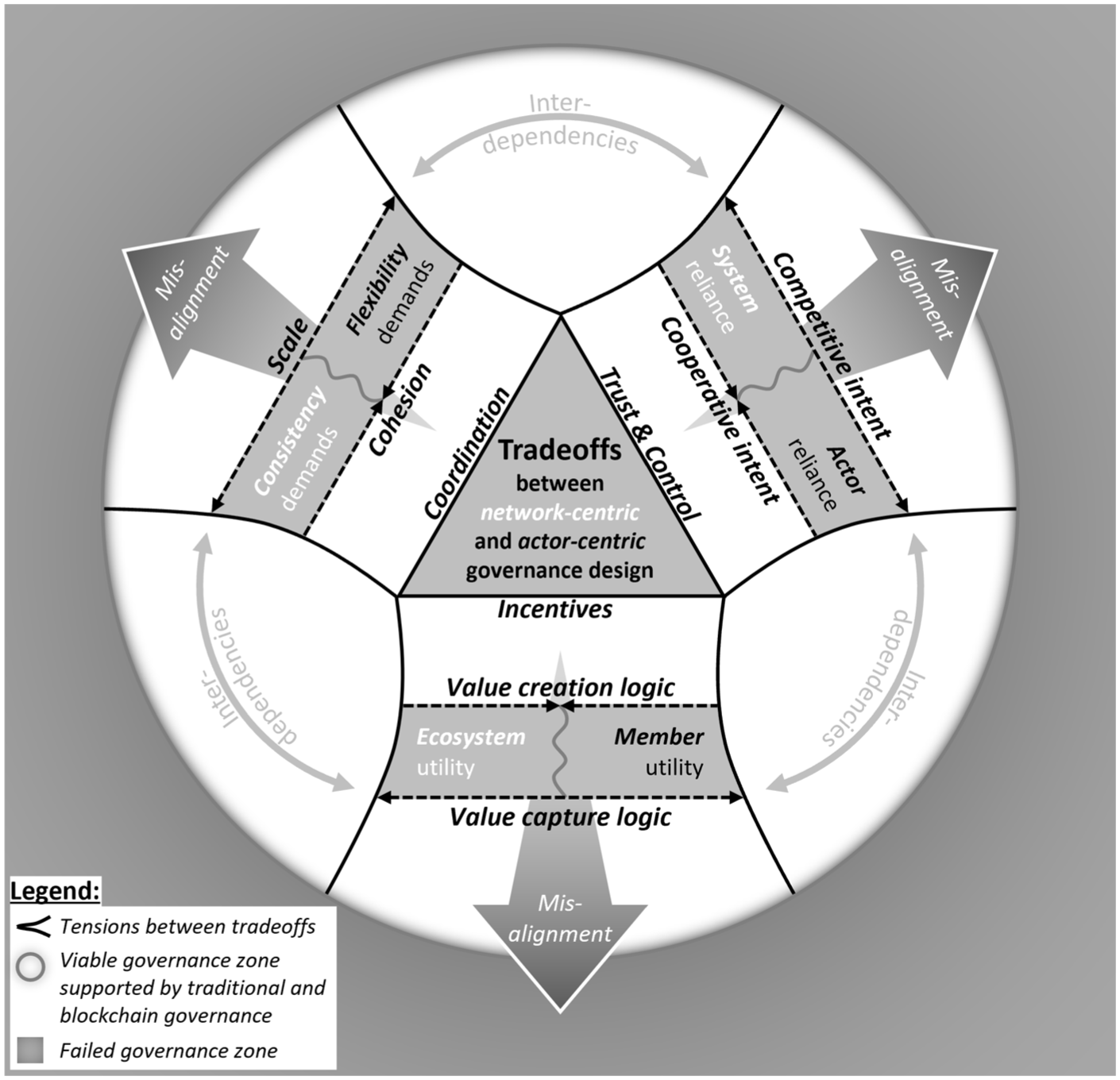
Governance Tradeoffs and Misalignments in Blockchain-Based Interorganizational Ecosystems
Treading this tightrope of tradeoffs is a critical balancing act for which there is no universal solution. Instead, ecosystem members must carefully evaluate governance advantages and disadvantages to identify a solution that aligns with their project’s objectives and the ecosystem’s composition. Our internal records show that approximately half of the blockchain projects failed to meet expectations and were discontinued, raising serious concerns within IBM about the viability of this line of business. An analysis of news articles published on Ledger Insights reveals a marked decline in press coverage of IBM blockchain projects after 2020 (see Figure A2, Online Appendix). Notably, in “most blockchain projects [. . .] it’s never really been a technical issue. It’s more a people and mindset issue” in which governance misalignments played a prominent role. An August 2021 internal IBM presentation based on 100 projects identified scalability, difficulty communicating value, economic infeasibility, slow adoption, shifting priorities, and lack of funding, with governance misalignments being a key concern. Many managers only realized in hindsight how well-intended governance decisions contributed to failures. For instance, concerning incentives, a project manager recognized that the stakeholders should have decided on “the business model and the monetization model upfront because it is easier to also get the stakeholders on board.” While not every governance issue can be anticipated ex ante, these failures show that neglecting incentive, trust and control, and coordination tradeoffs can undermine otherwise viable projects, making governance design decisive for whether interorganizational ecosystems succeed.
Discussion of Theoretical Implications and Conclusion
In this paper, we examine the governance design and effectiveness of interorganizational ecosystems that employ both traditional and blockchain-based digital governance mechanisms. Drawing on evidence from 81 interorganizational blockchain projects across 25 industries, we identify three governance tradeoffs: consistency versus flexibility in coordination, system reliance versus actor reliance in trust and control, and ecosystem utility versus member utility in incentives. These tradeoffs are contingent on boundary conditions that amplify or attenuate them: Network scale and cohesion shape the coordination tradeoff; competitive versus cooperative intent conditions the tradeoff related to trust and control; and value creation versus value-capture logics inform the incentive tradeoff. Our findings reveal that while blockchain can facilitate and sometimes enable large-scale collaboration, it also introduces distinct governance tensions, such as transparency-induced vulnerabilities and conflicts between network-centric rules and actor-centric needs. By identifying these tensions and the mechanisms that trigger governance misalignments, our study explains why many ecosystems fail to sustain collaboration and provides actionable guidance for designing more effective governance frameworks.
Theoretical Contributions to Governance Research
From a phenomenological perspective, our study advances governance research by clarifying how blockchain, as a digital governance mechanism, reshapes collaboration in interorganizational ecosystems. Prior theorizing on blockchain in interorganizational ecosystems often relies on theories grounded in bilateral exchanges, including transaction cost economics and relational governance (e.g., Lumineau et al., 2021), which have limited ability to represent the multilateral interdependencies that define ecosystems (Adner, 2017; Wareham et al., 2014). Similarly, research on blockchain-based cryptocurrencies and DAOs focuses on coordination among anonymous or loosely connected individuals (e.g., Gregory et al., 2025; Hsieh & Vergne, 2023) and therefore does not capture the dynamics in organizational settings where firms operate within competitive markets and corporate hierarchies. Finally, platform-oriented studies tend to treat ecosystems as centrally orchestrated structures with intermediaries defining rules and overseeing compliance (e.g., Chen, Yi, Li, & Tong, 2022; Uzunca, Sharapov, & Tee, 2022), which does not align with blockchain’s premise of decentralization and disintermediation. We extend this research by showing how blockchain-based collaboration creates specific governance tradeoffs, where misalignments arise when its network-centric rules conflict with organizations’ unique needs, thereby shaping the success and failure of interorganizational ecosystems.
In extension, our second contribution refines the construct-level understanding of how digital technologies interact with traditional governance mechanisms in ecosystems. Existing research has primarily theorized structural mechanisms such as alignment architectures and role definitions, contractual mechanisms that define rights and obligations, and relational mechanisms that foster trust and reciprocity (Adner, 2017; Shipilov & Gawer, 2020). Although this work offers strong foundations, it pays limited attention to digital governance despite its growing relevance. Where digital governance is considered, studies emphasize complementarities, suggesting that digital systems enable large-scale collaboration while traditional mechanisms mitigate their rigidity (Hanisch et al., 2023). Our findings refine this view by showing that digital and traditional governance can produce incompatibilities, because network-centric rules encoded in blockchain systems, including immutable protocols, uniform data visibility, and distributed decision processes, often conflict with actor-centric needs for flexibility, discretion, and strategic control. Moreover, blockchain introduces a paradoxical situation that has been largely overlooked: it decentralizes governance by distributing validation and data management across participants, while it also centralizes governance through a shared digital backbone and reliance on strategic leaders who manage onboarding, integration choices, and network standards. Our framework organizes these tensions into three tradeoffs around coordination, trust and control, and incentives, offering generalizable insights into the limits of blockchain as a digital governance mechanism and illuminating conditions under which interorganizational ecosystems are more likely to struggle or unravel.
Proposition 1: Governance misalignments arising from tradeoffs between network-centric rules and actor-centric needs increase the likelihood that interorganizational ecosystems will fail.
Third, we advance the understanding of the mechanisms that underpin interorganizational governance by refining two foundational assumptions in classic theory. The first concerns information asymmetries and resultant potential for opportunism, which are typically viewed as the primary governance problems (Goldsby & Hanisch, 2023; Williamson, 1991). Our findings challenge this assumption by showing that increased information transparency through a shared digital ledger does not simply reduce opportunism but creates new vulnerabilities. Interviewees emphasized that uniform visibility into operational and commercial data exposed sensitive information to competitors, enabled strategic monitoring, and heightened concerns about misuse. These effects produced new forms of opportunism and defensive behavior that complicated collaboration. The second concerns network effects, which are traditionally seen as exogenous externalities that accrue uniformly across participants (Katz & Shapiro, 1985). We extend recent advances recognizing that network effects are endogenous to strategic choices (e.g., Afuah, 2013; Ploog & Rietveld, 2025) by drawing particular attention to governance decisions as a salient driver. Our findings reveal that in interorganizational ecosystems, the realization of network effects depends on governance design, as uneven data access, coverage, and control over bottlenecks constrain their potential. Actors who control critical network data or positions gain disproportionate influence over ecosystem decisions and value capture, which destabilizes collaboration. Together, these new mechanisms show that digital technologies redistribute governance problems in ways that can erode alignment and increase the likelihood of ecosystem failure.
Proposition 2: Digital governance mechanisms enabled by blockchain can induce new forms of opportunism related to transparency-induced vulnerabilities and strategic exploitation of network positions, which hinder collaboration and increase the likelihood of interorganizational ecosystem failure.
Finally, our study contributes to governance theory by specifying when blockchain-based collaboration becomes fragile and when governance tensions can be partially alleviated. Extant research often assumes that alignment is achievable when complexity is limited, interests are shared, or central orchestrators can impose order (Provan & Kenis, 2007; Wareham et al., 2014). By contrast, we identify conditions under which governance misalignments persist and intensify—namely when ecosystems scale, competitive dynamics sharpen, and value-capture logics dominate. Each condition amplifies a distinct governance tradeoff: Scaling expands data coverage but strains the balance between consistency and adaptability; competition undermines reliance on system-level trust and shifts actors toward private safeguards; and value-capture logics exacerbate incentive misalignments by prioritizing individual appropriation over collective gains. At the same time, we show that these tensions attenuate when ecosystems exhibit greater cohesion, cooperative intent, and value-creation logics. Under such conditions, actors are more willing to accept shared decision processes, rely on collective controls and system trust, and align incentives around ecosystem-level benefits. Together, these findings challenge the idea of stable or optimal alignment, where “all actors are satisfied with their positions” within the ecosystem (Adner, 2017: 42), by showing that misalignment is a persistent feature rather than an exception. We thus extend governance theory by explaining why some blockchain-based ecosystems stabilize while others unravel despite addressing clear industry problems and resting on robust technological foundations.
Proposition 3a: Governance tradeoffs in coordination, trust and control, and incentives become more pronounced as ecosystems expand in scale, competition strengthens, and value-capture logics dominate, thereby increasing the likelihood of interorganizational ecosystem failure.
Proposition 3b: Governance tradeoffs in coordination, trust and control, and incentives become less pronounced as ecosystems exhibit greater cohesion, cooperative intent, and value-creation logics, thereby reducing the likelihood of interorganizational ecosystem failure.
To summarize, Table 2 provides an overview of our theoretical contributions relative to extant governance research.
Overview of Theoretical Contributions
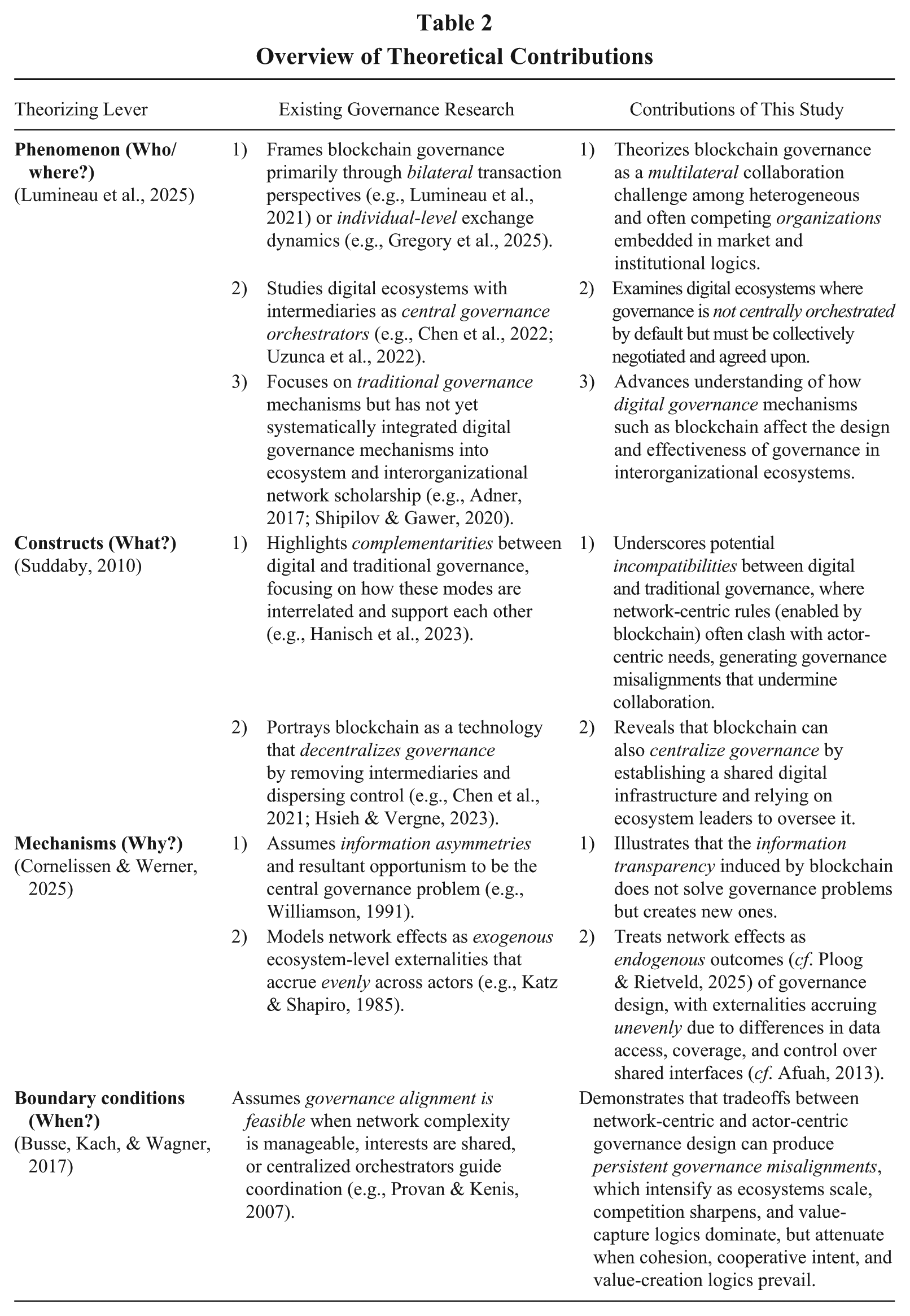
Limitations
We would be remiss not to acknowledge the limitations of our study. First, our examination of IBM cases may introduce potential biases. IBM emphasizes specific blockchain technologies (e.g., permissioned rather than permissionless blockchains), so our data do not represent the full spectrum of available technologies. Additionally, IBM’s clients are typically large, financially robust firms, which overlooks the vibrant startup ecosystem surrounding blockchain technologies (Friedlmaier, Tumasjan, & Welpe, 2018). Our single-vendor focus also restricts insights into competitive dynamics among technology providers. As another blockchain provider we interviewed cautioned,
One of the risks here is vendor lock-in. For example, if you go on the [IBM project name] blockchain, before you know it, your whole supply chain is locked in with a single vendor. IBM will always find a way to monetize it later, and then you’ll essentially be owned by big tech because the system becomes so critical to your operations that you won’t be able to get rid of them.
Moreover, given the scale of many ecosystems, we were unable to interview every relevant participant. At times, we lacked access to specific stakeholders, such as when projects were discontinued or confidentiality agreements restricted access to IBM client names. This meant that, despite extensive triangulation, we often relied on IBM accounts. IBM informants may also reflect the firm’s culture and strategy rather than a neutral view of the blockchain landscape. Therefore, future work could explore how heterogeneity among technology providers (e.g., in terms of governance approaches, client relationships, and technology choices) shapes interorganizational ecosystems.
Future Research Opportunities
There are opportunities for future research to build on our qualitative findings for quantitative analyses. A natural extension lies in testing the relationship between different governance configurations and possible outcomes—for example, the extent to which organizations join, leave, or contribute to an ecosystem. Given the high failure rate and stagnation of many initiatives, we consider this a promising endeavor. Such a theory-testing approach could refine our conceptual understanding of blockchains and identify important interdependencies between governance choices. Moreover, it would be insightful to further explore the governance adaptation dynamics in interorganizational ecosystems and how organizations alter their established blockchain-based and traditional governance in response to the adaptive pressures emerging from the inclusion of new members or shifting project goals. Understanding governance misalignment and realignment processes is best suited to a qualitative case study. Another fruitful avenue for future research would be to integrate the discussion on blockchain-based governance with core questions related to a firm’s boundaries. Large interorganizational ecosystems inherently pose such questions concerning, for example, ownership and control over key assets and value-generating activities. Defining the locus of value creation in a decentralized network would address the business model design difficulties that many interviewees highlighted.
Another broader direction for future research on interorganizational blockchains is the influence of founders or “lead organizations” in ecosystems (Roehrich, Kalra, Squire, & Davies, 2023; Zhan et al., 2025). Our interviewees pointed to how the preferences of those who spearhead blockchain projects largely shape ecosystem outcomes. In fact, many large blockchain projects are associated with specific organizations, such as TradeLens with Maersk and Food Trust with Walmart. A longitudinal case study to understand how these organizations contribute to the success or dissolution of such ecosystems could be particularly insightful. Such studies could apply sociocognitive and sociopolitical theories to understand the sensemaking processes amid uncertainty, the power dynamics, and the influence tactics. Researchers could investigate how founders’ cognitive biases and heuristics affect their decision-making processes and how they manage power dynamics within ecosystems. Additionally, researchers could explore how founders use influence tactics to give strategic direction and their impact on ecosystem outcomes.
A third area we highlight relates to the industry intermediaries that are inherently threatened by the implementation of blockchain solutions. Blockchain’s peer-to-peer nature is designed to cut out “middlemen,” which naturally sparks resistance among those who are “going to be made less relevant by this network.” As Meeta Vouk (2018), director of the IBM Singapore Research Center, put it, “If you have a process, for example, where there is no middleman, blockchain is not going to be of much help to you,” underscoring that the very point of blockchain is disintermediation. Indeed, a lack of support from intermediaries in the value chain can be a significant obstacle to the adoption of blockchain technology because “they either can support you or block the adoption of the project,” as one project manager stated. In some cases, blockchain-induced disintermediation may even disrupt the business models of certain industry players: “In a trusted environment like blockchain, we may not need that company sitting between us” (Chrystie, 2020). As another project leader explained, “there wasn’t much of a value for these [industry players]. In fact, it was the opposite of value, it was cutting into services that they today already provide.” The relevant role of industry intermediaries has received scant attention in the literature thus far but might lead to fruitful insights, especially via comparisons to intermediary-based platforms.
Design Principles for Managers
In practice, “getting governance right is the hardest” (Barbosa, 2023), and our analysis of its inherent tradeoffs shows that “there is no single good governance structure” (DiCaprio, 2021), precluding any simple “one-size-fits-all” solutions. However, many practitioners reflected on lessons learned, allowing their voices to guide our practical recommendations for establishing blockchain-based interorganizational ecosystems. Crucially, managers should be mindful of the fact that “most of the blockchain initiatives failed not because of technology but because of governance.” For managers, a first step can be to “define a shared business problem” that creates urgency across firms—for example, inefficiencies, fraud risks, or compliance gaps—to ensure that blockchain is the right solution. At the same time, blockchain is rarely a peripheral add-on because it typically touches “critical processes” at “the heart of the organization,” demanding senior leadership engagement, as lower-level employees lack the “clout” to push such initiatives. Managers must also confront cognitive barriers in industries with a “zero-sum game” mindset. Blockchain thus requires unprecedented collaboration, forcing firms to share sensitive data and intellectual property in ways they have historically resisted. As one interviewee noted, success depends on cultivating a “collaborative culture” where participants are genuinely “convinced that working together is going to bring you farther than going it on your own” (Sofia et al., 2024).
For managers, successful governance design therefore depends on creating an inclusive, adaptive, and incentive-aligned model. First, functional ecosystems must “involve a broad and diverse set of stakeholders, including competitors and regulators,” to build legitimacy and trust. Managers also need to make sure that governance remains flexible by incorporating “rules to change the rules” (Webber, 2020b), along with clear procedures for onboarding and offboarding participants and establishing advisory boards to “shape the future roadmap of the platform” and sustain ecosystem health. Equally important is defining “rules and processes and what to do when things go wrong” upfront (McCurdy & Fuhrman, 2021), since blockchain lacks the adjudication history of traditional systems. Structurally, separate legal entities can create a “Chinese wall” to reassure competitors, while blockchain features such as immutability and distributed control can enhance trust in sensitive transactions. Finally, incentives must be carefully tailored, beginning with a “minimum viable ecosystem” (Leuthardt, 2019) to test assumptions and iron out “design teething problems.” Particularly, managers should understand “what value is in it for every single organization that’s going to be on the network” (Webber, 2020a), recognizing that “equitable doesn’t mean equal” (McCurdy & Fuhrman, 2021). Offering indirect benefits such as shared standards and updated IT infrastructure can motivate reluctant actors. To complement these lessons learned, we provide an
Supplemental Material
sj-docx-1-jom-10.1177_01492063261420752 – Supplemental material for Success and Failure in Blockchain-Based Interorganizational Ecosystems: A Governance Perspective
Supplemental material, sj-docx-1-jom-10.1177_01492063261420752 for Success and Failure in Blockchain-Based Interorganizational Ecosystems: A Governance Perspective by Marvin Hanisch, Pim Roozen and Vasileios Theodosiadis in Journal of Management
Footnotes
Acknowledgements
We are grateful to Cuili Qian, our action editor, for her clear and constructive guidance throughout the review process. We also extend our appreciation to the three anonymous reviewers for their thoughtful and developmental feedback. Special thanks go to Curtis Goldsby for providing access to research materials and for his helpful comments on multiple drafts. This study would not have been possible without the support of our numerous interviewees, who generously shared their time and expertise. We are thankful to Fabrice Lumineau and Wenqian Wang for their friendly and valuable comments on an early version of the manuscript, and to Pedro de Faria and colleagues in the Innovation Management & Strategy department at the University of Groningen for their insightful discussions during our revisions. We acknowledge Franziska Neugebauer for fruitful exchanges and artistic support, and IBM Corporation, especially Filipe Campos Silva Teixeira, for enabling this practitioner-academic collaboration, particularly through Pim Roozen’s internship and access to internal records and employees that formed the foundation of this project. Finally, we thank Mary Lacity for her early encouragement and enthusiasm, which inspired this work.
Supplemental material for this article is available with the manuscript on the JOM website.

Notes
References
Supplementary Material
Please find the following supplemental material available below.
For Open Access articles published under a Creative Commons License, all supplemental material carries the same license as the article it is associated with.
For non-Open Access articles published, all supplemental material carries a non-exclusive license, and permission requests for re-use of supplemental material or any part of supplemental material shall be sent directly to the copyright owner as specified in the copyright notice associated with the article.
