




Abstract
Sustainability standards have proliferated widely in recent years but their legitimacy remains contested. This paper suggests that sustainability standards need to cope with an important but unexplored paradox to gain legitimacy. While standard setters create low entry barriers and requirements for adopters so that standards can diffuse quickly and achieve a status of cognitive legitimacy, standards also need to ensure that adopters create high levels of impact, thereby acquiring moral legitimacy. While the need for diffusion and impact occurs at the same time, they cannot be achieved simultaneously. We unpack this paradox and show that its salience for standard setters differs depending on (a) the growth trajectory of a standard and (b) the perceived intensity of the demands for diffusion and impact. We outline five response strategies that standard setters can use to tackle the diffusion–impact paradox and illustrate our theoretical considerations through a detailed case study of the UN Global Compact. Our paper advances scholarly understandings on how sustainability standards gain legitimacy and sheds light on the complex and inherently paradoxical nature of legitimacy. We derive implications for the literatures on sustainability standards, legitimacy, and paradox management.
Introduction
Sustainability standards, such as the Forest Stewardship Council (FSC), the Roundtable for Sustainable Palm Oil (RSPO) and the United Nations Global Compact (UNGC), have proliferated rapidly and form part of an emerging institutional infrastructure of private governance addressing global challenges in the realm of human rights and environmental protection (de Bakker, Rasche, & Ponte, 2019). Yet, the legitimacy of these standards is contested (e.g., Voegtlin & Pless, 2014), and the questions of when and how sustainability standards gain legitimacy have attracted significant attention (e.g., Bernstein & Cashore, 2007; Etzion & Ferraro, 2010; Haack, Pfarrer, & Scherer, 2014; Mena & Palazzo, 2012).
This paper suggests that sustainability standards need to cope with one important, yet largely unexplored, paradox to gain legitimacy. On the one hand, standards need to diffuse quickly to create acceptance and perceptions of taken-for-grantedness that endow them with cognitive legitimacy and the “right to rule” (Buchanan & Keohane, 2006, p. 405). After all, standards “provide rules for the many” (Brunsson & Jacobsson, 2000, p. 2), and the greater the number of adopters who embrace a standard the more likely it becomes that other organizations will join, due to institutional and bandwagon pressures (Delmas & Montiel, 2008; Jamali, 2010). Standard setters seek to increase adoption numbers and thus cognitive legitimacy by keeping entry barriers and accountability requirements low (Prakash & Potoski, 2007; Zeyen, Beckmann, & Wolters, 2016). On the other hand, standards are expected to have a lasting effect on practice. However, weak requirements may lead to the adverse selection of low-performing adopters. This may attract criticism from non-governmental organizations (NGOs) arguing that the standard lacks impact and merely serves as a marketing tool to generate favorable impressions (Delmas & Burbano, 2011). Such criticism challenges a standard’s moral legitimacy in the view of society at large and may push an initiative towards ratcheting up its requirements. Enforcing stricter control and higher entry barriers, however, makes it more costly for organizations to join the standard, thus slowing down its diffusion. In turn, limited proliferation makes it more difficult to perceive the essence and goals of a standard and raises doubts regarding its prospects of gaining prominence and a status of taken-for-grantedness. This situation can be framed as a paradox, because the needs for cognitive and moral legitimacy occur at the same time and cannot be achieved simultaneously (Schad, Lewis, Raisch, & Smith, 2016).
Not all standard setters experience the diffusion–impact paradox as equally salient and thus relevant for strategic decision-making. For instance, the paradox is unlikely to be salient in the early stages of a standard’s development, as adopters have not yet developed a comprehensive understanding of the nascent standard and thus struggle to bestow cognitive legitimacy. Similarly, civil society actors are not yet invested in the deliberate assessment of a standard’s moral legitimacy making it mostly a topic discussed in expert circles (Stone, 2008). Building on these considerations, this paper asks two interrelated questions: When does the diffusion–impact paradox become salient for standard setters and in ways that entangle the two dimensions of diffusion and impact? (RQ1); and How can standard setters respond to such a diffusion–impact paradox? (RQ2).
The first question implies that we cannot take the paradox itself for granted. Our arguments suggest that the paradox’s salience depends on (a) the growth trajectory of a standard and (b) the perceived intensity (for standard setters) of the two demands underlying the paradox. We argue that the paradox becomes relevant once a standard has passed through an initial growth phase that widens and diversifies its member base as well as the set of evaluating audiences that bestow legitimacy. In addition, we suggest that the perceived intensity of demands for diffusion and impact is influenced by different contextual conditions (e.g., whether standards operate in crowded market spaces). The second research question examines how standard-setting organizations respond to the paradox. We suggest that standard setters’ responses are impacted by how salient the paradox becomes. We theorize different response types and conceptualize the scope for which a given response is effective, also discussing the factors and contextual circumstances that influence response choices. We illustrate our arguments by discussing how the growth of the United Nations Global Compact (UNGC) in the past 20 years influenced the salience of the paradox and led to the choice of specific response strategies.
Our discussion on the diffusion–impact paradox is anchored in the interdisciplinary scholarly discourse on sustainability standards (de Bakker et al., 2019), and combines this literature with organization and management research on legitimacy (Suchman, 1995; Suddaby, Bitektine, & Haack, 2017) as well as paradox theory (Schad et al., 2016). The main contribution of our paper is to the literature on sustainability standards by specifying conditions under which the diffusion–impact paradox becomes salient for standard setters. While the previous literature has acknowledged that diffusion and impact cannot be easily aligned with each other (e.g., Bernstein & Cashore, 2007; Prakash & Potoski, 2007), we advance research by construing the relationship between diffusion and impact as a paradox whose salience for standard setters differs depending on a standard’s trajectory stage and context. Advancing a paradox perspective on sustainability standards is important because it helps us to understand how exactly diffusion and impact are intertwined and why standard setters cope in different ways with the underlying tension. Gaining deeper insights into the diffusion–impact paradox advances our understanding of how sustainability standards may gain support. Ultimately, only standards that are broadly endorsed and receive allocated resources can tackle global problems effectively and thereby ease the transition towards a more sustainable and just economy.
Our arguments also contribute to studies discussing legitimacy in the context of private governance (e.g., Mena & Palazzo, 2012; Scherer & Palazzo, 2011; Wijen, 2014) as well as legitimacy research more broadly (Suddaby et al., 2017). While prior work in organization theory has highlighted that organizations can accommodate conflicting legitimacy strategies (Scherer, Palazzo, & Seidl, 2013), we suggest that opposing forms or sources of legitimacy can be simultaneously relevant for organizations. In this view, the legitimacy demands themselves can be paradoxical for organizational actors, not just their response strategies. This insight points to the need for future research on the inherently temporal and contextual nature of legitimacy, complementing conceptions of legitimacy as a stable property or “asset” of organizations. Specifically, our research clarifies that legitimacy is not only composed of different forms of legitimacy (Suchman, 1995), but that these different legitimacies coexist and evolve in complex and sometimes unanticipated ways. Our analysis suggests that cognitive legitimacy (supported by diffusion) and moral legitimacy (supported by impact) not only reinforce each other but may come into conflict. While the management of tensions and paradoxes seems particularly pertinent to the context of sustainability (e.g., Hahn, Pinkse, Preuss, & Figge, 2015), it may constitute an important research frontier for legitimacy research more generally.
Finally, we also contribute to the literature theorizing the role of paradox in organization theory. While this literature has adopted a process-based approach showing how paradoxes are managed over time and how a sustainability strategy becomes legitimate through action (Hengst, Jarzabkowski, Hoegl, & Muethel, 2020), we show how organizations’ own development affects the evolution of a paradox over time. More specifically, we theorize how pressures that standard setters experience due to their growth trajectories affect the experienced salience of a paradox as well as what they do next.
The Legitimacy of Sustainability Standards
What are sustainability standards?
The theoretical debate on sustainability standards is part and parcel of the wider debate on business contributions to private governance. Such private governance emphasizes that policies do not need to be derived from states’ sovereign authority but that non-state actors also play a significant role in the design and enforcement of relevant rules (Büthe, 2010). We follow a comprehensive definition of sustainability standards and understand them as “voluntary predefined rules, procedures, and methods to systematically assess, measure, audit and/or communicate the social and environmental behavior and/or performance of firms” (Gilbert, Rasche, & Waddock, 2011, p. 24). Standard setters are those organizational actors who define these rules, procedures, and methods (Brunsson & Jacobsson, 2000). Over time, different types of sustainability standards have developed (Fransen, Kolk, & Rivera-Santos, 2019). Our main theoretical argument on the diffusion–impact paradox applies to different types of sustainability standards. However, the type of standard may influence the perceived intensity of the demands for diffusion and impact.
One distinction is made between multi-stakeholder initiatives (MSIs) and business-driven schemes (de Bakker et al., 2019). MSIs reflect standards which are governed jointly by representatives from different stakeholder groups (usually business, civil society, and government actors). In some cases, MSIs have created governance structures that balance the interests of these groups (e.g., in the case of the FSC), while in other cases the label “MSI” is used more broadly to denote that different stakeholder groups are involved in a standard’s governance (e.g., in the case of the UNGC). By contrast, business-driven standards are exclusively governed by business representatives and try to keep the influence of other stakeholder groups at bay (e.g., the Business Social Compliance Initiative, BSCI; Egels-Zandén & Wahlqvist, 2007). MSIs generally have stronger “input legitimacy” because their governance is open to public scrutiny and more inclusive of the heterogeneous goals and interests of various stakeholders (Mena & Palazzo, 2012).
Another distinction is made based on the purpose of standards. Gilbert and colleagues (2011) distinguish between certification standards and principle-based standards. Most sustainability standards are designed to monitor production facilities and to verify compliance with predefined rules (e.g., the RSPO). Usually, certification standards are embedded into global supply chains and thereby act as signaling mechanisms for end consumers and other companies. By contrast, principle-based standards—such as the UNGC or the Principles for Responsible Investment (PRI)—do not monitor compliance. Rather, they define principles that serve as a platform for learning, dialogue, and partnership (Rasche, 2009). Critical stakeholders often perceive principle-based standards to “lack teeth” and impact (e.g., Sethi & Schepers, 2014) and therefore challenge this type of standard on moral grounds, a point we turn to next.
Sustainability standards and their legitimacy
Theorists of organizations typically define legitimacy as a social judgment of appropriateness that is audience-dependent (Haack, Schilke, & Zucker, 2021; Suddaby et al., 2017). While legitimacy represents a relationship between a legitimacy object (e.g., an organization, practice, or social structure) and an evaluating audience and is thus created in a process of social construction, legitimacy entails tangible benefits (Suchman, 1995). The dual nature of legitimacy—subjectively construed and objectively possessed—equally applies to sustainability standards. As a given standard and standard setter tend to be mentally represented as one shared conceptual unit, and because standard setters are often held accountable for the (lacking) success of a standard, the two legitimacy objects affect each other in terms of legitimacy—the legitimacy of a standard is interdependent with the legitimacy of the standard setter, for better or for worse (Haack et al., 2014). Likewise, the legitimacy of a standard can affect the legitimacy of adopting firms and industry actors connected to the standard through network ties, and the legitimacy of a standard may have a positive or negative impact on the social acceptability of private governance as a whole.
We suggest that the legitimacy of sustainability standards is based on two distinct legitimacy types, cognitive legitimacy and moral legitimacy. 1 Cognitive legitimacy refers to the comprehensibility and taken-for-grantedness of a legitimacy object (Aldrich & Fiol, 1994; Suchman, 1995). Cognitive legitimacy is considered the most stable and enduring type of legitimacy (Scott, 2008; Suchman, 1995). In its strongest form, taken-for-grantedness, cognitive legitimacy does not require active evaluation and reflects audiences’ tacit approval of a largely natural and unscrutinized reality (Golant & Sillince, 2007; Tost, 2011). The acquisition of cognitive legitimacy is particularly essential for novel entities in their quest to overcome the “liability of newness” and to attract resources needed to survive and grow (Aldrich & Fiol, 1994; Fisher, Kotha, & Lahiri, 2016). Gaining cognitive legitimacy is essential for sustainability standards because evaluating audiences often struggle to make sense of novel and unknown entities, especially if they involve global regulatory issues that are detached from direct experience (Cashore, 2002). Audiences thus develop knowledge about novel standards by drawing on analogies with existing, already comprehensible, and legitimate practices (Etzion & Ferraro, 2010). In addition, they assess the actors, entities, and issues with which standards are associated, levering on the heuristic value of publicly visible network connections (Baum & Oliver, 1991). In this view, the affiliation of a well-known business firm (e.g., an industry leader or a “celebrity” firm) or a well-respected international organization, such as the United Nations, can help evaluating audiences develop a better understanding about nascent sustainability initiatives and thus improve a standard’s cognitive legitimacy (Haack et al., 2014).
In addition to cognitive legitimacy, sustainability standards need to attain moral legitimacy. Moral legitimacy reflects a judgment on what is “the right thing to do” with respect to widely endorsed social norms (Suchman, 1995). One subtype of moral legitimacy that we consider particularly relevant for sustainability standards is consequential legitimacy. Standards can gain consequential legitimacy if they are not based on narrow self-interest but produce “socially valued consequences” (Suchman, 1995, p. 580). Moral aspects of legitimacy have been intensively discussed in research on policy–practice decoupling (e.g., Haack, Schoeneborn, & Wickert, 2012) which finds that standards are often only adopted symbolically without entailing substantive change. Accordingly, NGOs and critical consumer groups “name and shame” adopters they perceive to be decoupling and point to morally objectionable issues (den Hond & de Bakker, 2007). Whereas some strands in organization theory see decoupling as beneficial for organizations on the grounds that it enhances internal coordination in a context of conflicting demands (Meyer & Rowan, 1977), in business and society research decoupling is seen as a questionable form of deception because the merely symbolic adoption of standards is believed to impede the organizational embedding of sustainability (Behnam & MacLean, 2011; Haack, Martignoni, & Schoeneborn, 2021). As a result, decoupling, as well as the mere suspicion of “greenwashing,” undermines a standard’s moral legitimacy (Seele & Gatti, 2017).
For cognitive legitimacy, firms adopting a standard (or considering adopting it) represent the main evaluating audience bestowing legitimacy. For moral legitimacy the key evaluators comprise NGOs, consumer groups, unions, and charitable organizations. In addition, the media increasingly monitors the social and environmental impact of business behavior and represents a source of moral legitimacy (Deephouse & Suchman, 2008). Both cognitive and moral legitimacy coalesce, through a non-deterministic process, into a “summary” evaluation of generalized legitimacy (Tost, 2011). 2
The literature on sustainability standards has started to employ a temporal perspective and explored how legitimacy can be achieved in the context of private governance (Bernstein & Cashore, 2007; Zeyen et al., 2016). Researchers suggested not judging a standard’s legitimacy based on its consequences at one point in time but instead to also include its later ramifications (Cashore, Auld, Bernstein, & McDermott, 2007). These works demonstrate that an analysis of the social dynamics underlying the legitimization of sustainability standards can reap significant analytical benefits. The current literature on sustainability standards, however, has not disentangled the interaction between legitimacy types—neglecting the possibility that different types may be in conflict and face tensions that develop over time. The general organization theory literature on legitimacy has traditionally assumed a linear and synergetic progression from moral and pragmatic legitimacy to cognitive legitimacy with taken-for-grantedness as the endpoint of the legitimation process (Golant & Sillince, 2007; Greenwood, Suddaby, & Hinings, 2002). In the following, we offer a discussion of the temporal development of the tensions between two major sources of legitimacy for sustainability standards, i.e., the diffusion of a standard (supporting its cognitive legitimacy) versus its impact (supporting its moral legitimacy).
The Diffusion–impact Paradox
Most standard setters are interested in the wide diffusion of their initiative because only with a significant number of adopters will a standard attract attention and be considered relevant. Diffusion reflects “the spread of a practice or organizational structure within a social system” (Colyvas & Jonsson, 2011, p. 30). It has been suggested that diffusion constitutes a major source of cognitive legitimacy (Green, 2004) and that a widely diffused practice induces a perception among evaluating audiences that the practice enjoys broad acceptance and forms part of an increasingly taken-for-granted reality (Colyvas & Jonsson, 2011). At this stage, business firms realize that the principles of the standard are valid and ought to be followed, independent of the rational calculus of weighing costs and benefits of standard adoption (Haack & Scherer, 2014; Zeyen et al., 2016). Both institutional and bandwagon pressures then push a growing number of firms to formally embrace the standard.
However, as sustainability standards grow their member base, cognitive legitimacy achieved through diffusion cannot act as the only source of legitimacy. Well-known and visible standard setters are especially likely to receive attention and criticism by the media and civil society actors, particularly if they have established only low entry barriers and therefore are assumed to have limited impact (Behnam & Maclean, 2011). We understand impact as a “change in outcomes” (Mills-Scofield, 2012)—that is, the social and environmental change that is generated by a standard. A major concern is that weak requirements attract firms performing rather poorly in the realm of sustainability, promoting adverse selection and free-riding behavior (Lenox & Nash, 2003; Prakash & Potoski, 2007). Sasser (2002) has shown that, irrespective of a standard’s diffusion, most NGOs will not grant moral legitimacy to sustainability standards unless these initiatives can show on-the-ground effects of their members’ practices. Yet ratcheting up requirements to gain moral legitimacy is likely to negatively affect adoption rates and thus cognitive legitimacy. As Bernstein and Cashore (2007, p. 359) remark, standard setters can raise requirements, but by doing so they “risk driving away firm support.”
Standard setters thus face a paradox. On the one hand, they depend on low entry requirements in order to grow the number of adopters and thereby create perceptions of success and inevitability due to the wide prevalence of the initiative (a major source of cognitive legitimacy). On the other hand, they need to ratchet up entry requirements as critical stakeholders demand higher levels of impact (a major source of moral legitimacy). It is this simultaneous existence of demands for cognitive and moral legitimacy that we conceptualize as the diffusion–impact paradox. We argue that this tension meets the basic characteristics of a paradox: contradiction, interdependence, and persistence (Schad et al., 2016; Smith & Lewis, 2011).
First, paradoxes consist of contradictory elements (Schad et al., 2016, pp. 10–11). Contradiction, here, implies that two elements are mutually exclusive in the sense that the more an actor emphasizes one element, the more she will be drawn away from the other (Putnam, Fairhurst, & Banghart, 2016). The literature emphasizes that contradictions occur because both elements that negate each other cannot be achieved simultaneously (Rasche, 2008), while it would be possible to address them separately or sequentially. The diffusion–impact paradox puts two conflicting demands on the shoulders of standard setters, and both demands “seem logical in isolation but absurd and irrational when appearing simultaneously” (Lewis, 2000, p. 760). When viewed separately, it is beneficial for standard setters to achieve higher levels of diffusion or more impact. However, both demands can contradict each other once a standard develops, a point we discuss in depth below.
Second, paradoxes occur if the opposing demands are interdependent. Interdependence implies that both demands cannot be fully separated because they reflect “two sides of the same coin” (Lewis, 2000, p. 761). Interdependent demands mutually constitute each other (Schad et al., 2016). The diffusion–impact paradox shows such interdependence, because both criteria are necessary for achieving legitimacy in a context of heterogenous audiences. Without high levels of diffusion, a standard will be judged as unsuccessful and current and prospective adopters are unlikely to attribute much legitimacy to it. Legitimacy in the eyes of evaluating audiences (e.g., NGOs), however, also rests on the standard having an impact on the ground. Both demands therefore contain elements of a greater whole, in our case the generalized legitimacy of sustainability standards.
Finally, paradoxes do not just reflect contradictory and interrelated demands, but the demands are also persistent (Smith & Lewis, 2011). Management research has highlighted that this persistence distinguishes paradoxes from other types of organizational tensions (Schad, 2017). The interdependent contradictions cannot be easily “solved” but usually exist for a longer period or even push organizations towards an ongoing process of addressing and coping with the paradox (Putnam et al., 2016). Although paradoxes are persistent, it is possible to temporarily address them (e.g., by accommodating one demand; Jarzabkowski & Lê, 2017). As we discuss next, the diffusion–impact paradox cannot be conclusively resolved by standard setters, and it is therefore likely that it remains a persistent element of organizational life, at least as long as a standard aims to broaden its participatory base.
Salience of the Diffusion–impact Paradox
The diffusion–impact paradox is not equally relevant to all standards at all times. We distinguish two aspects that influence the salience of the paradox: (1) a standard’s growth trajectory and (2) the intensity with which standard setters perceive demands for diffusion and impact.
Standards’ growth trajectory
The diffusion–impact paradox is present during the overall growth trajectory of a standard. Yet, although the paradox is persistent, it is not equally relevant in all stages of development. Figure 1 depicts an idealized diffusion model that shows three different growth stages of sustainability standards. We assume an S-shaped diffusion curve as set out by Rogers’ (2003) research on diffusion.
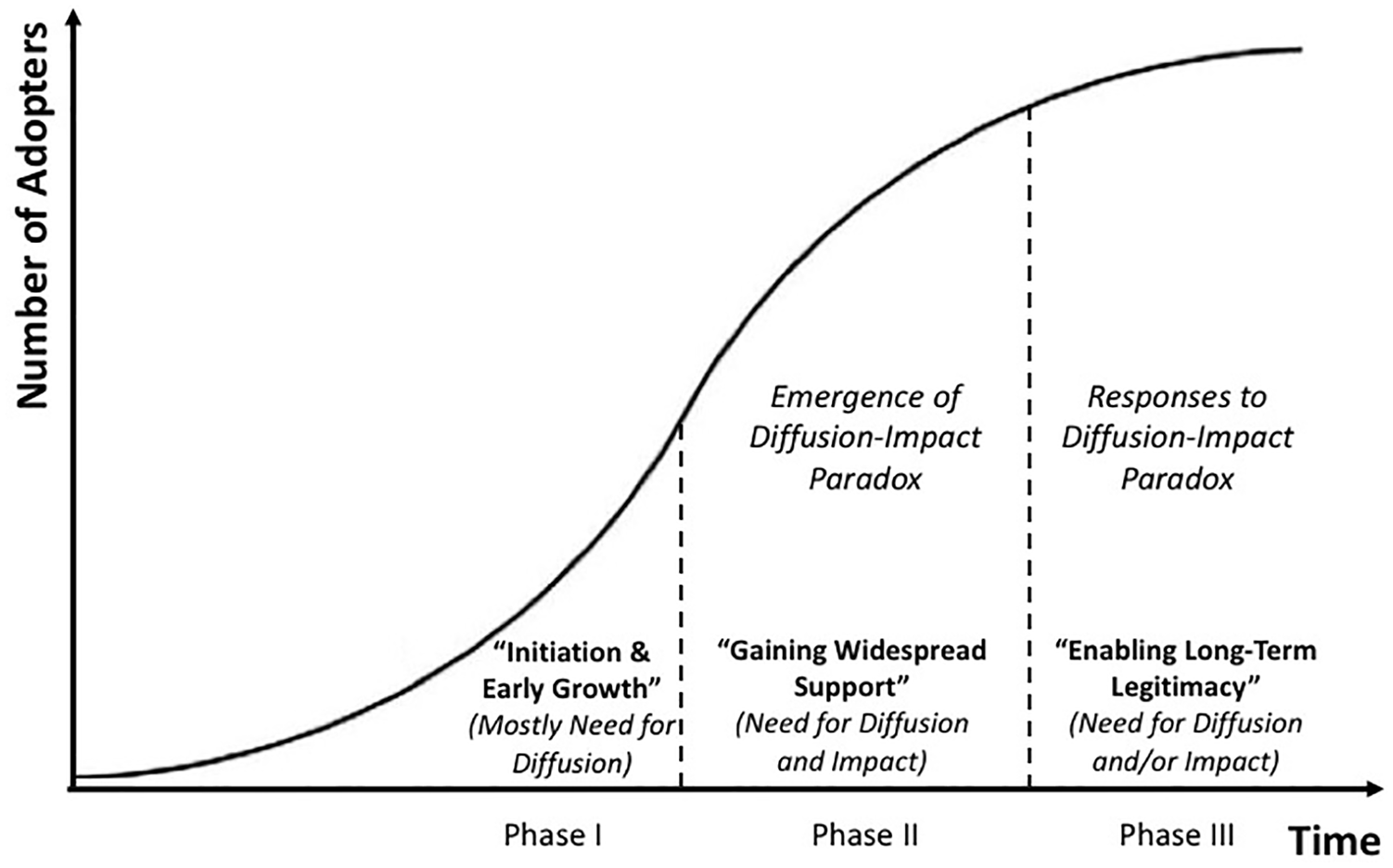
The Diffusion–impact Paradox and Sustainability Standards’ Growth Trajectory.
Phase I—Initiation and early growth
During this initial phase standard setters will try to attain cognitive legitimacy. Cognitive legitimacy is bolstered through the diffusion of a standard (Green, 2004), and the ubiquity of a standard indicates that it has become widely accepted, independently of whether it developed a foundation that enables it to persist (Colyvas & Jonsson, 2011). Similarly, being part of a growing populace lends materiality to an emerging group, helping it to get noted and perceived as “real” (Wry, Lounsbury, & Glynn, 2011). The understanding that diffusion and cognitive legitimacy are linked has been common in institutional theory which argues that mimetic isomorphism and growing adoption numbers bolster cognitive legitimacy (e.g., Tolbert & Zucker, 1983). It is also reflected by research in population ecology which has treated “population density” as a proxy for the cognitive legitimacy of an emerging organizational form (Carroll & Hannan, 1989). Given that in a very early stage of standard development potential adopters struggle to make sense of a standard and assess its chances of success, the number of current adopters “can become a proxy for mission fulfillment” (Zeyen et al., 2016, p. 354). In addition, current and prospective adopters will judge support for a sustainability standard as evidence that the standard forms part of an increasingly valid and natural reality (Haack & Scherer, 2014). Research has also shown that diffusion and ensuing cognitive legitimacy can be significantly bolstered through the use of language (Abrahamson & Fairchild, 1999), for instance, through the use of “growth stories” (Wry et al., 2011, p. 450) and “success narratives” (Haack et al., 2012, p. 825).
It follows that standard setters have an incentive to keep requirements for standard adoption low, because this is likely to attract firms which operate either close to or already at the level of the requirements (Prakash & Potoski, 2007). Relevant firms join because they can achieve compliance at low costs and thereby reap potential benefits without much additional effort (e.g., through differentiation from firms with lower sustainability performance; Hoffman, 1997). In some cases, adopting firms are mission-driven companies who feel that their own set of core values fits well with the prescriptions of the standard (Hayward & Vertinsky, 1999). In other cases, standards may attract “model firms” during this phase (Bernstein & Cashore, 2007)—that is, well-known and reputable companies that do not face high compliance costs but who can legitimize the operations of the initiative.
The diffusion–impact paradox is less likely to occur during this initial phase, since evaluating audiences are less concerned with the moral legitimacy of standards and because judgments regarding social appropriateness of a standard predispose some minimum knowledge of its very essence and goals. Hence, at this stage, standard setters usually do not yet face pressures to increase the impact of their initiative. Questions of impact and “depth” (and thus moral legitimacy), however, become increasingly pertinent in the second phase.
Phase II—Gaining widespread support
Once a sustainability standard has achieved a minimum number of adopters and level of cognitive legitimacy, standard setters will try to enroll more participants in order to mainstream and further consolidate the initiative (Klooster, 2010). Further enlarging the member base of a standard often requires gaining support from firms whose current practices are quite distant from the defined behavioral requirements and who therefore face higher compliance costs (Bernstein & Cashore, 2007; Zeyen et al., 2016). For standard setters, the gap between behavioral requirements and actual practice results in pressure to keep entry barriers low, as more stringent requirements usually cause higher investments in monitoring and sanctioning.
The diffusion–impact paradox becomes increasingly relevant in this phase, because standards will attract the attention of social and environmental NGOs and other critical stakeholders (e.g., labor unions) who will challenge the standard on moral grounds. Although the NGO landscape is diverse and organizations differ on how they view voluntary standards (King, 2008), some NGOs will challenge and actively target standards with low compliance requirements, for instance by pointing out that non-compliant firms are listed as members or by criticizing the inappropriateness of non-demanding requirements. The interest of NGOs is to either “raise the bar” of a standard to increase its impact or to publicly criticize an initiative by pointing out (perceived) deficiencies and transgressions so that support from other business firms and stakeholders declines (Briscoe & Gupta, 2016; den Hond & de Bakker, 2007). In this phase a focus on issues related to moral legitimacy gradually complements a standard’s initial quest for cognitive legitimacy.
In this second phase, evaluating audiences increasingly request higher entry barriers for joining sustainability standards, including strict requirements for reporting and accountability, and sanctions such as “delisting” for non-compliant adopters (Aravind & Christmann, 2011). Not conforming to these impact-related dimensions jeopardizes the moral legitimacy of the standard and the standard setter, irrespective of whether the standard has gained cognitive legitimacy. In fact, targeting and boycotting prominent adopters of a standard has been shown to grant significant attention and leverage to civil society critics, becoming a “business model” of NGOs (Spar & La Mure, 2003). In this view, achieving cognitive legitimacy threatens a standard’s emerging moral legitimacy.
Phase III—Responding to the paradox
In the long run, standard setters are interested in acquiring a high degree of both cognitive and moral legitimacy for their standards. However, for this to happen they need to tackle the diffusion–impact paradox. Although the paradox cannot be “resolved,” in the sense that there is a solution to the paradox that would make it disappear (Smith & Lewis, 2011), there are different ways to address it. How exactly a standard attains legitimacy will depend on the intensity with which demands for diffusion (cognitive legitimacy) and impact (moral legitimacy) are experienced by the standard setter.
Perceived intensity
Previous research has emphasized that paradoxes become salient if they are “consciously observed and articulated” (Jarzabkowski, Bednarek, & Lê, 2018, p. 178). Evaluating audiences differ in how strongly they recognize paradoxes in their enactments, making it necessary to focus on the perceived intensity of the contradictory demands. Gaim, Clegg, Pina e Cunha, and Berti (2020, p. 9) define the intensity of contradictory demands as consisting of two factors: (a) the perceived urgency of a demand (i.e., how crucial is a given organization’s need to engage with the demand) and (b) the perceived influence of a demand on the organization (i.e., the degree to which the demand influences current or future performance or limits possibilities for action). In the following we discuss which factors influence the perceived intensity of demands for standards’ diffusion and impact. We focus both on the perceived urgency of demands as well as their likely influence on standard setters. This discussion shows that the paradox is not equally salient to all standard setters in the sustainability domain.
Perceived intensity of demand for diffusion
Standard setters face different levels of pressure to grow their member base and thus enhance their cognitive legitimacy. Some standards are created as niche initiatives—that is, standard setters deliberately use the ambiguity attached to the concept of sustainability (Montiel, 2008) in order to differentiate their initiative. For instance, “bird friendly” coffee, which was created by the Smithsonian Migratory Bird Center in 2000, is positioned as an initiative protecting forest cover providing the habitat for birds and other wildlife. Although the standard also covers other certification areas, like organic production, it is still perceived as serving a small market niche in the overall coffee market (Raynolds, Murray, & Heller, 2007). Often, the developers of niche standards are not interested in mainstreaming their requirements by means of reaching a high level of diffusion and therefore do not face urgent pressure to grow their member base. In some cases, niche standards are based on the ideological roots of those people and organizations that were involved in their creation. It is therefore unlikely that such initiatives experience high diffusion rates as a demand that significantly affects future performance targets.
We suggest that the perceived intensity to reach diffusion is particularly high for standards that operate in competitive and crowded markets for sustainable products. In such markets, standard setters have a strong interest that their initiative turns into a de facto standard and reaches a status of taken-for-grantedness where alternatives to the initiative become “literally unthinkable” (Zucker, 1983, p. 25). Prior research has shown that such markets exist in the context of product certifications, for instance related to forestry (Gulbrandsen, 2012), textiles (Fransen, 2011), and coffee (Reinecke, Manning, & von Hagen, 2012). Although standard setters in these markets usually target different adopters and also differentiate their offerings, they still face competition, especially in those situations where standards have become similar to each other because of mimetic isomorphism (Gulbrandsen, 2008).
We expect that the pressure to diffuse a standard is particularly high if the creation of a multi-stakeholder scheme has been countered by the launch of a business-led initiative. For instance, as discussed by Cashore and colleagues (2007) and Pattberg (2005), the creation of the FSC in 1993 by multiple stakeholder groups was countered by the launch of industry-dominated programs such as the Sustainable Forestry Initiative (in 1994) and the Programme for the Endorsement of Forest Certification (PEFC) (in 1999). In many cases, such standards directly compete for adopters and hence have a strong interest in diffusing their requirements as widely as possible. Gulbrandsen’s (2005, p. 346) analysis of sustainable forestry in Sweden showed that “To ward off competition from the PEFC and to attend to industry needs, the FSC in 2000 reduced labelling thresholds [. . .].”
Pressure to diffuse a standard can also come from “within” an initiative. In particular, developers of certification standards are likely to push for high levels of diffusion, if they are supported by large corporations that have an interest in reaching a critical mass of end consumers. Certification standards aim at reconfiguring markets for certain products and thereby address sustainability problems that firms have little incentive to address on their own (Bernstein & Cashore, 2007). However, in order to reconfigure existing markets in such a way that sustainable products and services become more accessible to consumers, standards need the support of a critical mass of adopters. A standard’s cognitive legitimacy supports the possibility of such market reconfigurations, because it makes the initiative appear inevitable and almost “given” to consumers (Suchman, 1995). For instance, the FSC managed to create a high level of consumer recognition in the UK due to the support of mainstream brands and retailers (FSC, 2020).
Perceived intensity of demand for impact
Standard setters also differ in terms of their perception of the need for impact. One important question is whether a standard’s governance system is receptive to the criticism that impact is lacking. While criticism may be voiced by external stakeholders, governance organs (e.g., a board) can decide to ignore, or at least downplay, such demands. Prior research suggests that initiatives with a multi-stakeholder governance system have a higher capacity to respond to criticism from outside audiences (Breeman, Dijkman, & Termeer, 2015). This is because a well-developed multi-stakeholder governance implies that different actor groups are involved in decision-making, which enhances standards’ ability to accept and respond to criticism (Mena & Palazzo, 2012). Including more stakeholders into a standard’s governance enhances its sensitivity to multiple (and sometimes competing) perspectives on social and environmental problems (Bennett, 2017) and therefore also makes the initiative more receptive to criticism by other parties.
The perceived intensity of stakeholders’ demand for impact will also depend on a standard’s level of public exposure. The number of sustainability standards has significantly increased throughout the last decade. Critical stakeholders can therefore not monitor all initiatives but will focus their efforts on those standards that are best known to the public, for instance because they are already known to consumers or because well-known corporations support them (Barnett, 2014). Prior studies have shown that organizations with a high level of public visibility and strong reputations are likely to receive more attention from critical stakeholders (den Hond & de Bakker, 2007; King, 2008). For instance, one reason why the Marine Stewardship Council (MSC) received public attention was because of the involvement of Unilever in its creation and the early support of Walmart for MSC-labeled fish (Ponte, 2012). High levels of public exposure put standards into a situation where evaluators will judge whether standards’ activities are morally legitimate whereas less exposed standards may escape attention and/or unfavorable evaluation (Barnett, 2014).
A standard’s public exposure is also influenced by the visibility of the sustainability issue that it addresses (Scherer et al., 2013). Sustainability issues face different levels of visibility that impact whether stakeholders pay attention to them and whether they are perceived as requiring urgent action (Bansal & Roth, 2000). The visibility of issues is influenced by various issue characteristics (Mitchell, Agle, & Wood, 1997), their position on the public issue lifecycle and the attention they receive (Bonardi & Keim, 2005), and the degree to which they resonate with and are prioritized by the standard setter (Bundy, Shropshire, & Buchholtz, 2013). Issues for which solutions are not yet in sight usually receive more public attention (e.g., often pushed by trigger events, like scandals, that mobilize stakeholders), while issues for which stakeholders believe solutions already exist receive less attention. Finally, a standard’s public exposure is also impacted by the visibility of its hosting organization. The UNGC, for instance, has received fairly high public attention due to its affiliation with the UN system, which itself enjoys high visibility and trust (Edelman, 2020).
Standard Setters’ Response Strategies
Because the salience of the diffusion–impact paradox differs for standard setters, in phase III of a standard’s growth trajectory these organizations will respond in different ways to the underlying tension. Standard setters who do not perceive the paradox in very intense ways are less likely to problematize the contradictory nature of the two demands and hence will react differently than standard setters who perceive demands for both impact and diffusion as high. We therefore suggest that standard setters’ responses fall into different behavioral zones (Figure 2). Introducing these zones implies to focus on standard setters’ experiences of demands for diffusion (affecting cognitive legitimacy) as well as impact (affecting moral legitimacy) and to work out the likely reasoning strategies that these organizations adopt to cope with the paradox. Please note that these zones present ideal types and we acknowledge that there may be overlap between them. Also, standard setters may move from one zone to another over time, meaning that Figure 2 embodies a snapshot of a more dynamic reality. By portraying standard setters’ response strategies in this way, we assume a certain degree of intentionality on their part (e.g., to weigh costs of addressing competing demands; see Durand, Hawn, & Ioannou, 2019).

Organizational Responses to the Diffusion–impact Paradox.
Zone of indifference
If demands for diffusion and impact are only experienced weakly, their perceived relevance for the standard setter is low. In this zone, actors are likely to feel indifferent vis-a-vis the conflicting demands. Being indifferent implies little to no responsiveness and that neither demands for diffusion nor for impact will strongly resonate with, or be prioritized by, standard setters (Bundy et al., 2013; Gaim et al., 2020).
Zone of suppression (impact)
Some standard setters will emphasize diffusion at the expense of impact. Suppression of paradoxes has been observed as a general response strategy and implies “overriding one element of the paradox while fostering the other” (Jarzabkowski & Lê, 2017, p. 436). By suppressing demands for impact standard setters focus on activities that push a standard’s proliferation even when these activities adversely influence a standard’s effectiveness. For instance, since its launch in 1996, ISO 14001 has been criticized for not leading to significant improvements in firms’ environmental performance. One criticism was that the standard focused too much on management processes and too little on actual results in terms of enhanced environmental conditions in affected communities and habitats (Ferrón Vílchez, 2017). Firms are primarily certified for having created environmental management processes, while it often remains unclear whether these processes actually lead to the desired outcomes (e.g., reduced emissions). Although ISO 14001 focuses on management processes, ISO still emphasizes that adopters have to improve their environmental performance and hence impact (Aravind & Christmann, 2011). Although firms have to bear certification costs, the standard has rather low entry requirements which are believed to permit symbolic adoption and greenwashing (Boiral, 2007).
Despite these early criticisms, ISO did not tie the standard to any specific environmental performance requirements, thereby retaining entry requirements low enough for the standard to reach a high level of global diffusion. As of 2019, more than 312,000 firms have received an ISO 14001 certification worldwide (ISO, 2020). The suppression of impact is not surprising, as the standard lacks multi-stakeholder governance and primarily reflects industry interests (Aravind & Christmann, 2011; see discussion above). Prakash & Potoski (2007, p. 784) describe this situation as a credible commitment problem—that is, standards that have reached a certain degree of legitimacy may capitalize on the “sticky nature” of such legitimacy and therefore have no incentive to introduce more stringent requirements.
Zone of suppression (diffusion)
Other standard setters will emphasize impact at the expense of diffusion. Such standards will accept a slower growth in adoption numbers because they uphold more stringent rules. For instance, the Roundtable for Sustainable Biofuels (RSB) was developed as a stringent multi-stakeholder standard with comprehensive coverage of relevant issues. After an initial growth phase, the RSB faced heavy competition for adopters, as several other standards entered the market. In particular, the International Sustainability and Carbon Certification (ISCC) initiative, which lacked a balanced stakeholder representation and was conceived as being less specific in important key issue areas (Gan & Cashore, 2013), quickly gained new adopters, as it offered less stringent rules and thus lower entry barriers. However, the RSB did not become engaged in a race-to-the-bottom and maintained its strict requirements, which not surprisingly slowed its participant growth. Ponte (2014, p. 267) quotes an RSB member: “ISCC took much of the work that RSB did, twisted it a bit, got German government subsidies and started peddling the standard aggressively with business. It overtook RSB to the market.”
Zone of ambivalence
Standards that experience both demands as moderately strong will try to strike a middle ground between diffusion and impact. Actors acknowledge the competing nature of both demands and try to adjust the standard in such a way that both elements are framed as necessary. This can be achieved through differentiation, namely the publicly visible distinction of standard adopters based on performance criteria (Haack & Scherer, 2014). In practice, differentiation helps a sustainability standard advance at different speeds and to find a compromise between diffusion and impact. For instance, the Global Reporting Initiative (GRI), which was launched in 2000, managed to quickly diffuse its standard and make it a de facto requirement for firms aiming at non-financial disclosure (Etzion & Ferraro, 2010). However, critics pointed out that the actual level of reporting differed significantly between adopters.
The GRI’s public exposure as well as its multi-stakeholder governance model made it difficult to downplay the demands for increased impact (see our discussion above). As a response, the GRI introduced “application levels” in 2006 (GRI, 2006). These levels differentiated adopters according to how the GRI framework was applied in a specific report. This differentiation allowed leaders in sustainability reporting to be recognized and incentivized for their work, while, at the same time, it also meant that laggards could still participate. Although this response acknowledged the simultaneous need for both demands, it did not recognize their interdependence. The GRI’s scheme did not work in a way whereby the initiative’s impact was increased through higher levels of diffusion.
Zone of transcendence
While ambivalence implies that standard setters try to find a compromise between both demands, transcendence aims at integrating them. If standard setters perceive demands for diffusion and impact strongly, they cannot just look for a compromise, but they have to find a solution that rests on the belief that both demands are mutually constitutive. In the zone of transcendence, standard setters see the two demands as constituting each other—i.e., there is no diffusion without impact, and vice versa. Transcendence therefore reflects “[a] response that involves altering or reframing thinking to see elements of the paradox as necessary and complementary (both/and thinking)” (Jarzabkowski & Lê, 2017, p. 437). Such transcendence requires that standard setters actively engage with the paradox, for instance by trying to better capture the complexity of the underlying contradiction (Gaim et al., 2020; Putnam et al., 2016). For instance, the FSC had to find a way to maintain its growth strategy and, at the same time, counter claims that it had only limited impact on deforestation (Moog, Spicer, & Böhm, 2015). As indicated above, sustainable forestry was a market where multiple standard setters were in direct competition. To combine diffusion and impact in a both/and-type thinking it decided to move from using just one broad FSC label to three different types of label (“FSC 100%,” “FSC Recycled,” and “FSC Mix”).
This change had two effects. On the one hand, it increased the availability of FSC certified products, because it allowed more manufacturers to participate, thus supporting diffusion. Prior to the existence of the three labels some manufacturers were unable to source enough certified wood so that they could use the FSC label on their products. On the other hand, it also strengthened the impact of the initiative because it increased the visibility of certified products and hence stimulated a growth in consumer demand. Increased demand, in turn, helped to further increase the supply of labeled goods and thereby supported the creation of positive outcomes for final beneficiaries (Watanabe, 2020). This example shows that increased diffusion can support higher levels of impact, showing the interrelated nature of both poles underlying the paradox. Note that the FSC’s introduction of new labels differs from the GRI’s differentiation strategy (see above). While the GRI’s response aimed at a compromise between diffusion and impact by keeping both leaders and laggards as participants, the FSC’s new labels improved impact through higher levels of participation by manufacturers.
Illustrative Example—The UN Global Compact
We now illustrate our arguments by drawing on the context of the UNGC. Adopting a longitudinal perspective covering the time period from 2000 to 2020, we tease out the temporal character of the diffusion–impact paradox. The case of the UNGC exemplifies how a standard’s growth trajectory affected the salience of the diffusion–impact paradox as well as the ensuing choice of suitable response strategies.
The UN Global Compact
The UNGC is a principle-based standard and therefore does not aim at certifying participants. Its mission is to provide a platform for learning, dialogue, and partnership so that firms can continuously improve their ability and capacity to address sustainability issues (Rasche & Kell, 2010). The standard is administered by the UN and therefore remains part of the UN system. When joining the initiative, firms promise to adhere to ten universal principles in the realms of human rights, labor rights, the environment, and anti-corruption (Rasche, 2009) (see Figure 3). These principles are designed to serve as a “moral compass” for firms (Kell, 2003, p. 41), and relevant learning, dialogue, and partnership activities are supposed to support these principles. From its inception, the UNGC had very low entry barriers. Firms wanting to join the initiative have to write a letter of commitment addressed to the UN Secretary-General and fill out an online application form that collects some basic information about the company. As of May 2021, more than 12,000 firms from over 160 countries are listed as participants. Non-business participants (e.g., NGOs, associations, universities, cities) can also join and are asked to support the implementation of the ten principles.

The UN Global Compact’s Ten Principles.
The contextualization of the ten principles is achieved through so-called local networks. Such networks reflect “clusters of participants who come together voluntarily to advance the Global Compact and its Principles at the local level [. . .] by providing on-the-ground support and capacity-building tied to distinct cultural, economic and linguistic needs” (Whelan, 2010, p. 318). As of August 2020 the UNGC has supported the formation of such networks in over 80 countries. The creation of national communities plays an important role for the initiative’s diffusion and impact. In many cases, diffusion is supported by local networks because these networks organize outreach events and thereby attract new participants. Also, local networks organize collective action initiatives on the ground (e.g., partnership projects) which enhance the overall impact of the UNGC (UN Global Compact, 2015).
The UNGC’s diffusion–impact paradox
In the following, we discuss the diffusion–impact paradox in the context of the UNGC. Figure 4 shows the overall participant growth (2000–2020) for the initiative.

UN Global Compact—New Business Adopters per Year (2000–2020).
Initiation and early growth (2000–2006)
Launched in 2000, the initiative started out with 44 supporting businesses (Kell, 2013). Early adopters included well-known global companies, such as Shell and Nike, who had built up knowledge and resources on corporate sustainability in response to their prior involvement in large-scale scandals (Spar & La Mure, 2003). Due to their familiarity with the social and environmental issues addressed by the UNGC, these firms did not face significant costs for additional efforts in support of the initiative. Because of its low entry barriers, the UNGC quickly attracted new adopters and increased its number of participants every year. Although the UNGC faced some occasional criticisms by NGOs and unions in its early days (Rasche, 2009), there was no broad pushback against the initiative.
Gaining widespread support and first paradox response (2007–2017)
From 2007 onwards, the UNGC’s growth rate stabilized at a high level with 1,000 to 1,400 firms joining each year (2011 being an outlier, with 1,800 new participants; see Figure 4). The initiative started to be adopted more broadly with many small- and medium-sized enterprises (SMEs) joining and the UNGC entering new geographic territory (e.g., China and India; see Rasche & Kell, 2010). The diffusion–impact paradox emerged during this phase. On the one hand, the initiative faced pressure to stay on the growth path. In 2010, Secretary-General Ban Ki-Moon set out the goal of reaching 20,000 participants by 2020 (Peter & Roth, 2010), and not coincidentally the song “Growing in numbers” (by American songwriter Moby) was played at the UNGC 2010 Leaders’ Summit. Also, the UNGC was increasingly positioned as the UN’s “flagship initiative” (Abrahams, 2005, p. 12) for engagement with the private sector; a claim that only had substance if the UNGC was joined by a wide array of participants from all over the world.
On the other hand, there was rising criticism from NGOs and unions that the initiative lacked impact. In 2000, a broad alliance of NGOs launched the Global Compact Critics blog which served as a platform for “naming and shaming” the UNGC and participating companies, but it was only in 2007 that the number of blog contributions significantly increased (from 15 blog posts for the period 2000–2006 to 179 posts in 2007 and 2008). The blog was used to show that several participating companies violated the UNGC’s principles without facing consequences (e.g., PetroChina’s alleged complicity in human rights abuses in Sudan). The blog also highlighted the UNGC’s association with individuals allegedly involved in wrongdoing (e.g., claims that UNGC board members were involved in fraud) as well as the UNGC’s link to controversial practices (e.g., accepting donations from tobacco companies and mercenary firms). These debates were picked up by influential corporate social responsibility (CSR) blogs, culminating in reflections about whether the UNGC should have “sharper teeth” or continue pushing for growing adoption numbers (Crane & Matten, 2013). Researchers started to lament the lacking impact of the UNGC, complaining the UNGC “is a mile wide and half an inch deep” (Sethi & Schepers, 2011, p. 272). Also, the popular press launched critical articles discussing the UNGC. For instance, Ethical Corporation ran an article titled “UN Global Compact: Ten Years of Greenwashing?” (Entine, 2010). In 2011, an external review body of the UN system, the so-called Joint Inspection Unit, published a report critical of the UNGC. The report concluded that “[. . .] the Global Compact has succeeded in expanding significantly its constituency and multiplying its outreach activities to the private sector, contributing to legitimizing the Organization’s engagement with the private sector over the years. Yet, the lack of a clear and articulated mandate has resulted in blurred focus and impact.” (United Nations Joint Inspection Unit, 2010, p. iii)
A first pragmatic response to the paradox was “suppression of diffusion” (see Figure 2). Due to the substantial criticism that the initiative lacked impact (Sethi & Schepers, 2014), the UNGC decided to limit diffusion by forcing those companies that did not communicate on the actual implementation of the ten principles to leave. Practically speaking, this move was supported by the introduction of the “communication on progress” (COP) policy (Hamid & Johner, 2010). The policy required all business participants to report annually on implementation progress vis-a-vis the ten principles. If a participant decided to not submit a report, it was first labeled “non-communicating” and then later delisted from the UNGC participant database. Until 2015, the UNGC had to delist more than 6,700 companies for failure to comply with its COP policy (Rasche, Gwozdz, Lund-Larsen, & Moon, 2021). The high number of delisted companies undermined the diffusion and perceived taken-for-grantedness of the initiative; the net growth rate of the UNGC was for many years only slightly positive.
The “suppression of diffusion” response strategy was shaped by the intensity with which the UNGC experienced the competing demands for diffusion and impact at that time. The demand for diffusion came primarily from within the UN system, while the demand for impact was voiced mostly by external stakeholders. Yet, lack of impact was perceived as being a greater threat than lack of diffusion. This was mostly because NGOs did not just criticize the UNGC as such, but they argued that the initiative’s lack of impact had serious consequences for the trust that others put into the UN system as a whole. Despite criticism of its bureaucratic structures and slow decision-making, the UN remains one of the most trusted international organizations (Edelman, 2020). Critics claimed that this trust is undercut by the UNGC’s lack of impact, jeopardizing the legitimacy of the UN as a whole (Haack et al., 2014). Sethi and Schepers (2014, p. 200) argued, for instance, that “companies have been eagerly exploiting ‘the commons’ of the UN reputation,” and a number of NGOs campaigned against the “corporate capture” and “privatization” of the UN. Linking the lack of impact to the lack of trust in the UN system made this criticism salient and hard to avoid or downplay for key decision-makers within the UN. The high demand for impact was also shaped by the public exposure of the UNGC (see our discussion above). Because of its affiliation with the UN, its support by large and prominent firms, and its broad coverage of sustainability issues, the UNGC was a very visible initiative that attracted a lot of attention.
Reemphasizing diffusion and second paradox response (2017 onwards)
The “suppression of diffusion” response enabled the UNGC to delist participants that violated its COP policy, but it did not help to increase impact. The rationale behind delistings was to “name and shame” non-compliant companies. Delistings were publicly announced on the UNGC’s website and the hope was that this would drive away free-riders. Yet as the UNGC did not change its low entry requirements, the initiative still attracted firms that did not significantly change their practices on the ground and the risk of negative legitimacy spillovers from the UNGC to the larger UN system continued. Many companies used the low entry requirements to join, just to be delisted a few years later (Rasche et al., 2021). Hence, the “suppression of diffusion” response did not increase impact while it also left the UNGC with fewer participants and hence limited diffusion, which posed a threat to its overall legitimacy. There was a need to rethink how to best deal with the diffusion–impact paradox.
While it was clear that the delisting policy had to remain in place, so that free-riding could be sanctioned, the UNGC also had to look for a way to better control diffusion and to initiate additional participant growth. Demands for better controlling diffusion came mostly from actors within the UNGC. The UNGC board, in which business actors control the majority of seats (Sethi & Schepers, 2014), focused on developing a retention strategy (to better communicate with companies that are at risk of being delisted) as well as a new engagement model (to better outline the value of the initiative to current and future participants; see UN Global Compact, 2017). Due to the business-driven nature of the UNGC (and the resulting lack of balanced multi-stakeholder governance), the board’s main concern was not to react to criticisms of lacking impact but to lower the delisting rate. Retention of participants was particularly important to the board, as more and more firms were delisted thereby putting pressure on the global presence of the initiative, thus undermining the perception that UNGC membership constituted a broadly accepted way to regulate global business. This strategy change initiated a shift in the UNGC’s response to the diffusion–impact paradox. The initiative moved towards the “zone of ambivalence” (Figure 2). The aim was to find a compromise between diffusion and impact; not to entirely reframe the initiative’s thinking about diffusion and impact, but rather to find a way to serve both demands without going to extremes (see also Lewis, 2000, p. 763).
In 2018, the UNGC presented a new engagement model that defined two levels: “participant” and “signatory.” Firms which joined as a participant had to make a required annual financial contribution (based on their revenue), while firms that joined as a signatory only had to make this contribution if they had more than US$50 million gross revenue per year (UN Global Compact, 2018). To justify the financial contribution, participants received access to more resources, activities, and tools than signatories, increasing their ability to effectively implement the ten principles. This change increased the entry barriers—the UNGC was no “free lunch” anymore. Further, the initiative implemented a retention strategy which involved a “multi-pronged communication that is a collaboration between UNGC NY [New York] and Local Networks. Given the priority of retention, the growth strategy for 2018 will be highly focused [. . .]” (UN Global Compact, 2017, p. 3). This strategic move helped the UNGC to better combine diffusion and impact resulting in higher adoption rates for 2019 and 2020. For the near future, we anticipate that the UNGC will move closer towards the “zone of transcendence,” trying to use the new engagement model to enhance diffusion through impact.
Contributions and Future Research
While prior work on sustainability standards has emphasized that diffusion and impact can be competing demands (e.g., Bernstein & Cashore, 2007; de Bakker et al., 2019), our paper specifies this argument by framing them as two poles of a paradox that occurs when construing both diffusion and impact as important sources of legitimacy that sustainability standards rely on. The diffusion–impact paradox highlights the conflicting nature of cognitive legitimacy (bolstered through diffusion of the standard) and moral legitimacy (strengthened if a standard has impact). Of course, this paradox is not equally relevant to all standard setters in the area of sustainability. Our paper therefore contributes to the literature on sustainability standards by specifying conditions that affect the salience of this paradox—i.e., a standard’s growth trajectory as well as the perceived intensity of the two underlying demands (in the eyes of standard setters). In addition, our analysis advances the literature on sustainability standards by identifying five paradox response strategies that can help better understand standard setters’ strategic decisions vis-a-vis demands for impact and diffusion.
Our arguments have important implications for the organization theory literature on legitimacy. While prior work highlighted that organizations are able to accommodate conflicting legitimacy strategies (Chowdhury, Kourula, & Siltaoja, 2021; Scherer et al., 2013), our theorizing highlights that different sources of legitimacy can be simultaneously relevant for organizations. The presence of distinct and potentially conflicting sources of legitimacy clarifies that legitimacy itself needs to be theorized and empirically studied as an inherently paradoxical concept and explanandum in its own right (Haack et al., 2021). Previous scholarship has acknowledged that legitimacy is a social process (Suddaby et al., 2017), yet tended to assume that legitimation follows a linear progression of different legitimacy types culminating in the achievement of cognitive legitimacy (Greenwood et al., 2002; Golant & Sillince, 2007). Discussions of contradictions involving different legitimacies (pragmatic, moral, cognitive) are comparatively rare, with the exception of the study of Alajoutsijärvi, Juusola, and Siltaoja (2015) who show that in the business school context certain sources of legitimacy can strengthen and threaten legitimacy at the same time.
Our arguments also contribute to paradox theory by extending process accounts of paradoxes in organizations (Hengst et al., 2020). While prior research has observed how paradoxes in organizations evolve over time and influence each other, we show that organizational growth trajectories affect the emergence of paradoxes and responses to them. The diffusion–impact paradox only becomes salient for standard setters after a phase of initial participant growth. Depending on whether standard setters favor an expansion of their operations through quantitative participant growth, they adopt different paradox response strategies. These observations allow us to link the development and maturing of organizations to the emergence and handling of paradoxes. So far, most paradox process research has discussed how organizational groups or individual roles influence the evolution of paradoxes (Jarzabkowski, Lê, & van de Ven, 2013). Our paper complements these findings by focusing more explicitly on how organizations’ own growth patterns affect how paradoxes are addressed.
We see three main avenues for future research. First, there is need to further differentiate how different types of sustainability standards are experiencing the intensity of this paradox. The dynamics underlying principle-based standards, like the UNGC, differ from the dynamics that are attached to certification schemes like the FSC or MSC. Principle-based standards are more likely to experience the paradox strongly, because they are more often, and severely, criticized for a lack of rule enforcement while, at the same time, aiming for high diffusion rates. How do the characteristics attached to different types of standards influence the perceived demands for diffusion and impact? Answering this question will allow for a more fine-grained analysis of the paradox.
Second, another fruitful area for future research is to discuss how standard setters’ response strategies to the paradox change over time. The UNGC case showed that standard setters may, over time, find themselves in different behavioral zones, and thus may adopt multiple responses. Hence, researchers could develop a more dynamic model that identifies different pathways between the discussed response zones. For instance, it is likely that if a standard manages to suppress one side of the paradox and then suddenly faces an external shock (e.g., loss of stakeholder support), the response strategy may change.
Third, future research should identify relevant boundary conditions for our theory, such as cost of implementation (Durand et al., 2019; Scherer et al., 2013) and visibility of the degree of implementation (Haack et al., 2021). Significant implementation costs and visibility can make it more difficult for standard setters and adopting firms to respond adequately to demands for impact, rendering diffusion a more realistic and attractive goal. On the other hand, lower costs and visibility can facilitate differentiation dynamics and the achievement of impact in the long run (Barrese, Philipps, & Shoaf, 2020; Haack et al., 2021). Considering additional factors and boundaries can thus lead to largely counterintuitive insights regarding the diffusion–impact paradox, constituting an important research frontier for organization theory and sustainability research.
Footnotes
Declaration of Conflicting Interests
The author(s) declared no potential conflicts of interest with respect to the research, authorship, and/or publication of this article.
Funding
The author(s) received no financial support for the research, authorship, and/or publication of this article.
Notes
Author Biographies
