



Abstract
During times of suffering such as that inflicted by the COVID-19 pandemic, compassion expressed by leaders helps to ease distress. Doing so, those in a position to provide resources that might facilitate coping and recovery are attentive to the situations of distress. Despite an abundance of leadership theorizing and models, there still is little academic literature on compassionate leadership. To address this limitation, we present an exploratory case study of New Zealand Prime Minister Jacinda Ardern, someone widely recognized for her compassionate leadership and frequently described in paradoxical terms (e.g. ‘kind and strong’; embodying ‘steel and compassion’). We address her compassionate leadership through the lenses of paradox theory, legitimacy theory and conservation of resources theory. We contribute a heuristic framework that sees various types of legitimacy leveraged synergistically to build resources and alleviate suffering – providing further legitimacy in an upward spiral of compassionate leadership.
‘It takes courage and strength to be empathetic, and I’m proudly an empathetic, compassionate leader’
The human, social and economic consequences of the COVID-19 pandemic are the most significant in living memory. In the midst of this crisis, there have been examples of political leadership deeply lacking in both capability and compassion: the inept handling of the crisis by Trump in the USA; Modi’s failure to lockdown in India, not forgetting Bolsonaro in Brazil, whose actions have contributed to the virus spreading further and faster than might otherwise have been the case. These leaders are responsible for much distress, suffering and loss of life: responsible, because they could have done otherwise than they did. One case in particular, that of Bolsonaro, has been singled out for the extent of its harm by The Lancet (The Lancet, 2020; Hallal, 2021). In stark contrast to these governmental examples of what leadership should not be, are those leaders distinguished by their capability and compassion, such as New Zealand’s Prime Minister Jacinda Ardern. Prime Minister Ardern has been lauded for effectively addressing social and economic suffering and disease, providing security and protection as well as hope and comfort to the New Zealand people (Johnson and Williams, 2020; Maak et al., 2021; McGuire et al., 2020; Panayiotou, 2020; Wilson, 2020).
While even critical scholarship, typically ambivalent on the subject of leadership (Alvesson and Spicer, 2014), acknowledges that it can be make a difference in times of crisis (Wilson, 2020), the importance of that leadership difference being enhanced by displaying compassion has only relatively recently been considered (Dutton et al., 2002; Frost, 2003; Worline and Dutton, 2017). Compassionate leadership therefore remains undertheorized and under-researched (Shuck et al., 2019; Worline and Dutton, 2017), with Dutton et al. (2014: 292) observing that “to date no systematic empirical studies address how leadership matters in terms of compassion at work”. More recently, Crosweller and Tschakert (2020: 2) noted that “concrete examples of caring and compassionate leadership remain scarce”.
Compassionate leaders might be thought to be emotionally intelligent; however, the emotional intelligence (EI) literature to date has not sharpened its intelligence by considering the nature of compassion. The literature on emotion, emotional skills and emotional responses in organizations (Ashkanasy and Humphrey, 2011) or on leaders’ EI (see, for example, George, 2000; Wong and Law, 2002) lacks theorizing about compassionate leadership. More than merely an emotion, compassionate leadership is a relational process (Uhl-Bien, 2006) involving organization (Dutton et al., 2006). The EI literature acknowledges that leaders can be emotionally intelligent by being manipulative (Nagler et al., 2014; Walter et al., 2011); by contrast, compassion that is manipulative presages a very different type of organizational relation to that of emotionally intelligent exploitation. It is important to distinguish compassionate leadership from emotional intelligence as the individual capacity to understand followers and to regulate emotions (Harms and Credé, 2010), as well as from servant leadership, which emphasizes the growth of those whom the leader serves (Lee et al., 2020). Compassionate leadership also differs from emotional complexity (Rothman and Melwani, 2017), the capacity to make adaptive decisions and handle contradictions and paradoxes. All these forms of leadership may support compassionate leadership but do not, per se, constitute it.
Drawing on organizational literature, we define compassionate leadership as a capacity (developed below) for noticing indicators of followers’ distress, empathizing with their experiences of pain and struggle, appraising contextual causes and responding to conserve, build and replenish resources that alleviate follower suffering (Dutton et al., 2002; Frost, 2003; Worline and Dutton, 2017). Hence, it is a practice. As a research question we accordingly ask what practices convey compassionate leadership as a response to suffering in times of crisis? We do so with respect to the organization of Jacinda Ardern’s New Zealand government’s response to crises, including a Christchurch massacre that saw 51 people murdered and the COVID-19 pandemic. We make use of New Zealand government documents, media reports and academic writings to undertake a case study (Yin, 2018) of Jacinda Ardern, a prime minister who ‘proudly’ declares herself as ‘an empathic and compassionate leader’ (Ardern, 2018a: BBC Interview).
The case of Ardern indicates that combining the words compassionate and leadership may be a paradoxical challenge (Tomkins, 2020; Simpson and Berti, 2020) invoking both kindness and strength, support and assertiveness, inclusivity and equity. These are poles in tension, each complementing the other, without privileging either. Accordingly, we employ paradox as an informing theory (Putnam et al., 2016; Smith and Lewis, 2011), highlighting the contrasting values and strategies drawn upon by compassionate leaders as paradoxical poles that can be integrated to generate transcendent synergies. Additionally, we turn to the literature on legitimacy (Tost, 2011; Suchman, 1995; Suddaby et al., 2017) and conservation of resources (COR) (Hobfoll et al., 2018; Hobfoll and Freedy, 2017). A leader’s compassionate response relies upon follower legitimization that, in a leader-member-exchange process, reinforces a leader’s ability to conserve and replenish resources to alleviate followers’ distress. We highlight how loss (including loss threat) of resources due to natural, social, personal or relational events causes suffering (Hobfoll et al., 2018). Efforts to alleviate distress compassionately focus on resource conservation and regeneration (Barsade and O’Neill, 2014; Rathert et al., 2020; ). We advance a novel heuristic framework for modelling compassionate leadership.
The paper is organized as follows. First, we consider theorizations of compassionate leadership, which we follow with a discussion of the case, its data sources and methods of analysis. Our case is theoretically informed; thus, we outline our theory in terms of two sets of integrated, complementary poles: inclusiveness and rationality as well as idealism and pragmatism. After attending to some limits of the study, we draw some general conclusions on the nature of compassionate leadership.
Theorizing compassionate leadership as a response to suffering
Compassionate leadership focuses on addressing suffering as its distinctive characteristic. Organizational compassion research suggests that compassionate leaders buffer the stresses of work life and life in general, caring and appropriately responding to indicators of adversity amongst their reports (Dutton et al., 2002). Compassionate leadership facilitates broader organizational compassion, resulting in positive individual and organizational benefits (e.g. enhanced healing, trust, engagement, commitment, positive affect and performance; see syntheses in Dutton et al., 2014; Worline and Dutton, 2017). When leaders respond to painful events with compassion, they foster individual and team/organizational wellbeing and resilience (Dutton et al., 2002, 2006; Van Dierendonck and Patterson, 2015). Moreover, compassionate leaders set the tone for the value and legitimacy of compassionate workplace acts, facilitating the addressing of employee pain in a manner that is timely and effective.
Existing understandings of organizational compassion (Dutton and Workman, 2011; Frost, 1999), defined it as a four-part process, characterized by the acronym NEAR: (1) Noticing suffering among organizational colleagues or reports; (2) Empathizing with the pain experienced; (3) Appraising the circumstances of suffering to better understand them; and (4) Responding by taking action to mitigate suffering (Dutton et al., 2014; Simpson et al., 2020; Worline and Dutton, 2017). Building on this definition, we propose conceptualizing compassionate leadership as a meta-capacity (Cunha et al., 2021) for demonstrating these NEAR capabilities, while integrating them in the exercise of power. Past work on organizational compassion has not specifically addressed the role of leaders in terms of the relationship between compassion and power (Simpson and Berti, 2020; Simpson et al., 2014a, 2014b). To theorize compassionate leadership, the topic we discuss next, we draw upon the role of power as conceputalised in legitimacy theory (Suchman, 1995; Tost, 2011) and subsequently consider how a leader’s ability to conserve and replenish resources to address suffering is a paradox that relies upon and is instrumental to earning such legitimacy.
Compassionate leadership as a legitimacy-building process
In contrast to many leader-centric perspectives, Weber (1919 [1946]) saw follower consent as the basis of a leader’s legitimated domination or authority. Such perceived authority might be based on charismatic projection, institutional grounding in tradition or acceptance of rational-legal precepts as binding obligations. Legitimacy is the key attribute of leadership in Weber’s viewpoint. More recent scholars reinforce this perspective (Suchman, 1995; Sidani and Rowe, 2018; Tost, 2011). Legitimacy may be defined as ‘a generalized perception or assumption that the actions of an entity are desirable, proper, or appropriate within some socially constructed system of norms, values, beliefs and definitions’ (Suchman, 1995: 574). Legitimacy can be treated as a property and resource but also as an interactive process of social construction involving multiple actors (Suddaby et al., 2017). Suchman (1995: 571) proposes ‘three primary forms of legitimacy: pragmatic, based on audience self-interest; moral, based on normative approval: and cognitive, based on comprehensibility and taken-for-grantedness’. Similarly, Tost (2011) sees legitimacy as based upon three types of evaluations: instrumental (related to efficiency, effectiveness and utility), relational (concerning respect, fairness and affirmation of follower’s self-worth, dignity) and moral (concerning ethics, integrity and authenticity). Sidani and Rowe (2018) view authentic leadership legitimation as resting upon follower attributions of the moral legitimacy dimension.
Leadership receives its most challenging legitimacy tests in contexts where critical life threatening events (Deroy and Clegg, 2015) fundamentally disturb order, meaning and sensemaking (Boin and Hart, 2003). When unanticipated contingencies threaten the sense of equilibrium attached to everyday taken-for-grantedness, shocks to normative order can be profound, sometimes even anomic, requiring deep resources of legitimacy for repair. Compassionate leadership accordingly both relies upon and contributes to a leader's legitimacy.
Compassionate leadership as a resources-preserving-building-replenishing process
Effective leadership, through its capacity to conserve and develop organizational members’ resources, draws on and builds legitimacy (Mao et al., 2019; Tabor et al., 2019). Resources are defined as anything individuals perceive as helpful for attaining personal goals (Halbesleben et al., 2014). They may be ‘objects, personal characteristics, conditions, or energies that are valued in their own right’ (Hobfoll, 2001: 339). Internal resources include ‘vigour, hope and self-efficacy’ providing ‘energy and motivation to seek and maintain external resources such as supportive relationships’ (Tafvelin et al., 2019: 160). Other relevant resources include internal locus of control (Mallin and Mayo, 2006), supervisor support (Guan and Frenkel, 2019; Wang et al., 2019), supervisory and co-worker support (Cordes and Dougherty, 1993), as well as task complexity, personal decision making and individual autonomy (Spreitzer and Mishra, 2000). These resources can promote physical, emotional and social wellbeing, enhancing followers’ resilience and coping (Clarke et al., 2015).
Leaders capable of increasing and conserving resources and addressing suffering by replenishing meaning, hope and general wellbeing generate legitimacy (Breevaart et al., 2014; Gutermann et al., 2017). Compassionate leaders recognize resource depletion and empathetically foster resource conservation and replenishment, initially at individual and relational emotional levels, reinforcing legitimacy through a process of resource exchange (Suchman, 1988). Counter to assumptions that compassionate leadership is weak, sentimental and ad-hoc (Thompson, 1975; Du Gay et al., 2019), a resource-legitimacy organization processes view is more complex, conceiving compassion as both soft and strong, emotional and rational, sensitive and decisive. Rather than being merely a stand-alone value, compassion organizing involves paradoxically contradictory but complementary processes, which we consider in the section that follows.
Compassionate leadership as laden with paradox
Conserving and replenishing followers’ resources to compassionately address suffering during crises is a process pervaded with paradoxical challenges (Araújo et al., 2019; Simpson and Berti, 2020). Organizational scholars describe paradoxes as persistent mutually interdependent but contradictory tensions (Smith and Lewis, 2011). Paradox can be confusing and paralyzing if it is assumed that rational choice means opting exclusively for one or other pole of a paradox (Berti et al., 2021). Effective paradox management may include addressing different priorities at different times and places (Poole and Van de Ven, 1989), navigating a path that oscillates between poles (Jay, 2013). Navigation may be by virtue of designing hybrid structures and practices (Gümüsay et al., 2020; Smith and Besharov, 2019); reframing situations to transcend opposition by transmuting it into synergy (Bednarek et al., 2017), or through using the ‘accounting’ skills of ‘power assisted steering’ (Buchanan and Badham, 2020) in providing rationales for action. Power is a practice for which prime ministers develop different skills; we will argue that those of Ardern consist of developing accounts that balance and accommodate tensions constituting compassionate leadership.
Organizational compassion is simultaneously ‘emotional, sentimental, selfless, virtuous, discretionary and interpersonal as well as strategic, rational, instrumental, calculated and institutional’ (Araújo et al., 2019: 34). Organizational compassion’s paradoxicality resides in these ‘contradictory couplings’ (Chua and Clegg, 1989). While each of these aspects of organizational compassion is significant, the tensions in balancing them can be detrimental. These tensions represent competing humanistic and institutional logics, the former relying on the latter for coordination at a social-organizational level (Cooper and Burrell, 1988; Burrell, 1988), at the risk of colonization and erosion (Habermas, 1990). Tensions can be transcended through coordinating dialogical processes between stakeholders seeking to ensure that institutional logics support rather than supplant humanity in compassion relations (Araújo et al., 2019).
Consistent with authors that question the paradox denying either/or approach to managing tensions and adopt a paradox accepting both/and approach (see, for example, Schad et al., 2016; Smith et al., 2016), leadership can be inclusive by being rational (and vice-versa) and idealistic by being pragmatic (and vice-versa). Interpreting compassionate leadership through a paradox lens constitutes an important contribution as the compassion literature has been almost silent about the tensions experienced by compassionate leaders and how they manage them. A better understanding of how compassionate leadership works in practice is a significant contribution both for developing theory and for identifying practical guidelines for leaders seeking to bring compassion into their leadership practice.
In analysis of the case study we deploy a paradox perspective that captures the complex dynamics of articulating and dealing with opposing demands of leadership and compassion (Cunha et al., 2021). In doing this, we do not present Jacinda Arden as an ideal role-model of leadership but as an extreme exemplary case of a leader fully embracing a compassionate leadership approach (Flyvbjerg, 2006). Her case allows us to capture the practices of compassionate leadership, revealing its paradoxical dynamics.
Exploratory case, data sources and theoretically informed inquiry
Case study research can focus on an event, entity or a single person (Yin, 2018). The present case is selected not for statistical but for theoretical reasons (Eisenhardt, 1989); consideration of the case is limited to the first term of Prime Minister Ardern from 2017 to 2020. We chose Jacinda Ardern’s leadership as purposive theoretical sampling to illustrate a ‘feature or process in which we are interested’ (Silverman, 2014: 246). The selection of New Zealand’s prime minister as an exploratory case rests on her claims to be committed to ‘building a better country that all New Zealanders can be proud of through modern, compassionate leadership’ (Ardern, 2019e), claims supported by academics (Johnson and Williams, 2020; Maak et al., 2021; McGuire et al., 2020; Panayiotou, 2020; Wilson, 2020), particularly in response to unprecedented crises. These include the 2019 terror attack by a white supremacist on two Christchurch mosques, the 2019 White Island volcano disaster, as well as the first year of the Coronavirus pandemic.
Data
As a high-profile public figure, personal access to Ardern was not feasible, especially during the global pandemic. The limitation was compensated by ample publicly available discursive data (Berti, 2017; Whittle et al., 2008). Discursive sources include Ardern’s official statements, speeches and policy documents, available from government web portals: mostly Beehive.gov.nz (official government website) as well as Parliament.nz (official Hansard reports); some interviews and other reporting in the business press (Financial Times, Forbes) as well as reputable popular press (BBC News, Guardian, New York Times, Time). Ardern’s own statements and speeches as well as other government sources were taken as primary sources. A concern about this data is that, as a careful communicator, this material presents Ardern in an entirely positive light; however, these are her accounts, and it is through these accounts that she is analysed. All media reporting was sourced to verify Ardern’s government accounts of corresponding events and reviewed for possible counter narratives.
Analysis
Discursive content analysis of data (Krippendorff, 2018) produced 14 first order concepts (Figure 1), precipitating a search for additional information (Duriau et al., 2007). Using axial coding (Strauss and Corbin, 1998), the number of first order concepts was reduced to four second order themes (second-order categories): idealism, pragmatism, inclusivism and rationality. Using theory (paradox and legitimacy) to further refine the data, emergent second order categories were aggregated as two paradoxes (through which power can steer using two navigation strategies) (right side of Figure 1): (1) inclusivism and rationality (steered through controlled oscillation), and (2) idealism and pragmatism (steered through integrative rhetoric). These paradoxes and navigation strategies will be expanded on in the sections that follow. Data structure.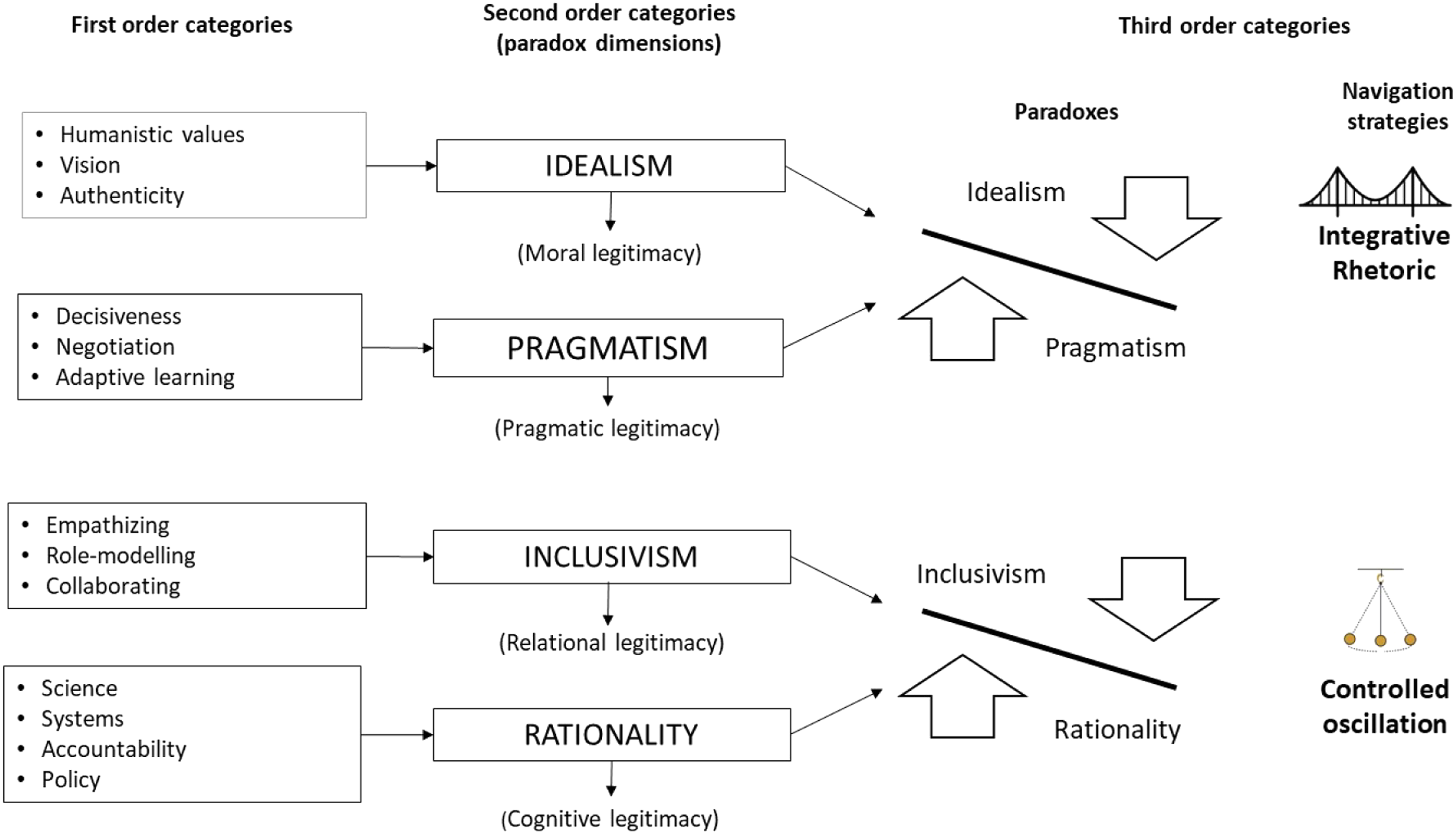
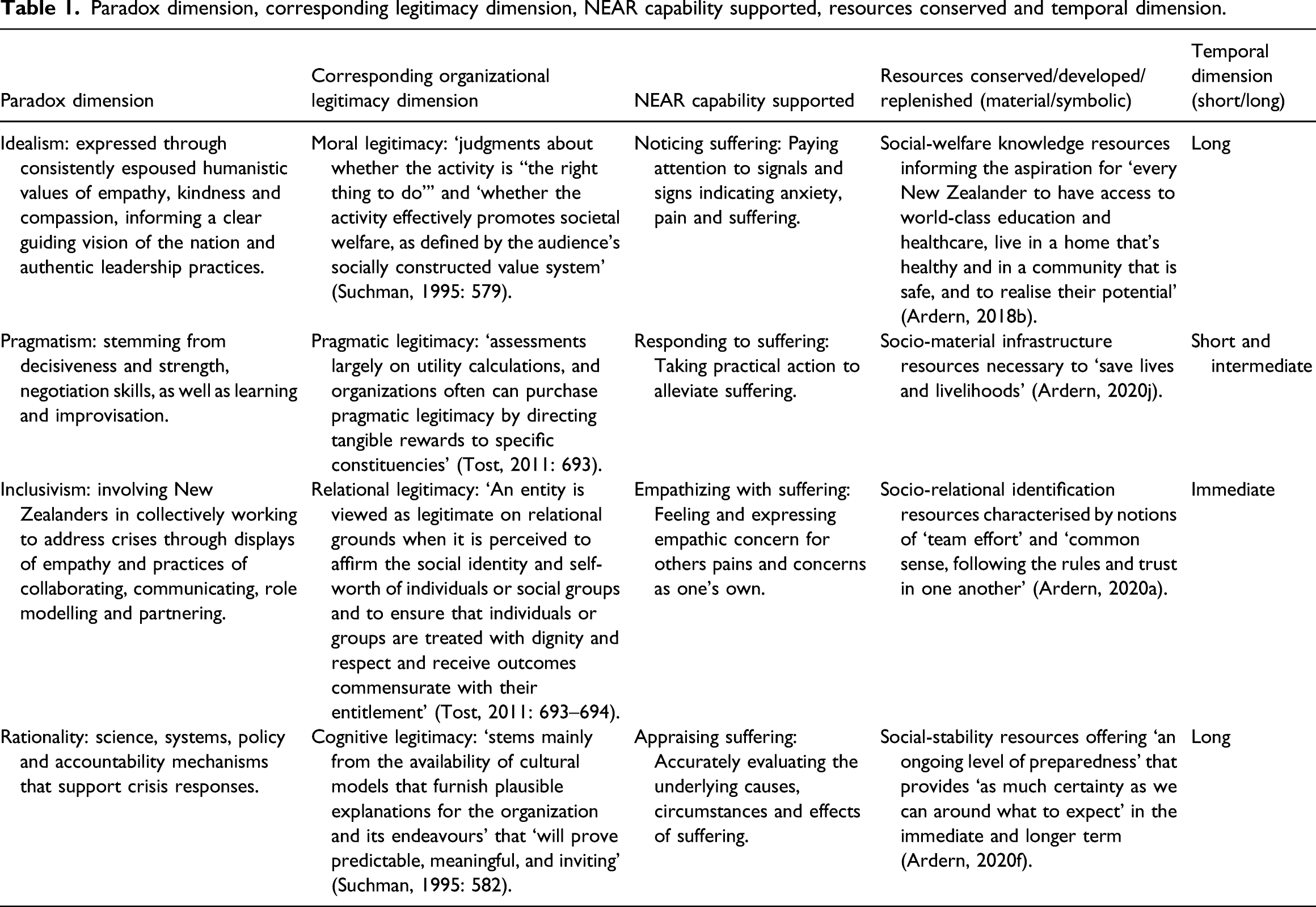
Paradox dimension, corresponding legitimacy dimension, NEAR capability supported, resources conserved and temporal dimension.
First paradox dimensions: idealism and pragmatism
‘I am a pragmatic idealist. I will always strive for better. But I am pragmatic about how much time that sometimes takes’ (Ardern cited in Manhire, 2019). Ardern signifies a major paradox of compassionate leadership: the tension between idealism and pragmatism. Idealism is to be driven by ideals of justice, peace and wellbeing, rather than by practical considerations of efficiency in terms of productivity and finance. Pragmatism, on the other hand, is concerned with utility, evaluating beliefs, strategies and theories in terms of how they might be efficiently implemented (Tost, 2011). We consider how Ardern navigates these two poles through power steering using integrative rhetoric.
Idealism is foundational in Ardern’s leadership approach, expressed through humanistic values, vision and authenticity. It is associated with the humanistic values she espouses, arguing that: ‘Our societies must be compassionate and inclusive no matter what religion, race or gender’ (Ardern, 2019b). It informs her government’s planning ‘that represents our shared vision’ (emphasis added) ‘for a modern and prosperous New Zealand’, rooted in ‘concepts like compassion and kindness’ (Ardern, 2018b). It is expressed in the authenticity Ardern brings to her leadership by sharing rather than hiding her personal life, including the challenges of pregnancy and motherhood, to represent a rounded sense of herself as accessible and relatable (Jamet, 2019; Pullen and Vachhani, 2020).
We associate Ardern’s idealism with the moral legitimacy dimension, described by Suchman (1995: 579) as resting on the evaluator’s ‘judgments about whether the activity is “the right thing to do” and “whether the activity effectively promotes societal welfare, as defined by the audience’s socially constructed value system”’. As part of the compassion organizing process Ardern’s (2018b), idealism in noticing suffering informs plans for addressing ‘the future of work, climate change, social isolation and the long term impacts of poverty’ (noticing being the first of four elements in the NEAR compassion process). As a resource conservation process, the moral legitimacy Ardern’s idealism confers is deployed as plans to conserve and develop longer term social-welfare knowledge resources informing an aspiration for ‘every New Zealander to have access to world-class education and healthcare, live in a home that’s healthy and in a community that is safe, and to realise their potential’ (Ardern, 2018b).
Pragmatism is concerned with results, guided less by ideals and more by practicality, less by what ought to be and more by what can be. From a strictly idealistic perspective, pragmatism can be viewed as compromising values in the interests of expediency or convenience. From a pragmatic perspective, such idealism is, in the words of Voltaire, to ‘make the best the enemy of the good’. Ardern was initially elected prime minister in 2017, with commentators unclear which aspect of ‘pragmatic idealism’ would characterize her leadership (Mapp, 2017); her idealism was quickly seen to centre on pragmatism through attributes such as decisiveness, negotiation skills and adaptive learning. Pragmatic decisiveness is demonstrated, for example, in Ardern’s ‘go hard and go early elimination strategy’ (Ardern, 2020a), implemented after New Zealand had just 102 coronavirus cases (Ardern, 2020h), imposing one of the most comprehensive responses of any western-style democracy, one characterized by critics as ‘almost authoritarian’ (Richter, 2020), ‘Nanny State’ (McCarthy, 2020) and as ignoring ‘concerns that elements of the lockdown might have been illegal’ (Richter, 2020). Pragmatism also characterized her negotiation skills demonstrated in the aftermath of the Christchurch shooting in which 51 members of the Muslim community were murdered, with their shooting livestreamed by the perpetrator on Facebook (Ardern and Nash, 2019). Within just 6 days, she succeeded in steering New Zealand’s most significant gun control legislation in many decades through parliament, including a total ban on semi-automatic weapons. Adaptive learning is another expression of Ardern’s pragmatism, seen, for example, in the development of her government’s coronavirus strategy from the initial response. Initially its stated objective was to ‘slow down COVID-19’ (announced on 12 March 2020) (Ardern, 2020g), to ‘spread the cases, and flatten the curve’ (announced on 14 March) (Ardern, 2020d). With the introduction of an alert level system, the new objective became ‘eliminate’ or ‘stop the virus in its tracks’ (Ardern, 2020e) (announced on 23 March). Later, as alert levels came down, Ardern confirmed the country’s ‘strategy for responding to the COVID-19 pandemic remains elimination’ (Ardern, 2020f) (announced on 14 July).
Discussing pragmatism as a legitimacy dimension, Suchman (1995: 585) observes the following: ‘Audiences base pragmatic assessments largely on utility calculations, and organizations often can purchase pragmatic legitimacy by directing tangible rewards to specific constituencies’. There is a close family resemblance between pragmatic legitimacy and Tost’s (2011: 693) instrumental legitimacy, related to an entity’s perceived ‘efficiency, utility and effectiveness’. In the context of the compassion organizing process, Ardern’s pragmatism has been helpful in taking decisive action in response to human suffering (responding being the fourth and final element in the NEAR compassion process). As a resource building-conserving process, Ardern deploys the legitimacy conferred by her pragmatism in creating and maintaining socio-material infrastructure resources necessary to ‘save New Zealanders’ lives and prevent the very worst’ (Ardern, 2020k) in the immediate term, eventually also allowing the country to ‘save lives and livelihoods by opening up our economy sooner’ (Ardern, 2020j) in the intermediate term.
Ardern bridges tensions of idealism and pragmatism through rhetoric used as a steering strategy. Rhetoric is ‘the conscious, deliberate and efficient use of persuasion to bring about attitudinal or behavioural change’ (Cheney et al., 2004: 84). Rhetoric is a valuable resource for leaders because ‘it can persuade organizational members that there are links between goals that they already value and goals that might otherwise be seen as divergent from their interests’ (Jarzabkowski and Sillince, 2007: 1659). Especially in her use of social media, Jacinda Ardern is masterful in ‘rhetorical blending: epidemiology brightened with empathy, law leavened with mom jokes’ (Cave, 2020: n.p.). Arden’s ‘constructive’ use of rhetoric, aimed at reconciling contrasting needs, is clearly distinguishable from that of other political leaders, such as the 45th President of the United States. Trump’s use of rhetoric was characterized by negativity (attacking, vilifying and de-legitimizing opponents) (Ross and Caldwell, 2020) while Ardern’s use of rhetoric as a discursive device for accommodating opposed polarities (Bednarek et al., 2017) is exemplified by her State of Emergency announcement. The announcement was accompanied by an appeal for New Zealander’s to ‘stay home, break the chain of transmission, and save lives’ (Ardern, 2020i). Wilson (2020) considers this appeal a crisis communication masterclass in that it not only communicates meaning but also purpose. By presenting the pragmatic requirement for a lockdown not as an imposition on individual freedom, but as a collective endeavour to safeguard public health, Arden’s account avoided tension between individual and collective interests.
Second paradox dimensions: inclusiveness and rationality
Ardern’s (2019c) use of phrases such as ‘compassionate domestic policies’ (emphasis added) indicates a leadership approach committed to heart and head, inclusion and rationality [a tension famously highlighted in Thomas Jefferson’s ‘Dialogue between my heart and head’ (Jefferson and Cosway, 1999)]. For the heart, Ardern emphasizes an emotional-relational theme of ‘inclusion, compassion, and empathy’ (Ardern, 2019a). For the head, she demonstrates a commitment rationality emphasizing ‘the important role that science plays in informing our policy decisions, and the crucial role that accurate science communication plays’ (Ardern, 2019d). Starting with inclusiveness, we next consider how Ardern navigates, steers through and integrates each of these poles.
Inclusiveness, conceptualized by Nembhard and Edmondson (2006) as ‘attempts by leaders to include others in discussions and decisions in which their voices and perspectives might otherwise be absent’ (p. 947), is a prominent feature of Ardern’s leadership approach, demonstrated in her practices of empathizing, role-modelling and collaborating. An example that encapsulates these three practices, early in the Coronavirus crisis. Ardern announced that as a way of ‘showing leadership’ and as ‘an acknowledgement that every person and organization has a part to play as we unite to stamp out COVID-19 and save lives’ she, her ministers and public service chief executives would ‘take a 20per cent pay cut over the next six months’ (Ardern, 2020b). Ardern’s inclusiveness through collaborating is exemplified by her appeals to New Zealanders during her COVID-19 announcements stressing, ‘We’re in this together and must unite against COVID-19’ (Ardern, 2020h), or her repeatedly referring to the nation as ‘a team-of-five-million’ (Ardern, 2020a, 2020c).
We associate Ardern’s inclusiveness with Tost’s (2011) relational legitimacy dimension, which he describes as arising when an entity ‘is perceived to affirm the social identity and self-worth of individuals or social groups’ ensuring they are ‘treated with dignity and respect and receive outcomes commensurate with their entitlement’ (pp. 693–694). In the context of the compassion organizing process, Ardern’s inclusiveness provides empathy for those who suffer (empathy being the second of four elements in the NEAR compassion process). As a resource conservation process, the relational legitimacy conferred by Ardern’s inclusiveness is deployed through efforts to conserve, create and replenish immediate term communal socio-relational identification resources, that she characterizes as a ‘team effort’ of ‘common sense, following the rules and trust in one another’ (Ardern, 2020a).
Rationality concerns that which is plausible and predicable. Leadership driven by high aspirations of idealism and social inclusivity is sometimes accused of lacking rationality in the face of social facts. Empowered by follower support and cultish idolatry (Vance, 2020), the dark side (Fragouli, 2018) of charismatic leadership can override due process and rational science by giving credence to impulses and ideology (Maak and Pless, 2006). Ardern represents a form of charismatic leadership that is idealistic, legitimate and committed to rationality. Rationality is seen in Ardern’s (2020f) commitment to ‘be guided by science’ (italics added) through the pandemic and maintain strong relationships with New Zealand’s scientific body (Wilson, 2020; Maak and Pless, 2006). It is seen in her implementation of effective systems, such as investing in the latest genomic sequencing advances to establish a world leading contact tracing regime (Geoghegan et al., 2020). It is seen in measures of accountability, such as establishing a Parliamentary Epidemic Response Committee, purposefully created with a majority of opposition members and chaired by the leader of the opposition, to scrutinize and report to parliament on the Government’s epidemic management (Ladley, 2020). Within the context of addressing longer term issues of social inequality and poverty, rationality is also seen in the policy framework of a ‘wellbeing budget’ requiring any government funded project to demonstrate a contribution towards improving New Zealander’s lives, a framework that has supported ‘extending paid parental leave, closing the gender pay gap and raising the minimum wage’ (Ardern, 2018b).
We associate the rationality Ardern brings to her leadership with Suchman’s (1995: 582) cognitive legitimacy dimension, which ‘stems mainly from the availability of cultural models that furnish plausible explanations for the organization and its endeavors’ and ‘prove predictable, meaningful, and inviting’. As part of the compassion organizing process, Ardern accurately appraises critical situations (appraising being the third, rationality informed, factor in the four-part NEAR compassion process), such as the need for border control and lockdown during the pandemic. As a resource conservation process, Ardern has deployed rational-cognitive legitimacy in conserving and building social-stability resources through ‘an ongoing level of preparedness’ offering ‘as much certainty as we can around what to expect’ in the immediate and longer term on account of ‘implementing a plan that works’ (Ardern, 2020f).
In responding to issues, Ardern uses a strategy of power steering that manages the dynamic opposition between inclusiveness and rationality through careful oscillation. The oscillation is between actions aimed at affirming a logic of technical rationality (represented by the primacy of scientific advice and compliance with bureaucratic policies ensuring accountability and standardizable action) and action aimed at acknowledging and empathizing with individual suffering. Oscillation between poles is acknowledged in the paradox literature as a viable strategy for balancing multiple logics (Smets et al., 2015; Tuckermann, 2019). It is controlled through formal structures, stakeholder relationships and leadership expertise acting as ‘guardrails’ limiting the extremes in oscillations (Smith and Besharov, 2019).
Discussion
The findings of this paper indicate that compassionate leadership, as a social process, is more complex and paradoxical than it is usually represented in literature, suggesting that compassion buffers (Kanov et al., 2004) and replenishes the strain on resources (Kahn, 1993; Scott et al., 1995; Barsade and O’Neill, 2014) that become exhausted and cause suffering during crises (Hobfoll and Freedy, 2017). Our analysis has identified Ardern as integrating the four NEAR organizational compassion subprocesses in her leadership through paradoxical behaviours that generate legitimacy in addressing suffering through resource conservation and replenishing efforts. Her compassionate response is dependent on follower legitimization that, in a leader-member-exchange process, reinforces her ability to conserve and replenish resources to alleviate followers’ distress. The power of her compassionate leadership response is in the interaction between paradoxes (represented by the dotted lines and two black boxes linking the two paradoxes in Figure 2). Through this interaction, legitimacy and material resources are reinforced in a positive resource exchange spiral. Ardern steers a path through these paradoxical dimensions using integrative rhetoric and controlled oscillation (at the centre inside the dotted line at the top and bottom of Figure 2). She thus cultivates her legitimacy with enhanced follower trust, recognition and acceptance of her policies. In exchange, followers gain a sense of identification, moral support and belonging as non-material resources. She further builds follower consensus and increases followers’ strategic scope in exchange for practical material resources of support, synergies and collaboration. These interdependent relationships help both leaders and followers embrace and manage paradoxical tensions. Doing so enables conserving and developing of material resources of social welfare knowledge, socio-material infrastructure, socio-relational identification and social-stability to address suffering. The positive cycle represented in Figure 2 is further described below. Positive cycles generated by compassionate leadership as paradox management.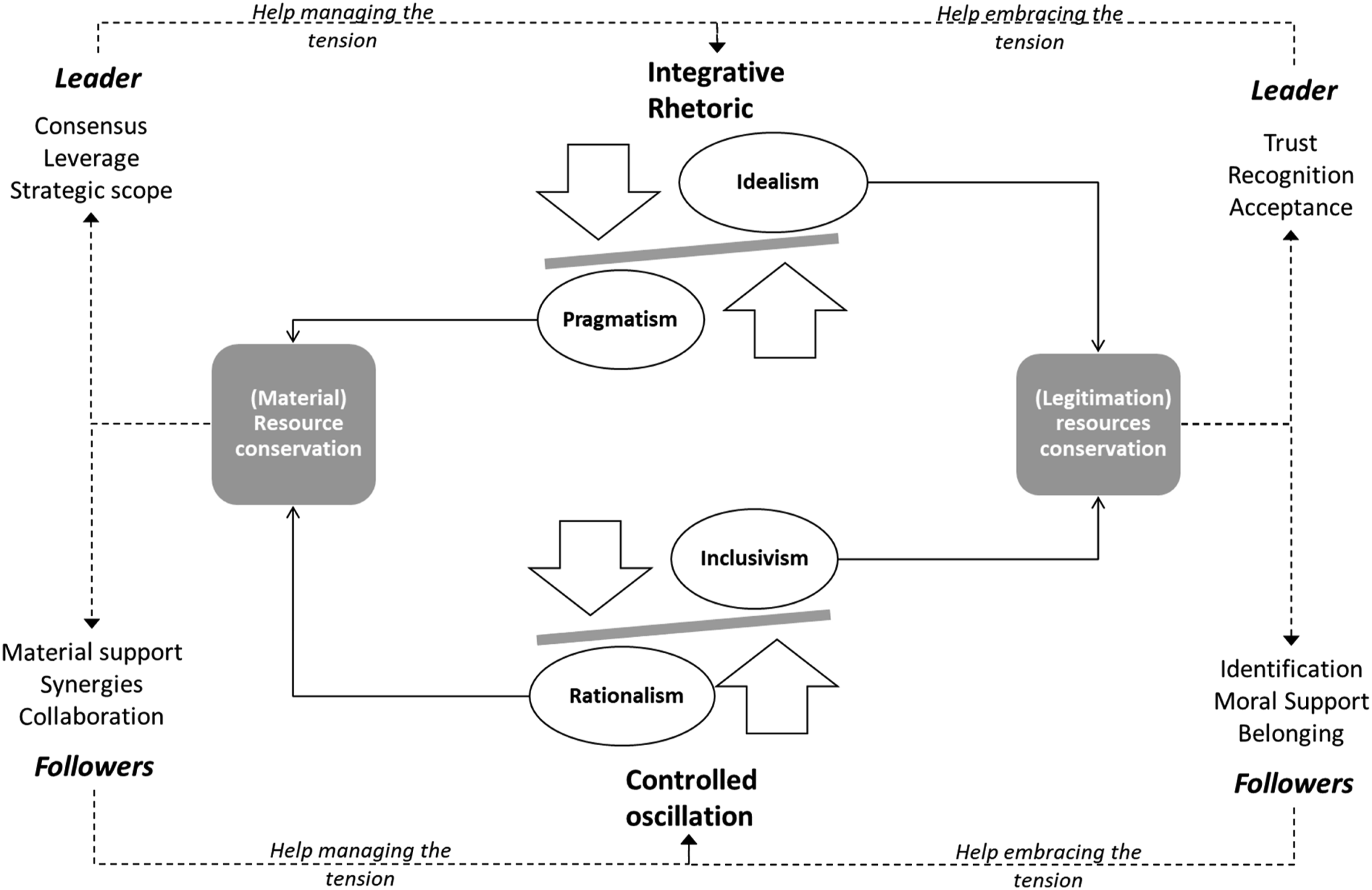
The exercise of compassionate leadership is practiced initially by attending to the four elements of the NEAR model. These elements require the leaders’ decisions to be accorded legitimacy. Doing so implies simultaneously adopting strategies in support of humanistic ideals, practical needs, inclusivity and rationality. Being a compassionate leader is not a box ticking exercise that attends to elements in isolation. Whereas a contingency approach would treat these elements as a ‘tool kit’ of competencies to be employed in different situations, the compassionate leadership approach exemplified by Ardern engages all dimensions concurrently, an approach requiring a consummate mastery of ensuing tensions.
While there is no apparent conflict between the need for conserving/replenishing legitimation and material resources, different logics underpin these two elements. Legitimacy is not a property, a stable condition but a socially constructed outcome emerging from the active participation of multiple agents (Suddaby et al., 2017). Conserving legitimation resources requires promoting a common identity and values, which for Ardern are principles of idealism and inclusivism. Doing this is coherent with a value-based rationality, ‘determined by conscious belief in the value for its own sake’ (Weber, 1922 [1978]: 24–25). By contrast, conserving material resource implies a different logic, aligned with what Weber (1922 [1978]: 24) defines as ‘instrumental rationality’, concerned with the choice of efficient means ‘for the attainment of the actor’s own rationally pursued and calculated ends’. Tension emerges in the relation between specific demands deriving from idealism versus pragmatism and rationalism versus inclusivism. Integrative rhetoric is used to steer a course through the former paradoxical tension by reframing the relationship between the opposing elements, to show that, in a broader context, the contradiction can be transcended (Bednarek et al., 2017). A course is steered through the latter paradoxical tension by means of controlled oscillation between the two poles. These power steering strategies are complemented and supported by a virtuous circle that results from processes of communicative action that strive to build broad mutual understanding what is required to reach agreement on the value of the goals (Habermas, 1984, 1989). The leaders' desire for consensus and trust resonates with the material support provided, amplifying the citizenry’s sense of identity in a coordinated fashion.
The process of communicative action is dynamic. Leaders invest resources in legitimacy-building actions and followers attribute legitimacy to the leader, supporting a broader resource conservation process (Breevaart et al., 2014; Gutermann et al., 2017). The process replenishes itself by investing ‘resources to gain resources’ (Halbesleben et al., 2014: 1337), providing protection from resource loss or boosting recovery from its occurrence. In this regard, compassion plays a specific role in the dynamics of legitimation. Different aspects of Ardern’s steering strategy (inclusiveness, rationality, idealism and pragmatism) resonate with various recognized legitimacy dimensions (relational, cognitive, moral and pragmatic). Each of these strategies/dimensions can be further aligned with the capabilities required for organizational compassion (Simpson et al., 2020) and resource conservation/generation.
Success in conserving resources provides slack for innovation, affording more scope and material support for strategic collaboration in improving follower conditions. Attention to optimization and efficiency is balanced by communicating symbolic action that combines inclusivism and idealism in doing so. Positive outcomes accrue from this process both for the leader in gaining in trust, recognition and acceptance as well as for followers’ identification and sense of moral community. Together, resource conservation and symbolically communicating belonging to an ethically holistic community are strategies that manage the paradoxical tension between inclusivism and rationality and between pragmatism and idealism.
Engaging idealism, pragmatism, inclusiveness and rationality concurrently generates paradoxical tensions underpinned by divergent but interdependent logics. Those paradoxical tensions that cannot simply be defused can be strategically steered through compassionate leadership (Smith and Lewis, 2011, 2012). Having an abundance of resources softens the impact of paradoxes (Miron-Spektor et al., 2018) and sustains strategic agency (Berti and Simpson, 2021a, 2021b). Belonging to an inclusive and supportive community facilitates acceptance of the legitimacy of power steering (Keller et al., 2020; Pradies et al., 2020). Consequently, the maintenance of a dynamic balance between inclusivism and rationality and between pragmatism and idealism becomes an essential source of resource stability and regeneration for the wider community. In concert, the dimensions generate legitimacy, starting from moral, followed by relational, cognitive and pragmatic dimensions. In the process ‘legitimacy becomes more elusive to obtain and more difficult to manipulate, but it also becomes more subtle, more profound, and more self-sustaining, once established’ (Suchman, 1995: 585).
Limitations and future research
That Ardern uses mostly positive terms could be a limitation of data based almost entirely on Ardern’s official statements, albeit there is some cross-referencing to media reporting. A broader set of sources through interviews with Arden and those in her circuits of power may provide more critical data; typically these occur in biographies of departed rather than present leaders, with Robert Caro (1983, 1990, 2002, 2012) having set a benchmark that few will attain, even after years of devotion to their subject. The present study nonetheless has value as an account of a world leader’s consistent representation of compassionate leadership philosophy and practices that we have systematically analysed using the lenses of paradox theory, legitimacy theory and conservation of resources theory.
A consideration that behoves further investigation is whether Ardern’s specific configuration of legitimacy dimensions in the service of compassionate leadership is generalizable to other contexts. Authentic leader–follower alignment can lead to sub-optimal decisions and some compassionate responses may have counterproductive effects. For instance, Ardern’s COVID-19 elimination strategy could be criticized as isolationist rather than fostering a global pandemic elimination effort. Despite early successes and domestic popularity, had vaccines not been developed or proven ineffective and enduring cohabitation with the virus become a necessity, a lack of infection management experience would have been problematic. In posing as the protector of the island nation from external ‘pollution’, Ardern’s coronavirus policies could be construed as not dissimilar to those of reactionary leaders asserting nationalism as a basis for sovereignty, except that her nationalism is broad and inclusive of all New Zealanders as her response the mosque murders demonstrated. Nonetheless, tensions between long- and short-term outcomes and local and global interests require consideration: an element of autarchy was required for consent from the community of a remote island nation. New Zealand’s island geography and its cultural profile operated as facilitators of Ardern’s stance in dealing with New Zealanders’ response to the threat of the coronavirus (Wilson, 2020; Windsor et al., 2020). It is possible that national culture and geographical idiosyncrasies are boundary conditions affecting how Ardern’s paradoxical compassionate leadership contributes towards conserving and building followers’ resources.
That additional paradoxes can underpin compassionate leadership should also be considered. In a Portugal based study relevant to organizational compassion, Araújo et al. (2019: 34) identified paradoxical tensions between considerations that were selfless and strategic, as well as individual and institutional, representing these as competing humanistic and institutional logics. Ideally, the former can be symbiotic with the latter in coordinating at a social-organizational level. There is always the risk, however, of the latter colonizing and eroding the former. At a leadership level, compassionate leaders may manage paradoxical tensions and ensure institutional logics support rather than supplant humanity, through inner reflective dialogic practices that valorize public communicative competencies. In Arden’s case, she balances unavoidable paradoxical tensions that emerge between idealism and pragmatism through bridging rhetoric, while meanwhile balancing tensions emergent between inclusiveness and rationality through steering by controlled oscillation.
Another relevant question is whether or not the heuristic model of compassionate leadership derived from this exploratory case bridges distinct leadership models that have evolved in human society (Van Vugt and Smith, 2019). One prominent model, signified as the dominance model, is premised on functional conflict resolution and inter-group competition through domination, power asymmetry, coercion and manipulation. Another model, referred to as the prestige model, is founded on character, expertise and inclusion, functionally oriented towards collective integration and collaboration. While apparently rooted in a prestige model, Ardern’s compassionate leadership also makes use of elements of dominance, using displays of determination and strength.
Conclusions
The case of Jacinda Ardern demonstrates the integration of compassion and leadership through practices of cultivating legitimacy dimensions paired as paradoxes: inclusiveness with rationality; idealism with pragmatism. Within each pair, it is the interaction between the respective dimensions, rather than their separate effects, that matter for building followers’ resources and addressing suffering. Legitimacy is consequently further reinforced in a positive spiral. In a resource exchange process, Ardern steers through paradoxical dimensions to conserve, build and replenish follower resources. These resources comprise socio-welfare knowledge, socio-material infrastructure, socio-relational identification and socio-stability, conferring hope and trust, health and wellbeing, basic wages and security, personal dignity and confidence in the government’s ability to deliver collective resources and address suffering during crises. In sum, what Ardern shows is that compassionate leadership (i.e., one who is kind, empathic, etc.) is supported through utilizing paradoxical legitimacy dimensions that build followers’ resources and alleviates their distresses.
Footnotes
Declaration of conflicting interests
The author(s) declared no potential conflicts of interest with respect to the research, authorship, and/or publication of this article.
Funding
The author(s) received no financial support for the research, authorship, and/or publication of this article.

Notes
Author Biographies