




Abstract
In research on process organization studies, the concept of multiplicity is widely used, but a fundamental confusion about what process multiplicity means persists. As a result, we miss some of the potential of this concept for understanding process dynamics and process change. In this paper, we define process multiplicity as a duality of ‘one’ and ‘many’, and we conceptualize ‘the many’ as a space of possible paths encompassed by a process. We use the notion of paths to operationalize process multiplicity and make it accessible for empirical research. When we see process as a multiplicity, process change can be understood as expanding, shifting or contracting the space of possible paths. We suggest that this concept of process multiplicity also has implications for a range of other theoretical and practical topics, including standards, standardization and flexibility as well as process replication, management and resilience.
Introduction
Multiplicity has become a foundational concept in process research (Khandker, 2017; Langley & Tsoukas, 2017). From any perspective, processual phenomena have a kaleidoscopic quality that belies any simple description. Cloutier and Langley (2020, p. 5) provide an elegant summary of the key idea: ‘the multiplicity of potentialities inherent to process theorizing can manifest itself as a burgeoning complexity of explicit alternate pathways that a process might take’. While the central idea of ‘alternate pathways’ seems clear enough, the term multiplicity is sometimes clouded with confusion and has been difficult to operationalize in empirical research. How many pathways are possible? Does it matter if there are more paths or fewer? Process theorists recognize that multiplicity is pervasive, but lack the tools to say how or why it matters.
A simple example helps to illustrate process multiplicity and the challenges to theorizing and analyzing it: a visit to a medical clinic. On the surface, a medical clinic looks quite simple. 1 When patients arrive, they check in at the front desk and sit in the waiting room. When their visits are complete, they check out. We have all checked-in and checked-out at medical clinics (as well as hotels, restaurants and other establishments). In any given visit, we experience one particular sequence of actions, i.e. a particular performance of the clinical process at that establishment. From theory and our own experience, we know that other performances are possible, but we can only guess how many. This creates a paradox: the clinical process is simultaneously one thing (a single sequence of actions) and many (possible paths).
This paradoxical tension between one process and many possible paths is a central concern in several streams of process research. For example, recent research on organizational change shows that when people try to change a process they encounter a vast number of possible ways to perform the process (Golden-Biddle, in press; Huising, 2019). This creates enormous practical complications for accomplishing change: how can we map the ‘as-is’ process within this vast space of possible paths? How can we create a new ‘to-be’ process? Similarly, research on organizational routines has shown that ‘routines exhibit a high degree of performance variation; i.e., each iteration of the routine differs from the previous one’ (Danner-Schröder & Geiger, 2016, p. 633). Birnholtz, Cohen and Hoch (2007, p. 316) describe this as ‘the paradox of the (n)ever changing world’: from one perspective, every performance is different; from an alternate perspective, it is all the same routine. Research on standardization and flexibility examines the way actors purposefully either limit variations in performances or try to increase them (Danner-Schröder & Geiger, 2016; LeBaron, Christianson, Garrett, & Ilan, 2016; Spee, Jarzabkowski, & Smets, 2016; Turner & Rindova, 2012). In these three streams of research the key challenge is how to theorize and conceptualize the relationship between one process and many possible paths and to examine empirically how participants accomplish variations and change.
Given the significance of process multiplicity as both a practical and an academic concern, it is important to develop tools that allow us to theorize and operationalize process multiplicity. Building on Cloutier and Langley’s (2020) notion of alternate pathways, we operationalize process multiplicity (as distinct from multiplicity of other phenomena) as a space of possible paths. We can identify this space of possible paths by analysing the sequential relations between actions in a process. In keeping with Cloutier and Langley (2020), we adopt an etic (outsiders) perspective, rather than an emic (insiders) perspective (Pike, 1967; see also Poole, Lambert, Murase, Asencio, & McDonald, 2017). Taking the example from the medical clinic: by looking at how checking-in is related to other actions such as sitting in the waiting room, going to the examination room and obtaining the patient history, and how these in turn are related to other actions in a patient visit, we can identify all the possible ways in which a patient visit can unfold.
The focus on relations between actions implies a relational perspective, where process is constituted from ‘dynamic, unfolding relations’ (Emirbayer, 1997, p. 281). These relations between actions within a process influence (but do not determine) what Tsoukas and Chia call the ‘patterned unfolding of human action’ (2002, p. 577). We operationalize this idea using Pentland and Feldman’s (2007) narrative network, which provides a way to summarize relations between actions in observed performances of a process. The space of possible paths results from the relations between actions that have been observed. Thus, the number of possible paths may be large but it is not infinite.
The essay is organized as follows. First, we briefly review existing concepts of multiplicity and show how process multiplicity needs to be understood as a distinct kind of multiplicity. Then, we work through the argument step by step: What is process multiplicity? How can we operationalize this idea in empirical research? How can we interpret a process as a space of possible paths? And how does multiplicity relate to process dynamics, such as organizational change, standardization and customization? At this stage, we have more questions than answers, but by providing a theoretical framework that can be operationalized in empirical research, we offer a promising way forward.
Multiplicity in Process Organization Studies
In process organization studies, scholars base the idea of multiplicity on the philosophy of Henri Bergson (1950) and Gilles Deleuze (Deleuze & Guattari, 1987) (Khandker, 2017; Robinson, 2017). Bergson (1950) suggests that multiplicity can be understood in a quantitative way and in a qualitative way (Khandker, 2017; Nayak, 2008). Quantitative multiplicity refers to measurable things and is numerical in nature (e.g. counting a herd of sheep). ‘It covers a multiplicity of parts which can be considered separately’ (Bergson, 1950, p. 76). Qualitative multiplicity, by contrast, is ‘a self in which succeeding each other means melting into one another and forming an organic whole’ (Bergson, 1950, p. 128). As an example, Bergson (1950, p. 86) notes that the sounds of bells are typically not counted, but they are experienced in relation to one another in a way that creates a ‘qualitative impression produced by the whole series’. In other words, the sounds of each bell relate to each other and hereby form a coherent whole that is different from a simple aggregation of the sounds. While a quantitative multiplicity foregrounds things as discrete entities, a qualitative multiplicity foregrounds how these things relate to form a distinctive whole. Although Bergson (1950) did not use Emirbayer’s (1997) distinction between relational and substantial ontology, it seems clear that quantitative multiplicity implies a substantialist ontology, where entities exist as discrete units. In contrast, qualitative multiplicity implies a relational ontology, where entities are defined through relations with other entities.
In organization studies, scholars have used the term multiplicity in both ways. Linstead and Pullen (2006, p. 1289), for instance, suggest that gender can be seen as a qualitative or ‘intensive multiplicity which looks at the different processes at work within an apparently integral body’. Similarly, Mol (2002) elaborates on multiplicity in a qualitative sense, when she explores the disease atherosclerosis. She shows how atherosclerosis is enacted differently from one place, apparatus and treatment to the next and yet these different enactments of ‘atherosclerosis’ are made to cohere as one disease. Building on Deleuze and Guattari (1987), Linstead and Thanem (2007) argue that the ‘multiplicity of organization’ is inherently qualitative and ‘irreducible to numbers’ (p. 1485). More frequently, however, multiplicity is used in a quantitative sense, as a synonym for ‘several’ or ‘many’. For example, in their analysis of global standards for coffee, Reinecke, Manning and von Hagen (2012) refer to a multiplicity of standards. Denis, Lamothe and Langley (2001, p. 825) talk about pluralistic organizations as ‘settings in which a multiplicity of actors and groups pursue varying goals’. This variation in the usage of the term multiplicity can be confusing at first, but it is easily understood once it is pointed out.
The question is how these ideas can be applied to processual phenomena, like visits to a medical clinic. In a typical outpatient clinic, there is a multiplicity of staff: doctors, nurses, technicians and administrators. The staff treat a multiplicity of patients for a multiplicity of diseases. These are examples of quantitative multiplicity a la Bergson (1950). However, they refer to things (e.g. people, diseases) in a process, rather than the multiplicity of the process itself as a whole. We can consider the multiplicity of the process in a quantitative way, as well. For example, we can count the number of visits to the clinic, or the number of visits that include a specific action, such as a biopsy. Quantitative multiplicity is easy to count, code and compare. It is important because it can help us understand resource utilization and efficiency. However, counting staff, patients and visits provides only limited insights into the ‘alternate pathways that a process might take’ (Cloutier & Langley, 2020, p. 5; emphasis added), which are essential to the idea of process multiplicity that we develop in this paper.
To see the possible paths that the process might take, we need to apply a relational perspective (Emirbayer, 1997) to the sequences of action that make up the process. For example, the clinical process consists of observing, testing, treating, taking notes, questioning, explaining, and so on. Each visit to the clinic unfolds through the sequential relationships of these doings and sayings. The relations between actions are (re)produced as each performance of the clinical process unfolds. We cannot simply count the doings and sayings because the process depends on how they are related. Nor can we limit ourselves to the relations between actions in a particular visit because visits can unfold in many ways. Process multiplicity requires a new way of seeing the process as a whole.
‘Seeing’ process multiplicity: An eye-opening move
Two recent studies of organizational change processes illustrate why it is important to be able to ‘see’ the space of possible paths and why we need a relational perspective to do so. The studies highlight that when we look closely at process multiplicity, the results can be eye-opening. For example, Huising’s (2019) study of process mapping teams provides a detailed account of the difficulties involved in grappling with multiplicity. Huising (2019) studied six teams that engaged in process mapping in the context of business process redesign. The teams consisted of practitioners who were familiar with the processes they were supposed to map and redesign. They ‘traced the entire string of activities involved in building a product, processing a claim, or attracting and retaining a client’ (Huising, 2019, p. 1065). Mapping the possible ways in which these processes could unfold had a profound impact on the practitioners involved. They came to see that the process that they had perceived as rigid and inert was constituted through a myriad of actions and paths. As Huising (2019, p. 1068) describes, these team members shifted from understanding the [. . . process] as a planned object, naturalized and existing independent of their participation, to understand it as an emergent process, constructed and constituted through their daily actions. Observing the [. . . process] as continuously in the making gave employees an overwhelming sense of possibility, sparking ambition [. . .] Once they could see the ‘what’ [i.e., the process] as a dynamic social creation, they could begin asking better questions about ‘how’.
In other words, seeing the multiplicity and its space of possible paths problematized the taken-for-grantedness of the process and opened up possibilities for change.
In another example, Golden-Biddle (in press) describes a similar case where members of a large hospital wanted to map the process of inpatient medical care. When they encountered the possible paths by which inpatient medical care could unfold, many of which they saw as inefficient and undesirable, they became motivated to imagine radically new paths for delivering medical care. More specifically, they imagined paths that were suitable to deliver ‘collaborative care’, which focused on the needs of patients and ensured that staff worked as a team to accomplish this. For instance, they imagined and enacted a new path in which a team of three, including a physician, a nurse and a clinical expert, would meet side-by-side with the patient and their family in real time, instead of each of them visiting the patient individually. Here, as in Huising (2019), shifting the attention from the one (process) to the many (paths) led practitioners to see the process as a space of possible paths rather than a fixed, inert thing.
Defining and Conceptualizing Process Multiplicity
To grasp process multiplicity, we are faced with a conceptual and operational challenge. Cloutier and Langley (2020, p. 5) frame the problem nicely: ‘how does one do this [i.e., capturing process multiplicity] when the possible contingencies and counterfactuals, each orienting towards an alternate pathway, are (at least in principle) infinite?’ In this section, we define process multiplicity and the space of possible paths. We show how a relational perspective can be applied to understand process multiplicity.
A duality of one and many
We start from the observation that a process, i.e. a set of sequentially related actions that unfold over time, has the potential to unfold in many different ways. As Tsoukas and Chia say, process emerges from a ‘flow of possibilities’ (2002, p. 572). In contrast, the common definition of a process implies that it is a singular sequence: ‘a series of actions or steps taken in order to achieve a particular end’ (Stevenson, 2010, p. 1415). This view aligns well with the general tendency to treat processes as ‘black boxes’ (Pentland & Feldman, 2005; Sydow, Schreyögg, & Koch, 2009), and with the ‘one best way’ that characterizes scientific management (Taylor, 1911) and its many descendants. To address this apparent paradox of ‘one’ process and ‘many’ possible paths, we define process multiplicity as a duality of one and many. When a patient visits the clinic there are many possible paths along which the process (i.e. the one) could unfold. Following Deleuze and Guattari (1987), we use multiplicity as a noun, not an adjective (‘every process is a multiplicity’, not ‘every process has multiplicity’).
The space of possible paths
The claim that a process is a duality of one and many leads to the question how we can conceptualize ‘the many’. Cloutier and Langley (2020, p. 5) note that ‘the multiplicity of potentialities inherent to process theorizing can manifest itself as a burgeoning complexity of explicit alternate pathways that a process might take’. We refer to these ‘explicit alternate pathways’ as the space of possible paths in a process. The space of possible paths is related to the idea of equifinality (von Bertalanffy, 1968) because it implies that there may be many ways to accomplish the same outcome. A possible path has an intuitive, practical interpretation: it represents a possible way to get something done.
Paths across a meadow are a suitable metaphor to characterize the space of possible paths. As people walk across the meadow (i.e. perform the process), paths emerge. Some of these paths may become more beaten than others, because more people follow them. Over time, other paths might vanish as the grass fills in the unused areas. People might be inclined to follow existing paths rather than making new paths. Depending on the situation, however, they could still cross the meadow and not follow a path. When two paths cross, the crossing offers four different ways to get across the meadow. If there are more intersections, there are many more possible paths.
This metaphor helps illustrate four key conceptual issues in our approach. First, it highlights the difference between a performance and a path. In this metaphor, a performance consists of a specific person walking across the meadow at a specific time. It corresponds to what Feldman and Pentland (2003) refer to as the ‘performative’ aspect of a routine. A performance is a particular enactment of a possible path. A path is a possible sequence of actions of how a process could unfold. 2
Second, it highlights the difference between a possible path and an actualized path. On a meadow with several intersecting paths, there will be many possible ways to proceed. Each intersection presents a choice of how to proceed and these choices multiply across the field. Some of these paths will be followed frequently, others may never be followed.
Third, it illustrates the idea that what has happened in the past carries potential for what can happen in the future (Hernes, 2008; Whitehead, 1978). Paths form as people cross the meadow and paths guide future crossings. The paths are an ongoing, dynamic product of the performances and vice versa. Goh and Pentland (2019) suggest that this can be interpreted as patterning (Feldman, 2016).
Finally, the metaphor illustrates the basic duality that defines process multiplicity. The one exists as ‘crossing the meadow’. The many exist in the possible ways of crossing the meadow via the network of paths. Together, the one and the many coexist as a duality.
A relational view of process multiplicity
The space of possible paths depends on what actions are taken and how they relate. There are many kinds of relations (e.g. temporality, spatiality, meaning), but in this essay we focus exclusively on sequence. Sequence is essential to narrative, process, time and temporality. Sequence generates process and vice versa. We build on Emirbayer’s (1997) idea that sequences of actions can be seen as dynamic, unfolding relations between actions. In processual phenomena, sequence is an essential relation: not just what happens, but what happened before and what happens next? In every process, sequence marks the progression of actions. In some processes, sequence changes the meaning of prior actions (e.g. birth before marriage vs. marriage before birth). For instance, in handoffs between shifts in an intensive care unit, LeBaron et al. (2016) show that the sequence of what is said (and not said) can be informative.
The medical clinic provides many examples where sequential relations affect how the process unfolds. For example, upon taking vital signs, the nurse might send the patient to the emergency room. Or, a patient might complain about an itchy spot, but the physician may see it as a symptom of a more severe condition. Even in these simple cases, two distinct things are happening, both of which depend on sequence. First, because of something that happens, the process takes a turn. Going forward, the next actions will be different. Second, looking backward, prior actions take on a new significance. The actions already enacted can look different in light of current actions. This kind of retrospective/prospective flexibility is an essential temporal aspect of agency (Emirbayer & Mische, 1998), sensemaking (Weick, 1995) and narrative (Kaplan & Orlikowski, 2013). Clearly, relationality shapes each performance of the clinical process. The question is how relationality shapes the whole clinical process as a space of possible paths (as a multiplicity).
To show how we can move from quantitative process multiplicity that merely counts visits to a clinic to a relational understanding of process multiplicity that gives us insights into the space of possible paths, we start from the substantialist perspective. From this perspective, performances of a process are substances with variable properties (e.g. duration or cost). Sequences of actions are seen as self-subsistent entities that come pre-formed (Emirbayer, 1997). We visualize this perspective in Figure 1, where each row (i.e. grey arrow) represents a performance of the process. Each performance is composed of actions (i.e. white boxes), but the sequential relations among these actions need not be considered because each performance is seen as a complete, self-contained, individual case. As described earlier, this perspective is useful to understand resource utilization and efficiency.

Process multiplicity from a substantialist perspective.
A first step towards a relational perspective views the constituent actions in relation to other actions. In any sequential phenomenon, actions are related over time, as suggested in Figure 2 – the labelled boxes represent different kinds of actions (e.g. move patient to examination room, take blood pressure). As discussed above, actions are affected by what came before and what comes next. The same actions in a different sequential order can have a different meaning (LeBaron et al., 2016). Figure 2 helps to clarify the distinction between paths and performances mentioned above. It depicts four performances of a process, but performances 1 and 3 include the same sequence of actions, so they enact the same path. Thus, Figure 2 depicts four performances and three paths.

Sequential relations between actions within performances: four performances and three paths.
However, even though Figure 2 considers sequential relations between actions, it still treats each performance of the process as a self-contained, independent case. In other words, it takes a relational view on actions, but a substantialist view on performances. Also, it takes the performance as the unit of analysis rather than taking the whole process as the unit of analysis.
To make the move from performances to the whole space of possible paths, we need to take another step towards a relational perspective. Rather than asking ‘what happens next’ within a particular performance, we can ask ‘what could happen next’ in a set of performances. For example, in one visit to the medical clinic, ‘check-in at front desk’ is followed by ‘sit in the waiting room’. In another visit, if the clinic is not busy or the patient’s symptoms are sufficiently severe, ‘check-in at front desk’ may be followed by ‘go to examination room’. If you look at a single performance, you don’t see that both of these possible paths exist. By considering the process as a whole, we can identify the paths that actually occurred (as shown in Figure 2), but also the paths that could occur (Pentland & Feldman, 2007).
Note that possible paths do not imply that performances are given or predetermined. Actors perform actions one step at a time. By performing the next action, they continuously shape the possible paths along which the process could unfold. In doing so, they expand or contract the space of possible paths. They may follow an existing path or branch onto a new one. There may be many ways to arrive at a particular situation and many ways to proceed. And in a medical clinic, there are usually several overlapping performances happening at the same time. There are several patients in the waiting room and one patient in each examination room. What happens in one examination room can influence the possibilities in other examination rooms. Each time a physician or nurse leaves one examination room and enters another, they entangle the performance of one patient visit with another. The idea that each visit to the medical clinic is a single, self-contained case does not stand up to scrutiny. In practice, the clinic functions as a whole.
A relational perspective on process provides the foundation for seeing the process as a network of sequentially related actions, as shown in Figure 3. In this view, each action in a process can be related to multiple other actions. The actions are not self-contained or independent; the significance of each action emerges from its relationship to other actions. The full significance of what has just happened may not yet be understood, because future actions have not yet taken place. When we treat performances as self-contained, individual cases, we see a limited set of possible paths (Figure 2). When we consider sequential relations in the process as a whole, we see the entire space of possible paths (Figure 3).

Related actions in a set of performances can generate many possible paths.
The medical clinic can help illustrate why relationality is like rocket fuel for process multiplicity. At each step in a performance, there are alternative actions that could happen next and therefore many possible paths how a process could unfold. For example, after the physician conducts the physical examination, several actions can happen next: discuss the diagnosis and treatment plan, mark spots on the patient’s body for biopsy, enter data in the medical records system, and so on. Because each action creates the context for subsequent actions, each choice cascades through the entire network of actions. The cumulative effect is exponential because the number of possible paths is multiplied at each step. There are over a hundred steps in a typical visit. As a result, as we demonstrate below, a simple clinical process can encompass a vast number of possible paths.
Operationalizing Process Multiplicity
While process multiplicity is regarded as a foundational concept, it has been difficult to operationalize in empirical research. A key challenge is how to use empirical evidence about actual paths to make inferences about possible paths. In this section, we show how process multiplicity can be operationalized and used in empirical research by drawing on interview data from an outpatient dermatology clinic at the University of Rochester Medical Center (URMC) (Ryan Wolf et al., 2019). We elaborate potential pitfalls when operationalizing process multiplicity.
Before proceeding, we summarize our terminology and introduce the terms we use for operationalizing these concepts in empirical research. Table 1 shows key theoretical concepts and corresponding terms for operationalizing them, as needed. Connecting concepts to indicators provides a way to bring process multiplicity into empirical research.
Definition of key concepts used in the paper.

Estimating the space of possible paths
If we see every process as a space of possible paths, it makes sense to ask if that space is large or small. Some processes may have a handful of possible paths, while other processes may have billions. Ryan Wolf et al. (2019) found substantial differences in the space of possible paths among the different dermatology clinics at URMC. These differences in the spaces of possible paths appeared to result from differences in clinic organization and management. Likewise, clinics that perform orthopedic surgery have many more possible paths than dermatology clinics. As we discuss below, the number of possible paths may have consequences for a variety of organizational processes and outcomes.
To estimate the number of paths, we use a narrative network, which operationalizes the set of actions and relations between actions in a process (Pentland & Feldman, 2007). Narrative networks are well suited for this purpose because they summarize relations between actions in a collection of process performances. A narrative network is a weighted, directed graph where the nodes represent categories of actions and the edges represent sequential relations between those actions (Pentland, Recker, & Wyner, 2017). In colloquial terms, it is a kind of flow diagram; in technical terms, it is a ‘directly follows graph’ (van der Aalst, 2019, p. 321) because it shows which actions directly follow other actions. It provides a snapshot of how actions in a process are related sequentially in a particular window of time (e.g. a day or a week). 3
Table 2 shows a fragment of the coded interview data used to construct the narrative network for the dermatology clinic (shown in Figure 4). The interview protocol was intended to elicit narrative descriptions of typical visits (‘Describe a patient visit’) and variations (‘What else can happen?’). The result is a detailed narrative description of what happens during the visit. The actions described in Table 2 become the nodes of the network. The sequential relations between the actions in Table 2 become the edges of the network. For example, in Table 2, ‘obtains patient history’ is followed directly by ‘performs physical examination’.
Fragment of one patient visit.

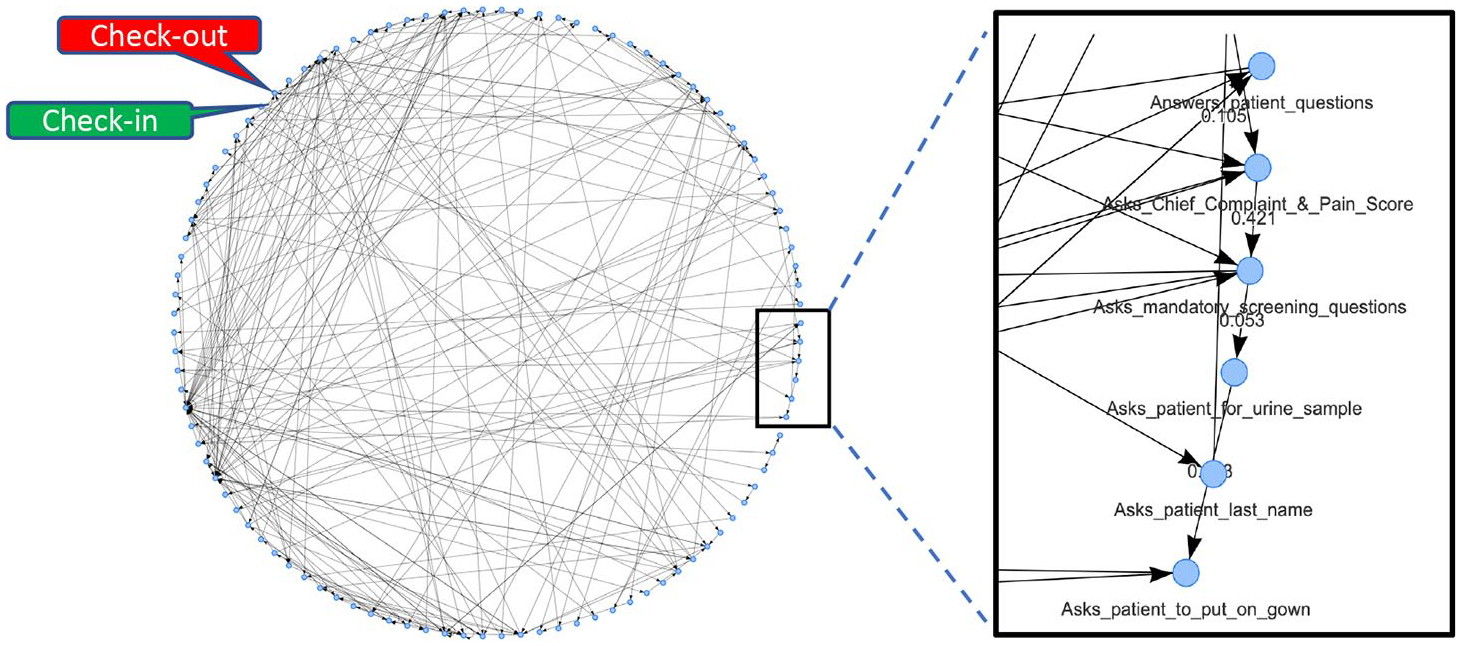
Narrative network for patient visits.
The particular fragment shown in Table 2 is from the point of view of a physician describing a typical visit. From the point of view of each role (office staff, nurse, resident, physician), Pentland et al. (2019) found that only a portion of the possible paths are visible. This is because of division of labour in the clinic. The office staff perform a different set of tasks than the nurses, the residents, or the physicians, so they see a different portion of the overall process. Naturally, this suggests an important limitation on operationalizing process multiplicity, as we discuss below.
Figure 4 shows a narrative network that describes patient visits to one dermatology clinic at URMC, the Highland clinic. To get a more complete view of the space of possible paths, we aggregated data from four different points of view: office staff, nurses, residents and physicians. In Figure 4, there is a direct sequential relation between each pair of actions observed or recorded in the data. To construct the full network, one simply counts up all sequentially related pairs of actions in the data.
Figure 4 presents a distinctly etic view (Pike, 1967) because it shows the space of possible paths in a way that none of the participants could perceive or describe. The data for a narrative network can be collected through any means that provides sequentially related actions (observation, interview and archival methods are all feasible). As in the examples from Huising (2019) and Golden-Biddle (in press), the network combines data from multiple points of view.
If we were to examine Figure 4 closely, we would see that at each moment in a patient visit, there are typically a small number of actions that happened next (ranging from 1 to 5). 4 In other words, at any point in time, while caring for a patient, the providers identified a handful of subsequent typical actions. In principle, other actions are possible, but in practice, there is a small set of specific actions that they typically perform next. As the process unfolds, each action transforms the situation and a new set of ‘next actions’ becomes relevant. As visits proceed from one action to the next, the number of possible paths multiplies. In order to get a picture of the overall process – the whole space of possible paths – we need a systematic way to aggregate these paths, as shown in Figure 4. This figure embodies the same logic as Figure 3, but with real data.
We can use this network to estimate the number of possible paths from check-in to check-out. Visually, you can imagine tracing through the network and counting each distinct path. Each path you trace would represent the story of a possible patient visit. Rather than counting by hand, we use the methodology described by Goh and Pentland (2019) to estimate a total of about 17 billion (1.7 × 10¹⁰) possible paths.
The fact that a dermatology clinic has billions of possible paths suggests that the space of possible paths can be surprisingly large. Of course, the space of possible paths contains many performances that may never be actualized. Like a language, there are many sentences that may never be written or spoken. Further, many of the paths are inconsequential variations. While the number can be large, it is not infinite because it is restricted to paths where each step from one action to the next was actually observed or described as possible in the data. If the performances either observed or described as possible are very similar, the space of possible paths will be quite small. In the limiting case, there may be a single path across a meadow or no paths at all. The number of possible paths is an empirical question.
Accuracy of estimating the space of possible paths
It would be a mistake to think of this estimate as a precise measure of the space of possible paths and we do not claim that it is. At best, it is an estimate. There are several important factors that contribute to making this estimate and they should be considered when interpreting what it means. These factors may result in overestimating or underestimating the space of possible paths.
Visibility
If you cannot observe parts of a process, you will underestimate the space of possible paths. For example, if your access to a process includes only the typical cases (so that exceptions and workarounds are not visible), you will underestimate. Moreover, you might miss actions if you only take specific points of view into consideration (e.g. only the office staff), instead of trying to get a holistic view on the process from multiple points of view.
Granularity
When you zoom out, everything looks the same: a visit is a visit. When you zoom in, there is more variety. The closer you look, the more variety you see. For example, on one level of granularity ‘checking-in to the clinic’ is one action. Zooming in would reveal many actions that constitute checking in, such as taking the patient number, confirming the appointment, updating patient data and so forth. Zooming in increases the number of actions and relations, which can have a tremendous effect on the number of paths. Therefore, when making comparisons, we need to keep the same coding scheme for all cases being compared (Pentland, 2003).
Aggregation
If you look at one performance, you see one path. In the hypothetical case where there is a single, fixed path, gathering data on one process performance would be enough. In more typical situations, where there is variation in performances, you need to include multiple performances to avoid underestimating the space of possible paths. Also, as you vary the time window (day, week, month, year), you may get a very different picture, especially if the process is changing.
Hidden constraints
This method for estimating paths assumes that actions in the distant past (at the start of the performance) do not influence what happens next in specific situations. This corresponds to the Markovian assumption that history is carried into the current moment (Abbott, 1990). However, if an action at one point in the process can influence (or determine) actions at some distant point in the process, then this method would tend to overestimate the space of possible paths.
Organizational forgetting
It is also important to consider that actions or sequential relations between actions that happened in the distant past may not be included in the space of possible paths anymore, because they have been dropped from normal practice or ‘forgotten’ by the organization (de Holan & Phillips, 2004). Counting paths that no longer occur would lead to an overestimation of the space of possible paths. It is best to think of the estimate as a snapshot of a process at a particular point in time, that is, at best, stable-for-now (Goh & Pentland, 2019).
Novelty
There is always a possibility for new technology, new rules, new assumptions or other sources of novelty that change the set of available actions or change the sequential relations between actions. This means adding or removing nodes and edges to or from the network, which will change the number of paths. Adding a new mode of treatment in the clinic adds a new action with new relations to other actions, which generates new paths. Not considering new actions can lead to an underestimation of the space of possible paths.
Noise
In most processes, there is the possibility of repetition, rework, back-tracking, shortcuts, workarounds, exceptions, improvisations and errors, all of which contribute to paths. These may be considered legitimate parts of a process, but there may also be errors or omissions in data recording.
Comparing Process Multiplicity
We know that process multiplicity is pervasive. By definition, every process is a multiplicity. Further, some spaces of possible paths are larger than others. By analogy, some meadows have a single direct path; other meadows have a criss-crossing maze of paths. The methodology we have outlined here provides a way to compare the space of possible paths so that we can begin to theorize about its role in processual phenomena, such as stability, change, flexibility and standardization. Comparisons are likely to be interesting, because the space of possible paths can vary by many orders of magnitude, even within the same process in different time frames. For example, Goh and Pentland (2019) found that the number of possible paths in an agile software development project varied dramatically over a period of weeks.
We envision two broad types of comparison that should be useful for theory building. First, we might want to compare a single process over time, as in Goh and Pentland (2019). Is the space of possible paths expanding or contracting? Are there peaks or turning points? For example, Dooley and Van de Ven (2017) hypothesize the existence of cycles of divergence and convergence in innovation processes. To the extent that such cycles exist, we might expect to see periods where the space of possible paths expands (i.e. divergence) followed by periods where it contracts (i.e. convergence).
Second, we might want to conduct cross-sectional comparisons of different processes (e.g. clinical processes in dermatology vs. other medical specialties). For example, one clinic may have a much larger space of possible paths than others. With sufficient data, these analyses could be carried out as quantitative studies to investigate the antecedents and consequences of process multiplicity. However, in making any comparison, it is important to be mindful of factors that influence the apparent number of possible paths. To the extent possible, visibility, granularity, aggregation and other factors need to be held constant so that the comparison is meaningful.
Discussion
Process multiplicity has been hiding in plain sight. It was always there, but it has been hard to see. Taking a relational perspective allows us to see it better, by moving from counting performances to estimating the space of possible paths. This move can be interpreted in terms of figure–ground perception. In the absence of a clear way to conceptualize process multiplicity, we focus on the one (the figure). By defining process multiplicity as a duality of ‘one’ and ‘many’ and showing how ‘the many’ can be conceptualized and operationalized, we offer a way to see both the figure and the ground, and reversing our perception to be able to see ‘the many’ (the ground), i.e. the space of possible paths. In this section, we articulate implications of bringing process multiplicity into focus.
Process multiplicity and process dynamics
Figure 5 shows the dynamic mechanism that generates process multiplicity. It illustrates that the space of possible paths is larger than the actual performances. As actors perform a process, they enact a part of the space of possible paths (see arrow ‘performing’ in Figure 5). The space of possible paths is shaped through patterning (Danner-Schröder & Geiger, 2016; Feldman, 2016; Turner & Rindova, 2018) or ‘the formation of new paths and the dissolution of old paths’ (Goh & Pentland, 2019, p. 1901). Patterning is exemplified by the process of people crossing the meadow and forming new paths or reinforcing existing paths. Depending on how the process is performed, patterning can expand or contract the space of possible paths. Novel performances (outside the current space of possible paths) can add new actions and relate actions in new ways, thereby adding new paths and expanding the space of possible paths. Also, over time, actions and relations could be forgotten or restricted, which will contract the space of possible paths. Likewise, managerial intervention or technological change can shape the space of possible paths.

The working mechanisms of a process multiplicity.
Discovering possible paths not (yet) taken
In a typical process, some paths are frequently taken, some paths are rarely taken and some paths are never taken, yet we include them all in our space of possible paths. This is clearly a heretical choice. Orthodox statistical thinking should limit us to the central tendencies and most probable paths. Likewise, orthodox process management should limit us to the most common variants and enforce conformance to the most desirable variants (Rosa, van der Aalst, Dumas, & Milani, 2017). While central tendencies are a useful tool for some problems, they fail to capture the duality that defines process multiplicity. To grasp a process as a whole, attention needs to be on the whole space of possible paths, not just the dominant few. From that perspective, rare paths and the paths not (yet) taken are extremely important.
Why do rare paths and paths not yet taken matter? First, they help us to reimagine the process. If we pay attention to what ‘could be’ we start envisioning an alternative version of a process that has not occurred yet, which then could become a motor for change. For example, Golden-Biddle (in press) and Huising (2019) both show how paying attention to the space of possible paths helped to see the process anew. In current American politics, calls to ‘defund the police’ have a similar quality. We always had these actions (i.e. taking money away from one department and reinvesting it in other departments) available in funding public services, but now we are asking how we can use this path in a new way. If there were no space of possible paths, we could not come up with alternatives. Research on organizational change is oftentimes concerned with how to remove barriers to change, in particular, resistance from employees and managers (Huy, Corley, & Kraatz, 2014; Sonenshein, 2010), but we argue that it is equally important to focus on possible paths. Feldman and Sengupta (2020) contrast the logic of probability with the logic of possibility and similar to us suggest that the art of management, particularly of public policies and programmes where ‘wicked problems’ abound, often requires us to think in terms of the possible rather than the probable. As a consequence, rather than removing barriers we can begin to create and expand possible paths.
Second, rare paths or paths not yet taken can have extremely significant consequences, especially in high reliability organizations. Research on high reliability organizations is concerned with this issue since the ‘name of the game is reacting to unexpected sequences of events’ (Roberts, 1990, p. 104). Paying attention to the space of possible paths enables organizations to learn from what is oftentimes considered ‘noise’ (Maslach, Branzei, Rerup, & Zbaracki, 2018). If we see a process as a space of possible paths, we can pay equal attention to more or less likely paths, rather than collapsing the process into a singular sequence or a small set of ‘most probable’ paths.
Process change: Expanding, contracting and replacing the space of possible paths
Focusing on the space of possible paths creates a new perspective on process change. When (re)designing a process, process designers often work with an idealized model that represents the process (Dumas, La Rosa, Mendling, & Reijers, 2018). Idealized models can be created by ‘mining’ or ‘mapping’ the existing (‘as-is’) process or by encoding managerial rules or policies about how the process should be performed. Idealized models are typically expressed with a process map that consists of boxes and arrows (Feldman, 2016).
Often, ‘changing a process’ means moving boxes and arrows in the idealized model/map. The model (the ‘one’) is rearranged in an effort to change the way the process unfolds in practice (‘the many’). Process maps provide a convenient shorthand, but the map is not the terrain. Research on organizational routines has long pointed out that the map does not determine the actions people take (Pentland & Feldman, 2008) and that people create many new performances in an effort to enact the new idealized model (e.g. Berente, Lyytinen, Yoo, & King, 2016; Bertels, Howard-Grenville, & Pek, 2016; Rerup & Feldman, 2011), some of which may conform with the process as designed or intended, some that deviate and some that produce unintended consequences.
While routine dynamics research has been very useful in showing how processes are generative systems in the interplay between the ‘one’ and actual performances, our conceptualization of process multiplicity takes this view one step further: it allows us to consider not only change in actual performances, but also changes in possible paths. Thus, we can ask how does the space of possible paths change when organizational members change the idealized model? And what are the mechanisms that drive this change? Because the space of possible paths changes exponentially, small changes in performances can lead to tremendous expansions or contractions in the space of possible paths. Thus, when participants perform a new workaround in an effort to enact the idealized model, this small change cascades through the entire network of actions and significantly increases the space of possible paths. These changes emerge as a result of enacted performance – the doings and sayings of people as they go about their work.
For example, consider the changes in the clinical process driven by the Covid-19 pandemic. During the initial ‘lockdown’ phase, most face-to-face patient visits were cancelled and replaced by video- or telephone-based telemedicine. Patients at URMC clinics could also upload digital images via a web portal. The ‘one’ process was thus rearranged to accommodate contactless patient visits. Even though the process now included one additional way to do patient visits, in practice a few new performances of video- and telephone-based patient visits resulted in many more possible paths. Over time, regular in-clinic visits resumed and the prevalence of telemedicine has started to decline. During each of these phases, the clinics were creating and enacting a shifting mix of possible paths.
The Covid pandemic is an extreme example, but it illustrates three different ways that the space of possible paths can change: expansion, contraction and replacement. First, when additional ways of performing a process emerge, the space of possible paths expands. An expansion in the space of possible paths means that more possible paths become available for performing the process (see arrow ‘performing’ in Figure 5). Hence, even with a simple change, such as adding a new way that patients can schedule a visit to the medical clinic, we should not be surprised that a host of new performances emerges in the process, and rather expect the emergence of performances that we did not envision before. Focusing on change in the space of possible paths helps to appreciate the generative potential of process, i.e. that a single new performance can lead to many new paths. Second, when paths are eliminated the space of possible paths contracts. Contraction, for instance, might happen when prior performances are forgotten (de Holan & Phillips, 2004) or forbidden, as in the case of face-to-face visits during the Covid-19 lockdown. Third, when old ways of performing a process are replaced by new paths, the space of possible paths changes but it does not become larger or smaller. This discussion indicates that the space of possible paths is not static, but can change from performance to performance. Each performance has the potential to expand or contract the space of possible paths or replace existing paths with new paths.
Standardization, flexibility and the space of possible paths
Standards and standardization are ubiquitous in organizational and social life (Brunsson, Rasche, & Seidl, 2012; Timmermans & Epstein, 2010). Much research has examined the standard-setting process (Brunsson & Jacobsson, 2000) as well as the implications of standards for organizations (Boiral, 2011, 2012). Reinecke et al. (2012) discuss the multiplicity of standards for sustainability in coffee production. They offer a detailed analysis of how a collection of standards undergoes a process of differentiation and convergence. While they describe standards as defining the ‘rules of the game’ (Reinecke et al., 2012, p. 791), they never engage the question we address here: given these standards, how many ways can the game be played? Or stated differently, how does this multiplicity of standards influence the multiplicity of the process?
Our conceptualization of process multiplicity also contributes to research on standardization and flexibility of the performances of a process (Danner-Schröder & Geiger, 2016; Spee et al., 2016; Turner & Rindova, 2012). This research has examined how participants balance competing pressures for standardization and flexibility and the actions they take and the artifacts they use to either standardize or flexibilize their performances. Prior research takes ‘the one’ as a point of reference for standardizing and flexibilizing: when actors standardize the process they enact ‘the one’, and when they flexibilize they deviate from ‘the one’ (Turner & Rindova, 2012).
In contrast, our conceptualization takes the space of possible paths as a point of reference. From this perspective, when actors standardize a process, they try to contract the space of possible paths. To make a process more flexible, they try to expand the space of possible paths. Danner-Schröder and Geiger (2016), for example, show the effort that is required to standardize the performance of aid processes in severe catastrophe settings, such as earthquakes or tsunamis. Through training, rescuers learn to actively suppress the possibility of immediately helping the victim rather than erecting the camp first, which ultimately enables them to help more people. Standardization implies the ‘suppress[ing of] possible irregularities and novelties’ (Danner-Schröder & Geiger, 2016, p. 645). In a similar way, flexibilizing requires effort in exploring and expanding the space of possible paths. Danner-Schröder and Geiger (2016) show how participants undertook training in selecting and recombining actions into new sequences, i.e. new possible paths.
Our conceptualization of process multiplicity suggests that because the space of possible paths dynamically expands and contracts as performances unfold, participants need to continuously adjust and calibrate standardizing and flexibilizing activities. From this perspective, standardization and flexibility can be understood as effortful and emergent accomplishments in shaping the space of possible paths.
Further examples of how process multiplicity matters
There are other theoretical and practical arenas where the number of possible paths seems likely to influence important outcomes. Assuming that the comparison is fair (e.g, same granularity, visibility, and so on), we expect that a process with few possible paths is different from a process with lots of possible paths. The size can differ by many orders of magnitude, so it can be like the difference between a gentle breeze and a tornado. It is hard to imagine that multiplicity is inconsequential, but we need empirical research to understand it better.
Process replication and standardization
Nelson and Winter (1982) define replication as the costly, time-consuming activity of copying an existing pattern of productive activity. We propose that a process with a larger space of possible paths will be more costly and time-consuming to replicate than a process with fewer possible paths. This hypothesis aligns with the D’Adderio (2014) argument that the multiplicity of performances makes routine transfer more difficult, particularly when one goal is to ‘copy exactly’ the pattern of action. Similarly, if the space of possible paths is large, it may be harder to standardize because there are many possible paths that have to be suppressed.
Process management
For the same reason that they are harder to replicate, processes with more possible paths will be harder to map, monitor and control. Decades-long practical experience with process management indicates that processes with more variations are more difficult to design, change and control than simple processes (Dumas et al., 2018). First, it is more difficult to map the existing (‘as-is’) process to determine what is happening and what is really important. For example, in the medical clinic, which of the possible paths need to be preserved? Then, when a new process is designed and put in place (‘to-be’), it is more difficult to monitor and control. When managers try to intervene in a process with more paths, they may be unable to grasp the full implications of their interventions a priori, leading to unanticipated effects. Or they might be unable to intervene at all because people use alternative paths when managers try to block or add specific paths.
Process resilience
While a large space of possible paths may make processes more difficult to replicate and control, a process with more possible paths should be more resilient to disruptions or exogenous shocks. In many kinds of systems, such as supply chain networks (Ivanov, Sokolov, & Dolgui, 2014), redundancy is a recognized source of resilience. A larger space of paths will have more redundant paths, which should minimize the single points of failure. If some paths are disrupted or blocked, there are many other alternatives to accomplish the same outcome.
Future research could use the conceptualization and operationalization of process multiplicity developed in this paper to examine the practical consequences of a larger or smaller space of possible paths for different organizational phenomena.
Conclusion
Multiplicity is a fundamental concept in process research, yet current research lacks clarity in how it can be conceptualized and operationalized. In this paper, we describe how multiplicity can be approached from a substantialist and a relational perspective. We focus on one type of multiplicity that arises from sequential relations between actions: process multiplicity. It inhabits literally everything that happens in organizations because nothing happens without process. We have made this ubiquitous phenomenon visible by providing concepts and methods for seeing the space of possible paths in every process. Now that we can see process multiplicity more clearly, we hope that future research will illuminate its significance for important topics, such as organizational change; standardization and flexibility; and process replication, management and resilience.
Footnotes
Funding
The author(s) disclosed receipt of the following financial support for the research, authorship, and/or publication of this article: This material is based upon work supported by the National Science Foundation under Grant No. SES- 1734237. Any opinions, findings, and conclusions or recommendations expressed in this material are those of the author(s) and do not necessarily reflect the views of the National Science Foundation. This research was also supported in part by University of Rochester CTSA (UL1 TR002001) from the National Center for Advancing Translational Sciences (NCATS) of the National Institutes of Health (NIH). The content is solely the responsibility of the authors and does not necessarily represent the official views of the National Institutes of Health.