




Abstract
The promotion of social innovations by non-profit and business organizations has gained increasing interest. Yet, there has been limited research on routines that organizations use to facilitate social innovations. This paper uses a dynamic capabilities framework to understand the microfoundations of dynamic capabilities for social innovation in small non-profit organizations. Through analysis of routines of 20 small organizations in five European metropolitan areas, the paper demonstrates that many microfoundation aspects resemble generic abilities of opportunity identification, alliancing, user engagement, networking, and organizational learning. However, their orientation toward public values requires incorporating commitments to social value and principles of ethics, responsibility, and sustainability, into different organizational processes. We suggest that social impact does not always require substantial investment and can be achievable through modest changes such as repurposing surplus resources. Building flexible routines that enable such incremental changes is a key element of organizational capability to adapt to changing contexts.
Keywords
In recent years, there has been growth in research attention to social innovations as mechanisms that can drive transformative change and address gaps in public value provision that are difficult to fill through conventional, market-oriented, innovation activity (Godin, 2012). Social innovations are generally understood as novel solutions to social problems that are more effective, efficient, or sustainable than existing formulations and that primarily generate public value (Phills Jr et al., 2008). It is argued that social innovations can address unmet social needs by establishing new institutions, practices, norms, and changing power relations among actors (Avelino et al., 2019; Cajaiba-Santana, 2014; Moulaert et al., 2014; von Jacobi et al., 2017). In the European context, social innovation is endorsed in strategic documents as innovations that will engage public, businesses and civil society sectors (European Commission, 2010). Numerous policy initiatives, including funding, prizes, networks, and incubators, have been developed to support social innovation (European Commission, 2022), although recent analysis demonstrates that these initiatives lack cross-national coherency in their understanding of who social innovators are and how they should be supported (Krlev et al., 2020).
Extant literature has begun to explore the roles of managerial capabilities and strategic decisions in facilitating social innovation processes in different organizations. As with other innovation forms, the processes of social innovation require capabilities related to organizational agility, resilience, and effective use of connections. For example, to identify opportunities for social innovations, organizations need to engage a wide range of stakeholders to understand and anticipate their needs (Herrera, 2015; Tabaklar et al., 2021). In turn, developing a social innovation involves realigning organizational resource bases, which requires an effective usage of organizational and personal social capital to acquire tangible and intangible resources (Cui et al., 2017; Le Ber & Branzei, 2010; Shier & Handy, 2016). Finally, organizational cultures that support novel ideas of employees facilitate creative processes and help to reimagine solutions to social problems (Shier et al., 2019; Vézina et al., 2019).
There is some existing research that investigates dynamic capabilities for social innovation in large hybrid and non-profit organizations (Altuna et al., 2015; Shier et al., 2019; Tabaklar et al., 2021; Taylor et al., 2020; Vézina et al., 2019). However, there has not yet been thorough investigation of routines that facilitate social innovation in smaller non-profit organizations, and whether these routines differ from larger organizations of the non-profit or other sectors. In addition, the specific organizational routines and processes that allow these organizations to identify and implement novel ways of delivering public value have not been fully examined.
We address this knowledge gap by investigating the microfoundations of dynamic capabilities associated with social innovation in organizations. We use Teece (2007) operationalization of dynamic capabilities as sensing, seizing, and transforming capabilities to understand how small organizations identify opportunities and implement social innovations. In particular, we investigate the microfoundations of dynamic capabilities, which are understood as specific skills (e.g., cognitive skills) and processes (e.g., building partnerships, managing knowledge) that underpin sensing, seizing and transforming capabilities (Helfat & Peteraf, 2015; Teece, 2007).
Using a combination of snowball and purposive sampling, we selected 20 micro and small non-profit organizations to explore specific skills, routines, and processes that facilitate social innovation. These organizations were selected from five metropolitan areas in Europe: Manchester (UK), Utrecht (Netherlands), Stockholm (Sweden), Sofia (Bulgaria), and Budapest (Hungary). The research defines relevant organizations in broad terms as formal and informal entities operating with a recognized name that engage in identifiable social innovation activities.
We contribute to the literature by demonstrating that the introduction of social innovations involves microfoundations specific and non-specific to social innovation. Non-specific microfoundations included capabilities described in the literature on commercial enterprises and service firms, such as understanding and acting on user’s needs using a variety of channels, adjusting organizational resources, stretching the focus of solutions to new target groups, and changing organizational status and cost of services. We show that dynamic capabilities specific to social innovation are based on the dedication of the managers to tackle issues of communities via developing flexible solutions that deliver long-term community spillovers.
Literature Review
Dynamic Capabilities Framework
Dynamic capabilities refer to hard-to-replicate capabilities that allow organizations to respond to changing external and internal conditions and gain performance-related benefits (Eisenhardt & Martin, 2000; Teece, 2018; Teece & Pisano, 1994; Wang & Ahmed, 2007; Winter, 2003; Zahra et al., 2006). The framework was introduced to study how manufacturing companies develop routines to sustain their competitive advantage. This framework has also been used to investigate the dynamic capabilities of firms in services which vary by organizational age and their diversity of organizational routines (Agarwal & Selen, 2009; den Hertog et al., 2010; Døving & Gooderham, 2008; Uner et al., 2020; Zahra et al., 2006; Zollo & Winter, 2002).
Teece's (2007) disaggregates dynamic capabilities into three groups: (1) sensing capabilities, associated with identifying and shaping opportunities; (2) seizing capabilities that allow organizations to quickly respond to the identified opportunities; and (3) transforming capabilities that allow organizational systems to stay aligned to the strategy and to avoid path dependences. In turn, sensing, seizing, and transforming capabilities are underpinned by different microfoundations—individual-level abilities, processes, and skills that help organizations to alter their resource bases and existing ordinary routines (Eisenhardt & Martin, 2000; Helfat & Peteraf, 2015).
The dynamic capabilities framework has been increasingly applied to study social value creation in business enterprises and strategic processes of public sector organizations. It has been demonstrated that underlying skills and processes of dynamic capabilities associated with social value and sustainable outcomes resemble microfoundations of “generic” (economic value-oriented) capabilities such as environmental scanning, alliancing, rapid decision-making, and developing new products and services. Significantly, an orientation toward non-economic goals results in more socially complex and multi-stakeholder dynamic capabilities that integrate capabilities deployed at individual, organizational, and ecosystem levels (De Silva et al., 2021; Khan et al., 2020; Kokshagina, 2021; Linde et al., 2021; Sermontyte-Baniule et al., 2022; Tiberius et al., 2021).
The process of sensing opportunities aimed at non-economic value largely relies on the individual-level capabilities of founders and senior managers, including their understanding (and ability to gain knowledge) of existing social and environmental issues and an ability to pursue risky opportunities (De Silva et al., 2021; Khan et al., 2020). In turn, strong organizational-level capabilities of building and governing relationships with cross-sector stakeholders facilitate the development of solutions that could effectively address the problems of different groups (Barrutia et al., 2022; Buzzao & Rizzi, 2021; Linde et al., 2021). Importantly, partnership reconfiguration and governance capabilities incentivize different stakeholders to work for a common good, which creates evolutionary system change (Linde et al., 2021).
Dynamic Capabilities and Social Innovation
Exploring how organizations build routines to develop social innovation raises the question of how contexts for social innovation differ from the contexts for conventional (market-oriented) innovation. Three points are relevant here. First, social innovation is not generally associated with market competitiveness since it primarily aims at generating public value (Jessop et al., 2014; Phills Jr et al., 2008). However, social innovation can lead to the creation of a competitive advantage. In business enterprises, it takes the form of new markets and methods of production (Herrera, 2015; Mirvis et al., 2016). In the non-profit sector, the implementation of social innovations, among other strategic mechanisms, could be used to compete for resources with organizations that provide similar services (Chew & Osborne, 2009).
Second, the social innovation process is a collaborative effort that can be carried out by paid workers and/or unpaid volunteers of organizations that may be operating in any sector—non-profit, for-profit, or government (Howaldt, Kaletka, et al., 2016; de Wit et al., 2019; Tanimoto, 2012). Therefore, capabilities associated with the effective use of social capital become crucial for social innovation process. To anticipate emerging social needs and seize opportunities for social innovation, organizations must develop capabilities of creating and maintaining relationships with a wide range of stakeholders such as employees, user communities, and organizations connected to those communities (Fassin et al., 2017; Herrera, 2015; Tabaklar et al., 2021).
Employees are essential stakeholders that contribute to the process of social innovation. Several studies point out that creating opportunities for staff of all levels to engage in social innovation is critical for developing impactful social innovation (Shier et al., 2019; Vézina et al., 2019). In this sense, abilities of senior managers to build trust-based relationships and navigate multiple partner logic becomes essential for creating routines that facilitate social innovation processes (Sanzo-Perez et al., 2015; Voltan & De Fuentes, 2016). In addition, the ability of executive leadership to transform organizational processes by creating opportunities for staff and user empowerment, self-expression, and cross-team collaboration helps to create a supportive environment for social innovation (Shier et al., 2019).
In the non-profit context, the process of building relationships is grounded in empathy, which facilitates learning and co-creating with different stakeholders and contributes to social innovation development (Taylor et al., 2020). Maintaining those relationships helps organizations adjust to highly dynamic contexts by quickly mobilizing relevant stakeholders and gaining access to financial and physical resources, knowledge, and learning opportunities (Tabaklar et al., 2021).
Third, social innovations are typically developed by micro and small organizations. A survey of 1,005 social innovation initiatives worldwide demonstrated that around two-thirds of the initiatives emerge in micro organizations of under five employees and small organizations of under 50 employees (Howaldt, Kaletka, et al., 2016). In this context, as the survey reports, the lack of resources (especially financial resources) within these smaller organizations becomes a key barrier in scaling up social innovation. However, the capabilities of linking and coordinating resource bases can lead to expanded social innovation initiatives that involve multiple partners (Cui et al., 2017). Bigger organizations could facilitate the social innovation process by transforming organizational structures via, for example, creating new organizational units dedicated to social innovation work (Altuna et al., 2015; Vézina et al., 2019). However, these transformations do not seem feasible for smaller organizations with few members of staff.
Overall, dynamic capabilities associated with social innovation, like those associated with social and environmental value creation by business enterprises, include generic and specific dynamic capabilities. However, compared to the dynamic capabilities of business enterprises, dynamic capabilities in the context of social innovation are not well explored yet. In particular, little is known about routines of smaller organizations since most of the existing research focuses on dynamic capabilities for social innovation in large organizations (Altuna et al., 2015; Tabaklar et al., 2021; Taylor et al., 2020; Vézina et al., 2019).
Research Design and Methods
To understand the microfoundations of dynamic capabilities associated with social innovation in small non-profit organizations, we used a qualitative case study approach (Hartley, 2004; Yin, 2009), using purposive and snowballing sampling methods to identify organizations for the study. The case studies draw on the analysis of qualitative data collected through face-to-face interviews and from supplementary data sources such as organizational websites. A qualitative methodology was chosen since it allowed retracing the development paths of social innovations from the stages of idea generation to fully-formed projects.
We started the selection process by identifying target locations among European cities. Europe was chosen as a target area for this research for practical reasons such as ease of travel, while minimizing language barriers also played a role in the selection process. We selected five cities—Manchester (UK), Utrecht (Netherlands), Stockholm (Sweden), Budapest (Hungary), and Sofia (Bulgaria)—which represented locations diverse in socio-economic terms and infrastructures for social innovation support. While recognizing the importance of broader social, economic, institutional, and political frameworks in the case study cities and countries, the present analysis focuses on internal organizational microfoundations to understand how organizations develop dynamic capabilities to operate within these contexts.
We used a combination of purposive and snowballing sampling in the following way. We first searched for organizations that satisfy the criteria outlined below via desk research—for example, using search engines, relevant online forums, lists of local non-profit organizations or social innovators, and searching for studies on social innovations in a specific area. We also looked for local experts who could help identify relevant organizations—for example, researchers and practitioners who worked in the areas of social entrepreneurship or social innovation.
We targeted micro and small non-profit organizations that developed at least one social innovation. “Organizations” are understood in broad terms as formal and informal entities with a recognized name that engage in diverse activities to promote social innovation. For example, an informal group A that runs monthly events on experimenting with technology, and an enterprise B that sells services, are considered relevant organizations. We understood “non-profit organizations” as non-business organizations that aim to achieve public benefit. These organizations could represent different operational sectors and legal forms, such as social enterprises, voluntary organizations, and informal community groups. However, as soon as they satisfied the criteria of being non-business organizations primarily aimed at creating public value, they were considered “non-profit.” This approach of considering a broader spectrum of organizations enabled us to investigate whether diverse social innovations have similar or different dynamic capabilities.
To identify social innovation initiatives, we drew on Phills Jr. et al. (2008, p. 36), who defined social innovations as “novel solutions to a social problem that is more effective, efficient, sustainable, or just than the existing solutions and for which the value created accrues primarily to society as a whole rather than private individuals.” We considered an initiative a novel solution if it was new for the target group it served and not necessarily for the world. The novelty of a solution was judged primarily on our understanding of the local context, which we formed through scoping reviews for each location. These reviews were based on reading previous studies on social innovation or non-profit activity in the selected areas and doing desk research on common social issues present in five cities. We also referred to organizational websites and other sources of information that could indicate a solution’s novelty and uniqueness.
We contacted candidate organizations by email to participate in interviews at the second step. One of the authors visited the five selected cities in January to May 2018 to conduct face-to-face interviews with the founders, directors, or managers of selected organizations. Interviewing one person (usually a founder or a manager) per organization was sufficient, given the small size of organizations. We chose face-to-face communication over phone or online interviews since it allowed us to observe the details of the operation and location of the initiatives, participate in activities, and interact with users, where possible. Supplementary data about organizations was collected through websites and other documentation before to the visits.
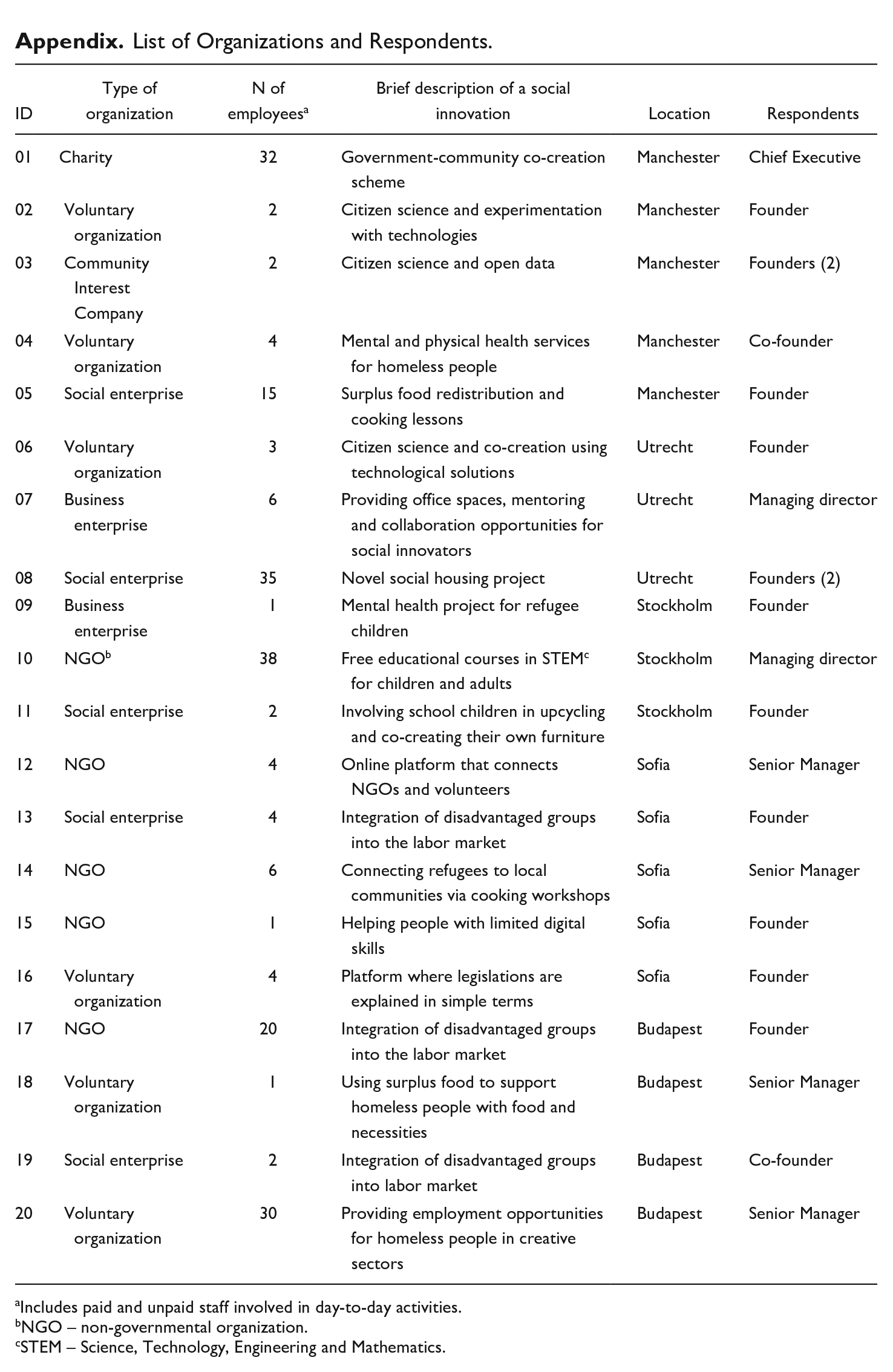
The final dataset included 20 small organizations (including informal grassroots groups) that innovated on social issues ranging from inclusion to sustainability. In the Results section, box brackets [ ] refer to the relevant organization’s identification number (the Appendix provides summary details of the organizations studied). Examples of social innovation developed by organizations include a drop-in service for homeless people where they can access quality food alongside a range of mental and physical health services [04], series of workshops that invite refugee and local mothers and children to cook and interact [14], or a program that integrates disadvantaged groups into the labor market by providing education and employment opportunities [19]. Due to country-specific variations, selected organizations had different legal forms such as charities, foundations, and voluntary organizations. All selected organizations were service sector organizations, and a few provided services bundled with products.
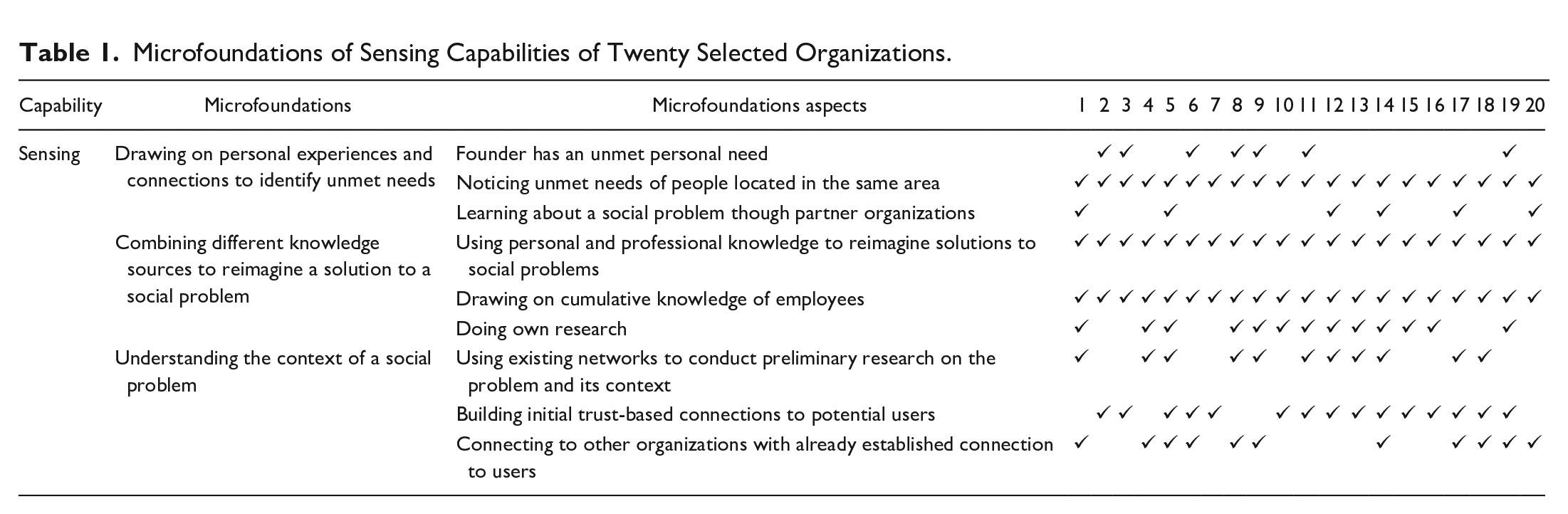
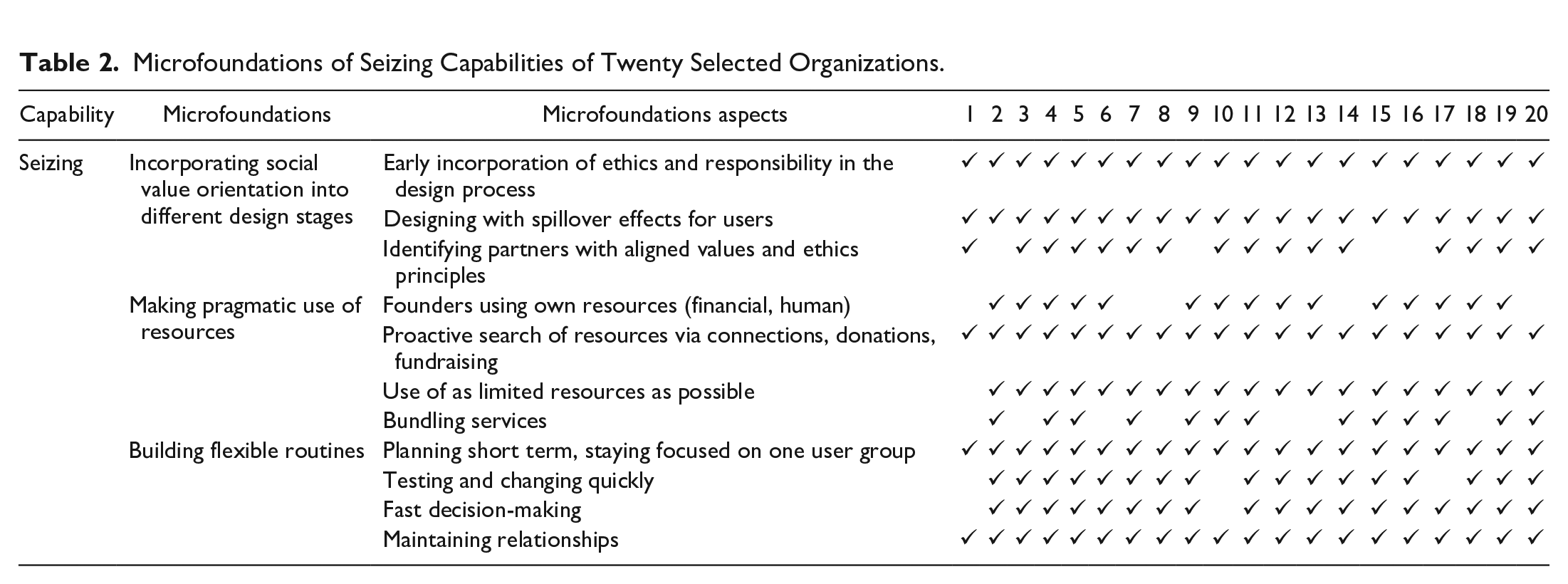
The interviewees were asked to describe the main stages in social innovation development and any skills, experiences, and associated routines that facilitated its development. During the interviews, we also asked the interviewees to nominate other organizations or people whom the researchers could contact. The interview data was supplemented with data gathered from the websites of the initiatives and similar sources, where possible. Collected data was analyzed using an inductive approach (Gioia et al., 2013). We first manually coded the interview data at a sentence and paragraph level, which resulted in 126 common themes. The resulting codes formed first-order concepts that describe specific processes, skills, or events associated with social innovation processes in organizations. First-order concepts were grouped into second-order concepts that represent broader groups of skills, activities, and routines that underpin social innovations. On the basis of this, second-order concepts were assigned to aggregate dimensions. In line with Teece (2007), we used sensing, seizing, and transforming capabilities as three overarching aggregate dimensions. Figure 1 presents the data structure and analysis framework used in the study, and Tables 1-3 demonstrate the breakdown of identified dynamic capabilities across selected organisations.
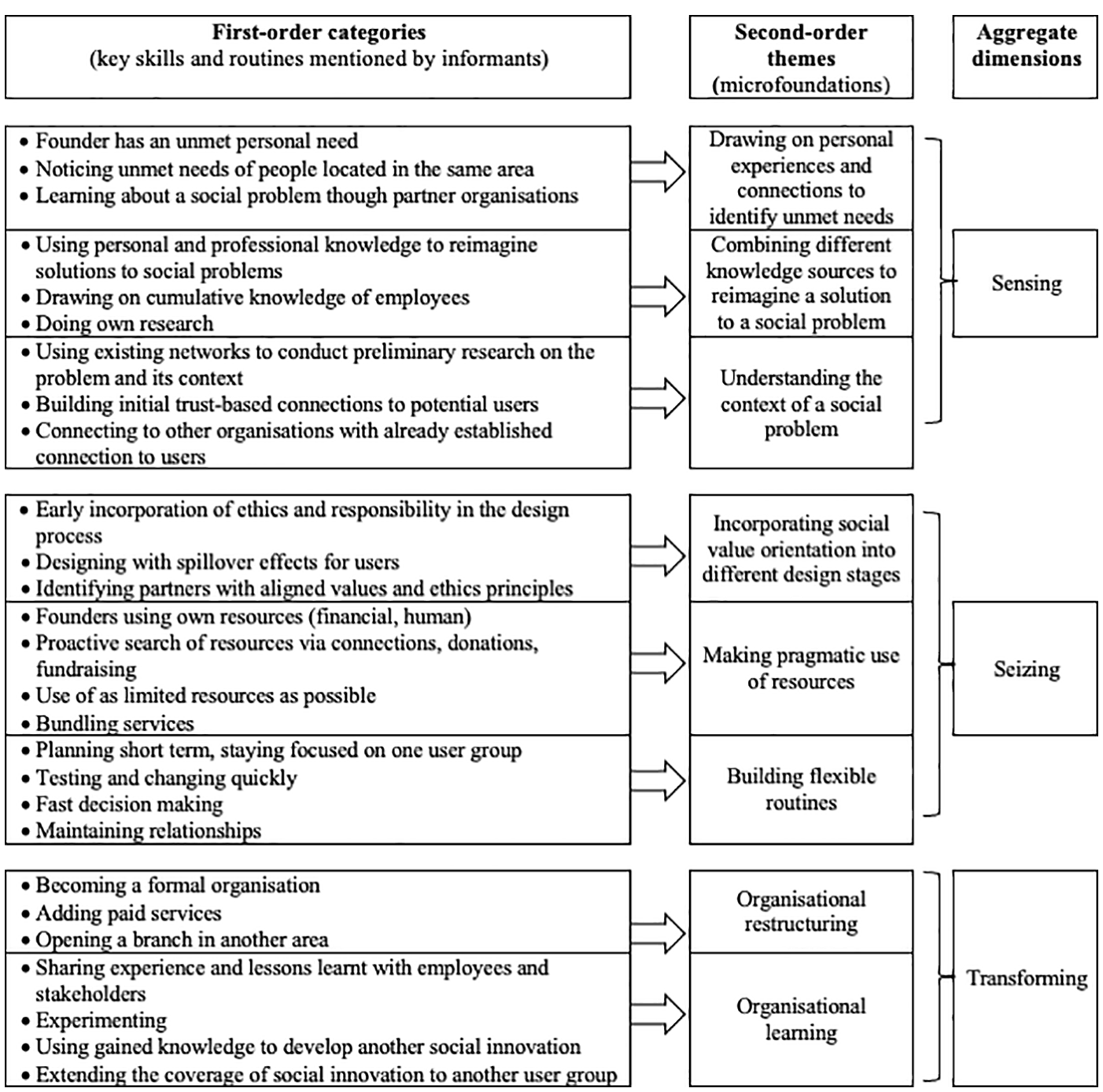
Data Structure.
Microfoundations of Sensing Capabilities of Twenty Selected Organizations.
Microfoundations of Seizing Capabilities of Twenty Selected Organizations.
Microfoundations of Transforming Capabilities of Twenty Selected Organizations.

Results
Sensing Capabilities
We identified three microfoundations of sensing capability: (a) drawing on personal experiences and connections to identify an unmet social need; (b) combining different sources of knowledge to reimagine solution to social problem; and (c) understanding the context of a social problem. Reliance on specific microfoundations to identify an opportunity for a social innovation depended on the pre-existing organizational knowledge of different social problems and connections with prospective users. In small organizations, “organizational” knowledge and connections are primarily represented by experiences, knowledge, and networks of the founders or senior managers.
In some cases, personal experiences of a social problem and an inability to find an accessible solution for it motivated founders or key decision-makers of an organization to identify an opportunity for social innovation. Identification of an opportunity was often a rapid process driven by feelings of anger, enthusiasm, passion, and a willingness to make a difference for people in a similar situation. Examples of such situations include two people being unable to find any communities involved in technology experimentation in Manchester [02], which led them to think about how they could create their own community. Another example is a refugee being unable to access mental health support in Stockholm [09], who used this as an opportunity to design an accessible mental health support tool. Interviewees described this process in the following way: I was angry. One of my kids came back home with a bleeding scratch from a nail from his school’s old sofa. I realised that the furniture had not changed since I was at school, and the schools did not have a budget to change it. I realised that I have three choices: to be a “troll” mom and criticise the system, to become a politician and work on what I believe in, or to start a business and work from the ground level and do something about it. That was what I was going to do because it is the most constructive way to bring actual change. So, I started to work on this project on my own. [11] We wanted to start something that will help people with autism. We have two children and one of them is autistic. It is so hard for them to find a job. [19]
Similarly, witnessing people struggle to find solutions to their problems motivated founders to make a difference for others. Finally, a few organizations identified the gaps in public service provision through experience working with disadvantaged communities or conversations with partners who pointed toward the unmet social needs of a specific group. Different organizations selected a specific social group to target in different ways. For example, founders with a personal connection to a social problem were determined from the start to make a difference for people suffering from a similar problem. Others made decisions based on observations (e.g., seeing homeless people on the street), media coverage (e.g., seeing articles about a specific social issue), conversations with friends and strangers (e.g., learning about a social issue from a close friend), or other unplanned events.
We found that organizations conducted different forms of research to understand the context of a social problem and the nature of alternative solutions that address it for a particular target group. Given the limited resources that organizations had, organizations conducted their own small-scale research through a range of conversations with field-based partners, knowledgeable individuals, or their target group. Many of the new organizations had first to establish connections to the target group and field-based partners; however, in some cases, the employees used relations built at their previous places of employment.
Organizations shaped identified opportunities using a combination of personal experiences, inter-disciplinary skills gained through formal education and professional experiences. Building on experiences gained elsewhere enabled some organizations to reimagine products or services. For example, while a group of friends in Manchester lacked the experience of working with homeless people, they used the experience of the hospitality industry to create an idea of a restaurant-like walk-in service where the homeless would be able to access food cooked in restaurants, as well as showers, toilets, and health care services. On the other hand, other projects used relevant knowledge to improve existing services. For example, following many requests from friends and family, a group of law students saw an opportunity to develop a website that explained legislation using simple language. In both examples, new organizations used diverse knowledge and experiences to develop new and reimagine existing services.
Seizing Capabilities
We identified three microfoundations of seizing dynamic capabilities: (a) incorporating social value orientation into different design stages, (b) making pragmatic use of resources, and (c) building flexible routines. Incorporating social value orientation into an innovation development implied that organizations prioritized the safety of prospective users and satisfaction of their needs over other aspects, for example the scale of the project. A common way to ensure that was to select partners to co-design or co-deliver a service based on similarities in values rather than exclusively (financial) resources. Selecting partners with similar values helps to ensure that the public value orientation of a social innovation was not dominated by the aims to create private value or serve political agendas. The selectivity in partnerships implied that organizations could decline some of the prospective partnerships despite the prospect of gaining resources. Partnership opportunities were declined if a potential connection could imply unethical practices, dishonesty, or harm to the target group or the organization delivering the project. Interviewees illustrated it in the following ways: From the beginning, we tried to avoid contacting the government and businesses [. . . because we did not fully believe that they would not compromise our mission]. We wanted to work at the grassroots level and partner with similar organisations. Our project is very trustworthy for people because they know that we do not have a state or business interest. [12] We are friends with a similar organisation located in another city, we talk to them often. That is a great thing about our field—there is no such thing as competition for clients but a common desire to help people instead. [14]
Organizations also developed processes to be able to design solutions with spillover effects. Spillover effects are the intended and unintended benefits delivered by organizations to communities beyond their primary activity of service provision. The ability to create spillover effects helped to strengthen user communities so that they could become more independent in sustaining themselves when a social innovation project ends. In addition, it helped to build or strengthen organizational reputation, trust, and networks, which organizations used to access resources and knowledge. Maintaining relationships with the users also enabled organizations to engage them in the design process and address aspects of social problems which are difficult to uncover via formal research.
Another important underlying process of seizing capabilities was making pragmatic use of resources. Due to their smaller size, funding opportunities were often not available for organizations. As a result, organizations developed an ability to develop new solutions using as few resources as possible, which often required their founders to use their own savings to support social innovation. Some organizations used other available resources, for example, an office space that remained empty outside of office hours, to develop a social innovation.
Many organizations, however, lacked readily available resources and had to seek them proactively. Some asked for donations of, for example, food, equipment, and any unused furniture, while others applied for funding and maintained formal and informal connections to ensure a stable stock of resources, which also signified the ability of founders to manage multi-stakeholder partnerships. Another way how organizations overcame resource shortages was to find ways to bundle different services together. For example, organizations with permanent physical spaces often invite their partners so that relevant services can be delivered under one roof. Such an approach was preferred in projects that addressed complex issues such as homelessness, poverty, and integration.
The final group of microfoundations related to the ability to build flexible routines. Staying flexible helped organizations to adjust to their limited resource bases, change the course of social innovation projects if needed, or to adjust to changes in internal and external circumstances. This flexibility was achieved using a combination of short-term planning, fast decision-making protocols, focus on smaller user groups, and smaller scales to be able to amend routines given any demand and feedback from the users. Most importantly, flexible planning was often a necessary measure caused by short-term funding and uncertainty of the demand for a novel solution. Planning organizational development for several weeks or months ahead allowed organizations to avoid making false promises while maintaining the trust of their users. For example, projects involving physical project delivery through monthly or weekly meetings changed the themes of every meeting without changing the delivery method. Frequent but planned changes allowed the organizations to understand the target group's needs better and adjust as required. However, the uncertainty of the project pathway and limited availability of resources beyond several months often meant that organizations had to deliver solutions that bring some change for the communities, but not necessarily the desired amount of change.
Transforming Capabilities
Microfoundations of transforming capabilities included (a) organizational restricting and (b) organizational learning. The organizational restructuring was achieved by, for example, changing the informal status of an organization to formal status. Having an official status enabled organizations to build their reputation as professional organizations and thus raise their profile in the eyes of partners and funders. In addition, change in organizational status enabled organizations to widen their access to resources and benefits such as funding and tax exemptions, and engage in professional networks.
Another form of organizational transformation was related to the modification of the developed solutions. To address the issue of limited resources, some organizations introduced paid services to keep core services free. Examples included offering legal services for corporate and industrial partners to keep their base legal services free for the general population or running disability training for businesses and third-sector organizations to generate funding for the projects that employed disabled people. Keeping services free for the target group despite a shortage of resources also allowed projects to maintain the trust of their users and supporters. One of the interviewees described a decision to introduce paid activities in the following manner: We started to do many paid legal courses in private companies to pay for our administrative expenses and hire a professional editor. The money that we earned helped to keep expanding our service [of explaining the laws in simple language] and keep it free for the users. [20]
Organizational learning took several forms. Experimenting, either on a trial-and-error basis or as a planned process, allowed organizations to learn and transform their organizational routines. The importance of experimenting was described by interviewees, for example, We learn from our own mistakes. We as a company are very flexible. One of our strong points is improvisation. [08]
Experimenting was the primary source of learning in organizations; however, these processes were often not formalized or managed. As a result, there were limited incentives to codify organizational practices and new knowledge, and for many organizations, a major part of organizational knowledge remained in a tacit form. Sharing and exchanging tacit knowledge through face-to-face communication was common among organizations with similar target groups. However, organizations rarely used the experiences of other organizations and preferred to learn from their own practical experience. A reason for limited incentives to codify their knowledge was related to stability in leadership, either at the project level or the organizational level, and in team composition. As most of the selected organizations were small and less than 10 years old, tacit knowledge approaches proved to be effective.
The ability of organizations to experiment and change was shaped by managerial perceptions of the need to change and their ability to recognize emerging social needs. Organizational histories and organizational cultures also shaped processes of experimentation and organizational learning. Some organizations noted the importance of past experiments with local public organizations and their overall openness to collaborating with the third sector. Several founders also highlighted that a history of an organization participating in experimental projects created an environment open to novel ideas, which simplified the process of non-executive employees introducing novel ideas.
We found that building another social innovation project using knowledge and infrastructure was another way of organizational learning. This process was often initiated once the routines associated with the “original” social innovation became new core organizational capabilities, so that new innovations were developed on their basis. For example, one of the interviewed organizations that developed an educational service to help children learn math, used their proven methodology as a foundation for an online math course in the Arabic language offered to refugees arriving in Sweden to all Arabic-speaking people. In this example, the flexibility of a developed service (math lessons) allowed the organization to adjust it for the needs of a new group without needing to develop a new service.
Discussion and Conclusion
This research investigated microfoundations of dynamic capabilities for social innovation in organizations located in five European urban areas: Manchester, Sofia, Budapest, Utrecht, and Stockholm. The study focused on the routines and processes of smaller organizations, which to date have received little scholarly attention. While a significant share of social innovation emerges in micro and small organizations that operate with scarce resources (Howaldt, Schröder, et al., 2016), it is crucial to understand (a) what organizational routines these organizations develop for social innovation, and (b) whether these routines substantially differ from generic (market-oriented) dynamic capabilities.
Dynamic capabilities associated with social innovation were the abilities to “do more with less”: delivering more public value, satisfying more social needs with fewer resources, and targeting smaller communities. The routines that supported social innovation development were outward-looking in their value generation and driven by the question “how can we help communities?” instead of being an inward-looking organization focused on “how can we improve our position on the market?”
We found that some of the microfoundations resembled generic microfoundations of dynamic capabilities. These microfoundation aspects included managerial skills to identify opportunities, develop partnerships, engage users in service development, and incorporate lessons learned into new routines. However, there were a few distinctive features associated with dynamic capabilities for social innovation. Orientation toward community benefit rather than a company’s benefit requires organizations to incorporate principles of ethics, responsibility, sustainability, and commitment to creating social value in managing different organizational processes and routines. For example, building partnerships was strongly influenced by a degree of value alignment between the prospective partners rather than an opportunity to access resources. In addition, limited disposable resources of smaller organizations require an ability to use resources pragmatically and develop flexible routines to keep providing value in changing circumstances. The flexibility could manifest through adjusting the mode, location, and frequency of service delivery. Another approach to flexibility involved creating spillovers—small changes such as letting community members use abundant spaces to pursue their own creative projects—that could deliver sustained value to user communities in case a social innovation project stops operation.
In addition, we have also found that in small organizations, many microfoundations heavily relied on managerial personalities, particularly their networking capabilities, compassion, and ability to combine diverse sources of knowledge. For example, opportunity identification process often depended on the personal experiences of the founders and an aspiration to help others. Similarly, the ability of founders to pull various sources of knowledge facilitated the processes of creating new approaches to unmet social problems. These findings indicate the role of managers’ personalities in building dynamic capabilities, as suggested by Zahra et al. (2006), and add to the observations of social innovation literature about the roles of compassion and emotional involvement of managers in social innovation development (Tanimoto, 2012; Vézina et al., 2019).
Findings of our research support previous studies that demonstrated existence of generic and specific dynamic capabilities associated with sustainable innovation in business enterprises (Buzzao & Rizzi, 2021; Khan et al., 2020; Mousavi et al., 2019; Tiberius et al., 2021) and social innovation in large organizations (Altuna et al., 2015; Tabaklar et al., 2021; Vézina et al., 2019). However, our study also demonstrated that although limited resources constrained the potential of small organizations to generate systems change, it enabled them to change rapidly and avoid complex decision-making chains of larger organizations (described in Vézina et al., 2019).
Since the considered social innovations were service innovations, microfoundations also resembled dynamic capabilities of service firms, for example, bundling services, co-producing and involving of users (Agarwal & Selen, 2009; den Hertog et al., 2010; Janssen et al., 2016). Therefore, despite different value orientation of organizations aimed at public and private value creation, the service nature of activities played a significant role in shaping underlying organizational routines.
A theoretical implication of the study is that changing the focus from private value generation to public value generation demonstrates the applicability of the dynamic capabilities framework for the study of innovations beyond the business enterprise sector. We showed that extending the framework’s orientation is feasible and allows it to be used to understand the innovation process in organizations primarily oriented toward the creation of public value including (but not limited to) those in the public and non-profit sectors.
The contribution of this study to the social innovation literature lies in the demonstration of the diversity and evolutionary nature of organizational processes involved in developing social innovations. Viewing social innovations as capability-enabled processes that emerge in existing organizational settings, change established processes, and alter resource bases is a perspective weakly explored in the social innovation literature with a few exceptions. In turn, further use and adjustment of organizational research frameworks could contribute to understanding social innovations as strategic instruments in organizations.
This study has several limitations. The primary objective of this paper was to analyze the internal dynamics of organizational routines, and we acknowledge that this approach does not extensively explore the influence of external contexts—social, economic, institutional, and political circumstances—on organizational behavior. Understanding the roles of such external drivers offers a fuller picture of organizational routines, although this may not be feasible in multi-location situations where study resources are constrained. The research is also limited by the ability of researchers to judge whether a particular organization developed a social innovation. This judgment depended on the researchers’ knowledge of the socio-economic contexts of five cities and the information available about each candidate organization. This approach could have missed organizations with limited online presence and organizations whose innovativeness was difficult to judge for a non-locally located researcher. In addition, the research used a higher number of cases than is traditionally used in research on dynamic capabilities. This allowed the study to determine similar routines associated with social innovation in different contexts but could also result in potentially overlooked specific routines for social innovation in particular organizations.
It is conceivable that social innovations as instruments to create public value can be implemented in market-oriented as well as public-oriented organizations. Further research could continue exploring cases of social innovations in business sector organizations from the perspective of their capabilities to deliver public value. Another promising research topic concerns the role of knowledge and learning. The evidence showed that social innovation involves tacit and organization-specific knowledge that is openly shared with other organizations but rarely applied by other organizations. Further research could explore the role of knowledge flows between organizations and communities in the process of social innovation relative to business innovation.
Managerial Implications
The managerial implications of this paper are related to (1) the importance of managers’ personalities in building capabilities that maximize public value, and (2) the ability to use limited resources to build flexible solutions. The importance of personal features for social innovation processes suggests that qualities such as emotional intelligence, the ability to be compassionate toward other people’s problems, and networking capability should be considered when appointing and mentoring employees who will work directly with target groups and manage projects.
The study also emphasizes the importance of developing flexible solutions to maintain public value provision as internal or external changes occur. Public value creation did not always require substantial investments and radically innovative solutions. Managers of public sector and third sector organizations enhanced public value creation by asking, “what small changes can we implement to improve the well-being of the target group?” Managers of business organizations could ask such questions as “how can we use our experience of providing commercial services to create public value” when searching for opportunities or “how could we use a surplus of resources to help social innovators?” to help local community organizations and form partnerships. Many interviewed organizations highlighted that access to unoccupied office spaces, meeting rooms, unwanted furniture, unused technologies, or unsold food was a significant form of nonfinancial help that was beneficial for both the donor and receiving organizations. Therefore, developing strategies to access locally available surplus resources (for organizations engaged in social innovations) and making surplus resources available (for organizations that wish to help social innovators) could prove mutually beneficial for different actors in local areas.
Footnotes
Appendix
List of Organizations and Respondents.
| ID | Type of organization | N of employees a | Brief description of a social innovation | Location | Respondents |
|---|---|---|---|---|---|
| 01 | Charity | 32 | Government-community co-creation scheme | Manchester | Chief Executive |
| 02 | Voluntary organization | 2 | Citizen science and experimentation with technologies | Manchester | Founder |
| 03 | Community Interest Company | 2 | Citizen science and open data | Manchester | Founders (2) |
| 04 | Voluntary organization | 4 | Mental and physical health services for homeless people | Manchester | Co-founder |
| 05 | Social enterprise | 15 | Surplus food redistribution and cooking lessons | Manchester | Founder |
| 06 | Voluntary organization | 3 | Citizen science and co-creation using technological solutions | Utrecht | Founder |
| 07 | Business enterprise | 6 | Providing office spaces, mentoring and collaboration opportunities for social innovators | Utrecht | Managing director |
| 08 | Social enterprise | 35 | Novel social housing project | Utrecht | Founders (2) |
| 09 | Business enterprise | 1 | Mental health project for refugee children | Stockholm | Founder |
| 10 | NGO b | 38 | Free educational courses in STEM c for children and adults | Stockholm | Managing director |
| 11 | Social enterprise | 2 | Involving school children in upcycling and co-creating their own furniture | Stockholm | Founder |
| 12 | NGO | 4 | Online platform that connects NGOs and volunteers | Sofia | Senior Manager |
| 13 | Social enterprise | 4 | Integration of disadvantaged groups into the labor market | Sofia | Founder |
| 14 | NGO | 6 | Connecting refugees to local communities via cooking workshops | Sofia | Senior Manager |
| 15 | NGO | 1 | Helping people with limited digital skills | Sofia | Founder |
| 16 | Voluntary organization | 4 | Platform where legislations are explained in simple terms | Sofia | Founder |
| 17 | NGO | 20 | Integration of disadvantaged groups into the labor market | Budapest | Founder |
| 18 | Voluntary organization | 1 | Using surplus food to support homeless people with food and necessities | Budapest | Senior Manager |
| 19 | Social enterprise | 2 | Integration of disadvantaged groups into labor market | Budapest | Co-founder |
| 20 | Voluntary organization | 30 | Providing employment opportunities for homeless people in creative sectors | Budapest | Senior Manager |
Includes paid and unpaid staff involved in day-to-day activities.
NGO – non-governmental organization.
STEM – Science, Technology, Engineering and Mathematics.
Acknowledgements
The authors thank Efthymia Amanatidou, Jonatan Pinkse, Bruce Tether, the editors and two anonymous reviewers for comments on an earlier version of this paper. We also thank the representatives of social innovation organizations who participated in the research.
Data Availability Statement
The underlying research data are not publicly available as the participants of this study did not give written consent for their data or interviews to be shared.
Declaration of Conflicting Interests
The author(s) declared no potential conflicts of interest with respect to the research, authorship, and/or publication of this article.
Funding
The author(s) disclosed receipt of the following financial support for the research, authorship, and/or publication of this article: This work is supported in part by an Alliance Manchester Business School Doctoral Scholarship (AK).
