




Abstract
In the evolving startup landscape, formal human resource (HR) processes may be perceived as slowing down decision-making and adding unnecessary costs. By reimagining competencies and aligning with the different stages of startup’s journey, HR can become a valuable business partner. Different stages of a startup are explained by conceptualising a framework ‘SCIENT’; each letter of this framework represents a distinct phase, namely Solution to a problem, Customer Value Proposition, Investors, Ecosystem, Novelty and Team. At each of these phases, the pivotal role played by HR in facilitating diverse perspectives, learning from failures, promoting diversity and culture of innovation, and adopting digital solutions for talent management are discussed. The article concludes by emphasising the dynamic and unique nature of these issues, calling for a reimagined role of HR in ensuring the success of startups.
Keywords
Introduction
The last decade has seen a big growth in the number of startups in India—currently, 90,000 startups and over 100 unicorns make India the world’s third-largest startup ecosystem. In this booming startup world, entrepreneurs often prioritise speed over human resource (HR) activities in their early stages. Innovation, digitalisation, technology and agile work practices are the buzzwords that are driving the new ventures. Also, it is common that many of these startups are managed by young professionals who often lack necessary training and exposure to people-practices of large organisations. Many founders have necessary technical expertise in their domain and are more excited to build a venture from the ground up, overlooking people-aspects of building an organisation due to their lack of exposure or their overenthusiasm to build product or service quickly. These new-age companies do not get dragged down by bureaucracy and concentrate solely on their core competencies. To inculcate and drive such an ‘agile’ work culture, HR professionals need to reimagine how they approach these entities and align their competencies to the different phases in a startup journey.
Startups, particularly in their early stages, often do not hire HR professionals for several reasons: In the early stages, startups usually have a small team. The founders or other team members often take on multiple roles, including HR responsibilities, to keep operations running smoothly. Startups operate on limited budgets and prioritise hiring for roles that directly contribute to product development or sales. They are agile and adapt quickly to changes. Formal HR processes can sometimes slow down decision-making and reduce flexibility. Founders often prefer to shape the company culture themselves in the early stages. They may feel that bringing in an HR professional too early could interfere with the organic development of the company’s culture and can be seen as an additional cost that does not directly contribute to these areas. However, as the startup grows, the need for a dedicated HR professional becomes more apparent. They play a crucial role in areas like talent acquisition, employee engagement, compliance with labour laws and establishing formal HR policies and procedures. Therefore, while HR professionals might not be the first hires in a startup, they are essential for scaling the business in the long run.
In this context, HR professional’s role is to be a partner to the founder to ensure that they are aligned as well as understand and support the dynamic nature of a startup: Balancing quality with velocity. HR can play a vital role to ensure that assumptions are clearly hypothesised and validated incrementally. HR for startups should act as a strategic business partner during the startup’s life cycle. In this essay, we will explore how HR practices can be reimagined to achieve this transformation.
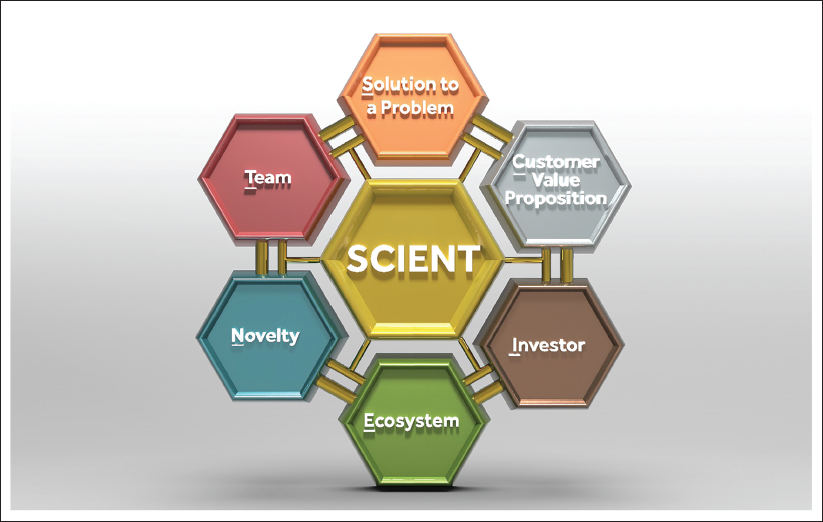
To understand startups’ evolution better, we need to break down the important phases right from seed stage. Here, we present a conceptual framework titled as ‘SCIENT’ depicting the different phases of an early-stage startup (Figure 1). Each letter in the acronym stands for a particular stage in the startup journey. Also, it is to be noted here that these stages are all not always sequential and occur in a dynamic manner. In the next few sections, each of these phases is briefly discussed, highlighting the challenges primarily from HR lens, and then we talk about how HR competencies can be aligned in each of these stages to address these issues.
Early-stage Startup Phases: A Conceptual Framework.
Solution to a Problem
Startup is built around a problem that founders think is important. Often, the starting point is based on intuition leading to a product idea, technology, market opportunity, perceived customer pain, etc. Once the opportunity is identified, the next step is to develop a product or service that solves the identified problem. However, before building anything, sufficient evidence needs to be gathered by testing initial assumptions. This often involves market research and customer interviews. The problem needs to be analysed in detail to validate whether the problem actually exists, and proposed solutions need to be validated to check if they effectively address the problem. Design Thinking methods (Brown, 2008) are found to be extremely useful and popular in obtaining this problem–solution fit through multiple iterations.
Customer Value Proposition
Understanding the customer and evaluating how new products and services create value is very important in the startup journey. There are various practices adopted for the discovery of customer value proposition. The goal is to identify a specific group of target users, jobs-to-be-done, validate pains, needs and customer’s willingness to pay (Osterwalder et al., 2014). Creating a value proposition is an iterative process that requires continuous testing and refinement through user interviews and quick prototypes. Constantly reassessing and iterating startup’s value proposition is necessary to stay competitive in a dynamic market. Achieving this product-market fit means the product has a proven demand in a viable market.
Investors
As product-market fit is achieved, more funding is needed to make prototypes, validate solutions and acquire customers. A startup may go for bootstrapping or seek external funding (Sapienza et al., 2003). Investors are often attracted to novelty and sustainable business models by virtue of their potential for high returns.
Ecosystem
Once product-market fit is achieved, the startup focuses on scaling the product and expanding its user base by adopting the appropriate business model that creates, delivers and captures value (Osterwalder et al., 2014). At this stage, the ecosystem elements such as competition, regulation, governance aspects, technology and changing customer preferences are important to the venture. All these elements influence the business model, which needs to be analysed. Activities involve looking outside and inside your organisation, aligning resources and organising for execution.
Novelty
Novelty is a valuable asset for early-stage startups. A novel product or service can attract attention and interest of lead customers and helps in differentiating from the competition. Converting novelty into monetisable innovation is a necessity for startups. In the fast-paced startup environment, a culture of innovation is crucial for sustaining the growth of the startup.
Team
All these activities require a team with an entrepreneurial mindset. There are many stages of team building that startups face from venture creation to scaleup. These include finding the right partners as founding team and growth of the team for execution. Also, the softer aspects such as setting up the right culture, diversity and inclusion, results orientation and storytelling define the trajectory of the startup.
Entrepreneurship process is iterative, and every startup journey is unique. You may need to go back and forth between these steps as you learn more about your market, customers and product. Some might achieve product-market fit quickly, while others might pivot multiple times before finding a successful product. The key is to remain flexible and adaptable as you navigate the path to startup success. Even if a full-time HR professional is not hired, it is important for startups to consider HR functions and best practices (Boudlaie et al., 2022).
This leads us to understanding the key competencies that HR teams should focus at each stage of the startup journey.
Solution to a Problem
Startups often fall in love with their product or their first solution instead of understanding the actual problem; this can lead to neglecting of the customer perspective. Methods like Design Thinking focus on bringing early customer orientation, empathy towards stakeholders, direct observation, etc. In addition, they go through divergent and convergent phases, which lead to bringing diverse perspectives and systematically focusing on making a choice between alternatives (Maurya, 2016). HR professionals becoming champions of the Design Thinking process and facilitating these interactions will lead to achieving a better problem–solution fit. Differences of opinion are common during problem-solving. HR can focus on conflict resolution strategies at this stage and ensure a positive, respectful environment where everyone’s ideas are heard.
Customer Value Proposition
Conducting effective customer interviews is a difficult task, and many end up with the wrong results. Early-stage startups need to avoid confirmation bias. Sometimes, teams discard or underplay evidence that conflicts with their hypothesis. This leads to false signals about customers’ potential interest in the solution. To avoid this, HR professionals can play a huge role in involving others to bring in different perspectives and play devil’s advocate. Early-stage ventures fail; these are experiments to some degree, and care must be taken to test and validate the hypothesis. Quick decision-making is crucial, consisting of frequent iteration loops between the development phases. HR can play a pivotal role in treating failures as a learning opportunity and promoting the culture of ‘learn fast, learn cheap’ (Edmondson, 2011).
Investor
When startups reach the critical stage of readiness to approach investors for funds, they invariably have a high inward focus. Ironically, the investors who walk in at this juncture expect the startups to be market savvy and sharp on the pulse of the customer. This is where HR can be a coach advising the startup on managing the investors. They must condition the founders to be candid yet ambitious, thorough technically yet open to new perspectives. During deal making, HR must double up on due diligence and safeguard the larger interests of the team that can fundamentally make or break the startup. The excitement and anticipation of funds have been known to play games with the minds of even the most committed founders. The best of them also need good counsel—legal and otherwise.
Ecosystem
Finding the right business model and validating the assumptions is a herculean task (Ries, 2011). It requires HR professionals to support the founders with developing outside–in perspectives about competition, changing demographic trends, governance issues and understanding customers and suppliers. Balancing these issues with internal capabilities, resources and practices is needed. This balancing act requires significant adjustments by all stakeholders, and HR can bring proven change management practices (Kotter & Cohen, 2002) to ensure minimal disruption.
Novelty
Novelty is a valuable asset for early-stage startups. The ability to consistently produce novel ideas and drive them to market is a strong indication of an innovative company. Innovation is a team effort, and culture of innovation should be integrated into startup’s overall business strategy to help propel growth. HR should plan to build and protect the intellectual property of the new venture.
Team
Every startup has more work to be done than talent and other resources available to it; thereby, working with constraints is the inherent nature of entrepreneurship. Selecting the right individuals is a candid process on assessment of skills, motivations and financial expectations. The tasks of onboarding, orientation and training can be simplified with smart self-driven digital solutions that are now widely adopted by new-age companies. Few examples of this could be a smart onboarding and orientation platform, an intelligent digital sales manual that can train sales professionals quickly, and an online buddy system to expedite cultural induction. With SAAS-based solutions employees spend less time on administrative tasks and are enabled to perform at potential. Therefore, HR must adopt cutting-edge digital solutions to be agile and cost efficient (Montero Guerra et al., 2023). In the journey of team building, diversity in skillsets, education, economic and cultural background and even gender adds immense long-term value in keeping perspectives well rounded. A strong culture of celebrating small wins, healthy competitions, pitching in and expression of gratitude for stretch efforts keeps the team collaborative. This is where individuals draw the essential ingredient of motivation to keep up with the hustle of the startup.
While there may be examples of the startups that have successfully broken the normal business practices and achieved skyrocketing growth, unfortunately, countless others have failed in their place—many because they thought building the right culture, learning environment, employee happiness and teamwork chemistry were nice things to do and are important only when the company is big. The role of HR, whether it is played directly by the founder or the partners, must be played out completely. Even a five-person team is a little organisation that needs leadership and management—enough to initiate people practices and HR automation.
Finally, this is merely a snapshot of the startup process and all the people issues involved in early-stage startups. Also, these issues are dynamic in nature, and every startup journey is unique. Nevertheless, there is immense scope for industry, academia and government to highlight and propagate the important HR competencies essential for startup success and help the entrepreneurship ecosystem embrace the reimagined role of HR.
Footnotes
Declaration of Conflicting Interests
The authors declared no potential conflicts of interest with respect to the research, authorship and/or publication of this article.
Funding
The authors received no financial support for the research, authorship, and/or publication of this article.