



Abstract
Prosecutors play a large role in determining sentences and may alter their decision-making based on changes in Department of Justice (DOJ) priorities. Consequently, I use the inhabited institutions perspective to investigate whether and how a series of DOJ memos (Holder memo, Thompson memo, McNulty memo) affected sentencing severity for organizational defendants in federal courts. My analyses consist of multi-level regressions of total fine, probation length, and corporate compliance program orders using the 1992–2013 “Organizations Convicted in Federal District Courts” dataset collected by the United States Sentencing Commission (USSC). The results suggest assistant U.S attorneys adjust their approach based on departmental guidance, with punitiveness being linked towards perceived support from the main office for this behavior.
Keywords
Corporate crime is a far-reaching phenomenon that has led to billions of dollars in financial losses (Eisinger, 2017; Homer & Higgins, 2020), health-related issues for large numbers of people (Payne et al., 2012), and even deaths (Dodge, 2020). Such offenses are common enough that the U.S. government has implemented a special set of federal sentencing guidelines to deal with organizations that break the law (Miller, 1991; Parker & Atkins, 1999; USSC, 2022). However, the sentence severity under these guidelines may have ebbed and flowed over time, leading to uncertainty over whether they reduce future offending (Eisinger, 2017; Green & Bodapati, 1999). This could be evidenced by a series of memos issued to assistant U.S attorneys, from Main Justice (DOJ headquarters) which were seen as signals of how much it prioritized punitiveness towards organizational offenders. Assistant U.S. attorneys (who play a large role in determining criminal sentences) may have taken their cues from them.
This aligns with neo-institutional perspectives of organizations which suggest that institutions (i.e., courts) exist in a reciprocal relationship with external forces and adapt to changes in their environments leading to operating differences between individual institutions (Ulmer, 2019). In particular, the inhabited institution perspective suggests the main source of this divergence is because individual organizations and the actors within them “inhabit” the rules and norms of their field, i.e., they interpret them through the lens of their own culture, ideologies, or circumstances. Consequently, organizations within the same field function in substantially different ways. Contemporary court sentencing literature has emphasized this paradigm; though courts may be subject to the same general regulations and guidelines, these shared rules and norms have often been interpreted and implemented in ways that reflect local concerns on matters such as immigration (Light, 2014; Painter-Davis & Ulmer, 2020; Ulmer & Parker, 2020). Thus, a major theme of contextual studies of federal/state courts and sentencing has been between-court variation in the implementation of policies such as sentencing guidelines (Johnson et al., 2008; Ulmer & Johnson, 2004; Ulmer, 2019). However, current research may have under-scrutinized the ways in which courts could be pushed towards greater conformity. It is an open question as to whether, and how much, centralized authorities such as the DOJ can produce conformity among the diverse federal district courts and their U.S. Attorneys’ Offices. As laid out in DiMaggio and Powell (1983), however, there are multiple institutional forces that can promote conformity and uniformity within fields.
While federal district courts operate independently, the people within them can be influenced, constrained, or encouraged by sponsoring agencies or other entities that they may have connections to (Hofer, 2019; Rosenberg, 1991). This is particularly true for assistant U.S attorneys regarding directives from the main office of DOJ under the Attorney General (AG) and their staff. Shifting priorities of the AG have been linked to large-scale changes in charging and sentencing practices (Lynch et al., 2021; USSC, 2017) such as when Eric Holder encouraged federal courts to move away from imprisoning low-level drug offenders (USSC, 2017). There is evidence that the DOJ has undergone similar shifts in the perceived seriousness of crimes committed by organizations and how it should handle these offenders based on the Holder, Thompson, and McNulty memos issued during the 1990s and 2000s (Eisinger, 2017). No studies have investigated whether these memos were indeed followed by measurable shifts in prosecutorial behavior or sentencing outcomes for organizational offenders. Using the United States Sentencing Commission’s (the USSC) 1992–2013 “Organizations Convicted in Federal District Courts” dataset, I assess whether a central authority within an institutional field (Main Justice) can indeed overcome the substantial forces fostering divergence in federal prosecution and sentencing (Johnson et al., 2008; Ulmer, 2019) and impose change in a specified direction on different organizational parts (federal district courts) and actors (U.S. attorneys).
Inhabited Institutions
The term “Inhabited institutions” does not refer to one theory but rather a group of them that draw heavily on vocabulary and concepts that originated in the field of neo-institutional theory in organizational sociology and symbolic interactionism (Ulmer, 2019). According to organizational sociology, both courts in general and the federal court system can be considered part of institutional fields. These institutional fields consist of organizations and actors interacting around a common set of goals and activities, structured by shared formal and informal normative systems and cultural meanings. Nonetheless, that does not mean that they are homogenous. Instead, the inhabited institutions perspective states that institutional fields should be viewed as being “inhabited” by organizations and the individual actors that work within them. These organizations and actors interpret field-wide norms and meanings through the lenses of their local interests, cultural meanings, and contextual constraints via a process known as local substantive rationality. Local substantive rationality in the context of legal decision-making refers to the criteria that are guided by or in service of ideologies and goals that are not necessarily related to the law (Savelsberg, 1992; Ulmer, 2019). In other words, decisions made by judges, prosecutors, or other court officers may be motivated by personal ideologies, professional objectives, or local organizational culture when they have discretion. In practical terms, law is often administered locally even when courts are ostensibly under the same guidelines and statutes, such as in the federal court system. Local federal district courts often interpret and apply guidelines, laws, and polices in ways that fit with local priorities, culture, and internal pressures (Johnson, 2006; Johnson et al., 2008; Kautt, 2002; Painter-Davis & Ulmer, 2020; Ulmer & Bradley, 2018). Consequently, a literature has arisen to explain these “court communities”; one of the most prominent themes has been variation between courts and the difficulty of obtaining uniformity through policies such as guidelines, even when courts have been required to follow them like with the federal sentencing guidelines prior to the United States v. Booker, 543 U. S. 220 (2005) (Galvin, 2015; Lutz, 2018).
However, variation is not insurmountable. Institutional fields often have centralized authorities that work to maintain conformity and compliance between members. This process, referred to as field isomorphism, is conducted through a variety of methods such as forced compliance via rules and regulations, linking perceived institutional legitimacy to adherence to norms, and/or shared methods for making sense of institutional duties (DiMaggio & Powell, 1983; Scott & Davis, 2007). Sentencing guidelines within the federal district court system can be considered an expression of these strategies. For a time, court officials were bound by law to follow these guidelines when applicable. Though that is no longer true, the federal sentencing guidelines may still serve to create conformity between districts by communicating to individual court officials what the recommended sentencing norms and rationales are (Lynch et al., 2021). Federal sentencing decisions do not occur within a vacuum; they can be challenged and even voided if the decisions themselves or the rationale behind them are found to be unsatisfactory. Should this happen, there can be major professional consequences for the responsible officials, such as a loss of reputation with their peers or stunted future career prospects. This is especially true for assistant U.S attorneys as they are under enormous pressure to secure guilty verdicts whenever they bring up charges against someone; Consequently, it is often within prosecutors’ (and other criminal justice officials) interest to pay attention to sentencing guidelines and how they are told to read them as their decisions are less likely to be overruled or overturned if they are grounded in the guidelines and their principles.
Organizational Sentencing
The U.S. government implemented the sentencing guidelines for organizational offenders during the early 1990s (Alexander et al., 1999; USSC, 2022). This data, which includes all convictions of organizations that have been upheld in each of the 96 federal districts (Miller, 1991), is utilized in much of the existent academic research on corporate criminal sanctions.
The most common outcome of interest is fines as they are the most common (and frequently only) sentence that organizations receive (Green & Bodapati, 1999; Schell-Busey et al., 2016). Fines are normally predicated on how much organizations can afford; those who can afford them receive higher fines (Alexander et al., 1999; Galvin, 2015; Green & Bodapati, 1999; Homer & Higgins, 2020; Lutz, 2018). However, the results seem to be mixed on the impact of prior history of illegal/unethical behavior; some find that prior record makes no difference (Piquero & Davis, 2004; Lutz, 2018) while others suggest it increases the amount fined (Galvin, 2015; Homer & Higgins, 2020). Meanwhile, though less common, studies have explored how guideline related variables affect other sanctions. Homer and Higgins (2020) observed that organizations with higher culpability scores and prior charges against them were significantly more likely to be ordered to institute compliance programs (monitoring offices meant to prevent future illegal behavior). Homer and Higgins (2021) offered evidence that likelihood of sanctions may be linked together; corporations were more likely to be assigned community service the greater their assigned fine was. Finally, both Galvin (2015) and Lutz (2018) found that very few variables that predicted fines for organizations also predicted probation sentences. In summary, even though the relevant variables may shift based on the examined sanction, it appears an organization’s culpability and practical circumstances play an important role in federal sentences.
There is some research on the relationship between temporal context and organizational sentencing. Galvin (2015) examined the repercussions of the 2001-2002 bankruptcies of Enron, World.com, and other large companies that spawned the Public Company Accounting Reform and Investor Protection Act of 2002. During the scandal period and in the years afterward, corporations received significantly higher fines though this was concentrated amongst a sub-group of offenders. Lutz (2018) indirectly analyzed the effects of the 2008 Great Recession by comparing sanctions given out before and after the passage of Dodd-Frank Wall Street Reform and Consumer Protection Ac (2010). They concluded that Dodd-Frank made corporate sanctions tougher as they observed that fines paid post-Dodd-Frank were substantially higher than those pre-Dodd-Frank, especially for financial offenses. Based on these findings, it appears organizational sentencing is somewhat sensitive to outside events, with those that highlight the negative consequences of corporate crime leading to tougher sentences.
Both Galvin (2015) and Lutz (2018) tested the influence of events that would have affected organizational sentencing more tangentially. They scrutinized the impact of the United States v. Booker, 543 U. S. 220 (2005) by comparing sentences before and after. In short, United States v. Booker, 543 U. S. 220 (2005) rendered the previously mandatory federal sentencing guidelines to be solely advisory. Consequently, judges ostensibly gained greater discretion and influence over sentencing (Hofer, 2019). Nonetheless, neither study found United States v. Booker, 543 U. S. 220 (2005) to have a substantial effect on sanction severity or the likelihood of departures once the models were fully specified. Therefore, it seems judges generally stick to the current sentencing guidelines.
These period analyses emphasize the role that judges play in the organizational sentences yet they judges are only one stage of the legal process (Metcalfe et al., 2016; Ulmer, 1995). Prosecutors arguably play even larger roles in the sentencing as they possess complete discretion over whether to file charges against a defendant and the crime(s) that the defendant will be charged for (Flemming et al., 2016; Spohn & Fornango, 2009). Since these charges determine the guidelines that defendants are subject to and judges rarely seem to deviate from the guidelines for organizational sentences, it can be argued that prosecutors play the most important role in sentencing organizational offenders. Since federal district attorneys are appointed and are at least formally accountable to the DOJ, there have probably been events and institutional changes that may have affected how prosecutors’ approach organizational offenses (Eisinger, 2017; Lynch et al., 2021). However, as of writing, no researchers appear to have investigated them using the USSC data.
Current Study
Though there is substantial variation in local district court dynamics and priorities, that does not mean court officials are completely unaffected by top-down, institution-wide initiatives. District prosecutors are expected to comply with directives initiated by the DOJ under the purview of the attorney general (Eisinger, 2017; Lynch, 2021). Though the attorney general cannot directly force districts or their employees to act in a certain way, they are responsible for establishing broader priorities, including what offenses to focus on and how they are to be handled. These kinds of directives send signals regarding what practices will be considered acceptable and what will be scrutinized (Lynch, 2021; Rosenberg, 1991). Prosecutors whose orientations align with these new directives may be emboldened where they would not have before while prosecutors whose orientations do not may pull back for fear of suffering professional consequences. Like in state and municipal courts, federal prosecutors have complete discretion over what to charge defendants with, whether to offer a guilty plea, and what terms they attach to it. Given that most federal criminal cases (both individual and organizational) are resolved through a guilty plea, it is reasonable to assume that any substantial fluctuations in sentence severity in federal district courts are at least partially due to how prosecutors approach certain cases.
However, attorney general tenure may be too broad a measure to detect temporal differences in organizational sentencing. Though attorney generals may have their signature priorities, they often handle multiple long-standing concerns and unforeseen events. During the early 2000s, there were multiple high profile corporate crime cases such as the Enron scandal. However, corporate crime never seemed to be a major concern for the George W. Bush administration or his attorney generals. The main reason why is because during the same period, the 9/11 terrorist attacks occurred; this event led to dramatic changes to U.S. criminal justice and domestic security organizations, which were reoriented to combat terrorism and other foreign threats (Eisinger, 2017). Therefore, it may make more sense to test for changes in prosecutor behavior towards organizations by scrutinizing intervals that specifically pertain to them.
During the late 1990s and 2000s, the DOJ released a series of internal memos that chronicled the establishment of and changes to policies for issuing charges against organizations. These memos were seen as signals of the DOJ’s overall commitment to prosecuting corporate cases and how much support prosecutors could receive during the process (Cohen, 2007; Eisinger, 2017; Gardner, 2008; Paulsen, 2007; Power, 2007). Prosecutors will be more aggressive and push for harsher sentences when they believe doing so will is in line with the priorities of Main Justice since they are more likely to receive support if their decisions are challenged. On the other hand, prosecutors will push for more lenient sentences when punitiveness in these cases is not valued as they still want to close organizational cases while avoiding potential pushback (Lynch, 2021; Spohn & Fornango, 2009).
Organizational sentence severity will vary based on memo period.
When the federal organizational sentencing guidelines were first established, individual federal districts largely relied on their own discretion when it came to how they implemented them. However, the Holder memo (circulated June 6th, 1999) represented the first attempt by the DOJ to establish a general approach for prosecuting organizations offenders. It provided a series of non-binding instructions about the factors to consider. In addition to traditional concerns (strength of evidence, likelihood of trial success etc.,) prosecutors should consider the severity and pervasiveness of the corporation’s wrongdoing, the collateral consequences to employees and the community, and its efforts to remedy the situation (Eisinger, 2017). Therefore, a crucial component behind the decision to charge is the extent to which the defendant cooperated with the government in its investigation with attorney-client privilege being a key sticking point. Attorney-client privilege is the principle that information exchanged between lawyers and clients regarding legal matters is protected by law so they can legally refuse to discuss it with others, even the government (Cohen, 2007; Gardner, 2008). However, in many corporate cases, lawyers for both individual defendants and the organization itself may have information that could be critical to understanding the extent of guilt for either and/or both (Schell-Busey et al., 2016; Sutherland, 1983). The Holder memo created a greater expectation that corporations and their employees would waive attorney-client privilege when it came to legal documents and discussions relevant to the case (Gardner, 2008). Thus, prosecutors may have been emboldened to dig deeper into the behavior of organizational defendants, leading to harsher sentences relative to the pre-Holder period. In the context of the present manuscript’s data, the pre-Holder period ran from 1992–1999. The Holder memo period ran from 2000–2002.
The second memo was the Thompson Memo (January 20, 2003) which made the Holder memo formal DOJ policy and tasked prosecutors with identifying and punishing individuals responsible for a corporation’s malfeasance. Furthermore, these new guidelines led to a major change in how prosecutors evaluated corporate cooperation. It brought greater scrutiny for the advancement of legal fees to employees by corporate defendants (Eisinger, 2017; Power, 2007). Since corporate offenses often involve illegal activities committed during everyday operations, individuals employed by a corporate defendant may be investigated as potential witnesses or even co-defendants. Legal proceedings for corporate cases can last for years, resulting in astronomical legal fees that individuals may be unable to pay. Therefore, corporate defendants have provided legal counsel or paid the legal fees of employees and associates in these situations. Many white-collar prosecutors believe this is less about corporate defendants looking out for their employees and more about them making sure those employees refrain from revealing anything that could indicate liability (criminal or civil) for the company (Eisinger, 2017; Tombs & Whyte, 2020). Under the Thompson memo, the DOJ sought to penalize corporate defendants who advanced legal fees to employees who were accused of crimes. This development could be viewed as a signal of greater official support for aggressive prosecutions of corporate crimes. It is no secret that criminal proceedings against corporations are frequently complicated and long-running processes that involve extensive negotiation between the government and the defense (Cohen, 2007; Sutherland, 1983). With these new department guidelines behind them, prosecutors may have been more confident in pursuing more and tougher charges against corporate defendants, leading to sentences being more punitive in the post-Thompson period compared to previous eras. The post-Thompson memo period ran from 2003–2006.
Organizational sentences will be harshest in the post-Thompson Memo period.
However, the last memo of note dialed back punitiveness brought on by the Thompson memo. On December 12th, 2006, the department issued the McNulty memo which stated that prosecutors had to get permission from their superiors for multiple major prosecutorial decisions, such as asking corporate lawyers to waive attorney-client privilege or requesting corporate defendants to not pay the legal fees of individual person defendants (Eisinger, 2017; Paulsen, 2007). The memo was distributed after a severe backlash from the business community and politicians sympathetic to them. These critics accused the DOJ of creating an unduly coercive environment where corporate defendants were forced to hand over privileged information that could damage their reputations and open them to additional liability. Meanwhile, individual person defendants could find themselves facing enormous legal costs since companies could be penalized for advancing legal fees. Restraining the discretion of individual prosecutors was touted as the best way to limit the collateral consequences of any potential abuse of this system (Cohen, 2007; Paulsen, 2007).
On the other hand, prosecutors viewed the McNulty memo as making it harder for them to build cases against organizations as they had additional hurdles to clear, giving them less leverage in their negotiations with corporate defendants. The memo was seen as a sign of the DOJ backing away from aggressive organizational prosecution (Eisinger, 2017; Paulsen, 2007). As a result, prosecutors may have offered lighter sentences during this period. The post-McNulty period ran from 2007–2013
Organizational sentences will be most lenient in the post-McNulty memo period.
Data
The present manuscript will analyze the Organizations Convicted in Federal Courts dataset published by the USSC from 1992–2013 in the STATA platform. These data were collected to ascertain the extent organizational sentencing guidelines were followed within federal courts and estimate the impact of policy changes. The data covers both case-level (type of offense, sentenced punishment, degree of restitution) and defendant-level variables (organizational structure etc.) (USSC, 2022). This dataset was chosen because it represents the most complete record of federal sentencing data for organization defendants that is available to the public as each year of the data contains every organizational case handled by the federal district courts system that resulted in a conviction and were held as constitutional. Granted, this means the data does not represent all or even most of the organizations that are sanctioned for unethical or illegal behavior within the U.S; the criminal justice system tends to handle only the most serious incidents. However, this data should be an excellent representation of how federal courts deal with organizational defendants.
The original sample contains a total of 3950 cases. However, multivariate normal (MVN) multiple imputation was used to address missing data for two variables; culpability score (1491 imputed) and number of employees (1414 imputed). MVN was chosen because both variables are continuous and are believed to be normally distributed. All other variables in the analyses were classified as regular and not imputed. There was a total of 25 imputations which resulted in a modified sample of 102,700 cases within 94 district courts.
Measures
Outcomes
Fine Amount Logged
The natural log of a defendant’s total fine once base fine and all enhancements/reductions were considered. Given this variable’s extreme range and left skewness, it was transformed for linear regression. Sentences with no fine were coded as .1.
Months of Probation Logged
The natural log of how many months of probation a defendant receives. Non-transformed probation sentences range from 0 to 60 months. Like total fine, this outcome was transformed to make linear regression more feasible. Cases where no fine was given were coded as .1 so they would be included in the analyses.
Compliance Program Ordered
Whether a defendant was ordered to institute a compliance program to prevent future illegal behavior. It is a dichotomous measure coded as no (0) and yes (1).
Predictor Variable
Memo Period
Periods of time in between DOJ-wide memos that were specifically related to organization prosecution. It is a nominal variable coded as (1) pre-Holder Memo (reference), (2) post-Holder Memo, (3) post-Thompson Memo, and (4) post-McNulty memo. Memo periods are rounded to the first full calendar year they would be in effect. The pre-Holder memo period is the reference because it was before assistant U.S attorneys received any specific directions regarding how to prosecute organizational defendants aside from the corporate sentencing guidelines of 1991. Therefore, prosecutors largely operated on their own priorities and judgement.
Grouping Variable
District
The federal district court that a case was sentenced in. Given the plethora of research indicating that court characteristics impact the cases processed through them, it is prudent to account for how cases are clustered within courts using multi-level regression models.
Case Level Controls
Ownerships Structure
Whether an organization is openly traded or controlled by a single person or a relatively small group. It is a nominal variable that is coded as (1) closely held or private organization (reference), (2) openly traded organization, (3) non-profit organization, (4) government organization (public-entity or public service), (5) partnership, (6) sole proprietorship, (7) association, or (8) other.
Number of Employees
An organization’s size as represented by how many employees it has scaled to the hundreds in order to account for the large range of values. This includes full-time employees, part-time employees, hourly workers, seasonal employees, and contractors. Missing values for this variable were replaced via multi-variate normal (MVN) multiple imputation. A square term of number of employees is also included to measure for potential non-linearity in the relationship between sanction severity and organization size.
Offense Type
The offense with the highest maximum fine that an organization is convicted of. The offense type is one of the most consistent predictors of sanction severity as certain offenses are viewed as more heinous. It is a nominal variable whose categories include (1) Fraud (reference), (2) White-collar crime, (3) Street crime, (4) Environmental/food and drug crime, (5) Other, and (6) Missing. The guidelines data contains a much more detailed list for this variable and the above categories were constructed from this list to create distinctions that possessed substantive differences (Table 7 in appendix). White-collar crimes represent offenses that occur within the context of normal business activities such as tax evasion or copy-right infringement. Environmental/food/drug offenses represent violations of regulatory standards; it is a common practice in white-collar literature to treat them as separate from other offenses. Street crimes represent “typical” criminal activities such as drug trafficking or racketeering. Finally, fraud was chosen as the reference because not only is it one of the most common offenses but there is the perception that it is not white-collar crime given its amorphous nature.
Culpability Score
Developed by Homer and Higgins (2020), this is a continuous measure of how responsible an organization is for its criminal behavior based on a battery of questions involving tolerance of the criminal activity, acceptance of responsibility, whether it violated judicial orders or committed obstruction of justice, etc. It ranges from 0 to 14 with missing data being replaced using multi-variate normal (MVN) multiple imputation. This variable was included because it incorporates a variety of conditions which are directly relevant towards the sentencing guidelines (Homer & Higgins, 2020, 2021)
Prior History of Misconduct
Whether an organization has a history of misconduct or pending civil or criminal charges. It is a categorical variable operationalized as (1) no history, (2) prior history, or (0) missing. Prior record is one of the most reliable predictors of sentence severity. Sentencing guidelines frequently have built-in sentence enhancements for repeat offenders. Even they do not, court officials will likely see repeat offenders as deserving harsher punishment.
Criminal-Purpose Organizations
Whether an organization is established and operated primarily for criminal purposes. It is a nominal variable coded as (1) No (reference), (2) Yes, and (3) Unknown. Research shows that courts sentence criminal-purpose organizations more harshly to liquidate them. For readers concerned that these organizations may represent a fundamentally different population compared to generally legitimate organizations that commit crimes, that should not be an issue. Criminal purpose organizations represent such a small proportion of the overall sample (3.37%) that it is unlikely that they would exert excessive influence on the results.
Plea Status
The status of how the sentence was reached. It is a nominal variable whose categories are (0) plea received (reference), (1) plea not received, (2) trial, and (3) missing. How courts arrive at a sentence has repeatedly been shown to affect sentence punitiveness. Court officials will be more lenient towards those who plead guilty compared to those who are found guilty in a trial.
Departure Status
Whether and what kind of sentencing departure is granted. Departures can result in dramatic enhancements and reductions in prescribed sentences, so it is necessary to account for their presence. It is a nominal variable coded as (0) No departure (reference), (1) Downward departure, (2) Substantial assistance departure, (3) Upward departure, and (4) Missing.
Existence of a Compliance Program
Whether the organization had an ethical compliance program in place when the offense occurred. It is a categorical variable that is coded as (1) No (reference), (2) Yes, and (3) Missing. Court officials may be more likely to order corporations to institute a compliance program if one is absent or if the existent one is viewed as ineffective (Homer & Higgins, 2020).
Financial Status at Time of Sentence
This is a nominal variable coded as (1) Solvent and Operating (reference), (2) Defunct, (3) Bankrupt or signs of severe financial distress, (4) Other, and (5) Missing. Court officials may be less inclined to issue financial sanctions when an organization is under severe financial duress or shows other signs that it may have difficulty paying fines (Green & Bodapati, 1999). They also may be less likely to assign probation or corporate compliance programs if they believe the organization may dissolve.
Analyses
The analyses will employ multi-level regression analysis techniques; specifically, mixed linear regression with random intercepts for total fine and months of probation and random effects logistic regression for compliance program order. After presenting descriptive statistics, I cover multi-level regression analyses using the full sample to examine whether and how sanction severity differs between each of the different memo periods. Then, assuming that there are disparities, I will investigate the potential mechanisms for the observed disparities by conducting sub-sample analyses of all cases from each memo period to see if there are changes in how other predictor variables are treated that are in line with contemporary accounts of changes in prosecution patterns described by Eisinger and other sources.
Results
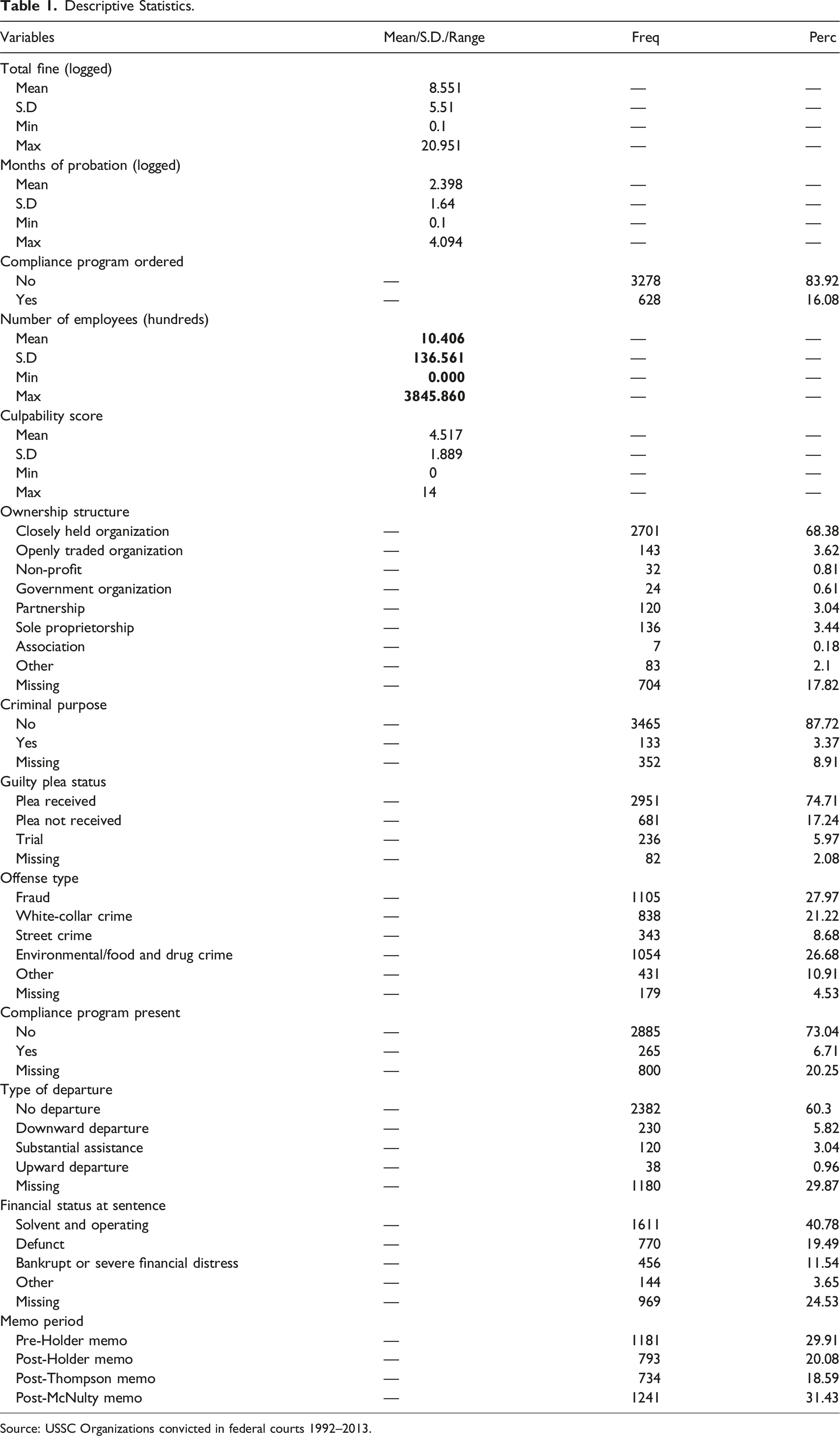
Descriptive Statistics.
Source: USSC Organizations convicted in federal courts 1992–2013.
The overwhelming majority of these organizations are legitimate entities that engaged in illegal activity (87.72%) rather than ones established primarily for the purpose of crime (3.37%). This could be why the most common offenses committed are fraud (27.97%), environmental/food and drug (26.68%), and white-collar crime (21.22%) with street crimes such as extortion being relatively rare (8.68%). Most of sentences were within guidelines ranges since more than half did not receive any kind of departure (60.3%). Surprisingly, convictions are more common in the pre-Holder Memo and post-McNulty Memo (36.92%) periods, which were expected to be periods of relatively lenient treatment.
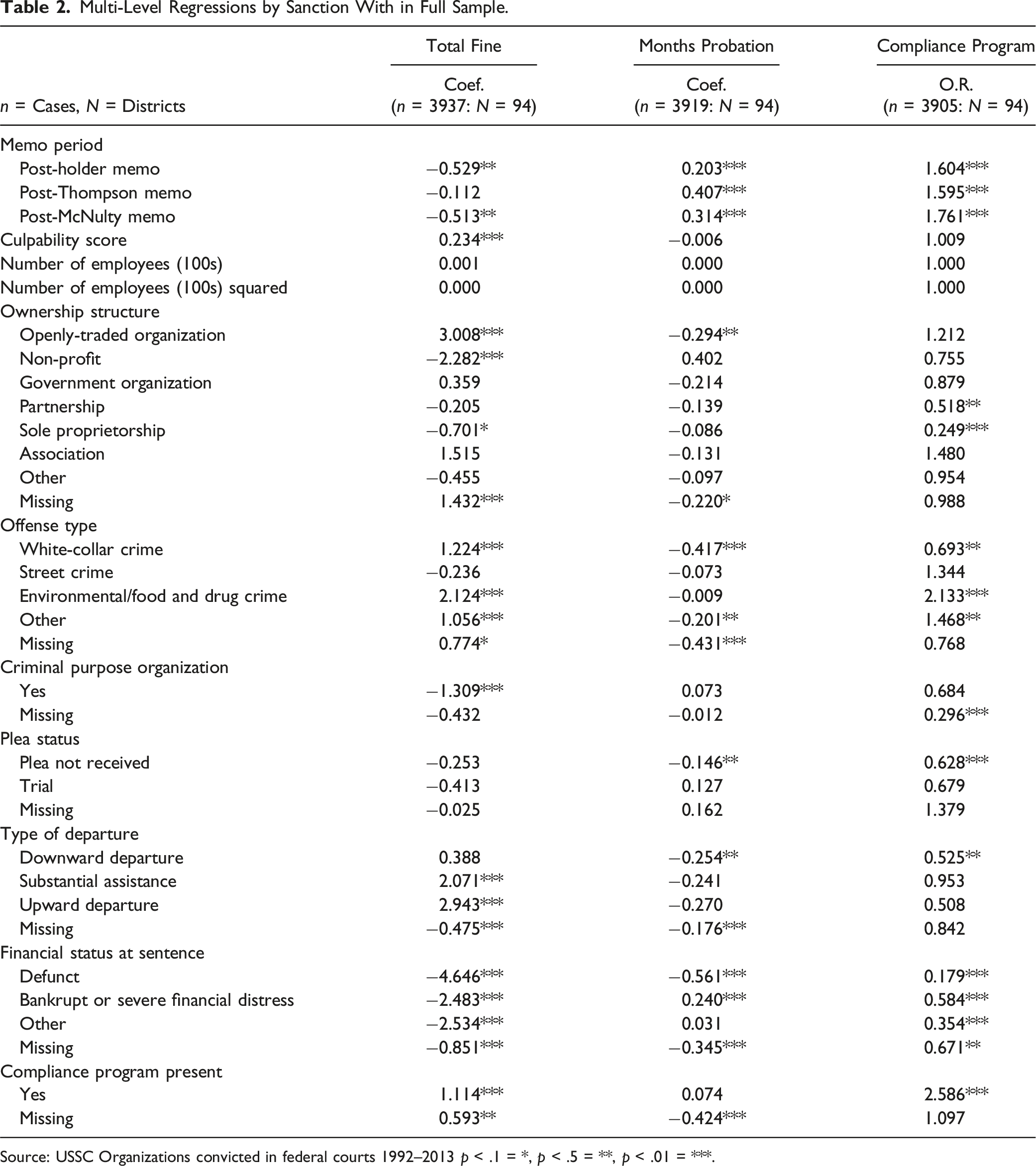
Multi-Level Regressions by Sanction With in Full Sample.
Source: USSC Organizations convicted in federal courts 1992–2013 p < .1 = *, p < .5 = **, p < .01 = ***.
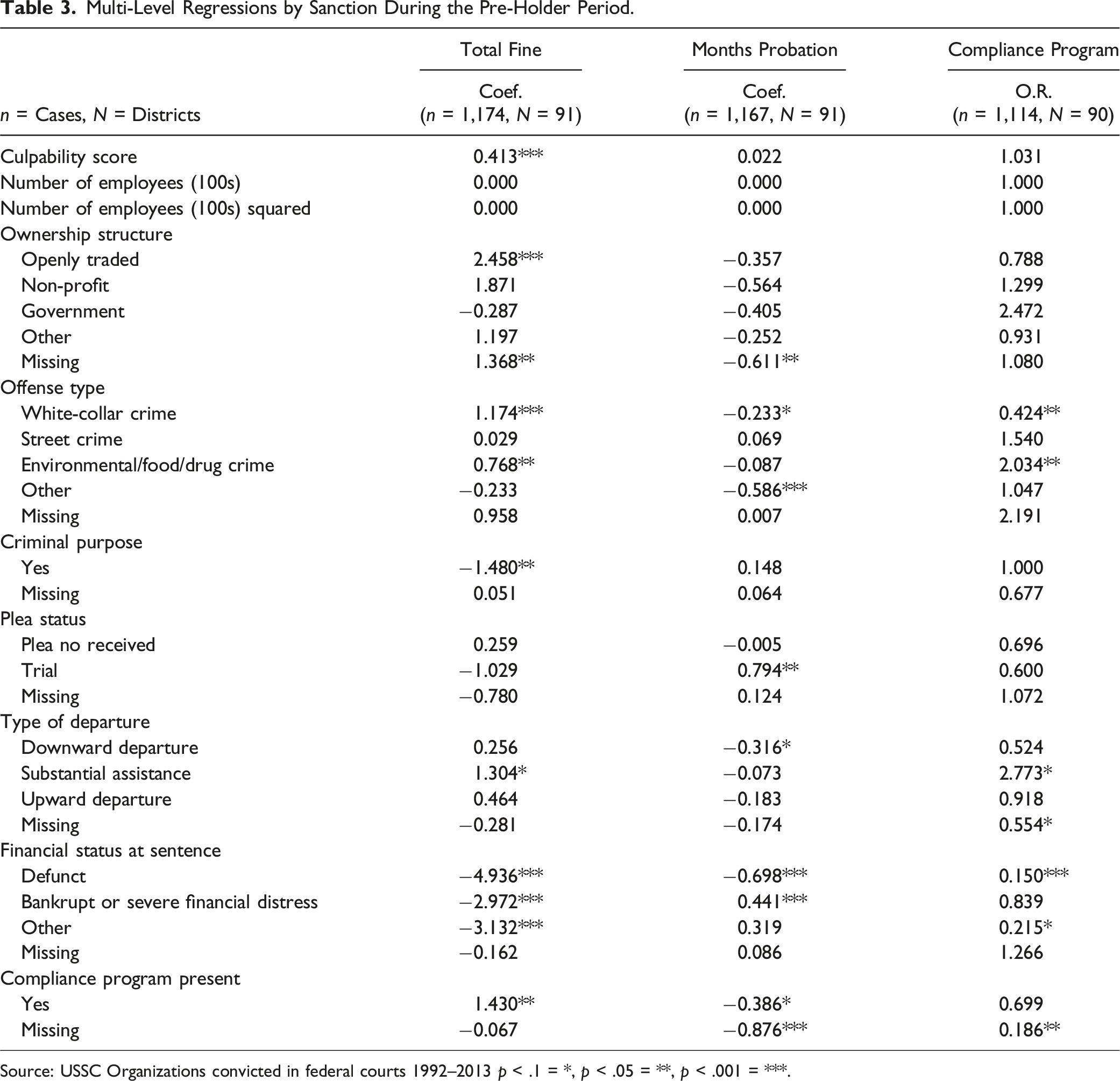
Multi-Level Regressions by Sanction During the Pre-Holder Period.
Source: USSC Organizations convicted in federal courts 1992–2013 p < .1 = *, p < .05 = **, p < .001 = ***.
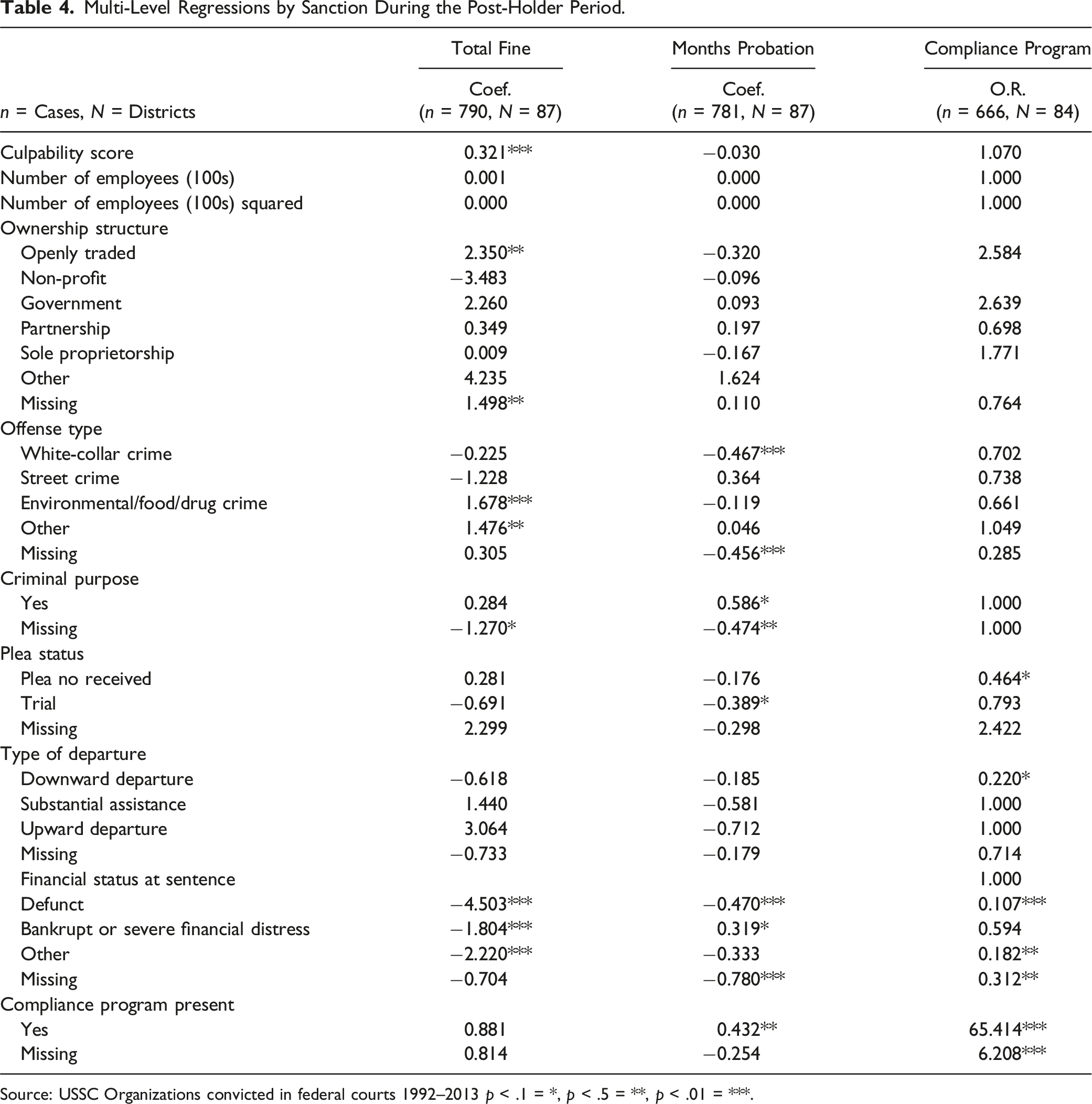
Multi-Level Regressions by Sanction During the Post-Holder Period.
Source: USSC Organizations convicted in federal courts 1992–2013 p < .1 = *, p < .5 = **, p < .01 = ***.
Multi-Level Regressions by Sanction During the Post-Thompson Period.
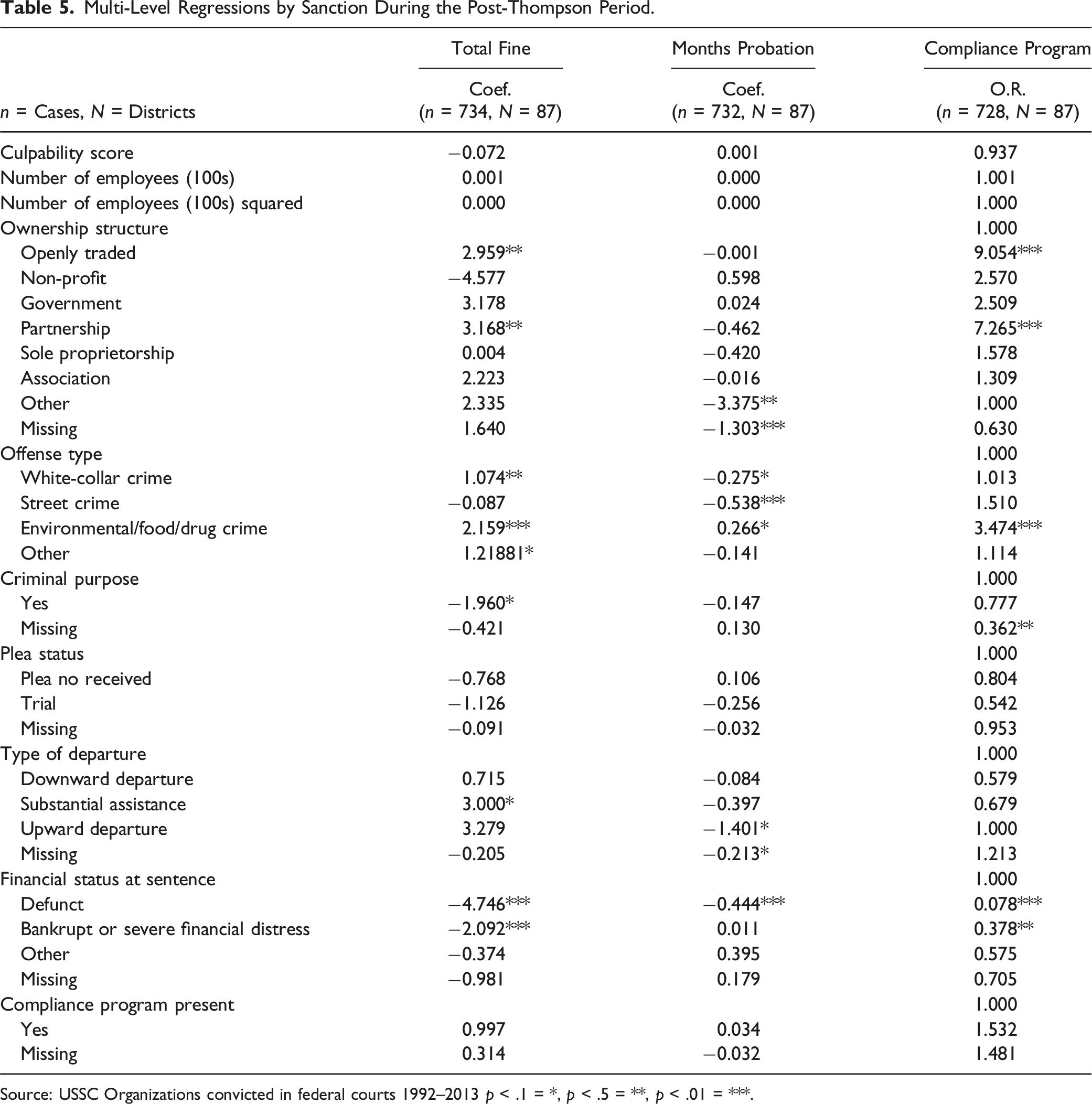
Source: USSC Organizations convicted in federal courts 1992–2013 p < .1 = *, p < .5 = **, p < .01 = ***.
Multi-Level Regressions by Sanction During the Post-McNulty Period.
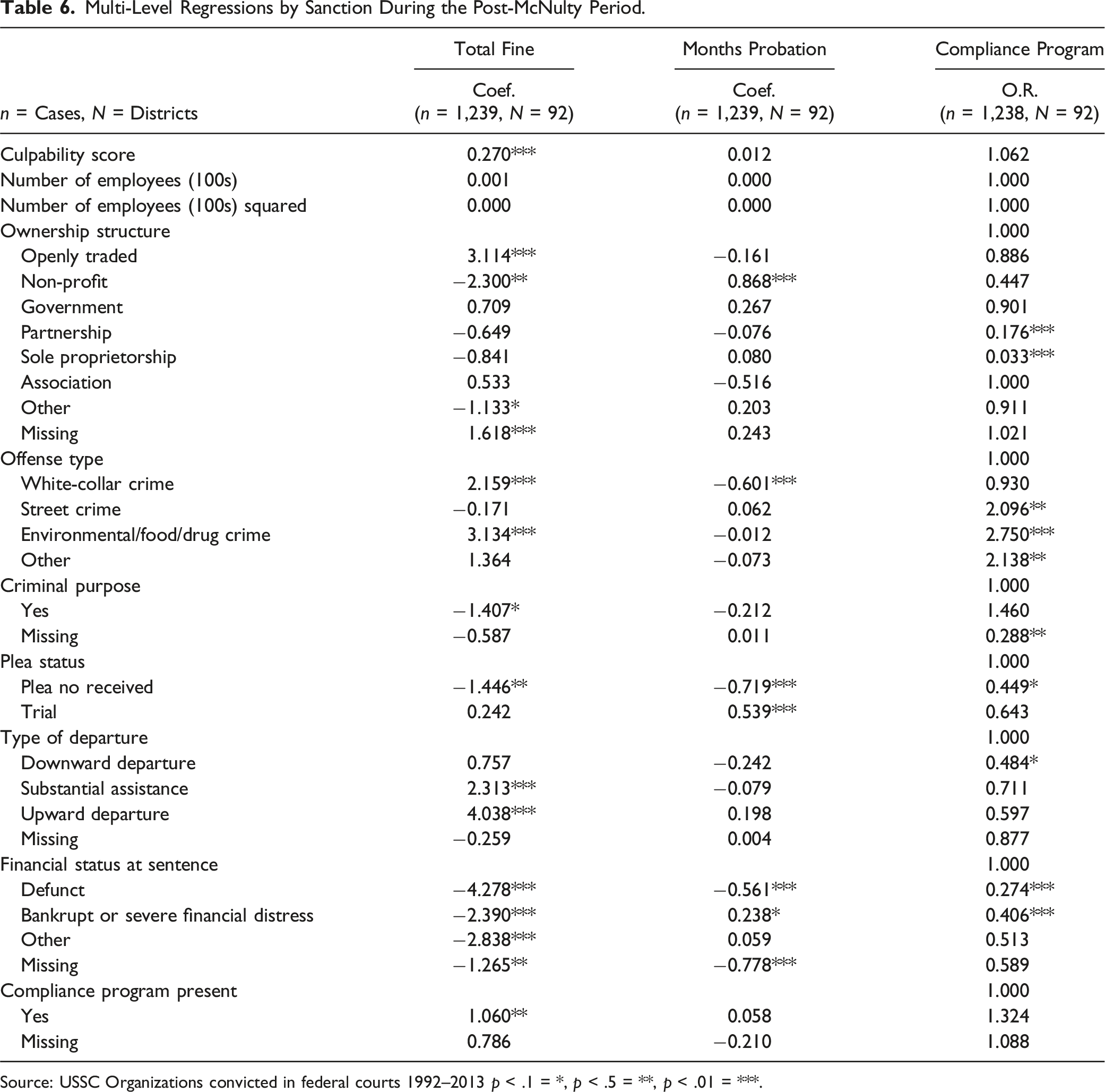
Source: USSC Organizations convicted in federal courts 1992–2013 p < .1 = *, p < .5 = **, p < .01 = ***.
There is evidence the memo periods had a demonstrable impact on organizational sentencing. All three sanctions varied considerably between them. However, the results were not entirely as predicted. I hypothesized that sentences would be most severe during the post-Thompson period and the results support that. Whereas total fines were substantially lower in both the post-Holder and post-McNulty periods relative to the pre-Holder memo, that is not so for the post-Thompson period. Defendants received the most months of probation in the post-Thompson period. Finally, even if courts were not most likely to assign compliance programs during the post-Thompson period, they were close. This all gives the impression that federal district sentences where toughest on organizational offenders when prosecutors had the explicit support of the justice department. Meanwhile, sentences were not most lenient when I expected them to be. I predicted sentences would be least severe during the post-McNulty period, but the results suggest they were least severe during the pre-Holder period. While sentences in the post-Holder and pre-McNulty periods had smaller fines, courts gave out the fewest corporate compliance program orders and months of probation during the pre-Holder period. Looking at the totality of the results, it seems federal courts were most lenient during the pre-Holder period.
These findings could be explained by considering the landscape of organizational sentencing during these periods. The federal sentencing guidelines for organizational offenders were implemented at the beginning of the pre-Holder period. While these guidelines were meant to reduce variation between districts, it is likely they shifted sentencing discretion away from judges towards prosecutors (as research into other federal guidelines shows). During this time, there was no system-wide directive regarding how to treat organizational defendants who likely made up only a small proportion of any given district’s dockets. Consequently, prosecutors may have viewed organizational cases as lesser priorities, so they favored larger fines to deter organizational defendants while saving probation for individual defendants who committed more traditional offenses. However, the United States experienced a series of high-profile corporate scandals and crimes such as the collapse of Enron. These events heightened visibility and concern towards organizational offending, putting pressure on the DOJ to act. Though it preceded these events, the Holder memo provided a framework for all federal prosecutors on making charging decisions for organizational offenders; it instructed them to consider crime severity and public harm, the existence of safeguards against malfeasance, and the collateral consequences for those not directly responsible. Furthermore, contemporary academic research questioned the effectiveness of fines as deterrents. Seasoned corporate prosecutors like those behind the Holder memo may have already come to similar conclusions so they reduced fines and started assigning more months of probation and more corporate compliance programs.
However, the Holder memo was only advisory for assistant U.S attorneys which may explain why the increase in sentence severity may be smaller compared to other periods. The Thompson memo codified the Holder memo into official DOJ policy; prosecutors were now expected to follow its instructions. Furthermore, even though the focus was individuals behind an organization’s criminal actions, the Thompson memo also urged prosecutors to be tougher on organizations when necessary. The memo defined what could be reasonably considered cooperation when it came to DOJ investigations and organizations that did not meet these standards were to be penalized. This would explain the higher levels of both fines and probation sentences. Prosecutors could have been emboldened to not only punish organizational offenders but to also ensure future compliance though DOJ supervision and functioning corporate compliance programs.
But then the McNulty memo was circulated, and it was widely seen as a retreat by the DOJ from corporate prosecution. It forced prosecutors to seek permission before asking for waivers of attorney-client privilege or penalizing the advancement of legal fees, making it easier for defendants to keep witnesses (the most important part of organizational cases) from testifying. It was a serious handicap for federal prosecutors who reportedly became more cautious about what organizational cases they chose to prosecute and the punishments they sought in them. The McNulty memo was written partially in response to a legal/political backlash on behalf of the business world, which criticized the DOJ for placing “undue” burdens on organizations which caused collateral harm for non-guilty employees. Instead, courts should work with defendants to establish systems that could detect and prevent future incidents. It seems prosecutors did just that; fines and probation sentences were lowered during the McNulty period, but corporate compliance programs became even more common. This all points to the McNulty memo having a chilling effect on organizational sentence severity. Though sentences may have been tougher than they were in the pre and even post-Holder periods (which could mean certain districts continued with tougher sentences for organizations), the results from the McNulty period suggest that prosecutors pulled back when the DOJ signaled that excessive punitiveness for organizational defendants would be scrutinized.
Memo-Specific Subsample Analyses
Analyses of each memo period reveal that the effects associated with ownership structure, offense type, financial status, and the presence of compliance programs change between them (Tables 3–6). The general pattern is that up until the McNulty period, there is a trend towards greater punitiveness in organizational sentences as seen with certain types of defendants (namely white-collar offenders). These observations seem to align with what was observed in the aftermath of the memos’ passage. During the pre-Holder period, fines appeared to be the most popular punishment; in fact, larger fines were frequently paired with fewer months of probation and corporate compliance program orders (Table 3). Moving onto the post-Holder period, this preoccupation with fines seems to have waned as courts appear to be more willing to surveil organizations through probation sentences or corporate compliance programs as seen in the case of bankrupt organizations or those that already reported compliance programs. However, this new-found punitiveness was not all encompassing. White-collar offenders, allegedly the target of the Holder memo, were still sentenced relatively leniently (shorter probation sentences with no increase in fines or compliance programs) (Table 4).
Yet that seems to have changed once support for white-collar and organizational prosecution became more overt. During the post-Thompson memo period, white-collar offenders received much higher fines than they had under the Holder memo and though they still received fewer months of probation overall, this preferential treatment seemed to have lessened. There were other signs of greater punitiveness. Sentences against environmental/food/drug offenses were also arguably harshest during this period; they faced longer probations and the highest likelihood of corporate compliance program orders. Furthermore, the post-Thompson period is the only time where openly-traded organization receive higher fines and are more likely to receive corporate compliance program orders (Table 5). Thus, prosecutors may have been were more willing to push for harsher sentences even if defendants were not “traditional criminals” or if they had the resources to make prosecution difficult.
However, once the McNulty memo was released, this newfound punitiveness towards these defendants lessened to a degree. Openly-traded organizations were no longer more likely to receive corporate compliance program orders in the McNulty period. Courts also seem more inclined to allow white-collar defendants to police themselves again as received the fewest months of probation and while still being no less likely to receive corporate compliance program orders (Table 6).
Discussion
Much like individual defendants, federal criminal sentences for organizational defendants are subject to guidelines so punishments fit the crime and defendants receive consistent treatment. Yet multiple studies of federal courts show that this is not a guarantee (Painter-Davis & Ulmer, 2020; Spohn & Fornango, 2009; Ulmer & Bradley, 2018; Ulmer & Parker, 2020). There can be substantial variability between districts as local actors often interpret sentencing guidelines in ways that align with local priorities and politics. Nevertheless, there may be forces in the federal court system that counterbalance this by pushing for greater conformity; one such force being sponsoring agencies that provide common priorities and logics and then tying perceived legitimacy within the institutional field to how well actors align with them. I examined whether that was true for assistant U.S attorneys and DOJ memos that provided instructions on how to treat corporate/organizational offenders (Cohen, 2007; Eisinger, 2017; Gardner, 2008). They were the Holder, Thompson, and McNulty memos and sentences seem shift along with their release. Sanctions were most lenient pre-Holder memo, became more severe after the Holder memo, even harsher under the Thompson memo, only to lessen with the release of the McNulty memo.
The inhabited institutions perspective states there are obstacles to conformity within any institutional field; in criminal courts, local politics and circumstances currently shape sentencing practices and will likely continue to do so. However, this study suggests they do not represent insurmountable obstacles to change within a field; my findings imply there can be wide-scale shifts in federal district court sentences when there is concerted effort to communicate and enforce department-wide messages and priorities. Since changes in sentencing patterns seem to coincide with directives to assistant U.S attorneys, it appears they are generally receptive to efforts to maintain isomorphism in their institutional field. As a collective, they will pull back when it is advantageous while they will push forward when that behavior rewarded or acceptable. However, readers should keep in mind that this probably varies by specific federal courts. Lynch (2021) observed that district attorneys and other middle managers were key mediators in whether DOJ memos were followed by actual shifts in decision-making; line prosecutors tended to follow the lead of the district attorney. Furthermore, changes do not occur in a vacuum. Sentencing is a collaborative process between judges, defense attorneys, and prosecutors especially in white-collar crime (Sutherland, 1983); if one component shifts one way, another component may go the opposite direction. Lynch (2021) observed that in recent years, federal districts where prosecutors began giving more punitive sentences also saw judges grant more downward departures, possibly as a countermeasure. It seems that even if inhabited institutions can be changed by isomorphic forces, scholars may need to take a holistic view of precisely who is “inhabiting” a particular institution to accurately gauge the extent of change. Afterall, even though the current work implies that policy changes can lead to broad-scale shifts in sentencing patterns in the federal district system, the right people may need to be in place for the changes to be enforced.
However, further research is necessary as the present manuscript has several limitations. One being it is ultimately an indirect examination of prosecutorial behavior. Though prosecutors have a major influence over sentencing given they control charging decisions, provide recommended sentences, and negotiate pleas with defendants, other judicial officials (judges, defense attorneys) also play significant roles. Since this manuscript examines the end-product of the sentencing process rather than how sentences were generated, it is not possible to separate the influence of prosecutors from others. This is an issue because of the possibility the observed period effects could be the result of broader changes in judicial attitudes towards corporate punishment instead of organizational directives targeted specifically as prosecutors. Therefore, the relationship between the memos and changes in organizational sentencing severity could be spurious as the memos may have been released contemporaneously to these changes. Nevertheless, there are some signs that point towards the memos playing a role. If the memos truly had no effect, it is odd that there are measurable differences in sanction severity that coincide closely with their release and the subsample analyses indicated patterns that are consistent with those attributed to the memos (Cohen, 2007; Eisinger, 2017; Gardner, 2008; Power, 2007). Furthermore, given that almost three-quarters of cases were resolved via plea which prosecutors negotiate, it is highly likely that changes in prosecutorial behavior contributed at least somewhat to the observed shifts in organizational sentencing patterns. However, more direct evidence is necessary to confirm that. Future researchers could build on this study by examining data that is specifically tied to prosecutorial decision-making. Prosecutors in the federal system face tremendous reputational pressure to ensure that when they press charges, they stick (Eisinger, 2017; Lynch et al., 2021). Consequently, prosecutors often decline to do so when they are not confident in success. Otherwise, prosecutors may offer defendants NPAs (Non-Prosecution Agreements) which are agreements to take remedial actions (usually fines) without admitting guilt or responsibility for criminal behavior. Eisinger (2017) suggests both are common for organizational criminal cases given their inherent difficulty. Consequently, a future study could examine whether the memos or other departmental changes affected the decision to drop charges or push forward with NPAs for organizational defendants.
Subsequent research could also build on this study by attempting to replicate its findings in other datasets on organizational sanctions. Illegal corporate behavior is typically handled by government regulatory agencies such as the SEC (Securities and Exchange Commission). If a case is sufficiently serious, these agencies may pass it on to the DOJ and the relevant federal district court, which is relatively rare. These agencies have different methods of punishment, organizational goals, and cultures compared to federal district courts. It is unrealistic to expect observations from criminal courts to be completely transferable to the context of administrative and regulatory agencies. Furthermore, there is another reason to test the present findings with other data. The “Organizations Convicted in Federal Courts” dataset is not without its shortcomings; in the past, there have been concerns about certain populations of organizational offenders (publicly-traded organizations, etc.,) being under-represented due to cases appearing in independent sources but not in USSC data (Alexander et al., 2000) though data quality is said to have improved since then. These concerns combined with the fact the “Organizations Convicted in Federal Courts” does not include convictions that were struck down may indicate this dataset should be considered an overview of how one particular system handles organizational malfeasance rather than an exhaustive record. Thus, it would be beneficial for scholars to search for other sources of both civil/non-criminal and criminal sanctions levied against organizations in order to compare results.
Nonetheless, research on federal organizational sentencing is valuable because it provides insight into the criminal justice system’s approach towards corporate crime. Though it processes a small percentage of corporate/organizational offenders, the criminal justice system represents the ultimate avenue for accountability when cases are too serious for administrative or regulatory sanctions. Furthermore, these defendants have exposed a reality that is often underemphasized in the inhabited institutions literature. Studies in this line of inquiry have often concentrated on forces of variation when forces of conformity can be just as important. It is true that local agencies and the actors exercise agency by making decisions that incorporate elements of their local ideologies and circumstances. However, focusing too much on the details may obscure the broader picture that organizations and actors typically exert their discretion within the confines of the rules, directives, and norms imposed on them by overseers. Federal court officials are required to respond to changes in official DOJ policy and the results suggest that they responded in ways that were in line with guidance from the Holder, Thompson, and McNulty memos. Therefore, local concerns and priorities do not always blunt institutional field wide directives imposed from the outside; substantial change can be achieved when leadership sets policies while possessing the mechanisms and willingness to see them followed.
Footnotes
Declaration of Conflicting Interests
The author(s) declared no potential conflicts of interest with respect to the research, authorship, and/or publication of this article.
Funding
The author(s) received no financial support for the research, authorship, and/or publication of this article.

Data Availability Statement
Appendix
Table 7
List of Crimes Within Offense Types. Source: Organizations Convicted in Federal Courts.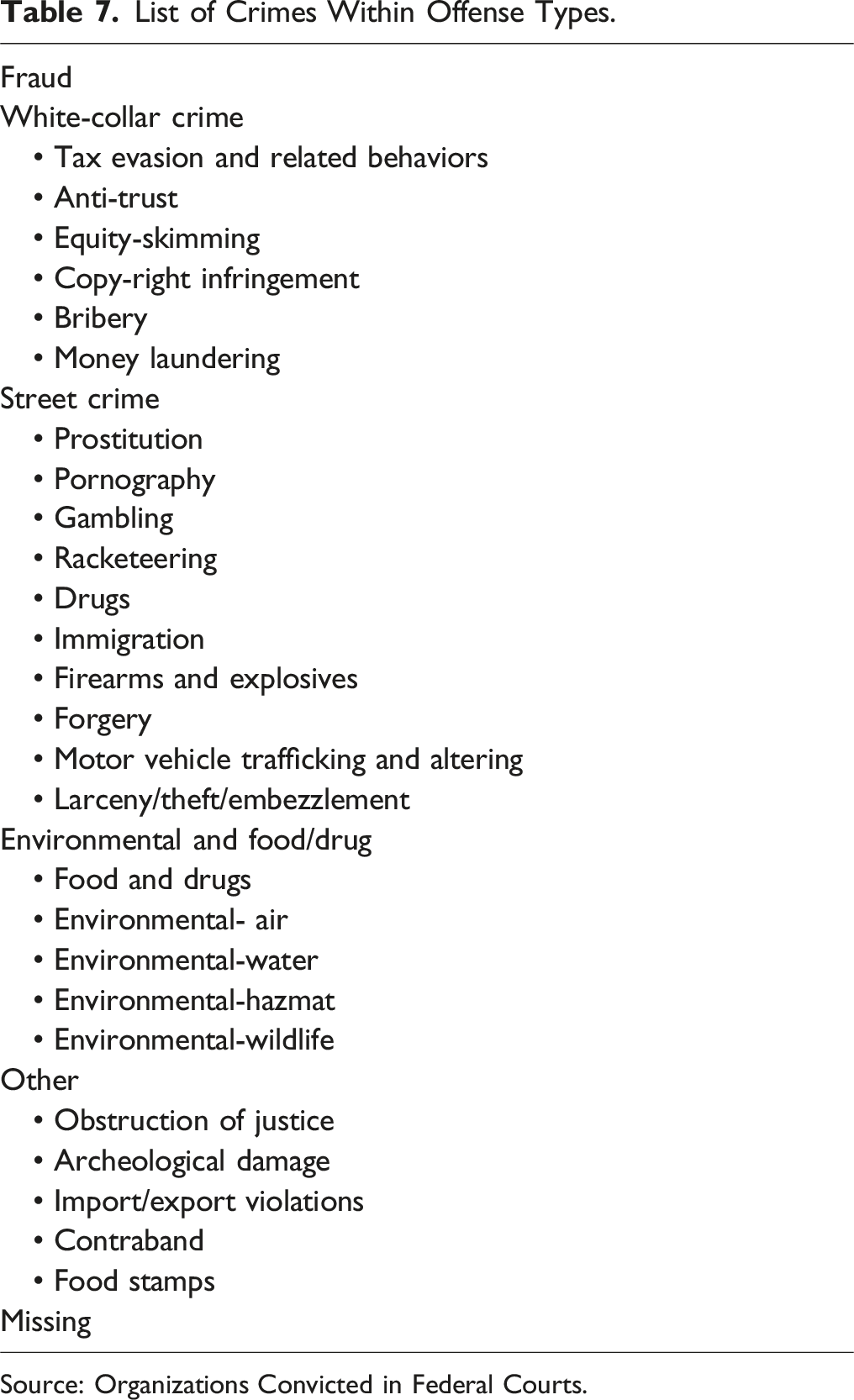
Fraud
White-collar crime
• Tax evasion and related behaviors
• Anti-trust
• Equity-skimming
• Copy-right infringement
• Bribery
• Money laundering
Street crime
• Prostitution
• Pornography
• Gambling
• Racketeering
• Drugs
• Immigration
• Firearms and explosives
• Forgery
• Motor vehicle trafficking and altering
• Larceny/theft/embezzlement
Environmental and food/drug
• Food and drugs
• Environmental- air
• Environmental-water
• Environmental-hazmat
• Environmental-wildlife
Other
• Obstruction of justice
• Archeological damage
• Import/export violations
• Contraband
• Food stamps
Missing