



Abstract
Based on the analysis of a survey among university students, the current study investigates the correlates of witness decision-making for three types of crime: white-collar crime, violent crime, and property crime. Using hypothetical scenarios, we contribute to the literature on law enforcement-citizen cooperation and white-collar criminality by (a) exploring whether witness willingness to report differs depending on the crime, and (b) separately assessing the effects of independent variables on witness decision-making. The overall level of willingness to report across hypothetical scenarios was high. Both property crime and violent crime are more likely to be reported than white-collar offenses. Irrespective of crime type those with previous contact with the criminal justice system in the last 3 years and lower level confidence in the police effectiveness expressed a lower likelihood of reporting crimes they would witness. The level of trust in the police correlated with the likelihood of reporting violent crimes and property crimes only, while sex was associated with violent crime and white-collar crime.
Keywords
Introduction
Crime reporting by civilians is a key factor in shaping officially recorded crime statistics (Tarling & Morris, 2010). Most offenses can be identified either through direct observation by the police (Skogan & Antunes, 1979) or via civilian reporting (Bennett & Wiegand, 1994). The category of civilian reporting of offenses entails not only victims but bystanders or witnesses as well. The latter source of crime reporting constitutes the core of the current paper.
A witness to an offense has at least three choices - direct intervention, indirect intervention (i.e., calling the police), and ignoring the situation (Hart & Miethe, 2008). As highlighted by Linning and Barnes (2020), witnesses have received less attention in criminological research despite being a group of civilians capable of reporting wrongdoings. Numerous analyses have shed light on the potential role of third parties in the detection of crimes, which have identified a varying degree (between 9 and 16%) of detection of crimes by witnesses (Galvin & Safer-Lichtenstein, 2018; Ministry of Justice, 2015; Schnebly, 2008). In addition to their potential role in crime reporting, Banyard et al. (2005) note that witnesses can also prevent the victim either from experiencing crime or suffering from crime more. Furthermore, the police may need information from victims and witnesses for the identification of perpetrators (van Damme, 2015).
Galvin and Safer-Lichtenstein once posited that “third-party reporters should be focal points of future reporting analyses” (2018, p.1074). Fortunately, there is a growing literature on correlates of witness reporting (e.g., Avdija, 2019; Gingerich & Oliveros, 2018; McCarthy et al., 2021; Nicksa, 2014). To the knowledge of the authors, although some studies have explored third-party crime reporting across multiple crimes (see Gingerich & Oliveros, 2018; McCarthy et al., 2021; Nicksa, 2014), none of them has separately explored predictors of witnesses’ decision-making with regard to violent crime, property crime, and white-collar crime. To our knowledge, this is the first criminological attempt to regress the same set of independent variables in three separate models for three different crime types. Adopting a comparative approach allows for the incorporation of white-collar crime alongside violent crime and property crime as dependent variables. To our knowledge, despite several studies on victimization reporting among certain crimes such as financial crimes that can be labelled as white-collar crime, (e.g. Nerenberg, 2000; Schoepfer & Piquero, 2009), no previous study has focused on reporting behavior of witnesses of white-collar crimes (the study coming close to it was done by McCarthy et al., 2021). Thus, this comparison enhances the theoretical value of this study since our understanding of the correlates of a witness’s decision to report a crime is currently limited to traditional offenses, such as violence and theft.
Coined by Sutherland (1939) to describe a form of crime perpetrated by individuals of high social status in the context of their job, white-collar crimes have been variably defined by subsequent scholars. In fact, Nelken (2012) listed seven sources of ambiguity, such as the difficulty to see ‘the criminal’ and ‘the respectable’ person in the same individual. Some have proposed an offense-based definition (Edelhertz, 1983), while others suggested a focus on the position of an offender (Reiss & Biderman, 1981). Some scholars have even argued that the law should be the sole reference point in determining whether a behavior can be considered a business deviance (Coleman, 1987). Summarising several definitions, Cliff notes that definitions usually “concentrate on either or both of the following factors: characteristics of the offender, such as social status, or positions of trust within the community and characteristics of the crime itself” (2017, p.1). What is evident from these definitions, then, is that “white-collar crime is neither a legal category nor a specific offense per se” (Simpson, 2013, p. 312). Rather, it is a criminological construct. Irrespective of the definition adopted, looking at witness behavior with regards to white-collar crimes is important in several respects.
White-collar crimes can arise out of either commission or omission of duties (Michalowski & Kramer, 2006). They “generally take place in private settings… [which is an] impediment to normal policing methods (Nelken, 2012, p. 628). Supporting this view, Clarke (1990) points to difficulty in detection not only by outsiders but even insiders such as managers and colleagues. It therefore should not be surprising to observe a rather small detection likelihood of white-collar criminals (Gottschalk, 2018). Thus, witnesses are able to thwart and/or report wrongdoings that occur “behind closed doors”. There is evidence that whistleblowers, who are in a position to witness lawbreaking among white-collar professionals, “are the single most important source of detection” (Gottschalk & Smith, 2016, p. 427). One more factor making the study of witness behavior in the context of white-collar crime is a “physical separation between the offender and victim, and the superficial appearance of legality” (Benson & Simpson, 2014, p. 247). In crimes such as burglary or stabbing, both parties interact with each other, and victims can instantly realise their victimization. White-collar crimes do not require physical proximity between parties. A food producer, for instance, may produce unsafe meals and dispatch them to consumers several miles away. The effects of consuming such subpar meals may not be felt immediately either. However, should a witness observe the production of unsafe meals, they can report it to the authorities. It is this specific position of witnesses that warrants the incorporation of white-collar crimes.
Thus, this paper’s objective is to identify whether levels of willingness among witnesses to report differ among these three crimes. Two key research questions guide the current study; (A) Do the levels of reporting willingness among witnesses vary between white-collar crime, property crime and violent crime? (B) What is the explanatory power of independent variables on witness decision-making regarding three different crime types?
This article is structured as follows. The literature on crime reporting among witnesses is presented. It is followed by a discussion of the main differences between white-collar crimes and the other two crime categories used. The subsequent section is on the context of Azerbaijan, with particular emphasis on its criminal justice system and public attitudes to it. The methodology section comes next. Following the presentation and discussion of the results, the article concludes by acknowledging the limitations of the findings.
Witness Crime Reporting
Although a significant number of studies exist on bystander intervention in the form of physical intervention, most of them focus on medical emergencies and accidents (Hauff et al., 2003; Katzev & Averill, 1984; Shotland & Heinold, 1985). Few works on the case of theft also exist (see Bickman & Helwig, 1979; DeJong et al., 1980). The literature shows that many initial studies conducted in this subject have explored direct intervention by bystanders. Thus, the presence of other bystanders (Darley & Latane, 1968), physical prowess and necessary training in intervening physically (Huston et al., 1981), type of aggression - physical or verbal (Moule & Powers, 2019), the ability of a witness to maintain his or her anonymity, and a prospect of court testimony or police investigation (Rothe et al., 2002) all have been identified as potentially relevant factors shaping decision-making of a witness. However, since the current study’s focus is on indirect intervention by bystanders, studies with similar foci will be reviewed from now onwards.
Several studies (Avdija, 2019; Felson et al., 2002) have attempted to explore the correlates of third-party reporting. On the basis of the analysis of the National Crime Victimization Survey, Galvin and Safer-Lichtenstein (2018) identified a relatively stronger influence of crime seriousness than the offender’s relationship with the victim on third-party reporting decisions. Note, the crimes covered in their analysis involved incidents of rape, sexual assault, robbery, and both simple and aggravated assaults. In the analysis of the study covering 1,343 witnesses, Linning and Barnes (2020) found that 74.4% did not report the incident to the police. The original question used in the survey asked whether respondents had witnessed or heard about serious crimes in their neighborhood including assault with or without a weapon, a sexual assault or rape, a robbery or mugging, drug dealing, or physical spousal abuse over the past 6 months. Their results suggest that higher perceptions of neighborhood social cohesion are associated with a lower likelihood of third-party crime reporting, while confidence in police effectiveness is a non-significant explanatory factor.
A survey among six ethnic communities in the US by Davis and Henderson (2003) adopts a somewhat similar approach to the present paper as it directly compares witness reporting decisions across four hypothetical offenses - muggings, break-ins, drug sales, and domestic violence. Their study concluded that ‘‘community empowerment’’ is the strongest predictor of crime reporting. The rates of reporting (likely to report) were as follows: break-ins (83%), muggings (77%), family violence incidents (71%), and drug selling (54%). Nicksa’s (2014) study of bystander willingness among 295 college students to report three different crimes to the police or campus authorities employed twelve hypothetical vignettes where the relationship with the offender and crime type varied. The results found no statistical significance for anonymity, but crime type, bystander’s sex, and bystander’s relationship with the offender all had an influence. Physical assault was the most likely to be reported, followed by theft and sexual assault. Women were more likely than men to report each crime type, and bystanders who were good friends of the offender were less likely to report it than strangers. A survey by Khondaker et al. (2015) among Bangladeshi immigrants in New York asked: “If you know someone who is involved in an illegal activity, will you inform the police?” The predominant majority (81.1%) acknowledged their willingness to report. They also found a positive association between satisfaction with the police and the intent to notify the police.
Scant research from non-Western countries is also worth looking at, for Azerbaijan is also a non-Western country. A recent study from Azerbaijan’s neighboring countries – Russia and Georgia - used hypothetical scenarios to gauge willingness to report illegality (theft of a wallet by an ordinary person and a police officer against a drunk person) to the state authorities (McCarthy et al., 2021). Two factors – the anonymity of a reporter and the severity of the crime - strongly affected the decision to report, while financial incentives showed no significant effect. The study also identified a variation in willingness to report crimes, as physical beating was more likely to be reported than stealing. Based on the examination of a large-scale household survey conducted in Costa Rica, Gingerich and Oliveros (2018) found a lower likelihood of reporting among citizens who have directly witnessed police violence. Finally, a survey of two contrasting communities within a Chinese city among 211 respondents suggests that when demographic characteristics are held constant, fear of crime, and type of community predict bystander intervention (Zhong, 2010).
In short, the literature shows the predictive capacity of several demographic and social factors in shaping the decision of witnesses regarding reporting victimization events to the police. Furthermore, unlike many criminological phenomena, witness reporting has been explored in economically developing jurisdictions as well, though none in the post-Soviet landscape the current paper covers. There is also a handful of studies comparatively exploring the level of willingness to notify the authorities. What is largely missing, however, is (a) a comparative analysis of the same set of predictors across multiple crimes, and (b) the incorporation of white-collar crimes. Nearly all studies have used interpersonal or property crimes as their dependent variables, whereas the current study adds white-collar crimes for comparison. Thus, the logical question is – how much do white-collar crimes differ from crimes of violence or acquisitive nature?
The Differences Between Crimes
As highlighted by Nelken (2012), the concept of white-collar crime is ambigious. Building on Sutherland’s offender-based definition, Reiss and Biderman (1981) argued that white-collar crimes are the ones where an individual abuses his significant power or influence for illegal individual or organizational gain. Thus, a high-ranking civil servant abusing his power to embezzle public funds would be seen as a white-collar criminal. On the opposite end, Edelhertz (1983) proposed an offense-based definition, which defined an act as a white-collar crime should it fit the following description: “an illegal act or series of illegal acts committed by non-physical means and by concealment or guile to obtain money or property, to avoid the payment or loss of money or property, or to obtain business or personal advantage” (p. 3). Embezzlement or receiving kickbacks, as well as food and drug violations, are some examples.
White-collar crimes differ from violent and property crimes not only in terms of execution but in many cases, their impacts. These differences have the potential to impact upon intent to notify the authorities of a crime one would witness. White-collar crimes against consumers tend to be invisible, as victims are usually unaware of any harm (Croall, 2009) due to the delayed victimization effect (Friedrichs, 2007). Christie (1986) and Quinney (1972) both argue that in most cases, victims of white-collar crimes do not always fit the “ideal victim” image in the way interpersonal violence and robbery that result in tangible harm do. Thus, white-collar crimes tend to have delayed victimization (Friedrichs, 2007), seemingly victimless nature and delegitimation effects on institutions (Nelken, 2012; Shover et al., 1994). The implication for crime reporting by a witness is that since they may not directly observe the victimization of someone, witnesses may not think of reporting at all. What could also deter witnesses from taking an action is the way white-collar criminals are treated. It has been suggested that the perpetrators of these crimes have a greater probability of escaping prosecution (Friedrichs, 2007; see Michel, 2015 for a discussion). As noted by Nelken (2012) and van Slyke and Bales (2013), white-collar offenders are generally treated leniently and punished less harshly, and have significantly lower chances of being criminally prosecuted and imprisoned compared with street offenders (see Michel, 2015 for a discussion), which may discourage witness reporting. Finally, unlike street crimes, these crimes can be committed by an institution, which may be more powerful than an individual to retaliate against a reporter, something that may potentially deter witness reporting.
The Context of Azerbaijan
Azerbaijan differs significantly from Western societies in many ways. Two specific governance indicators for Azerbaijan relevant to the criminal justice system are among the lowest percentile globally. While the value of the percentile rank for the control of corruption is 16.35 out of 100, the figure for the rule of law is 25.96 out of 100 (World Bank, 2020). Furthermore, the level of satisfaction of victims about the way their report was handled by law enforcement or the court is mostly low, with nearly 70% of the victims rating their experience as either “mostly poor” or “very poor” (Social Research Centre, 2020). Relatively lower public trust towards the criminal justice system has been noted by several foreign organisations (e.g., Netherlands Helsinki Committee and the Helsinki Foundation for Human Rights, 2016), as well as local researchers (e.g., Valiyev et al., 2017). Furthermore, Transparency International’s 2020 Corruption Perceptions Index (CPI) ranked Azerbaijan 129 out of 180 in a list of countries in terms of the seriousness of corruption perceived by the public (Transparency International, 2020). Despite its scale, there is evidence that local people are not unambigious when it comes to reporting corruption. A survey by Transparency International (2016) found that 21% of the participants feel undecided or unsure to report should they experience or witness corruption, while 18% acknowledged that they would not feel personally obliged to report such a transaction. The same survey also revealed that only 9% of the people engaged in bribery reported the incident to the authorities.
The reputation of the police, the institution responsible for law and order and one of the first places people generally make reports to, is tainted. This public attitude becomes ever more important in the context of contacting law enforcement to report illegal activity since the agency where the report will be made is likely to be seen as corrupt, unreliable, and even indifferent to public needs by citizens. Despite significant changes in the police, such as increases in salaries, modernisation of the infrastructure, and active use of public relations strategies, the country has not undergone radical reforms as seen in some post-Soviet states, like Georgia’s shock therapy (McCarthy et al., 2021), where the tasks of the police were downsized, and salaries increased substantially (Kakachia & O’Shea, 2012; Light, 2013).
What makes Azerbaijan particularly interesting in the context of third-party crime reporting is the deep-rooted public attitude towards engagement with the state in a post-Soviet landscape. As noted by several scholars (Rennison, 2007), not all social norms encourage reporting, and local norms in Azerbaijan may be one of them. Writing on Russia and Georgia, McCarthy et al. (2021, p. 9) point to the ambiguousness of any decision to cooperate with the state, particularly law enforcement, “which in the recent past would have been associated at least as much with regime survival as public order.” It is in this context the present survey has been conducted.
Methodology
Sample
A convenience sample of students (social work and sociology, all undergraduate) from Baku State University and Azerbaijan Tourism and Management University was chosen (n = 222). All students were at third and fourth (final) year of their study. The choice of social work and sociology courses only stems primarily from accessibility issues. Two authors of the study worked as lecturers in these universities and had access only to those courses’ cohorts. Due to its student-based sample, the authors of this study do not claim that the findings are representative of the general population of Azerbaijan. Rather, it is indicative of one subset of the general population – the student body.
The choice of a student body as the sampling unit was based on numerous theoretical and practical grounds. Several different studies had demonstrated that students are appropriate for attitudinal research and theory testing (Austin & Hummer, 1994; Gibbs et al., 2003). At least two studies on third-party crime reporting have used the student body as their samples (Avdija, 2019; Nicksa, 2014). From a practical point of view, the choice of the student body as the sampling unit was seen as viable due to the lack of funding and limited resources. No financial incentive was provided.
The choice of Baku State University and Azerbaijan Tourism and Management University was based primarily on one factor. Two authors were employed in these universities at the time of the survey; hence, the accessibility of students is a decisive factor in sample selection. These authors conducted the survey in the social sciences department. The participation rate was 75%.
Data Collection
The questionnaire was created by the authors of this paper to conduct a criminological survey covering a wide variety of issues; crime reporting per scenarios, trust in the criminal justice system, previous victimisation, previous contact with the criminal justice system, perceived level of corruption and fairness in the criminal justice system, and previous experience ensuing crime reporting. The questionnaire contained 40 items. The present data were obtained from a survey that was general in nature, having been designed to gather information about numerous crime and justice-related issues among students. The current analysis covers the responses given to variables relevant to crime reporting in general.
A self-administered online survey was employed. At the time of the survey (January–April 2022), teaching was in hybrid mode. Thus, students in some courses were invited to a virtual meeting, while on other classes, one of the authors was present in the class. Participation in the survey was voluntary. In both cases, a link to a web-based survey containing the questionnaire was shared. All the responses were anonymous. That the self-administered online survey was employed has two advantages in the current survey. First, writing on Azerbaijan, Sadigov and Guliyev (2018, p. 87) warn of the “reliability of survey data on regime-related attitudes obtained by public polling in societies with limited freedoms.” Given that trust in law enforcement, perceived fairness of the criminal justice system and corruption-related issues may be connected to government policy, some respondents may have felt reluctant to express their genuine opinions had their answers and identities been possible to be matched. This possibility was eliminated with the self-administered online survey. Secondly, the self-administered online survey allowed respondents ample time to think and reflect before answering, which was especially important in certain elaborate questions. The average duration of the survey was approximately 18 minutes.
Dependent Variable
The dependent variable in this study is the decision of a respondent to report others’ criminal behavior to law enforcement on the basis of hypothetical scenarios. 9 crimes are presented as scenarios. Per scenario, on a scale of 1 to 5, a respondent was asked “how likely is it that you would report it to the relevant authorities?”, and the scale was - 1 (very unlikely) to 5 (very likely). “Not sure” (coded (3) was added as well. To note, presenting scenarios to gauge the actions people might take if they were to witness a crime has been previously employed by other researchers (Gingerich & Oliveros, 2018; McCarthy et al., 2021; Nicksa, 2014; Zhong, 2010). It is important to note that for all scenarios, respondents were presented with the following conditions: (a) you are the only witness of the offense, and (b) your anonymity is guaranteed. There was no randomization of the two conditions, as all respondents received the same set of conditions for all scenarios.
Since white-collar crimes constitute the focus of the present paper, it is worth briefly discussing its operationalization and conceptualization. As already discussed, white-collar crime does not have a universally accepted criminological definition. It is not a legal category either (Simpson, 2013). What further complicates the matter is the absence of conceptual agreement about the measurement of white-collar crime (Simpson, 2013). For operationalisation purposes, nonetheless, the present study adopts the definition proposed by Edelhertz (1983, p. 3): “an illegal act or a series of illegal acts committed by nonphysical means and by concealment or guile to obtain money or property, to avoid the payment or loss of money or property, or to obtain personal or business advantage.”
The current survey presented 9 scenarios to the sample, which raises a question – what was the basis of the choice of these 9 particular offenses? The white-collar crimes presented to the sample in the current study are of different natures as one covers financial crime (bribery), while the other two involve the violation of health and safety regulations, as a result of which consumers could physically suffer. While all would fit the concept of a white-collar crime, their impacts on victims vary. The bribery case involves the grant of permit construction, which, otherwise, would not have been granted. One could argue that it has three components discussed above – (a) delayed victimization and seemingly victimless nature because it is impossible to ascertain whether and when the illegal construction will induce harm to others; and (b) delegitimation effects on institutions because it undermines the legitimacy of the relevant authorities. In other scenarios where a businessman sells counterfeit vehicle parts that are potentially hazardous to the safety of drivers/passengers, and a kebab shop owner deliberately uses meat that is not safe to consume anymore, the wrongdoings similarly may have delayed victimization. In all cases, victims may not be aware of their victimization. Violent and property crimes, on the other hand, involve immediate victimization, while the impacts also vary between scenarios.
Independent Variables
Descriptive Statistics for the Variables.
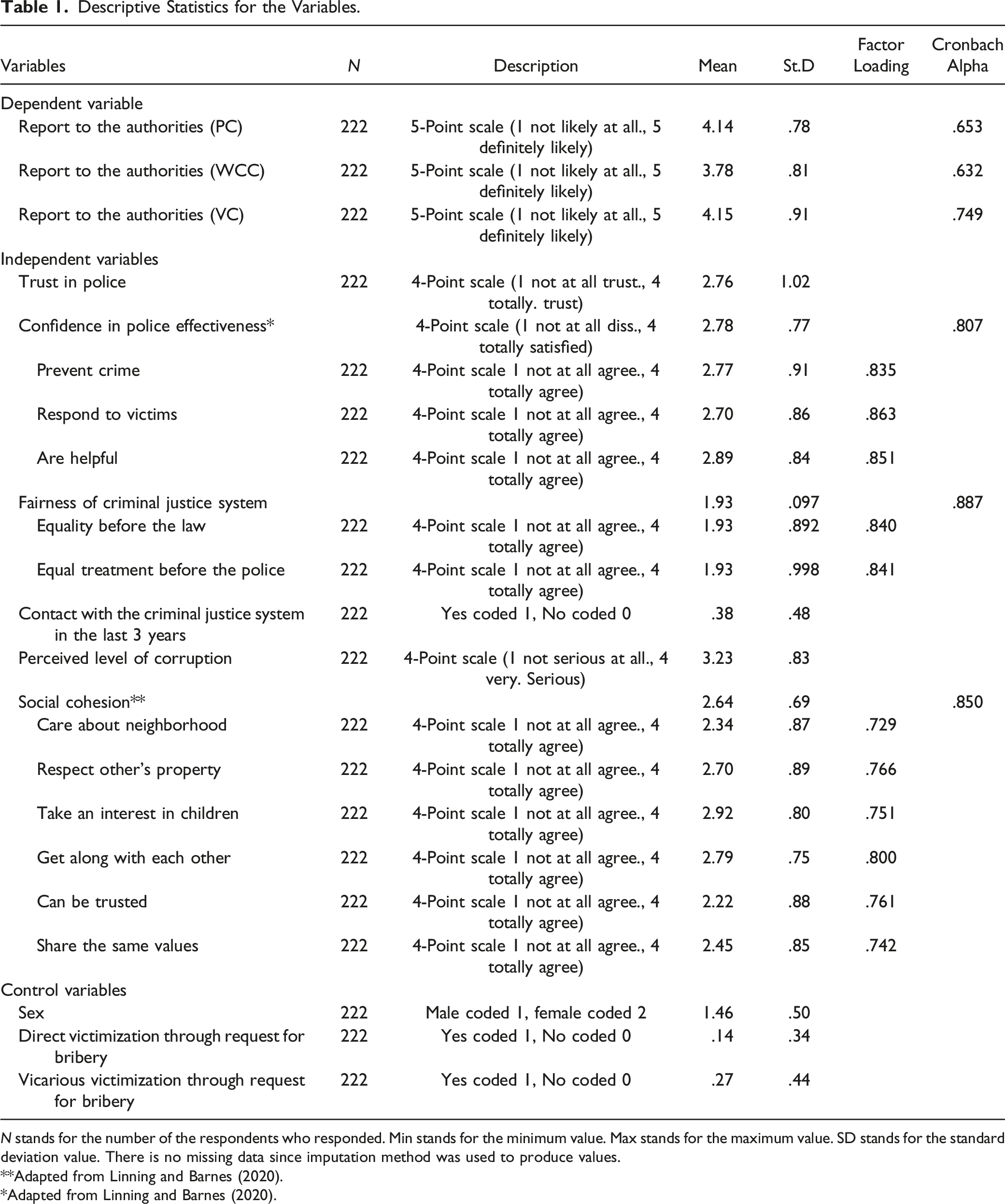
N stands for the number of the respondents who responded. Min stands for the minimum value. Max stands for the maximum value. SD stands for the standard deviation value. There is no missing data since imputation method was used to produce values.
**Adapted from Linning and Barnes (2020).
*Adapted from Linning and Barnes (2020).
Analysis
Since the dependent variable was ordinal, and three different crime types were analyzed, three separate ordinal logistic regression models were run. Before regression models, four assumptions must be met. The dependent variable measured in this analysis is ordinal, and there are ordinal and categorical independent variables. To test for multicollinearity, variance inflation factors (VIF) and tolerance values were computed. The tolerance values were all greater than .5 and VIFs were all greater than .2 1 , which suggests little concern for multicollinearity across the independent variables. Then, a test of parallel lines test was run to find whether the assumptions for an ordinal logistic regression are met.
Prior to running regression analyses, data were checked for missing values and assumptions. As to missing data, only a handful of items had missing data, and all were far below the tolerance levels of 5% and 10% suggested by Schafer (1999) and Bennett (2001) respectively. As the sample size was already relatively lower, and not more than 1% of missingness was recorded for any response, these cases were not dropped. Before imputation, Little’s MCAR test was run to see whether there is any pattern to nonresponse. The results suggested an absence of statistically significant differences (p ≥ .5). Finally, as three variables - social cohesion, perceived fairness of the criminal justice system and confidence in police effectiveness to be included in the model were constructs based on multiple items, a principal component factor analysis was conducted to determine the optimal number of components and reduce final data, for which the results are shown in Table 1.
Results
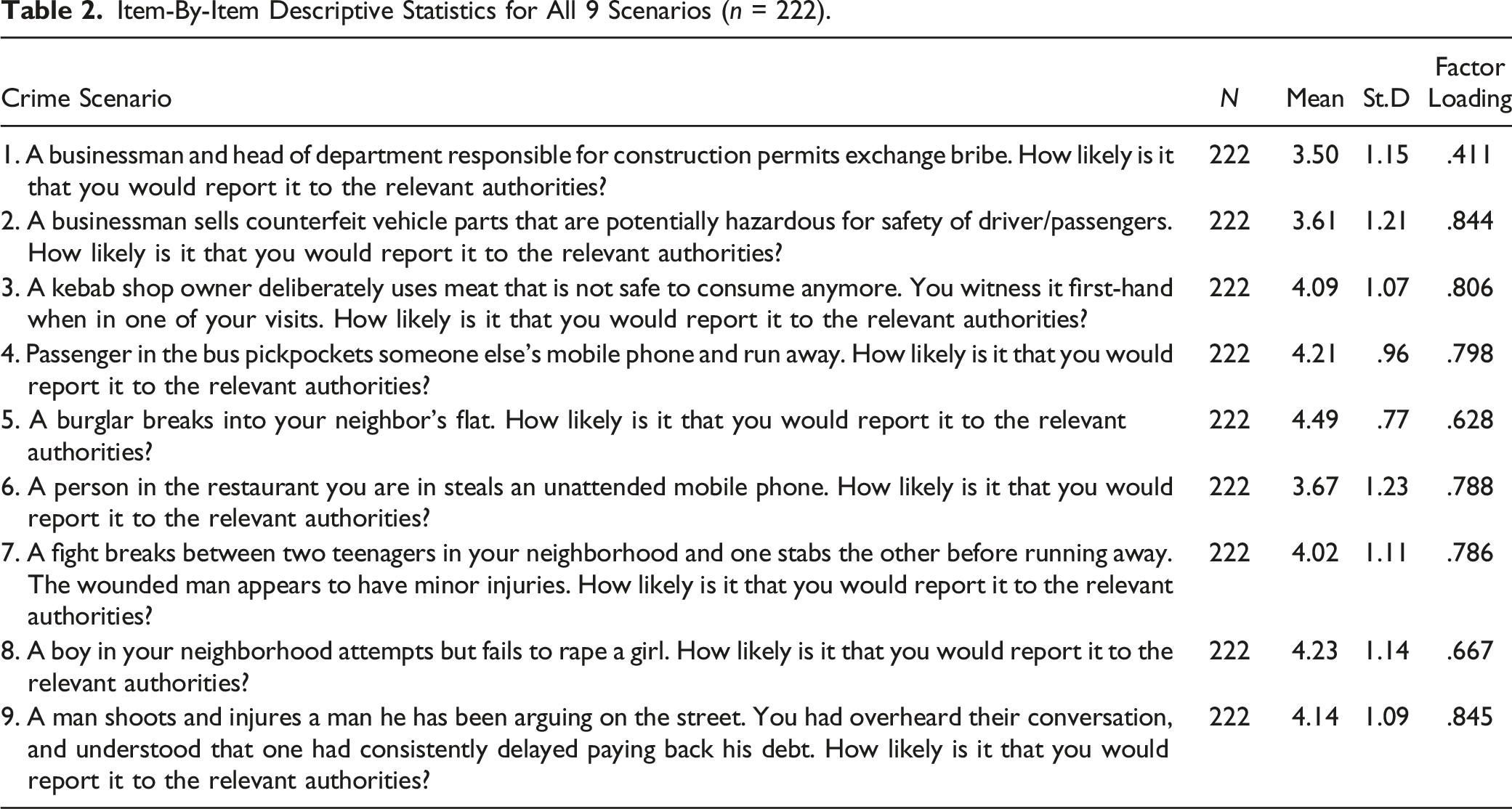
Item-By-Item Descriptive Statistics for All 9 Scenarios (n = 222).
Bivariate Analysis for all Variables.
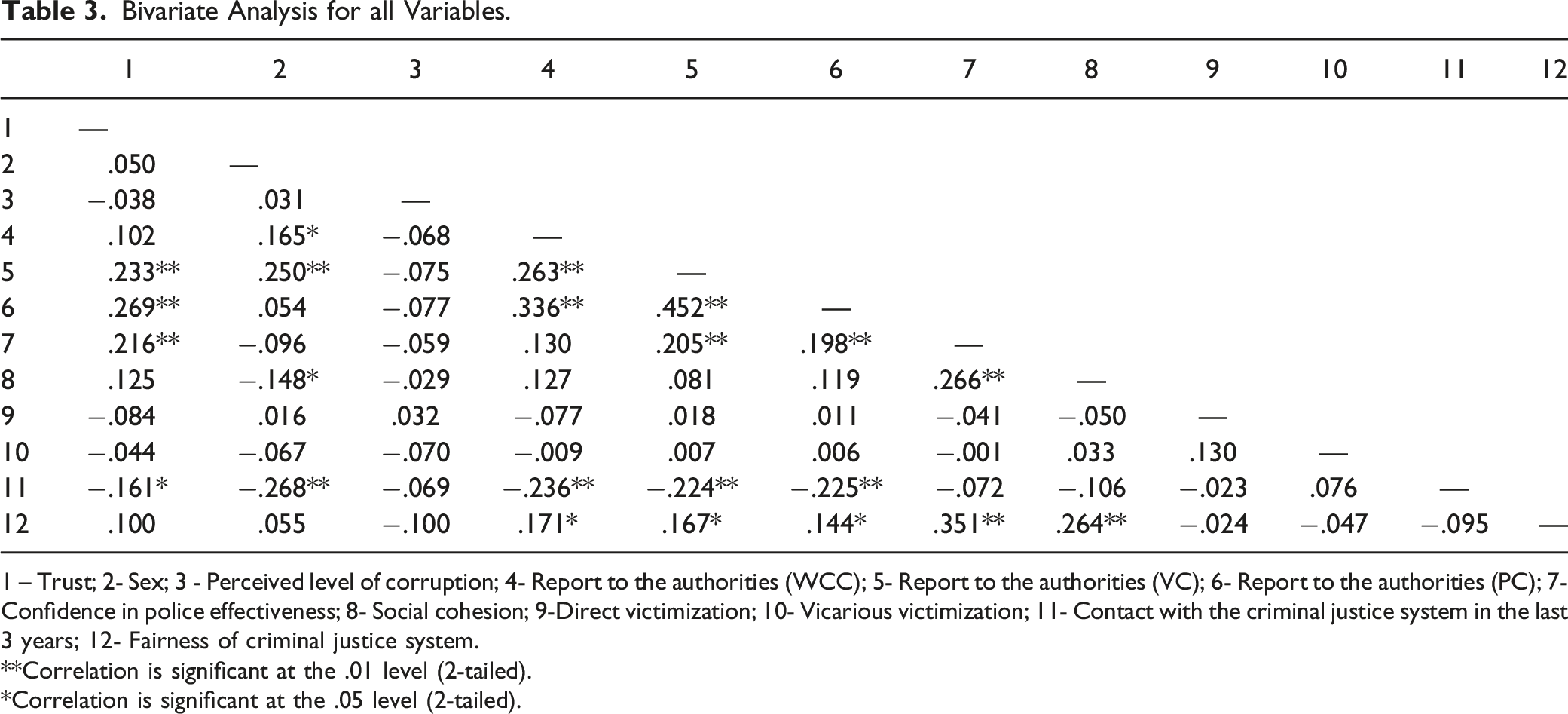
1 – Trust; 2- Sex; 3 - Perceived level of corruption; 4- Report to the authorities (WCC); 5- Report to the authorities (VC); 6- Report to the authorities (PC); 7- Confidence in police effectiveness; 8- Social cohesion; 9-Direct victimization; 10- Vicarious victimization; 11- Contact with the criminal justice system in the last 3 years; 12- Fairness of criminal justice system.
**Correlation is significant at the .01 level (2-tailed).
*Correlation is significant at the .05 level (2-tailed).
Principal components factor analyses for three indices – social cohesion, perceived fairness of the criminal justice system and confidence in police effectiveness generated a one-factor solution in all cases. As Table 1 shows, for social cohesion, Bartlett’s Test of Sphericity value was less than .01, and the Kaiser-Meyer-Olkin (KMO) measure of sampling adequacy was .847, which is above the suggested threshold value of .60 (see Kaiser, 1974). Among 6 components, one component had Eigenvalue (Cattell, 1966) greater than 1, which explains 57.6% of the variation. All components had factor loadings between .729 and .800. As to the police effectiveness construct, Bartlett’s Test of Sphericity value was less than .01, and the Kaiser-Meyer-Olkin (KMO) measure of sampling adequacy was .712. One component had an Eigenvalue greater than 1, which explains 72.2% of the variation. Reliability analyses generated Cronbach’s alpha values of .807 (confidence in police effectiveness), .887 (fairness of the criminal justice system) and .850 (social cohesion). A principal components factor analysis for perceived fairness of the criminal justice system also generated a one-factor solution, and one component explained 84% of the variation. KMO measure of sampling adequacy – .50 was slightly below the suggested threshold value of .60, but Bartlett’s Test of Sphericity value was less than .001. Regarding factor loadings, Stevens (2002) suggests that for a sample size of 200, the loading size should be greater than .364 for it to be considered significant. Thus, the factor loadings achieved in the current study exceed this threshold.
Finally, as to the dependent variable, each crime category had three scenarios. Three crime categories were constructed based on the combination of the responses to the respective three scenarios. Cronbach Alpha values differ notably, and two of them are lower than the .7 level suggested by Kline (1999). While we acknowledge it as a potential sign of weak internal consistency of items, it is somewhat understandable given that these scenarios present different vignettes. Tavakol and Dennick (2011) see heterogeneous constructs as one of the causes of low value of alpha, which we believe to be the primary cause for the value observed in white-collar crime scenarios. Mean scores for two white-collar crime scenarios, as seen in Table 2, are rather similar, while the score for the scenario involving the deliberate use of unsafe meat is relatively higher. It may be due to the differential perceived consequences of these three offenses. The scenario with the highest score of reporting intention is the one that, at face value, is more likely to induce physical harm to people consuming food. Overall, instead of running 9 regression models for each crime, creating 3 indices for different crime categories was deemed as a more practical option.
As to the principal component analysis of the responses given to scenarios, all factor loadings achieved exceed the threshold mentioned earlier. Again, a one-factor solution was generated for all crime categories. The principal component analysis for three crime categories are as follows; violent crime (eigenvalue1 = 1.777, variance 1/59.24%, KMO = .603, Bartlett’s Test of Sphericity = p < .001), property crime (eigenvalue1 = 1.653, variance 1/55.08%, KMO = .601, Bartlett’s Test of Sphericity = p < .001) and white-collar crime (eigenvalue1 = 1.532, variance 1/51.05%, KMO = .520, Bartlett’s Test of Sphericity = p < .001).
Regression Outputs
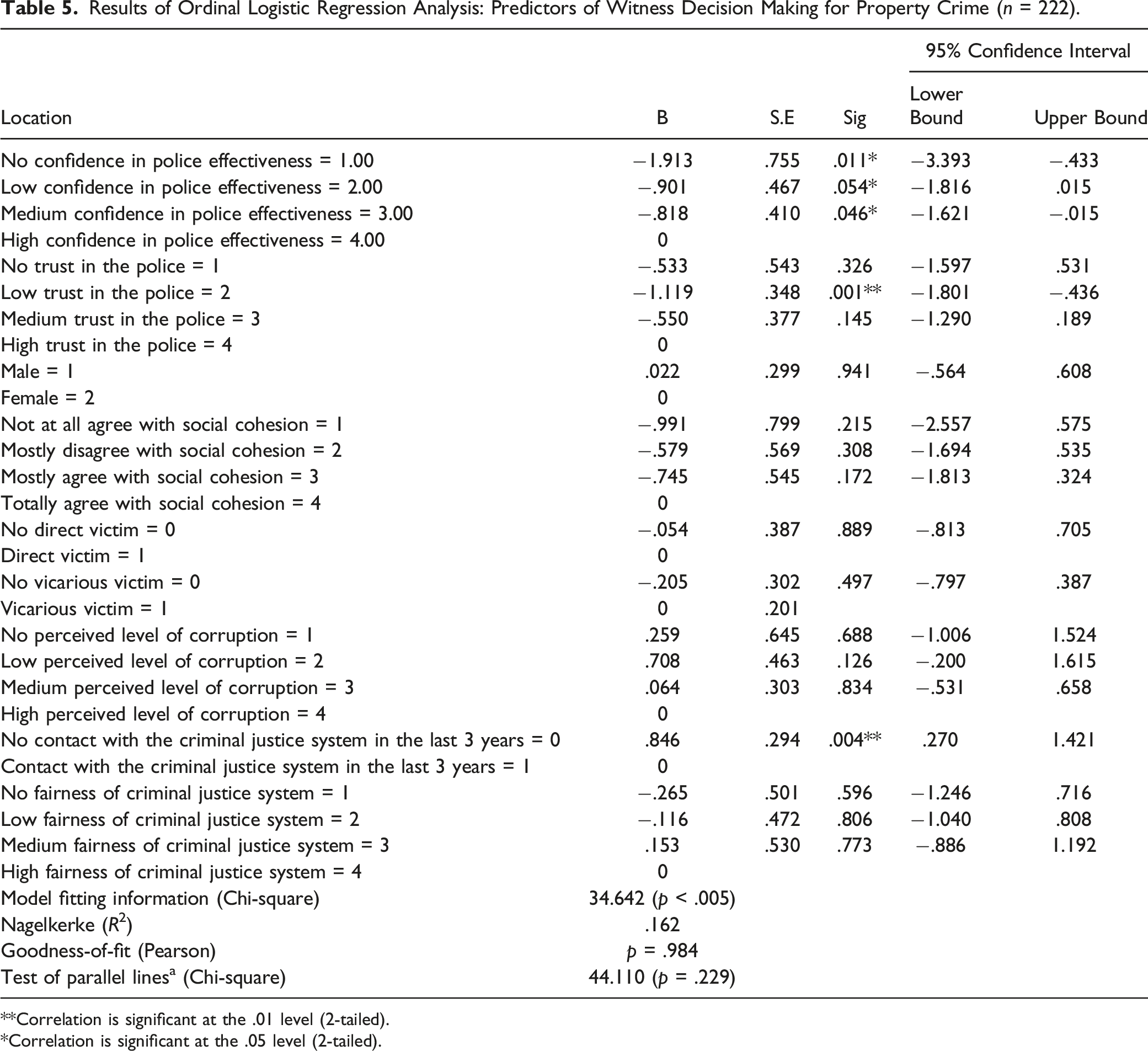
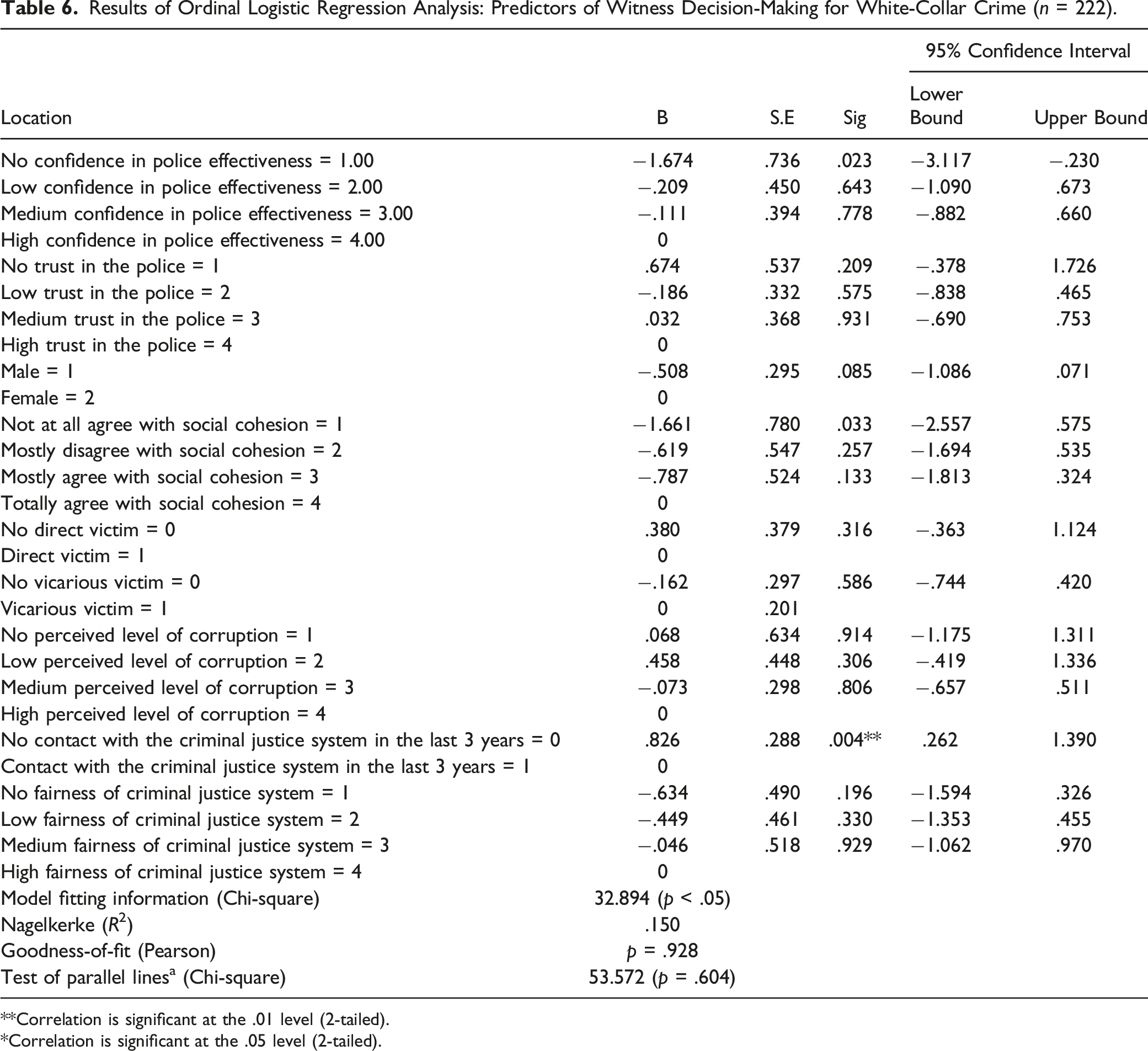
Next, ordinal regression was used to analyze the relationship between a single dependent variable (ordinal) and multiple independent variables. Before running an ordinal logistic regression, we tested several assumptions for the analysis to be reliable and valid. The results of a test of parallel lines for all three models suggest that the proportional odds assumption is met since the p-value was greater than .05 in two models, and almost equal to .05 in one model. The significance level of goodness of fit tests for all three models was greater than .05 as well, whereas model-fitting information results indicate a good level of fit between the model and data (p values ranging between .003 and .025).
Results of Ordinal Logistic Regression Analysis: Predictors of Witness Decision-Making for Violent Crime (n = 222).
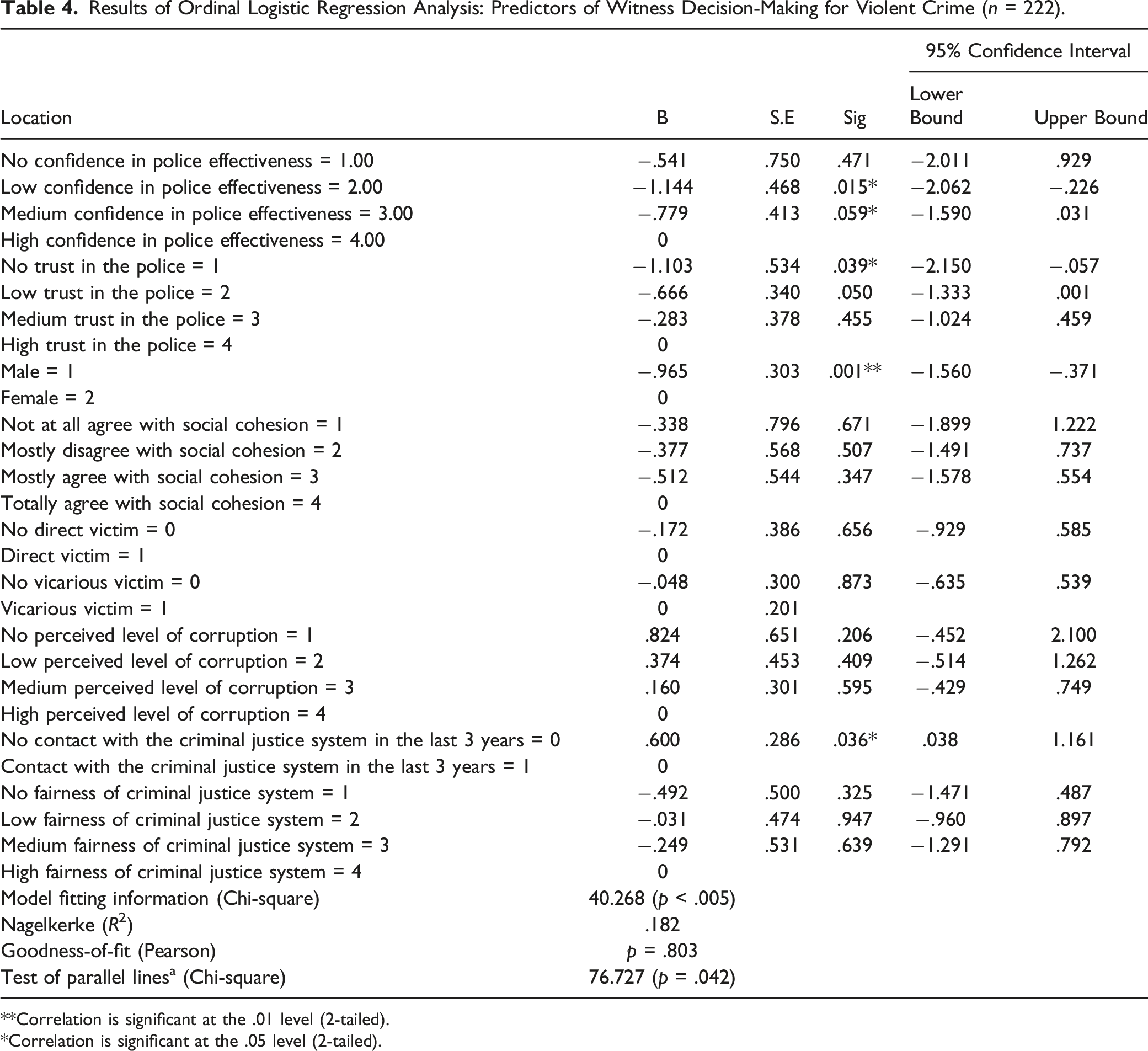
**Correlation is significant at the .01 level (2-tailed).
*Correlation is significant at the .05 level (2-tailed).
Results of Ordinal Logistic Regression Analysis: Predictors of Witness Decision Making for Property Crime (n = 222).
**Correlation is significant at the .01 level (2-tailed).
*Correlation is significant at the .05 level (2-tailed).
Results of Ordinal Logistic Regression Analysis: Predictors of Witness Decision-Making for White-Collar Crime (n = 222).
**Correlation is significant at the .01 level (2-tailed).
*Correlation is significant at the .05 level (2-tailed).
Discussion
As argued by Tyler (2012, 77), “a citizen’s decision to inform the police of crimes they have witnessed or experienced is a critical juncture in the criminal justice process…“. The current study identified a greater level of intent among 222 Azerbaijani students to notify the authorities of all crime categories presented, a similar finding reported in different jurisdictions among various population groups (e.g., Davis & Henderson, 2003; Khondaker et al., 2015; Nicksa, 2014). Thus, one could argue that irrespective of jurisdiction and demographic group (general population or subsection of general population) people, at least in theory, are willing to inform the authorities and exercise informal control. Nonetheless, the fact that self-reported willingness is high does not necessarily translate to actual preparedness to report. Thus, Linning and Barnes (2020) found that 74.4% of witnesses did not report the incident to the police. A vignette study on reporting cybercrimes to the police also produced a similar result, where while nearly two-third of the respondents indicated reporting the cybercrimes in the vignettes, a mere 13% of victims made a report to the police (van de Weijer et al., 2020).
While self-reported willingness is generally high among our student sample, the mean scores indicate an important difference between crime types. Property crime and violent crime are more likely to be reported than white-collar offenses, which is one of the major contributions of this paper to the literature not only on law enforcement-citizen cooperation but also on white-collar criminality. As noted previously, our understanding of witnesses’ decision-making is currently limited to traditional offenses, such as violence and theft, and thus, whether witnesses would behave (under hypothetical circumstances) differently in the case of white-collar criminality is unknown.
This difference can be explained by several factors. One possible explanation is that since white-collar offenses may not have direct victimization and be financial, not physical, in terms of their harm (Friedrichs, 2007; Shover et al., 1994; Nelken, 2012), some respondents in our study may have not considered them serious enough to report. That the crime seriousness affects decision-making in reporting among victims has been proven in numerous studies concerning victims (Laner et al., 2001; Rennison, 2007; Rothe et al., 2002; Schnebly, 2008; Tarling & Morris 2010), and thus, could well be an influential factor among witnesses too. This explanation is supported by an item-by-item analysis of white-collar offenses. Among those presented in the questionnaire, a relatively lower level of cooperative intent was attained for bribery than the other two crimes that could physically harm people (selling counterfeit vehicle parts and defective food).
Alternatively, since the perpetrators in all scenarios were enterprises, some respondents may have assumed them to be financially capable of avoiding police and prosecution through bribery or the use of informal connections, something not uncommon in Azerbaijan where corruption is relatively more serious and the justice institutions tend to suffer from external interference. Indeed, a student-based study by Tankebe et al. (2019) specifically measuring cooperation with the police against corruption found that the participants feeling that a corrupt official faces a risk of arrest were more likely to provide information to the police. A recent analysis by Hinks (2020) confirms the “effectiveness” of these corrupt practices in influencing the outcome of the justice institutions. Thus, the observation that -collar offenders are generally treated leniently and punished less harshly (or, perhaps, not punished at all) may partly explain the mean differences in the level of intent to report between the three crime categories.
What about the predictors of decision-making among witnesses? Evidently, contact with the criminal justice system plays an important role, regardless of the crime category. These findings were expected, given the evidence on the role of the previous contact in shaping one’s assessment of law enforcement (Jackson et al., 2012; Skogan, 2006; Viki et al., 2006). It suggests that people with contact experience may have come to believe that law enforcement will not handle their report in the way they would like, because of what happened to them in the subsequent handling of their case by the police in the past. Speaking specifically of Azerbaijan, a recent survey found that nearly 70% of the victims rated their experience with their police report as either “mostly poor” or “very poor” (Social Research Centre, 2020). Thus, our findings overlap with many previous studies where victims with previous contact with the criminal justice system (especially the police) were less likely to report their victimization. When examining contact experience’s effect on trust, Boda and Medve-bálint (2017) highlight the importance of distinguishing those who reported negative personal experiences from those who were satisfied with how the police treated them. Although the current survey did not distinguish between bad or good experiences among those with previous experience of contact, both police-related items were police-initiated, while participation in court could be a result of either police or citizen-initiated procedures. Thus, with regards to police-related items, one may assume that they may have likely resulted in poor experiences and thus reduced self-reported intent to cooperate across scenarios in the questionnaire. Indeed, relatively outdated evidence from other developing countries – Russia and Pakistan - with similar characteristics to Azerbaijan show that such could be the level of citizen distrust in the police that some people would actively avoid police contact (Levada Center, 2004 cited in Semukhina & Reynolds, 2013; Muhammad & Conway 2005). The presence of such an attitude is plausible in Azerbaijan as well. Another explanation may be related to the proposition put forward by van Damme (2015), who points to the tendency of generalizing among people with previous contact, who, due to their bad experience with a specific police officer, may assume that the whole police organization is bad. Furthermore, given the degree of corruption in the local criminal justice system, as well as issues with the way police forces operate (Mehdiyev, 2021), evidence of the depressing effect of vicarious exposure to corruption (Tankebe et al., 2019) and bad experiences with the police in the past on cooperative intentions (Boateng, 2016), our findings become rather understandable.
In the same way as contact with the criminal justice system, confidence in the police predicts decision-making across hypothetical scenarios, regardless of the crime category. This result contrasts with the findings reported by Linning and Barnes (2020) but is in line with a number of papers (Jackson et al., 2012; Tankebe, 2009) concerning crime reporting among victims. Trust, on the other hand, was a statistically significant predictor of violent and property crimes. Many studies have found that lower trust reduces reporting likelihood (e.g., Boateng, 2016; Bradford & Jackson, 2016; Gibson et al., 2010; Hough et al., 2010; Jackson et al., 2012; van Damme, 2015), and thus our findings overlap with them. The convergence of the results suggests that regardless of whether a person himself or someone else is on the receiving end of criminal behavior, the likelihood of an illegal act being reported is low among those with lower trust. However, it is worth pointing out the irrelevance of the trust in the police as an effect on reporting the likelihood of white-collar crimes. While our data do not allow us to understand the motives, one potential explanation is the way white-collar crimes are handled by the authorities. As is the case in many countries, white-collar crimes generally fall outside the jurisdiction of the police in Azerbaijan. Perhaps, it is the trust and/or confidence in regulatory agencies that have more influence on respondents’ intent to report white-collar crimes.
The sex of a participant was significant, though it was relevant only for violent crimes and white-collar crimes. Female students expressed a greater degree of propensity to inform the authorities in the event of witnessing an illegal activity. The existing literature on bystander intervention is rich with studies exploring the influence of sex, though findings are mixed in nature. While some have found the effect of sex (e.g. Nicksa, 2014), others (e.g. Davis & Henderson, 2003) have reported the opposite. Our findings on the effect of sex on witness reporting also resonate with those concerning victims (Goudriaan et al., 2006; Slocum et al., 2010, among others). While one possible explanation of this difference can be linked to the notion of women being more altruistic, caring, and nurturing than men (e.g., Eagly & Crowley, 1986), one may also argue that women may feel physically less prepared and brave to intervene directly out of fear of potential retaliation or unintended harm inflicted by the parties involved; hence, a greater propensity to notify the authorities.
Overall, what does this study tell us? That the contact with the criminal justice system was significant in all three models suggests a need for the local police and court system to improve their relations with the citizens they come into contact with. Over the last few years, the authorities in Azerbaijan have initiated various transparency-increasing measures and adopted anti-corruption campaigns. For example, the Ministry of Interior has an active social media presence through which it interacts regularly with the media and members of the public. This is a significant change in a country where The Ministry of Interior had long been absent from social media. On the anti-corruption front, the Office of the General Prosecutor underwent important structural changes in 2011 (Prosecutor General’s Office, 2023). More recently, several high-profile heads of the local executive council were arrested by the State Security Service on the charges of embezzlement of public funds and corruption, offenses that would fall under the umbrella of white-collar crimes. Our findings, however, suggest that if the authorities want the public to have a more positive image of them, and inform them of the wrongdoings they would witness, the quality of citizen-officer interactions needs to be improved.
Regarding specifically white-collar crimes, as already noted, these crimes tend to take place in private settings, away from the public gaze. Thus, one could argue that this is where the cooperation of the witnesses with the police and law enforcement, in general, is most needed. However, the data indicate that the level of intent to notify the police is lowest exactly for white-collar crimes. For policymakers, this indicates that citizens may not always be relied on to provide information about crimes that occur in private settings. Nonetheless, looking at the full side of the glass, overall, a relatively greater proportion of the sample are willing to cooperate with the police in this regard should a need arise.
That the model employing white-collar crimes as the dependent variable had the lowest explanatory power may indicate that there are possibly other omitted variables that would have provided a further explanation for the differences in the results. In other words, lower explanatory power can be interpreted as a sign of the different nature of white-collar crimes. As already discussed, our data suggest that crime seriousness is important in shaping witness decisions. Thus, features such as delayed victimization or absence of immediate physical harm are some of the key differences between white-collar crime scenarios and other crime scenarios in the present survey. Moreover, the absence of variables such as trust and/or confidence in regulatory agencies in the model may be one of the reasons, for it is these agencies that usually deal with crimes of businesses and organisations in general. Finally, as already noted, it is possible for some people to not view white-collar crimes as an illegal activity in the first place, for reasons such as the difficulty to see ‘the criminal’ and ‘the respectable’ person in the same individual (Nelken, 2012). Violent crimes and property crimes, on the other hand, are usually seen as crimes unequivocally.
A final point to make about this paper’s contribution is related to crime reporting among victims. Though less studied relative to violent crime and property crime reporting among victims, there is literature on reporting behavior among victims of various financial and economic crimes. These studies (Kane & Wall, 2006; Schoepfer & Piquero, 2009; Shahbazov et al., 2023; Van Wyk & Mason, 2001) have focused primarily on fraud and revealed various rates of reporting. As to correlates of reporting behavior, Shahbazov et al. (2023) and Mason and Benson (1996) found no effect of socio-demographic traits. The extent of financial loss (Shahbazov et al., 2023) and social support in the form of information from others (Mason & Benson, 1996) are some of the correlates affecting reporting behavior. The present paper adds to the literature on white-collar crime reporting but does so by looking at the behavior of witnesses. What the present study found with regard to correlates differs from previous studies. Unlike the studies discussed above, our survey revealed the significance of contact with the justice system and confidence in the police as predictors of reporting behavior among witnesses.
Limitations and Further Research
The authors acknowledge several limitations of the current study. A hypothetical scenario-based approach suffers from a core limitation. From a validity point of view, as respondents were asked to state their decision on hypothetical scenarios rather than actual events, some participants may have answered the questions in a way that is perceived favorably by others due to social desirability bias, therefore potentially skewing the results in favor of willingness to report an offense. Some scholars even warn against the use of self-reported accounts in victimization research, particularly on the role played by bystanders (Philpot et al., 2019). Indeed, our data suggest that the results should be interpreted with caution. Thus, the fact that the sample had a very low rate of reporting in the past but a notably higher level of willingness to report across hypothetical scenarios indicates a potential influence of social desirability bias on responses. Nonetheless, as noted by Laner and colleagues (2001), this approach “reveals general tendencies of how their behavior would vary in response to similar variations in real situations”. In fact, Bickman and Helwig (1979) found that a consistent and statistically significant predictor of actual intervention behavior was the respondents’ predicted willingness to intervene in an earlier hypothetical scenario.
There is another limitation stemming from the way scenarios were presented. While all scenarios stated that “your anonymity is guaranteed”, it did not state whether a respondent knows the offender. We acknowledge it as a limitation since the previous research has shown the impact of knowing the offender on witness reporting (McCarthy et al., 2021). One more potential limitation of the wording of the scenarios is related to white-collar crimes. Unlike most traditional offenses, many white-collar crimes are dealt with by the agencies outside law enforcement sphere, such as financial regulatory or health and safety agencies. It is possible that some respondents may have expressed unwillingness to report white-collar crimes in scenarios on the assumption that they do not fall into the jurisdiction of law enforcement. Finally, the scenarios presented differed in terms of the ultimate harm they either incurred or could incur on the victims, which makes it challenging to identify the impact of the severity of victimization on the dependent variable.
Speaking of the questionnaire, we acknowledge the omission of potentially significant variables that could have impacted the level of reporting willingness. For instance, another study focusing on third-party intervention found negative impact of fear of criminal retaliation on their willingness to report crimes to authorities (Avdija, 2019), a variable that had been omitted in the present study. There is also evidence from deterrence literature showing that perceptions of the certainty of apprehension for corrupt behavior (Tankebe et al., 2019) can shape cooperative intentions – if people believe that a criminal act is likely to be detected by the authorities, they become more likely to inform the authorities. The current survey did not measure perceived deterrence, a limitation we acknowledge.
As already noted, we acknowledge low Cronbach Alpha values as a potential sign of weak internal consistency of items. The implication is that the indices created may not reliably represent the attitudes to 9 crimes. Future studies should take a more cautious approach in devising scenarios to avoid the problem encountered in the present analysis.
Sample wise, the survey has been conducted among students at two urban universities, meaning that the results cannot be generalized to the whole population or to the student population. A number of non-criminological studies (e.g. Wild et al., 2022) highlight significant differences between the student body and the general population in terms of representativeness. Thus, a survey among general population could have produced different results, since, for instance, nationally representative sample would include people of greater variety compared to students at two urban universities. Indeed, as the sample is made up of students only, the findings are not representative of the general population of Azerbaijan. The current sample, thus, has low demographic diversity (i.e. no employed, middle-aged or married respondents). That the social work and sociology courses were covered only is another limitation we acknowledge. It is not impossible that, for instance, the inclusion of law and criminology students as well could have produced a different overall outcome. That is, given their relatively higher familiarity with crime and law, law and criminology students’ reported level of willingness could be different to their peers at social work and sociology courses.
Thus, a future survey covering samples from different universities in urban and rural areas or based on a nationally representative sample is warranted. In terms of response validity, despite the absence of an interviewer and the anonymous nature of the survey, the authors still feel that certain questions may have been answered in a dishonest way by some respondents. Azerbaijani scholars Sadigov and Guliyev (2018, p. 87) warn of the “reliability of survey data on regime-related attitudes obtained by public polling in societies with limited freedoms”. Given the presence of several politically sensitive questions and their relation to the regime, such as the trust in and perception of law enforcement agencies and courts, some students might have felt reluctant to express their genuine opinions on particular matters.
Footnotes
Acknowledgments
The corresponding author dedicates this article to his late grandfather, Mr.Fattah Heydarov.
Declaration of Conflicting Interests
The author(s) declared no potential conflicts of interest with respect to the research, authorship, and/or publication of this article.
Funding
The author(s) received no financial support for the research, authorship, and/or publication of this article.
