



Abstract
China has established the largest higher education system in the world and made great efforts to find an effective quality assurance mechanism through a series of policies and reforms. This article focuses on the external quality assessment (QA) schemes of higher education in China. It illustrates the evolution of Chinese QA policies and explores the dynamics behind the policy evolution using the theoretical lens of punctuated equilibrium theory. Based on policy text analysis and in-depth interviews with policy implementers and consultants, it finds that the QA policies in China went through long periods of stability and two rapid changes. The policy evolution was driven by the changes in both policy image and policy venue. The change from a positive policy image to a negative one, accompanied by the transfer of policy venue, led to the collapse of previous policy stability and drove the emergence of new policies. As a result of continuous methodological experimentation, diverse QA instruments have been established.
Keywords
Introduction
The new demands of mass systems of higher education and the emerging environment of global academic competition are altering the traditional ways of assuring academic standards in universities (Dill & Beerkens, 2013). A formal system of external quality assessment (QA) in higher education has become a widely used, global practice. At the same time, questions related to the aims of the system, its effectiveness, and costs regularly emerge, and the search for the most effective QA system continues (Beerkens, 2015). China is currently facing this exact situation. Since its birth a century ago, Chinese higher education has gradually shifted from its elitist roots and has now embarked on an internationally recognized path of massification. China currently has the largest higher education system in the world. In 2024, 48.46 million students were enrolled in Chinese higher education institutions (HEIs) (Ministry of Education (MOE, 2025)). Furthermore, since the mid-1990s, the Chinese government has started a series of programs to build world-class universities and disciplines (State Council, 2015). Accompanying the rapid growth of the higher education system and the process of developing world-class universities, quality has become a central focus in the public debate about higher education since the end of the 1990s. Based on continuous policy design and reforms, an array of quality assurance schemes of higher education has been established.
As a result of the rapid economic growth in China, the Chinese development model has received significant attention. The Chinese model of higher education development, characterized by a rapid expansion of enrollment, led to significant concerns over its quality and ways to assure it; this model and its critiques are certainly relevant to other developing countries experiencing similar situations. This research intends to explore how China, with the largest higher education system in the world, developed its QA system. It is expected that the experience and lessons drawn from Chinese QA practices can be extended to other contexts, including other Asian economies and countries in the global South. Furthermore, the question of what has driven the Chinese QA policy evolution has not been fully answered. The dynamics of Chinese QA policy evolution that we found are also helpful for worldwide research on quality assurance since the literature that goes beyond the American and European contexts is still scarce. This article will first illustrate the evolution of Chinese QA policies. Specifically, the questions of who evaluates what and how is addressed. Then, the dynamics behind policy change are explored with the help of the lens of punctuated equilibrium theory (PET). Ultimately, the question of what forces have driven the origin and change of QA will be answered.
Theoretical Framework
The first-generation policy process models developed in the middle of the twentieth century emphasized incremental adjustment in policy change (Baumgartner & Jones, 1991). However, based on observations of American history, Baumgartner and Jones (1993) hold the view that many policies go through both periods of extreme stability and short bursts of rapid change, and so they proposed the PET theory to explain this phenomenon. In general, negative feedback on policy actions leads to a tendency toward equilibrium in the policy system. However, there is also positive feedback, which means that small inputs can cause changes quickly and dramatically. The microfoundation of PET is bounded rationality, which means that decision-makers faced with thousands of real and potential problems choose the best course of attention channeled by their cognitive and emotional architecture (Jones, 1994). With severe limits to their attention, policymakers can give attention to only some issues with serious problems (Baumgartner et al., 2006). The intermittent nature of high-level attention to a given problem results in periods of equilibrium and periodic punctuations (Baumgartner & Jones, 1993).
In PET, policy image and policy venues are two keys to understanding policy evolution (Baumgartner & Jones, 1993). Policy image means how a policy is understood and discussed in public and in the media, including empirical information and an evaluation with emotive appeals called tone (Baumgartner & Jones, 1991). Policy venue refers to the authority or interest groups, which have the power to make authoritative decisions on relevant policy agendas. At the beginning of policy-making, the centralized and closed system dominated policy venue, excluding other participators or outsiders. Under this condition, the policy tends to gain positive understanding and comments from the public and media, that is, “positive policy image.” A closed policy venue and positive policy image lead to a policy monopoly. Faced with external pressure, the policy monopoly may result in positive or negative feedback. When there is less pressure and internal stability, policymakers would solve problems within the original policy system and the policy will reveal gradual change and stay long periods of equilibrium. This is considered as the equilibrium period of system reform. After the policy takes effect, if it fails to adapt to the change of the social environment, it would gradually lose the support of the public and authorities. In this case, policy monopoly will be confronted with strong pressure and the policy will gradually evolve into negative understanding and discussion in the public and media, which is called “negative policy image.” Under this circumstance, the policy equilibrium may be broken and new policy experts and specialists are invited to join the policy-making. Then, the original policy venue will be transferred and policy monopoly will collapse. Thus, system reform moves from an equilibrium period to a punctuated period. Only if the new policy image proves its effectiveness will the new policy system achieve equilibrium, and a new policy monopoly will emerge (Xiong & Wang, 2022).
PET was developed in the American institutional environment. Some studies have indeed confirmed the applicability of PET to the Chinese institutional framework, such as in the evolution of social security and employment policies and census register policies (Li & Wang, 2018; Peng & Cao, 2023; Qin & Huang, 2023). However, due to the difference in the mechanism of decision making and political systems between China and Western countries, the PET cannot be applied mechanically in the analysis of China's QA policy evolution. In particular, given China's centralized governance and top-down decision-making system, the way of policy venue transferring might differ widely from American's situation (Xiong & Wang, 2022). However, shifts in decision-making participants and power balance among them can also lead to policy venue transfers to a certain extent. Thus, changes in policy image and policy venue remain relevant in explaining the dynamics of QA policy changes, even though the underlying microlevel forces driving these changes may differ from those in Western contexts. Thus, we borrowed the PET framework to examine the dynamics behind the evolution of QA policies in China.
Research Methods
The aim of the current analysis is to describe the evolution of Chinese QA mechanisms and to identify the overall dynamics of change. For this purpose, we firstly reviewed all the policy documents regarding QA issued by the central government from 1985. Through the text analysis of these policy documents in the past 40 years, the overall pattern of QA's change in China were identified, including the shifts in evaluating organizations, evaluation procedures, evaluation criteria, the presenting methods of evaluation results, and the relationship between evaluation results and funding. The specific policy evolution is described in the next section.
Secondly, in order to identify the factors that influenced the establishment and further development of the Chinese QA system, a qualitative approach was conducted. It focused on the impact of a state-run QA system—Quality Assessment of Undergraduate Education (QAUE) to explore how a policy monopoly (QAUE) was first established and finally broken, moving an equilibrium period to a punctuated period. At the beginning, three universities that had undergone government-run evaluations were purposefully selected as samples. Considering the fact that the understanding of quality might differ across universities of different levels and the influence QA on them might also differs (Liu, 2016), we chose one elite university listed in the 985 project, which has selectively funded 39 universities to build world-class universities in China, and one less elite institution which was selectively funded by the provincial government, and one non-elite teaching-intensive institution funded by the local government. “The logic and power of purposeful sampling lie in selecting information-rich cases for study in depth. Information-rich cases are those from which one can learn a great deal about issues of central importance to the purpose of the inquiry, thus the term purposeful sampling” (Patton, 2002, p. 230). At each university, first, one university-level leader responsibility for the university's teaching quality assurance was interviewed. Second, two faculties/departments were selected in each university, and from each faculty/department, one faculty/department leader with responsibility for QA and three academic staff members with teaching experience were selected as participants. In total, 27 individuals were interviewed, including three university leaders, six faculty/department leaders and 18 academic staff (these 27 interviewees were labeled from No. 1 to No. 27). The interviews targeted information about the impact of external QA on the evaluated institutions and the problems these evaluations have caused; in particular, whether the QA had brought new understanding of quality (the new policy image). In addition, four university and government leaders who worked as important policy consultants in the establishment and restructuring of the QA system in China were also interviewed to uncover the black box of policy-making (these four interviewees were labeled from No. 28 to No. 31). All the interviewees were asked for consent to participate in the research and assured of anonymity. The interviews explored the driving forces behind the evolution of QA policy, including the positive and negative consequences of the QA and whether they had brought new policy image, and whether the policy-making participants (policy venue) have changed during the QA policy evolution.
The data analysis process combined both inductive and deductive approaches. First, the impact of the QA on the evaluated institutions (whether the QA has brought the expected quality improvement and changed power relationship between the state and universities, etc.) was analyzed using descriptive coding (an inductive approach). Second, elaborative coding was used to relate the current codes and categories with the theory of PET (a deductive approach) (Saldana, 2015). The ways in which the changing policy images and policy venues have driven the policy evolution were explored. Throughout the whole process, data collected from all interviewees were compared to identify similarities and differences among them. Based on the findings, conclusions were drawn regarding how a policy monopoly (QAUE) was firstly established and then collapsed (the policy moves from an equilibrium period to a punctuated period) and how a new monopoly was established based on the new policy image and policy venue (a new equilibrium period). The data are discussed in the fifth section on the research findings.
Research Finding
Finding 1: The Evolution of the Chinese QA System
Based on the text analysis of the relevant policy documents, the evolution of the QA system in China can be described in three main stages. From 1990 to 2001 (stage 1), QA schemes were initiated, characterized by methodological experimentation. From 2002 to 2009 (stage 2), a national QA scheme was established, and large-scale university evaluations were implemented, characterized by greater professionalization. From 2010 to the present (stage 3), the QA system has been restructured with diversified evaluation methods, characterized by a greater focus on the quality work inside HEIs.
Stage 1: 1990–2001
Beginning with the enactment of the Decision on the Educational System Reform in 1985, a QA system emerged as a distinct area in Chinese higher education. This policy document required educational administrative agencies to periodically evaluate the quality of HEIs (CCCPC, 1985). Following this announcement, pilot assessments of higher education institutions specializing in engineering were initiated in 1985, and the first official regulations for QA were enacted in 1990, entitled Tentative Regulation of Assessment in Higher Education Institutions (SEC, 1990). Three forms of QA, quality accreditation, excellence assessment, and random assessment, were then established, focusing on the quality examination of newly built and low-quality institutions, universities with a long history of undergraduate education and high-quality teaching, and institutions located between the above two categories. From 1994 to 2001, 221 institutions were evaluated through these three evaluation schemes. At this stage, QA was collectively operated by the central and provincial governments. The evaluation procedures included self-assessment by the universities and a site visit by external evaluators. The institutions that were deemed unqualified were required to complete follow-up improvements. The evaluation results were sometimes published by the central government but were not always available to the public (SEC, 1990).
Stage 2: 2002–2010
The MOE integrated the three QA schemes together and launched a new project in 2002, the QAUE. Thus, a unified national QA scheme was established. Under this project, all HEIs offering undergraduate education were required to undergo a compulsory evaluation within a 5-year rolling cycle. The QAUE program was designed by the MOE and implemented by an arms-length agency, Higher Education Evaluation Centre (HEEC). The evaluators were experts in various disciplines with high academic reputations or administrative experience within HEIs. The evaluation procedures were standardized and included self-assessments, site visits, and follow ups. The evaluation was conducted at an institutional level. The content of the self-evaluation report, together with the information assembled during the on-site visit, enabled the evaluation panel to produce a review report. Following the report, the evaluated institutions had to execute certain reforms based on the recommendations of the external evaluators. The MOE retained the right to examine whether the reforms had been successfully implemented after 1 year, conducting these assessments on a random basis. The MOE would then publish the evaluation results—excellent, good, qualified, or unqualified—in the media. There was an implicit link between the assessment results and funding decisions (Zhou, 2004). It was recognized that the evaluation results had implications for universities’ quotas for student recruitment as well as the approval of masters and doctoral programs, which are of significant importance to institutions’ reputations and development (Wang & Liu, 2009). A total of 589 HEIs were involved in the first round of assessment from 2002 to 2008. A total of 96.4% of the HEIs assessed were excellent or good, while none classified as unqualified (Table 1) (HEEC, 2017).
Evaluation Results of the QAUE.
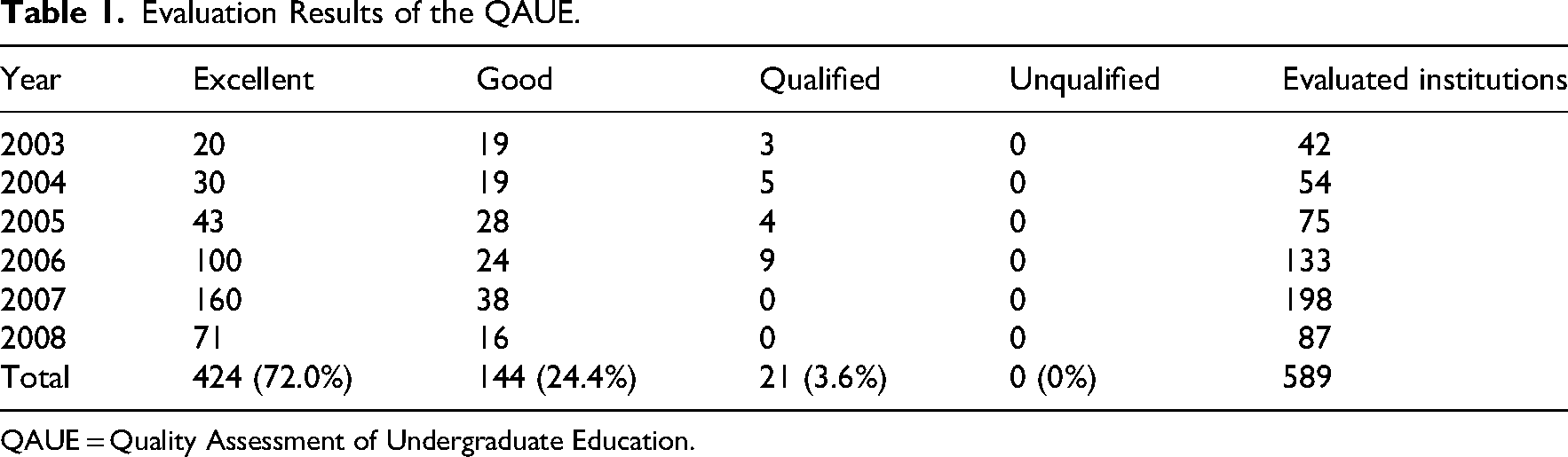
QAUE = Quality Assessment of Undergraduate Education.
Stage 3: 2010–Present
Following the first-round evaluation of QAUE, the Chinese government restructured the national QA system. The National Education Planning Outline of China's National Plan for Medium- and Long-term Education Reform and Development, released in 2010, emphasized the necessity to improve the QA system and proposed “to separate government administration, school operation, and evaluation” (CCCPC & State Council, 2010). Based on this outline, a new national QA system was planned (MOE, 2011). This new system includes the following five forms of assessment:
HEIs are required to establish their internal QA mechanisms and produce an annual quality report on their undergraduate education. The QAUE was transformed into an institution evaluation, including qualification evaluation and quality audit. Qualification evaluation focuses on the HEIs with newly established undergraduate programs and examines whether these institutions have reached the basic standards of educational quality set by the HEEC. Quality audit was designed for those universities that had previously passed an institution evaluation. In principle, the quality audit is a tailored, mission-based assessment scheme. It emphasizes different evaluation criteria for HEIs with different missions. The need to construct world-class universities was highlighted for those top institutions. Similar to the QAUE, the evaluation procedures of the institution evaluation include self-assessment, site visits, and follow ups. A database of the basic assessments of teaching in HEIs was established, and basic information on undergraduate education was collected from HEIs. Universities are encouraged to become involved in international evaluations conducted by external agencies or experts. Some disciplinary areas, such as engineering and medicine, are encouraged to conduct professional accreditation.
Thus, multiple instruments were used in the new national QA system. As of 2018, 205 HEIs underwent qualification evaluation, and approximately 650 institutions were assessed through a quality audit. The quality information of all 1239 universities and colleges in the country had been included in the database with the basic assessments of teaching as of 2018 (HEEC, 2023).
The changes made to the QA system in China in recent years are synthesized in Table 2. Evaluation agencies have changed from being solely governmental bodies to cooperation between the government and independent evaluation agencies. The QA schemes have also become more diversified, changing from a single-approach evaluation to multiple instruments. At the same time, mission-based evaluation has partly replaced the standards-based evaluation that characterized the old evaluation schemes in order to match the diversified purposes of universities. Compared with the initial evaluation procedures, the new QA schemes pay more attention to self-evaluation and follow up, aiming to emphasize quality improvement. The evaluation results that were based on grades and competition-oriented have been replaced by less-competitive qualitative reports in the quality audit.
The Implementation of EQA at Different Stages.
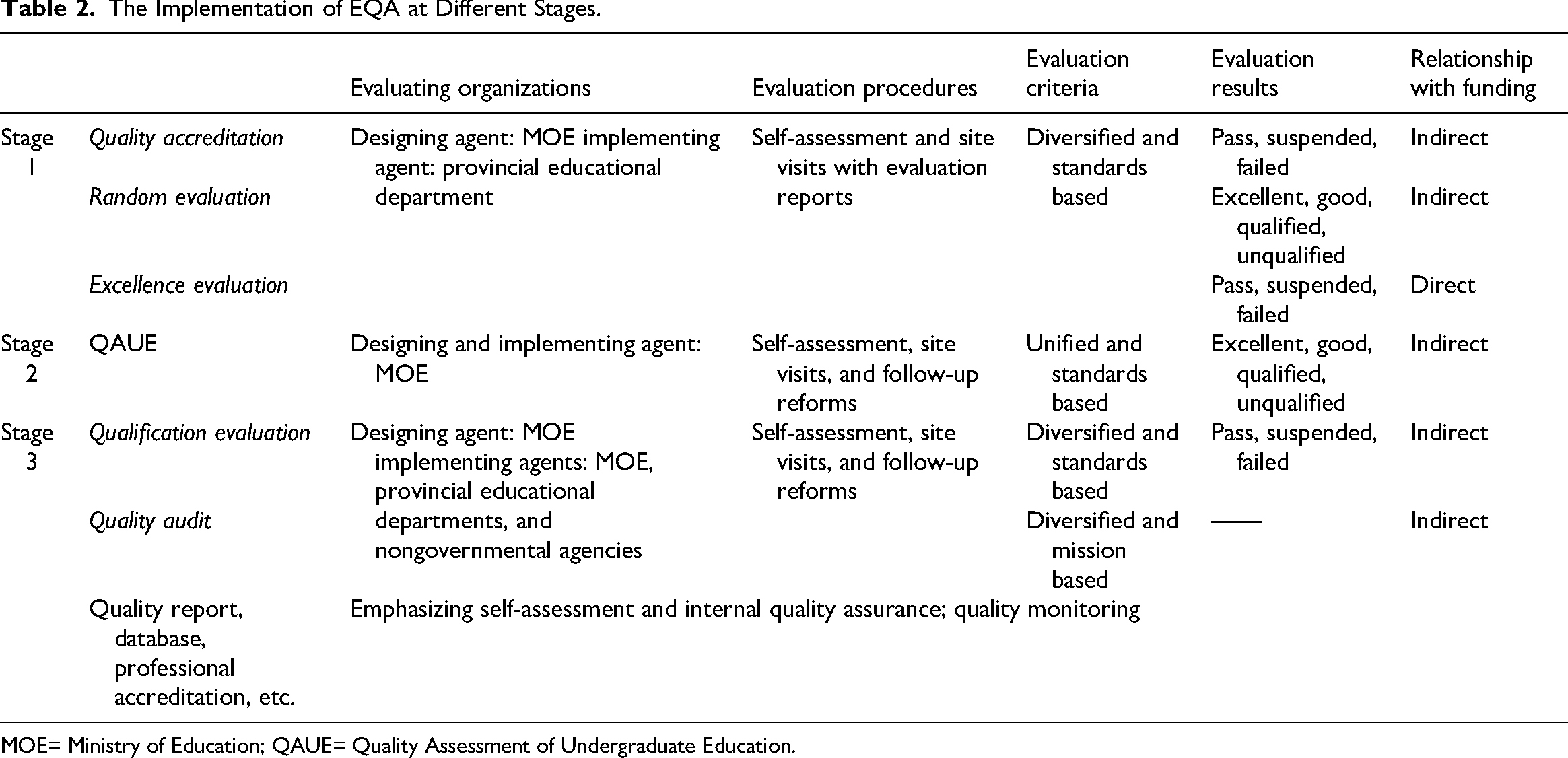
MOE= Ministry of Education; QAUE= Quality Assessment of Undergraduate Education.
On the whole, the QA policies in China have experienced long periods of stability and equilibrium, that is stage 1 from 1990 to 2001, stage 2 from 2002 to 2009, stage 3 from 2010 until now. There are also two periods of rapid change leading to the establishment of the national QA system in 2002 and its restructuring in 2010.
Finding 2: The Dynamics of the Transformation of the Chinese QA System
Based on the reviews of related studies on QA in China, and interviews with policy consultants and policy implementers, the dynamics behind the evolution of QA policies, particularly the establishment of the national QA system and its recent restructuring, are further explored.
The Driving Forces Behind the Initiation of the National QA System
First, the main driving force behind the establishment of a national QA system was the changing public image of higher education quality. The higher education quality used to be unquestionable in the public view but the rapid growth in enrollments in higher education at the end of the 1990s has brought quality decline. The dramatic expansion of student enrollment saw the number of undergraduate admissions in China grows five times from 1998 to 2005. This rate has continued to increase, as shown in Figure 1. Although funds for higher education have increased significantly (see Figure 2), they have done so at a slower pace than the participation rate. Consequently, both the unit cost per higher education student and the teacher–student ratio have steadily declined (MOE, 1998–2008; Wang & Liu, 2009). At the same time, the administrative regulations and skills of universities have not been updated to accommodate the rapid expansion and diversification of their student bodies (Wang & Zhao, 2009). This has led to low efficiency in quality management within HEIs. Moreover, in the context of global competition and the knowledge economy, the research capabilities of universities have received growing attention. In this context, academic staff tended to place more time and energy into research, while teaching was often neglected (Li, 2016; Mohrman et al., 2011; Yu et al., 2008; Zhang, 2008). Consequently, the teaching quality gap has become broader and more difficult to close. This quality issue has been noticed inside and outside the higher education field. For example, the National Association of Higher Education held a congress titled “Quality and Its Assurance in Higher Education in China in the 21st Century” in 2001, which tried to find ways to assure the teaching quality of Chinese universities. At the same time, the quality of higher education became a public concern. Many media reports have emerged addressing the decline in teaching quality, the chaos of university fees and tuition, and the inappropriate behaviors of college students (Liu et al., 2018).
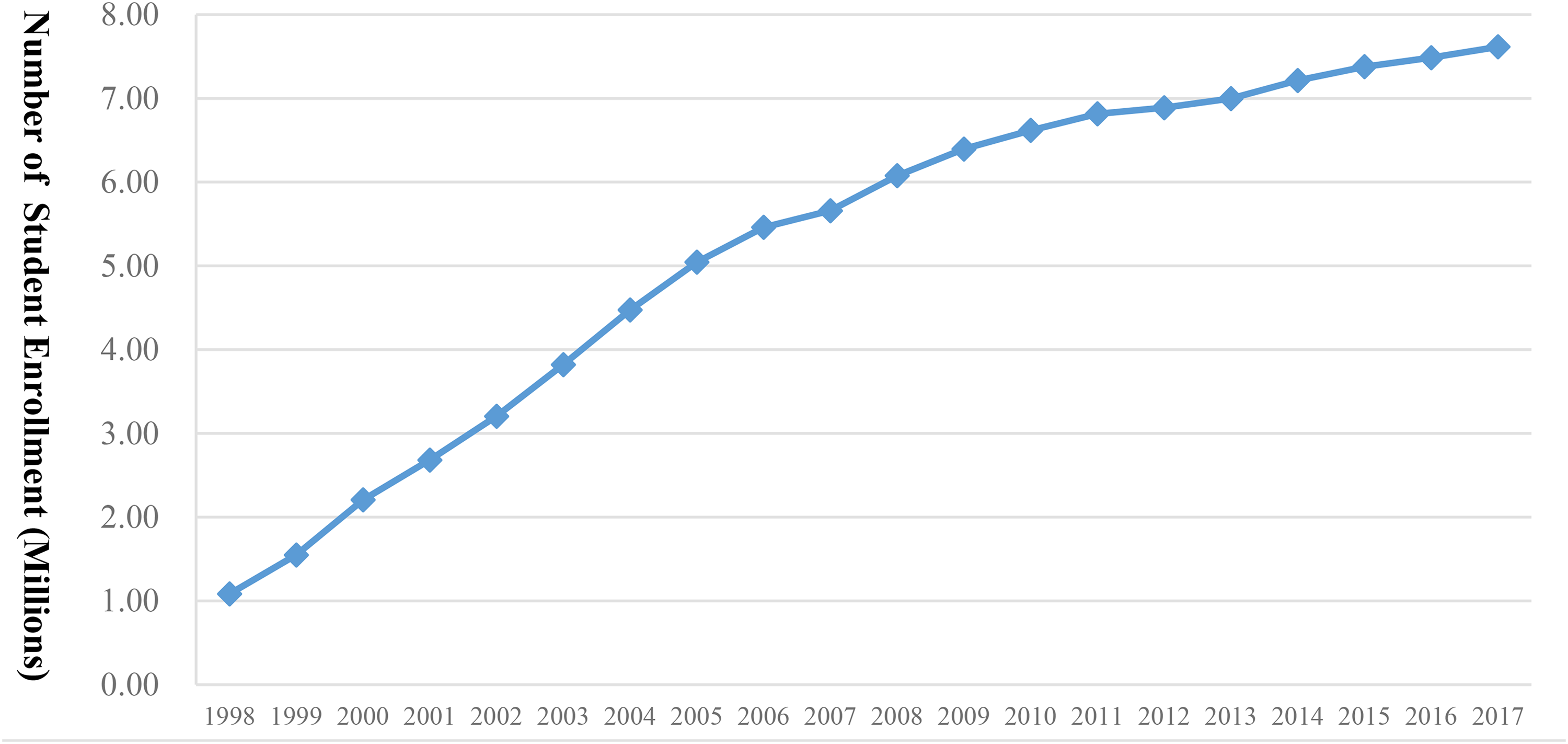
Number of student enrollments from 1998 to 2017 (MOE, 1998–2017). MOE= Ministry of Education.
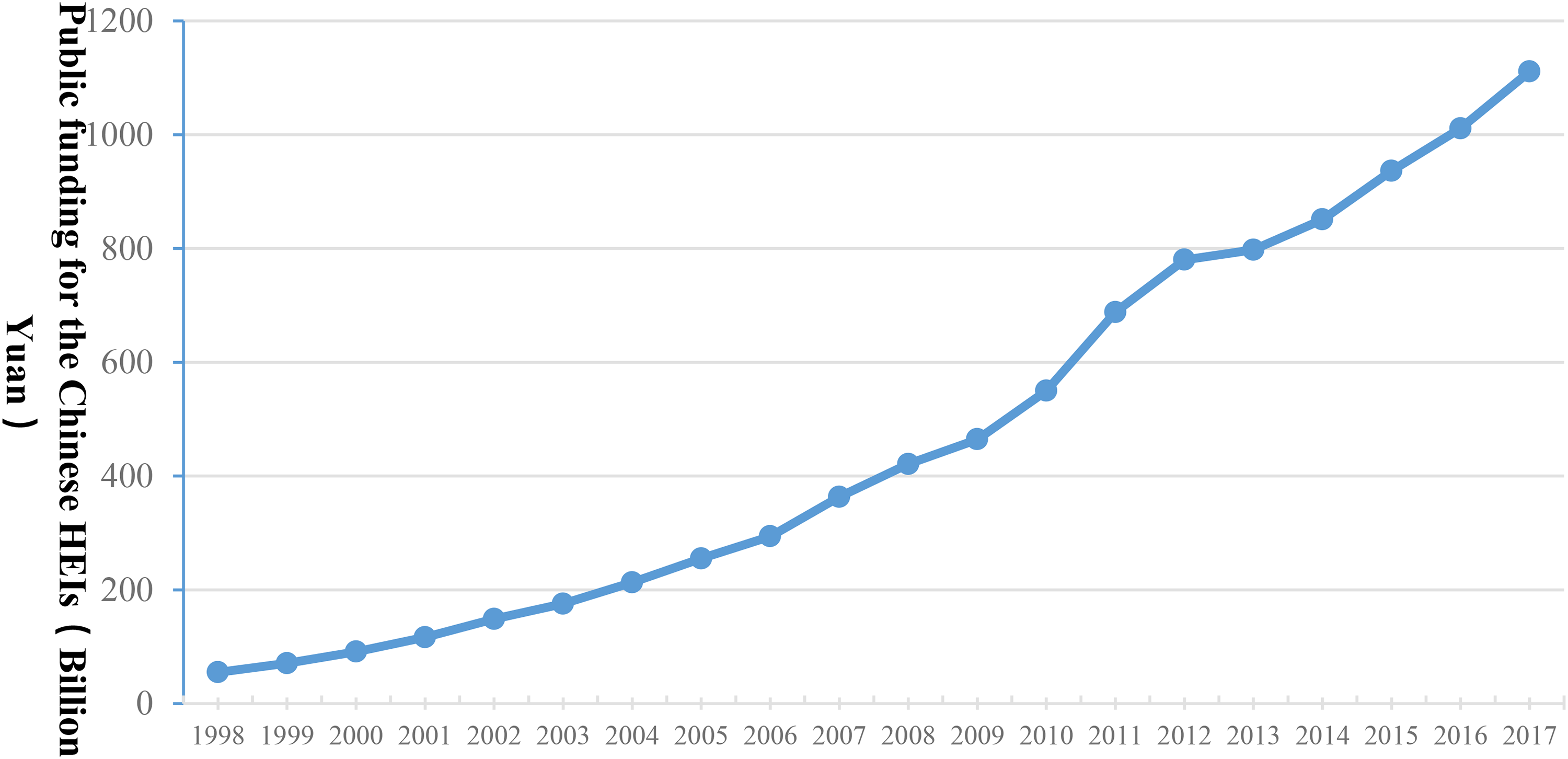
Public funding for Chinese HEIs from 1998 to 2017 (MOE, 1998–2017). HEI= higher education institutions; MOE=Ministry of Education.
Second, accompanying the expansion of student enrollment and the subsequent quality decline, changes also occurred in the policy venue of higher education. More stakeholders became involved in the quality issue. On the one hand, a cost-sharing policy for tuition fees was introduced in China in 1997, and students began to contribute to higher education funding. In the meantime, driven by the growth in enrollment numbers, competition in the labor market has grown, and unemployment among graduates has risen (Hu, 2009; Wang & Zhao, 2009). In this context, the value and quality of university education began to be questioned by the public: was it worth paying such high tuition fees? Students and their parents have more voice in the policy-making regarding higher education quality. They started to require information about higher education, increasing the need for accountability. On the other hand, the Chinese government has always dominated the higher education policy venue. Following the Soviet Union model, Chinese higher education was structured and operated under rigid state control before the 1980s. The central government essentially controlled all substantive and procedural matters relating to universities. Influenced by the market-driven economic reforms in the 1980s, the Chinese government initiated comprehensive reforms in the Chinese higher education sector. As a result, local governments and HEIs were given more autonomy in terms of governance, curriculum, finance, and management. The central government assumed a macromanagement role through legislation, and was responsible for the allocation of funding, planning, information service, policy guidance, and essential administration. Facing the current quality decline crisis, it seems necessary for the central government to reinforce its supervision of higher education. Especially, as a result of the massification of higher education, the level of public funding invested in higher education has increased substantially (as shown in Figure 2). The central government tends to play the role of monitoring higher education quality and ensuring accountability to the taxpayers and other stakeholders.
The changing public image regarding higher education quality had driven the emergence of a nationwide QA scheme. In 2002, following the graduation of students who enrolled in the first year of expansion, a national QA scheme, QAUE, was designed, and large-scale institutional evaluation was initiated. QA was initially expected to respond to the concern about quality decline by improving quality. As articulated in the QAUE Project, “the QA scheme intends to push universities … to improve their education quality and efficiency” (translated from MOE, 2002, p. 10). Second, the emergence of QA is also related to the change in policy venue. As a result of the student enrollment expansion and cost-sharing policy, participants in the higher education policy-making have slightly changed. Students and parents have become investors in higher education and so their voices have to be heard. QA has been adopted as an instrument to hold higher education accountable to stakeholders and society as a whole in terms of standards achieved and the use of public and private funds (Trow, 1996). Moreover, as the eligible body of monitoring and assuring quality, the central government has got more power in the QA policy-making and so the policy venue has changed. As indicated in the QAUE Project, “The QA scheme intends to further strengthen the macro-level governance and guidance of the state over teaching in HEIs… and prompt universities to actively implement the state's educational policies” (translated from MOE, 2002, p.10). Thus, QA was adopted by the state to monitor and assure university quality from a distance.
The Driving Forces Behind the Restructuring of the QA System in China
The restructuring of the QA system occurred in response to the changing public images of quality and QA policies per se over the past decade. Firstly, the public image of higher education quality has slightly changed. The rapid growth in enrollment numbers peaked in 2005, and since then, growth has steadied. QAUE has also pushed local governments and HEIs to increase their investment in teaching. Thus, the quality gap caused by growing student numbers and the declining unit cost has been somewhat diminished. Meanwhile, with the dream of building world-class universities, Chinese universities were facing more pressure to develop their own characteristics. At the same time, the diversification of HEIs with various purposes has been gradually accepted by the public. Quality is regarded more as “fitness for purposes” than as “excellent,” according to Harvey and Green's (1993) definitions. In this context, a detailed examination of higher education provisions with standardized evaluation criteria, like the QAUE, leading to bottom-line quality assurance is no longer necessary for most Chinese HEIs, and diversified evaluation schemes are deemed more necessary than the standardized one. That is to say, the QAUE could not effectively respond to the changing definition of quality in the public view any longer.
At the same time, the problems of QAUE were gradually exposed during its implementation from 2002 to 2008, and a negative policy image emerged. First, the impact study shows that QAUE has effectively assured bottom-line quality. It pushed Chinese universities to increase the number of resources committed to undergraduate education and to improve their internal quality management. However, the potential of QAUE to influence the teaching and learning process and to stimulate the improvement of teaching programs above a minimum threshold level is questionable. The quality measurement of the QAUE mainly depended on the quantitative performance indicators designed by the MOE. External experts had not been in active dialogue with the staff of the evaluated universities to assist them identifying specific weaknesses and give them relevant suggestions for improvement. As the interviewed academic staff indicated, the evaluators’ suggestions were “too general and did not touch the essential problems of teaching” [Interviewees 9, 22]. Meanwhile, the standards-based evaluation is not beneficial to the diversity of HEIs. Second, the QAUE scheme has not effectively responded to public demands for accountability. Many people were not convinced by results that showed that more than 90% of China's evaluated HEIs were excellent or good. The interviewees also admitted that some of the information in the self-evaluation reports and the related materials prepared by the universities were false [Interviewees 11, 13, 17, 22, 24, 26], and a number of rehearsed lectures occurred in institutions when external evaluators were present: “It will be ideal if [you] can make every class as good as those [rehearsed ones], but everybody knows it is impossible” [Interviewee 13]. Third, it was also reported that the QAUE caused numerous problems, such as incurring substantial costs and bureaucratic burdens for HEIs. To obtain better evaluation results, the evaluated institutions made considerable efforts to meet the requirements of the state-run external evaluation. Some responses were believed to be unrelated to quality improvement and have caused burdens on HEIs. As emphasized by eight interviewees, “nobody is keen to be evaluated,” but “a bad evaluation result could ruin the university's future,” and thus we “chose to become actively engaged and tried to do our best” [Interviewees 1, 4, 7, 10, 12, 16, 19, 22]. It was even reported that many institutions have tried to impress the external evaluators with lavish receptions: “To be honest, we have tried our best to welcome them. I am sure even if the President of China came to the college, we would only be able to entertain him in the same way” [Interviewee 8].
The change of policy image regarding higher education quality and QA has also facilitated the change of venue assignment. New specialists and stakeholders got involved in the policy-making. First, the legitimacy of the central government as the quality monitor of higher education has been questioned. Most HEIs in China are publicly funded under the auspices of the state. Thus, the state played the role of both the “referee” and “player” in the QAUE scheme. As a result, the state chose to tell the public “I am doing very well.” The rosy picture shown by the QAUE and the problems it has caused have diminished the trust of the public. The public has realized that it is not absolutely legitimate for the state, as the owner of public universities, to also assess university quality. Chinese academics have also strongly suggested that assessment work should be done by independent evaluation agencies, which are expected to provide a more reliable QA service (Li et al., 2006; Zhang, 2008). Moreover, although the QAUE has indeed strengthened the “macrolevel governance” of the state over HEIs, as expected by the policy (Li et al., 2006), the state-run QA scheme made HEIs feel burdened, so their dissatisfaction was particularly strong. For example, in an interview with Southern Weekend in 2008, the president of the University of Science and Technology of China, Qingshi Zhu, strongly suggested that government-run compulsory evaluation (QAUE) be stopped immediately and that nongovernment agencies play a more important role in evaluation (Fu, 2008).
The changed policy image and policy venue had made the previous policy monopoly collapsed, and a punctuation occurred when the first round of QAUE finished. To respond to the fierce criticisms of the QAUE, many meetings were held. New participants joined the policy-making process. As one interviewee said, “Government officials, university leaders and higher education researchers joined the meetings, talked about the problems of the QAUE and tried to find more appropriate evaluation methods” [Interviewee 29]. Consequently, the QA system was restructured in 2010. First, the state proposed that “government administration, school operation and evaluation should be separated” (CCCPC & State Council, 2010). Therefore, the central government gave up its paternalistic role in assuring quality and slightly retreated from it. Specific evaluation work has been partly delegated to local governments and independent evaluation agencies in the new QA scheme. At the same time, universities are required to publish quality reports to directly provide accountability to external stakeholders. Second, diversified QA schemes have been used to respond to changing quality conception. A mission-based evaluation scheme appeared in the form of quality audit, and it encourages universities to develop their own unique characteristics, to respond to the new public view of higher education quality (Liu, 2013). More emphasis is given to internal quality assurance and continued quality monitoring, which are believed to be more efficient in quality improvements, as indicated by HEEC officials (Liu, 2013). The interviewed policy consultants believed that “the new QA scheme is more appropriate for university development” [Interviewee 31]. Compared with the QAUE, it is “less aggressive and more acceptable for various stakeholders, and there are much fewer opposing voices [to QA] now” [Interviewee 30]. It is expected that the new QA scheme could reach a new policy equilibrium.
Discussion and Conclusion
Overall, China has continued to search for the most appropriate QA system through a series of reforms and experiments. QA policies have gone through two times of punctuation leading to new policy equilibriums, including the establishment of the national QA scheme and its restructuring. The policy evolution is a result of changing policy images and policy venues. The policy image mainly involves changing public perceptions of higher education quality and the effectiveness of QA policies. In the context of the rapid growth in student enrollments at the end of 1990s, quality decline became an important issue in Chinese higher education. A standards-based evaluation (QAUE) was firstly adopted to bridge the “quality gap” and to encourage quality improvement. The impact study showed that the standards-based QAUE scheme assured a bottom-line quality but its effects on the real improvement of teaching and learning activities were considered marginal. Moreover, the landscape of higher education has considerably changed in the past two decades. The tension between the growing student enrollments and declining unit costs has now eased to some extent in the context of steady enrollment numbers. The bottom-line quality assurance in most HEIs has also been realized after a decade of effort. The dream of building world-class universities has pushed universities to develop their own characteristics. In this context, diversified quality definitions have been steadily accepted by the public, replacing the standardized definition in the elite higher education era. Thus, diversified quality assurance schemes and mission-based quality evaluation were then used in the newly designed evaluation schemes with the aim to encourage the diversification of HEIs.
In terms of the QA policies, the QAUE was established in 2002 to assure and improve the quality of higher education and to provide accountability to the public. However, the implementation of QAUE from 2002 to 2008 shows that it was not very effective for quality improvement as discussed above. And as an instrument to provide accountability to society for the increasing public funding, and to restore trust in them (Stensaker & Harvey, 2010), it has not performed very well. The rosy picture it shows has not effectively enhanced trust in higher education. Additionally, the QAUE itself has drawn much criticism regarding its negative effects. Thus, the public image of the QA policies has shifted to be negative.
The policy venue has also slightly changed, partly because of the changed policy image. After the massification of higher education, the original closed model of higher education policy design, containing only governments and HEIs, became more open, and public opinion was given more consideration in the policy venue. The quality decline has made it necessary for HEIs to provide accountability to the public and for the government to enhance the supervision on HEIs through the implementation of QA. At the beginning, the state was trusted by the society to play the role of an impartial quality auditor. The state monopolized the evaluation process under the QAUE scheme, but this was not very successful. The low-efficiency of the QAUE scheme in terms of quality improvement and accountability and the problems it has caused made it less legitimate for the government to monopolize the evaluation work. After heated discussions and a long power struggle among different stakeholders, the state has retreated slightly although it is still the most important player in the current QA scheme. The self-regulation of universities has become more of an issue, and nongovernmental agencies are supposed to play a more important role in quality assurance. The participation of nongovernmental organizations in QA is believed to be an important sign of the transformation of the original governance model—“large government and small society” (based on government's dominating role in social management)—in China. In this regard, we not only found that the political context influences the EQA system but that the system itself has changed existing authority relationships in higher education field to some extent.
On the whole, the changing policy images and policy venues have driven the QA policy evolution. The specific process is shown in the picture (Figure 3). The case of QA policy evolution shows that given China's centralized governance and top-down decision-making system, the policy venue transferred not as much as that in a multiple-party political system. The central government always dominates the policy-making process in China, but after an existing policy equilibrium was broken, new specialists and stakeholders participated in the policy-making and their voices could influence the government's decision making to some extent (Xiong & Wang, 2022). Thus, the policy venue slightly changed. That is to say, the PET theory with some amendment could be used to explain the policy evolution in Chinese context.
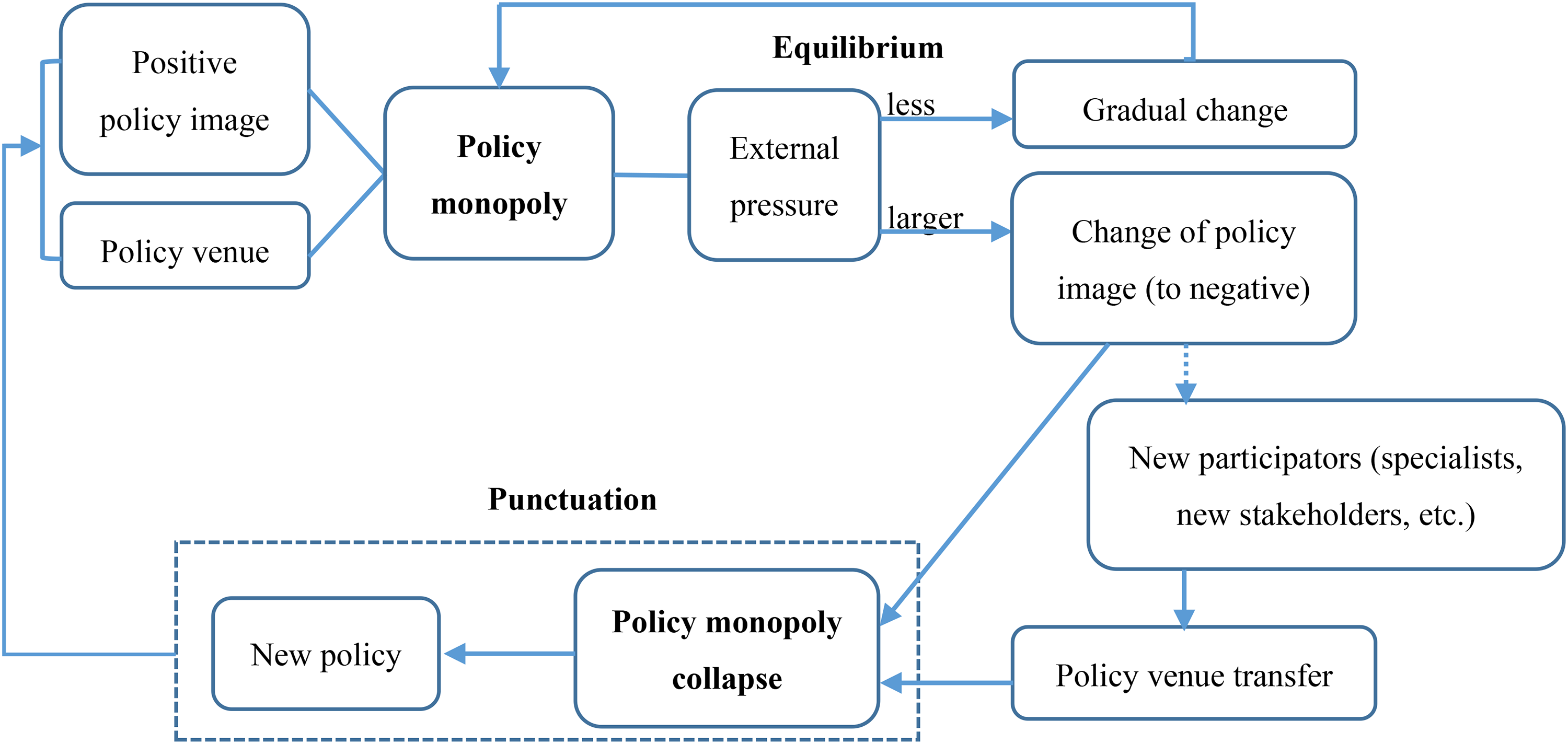
The amended PET theoretical framework to describe the policy evolution in the Chinese context. PET= punctuated equilibrium theory.
Additionally, it is worth mentioning that the policy evolution is not only driven by the factors inside a certain country in the context of globalization. Policy borrowing is also very important force influencing the policy change. Probably because of this, the QA schemes in China have become similar to those in Western countries. For example, the newly designed quality audit has borrowed some of the strategies found in the Institutional Audit of the UK Quality Assurance Agency for Higher Education, and professional accreditation has imitated approaches found in US practices. Similar to what happened in the West, the Chinese QA system has experienced gradual expansion (Gornitzka & Stensaker, 2014). One QA instrument cannot meet all expectations from all the stakeholders and thus multiple instruments have been used. Of course, the current diversified QA system also faces many challenges. For example, the multiple instruments may create additional bureaucratic burden on universities. The implementation of quality audit also showed a strong path dependence on the previous QAUE and the real participation of nongovernment evaluation agencies is not as much as expected, and the equal dialogue between the external evaluators and the evaluated institutions has still not been fully established (Lin, 2016). Thus, time is needed to adequately assess the effectiveness of the current system.
Footnotes
Ethical Approval
The research followed the British Educational Research Association (BERA) Guidelines. The participants of the semi-structured interviews were duly instructed about the intention, purposes and nature of the study. The interviews were conducted with their voluntary consent. In particular, participants were informed about the use of audio recording in advance. They were also advised of their right to withdraw from the research at any time. Secondly, the research respected the participants' right of confidentiality and anonymity. Their names would not be published and the data would not be used for anyting other than this research. No incentives were used to avoid the creation of potential bias in participants' responses.
Funding
The authors disclosed receipt of the following financial support for the research, authorship, and/or publication of this article: This research is collectively funded by Humanities and Social Sciences Foundation of the Ministry of Education of China (22YJA880030), National Natural Science Foundation of China (72274019), and the First-class Education Discipline Development Project, Beijing Normal University (YLXKPY-XSDW202404).
Declaration of Conflicting Interests
The author is an EB member of the journal. The author(s) declare that they have no conflicting interests during the reviewing and publishing process.
