



Abstract
This study explores resilience changes among twenty experienced rural Chinese teachers from a sensemaking perspective. Using qualitative interviews, reflective logs, and artifacts, it identifies four resilience paths: challenger, keeper, reviver, and survivor. Findings show teachers’ perceptions of dilemmas and resources shaped their resilience trajectories, highlighting its dynamic, context-dependent nature. The research underscores the interplay between individual agency and environmental factors, offering insights for supporting teachers in challenging contexts. It contributes to understanding resilience, developmental, and contextual dimensions.
Introduction
Research has consistently established that teacher resilience is a multifaceted and dynamic construct, operating within social systems rather than existing as a static trait (Beltman et al., 2011; Luthar et al., 2010). Based on this idea, more and more studies on teacher resilience have demonstrated the changes with mixed patterns in their teaching life, which could grow, be reluctant, and go down from a social-ecological perspective (Sun & Huang, 2024; Wang & Lo, 2022). This perspective underscores the importance of understanding how social-ecological factors contribute to the diverse resilience characteristics observed among teachers in different contexts. However, while the social-ecological framework provides valuable insights into external influences, it often overlooks the role of teachers’ sensemaking processes and their subjective perceptions within their professional environments.
As previous research has indicated, teacher resilience is frequently conceptualized as a set of personal assets and traits that enable teachers to sustain high levels of enthusiasm, commitment, and effort in their teaching roles (Kitching et al., 2009). Consequently, teachers’ perceptions and interpretations of their experiences play a critical role in shaping their agentive responses to social-ecological factors. The sensemaking perspective, which emphasizes how individuals perceive, interpret, and meaningfully respond to external events (Weick, 1995), offers a promising avenue for addressing this gap. By focusing on teachers’ sensemaking processes, researchers can better understand why teachers within the same context exhibit divergent resilience trajectories. This approach not only enriches our understanding of the complex, dynamic, and context-specific nature of teacher resilience but also highlights the interplay between individual agency and environmental influences. Therefore, it is essential to adopt a sensemaking perspective to investigate why different teachers exhibit varying resilience change trajectories in similar contexts. Such an approach can deepen our comprehension of teacher resilience’s intricate and ever-evolving nature, providing a more holistic framework for understanding how teachers navigate their professional challenges.
Against this backdrop, the current study investigates how teacher resilience evolves over the course of their careers and explores the role of teachers’ sensemaking in shaping this process. Specifically, the study is guided by one overarching research question: How does the resilience of Chinese rural teachers change over time? The findings underscore the dynamic and complex nature of teacher resilience, propose taxonomy of resilience change patterns, and demonstrate how these patterns emerge from teachers’ diverse perceptions of challenges and available resources within their specific contexts.
Literature Review
Teacher Resilience: A Developmental, Interactive Construct
Despite a surge in research interest in teacher resilience over the past decades (e.g., Beltman et al., 2011; Gu & Li, 2013; Mansfield et al., 2012), there remains no consensus among researchers on its definition due to its inherent complexity and plurality. Broadly, teacher resilience has been conceptualized through two primary lenses: psychological and social constructions. From a psychological perspective, resilience is often regarded as an individual’s inherent quality or capacity. For instance, some scholars define teacher resilience as the ability to regulate emotional states (Gu & Day, 2013) or to recover and sustain well-being in the face of adversity or frustration (Day, 2008; Fleet et al., 2007). Similarly, it has been characterized as a set of personal attributes and traits that enable teachers to maintain high levels of enthusiasm, commitment, and effort in their professional roles (Kitching et al., 2009). These psychological constructs emphasize resilience as an internal, individual phenomenon rooted in personal assets and characteristics.
A paradigm shift in resilience research occurred in the 1980s, marked by a transition from focusing on individual resilience traits to examining the protective factors and processes that influence resilience development, particularly how these factors contribute to positive outcomes (Luthar et al., 2010). While the psychological perspective on teacher resilience has helped clarify the individual characteristics of resilient teachers, some scholars (e.g., Johnson, 2004; Luthar et al., 2010; Richardson, 2002) argue that teacher resilience is a multidimensional construct that operates dynamically within the social systems in which teachers are embedded. These systems involve the interplay of specific social and cultural elements that shape resilience outcomes. Furthermore, researchers have emphasized that resilience is not a fixed or unchanging personal trait; rather, it evolves under the combined influence of personal and external protective and risk factors (Beltman et al., 2011; Mansfield et al., 2012). In other words, individuals may possess an innate biological foundation for resilience, which facilitates the development of social skills, problem-solving abilities, critical awareness, autonomy, and a sense of purpose (Hong, 2012). However, the capacity to recover from challenges and conflicts is also significantly influenced by external factors, such as the nature of the work environment and the support systems available in the surrounding context (Luthar et al., 2010). This dynamic interplay highlights the importance of considering both individual and environmental dimensions when studying teacher resilience.
This study adopts a developmental and interactive perspective, building on prior research on teacher resilience. It emphasizes that changes in teacher resilience are deeply intertwined with the dynamic interplay between teachers’ perceptions, self-efficacy, and external factors embedded within their sociocultural environments. Drawing on Ungar and Theron's (2020) framework, three critical elements must be considered when examining individual resilience: (1) risk and protective factors, (2) the interactive processes between these factors, and (3) resilience changes over time. Risk factors refer to the challenges or dilemmas teachers encounter in their professional growth, which serve as the foundation for resilience development. Protective factors, conversely, encompass the resources teachers utilize to navigate these challenges. The interaction between risk and protective factors shapes the resilience-building process and its outcomes. Importantly, within the resilience framework, risk and protective factors are interdependent; neither can independently determine resilience outcomes.
Teacher Resilience Changes from a Sensemaking Perspective
While research on teacher resilience changes is growing, it remains relatively limited. Existing studies have predominantly adopted a social-ecological perspective to understand these changes, emphasizing that shifts in teacher resilience result from the interplay of social-ecological factors across multiple levels. For instance, Sun et al. (2024) explored resilience patterns among high-performing rural teachers, uncovering three trajectories: challenger’s path, reviver’s path, and survivor’s path. The social-ecological perspective offers valuable insights into the broader external influences and their interactions, providing a framework for understanding how these factors collectively shape teacher resilience. However, this perspective has limitations in explaining why teachers within the same social context exhibit diverse resilience change patterns.
Guided by the sensemaking perspective, this study diverges from prior research by rejecting the notion of teachers’ traits as fixed. Instead, it proposes an integrative approach that focuses on how teachers’ sensemaking evolves across various developmental stages. Sensemaking theory, first introduced in the late 1960s, was initially developed to explain the internal mechanisms underlying interactions among individuals. It has since been applied to organizational sociology, highlighting the connection between individual meaning-making and organizational contexts (Weick, 1995). At its core, sensemaking involves individuals perceiving, interpreting, and responding meaningfully to external events (Weick, 1995). As Rom and Eyal (2018) noted, “It determines what people see and do, how they perceive reality, and why they make different interpretations of the same events or assign the same interpretations to different ones” (p. 63). Within their environments, individuals actively construct meaning, which in turn shapes their emotions and behaviors (Coburn, 2004).
We adopted a sensemaking perspective to examine how a group of Chinese rural teachers responded to external factors in shaping their resilience trajectories. Based on this perspective, we developed a conceptual framework (Figure 1) to elucidate the diverse pathways of teacher resilience change. This framework comprises three key propositions: (1) teacher resilience is viewed as a developmental, dynamic, and interactive process shaped by the interplay of protective and risk factors; (2) the teacher's sensemaking process is identified as a central mechanism in this process; and (3) sensemaking acts as a guiding force that influences the development of teacher resilience.
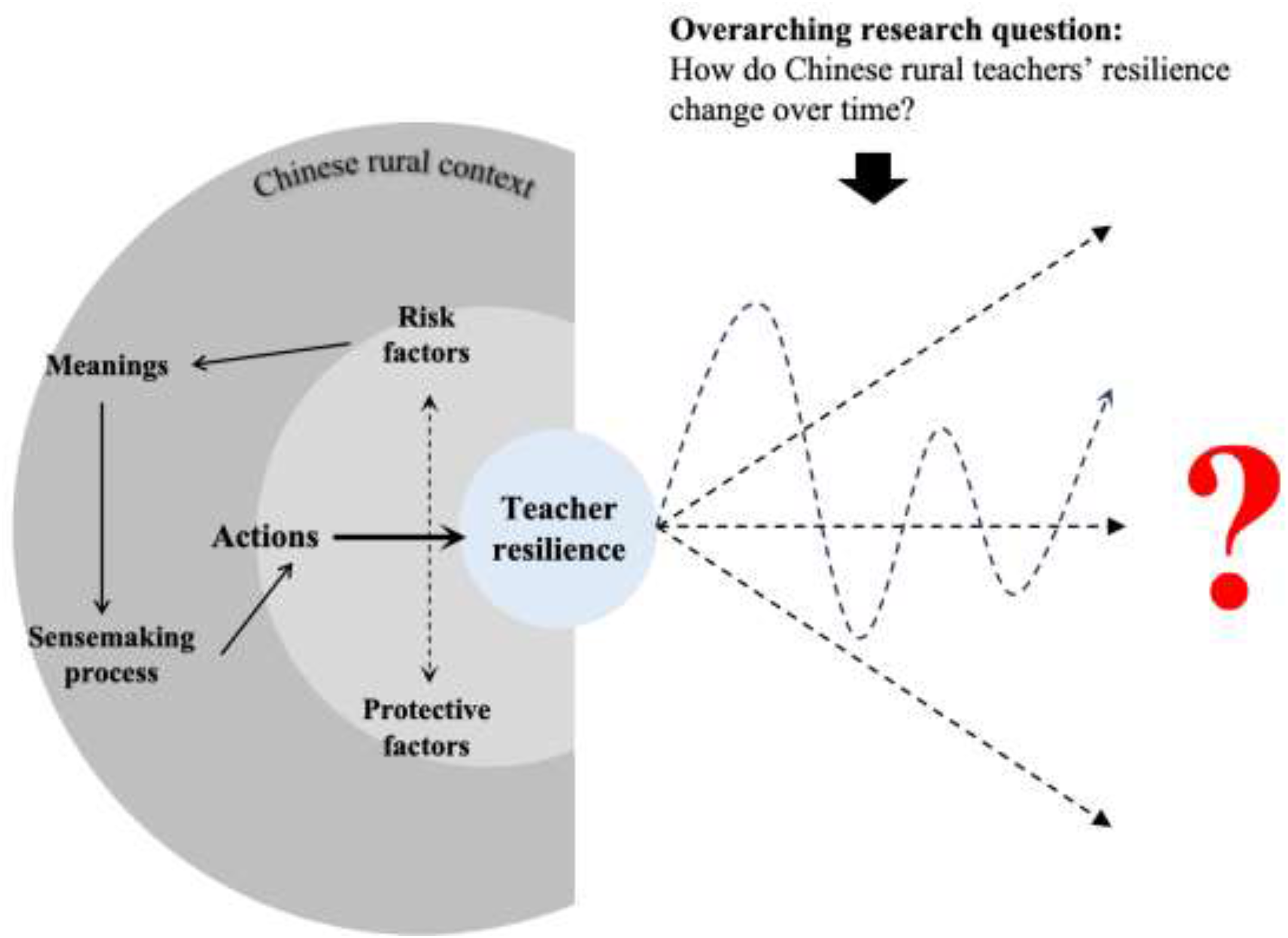
Conceptual Framework.
It is important to emphasize that this process is multidirectional: sensemaking influences teacher resilience, and teacher resilience, in turn, influences sensemaking. Teacher resilience is not merely an outcome of the sensemaking process but it also shapes the trajectory of sensemaking itself, with significant implications for resilience pathways. This study, however, focuses primarily on the former-how sensemaking influences teacher resilience for two main reasons. First, due to space limitations, it is challenging to cover all aspects comprehensively. Second, within the Chinese cultural and policy context, we observe that teachers’ actions are more often shaped by external factors rather than the reverse. Additionally, while sensemaking theory encompasses a wide range of concepts, this study adopts only two key dimensions: perception and actions. This focused approach allows for greater exploration of whether new insights, distinct from findings in other cultural contexts, might emerge within the Chinese setting.
Teacher Resilience Change in Chinese Rural Context
Scholars have established the critical role of sociocontextual factors in shaping teacher resilience trajectories (Wang & Lo, 2022). Chinese rural education system, characterized by persistent resource disparities and teacher retention challenges (Liao, 2019), reflects broader socioeconomic inequities. Although policy interventions (e.g., financial incentives and resource redistribution) have mitigated some issues, structural barriers continue to hinder rural teacher recruitment. Consequently, rural schools rely heavily on experienced, locally trained teachers, while younger graduates remain underrepresented in these settings.
Second, rural-to-urban migration (“urban pull”) has resulted in numerous left-behind children under grandparental care (State Council, PRC, 2016). These children often exhibit academic and behavioral challenges, requiring rural teachers to fulfill multiple roles as educators, counselors, and mentors (Wang & Lo, 2022). However, inadequate resources, insufficient teacher training, and urban-centric professional development programs hinder effective support. This mismatch between systemic preparation and rural realities exacerbates teachers’ occupational stress while compromising educational quality.
Third, rural teachers encounter systemic barriers in professional title advancement. Chinese hierarchical promotion system ties career progression to teaching effectiveness, predominantly measured by standardized test scores (Song et al., 2013). However, rural educators face unique challenges: they must improve academic outcomes among left-behind children while working with limited resources, and navigate evaluation systems ill-suited to rural contexts (Zhang & Tsang, 2019). Furthermore, the “acquaintance society” culture (Hong, 2012) creates inequities in resource distribution and assessment practices, compounding professional frustrations. These structural constraints disproportionately disadvantage rural teachers in the promotion system, undermining their career motivation.
Research Methodology
Research Context and Participants
To examine sensemaking’s impact on resilience dynamics, we conducted a qualitative case study at School F in H County (S Province), a representative rural school in eastern China’s underdeveloped northern region. During 2022 data collection, the school served 289 predominantly left-behind children with 42 teachers (80% locally recruited). The site was selected for three reasons: (1) its typical rural challenges (agricultural economy, limited infrastructure), (2) researchers’ linguistic capacity (local dialect proficiency for interviewing senior teachers), and (3) exceptional institutional support allowing full immersion.
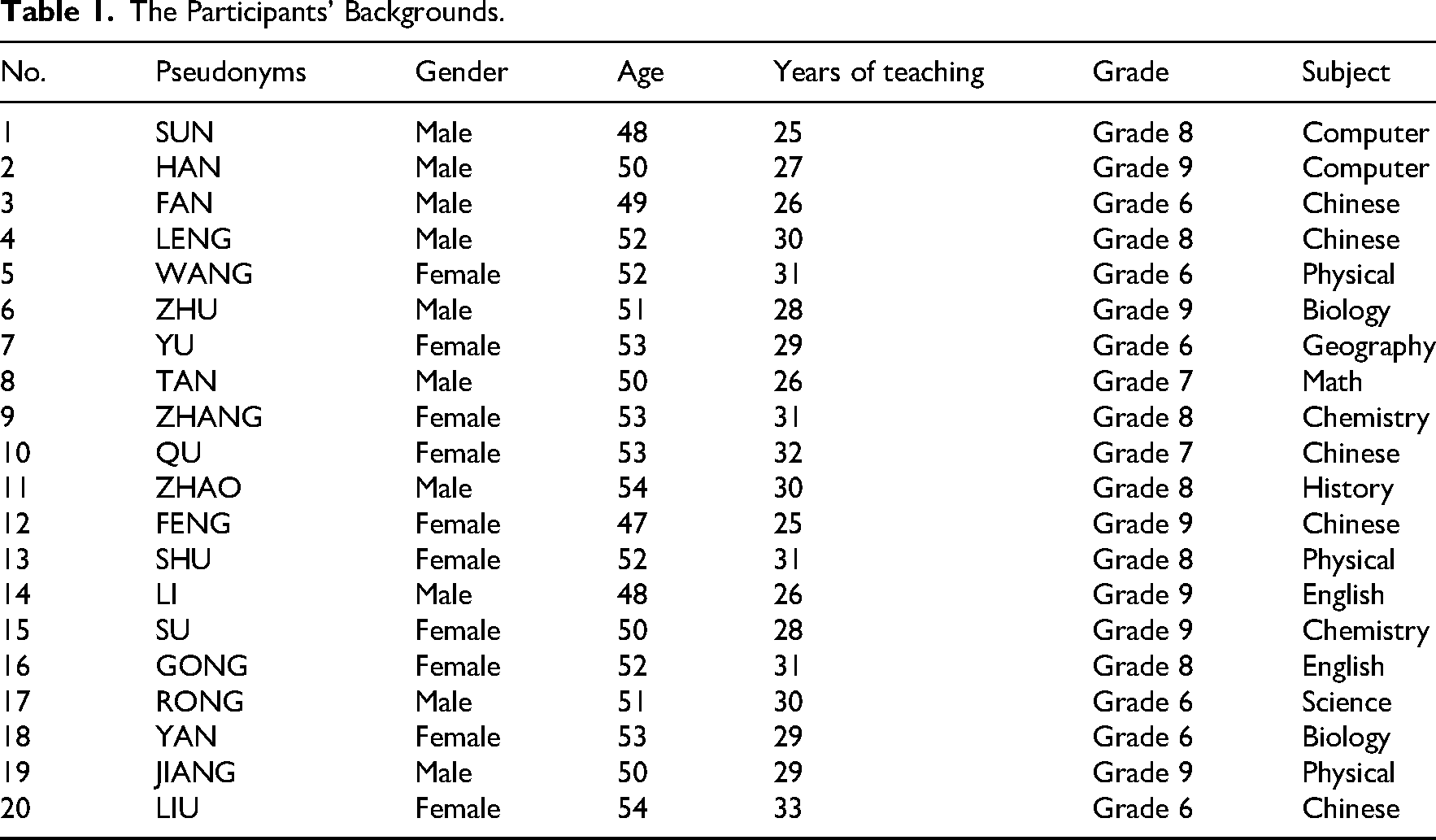
Considering the focus on experienced rural teachers, a purposeful sampling approach (Devitt, 2002) was adopted to select teachers with a minimum of 25 years of experience at School F, tracking their resilience trajectories through challenges and coping strategies. Participant demographics (subject, experience, grade level) were anonymized (see Table 1).
The Participants’ Backgrounds.
Data Collection
Three techniques of data collection were employed in the fall of 2022: semistructured interviews, researchers’ field notes, and artifacts. A summary of the data sources is given in Table 2.
Data Sources.

Two rounds of semi-structured individual interviews were conducted to gather information on the participants’ career trajectories and the reasoning behind the procedure and to fully understand (1) the participants’ experiences since commencing teaching at School F, encompassing the challenges encountered and the strategies employed to overcome them, (2) the personal and contextual factors shaping their resilience strategies, and (3) changes in their professional image, passion for and attitude toward teaching, and willingness to continue teaching in School F in the future. Each interview, lasting between 1 and 2 h, focused initially on critical events, followed by opportunities for participants to elaborate, enabling a deeper exploration of their early educational experiences and their impact on the changes in resilience. Twenty teachers shared their perspectives on interpreting challenges and resources, as well as their actions across different developmental phases. The interview questions were formulated based on the prior research findings (Beltman et al., 2011; Li et al., 2023) and the specific context of School F (see the Appendix for details of the interview protocol). These interviews aimed to capture the complexity of their perceptions and attitudes toward the challenges and resources in their different development stages.
From September to November 2022, the first author carried out the fieldwork. Immersing herself in the environment, she lived among the teachers to understand their daily routines, social interactions, the school environment, and cultures (Jorgensen, 1989). Specifically, the first author shadowed all participants as a participant observer, noting their interactions with peers, school leaders, and students both inside and outside the classroom. This personal connection allowed for a more in-depth understanding of the participants’ experiences. Detailed field notes with analytical reflections (approximately 27,563 words) were recorded during this immersive phase.
As ethnographers conducting participant observation and interviews, our positionalities as scholars in the field of education inevitably shaped how we interpreted social interactions and narratives. To enhance reflexivity, the first author, who collected the data, maintained a research journal throughout the fieldwork to record her assumptions, emotional responses, and evolving understandings. The second author acted as a critical friend, supporting the first author in reflecting on, clarifying, and refining these understandings, which in turn deepened the interpretations of the observed phenomena. This collaborative approach enabled us to identify moments when our preconceptions might have influenced the data collection process. Two sets of artifacts were obtained from school administrators with the purpose of enriching our understanding of participants’ backgrounds and experiences. The first set contained teachers’ demographic information (e.g., age, years spent teaching, and qualifications) to complement individual profiles. The second set comprised professional assessments and educational policies, allowing for verification and further insights into gathered information from diverse sources.
Data Analysis
Following the transcription of interview data, this study adopted a qualitative inductive approach for data analysis (Strauss & Corbin, 1998). The researchers began by thoroughly reviewing and rereading the interview transcripts to identify a range of codes related to the challenges and resources teachers encounter at various stages of their professional growth, as well as their interpretations of these experiences and coping strategies. For example, when addressing the challenges of professional title promotion, teachers ascribed different meanings to the situation. Some perceived it as an overly burdensome process that caused emotional strain, while others regarded it as an opportunity for professional development. Key codes that emerged included “challenges of title promotion,” “interpretation of pressure and obstacles,” and “interpretation as a growth opportunity.”
These codes were further analyzed through the lens of sensemaking theory (Rom & Eyal, 2018; Weick, 1995) to explore how teachers engaged with various stakeholdersing the interview transcripts to identify a range of codes related to thell as contextual factors such as reform policies and the cultural dynamics of rural China. This analytical process culminated in the development of a typology consisting of four distinct patterns: the “challenger’s path,” “keeper’s path,” “reviver’s path,” and “survivor’s path,” which collectively elucidate the variations in teacher resilience. To strengthen the validity of the findings, field notes and documents collected by the first author were systematically analyzed to identify relevant themes. These themes were then cross-referenced with the interview data to ensure a more objective and triangulated perspective.
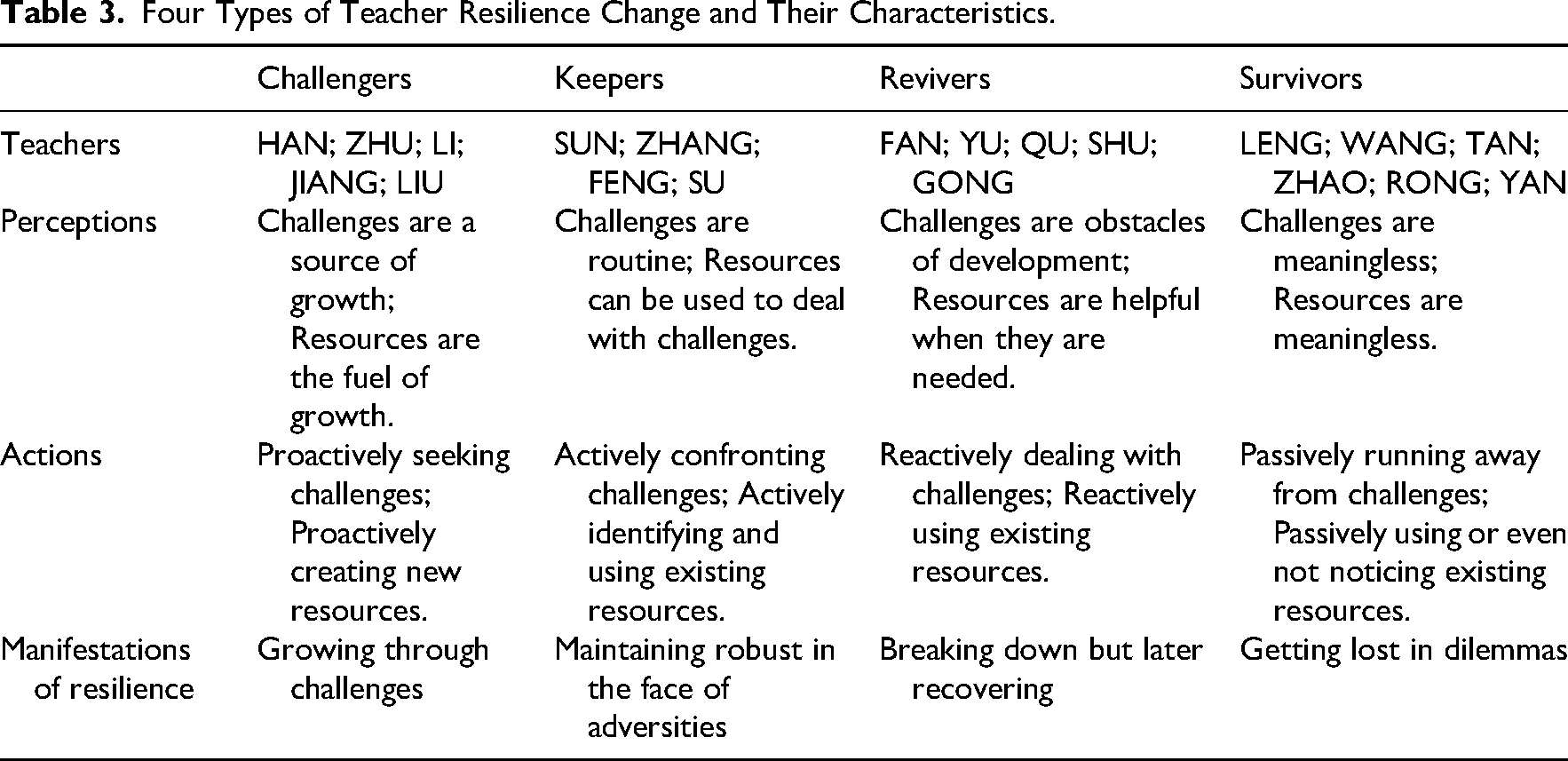
All interviews were conducted in Chinese to preserve the original meanings and cultural nuances of the participants’ responses. To facilitate the writing process, the second author translated the codes and themes into English. These translations were subsequently backtranslated into Chinese by the first author to ensure accuracy. Both authors collaboratively compared the backtranslated version with the original data, making iterative adjustments until consensus was achieved. Table 3 summarizes the key findings of the study.
Four Types of Teacher Resilience Change and Their Characteristics.
Research Trustworthiness and Ethics
The initial analysis of the data was performed separately by the first author to strengthen the credibility of the study. During this process, the second author offered sharp and insightful feedback on the emerging results. Once both independent analyses were completed, their aligned outcomes were highlighted as the core conclusions. Following this, the authors examined the broader significance of the findings, revisited any discrepancies through further analysis, and ultimately came to a unified conclusion—a crucial measure that reinforced the trustworthiness of the research. Before the study began, ethical clearance was secured from one of the authors’ affiliated institutions. Multiple protective measures were put in place to ensure participant safety and data privacy, such as obtaining informed consent, removing identifying details from datasets, and limiting data access to authorized personnel only.
Research Findings
The findings reveal four distinct resilience change pathways: the keeper’s path, challenger’s path, reviver’s path, and survivor’s path. These pathways highlight the teachers’ varied perspectives on challenges and resources, underscoring the diversity in their experiences and responses (see Table 3).
Challenger’s Path: Growing Through Challenges
The “challenger teachers” in the rural schools demonstrated a resilient attitude when confronted with challenging circumstances, and their ability to bounce back increased as they faced numerous risk factors. Five teachers (Han, Zhu, Li, Jiang, and Liu) fell into this group.
Perceiving Challenges and Resources as the Fuel of Growth
The “challenger teachers” consistently exhibited a positive and proactive outlook. To them, the challenges they faced were not obstacles but rather opportunities for personal and professional development in negotiating with surrounding crucial individuals and contexts. They did not view challenges as barriers to professional development; instead, they viewed them as chances to pinpoint their weaknesses and issues. Furthermore, these teachers perceived resources as the fuel of growth and saw resources as vital for their professional development, even in resource-scarce rural settings. Despite acknowledging resource limitations, many teachers remained unfazed and adeptly adjusted their mindset to utilize available resources effectively when confronted with educational challenges. For instance, LI encountered difficulties applying theoretical knowledge to practical teaching in the early stages of her career. Rather than feeling discouraged, LI saw this as a chance for growth. By engaging in classroom observations, pedagogical research, and collaborative reflection with seasoned colleagues, LI transformed this challenge into an opportunity for growth, becoming an integral part of the professional community. This adaptive approach of turning hardships into stepping stones had enabled these teachers to derive fulfillment from their students’ progress and development as educators daily.
Proactively Seeking Challenges and Creating New Resources
These teachers demonstrated a proactive inclination toward seeking challenges. They exhibited positive attitudes in accessing resources and a proactive spirit in actively seeking and crafting learning opportunities within their professional growth. Instead of becoming disheartened or anxious in the face of challenges, these teachers actively pursued more challenges to advance their professional development. Commonly expressed sentiments include “embracing challenges,” “viewing challenges as opportunities,” and a mix of “struggle and joy.” In scenarios where resources were scarce in rural educational settings, rural teachers might require support in accessing resources or avenues for self-improvement. As shared by Zhu and Jiang, when confronted with obstacles, their immediate reflex was to actively seek assistance from peers, superiors, and family members. As Liu mentioned, I am inspired by how I do and deliver lessons. Thus, I often take the initiative to invite veteran teachers who teach the same subject as I do to join me in seminars, prepare lessons for them, and discuss relevant issues with them. (Interview-Liu-1014)
Consequently, the “challenger teachers” demonstrated greater proactivity in addressing dilemmas and resource management. As teachers persisted in surmounting challenges, their enthusiasm for tackling obstacles, belief in their capabilities, and overall well-being exhibited an upward trajectory.
Keeper’s Path: Maintaining Robust in the Face of Adversities
The “keeper teachers” displayed consistent and strong resilience growth. Among the participants in this research—Sun, Zhang, Feng, and Su—four teachers exemplified this category.
Perceiving Challenges and Resources as Routine
“Keeper teachers” exhibited a generally optimistic outlook toward challenges and resources. While they might not perceive challenges and resources as avenues for personal growth like “challenger teachers” do, they remain positive when faced with obstacles and swiftly leverage available resources to address them.
These teachers viewed challenges as part of their daily routine. They understood that facing challenges was a natural aspect of life and saw no reason to become excessively anxious. When confronted with challenges, she would first regulate her emotions, stay calm, and strategize solutions, one step at a time. Rather than succumbing to negative emotions, she would objectively assess complex situations, identify weaknesses, and seek appropriate resources for resolution. Moreover, these teachers viewed resources as essential tools for addressing challenges. The “keeper teachers” proactively engaged with difficulties, promptly managing their emotions while navigating teaching challenges and adversities. Their challenges did not hinder their development. Instead, they demonstrated robust resilience and continual growth throughout their careers. In interviews, Feng faced a balancing act between childcare and significant school responsibilities upon starting her teaching career. She decisively requested assistance from her family, who shared childcare duties, enabling her to resolve the dilemma successfully. The teacher narratives underscored the significance of these experiences in aiding them to recognize resources, navigate challenges, ignite their passion for learning, strengthen their belief in education, and find purpose and optimism in their daily professional endeavors.
Actively Confronting Challenges and Using Existing Resources
The “keeper teachers” demonstrated a positive approach when facing obstacles, viewing challenges as an inherent part of the developmental process. They frequently emphasized the importance of “passion,” asserting that teachers must exhibit enthusiasm for the teaching profession and the advancement of students. This enthusiasm entailed a dedication to classroom instruction, continuous improvement through teaching exploration, and nurturing a supportive bond between teachers and students. Consequently, challenges were not sources of anxiety and despair but were viewed as routine occurrences within the educational ecosystem.
The “keeper teachers” also had a supportive attitude toward resources that could help problem-solving. In the field notes, the first author wrote, Teachers actively looked for explicit or implicit resources in their surroundings to help them overcome challenges. In instances of resource insufficiency, these teachers diligently sought additional support to navigate challenges and upheld consistent resilience in the interim. (Field note, 1009)
These instances highlighted that “keeper teachers” adeptly tackle problems, utilize available resources constructively, and uphold a positive view toward challenges and available resources.
Reviver’s Path: Breaking Down but Later Recovering
The “reviver teachers” indicated a recovery change in the development of teachers’ resilience. Five (Fan, Yu, Qu, Shu, and Gong) teachers’ resilience change presented this characteristic in this research.
Erratic Perceptions of Challenges and Resources
The “reviver teachers” frequently exhibited pessimistic sentiments in response to obstacles, a stark contrast to the attitudes of the “keeper teachers” and “challenger teachers,” which was why this group of rural teachers encountered a steady decline in their resilience in handling adversities, accompanied by prolonged periods of negative emotions. Some “reviver teachers” started doubting themselves as work-related issues piled up unresolved. While they aimed to fulfill the demands of their positions, their passion waned. The interviews with these rural teachers showed that they often express negative emotions such as “I cannot breathe” (Interview-Qu-0929) and “my enthusiasm for teaching has been dampened” (Interview-Fan-1017). As Shu indicated, The students lack enthusiasm for learning, despite thorough lesson preparation. No one pays attention in class, making me feel like my efforts are in vain. (Interview-Shu-1020)
These examples underscored the powerlessness and burnout experienced by rural teachers when encountering challenging circumstances, impeding their capacity to manage such stressful events effectively. Maybe the “reviver teachers” avoidance tactic, which they employed to protect themselves, caused them to become more limited in their thinking and stay inside their own “safety zone.” However, over time, as they emerged from their despondency, they began to engage with others actively, seek advice from experienced colleagues and school leaders, and share work-related challenges when overwhelmed. Regaining their purpose and motivation, the “reviver teachers” gradually started believing in their capabilities and recognized the value of resources in overcoming future challenges.
Reactively Responding to Challenges and Resources
Initially upholding high standards of professionalism, “reviver teachers” struggled to confront difficulties that arose. Consequently, they gradually needed more motivation and zeal to overcome the daily obstacles encountered as teachers. Uncertain about how to navigate these challenges, they were hesitant to take on new ones, with one reflecting, “I felt like there were too many challenges for a while and did not even know how to deal with them” (Interview-Yu-1015). The persistent work-related frustrations eroded their resilience and self-confidence. Gradually, the “reviver teachers” ceased proactively addressing challenges as their motivation waned.
The reviver teachers’ attitudes toward resources could be characterized as “situational dependency.” Following self-assessment, they tended to select specific resources to overcome their difficulties. For such teachers, the title promotion policy had transitioned from an incentive to a constraint or a goal that must be attained or relinquished. However, for the “reviver teachers,” the teacher title evaluation policy served as a beneficial motivational tool, reigniting their dedication to education and teaching after stagnation and prompting them to reengage with their work (Field note-20221120).
Survivor’s Path: Getting Lost in Dilemmas
The “survivor teachers” were those who distanced themselves from connections that could have assisted in enhancing their resilience. Their demeanor changed from that of busy, vivacious, and self-improving professionals to one that suggested retreat and escape, with survival as the primary goal of endeavors, indicating a degradation of resilience. Six teachers (Leng, Wang, Tan, Zhao, Rong, and Yan) in this research belonged to this group.
Negative Perceptions of Challenges and Resources
“Survivor teachers” viewed challenges as meaningless. They lacked enthusiasm in addressing the issues they faced in their daily teaching routines and exhibited two distinct behaviors. When confronted with a challenging situation, they believed it was too demanding to overcome and opted to “opt out.” Once they achieved their career’s pinnacle, they actively avoided external challenges: “I have already achieved my goals, so I do not want to continue striving” (Interview-Rong-1025). Furthermore, these teachers viewed resources as irrelevant. Like their perception of challenges, the “survivor teachers” deemed resources useless. The erosion of their resilience was evident in their shift from being proactive, dynamic, and self-improving professionals to exhibiting withdrawal and escapism, with survival becoming the primary focus.
These teachers were so distressed by rejection and failure that they avoided confronting unresolved issues and engaging with their classmates. They felt that teaching had no purpose and lost motivation to succeed (Field note-1104). Their professional growth no longer seemed too vital since they had become dejected and dissatisfied educators who had convinced themselves to stop worrying about the issues and eventually gave up.
Negatively Responding to Challenges and Resources
These teachers typically exhibited passive avoidance behavior toward challenges. Their mindset aligned with “reviver teachers,” who hold a pessimistic view of their circumstances. At the onset of their careers, many teachers displayed a genuine passion for teaching and a solid commitment to their students’ growth. However, as they grappled with persistent challenges in their profession, they found their peers unequipped to offer adequate support, leading to work-related frustrations that diminished their self-efficacy and hindered their problem-solving motivation. A significant portion of “survivor teachers” expressed discontent with the existing teacher management framework, leading to disillusionment and burnout. This discontent manifested in requests for reduced workloads, as highlighted in an interview with Zhao: “It is necessary to establish good relationships with leaders to obtain more development opportunities. I feel tired and lack motivation” (Interview-Zhao-1010). This instance underscored the pessimistic outlook of “survivor teachers” when acquiring professional development resources.
They adopted a protective stance toward resources, shielding themselves from external aid despite acknowledging their potential to alleviate their circumstances. This behavior stemmed from a diminished drive to access resources to address their challenges proactively. For example, the teacher title promotion policy in China served as a pivotal incentive for professional growth (Archival documents). However, in reality, it failed to resonate with teachers who needed more intrinsic motivation to pursue such evaluations. Upon achieving this external goal and losing the associated extrinsic motivation, these teachers experienced declining enthusiasm for teaching.
Discussion and Implications
This research adopted a qualitative case study and explored teacher resilience change patterns from a sensemaking perspective. The research findings reported above have the potential to strengthen the knowledge base of the research on teacher professional development in hard-to-staff areas and suggest implications for sustaining and improving rural teachers’ resilience.
Drawing upon the extant literature on teacher resilience (Sun & Huang, 2024; Wang & Lo, 2022), this study advances the empirical understanding of teacher resilience in a comprehensive manner. It does so by examining experienced teachers within challenging educational contexts in China. While Wang and Lo (2022) investigated novice teachers in rural China through a socioecological lens to explore the development of teacher resilience, Sun and Huang (2024) employed an emotional resilience framework to analyze how beginning teachers navigate internal and external factors for personal and professional growth. The present study extends this body of work by shifting the research focus to experienced teachers in rural Chinese settings, specifically those with a minimum of 25 years of teaching experience. This approach not only broadens the scope of inquiry but also provides insights into the dynamic evolution of teacher resilience across the professional lifespan, particularly in relation to the diverse challenges and resources encountered at different career stages (Huberman, 1993). Moreover, by utilizing empirical data from an underresearched context—a rural Chinese school—,this study highlights the interplay between contextual factors, such as challenges and resources across various career phases (Gu & Li, 2013), and teachers’ perceptions of these factors, thereby contributing to a more nuanced understanding of the mechanisms underlying the development of teacher resilience.
Second, this study advances teacher resilience research by proposing a four-path typology (keeper, challenger, reviver, and survivor), demonstrating resilience’s nonlinear, developmental nature (Day & Gu, 2009; Gu & Li, 2013). Early-career teachers typically confront instructional challenges while establishing professional identity (Hargreaves & Jacka, 1995; Johnson, 2004), whereas mid-career teachers may experience resilience dips before recovery, echoing Huberman's (1993) stagnation observations. Late-career teachers show polarized trajectories: “keeper/challenger” teachers sustain commitment through renewal, while “survivor” teachers disengage, prioritizing self-interest (Dufour & Eaker, 1998; Huberman, 1993). The typology serves as a conceptual framework rather than definitive categorization, acknowledging resilience’s fluid, context-dependent nature. While case-derived patterns emerge, the classification emphasizes dynamic sensemaking processes and resists rigid typological boundaries. This approach enables systematic examination while honoring resilience’s inherent complexity.
Third, this study advances teacher resilience research by examining resilience changes through a sensemaking lens (Wang & Lo, 2022). Findings reveal two distinct orientations: proactive teachers (“challengers” and “keepers”) view challenges as growth opportunities, creatively leveraging resources (Rom & Eyal, 2018). Conversely, reactive teachers (“revivers” and “survivors”) demonstrate passive coping strategies—revivers struggle with pessimistic outlooks (Maitlis & Christianson, 2014), while survivors actively resist adaptation. Notably, while Sensemaking Theory posits bidirectional environment-behavior influence (Coburn, 2004), this study found minimal teacher impact on their environment. This may be explained by the fact that under the Chinese culture of government-dominant system of education management and Confucianism, teachers have a strong sense of discipline and have developed a strong habit of conformity (Su & Tsang, 2023). However, this does not mean that resistance does not exist; it may be minor and insignificant and deserves to be further explored in future research.
Fourth, this study suggests several practical implications for teacher educators and school leaders. The findings can help teacher educators in comprehending and proactively addressing teachers’ diverse sensemaking and responses to challenges and resources during their distinct developmental stages. Teacher educators should regard teachers’ sensemaking as a pivotal attribute and emphasize it in their program objectives, curriculum development, and teacher training approaches based on the empirical evidence from our findings showing the significant roles of individuals’ sensemaking in sustaining teacher resilience. Additionally, the research findings also offer implications for school leaders to maintain and enhance teachers’ resilience within intricate institutional settings. School leaders should craft diverse professional development opportunities to bolster teachers’ growth while considering the variability in teachers’ sensemaking. The distinct sensemaking and responses recognized in this study can act as indicators for school leaders to identify teachers’ sensemaking, and to actively explore contextually appropriate and effective critical thinking strategies to advance their professional growth.
Limitations and Directions for Future Research
This study is limited in several ways. First, the study primarily relied on the participants as the primary data source. Future research can draw on additional data sources to validate this study’s findings, such as collecting significant others’ perspectives (e.g., school leaders) to unpack the teacher resilience changes further. Second, this study only captured the teacher resilience changes in one Chinese rural school. However, teachers in different environments may have different processes of resilience change due to the influence of different background factors. Future research can expand to focus on teacher resilience changes across different schools. Third, this study’s conceptual framework captures four paths for teacher resilience change. However, there may also be other possible paths. Future studies can add new paths of teacher resilience changes to the study’s conceptual framework. These theoretical explorations and empirical examinations will help deepen our understanding of the complex phenomenon of teacher resilience changes.
Footnotes
Ethics Approval and Consent to Participate
This study was approved by the research ethics review board of the second author's (corresponding author) institution. The researchers obtained all participants’ informed consents before any research activities commenced. They also followed the internationally used protocols to conduct the research in ethical manners.
Author Contributions
Funding
The author(s) disclosed receipt of the following financial support for the research, authorship, and/or publication of this article: This work was supported by the Shandong Natural Science Youth Foundation of China, (grant number ZR2024QG082).
Declaration of Conflicting Interests
The author is an EB member of the journal. The author(s) declare that they have no conflicting interests during the reviewing and publishing process.

Appendix: Interview Protocol
Personal: name; sex; age; hometown
Education: highest degree attained; whether graduated from a teacher education program; whether obtained a teaching certificate (and if so, which subject)
Professional: years of teaching; subject(s) taught; other positions at school; number of courses taught, number of classes taught, teaching hours each week, working hours each day, and other activities outside school (all in the last semester)
Why did you choose to become a teacher? What factors influenced your choice? What was your understanding of a teacher’s job at that time? How did you come to teach in this school? What made you remain here? How do you like teaching in this school? How do you feel about its management, physical environment, culture? What about the salary and staff welfare? Is there anything you are unsatisfied with? Most teachers experience ups and downs in their professional life. Do you remember any major difficulties or challenges you have faced since you started to teach here? What is your attitude about these challenges? Could you give us some examples? When tackling these difficulties, did you get any help from others (e.g., school leaders, colleagues, friends, or family)? Are there any personal factors (e.g., your personality) that affect your actions in response to difficulties? Which factor do you think is the most important? What is your attitude about these supports? Do you think your professional life is affected by external factors such as policies or culture? How do they affect your personal experiences? What is your attitude about these external factors? Since you started teaching here, has your passion for teaching ever decreased/increased? If so, what happened? How did you deal with that? We call teachers who take positive action in the face of challenges and bounce back quickly ‘resilient’ teachers. Do you think you are such a teacher? Why? How do you understand the job of teaching at present? If given a choice again, would you still choose to become a teacher? Would you still choose to be a rural teacher in this school? What are your long-term goals? Will you remain in this school? Why?