




Abstract
This study examined the moderating role of school attributes in the relationship between teacher personality traits and teacher leadership in early childhood education in Beijing, China. A total of 492 preschool teachers were investigated using a convenient sampling method. The results indicated that except for the correlation between the personality trait of agreeableness and participation in school-based decision making, and the correlation between the personality trait of neuroticism and characteristics of teacher leaders being not significant, correlations between other dimensions of teacher personality traits and teacher leadership were significant. The moderating role of school attributes occurred in the influence of two personality traits—extraversion and openness to experience—when participating in school-based decision making. The study suggests that school leaders distinguish different personality traits of teachers and transformational leaders who can empower and cultivate informal teacher leaders.
Introduction
In recent years, the role of teacher leadership in leading school development and improvement in education has attracted significant attention in Chinese school contexts (Zhang et al., 2023; Zheng & Ye, 2024). China is characterized by a hierarchical administrative structure, which has long given school principals the authority to do things other school staff members cannot do. The traditional hierarchical culture also shapes teacher leadership in early childhood education (ECE). Since 1989, China's preschool management system has fallen under the domain of the Preschool Director's Responsibility, which stipulates that preschool principals have the authority to identify what and how work should be done and delegate responsibilities accordingly. Preschool teachers tend to accept orders their principals give, regardless of their opinions on the matter.
Teacher leadership is “the process by which teachers exert influence on their colleagues, principals, and other school members through cooperation and discussion to promote the development of students and promote the continuous reform of the school” (York-Barr & Duke, 2004, p. 287). Generally, teacher leadership is considered to involve formal roles and informal expression (Smylie & Eckert, 2018). As Chinese culture is hierarchical, questions emerge regarding the degree to which school principals might delegate power and authority to their teachers. Numerous studies have indicated that teacher leadership in ECE in China is severely weakened because of the top-down bureaucratic management system (Ho & Tikly, 2012). However, Nguyen et al. (2019) point out that the formation of teacher leadership cannot be explained on a macroscopic scale only (i.e., national culture). Teachers also influence teacher leadership. The Western literature has indicated that efforts directed by informal leaders can more significantly influence a school's improvement and development than the efforts of formal leaders (Fairman & Mackenzie, 2015). There is scarce research on the relationship between teacher leadership and teachers’ characteristics. In this study, we focused on the personality traits of teachers. Khausar et al. (2019) describe that “being an effective and authoritative teacher leader requires the necessary personality traits” (p. 474). Harris et al. (2006) also pointed out that teachers, as social professionals, have unique personality traits that distinguish them from practitioners in other industries, and these personality traits will have a profound impact on their professional behavior, professional cognition, and career development. In this regard, this study examined the moderating role of school attributes in the relationship between teacher personality traits and teacher leadership in ECE in China.
Literature
Personality Traits and Teacher Leadership
Based on criticizing the mechanization and stereotyping of early personality theory, Allport (1968) pioneered the theory of personality traits, which emphasizes the comprehensive, dynamic, and situational characteristics of individual personality traits. Goldberg (1993) used lexical analysis to fully consider cross-regional and cross-cultural influences, and divided the Big Five factors into the following five dimensions:
Extraversion personality: talkative, energetic, and confident Agreeableness personality: compassionate, kind, and perceptual Conscientiousness personality: being organized, thorough, and planning Neuroticism personality: tension, emotional control, and anxiety Openness to experience: the breadth of individual interests, imagination, and insight (pp. 26–34).
Existing research has emphasized that personality traits present the major noncognitive skill in teachers that significantly influence their professional development. The Big Five model is the most used personality theoretical framework (Goldberg, 1990). It has been studied different leadership styles, such as ethical leadership (e.g., Özbağ, 2016; Velez & Neves, 2018), servant leadership (e.g., Gillet et al., 2011; Greasley & Bocârnea, 2014), and transactional and transformational leaderships (e.g., Bono et al., 2012; Simic et al., 2022). In the educational context, research has focused on the relationship between teacher personality and leadership in vocational education (e.g., Marshall et al., 2012), elementary schools (e.g., Reeve et al., 2018), and middle and high schools (Bastian et al., 2017).
According to the current considerations in the leadership literature, personality traits like extraversion, agreeableness, conscientiousness, and openness to experience are positively associated with leadership behaviors, while neuroticism has a negative correlation. For example, traits such as agreeableness, conscientiousness, and openness to experience are positively linked to authentic leadership (Shahzad et al., 2021), ethical leadership (Özbağ, 2016), and transformational leadership (e.g., Garcia et al., 2014; Shahzad et al., 2021; Simic et al., 2022). Extraversion is positively connected to authentic leadership (Shahzad et al., 2021), but does not have a significant relationship with ethical leadership (Özbağ, 2016). Conversely, neuroticism is negatively related to transformational leadership (Simic et al., 2022), authentic leadership (Shahzad et al., 2021), and ethical leadership (Özbağ, 2016). In sum, it is clear that different personality traits have varying effects on leadership styles.
When conducting an extensive search for relevant literature on research into personality traits and teacher leadership in ECE, however, no relevant studies in ECE were found. As a consequence, a wider scope of literature on educational leadership research in related fields was conducted. Previous studies have examined the link between teacher personality traits and various aspects of teacher leadership. These aspects include classroom management (Aliakbari & Darabi, 2013; Mangi et al., 2020), teacher–student interpersonal behavior (Fisher et al., 1998), and autonomy-supportive motivation (Reeve et al., 2018). The leadership literature has found that teachers who are open to new experiences and agreeable tend to have an autonomy-supportive style (Reeve et al., 2018). On the other hand, teachers who exhibit extraversion are more likely to display cooperative leadership behaviors, whereas neuroticism is associated with teacher oppositional behaviors (Kokkinos et al., 2010).
School Attribute, Personality Traits, and Teacher Leadership
According to social systems theory, the role played by the individual in the social organization system must struggle with the role expected by the organization, and only by meeting the two conditions of one's personality, the expectations and needs of the organization at the same time, the individual can better exert his influence (Getzels, 1958). Individual teachers exist within the school organization, and consequently, teacher leadership is affected by both individual characteristics and organizational factors. Göncz (2017) believes that the influence of teacher personality traits on their work in school depends on the attributes of the workplace: when teachers indicate certain characteristics in a specific school environment, they may be affirmed and supported; however, in another case, it may be seen as an unimportant feature or suppressed. For example, teachers who work in schools that foster openness, sincerity, and mutual respect are better able to achieve professional development (Cansoy & Parlar, 2017; Katzenmeyer & Moller, 2001). A supportive school environment empowers teachers with professional autonomy and provides opportunities for participation, cooperation, and sharing (Wenner & Campbell, 2016). On the contrary, teachers who work in a school lacking a common vision and trust (Muijs & Harris, 2006), may have a low level of leadership behavior (Kılınç, 2014).
Research has shown that the organizational context can moderate the relationship between personality and leadership. For example, Frolova and Mahmood (2019) found that corporate culture moderated the relationship between personality and duty-orientation leadership of employees in three main big cities of Kazakhstan. Similarly, Phaneuf et al. (2016) studied the public safety organization in Canada and found that the organizational context plays a moderating role in the relationship between personality and transformational leadership. Leaders who have relationship-oriented personalities emerge as transformational leaders only in a favorable organizational context. Chuttipattana and Shamsudin (2011) also found that the organizational culture significantly moderated the relationship between personality and managerial competencies of primary care managers in Thailand. However, there is a research gap in the school context regarding the moderating effect of school attributes on the relationship between personality and leadership. Therefore, this study aims to fill this gap by examining the effects of school attributes on the relationship between personality and leadership in schools.
School Attributes in China
School attribute refers to the running system that a school belongs to. In China, two main school attributes provide full-time early education for children aged 3 to 6 years: public and private preschools. The two school attributes are essentially different regarding organizers and investors. Private preschools are market-driven, and most receive little or no funding from local governments. Therefore, local governments have given private preschools autonomy in school decision making. Teachers in private schools are under less government supervision and have more equal relationships with managers and colleagues; they have better intrinsic motivation and creativity (Fidan & Oztürk, 2015). Conversely, the operating funds of public preschools are mainly supported by local governments, leading to more government-oriented decision making. As stated by Getzels (1958), public preschools have certain expectations of teachers, and teachers who are creative and willing to break the rules may not be recognized and supported. Conversely, teachers in private preschools have relatively fewer professional expectations and system constraints placed on them, more work autonomy, and a low risk of exerting individual influence (Akhtar et al., 2010). In this regard, school attributes shape teacher personality traits to influence teacher leadership practices.
The Present Study
In this study, we situate teacher leadership in the context of ECE in China, which has a hierarchical society. Since the 1980s, preschools in China have gradually formed a management model for the principal responsibility system. Under this model, almost all major matters are decided by school principals (Jiang et al., 2016; Tsang, 2007). However, every school has a management system built during its formation. As mentioned, public preschools in China have a higher level of hierarchical structure, while private preschools have a higher degree of autonomy in school-based decision making. Since each organization is formed by people with different characteristics, the management system that is developed by each organization has certain features that make it unique (Walker & Dimmock, 2005).
Early research has indicated that teachers’ perceptions of organizational structure are the determining factor that influences their decisions on whether or not to take on leadership roles (Mulford & Silins, 2003; Silins & Mulford, 2004). Consequently, their impact on teacher leadership practices may be different. Overall, this study aims to investigate the following two research questions:
What is the relationship between teacher personality traits and teacher leadership? How do school attributes moderate the relationship between teacher personality traits and teacher leadership?
Methods
Research Site and Participants
This study was conducted in Beijing, widely regarded as the political, cultural, and educational hub of China. Since 2019, Beijing has implemented the Measures for the Supervision and Evaluation of Preschool Quality policy, aimed at bolstering the supervision and accountability of ECE. The policy dictates that quality supervision and evaluation results are critical benchmarks for identifying school performance management. Consequently, a rigorous system of supervision, management, and accountability mechanisms has been put in place to oversee the development of ECE in Beijing. As a result, preschool teachers have had to surrender some of their leadership autonomy to cope with the increased inspection and supervision work under their principal's direction. The bureaucratic management system prevalent in China has weakened teacher leadership in ECE to a large extent. However, this study seeks to explore the relationship between teacher personality traits and teacher leadership, thereby demonstrating that the formation of teacher leadership is influenced not only by macroscopic factors but also by the individual characteristics of teachers.
As of June 2020, there were 1,899 preschools in Beijing: 936 private preschools and 963 public preschools. Given the human limits of the researcher, a convenience sampling method was used. Convenience sampling is a kind of nonrandom sampling in which only members of the target population who meet certain practical criteria, such as easy accessibility, availability at a given time, or willingness to participate, are included in the study (Dörnyei, 2007). We acknowledged the limitation of nonrandom sampling which cannot achieve generalizability. However, we tried our best to select the samples that were representative by first identifying relevant sample categories (e.g., teaching experience, education degree, and job positions) and then determining the number of samples in each category. Finally, this study selected 28 preschools in various administrative districts of Beijing: 17 public preschools and 11 private preschools.
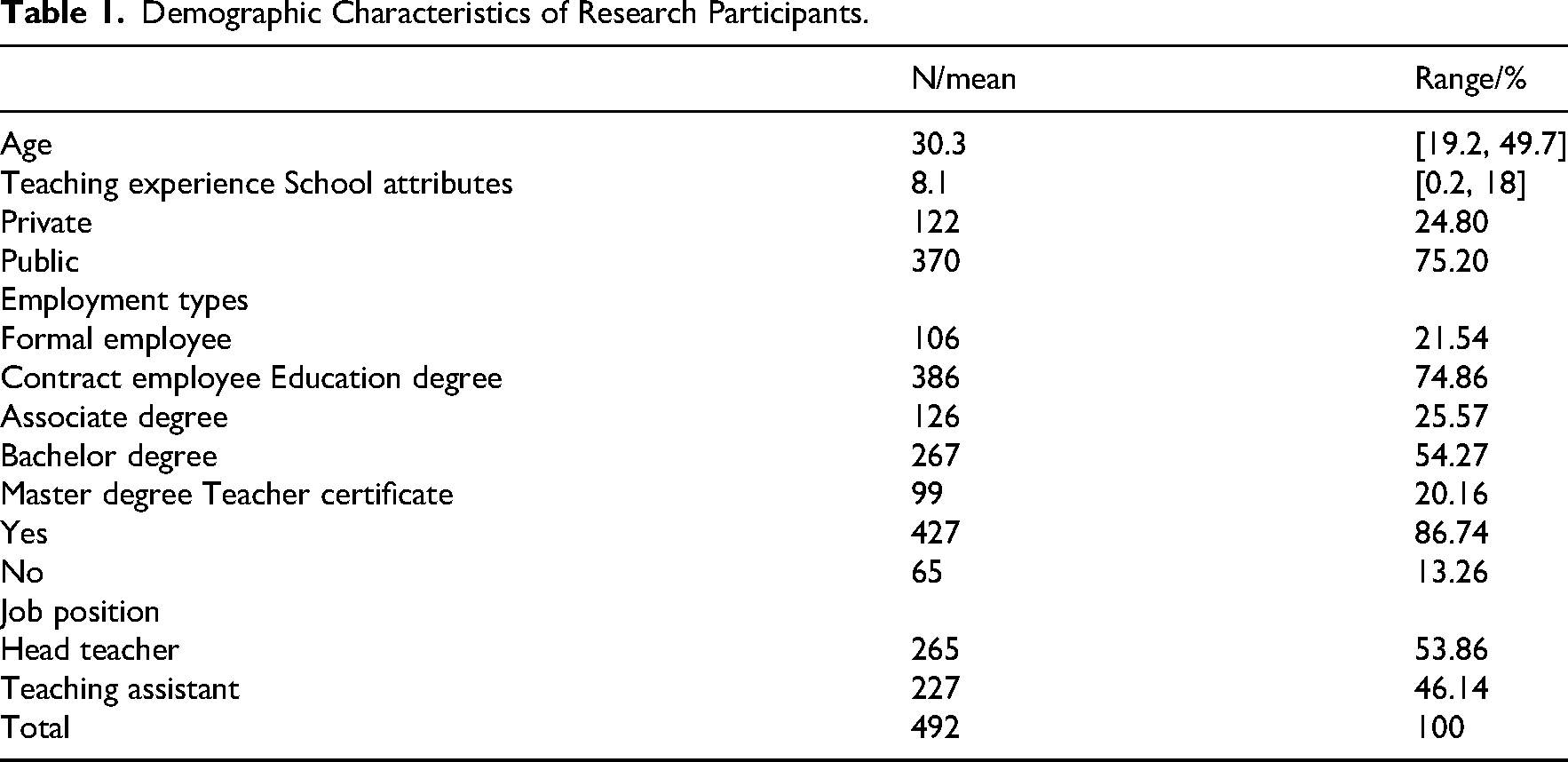
Paper questionnaires were addressed. Five hundred and twenty-eight preschool teachers were examined. After eliminating invalid data which were managed repeatedly or blank answers to the questionnaire, 492 preschool teachers remained. Table 1 presents detailed demographic characteristics. It is noted that for formal staff members, their salary and personnel matters are administrated by the local governments. Meanwhile, contract-based staff has to sign a labor contract with their schools, indicating that their salary and personnel matters are administrated by the schools but their contract rights are protected by the local government. It is worth noting that out of the total number of staff, 386 (74.86%) were on contract. This is a common trend in China, where contract preschool teachers makeup the majority of the teaching force. According to statistics from the Chinese Ministry of Education, there were three million preschool teachers in 2018, but only 0.45 million (15%) held permanent positions (Chen, 2019). This suggests that a significant 85% were working on a contract basis.
Demographic Characteristics of Research Participants.
Instruments
As discussed in the literature, different dimensions of personality traits will be differentially related to teacher leadership. In the study, we address the relevant scales to achieve the research questions. To build trust and rapport, we are responsible for protecting the rights of participants in an ethical manner. Research participants received the consent form before filling out the survey and were informed of their rights and the possibility to opt out at any point. We also promised them that all interview data would be kept secure. They were also informed that the final report would contain identifiers guaranteeing their anonymity and that confidentiality was used throughout the research process.
The Big Five Inventory (BFI). The inventory is composed of five dimensions with 44 items indicated by John and Srivastava (1999), including extraversion vs. introversion (9 items), agreeableness versus antagonism (8 items), neuroticism versus emotional stability (8 items), conscientiousness versus lack of direction (9 items), and openness versus closedness to experience (10 items). The BFI was rated using a four-point Likert-type response format ranging from “1 = completely disagree” to “4 = completely agree.” In this study, the Cronbach's alpha of the scale and each dimension of the scale were between 0.76 and 0.86. Confirmatory factor analysis was used to examine the structural validity of the scale. To judge the fit of the model, the recommended acceptable cut-off values were applied: nonsignificant χ2; the comparative fit index (CFI) and goodness-of-fit index had to be higher than 0.90; the root mean square error of approximation (RMSEA) and the standardized root mean square residual (SRMR) had to be lower than 0.08 (Hu & Bentler, 1999). Confirmatory factor analysis was used to test the degree of model fit of the scale. The results indicated that all indicators performed well (χ2 = 190.713, df = 73, p < .001, CFI = 0.971, Tucker–Lewis index (TLI) = 0.962, RMSEA = 0.081, SRMR = 0.038).
Teacher Leadership Scale (TLS): This four-dimension scale with 19 items was designed to investigate teacher leadership in ECE in China by using mixed methods (Wang & Xia, 2022). The four dimensions include leading teaching and professional development (8 items), characteristics of teacher leaders (4 items), participation in school-based decision making (4 items), and diversity and continuous improvement (3 items). The TLS was rated using a four-point Likert-type response format ranging from “1 = completely disagree” to “4 = completely agree.” In this study, the entire scale and Cronbach's alpha of each dimension of the scale were between 0.768 and 0.894. The results indicated acceptable model fit: χ2 = 204.216, df = 125, p < .001, CFI = 0.959, TLI = 0.962, RMSEA = 0.081, SRMR = 0.026.
Control variables: This study addressed six demographic variables as control variables, including age, teaching experience, employment type, education level, job positions, and teaching certificate (Wang, 2018).
Data Analysis
All data were analyzed using SPSS 25.0 software packages. The value of each item was summed to calculate the mean of each dimension of the BFI and TLS. A moderation analysis was performed; as the literature suggests, the effect of teacher personality traits on teacher leadership depends on school attributes. Moderating variables may reduce or enhance the degree and change the direction of the relationship between independent and dependent variables (Lindley & Walker, 1993). A multiple regression analysis was performed in this study (Holmbeck, 1997). The moderating effect of this study can be tested using the following three mathematical models:


Model 1 tests the influence of teacher personality traits (PT) on teacher leadership (TL), upon which model 2 adds the school attributes (SA) as an independent variable for analysis. In model 3, the interaction term (PT × SA) was added to test the moderating effect.
Results
Descriptive and Correlational Analyses
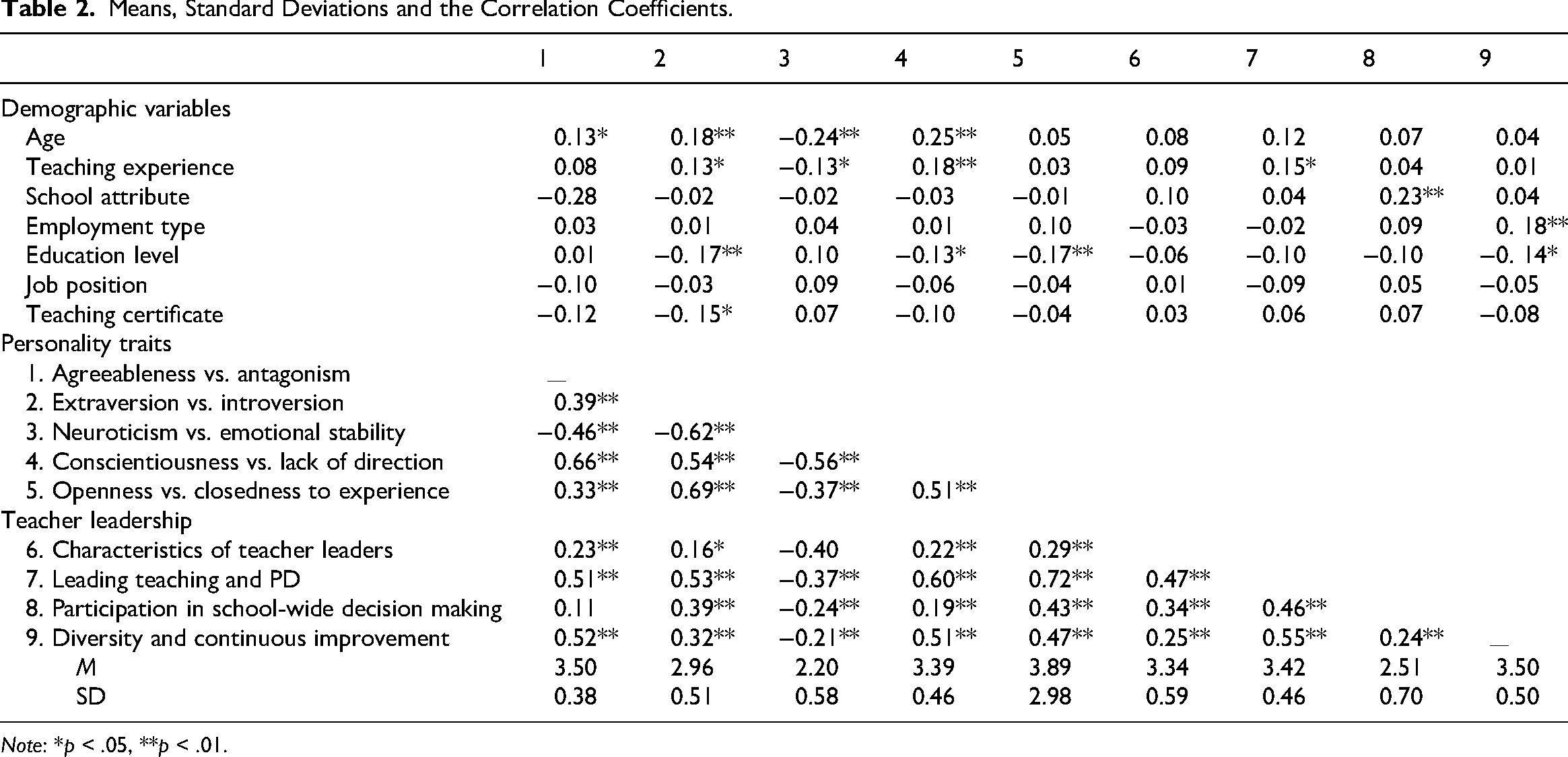
Table 2 presents the means, standard deviations, and correlation matrices of all the variables in this study. Except for the correlation between agreeableness and participation in school-based decision making (r = 0.11, p >.05), and the correlation between neuroticism and characteristics of teacher leaders were not significant (r = −0.40, p > .05), correlations between other dimensions of teacher personality traits and teacher leadership were significant. The moderator of school attributes only revealed a significant positive correlation with participation in school-based decision making (r = 0.23, p < .01). Hence, in the moderation analysis, we will only consider the moderating role of school attributes in the relationship between teacher personality traits of extraversion and openness, and their participation in school-based decision making.
Means, Standard Deviations and the Correlation Coefficients.
Note: *p < .05, **p < .01.
Linear Regression Analyses
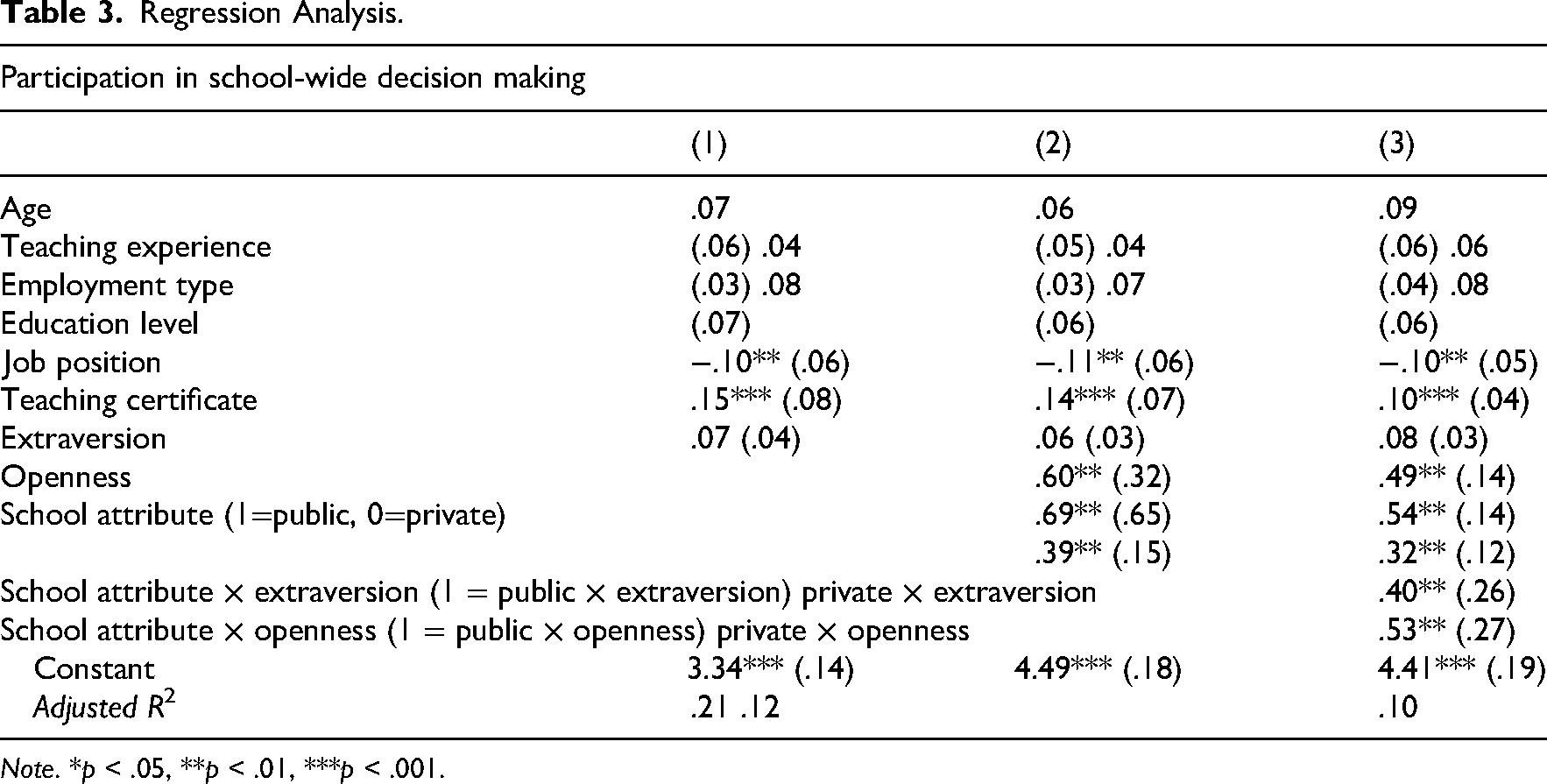
Linear regression analyses were performed to examine the relationship between personality traits and teacher leadership. Table 3 lists all regression results sufficient to address the research questions.
Regression Analysis.
Note. *p < .05, **p < .01, ***p < .001.
First, it shows the results solely for the control variables—age, teaching experience, employment type, education level, job positions, and teaching certificate. It shows that only education level (β= −.10, p < .01) and job position (β= .15, p < .001) had a significant association with participation in school-wide decision making. Next, it illustrates the results for the relationship between teacher personality traits of extraversion and openness and decision making together with all controls. The hypothesized positive relationship of extraversion (β= .60, p < .01) and openness (β= .69, p < .01) in decision making that we had discovered previously in the bivariate analysis was still present.
We finally entered the interaction term of school attributes and personality traits (i.e., extraversion and openness) in the regression equation. A positively significant correlation of the interaction effect on decision making was found at the levels of private × extraversion (β = .40, p < .01) and private × openness (β = .53, p < .01). To better interpret the form of interaction between school attributes and personality traits (i.e., extraversion and openness), we plotted it graphically in Figure 1. To form the graph, the regression lines of personality traits (i.e., extraversion and openness) on decision making were plotted under the condition of school attributes (i.e., private and public preschools). It shows that teachers in public preschools had less decision making than teachers in private preschools.
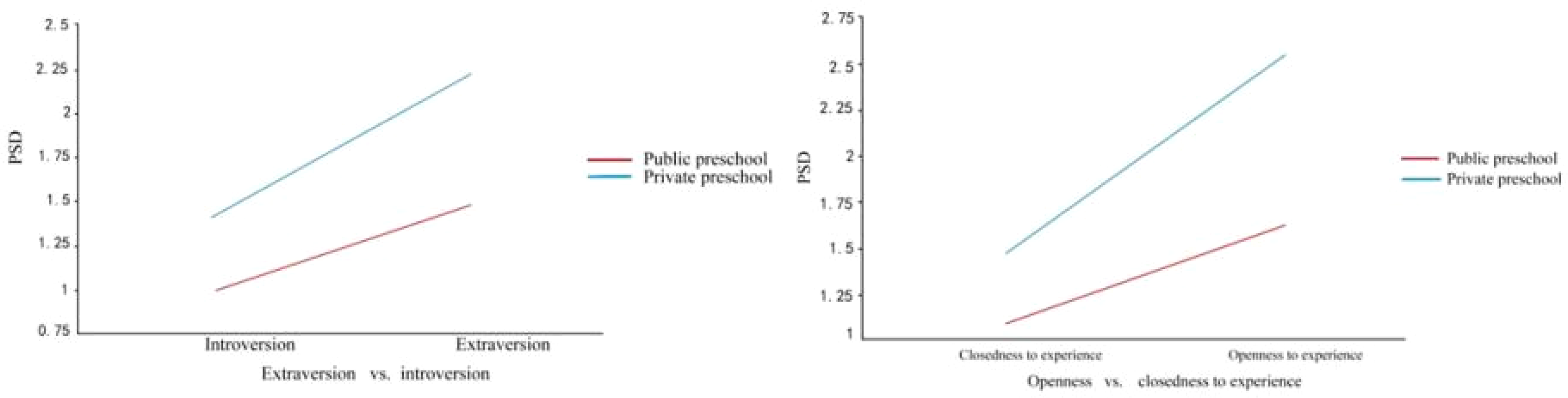
School Attributes As A Moderator of the Relationship Between Teacher Personality Traits and PSD. Note: PSD, participation in school-wide decision making.
Discussion
Teacher Personality Traits and Leadership
The results of this study showed neither significant relationships between agreeableness and participation in school-wide decision making, nor neuroticism and characteristics of teacher leaders. Nevertheless, the investigation did reveal that extraversion, agreeableness, conscientiousness, and openness to experience were all positively associated with the majority of measured dimensions of teacher leadership. Conversely, neuroticism displayed a negative correlation with these dimensions. The results are in line with the earlier studies cited in the literature. For example, traits such as agreeableness, conscientiousness, and openness to experience are positively linked to authentic leadership (Shahzad et al., 2021), ethical leadership (Özbağ, 2016), and transformational leadership (e.g., Garcia et al., 2014; Shahzad et al., 2021; Simic et al., 2022). Conversely, neuroticism is negatively related to transformational leadership (Simic et al., 2022), authentic leadership (Shahzad et al., 2021), and ethical leadership (Özbağ, 2016). This study adds to the traits theory on teacher leadership in ECE within a Chinese hierarchical context by finding similarities with other leadership areas.
In this study, the dimension of characteristics of teacher leaders refers to the competencies that a teacher leader should possess to function as a leader. Several studies have discussed teacher leadership is not about formal assigned roles, but emerges informally by earning it through specific actions (Carrion & García-Carrión, 2015; Poekert, 2012). It is commonly believed that teaching experience, interpersonal 16 skills, creative thinking, and professional-pedagogical knowledge are the key criteria for considering teacher leaders (Katzenmeyer & Moller, 2009). Indeed, recognition of colleagues’ strengths is important in teacher leadership (Fairman & Mackenzie, 2015). Existing evidence suggests that individuals who possess high levels of openness, conscientiousness, agreeableness, and extraversion are more likely to engage in knowledge-sharing behaviors (Anwar, 2017; Lin et al., 2018), which can be considered a form of informal teacher leadership.
Participation in school-wide decision making indicates that teachers are granted an important role in the decision-making process within schools. Surprisingly, this study shows no significant relationship between agreeableness and participation in school-wide decision making, which is opposite to the existing research that suggests agreeable teachers maybe better suited to a participatory management environment (Benoliel & Somech, 2010; Miceli et al., 2018). One possible reason might be that preschool teachers may believe that leadership concerning school-wide decision making is structured within the school's formal position under a Chinese hierarchical school structure (Wang & Ho, 2020). In the context of educational institutions, agreeableness has been shown to have a greater impact on the management of classroom settings, particularly on the interaction between teachers and children, and the teaching and learning process (Burić et al., 2023). While it may also hold some relevance in school-level management, the influence is comparatively lesser.
Leading teaching and professional development concerns teachers positively employing leadership practices to influence teaching and learning, and promote the professional development of their colleagues. In China, preschool teachers are allowed to share their professional thoughts in the professional learning community, a specific platform where teachers, especially those without a post, can act in a leadership role (Wang & Ho, 2020). In this group, human relationships are equal. Based on recent research, it appears that certain personality traits can greatly benefit teachers’ engagement in learning activities. Specifically, conscientiousness, extraversion, and openness to experience were found to have a positive impact (van Daal et al., 2014). Additionally, Jones' study (2015) indicates that a teacher's agreeableness and extraversion can predict their effectiveness in providing instructional support.
Diversity and continuous improvement suggest that teachers can respect and learn from colleagues’ ideas and experiences. The relationship between specific personality characteristics and colleague interaction has been empirically examined. For example, persons with high introversion prefer to be alone and have low-level involvement with their colleagues (van Emmerik & Euwema, 2007). Conversely, extroverts experience better relationships with colleagues (Bester, 2019). It was found that teachers value appreciation and acknowledgment as well as personal support and acceptance when they work together (Hargreaves, 2001). It is not surprising that teachers with higher extraversion, agreeableness, conscientiousness, and openness to experience tend to be more interactive with their colleagues and share teaching expertise in teamwork.
The Moderating Role of School Attributes
This study found that both extraversion and openness were positively correlated with teachers’ participation in school-based decision making, with the correlation moderated by school attributes (i.e., public and private). Research has shown that there is a positive correlation between school culture and teacher extraversion. For instance, Wong and Zhang (2014) found that teachers who view their school culture positively tend to be more extroverted, leading to greater job satisfaction and self-esteem. Moreover, schools that prioritize giving teachers a say in decision making tend to have more open-minded teachers (Inandi & Giliç, 2016). The moderation analysis indicated that teachers in public preschools, with personality traits of extraversion and openness to experience, had a significantly weaker influence on participation in school-based decision making than those in private preschools. The results of this study validate the view of Göncz (2017), who argues that the influence of teacher personality traits on their professional behavior depends on the attributes and characteristics of the school organization. This situation is mainly affected by the different management systems between public and private preschools in China. The organizational culture created by different school management styles determines whether or not teachers are allowed to participate in school-wide decision making (Chukowry, 2018; Cooper et al., 2016).
As mentioned, local governments have given private preschools more autonomy in school decision making than public preschools, leading teachers in public preschools may believe that leadership is structured within the school's formal position under a Chinese hierarchical school structure (Wang & Ho, 2020). Lee (2013) also indicates that teachers showed their willingness to participate as teacher leaders based on the enhancement of a collaborative sharing and professional learning culture and flattened bureaucratic structure within the school context. In this regard, even though the teachers working in public preschools hold extraversion and openness to experience, they tend to play a follower, especially in school-wide decision making (Ho, 2010). Recently, the Beijing government has introduced a series of policies to strengthen the supervision of the quality of ECE for public preschools, indicating that public preschools are facing increasing inspections and supervision. The bureaucratic management atmosphere of public preschools has gradually deepened, resulting in teachers participating in school-based decision making as ultra vires (Parlar & Cansoy, 2017). Compared to public preschools, teachers in private preschools are under less government supervision and have more equal relationships with managers and colleagues; they have better intrinsic motivation and creativity (Fidan & Oztürk, 2015). As a consequence, school attributes moderate the relationship between teacher personality and teacher leadership.
Conclusion
This study examined the moderating role of school attributes in the relationship between teacher personality traits and teacher leadership in ECE in China. The results indicate that teacher personality traits predicted teacher leadership practices, and school attributes played a moderating role in the relationship between them, especially regarding participation in school-based decision making. The results of this study inspire school leaders to pay attention to distinguishing different personality traits of teachers and providing the teachers with different platforms to exert teacher leadership. In the process of strengthening the supervision of the quality of ECE in Beijing, the local government should avoid high-quality evaluation work and narrow down the bureaucratic management atmosphere of preschools. Only when this happens can preschool teachers actively participate in matters outside classrooms that are important to school improvement and development. Moreover, we suggest that transformational school leaders can empower and cultivate informal leaders.
This study has some limitations. First, it adopts a convenience sampling method, which has only a certain degree of convenience and reliability. Consequently, the determination of the sample unit is arbitrary, and the sample lacks representativeness. Second, the study employed a cross-sectional design, indicating that the results were correlational and no causal inferences could be made. Finally, this study uses the five personality traits of teachers as independent variables to discuss their relationships with teacher leadership; however, it ignores the comprehensiveness of the personality traits of individual teachers.
Footnotes
Ethical Approval and Informed Consent Statements
Given the sensitive nature of the research and the potential discomfort written consent might cause to participants, oral informed consent was obtained instead. The consent process was witnessed, and detailed records were maintained. Participants were provided with written information about the study and were given ample opportunity to ask questions before agreeing to participate.
Funding
This work was supported by the National Social Science Foundation of China under [grant number CHA200265]; Ministry of Education of the People's Republic of China.
Declaration of Conflicting Interests
The authors declared no potential conflicts of interest with respect to the research, authorship, and/or publication of this article.