



Abstract
Korean elementary students actively engage in transboundary learning across diverse educational spaces. Alongside formal schooling, they participate in various forms of shadow education, shaping a dynamic learning culture referred to as Transboundary Learning Cultures (TLC). This study explores how students connect learning experiences across school and non-school settings, drawing on TLC and nomadic inquiry to challenge fixed notions of educational spaces as confined solely to the boundaries of formal schooling. Through a qualitative case study, we examine how their ways of learning shift depending on learning spaces, revealing learning as fluid and situated. Additionally, from a post-colonial perspective, the study critiques Western-centric views that portray Korean students as passive learners, instead emphasizing their proactive and agentive engagement in learning. By highlighting the hybrid and interconnected nature of their learning practices, it contributes to the transnationally emerging field of TLC and broadens understandings of student agency, learning space, and the cultural complexity of learning practices.
Keywords
Introduction
Shadow education (SE), also known as private supplementary tutoring, has become a global phenomenon (Baker, 2020; Bray & Lykins, 2012). Korean elementary students (KESs) commonly engage in SE alongside their regular schooling to enhance their academic skills and foster a positive attitude toward learning. In Korea, SE should be recognized as a vital learning space for students’ academic success, rather than solely a supplementary or incidental resource (Kim et al., 2023; Kim & Jung, 2021).
According to the proliferation of SE as a new learning space, Kim, Jo and Jung (2021) have contributed to theorizing the new ways of learning within and beyond traditional schooling, conceptualizing it as a “transboundary learning culture (TLC),” which was inspired by post-modern theories influenced by Nietzsche, Deleuze, and Derrida (pp. 54–59). Through TLC, students autonomously traverse schools and SE institutes to pursue their educational goals, challenging the conventional notion of SE as passive, inferior, and deviant compared to public education (see, e.g., Bray, 2009; Ripley, 2013; Seth, 2002). Similarly, Min and Jo (2021) draw on the nomadology of Deleuze and Guatarri (2010) to propose the concept of “students as nomadic subjects,” engaging in forms of nomadic resistance by deterritorializing their own learning through the heterogeneous learning spaces offered by SE (p. 77). They further reject the image of Asian students as passive and obedient by highlighting their nomadic practices of TLC, which actively utilize SE (p. 82).
Under the prevalent belief that “the sooner, the better”—the notion that beginning learning earlier than one's peers guarantees academic success (Jung et al., 2021)—the participation rate of KESs in SE has increased. This rise has contributed to the steady expansion of both the number and types of SE institutes in Korea (Statistics Korea, 2023). Despite the widespread prevalence of SE among KESs, there remains a notable lack of research exploring how KESs strategically utilize various SE institutes to pursue academic achievement. While Park et al. (2015) provide a detailed account of KESs’ learning experiences in SE, their study primarily categorizes learning characteristics by grade level (1st–6th) and does not fully capture how students actively and dynamically engage in TLC through the exercise of agency. Moreover, much of the existing literature has emphasized the negative aspects of SE, influenced by the Korean government's framing of SE as a “social evil” that undermines educational equity and intensifies academic stress (Hong et al., 2016).
In this regard, this study investigates how KESs engage in TLC in pursuit of academic success. It specifically examines an educational phenomenon in which KESs, characterized by “nomadic subjectivity” (Braidotti, 1994, 2011), independently select and design their learning spaces beyond the boundaries of formal schooling. Drawing on the principles of TLC through a qualitative case study, this research delves into students’ narratives about their use of diverse learning spaces, materials, and strategies across both school and SE in Korea. This work represents the first international effort to examine how elementary students navigate between school and SE, revealing a broader educational phenomenon of learning across multiple spaces. Given the global prevalence of SE, it contributes to a more nuanced understanding of TLC at the elementary school level.
Importantly, this study does not seek to essentialize or naturalize notions of learning or student agency in Korea. Rather, it critically engages with KESs’ learning practices through their lived experiences and narratives. Furthermore, it explores the ontological possibilities of students’ nomadic subjectivity and emerging concepts of learning shaped through local practices. These efforts reflect a post-colonial approach that resists the continuation of “epistemic violence” (Spivak, 1988, p. 280), whereby Eurocentric discourses have historically represented Korean students as passive and dependent subjects within their own epistemic framework.
Transboundary Learning Culture of Korean Elementary Students
The participation rate of KESs in SE has remained consistently high despite the implementation of various regulatory policies by the Korean government over an extended period. According to Statistics Korea (2023), the participation rate in SE among Korean students reached 85.2% in 2022. Once children enter elementary school, they tend to increase both the number of SE institutes they attend and the time of their participation. For instance, according to Ryu (2022), six-year-olds who have not yet entered elementary school typically participate in an average of 2.2 SE institutes. This number increases to 3.5 when they begin elementary school at the age of seven and further rises to 4.2 by the time they reach eight years old.
During the COVID-19 pandemic, parents with elementary students increasingly relied on SE due to the added responsibility of managing and teaching their children at home in the absence of regular schooling (Piao & Hwang, 2021). In response to this situation, SE institutes began offering a wide range of online lectures in both synchronous and asynchronous formats, with diverse learning materials and content tailored to meet the needs of parents and students. Korean parents and students accordingly relied more on SE during this period.
KESs engage in SE for a wide range of educational purposes, including learning subjects such as Korean, English, and mathematics, as well as art, music, and physical education (Park & Kang, 2023). The role of SE for KESs extends beyond mere childcare; instead, it is crucial for academic achievement in schools through “preview learning,” which involves studying school content in advance of school classes (Jung et al., 2021). Specifically, the motivations behind KESs’ participation in SE are varied, with 84.9% seeking to deepen and supplement their school learning and 42.9% attending to gain an advantage in preview learning (Statistics Korea, 2023). In contrast, only about 20% of students attend SE for childcare purposes. This highlights that KESs primarily enroll in SE with the intention of improving academic performance, regardless of the subjects covered (Lee & Yoo, 2021).
Although researchers and policymakers often characterize SE as abnormal or even “corruption” due to its association with educational inequality and severe competition (Baca, 2013), SE remains prevalent among KESs due to its effectiveness in enhancing students’ academic achievement (Byun, 2014; Byun et al., 2022; Yoon & Kim, 2016). Lee et al. (2012) found that all forms of SE positively impact elementary students’ learning abilities, including self-management, problem-solving, test-taking, and information processing. These positive results in students’ academic success can be attributed to SE's development and implementation of their own curricula, textbooks, assessments, and other learning materials aimed at facilitating students’ academic achievements.
As KESs actively engage in TLC, moving beyond the conventional boundaries of school, it becomes imperative to examine their learning experiences not only within formal schooling but also in SE settings. However, existing research on KESs’ learning experiences has rarely addressed how students utilize specific learning strategies and materials in the practice of TLC—an approach that differs significantly from that of middle and high school students. This study, therefore, aims to illuminate the distinctive features of KESs’ TLC by focusing on their vivid narratives and lived learning experiences across both school and SE contexts.
Research Methods
This study employs a qualitative case study approach. As case studies consider culture as an “ongoing, contested production” (Bartlett & Vavrus, 2017, p. 15), we use this method to unpack KESs’ TLC as a continuously changing, evolving, and nomadic phenomenon, rather than a static or sedentary one. Given that we view transboundary culture as a transnational, relational phenomenon (Kim et al., 2021), the inherent feature of case studies that transcends demarcations aligns well with the nomadic inquiry, the theoretical framework we use to analyze this educational phenomenon. In this sense, it aims to become unbound from established boundaries, exploring various ways of TLC that go beyond the confines of specific learning spaces and materials.
For data collection, we conducted in-depth interviews over a period of nine months, from September 2022 to May 2023. We selected 30 KESs and 10 parents from three public elementary schools in Korea. The participants consisted of 8 students in the lower grades (1st–2nd grades), 12 students in the middle grades (3rd–4th grades), and 10 in the upper grades (5th–6th grades). We conducted purposeful sampling to select students who had at least one year of experience in SE and who spontaneously demonstrated a tendency to participate in the study (Creswell, 2014). Among the student participants, we aimed to ensure diversity in the forms of SE in which they were engaged. The parents who participated were those of the student participants, 10 being voluntarily selected from the group.
In-depth interviews were conducted 3–4 times with each participant to uncover various aspects of KESs’ learning experiences, efforts, achievements, and satisfaction, both in schools and in SE. Depending on the requirements of the study, interviews were conducted with students and parents either simultaneously or individually, allowing for a comprehensive examination of the various entities and practices associated with TLC. To facilitate the collection of rich and diverse qualitative data, an interview guide was developed based on document analysis of existing literature and authors’ experiences related to SE (Lincoln & Guba, 1985), Table 1.
Interview Guide.
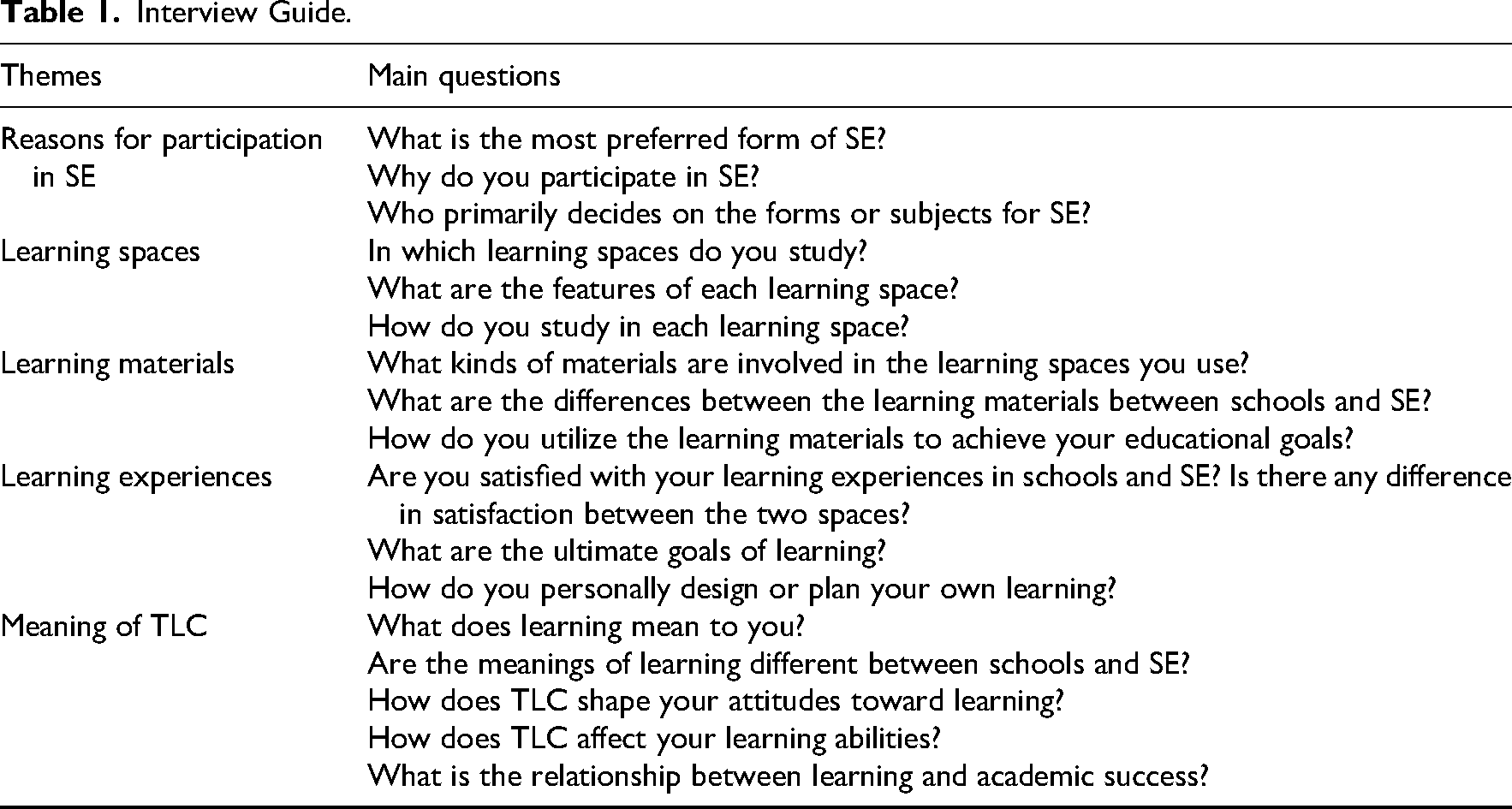
A document analysis was conducted to collect data from various learning spaces used by the students, including curricula, textbooks, workbooks, online resources, tests, and portfolios from the participants. We gathered diverse learning materials, including textbooks and workbooks (36), worksheets (60), school and test records (30), consulting results (23), and study planners (16). The analysis aimed to comprehend how various practices and learning objectives evolved in accordance with heterogeneous learning spaces.
For the data analysis, three rounds of qualitative coding were performed based on the collected data (Saldaña, 2014). We intensively and recursively read and coded them to verify the patterns of their students’ learning experiences, which led us to find key features of KESs’ TLC. We conducted member checking, involving the sharing of interview transcripts and results with participants, to enhance the credibility and validity of this study (Lincoln & Guba, 1985; Lather, 1993).
Nomadic Inquiry on Korean Elementary Students’ Transboundary Learning Culture
By investigating KESs’ TLC, we identify four key features that characterize their educational experiences both inside and outside schools. Drawing on Deleuze and Guattari's (1987, 2010) theoretical approach of nomadology, which challenges and transcends established structures like fixed territories and boundaries, this study unpacks KESs’ innovative approaches to learning and pursuit of academic success beyond the traditional boundaries of schools. These insights not only illuminate KESs’ dynamic, nomadic learning practices and emerging educational approaches but also underscore their capacity to navigate diverse learning environments, ultimately shaping their learning subjectivity.
The Deterritorialization of School Space
The first feature of KESs’ TLC is the “deterritorialization of school space.” This refers to the complex of learning spaces that KESs engage with and how they “deterritorialize” by dismantling the fixed learning spaces and actively participating in SE. According to Deleuze and Guattari (1987), deterritorialization is to “go from the central layer to the periphery, then from the new center to the new periphery, falling back to old center and launching forth to the new” (p. 53). This concept rejects sedentary and fixed linear order; instead, it aims for a nomadic life characterized by “a different way in every assemblage, passing from one to the other, opening one onto the other, outside any fixed order or determined sequence” (p. 347). As KESs’ learning practices challenge and disrupt the fixed territories and boundaries of schools by utilizing diverse learning spaces within SE, they establish new connections and travel emerging ways of learning.
As discussed in numerous educational studies on Korean students (see, e.g., Kim, 2016; Kim et al., 2023; Kim & Jung, 2019, 2021), they engage in learning across various spaces of SE alongside their public schooling to achieve academic success. This phenomenon can be understood through the process of “deterritorialization” from school spaces and “reterritorialization” onto SE. Reterritorialization does not involve a “return to a primitive or older territoriality” but rather encompasses “a set of artifices by which one element, itself deterritorialized, serves as a new territoriality for another, which has lost its territoriality as well” (Deleuze & Guattari, 1987, p. 174). For KESs, the reterritorialization of SE signifies the emergence of new learning spaces where learning practices are continuously challenged, changed, and transformed, while simultaneously deterritorializing the spaces associated with schools. The possibilities of deterritorialization within SE emphasize its ontology of metamorphosis and multiplicity, as learning spaces are not confined or fixed but rather comprise fluid spaces with gaps and openings due to its diverse forms and applications (Carvalho et al., 2016; Edwards et al., 2009).
Through engagement with various forms of SE, KESs have developed complex and hybrid learning practices within their educational environment. Among the forms of SE, hakwons, also known as private tutoring institutes, are the most prevalent reterritorialized learning spaces, resembling schools with physical classrooms, classmates, curricula, assessments, textbooks or workbooks, and learning materials (Kim & Jung, 2019, p. 65). In hakwons, KESs have access to a wide range of subjects and content, including arts and sports, as well as Korean, English, math, science, and social studies. These learning spaces encompass both “comprehensive hakwons,” where multiple subjects are taught in a single classroom, and “one subject hakwons” that focus on specific subjects (Kim & Jung, 2019, p. 67). For KESs, comprehensive hakwons emphasize the development of fundamental literacy and numeracy skills through subject-based teaching in Korean, English, and math.
I have been attending a comprehensive hakwon every weekday for five years since the first grade. In this hakwon, I have learned all school subjects, including Korean, English, math, social studies, and science. Learning with the tutors at the hakwon has particularly helped me improve my Korean and English skills because it deepens my understanding of the school classes. (Min-ha, Interview, March 6, 2023)
While comprehensive hakwons share similarities with schools, they employ different tutors for each subject and organize classes based on students’ academic levels. This allows for more tailored learning experiences compared to schools, where a single homeroom teacher typically instructs all subjects. Although hakwons fall under the umbrella of SE, the corresponding learning spaces vary in terms of subjects, tutors, goals, tuition fees, content, and academic levels. As a result, KESs’ TLC involves not only navigating between the boundaries of schools and SE but also simultaneously engaging in various forms of SE.
Students’ narratives illuminate how KESs engage with SE in alignment with their unique educational goals and strategies. This involves a process of deterritorialization from school to diverse SE institutes—both in-person and online—thereby transcending a fixed center and forming new centers of learning (Deleuze & Guattari, 1987). SE itself does not possess a fixed territory or predetermined form. As a representation of nomadic learning spaces, it embodies a “smooth” space characterized by the continual shifting and erasure of “traits” along its trajectory (Deleuze & Guattari, 1987, p. 381). Its hybrid nature and fluidity make it challenging to define as a singular learning space. Instead, SE encompasses a wide range of educational activities outside of the formal school system, resulting in an ever-evolving and fluid definition. The learning space known as SE, in other words, lacks fixed boundaries and rigid educational methods, adapting to various forms and networks in order to cater to the individualized needs and interests of each student.
The Presence of Rhizomatic Learning Materials
KESs actively use various learning materials, including workbooks, test prep books, reference books, and online sources, from both their schools and SE (Park et al., 2015). This phenomenon can be analyzed by “rhizomatic learning materials” due to the rhizome's characteristics of nonhierarchical, interconnected, and decentralized expansion (Deleuze & Guattari, 1987; Young et al., 2013). In the traditional educational model, school curriculum and textbooks are often seen as the central and authoritative source of knowledge based on the national curriculum with basic concepts and activities. However, the rhizomatic approach, which posits that “any point of a rhizome can be connected to anything other, and must be” (Deleuze & Guattari, 1987, p. 7), challenges this notion by acknowledging that learning is not limited to a single source but is rather a network of interconnected materials and resources. In Korea, this would mean recognizing the multiple entryways and connections that exist between various learning materials provided by SE and workbooks published by private educational publishers. These learning materials offer more detailed conceptual explanations and exam questions of varying difficulty levels, motivating students to engage in SE as a means to study using these resources. As a result, KESs’ active engagement with diverse materials enables a more flexible and adaptable learning experience, fostering a deeper understanding of subjects aligned with each student's academic level.
The primary rationale behind KESs’ utilization of learning materials from SE, despite the presence of school textbooks, is their perception that school textbooks lack the depth required for thorough learning and adequate preparation for specific tests (Hong & Park, 2019). School textbooks focus on providing foundational concepts and content for each subject, often incorporating fun activities like games, discussions, crafts, and drawing to engage students’ interests and cater to their emotional and physical aspects. While these aspects are important for children's overall development and align well with the broader goals of schooling, students often find that textbook explanations lack the depth necessary for comprehensive understanding, and the questions are too simplistic to effectively apply concepts across diverse problem types and levels of difficulty. On the other hand, Korean students tend to prioritize academic success, which is primarily measured through various exams, particularly the university entrance exam. This exam-centered approach to learning emphasizes cognitive abilities and subject-specific understanding over emotional or physical development. Accordingly, students are often prompted to seek additional learning materials and support through SE.
Through interviews, we found that KESs expressed high satisfaction with the learning materials provided by SE, as these materials embody rhizomatic principles of heterogeneity and connectivity, effectively catering to their individualized learning needs and academic goals. We have identified two main ways in which students utilize learning materials from SE.
First, KESs make extensive use of learning materials provided by hakwons. Hakwons offer a wide variety of learning materials, including workbooks, test-prep books, and various printed resources. Compared to the materials found in school textbooks, these materials offer more detailed explanations of the knowledge and concepts in each subject, often accompanied by additional storytelling and illustrations to aid students’ understanding. Hakwons commonly employ workbooks from private educational publishers, adapting them according to their unique curricula and the students’ grades and academic levels. Students express high satisfaction with these materials, as they are designed to be more student-centered and conducive to learning. For instance, Han-bin, a fourth grader, shared that “workbooks in hakwons are more friendly and motivating than school textbooks because they contain numerous examples and explanations for difficult concepts, as well as diverse questions ranging from basic to advanced” (Han-bin, interview, May 3, 2023).
Second, one of the primary sources of learning materials for KESs comes from subscribed learning programs, such as Kumon and Eye Level. The workbooks from this form of SE are designed to allow students to study independently for as little as 30 min to an hour per day. They cover the core learning concepts outlined in the national curriculum, providing specific examples and questions of varying difficulty levels that are not limited by the students’ grade levels (Lee et al., 2012). For instance, Ah-young, a 3rd-grade student, studies math at a 6th-grade level using the workbooks provided by a subscribed learning program.
I am currently studying math that will be taught in the 6th grade using Kumon's workbooks. I spend 30–60 min daily solving math problems with the workbooks provided. Additionally, once a week, a tutor visits my home to assess my progress and review the topics covered. Even when I am on trips, I bring the workbooks with me and continue solving math problems. (Ah-young, interview, April 18, 2023)
The subscribed learning programs incorporate AI technology to offer personalized learning materials based on students’ levels. For instance, in an English subscribed learning program company, each enrolled student receives a tablet to practice their listening, speaking, reading, and writing skills using the AI training system. The AI system records and stores students’ data, such as audio files for speaking practices and writing samples. Moreover, the AI system grades students’ exams, analyzes their learning progress and levels, and provides feedback and recommendations for specific learning programs and areas that require improvement. The integration and connection of online and offline materials, along with the involvement of both human tutors and AI system, reflect a rhizomatic learning approach that transcends the boundaries between humans and non-humans or digital and non-digital while connecting any point to any other point (Deleuze & Guattari, 1987; Jones & Bennett, 2016).
The learning materials utilized by KESs surpass the limitations of grades, physical locations, and prescribed curricula, adapting to their unique academic needs. The diverse and hybrid nature of rhizomatic learning materials highlights the transformation of learning from a linear progression of the traditional “school year system” from 1st to 12th grade to a multifaceted endeavor encompassing various interconnected activities within dynamic and ever-evolving learning practices shaped by students’ levels and interests. Embracing the rhizomatic nature of learning can lead to a more inclusive and dynamic educational approach that empowers students to actively navigate their learning journey and achieve academic success through a network of interconnected learning resources.
The Emergence of a New Learning Path for Academically Gifted Students
The third feature of TLC is to create a new learning path for academically gifted students. This path is salient among students with higher academic abilities whose goal is to enter prestigious universities. Students who find public schooling insufficient for their academic purpose and level seem to seek a new path or educational space called “gifted education hakwon” as the best place for individualized learning.
The distinctive learning approach of high-achieving KESs resonates with the concept of “lines of flight,” which refers to a creative and revolutionary process wherein individuals transgress established hierarchies and norms, aiming to discover new possibilities and pathways (Albrecht-Crane & Slack, 2003; Deleuze & Guattari, 1987). While deterritorialization emphasizes the dismantling of existing structures and boundaries, lines of flight, as a process of deterritorialization, underscore individuals’ agency towards new trajectories and paths, driven by their “desires” for exploration and innovation. In the context of the new learning paths for academically gifted students, lines of flight can be observed in their learning practices and their desire to explore challenging and advanced learning beyond their grade level.
In Korea, the emergence of this new learning path for gifted education has gained momentum since the Lee Myung-bak administration (2008–2013) introduced the “High School Diversification 300 Project.” This initiative established 300 new special purpose high schools (SPHSs), encompassing gifted and talented high schools, foreign language and international high schools, and science high schools. Its objective was to broaden the spectrum of high school choices for students, ensuring educational excellence and competitiveness through the establishment of SPHSs (Exley, 2019; Lee, 2013). Graduates from SPHSs have a higher likelihood of gaining admission to prestigious universities due to high-quality curricula and distinctive programs. For instance, despite only about 10% of all Korean high school students attending SPHSs, in 2017, 26.7% of new students at Seoul National University, 20.8% at Yonsei University, and 17% at Korea University—renowned as the top universities in Korea—had graduated from SPHSs (Son, 2017). These outcomes have led to intensified competition for admission to SPHSs, even from the elementary school years (Byun et al., 2022, p. 61; Exley, 2019, p. 12).
KESs, those eager to enter SPHSs, actively engage in gifted education hakwons to prepare for the specific admission processes. SPHSs conduct interview tests that orally assess students’ academic performance using challenging questions that go beyond middle school levels. As public schools strictly adhere to the national curriculum for designated grade-level subject content, the primary learning spaces for students to study content beyond their grade level are those in gifted education hakwons. According to Kim et al. (2020), most Korean gifted elementary students participate in SE, with the majority attending gifted education hakwons. The main subjects they study in SE are Korean, math, English, and science, which are key subjects for SPHS entrance exams and school tests.
Gifted education hakwons for KESs operate curricula and classes with three main strategies. Firstly, they offer foundational learning for all subjects in schools, much like other hakwons. While gifted students may excel in certain subjects, it remains crucial to systematically manage learning across all subjects to ensure their comprehensive adaptation to school learning. Acquiring fundamental knowledge of school subjects is vital for KESs as it significantly influences their academic performance on middle school exams, which are a key criterion for SPHS entrance. As such, these hakwons comprehensively cover middle and high school subjects, which aims to enable students to achieve high grades across all subjects in school exams (Han & Park, 2013).
Secondly, gifted education hakwons offer a specialized program aimed at preparing students for admission to SPHSs. After acquiring fundamental knowledge in each subject, students then shift their focus to advanced learning in math, science, and English—subjects that are predominantly assessed in the entrance exams for SPHSs. These exams often encompass content that extends beyond the high school level, even delving into advanced college-level concepts (Lee & Hong, 2019). Moreover, since the entrance exams for SPHSs evaluate a wide array of abilities, including discussion, interview, and essay writing, hakwons facilitate various discussions and essay writing activities centered around subject knowledge.
Lastly, Korean gifted elementary students prepare for various domestic and international competitions or Olympiads at gifted education hakwons (Kim et al., 2020). This unique feature differentiates gifted education hakwons from other types of hakwons for KESs. Participation in these competitions requires students to acquire subject knowledge ranging from foundational to advanced levels. The competitive spirit and motivation from these endeavors can foster sustained interest in learning (Ko & Han, 2015). Significantly, the questions in these competitions often resemble those in entrance exams for SPHSs or the essay writings for university entrance, making the preparation for these competitions a natural step toward preparing for SPHSs and university entrance exam.
Gifted education hakwons represent a novel learning path for KESs with high achievements, standing as a nomadic space that diverges from traditional educational environments. Functioning as spaces for a line of flight, these hakwons depart from the sedentary, fixed structure of school-centric learning. This departure entails pursuing unique learning objectives, curricula, workbooks, and tutors geared towards achieving further academic excellence, setting them apart from other learning spaces. The desire to enter SPHSs motivates nearly all Korean gifted students, as they recognize its advantageous impact on admission to prestigious universities. Thus, KESs nurture ambitions of accessing prestigious universities by pursuing an alternative learning path that distinctly extends beyond the boundaries of traditional schooling.
The Development of Novel Ways of Learning by Nomadic Learners
The preceding three features of TLC point to the possibility for KESs to become “nomadic learners,” drawing on Braidotti's (1994, p. 5) concept of “nomadic becoming,” as they actively shape their learning practices and trajectories through SE. Importantly, the final feature explores more deeply how KESs are characterized as nomadic learners through their novel forms of transboundary learning, which involve the cultivation of distinct attitudes and strategies toward the notion of learning. This encompasses the rationale behind the formation and accumulation of the previous three features of TLC among KESs, fostering new ways of thinking about learning and academic achievement within the Korean educational landscape. Aligned with existing literature that highlights the qualities of successful learners—such as self-directedness, intrinsic motivation, adaptability to changing environments, and self-efficacy (Redondo & Martin, 2015; Reeves, 2013)—KESs cultivate and apply these academic, emotional, and social competencies through their unique engagement with TLC. Within the Korean context, these innovative learning approaches are increasingly recognized as effective strategies that enhance students’ potential for academic success.
To illustrate how KESs can be understood as nomadic learners, we identify three innovative learning practices they engage in. First, through various learning spaces between schools and SE institutes, KESs gather a diverse array of learning information tailored to their learning levels, goals, and interests with their parents (see, Choi et al., 2025). This has positive effects on students’ self-directed learning, as well as their interest and motivation in their studies (Gureckis & Markant, 2012). They primarily access this information online, utilizing their personal devices. In recent years, apps and websites have emerged to provide students and parents with information about the educational resources available in each city and neighborhood, including the latest educational materials, entrance exams, schools, and SE. Jun-seong, a 6th grader, actively utilized an app to search for a math hakwon to supplement his math skills. He remarked, “I like this app because I can easily access information about hakwons. I read reviews of hakwons through it. I also ask my friends whether they are satisfied with the teaching and materials at their hakwons” (Jun-seong, interview, March 8, 2023). Similar to Jun-seong, KESs as nomadic learners proactively seek out various educational information independently and discuss it with their parents, rather than passively adhering to a learning path predefined by their parents and teachers.
Another way of learning involves actively participating in the decision-making process of their learning activities and programs, being guided by the educational information KESs and their parents gather. The ability of students to make decisions and exhibit spontaneity in their learning is pivotal in maximizing learning effectiveness and motivation (Williams & Burden, 2001). Through extensive interviews, we found that KESs mainly make decisions about the most suitable learning environments, materials, and tutors, after gathering educational information. Even though they may lean on parental and teacher guidance more than middle and high school students, they primarily determine which subjects to study or which learning materials to explore through SE (see, also, Choi et al., 2025). For instance, Su-jin's mom considers factors such as cost, time, tutors, and educational resources when selecting SE institutes. However, the final decision ultimately rests with Su-jin, as her interests, the presence of close friends, and overall enjoyment play a pivotal role, often leading students to engage in activities they find enjoyable.
Lastly, KESs plan their learning paths based on the self-awareness cultivated through TLC. This self-awareness pertains to viewing themselves as “active learners” rather than “passive learners” who merely follow the guidance and plans of parents and school teachers. As active learners with self-awareness and decision-makers of their own learning practices, their “transgressive identity” (Braidotti, 1994, p. 35) becomes more evident as they connect, mobilize, and engage with a wider range of educational information and materials. This self-awareness has a positive impact on their intellectual curiosity and motivation for achievement (Shi, 2017), prompting them to shape their ways of learning by recognizing their academic goals and pathways. They make informed decisions about their learning activities based on their learning experiences, actively participating in TLC.
These three ways of learning practices adopted by KESs as nomadic learners differ significantly from the interpretations provided by Western scholars thus far. Specifically, students in East Asian countries have often been portrayed as passive learners who depend on their teachers’ instructions and exhibit obedient behavior (see, Ballard & Clanchy, 1991; Raymond & Teo, 2017). This perception stems from the Confucian cultural legacies that emphasize the importance of respecting teachers’ authority and knowledge, wherein resistance or disagreement with teachers is not readily accepted. However, as Braidotti (1994) proposes the concept of “nomadic subjects” who are “not taking any kind of identity as permanent” (p. 33), Korean students can be understood as nomadic learners who engage in continuous negotiation, interaction, and translation, actively designing their learning practices and experiences according to their own needs and interests within learning environments shaped by a multitude of shadow education SE institutes. Thus, describing Korean students solely as passive learners from a Western perspective legitimizes and perpetuates fixed identities rooted in “orientalism” (Said, 1978). The result we found challenges such Western-centric interpretations of Korean students by shedding light on how KESs actively design and plan their own ways of learning through both SE and formal schooling, thereby resisting grand narratives (Lyotard, 1979).
Conclusion
This qualitative case study elucidates KESs’ TLC by drawing on the principles outlined by Kim and Jung (2021). To capture students’ learning practices, we conducted in-depth interviews with 30 KESs and 10 parents. Taking inspiration from Deleuze and Guattari's (1987) nomadic inquiry, which challenges and transcends established structures such as fixed territories and boundaries, it delineates key features of KESs’ TLC and the rationale behind KESs as nomadic learners.
This study represents the international attempt to investigate the learning experiences of KESs and the reasons behind their academic success within the context of TLC. Existing research has primarily concentrated on their experiences within schools, overlooking a comprehensive understanding of students’ overall learning experiences. Given the widespread prevalence of SE globally, particularly in East Asian countries, this study highlights the potential for the production, modification, continuous transformation, and emergence of new ways of learning through KESs’ TLC, moving beyond traditional understandings of learning confined to the school system.
This endeavor expands the field of curriculum studies by advocating for a transnational approach that takes into account diverse local contexts, ultimately contributing to the reconceptualization of global discourses and curriculum studies through collaborative efforts (Gough, 2003; Kim, 2010). By employing post-colonial approaches by describing KESs as active, nomadic learners, this study challenges the prevailing stereotype of passive students who merely follow parental and teacher guidance, as often portrayed in previous research. This perspective resists the Western-centric “regime of truth” (Foucault, 2003) and seeks to reposition South Korea as an active site of critical knowledge production, rather than a passive recipient of Western epistemologies (Chen, 2010; Takayama, 2018).
Footnotes

Declaration of Conflicting Interests
The authors declared no potential conflicts of interest with respect to the research, authorship, and/or publication of this article.
Ethical Consideration
All participants provided written informed consent prior to enrollment in the study.
Funding
The authors received no financial support for the research, authorship, and/or publication of this article.