



Abstract
This study introduces the concept of “transboundary learning culture” as one of the important concepts to better understand students’ contemporary learning both in the East and West. Not solely relying on public schooling, schooling students employ shadow education for their academic success, which is an emerging global educational phenomenon. Based on fieldwork and qualitative data analysis through Korean shadow education practices, the authors propose the concept of “transboundary learning culture” to characterize such a new emerging trend in students’ learning practices and explain four forms of such new learning, namely (1) complex learning spaces; (2) consilience of learning materials; (3) fusion of the concepts of a good learner and (4) coexistence of the two paths for academic success. It is expected that reading the concept and considering students’ learning practices from the concept will enable scholars in curriculum studies, learning sciences, and the anthropology of learning.
Introduction
Considering the strong influence of shadow education on academic learning, contemporary students in East Asia and the Western Hemisphere are not solely involved in public schooling. They consider shadow education as important as public schooling (Christensen & Zhang, 2021, p. 434; Feng, 2021; Hallsén, 2021; Kim & Jung, 2022). For some students, shadow education is regarded as a more effective method of learning. Such positive application of shadow education for their academic success and cognitive development during public schooling constitutes a new culture of learning entitled “transboundary learning culture” (Kim et al., 2022, p. 60). Such changes in school learning practices require education scholars to consider this global phenomenon more seriously as an important topic in studying students’ academic success and learning cultures. This observation is also crucial considering Baker’s (2020) new emphasis that shadow education is no longer a matter of choice but an indispensable component of students’ academic learning. In addition, explaining such practices within East Asian regions and reading their meanings and values will provide a method of understanding the culture of learning in East Asia, which has never been fully studied in the area of anthropological questions, regarding East Asian students’ culture of learning (Anderson-Levitt, 2014, p. 350).
Thus, this study attempts to explain the concept and practices more precisely and deeply, which were originally created in South Korean studies (Kim, 2018a, 2018b), and later introduced worldwide through English publication (Kim et al., 2022). Thus, this study is a new edition to recapture previous thoughts in journals written in Korean and expand previous discussions and ideas for scholars in this field of inquiry. The authors believe that previous discussion on the concept was not sufficiently developed to fully explain the concept, and it should be rewritten with more qualitative data and evidence. Therefore, the authors reread the original text written in English and decided to publish this article for further complementary work to help readers better understand the definition, meanings, and practices.
It is dramatic to observe the Korean scene of shadow education, which has long been illegal under the Korean government, however, is as important as public schooling (Kim, 2016, p. 15). As another example, Park Keun-Hye government also prohibited shadow education learning by implementing “No Prior learning Law Through Shadow Education” (Hong et al., 2016). However, a year later, this law was cancelled by the government, as it was not possible to control students’ prior learning through shadow education after school. Thus, Korean students and parents live in an age of a transboundary learning culture, where shadow education is actively used and selected for personal educational purposes and needs. The authors believe that such a new movement of social recognition and acceptance, similar to public schooling as another important learning place, is happening worldwide, including in China, India, Singapore, Japan, England, Canada, and the Taiwan region of China. For example, John Jerrim's report (2017) indicates that more than half of high school students in London use shadow education for their additional mathematics learning after school and shadow education practices are also recognized as learning places in Canada (Aurini & Davies, 2004, p. 420).
From this perspective, conceptualizing and attempting to understand the practices of transboundary learning culture appears to be relevant and valuable, as more students in this world apply shadow education to their school learning, which appears to have become the preferred practice. This implies that scholars in this field are required to explore the manner in which students effectively use both qualitatively different learning places (public schooling and shadow education) for their educational needs and the type of integration of learning places that are developed as new trends in students’ learning practices. For a more serious discussion on the concept and implications of the practices for the study of shadow education in the future, analyzing students’ methods of learning in two different places and examining the manner in which they use them for the best results (school grades, high school admissions) comprise the research questions in this study. Thus, philosophical ideas and theories on postmodern and transboundary thinking are discussed as the academic basis of the concept (Coyne, 2011; Deleuze, 1968; Derrida, 1978, p. 77; Habermas, 1984, pp. 85–101; Heidegger, 1972; Norberg-Schulz, 1988; Wilson, 1999, p. 40) and students’ methods of learning using the integration of shadow education and public schooling is conceptualized and explained with theoretical concepts in the field.
Transboundary Learning Culture: Evolution and Development of the Concepts
The concept of transboundary learning culture emerged from the study “Crossover of Learning: A Qualitative Research on Roles and Limitations of Shadow Education as a New Learning Culture of Korean Students.” This 2-year project (Kim, 2018a, 2018b) was funded by the Korea Research Foundation in South Korea. Young Chun Kim was the chief investigator and Jae-seong Jo was the researcher for the project. The phrase “Crossover of Learning” was selected, however, was later transformed to transboundary since “crossover of learning” is used more often in the field of arts and cultural lives and later was used in academic fields. Since shadow education was, at the time, negative for most educational scholars in South Korea, Kim did not wish to use shadow education solely as the theme of the research and instead persuaded the reviewers of the projects in curriculum studies to consider the meanings and implications of Korean students’ changing landscape of effective learning under both shadow education and public schooling. Thus, the author emphasizes the importance of the theme for interpretive inquiry into the phenomenon rather than the importance of shadow education learning itself. The strategy for persuasion was successful, and the reviewers in the letter of the evaluation form judged that the topic should be researched as a new educational feature of South Korean students’ academic success.
Two academic articles were published. The first article defined five forms of shadow education in South Korea (Kim, 2018a). The features and effects of each form on South Korean students’ learning were explained through their learning experiences and practices. Using various qualitative cases and evidence, the authors attempted to indicate scholars in this field better understand the purposes for which each form is promoted for students’ academic success and the types of groups of students that were able to enroll for these practices (the unequal nature of shadow education). However, this article aimed to show Korean educators that South Korean students actively use various shadow education for their school success, and it is important to recognize the existence and impacts of these practices when discussing Korean students’ spaces of learning and learning culture. Another focus of the article was to emphasize that South Korean students participate in at least each form of these various practices; thus, adding such a new form of shadow education is necessary for discussing South Korean students’ academic learning. That is, at least two different learning places (curriculum, teachers, or spaces) are a necessary requirement when discussing academic learning and school success in South Korea.
In the second year of the project, Kim and Jo collected and reanalyzed data on South Korean students’ learning culture under shadow education for the second article publication. They realized that Korean students did not separate shadow education from public schooling for school success and consider it positively for educational purposes. This new recognition and attitude is fundamentally different from the past tradition of social stigma against shadow education in South Korea (primarily the Korean government and social media). Moreover, they determined that parents’ attitudes toward shadow education were different from those of past years, who now appeared to accept the necessity of shadow education, although they indicated the additional burden of tuition fees. To capture the students’ and parents’ emerging ideas of the new roles of shadow education in South Korea, Kim and Jo developed new interview guides to determine the practices and reasons toward questions of “How do students use shadow education for school success alongside learning in public school? What types of strategies and methods do they create for the effective integration of two different teaching places? What causes each student to develop his or her own form of integration according to class, school grade, region, and type of school subject?”
After qualitative data were collected from in-depth interviews (life history, focus group, and unstructured interviews), participant observation (students’ learning in public schooling, methods of learning in shadow education, lectures, and lessons in various forms of shadow education), and document analysis (students’ curriculum, workbooks, diaries, and various materials on shadow education institutes), qualitative coding processes were applied to them to develop emerging themes of students’ learning under the idea of integrating public schooling and shadow education. Consequently, four new types of integration were developed, which were later named based on the reading of the transboundary discourse, as follows:
Complex involves several different but related parts. This is best characterized as arising from large-scale, nonlinear interactions (Cilliers, 1998, p. 37). Consilience is key to unification. There is an agreement between the approaches to topics in different academic subjects, particularly science and humanities. This word is preferred over “coherence” because its rarity has preserved its precision, whereas coherence has several possible meanings, only one of which is consilience (Wilson, 1999, pp. 8–9). Fusion is the process of combining two or more concepts to form a single entity. The play of fusion no longer belongs to the horizon of Being, but one whose play transports and encloses the meaning of Being (Derrida, 1982, p. 22). Coexistence is the state or fact of living or existing simultaneously or in the same place. All coming-to-an-understanding in being-with-one-another is a coming-to-an-understanding on a particular basis of being trusted with regard to something, a basis for discussion that is itself not discussed (Heidegger, 2009, p. 104).
These concepts were selected and applied to the process of data analysis and interpretation after reviewing the literature on transboundary discourse in philosophy. Relating such relevant literature and perspectives from the field was fortunate for the project, since the authors were able to explain South Korean students’ new learning culture with those academic concepts and theories. Among several types of sub-concepts under transboundary discourse, these four concepts were selected and applied to categorize South Korean students’ new learning culture and later grouped into the concept, “transboundary learning culture” by combining transboundary with learning culture. Thus, the analytic processes and coding scheme were open and developmental in the first part of the data analysis stage, and the emerging themes were named and characterized by the four sub-concepts under transboundary discourse. Thus, this research is interpretation, inquiry, orientation driven as well as theoretical. This approach is well explained in Lather's postmodern qualitative research camps (Jackson & Mazzei, 2022, p. 67). They use postmodern theories as an analytic lens and scheme to guide, design, and analyze qualitative research practices. Examples include the Use of Empire (Coloma, 2013), Foucault (Baker, 2007, p. 92), Derrida (Bojesen, 2021, p. 118), Deleuze (Semetsky, 2006), and Said (Rizvi & Lingard, 2006).
Thus, the authors acknowledge that this concept is more theoretically driven, is in the inceptive stage of academic theorizing, and should be more deeply discussed and theorized through future studies on the topic by other scholars in different research settings, nations, and research participants. Such a critical and reflective process of theorizing building on the topic will enable scholars of this new phenomenon to produce more relevant and indexical concepts and ideas in studies on transboundary learning culture.
Four Characteristics of Transboundary Learning Culture: Practices in South Korean Students’ Educational Lives
The previous section discussed the emergence of the sub-concepts of transboundary learning culture. Each concept has been introduced in the literature on transboundary discourse. This section explains how each concept functions toward school success in Korean public schooling as a new component of the transboundary learning culture. We suggest them as features of South Korean students’ transboundary learning culture, and expect that these practices are observed in Korean students’ educational lives and used as an analytic perspective for scholars and educators to examine the manner in which similar contemporary students in East Asia, Europe, and North America, use these new practices; and search for different forms of these practices according to differences in cultural and educational traditions.
Complex Learning Spaces
The first feature of South Korean students’ transboundary learning culture is the complex learning spaces. As the “complex” concept refers to an amalgamation of distinct components, it implies the two types of prominent educational spaces: public education and shadow education. The concept of “complex” was borrowed from Habermas (1984) and Snow (1993), and created in relation to the students’ learning places under shadow education in this study. The concept of multiple spaces is most easily imagined when considering shadow education in addition to public schooling. That is, in the twenty-first century, students learn both in public and shadow education. When considering an image, we considered two different learning spaces. Studying at school and in shadow education. Thus, this concept of space allows us to propose that most contemporary students participate in at least two learning spaces and use them for their own educational purposes.
However, the number of spaces for a transboundary learning culture does not always mean two; more than two spaces are possible for a certain group of students. As there are five major forms of shadow education practices (Kim, 2018a; Kim & Jung, 2019), for example, (1) PTI (private tutoring institute); (2) HVPT (home-visit private tutoring); (3) IBPT (Internet-based private tutoring); (4) PLP (prescribed learning programs); and (5) after school programs, and the number of their combinations.
The most common type of complex space is the integration of public schooling and PTIs, which Bray (1999) called classroom-based tutoring. This is the most “school-like” (Aurini & Davies, 2004, p. 419) form of shadow education as it has its own physical space (classrooms and buildings), and classes are often organized based on age or academic level. PTIs provide students with instruction and curricular programs similar to those in public schooling in terms of curricular progress and subject content. At PTIs, students supplement their learning with materials developed by institutes to master their knowledge and skills (Jung & Jung, 2019; Kim, 2016). Students who are lagging behind in school receive remedial programs with tailored learning materials to help them reach the required level. In this complex learning space, PTI learning functions by preparing students for school and higher education entrance exams. Advanced students accelerate their learning opportunities at PTIs using advanced and condensed learning materials.
The second type of complex learning space is a combination of public schooling and HVPT. HVPT is one-to-one or small-group tutoring and is the most individualized form of shadow education (Kim & Kim, 2015). Several students and parents favor the HVPT and believe that it is the most effective, as it is the most personalized form for subjects such as mathematics and English. HVPT sessions are based on a one-to-one relationship between a student and tutor, and the tutor takes responsibility for improving students’ achievements. The tutors personalize instructions for each student in terms of selecting the curriculum and teaching methods. HVPT is used by students from wealthy families because tuition fees are the highest among shadow education types (Kim & Jung, 2019, p. 119). Some students have a tutor for each subject if their parents can afford and therefore, the tuition fees are extremely high. Familial investments for this type increase in the high school years as students prepare for college entrance exams. In elementary schools, the tutor covers multiple subjects, however, in middle schools, the tutor teaches only one subject, and their qualifications are proven by their college major and teaching experience.
With these two learning spaces, the third most prominent complex is the combination of IBPT and public schooling. Owing to the advantages of Internet technologies and the ease of learning at home and in other comfortable places (study cafés, restaurants, and even during school lessons), this feature is being increasingly accepted and used by Korean students. Among its many merits, two notable features attract Korean students. First, students could study school subjects with the most sought-after tutors at low tuition fees. The monthly fee is lower than that of Hakwon, and relatively cheaper than that of HVPT. One can take lessons from sought-after tutors who are generally assessed as better teachers than classroom teachers in public schools. For example, students in rural areas can select this type because of the lack of available PTIs and can take higher-quality lessons from online tutors that have relatively reasonable tuition fees. The second reason for its popularity is that a systematic approach to subject knowledge is based on personalized instruction, which is rarely present in classroom teachers’ lessons. Students can retrieve recorded lessons from the IBPT web and use them to learn about school subjects. IBPT is particularly helpful when the lessons in public schooling are not helpful for students’ comprehension and classroom teachers no longer discuss the topic once the lesson is over.
It is noteworthy that students’ learning places vary and effective learning occurs through complex learning spaces. Although public schooling continues to function as the main body of the curriculum (what students should know and learn for academic success), students actively apply shadow education to maximize the purpose of public schooling and supplement their learning—both for remediation and acceleration—as it makes learning more personalized because of smaller student-teacher ratios and tailored curricular programs and learning materials (Kim & Jung, 2019; Kim et al., 2020). However, Kim's previous studies and several other international studies on the problems of shadow education have focused on the economic burden of additional learning on families. Thus, a discussion of complex learning spaces needs to be addressed in the context of family finance; therefore, it is a matter of social class in capitalist countries and educational inequalities. As learning in shadow education is strongly related to the private costs of students and parents, the number of learning spaces is also problematic as one of the criticisms of the roles and values of shadow education, unlike the general advantages of combining two different learning spaces for effective learning.
Further analysis of the use of this practice suggests three positive impacts on academic success in public schooling. First, students’ total learning time appears to have increased through this transboundary learning culture. Students study outside public schooling as they wish or require (Byun, learning beyond school walls). For example, students who opt to use Internet-based hakwon do not waste their learning time, finding their favorite learning space without trial and error. Second, students’ choices of learning programs are possible, which makes learner-centered and customer-centered ideas of education possible. Students can study in various individualized learning places. Third, the use of learning places enables students to better understand and master the Korean government's curriculum. By studying in new learning places outside public schooling, students are expected to follow the contents and pace of the school curriculum and achieve the intended purpose of the formal curriculum in public schooling.
Consilience of Learning Materials
The second feature of a transboundary learning culture is the consilience of learning materials. Consilience refers to the use of different materials to achieve goals (Wilson, 1999). Wilson (1999) explained that consilience is practical action to search for the right meaning through use of various materials in humanities, social sciences, and arts (p. 22). It is generally expected that such a combination of materials will be more beneficial for achieving the objective rather than the sole use of a material. Thus, use of consilience in relation to the learning material suggests that students are able to achieve their educational purpose (understanding of subject knowledge and mastery learning) when they use learning materials (curriculum and texts) with those of public schooling. The use of shadow education materials as complementary resources is particularly important when national curricula such as school textbooks are not sufficiently personalized for students’ levels of understanding and difficulties.
This feature of consilience is easily noticeable and prominent for students’ academic learning in public schooling. Most students use their favorite learning materials in their daily learning and even take them into classroom learning. They believe that, in South Korea, textbooks in most subject areas are standardized and taught to all students as the only resource. Teachers use these as the only guidelines for effective teaching and learning, and there are no exceptions. There are many problems in teaching based on national textbooks, which are mostly related to students’ levels of understanding and personalization. The first problem arises when the content of the subject is difficult to comprehend. It occurs in Korean, mathematics, and English. They are not student-friendly, and the problem becomes serious as the grade increases, such as in middle school and high school. Students cannot follow school lectures without additional and complementary learning materials to improve their understanding of the content. Incomprehensibility and a high level of difficulty make students’ learning impossible when teachers do not understand student requirements. Where teachers do not follow easy-to-understand methods of teaching, students are unable to keep pace with the school curriculum without relying on additional resources of shadow education. Furthermore, where teachers are bound by their professional obligations of following the annual curriculum, students’ incomprehensibility is not an important task for teachers.
Therefore, students in South Korea use shadow education to find the best materials to help them solve their learning problems and difficulties arising from school teaching. Tailored course books, workbooks, question workbooks, mock-test books, and various online lectures are examples of this category. The production of learning resources complementing school textbooks and lessons is an extensive enterprise in the South Korean shadow education business, and one of the major directions of shadow education companies is to produce student-friendly learning programs and resources and make them the best sellers. Thus, in South Korea, it is easy to know that students in a certain grade and subject area study using the best-selling learning materials for school learning, which are generally teachers’ lessons based on textbooks. Thus, it is common for Korean students to follow these learning materials all the time at home or in school. These materials are particularly helpful as students find them easier to understand compared with school textbooks or classroom teaching. Learning these techniques is advantageous for mastery learning and text performance. The authors predict that in countries and regions such as China, Japan, Singapore, South Korea, and the Taiwan region of China, where the levels of difficulty of some cognitive subject areas such as mathematics, science, and language are much higher than those in Western nations, this study adds various materials to shadow education for a more precise understanding through multiple combinations to that of public schooling.
The authors noticed that the quality of the learning materials was one of the most important criteria for selecting budding programs. That is, Korean students assess the quality of their original and, thus, more effective learning programs (materials, activities, workbooks, and notes) that tend to solve their learning problems in public schooling. Thus, popular shadow education industries and franchises emphasize the quality and effectiveness of programs to ensure that their learning succeeds in public schooling. One of the nationally recognized franchise companies in elementary mathematics advertises their program with the catchphrase, “We will teach until your children finally understand.” It is televised every night, when most Korean families eat dinner at home. Thus, it is easy to notice that most Korean students study using shadow education materials, although government officials maintain that following school textbooks is sufficient to secure admission in the best colleges in South Korea.
The following examples demonstrate the convenience of the transboundary learning culture through two major ways of integrating different learning materials: (1) studying with workbooks and (2) studying using internet technology. The first is a combination of school textbooks and workbooks developed by shadow education publishing companies. Workbooks contain the most important parts of a subject and provide explanations in simple formats at different academic levels. Reading and using workbooks to study allow students to comprehend content knowledge and become aware of what is important, what to memorize, and how to solve problems related to content knowledge through images, stories, and examples. While these guidelines are not provided in school textbooks, this knowledge may be provided through teachers’ instructions available only during classes.
The second concerns the integration of online lessons through Internet based teaching institutes, which vary in terms of instructional styles, academic levels, areas of school subjects, and the purpose of learning. In the first type, students are provided with learning materials or workbooks developed by companies and study using online lectures and printable materials. Some tutors are famous for their excellent teaching skills and are considered by students to be better than their classroom teachers (Cheng, 2007; Kim, 2016; Paramita, 2015). They know what is important when learning a concept from school textbooks, what is to be studied and learned, and how the concept should be understood. In some respects, this approach is considered the integration of two educators (teachers in public school and tutors in shadow education) who use different teaching techniques and methods of engagement. Thus, South Korean and several East Asian students have access to teaching figures other than their schoolteachers, which have become an important form of learning material. This approach is expanding and becoming popular among South Korean students (Cheng, 2007) and other countries, even crossing national borders as some companies employ offshore tutors (Ventura & Jang, 2010). Table 1 presents a sample list of Korean students’ use of consilience in learning materials.
Examples of Korean Students’ Use of Consilience in Learning Materials.
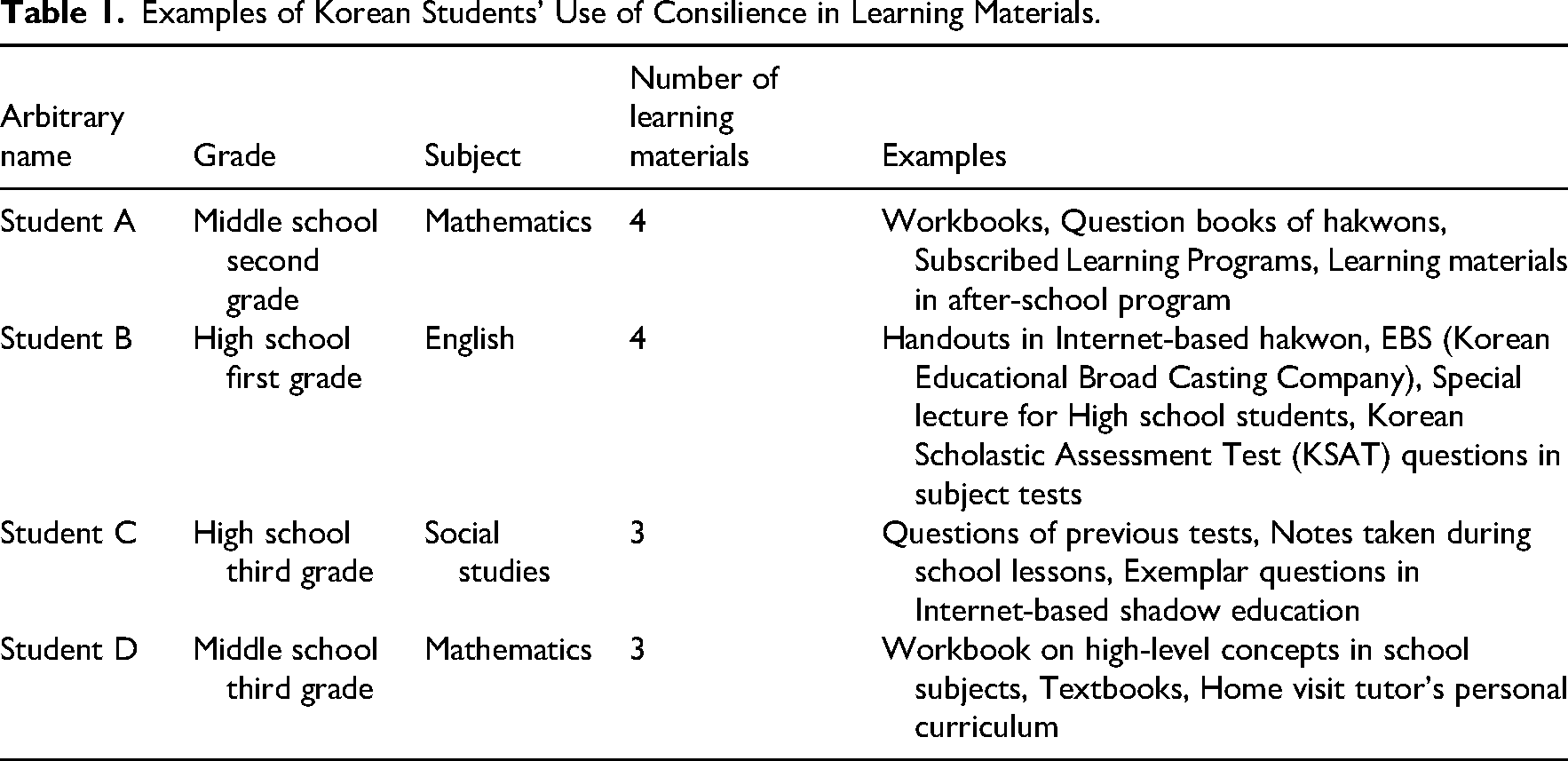
Further analysis of the effects of the transboundary practices through consilience revealed the positive impacts for students’ school learning and performances. First, this method helped Korean students increase their levels and degrees of understanding of their subject. Studying different types of materials on content (unit, theme, concept in subjects) appears to erase the problems that occur in learning practices based on a particular/single textbook (learning material). The use of various and multiple texts for the topic decreases students’ negative feelings such as tiredness, low interest, and the simple act of memorizing knowledge. This new transboundary practice of consilience enables students to more easily acquire the concept and knowledge of the subject through various approaches (ways of explanations, examples, and assessment). Second, student mastery learning is possible if classroom teachers wisely select and provide them with more individualized instructional (learning) materials. Using a person-centered curriculum and instructional materials. Students who had difficulties in public schooling helped accomplish the course objectives and performance levels. This inceptive finding pushes school educators and tutors in shadow education institutions to consider the importance of producing more varied, creative, and developmentally appropriate learning resources and approaches.
Fusion of the Concepts of a Good Learner
The third feature of students’ transboundary learning culture is the fusion of the concepts of a good learner. This feature was imported from the definition of fusion by Norberg-Schulz (1988), who defined fusion as the birth of new quality and concepts after the combination of two different concepts (ideas, approaches, and materials) (p. 8). Thus, it is not the simple addition of two different concepts; rather, it is the production of new ideas and concepts based on the integration of two entities and materials. This feature of fusion was witnessed in Korean students’ learning in two educational spaces and was particularly related to the students’ new understanding of the definition of learning and learners. Unlike the traditional definitions of good learning and good learners, where only public schooling was used as the sole institution for academic learning, they produced and developed a new definition of a good learner and the types of attitudes, skills, and competencies they should possess. The authors believe that this new definition of a good learner was created and produced by their experiences and assessment of the two educational spaces. That is, contemporary South Korean students no longer adhere to the traditional image and stereotype of a good learner rather, they apply newly created image of a good learner to their academic lives and success.
Thus, South Korean students believed that traditional methods of learning in public schooling were no longer effective in their educational success but rather in maximizing their educational efforts and outcomes. For them, docile and obedient methods of studying based on teachers’ directions and guidance were not ideal representations of good learner behavior. As emphasized by the concept of banking education (Freire, 1970), following teachers’ lessons and instruction and preparing for the school test based on teachers’ explanations during class was not regarded as the best virtue for effective learning (p. 247). This new definition of a good learner emerged through their participation in shadow education and situated learning in practice.
South Korean students believed that there were three types of definitions of a good learner: They were regarded as major competencies that successful learners should possess and practice in their everyday lives, and these qualities (competences) were qualitatively different from the images that have been emphasized in public schooling. These are: (1) designing learning schedule; (2) finding the best strategies for school exams; and (3) finding the best information for academic success. First, they believe that designing their learning activities and plans, such as for final exams and classroom tests, is important for their academic success. This concept emerged from the problems of the traditional features of public schooling, where teaching is based on the annual curriculum and controlled and guided by the Korean government of education. Such a plan is rigid and inflexible for each student's learning practices (learning behaviors, speeds, and objectives). For example, quick learners do not consider classroom lessons interesting because they already know the content, and some students do not consider the extra curriculum and subjects related to arts and music because they are not the major subjects to be tested for higher education entrance examinations. This design activity is strongly evident for students having a high level of academic motivation and the purpose of applying to sought-after high schools and Ivy League colleges in South Korea. They know that following school policies and suggestions is not effective; they are autonomous agents to determine what should be followed and selected regarding curriculum, learning, and career development.
Second, identifying relevant information regarding success in public schooling is emphasized in the newly defined concept of “good learning.” This idea emerged from students’ strong experience in shadow education learning and they came to recognize that there are better and easier methods to prepare for school tests. They believed that knowing and preparing for a school test based on this information enabled them to produce higher scores and grades in school examination practices. Thus, for South Korean students, identifying the best resources for examinations is as important as learning itself for school tests. They know that if they find shadow education programs on school tests, they will be able to perform well in examinations and that school tests are one of the most important competencies for academic survival and educational competition.
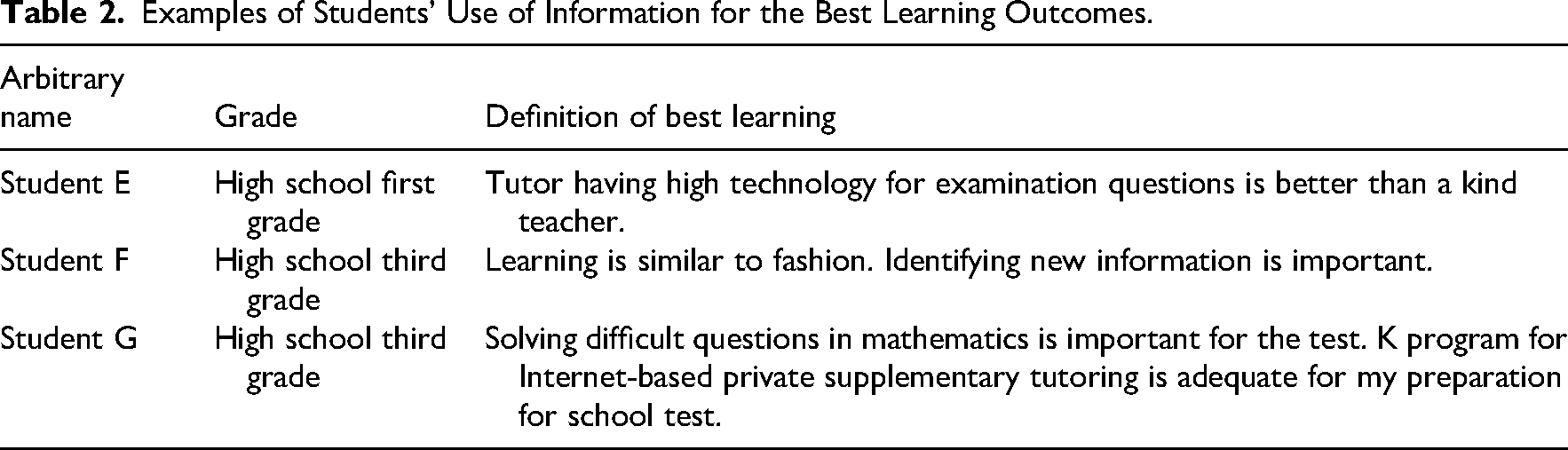
This active search for effective preparation for school tests is required in subject areas such as Korean language, mathematics, and science-related courses. Most students have difficulties in acquiring a deep understanding of the subjects during class, and teachers’ linguistic explanation during a short lecture in public schooling is insufficient for mastery of the concepts and test preparation. Even worse, classroom teachers never advise students regarding the methods of studying for the test. Such features of public schooling in South Korea, where teachers’ lessons based on school textbooks are difficult for most students to master, lead them to rely on shadow education programs for effective test preparation. They believe that these programs will reduce their time, energy, and efforts for the test and, more importantly, will help them to better understand subject knowledge with easier explanations. Table 2 presents examples of students’ use of information to achieve the best learning outcomes.
Examples of Students’ Use of Information for the Best Learning Outcomes.
Examples of Students’ New Paths for Academic Success.
The third feature of students’ new definition of effective learners is their decision-making skills. This implies that South Korean students use independent thinking and actions for their school success and consider their own active participation in the entire learning process as major decision-makers. They believe that they play a leading role in deciding how and what to learn, and from where or whom to learn. This definition is fundamentally different from the old image of South Korean students, whose academic lives and processes were completely determined by public schooling and the national curriculum guidelines of the South Korean government. Although the Korean government emphasizes the importance of guides, pedagogical methods, and school curriculum, Korean students and parents do not appear to acknowledge those ideas and methods; instead, they search for new and alternative mechanisms to achieve academic success through their own decision-making processes regarding the task of effective learning.
In an era where various choices for effective learning through shadow education are possible, students continuously pose questions (“Is this course suitable for my academic level?”; “Does this tutor help me engage in the lessons?”; “Does this course develop software to respond to my questions quickly?”; and “How suitable are the materials developed for my understanding?”) and attempt to obtain the best answer. Exploring the best options using multiple methods (mothers’ meeting groups, classroom friends’ suggestions, Internet surfing, television advertisements), they attempt to identify new information and knowledge regarding new methods of effective learning, school and higher education entrance examinations.
Understanding the practice of fusion requires educators and classroom teachers in public schooling to widen their concept of “successful learner” or “excellent students.” This pushes educational scholars and practitioners to redefine the traditional concept of a good student and learner with a set of particular qualities based only on the structure of public schooling and the school curriculum. If we accept this third practice more seriously, teachers and curriculum developers need to consider the emerging qualities for successful and effective learning. Authors believe that there are insufficient references and literature for this alternative but important methods of effective learning for school success exist. For example, the emergence of a post-human learning culture with high levels of technology requires educators to redefine best practices and approaches for successful learning and effective teaching strategies (Jung et al., 2022, p. 8).
Coexistence of the Two Paths for Academic Success
The fourth feature of students’ transboundary learning culture is the coexistence of paths to academic success. As Barker (2008) stated, coexistence means that different ideas and theories exist and are respected without conflict in the same space, implying that students in South Korea no longer consider public schooling as the sole institute for academic success and use shadow education as another institute for school success. This suggests that there are at least two paths to academic success and that students select their favorite path based on their individual purposes and plans. More seriously, shadow education is regarded as being more effective than public schooling. It can also be used as an alternative path for students who do not like the public schooling system and prefer shadow education. Some students and parents believe that without complete reliance on public schooling, their children are able to perform better than students relying only on public schooling, and completely using shadow education may be the best choice for their school success. Ironically, this extreme supposition of the importance of shadow education is found in many high schools in South Korea (Sung, 2018). For some high school students, shadow education is a genuine success path for colleges, whereas public schooling is a waste of time, learning, and a good place to take a nap. Parents believe that relying solely on school policies and suggestions for higher education application and admission is insufficient for the success of their children, and sometimes such school approaches are outdated and ineffective compared with those of shadow education institutes and practices. They believe that following school rules and curriculum and achieving higher grades are important, however, there can be better mechanisms and ideas to realize their educational success through the shadow education learning model. They tend to believe that schools are slower than shadow education in terms of the amount and quality of practical knowledge and strategies that allow their students to attend qualified high schools and prestigious colleges.
This change in educational customers for a new success path is easily found in Korean studies on students’ academic learning and in Asia. Yang and Kim (2010) discovered the “phenomenon of inverted roles” in public schooling and shadow education. Unlike in the past, several parents in South Korea tend to believe that using shadow education could be a better mechanism for their children to achieve their academic objectives in high school and colleges in South Korea. For them, shadow education learning is not a “social evil” (Bray, 1999; Park et al., 2016, p. 237), it is used as an effective path for school success: Vietnam (Dang, 2007), Japan (Mori, 2015), South Korea (Kim, 2016; Kim et al., 2020), mainland China (Yuan & Zhang, 2012), Hong Kong, China (Bray & Kwok, 2003), Taiwan, China (Liu, 2012), Bangladesh (Nath, 2008), and Sri Lanka (Gunasekara, 2009). In particular, regional studies on East Asian shadow education as a powerful learning method for school success have revealed that shadow education is actively pursued as a choice for academic success in their lives (Kim & Jung, 2022). India is the most representative example of how shadow education is used as a stronger institute for student learning in college admission (Gupta, 2021, p. 57). It is ironic to read Lee and Zhou's ethnographic analysis of the academic success of East Asian students in the United States that shadow education is the major factor that makes them excel over students in minority groups and even White students in the United States (2015).
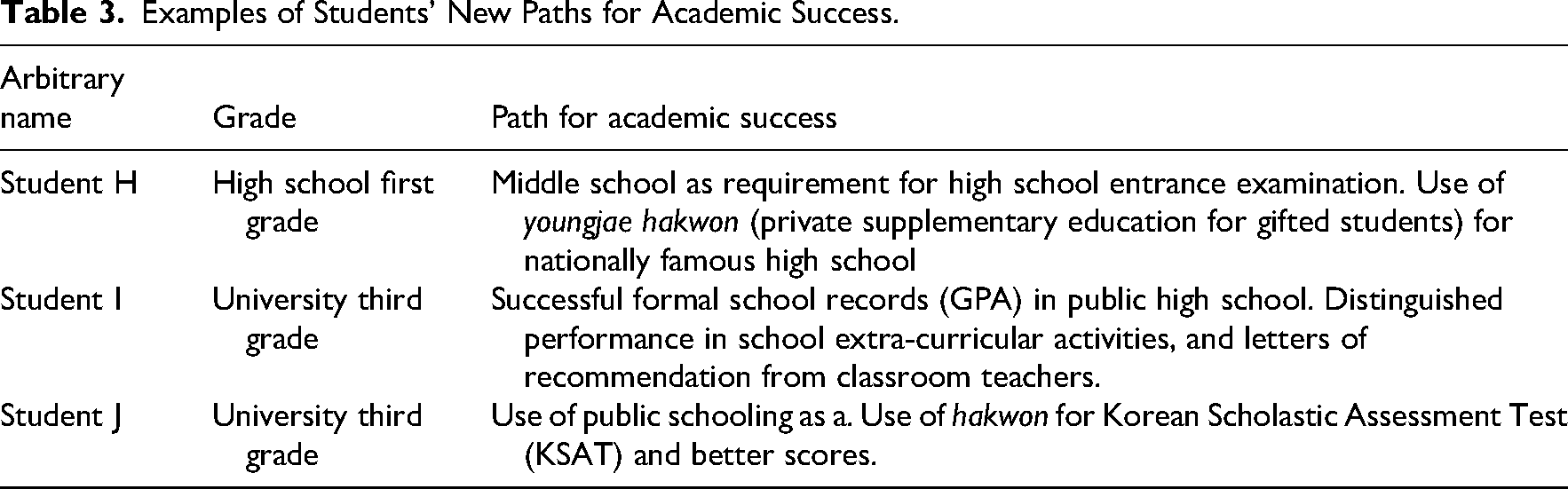
The emergence of an alternative path to academic success does not imply that public schooling will no longer be useful. Although its popularity has weakened through the expansion of shadow education, it continues to function as a traditional path for school success. Having satisfactory grades and academic record, such as grade point average (GPA), is important in applying for high school entrance exams and, more importantly, for college admission decisions. There is strong social recognition that although Korean Scholastic Assessment Test (KSAT) scores are important in college admissions, students’ academic records and various documents on students’ activities during middle and high schools are equally important. Furthermore, letters of recommendation from teachers and principals’ personal reviews of students’ academic abilities are crucial when applying to prestigious colleges in South Korea. For positive reviews, students should continue to study hard for school exams, and behave as diligent students during school lessons. They must also follow classroom lessons and demonstrate higher levels of academic understanding and performance through classroom activities, social interactions, and quality reports. If some colleges emphasize this type of academic record in public schooling, students will consider academic activities and records based on the national curriculum and classroom teachers’ lessons as important paths for their academic success (Table 3).
Korean students’ use of coexistence for school success raises two serious issues for school administrators and teachers. First, students and parents do not believe that public schooling and related practices are the best options for future success. It may challenge the traditional authority, prestige, and power of public schooling, however, push school educators to respond to the changing concept of public schooling with new ideas, philosophies, and positions. Second, more peaceful and harmonized attitudes toward emerging practices for academic success through shadow education, informal education, and an alternative curriculum outside of public schooling are required. Thus, it may be a new task for educators and educational scholars to search for a better educational stance and interpretation in the age of the future when a transboundary learning culture will be used as a leading practice for students’ academic life.
Conclusion
This study attempts to conceptualize the definition of a transboundary learning culture as a major topic for future shadow education studies and to explain four major features of the concept. Through qualitative fieldwork on South Korean students from elementary to high school, four major characteristics of transboundary learning cultures were drawn and explicated with various data and examples of Korean students’ learning cultures based on transboundary discourse. The authors observed that the students’ manner of learning and their attitudes toward effective learning were not seriously discussed and theorized, although shadow education is a major part of contemporary students’ academic learning, and there have been inadequate empirical and theoretical studies discussing the changing landscape of students’ learning culture both in public schooling and in shadow education (Hallsén, 2021; Kim & Jung, 2022). In addition, there was authors’ academic judgment that this topic should be discussed as one of the major research questions in shadow education studies by posing questions such as, “How do students in South Korea and possibly in East Asia create and use a new learning culture (practices, methods, attitudes, and beliefs) considering shadow education is as important as public schooling? How can we define and conceptualize student learning cultures when shadow education and public schooling are used for academic success?” Four types of features (methods) of transboundary learning culture were defined and suggested as new learning methods for school success.
As there are no theoretical concepts and terms to let us better understand this new complex scene of students’ academic learning, the term, “transboundary learning culture” and its related four sub-concepts are used as analytic lens to better understand the manner and purposes for which students study under two different educational institutes. Thus, scholars can participate in theorizing this concept using data and evidence collection to further analyze more diverse research settings and nations, as well as students’ educational lives. Such local and international studies on these concepts will allow scholars in shadow education studies to advance this initial idea of transboundary learning culture to a new global topic for further theorization of the concept (Kim, 2018a). Furthermore, this new international task will push scholars in educational studies in general and specialists in the learning sciences, anthropology of learning, and curriculum and learning studies to pose critical questions regarding the effects and validity of public school teaching such as, “Why do students develop and use such types of transboundary learning practices? What problems of public schooling is related to students’ learning from educational customers’ perspectives? How should it be improved for their better future?”
Footnotes
Declaration of Conflicting Interests
The authors declared no potential conflicts of interest with respect to the research, authorship, and/or publication of this article.
Ethical Consideration
Ethical approval was not required for this study since no empirical studies were conducted, and no human data or participants were involved.
Funding
The authors received no financial support for the research, authorship, and/or publication of this article.
