



Abstract
Introduction
Pituitary adenoma accounts for 10%–20% of all intracranial malignancies. The primary modality of treatment is surgery, while pituitary radiation is indicated in residual or recurrent setting post-surgery. Currently, stereotactic radiotherapy (SRT) is one of the main modalities of radiation treatment. The objective of this article is to describe the procedural steps for radiation planning of SRT of pituitary adenoma
Methods
The step-by-step procedure for stereotactic planning of pituitary adenoma has been described using a clinical scenario of pituitary adenoma.
Results
The stereotactic radiation planning of pituitary adenoma starts with the basic history and relevant clinical evaluation that is visual testing. Magnetic resonance imaging (MRI) of the brain is the imaging modality of choice. Evaluation of surgical notes and post-operative histopathology confirmation of diagnosis should also be done. The radiation planning of pituitary adenoma starts with Computed tomography (CT) simulation and MRI of brain that should be done in prescribed format to achieve uniformity in radiation planning. After CT and MRI image fusion, contouring of target, organs at risk (OAR) and radiation planning should be done. The plan evaluation includes target and OAR coverage index, conformity, homogeneity and gradient index and beam arrangement. After radiation plan evaluation, treatment is delivered after quality assurance and dry run.
Conclusion
The article highlights the sequential process of radiation planning for SRT—starting from simulation, planning, evaluation of plan and treatment.
Introduction
Pituitary adenoma is the third most common brain tumour after gliomas and meningioma. 1 It is divided into microadenoma (less than 1 cm) or macroadenoma (more than 1 cm) based on size criteria or functional and non-functional tumours based on hormonal activity. Surgery is the treatment of choice for all pituitary tumours (except prolactionoma) and is associated with 50%–80% of local tumour control. The treatment failures following surgery are due to incomplete tumour resection or local infiltration of tumour into surrounding structures or microscopic tumour nests. 2
Pituitary radiation is indicated for local treatment for residual or recurrent pituitary adenoma following primary surgery. 3 With the advent of modern stereotactic radiation techniques such as single-fraction stereotactic radiosurgery (SRS) or as fractionated stereotactic radiotherapy (SRT), it is now possible to deliver very high dose of radiation to a small focused target in conformal way with minimal radiation toxicity to surrounding critical structures. Both SRS and SRT are associated with excellent growth restriction and control of hormone hypersecretion. 4
Methods
In this article, the various steps of radiation planning for SRT have been illustrated in an easy way for the beginners who are planning for SRT in a case of pituitary adenoma with the help of a clinical case as described below. Ethical approval was not required for this article as it only describes the procedural details of SRS radiation planning using a clinical scenario. Informed consent from the patient was obtained before start of radiation planning as part of institutional protocol.
Clinical Scenario
A 52-year-old male presented with the chief complaints of projectile vomiting for two days. It was associated with reeling of head and involuntary movements of all four limbs. There was no associated headache, blurring of vision. He had no history of any co-morbid conditions.
Imaging
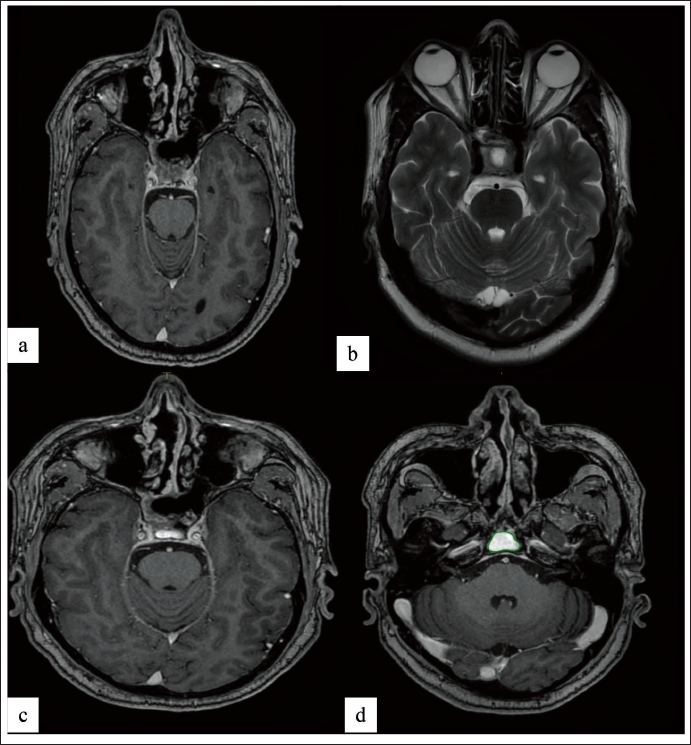
On imaging by magnetic resonance imaging (MRI) of the brain (Figure 1a), there was a lesion in sellar region of size 2.3 cm × 1.6 cm × 1.6 cm and extending into suprasellar location. The pituitary gland was not separated from the lesion. The optic chiasma was compressed and superiorly displaced by the lesion. There was no cavernous sinus involvement (Figure 1b). On contrast examination, there was peripheral rim enhancement with irregular non-enhancing area within the matrix of lesion representing necrosis.
Magnetic Resonance Imaging (MRI) T1 Sequence of the Brain Showing Lesion in Sellar Region of Size 2.3 cm × 1.6 cm × 1.6 cm. (a) MRI T2 Sequence Showing no Cavernous Sinus Involvement. (b) Post-operative MRI Showing Residual Lesion in Sella, (c) and Fat Saturated (FATSAT) Sequence Showing Hyperintense Packing Material (Green) (d).
Pre-operative Hormone Evaluation
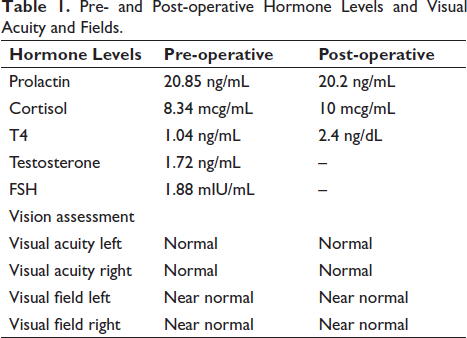
The hormone levels are depicted in Table 1.
Pre- and Post-operative Hormone Levels and Visual Acuity and Fields.
Surgery
The patient underwent near total excision of the lesion by endoscopic trans-sphenoidal approach and the surgical defect was filled with packing material.
Histopathology
On histological evaluation, the lesion was found to be pituitary macroadenoma. On immunohistochemical study, the synaptophysin and chromogranin were positive and Ki-67 was 2%. With the above findings, the diagnosis was confirmed to be pituitary macroadenoma.
Post-operative Imaging
The post-operative MRI (Figure 1c) showed residual lesion of size 16 mm × 11 mm × 7 mm on right side and 12 mm × 8 mm × 8 mm lesion on left side of the sella. The bilateral cavernous sinus was normal and optic chiasma was 4 mm away from the tumour. The fat saturation (FATSAT) sequence showed hyperintense packing material (Figure 1d).
Post-operative Hormone Evaluation
The hormone levels are depicted in Table 1.
Visual Testing
The pre- and post-operative testing was done for visual acuity and field and depicted in Table 1.
Treatment Decision by the Tumour Board
The patient details were put in the tumour board for decision regarding the line to treatment. After group discussion with neurosurgeon and radiation oncologist, board decided to plan for SRT.
Discussion with the Patient
Patient was explained about the bouquet of treatment options such as re-surgery and radiotherapy and complications and outcome of each procedure. Further, the radiation treatment procedures, vision preservation, follow-up imaging, hormone and vision evaluation were also explained to the patient.
Counselling of the Patient
The patient was counselled regarding slow tumour response to radiation, need for surgery or re-irradiation in future, post-radiotherapy cyst formation, hypopituitarism and the need for hormone replacement post-treatment.
Patient’s Preference
The patient opted for radiation as his major concerns were vision preservation besides tumour control.
Dose Selection
Based on the type, size and location of tumour, the dose and fractionation of radiation is determined. Single fraction SRS (13–16 and 16–25 Gy) is the preferred option for treatment of residual or recurrent non-functional pituitary adenoma post-surgery with tumour size < 2–2.5 cm. Fractionated SRS (21 Gy in three fractions or 25 Gy in five fractions) is preferred for larger residual disease or that are close to optic pathway. 5 Iwata et al. in their article stated that hypo-fractionated SRS (21 Gy in three fractions or 25 Gy in five fractions) is effective in local tumour control as well as safe from visual and neuroendocrine point of view. 6
Decision of Radiation Tumour Board
As the tumour was located very close to optic chiasma, fractionated radiotherapy was planned to a marginal dose of 25 Gy in five fractions in order to protect the vision.
SRT Planning Steps
Here we describe the steps of treatment of pituitary adenoma from simulation to plan execution.
Step 1—Computed Tomography Simulation
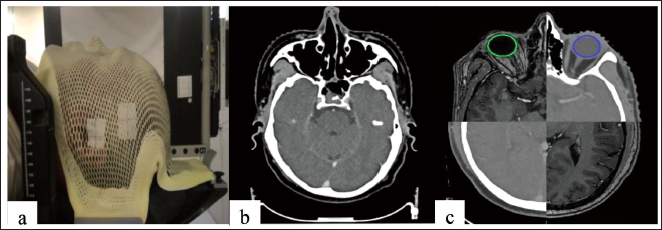
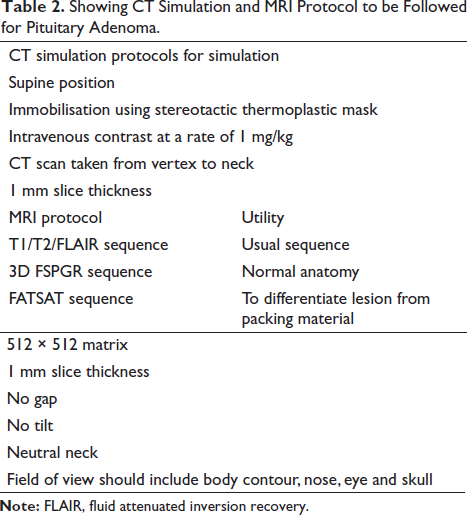
During simulation, patient was set up in the supine position with neutral neck position and immobilisation was done using a thermoplastic mask and stereotactic frame (Figure 2a). Fiducials were placed on the thermoplastic mask after proper alignment with the lasers. Intravenous contrast was given at a dose of 1 ml per kg body weight. Then, CT scan was taken from the vertex to neck with CT slice thickness of 1 mm as depicted in Table 2. After simulation, the digital imaging and communications in medicine CT images were sent to our treatment planning server which was then imported for delineation of target and organ at risk.
Showing the Immobilization of the Patient Using the Stereotactic Thermoplastic Mask and Frame During Computed Tomography (CT) Simulation in Lateral View. (a) The Planning CT Scan Taken During Simulation (b), and Fusion of Post-operative MRI of the Patient with Planning CT Scan (c).
Showing CT Simulation and MRI Protocol to be Followed for Pituitary Adenoma.
Step 2—MRI Protocol
MRI of brain of the patient was done using 512 × 512 matrix in the neutral neck position similar to that of CT scan during simulation with no gap, no tilt and 1mm slice thickness as depicted in Table 2. The field of view included the body contour along with nose, eyes and skull. The MRI should include the usual T1, T2 and fluid-attenuated inversion recovery sequences. In addition, the three-dimensional fast spoiled gradient echo (3D FSPGR) MRI sequence was used to view the normal anatomy. FATSAT sequence was used to differentiate the lesion from the packing material.
Step 3—Image Fusion
These acquired MRI sequences were fused with the planning CT scan by contouring the eyes, lens and basilar artery, and matching was done using auto-fusion technique to help in target and organ at risk (OAR) delineation (Figure 2c).
Step 4—Target Delineation
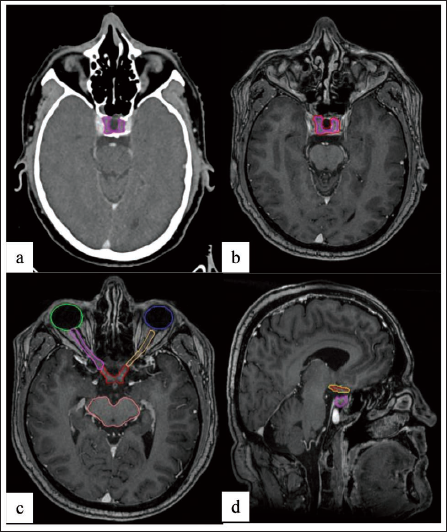
The gross residual tumour seen on the CT images that was fused with the MRI images to consider the exact extension of tumour was delineated as gross tumour volume (GTV) (Figure 3a). There is no necessity for delineation of clinical target volume in SRS. The planning target volume (PTV) (Figure 3b) was drawn taking 1 mm around the GTV. 7 Smoothing of the contour was done from the adjacent bone. Multi-planar evaluation that is evaluation of both the GTV in all the three planes—axial plane, coronal and sagittal, and PTV was done in all the three planes—axial, coronal and sagittal.
In the present case, the GTV volume was 1.106 cc and the PTV volume was 2.456 cc.
Showing the Delineation of the Gross Tumour Volume (GTV) (Pink) of Residual Pituitary Adenoma in the Axial Plane (a) Planning Target Volume (PTV) (Red) Generation Around the GTV Taking 1 mm Margin in the Axial. (b) Delineation of Organs at Risk that is Left Eye Ball (Blue), Right Eye Ball (Green), Left Optic Nerve (Yellow), Right Optic Nerve (Pink), Optic Chiasma (Red), Brain Stem (Peach), (c) and Pituitary Stalk (Pink) (d).
Step 5—Organs at Risk (OAR) Delineation
The OARs (Figure 3c and d) for delineation included the brainstem, Pituitary stalk, Cavernous sinus, optic chiasma and optic apparatus that were contoured using the MRI that was fused with the planning CT as per European particle therapy network consensus-based atlas. 8
Step 6—RT Technique
Radiation planning can be done using any of the RT techniques such as intensity modulated radiotherapy, volumetric modulated arc therapy (VMAT), dynamic conformal arc therapy, or 3-dimensional conformal radiotherapy according to expertise of radiation physicist and physician.
In the present case, planning was done using VMAT technique.
Step 7—Plan Evaluation
After the completion of planning by the physicist, the evaluation for the treatment plan is done using the following indices as noted below.
PTV Coverage Index
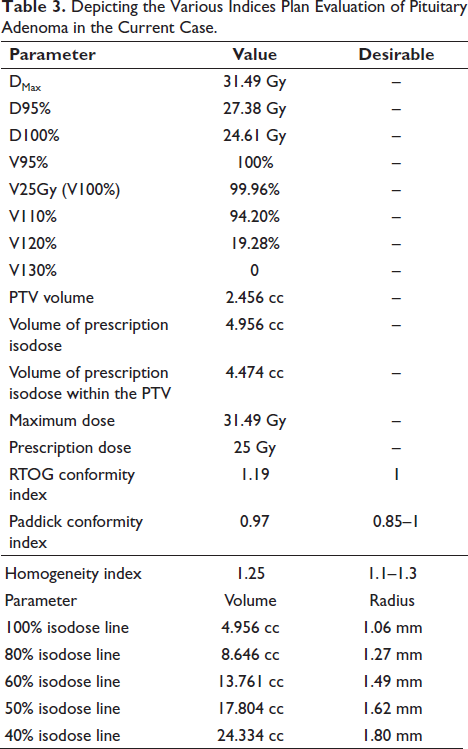
Following the planning, we need to see the PTV coverage. The prescription isodose level is usually not 100% of the prescribed dose covering 100% of the PTV. Often 95% of the prescription dose should cover 95% or higher percentage of the PTV otherwise 100% of the prescription dose should cover 95% or higher percentage of the PTV. 9 In the present case, 95% of the prescription dose covers 100% of the PTV and 100% of the prescription dose covers 99.96% of the PTV which meets the above-mentioned parameter for the PTV coverage and is depicted in Table 3.
Depicting the Various Indices Plan Evaluation of Pituitary Adenoma in the Current Case.
Intracranial Stereotaxy Organ Constraints and OAR Coverage
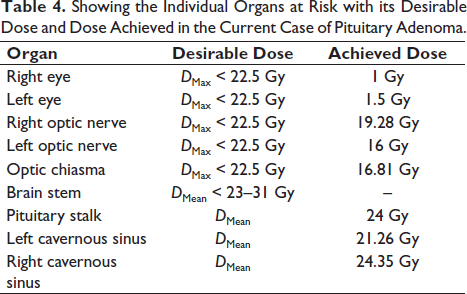
Keeping in mind the desirable dose constraints to the OAR we need to check the dose to individual OARs. 10 The dose desirable and dose achieved for all the OARs in the present case are depicted in Table 4.
Showing the Individual Organs at Risk with its Desirable Dose and Dose Achieved in the Current Case of Pituitary Adenoma.
Conformity Index
To note the conformity index of the SRS, here we used two types of conformity indices that is the radiation therapy oncology group (RTOG) conformity index and the Paddick conformity index.9, 11 RTOG Conformity index (CIRTOG) is calculated using the following formula. CIRTOG = Volume of Prescription Isodose/PTV volume In this case of pituitary adenoma, the RTOG conformity index was 1.19 (Table 3). Paddick conformity index (CIPaddick) was calculated using the following formula. CIPaddick = (Volume of prescription isodose in the area of interest i.e., PTV) 2 /PTV volume × Volume of Prescription Isodose. Here in the current case, Paddick conformity index was 0.97 (Table 3).
Homogeneity Index
It is calculated using the formula: Homogeneity Index = Maximum Dose/ Prescription Dose. In this case, the Homogeneity Index was 1.25 (Table 3).
Dose Fall Off
The dose fall-off observation is very much needed in the plan evaluation under the heading of gradient index. For this, we need to calculate the difference between various isodose lines. In order to calculate the difference between the isodose lines we need to calculate the equivalent radius.
Equivalent Radius Calculation
To evaluate the dose gradient, we have to find out the difference between radius of various isodose lines. But none of the isodoses are spherical. So, we use the following formula to calculate the equivalent radius. First: Find out the specified isodose volume. Second: Calculate the radius of the isodose volume by using the formula: V = 4/3 ύ r 3 . Therefore, r = (3V/4 ύ)1/3. The calculation of volume and radius of various isodose lines in the present case is shown in Table 3.
Gradient Index
The formula for calculating gradient index is given below. Gradient Index = Equivalent radius of 50% isodose
Distance Between Various Isodose Lines
The ideal difference between 80% and 60% isodose lines should be <2 mm. 12 In the current case, it is 0.21 mm. The ideal difference between 80% and 40% isodose lines should be <8 mm. In the present case, it is 0.53 mm.
Beam Arrangement
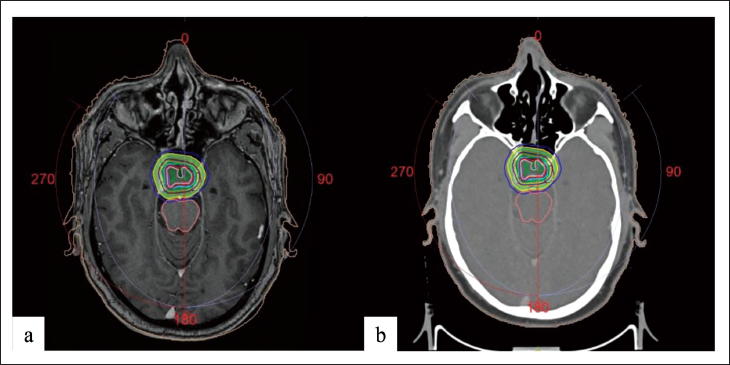
The arrangement of the beams (Figure 4a and b) was done such that there is adequate coverage of the target while giving less dose to the OARs. It should be noted that the beams should not pass through the ipsilateral eyes.
Showing the Beam Arrangement in Axial View in MRI (a) and Planning CT Scan (b) for the Current Case of Residual Pituitary Adenoma.
Step 8—Quality Assurance (QA)
Mechanical isocentre check was done using the Winston Lutz test and the point dose verification was done keeping the tolerance as 1 mm. 13
Step 9—Dry Run
Treatment verification consists of setup reproduction, isocentre verification and clinically verifying each treatment field—check beam clearance, check any interlock—MLC interlock and potential monitor unit problems. Then clearly mark the immobilsation devices after successful dry run.
Step 10—Pre-medication Protocol
Before the start of treatment, pre-medication was delivered in the form of tablets as described below—all starting the day before the start of RT treatment. Tablet Dexamethasone 8 mg—thrice daily. Tablet Ondansetron 8 mg—thrice daily. Tablet pantoprazole 40 mg—once daily. If the patient is diabetic, proper diabetic care needs to be taken.
Step 11—Set up Verification and Treatment Delivery
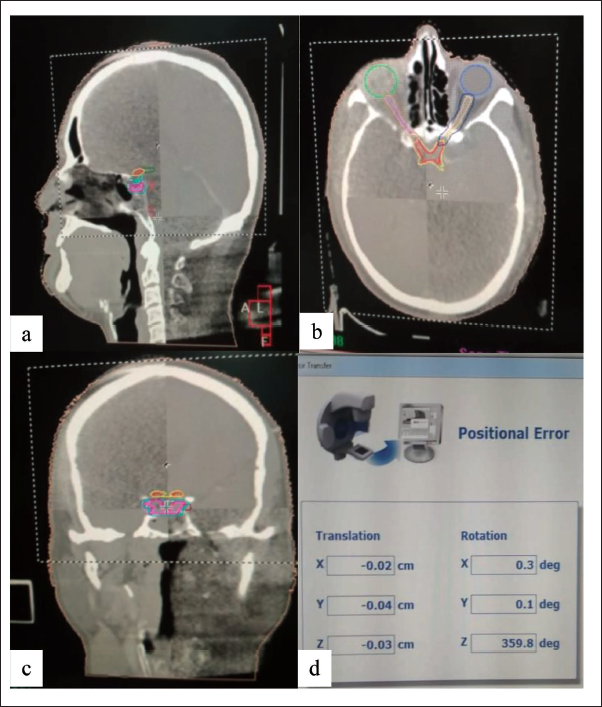
It includes cone beam CT correction (Figure 5a and c) and hexapod corrections (Figure 5d). After all the corrections have been done treatment is delivered.
Depicting the Treatment Verification of the Present Pituitary Adenoma Case. The Cone Beam Computed Tomography (CBCT) Correction of the Patient During the Treatment in Sagittal View. (a) Axial View. (b) Coronal View, (c) and the Hexapod Correction of the Same Patient During the Treatment (d).
Step 12—Post-medication
It is an optional protocol that usually includes anti-emetics, proton pump inhibitors and tapering the dose of steroid over a week.
Step 13—Advice and Follow-up
After the completion of the treatment, the patient is usually advised to follow every three monthly for the first two years then every six monthly. The first imaging after treatment completion should be advised at three months and further imaging at symptom progression. Hormonal check-up to be done for insufficiency and ophthalmic evaluation to be done to assess for optic neuritis if any during every visit.
Conclusion
This article conceptualises and acts as an easy guide for the beginners for the stereotactic radiation planning for pituitary adenoma.
Author Contribution
Conception and Design: KCP, AA, BDBSN. Data Collection: SA, KLR, DTV, BKM, PA. Manuscript Writing: KCP, AA, BDBSN, CRK, PSB, MM. Final Approval of Manuscript: All authors.
Footnotes
Declaration of Conflicting Interests
The authors declared no potential conflicts of interest with respect to the research, authorship and/or publication of this article.
Ethical Statements
This study only describes the technical details of step-by-step procedure of SRS radiation planning of pituitary adenoma, ethical committee clearance was not necessary for this article.
Funding
The authors received no financial support for the research, authorship and/or publication of this article.
Informed Consent
Informed consent from the patient was obtained before start of radiation planning as part of institutional protocol.
