




Abstract
Background:
Most autistic adults report partnered sexual experiences, but some experience challenges in navigating sexuality and intimate relationships. Sexual assistance (SA) aims to support individuals living with disabilities in their sexuality. This phenomenological interview study explored (1) reasons why autistic adults apply for SA and (2) helping and hindering aspects to explore and enjoy sexuality in the interactions between autistic adults and sexual assistants.
Methods:
We conducted semi-structured interviews with autistic adults (n = 4) and sexual assistants (n = 14) who collaborated with Aditi vzw, a Belgian organization for SA. We analyzed all interviews according to the Qualitative Analysis Guide of Leuven.
Results:
The main reasons for requesting SA were a desire for safe intimate and sexual relations, to gain sexual experience, and to develop as a sexual being, combined with a lack of opportunities or previous negative experiences. In the accounts on the interaction between the autistic adults and sexual assistants (1) building safe and supportive interactions, (2) exploring sexual scripts, and (3) attuning to information processing needs were the main themes. The organizational framework around SA and collaboration with families and professionals appeared in the interviews as pivotal preconditions.
Conclusions:
SA addresses barriers to experience intimacy and partnered sexuality for a group of autistic adults who otherwise might be deprived of positive intimate and sexual experiences and facilitates experiential learning. However, legal, ethical, and moral issues exist and also appeared in the interviews that need to be considered. Also, SA should be embedded in a larger set of interventions to guarantee the sexual rights and sexual citizenship of autistic people who experience barriers to partnered sexuality.
Community Brief
How sexual assistants can help autistic adults who have no access to a sexual partner.
Why is this study important?
Sexual assistance (SA) is a way to support adults with disabilities relating to intimate and/or sexual relationships and can include having intimate and sexual contact with a sexual assistant. Little is known about the expectations and experiences of autistic adults with SA and about what helps and hinders autistic adults in interactions with sexual assistants.
What was the purpose of this study?
To understand (1) why autistic adults apply for SA and (2) what helps and hinders autistic people to experience intimacy and sexuality in a positive way when they meet sexual assistants.
What did the researchers do?
We interviewed 4 autistic adults who met with sexual assistants and 14 sexual assistants who met with autistic people. The participants all worked with an organization in Belgium where SA is allowed.
What were the results and conclusions of the study?
Reasons to apply for SA were (1) meeting sexual needs, (2) gaining more sexual experience, (3) learning about one’s sexuality, and (4) doing this in a safe situation. Three themes appeared in helping and hindering aspects in the interaction with a sexual assistant. First, working on a safe and supportive relationship. This implied working on trust and connection, stepwise gaining new experience, open communication, supporting empowerment, being clear about roles and boundaries, and attention to regulating emotions. Second, learning about sexuality, by balancing sex and intimacy, challenging and sometimes adapting sexual scripts, discussing sexual knowledge, and introducing new experiences. Last, attuning to autistic information processing needs, by attention to predictability, communication, and sensory sensitivities. We found two themes relating to preconditions. First, a mediating organization making clear arrangements and supporting the autistic adults and the sexual assistants. Second, involving parents and caregivers in arranging and supporting the meetings.
What is new or controversial about these findings?
Sexual assistants can help some autistic adults explore intimacy and sexuality. However, attention to legal and ethical issues is important. First, sexual assistants need to be aware of how they direct sexuality and intimacy, leaving space for individual preferences. Second, SA is only a part of the response to the needs of autistic people who have limited access to partnered sexuality. Also important is support for finding a partner, maintaining a relationship, or accepting singlehood. Third, the context of autistic individuals has a significant role in access to sexual experiences, not only direct relatives and professionals who support or prevent referrals to SA but also laws.
What are the potential weaknesses in the study?
We interviewed only four autistic adults, with only one female and only heterosexual interactions. We do not know whether our results apply to other groups. Also, we did not speak with autistic individuals who mainly had negative experiences with SA.
How will these findings help autistic adults now or in the future?
SA might offer some autistic adults access to partnered experiences in a safe and positive way if local laws allow this. The results offer cues to organize SA attuned to autistic adults.
Background
Most autistic adolescents and adults are interested in and have experience with solo and/or partnered sexuality,1,2 in contrast to the asexuality and deficit discourse in the early scientific literature on the sexuality of autistic adults that still lingers in clinical practice and societal views. 3 These perspectives align with broader sexual dis/ableism, 4 reflecting the lowered sexual expectations for people living with disabilities (PLWD) that manifest in individual attitudes, institutional policies, and procedures, 5 as illustrated by the lack of attuned comprehensive sexuality education with attention to autistic sexualities, 6 limited sensitivity to and awareness of autism in general, mental, sexual, and reproductive health care,7,8 and stereotypical representations of autistic sexuality in mainstream media. 9 Supporting the sexual well-being of autistic adults aligns with human rights10,11 and is important given that it can contribute to general well-being. Access to comprehensive and good-quality information on sexuality, to high-quality sexual health care, and living in an environment that promotes sexual health are considered fundamental to sexual well-being. 12
In this article, we focus on the relatively small proportion of autistic individuals who have no or limited sexual experience or whose first partnered sexual experience occurs later in life, a proportion that is nonetheless higher than that observed in the general population.1,13 Some of these autistic adults experience no or less interest in solo and/or partnered sexuality and identify on the asexuality spectrum,1,14 while others experience barriers in finding a partner or ways to gain sexual experience, higher levels of sexual anxiety, and fewer positive sexual cognitions. 15 For individuals who have limited opportunities and a desire to experience and learn about partnered sexuality, one way of realizing sexual rights and well-being could be via access to sexual assistance (SA).16–18 SA is one of the number of different paid sexual services available to PLWD, 19 mostly organized in a limited number of European countries. 16 At present, the European Platform for Sexual Assistance (EPSEAS) has member organizations in Belgium, the Czech Republic, France, Italy, Spain, The Netherlands, and Switzerland.
EPSEAS defined SA as different ways of supporting and assisting people with a variety of social, physical, motor, sensory, intellectual, and psychiatric characteristics or impairments, sometimes age-related, with needs relating to learn about intimacy and sexuality, offered by a qualified assistant, consisting of enjoying intimacy or sexuality together attuned to the disability-related needs of the individual.16,20 SA is governed by a clearly defined framework on privacy, time spent together, and financial engagement, all within the boundaries of local legal frameworks. SA distinguishes from other ways professionals or volunteers can support the sexual needs of disabled individuals such as sexual facilitation, prostitution, surrogate partner therapy, or sex volunteers.16,21,22 All these ways of sexual support can be valuable but are not always available and accessible to everyone and are regulated and/or arranged in different ways across countries.
There is an ongoing debate on the moral, legal, and ethical aspects of SA and other forms of sexual support, highlighting tensions between disability rights, the rights of sex workers,16,22 and those of care professionals. 21 A key question is whether SA actually contributes to realizing sexual rights and well-being: it may also reinforce sexual ableist perspectives on the sexuality of autistic people, for example, by the notion that they can only gain sexual experience through sex work, or serve as a limiting surrogate if not embedded within broader efforts to support individuals in their specific contexts to pursue what they realistically value and aspire to be and do. 5
This study was prompted by the impression that autistic adults were frequently referred to or themselves applied for SA at Aditi vzw, a government-supported and officially recognized organization in the Flemish part of Belgium. This organization provides individualized guidance to individuals living with disabilities, elderly people, and individuals with mental health care needs. Aditi vzw facilitates contact and mediates between individuals seeking assistance and sexual assistants (SAs), within a care-based and educational model, emphasizing attuned, personalized support that enables individuals to explore their sexuality. 21 Service users pay the SAs for their time. Aditi vzw collaborates with adults and SAs who represent diverse genders, sexual identities, and interests. To situate this in the local legal context, in 2017, the Belgian Advisory Committee on Bioethics18 recommends SA as a relevant component of interventions aimed at safeguarding the sexual rights of PLWD. In June 2022, the Belgian government officially decriminalized sex work, following years of applying a tolerance policy.
The present study aimed (1) to qualitatively explore the reasons why autistic individuals seek SA, and (2) to examine the helpful and hindering aspects of interactions between autistic adults and SAs, as experienced by both service users and SAs.
Methods
Standards for Reporting Qualitative Research 23 guided the reporting of this study. We conducted semi-structured interviews and analyzed them in two phases within unpublished master’s thesis projects.24,25 In the present study, we integrated the analysis of all interviews.
Participants and recruitment
In the first phase, five autistic agreed to participate, of whom we ultimately interviewed four (one female, three male). Four of the five initial participants consented to invite their SAs (three female, one male) to participate in the study. All autistic adults had received a formal diagnosis of autism and had maintained long-term contact with SAs, ranging from 1.5 to 7 years. Two of them had prior experience with sex workers, while none had been involved in romantic relationships or other sexual interactions. Three participants learned about SA through professionals or relatives. One participant learned about SA via an information leaflet in a library. At the onset of their engagement with SA, one participant resided in a psychiatric hospital, one at home with parents, and two in supported housing. By the time of the interview, all participants had their own place to live with support from professionals or relatives. Three participants identified as heterosexual, one expressed being in doubt.
More SAs expressed their interest in participating in this project, also offering insight into interactions with a broader group of autistic people. So, in phase 2, we recruited additional SAs linked to Aditi vzw for a supplementary interview study (n = 10, all female). Eligibility criteria included having experience in providing SA to autistic individuals, with or without intellectual disability. The assistants represented a range of educational and professional backgrounds. Several participants highlighted that their motivation to become SAs was rooted in both professional and personal experiences with autism or PLWD. In addition, many expressed a strong commitment to sexual rights as a key reason to engage in this work.
Procedure
The university’s Ethics Committee (KU Leuven, SMEC G-2020-2726, G-2022-5252) approved both phases of the study. Aditi staff members informed eligible participants about the study and invited them to contact the researchers for additional information. They received written information and provided written informed consent. Next, we scheduled and conducted interviews in Dutch, the native language of the interviewers and interviewees (phase 1: all via video call, June to October 2021, phase 2: eight via video call and two face-to-face at the homes of the assistants, August 2022 to January 2023). We developed a topic list and sample questions to guide the interviews (see Supplementary Data S1). The questions focused on concrete experiences (e.g., the first and last meeting) and more general ideas and impressions (e.g., needs, expectations for the future). In the second study, the interview also included specific questions on experiences with autistic adults with an intellectual disability. The duration of the interviews with the autistic adults ranged from 52 to 82 minutes and with the SAs ranged from 35 to 103 minutes. We audio-recorded all interviews and transcribed them verbatim.
Data analysis
We employed the same methodology and methods across both phases of the study. Situated within an interpretivist paradigm, we adopted a critical phenomenological approach 26 to explore how participants ascribed meaning to the act of requesting SA (autistic adults) and to its performance (autistic adults and SAs). Methodically, we applied the Qualitative Analysis Guide of Leuven (QUAGOL), which aligns with this epistemological stance due to its case-oriented and iterative movement between part and whole at both individual and cross-case levels. 27 Master’s students conducted all steps (see Table 1) in close collaboration with two of the authors (I.N. and J.D.) through reflexive discussions. The team compared independent case reports, discussed coding schemes, coding, and the conceptual framework going back and forth between the interviews, narrative reports, and codes.
Analytical Steps
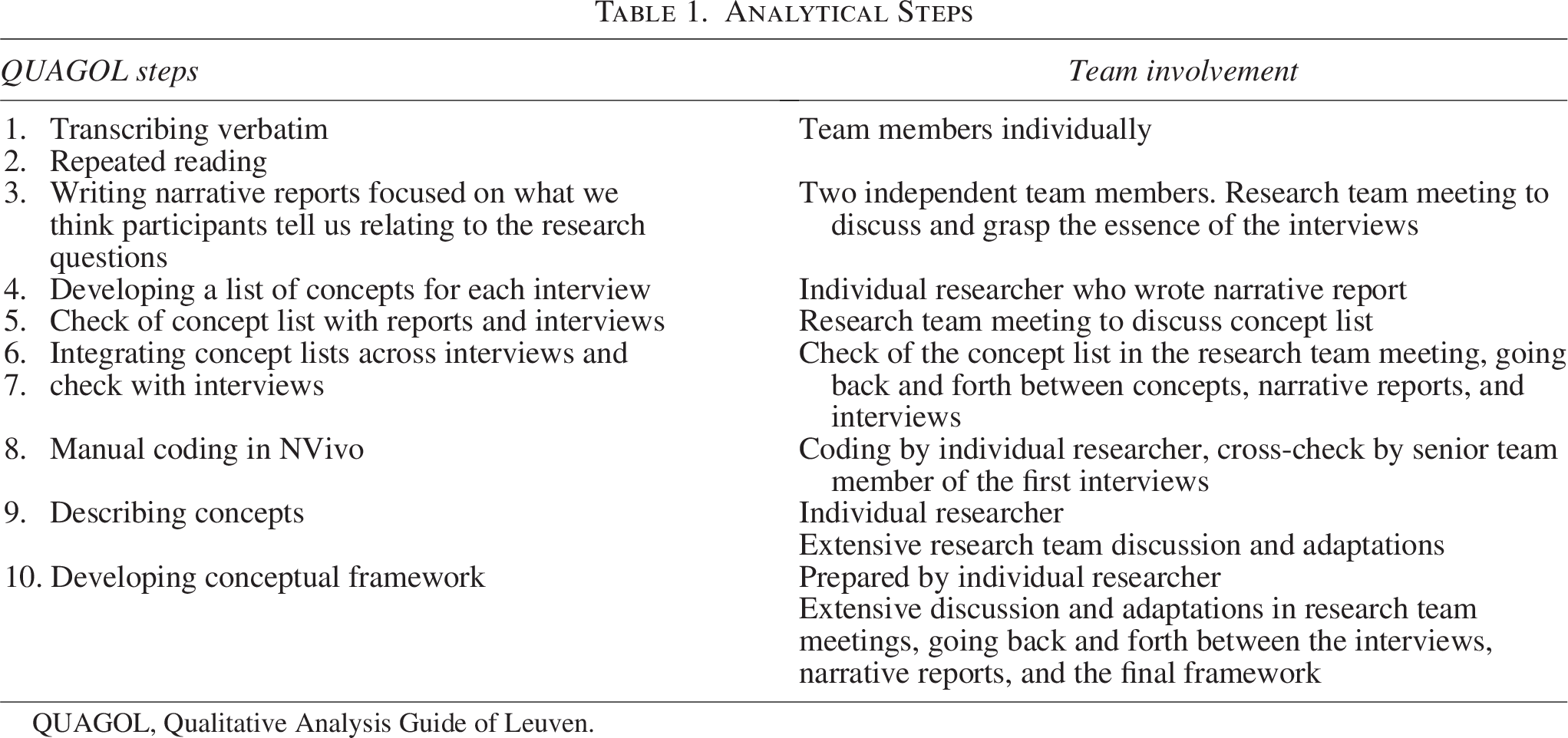
QUAGOL, Qualitative Analysis Guide of Leuven.
R.M. then merged the two analyses, again following the QUAGOL framework and working closely with I.N. and J.D. through reflexive team meetings after each step. First, we reviewed interview transcripts, narrative reports, and conceptual schemes. Second, the team deconstructed conceptual frameworks and refined concepts—sometimes by merging or splitting—until a single list of fully described and empirically supported concepts remained. This synthesis formed the basis for the final conceptual framework, which is presented in the “Results” section. We conducted the data analysis on the transcripts in Dutch and translated relevant quotes for the present article into English.
Community involvement
We discussed the setup of the study and the interview guide with members of the Reading and Advisory Group of Autistic Adults (LAVA, https://www.lavavzw.be). No autistic adults were structurally part of the research team for this study. We discussed the final analysis and report about the study during a reading session with eight LAVA-members. Participants of the session received articles and questions in advance. The researchers briefly introduced their article and then followed the discussion. At the end, the researchers reacted to questions and statements and joined the discussion. A member of the reading group wrote a report with recommendations that guided the final version of the article. Autistic adults were not paid for their contribution to this specific project, but there is a collaboration agreement including compensation in place for the broader project.
Positionality
Rooted in a sex-positive framework, we view sexual well-being as an important contributor to overall well-being. Committed to advocating for the sexual rights of autistic individuals with diverse support needs and recognizing them as sexual beings, we considered SA as a possible means of supporting the sexual well-being of autistic adults who lack access to partnered sexual and intimate experiences. However, we acknowledge that SA is neither necessary nor desirable for every autistic person, given the diverse support needs, preferences, and sexual experiences. J.D. and I.N. are senior researchers with a background in educational sciences, while R.M. is a junior researcher trained in biomedical sciences. All authors are non-autistic clinicians and researchers specializing in autism, working within the neurodiversity paradigm, and have no direct experience with SA. However, the team has long-standing expertise in the field of autism, relationships, and sexuality, and the research group operates within a participatory framework and collaborates closely with an autistic advisory group.
Results
We present the findings in line with the two research questions (see Table 2). First, four themes emerged from the analysis concerning autistic adults’ reasons to apply for SA. Second, the analysis of experiences of both autistic adults (AA1–4) and SAs (SAs1–14) resulted in three overarching themes with subthemes. During the analysis, two subthemes emerged that were not directly related to our research questions but pertained to different preconditions for SA.
Themes and Subthemes
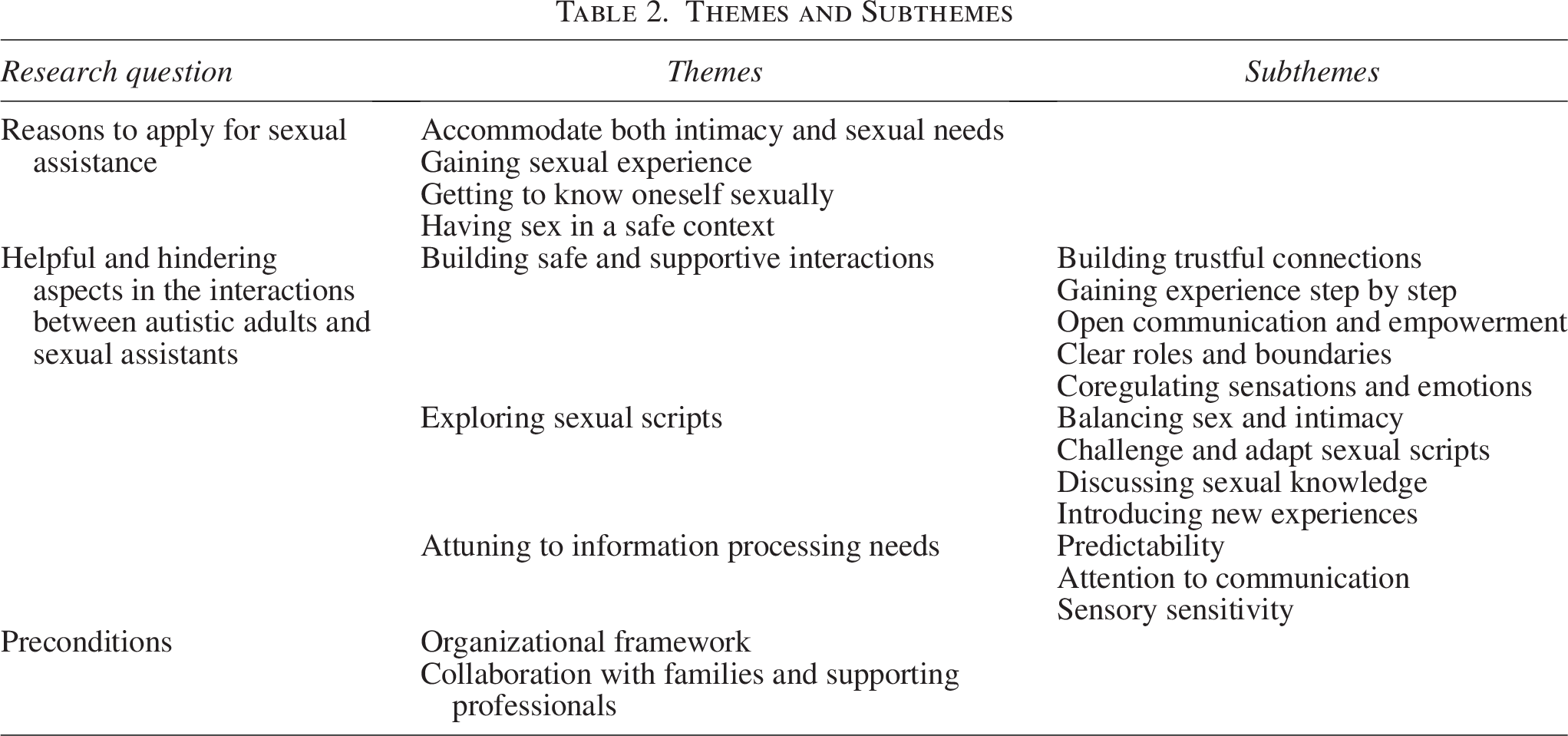
Autistic adults’ reasons for seeking SA
Autistic adults expressed several, often combined, reasons to apply for SA. First, accommodating both (unmet) intimacy and sexual needs, illustrated by the quote of an autistic adult stating that “I actually just wanted to be sexually satisfied, so that I could tick off that physical need” (AA1).
Second, the desire to gain sexual experience by comparing oneself with peers and perceived societal norms emerged as a significant impetus.
“I’ve never had a relationship, and of course, I was already thinking, well, 33 by then… and after a while, you see friends around you getting into relationships… And now and then, I would mention to my psychologist, like, well, I’d also like to have that experience.” (AA3)
Third, autistic adults viewed SA as a way to getting to know themselves sexually, as sexual beings.
“I hope (…) by meeting with a sexual assistant and then possibly having sex, to discover my own identity in that and to understand how I function, then I would like to have a girlfriend.” (AA1)
Fourth, participants who had negative experiences with prostitution, dating apps, or matrimonial services in their attempts to meet their needs turned to SA to have sex in a safe context.
“I couldn’t get any sex dates either […] the women only wanted to cash in credits for their website.” (AA2)
Apart from these reasons, SAs noted that some autistic adults were referred to SA after sexually inappropriate behaviors.
Helpful and hindering aspects in the sexual interaction between autistic adults and SAs
Building safe and supportive interactions
Building trustful connections
Autistic adults experienced the SAs’ gentleness as important for building trust, linking it to “the chemistry between both personalities, so, that’s (the sexual assistant) who actually radiates love” (AA2). SAs emphasized expressing genuine commitment to foster connection as one sexual assistant recalled responding to a question about the content of SA: “We’ll have to figure that out together, but you can be sure that whatever we do, I’ll do it from the heart—it’s genuine” (SA7). Both groups also valued everyday conversations as a way to connect. For example, an autistic adult described the sexual assistant as “very social, I mean (the sexual assistant) asks how my parents are doing, since both of them are in the nursing home. My father is already 84, and she asks about my parents and then also tells me about herself” (AA4). Some SAs, however, expressed the need for more reciprocity in interpersonal, intimate, and sexual contact, describing feelings of frustration due to the absence of eye contact and (experienced) stiff interpersonal interactions, while an autistic adult described reciprocity as meaningful when assistants “genuinely enjoy it when we have sex” (AA4).
Gaining experience step by step
A slow pace during sexual contact helped SAs avoid “overwhelming” (SA13) autistic adults, aligning with the autistic adults’ preference to “not go straight to the pounding, it should be at ease… you know, take it slow, start with foreplay like cuddling and stroking and so on” (AA4). Autistic adults valued this gradual approach not only within encounters but also across meetings, as one participant explained: “So far, I’ve built it up, but I haven’t yet been able to fully reach orgasm because it hasn’t worked out yet. That’s what I want to work towards now” (AA2). The slow pace created space for exploration and reflection, as an autistic participant described uncertainty about penetration:
“I don’t think we’re there yet. Maybe I just don’t like it, but I’m not really sure. I think that if I were to take the next step with (the sexual assistant), I might actually enjoy it. But when I think about it—yeah, putting it in—that doesn’t really seem that appealing to me. I feel like I prefer cuddling, stroking and being stroked, and being massaged.” (AA1)
This gradual approach also allowed mutual trust to grow. Autistic adults explained:
“The better you get to know someone, the more you can give them your trust, and the more you dare to ask for things.” (AA1)
“In the beginning that was still difficult… to orgasm next to someone you don’t know—I once asked, ‘turn around.’ And now that’s no problem at all.” (AA3)
Others highlighted how attunement deepened over time: “When you see someone for the first time you don’t know what to expect… but over time the feeling, the sense of it, grows” (AA4). SAs likewise stressed the importance of a slow pace, noting that “being careful, getting acquainted, and getting to know each other at a calm pace is really important for everyone,” (SA3) and that “it becomes more enjoyable as you get to know each other” (SA3).
Open communication and empowerment
During the sessions, assistants supported and encouraged autistic adults to share their experiences, such as “no, it doesn’t work, or it tickles too much” (AA3) and discussed sensations, such as “that hurts or that feels a bit boring” (SA5). After the sessions, assistants elicited feedback (“What did you enjoy the most?” “What are we definitely not going to do again?” [SA1]) immediately afterward or by sending a follow-up e-mail (“Do you have any feedback?” [AA3])
Autistic adults found it helpful when assistants offered options: “(SAs) leads, well, leads… shows what is possible” (AA4), while assistants emphasized leaving the decision to the autistic adults, as an assistant remembered asking: “If you think it’s okay, we can take something off, but if you prefer, we can keep our underwear on” (SA1). The initiative for scheduling the next appointment also rested with the autistic adult, as “the next step for a new appointment always comes from them” (SA12). Importantly, only SAs mentioned these strategies to support empowerment—except offering suggestions—thus reflecting their intentions rather than the experiences of autistic adults.
Clear roles and boundaries
Both groups emphasized the importance of boundaries and agreed that SAs safeguard the boundaries of both parties. SAs found it helpful to communicate their intimate and sexual boundaries in advance and to clarify their role explicitly with statements such as “I am like a physiotherapist, or like a masseur, or… you know, I also fulfill a physical need, and you pay for that, …” (SA5). Autistic adults considered this clarification helpful, as it made clear what to expect—and what not to expect—from SAs, as one autistic adult who described themself as needy explained: “That’s good, because otherwise it would be too difficult to keep emotional distance. I know myself, and I would struggle with that. This way I can clearly plan it in” (AA1). Setting boundaries was not always straightforward, as the same autistic adult felt these limits left too little time: “Sometimes I felt like I would have preferred it to last longer. I don’t think we ever lost the desire to be engaged with each other, but rather that there was too little time” (AA1).
In addition, SAs were proactive in creating and monitoring an environment where autistic adults felt secure enough to share their experiences. They emphasized the importance of actively attending to non-verbal communication and guiding the process. As one explained: “Being the director of the process and taking control also gives them a sense of safety” and further noted: “That’s why it’s so important to pay close attention to the non-verbal, to body language [.] those are all my feeling antennae” (SA1).
Although autistic adults felt safe in knowing that “when you say, this is my boundary, they will never cross it” (AA3), they sometimes hesitated to share their experiences, which warranted active questioning by SAs. For instance, one autistic adult looking forward to penetration admitted, “I don’t always dare to say that I’m in pain,” while another felt uneasy after rejecting a suggestion, noting: “I said ‘no,’ and yes, I find it a bit unfortunate that I disappointed the sexual assistant in that” (AA3).
Coregulating sensations and emotions
Both autistic adults and SAs described how the SAs supported the autistic adults in regulating sensations, experiences, and emotions. Autistic adults described feeling “always nervous for the first two seconds” (AA4) and “ruminating about everything, and that makes it difficult because sex is something you’re better off not ruminating about.” (AA1) After noticing sensations and emotions, the SAs helped to regulate in a variety of ways. One autistic adult shared: “It calms down when he massages me” (AA3), while a sexual assistant emphasized: “Yes, you really must reassure them. That’s very important” (SA13). Both autistic adults and SAs found it challenging for SAs to assess the emotional inner world of autistic adults due to their unique ways of expressing emotions. As one autistic adult noted, “I laugh quite quickly and often, and that can sometimes be misunderstood” (AA3). To address these differences in emotional expression, SAs focused on interpreting non-verbal cues of distress and actively checked in with autistic adults based on their observations. A sexual assistant clarified: “Once you’ve known people for a while, you know when you need to actively ask questions. You also start to understand their reactions and what they mean to them. And that’s different for every person” (SA4). Furthermore, SAs emphasized the necessity of considering the possibility of past traumatic experiences in autistic adults, and a trauma-sensitive approach. Also, caregivers were cautious to avoid triggering traumatic memories. One sexual assistant explained: “They were afraid that if they asked for SA, that trauma might resurface” (SA9).
Exploring sexual scripts
Balancing sex and intimacy
Some autistic adults’ sexual scripts were “very specific” (SA8), and tuning in on these scripts could help ensure that “you meet the sexual needs” (AA2). In addition, both SAs and most autistic adults emphasized the importance of conceptualizing SA more broadly than solely focusing on penetrative sex. Autistic adults appreciated incorporating intimacy alongside sexual acts during SA, with some stating: “In the end, I found that more enjoyable than purely the sexual aspect” (AA1). However, others emphasized the importance of sexual acts explicitly, expressing: “Sexual intercourse included! That, for me, is the complete package” (AA3). SAs prioritized intimacy over sex, experiencing it as a “victory” to “foster a sense of affection” (SA11). This emphasis on intimacy sometimes contrasts with some autistic adults’ focus on sexual acts, reflecting a mismatch that some SAs found disappointing and that could undermine mutual understanding. As one SA reflected, “Come on man! We’ve already had such great sessions together” (SA10), after an autistic adult shared that he liked oral sex the most.
Challenge and adapt sexual scripts
Some sexual scripts aligned naturally, while others diverged, requiring both autistic adults and SAs to challenge and adapt their sexual scripts.
“One of the expectations that didn’t came out was… that I once asked her if (SAs) would like to play the role of a doctor and I the patient, but then (SAs) answered ‘No, I don’t do that because I’m no nurse.’” (AA2)
SAs noted that autistic adults could experience stress and disappointment during sessions, influenced by unrealistic expectations shaped by pornography. This was experienced as “tension and expectations […], while it should actually be a time free of pressure” (SA13). At the same time, SAs needed to adjust their own scripts to meet the autistic adults’ specific needs and circumstances. As one assistant explained: “He never ejaculates, and at first, I found that unfortunate, but eventually, I understood that it’s actually better for him” (SA14).
Discussing sexual knowledge
SAs regarded discussing sexual knowledge as an essential aspect of their role. They provided sex education as SAs observed that some autistic adults had limited sexual knowledge. One assistant addressed the unrealistic expectations created by “a strap-on dildo being enormous,” explaining to the autistic adult: “that’s not a normal size” (SA5). SAs also stimulated autistic adults to explore their sexuality. For example, while some assistants explicitly discussed the negative influence of pornography on sexual expectations, others used pornography as a tool to help autistic adults explore sexual interests, suggesting: “Try watching a video at home or think about something pleasant, something that excites you. Just fantasize about that” (SA12).
Introducing new experiences
SAs and autistic adults described the role of the SAs to broaden the autistic adult’s sexual repertoire by introducing new experiences. Yet navigating between supporting exploration and imposing normativity demanded mutual reflection:
“(SAs) comes up with suggestions like ‘let’s do it this way or that way’ because I’m not so inventive with that. Then I can respond with ‘no, that doesn’t work… or yes, I’d really like that.’” (AA3)
An assistant encouraged intimacy by suggesting “Try to stay lying together under the blanket for one minute” (SA13). In addition, SAs guided autistic adults in learning gentle and subtle touch by providing hands-on experiences and offering feedback. This approach is illustrated by one assistant’s practice: “I start with a massage for all my autistic adults, with touches using oil and so on, and then I sometimes switch the roles” (SA10). SAs also aimed to facilitate the transfer of skills and experiences to contexts beyond SA. They encouraged autistic adults to explore sexuality independently, for example, by promoting to “practice that at home” (SA12). In addition, they discussed with autistic adults how they could transfer these skills to future relationships, although this was not always deemed possible. A sexual assistant stated that “(some autistic individuals) might never truly understand or gain insight into it or something like that” (SA12). Autistic adults, on the contrary, experienced personal growth through engaging in sexual experiences. One felt themself “blossoming” and described it as something that “provided me with a sort of confidence” (AA3).
Attuning to information processing needs
Predictability
Both autistic adults and SAs valued providing predictability. One way to achieve this was by making clear agreements with autistic adults, focusing primarily on the content of SA. As one autistic adult expressed: “Before our first date, we exchanged many emails back and forth, so I already had an idea of what a date would be like” (AA3). SAs likewise emphasized the importance of making clear agreements about the content of their services, while also underscoring the necessity of practical information such as frequency and duration. This is reflected in the statement: “(Agreeing on) the duration of a meeting is still a challenge to this day, […], yes, those are the kind of things to discuss, indeed” (SA4). Another way to promote predictability was through structure and rituals. Autistic adults appreciated the structured nature of the sessions, with one participant stating: “There’s a lot of structure in it, and that’s what I need” (AA1). SAs likewise highlighted the significance of structure and rituals and emphasized the need to align the session structure with the autistic adult’s daily routine. One described the start of a session: “At the beginning, when I enter, it’s always in a hotel; (the adult) always has the music playing already, and we always start with slow dancing” (SA12).
Attention to communication
Both autistic adults and SA talked about attunement to the verbal and non-verbal communicational characteristics of autistic adults and using clear and direct language as helpful factors. An SA’s quote illustrates this: “I also use short sentences, because they sometimes need time to process what I’m saying” (SA10) and “I say everything out loud, you know. I don’t expect them to read me or anything” (SA1). SAs saw actively confirming understanding as an important communication skill. One SA explained: “You just try to explain very slowly, very patiently, and kindly, like: ‘Okay, this is what I meant. What do you understand?’” (SA14).
Sensory sensitivity
Both autistic adults and SAs identified sensitivity to stimuli as a factor that could either disrupt or enhance interaction. An autistic adult described their skin as “very sensitive,” adding, “(SAs) experienced that right away, especially in the beginning, oh boy” (AA3). On the contrary, the attunement improved when SAs recognized and responded to signs of overstimulation. A sexual assistant noted that “knowing how someone experiences overstimulation [.] so you have to ask yourself, ‘Am I doing something wrong here?’” (SA4). Some SAs utilized sensitivity to specific stimuli to arouse autistic adults. For example, one sexual assistant used a particular coat, stating: “Touching it and really rubbing it […] aroused him” (SA5).
Additional findings: Preconditions for SA
Organizational framework
The intermediate organization played a vital role in coaching SAs and autistic adults, facilitating the match between, and serving as a contact point for both parties when questions and challenges arose. The organization provided training, information, and support to SAs and offered support and psychoeducation on sexuality and intimacy to autistic adults, ensuring both SAs and autistic adults had the resources they needed. One sexual assistant described: “Last week, I visited someone where there was absolutely no connection, at least, not for me. For him, there was, but not for me. […] Then I called (the organization) and discussed the issue” (SA9).
Collaboration with families and supporting professionals
SAs stressed the importance of collaborating with the autistic adults’ support networks. This was particularly important when autistic adults resided in residential facilities, where maintaining communication with caregivers and other professionals helped ensure proper preparation for visits, dealing with stress for the upcoming meeting, setting up the room, and arranging payment. Aligning with caregivers on the approach for individual autistic adults was equally vital, as one sexual assistant explained: “If I don’t cooperate with them and follow their suggestions, we’ll never make progress” (SA13). Moreover, caregivers often served as intermediaries, facilitating communication between SAs and autistic adults by handling scheduling, providing updates if the assistant was delayed, or conveying feedback. In addition, SAs indicated the need to maintain contact with autistic adults’ families, particularly for individuals with intellectual disabilities. As one sexual assistant noted: “What I find personally important, especially for people with autism or intellectual disabilities, is maintaining good contact with their family or someone close to them” (SA9).
Discussion
This study illustrates how SA can offer a meaningful context for autistic adults with limited sexual experience and limited access to safe partnered sexual interactions to explore and engage with sexuality. While the small number of autistic participants (n = 4) calls for caution in generalizing findings, their experiences offer insight into the needs, helping and hindering aspects pertaining to SA in line with the broader research on SA.28,29
SA can contribute to the realization of sexual citizenship, 16 when embedded within a supportive legal and care framework. However, participant narratives also highlighted that SA represents only one element within a broad constellation of factors that contribute to the realization of sexual rights. 5 These include the availability of comprehensive sexuality education, attention to prevailing views on sexual scripts, and the sexuality of autistic people among professionals, caregivers, and in the wider society.
While SA can play a valuable role in supporting the sexual rights of autistic adults with limited access to partnered sexual experiences, the interviews revealed several ethical tensions and dilemmas.
First, a care-based and educational model is central to the SA approach in this study. Both autistic participants and assistants described a (initially) high need for attunement and support in their interactions (e.g., clarity and predictability, explicit communication, coregulation, sufficient time), which preceded the possibility to experience and explore partnered sexuality and intimacy. The active role of the assistant was considered essential in regulating tension within interactions and in carefully navigating the boundary between guiding (e.g., initiating new sexual experiences, exploring personal needs and expectations, describing scripts and societal norms) and following (e.g., responding to scripts and fantasies, attuning to pace). This implied mutual attuning and perspective-taking, which could be complex in line with the double empathy problem. 30
The power dynamics between SAs and autistic adults—SAs providing sexual experience to a neurominority—can make the boundary between “normalizing,” respecting a partner’s preferences, and exploring one’s own sexual preferences precariously thin.16,22 In the accounts of the SAs, a tension emerged between educating autistic adults using normative, sometimes ableist scripts (e.g., “lying together under a blanket”) versus aligning with their individual sexual and intimate expectations and desires (e.g., role-play). Participants in this study, as well as individuals living with disabilities more broadly4,16 and autistic adults in previous studies and personal accounts, described a wide range of attractions, 31 needs, preferences, and sexual scripts32,33 that diverge from traditional heteronormative expectations. While the assistants’ narratives reflected openness to aligning with the autistic adults’ information processing, sexual expectations, and scripts, this openness was constrained by the assistants’ own expectations, preferences, and their understanding of the autistic adults’ perspective. 34 The interviews revealed a persistent tension between the opportunity to experience sexuality in a personally meaningful way and the implicit expectation to (learn to) adapt to a partner’s—often neurotypical—preferences. Creating space for explicit discussion of non-neurotypical and -heteronormative ways of enjoying sexuality and exploring these within a safe and caring context facilitated by assistants or the organizing institution could empower autistic adults to develop and express their own sexual scripts and enhance their awareness of interactional attuning. 5
Second, while SA can provide a safe and caring context to explore one’s sexuality and gain experience, 16 it does not fully address deeper needs for connection and (sexual) partnership. 5 The participants’ experiences of building trust with a sexual assistant while adhering to the structured “rules” of SA illustrated this tension (e.g., a 1-hour meeting, once a month). 20 Although this framework is designed to foster realistic expectations, 29 participants recognized that SA alone did not meet their broader needs. Some SAs emphasized the potential for clients to transfer skills and experiences gained through SA to other contexts. However, strategies aimed at fostering relationships—whether at the individual level, within their networks, or in broader society—were rarely discussed. This diversity of aims represents another area of tension that requires careful monitoring. SA can contribute to sexual rights and well-being by supporting individuals in building intimate relationships beyond the context of SA. At the same time, it may also function as a long-term alternative for individuals who otherwise lack access to partnered sexuality. The intermediary organization plays a crucial role in monitoring these dynamics and safeguarding the needs and rights of autistic adults.
Third, access to SA is not guaranteed across all countries, as legal and policy frameworks vary widely. 21 This variability contributes to the ongoing denial of sexual rights for many autistic individuals and people with disabilities more broadly, effectively disabling their opportunities to engage in partnered intimate and sexual experiences within safe and supportive contexts. 35 Even in contexts where local laws permit sexual support for autistic individuals, professionals, family members, and custodians who support their rights and needs often mediated access to SA. These actors play a pivotal role in either facilitating or restricting access, particularly for individuals with higher support needs. 19 Societal and personal views on sexuality, disability, and autonomy can significantly influence whether sexual support is considered acceptable or accessible. This underscores the need for sustained efforts to shift societal attitudes toward the sexual rights and citizenship of autistic people.36,37 It is equally important to recognize that not all autistic adults require or desire access to SA or other sexual services. Previous studies have shown that most autistic adults report partnered sexual interactions, experiences with romantic relationships, or limited interest in such experiences. 11
Last, sexual services for PLWD are organized in diverse ways, each with specific strengths and challenges. 21 The involvement of third parties remains a contested issue, as intermediaries may alter power dynamics and raise concerns about potential exploitation. 22 However, in our study, the role of the intermediary organization was consistently described as supportive and protective for all parties involved. Given the ethical, legal, and moral complexities surrounding SA and sexual rights, 16 we argue that SA should be embedded within—or at least facilitated by—a broader organizational framework. The organization featured in this study operates on a strictly not-for-profit basis and does not derive financial gain from SA. It provides support to applicants, their networks, and assistants, defines eligibility criteria, and organizes training and supervision focused on sexuality and autism. This structured approach offers safeguards to promote the well-being of both those seeking assistance and the assistants themselves. 22 A clear legal framework and policy infrastructure governing SA and mediating organizations are essential to uphold the rights of all people involved and to ensure that SA is delivered in a safe, ethical, and rights-based manner.
Strengths and Limitations
A key strength of this study lies in its grounding in the lived experiences of autistic adults and SAs, offering rich insights in their needs and experiences. 16 However, several limitations warrant consideration. First, the small number of autistic participants compared with SAs, particularly women, gender-diverse, and non-heterosexual individuals, represents a significant limitation. Only one autistic participant identified as female, and another expressed uncertainty about his sexual attraction and identity. Exploring potential differences in needs and experiences across gender and sexual identity could inform attuned support strategies. Attention to the experiences of autistic people with a range of support needs and to those who are non-speaking is also important. Second, while participants accessed SA independently, most did so with support from professionals or allies. Perspectives on applying for SA vary, and caregivers may oppose such support, limiting access for some individuals. Consequently, this study offers limited insight into the experiences and needs of autistic adults who are unable to access SA. In addition, due to our recruitment strategy, we did not include individuals who discontinued the assistance trajectory or who were dissatisfied with the interaction, which may have excluded critical perspectives. Last, although PLWD may also provide SA or engage in sex work, 38 this was neither asked about nor voluntarily reported by the SAs in the present study, as it was outside its scope.
Conclusions
Our study aligns with a sex-positive perspective on SA, one that emphasizes the accommodation of sexual rights for people experiencing barriers to exploring and enjoying their sexuality.16,17 Within a neurodiversity-affirmative framework, SA may meet some of the needs for learning about and/or enjoying partnered sexual pleasure for a subset of autistic adults who otherwise would lack safe opportunities to explore their sexuality or engage in intimacy and partnered sexuality. To uphold the sexual rights of autistic people who require support in this area, advocacy is needed for inclusive legal frameworks and for challenging persistent societal stigmas surrounding autism, sexuality, and SA.
Footnotes
Acknowledgments
The authors would like to thank all participants for sharing their experiences and insights; Elien Spaey, Marthe Reumers and Margot Vandebroek, who helped collecting data as a part of their master’s theses; Miek Scheepers and colleagues at Aditi vzw for their work in this field, their input and support; and the Autistic Adults’ Reading and Advisory Group (LAVA) for their input and feedback.
Author Disclosure Statement
No competing financial interests exist.
Funding Information
No funding was received for this article.
Supplemental Material
References
Supplementary Material
Please find the following supplemental material available below.
For Open Access articles published under a Creative Commons License, all supplemental material carries the same license as the article it is associated with.
For non-Open Access articles published, all supplemental material carries a non-exclusive license, and permission requests for re-use of supplemental material or any part of supplemental material shall be sent directly to the copyright owner as specified in the copyright notice associated with the article.
