




Abstract
True crime is a non-fiction genre that focuses on real crimes and those who were involved. As one may expect, this brings attention to victims of violent crimes. With such a delicate topic, true crime needs to maintain ethical practices. Many have speculated that victims are disrespected in these retellings, but in pre-existing research, no one has measured the extent of this disrespect. As such, the following question presented itself: What is the extent of murder victim maltreatment by true crime media present on Hulu as of 2022? To answer this question, a quantitative, exploratory media analysis was completed through the use of a codebook, which assigns point values that can be combined into an overall maltreatment score. The main focus of this codebook was the narrative and imagery shown throughout an episode. Starting with all true crime series, the sample size was narrowed down to five series. These five series were coded and received an overall maltreatment score. It was found that on average, these five series displayed a substantial amount of maltreatment towards murder victims. Additionally, further analysis showed that the treatment of victims was somewhat dependent on the killers. Not only does this demonstrate an injustice to the victims themselves, but also to those that knew them.
Introduction
With the rise of popular streaming services, such as Netflix and Hulu, interest in the true crime genre has grown exponentially. When 2,000 Americans were surveyed, it was found that 66% of respondents were somewhat interested or very interested in true crime. 1 True crime is defined as a story about a crime that happened, and as such, the audience expects as many details as possible. 2 This generally includes the names of people involved, the time and day the crime occurred, the location of the crime and much more. Details of the crime, regardless of their significance, are displayed to the public eye. This exposure may bring notoriety and attention to those involved.
True crime draws upon various aspects of a crime, including the crime itself, the investigation and even the trial of the perpetrator(s). Each of these processes relies on the cooperation of numerous people, all of which are put on display when the case is made into true crime. Some roles are less involved depending on their contributions to the case. Other individuals, who play a more pivotal role, receive more screen time, and therefore more attention. This includes the criminal themselves, and more importantly, their victims.
Typically, the criminals are the main focus when looking at crime, so they tend to become more prominent than other individuals involved in the case. Some criminals have even become household names, including Ted Bundy, Jack the Ripper and the Zodiac Killer. Each of these killers has had true crime media made about their crimes. Extremely Wicked, Shockingly Evil and Vile 3 , Portrait of a Killer 4 and Zodiac 5 are examples of this. However, the names of these victims are less notorious: Debra Kent, 6 Annie Chapman, 7 Paul Lee Stine 8 and more. The victims’ involvement in this media prompts the question, what is the extent of murder victim maltreatment by true crime media present on Hulu as of 2022? For this study, maltreatment is defined as any aspect that either shows a preference towards the killer or could potentially portray the victim incorrectly. While this is a broad definition, it allows for a more thorough analysis of true crime media.
Literature Review
Victimology
Victimology studies the relationship between victims and their offenders, along with the psychological effects that crime can have on victims. Victimology is divided into four different types: penal, general, theoretical and critical. 9 Using these four categories, victimologists can understand victims and their influence on the world around them. Despite the potential of this field of study, it did not emerge until recently, as a branch of criminology. 10 This is partially due to conflicting opinions regarding the field of study.
The traditional approach to victimology is that it is a way for victims to be compensated for their suffering, and to receive more recognition for their struggles. In Jessica Benjamin’s opinion, being a victim means competing against other victims for the right to say that they have experienced the worst. 11 It is this belief that leads to an increase in victim blaming. Victim blaming is when a victim is held responsible for the occurrence of the crime. This can come from professionals, such as police and medical officials, or it can come from more personal sources, such as friends or family. 12 Some victimologists still take this approach, but others have moved on to a more modern interpretation.
Zainab Bharmal, Divya Pravalikha Batthini and others find hope within the field of victimology. ‘The victim who was ignored as a component of the crime came back into life with the advent of this new field namely victimology.’ 13 Whereas victims used to be overlooked or blamed for the crime, they are now receiving the help and support that they need. This support comes in the form of new legislation, victim compensation and support groups. 14 Victimologists who take this approach are more likely to recognize victims as real people, even when others see victims as an afterthought.
Regardless of one’s opinion on the subject, researchers have established that victimology has had an impact on the lives of victims. But none of these researchers have thought to measure how victims are treated, in any context.
Fictional Literature
For many decades, serial killers have been a popular subject throughout literature. From The Silence of the Lambs 15 to American Psycho, 16 Americans have become accustomed to fictional serial killings. Arguably, different pieces of fiction contain varying levels of violence and, therefore, varying levels of social acceptableness, which has been examined by Sonia Baelo Allué. In The Silence of the Lambs, there are two serial killers present. But because Hannibal Lecter is presented as a ‘good guy’, American society will sympathize with him more than others, like Buffalo Bill. Additionally, because Buffalo Bill’s violence ended in this book, people are more accepting than when it comes to other literature, such as American Psycho. Often frowned upon due to its gore and violence, American Psycho receives more backlash from American society. Many researchers theorize this is because Patrick Bateman, the main character, is a typical member of society who is never caught for his crimes. 17 Even with this in-depth analysis of fictional serial killers, the way that fictional victims are treated is never considered an influential factor in society’s views on this kind of fiction.
Another category of crime fiction is the books that have a fictional plot, yet have characters based on real people. Susan Cheever’s father wrote fictional stories detailing the brutal deaths of young children. These young children were based on his kids, Susan and her siblings. When her husband saw nothing wrong with her father’s actions, Susan Cheever said this: ‘My husband has never been negatively written about in fiction—never seen his intimate physical and emotional flaws skewered on the page to create a character.’ 18 In this case, Susan Cheever only had her identity used, not her past trauma or experiences, yet she was still deeply affected. This does not even begin to encompass those who have had their actual identity and their actual story used.
Digital Media
As of the twenty-first century, many aspects of life have been digitized and adapted to new technology, including the true crime genre. In general, most true crime consumers utilize documentaries, series and podcasts as their main source of information. As such, victimologists have begun to analyse these new forms of media, and the consensus is that victims of violent crimes are being re-victimized. 19 With this in mind, Allison Jones and Emma Mabe completed an analysis of Conversations with a Killer: The Ted Bundy Tapes, 20 a popular true crime documentary on Netflix. Jones and Mabe’s study analysed this documentary in the context of victimology, women’s studies and ethnic studies. In this case, the conclusion was that the victims were objectified and did not receive the proper recognition. 21 As insightful as this research is, it does not recognize the complexity of the issue. Strictly speaking, the main character of this documentary is the killer, while the victims only play a supporting role. It is not unreasonable for a documentary to focus on its main character, but at the same time, the victims do not deserve to be treated as evidence.
Additionally, this modernized form of sharing information allows producers to include even more details about the crime and the people involved. As a result, many victims or their families have spoken out about the issue. Buzzfeed, a popular media platform, demonstrates this perfectly. In one of their recent articles, they provide insight into how different victims feel about the retellings of their stories. Some are offended by the way that their story is being broadcasted, finding it offensive and traumatizing. Others would rather take matters into their own hands, by producing their own true crime media, so they can share these experiences on their own terms. 22 Since popular platforms, like Buzzfeed, are noticing how victims’ families are being affected, this trend cannot be ignored.
Summary
Up until this point, researchers have explored victims in the context of victimology, literature and digital media. Each of these subjects relates to victims or true crime media, but very few examine both. Researchers who have analysed the relationship between victims and true crime have only completed a qualitative analysis and have failed to actually measure how often they are treated poorly. This is the gap that this study intends to fill.
Because this pre-existing research seems to highlight the presence of maltreatment, the researcher hypothesized that victim maltreatment would be present but infrequent and not extensive.
Method
Overview
To examine the extent of victim maltreatment, this study is conducted using a quantitative, exploratory media analysis through the use of a codebook. This researcher used quantitative data because these allowed for straightforward comparison and interpretation, which proved useful for generating conclusions. Because this study intends to explore the extent of maltreatment, rather than provide an explanation, an exploratory analysis is needed. The use of an exploratory media analysis specifically is necessary because this research looks at digital media. As such, different factors are examined than if a book or article were being analysed. In order to complete a quantitative, exploratory media analysis, this research uses a codebook. This was chosen because codebooks can take qualitative information and transform it into numerical data. 23 This is a common approach for those hoping to analyse digital media. An example of this is ‘Oversexualization of Marvel Heroines: A Content Analysis of the MCU’, 24 where the researcher developed and utilized a codebook to explore the extent of oversexualization in Marvel movies. This study and its codebook aided in the creation of the codebook used for this research.
This research is executed in four main steps: one, select true crime media on Hulu as of 2022 to examine; two, analyse these sources for victim maltreatment; three, score these sources using a codebook to determine which maltreatment criteria they meet; and four, compare the sources and attempt to ascertain a pattern. All methods used in this research were approved by an Institutional Review Board (see Appendix C).
Sample Selection
As one may expect, there are a variety of true crime series and documentaries present on streaming services. Hulu, Netflix, HBO Max and Prime Video are all examples of services that are currently streaming true crime media. The first step in the selection process was to decide which of these streaming services to analyse. Admittedly, Netflix is infamous for its true crime, which makes it a popular subject for research regarding the topic. As such, this researcher determined that examining Hulu would produce more unique findings. From there, the researcher looked at the media that Hulu itself classified as true crime. This led to a total of 48 sources. The researcher narrowed down these sources using four different criteria. The process involving these criteria can be viewed in Figure 1, a flowchart made by the researcher.
Narrowing the Sample Size.
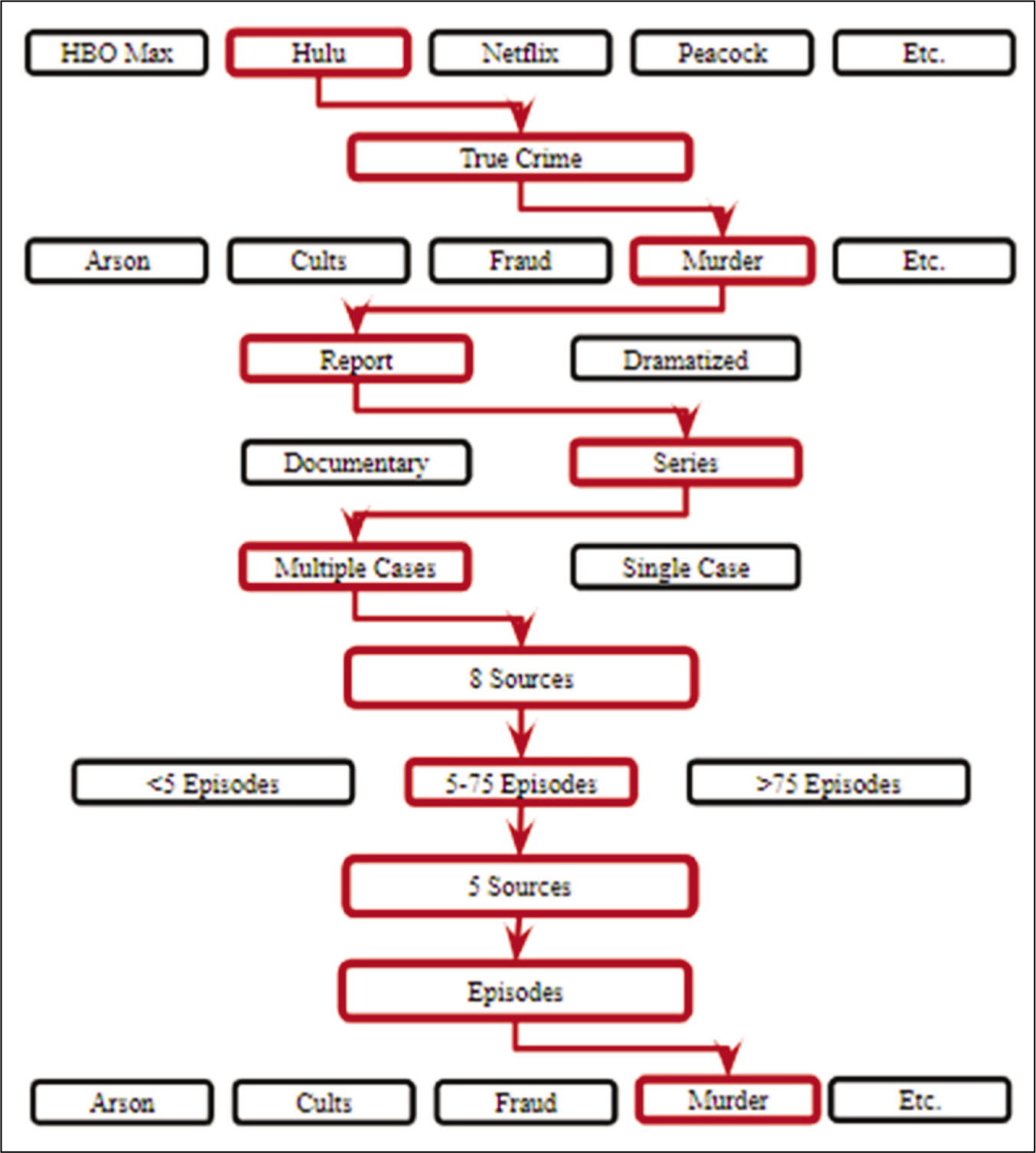
Type of Crime: The genre of true crime includes a variety of crimes, such as murder, arson, fraud and more. Because this research is directed at the maltreatment of murder victims, true crime media about cults or financial fraud can be disregarded.
Dramatized vs Not: Typically, true crime is divided into two categories, dramatized versions and those that act as reports of the events. Dramatized versions often take creative liberties, so the crime and those involved can be skewed. While this would be interesting to examine, this research is focused solely on reports of the events.
Series vs Documentary: As with any genre of digital media, true crime comes in many forms. Most true crime comes in the form of a series or a documentary. For this study, only series are used, because they provide a larger sample size than documentaries. This results in more reliable data.
Number of Cases: Some true crime sources feature a single case or multiple cases across various episodes. To analyse more instances, sources that focus on a single case are not used.
For example, A Wilderness of Error 25 reports a murder and is a series. Yet, it is excluded from this study because it focuses on a single case, the murder of the MacDonald family. To be included, a media source needs to meet all four criteria. After this was completed, the researcher was left with eight sources. In order to ensure that this research is viable and reliable, three series with less than five episodes or more than 75 episodes were removed. The remaining five sources were further narrowed based on the content of their episodes. True crime media does encompass all crimes, so some episodes focussed on crimes other than murder. Episodes of this nature were eliminated. The five series analysed in this study are not named, in order to prevent any negative repercussions for those involved in the production process. This researcher would like to prevent any blame from being directed at those who only executed design choices made by their superiors.
Codebook Development
As previously mentioned, this research relies on the use of a codebook to quantify data and ensure consistency. A codebook is defined as a list of variables indicating how the results for each item are coded. 26 Considering what this researcher is looking for, a codebook had to be developed for this study specifically, based on variables that made themselves apparent in existing research. The codebook is divided into two sections: imagery and narrative. Additionally, a third, miscellaneous section is used to record information that can later be used for comparisons and predictions. The codebook and variables used in this research can be found in Appendix A. The coding sheet used by the researcher can be found in Appendix B.
Within the category of imagery, the researcher looks at the use of the victim’s image and the use of the killer’s image as a reference. This includes images and videos of the victim and their killer. For the sake of this study, more exposure to the victim demonstrates that the victim is treated properly, while more exposure to the killer demonstrates maltreatment. Having many pictures of the victim shows that the victim is recognized as a person. Having many pictures of the killer shows that a stronger emphasis is being put on the killer, which this study deems unfair to the victim. This process is the same for videos.
Additionally, the imagery portion of the codebook examines if a recreation of the crime is used and how often it is shown. Recreations utilize a victim’s likeness, and the victim is likely portrayed incorrectly. Therefore, the usage of recreations in an episode is an example of victim maltreatment. Another portion of the imagery section examines the use of crime scene photos. The repeated use of crime scene photos is classified as victim maltreatment because they often depict the scene of the crime and injuries found on the victim’s body. These are graphic pictures, and their use can offend those who know the victim.
Narrative, the second category, examines how the source refers to the victim and the killer. Referring to the victim by other terms, such as the ‘victim’, the ‘corpse’ or any variations is deemed as maltreatment because the victim’s identity is being overlooked. Ideally, the victims’ real names should be used. Using real names helps maintain the victims’ identities, while other terms further objectify them. The opposite can be said for the killer. Describing the killer using other terms is not deemed as maltreatment. For both the victim and the killer, different circumstances are taken into consideration, because it is not uncommon for the identity of the victim or the killer to be unknown at the beginning of an episode.
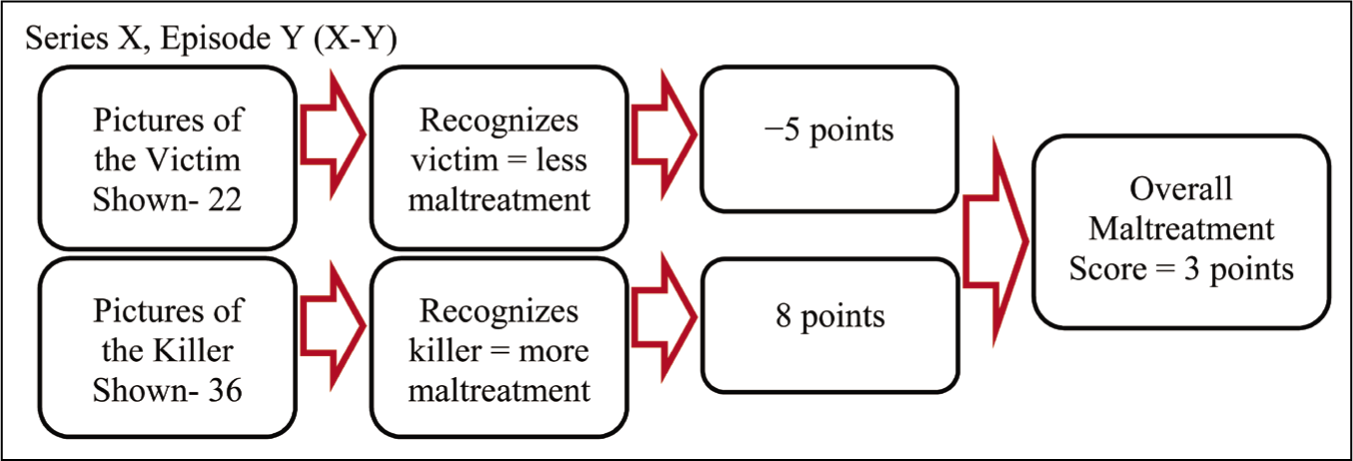
For the codebook used for this research, instances of maltreatment are represented by a positive point value and add to the maltreatment score. Instances that disprove maltreatment are represented by a negative point value and are subtracted from the maltreatment score. The point values for each examined variable can be summed into a maltreatment score for an episode. A positive maltreatment score demonstrates the presence of maltreatment, while a negative maltreatment score demonstrates that victims are being treated properly.
A simplified example of the codebook process can be seen in Figure 2, made by the researcher. As can be seen, this source displayed a picture of the victim 22 times, and because they recognize the victim, it subtracts from the maltreatment score. At the same time, a picture of the killer was shown 36 times. This calls for an increase in the maltreatment score. Once the two point values are combined, the overall maltreatment score is three points. This indicated that maltreatment is present, which is rational because the killer was shown more often. For each episode, this process is repeated with the multiple criteria previously mentioned.
The third section of the codebook is not incorporated into the final maltreatment score. Instead, information is gathered so that different factors can be compared. For example, some cases have multiple victims and one killer. By keeping track of the number of victims, the researcher can compare how the number of victims impacts the maltreatment score. Other factors that are recorded include the number of killers, was the killer caught and the killer and victim’s relationship.
Codebook Example.
Data Collection
Using these criteria, sources can easily be coded. This researcher accomplishes this by analysing a source and noting every instance of the phenomenon that the codebook examines. Then, these notes can be put through the codebook and each category produces a point value. These point values can be added up to form an overall maltreatment score. A higher score signifies a higher level of maltreatment, and a lower score signifies a lower level of maltreatment. This process was first completed in a pilot study to test the validity and make any changes. A small sample of Netflix true crime media was used, all of which also meet the sample criteria. Necessary changes were made, and the researcher moved on to the actual sample.
After using the categories to generate an overall maltreatment score for the five Hulu sources, the researcher can compare each source across several variables that were noted in the miscellaneous category of the codebook, which did not contribute to the overall maltreatment score.
Results
Data Visualization
For the purposes of this analysis, the researcher represented data through scatter plots because they provide a visual representation where trends can easily be identified. The first set of graphs contains five scatter plots that display how each series scores and one scatter plot that displays the aggregated data from all five series. By doing so, the overall trend can be evaluated, but it is also obvious that each series has varying results. For these scatter plots, the horizontal value is of no significance because it demonstrates how the series scores as time goes on, which is negligible for this research. The second set of scatter plots contains five scatter plots that compare different variables and average maltreatment scores. This was done in hopes that connections could be made between the score and the case itself.
Series Scores
For all five series, eligible episodes were examined and coded, resulting in a maltreatment score. Each point in the data point represents the score of one episode. A negative data point represents an episode with less maltreatment, while a positive data point represents an episode with more maltreatment. The researcher-generated graphs displaying the data for the five series as can be seen in Figure 3, along with the average maltreatment score for each series.
Individual Series’ Scores.
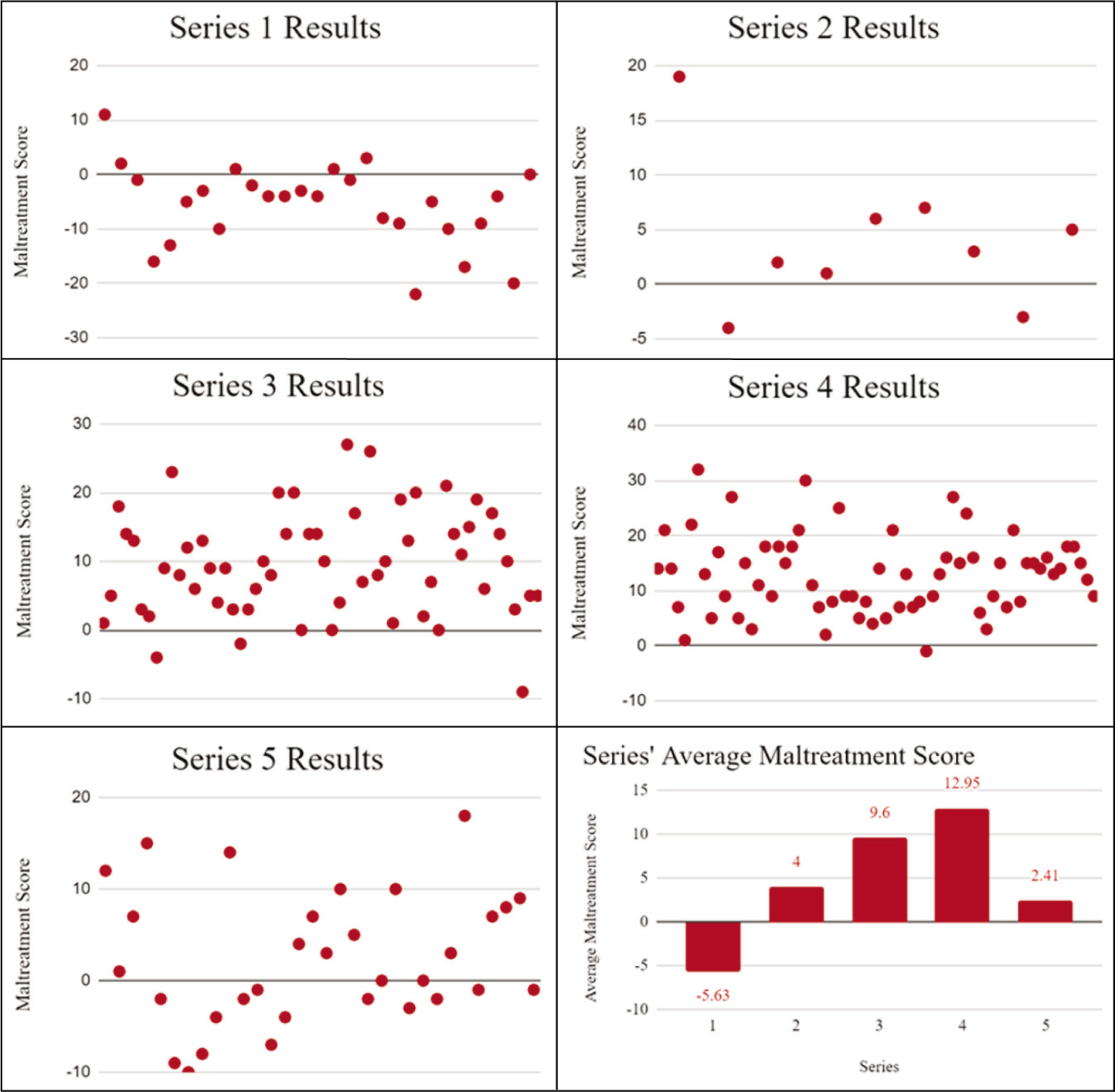
Each series examined had outliers because every episode and every case are different, but trends can be determined. From these graphs, the following observations were made. For Series 1, results were predominantly negative. There were a few episodes that received a positive score, but the average ended up being a score of −5.63 points, giving it the lowest score of all five series. Series 2 had the smallest sample size, with only nine episodes. These nine episodes generally received low, positive scores, so the average score was +4 points. Series 3 and 4, the longest of the five series, scored similarly. Series 3 had an average score of +9.6 points, while Series 4 had the highest average score of +12.95 points. Series 5 was the least consistent of all five series, with a range between −10 points and +18 points. Ultimately, Series 5 received an average score of +2.41 points.
The researcher generated one final scatter plot to represent the aggregated scoring of all five series which can be seen in Figure 4.
Combined Series Results.
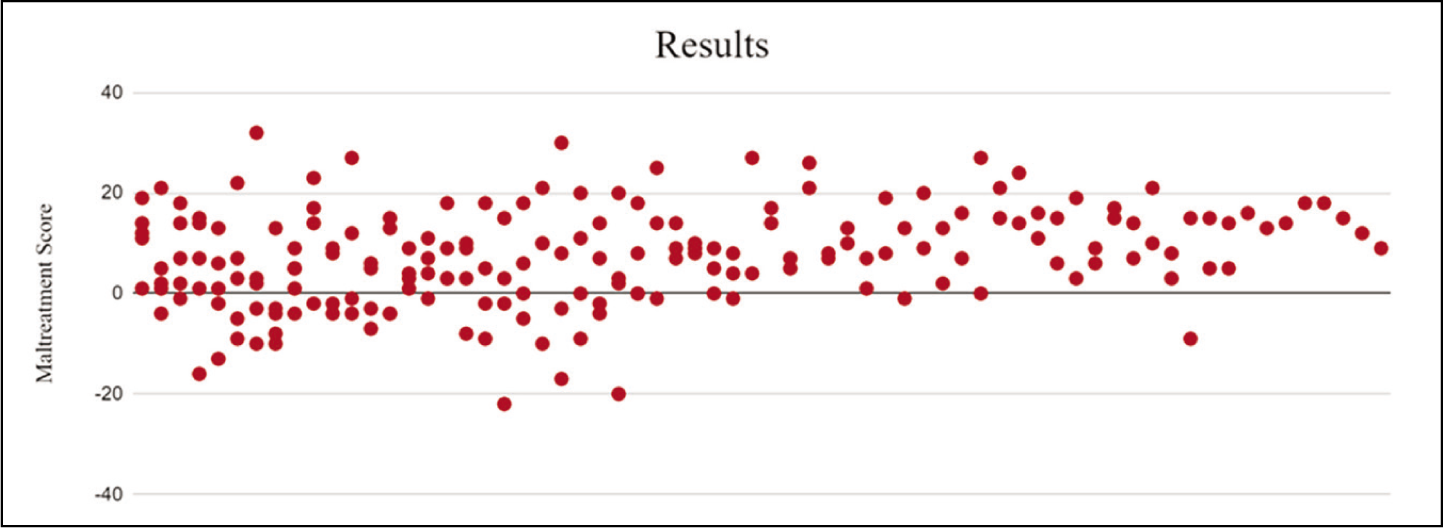
As previously mentioned, the horizontal aspect of this scatter plot can be disregarded. From this scatter plot, it can be seen that most of the 192 episodes examined received a positive maltreatment score. The overall average maltreatment score was +4.67 points.
Variable Comparisons
For each episode, five different miscellaneous variables were noted: the number of victims, the number of killers, the status of the killer, the degree of murder and the victim’s relationship with the killer. Within each variable, an average score was generated for each outcome of that variable. The researcher-generated graphs with these results can be seen in Figures 5 and 6. For three of the variables (number of killers, degree of murder and victim-killer relationship), ‘N/A’ was an acceptable response. This was excluded from analyses because ‘N/A’ was used for various reasons.
Variable Results.
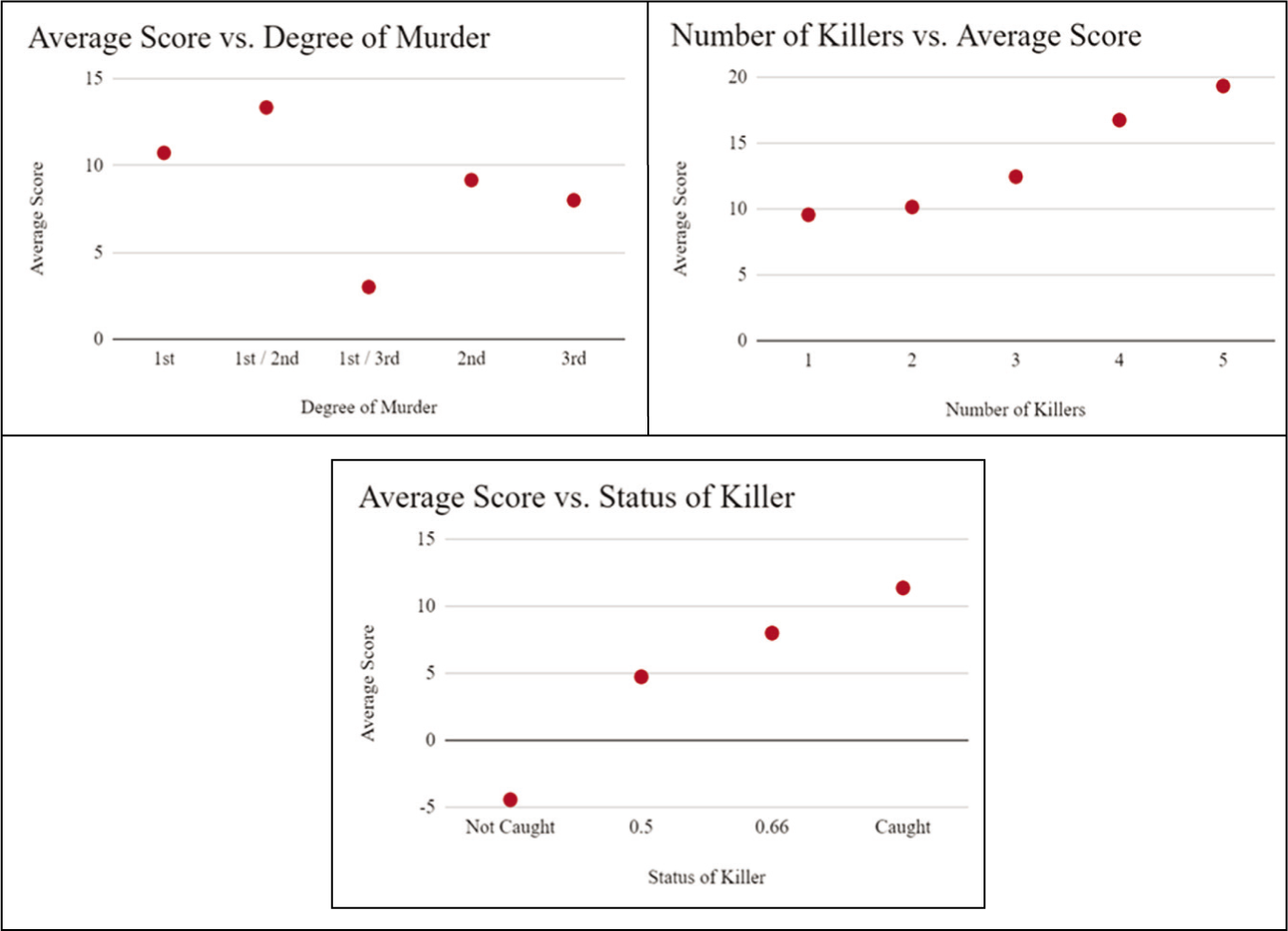
Number of Victims: Throughout the five series examined, each episode featured between 1 and 13 victims. To analyse the relationship between this number and the maltreatment score, an average score was generated for each response using its corresponding episodes and scores. These averages were then graphed and can be seen in the first chart of Figure. 5.
Number of Killers: For this analysis, the researcher repeated the same process used to analyse the number of victims. An average score was generated for each response using its corresponding episodes and scores. This graphed data can be seen in the second graph of Figure 5.
Status of Killer: This variable examines if the killer was caught or not. Other responses included ‘0.5’ and ‘0.66’, which represented episodes that displayed more than one episode. ‘0.5’ represents an episode where half the cases shown have been solved, and ‘0.66’ represents an episode where two-thirds of the cases shown have been solved. An average score was generated for each response using its corresponding episodes and scores. This was then graphed, as can be seen in Figure 5.
Degree of Murder: The degree of murder was examined, using only 1st-, 2nd- and 3rd-degree murder. Responses with ‘1st / 2nd’ and ‘1st / 3rd’ represented episodes with two different cases. An average score was generated for each response using its corresponding episodes and scores. This can be seen in the first graph of Figure 6.
Further Variable Results.
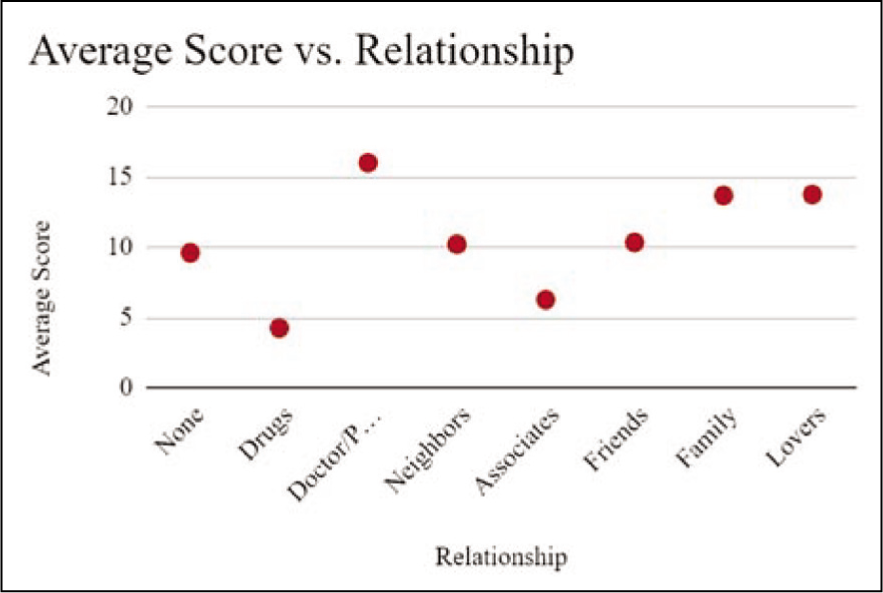
Victim–Killer Relationship: The relationship between the victim and the killer was noted throughout data collection. General relationships were used, such as ‘Associates’ and ‘Lovers’. An average score was generated for each response using its corresponding episodes and scores. These results can be seen in Figure 6, with the relationships arranged by increasing familiarity.
Discussion
These data must be interpreted before any conclusions can be drawn. The overall maltreatment score was +4.67 points, signifying that victim maltreatment was present. However, these results can be examined at a smaller scale by looking at individual series.
Series 1 was the only series to have a negative maltreatment score, with −5.63 points. There were a few positive data points that conflicted with this average, but overall, the episodes tended to have a negative score, signifying that no maltreatment was present. While Series 1 demonstrates less maltreatment by the codebook’s standards, there were instances of maltreatment that were not considered during the creation of the codebook. Throughout the series, numerous insensitive comments were made about the victims and the circumstances of their deaths. In the 19th episode (1–19), the two hosts referred to the victim as a ‘beefy man’ and a ‘fucking knucklehead’. These instances can be coded because they demonstrate the victim being referred to by another term besides their name, but that fails to express the extent of the maltreatment. Frequent, insensitive comments like this could potentially negate the low maltreatment score that Series 1 received.
The other four series received a positive, average maltreatment score. This suggests that victim maltreatment is prevalent throughout these series. As with Series 1, there were instances that were not involved in the coding process, yet they still provide insight into the series’ treatment of victims. One example of this can be found in the 31st episode of Series 3 (3–31). In this episode, Rolando Santos was found murdered, and the investigators eventually track down the woman who killed him. It is at this point that one of the lead investigators calls Santos’ killer attractive. This type of insensitivity was not taken into consideration during the creation of the codebook, and therefore cannot be incorporated into the maltreatment score. Alternatively, in Series 4, episode 62 (4–62), the producers used an alternative name for the victim, likely at the request of her family. This demonstrates some compassion towards the victim and their family but is negated by the high maltreatment score that the episode received. As such, Series 2–5 are justified with their positive maltreatment scores. Even when there are uncoded instances of fair treatment towards victims, the high maltreatment score cancels it out.
When examining the different variables that might impact the average maltreatment score, only two presented a real pattern, the number of killers and the status of the killer. Regarding the number of killers, it can be seen that as the number of killers increases, so does the average maltreatment score. This suggests that episodes featuring more killers demonstrate more maltreatment towards the victims. Regarding the status of the killer, the average maltreatment score tended to increase as more is known about the killer. Episodes presenting unsolved cases had a negative, average score, demonstrating less maltreatment. Alternatively, episodes presenting solved cases had a strong, positive maltreatment score, demonstrating more maltreatment. Episodes presenting more than one case, where the response was ‘0.5’ or ‘0.66’, had an average that fell between these two scores. When considered, both of these trends are rational. Assuming an episode talks about a single killer n times, then it makes sense that each additional killer adds an additional n times. Therefore, the average maltreatment score increases with the number of killers. If the case is unsolved and the killer is unknown, then half of the coding variables that indicate maltreatment are negligible. The more that is known about the killer, the more information can be included. From this, it can be concluded that the treatment of victims is somewhat dependent on the killer.
These results refute the researcher’s previously mentioned hypothesis. Victim maltreatment was proven to be frequent by the number of episodes that received a positive maltreatment score. As seen in Figure 4, the majority of episodes demonstrated maltreatment towards victims. Additionally, victim maltreatment was proven to be extensive by the scale used for this codebook. As can be seen in Appendix A, every five instances equated to a single point. An overall average maltreatment score of +4.67 points can be equated to approximately 20 instances of maltreatment towards the victims in each episode.
Limitations
As with any research, these results have some limitations. One major limitation is that the researcher has little to no knowledge about what occurred during the production of these true crime episodes. Limited access to resources could have impacted how the victim is treated throughout an episode. For example, assume that Episode X displayed three different pictures of the victim throughout its entirety. The producers may have had access to only these three photos, therefore using all the resources available to them, or they could have had access to ten different photos and chose to only use three. There is no way to determine this information, so this research had to be conducted under the assumption that producers had access to substantial resources, for both the killer and the victim.
Another limitation of this research is the sample size. Due to time constraints, only five series could be analysed for this study. There are countless true crime series that are currently available to the public, so the results of five series alone cannot be generalized to the entire population. However, this researcher can confidently say that, on average, these five series displayed strong maltreatment towards victims. Additionally, the analysis of different variables suggests that reliable predictions can be made about other true crime series. These results suggest that it can be reasonably assumed that episodes featuring unsolved cases and fewer killers will demonstrate less maltreatment towards the victims. And despite its smaller sample size, this research presented insight into the treatment of over 330 victims, who are the central focus of this entire study.
A third, more minor limitation of this research was that only one trial could be completed. Due to time constraints, each episode could only be watched and coded once. Had multiple trials been used, episodes’ scores from each trial could have been averaged, giving more reliable data. Unfortunately, this could not be done, but this brings to attention another benefit of using a codebook. Because each point value corresponds to a range, mistakes can be made during the coding process, and the episode should still receive the proper maltreatment score.
Implications
With such a sensitive topic, the results of this research have an impact on various groups. The friends and family of victims are the most positively impacted by these results. As previously mentioned, victims’ friends and family have used various platforms to advocate for their loved ones. Buzzfeed, a popular media site, recently published an article describing this. The families of murder victims, disturbed by true crime’s portrayal of their loved ones, have produced their own true crime media, and in some instances, have filed lawsuits against true crime series and their producers. 27 The results of this research help validate the feelings of these friends and family. Additionally, in recognition of the victims’ and their loved ones, the names of all victims whose stories were examined for this research have been listed in Appendix D.
Building off of this, these results negatively impact the producers of true crime. True crime producers have faced accusations and lawsuits based on their treatment of victims. These data suggest that true crime series and their producers have been maltreating victims since at least 1987 when the oldest series first aired. Not only does this reflect poorly on these producers, but it also strengthens accusations that have been made against them. Another group that is potentially impacted is true crime consumers. These results could induce a sort of awakening for those who watch true crime. The limited research that exists on this topic suggests that not many consider the treatment of victims while watching true crime. True crime consumers, upon seeing the results of this study, may reevaluate how they watch true crime. It is up to interpretation if this is a positive or a negative impact, and everyone will be impacted differently, but the potential is there.
Conclusion
The true crime genre has become increasingly popular in the last few decades. More and more Americans are consuming true crime media, and, therefore, more attention is being drawn to these crimes and those who were involved, including the victims. This prompts the question, what is the extent of murder victim maltreatment by true crime media present on Hulu as of 2022? This research used quantitative, exploratory media analysis to investigate this question. The resulting data suggest that victim maltreatment is prevalent throughout true crime media present on Hulu. It was found that more often than not, murder victims were portrayed incorrectly or received less recognition than their killers. This is an injustice to the victims themselves and those who knew them.
This research could easily be expanded upon into other aspects of true crime. The sample size alone brings plenty of potential. For this research, various criteria were used to determine which series would be used. By shifting these criteria, an entirely different subset of true crime can be examined. For example, future researchers could examine true crime that centres around a different crime other than murder, or they could examine documentaries specifically. With the proper justification, the sample can be shifted and a new understanding can be developed. Further research could also be completed with modifications to the codebook. Other variables can be investigated, such as who was interviewed for the episode. Further investigative research could provide a more well-rounded understanding of this topic.
In summary, murder victims deserve just as much recognition as their killers, if not more. The series that were examined for this research suggest that victim maltreatment is prevalent throughout true crime, but further analysis should be completed to determine the extent of the issue.
Footnotes
Declaration of Conflicting Interests
The author declared no potential conflicts of interest with respect to the research, authorship and/or publication of this article.
Funding
This research received no specific grant from any funding agency in the public, commercial or not-for-profit sectors.
Appendix A: Victim Maltreatment Codebook
Do not code any opening or closing credits. This does not include the introduction to an episode, which can be coded if it contains codable content.
For all coding, only utilize the information available to you as a viewer. Do not include any outside knowledge you may know, EXCEPT for the identity of the killer. Knowing the killer’s identity in advance will ensure ease of coding when identifying the use of the killer’s information.
Please code each episode with the English closed captioning subtitles ON, for ease of coding.
Finally, it is recommended that each episode be coded more than once, so reliable results can be guaranteed.
Appendix B: Coding Sheet
Episode designation: _______________ Date examined: _______________
Victim’s picture shown: _____________ Killer’s video shown: __________
Different pictures of victim: _________ Different videos of killer: _______
Killer’s picture shown: _______________ Recreation used: (yes/no)
Different pictures of killer: ____________ Recreation shown: _____________
Victim’s video shown: _______________ Crime scene photos used: _______
Different videos of victim: _____________ Different crime scene photos: ____
Victim referred to by name: __________________________________________
Victim referred to by other term: ______________________________________
Killer referred to by name: ___________________________________________
Killer referred to by other term: _______________________________________
Number of victims: ________________________________________________
Number of killers: _________________________________________________
Killer caught: (yes/no)
Degree of murder: (1st/2nd/3rd)
Killer and victim relationship: ________________________________________
Additional notes:
__________________________________________________
__________________________________________________
__________________________________________________
__________________________________________________
__________________________________________________
Appendix C: Research Approval Letter
Appendix D: Remembering the Victims
Below are the names of every victim from every case that this research examined. They deserve as much recognition as their killers, if not more. Don’t let their names be forgotten.