




Abstract
There is a growing acknowledgment of transgender homicide as a serious social and public health issue; indeed, the American Medical Association has even referred to violence against transgender people as an “epidemic.” Addressing this issue, however, requires understanding the patterns associated with this violence. Yet, reliable data for doing so does not currently exist, especially in recent years. As such, the prevalence of these incidents and their key features are not easily understood. The current study addresses this issue using a comprehensive nationwide database on 305 instances of homicide directed against transgender people between 2010 and 2021, collected through extensive open-source data collection methods. The descriptive analyses of these incidents demonstrate pronounced increases in homicide victimization over time, and clear geographic clustering by state, such that roughly one in four incidents occurred in just three states: Texas, Florida, and California. After accounting for the estimated size of the transgender population, Louisiana, Mississippi, and Missouri emerge as the most dangerous states with the highest risk of homicide victimization. The results also clearly demonstrate the intersectional nature of transgender homicide, in finding that most homicide victims are young Black or Hispanic transgender women. We conclude by emphasizing the need for multipronged policy responses to this issue that recognize the uniquely dangerous intersection of social problems that contribute to the vulnerable social position of many transgender people, including their vulnerability to homicide victimization.
Homicide is a significant public health issue in the United States, and homicides targeting transgender people have reached historically high levels in recent years (see, Fitzgerald, 2017; Lenning et al., 2021). Interpersonal violence against transgender populations has even been classified as an “epidemic” by the American Medical Association (2019). Indeed, transgender people are subject not only to elevated homicide risk, but also persistent harassment, intimidation, nonlethal assault victimization, and sexual violence (James et al., 2016; Stotzer, 2009). As many have noted, however, fatal violence, or homicide, against transgender people is extremely understudied (Westbrook, 2022), even in comparison to other forms of gender-based violence (Jauk, 2013; Wirtz et al., 2018). Documenting this violence is critical, however, because victimization statistics inform policy efforts, directives, and resource deployment.
The most significant reason for the lack of research on transgender homicide is a critical shortage of effective data on the subject (e.g., Davies et al., 2017; Dinno, 2017; Lenning et al., 2021; Westbrook, 2022). In other words, despite growing anecdotal evidence and rhetoric acknowledging that violent victimization—and homicide in particular—is a substantial problem among transgender communities, data on transgender homicides in America are severely lacking. As a result, valid and reliable information on the nature and extent of such incidents in the United States, especially in recent years, does not currently exist. The limited information that is available covers only a single year (e.g., DeJong et al., 2021; Osborn, 2022) or is primarily compiled by advocacy organizations, including the National Coalition of Anti-Violence Programs and the Human Rights Campaign (HRC Foundation, 2020), which publish regular reports and lists of murder victims obtained through media reports and other sources; but these reports do not include detailed, quantifiable information about victims, suspects, or related information, and sometimes contain sparse information beyond the name of the victim. 1 And, while some evidence of elevated victimization risk has been obtained from self-report surveys, that is clearly not possible for homicide victimization.
Without more extensive information, it is difficult to develop effective evidence-based policy efforts aimed at combating and responding to such events. Put simply, the lack of basic information pertaining to incidents of fatal transgender violence means that the prevalence of these incidents and their key features are not easily understood. The current study addresses this issue by introducing a comprehensive nationwide database on deadly violence directed against transgender people between 2010 and 2021, collected through extensive open-source data collection methods as part of an ongoing project intended to track and compile detailed information about these incidents of violence, both historically and moving forward. In doing so, we present a critical and timely descriptive account of the nature and extent of transgender homicide in America, including basic trends, patterns, and a descriptive characterization of those most likely to be the targets of such violence. We believe this descriptive account represents a crucial first step in addressing this pressing social and public health issue.
Transgender Homicide in the United States
In general, extant research has pointed to an elevated risk of violent victimization—in all forms—among transgender communities, relative to the general population. Xavier et al. (2007), for example, found that roughly 40% of the transgender people in their study reported being the victim of physical assault and, among those who had been victimized, a substantial portion of respondents reported being victimized multiple times (see also James et al., 2016). Some research has even argued that transgender people are frequently stereotyped as somehow being “deserving” of this violence (Merry, 2006). Wodda and Panfil (2014), for example, note the persistence of dehumanization—both in the media and public discourse—toward transgender people based on notions of a fixed gender binary. 2 This dehumanization, coupled with the mischaracterization of transgender people as deceptive, perpetuates transphobic social climates which function to produce gender-based hierarchies that facilitate transphobic violence and frame victims as partially responsible for their own victimization. 3 Unfortunately, and as a result of these processes, violence against transgender people is particularly likely to be brutal, severe, and result in death (see Bettcher, 2007).
Indeed, some international data collection efforts have suggested that a transgender person is murdered as frequently as every 3 days (Balzer, 2009). Yet, while all crime statistics are subject to measurement error to some extent (see Kitsuse & Cicourel, 1963), particularly those estimating victimization of marginalized communities (Lantz et al., 2019), the true extent of transgender homicide in America is difficult to calculate for three primary reasons (Dinno, 2017). First, the institutions charged with tracking and recording violent death (e.g., police reports, death certificates) are ill-equipped for tracking transgender identity (Lenning et al., 2021). 4 As Dinno (2017, 1442) noted, these inadequate reporting practices “erase transgender deaths.” As a result, official police data rarely accurately record transgender status (Wood et al., 2022), because doing so requires the officer to recognize a nonstandard gender identity and document it in official records, which sometimes do not effectively facilitate recording transgender status (Stotzer, 2009). Second, the gender (and thus transgender identity) of a homicide victim is not always obvious or apparent to those recording death. Finally, transgender people often face rejection from within their own family; for example, Grant et al., (2011), found that the majority of transgender people (57%) report experiencing significant family rejection. Family members sometimes seek to actively deny the transgender identity of the person (Grant et al., 2011), even after homicide victimization.
As a result of these processes, the Bureau of Justice Statistics estimates that violent transgender deaths may be at least 40 times greater than those reported in official crime statistics (see Momen & Dilks, 2021). The most common major data sources for homicides in the United States, including the Federal Bureau of Investigation’s Uniform Crime Report data, do not include any information about whether the homicide victim was transgender (Westbrook, 2021; 2022). Even the National Incident-Based Reporting System, which recently replaced the previous system as the primary source of national crime data (see Lantz, 2022a), offers very few opportunities for law enforcement agencies, and the personnel within them, to report a transgender identity outside of when a crime is explicitly motivated by bias (Stotzer, 2017). Many transgender homicides, however, are not obvious or explicit hate crimes (i.e., see Sherman et al., 2022). Information about homicide victimization also cannot, quite obviously, be collected using survey methods commonly used to measure victimization of transgender people (e.g., the U.S. Transgender Survey). These combined limitations mean that most data on transgender homicide come almost entirely from reports collected by advocacy organizations, or from small samples which limit analytic complexity because of power constraints (Hill, 2002; Stotzer, 2009; Westbrook, 2022; see also Westbrook, 2021). 5
Variation in Homicide Victimization Among Transgender Populations
While research on transgender people is lacking generally, it is also critical that the field take steps toward not just understanding overall patterns in transgender homicide but also variation and heterogeneity in homicide patterns among transgender populations. As Schilt and Westbrook (2009) noted, most of the literature on violence against transgender people has pointed to violation of gender norms and transgression of gender boundaries as the primary cause for such violence. But transgender people are not a monolith, and there is significant heterogeneity, or within-group differences, within these communities; there is likely also significant heterogeneity in homicides directed against them (Sherman et al., 2022). Grouping all transgender victims of homicide together fails to recognize the potential for unique differences—or uniquely high victimization rates—among certain transgender populations, like transgender women of color (see Wodda & Panfil, 2014). 6
Put simply, there is no universal transgender experience (Jamel, 2018; Momen & Dilks, 2021). We can only begin to attend to this nuance by assessing intersectionality, or within-group differences, in transgender homicide (Lenning et al., 2021). The concept of intersectionality, as a theoretical framework, specifically highlights the interconnected social impacts of race, gender, sexuality, socioeconomic class, and other factors, and attempts to capture the multiplicative effects of those intersecting identities (Crenshaw, 1989). Applied to transgender homicide, this approach points to the need for a critical evaluation of the interlaced identities of transgender individuals in their experiences with violence (see Lenning et al., 2021; Potter, 2013). Existing popular discourse on transgender homicide, however—including media coverage (see DeJong et al., 2021)—largely fails to recognize the intersectional nature of this problem, particularly along the lines of race and gender (Wood et al., 2022). Yet, prior research highlighting the need for intersectional approaches has argued that transgender women of color are particularly at risk for homicide because of pervasive, often institutionalized, practices that delegitimize the lives of transgender women (Capuzza, 2014; Wood et al., 2022). Violence against transgender men, transgender women, and gender nonconforming people, for example, may have many mechanisms in common, but likely also has etiologically and theoretically distinct mechanisms underlying each type of violence as well. Some violence against transgender people, moreover, may be inextricably linked to—and even motivated by—the victim’s status as transgender, while other violence may be incidental in that it is directed against a transgender person but independently motivated, while still other forms of violence may not be explicitly motivated by a person’s transgender status but still indirectly related to this status through other processes of societal marginalization (e.g., homelessness, poverty; Stotzer, 2008).
One particularly important outcome of this societal marginalization is differential participation in survival sex work, which prior research suggests is likely to be related to victimization risk (see Westbrook, 2022). Put simply, for transgender women—particularly women of color—who are subject to the combined forces of institutionalized racism, cisgenderism, and transphobia, sex work can become a means of survival (Sevelius, 2013). Transgender people are also more likely than cisgender people to experience employment discrimination and other forms of discrimination, limiting their access to legal forms of employment (Nadal et al., 2014), and thus leading to increased engagement in sex work. The illegal and stigmatized nature of sex work in the United States also means that sex workers are exposed to and experience high levels of violence. This is particularly true for those sex workers involved in street prostitution, which tends to be the most dangerous form of street work (Weitzer, 2009).
In addition to this general risk, transgender women engaged in sex work also experience higher levels of violence due to client behavior. Westbrook (2022) details two dangerous patterns associated with more severe victimization. First, some men deliberately seek out transgender women because of their own desires, but then respond to feelings of shame by directing violence toward these women. Others may engage in sexual intercourse with a transgender woman, believing them to be cisgender; in such instances, some men respond to feelings that they were deceived with violence toward the woman (Lyons et al., 2015; Schilt & Westbrook, 2009; Sherman et al., 2022; see also, Bettcher, 2007; Wodda & Panfil, 2014 for an extended discussion of this deception trope). Taken together, these processes suggest that involvement in sex work may be associated with homicide victimization (Westbrook, 2021), particularly for Black and Latina transgender women who participate in street prostitution at higher rates (Hwahng & Nuttbrock, 2007; James et al., 2016).
Other, admittedly limited, research that has identified other important differences in risk within transgender populations, such that transfeminine people are more likely to be killed than transmasculine people (Dinno, 2017; Westbrook, 2021). Very few studies, however, attend to racial differences and even fewer attend to the intersection of race and gender; again, this omission is primarily the result of data limitations. The studies that have examined racial differences in lethal violence have largely found elevated victimization rates among racial/ethnic minorities, and Black people in particular (Dinno, 2017), with the exception of Gruenewald (2012), who included lesbian, gay, and bisexual (LGB) people in their sample and found that most victims were White. More general research on nonlethal violence against transgender people has also found Black people to be disproportionately victimized, relative to others (Beemyn & Rankin, 2011; Lombardi et al., 2001; Stotzer, 2008; Xavier et al., 2005). Within this context, the current research follows recent arguments for intersectional approaches to the study of transgender victimization (Momen & Dilks, 2021) in examining diversity in homicide patterns among transgender populations.
Data and Methods
The current study introduces and presents results from a comprehensive nationwide database on deadly violence directed against transgender people between 2010 and 2021, as part of a larger project intended to track and compile detailed information about these incidents of violence moving forward. While various organizations and advocacy groups—including the Human Rights Campaign (HRC) and the National Coalition of Anti-Violence Programs—have made important efforts to collect and catalog homicides of transgender people before, none of these efforts, to our knowledge, included detailed, quantifiable information on victim, perpetrator, and offense characteristics of each violent incident.
Methodology
To create the current database, we cross-referenced these lists of victims as a critical starting point, and then employed rigorous open-source data collection techniques—including the extensive review of media and news reports, police reports, and other relevant sources—to collect detailed information about each instance of fatal victimization. Specifically, open-source searches were conducted using Google news, media reports, newspaper archives, the institutional library, and additional sources and web engines (e.g., Access World News Research Collection, LexisNexis, and Proquest), including Lesbian, Gay, Bisexual, Transgender, and Queer (LGBTQ+) specific sources when possible (e.g., TransGriot). These searches for additional information were conducted using key incident and victim details, including name and incident date, among other details. Given the nature of the population, these open-source searches were repeated with all known name variants, including former names. When search results revealed new name variants, additional searches were completed using that name. All information was entered into a comprehensive database accessible by each member of the team and inconsistencies regarding reported information were resolved collectively. This methodology employs techniques similar to Westbrook (2021), which used newspaper articles and related open-source data collection techniques to identify transgender people killed in the United States between 1990 and 2009. The primary advantage of this open-source approach is that it avoids systemic issues with police data that result from under- and misidentification of cases (e.g., see Lantz et al., 2019). We note that it is still likely, however, that our final dataset excludes some transgender homicides which were never identified by the police as transgender, and then never covered by the media or reported as such (see DeJong et al., 2021; Osborn, 2022).
This study presents a basic descriptive account of the resulting database, including 305 identified instances of homicide between January 1, 2010, and December 31, 2021. 7 In building this dataset, we collected information on a variety of individual (both victim and suspect) and incident characteristics. Individual factors included the basic demographic characteristics of each victim and offender (e.g., age, race/ethnicity, and gender) and the victim’s previous involvement in sex work. 8 Incident characteristics included the presence of multiple perpetrators; the type(s) of injury, if known; whether there was a robbery involved; and the physical location of the event—including location type, exact address, and the state in which the incident occurred.
We also account for the possibility of targeted violence by including information on whether an incident of homicide victimization was a hate crime. Because several states do not legally recognize targeted violence against transgender people as hate crimes, however, a strict measure reflecting whether a crime was officially labeled a hate crime would be insufficient. Put simply, in some states transgender homicides cannot legally be identified as hate crimes because such a legal classification does not exist (see Jamel, 2018). It is not uncommon, however, for the family of a victim or for local advocates to vocally indicate their belief that the crime may have been a hate crime. Accordingly, we developed two separate dichotomous measures indicating whether an incident was a confirmed hate crime (1 = yes), as well as whether the incident was suspected to be a hate crime by family, friends, or other sources (e.g., local advocates; 1 = yes).
Results
Figure 1 presents the number of homicides of transgender people by year, from 2010 to 2021. These results present a clear upward trend, with a relatively stable homicide count in the first 5 years, ranging from 11 homicides to 15 homicides per year from 2010 to 2014. There is a substantial increase in the years that follow, with the largest increase occurring between 2019 (N = 29) and 2020 (N = 47); this difference translates to a percent increase of roughly 62.1%. In 2021, the most recent year of data collection, there were 57 recorded transgender homicides. While these increases are likely the result of both increased violence and increased public attention over the study period, if evenly distributed over time (i.e., calculated as a rate), this count would equate to the murder of a transgender person approximately every 15 days in 2021, compared to every 33 days in 2014.
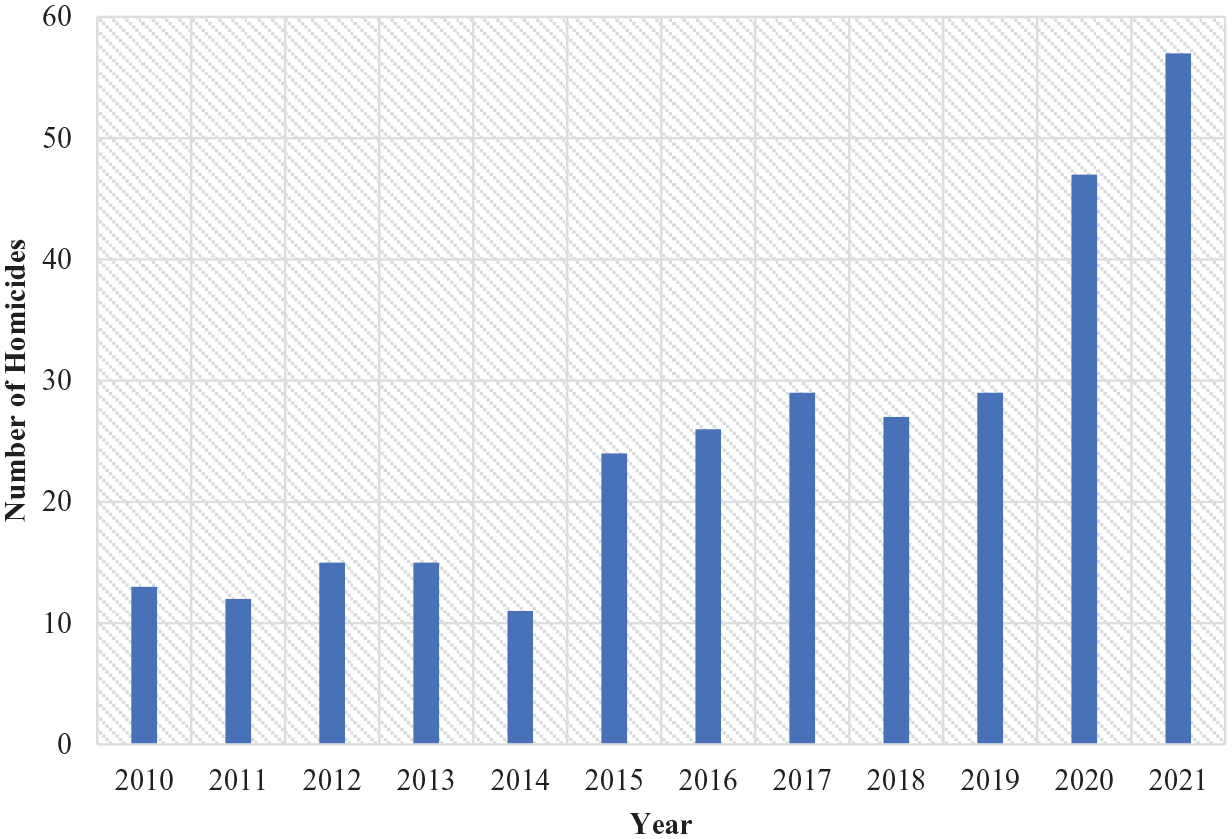
Transgender homicide frequency, by year.
Next, Figure 2 presents the number of transgender homicides between 2010 and 2021 by state, showing a clear pattern of geographic clustering, with more than 10% of homicides occurring in a single state (Texas), and an additional 8% occurring in Florida. Approximately one in four transgender homicides during the study period (25.2%), in fact, occur in just three states: Texas, Florida, and California. While there are likely different mechanisms responsible for some of this geographic clustering—including larger transgender populations in some states, compared to others—it is worth noting that the two states with the highest recorded counts of transgender homicide have also passed recent high-profile legislation widely interpreted as anti-transgender in nature (see Murib, 2022), a pattern we return to in the discussion.
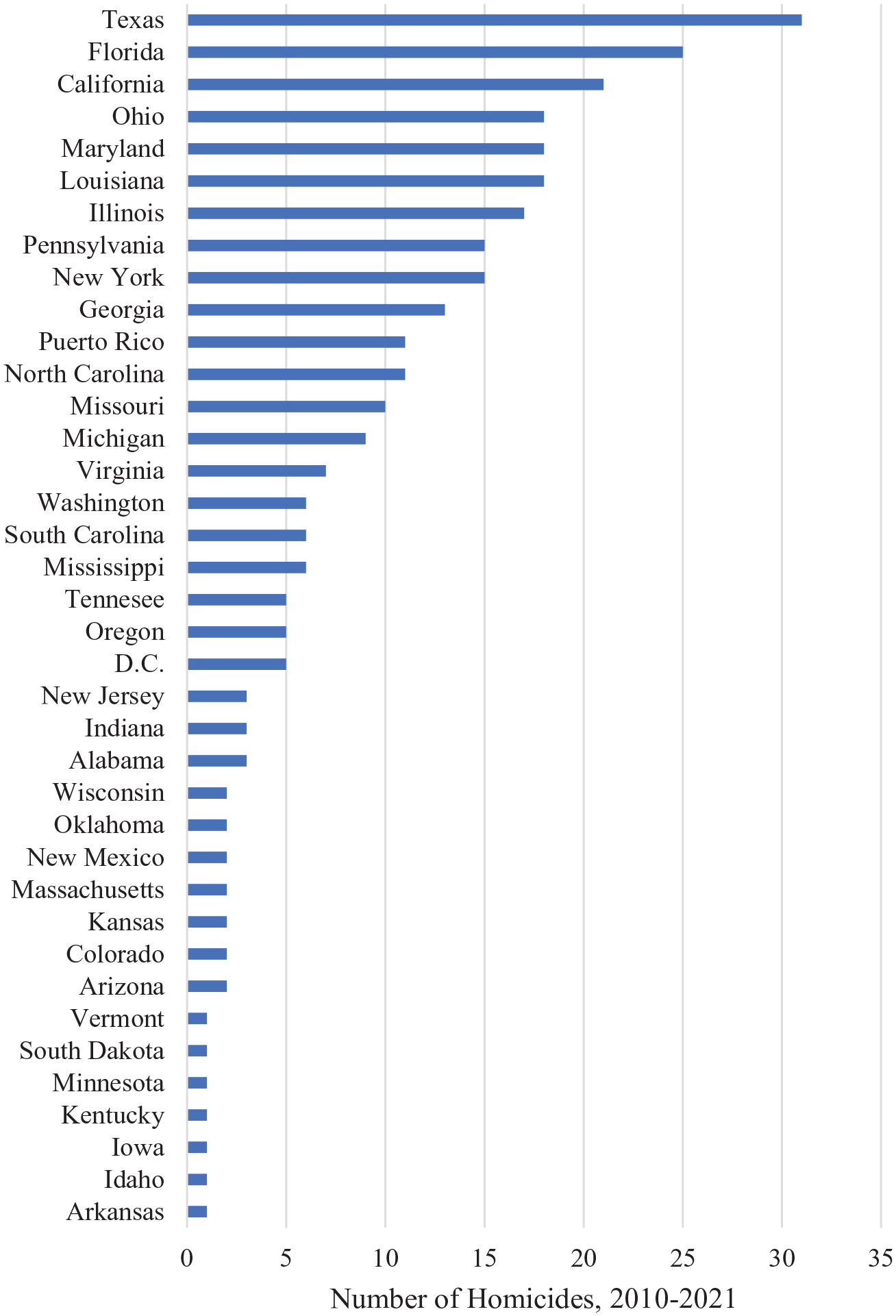
Frequency of transgender homicide, by location.
Because of the potential for overall state population size to impact these estimates, we also include a separate table estimating (a) the homicide rate using state population counts as the denominator and (b) estimates of the transgender population size as the denominator in an online supplement (Supplemental Table S.1). While both estimates are imperfect, given that the former approach uses the entire population as the denominator, rather than the population at risk (i.e., transgender people), and the latter method calculates rates based on the estimated, rather than actual, population at risk, they both reveal important patterns. When using the total population as the baseline, estimates indicate that Washington DC, Louisiana, Puerto Rico, and Maryland have the highest transgender homicide rates. The most dangerous states, in terms of homicide risk, when using the estimated transgender population as the baseline are Washington DC, Louisiana, Mississippi, and Missouri. 9 It is particularly worth noting here that Louisiana ranks high according to all three estimates—sixth by frequency, second by total population rate, and second by transgender population rate—suggesting the possibility that the state may be a particularly dangerous context for at-risk transgender people.
Next, Table 1 presents a descriptive profile of victims of transgender homicide; several notable patterns emerge here. First, regarding victim race/ethnicity, the most frequent victims of transgender homicide are Black (70.5%) or Hispanic/Latinx (16.1%), indicating that there are substantial racial discrepancies in victimization risk such that both Black and Hispanic transgender people are more frequently victimized than White transgender people. Altogether, only approximately 10.8% of victims during the study period were White. Second, there are heightened homicide victimization risks among some age groups, in comparison to others. The most frequent age range for victims was 18 to 29 years old (52.5%), followed by 30 to 39 years old (30.7%); taken together, the overwhelming majority of victims are between the ages of 18 and 39 years (83.2%, when combined). A further 9.2% of were aged 40 to 49 years old, 4.3% were 50 or older, and 3.3% of victims were under 18 years of age.
Transgender Homicides by Victim’s Race/Ethnicity, Age, and Gender: United States, 2010 to 2021 (N = 305). a
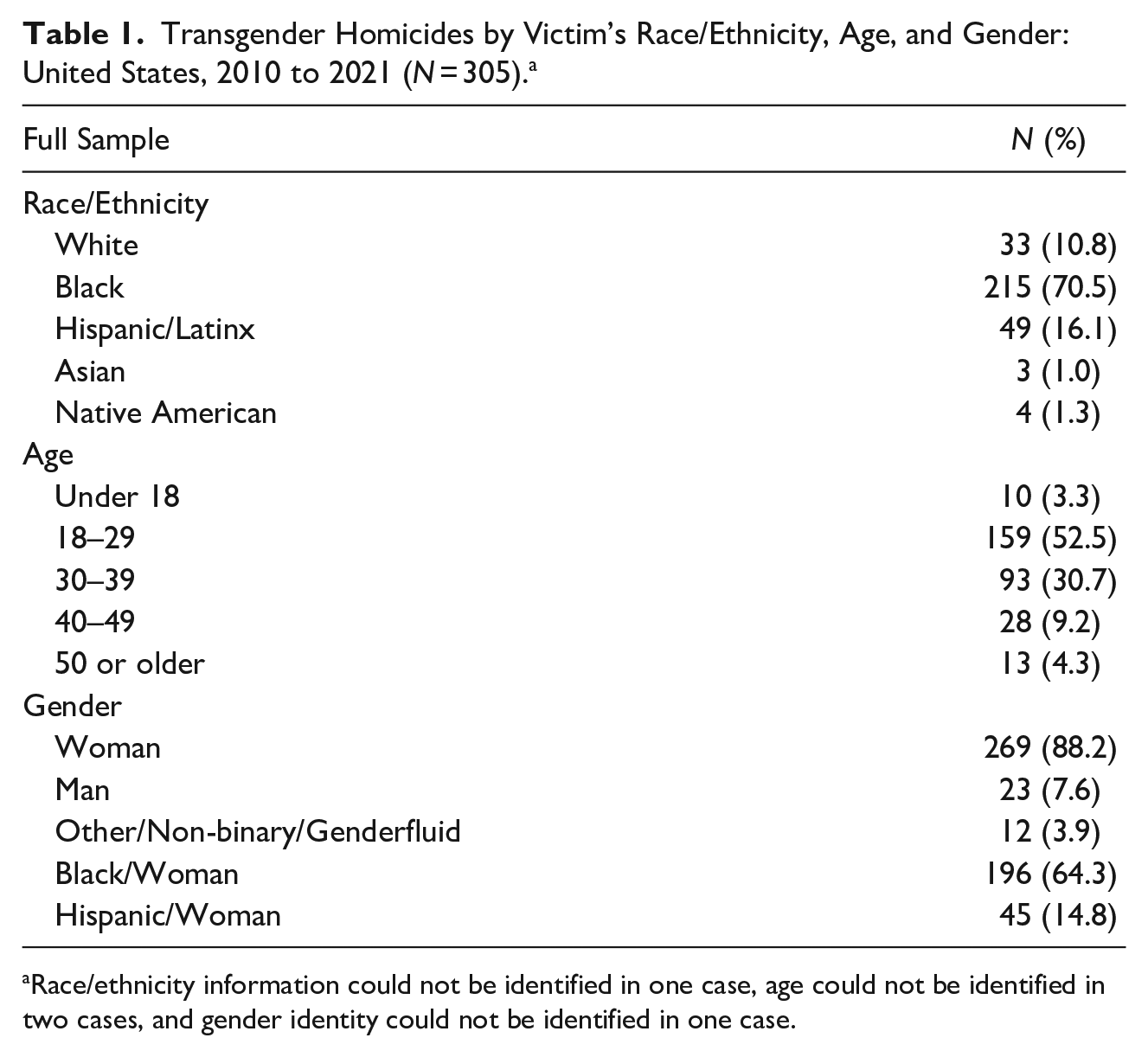
Race/ethnicity information could not be identified in one case, age could not be identified in two cases, and gender identity could not be identified in one case.
Third, we also disaggregate victimization frequency by gender, since treating transgender populations as a homogenous, monolithic group can obfuscate variation in the nature of violence against transgender people (see Ashley 2021; Factor & Rothblum, 2007; Westbrook, 2022). The results clearly indicate differences by gender, such that roughly 88.2% of transgender homicide victims identified as women. Only roughly 7.6% of victims identified as men, while a further 4.0% of victims identified as non-binary, genderfluid, or another gender identity. Finally, when considered jointly, our analyses reveal important bivariate patterns when examining race and gender jointly, such that approximately 79.1% of the sample were Black or Hispanic/Latina transgender women (64.3% and 14.8%, respectively). Taken together, these patterns demonstrate the clear intersectional risk of homicide victimization.
Finally, suspect and incident characteristics are presented in Table 2. Again, there are several notable patterns worth highlighting. First, consistent with current understanding of interpersonal violence more generally, suspects’ age and race are relatively similar to victim age and race, such that most perpetrators are young adults aged 18 to 29 years (62.6%) or adults aged 30 to 39 years(20.1%). In terms of racial demographics, roughly 63.9% of offenders were Black, while 13.2% of offenders were Hispanic/Latinx. White perpetrators are somewhat overrepresented relative to White victimization rates, such that roughly 23% of suspects were White, while only 10.8% of victims were White (as shown in Table 1). Only one Native American suspect was identified. Second, there is clear evidence that transgender homicide is gendered violence (see Jauk, 2013), given that the perpetrators in our data are almost exclusively men (92.8%); it is also worth noting that several of the female perpetrators identified in our study (N = 14) were involved in offenses where they were acting as a co-offender with a male perpetrator.
Characteristics of Transgender Homicides, 2010 to 2021. a
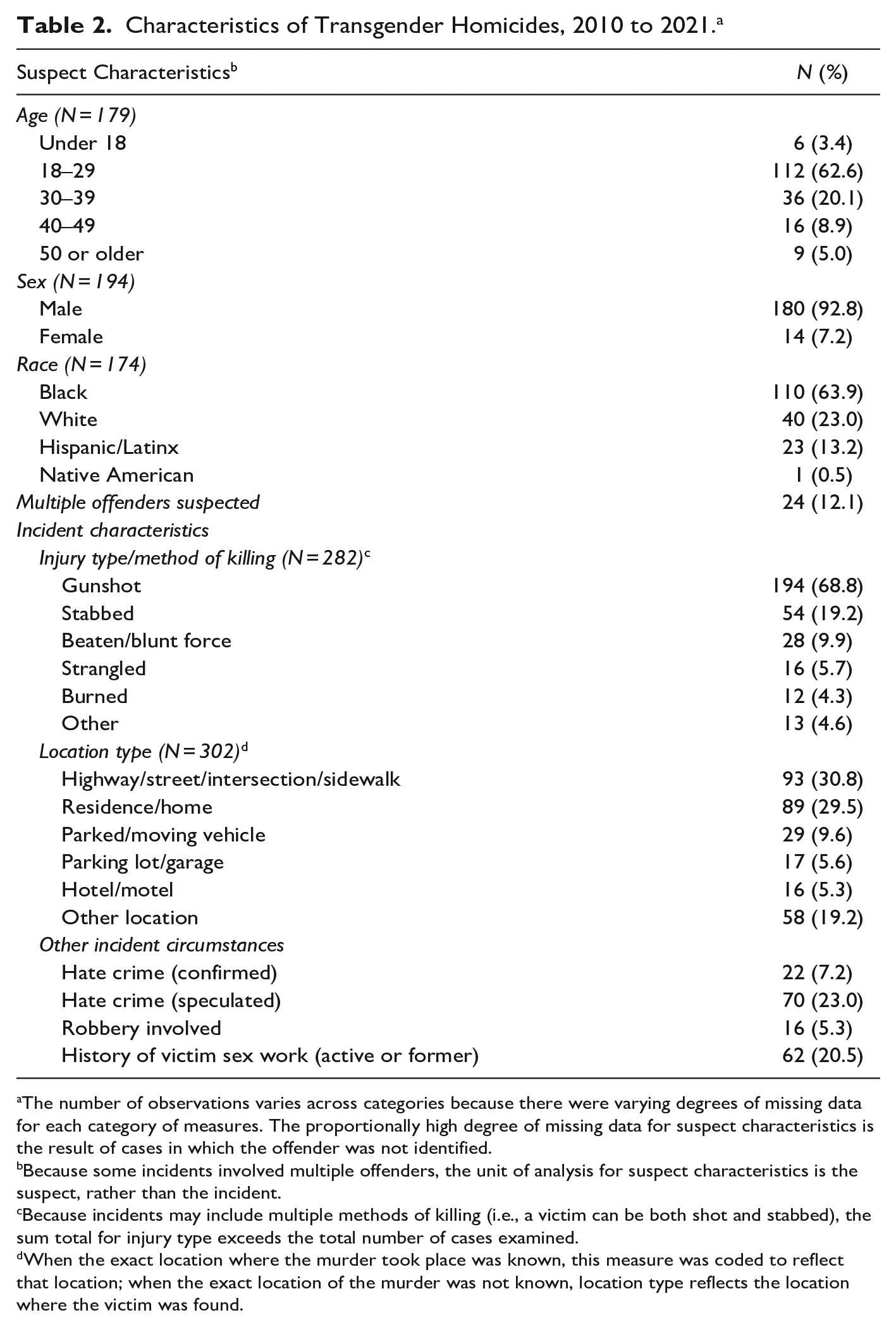
The number of observations varies across categories because there were varying degrees of missing data for each category of measures. The proportionally high degree of missing data for suspect characteristics is the result of cases in which the offender was not identified.
Because some incidents involved multiple offenders, the unit of analysis for suspect characteristics is the suspect, rather than the incident.
Because incidents may include multiple methods of killing (i.e., a victim can be both shot and stabbed), the sum total for injury type exceeds the total number of cases examined.
When the exact location where the murder took place was known, this measure was coded to reflect that location; when the exact location of the murder was not known, location type reflects the location where the victim was found.
Third, regarding incident characteristics, there is clear evidence that transgender homicide is inextricably linked to gun violence as a public health issue, given that approximately 68.8% of the victims in our study were shot. A further 19.2% of victims were stabbed, 9.9% of victims were beaten or killed by blunt force, 5.7% of victims were strangled, 4.3% of victims were burned, and 4.6% of victims were killed by other means (e.g., drowning, hanging). While not presented in Table 2, we also note a clear pattern of “overkill” (see Stotzer, 2017), such that 34 incidents exhibited two or more methods of killing (e.g., the victim was both shot and stabbed).
Fourth, there is a clear bifurcation of public and private violence, such that the two most frequent incident locations were either (a) highly public in nature, occurring on a highway, street, intersection, or sidewalk (30.8% of murders); or (b) largely private in nature, occurring inside a private residence or home (29.5%), often the victim’s own home. A further 9.6% of murders occurred inside a parked or moving vehicle, 5.6% occurred in a parking lot or garage, and 5.3% occurred at a hotel or motel. 10 An additional 19.2% of cases occurred at other locations, including abandoned homes, park/playgrounds, woods/fields, and a variety of other locations. It is also worth noting that four victims died while in a correctional institution of some type, a context in which transgender people are subject to significant victimization in other forms as well (see Jenness et al., 2019). Finally, while only 7.2% of incidents involved a confirmed hate crime or clear bias-motivated crime, a much larger proportion of incidents (23%) involved speculation by local advocates, family/friends/acquaintance of the victim, or other parties with knowledge of the case. Roughly 5.3% of cases involved the robbery or attempted robbery of the victim, and approximately 20.5% of victimization involved a victim with a documented history (either active or in the past) of sex work, in some capacity.
Discussion
The issue of fatal violence or homicide, victimization of transgender people is one of pressing social concern; yet, the current state of data on the topic precludes even basic research. In an era of evidence-based policymaking, it is critical that valid and reliable evidence is generated on the problem at hand if we wish to design and implement effective social policy. In this context, the purpose of the current research was to present a descriptive examination of transgender homicide in America using a newly collected dataset on the topic. In doing so, we present results from one of the first organized—and ongoing—data collection efforts for describing the nature and frequency of homicide as a distinct public health problem among transgender populations. The results suggest several important implications.
First, our results suggest the clear and obvious need to approach fatal violence against transgender communities from an intersectional lens. In other words, to effectively understand and address homicides against transgender people, this violence has to be understood as a multifaceted problem; transgender homicide is a problem stemming from transphobia, homophobia, racism, gun violence, and a variety of other social ills (see also, Lenning et al., 2021; Rodríguez-Madera et al., 2016; Stotzer, 2009). To borrow from Crenshaw’s (1989) metaphor of the highway intersection, transgender women, particularly those of color, exist at the uniquely dangerous intersection of race discrimination, sex discrimination, and a host of other discriminatory forces, including transphobia; put simply, the risk of harm for any one person existing in that intersection—from any direction—is exceedingly high. A Black transgender woman of color, for example, may be victimized because they are Black, they may be victimized because they are a woman, or because they are transgender; they may also experience double or triple discrimination, and may be victimized specifically because of the combination of these discriminatory forces, or because they are Black transgender women. While this research did not conduct any formal comparison of homicide rates among transgender people compared to homicide rates among the general population, prior research has suggested that there may be aspects of transgender homicide that are both different from and similar to other homicide (e.g., Sherman et al., 2022), and future research should consider such analyses. But, even if transgender people do not face a higher overall risk of being murdered, as some have suggested (see Dinno, 2017), it is almost certainly true, based on our findings, that young transgender women of color face a higher risk of being killed—and of “overkill” (e.g., the use of more violence than is necessary to kill) when they are killed—in comparison to the general population (see also Stotzer, 2017).
Next, while only a small percentage of transgender homicides were confirmed hate crimes (7.2%), these patterns should be contextualized within the landscape of American hate crime legislation. Specifically, there are compelling reasons to broaden our definition of hate crime for this analysis beyond strict legal definitions, given that gender identity was only recently included in federal hate crime legislation (Lantz & Malcom, 2022; Woods & Herman, 2014); even now, fewer than half of the states—not including Florida, where our analyses indicate that more transgender homicides occur than any other state except Texas—include gender identity or transgender identity in their state hate crime legislation (Movement Advancement Project, 2023). But, when our conceptual lens is extended to include cases in which local advocacy groups or those close to the victim argued or speculated that a case may have been a hate crime, such cases become much more frequent, in that nearly one in four cases involved a possible hate crime. As Lantz (2022b) noted, bias-motivated violence is often used as a mechanism for policing traditional power structures. Bias-motivated violence against transgender people is often used in this way as a source of gender policing, wherein trans people are targeted not just because they transgress traditional heteronormative gender norms, but because they “do gender” (see West & Zimmerman, 1987) in such a way as to also be perceived as their desired gender (see Jauk,, 2013; Lucal, 1999; Tomsen & Mason, 2001). Jauk (2013) noted that transgender women are particularly likely to be victimized in this context, and our results also suggest that transgender women are the most frequent victims of transgender-involved homicide.
Two additional conclusions can be drawn from these patterns as well. First, a nontrivial proportion of transgender homicides appear to be bias motivated. Drawing attention to these patterns is critically important, especially given that recent research suggests that these consequences extend to the larger community of those with shared characteristics (e.g., other, non-victimized transgender people) as well (see Wenger et al., 2022). Wenger et al. (2022), for example, found that simply knowing someone who has been the target of bias-motivated violence is associated with increased individual depressive symptoms. This pattern is likely particularly extensive among transgender populations, where harassment and victimization are extensive (see Kidd & Witten, 2007; Witten & Eyler, 1999). Indeed, research by Grant et al. (2011) found that an alarming 41% of transgender people have attempted suicide, compared to approximately 2% of the general population; exposure to community violence among those with shared characteristics likely plays a role in these disparities.
Second, while a nontrivial proportion of transgender murders are bias motivated, a substantial portion—indeed, a majority—of transgender murders are not hate crimes. The majority of research and popular dialogue, however, discusses transgender homicide as a single-issue problem centered around the perpetration of hate crime to enforce traditional gender norms and boundaries (see Schilt & Westbrook, 2009). The current study joins a growing chorus of recent research emphasizing that scholars and policymakers should avoid conceptualizing transgender homicide and anti-transgender violence as a homogenous phenomenon, but instead examine and respond to the issue as a varied and intersectional social problem (Momen & Dilks, 2021; Sherman et al., 2022; Westbrook, 2022; Wood et al., 2022). Put simply, to focus on homicide risk among transgender people, without attending to the unique heterogeneity in exposure to violence among transgender populations—among Black transgender women, for example—is to risk overlooking both the distinct and intersectional risks of race and gender discrimination, among other risks.
We also note that roughly one in five transgender victims of homicide were either actively involved in sex work or had a documented history of sex work, a finding consistent with past research (Valera et al., 2000; Weinberg et al., 1999). This research thus suggests the need to attend to the dangerous nature of sex work for transgender people in America. While there are very few studies on the subject (see Weitzer, 2009), research has found that transgender people are more likely than cisgender people to participate in survival sex work, largely because various forms of discrimination limit legal employment opportunities (Nadal et al., 2014; Westbrook, 2022). The illegal nature of sex work in the United States also means that those working in this occupational sphere experience disproportionately high levels of violence; this is especially true for transgender women (Cohan et al., 2006; Valera et al., 2000). Stated simply, the gendered and illegal nature of sex work means that transgender women—particularly Black and Latina transgender women—are disproportionately driven into vulnerable positions which likely heighten the risk of homicide victimization among this population (Dinno, 2017). Thus, in recognizing this pattern, it is critical—as researchers and policymakers—that we recognize the complex relationship between being transgender and being involved in sex work, as well as the elevated risk of interpersonal violence and victimization among all sex workers. Put simply, a sexual history of any kind, whether in a paid transaction or not, should not be used to discount or place blame on a victim (see Wood et al., 2022); instead, it represents one more point of leverage that should be considered in our policy efforts as we work to address violence against transgender populations.
Implications: Moving Research on Transgender Homicide Forward
Taken together, because of the intersectional nature of transgender homicide victimization, addressing transgender violence requires employing a multipronged approach. Anti-violence efforts should address employment discrimination among transgender populations by specifically incentivizing the employment of transgender people (Westbrook, 2022). Likewise, legalizing sex work—and facilitating legal protections for those who engage in it—would likely result in significant reductions in violence against transgender sex workers because of the potential to introduce new safeguards for protecting (see Brents & Hausbeck, 2005). Programs aimed at reducing transphobia may also be effective (see Westbrook, 2022), including exercises that encourage cisgender people to consider the perspective of a transgender person (Broockman & Kalla, 2016; Tompkins et al., 2015) and other related educational programming (Boccanfuso et al., 2021; Case & Stewart, 2013; Mizock et al., 2017).
Given the relative dearth of criminological research on the victimization of transgender people, especially relative to research on other marginalized populations, we also identify several points of emphasis for additional research moving forward. First, we identify a high degree of geographic clustering of transgender homicides in just three states: Florida, Texas, and California. While these patterns may be partially explained by larger transgender populations in these states—and our results suggest that states like Louisiana, Mississippi, and Missouri may be particularly dangerous for transgender people after accounting for the size of the transgender population—these relatively high frequencies suggest that future research should more explicitly consider the impacts of the existing landscape of transphobic legislation in America on the victimization of transgender people. Specifically, it is worth noting that Florida and Texas, in particular, have been in the national spotlight for the passage of high-profile legislation pertaining to transgender people in recent months. Critically, Lenning et al. (2021) argued that governmental policies which codify discriminatory policies toward transgender people can increase violent actions on an interpersonal level, by affirming violent ideologies toward these populations in the eyes of the public.
In other words, the relationship between violent policies and violent actions is cyclical (Lenning et al., 2021). Indeed, a large body of literature—drawing from a variety of disciplines—has indicated that macro-level contextual factors, like state legislation, can have significant impacts on individual behavioral outcomes at the micro level. Recent research in psychology, for example, argues that individual-level bias can vary as a function of concept accessibility, which is itself context dependent (Payne et al., 2017). Stated simply, the notion of concept accessibility refers to the probability that a thought, stereotype, or other piece of information will be accessed for use. In certain contexts, accessing “concepts” (e.g., biases, stereotypes) is easier; in states with high-profile anti-transgender legislation and related systemic prejudice, for example, it may well be easier for individuals to access anti-transgender stereotypes (like the deception trope, see Wodda & Panfil, 2014; Payne et al., 2017). Other research in criminology and sociology, drawing on the political legitimization perspective, argues that negative government attention toward specific population groups—including targeted legislation—can facilitate increases in prejudice, or “embolden” already bigoted individuals to engage in violence (see Dugan & Chenoweth, 2020; Lantz et al., 2023; Piatkowska & Lantz, 2021). While the precise mechanisms responsible for the geographic clustering we observe cannot be directly examined with the data at hand, future research should examine these processes more directly.
Second, our results clearly indicate that young transgender women of color face a higher risk of being killed relative to other demographic groups (see also Stotzer, 2017). This finding likely has significant implications not only for understanding transgender homicide as racialized violence, but for the racialized policing of these incidents. Prior research has demonstrated that the police response to a given criminal incident is directly influenced by the perceived worth of the victim, and that perceptions of worthiness are influenced by race, among other demographic factors (see Christie, 1986; Walklate, 2007). Put in another way, the “ideal victim” is that who is most readily given the “complete and legitimate status of being a victim” (Christie, 1986, p. 18); in a racialized society, the worthiness of that victim label is in part determined by one’s proximity to Whiteness (Mills, 1997). Most of the victims in our data are Black, or otherwise non-White, but Black people are more commonly constructed as criminal perpetrators, rather than victims. This pattern may have important implications for the policing of these incidents. As Christie (1986) noted, crime victims must have sufficient power to overcome “counter-powers” to mobilize the criminal justice system in their favor. In this case, the very nature of the combined impact of transphobia and the racialized relationship between police and Black communities may act as a counter-power inhibiting the effective policing of these crimes (Long, 2021). While it is beyond the scope of the present research, future research should more closely examine the policing of transgender homicide incidents (i.e., clearance outcomes), with a specific focus on how racial demographics of the victims impact those outcomes.
Finally, and relatedly, the racial identification of the perpetrators in our data is worth further discussion, especially as it relates to the racial identification of the victims of transgender homicide. At first glance, the uncritical observer might well conclude that most perpetrators are Black (63.9%), and that this issue is therefore one that is concentrated within Black communities. Indeed, while information regarding perpetrators is missing in a nontrivial proportion of cases and thus may be subject to some error, this observation is not necessarily untrue. But to interpret the high percentage of Black offenders out of context is to miss critical patterns in the data and, to state it bluntly, to risk playing into the trappings of Black people as the stereotypical perpetrator of violent crime, or as the “ideal offender” (see Christie, 1986). We must then consider these patterns more critically; put simply, it is well-established within the criminological literature—and research on violence more generally—that most interpersonal violence is intra-racial. It is thus critical to consider the racial demographics of perpetrators relative to the racial demographics of victims. When doing so, important patterns emerge among the three most common racial/ethnic categories in our data (i.e., Black, Hispanic, and White). While most transgender homicides are indeed intra-racial, Black people represent 70.7% of victims, but only approximately 63.9% of offenders. Likewise, Hispanic/Latinx people represent approximately 16.1% of victims, but only 13.2% of offenders. White people, however, represent only 10.9% of victims, but 23% of offenders.
In other words, when considering that most violence is intra-racial, the most critical pattern for furthering our understanding of this violence may well then not be when observations align with these expectations, but when we observe discrepancies in these patterns. In that context, Black and Hispanic people were identified as perpetrators at rates relatively commensurate—and indeed lower—to the rates at which they are identified as victims. White people, however, commit homicides against transgender people at rates more than double their victimization rates. This pattern is worth further theoretical consideration. The question we should be asking, in other words, is not necessarily why Black people account for a high degree of transgender homicide perpetration, but why White people account for such transgender homicide at rates that far exceed White victimization rates? The answer to the former question is likely quite simple: given that Black people are also the most frequent perpetrators and victims of transgender homicide, the explanation for these patterns likely lies in the overlapping social structures that Black people occupy, both as potential perpetrators and potential victims. The explanation for the high rates of White perpetration, however, are likely more complex. Prior research has consistently framed identity-based victimization as a mechanism for the maintenance of power within socially constructed race and gender hierarchies (Lantz, 2022b; Perry, 2002). And, while the current data are limited in its ability to assess such mechanisms directly, future research should consider the disproportionate rates of White offending we observe within this context: as one more mechanism of racialized oppression and subordination for those perceived as transgressing racial boundaries (see Bell, 1995; Harris, 1993).
Conclusion
Nearly two decades ago, Hill (2002) argued that to understand transgender violence, researchers should adopt a framework of genderism, transphobia, and gender bashing. Our research suggests that the issue of homicide targeting transgender populations is even more intersectional than that: as a public health issue, the issue of transgender homicide lies at the unique—and particularly dangerous intersection—of heteronormativity, misogyny, transphobia, racism, gun violence, poverty and homelessness, sex work, and a number of other critical social problems otherwise demonstrated to independently decrease and negatively impact life expectancy (see Westbrook, 2021). Thus, we join other research (see Jauk, 2013) in arguing that transgender homicide is best viewed as the result of targeted interpersonal violence that is itself embedded within a context of intersectional structural violence that, when combined, can become one particularly dangerous force (e.g., see, Potter, 2013). When coupled with a lack of options for help seeking and support, these factors lead many transgender people into uniquely dangerous and vulnerable societal positions. Moving forward, researchers and policymakers should continue concerted efforts to collect critical data on these issues, and to begin working toward using that data to inform prevention efforts for such violence.
Supplemental Material
sj-docx-1-jiv-10.1177_08862605231197139 – Supplemental material for A Descriptive Account of the Nature and Extent of Transgender Homicide in America, 2010 to 2021
Supplemental material, sj-docx-1-jiv-10.1177_08862605231197139 for A Descriptive Account of the Nature and Extent of Transgender Homicide in America, 2010 to 2021 by Brendan Lantz, Lexi Faulkner and Jack M. Mills in Journal of Interpersonal Violence
Footnotes
Acknowledgements
This database could not have been produced without the careful and extensive research assistance provided—at various stages—by Hannah Fulk, Danielle Basdekis, Isabella Ensign, Anna Cinq-Mars, Jessica Smith, and Andrea Villasmil. We also thank Dr. Marin R. Wenger for her extensive feedback on this research.
Declaration of Conflicting Interests
The author(s) declared no potential conflicts of interests with respect to the authorship and/or publication of this article.
Funding
The author(s) received no financial support for the research and/or authorship of this article.

Supplemental Material
Supplemental material for this article is available online.
Notes
Author Biographies
References
Supplementary Material
Please find the following supplemental material available below.
For Open Access articles published under a Creative Commons License, all supplemental material carries the same license as the article it is associated with.
For non-Open Access articles published, all supplemental material carries a non-exclusive license, and permission requests for re-use of supplemental material or any part of supplemental material shall be sent directly to the copyright owner as specified in the copyright notice associated with the article.
