




Abstract
Individuals who identify as belonging to multiple marginalized groups experience disproportionate violent victimization yet are reluctant to inform the police following an incident. Perceptions of the police as biased may influence whether victims report. This study examines low socio-economic and sexual orientation/gender-identity (SOGI) minority statuses on experiencing violent victimization, reporting to the police and perceived police bias as a reason for not reporting. Multivariate logistic regressions were applied to National Crime Victimization Survey data. Low-income, SOGI respondents reported greater odds of experiencing violent victimization but lower odds of reporting to the police. An increase in the odds of perceiving the police as biased was found among victims who did not report. Results suggest greater work to improve the strained relationships between the police and minority communities.
Introduction
Individuals who possess multiple marginalized identities encounter stigma-related experiences that may shape their interactions with law enforcement following violent victimization. In turn, a growing body of literature has consistently emphasized the disproportionate risk for victimization that sexual orientation and gender- identity minorities (SOGI) face as compared to their heterosexual counterparts. 3 While more research attention is being drawn to outcomes at the intersections of race/ethnicity among SOGI minorities, the combined contributions of SOGI and socio-economic statuses (SES) on victimization and its influence on reporting victimization to the police have not yet been explored.
In response to this gap in the literature, the current exploratory study assesses the relationship between multiple minority statuses and their influence on violent victimization and reporting behaviour. Although the serious and disparate nature of violence experienced by SOGI victims has been documented, current evidence suggests that they may be unlikely to notify the police following an incident. 4 Exposure to adverse conditions such as living in disadvantaged socio-economic circumstances may also influence victims’ experiences of violence, 5 and further impact the decision to report the incident. 6
While findings from victimization surveys shed light on the dark figure of crime, very little is known about the reasons why minorities decide not to report to police. Understanding these reasons may contribute to critically improving police and minority community relations. Finally, the current study utilizes the minority stress theory (MST) 7 as a theoretical backdrop to assist in understanding why individuals of varying minority statuses may not report violent crimes. Components of the theory are tested in subsequent analyses.
Literature Review
SOGI Status and Violent Victimization
In comparison to their heterosexual peers, the likelihood of experiencing varied forms of victimization is higher among people who identify as SOGI minorities based on national estimates. Recent National Crime Victimization Survey (NCVS) findings reflect serious forms of violent victimization rates are suffered by SOGI minorities between 2.8 and 6.1 times higher than heterosexuals. 8 Most research on victimization among SOGI minorities, however, has generally limited its focus to hate crimes or interpersonal forms of victimizations between intimate partners. The experience of other types of non-lethal violence that are physically injurious to victims (e.g., sexual violence, aggravated assault) remains understudied among this population. 9
The visibility of SOGI minorities is increasing, yet gathering information to assess the status and well-being of SOGI individuals at the national level has demonstrated shortcomings. 10 As the literature on the adverse experiences of SOGI minorities continues to grow, this body of work indicates that this marginalized group is particularly susceptible to various forms of violent victimization than are heterosexuals.
Following the implementation of recently refined SOGI measures in the NCVS, 11 a more detailed examination shows stark differences across sexual orientation categories. Men identifying as gay or bisexual and women identifying as lesbian or bisexual had a much greater likelihood of violent victimization (e.g., rape and robbery) ranging from 90% to 261% in increased odds, compared to heterosexual females. 12
SES and Violent Victimization
Studies that use an intersectional approach have not extensively examined the impact of socio-economic status. Whereas race/ethnicity and gender are central to such examinations, the additional impact of an impoverished class status and its relationship to deleterious outcomes is not often made. Investigations that assess these relationships would be relevant given the rising trend of victimization observed among the poor in the United States since the 1970s. 13 Moreover, as the divergence between those in higher-income from lower-income tiers increasingly widens over time, more individuals will be subject to greater inequities that may place them at greater risk of victimization.
SES maintains a complex relationship with violent victimization. Varying results are demonstrated with studies conducted in European countries, 14 as well as in the United States. 15 Collectively, findings indicate that violent victimization is not randomly distributed across socio-economic categorizations but is more likely to occur among the poor.
In their examination of SES and violent victimization using two different sources of data, Aaltonen and colleagues 16 found an association between serious violence and low SES among Finnish citizens. Non-lethal forms of violence such as aggravated assault and attempted homicide show strong effects among the most socially disadvantaged. Additional findings demonstrate an increase in differences between social strata as violence becomes more serious in nature. 17
Studies using representative data and are conducted in the United States demonstrate comparable results to those produced in Europe. Early studies show that violent victimization is unequally distributed across income groups with those from the poorest categorizations experiencing greater levels of victimization. Thacher 18 found that despite overall decreases in victimization rates over time, serious crimes involving violent victimization and incidences of burglary have become much more concentrated among the poor. This victimization disparity continues to grow among individuals living under economic oppression. 19
A more recent US national study found that individuals living within the lowest income bracket, defined as at or below the Federal Poverty Level, experienced a greater number of and more serious violent victimizations as compared to those with higher incomes. 20 Individuals in poorer homes experienced double the rate (39.8 per 1,000) of violent victimizations in comparison to those with higher incomes (16.9 per 1,000). 21 Incidents involving rape/sexual assault, robbery and aggravated assaults were experienced to a greater degree among individuals in poorer households (38%) relative to those in households with higher incomes (27%). 22 These findings demonstrate that bearing the burden of poverty also means enduring its multiple manifestations, including violent victimization.
The impact of SES has been largely absent from the victimization literature especially as it relates to the combined disadvantages of having multiple marginalized identities. However, this body of work points to attributions of ‘double jeopardy’ that are likely to shape outcomes of violent victimization, 23 reporting victimization to law enforcement 24 and the perceptions held of law enforcement among those who are victimized. 25
Reporting Violent Victimization to Law Enforcement
Although the rate of violent victimization among SOGI minorities exceeds heterosexuals, 26 some studies indicate that they are less likely to seek assistance from the police. 27 Non-reporting may be, in part, due to victim perceptions of law enforcement holding biases and/or homophobic attitudes. 28 However, recent findings show no significant differences in reporting various forms of victimizations between sexual minorities and heterosexuals. 29
For those who are economically marginalized, reluctance to make calls for assistance following victimization may be due to strained relationships with law enforcement. As a result of publicized accounts of police mistreatment, citizens in poor, minority communities may hold perceptions of police as mistrustful, as abusive and/or providing inadequate protection. 30 Adoption of such attitudes may influence victims’ subsequent police contact, 31 despite that rates of violent victimization are higher in this subgroup. Alternate evidence indicates that differences in economic standing have no bearing on police notification, however. 32
While many victimization studies identify whether or not the victim reported, what has generally been omitted are the reasons why certain subgroups of victims are less likely to report. Some of the more important reasons for a lack of police notification include: that the victimization was handled in a different way (34%), that the victim believed the incident was not important enough to report (18%) and that the police could not or would not help (16%). 33 As the most visible community agents in criminal justice, police officials’ better understanding of reactions to violent crime could enhance public safety and provide greater protective support to victims.
Theoretical Backdrop: Minority Stress Theory
Studies of marginalized groups require a theoretical lens to explain the chronic stressors and the related adverse outcomes, such as the violent victimization, that minorities may experience. MST highlights the unique, stigma-related stressors associated with the lived experiences specific to SOGI minorities and its impact on mental health. 34 According to MST, sexual minorities are at an increased risk of depression, low self-esteem, suicidality and internalized homophobia as a result of living within our predominant heteronormative standards. 35 This current body of work remains limited, however, because of an emphasis on mental and physical health outcomes. As a result, less is known about minority stress and the role it may play in the experience of victimization and victim–police interactions.
Multiple Minority Statuses
Elaborations of existing frameworks have emerged to consider multiple minority statuses rather than focus on the impact of a singular marginalized identity. One perspective utilizes the term ‘double jeopardy’ to assert that self-identities are interwoven such that gender is inextricable from race/ethnicity and indivisible from sexual orientation or class standing. 36 Early utilization of this idea was used to explain the simultaneous oppression experienced by poor or working-class women of colour. Thus, individuals placed into multiple marginalized categorizations may face increasing risks given hazardous double (or triple) vulnerabilities that may lead to acts of discrimination, exploitation and victimization. In line with these viewpoints, it could be further surmised that multiple minority statuses may inhibit reporting victimization 37 and intensify negative perceptions of the police. The additive oppression encountered by minorities may lead to diminishing perceptions of police legitimacy, which may then lessen victim reporting of criminal victimizations. 38
Yet, for those that belong to multiple marginalized groups, such as sexual minorities living in modest economic conditions, the experience of violent outcomes may be more likely. 39 As Cyrus 40 indicates, the intersection of sexual orientation and SES can significantly contribute to one’s experience of minority stress, caused by persistent stigma, prejudice and social isolation. These various stressors may be induced by an interaction of discrimination and diminished opportunity. It has been suggested that factors such as job loss or facing employment discrimination are unique stressors that sexual minorities may face over and above their heterosexual counterparts. 41
The Current Study
The aim of the current study is to address the limitations found in existing examinations of victimizations among economically disadvantaged, SOGI minorities. Using data from NCVS, the current study examines the impact of SOGI among lower-income participants and compares SOGI individuals to heterosexuals on three outcomes: the experience of non-lethal violent victimization, reporting violent victimization to the police and for those that do not report, whether the reason is due to perceptions of police bias.
Methods
Data
Data for the current examination consist of all attempted and completed personal and property victimizations from the NCVS between 2017 and 2020. The ongoing study obtains self-reported victimization information from individuals aged 12 years and older using a stratified, multi-stage, cluster design from households within the United States. Whether or not the victimization incident was reported to law enforcement officials, the study gathers detailed incident information on the frequency, the experiences and consequences related to non-fatal types of violent crimes against a person as well as household property crimes. 42 For individuals who chose not to report, information on the reasons why the incident was not brought to police attention is asked. Questions on the characteristics of unreported victimizations, characteristics of individuals that do not report and the rationale for non-reporting in the NCVS are intended to elucidate areas in which improvement in victim services and in victim–police interactions is needed. 43
The sample of interest for this study includes individuals with multiple minority statuses, specifically SOGI individuals with low socio-economic standing. Identification of poverty status in the current study followed prior investigations that defined low-income family households as less than 1.5 times the federal poverty. 44 As such, the NCVS data used in this study were restricted to cases where the respondent reported a household annual income between $7,500 and $24,999.
Additional measures asking participants about sexual orientation and gender identity were included in the redesign of the NCVS starting with the July 2016 data collection. Thus, the most recent and publicly available incident-level data of the NCVS were examined (2017–2020). Cases reporting low-income in addition to the new SOGI demographic measures were utilized to assess the impact of these multiple minority statuses on related victimization and police reporting experiences.
Dependent Measures
Violent victimization
The first dependent variable includes whether or not the respondent experienced a non-lethal violent victimization (0 = no, 1 = yes). These violent incidents may involve attempted or completed incidents of rape, sexual assault, robbery, aggravated assault and/or simple assault. 45
Reporting the incident to police
The second dependent variable includes whether or not the primary victim notified the police about the victimization (0 = no, 1 = yes). Third-party reports, which include incidents reported to the police by someone other than the primary victim, were coded as non-reporting.
Police bias as a reason for non-reporting
The third dependent variable measures whether non-reporting was due to victims’ perceptions of police bias (0 = no, 1 = yes). The measure is comprised of victims’ responses to an item that relates to the expectation of unfair or intolerant treatment from law enforcement. Specifically, victims who answered ‘yes’ to the reason that they did not report was that ‘Police would be biased, would harass/insult respondent, cause respondent trouble, etc.’ were considered non-reporting due to victim perceptions of police bias.
Independent Variable
To examine the impact of sexual minority status on the outcomes of interest, SOGI respondents were identified using a series of items that specifically tap into sexual and gender identification. 46 SOGI individuals are identified according to responses to the prompt: ‘Which of the following best represents how you think of yourself?’ Participants answering ‘[Lesbian or] gay’, ‘Bisexual’, ‘Something else’ are coded as SOGI minority status. Individuals are coded as heterosexual if the response indicated that they were ‘Straight, that is, not [lesbian or] gay.’
With respect to gender identity, individuals are coded as SOGI minorities in response to two questions utilizing a two-step approach to elucidate any differences from sex assigned at birth to current gender identification. 47 The first step involves asking respondents: ‘What sex were you assigned at birth, on your original birth certificate?’ Item attributes included: ‘Male’, ‘Female’, ‘Refused’ or ‘Don’t Know’. The second step in elucidating gender identity asks: ‘Do you currently describe yourself as male, female, or transgender?’ Individuals were coded as transgender if they responded as ‘Transgender’ in the second question or if their responses to sex at birth and current gender identity were different. 48
Control Variables
Informed by previous studies, the analyses controlled for several demographic and situational variables that are relevant in experiencing violent victimization, reporting the incident to police and/or perceived police bias as the rationale for not reporting.
Victim demographics
Overall, violent victimization is experienced by males to a greater degree than females, but this also depends on the type of crime examined. 49 Younger-aged individuals in adolescence and early adulthood are more likely to be victims of fatal and non-fatal forms of violence. 50 In terms of offender race/ ethnicity, it has been consistently shown that Blacks experience violent victimization over Whites, with Hispanic victims displaying rates less than Blacks but greater than Whites. 51
With regard to victim reporting and perceptions of police response, violent incidents are more likely to be reported if the victim is female 52 or Black. 53 Among older (65 years or older) and younger victims (12–17 years) who chose not to report the incident, it was believed that the police would not be helpful. 54 Victim characteristics controlled for are gender (male [reference], female; 0 = no, 1 = yes), age (range from 12 to 90), race (White [reference], Black or Other; 0 = no; 1 = yes) and ethnicity (Hispanic; 0 = no, 1 = yes). Additional measures of victim characteristics controlled for include whether the victim obtained an educational degree (0 = no, 1 = yes) beyond high school and if the victim was employed (0 = no; 1 = yes).
Offender Demographics
It is an undisputed reality in criminology that males are far more likely to commit crime, including violent crime, than females. Another criminological ‘fact’ is generally understood regarding offender age as involvement in violent criminal activity is most likely to occur during adolescence into early adulthood. 55 Based on 2018 NCVS victim reports of offender characteristics, Black offenders accounted for about a third of violent criminal incidents. 56
With regard to police reporting, offender characteristics have been found to impact the decision of whether a victim places a call for assistance and police response. 57 For example, non-reporting victims are less likely to view their victimization as unimportant if the offender is a minority. 58 In turn, the police are more likely to engage in formal sanctioning if the offender is a minority. 59 Offender characteristics that are controlled include age (18 years and older), gender (male [reference], female; 0 = no, 1 = yes) and race (White [reference], Black or Other; 0 = no, 1 = yes).
Situational Characteristics
Characteristics related to violent victimization, such as weapon use and victim injury, are also associated with police reporting. 60 Other incident characteristics such as bystander presence and the location of the incident (public vs. private) have been shown to impact victim–police interactions. 61
While the findings regarding the victim–offender relationship and police reporting differ depending on the type of crime examined, generally police are more likely to be notified if the offender is a stranger. 62 If the victim knows the offender, fear of retaliation is an important factor for those who do not report. The view that the police would not be helpful is more likely among victimizations involving strangers. 63
In line with previous research, multiple situational control measures were utilized for crime severity and include whether or not a weapon was used (0 = no, 1 = yes), whether or not weapon use was known to the victim (0 = no, 1 = yes), and if the victim was injured during the incident (no injury [reference], minor injury or severe injury; 0 = no; 1 = yes). Relational distance was controlled for with a measure assessing whether or not the offender was a stranger (0 = no, 1 = yes). Other situational controls include the location (if the incident occurred in or near the victim’s home; 0 = no, 1 = yes), the presence of bystanders (0 = no; 1 = yes), and whether the victim had been previously victimized by the same perpetrator(s) (0 = no, 1 = yes).
Analytical Strategy
To further examine the scope of victimization experienced by minorities, multivariate logistic regression analyses are applied to nationally representative victimization survey data from the NCVS to assess the influences of SES and SOGI statuses on three dependent variables of interest. Specifically, logistic regression analyses are used to assess whether low-income, SOGI minorities differ from heterosexual participants on three outcomes: the experience of violent victimization, reporting the victimization to the police and for participants who did not report the incident, was the reason due to victim perceptions of police bias.
The NCVS is dependent upon victim accounts of the incident, and in so doing, some information from the context may be missing. Within the current data collection, certain variables have larger percentages of missingness. Many of these involve details related to offender characteristics and include the offender gender, offender age, offender race and use of a weapon during the incident. Dropping cases with missing information may result in producing biased estimates, so the widely accepted method of multiple imputation was utilized to address this issue. 64 This analytical technique replaces missing values with plausible data derived from the existing information. 65 The imputation procedure was repeated 20 times, which has been deemed a sufficient number of iterations to generate stable results. 66
Results
Table 1 presents descriptive statistics for the demographic and situational characteristics of victimization incidents experienced by low-income individuals across sexual orientation status. Together, these respondents include 97,037 low-income individuals reporting victimizations, of which the majority are heterosexual persons (97.28%), with a much smaller percentage of sexual minorities (2.72%). The descriptive statistics point to several similarities in victimizations experienced across groups.
Descriptive Statistics of Demographic and Situational Characteristics of Victimizations Experienced by Low-income Individuals Across Sexual Orientation Status, 2017–2020 (n = 97,037).
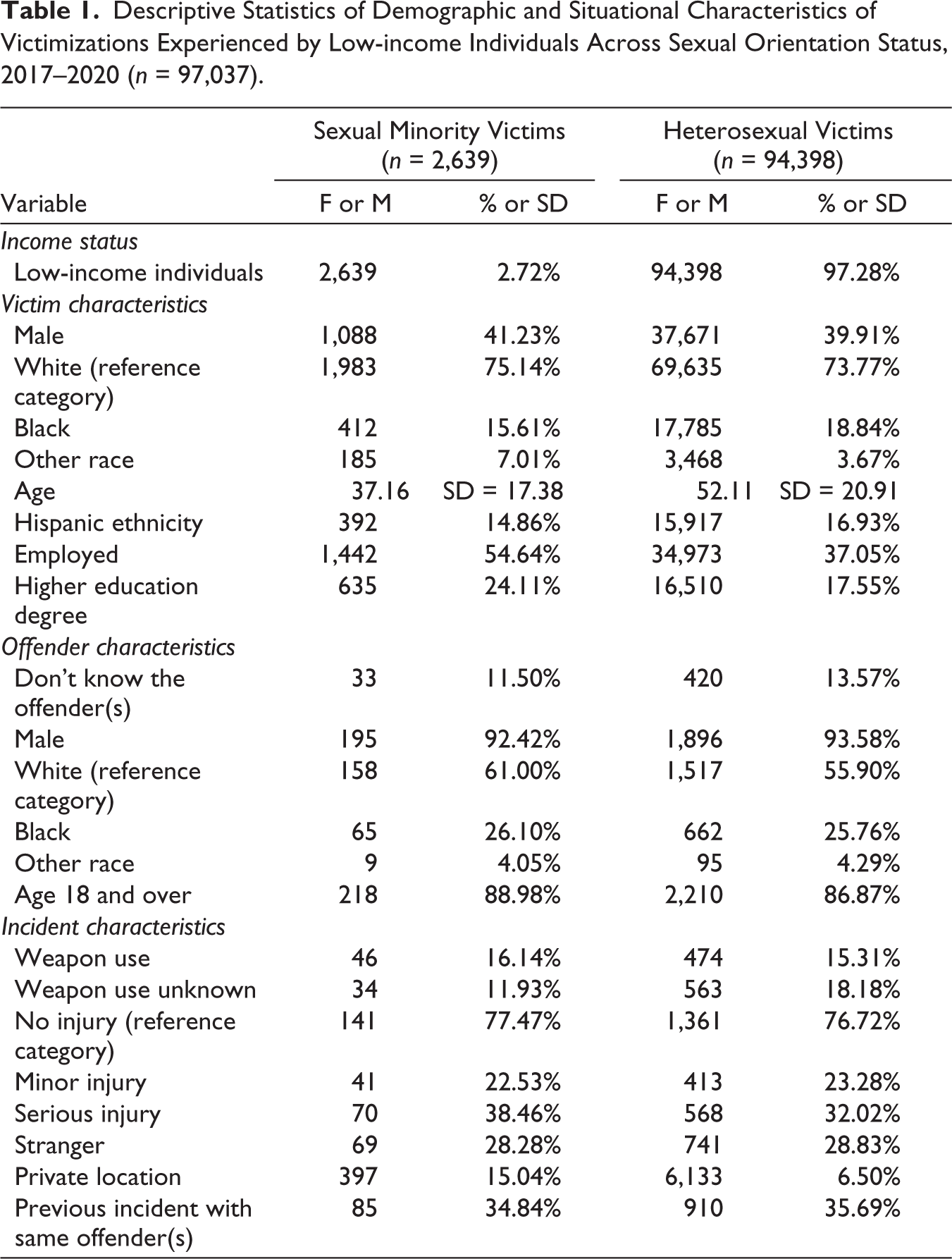
Victim demographic characteristics including sex at birth and race appear to be similar across sexual orientation status. Male victims comprised 41.23% of the sexual minority group and 39.91% of heterosexuals. Across both groups, high percentages of White victims were among sexual minorities (75.14%) as well as heterosexual individuals (73.77%). A greater percentage of sexual minorities reported being employed (54.64%) as compared to heterosexual victims (37.05%). Reports of similarly high percentages of victimizations involving male and White offenders were shown among sexual minority victims (92.42% male offenders; 61.00% White offenders) and among heterosexual victims (93.58% male offenders; 55.90% White offenders). While relatively small percentages of weapon use were reported during victimization incidents among sexual minorities and heterosexuals (16.14% and 15.31%, respectively), sexual minorities reported higher levels of serious injury (38.46%) as compared to heterosexual victims (32.02%). More violent victimizations among sexual minorities occurred in a private location (15.04%) relative to heterosexuals (6.50%).
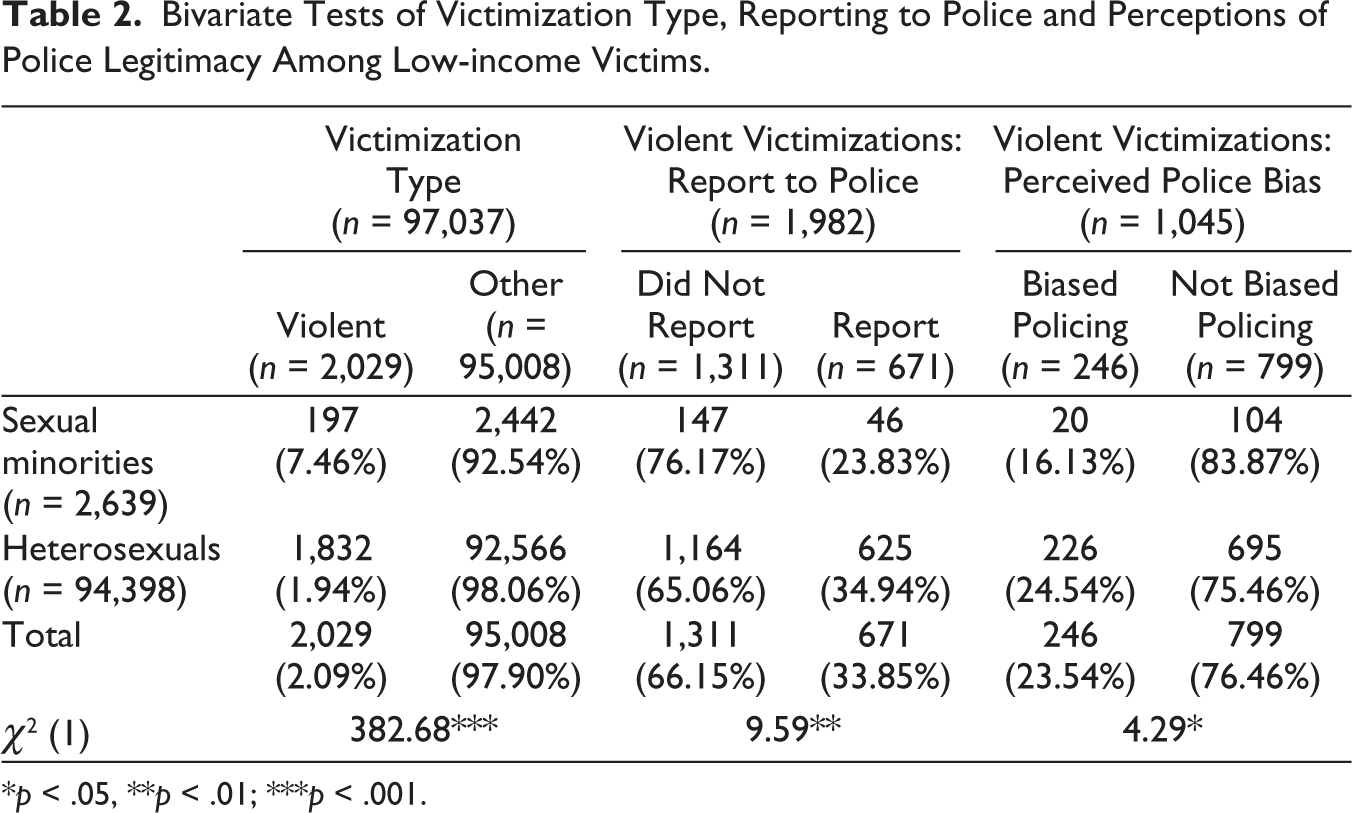
Table 2 presents the distributions of sexual orientation status with each of the outcome measures. Overall, both groups experienced smaller percentages of non-lethal forms of violent victimizations as compared to other types of victimization. However, a greater share of sexual minorities [n = 197 (7.46%)] reported experiencing violent victimizations over heterosexual individuals [n = 1,832 (1.94%)]. In turn, a greater percentage of heterosexual persons (98.06%) reported experiencing other forms of victimization, which included various forms of property victimizations, in comparison to sexual minorities (92.54%). About a third of heterosexual respondents (34.94%) reported the violent victimization to law enforcement, while fewer in the sexual minority group 23.83% sought assistance from law enforcement. Among those who did not report the violent victimization, the reasons for not contacting were due to perceptions of the police as biased or that the police would not view the victimization as important. These perceptions of biased policing were lower among victims in the sexual minority group (16.13%) relative to heterosexual victims (24.54%).
Bivariate Tests of Victimization Type, Reporting to Police and Perceptions of Police Legitimacy Among Low-income Victims.
*p < .05, **p < .01; ***p < .001.
Bivariate analyses point to important relationships between sexual orientation status and each of the outcome measures. This includes the occurrence of violent victimizations, χ 4 = 382.68, p <.001, reporting the violent incident to law enforcement, χ 4 = 9.59, p <.01, and victim perceptions of biased policing as a reason for non-reporting, χ 4 = 4.29, p <.05.
Experience of Violent Victimization
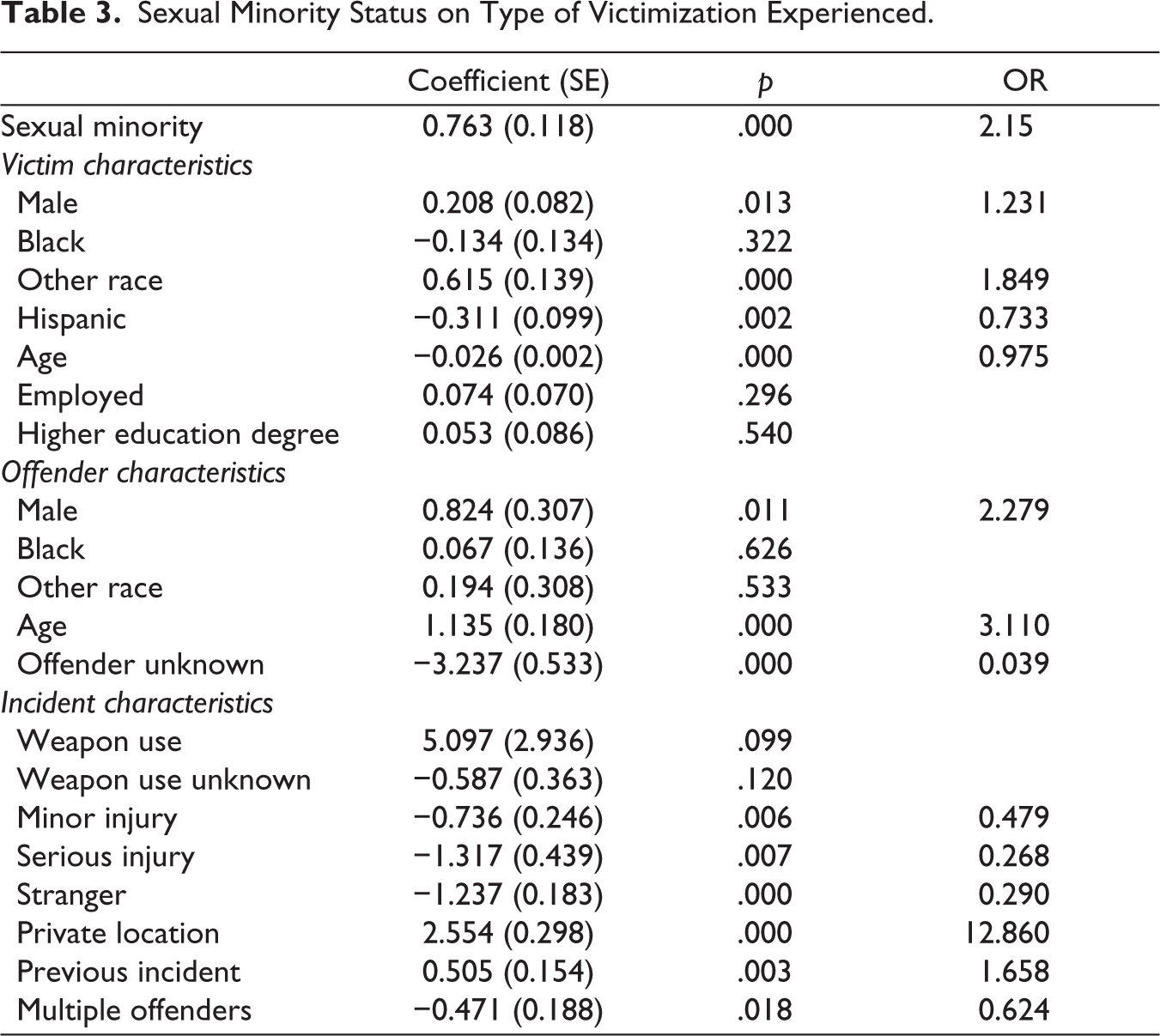
As shown in Table 3, after controlling for demographic and incident characteristics, the experience of violent victimizations was significant among sexual minorities (OR = 2.15). Important characteristics of the incident also significantly predicted violent victimizations which include a male offender and an offender over the age of 18. Victimizations that occurred in a private location emerged as the strongest predictor of a victimization involving violence.
Sexual Minority Status on Type of Victimization Experienced.
Reporting the Violent Victimization to the Police
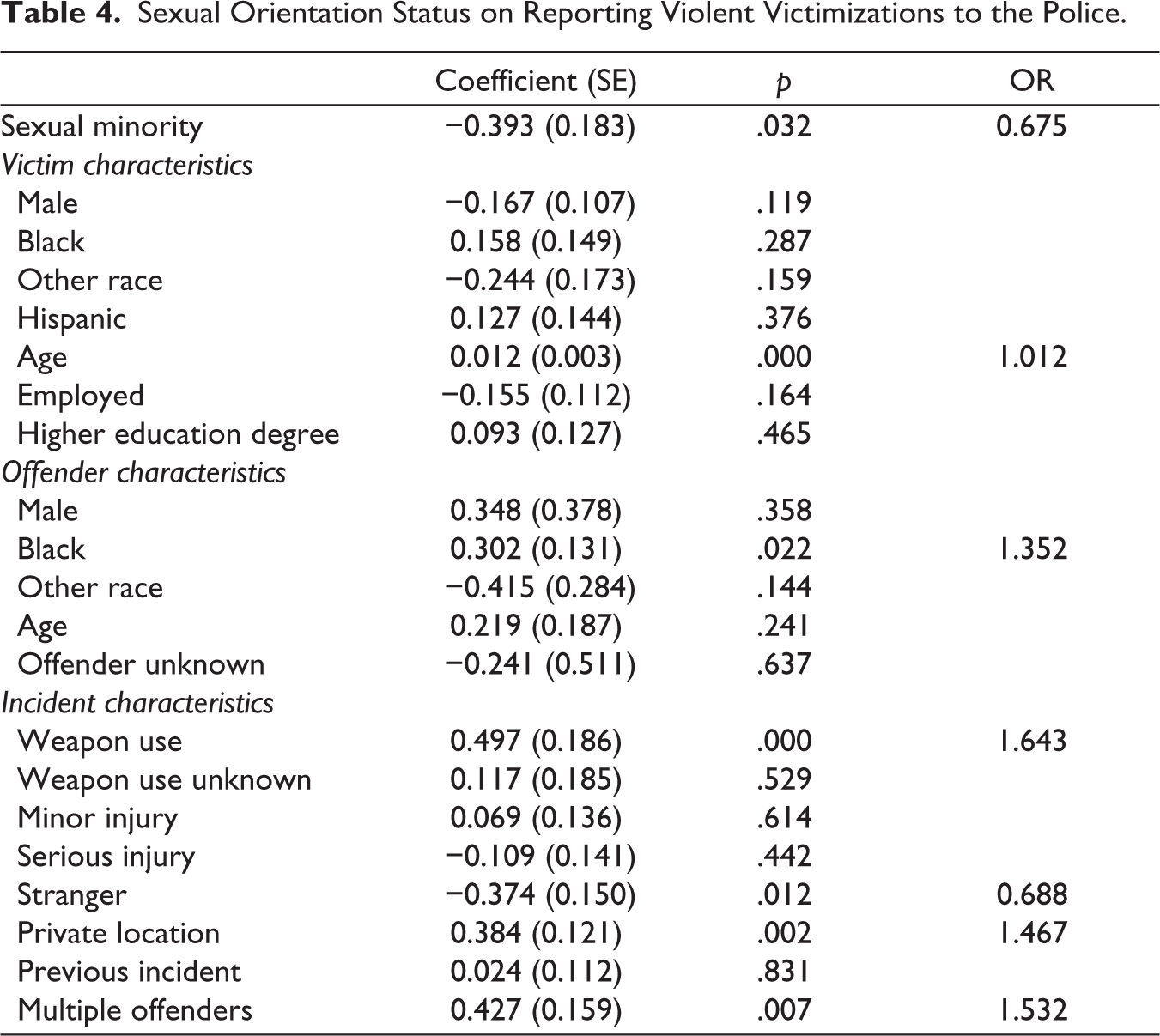
As highlighted in Table 4, the relationship between sexual minority status and reporting the violent incident to police is significant and inverse. Thus, sexual minority status is associated with decreased odds in reporting the violent victimization to the police (OR = 0.675). Stated alternately, the odds of reporting a violent victimization to the police was 32.5% less among sexual minorities in comparison to heterosexuals. Other significant predictors of reporting to law enforcement include situational characteristics such as weapon use, the incident occurring in a private location and if multiple offenders were involved.
Sexual Orientation Status on Reporting Violent Victimizations to the Police.
Victim Perceptions of Biased Policing
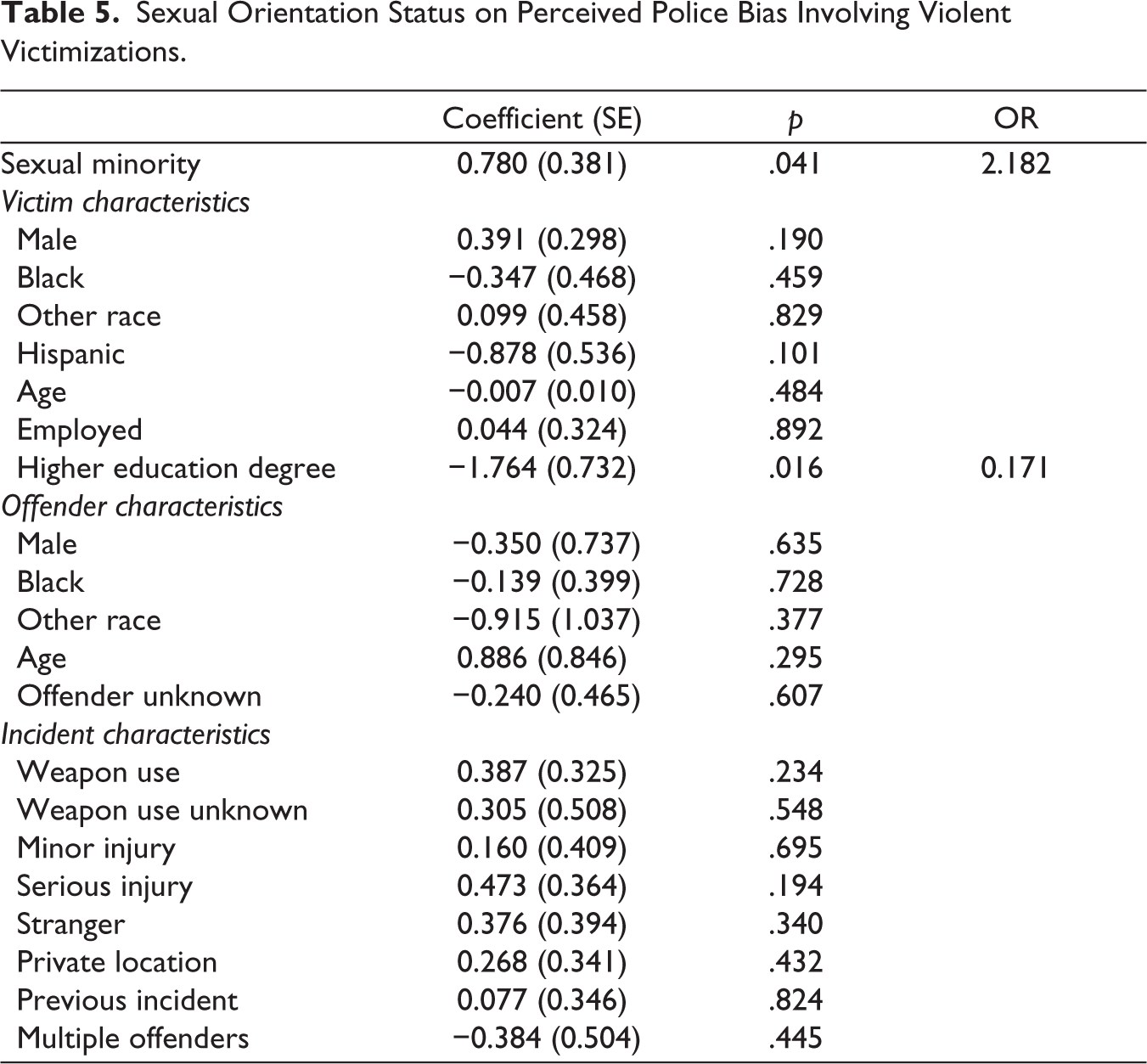
As displayed in Table 5, sexual minority status is significantly related to perceptions of biased policing among victims who did not report (OR = 2.182). The only other characteristic that is significant but inversely related to perceived police bias as a reason for non-reporting is whether the victim has a higher education degree. For those with a higher education degree, the odds of perceiving the police as biased are reduced overwhelmingly by 99.8% as compared to those without a higher education degree.
Sexual Orientation Status on Perceived Police Bias Involving Violent Victimizations.
Discussion
The current study aimed to examine the impact of sexual orientation among lower-income individuals on the experience of non-lethal violent victimizations, on the likelihood of reporting violent victimization to the police, and whether the reason for non-reporting to police is due to perceptions of police biases. Consistent with previous studies, 67 sexual minority individuals were more likely to experience violent victimization as compared to their heterosexual counterparts. This finding provides support for the additive impact of multiple minority statuses (i.e., identifying as SOGI and living in disadvantaged socio-economic circumstances) on the likelihood of experiencing negative life events such as violent victimization.
Findings from the current study provide partial support for the cumulative effects of multiple minority statuses on increased vulnerability to negative outcomes. While an MST framework 68 would suggest that identifying as a sexual and/or racial/ethnic minority would contribute to experiencing social stress, findings are only partially supportive. Although identifying as a sexual minority predicted the experience of violent victimization, identifying as Hispanic reduced this likelihood. Additional research is needed to clarify the impact of multiple minority stressors to include the impact of ethnicity.
Among the incident predictors, a private location emerged as the strongest indicator. It would be reasonable that several cases that involve incidents of sexual assault or assault could be classified as intimate-partner violence. Such cases are likely to occur in private locations, which would account for the high odds ratio associated with this characteristic. Additional research is needed to untangle the impact of SOGI on domestic-related victimization. 69
The current study also found that SOGI individuals were significantly less likely to report violent victimization to law enforcement in comparison to heterosexuals, which underscores important differences. However, the reasons why victims choose not to report are key to informing policy and practice. Identifying as belonging to multiple marginalized groups contributed to negative views of the police as biased, which could prevent victims of violent crimes from reporting the incident and gaining access to victims’ services.
While the current study provides contributions to the body of literature on victimization experiences, some limitations should be highlighted. The high degree of missingness associated with offender characteristics should be acknowledged. Although the method of multiple imputation was utilized to address this issue, 70 there is still potential for skewed results. An important avenue for future research pertains to the replication of the current study with a broader sample of SOGI individuals. The sample of SOGI individuals used in the current study did not allow for a breakdown by categories of sexual orientation or gender identity, such as lesbian, gay, bisexual or transgendered. Future research should aim to assess potential differences in the experiences of violent victimization and subsequent reporting to law enforcement across different categorizations of identity.
Footnotes
Declaration of Conflicting Interests
The authors declared no potential conflicts of interest with respect to the research, authorship and/or publication of this article.
Funding
The authors received no financial support for the research, authorship and/or publication of this article.