




Abstract
While research on intoxication and violence has been prolific, including research on sexual violence, little of the existing work has examined sexual victimization among sexual and gender minorities (SGM), especially in drinking settings where violence and aggression may be commonplace. Using data from interviews with 200 SGM young adults in the San Francisco Bay Area, we examine SGM young adults’ narratives of sexual victimization within drinking settings, exploring their discussions of objectifying gendered and sexual(ized) encounters and focusing specifically on the respondents’ experiences of cisgender men’s stranger intrusions, and the strategies they adopt in managing and coping with such intrusions.
Recent societal and media developments, such as the popularity of the #MeToo movement, have brought increased attention to issues of sexual violence (SV) at the interpersonal level (Burns & Sinko, 2023), defined here as experiences of sexual assault and sexual harassment, where the former involves coerced sexual activity and the latter refers to unwanted behaviors of a sexual nature that offend, degrade, or humiliate (Ussher et al., 2022). The existing literature on SV has tended to focus either on rape in different settings, including nightlife venues, or on sexual harassment primarily in the workplace (Kavanaugh, 2013; Uggen et al., 2021). However, a smaller critical alcohol literature has highlighted the extent of sexual harassment, gender-based micro-aggressions, and victimization among young adults in bars, clubs, and other public drinking settings (Fileborn, 2016; Graham et al., 2017). The resulting data suggests that the general public frequently trivialize or even normalize offenses perpetrated by or against intoxicated persons (Kavanaugh, 2013), as do victims themselves, who also tend to minimize the responsibility of offenders who had been drinking (Weiss, 2009), often due to an assumption that alcohol consumption was a mitigating factor. Within public drinking settings, victims of violence are also less inclined to conceptualize violence against them as a crime (Brennan, 2016), which can serve to further trivialize or excuse such incidences. In general, people often attribute greater responsibility to women, who are expected to avoid drinking to avoid sexual victimization, while allowing more room for alcohol consumption as an excuse of men’s violence (Fileborn, 2016; Graham et al., 2014, 2017; Graham & Wells, 2003; Kavanaugh, 2013). Cultural views of perpetrators’ motivations may vary, such that they are believed to either drink alcohol to diminish their own responsibility or to stay sober to maintain control over an intoxicated victim (Fileborn, 2016; Kavanaugh, 2013). Moreover, venue norms relating to alcohol consumption (e.g., drink specials, sex and alcohol-themed events, tolerance of intoxication) may further facilitate SV (Fileborn, 2016; Kavanaugh, 2013; Khan et al., 2020).
With the exception of a small but growing critical alcohol literature primarily on the experiences of bisexual, lesbian, and queer women (e.g., Fileborn, 2014; Nicholls, 2017), a majority of the existing sociological research on SV in bars and clubs has focused its attention on the experiences of heterosexual and cisgender women and has tended to exclude sexual and gender minorities (SGM). 1 This heteronormative approach has prevailed even though these minority populations are subjected to equal, if not greater, rates of violence and sexual victimization than cisgender heterosexual women (Chen et al., 2020). For example, a recent US national survey found higher lifetime prevalence of both contact SV 2 and public sexual harassment among adult bisexual (79.3% and 58.1%, respectively) and lesbian (59.9% and 42.9%, respectively) women than heterosexual women (53.3% and 29.0%, respectively) (Chen et al., 2023). In another US survey, nearly half (47%) of transgender and nonbinary respondents reported lifetime sexual assault (James et al., 2016), and while 48% of California adults overall reported lifetime experiences of SV, the figures are higher for women (65%) and much higher for nonbinary respondents (87%) (Raj et al., 2023).
To date, SV among SGM young adults, and gender minorities in particular, within bars and clubs has rarely been explored, despite elevated rates of sexual victimization among these groups and the important role of gay and queer bars as valued ‘safe spaces’ within LGBTQ + culture (Buckland, 2002; Fileborn, 2014; Hubbard, 2005). Thus, there is a need for additional research to consider the extent to which these populations experience SV within drinking settings and the ways in which alcohol and gendered drinking practices and behaviors contribute to this violence. In focusing on SGM young adults’ narratives of experiences of SV within drinking settings, the aim within this paper is not merely to extend the scope of SGM-inclusive research on SV, but also to highlight the importance of examining a broad spectrum of forms of SV that may contribute to, but not consistently be recognized as, criminal offenses. More specifically, using data from qualitative interviews, we examine SGM young adults’ narratives of sexual victimization within drinking settings, exploring in detail their discussions of objectifying gendered and sexual(ized) encounters. We focus on participants’ discussions of cisgender men’s performances of normative masculinity or ‘manhood acts’ (Schrock & Schwalbe, 2009), and notions of ‘masculine entitlement,’ analyzing how participants manage men’s stranger intrusions (defined below) (Vera-Gray, 2016) in nightlife settings and the safety strategies they adopt in doing so. However, prior to discussing in detail these issues, we will first briefly explore recent developments in how to best conceptualize certain forms of gendered and sexual violence that will be adopted within our analysis.
Recent Research on Sexual Violence and Gendered Intrusions in (Semi-) Public Settings
Recently, critical researchers have argued that Criminology has operated a narrow definition of SV, emphasizing legal categories such as rape and downplaying incidences of sexual harassment, often labeled as “non-classifying” or “non-serious” incidences (Fileborn & O’Neill, 2021; Uggen et al., 2021; Vera-Gray & Fileborn, 2018). This is in spite of the fact that sexual harassment victimization is common (Smith et al., 2022; and see above). According to a review of research on SV specifically in nightlife, prevalence rates vary between 10% and 50% and a few studies also identified higher rates of victimization among women and higher rates of perpetration among men (Quigg et al., 2020). The scope of SV covered in the review ranged from forced kissing and unwanted sexual touching to rape (Quigg et al., 2020), mirroring the partial overlap and definitional difficulties involved in measuring sexual harassment and violence.
In general, harassment refers to unwanted contact or pressure that is an expression of disrespect and is aggressive, intimidating, and/or persistent, including but not limited to behaviors such as verbal abuse, threats, and stalking (Mennicke et al., 2022). Harassment can take a variety of forms and have many different motivations, though our focus for this analysis is harassment related to sexuality (i.e., harassment that is sexual in nature and/or directed at a person’s sexuality, which often overlaps significantly with gendered harassment) in public or semi-public settings. Within the published criminology literature, the development of a hierarchy of SV and consequently a trivialization of everyday sexual harassment has been reflected both in the apparent lack of attention to issues of sexual harassment (Uggen et al., 2021), as well as the downplaying of sexual harassment as a legitimate area of study (Vera-Gray & Fileborn, 2018), both of which stand in contrast to research on lived experiences of SV (Fileborn & O’Neill, 2021; Kelly, 1987; Vera-Gray & Fileborn, 2018). Moreover, researchers have been somewhat cautious as to the usefulness of the specific term ‘sexual harassment’ in examining a seemingly wide range of harmful, disruptive gendered behaviors in different settings (Fileborn & O’Neill, 2021; Uggen et al., 2021; Vera-Grey, 2016). Difficulties are related to the fact that lived experiences do not fit neatly into categories such as harassment or assault (Armstrong et al., 2018; Kelly, 1987); many forms of harassment may not be overtly sexualized (Fileborn & O’Neill, 2021); and, as discussed, some forms of harassment in some settings may be normalized, and hence not reported or labeled sexual harassment (Armstrong et al., 2018; Brennan, 2016; Uggen et al., 2021). To better capture the gendered power dynamics involved in many forms of sexual harassment and highlight the fact that not all forms of sexual harassment are overtly sexualized, scholars have therefore introduced alternative umbrella concepts.
While currently there is no conceptual agreement in the literature, ‘street harassment’ has gained in popularity as an umbrella term that includes sexual and gendered harassment in public or semi-public places (Fileborn & O’Neill, 2021). According to Fileborn and O’Neill (2021), typical actions of this kind include catcalling, horn honking, staring/leering, following someone, unwanted conversation, sexualized gestures, unwanted touching, and more. Being exposed to such forms of harassment is common among women, SGM groups and other marginalized communities, with rates varying across countries and studies (Fileborn & O’Neill, 2021). Another alternative term, focusing explicitly on the gender of the perpetrator, is ‘men’s stranger intrusions’, where intrusion refers to a “deliberate act of putting oneself into a place or situation where one is uninvited” (Vera-Gray, 2016, p. 15) with the consequence of being disruptive. The key benefits that can accrue by using such terminology include foregrounding the actions of the perpetrator; coming closer to the victimization experience as it is lived; and better capturing the empirical reality where harassment in public spaces is frequently carried out by unknown men, a characteristic also noted by other feminist researchers (Hindes & Fileborn, 2023; Hutson & Krueger, 2019) and seen in our own research on young adults’ experiences of parties and nightlife (Bogren et al., 2023; Hunt et al., 2022; Petersen, Bogren, & Hunt, 2023). Although this term also has its limitations, such as excluding intrusions by people of other genders or non-strangers, and diverging from dominant legal definitions of SV, its ability to encompass a breadth of experiences ranging from gendered spatial domination, to verbal micro-aggressions, to unwanted sexual attention and contact make it particularly useful in conceptualizing the various (and often intertwined) forms of gendered SV participants experienced in drinking contexts.
The predominant theories of SV have primarily highlighted the role of patriarchy, particularly in structuring male peer support, hegemonic masculinity, hypermasculinity, and aggrieved entitlement (Fileborn & O’Neill, 2021; Kalish & Kimmel, 2010; Morris & Ratajczak, 2019). These theories see SV as a structural expression of cis masculine privilege, which reproduces systems of gender inequality. Research on hegemonic masculinity, hypermasculinity, and aggrieved entitlement is focused on the extent to which acts of SV are part of hegemonic, complicit or exaggerated ‘subtypes’ of masculinity performed in specific communities or settings (e.g., sports, the military) or, alternatively, how SV may be used as a resource to reclaim a masculinity that has been threatened (Kalish & Kimmel, 2010; Morris & Ratajczak, 2019). Male peer support theory, in turn, is focused on the relations between men and suggests that some all-male peer groups support gender violence, highlighting the role of additional factors such as membership in college fraternities and the culture and heavy alcohol consumption that are often central in such fraternities (DeKeseredy & Schwartz, 1993; Morris & Ratajczak, 2019).
Although gender has tended to be under-prioritized as a conceptual framework within research on alcohol-related violence (Moore et al., 2021), a growing body of studies shows that displays of hypermasculinity, involving sexual assertiveness and aggression, are frequent and normative in drinking and party settings outside college as well (Krebs et al., 2009; Mohler-Kuo et al., 2004; Weiss & Dilks, 2016). To examine the ways in which such performances affect the experiences of SGM young adults in public drinking settings, it is necessary to explore further the ways in which manhood acts are relational actions that “are aimed at claiming privilege, eliciting deference, and resisting exploitation” (Schrock & Schwalbe, 2009, p. 281), rather than identifying ‘subtypes’ of masculinity performed by specific groups of men. ‘Manhood acts’ are, in this sense, similar to what other scholars have termed entitlement (e.g., Kalish & Kimmel, 2010; Scaptura & Boyle, 2020) and may be enacted by individuals with different bodies, not only those assigned as male. However, Schrock and Schwalbe (2009) note that a male body – or, we would add, a body that others categorize as male – is a symbolic asset upon which special privileges and dominant positionalities are generally conferred in patriarchal societies.
Drawing from intersectionality theory, scholars have argued that violence directed at SGM individuals, including SV, can also be a combined expression of other systems of power that intersect patriarchy and traditional sexism, such as heterosexism, cissexism, racism, classism, and ableism (Fileborn & O’Neill, 2021; Hindes & Fileborn, 2023). For example, genderbashing, a concept that defines acts of SV as attempts to police gender boundaries in public settings, has been used to explain violence against gender minorities (Hill, 2003; Namaste, 1996). Research adopting an intersectional approach also suggests that transgender and non-binary people are more vulnerable to (cis-) men’s acts of SV and have less access to institutional means of enforcing their rights (Loick, 2019) and that people with multiply marginalized identities are more likely to be subjected to harassment related to perceived transgressions of White masculine norms (Baptist & Coburn, 2019).
In managing SV in public places, women and SGM people engage in ‘safety work’ (Boyer, 2022; Jauk, 2013; Kavanaugh, 2013; Vera-Gray & Kelly, 2020). Research has identified a wide range of safety strategies, from risk reducing acts such as restricting one’s movement by limiting where one goes, going out in groups, being ‘on guard’ while in public, and changing one’s gender presentation from feminine to masculine, to strategies used to situationally manage intrusions, such as staged compliance, acting or answering back, and official and informal complaints (Boyer, 2022; Jauk, 2013; Vera-Gray & Kelly, 2020). While fewer studies have examined safety work in relation to alcohol, the existing critical alcohol literature indicates that some women modify their drinking by having a drink limit while clubbing, guarding their drinks, and avoid accepting a drink from a man they don’t know (Kavanaugh, 2013; Nicholls, 2015). Moreover, Nicholls’ (2017) study suggests that sexual minority women face something of a double bind in nightlife settings. She found that risk management for queer women was tied to performances of normative heterosexual femininity, in the sense that individuals who adopt visible markers of this type of femininity felt that the risk of experiencing homophobic harassment was mitigated, while the risk of experiencing heterosexualized harassment increased (Nicholls, 2017). Similarly, a study by Fileborn (2014) shows that the presence of (large) groups of heterosexual men at licensed venues, including venues hosting LGBTQ + themed nights, prompted constant watchfulness and hyper-vigilance among lesbian, queer, and bisexual women.
While a large literature on the relationship between heavy alcohol use and SV is focused on risk factors, such as the greater risk of experiencing (for women) and perpetrating (for men) SV that is associated with drinking more often, spending time at bars, or participating in college parties (e.g., Krebs et al., 2009; Mohler-Kuo et al., 2004; Weiss & Dilks, 2016), significantly fewer studies have examined how objectifying gendered and sexual(ized) encounters in nightlife settings are experienced and managed across different culturally-grounded contexts. We build on the existing critical alcohol literature in discussing some of the ways that enactments of ‘manhood’ in nightlife also influence SGM young adults, who structured their drinking practices away from these performances to minimize potential victimization experiences.
Methods and Sample
Sample Characteristics.
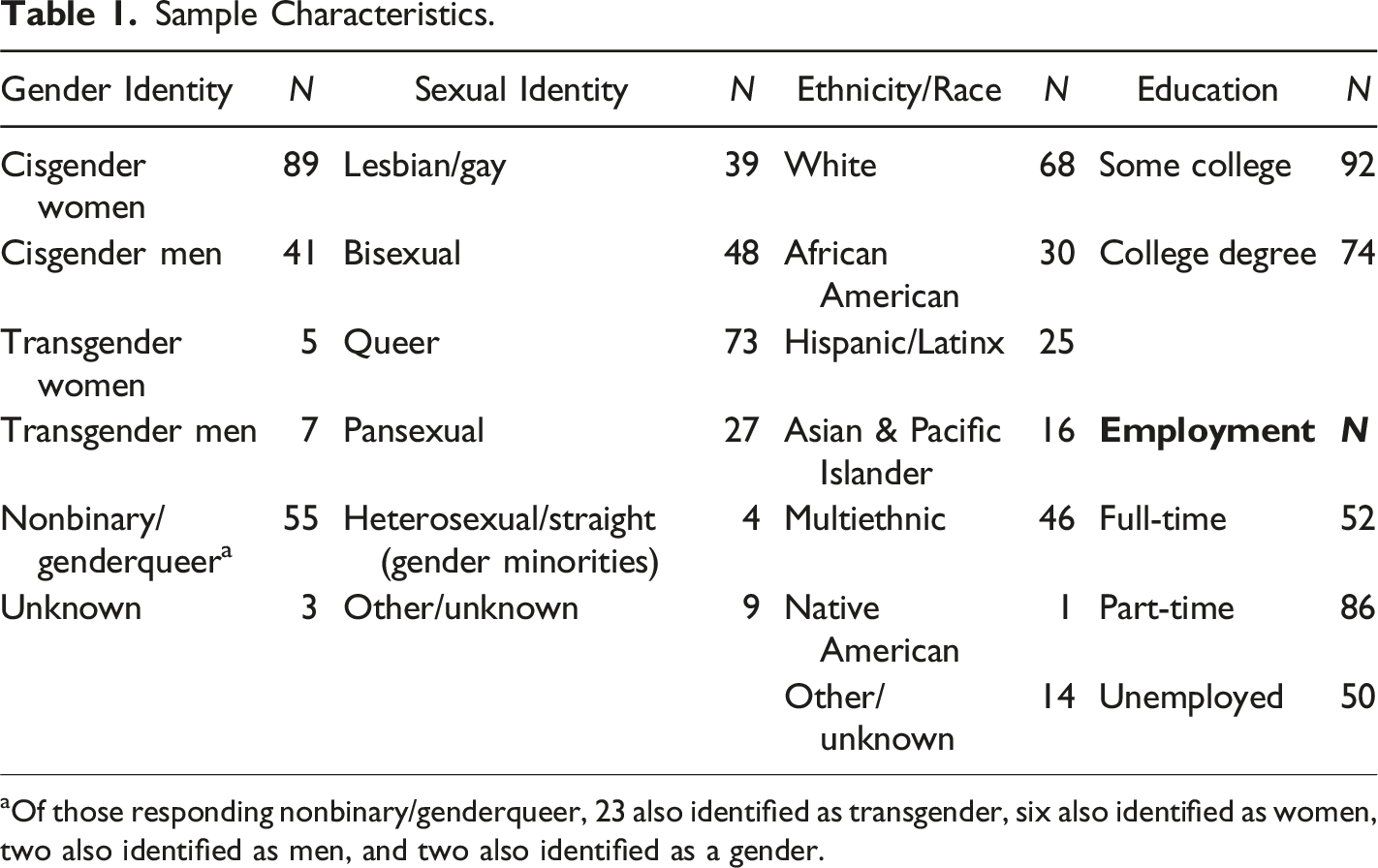
aOf those responding nonbinary/genderqueer, 23 also identified as transgender, six also identified as women, two also identified as men, and two also identified as a gender.
Participants were recruited through online advertisements on social media sites (e.g., Craigslist); flyers at local establishments (e.g., bars, cafes, and community-based organizations); and chain referral techniques. Volunteers were screened for eligibility and if eligible, scheduled for an in-person interview at a location of their choice. Eligibility criteria included being 18–26 years old, ability to meet in-person in the Bay Area, and self-identifying as any sexual or gender identities other than both heterosexual/straight and cisgender. Four interviewers conducted one-on-one, semi-structured, participant-centered interviews in person at our offices and occasionally in parks, low-traffic cafes, or the participant’s home or vehicle. The interview centered around a series of open-ended questions about the participants’ backgrounds, identities, and everyday lives, drinking practices, experiences and drinking outcomes. Interviews averaged 2–3 hours, were audio recorded, and participants received a $50 cash honorarium. Interviewers reviewed transcripts for accuracy and removed personally-identifying information.
Using qualitative analysis software ATLAS.ti, six team members coded all transcripts to capture and organize analytically meaningful segments of the interview content. We developed the extensive codebook to include deductive codes informed by extant literature related to study aims and inductive codes grounded in themes identified in interview notes recorded throughout the course of data collection. The research team met regularly to discuss coders’ impressions of the data, reduce discrepancies in coding decisions, and promote inter-coder consistency.
Interviewers noted throughout the course of data collection that gendered experiences of SV, though not an explicit focus of the study, were a prominent part of participants’ narratives about drinking. This preliminary finding guided our decision to pursue the present analysis. Codes queried to explore such narratives included ‘femininity,’ ‘masculinity,’ ‘sexual identity,’ ‘sexual behavior,’ ‘social context of use,’ ‘intoxication,’ and ‘violence’. To inductively identify patterns across participants’ narratives and group patterns into higher order thematic categories, we drew on LeCompte and Schensul’s (2013) pattern-level and constitutive analytical steps. We reviewed all data captured within these overlapping codes to identify patterns across the narratives and organized these patterns into higher-order thematic categories informed by relevant sociological literature. Finally, the authors iteratively refined these interpretive categories into the interrelated themes that organize the presentation of our findings.
Findings
The Ubiquity of Gendered Privilege: Entitlement, Intoxicated Masculinity and Spaces of Action
We identified entitlement as an important theme in the narratives, especially when participants were asked to describe their perceptions of masculinity, as exemplified in this quote from Ali, a 24-year-old Latinx genderqueer queer person, who identifies as much more feminine than masculine
3
: [Masculine] would mean… some type of entitlement. I think of people just being born in a world that never asks them to question or think about things […like] their entitlement, or their right to take up space, or to do something to another body. … I think of how I’m treated when I look more masculine, and how things are just easier. (078)
Like Ali, participants regularly invoked, either explicitly or implicitly, the notion of entitlement when describing masculinity, and cisgender men in particular. They constructed these men’s behaviors in drinking settings as involving particularly problematic intrusions upon other people. For instance, Freddie, a 24-year-old White, queer genderqueer person, perceived that: Cis men [are] especially not cool in bar spaces… people who have that social experience tend to be a little less aware of surroundings or interactions generally, and tend to command spaces and disregard the well-being of other people a lot. And so, [with alcohol] I just see like, the mix of even another layer - it’s like, cis men are just like already at that level of like, [dis]inhibition… and so, it’s peeling off another layer… no boundaries there. (026)
Freddie’s quote illustrates how intrusions, for many participants, signify a failure on behalf of cis men to fully acknowledge the equal worth of other people in a shared social space. Rather than creating the problematic behaviors they observe in bar spaces with cis men, Freddie views alcohol as exacerbating a sense of entitlement that they frame here as connected to a lack of boundaries.
In keeping with conceptualizations of SV as a continuum (Kavanaugh, 2013; Kelly, 1987), several participants connected entitlement and privilege to verbal and physical intrusions and displays of dominance (like Freddie, above), threats of violence (Angela, below), and physical coercion or violence (Daisy, Alice, Rachel, etc. below). Daisy, a 23-year-old White, feminine-presenting queer cisgender woman, spoke about how a range of men’s intrusions negatively impacted her despite differing in straight and queer drinking contexts: [Initially going to queer clubs I was] just really appreciating… not having straight men like leer at me. I mean maybe, a gay man would not be socially appropriate with me, but at least he wasn’t trying to kiss me, or take me home, or like won’t leave me alone, because he’s trying to get with me. So it’s different. I mean, it’s still not cool, but it’s just a different context. [… Some gay] clubs are very – I don’t know, kind of got that macho attitude, or I have had my body disrespected. … I don’t like it when, let’s say, a [gay] man is like, “Oh, you look so cute,” and then squeezes my boob. (030)
By noting that “at least” gay men’s intrusions aren’t as persistently threatening as those she endures in straight nightlife spaces, Daisy’s quotation shows how gay clubs may not necessarily be ‘safe spaces’ for queer women who are still subjected to violence (cf. Fileborn, 2014), albeit sometimes in a form positioned elsewhere along the continuum that may therefore, unfortunately, be constructed as preferable. Participants described gendered verbal and physical intrusions as sometimes non-sexualized and sometimes sexualized, an ambivalence that can be seen in Daisy’s somewhat ambiguous differentiation between the forms of and motivations behind men’s intrusions she deals with in drinking settings. Other participants also perceived cis men’s intrusions as especially threatening and unwanted when they occurred within a heterosexual(ized) dynamic or context, as in this quote from Angela, a 21-year-old lesbian-identified Chicana cisgender woman, who describes being threatened or punished with violence for saying no to men who flirted with her: The way I see it differently is, if I say no to a woman -- they’re like, “It’s okay. I get it.” But, … “let’s be friends” and it’s super cool. I can…t tell you how many times I…ve been called a slur or even, they’ve [men] tried to fight me for saying no to them… when women say something to me, it feels more like, “I’m offering this to you.” Whereas, if men say it, it feels like, “You owe this to me.” (082)
In discussing the relative ease with which her boundaries are respected by women versus men, Angela’s quote suggests how reduced entitlement may contribute to safer rejection dynamics. In Angela’s experience, challenging a man’s sense of entitlement by refusing his attentions can be met with hostility that can escalate into violence, a point noted by many researchers (Armstrong et al., 2018; Hlavka, 2014). Also, Angela makes a distinction between offering, which she sees as something women do in flirting or contacting her, and owing, which she describes as the expectation behind men’s approaches. Her comment highlights how, for many participants, gendered displays of dominance are involved in verbal interactions, and how ‘manhood acts’ in flirting situations may rely on entitlement rather than on a logic of invitation. In this context, scholars have suggested that one of the reasons why some cisgender heterosexual men respond defensively or angrily to sexual rejections is that rejections may threaten ‘manhood’ (Schrock & Schwalbe, 2009) and the hegemony of masculinity.
Overall, participants’ examples of entitled intrusions ranged from more subtle, everyday behaviors, such as imposing on others’ time, attention, or space, to objectification of others’ – especially feminine presenting – bodies, groping, expectations of sex and sexual gratification, and forced sex. In general, the data included only a few mentions of people being victimized by non-men. While also involving objectification, violation, and unequal power dynamics (e.g., due to age), these were less often about stranger intrusions than dynamics in existing relationships, were framed as outliers rather than ubiquitous, and were not discussed as especially related to drinking experiences or settings.
Furthermore, all participants did not experience victimization and potential victimization equally. Participants who identify as feminine or are perceived as women described how they were particularly wary of certain performances of normative masculinity and especially those involving alcohol. For instance, Ari, a 25-year-old mixed race Black, pansexual, genderqueer woman, described how she avoided intoxicated men out of fear for her safety: I don’t like drinking around men in general…. I’ve had a lot of … sexual aggression from men. I've had instances of guys trying to put their hands up my skirt or grab me. I’s – it’s a safety issue for me. Even as a child, I’ve been around guys that were intoxicated a lot and would attempt … to do more than they needed to in order to show that they were attracted to me …. I just feel uncomfortable if I’m around any guy at this point that’s over-intoxicated. (016)
For Ari and other participants, persistent experiences of SV from men who had been drinking has resulted in constant watchfulness around intoxicated men. In this sense, several participants noted that intoxication could further encourage entitled behaviors and potentially make the situation even more dangerous. For example, Alice, a 25-year-old White, cisgender queer woman explained her perception that, “a lot of men already feel like they deserve whatever they would like, but when you kind of take away a lot of rational thinking, and slight tendency to think before you act, I think that is really dangerous.” (112). Other examples included X, a 21-year-old Latinx queer, agender participant, described how “most of what I have seen is just the exacerbation of gender tensions and gender expectations that exist elsewhere, that are made much more clear, present, or violent by alcohol” (115) and Zeb, a 24-year-old White, queer, genderqueer trans person, said that while they see entitlement to space as an aspect of performing heteronormative masculinity, this combination becomes exacerbated when intoxication is involved. In general, Zeb and X are suggesting that drinking and becoming intoxicated enlarges the space of action (physically, mentally, interpersonally) of masculine-presenting individuals. At the same time, drinking in hetero-masculine spaces introduces an extra level of caution among SGM young adults, which in turn restricts their own space of action (cf. Vera-Gray & Kelly, 2020). This may be interpreted as a socio-relational effect of intoxication: intoxication potentially expands the possibilities for some cisgender men or masculine-presenting individuals, while limiting the options for heterosexual women (Bogren et al., 2023; Hunt et al., 2022) and feminine-presenting young adults.
We identified three types of socio-relational effects of intoxication, which all contributed to restricting participants’ space of action. First, participants felt that others use intoxication to provide mitigating explanations for men’s sexual transgressions, which is also supported by other research (Bogren et al., 2023; Graham et al., 2017). As Ari notes: I feel like men … get a pass with their sexual transgressions against women when they’re intoxicated. The idea of, ‘Oh, he’s just a kid, and he is just messing up’ … And then you have her who gets drunk, and something slipped into her drink, or just her being drunk, and she’s labeled as all these negative things; for a guy, it’s just okay. (016)
This gendered double standard Ari points out positions alcohol intoxication in ways that privilege and protect men regardless of who is intoxicated.
Second, many women and feminine-presenting participants described how they felt pressured to drink if they found themselves in the company of men, a perpetrator tactic that is sometimes described as involuntary incapacitation (Kavanaugh, 2013). Rachel, a 22-year-old White, queer, genderqueer person often perceived as a woman, compares her past experiences of drinking in the company of straight, cisgender men with experiences drinking with queer people: I don’t want to generalize… like… queer people can be abusive. But I’ve had many – a disproportionate amount of instances of being with men and being like, pushed just to drink more and put into… situations where sex could have been forced or sex was forced… Whereas I’ve noticed that when I’m with people who are queer and… not heterosexual, cis men, I tend not to feel pressured to drink.…, there’s a lot more boundary checking…. [I]t’s just… more common in my experience with – with cis men, cis, straight men… it’s like, drinking is more of a tool for them to like, make something happen. (002)
Rachel’s quote exemplifies men deliberately using alcohol to restrict women’s action repertoires through intoxication, thereby expanding their own space of action in sexual dynamics. Rachel makes a similar observation as Angela, above, in noting that boundaries (here about both drinking and sex) are more often disregarded by straight cis men than people with less privileged sexual and gender positionalities.
Third, participants also commented on the local culture of drinking settings. Many participants perceived masculine entitlement to be highly prominent in settings such as straight bars and clubs, as well as party environments dominated by men, such as fraternity parties, historically associated with displays of hypermasculinity and heteronormative behaviors (DeKeseredy & Schwartz, 1993; Leyshon, 2008; Tomsen, 1997). For example, Jessica, a 22-year-old Black, bisexual cisgender woman noted that, “a man will grope me, and think it’s okay because we’re in a club setting” (061). The importance of the culture of the drinking setting is further highlighted by Claire, a 24-year-old White queer cisgender woman, who, when asked whether she ever considered getting the bar or club staff to intervene in such encounters, explained that: That literally never crosses my mind. The thought of doing that … I kind of shudder at.... I don’t want to do that. Because…, something that I have experienced, I think a lot of women have experienced, is… being laughed at -- or… told that your experience isn’t real. So, to be like, “This person’s bothering me,” like, first of all, takes a lot of like, entitlement, which like, I don’t think I have. You know? Even though that’s not entitled, to be like, “my safety’s important.” But, you know, it’s like, [playing role of how the person bothering her might respond if she complained] “I was just being nice!… this girl’s a bitch… I was just trying to be kind, and she…” You know, like, I just feel like - I almost feel like I wouldn’t be believed unless somebody straight up like, hit me. …I don’t want to cause a scene. (005)
Claire’s quote further illustrates what many participants shared, that the culture of masculine entitlement and privilege in certain types of bars was co-produced or supported by staff. In this sense, participants felt that masculine privilege was not only about access to space and others’ bodies but also about occupying a privileged position in having one’s voice and one’s version of events not merely heard but accepted. Moreover, the quote highlights what many participants talked about, namely, having to develop strategies for handling such situations safely and finding pragmatic ways to work around these behaviors without risking escalation.
Intoxication, Femininity, and Safety Work: “Manag[ing] Yourself and All the People Around You”
While many of the participants noted the benefits of drinking, they and other SGM young adults may enjoy, including fun, camaraderie and bonding, pleasurable sensations and experiences, and an escape from the embodied, subjective, and interpersonal confines of sober reality, they felt that these benefits were too often limited by the negative consequences of men’s drinking practices, the intrusions that accompanied men’s drinking, and the risks of being intoxicated around men. Participants also felt that these negative consequences were compounded by other people’s normative views of femininity and drinking (cf. Fileborn, 2016) and by the impossible expectations linked to performing femininity in and beyond drinking settings. In coping with these limitations, they engaged in different forms of ‘safety work’ in drinking contexts (Boyer, 2022; Vera-Cruz & Kelly, 2020).
Regarding others’ normative views, Mayim, a 20-year-old nonbinary trans queer person who is masculine-presenting, described their perceptions of an existing inequality: I think men get the benefits of drinking. Or like, more masculine people … we don’t really have to deal with the consequences as much. … versus like, I think people who are being read as femme, or women, have to deal with the consequences of what men do when they’re drunk. ... Men definitely get a lot of permission to drink and not feel worried about their personal safety. [P]eople perceived as women are more targeted. And especially for trans and non-binary people, it’s more dangerous just to be around drunk people… more likely to have that ugliness come out. (051)
Adding to this sense of a double standard Mayim highlights, X, introduced above, explained that from their perspective: [F]emininity can… put undue expectations on bodies with drinking [and] the same expectations aren’t extended to masculine people and men. It is like, an expectation of femininity overall before alcohol is involved, to simultaneously… manage yourself and all the people around you, usually emotionally, and to also be a perpetual victim and be perpetually victimized. So when alcohol is brought into that… femininity and the expectations around that will often impose violence and potentials of violence on people who express or engage in feminine… appearances, with the expectations also that they should not allow anything to happen to them, and it’s their responsibility to make sure that nothing happens to them, while they’re facing a much higher magnitude of potentially-violent things that can be happening to them. (115)
X’s quote again brings up a double bind signifying impossible expectations on women and femmes, similar to that described by Renold and Ringrose (2011) as “schizoid subjectivities,” which constrained feminine subjects beyond the specific drinking setting. There were also several narratives of how performances of masculine entitlement constrained women, non-masculine men, and femmes’ experiences with intoxication. In some cases, participants not only emphasized how this led them to avoid drinking settings where straight men were drinking, but also described how they themselves avoided drinking and especially becoming intoxicated within such settings (cf. Kavanaugh, 2013). Alice, in discussing the dangerousness of intoxicated men, also described how being intoxicated herself impacted her ability to avoid or defend herself from the possibility of SV (cf. Fileborn, 2016): [E]specially as a woman, being impaired is scary, and even just getting home when you’re drunk. … I’m used to sexual harassment all the time. But when you’re drunk, it’s a little scarier, because you are slightly less in control. … it can be really dangerous. (112)
Impairment and a loss of control were viewed as potentially dangerous because they could undermine Alice’s personal safety and ability to engage in safety work. This worry about safety was particularly pertinent for many women and feminine-presenting participants because men could not only take advantage of their being intoxicated, but also because they felt that the very fact of being intoxicated could provide a signal to men that they were vulnerable and potential targets for sexual victimization. In this way, participants perceived that some men used alcohol strategically to enhance their action repertoires, while their own space of action was being eroded.
In their attempts to deal with what they perceived as such perpetrator tactics, participants adopted diverse interactional tactics of protection where the most common were to engage in different types of risk-reducing avoidance (avoiding intoxication, certain settings - especially those where straight men were drinking - or types of people) and in (hyper)-vigilance. Maria, a 21-year-old White bisexual woman who, like many other participants, had survived multiple sexual assaults both within and outside of drinking settings, described the potential dangers: I have to be more careful. I feel already, in social situations not necessarily that I have less control, but there’s kind of more things that I have to watch out for…. [B]eing a woman, that’s [referring to rape] one of the things you have to watch out for, more than being a male…. I try to be much more aware of each situation because there are all these extra things I have to look out for …[and] I’ve experienced what happens when I don’t look out for them and I’m not super diligent on protecting myself from that…. So, that kind of means I shouldn’t necessarily drink as much in situations…. watching my alcohol intake is kind of - I don’t want to say more important than a male watching his alcohol intake, but it’s more dangerous for me to have less control. (014)
Most participants perceived that impairment from alcohol intoxication could be dangerous, making them more vulnerable to harm as a result of compromised motor skills and changes in their sense of what was happening around them (cf. Fileborn, 2016). Importantly, however, Alice and Maria are not talking about this loss of control as inherently dangerous in and of itself, but rather, they describe how impairment from alcohol intoxication is framed as ‘more dangerous’ for them specifically because of the likelihood of SV within heteronormative social power dynamics.
Moreover, the vulnerability many participants felt was connected to others, especially men, categorized and positioned them with regard to gender, sexuality, and state of intoxication. Rachel, introduced above, explained: If I’m drunk in public, I’m going to be read as a drunk girl…. I’m vulnerable in that way…’cause sometimes, drunk girls are like candy for men to pick up…. They immediately become like public domain… being a drunk queer girl makes you a spectacle … your sexuality becomes a performance for men to enjoy. [In public] if I’m kissing a girl, some guy might be like… That’s for me. (002)
Cis straight men’s objectification of queer women’s sexuality was something many participants, especially femme lesbians and bisexual women, discussed encountering throughout their lives, and a pattern that has been noted in other studies (Fileborn, 2014). Here we see one way this specific experience of queer women’s objectification intersects with the aforementioned notion that intoxicated women are particularly targeted as objects of men’s sexual entitlement, intrusions, and violence. For example, Rachel (above) describes being assigned a gender category (‘I’m going to be read as a drunk girl’) and sexual identity (‘a drunk, queer girl’), as well as being assigned more specific, objectified positions when being drunk (‘a spectacle’; ‘your sexuality becomes a performance for men to enjoy’). Similarly, Sam, a 21-year-old Asian pansexual non-binary trans person, explained: Even though I’m non-binary, I feel like I’m still perceived as female by a lot of the world. [...] So that makes me a little bit more wary …. [I]f people did regard me as a guy or something, and if I were to be drinking, I don’t think I would be as much of a target, if I got drunk. (096)
Sam, like Rachel and others, exhibits a sense of deep reflexivity about how their identities may be perceived in different contexts, and the implications this has for navigating safety in nightlife settings.
However, in some situations, participants also mobilized their queer identity as a strategy to situationally manage intrusions, as in Sena’s, a 24-year-old White nonbinary queer and demisexual person, description of an encounter at a queer nightlife event that had hired straight security personnel: A straight cis dude [security guard] was hitting on me, and at first, I was just too drunk to make sense of it. And then after a while, I got it and made it clear – which is funny, because I’m also interested in men. But sometimes, if I’m trying to avoid violence from men or not even just violence, not that he was going to hit me then and there, but just unwanted attention from men, I’ll just make it obvious that I’m queer. ... Basically, imply that I’m not interested in them, for that reason, which is interesting because it’s like, I would love to live in a world where someday I could just be like, “Oh, I’m just not interested in you.” And that that’s enough. ... I remember being taught that I should say, “Oh, I have a boyfriend” or something. And I want to live in a world where I can be like, “Oh, I’m not with anyone and I’m just not interested in you” and that’s okay. (011)
As implied in Sena’s narrative, another major way of managing men’s stranger intrusions in bars and clubs, which participants relied upon but heavily resented, was the “I am taken by another man” strategy used to deflect men’s attention, or to reject them in a way that was understood as less likely to result in a violent reaction. For example, Bobby, a masculine-presenting trans man, talked about pretending to be the boyfriend of his women friends when the two of them were at bars, so that straight guys would not bother them as much.
To sum up, while cisgender sexual minority people also experience several forms of vulnerability and sexual victimization (Armstrong et al., 2018; Chen et al., 2020), participants’ narratives suggest that performances of masculine entitlement produce multiple and specific forms of vulnerability, especially among non-binary, trans, genderqueer and genderfluid participants. Given this situation and the possibility of being sexually violated, many of the participants talked about a need to be constantly cautious and on their guard. This vulnerability also extended to masculine-presenting participants, who felt that while they were somewhat protected from the outsized risk of violence that women and feminine-presenting participants experienced, their drinking practices were still impacted by being vulnerable in the company of men. This is illustrated in the following quote from Mayim, also introduced above, who explained that when it came to drinking: I’m always super conscious of … who are the people around me? What kind of context am I drinking in? Am I safe? Are there a lot of men around? And especially cis men, I feel very like, uncomfortable, like, being vulnerable. (051)
Discussion
A central focus in this paper has been to examine SGM young adults’ narratives of sexual victimization within drinking settings. Participants’ stories are disproportionately but not exclusively about the ‘manhood acts’ (Schrock & Schwalbe, 2009) and entitled intrusions of straight, cisgender men. In heteronormative drinking settings such as bars and clubs, participants describe such ‘manhood acts’ as involving both social-interactional intrusions and sexual boundary violations, only some of which are defined as criminal offences (cf. Fileborn & O’Neill, 2021; Kavanaugh, 2013; Kelly, 1987). Thus, in line with what other scholars have noted, participants’ experiences did not always fit neatly into socio-legal categories of sexual harassment or assault (Armstrong et al., 2018; Kelly, 1987) and included intrusions that were not always perceived as overtly sexualized, such as unwanted conversations and imposing on someone’s personal space (Fileborn & O’Neill, 2021). However, participants perceived less overtly sexualized and sexualized intrusions as related, using the notion of entitlement to explain this connection. In this way, participants’ lived experiences indicated that sexual harassment was not experientially distinct from other types of gendered dominance and violence, lending support to the notion of an experiential continuum of gendered and sexual violence (Kelly, 1987). Moreover, and consistent with existing research, participants constructed both straight and queer men’s stranger intrusions as a normalized part of nightlife culture, in the sense that such intrusions were perceived as being neglected by (and sometimes perpetrated by) bar or club staff in nightlife settings, which in turn prevented participants from reporting intrusions to staff or authorities (Armstrong et al., 2018; Brennan, 2016; Uggen et al., 2021).
Besides masculine entitlement, gender presentation and a critical approach to alcohol were key components in participants’ discussions of intrusions. Firstly, participants felt that being perceived as a woman, amplified the risk of experiencing heterosexualized harassment (cf. Nicholls, 2017). Secondly, alcohol played a role in these narratives of risk in that it was constructed as a disinhibitory agent with the capacity to exacerbate but not cause heteronormative gender performances (cf. Cowley, 2014). Participants felt that alcohol further inflates (cis) men’s sense of entitlement, that straight men use alcohol as a ‘tool to make something happen’ (for example in pressuring others to drink, see Rachel’s narrative), and that others (club and bar staff, bystanders, the general public) use intoxication as a mitigating explanation of men’s sexual transgressions. Furthermore, they also felt that drinking and being present in heteronormative drinking settings both amplified the risks of violence against feminine-presenting individuals and intensified expectations around the responsibilities of feminine-presenting individuals to “manage yourself and everyone around you.” Thus, participants argue that cisgender women and feminine-presenting individuals are disproportionally held accountable for their own as well as others’ behaviors and wellbeing, whereas men or masculine-presenting individuals are excused (“he’s just messing up”).
Among the participants in this study, both cisgender women and feminine-presenting individuals engage in safety work that requires (hyper)vigilance and restricts their space of action. As in other research on heterosexual cisgender women (Kavanaugh, 2013; Nicholls, 2015), participants felt the need to monitor and limit their own drinking, watch out for intoxicated cisgender men, exhibit extra caution when drinking in heteronormative or heteromasculine drinking settings, and use the strategy of pretending to be “taken by another man.” Some also felt that they had to avoid drinking around men in general. These risk-reducing strategies also involved attempts to predict the behavior of intoxicated cisgender men and a pressure to adjust one’s own behaviors, if possible, in relation to this prediction. Unlike previous research on heterosexual cisgender women, the feminine-presenting genderqueer or trans participants’ narratives illustrate that they also anticipated how intoxicated men might interpret their sexual or gender identities so that they could prepare protective strategies to avoid being the target of (sexual) violence. Thus, while research shows that physical appearance (e.g., clothing, hair, behavior) is a respectability-related concern for heterosexual cisgender women in nightlife settings (Griffin et al., 2013), our findings suggest that reflexivity among feminine-presenting genderqueer and trans individuals in nightlife settings is deeper as it concerns the ways that their identity is being ‘read’ or understood on an ontological level.
Limitations and Future Research Directions
This study was not designed specifically to investigate SGM young adults’ experiences with SV. Instead, data related to this topic arose organically as a defining factor in many participants’ drinking practices. This means that we did not elicit narratives on SV consistently across the entire sample, nor necessarily always probe further about the details of such experiences. While the data available for analysis is limited by this context, the prominence of this topic in the narratives illustrates the significance of SV in nightlife for many of the participants in the study. Additional limitations are that the study does not address other important intersections, especially those related to race/ethnicity and class, which powerfully influence the lived intricacies of social dynamics in gendered and sexualized interactions (cf. Armstrong et al., 2018). Furthermore, the analysis is based on a San Francisco Bay Area sample - a metropolitan, highly educated, and predominantly liberal area with a reputation as a vanguard of LGBTQ + rights and history as a hub of community organizing. These characteristics are likely to influence local social norms and expectations. Other future research might usefully examine these phenomena within areas with different characteristics, such as rural, conservative/anti-LGBTQ + or socioeconomically disadvantaged areas. Furthermore, SGM intragroup differences, while explored here in a preliminary way in terms of the relevance of ascriptions of femininity, were not comprehensively analyzed. Although queer cis men’s sexual victimization experiences were not nearly as ubiquitous in their drinking-related narratives, their experiences of alcohol-adjacent sexual victimization deserve dedicated attention in future research.
Conclusion and Implications
This study showed how SGM young adults navigate a continuum of gendered and sexualized forms of violence they are subjected to in drinking settings. Participants’ experiences suggest that many others present in clubs and bars uphold the excuse value of alcohol through a gendered lens (Bogren et al., 2023; Graham & Wells, 2003), and that staff in heteronormative bar and club settings are perceived as co-producing or supporting a hetero-masculine culture of entitlement. The safety dynamics participants described as characteristic of heteronormative clubs and bars is important in further developing preventative measures aimed at reducing sexual victimization. Others have suggested that prevention in bar settings should focus on countering gendered norms that permit unwanted acts like sexual touching, and that bars need to train staff on how to recognize and intervene to stop SV, as well as develop and implement policies to prevent SV occurring (Graham et al., 2017). Our findings suggest that such efforts should also include training about the different types of harassment and violence experienced by SGM and cisgender, heterosexual groups, and efforts to counteract ‘masculine cultures of entitlement’ among staff. Furthermore, the fact that participants’ experiences did not always fit neatly into socio-legal categories of sexual harassment or assault suggests that current socio-legal categories are in need of revision if they are to be evidence-based and appropriate for capturing the reality of widespread experiences of SV.
Critical research on alcohol and other drug education and prevention efforts for young people demonstrates that such efforts often contain harmful lessons about sexuality and gender relations (Elliot, 2008; Farrugia, 2017). These lessons convey an expectation that feminine subjects “constrain their actions, bodies, and desires” (Farrugia, 2024, p. 5) in service of the notion that mitigating alcohol-adjacent sexual violence is primarily their responsibility. We clearly saw this reflected in our participants’ narratives, and thus an additional important practice-based implication of this analysis is the need for alcohol education efforts to more productively address, rather than uncritically reify, inequitable gender dynamics structured by patriarchy as well as cisheteronormativity.
Footnotes
Declaration of Conflicting Interests
The author(s) declared no potential conflicts of interest with respect to the research, authorship, and/or publication of this article.
Funding
The author(s) disclosed receipt of the following financial support for the research, authorship, and/or publication of this article: Funding for this paper was made possible by a grant from the National Institute on Alcoholism and Alcohol Abuse (NIAAA) (AA022656).
