



Abstract
Known to be the oldest crime on earth, human trafficking has existed as an illegal industry from time immemorial. Statistics reveal that every year, 1–2 million men, women and children are trafficked worldwide, and about 0.22 million (225,000) are from South Asia. Amongst the South-Asian countries, India faces a high-ceilinged rate of sex trafficking and although it made its anti-trafficking interventions quite early, with the inclusion of anti-trafficking provisions in its domestic legislation and signed the United Nations Protocol, yet, the problem persisted and assumed alarming proportions. The principal argument that has been offered for the inept human trafficking responses in India is that the different facets of prevention, protection and prosecution centred on the human rights priorities of the victims are not adequately met.
The present article is based on an empirical study conducted by the authors to understand the underpinnings of the working of the Indian criminal justice system (CJS) from the lens of victim’s experiences in West Bengal, India. West Bengal is one of the states located in the eastern part of the country, which shares its borders with Bangladesh and Nepal, and acts as an epicentre of sex trafficking in India. To determine whether the anti-trafficking interventions in India, which are largely based on the rhetoric of raid-to-rescue, are attuned to the specific needs of the sex trafficked survivors; the authors attempted to assess their encounters with and confidence in the CJS. They used cross-sectional surveys to collect qualitative data from 40 victims (n = 40) across three after-care facilities in West Bengal, namely, Sanlaap, International Justice Mission and Mahima. The purpose of using this phenomenological study was to describe the phenomenon as participant-respondents experience them. In conclusion, the authors pinpointed the necessary interventions required at the legal and procedural levels to make the ICJS more responsive towards the needs of the sex-trafficked victims.
Background
Known to be the oldest crimes on earth, human trafficking and slavery have survived as illegal industries from time immemorial; but, the international attempt to define trafficking in persons is a recent phenomenon. With the adoption of the United Nations Convention on Transnational Organized Crime, 2000 and the Palermo Protocol and its subsequent adoption by 146 States, certain uniformity could be reached in understanding and defining the concept. 3 The definition given by the United Nations Protocol to Prevent, Suppress, and Punish Trafficking in Persons, Especially Women and Children identifies the three basic elements of the concept as the ‘act’, the ‘means’ and the ‘purpose’. The act specifies what is done, viz.: recruitment, transportation, transfer, harbouring or receipt of persons; the means identifies the mode through which the act is done, viz: through threat or use of force, coercion, abduction, fraud, deception, abuse of power or vulnerability, or giving payments or benefits to a person in control of the victim; and the purpose stipulates the intention with which the act is done, viz: subsequent exploitation. 4 Needless to say, human trafficking is perhaps the worst kind of human exploitation and victimization where people are converted into products of exchange to be negotiated, bought, sold, ill-treated and humiliated. Additionally, the impact of sex trafficking as a human rights, criminal justice and public health issue generates increased attention because of its repercussions on victims. 5 In comparison to other forms of trafficking, victims of sex trafficking are more susceptible to violence and exploitation since traffickers intend to generate huge monetary profits from the business of prostitution. Considering this, it must be borne in mind that human trafficking cases are of distinct nature since there are multiple suspects, multiple crime scenes spread across the source and destination points, and multiple victims and traffickers. Victims do not self-identify very often, especially, not upon initial contact with law enforcement officers. It requires very specific and focused interventions to bring victims to a place where they are willing to cooperate with the prosecutorial efforts. 6 Hence, bringing the victims out of agony and deducing their support and cooperation in the prosecution case becomes a post-rescue challenge. Under such circumstances, a victim-centred, trauma-informed anti-human-trafficking framework during prosecution of human trafficking offences would ensure victim cooperation, effective prosecution and increased convictions. 7 The criminal justice system too should ideally aim at striking a balance between the different facets of prevention, protection and criminalization, centred on the human rights priorities of the victims. Ensuring procedural, restorative and transitional justice to the victims of crime will not only enhance survivors’ experiences in human trafficking cases but will also give us an alternative model of justice which is inclusive of the victimization experiences. 8 Improving the training for law enforcement stakeholders as well as careful treatment of victims and witnesses, upon whose testimony the prosecution depends, are crucial parameters for the ultimate success of the prosecution case. Here law enforcement officers have a duty to ensure that appropriate victim protection measures at par with international requirements are incorporated in the national legislation.
Yet, to date, the maximum literature available on victims and victimology centres around the development of it as a non-theoretical field of enquiry, its limits as a subject matter, its relationship with criminology and its forensic or psycho-social aspects. Specifically talking of sex trafficking in the Indian context, even though data suggest that investigations, prosecutions and convictions for all forms of trafficking are inexplicably low in India compared to the number of incidents that take place, sparse literature could be found which discussed the issue from the perspective of investigation and adjudication of these cases. The Trafficking in Persons Report of July 2022 by the US Department of State points out that the government of India fails to meet the minimum standards necessary for eradication of human trafficking, although it is taking some positive measures to do so 9 ; the contention is further corroborated by the reports of the National Crime Records Bureau (NCRB), which reveal a rising trend in trafficking cases over the years with an abysmal conviction rate. For example, there were 8,132 human trafficking cases in India in 2016 against 6,877 in 2015, 10 which implied 15.43% increase in the number of cases. Data from the 2016 NCRB report further reveal that out of the reported cases, merely 2,403 were charge-sheeted, and ultimately, 163 cases resulted in conviction. 11 The acquittal rate was as high as 93%. Similarly, though there has been a drop in number of recorded cases from 8,132 to 2,854 in 2017, merely 5.7% (or 164) of those cases resulted in conviction. 12 Thereafter, the conviction rates have remained steady over the years 2018, 2019 and 2020 ranging anywhere between 2.8% and –8%. However, in the year 2021, the conviction rates again stooped down to 1.4% (out of 2,189 reported cases only 32 ended up in conviction). 13 This reveals an overall inexplicably low rate of conviction in trafficking cases as compared to the degree of incidents taking place in India. Additionally, out of the 6,533 trafficking incidents that happened in 2021, merely 2,189 were reported, which might be indicative of the low confidence of the victims in the criminal justice system.
Considering the present scenario, to apprehend the underpinnings of the working of the Indian criminal justice system from the lens of victim experiences in cases of sex trafficking, the researcher took up the present exploratory study. They contend that the role of trafficked survivors in furthering the interest of police and prosecutors and their interaction with the Indian criminal justice system still remains largely under-represented in India. Thus, the study incorporates a comprehensive understanding of survivor experiences with criminal justice stakeholders at procedural, restorative and transitional levels to detect how the legal system can best serve the needs of sex-trafficked survivors throughout the entirety of the criminal justice process.
As a prelude to this study, it seems important to discuss the development of victimology at the national and international levels in the following subsections.
Victimology: A Brief International History
Till the nineteenth century, the term ‘victim’ was used to describe individuals or animals who were sacrificed to please a deity. It was only during this century that the term became associated with the notion of harm or loss in general. The United Nations Declaration on Justice to Victims of Crime and Victims of Abuse of Power, 1985, associated the term ‘victim’ with two separate categories: (i) victims of crime and (ii) victims of abuse of power. For the first time, victims of crime were understood as persons who have suffered harm, either individually or collectively, including physical injury, mental harm, emotional sufferings, economic loss and impairment of fundamental rights via acts or omissions that are in violation of the criminal laws operative within the individual member states. 14 In other words, the idea of ‘victims of crime’ did not exist up till recent times, and the term ‘victimology’ is an even newer concept. 15 Benjamin Mendelsohn was the first person to have formally introduced the term ‘victimology’ in a 1947 scientific study relating to crime victims. 16 From an academic perspective, ‘victimology’ is understood as the scientific study of the aetiology of victimization, its consequential effects and how the criminal justice system accommodates and assists victims. 17 It includes the relationship between the victim and the accused and examines the interaction between victims and the criminal justice system.
In a broad sense, the international history of victimology can be depicted from the following three perspectives:
Conservative Perspective: Here, victimology confined its scope within the conservative tendency to analyse street crimes, and the basic postulates focused on carelessness and provocative acts of the victims resulting in violent responses. There existed a strong opinion within victimology that ‘all individuals should strive to take personal responsibilities to defend themselves and prevent criminal acts’. Conservatives within victimology further believed that the criminal justice system should be the patron of retributive justice, and victim satisfaction should emphasize the fact that offenders are being punished. They never vouched for compensatory jurisprudence or victim-assistance programmes. 18
Till the sixteenth century, the criminal justice system largely recognized the roles of victims in the process of justice administration. When a person or property was harmed, the victim and his family were given the right to seek justice. Back then, the criminal justice system was influenced by the principle of lex talionis or the principle of retribution. 19 However, post the industrial revolution, the early response to crime which centred on the victim was gradually diluted. Criminal law started to consider crimes as violations against state rather than as offences against victim(s). With the historical evolution of penal systems all over the world, the judicial process underwent a paradigm shift from private vengeance to state-administered justice. However, the state-administered system viewed victims as secondary entities and excluded them from the formal aspects of justice administration. Till the 1920s, this state-centred system remained in place, and only in the year 1940, scholars such as Mendelsohn, Von Hentig and Wolfgang formally launched ‘victimology’ as a separate branch of knowledge. 20 For much of the twentieth century, victims of crime were either ignored in criminological debates or portrayed as marginal and passive figures. 21 During the mid-twentieth century, though some concerns were shown towards these victims, it was not entirely sympathetic. The focus was not on the needs of these victims but more on identifying to what extent they were responsible for their own victimization. Thus, the first forays into the study of victimization gave birth to concepts such as victim precipitation, facilitation and provocation wherein victims were viewed as entities who were responsible for his or her own victimization. 22 The foundation of victim precipitation was rooted in the notion that while some victims are not responsible for their victimization, others are. However, victim facilitation focused on victim behaviours, which unintentionally make it easier for an offender to commit crime; in contrast to victim facilitation, victim provocation meant such acts of victims that would stir another person to commit a crime. However, both theories disregarded the victims and their plight while connoting blame and responsibility on the survivor. 23
Liberal Perspective: The 1900s marked a paradigm shift in how victims were viewed in the criminal justice system. As the concerns about crime was growing in the United States, criminology widened its scope beyond street crimes to include criminal harms inflicted on persons by delinquents. 24 Simultaneously, liberal victimology tried to provide the constitutional guarantee of equal protection to all victims under the law. In 1966, the President’s Commission on Law Enforcement and Administration of Justice was formed, and one of its first responsibilities was to conduct a National Crime Victimization Survey. As victims recalled their own experiences, it was understood that victimization was more extensive than originally thought. 25 Liberal victimologists advocated for providing safety net provisions for the welfare state to cover the existing gaps in the government’s benefit programmes in order to reinstate victims in their previous positions. 26 Ideologies of women’s rights movements and civil rights movements merged to create victim’s rights movements which were largely supported by females and minorities who concentrated on making procedural changes in the operation of the criminal justice system. 27 They largely supported restitution, rehabilitation and state compensation funds for victims.
Radical-critical Perspective: Radical and critical victimology is based on conflict theories such as Feminism and Marxism. Radical victimologists argued that the needless sufferings of the victims are a product of the existing social structure. According to them, the problems of crime, poverty and victimization can be resolved by a major shift in the existing social structure. 28 Being an offspring of radical criminology and radical sociology, it became a popular subject matter of radical theory debates during the 1970s. Radical victimologists assumed that the existing criminal justice system is a part of the problem because it safeguards the interests of the powerful more than it attends to the needs of the victims. They were interested in analysing the role of the victims in furthering the interests of criminal proceedings. 29
Thus, from an international perspective, the adaptation of a rights-based and need-based approach towards making amends for the harm caused to victims of crime is but a recent phenomenon. It was only after the inclusion of the United Nations Declaration of Basic Principles of Justice for Victims of Crime and Abuse of Power, 1985, that the world recognized a diverse and complimentary form of victim justice in terms of restitution, compensation, rehabilitation, satisfaction and guarantee of non-recurrence of the violations upon the victims.
30
The Declaration meticulously defined the universally accepted term of ‘victims’ and unanimously urged the nation-states to treat victims of crime with dignity and compassion keeping in mind their prompt redress and right to reparation. It outlined the measures to be taken for the victims of crime at international, national and regional levels to improve their access to justice, assistance, fair treatment, compensation and restitution. The document is hailed as the Magna Carta for victims of crime and is widely acclaimed as the ‘Victim’s Bill of Rights’.
31
The Declaration further mandated that a person may be considered a victim regardless of the fact that the perpetrator is not identified, apprehended, prosecuted or convicted. Furthermore, the term ‘victim’ should include the immediate family members or dependents of the direct victims and also persons who have suffered any kind of harm in intervening to assist victims.
32
In 1999, a Handbook on Justice for Victims was published to guide policymakers and victimologists around the world on the implementation, use and application of these basic principles.
33
Further, the Basic Principles and Guidelines on the Right to a Remedy and Reparation for Victims of Gross Violations of International Human Rights Law and Serious Violations of International Humanitarian Law, 2005, comprehensively interpreted the term ‘reparation’ to constitute rehabilitation, restitution, compensation, satisfaction and guarantees of non-repetition within its ambit. Since then, a wide variety of research has been documented on both victimization and victim assistance. And as Kirchhoff puts it,
Victimology has matured, from a relatively new development in criminology to the social science of victims, victimizations, and the reactions towards both—with reactions and interactions comprising the most important field: reactions of victims, informal reactions of the social environment leading to secondary victimization on one side, to the criminal justice reaction as one important reaction of the formal system of control on the other side.
34
Victim Justice in India in the Light of International Standards
In the international arena, the Declaration of Basic Principles of Justice for Victims of Crime and Abuse of Power set minimum standards for the rights of victims of crime. It primarily recognized four major components of victim’s rights in terms of access to justice and fair treatment, restitution, compensation and rehabilitation. It was additionally identified that access to mechanisms of justice, prompt redress, right to be informed of one’s rights, protection of privacy, proper assistance throughout the legal process, provision of financial compensation from state and national funds, right to restitution for the harm suffered, medical, material, psychological and social assistance are inter alia integral parts of victim justice. 35 It was argued that crime victims should not only be notified about the events and proceedings in the criminal justice process but should also have the right to discuss the case with the prosecutors. Being informed about the arrests made, being heard in the decision about the perpetrator’s bail, being present during release hearings, making victim impact statements during sentencing, etc., improve the chances of the victims to participate in the process of justice dispensation. 36 But how far the prevailing legal framework in India conforms to the international standards set by the UN Declaration almost two decades ago?
In India, the contemporary criminal justice system’s development was primarily premised on ‘procedural fairness’ and ‘justice’. 37 Crime victims continued to live on the periphery as ‘justice’ predominantly meant justice for the accused. The considerations of justice vis-à-vis the victims of crime never really figured in the scheme of things. In fact, the role of the victims designated under the criminal justice system prior to the 2008 amendment to the Code of Criminal Procedure was very limited. The victim merely initiated the law into motion as a complainant or informant who provided information about the commission of a cognizable offence to the police or magistrate. 38 He/she was not considered a party to the investigation process, nor had any right to seek information with regard to the progress of the investigation. The victim’s role was restricted to recording statement to the police under section 162 of the Code of Criminal Procedure, 1973, and undergoing medical and forensic examinations, where necessary. The victim or his/her advocate had no right to associate with the prosecution process in court, and the right of appeal against an order/judgment of acquittal was given to state, subject to leave of the High Court. Though the fine imposed under section 357 of the Code of Criminal Procedure, 1973, on the accused formed part of the compensation to the victim, in most cases, it was too inadequate to bring about any substantial changes in the life of the victim. Further, the rehabilitation of the victim did not figure in the entire scheme of justice. 39
As the aftermath of the Second World War witnessed a paradigm shift towards victimization and its consequences, in India too, the clamour for victim orientation gained momentum. 40 The Law Commission of India emphasized the need to incorporate victim’s rights in criminal trials. The 152nd and 154th Committee Reports of 1994 and 1996 made suggestions to include compensatory relief to crime victims, along with care, support and rehabilitation. 41 Moreover, the Malimath Committee on Reforms of the Criminal Justice System raised concerns about the alarming situation with respect to victim justice in India and endorsed victim’s right to active participation in criminal trials. 42 A new era of Indian victimology began when the Indian judiciary started focusing on a ‘victim-oriented justice delivery system’ in terms of victim compensation, speedy justice and victim rehabilitation. 43
Closely following the suits, a wave of amendments too, were integrated in the Indian criminal justice system. For example, keeping in mind the international mandate, for the first time, the Indian criminal justice code included a comprehensive definition of ‘victim’ under section 2(wa) of the Code of Criminal Procedure, 1973. The section defined victims as individuals who have suffered any loss or injury due to an act or omission that the accused person is charged of, and it included the legal guardian or heir of the injured persons. Furthermore, at the stage of trial, victims were allowed to put forward their stance in a limited manner. For instance, if the accused is granted bail, then under section. 439(2) of the Code of Criminal Procedure, 1973, the aggrieved party or victim is allowed to move the Sessions Court or High Court to cancel the same. Similarly, as per section 173(2) of the Code of Criminal Procedure, 1973, before forwarding the final report to the magistrate, the police officer is required to communicate about the action taken by him to the informant. The same Code under section 320 mandates the complainant’s participation for compounding an offence, and a victim of crime is also allowed to engage a counsel of his or her choice. The victim may engage a pleader to prosecute the case and may move the government requesting to appoint a special public prosecutor. However, under section 301(2) of the Code of Criminal Procedure, 1973, such a lawyer is required to act under the direction of the public prosecutor. 44
Additionally, some procedural aspects were embedded in the Code of Criminal Procedure, 1973, for victims of gender-based violence such as sexual assault, rape and harassment. These embodied the provisions relating to the recording of statements of victims by women police officers at their own residence under section 154(1), video graphing of victim statements under section 154(1)(b), recording of victim statements before the magistrate under section 164(5A), medical examination of victims within 24 hours by a registered medical practitioner under section 164A, use of special educators or interpreters during trial (if necessary) under section 164(5A)(a), speedy investigation under section 173(1A), in-camera proceedings in trials under section 327(2), treatment of victims in hospitals free of cost under section 357C and victim compensation scheme for the loss or injury caused by the offender under section 357A. 45
Further, subject to the fulfilment of the conditions provided under the Legal Services Authorities Act, 1987, section 12(1) of the Act ensures free legal aid services from the state to every person who has either filed a case or defending the same. At the post-trial stage of judicial proceedings too, the victim’s right to participation is partially recognized in terms of preferring an appeal against an order of acquittal with prior leave of the High Court. 46
Thus, in theory, the rights of victims of crime in India made great progress over the years. However, the slew of amendments which incorporated victim-oriented provisions in Indian law could not bring victims of crime to the centre stage. 47 In practice, to date, victims’ agony remains camouflaged, their concerns ignored, their voices unheard and their losses not indemnified. 48 While the scene changed internationally for victims of crime, in India, the conservative notions of criminal justice still clenched a predominant position, at least from a pragmatic standpoint. 49 Universally, the study of victimology has now become a by-product of the radical-critical approach and as opposed to traditional victimology, modern victimology centres around experiences of victimization and challenges the domination of positivism. The feminist scholars sought to demonstrate how the law and state institutions serve to criminalize and continuously victimize some groups over others. In the contemporary discourse, issues such as risk, vulnerabilities, repeat victimization, victims’ interactions with the criminal justice system, victim assistance and sensitivity hold significant positions. This being the case, the experiences of the sex trafficked survivors after the system is put into motion can be an area of research ripe for studies by Indian victimologists. The researchers contend that it is important to understand how these survivors view their interactions with the criminal justice system so that victim satisfaction can be maximized and additional harm caused to the victims can be minimized. To determine whether the Indian criminal justice system is attuned to the primary and secondary needs of these survivors, the researchers have made a humble attempt to qualitatively analyse the victim experiences of 40 such survivors and their interactions with the system stakeholders (police, prosecution and judges). The study sought to better understand how survivors perceive justice in cases of sex trafficking and explore whether alternative justice models can be applied to these cases in order to enhance survivor experiences and outcomes of the same. While capturing the voices of the sex trafficked survivors, the present study showcased a critical commentary highlighting the need for greater sensitivity on the part of the criminal justice stakeholders towards these survivors. The following subsection summarizes the methods and findings of this research in a comprehensive manner.
Research Methodology
Data Collection
To understand survivors’ perceptions of procedural, restorative and transitional justice, the study relied on semi-structured interview data collected from 40 such survivors across three protection homes in West Bengal. The researchers collaborated with three anti-trafficking service providers, namely, Sanlaap, International Justice Mission and Mahima, to identify potential survivor respondents for the study. The respondents were selected via convenience sampling based on availability and willingness to take part in the interview. To preserve respondents’ anonymity, service providers did not share their names or identifying information. However, they furnished the interviewer with the day, time and location of the interview, along with information regarding survivors’ basic demography, type of trafficking experienced and immigration status. Before conducting the in-depth qualitative methods study following a phenomenological approach, a semi-structured open-ended questionnaire (interview instrument) was prepared by the interviewer (see Appendix A). The instrument included questions on respondents’ demographics and background, incidents of exploitation, experiences with criminal justice processes (including raid–rescue intervention, investigation and prosecution) and perceptions of case outcomes. The interviewer specifically focused on collecting data on perspectives of survivor interactions with criminal justice stakeholders, including barriers to receiving services and involvement in the cases. The purpose of using phenomenological study was to describe the phenomenon as participant-respondents experience them. The researcher began each interview by explaining the study and provided an informed consent and waiver to be completed by each participant.
Data Analysis
After each site visit and conduction of face-to-face interaction with the respondents, the researchers stored all audio files and interview notes on a confidential drive in their personal laptops. Thereafter, the first-hand experiences of the participants were written down in a qualitative manner to analyse, identify and discuss their common experiences. The researchers focused on listing detailed meanings of the interactions through content analysis, including what was discussed between the lines. The recordings and transcriptions were reviewed multiple times to code the information into specific categories by identifying the reocurring words and phrases discussed by the participants.
Drawbacks of the Study
Due to the hidden nature of the research population, the researcher partnered with anti-trafficking service providers and relied on a convenience sample of sex trafficking survivors. Thus, all survivors included in the sample are connected to service provider partners. The sample does not include the perspectives of survivors who were never able to receive professional support. Additionally, the researchers instructed the service providers to refer clients only if they were willing to speak without being re-traumatized. Hence, the interviews are largely dependent on the discretion of the service providers. Lastly, without the help of statistical tools, it was difficult to accurately measure survivors’ satisfaction with the criminal justice system and interpret their victimization types solely on the basis of qualitative narratives. This leaves immense scope for valuable future research.
In the later subsections, we have mapped and analysed the findings of the victim narratives concocted from the qualitative interviews.
Findings from Victim Narratives
Profile Analysis
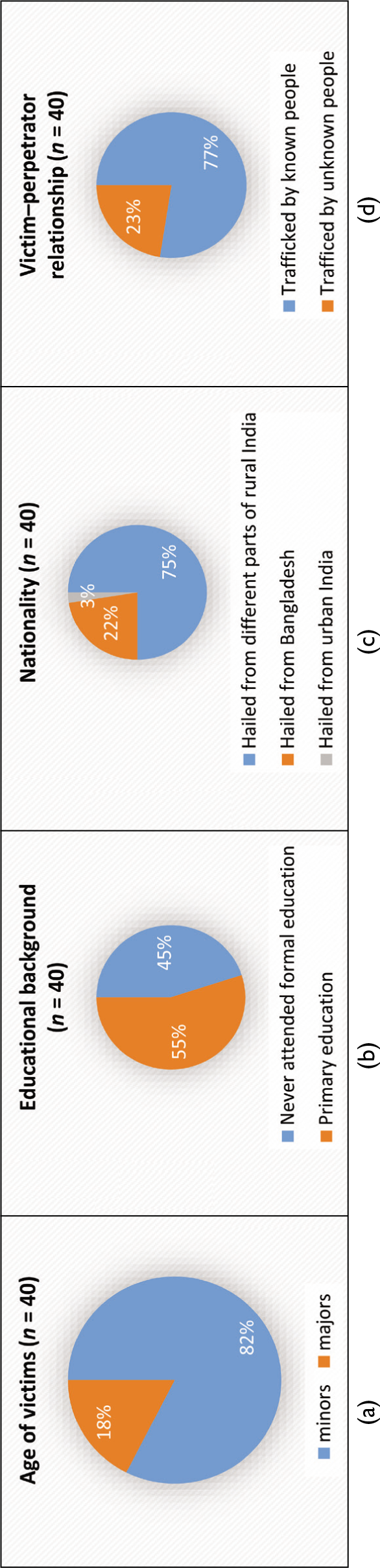
The researchers observed that out of the total survivors (n = 40) in the 22 cases, 33 (or 82%) were minors (Figure 1(a)). Also, 18 of them (or 45%) never attended any formal education and none went beyond class VII (Figure 1(b)). It was further noted that all the survivors belonged to poor backgrounds, and their respective families had too many mouths to feed. Due to their level of education and low economic settings, it was easy for the traffickers to lure these girls with false promises of employment or marriage. Moreover, while most of them (30 survivors or 75%) belonged to different parts of rural India, 9 (or 22%) hailed from Bangladesh (Figure 1(c)). Only one victim hailed from an urban area in West Bengal, Kolkata (Salt Lake). It was found that rural and poor communities with a lack of basic resources are more vulnerable to sex trafficking. Illiterate minor girls from impoverished families in rural places are less likely to decline opportunities to make money or get married. Lastly, 31 (or 77%) of the total survivors (n = 40), were trafficked by people they knew, which included family members, lovers, boyfriend-turned-husband, neighbours or friends (Figure 1(d)).
Profile Analysis.
Rescue Process
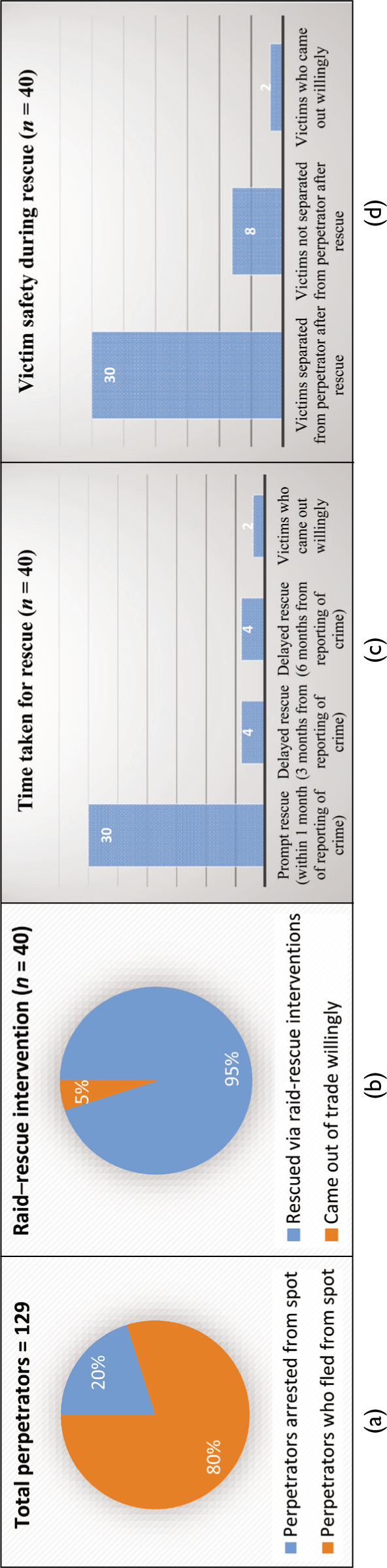
Out of the total survivors (n = 40) in the 22 cases, 38 (or 95%) were rescued via raid–rescue interventions (Figure 2(b)). Among the remaining two, one fled from the brothel she was captivated at and another came out of the trade willingly. Additionally, 33 (or 82%) of the total survivors (n = 40) were rescued by the Specialized Anti-human Trafficking Units or State CID especially designed to strengthen law enforcement responses to human trafficking. While most of the survivors (30 survivors or 75%) could be promptly rescued via raid–rescue interventions (raids were conducted within a month from the date of reporting of the crime); in the case of four survivors (or 10% survivors), the raiding team took three months to intervene (Figure 2(c)). Moreover, in the case of another four (or 10% of survivors), the raiding teams took six months or more to intervene. This picture depicts a lack of promptness on the part of police personnel in those specific cases. While in all cases female police were present during the raid–rescue interventions; a majority of the survivors (30 or 75%) were not separated from their individual perpetrators after rescue. The arrested perpetrators were put inside the same police van along with the survivors and taken for medical examination. Moreover, out of the 139 perpetrators in these 22 cases, only 28 (or 20%) could be arrested from the spot (Figure 2(a)). Interestingly, out of the total 139 perpetrators, 21 (or 15%) turned out to be female.
Rescue Process.
Post-rescue Interventions
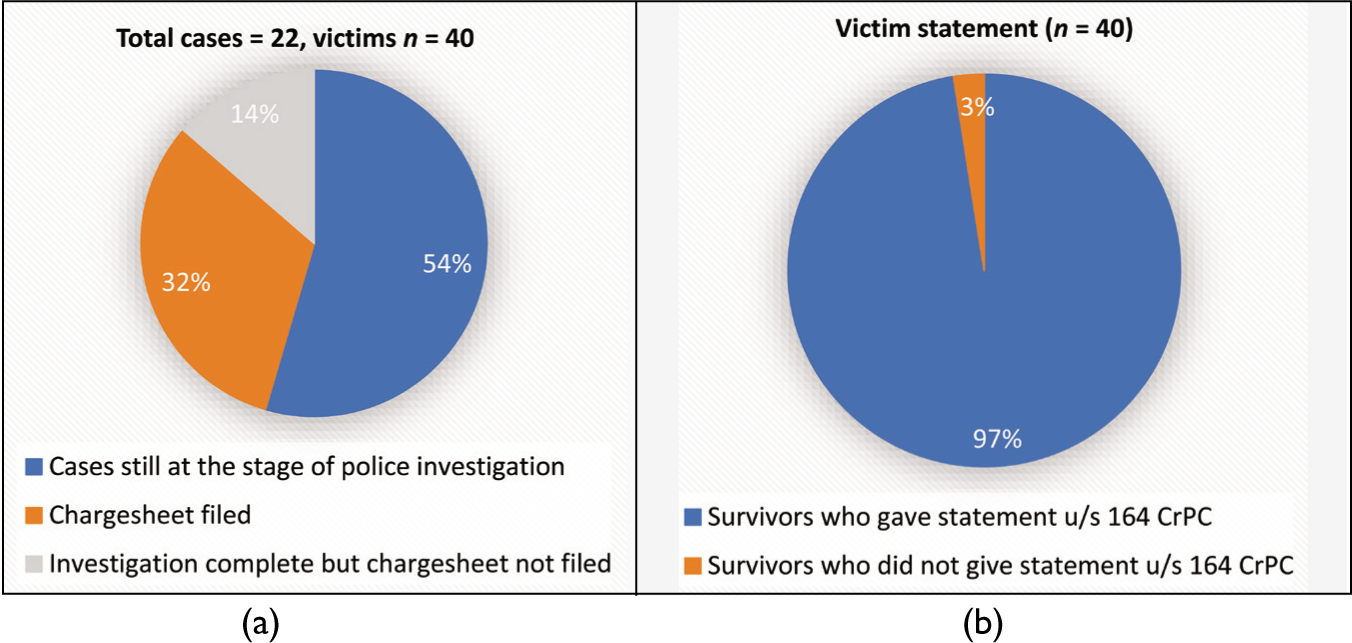
Specifically talking about the post-rescue interventions, all survivors underwent medical examinations, and the minor ones were produced before the respective child welfare committees. Additionally, except one, all other survivors had given their individual statements before the magistrate (Figure 3(b)). Out of the 39 survivors who gave their individual statements in front of the magistrate as per the requirements under section 164 CrPC, 4 (or 10%) seemed utterly disappointed with the interactions. They specifically mentioned that their versions were looked down with suspicion, and hurtful comments were made with regard to their character and moral settings. Moreover, 12 of the total 22 cases (i.e., 54%) are still at the stage of police investigation. In fact, in 5 of those 12 cases (or 41% cases), 6 months or more have lapsed from the date of the rescue of the individual survivors; still, a charge-sheet could not be submitted by the investigating officers associated with those cases (Figure 3(a)). This depicts a lack of effective partnership among several stakeholders engaged in providing responses to sex trafficking in India. It is necessary to note that inordinate delays in the investigation and prosecution of sex trafficking cases not only diminish the faith of the public in the existing criminal justice system but also lead to evidence manipulation ultimately jeopardizing the outcome of the cases.
Post-rescue Interventions.
Trial Proceedings
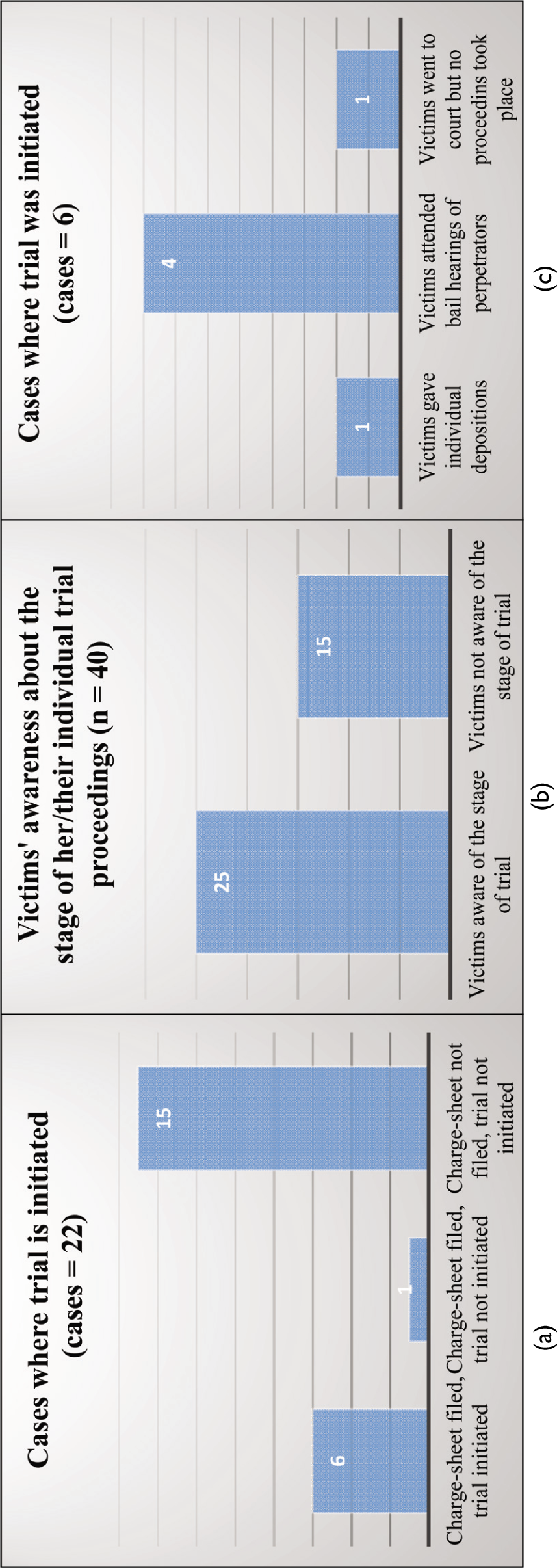
While interacting with the survivors (n = 40), the researchers noted that 25 of them (or 62%) were aware of the stage of their individual proceedings (Figure 4(b)) and only 2 (or 5%) knew about the right to victim compensation. On all occasions, the source of their knowledge was no formal authority but individual home mothers at the respective protection homes they were staying at. In general, a lack of information about court processes and available options was witnessed. Out of the 22 cases, only in 7 (32%) cases charge-sheet was filed and in 6 of those 7 cases, trial was initiated (Figure 4(a)). In three cases which involve Bangladeshi survivors, the repatriation process is still ongoing, even though in one of those cases, a time span of 11 months has already passed from the date of the survivors’ rescue. The researcher observed that, during the court visits, the survivors were escorted by police officials as well as NGO members. Thus, during their individual journeys to the respective courts, the protection aspect of the survivors was taken care of. However, it was noticed that, out of the six cases where trial was initiated, only in one case, the victim survivor submitted her individual deposition in front of the public prosecutor (Figure 4(c)). In four cases, the survivors were taken to the court to witness bail hearings of their perpetrators; and in one case, even though the survivors went to court, there were no trial proceedings since the defence lawyer was ill (Figure 4(c)). It is pertinent to note that in all the six cases where trial was initiated, the survivors faced their abusers in the respective courtrooms. There were no separate entries to courts for the survivors and their perpetrators, and the survivors could not avoid eye contact with their abusers. The perpetrators’ presence created fear and brought back old memories of violence leading to psychological trauma in the minds of the survivors. Moreover, out of the 40 survivors, only 3 (or 7%) were exposed to mock trial strategies during their stay at the protection homes. There was no information about legal options in the appropriate form and in most of the cases, no support person was available for referrals. All the 11 survivors (27%) who attended the trial mentioned that the courtroom layout was unfamiliar, intimidating and bureaucratic. However, none mentioned about facing any awkward questions inside the courtroom premises.
Victim-awareness and Participation in Trial Proceedings.
Interactions with the Criminal Justice Stakeholders and Victim Satisfaction
It was difficult on the part of the researchers to measure victim satisfaction from an analysis which is purely qualitative. However, the following parameters were identified as a range of judicial behaviours that may affect victim experiences and interactions with the criminal justice system:
Sense of opportunity to speak and to be heard Cross-cultural and/or communication issues Sense of being blamed for the abused caused Sense of fear during raid–rescue interventions Sense of information about ongoing legal processes Sense that all the perpetrators may not be held accountable for their actions Sense of intimidation in the courtroom Fear of confrontation with the perpetrator Fear of police aggression Sensitive treatment by all the stakeholders involved
The majority of the survivors (75%) mentioned that there was limited opportunity to speak and to be heard. Their fears, concerns and needs were not addressed at the various stages of the proceedings. They were not given any information about their rights and the legal options available to them. In some cases, there was complete absence of the standards of probity and respectful demeanour from all legal representatives acting in the proceedings. For example, out of the 40 survivors (n = 40), 4 (or 10%) mentioned that during and after rescue they faced ill-treatment and abuse from police. Police could not avoid labelling behaviours resulting in secondary victimization of the survivors. Moreover, five others (or 12%) mentioned that when their respective family members approached the local police for help with regard to their missing daughters, they were asked to give bribes. Owing to their lack of sensitivity and bureaucratic behaviour, some of the survivors (10 or 25%) still retain mixed feelings towards police. Their lack of trust germinates from the fact that police would visit the brothel premises quite often for extracting money or for sexual favours. Many a time they would leave the trafficker and/or exploiter and arrest the adult consenting sex workers. Thus, in general, the respondent survivors retain a sense of fear towards this community. Twenty-seven per cent of the interviewed survivors (or 11 survivors) who witnessed the courtroom layouts mentioned that they were clueless; the environment was unfamiliar, and the court staff was largely indifferent. There was a lack of safety as they feared actual confrontations with their perpetrators and facilities to use screens, phones or video evidence were not present. It was further observed that out of the total survivors (n = 40), 8 (20%) faced cross-cultural and communication issues as they hailed from remote villages of Delhi and Madhya Pradesh. Lastly, survivors’ perceptions of justice for themselves differed from the outcomes that they desired from the cases. While most mentioned that they want their perpetrators to face severe consequences; many stressed on finding autonomy and empowerment through self-defined goals.
Researchers’ Analysis
Deficiency of Victim Participation in the Criminal Justice System
Even though many of the rescued survivors generally felt that they were treated with respect, but, as indicated above, there exist contrary views too. The above picture clearly depicts that they felt less likely to consider themselves as involved entities in the entire criminal justice process. Transparency and communication throughout the various stages of rescue, post-rescue and trial proceedings still remain the key concern. Survivors reported challenges in understanding the complicated legal processes since post-rescue they were not in touch with the service providers and/or criminal justice stakeholders. They were unaware of what benefits they were entitled to and how to apply for them. In certain instances, a compassionate, trauma-informed approach to ensure respectful treatment of sex trafficking survivors by law enforcement officers was totally missing.
Lack of Trust towards Criminal Justice Stakeholders, Specially, Police
The researchers further observed that some of the individual testimonies of the survivors were quite hostile towards police because many police personnel form a client base of the same brothels that they raid. The survivors were unaware of the protective model of raid–rescue interventions because they had a prior image of police taking bribes, extracting money etc., from their brothel owners. Most of them were doubtful about these sting operations since they were concerned about its implications and their future well-being. Few respondents were distressed by the rude behaviours and abusive vulgar language that police personnel indulged in during raids. In other cases, the non-timely submission of conclusive reports (charge-sheets) by the investigative agencies posed serious questions on the accountability and supervision of officers investigating organized crimes such as sex trafficking. Moreover, in all the cases, non-arrest as well as the absence of investigation into the role of primary perpetrators (source-point perpetrators) who were involved with the first stage of the crime was witnessed. The role of abettors such as middlemen, taxi drivers and other persons who transported the survivors from source to destination for sexual exploitation was also not investigated into.
Absence of Victim Protection at Various Stages of Rescue and Post-Rescue Intervention
The narratives further revealed that post-rescue, as many as 75% of survivors were not separated from their perpetrators. They were put in the same police van and taken for medical examinations. These are the same perpetrators who employed tactics to subdue resistance and silence the victims by administering force, alcohol, drugs, verbal and physical coercion, and proactive manipulation and confusion. The researcher found that the obligation to protect the survivors from criminal acts of retaliation and intimidation was not taken care of. Moreover, during the submission of victim statements under the concerned magistrates, 4% of the total survivors were treated with disbelief. Redressing the need for secondary victimization requires the criminal justice stakeholders to avoid situations of victim blaming, inappropriate or insensitive behaviour and questioning victims’ credibility. However, the picture depicts a contrary situation. In cases where a trial was initiated, during court visits too, 11% of the survivors faced their perpetrators in the respective courtrooms. For victims of chronic violence such as sex trafficking, security is the primary concern because they may actually be or may perceive to be under ongoing risk and threat. Taken together, these contexts present the risk of re-traumatization and re-victimization of the survivors.
Lastly, with regard to repatriation of the Bangladeshi survivors: receiving appropriate orders from the concerned court, co-coordinating with the Bangladesh High Commission, communicating with the Ministry of External Affairs of India and the final wait for border clearance and travel permit become cumbersome for those who hail from interior parts of the country. In fact, most of them are from humble backgrounds and broken families. They do not possess proper IDs and other necessary documentation. Thus, the process of repatriation still remains extremely long and bureaucratic.
Presence of Trepidation towards Law Enforcement Agencies
The researchers perceived that due to the initial threats that the survivors endured, they still suffer from the fear of trusting law enforcement agencies. With regard to the role of judiciary towards justice for sex trafficked survivors, excepting that some of the respondents have been summoned to the court to tender victim statements, the protective measures to be rendered by the individual stakeholders were largely missing. Though most of the magistrates were by and large sympathetic, many of the essential requirements such as victim participation, victim protection, special services and support, information about criminal proceedings, separate waiting halls, video conferencing, etc., were entirely absent. In a nutshell, survivors felt like aliens to the entire criminal justice process.
Concluding Remarks
While the current research provides first-hand information on the narratives presented by the sex-trafficked victims, the fact that this organized crime network adopts innovative techniques to escape the realms of our justice delivery mechanism is irrefutable. Every aspect of law enforcement, including raid–rescue interventions, arrests, investigations, prosecutions, witness and victim protections etc., fall short of certifying higher conviction rate and addressing the actual needs of the trafficked survivors. Crime prevention and better conviction are only possible when we understand the legal gamut of offences that a trafficker may be charged with, including the interrelated legislations, and how to use them in investigating cases and prosecuting offenders. Victim cooperation and participation at various stages of investigation and trial can be ensured only when active measures are employed for protection of victims’ rights. The need of the hour is to have skilled stakeholders fully equipped with adequate knowledge and resources to combat the crime. Offenders’ accountability, clear attitudinal orientation, and utmost sensitivity towards the victims are the first steps to tackling the complex web of sex trafficking. Moreover, compensatory relief and a strong framework to access the relief can be a significant stride toward victim restitution.
Footnotes
Declaration of Conflicting Interests
The authors declared no potential conflicts of interest with respect to the research, authorship and/or publication of this article.
Funding
This research received no specific grant from any funding agency in the public, commercial or not-for-profit sectors.