




Abstract
Albert Bailey is the Executive Director and Chief Executive Officer of Spur Tree Spices, a Jamaican company specializing in authentic Jamaican spices. The company, which started in 2006, targets the Jamaican diaspora in the United States, United Kingdom and Canada, and has grown steadily, growing revenues from J$290M in 2016 to J$701M in 2020, primarily from internal financing. Bailey wanted to expand into Jamaican foods, which would complement the spices. Bailey and his management team debated whether they should raise resources to fund the expansion through debt or equity initial public offering (IPO).
Keywords
Introduction
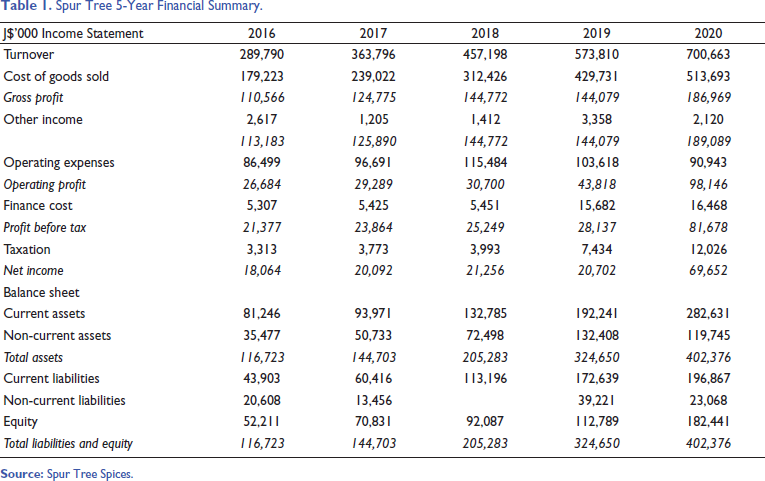
In February 2021, Albert Bailey, Executive Director and Chief Executive Officer (CEO) of Spur Tree Spices, a production and distribution company that specialized in the sale of authentic Jamaican seasonings and sauces, was examining the company’s audited financial performance with immense pride. The company had increased revenue by over 20% in each of the last 5 years. Total revenue for 2020 was over J$700M, 1 with over 90% generated from export sales. Spur Tree Spices had steadily improved profits over the years, with operating profits increasing by 123% in 2020. These positive results were achieved despite the difficulties caused by the COVID-19 pandemic, which had curtailed direct marketing initiatives.
Buoyed by the financials, Bailey thought that the outlook for Spur Tree was very positive and wanted the company to expand its current growth trajectory. Bailey wanted to expand into Jamaican foods, which would complement the spices.
Bailey and his management team had estimated that Spur Tree would need $350M to fund the expansion and liquidate loans. The team debated whether they should raise resources to fund the expansion through equity, that is, an initial public offering (IPO) or debt. The IPO means additional responsibility in terms of transparency of reporting, keeping investors regularly informed and maintaining the regulatory guidelines of the Jamaica Stock Exchange (JSE). With debt financing, Bailey would retain full control of the business; however, they would have to contend with interest rates and possible cash flow difficulties. Although Bailey was fairly confident that the time was right for expansion, there were some lingering questions. What source of financing is to be used, debt, equity or a combination? If a combination is used, what should be the target weights of debt and equity in the capital structure? He had told the board that a proposal would be presented at the February meeting, which was 5 days away, and he had not yet started the analysis.
Company Background
The company was started in 2006 by Harrinarine ‘Mohan’ Jagnarine, a Guyanese naturalized Jamaican. Jagnarine started modestly with one small commercial blender, supplying bulk jerk seasoning to one food service customer in New York, which was delivered via the defunct Air Jamaica airlines. He subsequently supplied jerk seasoning to the local food service market through GraceKennedy Food Service Division. In 2006, he moved to a 4,000 sq ft premises in Kingston. 2 In the ensuing years, Spur Tree has expanded its product line, and their products are available in Jamaica, the United States, Canada, United Kingdom, Cayman Island, Costa Rica and Australia through several distributor outlets (see Figure 1).
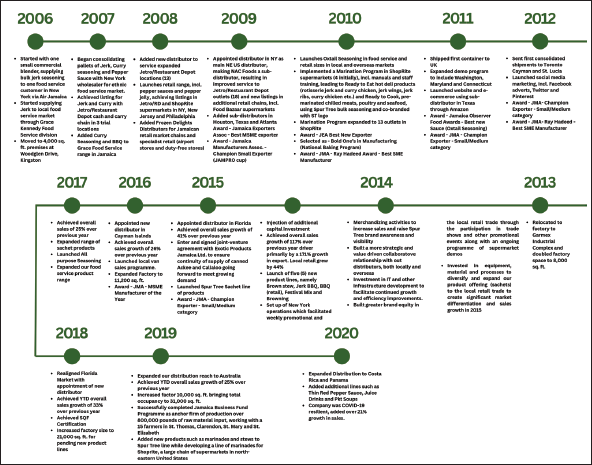
Bailey and Jagnarine met as employees at Island Grill Restaurant. Jagnarine started at Island Grill in 1989 and left in 1992 to become a restaurant manager at Burger King. In 1996, he returned to Island Grill as operations manager to spearhead the company’s island-wide expansion. In 2000, he left for New York to join Golden Crust Bakery and Grill, a chain of 90 restaurants located on the eastern seaboard, as operations manager. Followed by a 1-year consulting assignment to establish a chain of Caribbean-style restaurants in the Food Courts of major malls in Ontario, Canada. All this experience and knowledge of the North American food service and retail markets were indispensable. In 2005, Jagnarine returned to Jamaica and, in partnership with countryman and long-time friend Anand James and Dennis Hawkins, established Spur Tree primarily to satisfy the growing demand for exotic Caribbean flavours in the export market. 3
Before joining Spur Tree, Bailey worked with Island Grill for 14 years, initially as financial controller. He transformed the financial and accounting structure of the company by implementing new accounting and cost management systems and restructuring the company’s financing arrangements. In 2003, he was promoted to general manager, overseeing the expansion of the company to 18 stores. He joined Spur Tree in January 2014 as CEO and developed a detailed strategic plan to rapidly grow the company’s business. As CEO, Bailey was in charge of the strategic and operational management of Spur Tree. Bailey owned 20.95% of the company, while Jagnarine owned 42.9%. There were 10 other shareholders, all with ownership of less than 9%.
The story was told by Bailey of how the name Spur Tree was conceived: ‘The company name was inspired by Spur Tree Hill, a hill located in the parish of Manchester, Jamaica’. The Spur Tree Hill main road is famous for being a dangerous stretch to drive, as the road plunges from more than 2,000 feet to near sea level in the span of just a few kilometres. It was just as famous for a couple of sumptuous roadside jerk pits and a noteworthy curry goat hut. At the top of Spur Tree Hill, the view of the parish of Manchester’s lowlands and the parishes of St. Elizabeth and Westmoreland was spectacular. 4
Bailey continued, ‘Jagnarine had a restaurant in Mandeville and he used to sit up at a particular place and look out at Spur Tree Hill, and he thought that if he ever started a business in spices, spiritually, the name he could give the company was Spur Tree’. Jagnarine argued that Spur Tree Hill and its environs were known for some of Jamaica’s richest flavours in spices and that introducing these flavours to the world using the Spur Tree name would be spiritual.
Jamaica’s Special Economic Zone (SEZ)/Free Zone
Spur Tree operated out of a 20,000 sq ft manufacturing facility at Garmex Free Zone, located at 76 Marcus Garvey Drive in Kingston at the SEZ or Free Zone. A SEZ is a geographically demarcated area within a country’s national borders that is governed by trade and business laws that are distinct from the laws of the rest of that country. The objective of an SEZ was to attract investment to a nation’s shores, and thereby increase employment and economic growth. 5
The Jamaican government established its SEZ by the enactment of the Special Economic Zone Act of Jamaica, 2016 (SEZ Act) and the passing of the Special Economic Zone Regulation, 2017 (SEZ Regulations). The SEZ replaced the ‘Free Zone’ or Jamaica Export Free Zone Act (JEFZA), 1982. The JEFZA prescribed minimum export levels by free zone companies, combined with income tax exemptions, which presented a risk of non-compliance with World Trade Organization (WTO) rules prohibiting export subsidies. The SEZ legislative reform was passed to comply with WTO rules.
The Jamaican government envisioned that SEZs would attract investment and new economic activities to Jamaica, generate employment, link Jamaican domestic suppliers to global supply chains, and create other synergies with the rest of the Jamaican economy. It is for that reason that incentives have been offered that are potentially attractive to many businesses. The SEZ therefore presents an opportunity for potential investors to not only reap positive benefits for their private enterprises but also have a positive impact on Jamaica’s economy and labour force. 6
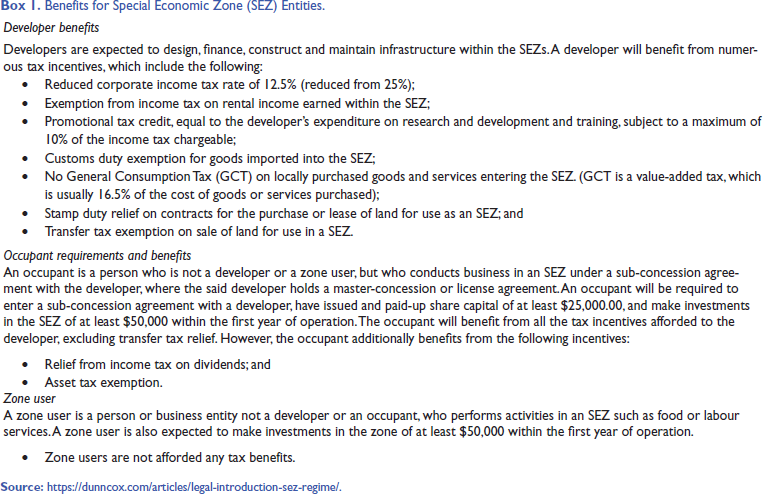
The SEZ authority (entity responsible for regulating and supervising the SEZ) grants operating certificates and authorizations to the various entities that may engage in SEZ activities. These entities included developers, occupants and zone users. Spur Tree Spices operated within the SEZ (see Box 1). Spur Tree Spices had strategically targeted the SEZ to leverage the benefits. The company, therefore, generated most of its revenue from the export market.
Benefits for Special Economic Zone (SEZ) Entities.
The Company
Spur Tree specialized in production, distribution and the sale of ‘all-in-one’ wet, authentic Jamaican seasonings and sauces for both retail and food service markets. The company claimed to use only the finest, fresh, natural ingredients, including scallions, thyme, scotch bonnet pepper and pimento (allspice) directly from small local farmers. The company claimed that its tag line, ‘just add meat’, speaks to the convenient and easy-to-use characteristics of their products. A value that they claimed greatly appealed to busy homemakers, young professionals and just anyone who wanted to produce tasty authentic meals. Their products included Oxtail, Curry, Brown Stew, Jerk BBQ and All-Purpose Seasonings. In addition to their premium seasonings and sauces, Spur Tree offered a wide range of high-quality complementary Jamaican staples such as Festival and Mix Juices, which distinguish it from other brands (see Figure 2). In 2020, Spur Tree purchased Exotic Products Jamaica Limited a producer of canned ackee 7 and callaloo, 8 primarily for the export market.

While the market callaloo was embryonic, the market for ackee was growing. The total export sales for canned ackee were over $12 million in 2014 and approximately $20 million in 2016. The Jamaica Promotions Limited estimated that sales would surpass $29 by the end of 2020. The growth in the market was fuelled by, among other things, government initiatives to expand ackee into global trade and research and development activities to reveal its nutritional strength. Information on market share is sparse; however, some of the more established companies in the market include GraceKennedy, Lasco Foods, Walkerswood Caribbean Foods, Caribbean Dreams and Island Delight. 9
Spur Tree has used a related company, Holland Bamboo Limited, to source and pre-process raw material inputs from various farmers. This has had several advantages for Spur Tree and its existing core of farm produce suppliers. First, the farmers no longer had to make lengthy trips to Spur Tree’s Kingston plant to deliver their goods, thereby saving significant time and cost. Spur Tree, in turn, no longer needed to allocate premium production space and resources to receiving, processing and storing incoming raw materials in its Kingston free zone facility. Holland Bamboo Limited, instead, would deliver pre-processed raw material in large storage containers ready to be processed into finished products. Spur Tree had converted the previously used processing areas into finished goods production space, significantly increasing its output capacity at its location in Kingston.
Although Spur Tree was active in the local market, its emphasis has always been on exports, targeting the Jamaican diaspora in the United States, Canada, United Kingdom, Cayman Island, Costa Rica, Panama and Australia through several distributor outlets. The philosophy was that there are more Jamaicans and persons of Jamaican descent residing outside the country, who value that special connection with home, whether through music, food or other forms of cultural authenticity. With this export focus, in 2020, 90% of the company’s revenue was generated from exports. The company noted that in recent years, there has been an expansion of the demand for Spur Tree products in the overseas market from non-Jamaicans of all different races and ethnicities seeking an authentic Caribbean food experience.
The company was reliant on its distribution arrangements to get its products to end users. Most of these distribution channels were in foreign countries. Its distributors included companies such as Jetro/Restaurant Depot Cash & Carry chain, ShopRite, Food Bazaar, Food World, Key Foods, Western Beef among others in New York, New Jersey and Philadelphia. The company also had distributors in Texas, Florida and Atlanta. Spur Tree products were also available in several other states through sub-distribution channels. Other markets included Canada, United Kingdom, Cayman Islands, Costa Rica and Australia, with each having a singular separate distributor.
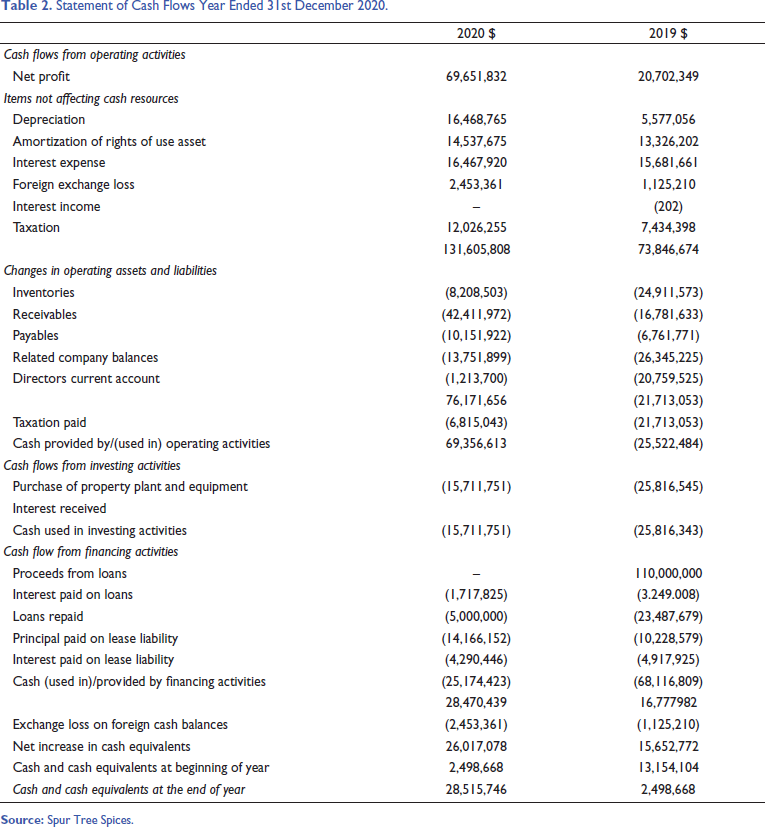
During the 2020 financial year, Spur Tree reduced its operating expenses by J$13 million to J$91 million. Because of the pandemic, Spur Tree transitioned to an online and social media marketing approach as opposed to the traditional print or in-store promotions. The change in marketing strategy resulted in a J$3 million reduction in travelling and entertainment costs to J$3 million for the 2020 financial year and a J$6 million reduction in advertising and promotion costs to J$3 million for the 2020 financial year. This primarily contributed to the decrease in the company’s operating expenses. Spur Tree Spices has steadily improved profits over the years, with operating profits increasing by 123% in 2020 (see Tables 1 and 2).
Spur Tree 5-Year Financial Summary.
Statement of Cash Flows Year Ended 31st December 2020.
Junior Stock Market
To stimulate economic growth, the Jamaican government, in collaboration with the JSE and other stakeholders, launched the Junior Market on 1st April 2009. It was designed to encourage and promote investment in Jamaica’s entrepreneurship, employment and economic development. The Junior Market would allow investors to put capital into legitimate small and medium-sized enterprises (SMEs) companies whose shares were traded on a special JSE platform.
As a general rule, the development of a Junior Stock Market is designed to attract new capital and to encourage new start-ups. Junior Stock Market companies act as the vehicle through which support and resources can be obtained from investors. The Jamaica Junior Stock Market (JJSM) was considered an important factor in the promotion of growth in the Jamaican economy via a solid investment climate. At the time, it was very difficult for SMEs to raise capital through commercial loans because they lacked the necessary security. Also, there was no capital market facility in Jamaica for SMEs to raise equity capital, which was extremely important to have a proper capital structure. This led to the proposal and implementation of the Junior Stock Exchange. 10
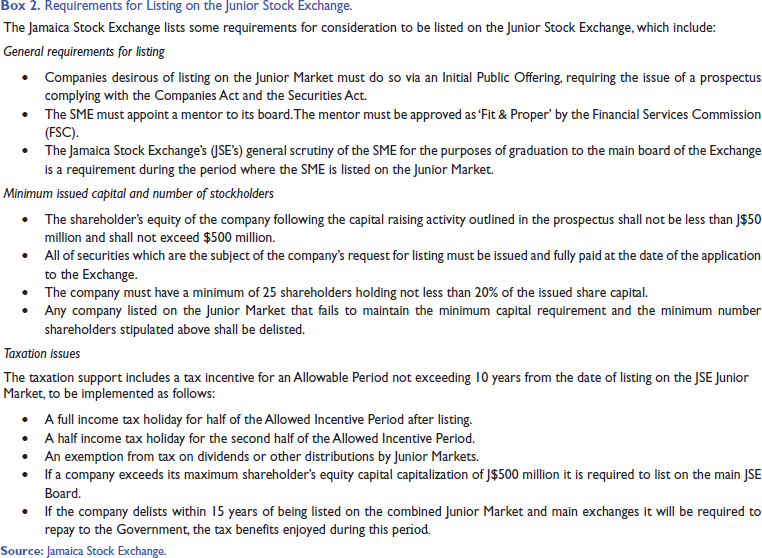
Bailey was intrigued by the prospect of growth funding via the JJSE, especially the tax incentives. It allowed for tax support for up to 10 years. There was a full income tax holiday for the first 5 years and a 50% tax holiday for the second 5 years. To be listed, companies must do so via an IPO; however, to be listed on the JJSM was a complicated process with strictly specified requirements (see Box 2). 11
Requirements for Listing on the Junior Stock Exchange.
Current Funding Arrangements
At the end of December 2020, Spur Tree had short-term loans of J$169.8M and no long-term loans. This included an interest-free directors’ loan of J$12.5M with no fixed terms of repayment. There was also a short-term loan of J$157M with interest at 9.25% with a maturity date of 30th November 2021. The loan was secured by a debenture over the fixed and floating assets of the company. Bailey remarked, ‘We didn’t build the company with large investment capital, it was funded primarily from internal sources. Prior to 2019, we had only borrowed J$30M’.
Spur Tree also had a loan agreement/credit facility of J$100M with GK Investments Limited (‘GKI’) dated 14th February 2019. The loan was secured by a charge on assets including Accounts Payable, Accounts Receivable, Fixtures, Furniture, Intellectual Property Rights, Other and Vehicles.
Decision
Bailey planned to establish a new processing facility and to transition Spur Tree from a spice company to a food company. ‘We want to become a full blown food company, not just spices’—said Bailey. In addition to having its associate company, Holland Bamboo Limited, sourcing and pre-processing raw material inputs from various farmers, the company would be located at the old sugar factory in St. Elizabeth, which is being converted into an agricultural park (agri-park). 12 Bailey explained that this will help to build capacity in terms of the production of finished goods.
This would facilitate heavy expansion into ackee. He had received a letter of commitment; however, the deal was not yet closed. There were other priorities beyond ackee, including breadfruit and callaloo. He also had to consider market expansion through distributorship. Spur Tree had selected their distributors carefully and also hired promoters to move the product off the shelf by conducting product tasting and demonstration. They found this approach especially useful, as one distributor had copied all of the Spur Tree range and started to distribute their own copycat product. Bailey repeated the company’s mantra, ‘We will not be the biggest company; we want to be the premier company offering authentic Jamaican products to the world’.
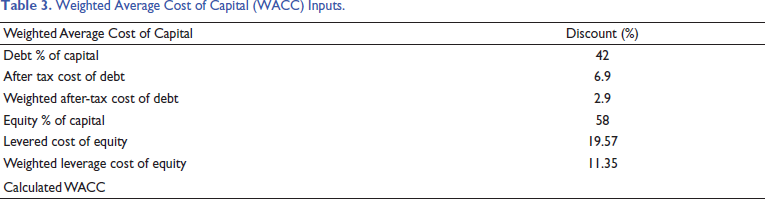
Having set the context, Bailey needed to decide whether to use the JJSM IPO option, private equity or debt to fund the expansion. Regardless of the financing option, Bailey knew that he needed to make a good pitch to convince the board and subsequently investors that the business deserved funding. Bailey had roughly estimated that the company would need J$350M to liquidate the loans and invest in capacity building, growth and expansion. He estimated using approximately J$169 million of the funds raised to liquidate current debt of approximately J$157 million to GK Investments and J$12.5 million to reduce the directors’ loan. To determine how to fund the $350M expansion and what combination of debt and equity to use, Bailey needed to calculate the weighted average cost of capital (WACC); the inputs are in Table 3. Bailey was scheduled to meet with the board in only 5 days, and he had not yet started; he needed to work quickly.
Weighted Average Cost of Capital (WACC) Inputs.
Footnotes
Declaration of Conflicting Interests
The authors declared no potential conflicts of interest with respect to the research, authorship and/or publication of this article.
Funding
The authors received no financial support for the research, authorship and/or publication of this article.
