



Abstract
This case study titled ‘Josh Software organizational innovations: Dynamic capabilities for social causes’ deliberated regarding how Josh Software undertook its organizational innovations. The case set in the emerging market of India, illustrated how an organization engineered organizational innovations towards serving social causes. The primary protagonist of this case is Mr Gautam Rege (hereby referred to as Rege) and the secondary protagonist is Mr Sethupathi Asokan (hereby referred to as Asokan). Rege cofounded Josh Software (
Keywords
Origin with Socially Directed Innovation
Mr Gautam Rege (referred to as Rege) cofounded Josh Software (
Fast forward to the year 2001, while Rege at this point was working in another organization the doctors of NICU of KEM Hospital, Pune again contacted him (Kimaya, 2015). The computer in which the programme software of NICU was hosted had crashed. As a student, Rege had just developed the programme and did not even take a backup of the programme. Rege never thought that his programme would work in the real world that too for three years on the trot (Rege, 2021a, 2021c). So, in the year 2001, Rege had to again recreate the software from scratch. Now the doctors of KEM urged Rege to explain why did he not make this software as a product and launch it in the market (Kimaya, 2015; Rege, 2021b, 2021c). In the year 2005, the NICU doctors of KEM Hospital again reached Rege and advised him to develop this software as a product and sell it to different hospitals hosting NICU facilities. The doctors told Rege that there was a lot of demand from different hospitals for this kind of software (Kimaya, 2015; Rege, 2021a). This was a socially important product which the country needed for a better future. The product was already being spoken of in Neonatal care conferences all across India (Rege, 2021a).
Advice from the neo-natal care doctors over a period of time became a trigger for Rege to develop this as a software product. Any software engineer dreams about developing a product. For Rege, this was increasingly becoming a reality. Given this backdrop, Rege cofounded Josh Software (
Josh Software: The Organization
‘Kimaya NICU’ was not bringing in cash for Josh Software (Rege, 2021a). Rege and Asokan however even after realizing this could not discontinue the product. This was because the product had significant social value (Kimaya, 2015). If ‘Kimaya NICU’ were to be stopped then a lot of NICU facilities in hospitals around Pune would be affected. By this time around about 35 hospitals were using this software. Discontinuation of ‘Kimaya NICU’ was thus never an option. Rege and Asokan were in a dilemma. This was regarding whether to make this software which had a lot of social value, proprietary or keep it free. If the software were available for free, it would do a lot of social good (Postner et al., 2015). A substantial number of hospitals would be able to easily adopt this software and apply it in the hospital’s respective NICUs (Kimaya, 2015). By keeping ‘Kimaya NICU’ free, the revenue would increase for Josh Software. However, there would be no profit as there was no margin for profit (Rege, 2021a). One has to remember that Josh Software had to incur all the costs associated with the development of the ‘Kimaya NICU’ software program. They could comprehend that philanthropy could only take them a certain distance only. Asokan and Rege decided that the software should be available for free given its social value (Rege, 2021a). Till today (that was March, 2021) this software was hosted online and furthermore was available for free. As of March 2021, ‘Kimaya NICU’ was globally used by 60 hospitals with almost 20,000 calculations based on the data collected from premature babies being analysed on a monthly basis (Rege, 2021a). In retrospection ‘Kimaya NICU’ did not bring much profit but it brought in a lot of goodwill (Rege, 2021a, 2021b, 2021c). There was a dilemma about whether they should invest in the technologies for ‘Kimaya NICU’ without the promise of much profit potential. Josh Software was widely appreciated in the NICU healthcare ecosystem initially in the city of Pune and then across India (Kimaya, 2015).
Josh since its inception that is 2007 has always grown primarily through word of mouth. 90% of the sales till the year 2021 have developed through word of mouth (Rege, 2021b, 2021c). The Josh Software motto has been a concoction of technology and passion (Josh Software, 2021a). It stated
Our name stands for passion. And, passion for technology is who we are.
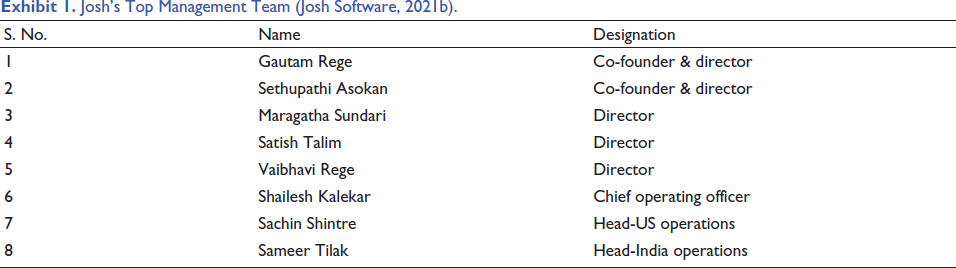
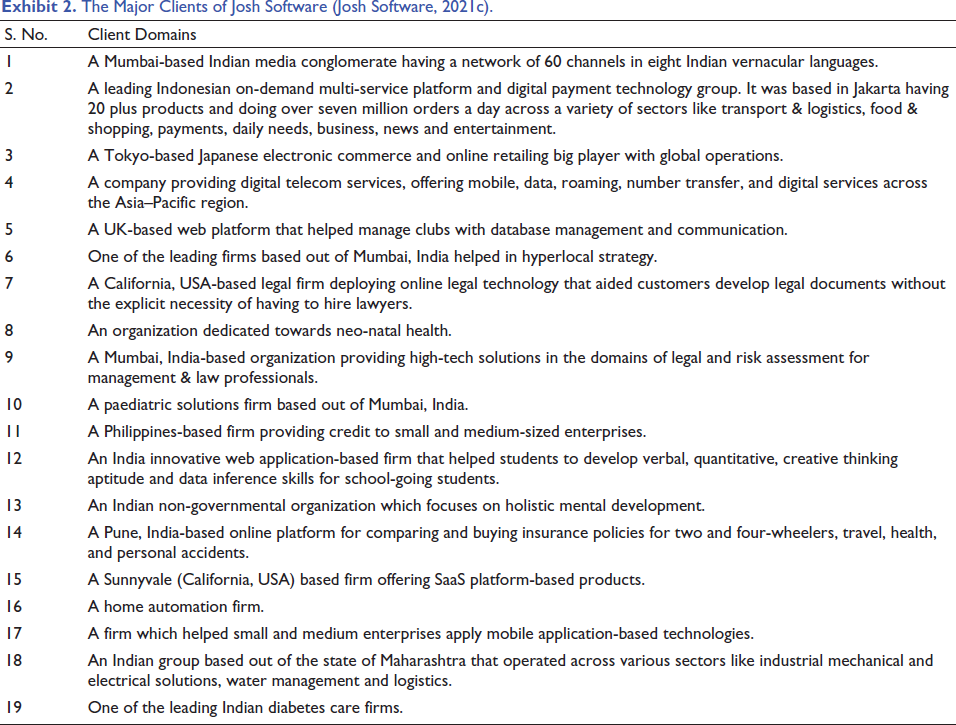
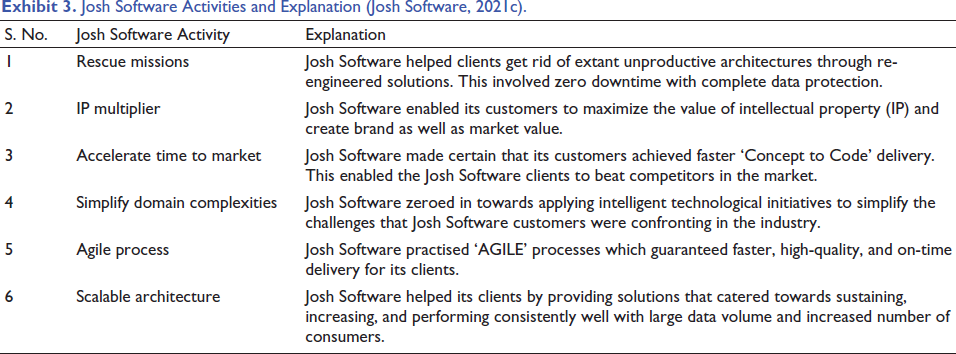
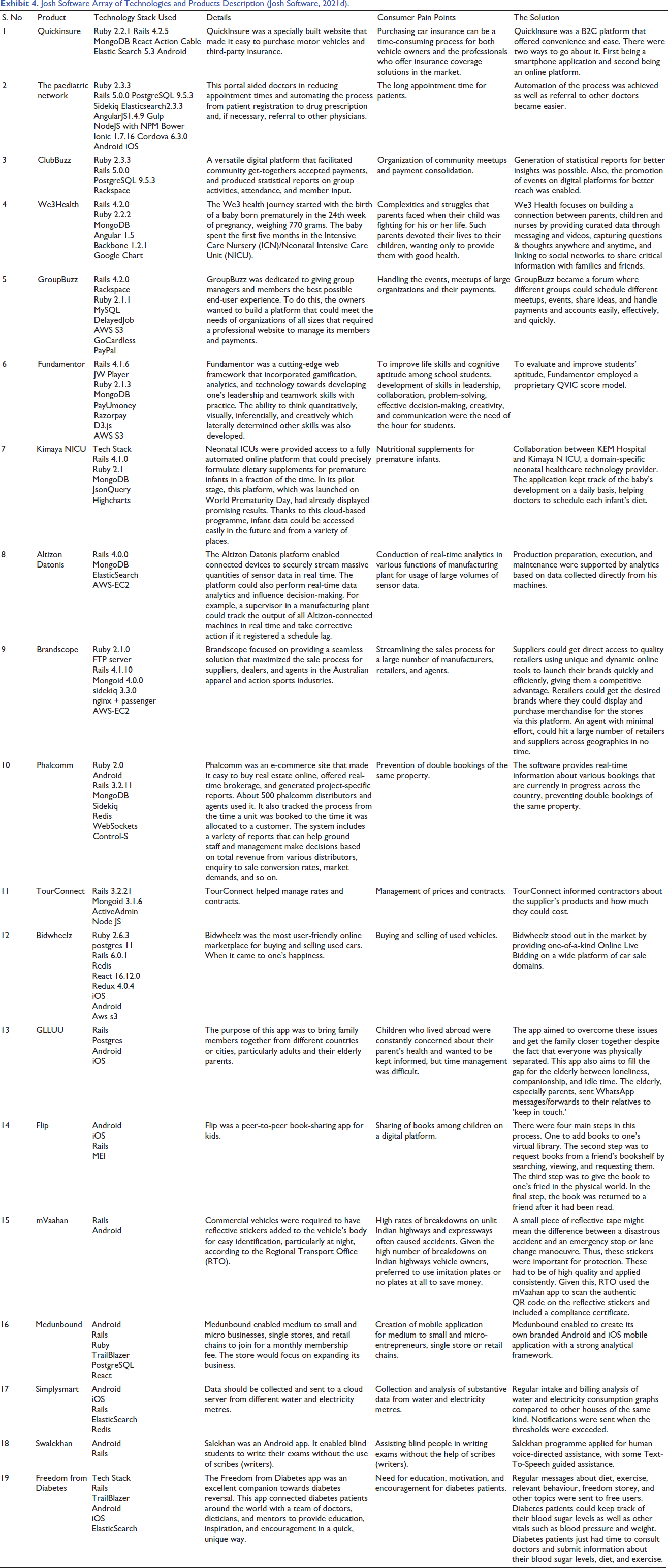
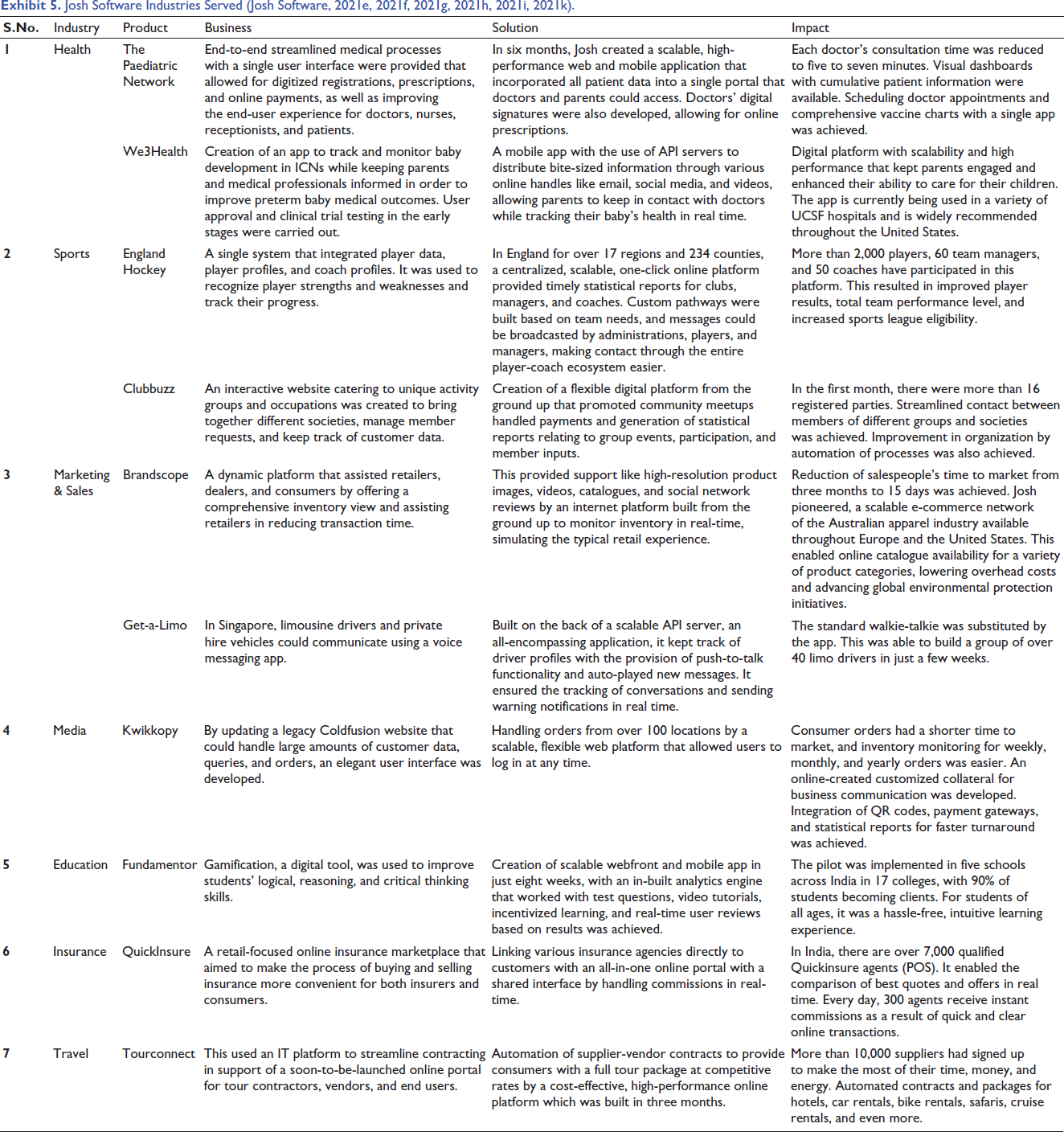
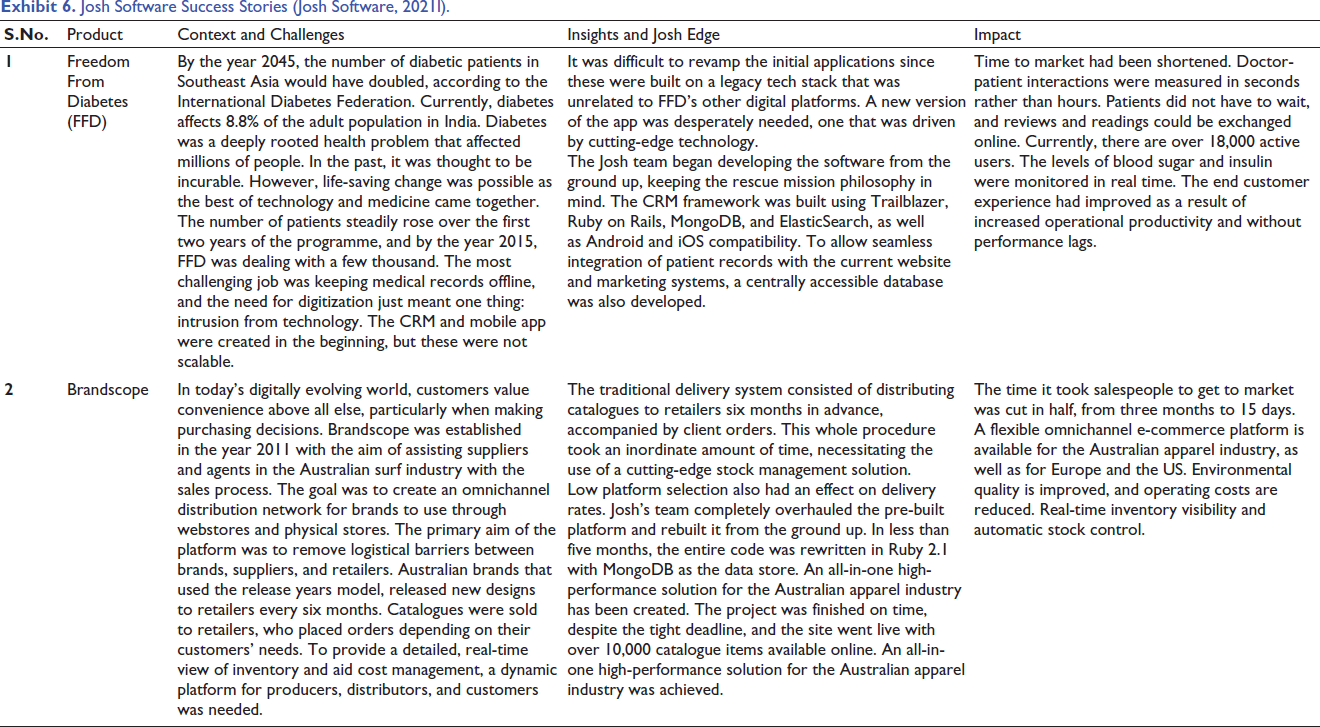
One could attribute the success of Josh Software’s success because of the top management team (Josh Software, 2021b). The top management team of Josh Software had motivated the employees to always be exited, motivated, passionate, and dedicated towards their job task endeavours. The Josh Software’s top management team members list has been tabulated in Exhibit 1. Over the years Josh Software has developed an illustrious set of clients. The various domains in which Josh Software clients worked have been tabulated in Exhibit 2. There was an array of activities that Josh Software carried out. These were primarily six such activities. These were ‘Rescue Missions’, ‘IP Multiplier’, ‘Accelerate Time to Market’, ‘Simplify Domain Complexities’, ‘Agile Process’ and ‘Scalable Architecture’. In Exhibit 3 Josh Software activities have been described (Josh Software, 2021c). Since the year 2007, Josh Software has developed an array of technologies and products. This set of technologies helped Josh Software serve the illustrious set of clients mentioned in Exhibit 2 (Josh Software, 2021c). In Exhibit 4, the products of Josh Software, the technology stack used (Josh Software, 2021d), its details the pain points solved, and the product description has been presented. Josh Software served a number of industries. These were health (Josh Software, 2021e), sports (Josh Software, 2021f), marketing and sales (Josh Software, 2021g), media (Josh Software, 2021h), education (Josh Software, 2021i), insurance (Josh Software, 2021j) and travel (Josh Software, 2021k). The industry catered through was based upon a specific product offered involving a particular business with a well-targeted solution which created an impact. The details regarding the industries served by Josh Software have been tabulated in Exhibit 5. Within the first one and half decades of the establishment of Josh Software successful narratives have emerged. The success stories were based upon the great products that Josh Software had developed to solve the challenges of the clients (Rege, 2021a, 2021b, 2021c). Josh Software achieved success because it provided unique solutions to its consumers (Josh Software, 2021l). This has been viewed as the Josh Edge and created significant client-side positive impact (Josh Software, 2021m). The insights from these successful narratives have been summarized and tabulated in Exhibit 6.
Josh’s Top Management Team (Josh Software, 2021b).
The Major Clients of Josh Software (Josh Software, 2021c).
Josh Software Activities and Explanation (Josh Software, 2021c).
Josh Software Array of Technologies and Products Description (Josh Software, 2021d).
Josh Software Success Stories (Josh Software, 2021l).
The Second Innovation: ‘Hunger terminal’
Asokan and Rege had always believed that any software company (colloquially referred to in India as IT firms) was as happy as its employees. Josh Software right from its inception started providing free breakfast, snacks, lunch and sometimes even dinner to its employees (Rege, 2021a). Josh Software also served tea and coffee to its employees for free. Most of these employees were bachelors. This was a big plus point for these young professionals working in Josh Software as these young employees did not have to bother regarding their food. This was a win-win situation for both Josh Software and its employees. The productivity of the employees also went up because the young employees (mostly bachelors) were free from the hassle of preparing food at home. Since the food was served in the offices of Josh Software the employees were also not required to venture outside the office for food. Thus, Josh Software employees spent more time at their work desks.
By the year 2011, Josh Software had become almost a 50-employee organization (Rege, 2021a, 2021b, 2021c). The food requirement had grown. At this point in time one of the employees suggested that Josh Software should continue to provide food to all its employees. It was the duty of the cofounders of Josh Software to serve food to the employees that the employee claimed. Given this backdrop, Rege did set up a canteen to cater to the needs of its employees. However, strangely soon enough the employees were not happy with the quality of food that was provided at the Josh Software canteen. The complaints regarding canteen services came because of oily food, dry food, uncleaned utensils, poor taste of meal served and such others. In one of the discussions regarding the quality of food served one employee strongly pointed out that the quality of food provided by Josh Software was also the responsibility of Josh’s top management. Rege and Asokan could not believe what they heard (Rege, 2021a). Rege and Asokan understood that they had to take a step back. An organization like Josh Software cannot get into the management of its canteen. This was beyond the scope of Josh Software as a software firm. Rege and Asokan immediately overnight stopped the canteen facilities of Josh Software. However, the Josh employees soon realized their loss. A few employees approached Asokan with the humble request to restart the canteen facilities at Josh Software. and Asokan nonetheless now undertook a different approach (Rege, 2021a, 2021b, 2021c).
Rege and Asokan had a discussion with the Josh team comprised of those members who were complaining about poor canteen and food (Rege, 2021a, 2021b, 2021c). Rege and Asokan made it clear that they had to find their own solution rather than just complaining. The idea of ‘Hunger Terminal’ thus sprouted from the employees of Josh Software. The idea of ‘Hunger Terminal’ was simple (Josh Software, 2021m). A dedicated team of Josh employees was formed to manage the issue of food provision for Josh Software employees during workdays. This team thought of sending an email in the early hours of the working day to all the Josh Software employees regarding what they wanted to eat during the course of the workday. This was the consumption side. Parallelly, this dedicated team of Josh Software employees also contacted all the food vendors that being restaurants and even street food vendors at a distance of about 5–15 minutes of travel time from the Josh Software office in Pune, India. Josh Software’s employees team made a proposition to these vendors. These food vendors would provide the menu card of their food items to the Josh Software team. In turn, the Josh Software team would circulate the menu card to the Josh Software employees. Josh Software employees were supposed to choose from the menu cards of the vendors who were willing to deliver food at Josh Software’s office. Once the employees on a workday selected their food requirements the list of food requirements was informed to these food vendors. These vendors had to cater to the needs of serving food at the Josh Software office subsequently during the day. This was the supply side narrative. Josh Software employees team thus every morning prepared a list of food that had been ordered by its employees and circulated it among the selected vendors who were located nearby. The food vendors were expected to make the delivery upon the order placements and this worked fine (Rege, 2021a, 2021b, 2021c).
Rege and Asokan, however, in this system provided an incentive. Rege and Asokan declared that whatever food price was in the menu card which the Josh Software team had earlier collected from the restaurants or the street vendors would be available to the Josh Software employees at a whopping 50% discount (Rege, 2021a). This was because Josh Software would pay 50% of the price listed on the menu card. This ensured that employees were delighted to get such heavily discounted food served at their work desks. The Josh Software employees did not need to venture outside in search of food and only had to pay 50% of the price for the food they consumed (Rege, 2021a). Because the employees were now paying 50 % of the food price, they understood the importance of the value of their preferred food served at their desks. This made the Josh Software employees satisfied as well as more prudent regarding their demands. The Josh Software team over the years developed an app (in line with ‘The Hunger Terminal’) that would enable this task of serving food to employees without having any inventory problems. This was based upon the logic and system of supply and demand as mentioned. It must be remembered that in India, the big software firms in their facilities ordered a significant amount of food with its canteen facilities. These firms faced the challenge of both food provision as well as food wastage. This was well and above the costs of running a canteen facility. This innovation from Josh Software gained traction from the local media in Pune. Many companies in Pune approached Rege and Asokan to understand the novel approach.
Thus, this could be developed as an app (in line with ‘The Hunger Terminal’) a new product and it could be a game changer. The new product as a new company named ‘Sure Food’ would soon be launched by Josh Software (Rege, 2021a, 2021b, 2021c). This ‘Sure Food’ app could be used by corporations to serve corporate lunches. Rege visualized this as the ‘Uberisation’ of corporate lunches and corporate food provisioning. Corporations could manage their lunches without holding any inventory. This was an entirely new exhaustive ecosystem for corporate lunches. Employees could get their choice of food served at their work desks. Rege and Asokan comprehended the big market potential of such a product from ‘Sure Food’ (Rege, 2021a, 2021b, 2021c). This innovation was a need indeed, but the solution was provided by the Josh Software team.
The Third Innovation: <Code/Curiosity>
Rege since he had started coding that was during the years 1997/1998 had been using open-source software (Rege, 2021a). Josh Software had from its very inception worked on open-source software only (ConfEngine, 2015b; SolutionsIQ India, 2016). Rege believed that increased usage of open-source software was the right direction for the world to move (ConfEngine, 2015b; SolutionsIQ India, 2016). Monopolies in software according to Rege are not good for the overall good of the technology world. Proprietary software which was developed and sold by the large information technology companies in the world made these large companies richer (ConfEngine, 2015b; SolutionsIQ India, 2016). The smaller companies like most IT firms in India which were using proprietary software were in a spot of bother. The smaller user IT companies which used proprietary software had to always pay rent to the larger IT companies and had to be constantly dependent upon the updates and the incremental development of the proprietary software carried out by the large IT companies (Rege, 2021a, 2021b, 2021c). The smaller user firms which were the consumers of proprietary software thus in the long run became captive to the larger IT companies. There was no end to the rent-seeking behaviour that the larger IT companies had developed from the proprietary software being used. The large IT firms owning the proprietary software dictated terms with the smaller IT user firms. The open-source software movement initiated through Linux in the 1990s and its likes provided the way out for the smaller user IT firms (Holtgrewe & Werle, 2001; Von Krogh & Spaeth, 2007). So, the narrative in software development shifted from competing to collaborating. This had been an ongoing narrative in the past. Rege believed that open-source software had more potential because it was developed by a lot of talented individuals spread all across the world (ConfEngine, 2015b; SolutionsIQ India, 2016). So, a lot of intelligent individuals with deep thinking were involved. Furthermore, open-source software was cheaper to develop and work with. This was because in open-source software unlike proprietary software there were no rental expenses to be provided by the smaller informational technology and other user companies to the larger informational technology companies (which had developed the proprietary software). Thus, smaller company companies benefited much more from the usage of open-source software as no outgoing payment was involved. Thus, <Code/Curiosity> was developed at Josh Software because of the philosophical thinking of Rege and Asokan (Josh Software, 2021l)
Rege and Asokan both believed that open-source software had been key in the progress of human civilization in the context of the information technology industry (ConfEngine, 2015b; SolutionsIQ India, 2016). However, there were very few developers who were engaged in the development of open-source software. The majority of the customers and consumers of open-source software hardly contributed towards the development of open-source software (Holtgrewe & Werle, 2001; Von Krogh & Spaeth, 2007). Rege and Asokan believed that for the open-source software movement to become more vibrant and sustained it was the responsibility of some software firms to engage in the development of open-source software and enhance the open-source software ecosystem (ConfEngine, 2015b; SolutionsIQ India, 2016). In the present-day context in the open-source software ecosystem, 99.3% of the participants were pure users and only 0.7% were contributors (ConfEngine, 2015b; Rege, 2021; SolutionsIQ India, 2016). This equation was not viable in the long run as the number of contributors needed to increase with respect to the number of users. Rege and Asokan believed that this balance needed to change favourably towards the contributors of open-source software. Rege and Asokan were interested in increasing the number of contributors to the open-source software community to at least by 1% more (ConfEngine, 2015b; Rege, 2021a; SolutionsIQ India, 2016). Most products which we as consumers are using are built on open-source. Thus, if through the efforts of Josh Software, the total number of open-source software contributors could become 1.7% it would be a great achievement by Josh Software (ConfEngine, 2015b; Rege, 2021; SolutionsIQ India, 2016). It would be a worthy effort. The big question was regarding how to convert 1% of open-source software consumers to contributors. The challenge was that individuals who could develop open-source software often aired that they neither had the time nor were provided incentives for developing open-source software. Mostly, such engineers were actively engaged with client projects (in their respective IT firms) which were very engaging. So, these engineers did not have enough bandwidth for open-source software development. Often such individuals lacked specialized expertise. There was also a view that the development of open-source software was the problem of someone else. Why should a software professional professionally engage in the development of open-source software when someone else is doing it? As a solution, Rege thought that open-source software development had to be competitive, self-motivating and incentivized (ConfEngine, 2015b; Rege, 2021; SolutionsIQ India, 2016). The incentives could be cash-based or in-kind rewards.
Towards this end, Rege and Asokan led a series of brainstorming sessions in Josh Software. Thus, to encourage the development of open-source software in Josh Software <Code/Curiosity> was conceptualized. <Code/Curiosity> was launched in the years 2019 by Josh Software. In <Code/Curiosity>, Josh Software provided challenges to amateurs who were developing or working on open-source software (Rege, 2021a, 2021b, 2021c). The amateur developers who developed very good open-source software were provided prizes, rewards, and incentives by Josh Software once the team of amateurs achieved a particular task assigned by Josh Software team (Rege, 2021a, 2021b, 2021c). Josh Software rated the performance of the open-source contributors and rewarded them with points. Within the first six months of the launch of <Code/Curiosity> more than two thousand five hundred (2500) developers joined the platform. Each and every developer’s work was monitored, tracked, and rewarded. This was also a new capability developed within Josh Software. There was a ‘Global Leader Board’ created for reward points. The points earned could be redeemed for actual money. In a span of one year (2019), $4,000 was spent on rewards by Josh Software towards rewarding contributors in open-source software development across the globe (Rege, 2021a, 2021b, 2021c).
Josh Software by <Code/Curiosity> mechanism was encouraging the practice of development of open-source software with a clearly defined matrix. This had evolved into a self-sustaining move as coders because they were being rewarded were continuously monitoring their contributions. Once it so happened that the <Code/Curiosity> software (which was open-source, so source codes and algorithms were visible to everyone in the first place) was hacked by a certain team of amateurs (Rege, 2021a). This was done by the amateurs to gain the maximum incentives from <Code/Curiosity>. Rege was very happy on this day as some ammeters had developed the technical capability to breach the very base of <Code/Curiosity> open-source software. Over the years, Rege has been advocating the philosophy and need for initiatives like <Code/Curiosity> open-source software in talks and conferences all across the world (ConfEngine, 2015b; GopherCon UK, 2019; SolutionsIQ India, 2016). One such talk topic was ‘Rewarding Open-Source with $$$’. Another one was ‘Gamifying Open-Source’ at XP Conference India 2016. The efforts of Rege and Josh Software spanning the last decade created a new occupation being an ‘Open-Source Software Developer’ (ConfEngine, 2015b; Rege, 2021; SolutionsIQ India, 2016). This was much beyond just having esteem or pride. ‘Open-Source Software Developer’ stood for such individuals getting sustained remuneration. The efforts of Rege and Josh Software also altered the conversation regarding open-source software development. <Code/Curiosity> as of March 2021 has been halted (Rege, 2021, 2021b, 2021c). How it can be launched as a more effective and efficient product was being deliberated upon at Josh Software. Soon Josh Software would launch <Code/Curiosity> by rebranding it with an enlarged scale and enhanced scope.
Josh Philosophy and Spirit: The Idea of ‘Anti Start Up’ and the Momentum Towards Social Good
Rege had over the years as an entrepreneur advocated regarding various technologies like Ruby (Confreaks, 2014; RubyConf Portugal, 2015), smart internet of things enabled connected devices (Jigsaw Academy, 2016, 2017a, 2017b, 2017c) and automation (Jigsaw Academy, 2017d; Rege, 2015). Rege has always focused on the interface of technology and society regarding the provision of affordable housing (Rege, 2015), automation solutions to ease someone’s livelihood insurance (Jigsaw Academy, 2017e), insurance (Dhoot, 2018) and others. The Josh Software journey over the years has stood for a philosophy and the Josh spirit. It was all about converting a crisis into an opportunity, a need into a business value proposition. In one conference, Rege had talked about anti-start-up. The listeners were taken aback by this talk. Rege talked about start-ups losing money in the short run. But the message was loud and clear, in the long run, a start-up should develop products or services that solve a compelling social problem. All the innovations of Josh Software exhibited this. ‘Kimaya NICU’ was for the well-being of prematurely born babies’ nutritional calculation. A very important social cause. ‘Hunger terminal’ was all about employee welfare as well as reducing food waste both vital organizational and societal necessities, respectively. <Code/Curiosity> was a step towards encouraging open-source software development. This was a need in the world of information-driven society. Josh Software represented this ethos, sensed societal needs, seized the initiatives and reconfigured the organizational efforts towards the greater good of society. Rege thought would it be correct to continue to undertake social innovations at Josh Software where profit levels were suppressed in the initial years, but organizational reputational assets were forthcoming. Rege pondered whether could this be the path going forward.
Footnotes
Declaration of Conflicting Interests
The author declared no potential conflicts of interest with respect to the research, authorship and/or publication of this article.
Funding
The author received no financial support for the research, authorship and/or publication of this article.
