



Abstract
In March 2019, Anubhav Dubay, the co-founder and CEO of Chai Sutta Bar (CSB), a fast-growing coffee chain, was prepared to discuss the company’s growth strategy with other leadership team members. He glanced at the crowded street with people tangled up in their work and remembered his college days of preparing for the Indian civil services. The aroma of the coffee, tea, and delicious seasoned snacks had engrossed commuters before heading towards work. He recalled the journey of CSB, which had begun in 2016 in Bhawarkua, a suburban area in Indore, an Indian city—the challenges and successes of his entrepreneurial journey, which he had taken with his two friends. Their main objective was to provide Indian consumers with affordable, low-cost beverages. CSB strategy of catering to consumers’ budgetary needs gained rapid popularity and garnered incentives for its expansion across the country. They have established over 150 outlets in different parts of India. Following this success, the company realized the need for a global presence by scaling up the business and expanding into other countries. They have three options: either CSB can follow their baseline strategy, which entails existing growth, similar to what they have done in India, or they can opt for shared ownership by selling a portion of their equity at a fivefold of their current Earnings Before Interest, Taxes, Depreciation, and Amortization (EBITDA), which would allow them to remain the face of change; alternatively, they can choose a complete buyout for ten times their current EBITDA with a nominal lifetime royalty fee. Here, we will examine the opportunities and possible challenges that CSB may encounter while expanding into the international market.
Keywords
We are not just the seller of tea, we sell vibes
Anubhav Dubey
A Journey from Civil Service Aspirant to Kulhad Chai
Anubhav was born in a small village in Rewa, India, in 1993. His father was in the real estate business. Since childhood, Anubhav has developed excellent problem-solving skills and a passion for entrepreneurship. Anubhav received his initial education from his parents and later attended Maharishi Vidya Mandir in his neighbourhood. His parents convinced him that he was fortunate to have such a chance and encouraged him to pursue higher education and join the civil services. Therefore, after completing his schooling, Anubhav went to Indore to pursue his higher studies, which was mainly motivated by his parents’ dream to join the Indian civil services. He earned a degree in taxation from Renaissance College, Indore, specializing in marketing and accounting. His vision was to understand the market structure and the demand patterns of Indian consumers. However, Anubhav came to Delhi to pursue his parents’ dreams but soon realized his passion for business and entrepreneurship. Anubhav believes, ‘An entrepreneur should clearly understand the government policy framework, customer needs, and a unique marketing strategy to persuade their target customer effectively’. Through his preparation for civil services, he understood the importance of social initiatives and developed essential leadership and management skills crucial for any successful entrepreneur.
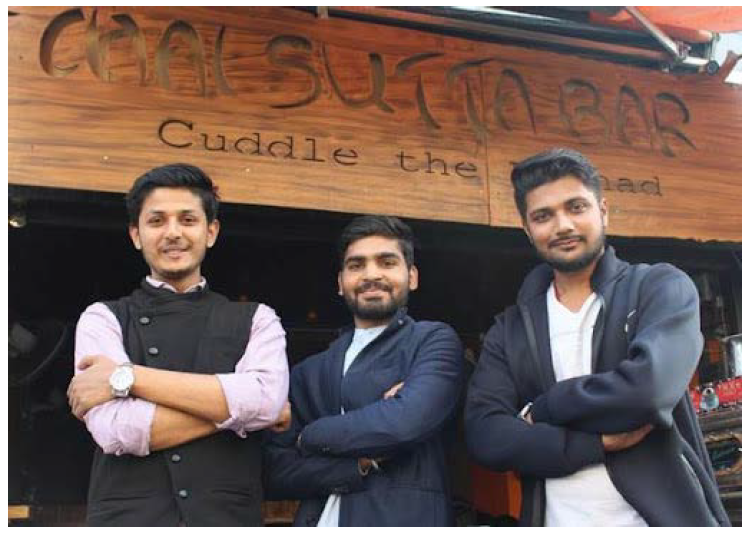
During those days, the idea of starting a new venture came to his mind. However, he realized the static nature of the market despite government incentives and the challenges involved in starting a new venture. While only a few enterprises have succeeded in recent decades, he chose to follow his passion and set an example for future generations. Thus, despite the challenges, Anubhav’s passion for entrepreneurship and strong determination led to the establishment of CSB in 2016. His two friends, Anand Nayak and Rahul Patidar, were the venture’s co-founders. Initially, they had taken a credit of $4,000 from Anand’s family business, which they combined with their savings to establish their first outlet. They selected Indore as an ideal location because it was emerging as an economic hub and held significant sentimental value as the city where their friendship began.
Anubhav’s Vision and Leadership Principle
Anubhav vision and leadership principles reflect a strategic approach to business that encompasses several key elements. Firstly, he recognizes the untapped market potential, particularly in segments overlooked by established chains. He realized that the market for affordable cafe-style food and beverages needed to be correctly structured and priced beyond the reach of many consumers. However, his friends considered purchasing a franchise, but he understood the market opportunity and encouraged them to start their venture to serve customers who could not afford expensive services. He convinced his friends that gradually rising communities of students and working-class people could form a solid customer base if they catered to their demands within their budget. It indicates a visionary perspective to strategically capitalize on those segments where others are unwilling to take risks. Secondly, Anubhav believes in continuous innovation to maintain firm growth and stay ahead of the competition. Therefore, he created a lean organizational structure to help him respond quickly to market opportunities. It reflects a leadership style that encourages creativity, adaptability, and confidence to take calculated risks in the market.
Furthermore, he emphasizes maintaining cost-effective services at a relatively lower cost than their competitors to attract a large customer base while maintaining profitability. It indicates his visionary approach for exploring growth potential in the untapped market with low-ticket value consumers who could not afford expensive services while maintaining efficiency, innovation, and customer satisfaction. Despite the hurdles, they decided to start their venture because of the diverse culture and market opportunities. Anubhav’s leadership principle involves understanding consumer preferences, market dynamics, and Customer-focused approach, positioning him as a visionary leader guiding CSB to sustained growth in domestic and international markets. It reflects his dedication to a customer-centric approach in determining business strategy. This ensures that CSB remains relevant and responsive in a dynamic market landscape.
Human Resources
Managing and developing a pool of motivated employees is critical for inducing organic growth. Therefore, CSB focuses on maximizing efficiency and productivity while reducing bureaucracy to achieve organizational goals. CSB strongly emphasizes on hiring and retaining the right talent while maintaining a lean organizational structure to ensure employee development and performance management. They primarily recruit employees from its self-owned NGO, the Farz Foundation, to assist those in need, it helps them fulfil their social responsibility. Maintaining quality service indicates a need for skilled and motivated employees; therefore, at CSB, newly recruited employees undergo a one-week training program to help them understand company policies and ethics. CSB maintains a performance-driven culture, emphasizing the importance of setting clear expectations and providing regular employee feedback. This approach ensures that the employees are aligned with the company’s goals, remains competitive and capable of meeting evolving market demands. Anubhav believes, ‘Integrating employees’ interests alongside CSB principles with a focus on preserving business ethics will advance firm growth’. Indeed, the company has developed a unique in-house employee evaluation method. This approach assesses employee potential and managerial skills to provide a personalized growth strategy based on relevant metrics, and those who perform well are promoted to leadership roles, encouraging others to excel. Employees were also trained in customer service and given a dress code to ensure uniformity. Minimizing organizational expenses while leveraging efficient decision-making processes with minimal bureaucracy has helped CSB establish a successful business in this competitive market. Therefore, despite having a corporate office, they adopt a lean organizational structure. The company operates with four key verticals: marketing, finance, human resources, and a separate franchisee relationship vertical. This structure enables them to monitor franchisee performance and provide adequate support. An organizational structure supports CSB in specialization, scalability, and accountability while defining clear expectations and establishing a well-defined chain of command.
Customer Focus Marketplace
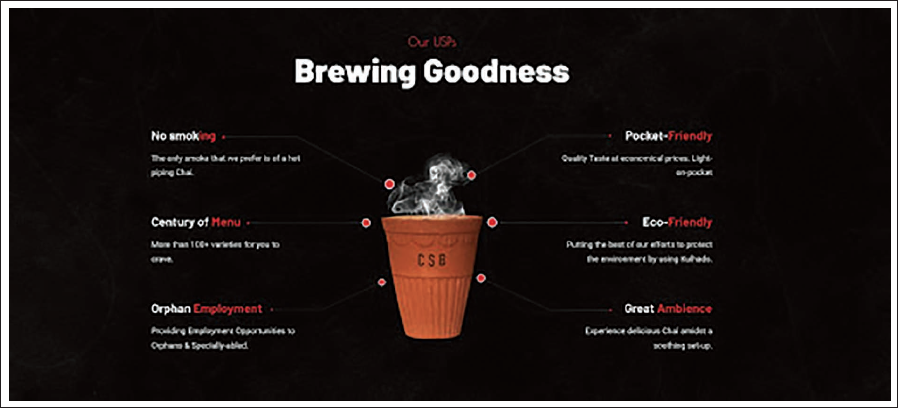
CSB focuses on students and low-income customers who seek to experience high-quality cafe-style service at a low cost, a niche currently lacking in the current market landscape. They aimed to provide a place for young students and low-income customers to enjoy traditional Indian beverages with friends and family. It was designed to focus on low-ticket value customers while providing them with quality products that align with their traditional culture. This approach helps them promote local traditions and creates a unique brand recall identity against established chains. They prioritized service quality to maintain customer satisfaction and emphasized data-driven decisions for updating menus and understanding the strengths and weaknesses of the firm. It helps them understand customer preferences and remain competitive in the market. CSB outlets have been designed with open-space counters to facilitate Western manifestations while maintaining a smooth, vibrant environment. They had high-stooled bars to foster pub culture among tea drinkers and space for instrumental artists. They maintained a standard menu in all outlets and made seasonal changes to provide local, fresh foods that encouraged healthy choices among the customers. However, CSB continuously evolved its menu based on customer preferences and market trends to remain competitive. They included dishes that complemented the main menu, such as sandwiches and pizza. They began with a limited selection of teas, coffees, and a few traditional snacks and only offered drive-through services. After the overwhelming demand for traditional beverages, other flavours were added based on local preferences. They have successfully developed a distinct identity by offering a variety of teas and coffees, as well as healthy Indian beverages. Anubhav commented, ‘They have employed interactive marketing strategies, by efficiently utilizing their networks to spread rumours and gather crowds, which has helped them extend their market reach’. CSB’s principle is to provide high-quality service to consumers with low ticket values, similar to what international chains offer. They mainly focused on untapped markets, especially students and the low-income segment, which most international brands often ignore. Anubhav believes there is a huge market gap in the beverage industry, which could help them grow in this competitive market as most of the established brands in the market focus on high ticket value while ignoring a large section of society. CSB adheres to six fundamental principles that strategically guide its actions and contribute to its success in the beverage industry. These principles include innovation, efficiency, adaptability, inclusivity, customer-centricity, and pricing strategy.
Competitors of CSB
The Indian beverage industry was mainly focused on high-ticket-value customers, thereby ignoring a large section of society—an untapped market with huge potential. But, since the inception of CSB, many other small firms at different levels have started their operations to cater to this segment. However, being a first mover, CSB always has an advantage over them. In analysing CSB’s market strategy, it becomes evident that the company primarily targets untapped markets, catering to customers with low-ticket values. As a result, in India, the main competition arises from other startups in the same segment rather than established beverage chains. This distinction in target markets and service offering sets them apart from the competition in the industry. While many established chains have incorporated traditional drinks into their menus, their prices are often too high compared to CSB, impeding their market success. However, the situation differs in the international market, where it would be difficult to maintain high-quality services at low price points. Given CSB’s ability to provide services at a comparatively lower cost than its counterparts, even within foreign market it is poised to encounter competition primarily from local brands rather than international beverage chains. Consequently, a comprehensive understanding of consumer preferences and market dynamics at each locale is imperative for CSB to succeed globally.
Franchisee Outlets
Anubhav has been interested in franchising CSB outlets since its inception to expand its market reach. Indeed, they began franchising at a low cost as a brand-building and marketing strategy to accelerate growth and generate revenue for future investment. The journey of CSB franchisees started with a regular customer at their first outlet in Bhawarkua, Indore. The franchise royalty gave them with capital to expand their business and explore new markets. The CSB in-house procurement team managed stocks and ensured quality across all outlets. They purchase raw materials from farmers and potters, sticking to their commitment to promote rural development. Anubhav believes that entrepreneurs should design their business strategies to benefit people in the lower strata of society to ensure overall growth and equal opportunity for all. Indeed, purchasing raw materials from farmers has become popular among entrepreneurs and has significantly impacted the farmers’ lifestyles and financial status.
Franchisee outlets need to follow CSB guidelines to ensure consistent customer service, and to maintain this standard, well-performing employees were promoted to client relationship management positions responsible for monitoring the franchisee outlets. Franchisees must adhere to strict guidelines set forth by CSB’s franchisee action team to maintain CSB’s high level of quality and service reliability. Anubhav commented, ‘While planning for an F&B outlet, we had initially considered taking a food chain franchise; however, the very next minute, we had a thought—why not sell our franchise? That was when the idea of working on a franchise model came to mind’.
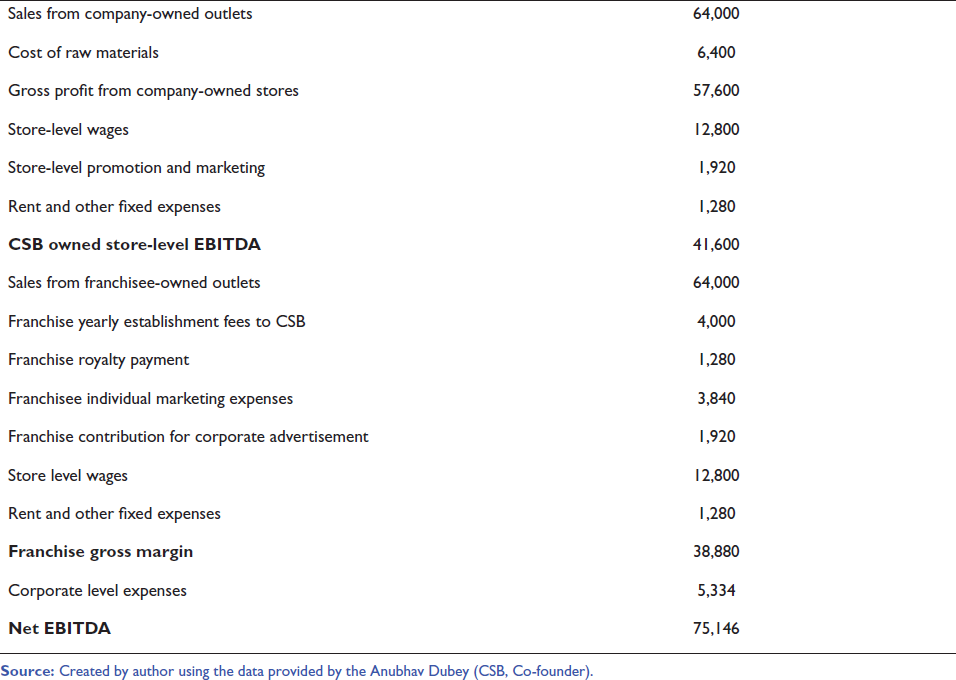
CSB may have multiple outlets in the same city depending on the market’s needs. However, the in-house research team performs a proper market analysis which includes PESTEL and SWOT analysis before granting franchise rights. These analyses facilitate informed decision-making regarding new franchisee outlets, ensuring mutually beneficial outcomes for all parties involved. By leveraging these analytical tools, they assess market potential and identify factors that may impact their business operations. The in-house research team performed an in-depth analysis to avoid mutual loss before opening additional outlets as they spent around $2,667 per outlet annually on maintaining other corporate overhead costs. Typically, franchise agreements last for five years, and existing franchisees are given priority over new ones. However, franchisees were required to follow CSB’s operating procedures while adhering to firm regulations on royalty income and fulfilling sales-bound promotion-related obligations. A successful outlet generated monthly sales of around $5,334, while the franchisee paid a 2% royalty fee and an additional 3% for advertising purposes. The majority of sales revenue went to wages (20%), raw material procurement (10%), and floor renting (2%). For all calculation purposes, we calculated each expense on a monthly basis. Franchisees needed to pay an initial amount of $20,000 as establishment charges, which included initial training costs and equipment required for the operation. We assumed each franchisee outlet had its advertising budget, which could be around 6% of sales. A typical outlet had 400 square feet of floor space and a medium-styled visual manifestation. CSB had over 150 outlets in India and a limited global presence in Nepal and Oman. However, CSB owned only three outlets, while the others, including five international locations in Nepal and Oman, were operated by franchisees. It demonstrated CSB’s brand value and growth potential in the market. CSB focused on expanding franchise-based outlets, which helped them achieve their growth targets while helping others to fulfil their dreams with pride.
Option to Expand
After a successful expansion in India, the CSB founders and senior management team focused on the potential for global expansion options. They had decided to capitalize on international opportunities following their successful growth in the Indian markets. Indeed, recent expansions in Nepal and Oman have been quite successful. The growing demand in these markets has compelled them to establish a global presence. They understand that determining the market size and opportunity cost before entering any global market is necessary. This process could provide them with a proper market analysis, requiring significant investment in the market. The company’s vision was to be the global leader in the beverage industry. However, maintaining the workforce and corporate offices worldwide requires a significant investment. Since many franchisees with outlets in India approached them for global footprints, CSB could attract many young, enthusiastic entrepreneurs, which could help them build a successful brand in the global market. CSB focused on achieving long-term growth while preserving its core values. Until now, the company has achieved organic growth by refining its operations and management approach. In the last four years, they have opened more than 150 franchise outlets following the baseline approach, and we could assume similar growth without additional investment from private firms. Investors could provide capital to CSB, but it could impact their long-term goals.
Since many private investment firms believed that CSB could grow even faster, the second option required CSB to sell a 50% stake at five times their then-current EBITDA. However, control would have remained with the founder. Indeed, investors believe the CSB story would inspire many other entrepreneurs who could add value to the firm. Private investment could help CSB expand quickly across the globe by opening more company-owned outlets, enabling them to test and grow in the market. Anubhav anticipated opening around 35 Company Owned Company Operated (COCO) outlets in different international markets, which could generate demand for another 110 franchise outlets. These outlets could stimulate market demand and increase the franchisee’s profits. Anubhav also discussed the third option, which involved selling 100% of their equity in the global business at a value equivalent to ten times their current EBITDA. Under this option, they had to give up control of the firm. In exchange, they received a significant infusion of capital and a nominal lifetime royalty fee, which could allow them to grow faster in the domestic market. However, Anubhav wanted to be the change agent and see the firm’s growth. He believed that CSB required the vision with which it began. Thus, it was difficult for Anubhav and his team to decide on their expansion strategy while maintaining long-term growth.
Making Decisions
With recent success in the international market and interest from private investors, Anubhav wondered if all of this indicated that competition in this segment would increase its difficulty in growing early. Anubhav considered various options: Should CSB sell the brand name and business model to a strategic buyer? Should they accept the offer from private investors to help CSB expand globally? Otherwise, CSB can continue to follow its successful baseline strategy with existing growth.
CSB simplified annual income statement have been calculated using the data provided by the firm. All the calculations are done in US Dollar, while taking $1 = ₹75 (Indian currency).
The Following Table Provides the Financial Details for the Year 2020–2021.
Authors’ Note
Shrikant Singh, Janmejaya Panda and Gopal Sharan Parashari has prepared this case based on an interview with Anubhav Dubay (CSB, Co-founder) solely for class discussion and not as an endorsement, a source of primary data or an illustration of effective or ineffective management. All the data and events discussed are provided by the Anubhav and due permission has been taken before publication.
Footnotes
Declaration of Conflicting Interests
The authors declared no potential conflicts of interest with respect to the research, authorship and/or publication of this article.
Funding
The authors received no financial support for the research, author-ship and/or publication of this article.
